Blog Archives
Honey Don’t (2025)
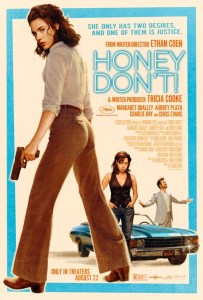 It’s the second collaboration between Ethan Coen and his wife Tricia Cooke and reportedly the second in their “B-movie lesbian trilogy” (the planned third film is tentatively titled Go Beavers). It’s better than 2024’s Drive-Away Dolls, a randy cartoon that was so overpowering and underwhelming. This time the filmmakers play around in the film noir genre with Margaret Qualley as a wily private eye, Honey O’Donahue. The whodunnit plot is a series of disconnected threads and plotlines that don’t connect together in interesting or surprising ways. It begins with an immediate mystery: a woman, dressed right out of Faster, Pussycat! Kill! Kill!, walking down an embankment to inspect an overturned auto and the body inside. Boom. I’m intrigued right away. Sadly, this might be the high point. A third of Honey Don’t involves Chris Evans playing a debauched minister selling drugs on the side and exploiting his congregation. His storyline seems to run in parallel with Honey’s investigation without really crossing in meaningful ways. It even resolves without her intervention. It’s also incredibly dull and repetitive, with Evans’ reverend being interrupted during sex multiple times for comedy, I guess. Honey Don’t exists as a winky flip on the noir genre, this time with lesbians! It doesn’t so much feel like a compelling story with colorful characters as it does a writing exercise. Qualley fares better as the straight-laced yet flirty private eye than she did as the horny caricature in Drive-Away Dolls. She’s got a self-possessed charisma and determination that works. If only the rest of the movie didn’t repeatedly let her down. It’s not offensively bad, or even as aggressively cringey as their previous collaboration, but Honey Don’t is another middling, daffy, disposable genre riff by Ethan Coen that makes me long for an eventual reunion with his brother.
Nate’s Grade: C
Share this:

Pain Hustlers (2023)
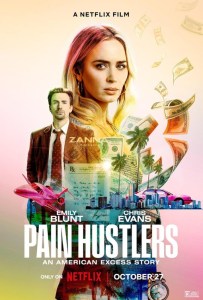
Pain Hustlers is the next attempt to dramatize the numerous stories behind the opioid crisis, a storytelling edict that is becoming its own tragic true-crime sub-genre (Dopesick, Pain Killer, Four Good Days, Recovery Boys, All the Beauty and the Bloodshed). The Netflix original has a starry cast and a topical and serious subject but it’s an un-serious movie caught up in the superficial quirks and appeal of being and making a goofy crime story of greedy sleazeballs.
Liza (Emily Blunt) is a struggling single mother trying to claw her way out of debt and, with her unfinished education and criminal record, few options are widely available. Then enters Pete Brenner (Chris Evans), a loud, gouache pharmaceutical rep for a powerful pain killer. He promises a lifestyle of luxury and power, as long as Liza is willing to ignore or bend a few ethics along the way. Together, they build a sales force of attractive women who wine and dine smaller doctors in order to get them to prescribe their special drug to anyone in need. It’s just that a drug intended for end-of-life pain wasn’t meant for common headaches. As sales boom, Liza begins to worry that her glitzy lifestyle is built upon a mountain of American corpses.
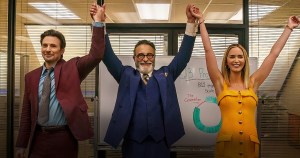
The biggest drawback of Pain Hustlers is that it fully focuses on the glitz and gives lip service to the cost of chasing that avarice. Plenty of movies illuminating bad people doing bad things are accused of glamorizing the misdeeds, from gangster movies to dark romances, though this narrow viewing often seems to conflate depiction with condoning the behavior (see: The Wolf of Wall Street). Watching stories about people stumbling their way into glamorous positions should provide some allure so as to better understand the seductive draw for the characters. The world of vice and power will be a compelling conflict, but for Pain Hustlers, it falters by just focusing on the high-powered lifestyle yet it still lacks specificity to make this story feel interesting on its own. You’ve seen variations of this kind of story before (we’ll call it Scorsese-esque) about the people struggling with less who get a ticket into a new world of access and freedom and then begin to worry At What Cost. Pain Hustlers goes through its plot beats with the most mechanical of movements. The personal details from this supposedly true story feel so generic, reminiscent of similar tales like, Love & Other Drugs and Hustlers. It feels less like an insider account of how these shady people exploited so many and more like the screenplay was cobbled together by what the filmmakers assumed this story must have pertained without reading much of the source novel by Evan Hughes. It’s absent the useful details that allow more of these accounts to prosper as we investigate moral relativism.
The other nagging shortcoming of Pain Hustlers is the consequences for all these bad people. I’m not saying that we need to see comeuppance and justice levied in order for the movie to work thematically; very often these white collar criminal types receive the faintest glance of judicial punishment. What this movie lacks is the emphasis on the consequences, and considering our main characters are pushing sleazy doctors to push highly addictive opioids, that’s a big miss. The movie is all about the climb for its heroine, the comparison of having the fancy life versus a life without. It shortchanges the extremely human cost of its bad actors in a way that does a disservice to the movie and its message. Because of its lack of specificity, this story could have been propelled by any prescription drug, from Viagra to Lipitor. The fact that we’re talking fentanyl, a drug responsible for 200 deaths every day last year according to the CDC, seems immaterial, and that is bizarre.

The effects of the opioid crisis begun by Purdue Pharma and the Sackler family, and then trickled down through the complicated tributaries of the American medical infrastructure, will be felt for generations. This is a major story. It would be like, say, telling the story of a struggling single mom who decides to take a career advancement in the Nazi Party in 1940s Germany. You’re not just doing a disservice to the people who really suffered, you’re doing a disservice to the audience to ignore the gravity of their moral culpability and excuse-making, of the drama of the character having to confront their part. For a movie about people profiting from opioid over-prescriptions, there is a grand total of one scene where Liza has to deal with the harsh real-world consequences of her actions (minor spoilers ahead, but I’d advise you to continue, dear reader). Early in the movie, when Liza was forced out of her home, she spent a few days living in a motel. The neighbor lady at the motel has a husband who dies from the opioid crisis, and this one man is meant to symbolize what she has wrought as a whole. It doesn’t work, and the fact that the movie presents Liza in tears trying to make amends to this widow, a character we haven’t had any thought over since Liza leaving her Act One beginnings, is a pitiful excuse for a reckoning.
Evans (The Grey Man) and Blunt (Oppenheimer) feel on autopilot here, namely because of the broad and bland characterization. Blunt resumes her Southern accent I recall from the Quiet Place movies, but her energy level feels too low, too disengaged, like she’s already at her quiet rectitude character phase when she should be at the gee-whiz giddiness of her moral slide. Evans is meant to be playing a cad prone to vulgar boasts and condescension for those he willfully steps over to reach his goals, but his “sleazeball” acting tics feel too forced, too played up, in all the ways that Blunt feels dialed down. There’s no baseline for the two of them, so the scenes they share together feel over and under-cooked, and with a generically developed rise-and-fall screenplay to boot. Andy Garcia (Father of the Bride) is the most interesting character as the head of the company, a doctor who began trying to ensure those in desperate need could have the dignity of mitigating their pain, and transforms into a megalomaniacal huckster who only wants to keep meeting the next sales projections. His rise-and-fall seems much more steep and intriguing than trying to give us Liza, a gutsy single mom (with a wacky mother of her own played by Catherine O’Hara) who we’re supposed to identify with and forgive for playing her part in a deadly chain that has wrecked untold lives across the country and world. She did it for her own kid’s medical treatment. So it’s all okay, right?

This is director David Yates’ first movie away from the familiar confines of the Harry Potter universe since the ill-fated 2016 Tarzan reboot, and only his second non-Potter movie since 2005. Given that history, I’m curious whenever this man jumps onto a non-Potter project because you would assume it has to be special in some manner. I’ll credit Yates with changing his visual preferences from the very drabby and gray palette of his Potter filmography.Pain Hustlers adopts a lot of the stylistic tics we expect in glitzy crime thrillers, from handheld camerawork to sun-bleached colors. There are other techniques to bring a documentary-like authenticity, but the constant cutting back to black-and-white interviews with the characters after the fact only serves as a narration crutch to keep things moving. The character narration lacks further insight from the distance or remorse of the onscreen events. The whole movie feels like a copy of a Scorsese imitator, something akin to 2009’s forgettable The Middle Men, a crime movie about a plunge into the underworld from a naif that doesn’t try too hard beyond empty reconfiguration of the superior style of its influences that I doubt anyone really remembers (you might as well add directorial narration, “Ever since I was young I always wanted to make a gangster movie…”). As immediate evidence to the case, there is a slow-motion house party in Pain Hustlers set to “Turn Down For What.”
Should you spend two hours watching Pain Hustlers? Not really, though if you have a fascination with the many schemers who contributed to making the opioid crisis as trenchant and terrible as it currently is, and likely will be for the near future, then maybe there’s some mild value to be had here. But even those people would be better served watching another Netflix series tackling the same subject matter, the 2023 limited series Pain Killer. For me, the Pain Hustlers story was too broad, and where it could have broken out with specificity is where it decided to wimp out and defer to genre cliches. It’s hard for me to argue that you should spend two hours watching this movie on the subject when you would be far better served, from an informative and entertainment standpoint, watching the two-part, four-hour 2021 documentary Crime of the Century by masterful filmmaker Alex Gibney. That film is damning and compelling and authentic in ways Pain Hustlers can only hope to imitate.
Nate’s Grade: C
Share this:

Ghosted (2023)

Have you ever watched a movie that felt like it was created by soulless robots? That was the overwhelming feeling I had with Ghosted, a supposed “romantic” “comedy” and spy thriller debuting on Apple Plus with big stars and a big budget and lacking anything that feels recognizably human. 2023 has been a year of exciting and precarious technological advances, and the emergence of A.I.-assisted chat and performative generators, from art to stories, is a Pandora’s Box that will not go away, especially for an industry looking to cut corners wherever possible to save a buck. Super producer Joe Russo has bleakly predicted it’s only a matter of time before studios lean into A.I. programs to help them write bankable screenplays. When that dark day arrives, if we haven’t already crossed that Rubicon, I imagine those A.I. ghostwritten scripts will feel a lot like Ghosted, a movie that feels like it was constructed from imperfect observers.
It all begins when boy meets girl at a farmer’s market. Cole (Chris Evans) refuses to sell a potted plant to Sadie (Ana de Armas) because her job keeps her away for up to months at a time. He cannot, in good conscience, sell this woman a plant he knows will be neglected. From there, they spend a whirlwind first date getting to know one another in and out of the bedroom. Then Sadie never returns Cole’s messages and calls again. He frets that he’s yet another modern dating victim of being ghosted when strange men kidnap him and ask him scary questions about things he has no clue about. He’s rescued from this interrogation by none other than a gun-toting Sadie. She reveals she’s really a secret C.I.A. agent and somehow her enemies have mistaken Cole for “The Tax Man,” a dangerous and mysterious assassin that’s actually Sadie. Now they’re on the run and Cole has to learn the ropes of spy business or else, and maybe he can get a second date while he’s at it.

The premise alone is a workable high-concept we’ve seen comedy variations of before, from Charade to Knight and Day to The Spy Who Dumped Me (remember that movie, anyone?). It’s the perspective of the novice being plunged into the chaotic and overwhelming world of spy-craft and having to rapidly adjust to a world they thought was just the stuff of movies and beach reads. It’s the kind of story that pokes fun at spy movies while embracing them as well, and it posits what would happen if one of us normies ever accidentally found ourselves in this high-stakes world. Where Ghosted doesn’t work is that the characters are both awful versions of the Novice and the Expert. There’s a slight amusement watching Evans plays out of his depth in action contexts, running counter to a decade of Marvel heroics, but this is short-lived. He eventually begins to be a capable partner for Sadie as she learns to trust another, which is the most expected and basic character arc for each of these people. However, Sadie is also boring, and even when the truth about her profession is revealed, it doesn’t make her that much more interesting. I was already doubtful when we opened with her talking to her therapist over her car’s phone and this was the first scene. She’s been slotted as Killing Machine with Trust Issues, and he’s been slotted as Too Afraid to Seek His Dreams, and so their conclusions are predictable and bland. There’s even a lack of a technique that Sadie teaches Cole that comes into play at a pivotal moment. That’s the most basic thing and they miss that.
There is also a notable absence of chemistry between the leads. While de Armas and Evans have co-starred in two prior films, they were opposed in 2019’s Knives Out and 2022’s The Grey Man. Actor chemistry is one of those ineffable qualities that you can tell pretty quickly whether it’s evident or lacking, and within minutes of the tortured house plant meet-cute, I sensed a gaping black hole of palpable chemistry. It’s even more obnoxious when MULTIPLE characters in MULTIPLE scenes implore the two to “get a room” because their supposed sexual tension is off the charts. Sure thing, movie.
Another quality that becomes very apparent is how forced everything in Ghosted feels. The romance feels forced but the comedy especially feels forced. The four screenwriters include the writers behind the Deadpool, Zombieland, Ant-Man, Spider-Man, and recent Jumanji movies, so we know these credited writers have a keen understanding of comedy. It makes the results on screen all the more mystifying and disappointing. The jokes generally feel off (“He expected a hottie not Mata Hari,” womp womp), the rhythm and tone feel a little too much, too forced, like the actors are desperately trying to compensate. It comes across like they were instructed to speak at a more fast-paced and clipped rate to attempt to emulate screwball comedy patter, but the material isn’t there to match the hyperactive verbal presentation. The music is also another factor in trying to better compensate. It’s trying to provide a jaunty, breezy energy level that isn’t sustained in the movie by its comedy, action, or romance. The number of needle drop song selections can also be insufferable and dumbfounding. The characters will start a gun fight and then “My Sharona” will crank up or, even more inexplicably, “Uptown Funk.” The relentless fallback of familiar pop and rock ditties intruding over the action doesn’t so much elevate the moment as make you realize just what would be missing without the song. I’m all for the clever use of music to jazz up a scene, but the final action sequence shouldn’t have to rely on Bruno Mars for any nascent fun.

There are a handful of moments and ideas here that could have worked in a better movie. I enjoyed a stretch in the middle where Sadie and Cole are ambushed by one bounty hunter with an absurd name after another, and each is a cameo from a familiar face and each gets dispatched swiftly. The movie also takes pains to make fun of Cole’s smothering qualities, including his snapping a picture of Sadie while she slept in his arms post-coitus and unaware. I wish this line of criticism would pick up more momentum but there’s only so much heat that Cole will take when he still needs to be the handsome and appealing lead. I also liked the idea of a villain, played by Adrien Brody like his copy of the screenplay didn’t have a single joke inside it, who is simply trying not to be revealed to be incompetent. I think there was especially more room to mine with the confusion over which character was the infamous Tax Man. The assumption that it must be a man could have opened up a broader and interesting subplot over sexist gender assumptions, with nobody believing that a g-g-g-girl could be such an accomplished trained killer (alas, the “girls can do it too” message seems to be all the movie offers in response).
Ghosted is not a good action movie, as it’s poorly sourced and edited, it’s not a good comedy, as the jokes are iffy and delivered in such an exaggerated and clunky manner, and it’s not a good romance, with two bland and under-developed genre character cliches portrayed by two actors who have a startling lack of chemistry together. The music is obnoxious and trying to compensate for the flagging energy level and forced comedy, the movie runs too long at almost two hours, and director Dexter Fletcher (Rocketman) has no feel for action or romance. It’s the comedy that made me most depressed, as no character talked like a semblance of a real human being, nor was their fast-paced, quippy dialogue truly zingy and entertaining. t was like watching a desperate person try and prove they are not, in fact desperate, but with every word only proving more and more their desperation. I’m sure some people out there will find this movie passably breezy or charming or at least inoffensive for two hours of inattention. It all felt so forced and inauthentic and tired to me. It’s best to just ghost this film in real life.
Nate’s Grade: C-
Share this:

Lightyear (2022)/ Luck (2022)
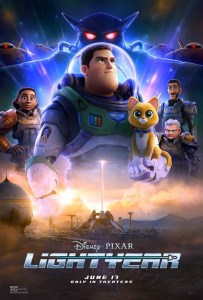 After two years and three movies sent straight to Disney’s burgeoning streaming service, Pixar returns with a theatrical movie that taps back to the very beginnings of this storied storytelling company. We’re told, via opening text, that Lightyear was Andy’s favorite movie and thus the reason he was so excited to bring home a Buzz Lightyear action figure in the first Toy Story. However, if this is Andy’s “favorite movie,” then this kid needs to be exposed to more movies. It’s an acceptable sci-fi story about Buzz (voiced by Chris Evans) learning the value of others and that being vulnerable is not the same as being weak. He’s a space ranger stranded on an alien world. Every time he attempts to restart their fuel system, it jumps him forward in time four years, and soon enough he’s a man out of time and those stranded have built a colony civilization over 100 years. There’s a band of misfits, who aren’t terribly funny, and some laser fights and action sequences, which aren’t terribly exciting, and the third act twist is predictable. The animation is top-notch, but the storytelling is definitely a few notches below infinity and beyond. What astounds me is that Andy could watch this movie and want a Buzz toy instead of the real breakout, the robotic cat Sox (voiced by Peter Sohn) who is wonderfully droll. I cannot fathom anyone watching this movie and desiring owning another character above this delightful supporting character. This movie makes me think a little less of Andy as a discerning arbiter of pop-culture zeitgeist. Lightyear is fine as escapist entertainment but too facile and inessential to the Toy Story universe.
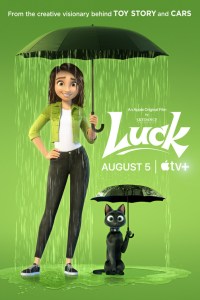 Luck is the first animated feature from Skydance, a production company that entered the animated realm by hiring former Pixar head John Lasseter as their chief creative executive. In some ways, Luck feels reminiscent of early Pixar movies, exploring the “secret life of” those in charge of dictating the forces of luck. The problem with Luck is that it is overwritten and overburdened with world building that crushes the emotional core. We follow a young woman aging out of the foster system and she’s been besieged with bad luck all her life. She follows a talking cat and discovers a hidden world where workers mine luck crystals and have lucky pennies as portal generators and there’s a dragon, for some reason, as the CEO of Good Luck, and to get back home she needs to team up with the cat to find a thing, but to find that thing they need to go to a place, but to go to that place they need to – and you get it. The plot is overworked with a chain of tasks that explain more of this world’s mechanics without connecting to the emotional journey of the character, like in 2015’s Inside Out. I was amazed that this woman lacks even a shred of bitterness about her own trenchant bad luck. There’s a nice message about accepting the bad with the good in life, and how both are opportunities for growth, but I kept wondering why our hero didn’t once lash out at those responsible. I’m also a little hesitant about using whether a little girl will be stood up by her potential new foster family as the stakes of completing the good luck reset goal. That seems pretty heavy for wackiness. The animation isn’t quite at the level of Pixar, or the best of Dreamworks, but it’s colorful and bright even if lacking more advanced lighting and texture. Luck lacks enough gravitas and development to really appeal to adults but it’s also probably too busy and convoluted to entertain small kids.
Nate’s Grades:
Lightyear: B-
Luck: C+
Share this:

The Gray Man (2022)
 Two movies removed from the Marvel Cinematic Universe (MCU), I’m starting to wonder if the brotherly directing duo of Joe and Anthony Russo are absent their own vision. Cherry was an exhausting and annoying experience overloaded with self-conscious stylistic choices that dominated the movie and squeezed it from its dramatic potential. Now we have The Gray Man, based upon the 2009 book by a former Tom Clancy writing collaborator, and it looks indistinguishable from any other big-budget spy thriller. It feels like The Russos doing their version of Michael Bay doing his version of the Jason Bourne series. It’s an expensive movie for Netflix, in the range of $200 million, and it just made me think about 2019’s Six Underground, their $200 million collaboration with Bay where he had creative freedom to make the most bombastic, hyper masculine, and tedious movie of his career. If you’re going to devote a fifth of a billion dollars for a Michael Bay-esque action movie, you might as well hire the real deal again. The Gray Man is a passable action movie, especially in its middle, but it’s wholly derivative and coasting off your memories of better spy thrillers and better characters.
The titular “Gray Man” is a super-secret Sierra agent given the code name Six (Ryan Gosling). He’s been the government’s indispensable tool for taking out bad guy and keeping the world safe for 18 years, working time off his prison sentence. Then it all goes wrong when, of course, his callous boss (Rege-Jean Page, Bridgerton) demands he “take the shot” even if it means the death of an innocent child in the process. Six declines, the covert assignment becomes much messier, and he learns that his target was a former agent from the sane secret Sierra cabal. The dying man gives Six a MacGuffin necklace that the big bad boss really wants. Six goes on the run, with the help of some allies like another agent (Ana de Armas) and his retired handler (Billy Bob Thornton), and the CIA sends every professional killer to get their man. This includes the mustachioed Llyod Hansen (Chris Evans), a ruthless private mercenary who brags about being kicked out of the C.I.A. academy for his lack of ethics and impulse control issues.
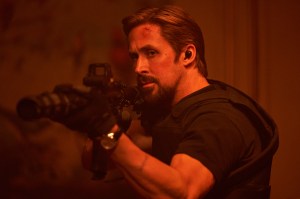 If you’re just looking for an action vehicle that provides enough bang and sizzle, The Gray Man can suffice. I’ll champion the highlights first before equivocating on them. There’s a recognizable blockbuster elan to the movie with enough energy to keep your attention. There is a significant uptick in the middle that gave me a false sense of hope that The Gray Man had transformed into a better movie. Again, this occurs well into an hour into a slightly under two-hour movie, but credit where its due, there is a nicely developed sequence of substantial action. For being a spy thriller, a majority of the movie takes place in and around Berlin. Six is handcuffed by German police to a park bench in the middle of an open square. Lloyd sends in vans of powerfully-armed goons that take out the police and then set their sights on Six. He’s trapped to the bench but still mobile, to a point, but he’s also unarmed. Watching the character react to these limitations and adapt is greatly pleasing. This is the stuff of good action cinema; supermen get boring without having to overcome legitimate obstacles and/or mini-goals. He’s able to escape and thwart his attackers and hides in a tram. This then becomes the next level of our action, and he has to utilize close-quarter combat to tease out his new attackers. And then a speeding truck with a rocket launcher shows up. And then de Armas shows up with a sports car for Six to try and leap into. And then both of those vehicles do battle while Six climbs atop the speeding tram and uses the reflection in a passing building to line up his shot to take out a goon inside the train underneath his feet. This entire middle action set piece is top-notch. It’s exciting, stylish without being too derivative, and there’s a clear set of cause-effect escalation. This is good action writing, and it’s a shame that this is also the peak with still 40 minutes left.
The beginning and closing of The Gray Man blunt whatever enjoyment I could gather. The film is oddly structured and uneven from reliable screenwriters Christopher Markus and Stephen McFeely (Avengers: Endgame). The opening scene watching Thornton recruit Gosling in his jail cell seems completely superfluous as something that could have been explained in passing, or needed no setup, but it’s at least short. There’s also a lengthy flashback in the middle of the movie that sets up Six’s allegiance to Thornton’s niece (Julia Butters, the little girl from Once Upon a Time… in Hollywood) as he babysits and saves her from kidnappers. Again, I don’t think we needed to have a set up why our protagonist would deign to save a child, but even if the movie wants to add more emotional heft to their relationship, why drop this in the middle of the movie? Why not even have this open the movie instead of the jailhouse recruitment? I like their scenes together. It reminded me of 2016’s underrated The Nice Guys. It’s just not enough to hang onto because there is no heart to this film; it is all quips and speed and flagging genre imitation. Just re-read the plot description. The genre cliches are all there, and we even have the old chestnut where the villain monologues that they and the hero are not so different.
 There’s also a questionable series of shorter flashbacks of Six as a kid surviving his abusive father’s rigorous “training,” including burning a kid’s arm with a cigarette lighter or dunking his head underwater. Again, I doubt we needed to visualize these scenes when Six could have explained his traumatic upbringing with Gosling’s acting. I was worried, and I’m still not dissuaded, that The Gray Man was establishing the parental abuse as having trained Six for these unique circumstances, that dear old bad dad somehow saved his adult son’s life. Do we need a flashback of his dad holding his head underwater to convey that Six, as his head is held underwater by Lloyd, does not like this? It reminded me of 2017’s Split when Shyamalan questionably had his character survive her captor because he recognized that she too had been abused. Did her trauma save her? The needless jumping around in time feels like The Gray Man attempting to be cleverer, or perhaps aping more of the genre expectations from an action movie of this size. The finale also lacks either the emotional catharsis or action climax that can serve as a satisfying conclusion. The last act is a compound assault set piece but it’s really just a series of interconnected gunfights and explosions. The mini-goals and engaging cause-effect escalation from before is absent.
There are a few commendable moments or choices among the blockbuster cruise control. I enjoyed that this was not just a Knives Out reunion between de Armas and a villainous Evans but it was also a Blade Runner 2049 reunion between de Armas and Gosling. I think de Armas deserves her own spy vehicle, especially after being one of the highlights of 2021’s No Time to Die (granted, it helps having Phoebe Waller-Bridge writing your character). I liked a hand-to-hand combat scene where Six utilized flares both to obscure his presence as well as an offensive weapon. Evans is fun to watch as a preening peacock of a villain, though there’s so little to his character beyond a bad mustache and smarmy attitude. There are some decent drone shots, though the dipping of the camera makes them feel more like point of view aerial assault shots. The Russos really, really like their drone shots in this movie (how much of the budget did this suck up?). However, the drone shots just made me think of the better drone shots from 2021’s Ambulance, Michael Bay’s newest movie, and it further cemented The Gray Man feeling like a clunky combination of other movies and artists. If you’ve seen any espionage action movie of the last ten years, you’ve seen enough to recognize all the key pieces of The Gray Man, and while its competent enough to satisfy the most forgiving of genre fans, it’s really just more empty noise.
Nate’s Grade: C
Share this:

Knives Out (2019)
 Rian Johnson is a filmmaker who likes to dabble across genres and put his high-concept stamp on them. His debut film, 2006’s Brick, was a moody noir-flavored mystery set in a modern high school. His next film, 2009’s The Brothers Bloom, was a whimsical con artist movie with cons-within-cons, and then Looper took time travel and twisted it into knots. From there the man was tapped to not only direct a new Star Wars movie but write one, and 2017’s The Last Jedi proved so divisive that Russia literally created robotic accounts to exploit raw feelings to better sow discord among Americans and undermine democracy. Johnson must have needed a detox from that galaxy far far away, and Knives Out is his version of an Agatha Christie-styled parlor mystery. Once again Johnson has taken an older genre, subverted its form, and made it his own in a way that feels reverent while also fresh, fun, and thoroughly entertaining.
Harlan Thrombey (Christopher Plummer) is a world-renowned mystery writer with a publishing empire in the millions. Then on the night of his birthday party, Harlan is found dead and every family member is a suspect. Could it be Marta Cabreara (Ana de Armas), the nurse who was last seen taking care of the old man? Could it be the daughter, Linda (Jamie Lee Curtis), eager to get out of her marriage to a cheating husband (Don Johnson, having a moment this fall)? Could it be the son Walt (Michael Shannon) who was going to lose his position of power in control of the family publishing empire? Could it be grandson Ransom (Chris Evans) who didn’t show up on time for the party but showed up early for the will reading? The local police detective (Lakeith Stanfield) is doing his best to navigate the many suspects. And then there’s the famed private eye, Benoit Blanc (Daniel Craig), hired by an unknown benefactor to discover foul play, who interrogates each family member, investigates the corners of the estate, and uncovers the truth.
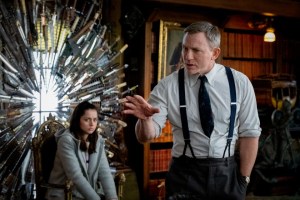 Knives Out is an incredibly fun movie to watch fly by for its extended 130-minute running time. The guessing game is enjoyable and there is a plethora of suspects and red herrings. Johnson is clearly a fan of the genre and doing his best to send it up in his own way while still staying true to its roots. Just look at the silly, Dickensian names and you can tell Johnson is enjoying himself (there’s a character named “Ransom”). The mystery is clever but it becomes something more than a whodunnit (more on that below) and that’s when Knives Out becomes special. Johnson has been repeatedly accused of being too clever by half, looking to produce some meta gymnastics to subvert audience expectations but to what end? This was an issue with the very end of Brothers Bloom and many had this same complaint with The Last Jedi. It’s not enough to subvert expectations if the alternative isn’t as compelling. Still, the choices that Johnson makes with Knives Out best serve to improve the emotional involvement in the story. That quality seems like a rarity when it comes to murder mysteries, because it’s all about solving the crime and not necessarily how it affects the people on a more human level. It’s a problem to be solved, an equation on the board, and the process eliminates the variables systematically. Except with Knives Out, Johnson opens up the central figure of Marta in such a way that she becomes a symbolic figure for the immigrant experience in this country, fighting for dignity and recognition. The political commentary isn’t deep, and some of the shots feel a little cheap, but where Johnson succeeds is treating Marta as an empathetic stand-in for an often-invisible class.
A half-hour or so into the proceedings, Johnson makes a very conscious choice that changes how we understand the mystery and especially how we’re involved. I’ll be careful about spoilers but suffice to say we get some very crucial information that makes us look at the murder differently. For the first act it feels like it’s heading into a whodunnit with our clan of suspicious relatives, but it does something else, and I would argue something better. The problem with an Agatha Christie-style whodunnit is that the film is structured toward solving one central mystery and other important dramatic elements can fall by the wayside. Once you know who the killer is, was the journey to unmask them worth the twists and turns? Johnson instead lets the audience in on crucial information so that Knives Out alters, and the “who” is less important than how this information affects our relationship with a set of characters. It becomes less who is the killer and more will this culprit get caught and how will they beat the encroaching investigation. It transforms the entire structure, where instead of everything leading to one reveal, now it becomes a series of mini-panics and scrambles to stay ahead of a trap. This made me that much more personally involved and Johnson doubled the dramatic irony and tension of scenes. It becomes more a series of obfuscation where we’re involved, remembering what clues might be the ones that ultimately prove too inescapable. There is a downside to this approach, letting out some big reveals early also serves to downplay the vast majority of the supporting players. These people are all given motives and suspicions early on, but once Johnson unloads his twists too many of these same characters just fade into the background, their story use extinguished.
 Another cheerful aspect of Knives Out is simply how much fun its cast is having, none more so than Craig (Spectre). I never really gave much thought to Craig as a comedic actor until 2017’s Logan Lucky, where he seemed to be unleashed, digging full bore into a charming and kooky supporting character, and it was downright joyful to watch him cut it up onscreen. He’s given such serious, macho roles but he really excels in the right comedic role, and he just has the time of his life playing Blanc. His southern-fried accent, penchant for theatricality, and garrulous nature all contribute to both tweak the idea of the clever inspector while playing into those clichés as well, steering into the fun we have with them. There were several moments I was left breathlessly cackling because of how Craig was delivering his lines with such relish. His explanation of the mystery being “a donut hole inside a donut hole” might be one of the best film scenes of the year. It also helps that Blanc has an affectionate working relationship with Marta, the heart of our movie, which makes this eccentric even more endearing to the audience. Just as Kenneth Branagh is continuing the adventures of his mustachioed private eye, I would happily watch another murder mystery featuring Blanc if Rian Johnson felt so inclined (pretty please).
The other actors do fine work even if many of them end up being underwritten figures either meant to be threatening suspects or cartoonish buffoons. Armas (Blade Runner 2047) is the lead actress and often the contrast for our rich elites and their out-of-touch perspectives; she’s the sounding board for their pettiness, acrimony, entitlement, and thinly-veiled racism. Armas just shines in the role as this figure who routinely makes the right choice even when it costs her. She’s a relatable, hard-working, kind character trying to keep her moral bearing in this high-stakes contest. Evans (Avengers: Endgame) is enjoyably smug and a welcome force to antagonize and puncture the egos of his fellow family members. Shannon (The Current War) has his effective moments of conveying menace and being laughably impotent. Every other actor does good work but too many of them barely make a blip. I forgot Riki Lindhome (Garfunkel and Oates) was in this movie from scene to scene. It’s a big cast so the goal is to make the most of their moments, and there isn’t a bad performance in the bunch, though some are far more broad.
Knives Out is a fun experience and further proof that when Rian Johnson really sets his mind on a certain genre, good and clever entertainments sprout. I want this man to tell the stories that excite him because there are still many more genres that could use the Rian Johnson stamp.
Nate’s Grade: A-
Share this:

Avengers: Endgame (2019)
 This may prove to be the most difficult review I’ve ever written in my twenty years (!) of reviewing movies. How do I ever begin to describe the events of Marvel’s culminating blockbuster Avengers: Endgame without stepping too far into the dark and dangerous territory of the accursed spoilers? I thought it would be difficult talking about last year’s Infinity War considering the shocking plot events and general secrecy, but this concluding chapter to a 22-movie journey is even more secretive (the trailer accounts for only footage roughly from the first twenty minutes). I’ll do my best, dear reader, to give you the clearest impression I can of this unique experience while respecting your need to be un-spoiled. In short, Avengers: Endgame is unparalleled in our history of modern popular blockbusters because it needs to work as a clincher to a decade-plus of hugely popular blockbusters for the Marvel Cinematic Universe (MCU), and boy do they ever stick the landing.
The film picks up with our surviving Avengers picking up the pieces following the events of Infinity War, namely Thanos (Josh Brolin) eliminating half of life throughout the universe. The original six Avengers are all suffering through guilt, depression, and degrees of PTSD following their failure to defeat Thanos. Scott Lang a.k.a. Ant-Man (Paul Rudd) arrives after having spent time in the quantum realm and has a potential solution that will involve traveling through time to correct the mistakes of the past and bring everyone who vanished back to life. The remaining teammates assemble at the behest of Steve Rogers a.k.a. Captain America (Chris Evans), including Bruce Banner a.k.a. Hulk (Mark Ruffalo), Black Widow (Scarlet Johannson), Thor (Chris Hemsworth), Hawkeye (Jeremy Renner), Rocket Racoon (voiced by Bradley Cooper), Nebula (Karen Gillan), and War Machine (Don Cheadle). However Tony Stark a.k.a. Iron Man (Robert Downey Jr.) needs the most convincing, as he is most afraid of making things even worse and losing more people he feels are too precious to be casualties to their failures once again.
 The thing to know ahead of time is that Endgame is not for the casual fan. This is a long love letter to the fans that have pored over all 22 preceding films, not just a scant one or two. Infinity War was accessible to relative newcomers because of the structure and focus on Thanos as the main character, providing a self-contained arc that lead up to his finger-snapping triumph. It also benefited from the fun factor of simply watching a bunch of popular characters interact and team up for the first time in MCU history. Now that a majority of those characters have turned to dust, the emphasis falls back on the original core of the Avengers, bringing things full circle. In several ways, Endgame is about bringing to a close this mammoth project that began with Iron Man, this decade of storytelling ambition that has stretched out into multiple inter-connected franchises. If you love these characters, then Endgame is a movie made specifically for you. There is a long stretch in Act Two that relies upon a decent amount of fan service and sentimentality, but I don’t think either is an automatically negative attribute. Before we reach the finish line it’s important to take stock of how far we’ve come and this goes for the essential characters and their long arcs. There are several fun cameos strewn throughout and the filmmakers even take an interesting tack of trying to reclaim and re-contextualize the MCU movies that fewer people enjoyed. It makes for a filmgoing experience that is heavy in references, in-jokes, Easter eggs, and cozy nostalgia, which will confuse and frustrate those not well versed in this big world.
The other thing to know, especially if you’re a long-standing fan, is that there will be tears. Oh will there be tears. I lost count of the amount of times I was crying, which was pretty much on and off nonstop for the final twenty minutes. I was even tearing up for supporting characters that I didn’t know I had that kind of emotional attachment for. The film is done so well that the first third actually could play as the MCU equivalent of HBO’s The Leftovers, an undervalued and elegant series about the long-term recovery of those that remain in a post-rapture world. The opening scene involves a character having to go through the loss of loved ones via Thanos’ snap, and it’s brutal as we wait for what we know is coming, dread welling up in the pit of your stomach. The Russo brothers, the returning directing team from Infinity War, know what scenes to play for laughs (the line “That’s America’s ass” had me in stitches), what scenes to play for thrills, what scenes to play for fist-pumping cheers, and what scenes to play for gut-wrenching drama. They allow the movie to be an existential mood piece when it needs to be, actually dwelling on the repercussions of a life post-universe culling. There’s a character who frantically searches to see if a loved one was among the missing, and that eventual reunion had me in tears. With the three-hour running time, the Russos have the luxury of allowing scenes to naturally breathe. This might be the most human many of these characters have ever seemed, and it’s after recovery and grief. Needless to say, the conclusion feels very much fitting but also unabashedly emotional, unafraid of diving deep into its feelings. I sobbed.
 I was worried once the film introduced the time travel plot device that everything was simply going to be erased and invalidate the struggles that came before. The worst use of time travel is when it eliminates any urgency or danger, allowing an endless series of do-overs to correct the past. Fortunately, returning screenwriters Christopher Markus and Stephen McFeely (Civil War, Winter Soldier) realize that in order for there to be a reversal, a glint of a happy ending, there must be a cost or else it all meant little to nothing. There are finite events in the movie that cannot change (as of now) and losses that will be permanent (as of now, if they don’t want to cheapen the journey). People died with Infinity War but we all knew, at least when it came to its dreary conclusion, that it wasn’t going to be too long lasting, which allowed the communal grief to be short-lived. After all, there’s a new Spider-Man film coming down the pike two months from now, so it’s highly unlikely the teenage web-head will remain dead. However, with Endgame, the deaths serve as the cost for resurrecting the MCU, and they will be felt for years. The screenplay provides limitations to the time travel mechanics, though I don’t think the collective hand-wave to the nagging paradoxes was as successful as the movie thinks it was. The film barrels ahead, essentially telling you to forget about the paradoxes and enjoy the ride, focusing on the characters and remembering what is really important.
Suffice to say Downey Jr. is once again his charming, self-effacing, and enormously entertaining self. The MCU began with this man and his contributions cannot be overstated. He is the soul of this universe. Evans is compelling as the straight-laced inspirational figure who takes stock of what he’s sacrificed over the years, Hemsworth showcases a potent mixture of comedic and dramatic chops, Johannson is definitely the Avenger going through the “bargaining” phase to try and make things right and she has some subtle emotional moments that belie her desperation and guilt, and Renner makes a welcomed return in a way that made me appreciate Hawkeye like I never had before. Brie Larson does reappear as Captain Marvel but the movie smartly puts her back on the sidelines protecting the many other worlds in the universe needing assistance because of how overwhelmingly powerful she can become. Larson filmed her scenes for Endgame before her own solo movie, released a month prior, so forgive the different hair and makeup, Twitter nit-pickers. I will say there is one scene that is a bit convoluted how it gets there but is destined to make women in the audience cheer with excitement as the MCU says, “Hey, that whole ‘strong female character’ thing? Yeah, we’ve had all that for years, and here you go.”
 How does one properly assess a movie like Avengers: Endgame, a conclusion not just to an Infinity War cliffhanger but to a twenty-two movie prelude over the course of eleven years? The emotional investment in these characters, their journeys, has to come to something to be ultimately meaningful when it’s time to close the chapter on one massively ambitious story before starting the next. And there will be a next chapter; the MCU’s unparalleled financial success assures the fanbase they’ll have plenty more high-flying and wild adventures to come in the years, and more than likely, decades to come. Marvel had the unenviable task of wrapping up a major narrative in a way that would prove satisfying without devaluing the individual films and overall time investment. Hollywood is filled with trilogies that messed up their conclusions. Nailing the ending is just as important as getting things going right, because without a satisfying conclusion it can feel like that level of emotional investment was all for naught. Endgame reminds you how much you’ve grown to love these characters, what fun you’ve had, and genuinely how much you’ll miss these characters when they depart for good. It’s hard not to reflect upon your own passage of time with the ensuing eleven years, how you’ve changed and grown from the MCU’s humble beginnings in the summer of 2008. These heroes and anti-heroes can begin to feel like an extended family for many, and so fans desperately need the ending to do them justice. Avengers: Endgame is the ultimate fan experience.
Nate’s Grade: A
Share this:

Avengers: Infinity War (2018)
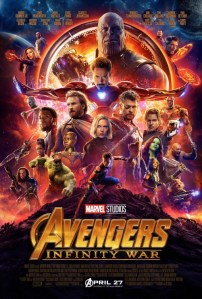 It’s hard to draw comparisons to the major commitment to long-form storytelling that the Marvel Cinematic Universe (MCU) has dabbled with over the course of ten record-shattering years of success. I can think of movie franchises that have been popular over long periods of time, like James Bond, but rarely do they keep to continuity. It’s been 18 movies and ten years since the caddish Robert Downey Jr. first stole our hearts in the original Iron Man, and its stable of heroes and villains has grown exponentially. Looking at the poster for Avengers: Infinity War, it’s hard to believe there’s even enough space just for all of the actors’ names. Infinity War feels like a massive, culminating years-in-the-making film event and it reminded me most of Peter Jackson’s concluding Lord of the Rings chapter, Return of the King. After so long, we’re privy to several separate story threads finally being braided as one and several dispirit characters finally coming together. This is a blockbuster a full decade in the making and it tends to feel overloaded and burdened with the responsibility of being everything to everyone. It’s an epic, entertaining, and enjoyable movie, but Infinity War can also leave you hanging.
Thanos (Josh Brolin) has finally come to collect the six infinity stones stashed around the universe. With their power, he will be able to achieve his ultimate goal of wiping out half of all life in the universe. Standing in his murderous way is a divided Avengers squad, with Tony Stark (Downey Jr.) still on the outs with a wanted-at-large Captain America (Chris Evans) and Black Widow (Scarlett Johansson). One of the in-demand infinity stones resides in the head of the Vision (Paul Bettany), who is in hiding with his romantic partner, Scarlet Witch (Elizabeth Olsen). They know Thanos will be coming for Vision eventually. On the other side are the Guardians of the Galaxy who have a few personal scores to settle with Thanos, the adopted father of Gomora (Zoe Saldana) and Nebula (Karen Gillan). Elsewhere, Thor (Chris Hemsworth) strikes out looking for the key to defeating the big purple menace. Thanos’ loyal lieutenants attack Earth to gather the remaining infinity stones, drawing the attention and push-back of Doctor Strange (Benedict Cumberbatch) and Peter Parker (Tom Holland). The various heroes of Earth and space unite to eliminate the greatest threat the universe has ever known.
 Avengers: Infinity War serves not as much a series of payoffs as it is climaxes, with climactic event right after another, and this time it’s for keeps (more on that below). There are moments that feel like major payoffs and moments that feel like shrug-worthy Last Jedi-style payoffs. Infinity War is the longest MCU movie yet at 149 minutes but it has no downtime. That’s because it has to find room for dozens of heroes across the cosmos. With the exception of three super heroes, everyone is in this movie, and I mean everyone. This is an overstuffed buffet of comic book spectacle, and whether it feels like overindulgence will be determined by the viewer’s prior investment with this cinematic universe. If this is your first trip to the MCU, I’d advise holding off until later. Any newcomer will be very lost. I’ve deduced the seven MCU movies that are the most essential to see to successfully comprehend the totality of the Infinity War dramatics, and they are Iron Man, The Avengers, Captain America: Winter Soldier, Guardians of the Galaxy, Captain America: Civil War, Doctor Strange, and Thor: Ragnarok. Naturally, being intimately familiar with the previous 18 movies will be best, but if you don’t have thirty hours to spare then please follow my seven-film lineup and you’ll be solid.
As far as the stakes, the MCU has been notoriously reluctant about killing off its characters, but Infinity War is completely different. I won’t spoil circumstances or names, of course, but the march of death happens shockingly early and carries on throughout. There are significant losses that will make fans equally gasp and cry. This is a summer blockbuster that leaves behind an impressive body count across the known universe and ends in a downbeat manner that will naturally trigger reflexive Empire Strikes Back comparisons. It’s hard to feel the full impact of the drastic decisions, and the grief over their losses because I know there is a Part Two coming summer 2019, and with that comes the almost certainty that several important events will be diminished or straight-out reversed. After all, in comics, nobody is ever really dead, though with movies the heroes have the nagging habit of aging. With that said, you better believe I was holding my breath during some standoffs, tearing up at some sudden goodbyes, and reflecting upon journeys shared.
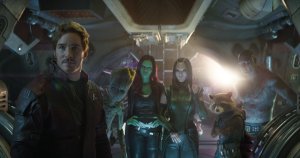 This is very much Thanos’ movie, which was one of the bigger surprises for me. Beforehand, our exposure to the big purple guy has been relatively minor, a brief moment here or a cameo there during a post-credit scene. Considering Thanos is supposed to be the universe’s biggest bad, it makes sense to finally give him his due, and that is what Infinity War does. Thanos gets the most screen time of any character and is given an honest-to-God character arc. He’s a villain who goes on an actual emotional journey as he follows a path that he feels compelled to even as it tests him personally. He finally opens up as a character rather than some malevolent force that is oft referred to in apocalyptic terms. We get his back-story and motivation, which is less a romantic appeal to Death like in the comics and more a prevention of the apocalypse reminiscent of the Reapers in the Mass Effect series. Thanos sees himself as a necessary corrective force and not as a villain. He’s never portrayed in a maniacal, gleeful sense of wickedness. Instead he seems to carry the heaviness of his mission and looks at the Avengers and other heroes sympathetically. He understands their struggle and defiance. Having an actor the caliber of Brolin (Deadpool 2) is a necessity to make this character work and effectively sell the emotions. Thanos is the most significant addition to the MCU appearing the latest, so there’s a lot of heavy lifting to do, and Infinity War fleshes him out as a worthy foe.
 As an action spectacle, however, Infinity War is good but not great. The action sequences are interesting enough but there’s nothing special and little development. There’s nothing that rivals the delirious nerdgasm of the airport battle in Civil War pitting hero-against-hero to dizzying degree. The characters are separated into units with their own goals leading to a final confrontation that feels more climactic conceptually than in execution. That’s because this is an Avengers film that falls into some of the trappings of the glut of super hero cinema, namely the army of faceless foot soldiers for easy slaughtering, the over exaggerated sense of scale of battle, the apocalyptic stakes that can feel a bit like a bell rung too many times, and even minor things like the lackluster supporting villains. Thanos’ team of lieutenants are all the same kind of sneering heavy with the exception of one, a sort of alien cleric heralding the honor of death from Thanos. Carrie Coon (HBO’s The Leftovers) is generally wasted providing the mo-cap for the Lady Lieutenant That Sounds Like a Band Fronted by Jared Leto, a.k.a. Proxima Midnight. There are far too many scenes where characters reluctantly strike a deal to give up an infinity stone if Thanos will spare the life of a beloved comrade. The film’s greatest point of entertainment isn’t with its action but the character dynamics. The fun is watching years-in-the-making character interactions and seeing the sparks fly. There’s more joy in watching Downey Jr. and Cumberbatch try and out smarm one another than with any CGI collision of a faceless army of monsters. There are so many characters that few are given fully defined arcs. Most are given beginnings and stopping places. Though the eventual sequel will have fewer characters needing to share precious screen time.
The standouts on screen are Hemsworth (12 Strong) carrying a large portion of the movie and not missing a beat of his well-honed comic rhythms from Ragnarok, Bettany (Solo) brings a sad soulfulness to Vision as a man who knows fate is likely unavoidable, and Dave Bautista (Blade Runner 2049) is perfectly deadpan as Drax and has the funniest lines in the movie followed closely by the exuberant Holland (Lost City of Z). To even say which characters deal with more complex emotions might be a spoiler in itself but there are several actors showing an emotive level unseen so far in the bustling MCU.
 Avengers: Infinity War marks a significant concluding chapter for one of cinema’s most popular series, until at least the next movie possibly makes it feel less conclusive. I pity Marvel because expectations are going to be astronomical for this climactic showdown. There are so many characters, so many crossovers, and so much to still establish, like Thanos as a character more than a spooky force of annihilation, that it feels rather breathless even at nearly two-and-a-half hours. You may be feeling a rush of exhilaration on your way out or an equally compelling sense of exhaustion. Infinity War doesn’t have the imaginative highs of a Dcotor Strange, the funky personality and style of a Guardians of the Galaxy, the wonderfully thought-out structure of a Spider-Man: Homecoming, the adroit weirdness of a Thor: Ragnarok, or even the hero-against-hero catharsis of a Civil War (still my favorite). What it does have is a sense of long-gestating finality, of real stakes and dire consequences. It’s not all pervading doom and gloom; this is still a fun movie, buoyed by crackling character team-ups and interactions. While, Infinity War won’t be all things to all people, myself included, it will please many fans, casual and diehard alike.
Nate’s Grade: B
Share this:

Spider-Man: Homecoming (2017)
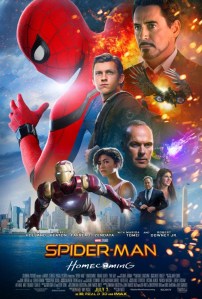 15 years. 6 movies. 3 different lead actors. 2 reboots. I wouldn’t be surprised if a majority of the American public likely knows more about Spider-Man than their relatives. In 2002, the first Spider-Man movie kicked off the new century by affirming to studios that superhero movies are a sound financial investment. Director Sam Raimi and Tobey Maguire kicked off the glut of superhero cinema, paving the path for the massive Marvel Cinematic Universe (MCU) and its own unparalleled run of financial and critical success. Then the overreach killed off Raimi’s Spider franchise in 2007 and overreach again killed off Sony’s Spider reboot in 2014. Sony wisely sought out an assist from the gurus of Marvel, striking a deal and having the web-slinger return to the MCU. Fans rejoiced. Spider-Man: Homecoming announces itself as a brash, exhilarating, hilarious, and amazingly assured film that immediately lines up with the upper tier of the MCU. Marvel should use this as Exhibit A, submit it to Fox, and say, “Here’s how we can do your franchises better.”
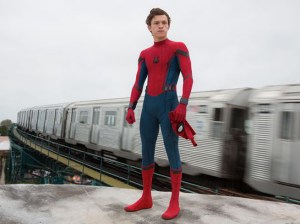
Peter Parker (Tom Holland) is your ordinary 15-year-old from Queens, New York who was given amazing powers after being bit by a radioactive (or genetically modified) spider. It’s been weeks since he was called into action by Tony Stark (Robert Downey Jr.) to thwart Captain America (Chris Evans). Now Peter is back home and waiting for his literal call to adventure, for Stark to officially call him up to join the Avengers. Peter anxiously waits for school to end so he can don his Spider-Man suit, modified by Stark Industries, and fight local crime and injustice. This mostly amounts to stopping bicycle thieves, helping old ladies with directions, and other inglorious tasks. Peter’s Aunt May (Marisa Tomei) would prefer he focus on his studies rather than the time he’s been spent on the “Stark internship” (his fib to cover said crime-fighting). New weapons begin appearing on the streets, built from the discarded alien technology from The Battle for New York. Spider-Man investigates the source, Adrian Toomes (Michael Keaton), a pilot who adopts the moniker of The Vulture while in the sky with his winged jet pack. The formidable weapons pose a real pressing danger to society, and Peter pushes further, at his own peril, to confront the Vulture and stop the flow of high-tech weapons.
 For many fans of the webhead, this will feel like the first time they’re watching the Spider-Man of the comics on screen. This is the first film incarnation where Peter remains in high school for the entire duration of the movie, and it’s also thankfully the only telling that eschews an origin story. He just is Spider-Man, however, the arc of the movie is him settling into that identity. It’s in many ways a coming-of-age story for the superhero set, as Peter has to come to terms with his earnest desire to help others and his own maturation, both as Spider-Man and as a high school sophomore. He’s learning just as much to be Peter as he is Spider-Man. Just because he has these powers doesn’t mean he’s ready for the rigors of the world. Homecoming is very much a high school movie. There are familiar John Hughes influences throughout, and the film smartly subverts certain high school tropes (driving lessons, prom dad from hell). It presents our hero struggling with asking the cute upperclassman (Laura Harrier) to the dance just as much as the demands of being a fledgling local superhero. His interior life is much more available and relatable but he’s still a teen navigating the world. Also, by having Peter be the youngest film incarnation yet, it allows for the satisfying indulgence of superhero wish-fulfillment. Whereas the X-Men powers are naturally linked to the progression of puberty, those are usually portrayed as a curse, something that ostracizes, confuses, and produces great anxiety and fear. With Spider-Man, being a superhero is the coolest thing in the world. He’s not consumed with angst like Andrew Garfield’s broody Peter Parker and his weirdly special DNA (what was the deal with his parents and that conspiracy? Oh well). Watching this exuberant Peter Parker embrace his new abilities with glee is a great way to keep the movie light and bouncy.
This is also, bar none, the funniest film yet in the MCU (yes, even dethroning Guardians of the Galaxy). With the lighter tone, the movie finds consistent opportunities to inject comedy, from the irony of Peter trying to lead a normal life, to the awkwardness of Peter’s attempts at crime-fighting, to his over eager demeanor, to misunderstandings and hasty excuse-making to conceal his double life, to the sterling supporting cast of characters that contribute different flavors of jokes when called upon. If anything there is so many talented supporting players I wanted even more time with them (Donald Glover, Hannibal Buress, Martin Starr). This cast is a comedic embarrassment of riches.
 I was laughing pretty much from beginning to end with Homecoming. Just thinking back on the school’s morning announcements (complete with anchor Betty Brant) makes me giggle. Peter’s best friend Ned (Jacob Batalon) is the movie’s chief source of comic relief, and in less careful hands he would become rapidly annoying. Instead, he’s a reliable presence and given a character arc with a payoff of his own, his desire to be Peter’s “guy in the chair.” It’s genuinely impressive screenwriting when even the comic relief sidekicks have arcs. Zendaya does an impressive job of selling every one of her jokes, which traffic in a very specific smart-aleck, apathetic tone. She’s graduated from the Disney Channel to the bigger leagues. There’s a hysterical series of inspirational education videos featuring Captain America, and if you stay past the end credits there’s a great payoff for that. There’s even some sly meta jokes calling back to Raimi’s Spider-Man. Every joke at least lands and most of them hit hard, benefiting from strong development and timing.
Nevertheless, just because it happens to be one of the funniest movies of the year, Spider-Man: Homecoming still finds plenty of space to be dramatic and thrilling. The comedy doe not tonally detract from the other elements. This is not an insubstantial movie just because it knows how to have some fun (take notes, Zack Snyder and DC). This is not a flippant movie because of tone or the heavy joke quotient. There are sincerely sweet moments born out of the characterization, like when Aunt May takes it upon herself to teach Peter how to dance (this would not be possible with a geriatric Aunt May). Director Jon Watts (Cop Car) has a steady command with his high-flying visuals and maintains the tight walk of tone that allows all the elements to work together as a blissful whole.
There are superb action sequences that advance the story forward and allow for the characters to grow. It’s exactly what good action is supposed to do, besides, you know, quicken the pulse. The humor can also arise naturally from these set pieces. Take for instance Peter suiting up while attending a suburban house party. He spots some alarming energy discharges on the other side of the suburb, but without any tall buildings for him to latch onto, he has to hoof it the whole way on foot. It’s a smart comedic aside and it helps to remind us that this Spider-Man isn’t an instant pro after getting his powers. It all comes together best in a D.C. rescue at the Washington Monument. It bridges the personal with the action. The bifurcated ferry set piece serves as the Act Two break and it’s a killer segment that pushes Peter to his limits to solve a dilemma that seems incapable of being fixed. There may not be any action scene to rival Raimi’s finest but the character-centric action and the organic development of the complications lays a foundation for a consistently entertaining film littered with joyful payoffs.
 The biggest fear I’ve read from Spidey fans was that the involvement of Robert Downey Jr. would tip the scales, turning a Spider-Man movie into a defaco Iron Man sequel. Considering America loves Iron Man, I don’t see how his inclusion is a problem. Civil War was still very much a Captain America film even though Iron Man was the co-lead. Tony Stark represents a distant mentor for Peter and also the gatekeeper. Peter is anxious to become an Avenger and looking for Stark’s approval, which brings an enjoyably unorthodox paternal side from Downey. If there is a complaint I can foresee, it will be that Spider-Man is too similar to Iron Man thanks to the special suit. Spider-Man’s suit has its own Jarvis-style A.I. program (adeptly voiced by Jennifer Connelly, wife to Paul Bettany, former voice of Jarvis) and extra special gadgets including a spider drone and unusual web shooting options. It provides a new sense of discovery for the character since we’re already starting with him powered. The second act is Peter getting accustomed to the boost his suit gives him, becoming reliant upon them, and then having it stripped away as a natural Act Two break so that the conclusion has even more stakes without the security of the suit. It makes Peter much more vulnerable. The Iron Man parts are more a background motivational force and this is still very much a Spider-Man film.
Holland (The Lost City of Z) is already my favorite Spider-Man. Period. He made such an immediate and strong impression in Civil War that I was greatly looking forward to his first big starring venture, and Holland does not disappoint. This is the first Spider-Man that doesn’t feel crushed by the heavy burden of being a superhero. He’s a kid eager to grow up and join the world of other caped crusaders, but he’s modeled his crime fighting from what he’s seen on TV. He doesn’t really know what he’s doing. He’s still an awkward kid, and Holland brings great authenticity to the smaller character moments and the bigger heroic strides (while maintaining a convincing American accent). This is a more relatable, vulnerable, and interesting Peter Parker. Even though he thinks he should be beyond the mundane life of high school, he doesn’t ever act pompous or look down on other characters, which is endearing. At times Holland feels like he’s going to explode with energy, as if life is too much to process in the intermediary. He’s a teenager and the world feels so big and open. It’s an instantly engaging and likeable portrayal that wonderfully capitalizes on the introduction from Civil War. This is a Spider-Man, and his spider world, that I want multiple sequels to further explore and challenge.
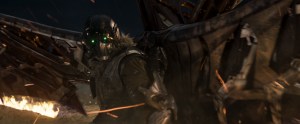
 Keaton’s Vulture already ranks as one of the best villains in the MCU (a low bar, I admit), and that’s because the movie humanizes him and gives him significant moments. He’s just a regular working-class man trying to provide for his family. In fact the first five minutes of the movie focus exclusively on Toomes and explains his sticky situation. He feels cast aside by those in the upper echelons of power. His eventual “you and I are the same” speech to Spider-Man has credible points. You can see, from his perspective, how he’s an underdog sticking it to the rich elites. Shockingly, there’s only one death in the entire movie and even that is an accident. Toomes is not your standard comic book villain, and there’s a brilliant third act twist that makes him even more centrally involved in the narrative. That opens a delicious sequence of dramatic irony. Keaton has a quiet menace to him that’s very unsettling. It’s all in the lower register. His character doesn’t blow up. He just narrows his brow and intensifies that scary stare. I’m glad the filmmakers realized that more Keaton was an asset to the film.
Let’s also take some time to celebrate the sixth Spider-Man movie for having a diverse population of characters that would actually represent Queens. Peter’s best friend is of Filipino descent, the girl he crushes on is biracial, the loner girl is biracial, and even the high school bully, Flash Thompson, is Hispanic, played by Tony Revolori from The Grand Budapest Hotel. This might be Marvel’s most diverse cast yet, though “yet” being the operative word considering that Black Panther is arriving in early 2018.
This movie is a total blast. Spider-Man: Homecoming actually manages to give new life to a character that has already appeared in five other movies. That’s an amazing feat. Another amazing feat is that six different screenwriters, including the director, are credited with this movie, yet it feels fully coherent in its vision and presentation. This is Peter Parker, the teenager struggling with self-doubt, hormones, and an eagerness to grow up, and the movie feels much more human-scaled, forgoing giant CGI smash-em-ups for something more grounded, personally involving, and ultimately successful. Just because Homecoming is fast-paced and funny doesn’t mean it lacks substance. I was elated during long portions of this movie, impressed by the steady stream of setups and payoffs, the incorporation of the many characters and comedic voices, and the varied action set pieces that were focused on character progression. If you are tired of superhero stories, I’d still heartily recommend this movie. Dear reader, I feel like I’m failing you and turning into a frothing fanboy because I can only think, at worst, of negligible quibbles against the film. Everything in this movie works. Everything. It’s everything I was hoping for and then some.
Nate’s Grade: A
Share this:

Captain America: Civil War (2016)
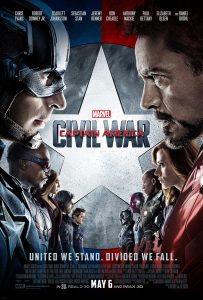 Think you were disappointed by last summer’s Avengers: Age of Ultron? The pressure-packed experience broke writer/director Joss Whedon who swore off being the creative shepherd of the Marvel cinematic Universe (MCU). Enter the Russo brothers, a pair who were widely known for their work in eclectic TV comedies like Community and Arrested Development before blowing away all modest expectations with 2014’s Captain America: Winter Soldier. I can say that the Russos are more than capable for the challenge. My simplistic blurb for Captain America: Civil War is thus: everything Batman vs. Superman did wrong this movie does right.
After the cataclysmic events of multiple movie climaxes, the world governments are wary of the power wielded by the Avengers. Secretary Ross (William Hurt, the lone returning element from 2008’s Incredible Hulk) is pushing the superheroes to sign the Sokovia Accords, which would put them under the control of a U.N. joint panel. This panel would decide when and where to deploy the Avengers. Captain America, a.k.a. Steve Rogers (Chris Evans), is worried about a group of people taking away their choice. Iron Man, a.k.a. Tony Stark (Robert Downey Jr.), believes that they need to accept limitations and that agreeing to these terms staves off something worse later. This division becomes even more pronounced when Rogers’ old friend the Winter Soldier, a.k.a. Bucky Barnes (Sebastian Stan), reappears as the chief suspect in a U.N. bombing. Black Panther, a.k.a. T’Challa (Chadwick Boseman), swears vengeance against Barnes for the bombing. As the assembly of heroes squares off over the fate of the Winter Soldier, Baron Zemo (Daniel Bruhl) is tracking down classified Hydra documents to uncover pertinent information that will topple an empire.
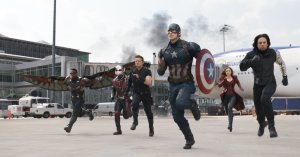 While I don’t want to turn every new film review as an opportunity to beat a dead horse, I cannot help but draw immediate and stark comparisons between Civil War and the earlier titanic superhero slugfest, Batman vs. Superman: Dawn of Justice. Let’s take this case point by point so there is no reasonable doubt left for the jury of ticket-buyers.
“Batman vs. Superman doesn’t set up its conflicts with enough time to develop them and it lacks real emotional stakes.”
With BvS (I’m saving my fingertips some drudgery), we hadn’t known these characters for more than one movie at best, and in the case of Bruce Wayne less than one. When they fought there wasn’t any real stakes despite the apoplectic marketing because we hadn’t built relationships with these characters. In the case of Henry Cavill’s Superman, many were turned off entirely by the guy (not necessarily by Cavill’s physique, though). Did anyone really care who won? The filmmakers relied on the audience to supply their pop-culture good will for the characters instead of proper characterization and development. In the case of Civil War, we’re dealing with the cumulative effect of having twelve movies to build up storylines and character relationships. We’re invested in these characters and their friendships, so when they fight it actually does matter. You feel for both sides and multiple characters and the movie does a good job of providing each side a credible motivation. It’s a political thorny issue but it’s kept very streamlined, focusing more on the characters. If the MCU has had one nagging problem throughout its history it has been a dearth of good villains. There’s Loki and… Loki. One solution is to just pit the heroes against each other and this produces as many fist-bumps as winces. My audience was gasping at reveals and twists and turns. They weren’t doing that with BvS. And wouldn’t you know Civil War actually has a climax that’s more than just an increasing series of punches and kicks (though plenty of those are featured); the climax is an emotionally grounded confrontation that cuts to the core of the group. The events of this movie matter and while obviously it can’t follow its divisions to an irrevocable end, I appreciated that not everything is resolved. These storylines and the conflicts between characters will carry onward when we pick up the pieces in 2018.
“Batman vs. Superman is too burdened with setting up an array of other film franchises that it loses badly needed focus and momentum.”
 To be fair, this charge can also be laid at the feet of Age of Ultron, which buckled under the heavy weight of setting up multiple other future movies rather than telling a completely satisfying movie in its own right. Once the franchises gave birth to mega-franchises, the wheels-within-wheels of moneymaking, now the studios require a lot of heavy lifting from our entertainment. They’re investments in futures and if done improperly can easily crumble under the failed execution like the Amazing Spider-Man series (R.I.P. 2012-2014). Miraculously, Civil War finds ways to involve every member of a large ensemble cast into the story in ways that matter. The movie finds small character moments that make them feel better rounded, like Vision (Paul Bettany) and Scarlet Witch (Elizabeth Olsen), and it introduces featured supporting players with great care. Black Panther is a terrific addition and brings a quieter intensity that contrasts nicely with the more colorful characters. Hawkeye (Jeremy Renner) introduces himself and Black Panther curtly says, “I don’t care” and goes back to fighting. Boseman (ageless I tell you!) is smooth and magnetic. Then there’s everyone’s favorite neighborhood Spider-Man (Tom Holland), or whom I’m already referring to my pals as “best Spider-Man.” It’s another incarnation of Peter Parker but the first that feels like an actual teenager, a bundle of adolescent energy and excitement. He’s the voice of the fans and during the big battle he can’t help but gush that he gets to be involved alongside the big names. Spidey’s a fanboy too. He also has a few choice meta one-liners that had me cackling. Holland (The Impossible) makes an immediate impact and, unlike BvS, finds new ways to make us care. I’m genuinely excited for solo Black Panther and Spider-Man adventures with these characters. Even the more traditional villain of Civil War, Baron Zemo, is handled in a way that provides an emotional motivation for his character that is sincere rather than mustache-twirling villainy. In a lot of ways this feels like a third Avengers film just with the size and scope alone. The dozen characters are juggled skillfully but the emphasis is always on Rogers and Stark and their significant personal conflicts.
“Batman vs. Superman’s action sequences are repetitive, joyless, and dank.”
I challenge some enterprising soul to even try and decipher what is happening during the climactic three-on-one monster battle in BvS. I was sitting in the theater and just gave up. I wasn’t having any fun and I couldn’t even literally tell what was happening onscreen with all the confusing CGI obfuscation. The action droned on and on with little variation and was at pains to include certain members and storylines (Lois, maybe don’t get so hasty with that kryptonite spear). It was all just one big overwrought mess that made you question whether anybody on that film production actually liked these superheroes. With Civil War, the action sequences are smartly conceived and choreographed, making excellent use of geography and adding organic complications. The standout is the 20-minute superhero-on-superhero brawl at the Leipzig airport. It is nothing short of nerd nirvana. The characters use their powers together in exciting ways and it further helps them feel like an actual team taking proper advantage of their resources. It’s the culmination of a child’s imagination at play, the living embodiment of smashing action figures against one another and flying around the room. I was thrilled that the Russo brothers found ways to incorporate all the heroes into the action. The specific powers are taken advantage of in fun and surprising ways. The action changes as the stakes keep getting more complicated as more heroes enter the fray. It’s a set piece that will become legendary within film geek circles and it provides payoff after glorious payoff.
“Batman vs. Superman is devoid of all fun and takes itself far too seriously. You feel beaten down, exhausted, and punished by film’s end.”
 The Marvel movies have earned a reputation for their brisk and breezy nature, which has unfairly been labeled as “weightless” and “silly.” I challenge someone to watch Civil War and tell me just how weightless and silly it is. The Russo brothers and the screenwriters take these characters seriously and their care shows. While there can be plenty of rapid-fire quips and one-liners, the movie’s sense of humor does not detract from the emotional weight of its dramatic shifts. There are political and thematic overtones, mostly the costs of vengeance and culpability, that provide extra depth to the onscreen derring-do. However, Civil War understands that an audience wants to be entertained as well with their heavy-handed messianic imagery. There are payoffs galore in this movie. Some are several movies deep from set up. It all comes together to make a thrilling and highly enjoyable movie experience that plays to its audience in the best way possible. It’s an expert summer blockbuster that packs its own punch. There’s a reason I have already seen Civil War three times already. There is so much to enjoy and it’s so tightly packed and structured that you can jump right in and go for the ride. This is the movie fans were hoping for. This is the movie that washes out the bad taste of the dreadful BvS. If one of my lasting disappointments with BvS was how it made me lose hope for future DC movies, Civil War has cemented my anticipation. The future creative direction of the MCU is in good hands with the Russo brothers. This is the movie that reminds you just how damn good superhero movies can be when they’re at the top of their game. I’d place Civil War right up there at the top of the MCU, though at this time I’m still holding Guardians of the Galaxy as the apex. They’re still achieving this high level of quality after a dozen movies, people. I would not have thought that Captain America would become the gold standard of the MCU but there it is. I felt beaten down by the merciless end of BvS. I felt the elation of an adrenaline-rush from Civil War.
I’ll conclude this unorthodox film review with my in-summary blurb: everything Batman vs. Superman did wrong Captain America: Civil War does right. Do yourself a favor and start the healing process from BvS and enjoy Marvel’s latest cinematic gift to its fans.
Nate’s Grade: A


 nathanzoebl
You must be logged in to post a comment.