Blog Archives
The Core (2003) [Review Re-View]
 Originally released March 28, 2003:
I knew about 15 minutes in that The Core was not going to take its science too seriously. Aaron Eckhart, as a hunky science professor, is addressing military generals and essentially says, “We broke the Earth.” He tells them that because the Earth no longer spins (don’t think about it, you’ll only hurt yourself) the electromagnetic shield will dissipate and the sun will cook our planet. And just to make sure people understand the term “cook” he sets a peach on fire as an example. At this point I knew The Core was going to be a ridiculous disaster flick with its tongue firmly planted in its cheek.
Earth’s core has stopped spinning and horrific disasters are starting to be unleashed with anything from drunken bird attacks to lightening strikes in Rome. I always love how in disaster films Mother Nature always instinctively goes after the monuments, the landmarks, the things of cultural importance. The United States government hires a ragtag group of scientists and NASA pilots to journey to the center of the Earth and jump-start our planet. Of course everything that can go wrong on this fantastic journey will eventually go wrong.
The Core is so improbable, so silly, that it ends up being guilty fun. If you let go, ignore the incredible amounts of birth imagery (the sperm-like ship tunneling through to get to the egg-like core), then the very game cast will take you for a fun ride.
There’s a scene where the government approaches kooky scientist Delroy Lindo to build the super-ship that will take them to said core. When asked how much he thinks it’ll cost Lindo laughs and says, ”Try fifty billion dollars.” The government responds, ”Can you take a check?” I was pleasantly reminded of an episode of Futurama where the space-time continuum is disrupted and time keeps skipping forward. The old scientist and a Harlem Globetrotter (it was a very funny episode) theorize that to create a machine to stop this problem they would need all the money on the Earth. Flash immediately to the two of them being handed a check that says, “All the money of the Earth.” Richard Nixon’s head, in its glass jar, then says, “Get going, you know we cant spend All the Money on the Earth every day.”
 The assembled cast is quite nice. Hilary Swank assumes a leadership role quite nicely. Eckhart is suitably hunky and dashing. Stanley Tucci is very funny as an arrogant science snob. Tcheky Karyo (the poor man’s Jean Reno) is … uh, French. I don’t think anyone would believe that these people were the best in their fields (only in movies are scientists not old white men but hunky and sexy fun-lovin folk).
Director Jon Amiel (Entrapment) seems to know the preposterous nature of his films proceedings and amps up the campy thrills. An impromptu landing of the space shuttle in an L.A. reservoir is a fantastic action set piece, yet is likely the reason the film was delayed after the Columbia crash. The cornball science and steady pacing make The Core an enjoyable if goofy ride. The film does run out of steam and goes on for 20 minutes longer than it should.
The Core is pure escapist entertainment without a thought in its head. And in dire times of war and harsh realism blaring at us every evening, there’s nothing wrong with a little juicy escapist fair. Buy a big tub of popcorn and enjoy. Does anyone else wonder if we broke the Earth just after its 5 billion-year warranty was up?
Nate’s Grade: C+
——————————————————
WRITER REFLECTIONS 20 YEARS LATER

I never knew just how influential the 2003 disaster movie The Core has been. It’s a schlocky Hollywood sci-fi thriller built upon junk science but still enjoyable junk food entertainment. However, the science was so unrepentantly bad, that the science community as a whole decided to do something about it, and in 2008 the Science & Entertainment Exchange was launched. Founded by the National Academy of Sciences (NAS), its director Rick Loverd told Salon magazine how influential pop culture can be in its depiction of science, citing Star Trek inspiring scientists, Top Gun inspiring pilots, and CSI inspiring young forensic students. He also cites the power of seeing positive representation, like 2016’s Hidden Figures. The Science & Entertainment Exchange is an organization that is intended to consult on the application and depictions of science in cinema, hoping to make things more realistic. Apparently, The Core’s director, Jon Amiel (Entrapment), was so taken back when a science advisor was bad-mouthing the movie to Scientific American because he was under the impression that his movie, including restarting the Earth’s iron core with atomic bombs, had been scientifically accurate. Among the scientific community, they regard The Core as the nadir of big screen accuracy (as an example of a movie that got the science fairly accurate, they cite 2014’s Interstellar). I bet you never knew how truly influential and world-changing The Core was, albeit for being a junk movie. However, as it was in 2003, and even twenty years later, this is exactly my kind of junk.
I recognized the campy appeal of The Core right away. It’s a goofy movie from the premise to the science to the action set pieces but it’s all played one hundred percent straight, which makes it that much more entertaining and amusing. The opening sequence involves people with pacemakers dropping dead (approximately 1.5 million people worldwide). Then the birds start acting funny and crashing into buildings and cars and panicked outdoor crowds. For a disaster movie literally about the possible demise of the planet, this is such a strange and minimalist start to the looming threat at hand. The movie feels like it’s a throwback to the science fiction mission movies of the 1950s with a touch of the worldwide disaster movies of the 1970s. Even with the modern special effects, which are as delightfully cheesy as the rest of the movie, it doesn’t feel akin to the disaster epics of Roman Emmerich. The movie feels cornier and more dated and less interested in large-scale disaster spectacle. The surface-level disaster carnage is marginal, mostly an out-of-control lightening storm in Rome that knows to always steer for the monuments and cultural artifacts. The Core, at its core, is about the fantastic journey of its brave scientists. Take for instance a scene where the Serge is locked behind and being crushed to death by extreme pressure. I don’t know how anyone could keep a straight face while Aaron Eckhart, our handsome lead scientist, shouts, “Serge!” over and over while Tcheky Karyo (The Patriot) pretends he’s being squished to death while the walls get closer and closer to his face. That’s the kind of stuff I want, not CGI waves killing thousands in large-scale yet antiseptic spectacle.
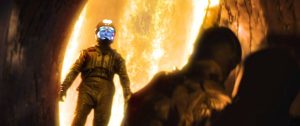 The movie takes about an hour before it really gets going, which is also admirably silly. Why devote so much time to setting up the reality of this dilemma for the complications and solutions to seem so throwaway? Seriously, the government uses one hacker (DJ Qualls) to control the entire Internet so that they can cover up the news about the possible impending apocalypse. It reminds me of an episode of The X-Files from the early 1990s where the government sends out an “all-Internet alert.” Perhaps the screenwriters felt we needed more time to accept the outlandish premise, which is strange because most disaster movies get a significant benefit of the doubt from audiences. Just having a person in glasses, and maybe a lab coat, or sweater if you want it to be more casual, explaining in a grave tone while removing their glasses dramatically, is likely all we need to accept the craziness to come. However, we do spend more time with our characters so that, when they depart one-by-one through sacrifice and accident, I actually cared enough because I was enjoying their comradery. I enjoyed Stanley Tucci being a blowhard who would even record his own narration as they travel through the Earth. I enjoyed Bruce Greenwood as the stern father figure that of course has to die first. I enjoyed Delroy Lindo as our excited but exasperated drill scientist. I enjoyed Hilary Swank as, essentially, the “best damn pilot I’ve ever seen.” I liked simply watching them all banter and bond together. It had enough development that their losses actually felt like losses and/or the accumulation of a character arc.
The question arises how do you keep things interesting when you’re burrowing through layer after layer of rock, and the answer is to just make things up. How about a layer of air? Could the Earth, compact as it is through billions of years of gravitational forces, have a layer of air like it was an English muffin? I did enjoy how the team had to restart their vessel before the magma poured into the vacant and awaiting space from their entry point. Of course, that raises the question now that magma is filling this vacant layer, have these scientists unintentionally ruined this unknown layer of the Earth? How about a layer with diamonds the size of states? These internal layers might as well be alien planets for as little they connect to reality.
 The movie is overlong and too uneven, but for fans of schlocky science fiction, it’s a delicious combination of campy entertainment. The silliness, played completely straight, even down to the part where Richard Jenkins explains man’ hubris is at fault for destroying the rotation of the Earth, is the grand appeal. I’m not going to call The Core a good movie but it sure feels like it knows exactly what kind of movie it is, and boy does it lean into that. My original review in 2003 caught on right away and I still recognized that same knowing vibe (why do we need a visual demonstration for the obvious concept of the sun cooking the Earth?). There really is a lot of birthing imagery too with the shape of the vessel burrowing to that egg at the center, so there’s that as well. The special effects are pretty murky and hokey for this kind of budget, but in 2023, that even works to the bountiful charms of the movie. I won’t pretend that most people will watch The Core with derision regardless of whether or not you’re an actual scientist. It inspired a generation of movies to be more scientifically sound, and it also inspired one of the biggest filmmakers on the planet. The metal that encases the spaceship? Unobtanium. You cannot tell me James Cameron wasn’t watching and taking notes.
Re-View Grade: B
Share this:

The Post (2017)
 Even with the added timely benefit of championing a free press in the era of Trump, Steven Spielberg’s The Post is a movie held together by big speeches and Meryl Streep. It’s the story of the Pentagon Papers but it’s told from the wrong perspective. It’s told through the reference of whether the owner of the Washington Post (Streep) will or will not publish and how this endangers her family’s financial control over the newspaper. Plenty of dismissive men doubt her because she’s a woman. It’s simply one of the least interesting versions of an important story. Streep is her standard excellent self and has a few standout moments where you can actively see her character thinking. I just don’t understand why all these talented people put so much effort into telling this version of this story. I missed the active investigation of Spotlight, how one piece lead to another and the bigger picture emerged. There was an urgency there that is strangely lacking with The Post. The question of whether she will publish is already answered. It feels like the screenplay is designed for Big Important Speeches from Important People. Tom Hanks plays the gruff editor of the newspaper and Streep’s chief scene partner. They’re enjoyable to watch, as is the large collection of great supporting actors (Bradley Whitford, Carrie Coon, Sarah Paulson, Tracy Letts, Matthew Rhys, Jesse Plemons, Bruce Greenwood, and a Mr. Show reunion with David Cross and Bob Odenkirk). This is a movie that is easier to admire than like, but I don’t even know if I admire it that much. The film has to call attention to Streep’s big decision and the stakes involved by underlining just what she has to lose and reminding you how brave she’s being. When Streep leaves the U.S. Supreme Court, there’s a bevy of supportive women lined up to bask in her accomplishment. It’s a bit much and another reminder that The Post doesn’t think you’ll understand its major themes. It’s a perfectly acceptable Oscar-bait drama but it sells its subject short and its audience.
Nate’s Grade: B
Share this:

Kingsman: The Golden Circle (2017)
 I’ve written before that director Matthew Vaughn is the best big screen filmmaker when it comes to making the most of studio money. This is the man who made Daniel Craig Bond, rejuvenated the dormant X-Men franchise, and gifted Fox a twenty-first century James Bond of its own. The first Kingsman movie was one of the best films of 2015 and was bursting with attitude, style, and perverse entertainment. It was my favorite James Bond movie that was never a Bond movie. Success demanded a sequel, and now Kingsman: The Golden Circle is upon us and proof that Vaughn may be mortal after all.
Eggsy (Taron Eagleton) is living a charmed life now that he’s earned his place within the ultra-secret, ultra-powerful Kingsman spy organization. In between battling villains and the riffraff, Eggsy tries to maintain some semblance of a normal life with his girlfriend Tilde (Hanna Alstrom), who, yeah, happens to be the princess of Sweden. Poppy (Julianne Moore) is a drug baron in the vein of Martha Stewart. She’s tired of lurking in seclusion in the jungles of Cambodia and wants the credit she deserves as the most successful businesswoman. She locates the homes of the remaining Kingsman and blows them up, leaving only Eggsy and Merlin (Mark Strong). Poppy takes aim at the war on drugs. She infects her own product with a deadly agent and holds the world hostage. Unless global leaders decriminalize drugs, millions of infected people will die. In the meantime, Eggsy and Merlin travel to Kentucky to seek out help from their American brethren, the Statesmen (Jeff Bridges, Channing Tatum, Halle Berry), a clandestine spy organization that also doubles as a gargantuan bourbon distillery.
 With Vaughn back at the helm I expected the best, and while Kingsman: The Golden Circle has plenty to like there is noticeably less to love. Being a sequel means that what once felt fresh will now lose some measure of its appeal and charm, and Vaughn and company do falter at times under the pressure to live up to what they established with their rip-roaring spy caper of an original. The brilliant structure of the first movie (mentorship, spy camp competition, class conflict themes) cannot be readily duplicated. There are interesting story elements here but Golden Circle doesn’t seem to know what to do with them, including with the titular Golden Circle. The villains never really feel that threatening. Poppy’s scheme is great and the 1950s diner iconography of her home is an eye-catching lair worthy of a demented Bond villain. It’s just that it feels like we never get a villain worthy of their wicked scheme. Where did she get all of this tech? Her henchmen are lackluster and a lackey with a cybernetic arm (Edward Holcroft) is no competition for Sofia Boutella (The Mummy) and her slashing blade legs. When the bad guys don’t feel like much of a challenge, it deflates the stakes and enjoyment factor of the big finale. It’s a series of ideas that need to be pushed further, refined, revised, and better developed. The first film was packed with surprises and payoffs both big and small, and the sequel feels lacking in payoffs of any kind.
The Statesmen are more a pit stop than integral plot element. You would think a majority of the film would be the international clash between Yanks and Brits, supplying some of that class friction that energized the first film. With the exception of Pedro Pascal (Narcos), you could eliminate them from the movie with minimal damage to the story. Channing Tatum (Logan Lucky) has gotten large placement in the advertisement but he is literally put on ice for a majority of the movie. The exaggerated cartoon nature of the Statesmen feels like Vaughn’s goof on American hyper machismo, but they stay at that same cartoon level throughout. They feel like parody figures, and Vaughn sidelines their involvement. The spy missions are a letdown. There’s an enemy compound atop a mountain in Italy, and all they do is walk inside, immediately grab the thing they need, and immediately run away. It all adds up to a two-hour-plus movie that’s still consistently enjoyable but also consistently unmemorable.
 There are things in The Golden Circle that feel like they’re here just because of fan response rather than narrative necessity. The biggest offender is the return of Harry (Colin Firth). He served his purpose bringing Eggsy into the clandestine yet dapper world of the Kingsman, modeling as a father figure, and dying to push our protagonist onward. Bringing him back to life doesn’t serve the story except to bring back a character we genuinely liked. In this sequel, his return and subsequent amnesia doesn’t force Eggsy to retrain his former mentor. Instead he’s mostly a tag-along as another character to shoot the bad guys. Harry simply shouldn’t be here, and resurrecting him takes away from the shock of his death and the weight of his loss. They even recreate the “manners maketh man” bar fight, except the inclusion is so contrived that I thought it was all some kind of Statesman plan to ease Harry back into fighting shape. Nope. Another aspect that feels forced is Eggsy’s relationship with the princess of Sweden. This feels like an apology for the crass joke from the first movie that upset people’s delicate sensibilities (apparently this was worse than a montage of people’s heads exploding). The relationship feels forced and every time the movie cuts back to his troubles with Tilde, they feel small and annoying. It’s like Vaughn is trying to salvage a risqué joke by turning them into a committed couple. Then again the “mucus membrane” moment in Golden Circle (you’ll know it when you see it) seems like a renewed attempt at being transgressive.
The action set pieces have their moments but like everything else there are few that stand out or will stand the test of time. The film starts off strong with a brutal fistfight inside a speeding car. Even with the cramped quarters, it feels easy to follow, creatively inventive, and exciting. As the fight continues, the sequence loses its creative verve and becomes indistinguishable from any other silly Bond car chase. The big finale where the remaining Kingsman storm Poppy’s jungle compound has some cool moments, like Eggsy taking cover behind a giant rolling donut. Regrettably, the action sequences lack the snap and imagination that have defined Vaughn’s films, proving to be yet another underdeveloped aspect. The hand-to-hand fight choreography is still strong and stylish. The final fight between Eggsy and the metallically armed henchman has the fluidity, vision, and fun that were missing from the other scuffles. I’ll credit Vaughn with finding ways to make a lasso and whip look badass and integrating it elegantly with fight choreography (no easy task, right, season five of Game of Thrones?). I kept patiently waiting for any sequence that grabbed my attention like the insane church massacre.
There are two elements in The Golden Circle that rise to the level of entertainment of the first film, and one of those is literally Elton John. It starts off as a cameo with John being kidnapped and forced to perform for Poppy’s private audience. Then he just keeps appearing. He passes over from cameo to downright supporting actor, and just when you think you’ve had enough and that Vaughn has overindulged his Elton John fandom, here comes a climactic solution that is inspired and completely justifies the repeated John appearances. I howled with laughter and wanted to clap in appreciation. It was the best setup-payoff combo in the entire film. The other creative highpoint is a treacherous left turn into the politics of the war on drugs. Poppy argues how legal consumables like alcohol and sugar are far more deadly and addictive. I’ve heard all those arguments before about the hypocritical nature of the war on drugs from every armchair philosopher. Where the film really surprised me was when it gave voice to a nasty perspective I’ve heard in response to the rising opioid crisis in America. Some view drug addicts more as criminals needing to be punished rather than victims needing a helping hand and treatment. When Poppy makes her demands, there are government representatives that openly cheer her ploy, believing they can wipe out the junkie scum. This unsympathetic yet eerily resonant response felt like Vaughn and company finding organic ways to raise the stakes and bring in more sinister forces.
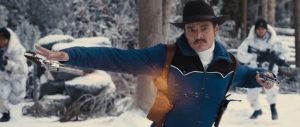 The movie never addresses one holdover from the original Kingsman that I think deserves at least a passing mention, and that’s the fact that every government leader or head of state in Western democracy had their head explode. That kind of public service vacuum would sow plenty of chaos and controversy, especially when people discovered that their elected leaders were complicit with the plan to kill the world’s remaining population. I feel like this was such a huge event that it at least deserves a cursory mention of some sort.
With the glut of disappointing and alternatively maddening action cinema this year, I’ll still gladly take Vaughn’s reheated leftovers. Kingsman: The Golden Circle feels like it’s succumbing to the bombastic spy hijinks it was satirizing before, losing some semblance of its identity and wit to crank out an acceptable though unmemorable sequel. It lacks the sense of danger and genre reinvention that powered the first film. Vaughn’s signature style is still present and there are fun and intriguing story elements available; however, the development is what’s missing. The cool stuff is there but Golden Circle just doesn’t know what to do with it, and so we gallop to the finale feeling a mild dissatisfaction. Apparently the studio execs at Fox want Vaughn to get started on a third Kingsman as soon as possible. I just hope he hasn’t lost his interest in the franchise he birthed. It would be a shame for something like this to become just another underwhelming franchise.
Nate’s Grade: B-
Share this:

Devil’s Knot (2014)
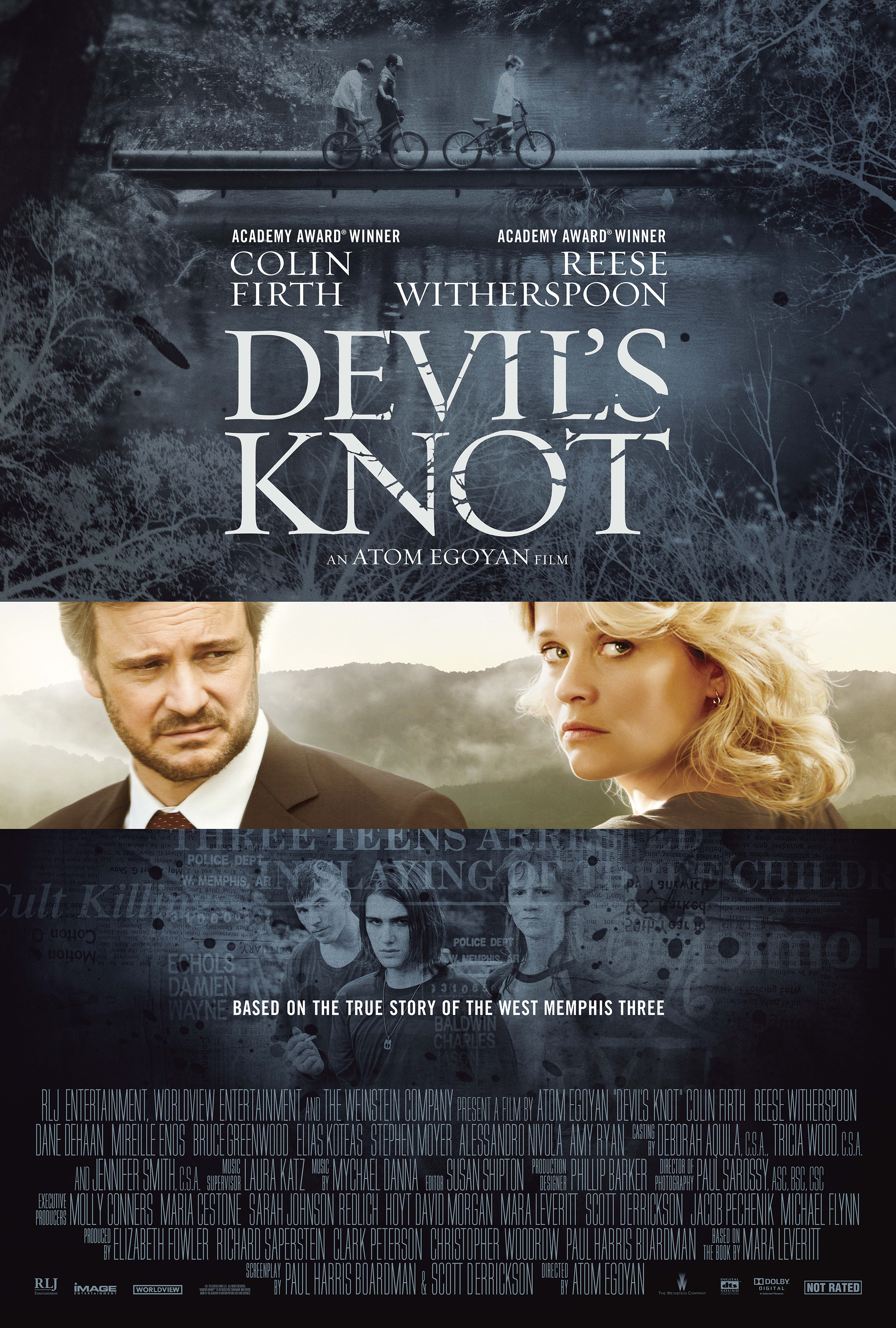 In 1993 in West Memphis, Arkansas, three eight-year-old boys went out late one night to ride their bikes. They were never seen alive again. The ensuing media circus that erupted lead to the conviction of three teenagers (The West Memphis Three) who many believed were innocent of these heinous crimes. Stop me if you’ve heard this story before. It was the basis of three stirring, powerful, galvanizing documentaries by Joe Berlinger and Bruce Sinofsky, two men credited with saving the West Memphis Three. Now after their release from prison, here comes Devil’s Knot, the first fictional film about the notorious case, Hollywood’s first crack at well-tread material. Is there anything new to be found?
Director Atom Egoyan (The Sweet Hereafter, Chloe) and his screenwriters do a credible job of distilling the complicated case against the West Memphis Three to its basics, relying on a modulated tone that shies away from the sensationalism that dominated the case back in 1993. With the benefit of time and hindsight, it’s easy for the movie to point out the erroneous thinking of the prosecution, the jump to conclusions, and the Satanic panic engulfing the community of Arkansas. We’re told by a police officer that they knew this “Satanic cult stuff” would hit town; they’ve just been waiting for the day. To its credit, the movie does a fine job of calmly and objectively pointing out the deficiencies in the police and prosecution’s case against the West Memphis Three. We’re told that from the twelve hours of interrogation with Jessie Misskelley, only 40-some minutes was recorded. The obvious mistakes in his confession, as well as the police coaching and coaxing him to their desired response, is made readily apparent. There’s “witness” Vicki Hutchernson (Mireille Enos of the oft-canceled The Killing) who says she say chief suspect Damien in a Satanic ritual, but the film cuts back from the imaginary to Vicki watching a movie on TV, the real source of her descriptive flourishes. Egoyan’s direction has a calm, objective overview that is reverent and respectful of the dead and the bereaved. It’s rarely boring and the facts of this case are such that any retelling would be somewhat compelling.
 So that brings me to the ultimate question: why even make a fictional movie about this subject? Four lengthy documentaries have covered the intricacies of the legal story, the breakdown in justice, and the personal toll on all sides of the crime. The only thing a fictional movie provides is: 1) the fun/distracting game of seeing relatively famous actors play the real-life people we’ve previously seen, and, 2) as an option for people who hate documentaries. If you’re one of those people who dislikes documentaries and doesn’t view them as “real movies,” then Devil’s Knot is for you, you dismissive filmgoer. Otherwise, literally everything was handled better in the Paradise Lost films. With the West Memphis Three thankfully out of prison, the omnipresent sense of urgency from the documentaries is now absent, replaced with a Monday morning quarterback sensibility pointing out all the obvious bias, judicial hypocrisy, and flaws of the case. And as anyone who has plowed through the powerful and addicting documentaries knows, there are plenty of flaws to point out for harsh scrutiny and incredulity. Movies have a long history of showing us an example of judicial injustice, and this is a prime example. However, Egoyan has put the emphasis of his movie on two outsiders rather than people in the center of this case. The West Memphis Three themselves are barely supporting actors in their own movie. I suppose the filmmakers may have wanted to present a different angle to the case since the Paradise Lost films showed the accused up close and personal. The construction of this plot just doesn’t work under the perspectives of Pam (Reese Witherspoon) and Ron (Colin Firth).
Ron serves as a pro-bono adviser to the defense, but that doesn’t mean he has the same access inside and outside the court. He can gather evidence on his own but really this guy is meant to be a fly-on-the-wall for the planning and frustration of all the legal roadblocks thrown at the defense. Is an added body in the room necessary? Could not one of the defense attorneys have provided the same purpose? Instead, he gets to grumble in the court and out about all the legal shenanigans going on to railroad innocent boys. He is essentially spelling it out to an audience. Pam has even less narrative purpose in the film. Her perspective makes sense early on as the mother of one of the murdered young children. Her panic, her worst nightmare come to life, it all makes for the stuff of major drama, which is why you’d imagine Witherspoon was drawn to the part. But once the case against the West Memphis Three gets going, Pam transforms into our Chief Reaction Shot Provider. Whenever a curious moment happens in court, we cut back to Pam and Witherspoon cocking her head in dawning curiosity and uncertainty. It’s as if she is meant to symbolically represent the entire community that was so fervent in their beliefs that these boys were guilty… until they heard the shaky case and the questionable experts put on the stand. So Pam and Ron end up becoming signals to the audience on how to feel and what to think. The movie doesn’t have enough faith in its audience to keep up with the minutia of the trail, or even the lawyers’ arguments, reducing a complex legal trial down to two nonessential characters nodding or shaking their heads.
 I’ll admit that I had some interest watching the actors inhabit the roles, and there are scads of people involved in this story. Bruce Greenwood (Star Trek) does a valiant job showcasing the head-scratching decisions of the trail judge, David Burnett, and his slimy dismissive nature. Stephen Moyer (TV’s True Blood) is particularly infuriating as John Fogleman, chief prosecuting attorney. Seth Meriwether (Trouble with the Curve) looks eerily like his character, the young and accused Jason Baldwin, and he nails his moral convictions and gentle nature. Dane DeHaan (The Amazing Spider-Man 2) gets to do his troubled youth thing he does so well. Kevin Durand is an actor I normally enjoy but even he can’t do justice to John Mark Byers, step-father to one of the slain boys, and easily the most memorable figure in the Paradise Lost films; the man is so theatrical and larger-than-life, and yet Devil’s Knot treats him like a featured extra, with many of his speaking scenes off camera. There isn’t a bad actor in the extremely large cast, though Firth’s Southern accent isn’t the most refined. If the movie lacks much reason for existing, at least the bevy of good actors respectfully bringing new life to these people, good, bad, and many somewhere in between, is the one credible quality to this movie.
What to make of Devil’s Knot, an example of a decent, modulated, and well acted movie that ultimately has no reason to exist in the wake of three excellent documentaries (Paradise Lost) and one other pretty good one (West of Memphis). The ground has been covered. However, that doesn’t mean that a well-told story can’t be told again, with a different angle, with a different approach, but Devil’s Knot hinges on two characters serving as metaphorical barometers to teach the audience what to think and how to feel. Then there’s the matter that the trail covers the entire 114-minute running time. There’s so much more that happens after the initial trial, so much that the last two minutes of this movie are almost a nonstop barrage of text updating the audience on many of the post-trial developments, including the West Memphis Three being released from prison in 2011. The movie feels too limited; there is so much more depth here, to the details of the case, to the personalities and human drama, to the story after the trial. Egoyan and his cast and crew have made a respectful fictional version of these sensational events, but the problem is that they don’t do enough to justify their own film’s existence. Unless you have an irrational hatred for documentaries, just watch those instead.
Nate’s Grade: C+
Share this:

Meek’s Cutoff (2011)
 The early frontiersmen lead difficult, backbreaking struggles as they migrated west to start anew. The pioneers had a perilous journey, and judging from Meek’s Cutoff, they had a hard time asking for directions. We follow a wagon train hopelessly lost in Eastern Oregon, blindly hoping they are getting ever closer to water. This awful movie feels about as adrift as the characters. Director Kelly Reichardt (Wendy and Lucy) recreates pioneer life in obsequious detail, which means that for most of the interminably long 104 minutes we’re watching characters walk. And walk. And walk. Hey, now they’re doing something, nope back to walking. Michelle Williams (Blue Valentine) has the most personality of this taciturn bunch, but I couldn’t have cared less about her lot. The movie is practically indignant about the narrative demands an audience has for its movies. This is not some arty examination on the treacherous nature of the human spirit, or some conceited claptrap like such. And in a growing trend of 2011 Sundance films, Meek’s Cutoff ends absurdly abrupt, just as the characters appeared at a crossroads and on the verge of mercifully doing something interesting. Instead, Reichardt ritualistically kills the movie on this spot, robbing the audience of any payoff after 104 minutes of fruitless and tiresome artistic masturbation. If I wanted to watch a recreation of frontier life without any regard to character or story, I’d watch the History Channel. This is an exasperating, maddening, crushingly boring movie that makes you feel trapped on that misbegotten wagon train.
Nate’s Grade: D
Share this:

Star Trek (2009)
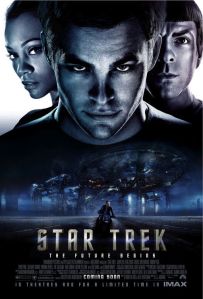 Star Trek has a hold on geek culture like no other franchise. It’s lasted over forty years, sustained five television series, and ten feature films (about four of them good), and let’s not forget the plethora of fanatical merchandise that includes everything from Trek cologne to Trek coffins. Star Wars has all the box office clout, but Trek has followers so devoted that they will create and learn a separate language, Klingon, that almost assuredly will never be spoken by anyone else outside of the festival circuit (you will never see a written Klingon exam that asks you “Where the library is?”). The Star Trek fans have been a foundation of geek culture for over four decades. People take this stuff very seriously. Trek has always been a headier brand of sci-fi, more devoted to ideas and moral dilemmas than shoot-outs and space chases, though Captain Kirk did teach the universe how to love, one green-skinned buxom alien babe at a time. 2002’s abominable Star Trek: Nemesis was meant to open up the franchise to a wider audience, but the film was the low-point for a franchise that also included William Shatner writing and directing the fifth flick (Nemesis also broke the odd/even movie curse).
When director J.J. Abrams approached Star Trek with the purpose of reinvigorating the flagging film series, you would think the man would wade into such a storied franchise with trepidation. Nope. He openly said he was making a “Star Trek movie for people who weren’t fans of Star Trek.” He was even going to change Trek canon. I imagine Trekkies (and no, I will never use the preferred nomenclature “Trekkers”) were nervous about an outsider, the author of the cinematic classic Gone Fishin’, meddling with hallowed ground. As I suspected, these fears were unfounded. The newest Star Trek does more than put a new coat of paint on an old franchise. This movie boldly goes where none of the Trek movies have gone before — turning reverent geek culture into a grand populist entertainment smash.
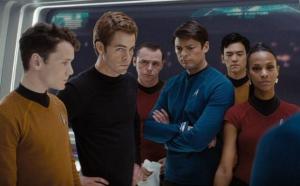 This new incarnation looks backwards, explaining how the crew of the U.S.S. Enterprise came together. The movie shows the path of Jim Kirk (Chris Pine), from troubled youth to eventual starship captain. Kirk’s father captained a starship for about 10 minutes, but he managed to save 800 lives under attack, including the birth of his son. Captain Pike (Bruce Greenwood) recruits Kirk to Starfleet Academy with the promise of doing something more with life. We also witness the boyhood of Spock (Zachary Quinto), who is teased for being half-Vulcan and half-human. His human mother (Winona Ryder) encouraged Spock to embrace his human emotions instead of cutting them off, Vulcan-style. Kirk and Spock clash at the Academy, and then an emergency requires all the recruits to saddle up for their first mission in space. Nero (Eric Bana) is a dastardly Romulan who has traveled back in time. In the future, he blames an older Spock (Leonard Nimoy) for the destruction of his home planet and the deaths of billions of Romulans. To ensure this does not happen, Nero is going to eradicate Starfleet home planets, starting with Vulcan and then Earth.
J.J. Abrams is a geek’s best friend. He understands geek culture, and yet the man is able to take genre concepts and make them easily accessible to the unconverted while still making a finished product that is respectful, playful, and awesome. Abrams is an expert on the pop culture catalogue, and he knows how to make genuinely entertaining productions that succeed on brains as well as brawn. He brought tired spy conventions into the twenty-first century with the cool, twisty Alias and Mission: Impossible III, which was really an extravagant two-hour episode of Alias, and I mean this in the best way. He has an innate understanding of action sequences and knows well enough that an audience needs to be engaged emotionally, so he makes the action as character-based as much as possible. Abrams has a terrific imagination behind the camera, and he reminds me of a young Steven Spielberg in his ability to marry artistic integrity with big-budget crowd pleasers. Abrams and his screenwriters Alex Kurtzman and Roberto Orci (Transformers, TV’s Fringe) have crafted a stellar Trek that will appeal to die-hards and those who couldn’t tell a Romulan from a Vulcan (I fall somewhere in between).
 The time travel storyline could have used more juice, however, it serves its purpose by establishing a parallel Trek universe to work with. Beforehand, Trek had established so many previous stories that it hamstrung writing new stories because they had to be extensively researched to make sure they did not conflict with 40 years of canon. Abrams and company wrestled free from the grip of the established history and can now play around unencumbered to a degree. I mean, fans don’t want to see something radically inauthentic, but Uhura and Spock as a couple? Sure, why not? The fan favorite character catch-phrases (“She’s givin’ it all she’s got,” “Dammit Jim, I’m a doctor?,” etc.) are organically worked into the story so that they don’t become falling anvils.
Star Trek‘s pacing can be whiplash inducing. It speeds through two hours of action and setup while still maintaining an emotional connection to the characters involved. The movie has a boyish enthusiasm for adventure and it’s fun watching well-known characters assemble and amble into new and interesting directions. The action is routinely thrilling and I enjoyed Abram’s small touches, like watching a crew member get sucked out into space and cutting all sound to illustrate the cold, empty vacuum. The amount of humor injected into the movie can be distracting at times, not because it isn’t funny but because of the brisk tone breaking. One second it’s a life-or-death scenario and the next Kirk is running around with giant goofy hands. Still, it’s good to see some humor in the Trek universe that isn’t related to alien culture clashes.
The young ensemble is amazingly well cast. I didn’t think a younger generation of actors would be able to step right in and play such lived-in characters, but they pull it off. The hardest shoes to fill are unquestionably Kirk’s, and Pine (Smokin’ Aces, Just My Luck) carries that same cocksure bravado without stooping to a stilted Shatner impersonation. His performance feels at times like Han Solo and Luke Skywalker rolled into one, and he’s an appealing presence that captures the essence of a dashing and rebellious scrapper. This Kirk is still an adventure-seeking, skirt-chasing 1960s kid at play. Quinto (TV’s Heroes) is blessed to look remarkably similar to Nimoy, but the actor also gets to explore the human side of Spock. He feels compelled to harness emotion, like all Vulcans, yet it’s intriguing when certain emotions slip out and build a bigger picture about what’s going inside the mind of a being dominated by logic. Quinto has less to work with by design and yet the man finds interesting ways to ensure Spock can be recognizable. Each of the supporting actors has their moment, but my biggest surprise was Karl Urban as Dr. Leonard “Bones” McCoy. Urban has mostly been confined to lame action movies as of late, like Doom and Pathfinder. But he’s really funny and his performance captures DeForest Kelly’s mannerisms down without turning into a caricature.
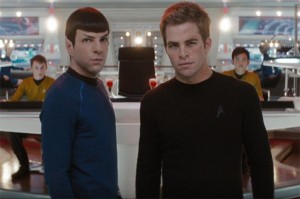 If there is a main weakness to Abrams’ Trek outing it’s that it feels far more like the opening act of a larger movie. Nero is a fairly weak villain, though Bana gives him a nicely polished glower. The villain is really just a tie-in for the time travel storyline, which is also a narrative quirk to secure an open field for further stories. Meaning, that much of the movie can be seen as assembling the pieces to simply move forward on their own. It’s an expensive set-up movie, and Abrams makes sure that the audience sees every dollar of the splashy visuals onscreen. Personally, I was also getting tired of the cinematography decision to fill the screen with as many light flares as possible. It seemed like every other moment had a blast of light beam in from some direction. After a while it sort of felt like an eye exam where the optometrist shines a flashlight back and forth. And it takes far too long for Scotty (Simon Pegg) to appear in the movie.
J.J. Abrams does more than hit the restart button. He has made a Star Trek that manages to be respectfully reverent but at the same time plays along to the mainstream visual sensibilities of modern cinema. It’s fun without being campy, reverent without being slavish, and this Trek never forgets to entertain from the opening assault on a starship to the Michale Giacchino’s closing credits score. This is an enjoyable rush of sci-fi escapism. The Star Trek series was always deeply hopeful and humanistic, believing in the best for humanity and that man, in cooperation, could achieve greatness. I think further escapades with this cast and Abrams at the helm could reach greatness. For now, I’ll be happy with this rollicking first entry into a franchise that seemed adrift in space. Bring on more of the green-skinned women.
Nate’s Grade: A-
Share this:

National Treasure: Book of Secrets (2007)
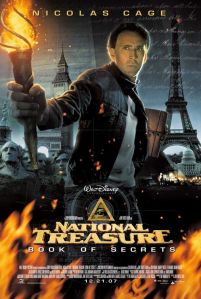 National Treasure: Book of Secrets is like a big dumb puppy that just wants love. It does a trick and thinks it deserves some form of recognition, and me with my cold heart just wants to shrug and move on with my day. How can I be so unmoved when there’s even a cartoon before the movie? For any prospective moviegoers, if you enjoyed the 2004 National Treasure, where I remind all that the U.S. Declaration of Independence had a secret treasure map on its other side, then chances are good you’ll enjoy Book of Secrets. That’s because they’re pretty much the same movie.
Ben Gates (Nicolas Cage) and his father (Jon Voight) are basking in their newfound respect from proving that their crackpot treasure schemes were in fact real. Their respectability is turned upside down, however, when Mitch Wilkinson (Ed Harris, with a dollop of a Southern drawl) has evidence that great-great-grandaddy Gates was responsible for planning President Lincoln’s assassination. He has a piece of John Wilkes Booth’s diary and a list of conspirators is jotted down, with great-great granddaddy Gates listed right there. The diary is authenticated and the Gates are devastated but ultimately unconvinced. They know their Civil War era ancestor would never betray his country and was unknowingly decoding a secret that could lead the Confederacy to an ancient golden temple, something that could help turn the tide of the war. This ancestor ripped pages out of the diary and threw them in a fire to protect the welfare of his country and was then shot by a secret Confederate soldier. In order to clear his ancestor’s good name, Ben Gates will have to find this hidden treasure, which is precisely what Mitch has wanted from the start.
 Gates re-teams with his pals from their first successful adventure, computer whiz Riley (Justin Bartha) and Abigail (Diane Kruger), who has thrown Gates out of their home due to his single-minded focus. Dating a treasure hunter is a certain path to a rocky relationship, ladies. Riley, who even wrote a book about his treasure exploits but still can’t get recognized, is game but Abigail has to be tricked into help. The group finally figures out that the only way to verify the temple’s hidden location is by getting their eyes on the mysterious President’s Book of Secrets, which only presidents can read. This means that Ben has no choice but to get the president (Bruce Greenwood) alone and beg to see a book not meant for outside eyes.
Book of Secrets is a little less dopey than the first preposterous National Treasure adventure, but that doesn’t mean it isn’t chock full of stupidity. According to these movies, apparently damn near everything in this country is built over an Indian burial ground or a giant cavern of treasure. I advise all readers to try digging in their backyards because it appears that the odds are in their favor (also: beware of your real estate company moving the tombstones but not the bodies). The clues are a little less mind-boggling, so instead of a single brick that’s been undisturbed for 200 years we get matching furniture for the Queen of England and the President of the United States. One doozey of stupidity is that one clue requires people to douse a large rock formation with water in hopes that they hit exactly the right spot and have an invisible eagle make its appearance. The plot is still structured on the clue-leads-to-other-clue template, which can be exhausting after a while because there’s never any indication of progress until the end arrives.
The subplot about kidnapping the president is ridiculous in the fact that, while already being dumb, it adds needless conflict. When Gates “”kidnaps” Mr. President he does so through a secret tunnel under George Washington’s Mt. Vernon estate. The passage closes behind them and cuts off the frantic Secret Servicemen. It is here where Gates makes his plea for the titular Book of Secrets, which the president confirms but cannot confirm publicly (well, it is a secret book of secrets). Instead of sensibly saying to his men, “Sorry guys, you know how old these places are, we got trapped, but Mr. Gates here helped get me out,” the movie tries to claim that the next course of action is that Gates will be on the run for kidnapping the leader of the free world. Huh? What makes this sequence stand out is how easily explainable it could all pass, and yet Book of Secrets figures the movie is better served by a contrived complication to add more outside pressure on Gates and his treasure hunting crew.
Of course all of the silliness and off-the-wall shenanigans would be acceptable if the film delivered some exciting action sequences that pinned you to your chair, but just like the first National Treasure, this movie is pretty much devoid of a well-thought out action sequence. Returning director Jon Turtletaub has no real visual flair and lets the material simply lay there on screen without much effort to jazz it up. Many action sequences are brief and never really flirt with complications. Usually, the script will propose a simple sequence of events like, say, “Good Guys on Run from Bad Guys” and then Turtletaub will show us exactly that, no better no worse. There’s nary a scene that actually utilizes its globetrotting destination to its advantage; most of the action is not geographic based, which means that it could happen anywhere because it doesn’t take advantage of the specifics of exotic locales. That is inexcusable to me, a big fan of good action sequences. A lengthy trip to an underground golden temple tries the patience as it rambles on and unabashedly apes the Indiana Jones series. Book of Secrets has a halfway decent car chase through the streets of London and that ends up being the highlight of the film. The trouble is that there’s more than an hour left at that point.
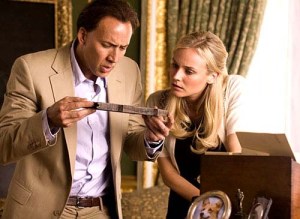 Book of Secrets is a slightly better film than the original. It jumps around in time through the lineage of the Gates clan and gives a better sense of the personal stakes for Ben and his father. Having their long-dead heroic family members linked to a dastardly assassination is good motivation for action, even if that action is ultimately finding an underground temple of gold (how A+B = C I will never know). The production design is skillful and the various European locations bring some sense of grander excitement that, sadly, will never be fully capitalized upon. The characters are still pretty shallow and one-note, but it seems like it’s less annoying this time because there’s less setup on who these characters are, which is, in short, shallow and one-note.
Cage is on autopilot and plays up his goofy mannerisms and William Shatner-esque line readings. This is a paycheck job for Cage and nothing more. Just because the first flick made tons of money is a lark to him and not an indication that he should try something different. He’s giving the people what they seemingly want, which is a wacky Nicolas Cage hamming it up with his patented version of kooky acting. Kruger is the exact copy of her character from the previous National Treasure, meaning she’s the bickering blonde counterweight to the conspiracy theorists on the journey. I suppose she plays a damsel in distress adequately. Voight gets more screen time this go-around thanks to a plump subplot involving the team seeking out the assistance of his ex-wife, played by Oscar-winning actress Helen Mirren. Yes, that Helen Mirren. Harris is given a do-nothing part as the villain and then the movie can’t even follow through on that. Everyone seems to have fun with all the nuttiness and goofy stunts, so I can’t fault them too much for faking it in a big Hollywood blockbuster.
I understand the appeal of these movies, which have found a sizeable audience willing to lap up a Cliff Notes of History along with their popcorn thrills. I imagine the fans of the original will show up in droves and make sure that National Treasure 3: The Mystery of Franklin’s Syphilis is fast-tracked for a future holiday release. I don’t mean to be a killjoy (my mother really enjoys these films) but I cannot get behind the National Treasure movement when the movies are riddled with rampant stupidity, contrived situations, convoluted conspiracies, one-note characters, and inept action sequences that never amount to much of anything beyond teetering homage to better adventure films. Book of Secrets is essentially the exact same movie reheated to take the chill off. Replace Sean Bean for Ed Harris as rival treasure hunter, add another female character, and there you have it, a mostly undisturbed formula that proved profitable in 2004.
Nate’s Grade: C
Share this:

I, Robot (2004)
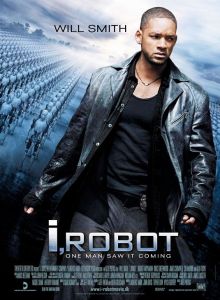 No doubt about it, Will Smith is the best hope our planet has in the face of adversity. He’s taken down aliens three times, foiled one conspiracy, stopped the South from rising again, and the man still finds the time to help Matt Damon with his golf swing. I fear we almost may be taking Smith’s world-saving exploits for granted. Smith’s newest chance to save the world arrives in I, Robot. Can Big Willie save the world yet again, or has he punched his time card one too many times?
In 2035, man has a new class of immigrants to do all the menial tasks no one wants to do – robots that look like crash test dummies. U.S. Robotics (USR) wants to push their new fall line of robots and make sure every happy home has a happy robot. Del Spooner (Will Smith) is a detective wary of our robotic friends. His colleagues laugh at his paranoia, remarking that no robot has ever committed a crime. This is thanks to the three laws hard-wired into every robot: 1) A robot cannot harm a human being, 2) A robot must obey a human beings order as long as it does not conflict with Law #1, and 3) A robot can do whatever to survive as long as this does not conflict with the other laws.
 This sounds great, except the robot creator (James Cromwell, always there if you need an old guy role) has apparently plummeted to his death from his USR office and the circumstances involving his demise are dubious at best. Spooner works alongside a robot technician/shrink (Bridget Moynahan) to find out more about what exactly is going on within USR and its suspicious CEO (the always shady Bruce Greenwood). Spooner discovers that a robot, who wishes to go by the name of Sonny, may have sent his creator to his death and may also be the first step toward uncovering the truth behind a grim conspiracy.
Smith has never really been a great actor but he is likable and charming enough, so that gets him through the day. The problem is that when hes saving the world in summer blockbusters he has a tendency to go into Will Smith Mode, which plays out like hes on auto-pilot. His stares, awkward mannerisms and aw shucks humor seem to be the same in every film. This isn’t to say that Smith cannot be a capable actor, but it seems that when a movies budget goes over a certain amount he resorts to playing Will Smith: World Saver and not so much a character of real value.
The other actors are more so playing vague archetypes than they are anything else. Greenwood is the sneaky, oily executive; Moynahan is the cold scientist learning how to be human once more; the invaluable Chi McBride is the no-nonsense police chief who rolls his eyes at Spooner’s crazy theories; and Shia LeBeof actually shows up for all of three minutes playing some kind of juvenile delinquent that is wholly unnecessary to the film.
The movie’s greatest accomplishment is the character of Sonny, modeled after a physical performance by actor Alan Tudyk. Sonny’s calm line readings, bursts of emotion, and questions on humanity make him a character the audience connects with, especially with the detached nature of Smith and Moynahan’s acting. Bet you never would have guessed this is from the same guy who played Steve the Pirate in Dodgeball.
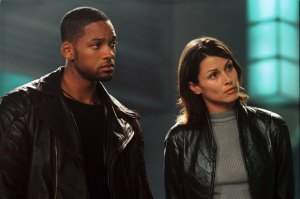 I, Robot isn’t exactly going to establish new ground in the world of science fiction. Its mostly a detective story with some twinges of sci-fi philosophy. As a detective story it adheres to the laws of detective movies, like how NO ONE ever believes the hero on his hypothetical assumptions and paranoia, which will of course always be right, and how the hero can only solve the case after he is thrown off it and gives up his badge. For two thirds of I, Robot we get an amiable, if average, detective story set in the future. Then we get a slightly incoherent final act where robots go all-out crazy.
Director Alex Proyas takes a step back from the grim, noir-ish worlds he worked with so effectively in The Crow and Dark City, and presents a cleaner and more sterilized world. His technical elements, like cinematography and musical score, are still well above par for the summer blockbuster. Proyas is a gifted visual tactician that knows how to wow an audience.
The sleek production design, fancy special effects, and strong visionary directing help lift an average story. Some of the story elements may not all work -like Spooner’s flimsy reason he hates all robots, and Moynahan’s character being very cold because she works around robots (get it? get it?)- but the professionalism of the people behind the scenes help make a rather exciting and occasionally thoughtful movie. Sonny’s questions about life and death as hes near termination are a nice addition to add something more to a summer blockbuster than explosions and car chases. Of course I, Robot also has some exciting car chases and action sequences. Certainly other, better sci-fi movies have dealt with these issues much deeper, and I, Robot seems to only skim the surface of intellectual debate, but at least it’s something (though this sounds really defeatist).
Bearing little resemblance to Asimovs collection of short stories, I, Robot is more a stream-lined sci-fi action flick, but its still a satisfying and stylishly entertaining diversion. Sci-fi fans may grumble at the notion of transforming a complex novel into a watered down action film, but I, Robot is a crowd pleaser that delivers the thrills when it needs to. If Will Smith keeps up this world saving pace he may get a little haggard and start turning into Danny Glover’s Lethal Weapon character: I’m getting too old for this aliens/robots/other aliens/more aliens/giant mechanical spiders shit. Well, at least Smith’s good at it.
Nate’s Grade: B
Share this:

Thirteen Days (2000)
 Another Kevin Costner film?! I’d rather suffer uncontrollable urination problems!” you could be saying to yourself. After Costner’s recent track record, hearing that he’ll have full Bostonian accent in hand seems a little nerve-racking. But despite Costner’s beantown speech 13 Days is a real surprise in just how much tension it actually wrings from the true story of the Cuban Missile Crisis.
Though 13 Days will suffer from the same problem Titanic did, people know their history and know how it ends. Though we all know we weren’t obliterated in nuclear war (At least I hope the majority of us know) 13 Days shows us the suspense through back-door politics as a fly on the wall in the White House. The audience sees all the political wrangling and power struggles in this cat-and-mouse game that made two nations hold their breathes in a high stakes stare-down. Bruce Greenwood, mainly known for beguiling Tommy Lee Jones in an assortment of flicks, plays our Commander in Chief John F. Kennedy. Costner seems to be a presidential advisor that could easily be mistaken for JFK’s imaginary friend the amount of time they spend together alone. Steven Culp plays Bobby Kennedy, and the fab threesome make up the core team that handled this bombastic situation. Of course there are dozens of other individuals involved within varying degrees, with the military leaders wanting procedures to lead them to inevitable war with Communist Soviets.
 The warhawks recommend a Cuban invasion whereas the option of a quarantine hangs in sight as well. Through the next trying thirteen days stress will accumulate as options become more clear as deadlines become clearer. The political maneuvering makes for a gripping story, though a tad punched up at certain areas. It proves time and again that history makes the best stories.
Let’s get down to what’s on everyone’s mind: how much is the suck-ratio zooming on Kevin Costner in this picture? Well, his accent is very very jarring to begin with but you kind of get used to it after ten minutes of wear and tear. Costner does an alright acting job but the real spotlight is on the Kennedy brothers. Greenwood and Culp turn in star-making performances that gives human glimpses to the already prolific Kennedys. Culp is outstanding as Bobby, showing that the superiors discount him because of his young age but that he’s a shrewd and thoughtful politician. Greenwood doesn’t exactly sound like JFK but he adds particular dimension to the man behind the center of the crisis.
13 Days is a prime example of showing how intense and frightening fiction can be. Director Roger Donaldson uses black and white interludes for no real reason, but his final product is one of nail-biting suspense.
Nate’s Grade: B+
Share this:

Here on Earth (2000)
 The story is nothing groundbreaking: new guy arrives in town, sweeps girl off her feet because he’s “different” than the rest, earns ire from mean boyfriend, and eventually gets the girl. It’s been the plot from everything from Lady and the Tramp to Edward Scissorhands. But even though the theme is based in predictability, the creators of ‘Here on Earth’ seem to have lazily put forth an execution.
The movie and its screenwriter have their logic completely reversed. The girl’s boyfriend is supposed to be the wife-beating snotty jerk, and the new kid is supposed to be the nice sensitive “different” guy. But in Earth, Klein is the snotty Richy Rich whose colors never change, and Josh Hartnett is the dependable and established nice guy boyfriend. The structure of this tragic tale is no way to build drama, only contempt for the female lead.
Whatever high-minded message Earth is hopelessly aiming for is destroyed by dialogue so cheesy that it could be considered a side dish at a local Taco Bell. By the time Klein starts naming Leelee’s breasts after different states in the Union the movie loses what little credibility it had or thought it did (“Massachusetts welcomes you”). It’s a wonder most of these young actors can even say what they do with a straight face.
Spoilers follow as I make fun of this movie. Just when you’re wondering why the hell Leelee is doing the things she does and it looks as if we may reach a conclusion or insight – BAM! – she has cancer and dies. This ranks up with “it was all just a dream” as one of the cheapest ways to sneak out of an uncomfortable or unexplained position. It turns out our Joan of Arc bumped her knee and somehow that has exploded into unstoppable cancer. The doctor tells the distraught family members that they always suspected this could happen. Like hell! Every time I stub my damn toe it never crosses my mind I’ve contracted cancer.
Here on Earth is supposed to be the tearjerker for the teen audience out there; the Love Story for the under twenty. But the only thing wringing from this formulaic clunker of a sob story is a healthy outpouring of sap, moral high ground, and a warning to always wear knee pads.
Nate’s Grade: C-


 nathanzoebl
You must be logged in to post a comment.