Blog Archives
Guardians of the Galaxy (2014)
 Who would have guessed that a movie that featured a talking tree and an anthropomorphic raccoon would be one of the best films of the year and one of the top grossing films of the summer? At this point for audiences, the Marvel name can do no wrong, but really it’s the degree of latitude given to Guardians of the Galaxy, an admittedly weird movie with strange characters, that allows this unique film to shine. Attaching offbeat director James Gunn (Super, Slither) to be writer and director was a risk that paid off tremendously, as Guardians is the Marvel film most entrenched with the particular personality of its creative director. This is a gleefully imaginative film that enjoys wading deep into weirdness, dancing to its adventurous Star Wars throwback beat, always with its focus set on comedy but not at the expense of quality drama or character development. Really, the characters are the focus of this entry into the franchise, and Gunn and his actors do a bang-up job of gathering the team and getting you to care about each and every one of them. Each one of these characters has a goal, several payoffs, and each is given their proper attention. In an ordinary superhero film, the archetypes would be ironclad. With Guardians, the tough guy made of muscle can also be a source of unexpected comedy with his literal-minded speech patterns. With Guardians, the talking raccoon can also be an emotionally disturbed victim of genetic experimentation who doesn’t know how to play well with others. These are damaged characters and their formation of an unconventional family unit is deeply satisfying and rather touching. I have seen the film twice and gotten teary-eyed both times. The real star of the film is Chris Pratt (TV’s Parks and Recreation), and what a breakout role he is afforded; he’s like Han Solo’s more juvenile nephew. But like the others, the part is surprising in its depth, with a well of sadness and displacement he still hasn’t processed while he scavenges the galaxy. The plot can be a bit unwieldy at times but pays off better for repeat viewings. This is a world I want to spend far more time exploring and with these characters as my merry prankster guides. With a movie this action-packed, thoroughly entertaining, and gratifying, why come back to Earth?
Nate’s Grade: A
Share this:

American Hustle (2013)
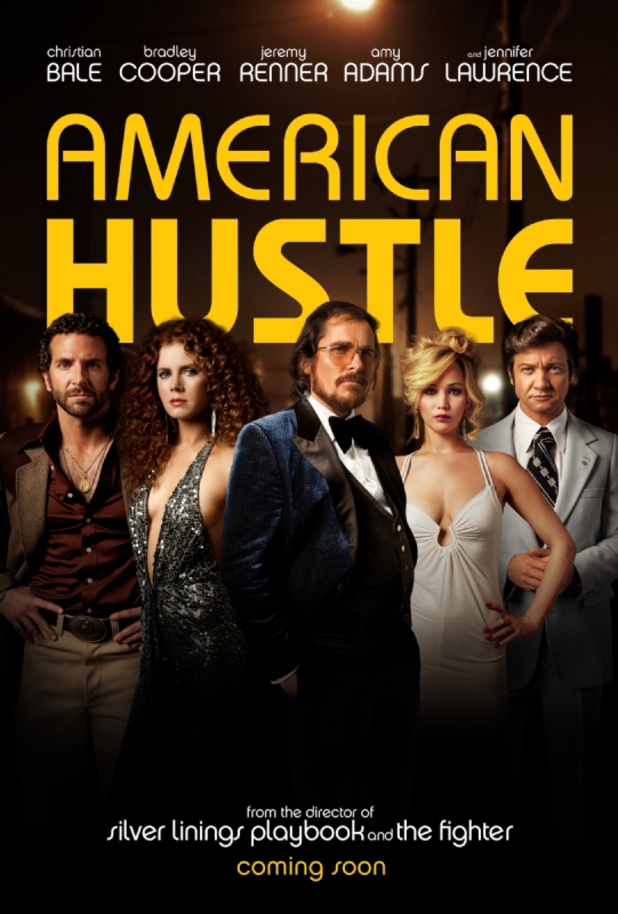 With two movies, writer/director David O. Russell has vaulted to the top of Hollywood. Previously known for his own difficult behavior, Russell’s last two films, The Fighter and Silver Linings Playbook, were both critical and commercial hits (Silver Linings made over $230 million worldwide). Both brought a bushel of Oscar nominations as well, making Russell one of the hottest directors for actors and producers. But a new side seems to have emerged over these last two movies, one less of Russell the domineering director and one of Russell the open collaborator. It feels like he’s just hitting his stride too. American Hustle is Russell’s latest and it’s sharply written, engrossing, lively, surprisingly comic, and readily entertaining.
In the late 1970s, the FBI set up an undercover sting to nail political corruption, ultimately nabbing several U.S. congressmen and one standing U.S. Senator. Richie DiMaso (Bradley Cooper) is an FBI agent who snags the perfect assistance. To catch a crook you have to think like a crook, and so Richie has strong-armed a pair of lucrative con artists into helping him. Irving Rosenfeld (Christian Bale) is a professional down to his elaborate hairpiece. He’s used to fleecing desperate people and selling phony artwork to the gullible, but he’s been too shy about making too much noise. If you stay small, you go unnoticed. Irving’s partner in crime is Sydney Prosser (Amy Adams), a kindred spirit who has reinvented her self. She and Irving are in love, and now they’re trapped by Richie to set up New Jersey mayor Carmine Polito (Jeremy Renner). The one unpredictable element is Irving’s young wife, Rosalyn (Jennifer Lawrence), who could blow up the whole operation with her careless and self-involved tantrums.
 Russell has once again given audiences one of the most entertaining films of the year, this time allowing them to participate vicariously in a con game, trying to anticipate the twists and turns and assessing everyone’s personal angle. This is a fictionalized rendition of the Abscam case (the opening text drolly says, “Some of this actually happened”) and it gives us a slew of meaty characters that have something going on. The central point elaborated in this pop crime caper is that we’re all cons, we’re all pretending, on some level, to be different people; Russell’s film just takes this notion to the extreme. Irving and Sydney are trying to escape lives of ordinary malaise, of being victims, of the more powerful dictating their options for them. With Sydney, she’s pretending to fall for Richie, but we don’t fully know which side she may choose to end up on. Richie is trying to also escape his dull life of desk jobs and lower middle-class dinners. His ambitions get hold of him, and with Irving’s aid, he catapults himself toward achieving those oversized dreams of his, never mind the ethical lapses in nabbing the bad guys. For Carmine, he’s so fiercely devoted to his community that you don’t doubt his loyalty for a second. He’s a man who sincerely wants to help others and is knowledgeable enough about how the world works, knowing he may have to grease some wheels to get the progress started. He is the most moral figure of the five main players and you may find yourself rooting for him to escape the snare closing in on him. Then there’s Rosalyn who has her hooks in Irving, looking for a sense of stability for her and her child. She’s a volatile cocktail of emotion but she knows what she needs to do to keep Irving anchored to her needs, though she’s also cognizant enough to latch onto a better provider if one materializes. Mixing and matching those characters, you have an eclectic mix of personalities clashing, many at odds with one another as far as goals, and the conflict stirred up is delicious.
Russell also attaches on his Martin Scorsese filter, delivering a freewheeling film about criminals from their wizened point of view, explaining the ins and outs of their hustle with flamboyance, style, and vigor. While the opening is a tad slow, including an opening minute watching Irving work his almost breathtaking comb over hairstyle, we plow right along into this world of hustlers and con men, learning tricks of their trade (hint: desperate people are desperate) and the tools to stay ahead of detection. We’re awash in multiple perspectives, each with voice over, a frenetic camera, and emboldened editing. It’s the Scorsese approach given studious application to the Abscam affair. It’s a great thing that Scorsese is the finest living filmmaker and devoting a two-hour-plus homage to the man’s most stylized crime pictures is a plus. Russell’s movie feels alive but also hungry, like many of his characters, restlessly searching for something. The scenes land but they don’t feel like they’re standing still; everything is propulsive in this movie. The small operation of Irving and Sydney is taken to the big leagues thanks to Richie’s ego, and the FBI’s desire for splashy headline busts, but wider exposure also exponentially multiplies the danger. Once the gambling scheme attracts the investment of the Mob, that’s when everyone has gone too far. I was clenching my fists in suspense toward the end, worried that our fictional cons may be too far in to survive.
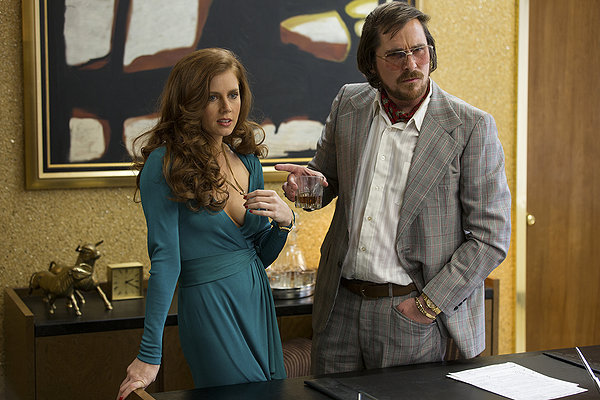 Russell hasn’t lost his magic touch with actors. His last two films have netted seven acting Oscar nominations and three wins, and the cast of American Hustle meets that same level of excellence. Perhaps even more so than The Fighter, the characters are given a very broadly comic brush, easily and routinely stepping into a carnival row of over-the-top behavior. It provides plenty of entertainment of the mishap and absurd variety, but there are also lone piercing moments of great empathy with these messy people. Mostly, the various actors all seem to be in a great syncopation, each one contributing where the other left off, building a great and compelling picture. When this ensemble is firing, it’s hard to beat. Special mention to comedian Louis C.K. (TV’s Louie) making the most of every scene he’s in as an FBI party pooper. His running gag involving a personal ice-fishing story is one of the film’s best jokes.
Bale (Out of the Furnace) is our guiding voice in this world, a flimflam man of the first order who fools maybe even himself. He’s got his own code of ethics and a heart behind that pot belly (another physical transformative performance by Bale the chameleon). He’s briskly entertaining but my only complaint is that, by being so suave and slick, he seems a tad too low-key at points given the risk involved. I know it’s part of the act, but from an audience standpoint, it makes him seem a tad too modulated. His equal is Renner (The Bourne Legacy) who is so earnest that it practically breaks your heart when he oversteps into morally murky territory.
However, Bale’s performance is compensated by the sheer craziness of the Silver Linings co-stars, Cooper and Lawrence. Cooper (The Place Beyond the Pines) is a lawman but also the film’s biggest antagonist. He gets drunk with power and the credit he’s receiving at the FBI. He’s also a deeply insecure man who is trying to style himself like Irving and Sydney as a posh reinvention. Cooper gives him a manic energy and taps back into his reservoir of eager-to-please egotism. Lawrence (Catching Fire) is the most unpredictable character. She acts on impulse, flirts with sabotage, and soaks up the spotlight she’s so rarely afforded. Lawrence is having the time of her life playing a loud, shrewish, vampy housewife who has a noticeable habit of starting house fires.
Beforehand, I would have thought that Lawrence and Adams should have swapped roles (still an interesting experiment), but having now seen the film, each suits them well. Adams (Man of Steel) is the saddest character of them all to me because she’s the bruised dreamer anxious to be anyone but who she really was. She relishes the con, more so than Irving, and ties much of her self-identity to her shyster skills.
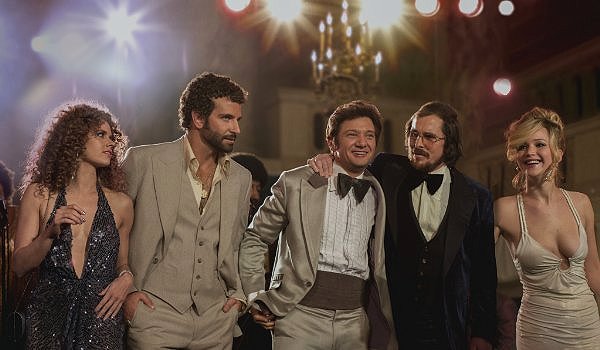 I’ve been dragging my feet writing my review and I’ve been trying to determine why, beyond, obviously, holiday-related sloth. American Hustle is readily a good movie that provides plenty of entertainment, meaty characters, and fun, but why do I keep feeling like it’s missing one undetermined ingredient? I can’t even articulate what at the moment but after having seen the film two times now, I feel like perhaps my emotional involvement was stunted. It’s a finely tuned script that delivers big performances for big-time actors, with a dandy ending that manages to dish out satisfying conclusions to its bevy of wheeler-dealers. But why didn’t I care more, why didn’t I feel more resonance by the time the end credits landed? The best theory I can surmise at this time is that we’re caught up in the con game, where everyone is pretending to be somebody else out of necessity or desire, that when it’s all over, we reflect on what a fun ride it’s been with fun characters but do we feel like we’ve gotten anywhere? I feel like I was more interested in the characters than attached to them. Again, American Hustle is still a sensationally entertaining movie and this paragraph is but a quibble, but it’s enough to thwart me from fully embracing and celebrating Russell’s film (confession: having already seen Scorsese’s brilliant Wolf of Wall Street, this could be coloring things for me with Russell’s Scorsese homage).
American Hustle is a fun ride with arresting performances, oodles of style, energy, and comedy. It’s a crime caper of the first order, easing you into this world and watching people play all sides. Even better, we’re given a volatile mix of personalities that clash, forming new and lasting conflicts, some of which could endanger the entire operation. These are interesting people to spend time with and so we can excuse the indulgences of a 140-minute movie that offers even more with this fantastic cast. Russell with a Scorsese filter is an even more improbably entertaining filmmaker. This is a crowd-pleasing sort of movie, much like Silver Linings, that doles out punchlines and payoffs with aplomb. It’s easy to go along for the ride, laugh uproariously, and then by the end sort of wonder whether it was all worth it. The emotional detachment to the characters may be a minor complaint for a film this largely satisfying, but since we’re spending so much time on our characters, I think I would have preferred something a tad more substantive by the end. It’s a great ride, with great characters and great humor, but there is a nagging concern that it may have been a better ride than a story. Regardless, American Hustle is an enjoyably alluring con that mines the absurdist fashions, personalities, and political overreach of the 1970s, painting a tale of criminals who may be the real heroes of the American dream.
Nate’s Grade: A-
Share this:

The Place Beyond the Pines (2013)
 Ambitious filmmaking is welcome, but usually ambition leads somewhere, which is the main problem with co-writer and director Derek Cianfrance’s unwieldy 140-minute multi-generational crime drama, The Place Beyond the Pines. First we watch Luke (Ryan Gosling) as a traveling motorcyclist enter a life of crime to support his infant son. Next the focus shifts to Avery (Bradley Cooper) as a cop with a conscience running into corruption on the force. Last, we jump ahead into the future and watch the dramatic irony unfold as the children of Avery and Luke interact, waiting for them to learn their paternal connection. I believe Cianfrance (Blue Valentine) and his team was attempting to tell a meditative, searching drama about children paying for the sins of their fathers, the lingering fallout of bad decisions and moral compromises. Except that’s not this film. By the end of the movie, while some secrets have been laid bare, there really aren’t any significant consequences. The film does an excellent job of maintaining a sense of dread, but it doesn’t come to anything larger or thought provoking. The entire structure of this film is geared toward a tragic accumulation, but it just doesn’t materialize. That’s a shame because it’s got great acting through and through, though I have grown weary of Gosling’s taciturn antihero routine that seems like a rut now. Avery’s portion of the plot was the most interesting and anxiety-inducing, but I found the movie interesting at every turn. The characters are given pockets of nuance and ambiguity as they traverse similar paths of desperation and conciliation. The Place Beyond the Pines is a perfectly good movie, albeit disjointed, that cannot amount to the larger thematic impact it yearns for.
Nate’s Grade: B-
Share this:

The Hangover Part III (2013)
 I was no huge fan of the first Hangover movie and I cited its 2011 sequel, a carbon copy of the original, as one of the worst films of the year. The supposed final chapter ditches the blackout formula, which on its face seems like a step in the right direction, but now we have a Hangover movie with no titular hangover and at heart this is a movie for no one, even hardcore Hangover fans. I became quite cognizant how little I was laughing, not just because the jokes were badly misfiring, which they were, but also because there were so few jokes. You’d be hard-pressed to label this a comedy. It’s really more of an action thriller. What humor does arise is usually mean-spirited, curdled, or just off-putting, particular the reoccurring theme of animal cruelty (maybe opening your film with a decapitated giraffe is not the best idea). The other major hurdle is that annoying supporting characters played by Ken Jeong and Zach Galifianakis are elevated to co-leads. Both of these characters are best when reacting to others rather than being the main actors in the story. This movie is so abysmal as a comedy that you start to think director Todd Phillips should try his hand at a straight action thriller; the guy has a strong eye for visual composition. The actors all look extremely bored. Could Justin Bartha, the character who always gets sidelined, just get murdered and they have to hide his body? Oh no, I think I just came up with The Hangover 4. I apologize already.
Nate’s Grade: D
Share this:

Silver Linings Playbook (2012)
 I am in love. It’s been days since I watched Silver Linings Playbook and I’m still under its spell. It’s a movie that gave me such rapturous emotional peaks, a deeply satisfying crowd-pleaser that doesn’t just nail the big moments, it crushes them. This is a movie that works so well with just about every facet of storytelling, from acting to writing to directing, that you’re liable to be in awe as I was.
Pat (Bradley Cooper), a high school history teacher, came home one day to find his wife in the shower with another man. He admittedly lost it, beating the man bloody, and has been remanded to a state psych ward for the past eight months. It’s determined that Pat is an undiagnosed bipolar case, and the court orders him to stay on his meds and stay 500 feet away from his now ex-wife, Nikki. Having lost his home, Pat is living with his parents (Robert De Niro and Jackie Weaver), both of whom don’t know how to help their troubled son. Pat is convinced he can win back his wife. He starts conditioning by running, wearing a garbage bag to better sweat off the pounds, and meets Tiffany (Jennifer Lawrence). She’s been fighting through depression after coping from the sudden death of her police officer husband. She agrees to help Pat get in contact with his ex, passing a letter, but at a price. He must compete with her in a dancing competition. They spend hours practicing their routine, getting to know one another, and stabilizing one another, providing a foundation for healing and success.
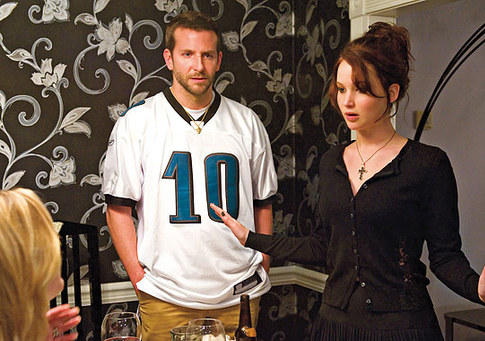 The story itself isn’t anything groundbreaking; you could glibly label it as the “bipolar rom-com” and it does adhere to that structure for the second half. But this is David O. Russell we’re talking about, the man behind 2010’s The Fighter, yes, but also offbeat dysfunctional family comedies like Spanking the Monkey and Flirting with Disaster. The man has a way of working within the framework of conventions and finding the rough edges, to make stories at once familiar and excitingly new. Is there anything groundbreaking with Silver Linings Playbook? It’s your boy-meets-girl formula at heart, but the execution is so extremely sure-footed, so exceptionally handled, that the movie leaves you buzzy and beaming. Once it ended, I wanted to run around, shouting from the rooftops for people to run out and see this movie. You want others to share in something so special and affecting. I felt a similar passion after seeing the unconventional romance Safety Not Guaranteed, and I’d advise any fans of Safety to certainly check out Silver. Being a rousing, crowd-pleasing sort of movie is not necessarily a yoke to weigh down its artistic integrity. As if enjoyment and creative accomplishment are opposing forces. I freely admit that Silver Linings Playbook is a masterful movie that knows what it takes to get an audience cheering, and I was thrilled to be part of that cheering throng. Here is a movie that just makes you feel good, and when was the last movie you saw that made you feel glowing with happiness?
This in an emotionally rich film; I was so happy after my screening that it felt like a high I didn’t want to come down from. To engineer a reaction that enhanced, that enlightened, that potent, well I must sing the praises of Russell and his actors. I bought into the love story and family drama big time. The payoffs are meaty and numerous, and I often found the film to be sincerely moving. There’s a great satisfaction in watching two oddballs find their special someone’s, and when the characters are this interesting, this human, and so well portrayed, it makes every stop along the journey that much more engaging and emotionally triumphant. It’s got an ending that pulls it all together in spectacular fashion, giving us exactly what we want while feeling earned and on its own eccentric terms. This is a deeply felt and compassionate film, one with as much uplift as acerbic rebellion. You feel like these people really do love one another. Silver Linings Playbook has memorized the playbook on how to win over an audience, but it always comes down to the same Xs and Os: strong characters, a compelling story, and people we genuinely care about, and that includes distaff supporting characters too.
 The characters are so interesting and beautifully flawed, and the actors are so in tune with one another, delivering bar-raising performances that take the movie into another realm of enjoyment. When actors are given plum roles about people with mental illnesses or disabilities, it must be very enticing to overindulge in tics and self-conscious mannerisms. That doesn’t happen with Silver Linings Playbook. Beyond an uptick in tempo, the actors portray their parts as characters rather than ailments. If anything, the acting in this movie is practically restrained given the circumstances. What’s more, Silver Linings Playbook is a fine example of what can happen when the cast works in tandem, challenging one another to up their game. It’s like every actor felt revived from all the talent on display. Russell knows how to push his actors like few other directors, and while this has lead to notorious Internet videos of his actors losing their cool, it’s also given way to raw performances that burn in your memory. Russell gets his actors to bring their A-game and then some. The Fighter got three Oscar nods for acting and I wouldn’t be surprised if Silver Linings Playbook gets three as well (I think Lawrence and De Niro are locks).
Cooper (The Hangover) has always had a certain smirking, leering quality about him, a guy used to portraying louts with charisma. I have never seen him tackle anything nearly as challenging as what he does with Pat. He’s unpredictably combustible, ready to explode at any moment, but also empathetic, trying to do better. Pat isn’t meant to be seen as a loveable loser. This guy has serious problems he’s working through. Cooper is simply incredible, showcasing skills and nuance you didn’t know the man had, radiating with an intense outpouring of spontaneous energy that doesn’t ever feel forced. Cooper is not bouncing off the walls here as some wild-eyed loony, playing upon codified ideas of what a bipolar person behaves like. He’s a deeply complicated guy, processing challenging and contradicting feelings in a brain that doesn’t necessarily follow the rules. He has so many impulses leading him in different directions. Pat is obsessed with his goal of impressing his wife, so much that he seems blind to the tangible connection he’s formed with Tiffany, and we yearn that he realizes the catch in front of him. I was won over completely by Cooper’s committed, attentive, anxious, and lively performance.
Readers will know that I harbor a serious crush when it comes to the talented actress, Lawrence (The Hunger Games). I was expecting her to be great in this movie, as this is pretty much my default setting with the actress at this point. I was not expecting what she delivered, a performance that is so enthralling, so astonishing, that you’ll be left stupefied that a woman at only the young age of 22 could be this phenomenally gifted. Lawrence had several scenes that just left me speechless. Lawrence is in elite territory now as far as I’m concerned. Her command of the character is just about impeccable, and you perk up every moment she’s onscreen. She’s a damaged woman recovering from her own powerful grief, but she’s so many things at any one moment. She can be lusty, provocative, angry, sullen, commanding, vulnerable, and hurtful. There are scenes where she will bounce around a plethora of emotional states, but each one gradually shifts to the other, making the transformation genuine and another layer to the character. If she were just some crazy girl we wouldn’t care if she eventually got her happy ending with Pat. With Lawrence’s talents, and Russell’s sharp writing, Tiffany becomes a figure worth fighting for, a bruised romantic that finds her rare kindred spirit who accepts and appreciates her messiness.
The supporting cast from top to bottom may not be at the same level as Cooper and Lawrence, but their output is also impressive. De Niro (Limitless) hasn’t been this good in ages, delivering a few monologues that will hit you square in the gut. Weaver (The Five-Year Engagement) is something of an enabler for the family, but she also gets her moments to shine and reassert her strength and dignity. Chris Tucker (in his first non-Rush Hour movie since 1997) is the least Chris Tucker I’ve ever seen him. He’s downplayed his motor mouth tendencies completely, and he’s a wonderful presence as he ducks in and out. He even teaches Tiffany how to “black up” her dance, a fact that most heterosexual males in the audience will be thankful for this time of year.
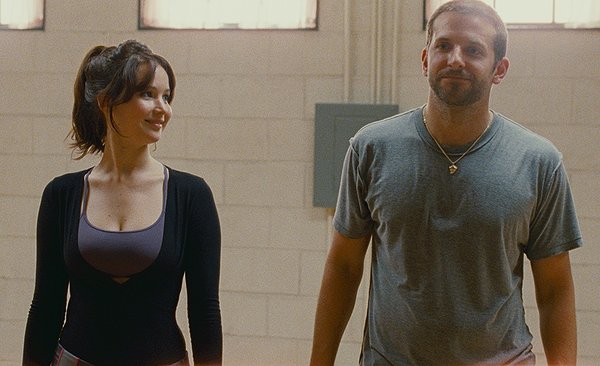 Russell deserves serious credit for portraying mental illness in a manner that doesn’t dance around the seriousness of the condition. Statistically one in three people suffer from a mental illness at some point in their life, and I’ll even admit that post-divorce, I too fell amongst those ranks (I’m a statistic!). In the case of Pat, He’s not just some unfeeling jerk who says inappropriate things or has problems reading social cues. He’s a guy going through serious personal struggles, same with Tiffany. These are not jokes. They are not send-ups of mental illness; they are people. At no point does the humanity of these characters get lost. We will laugh at their inappropriate comments, sure, but we are never laughing at them from some cushy sanctuary of superiority. I also think Russell examines an interesting, more socially-acceptable form of mass mental illness, namely the OCD-nature associated with sports superstitions. Smart and capable people can get caught up in the allure of superstitions, and when it concerns sports in general, groupthink overpowers. I consider myself a sports fan as well (I’m a double statistic!) and fully accept the ridiculous nature of fandom, but I thought it was a clever move for Russell to hold the mirror up to our own cracked community and its irrational behavior. And as any Philadelphia sports fan will acknowledge, they take fandom to a whole other level.
At this point, I don’t know what more I can write about this movie without coming across as a complete, frothing madman. Football, mental illness, ballroom dancing! I’m smitten big time with Silver Linings Playbook. I’m completely in the tank for this film. Future viewings (already planning one soon) will probably highlight certain minute flaws I’ve failed to notice the first go-round. And even if those flaws become more apparent (yes the final dance is something of a contrived climax) I simply do not care. The movie’s many virtues far exceed any shortcomings that could potentially arise. It plays to some familiar rom-com elements but it goes about its business with its own funky charm. The acting, writing, and directing are all on such a heightened level of excellence, it’s amazing just to watch all the parts work together so masterfully. I wasn’t just won over by this movie; I’ve become its disciple. I preach the gospel of Silver Linings Playbook. Here is a rapturous feel-good movie that doesn’t feel like it’s pandering or dulling its edge even after it takes some conventional turns. Cooper is terrific, Lawrence is astounding, and together they form the couple you cheer for. Silver Linings Playbook is everything you’d want in a stellar movie. I can’t wait to watch it again and get caught up in its wondrous spell once more. It took a long ten months but The Grey has finally been knocked off the perch. Silver Linings Playbook is nothing short of the best film I’ve seen this year.
Nate’s Grade: A
Share this:

Hit and Run (2012)
 Hit and Run was a labor of love for actor Dax Shephard (TV’s Parenthood). He wrote the script, co-directed the film, did plenty of his own car stunts, edited the film, and got his longtime girlfriend, the irascible Kristen Bell (Forgetting Sarah Marshall) to co-star as his love interest. I just wish the movie were better. It’s something of a strange mix, a road chase that zips along to loping comedic rhythms, spending as much time having characters engage in self-aware conversations about a variety of topics. It’s like a rom-com with car chases. Shepard and Bell are terrific together and have a natural comedic chemistry to them, an ease that befits both of their acting styles. Then there’s some of the more troubling comedic moments, like when the villainous Bradley Cooper (The Hangover) literally ties a leash around a black man and forces him to eat dog food. It’s one uncomfortable scene to watch. Then there are sudden bursts of violence and nudity, to go along with the bizarre conversational tangents. The plot is a loose collection of near-misses and digressive asides. It wants to be one of those 70s car chase comedies, something along the likes of a raunchier Smokey and the Bandit. This movie does keep you guessing, but it rarely adds up to anything worth all the trouble. Car enthusiasts will probably enjoy all the vehicular eye candy, and I’m happy to see Bell tackle a meatier role than she seems to be offered at this time, but I can’t work up more than a half-hearted shrug for Hit and Run. It looks good but just has nowhere to go.
Nate’s Grade: C+
Share this:

Limitless (2011)
 With a dream premise for a pill-popping culture, Limitless is a visually fervent thriller that manages to stay a step ahead of the pack. Bradley Cooper takes a pill and can unlock full potential of his brain, which involves, obviously, scoring big paydays and women. It’s a silly fantasy but a universal curiosity of what we could do if given full access to our noodle. Director Neil Burger (The Illusionist) uses every visual trick in the book to represent the new brainpowers, as we watch words, numbers, and memories drift through a colorful explosion of imagery. It’s all very pretty to look at. Burger’s visual prowess elevates the more pedestrian moments of Limitless, but the film has a way of surprising you. The Mob takes an interest in this wonder pill, operating at a new peak of production. A woman being hunted down takes the magic pill and is able to quickly formulate an escape. So what if the profound existential questions regarding human capacity and possibility are thrown aside, we got some nifty visual flourishes and foot chases here people. The pacing is relentless and the plot manages to find intriguing ways to keep a superbrainiac in danger. Limitless is a perfectly enjoyable movie with enough juice to forgive its lamer moments and contrived ending.
Nate’s Grade: B
Share this:

The Hangover: Part II (2011)
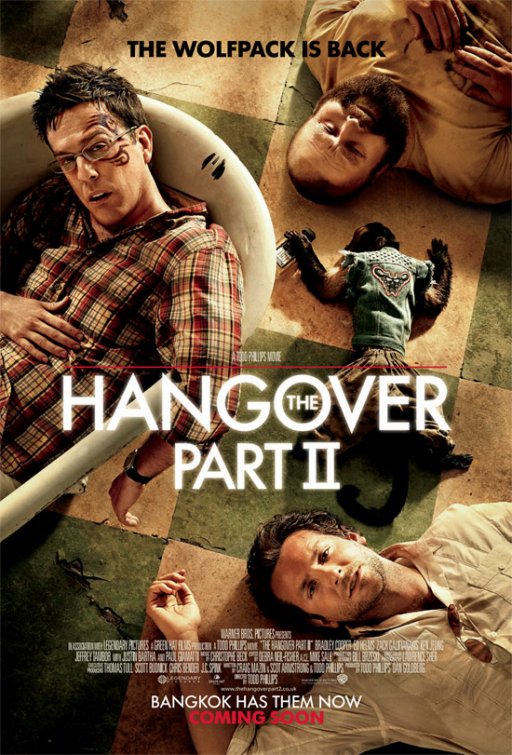 When you’re responsible for the highest-grossing R-rated comedy of all time, a film that grossed over half a billion dollars worldwide, then you don’t want to tinker with a winning formula of a surprise hit. Naturally, with that kind of money, a sequel was inevitable. Director/co-writer Todd Phillips (Old School, Due Date) is back and so is everybody and everything else. You’ll get a strong sense of déjà vu watched The Hangover: Part II. That’s on purpose. This calculated, rather soulless cash-grab sequel wants to recreate the organic experience of the first film. If you played The Hangover and The Hangover: Part II on simultaneous TVs, I would not be surprised if the same plot points happened at the exact same minute-marks. It might even be like a Pink Floyd/Wizard of Oz experience. I paid twice to see the same movie two years apart.
Stu (Ed Helms) is about to get married in Thailand to Lauren (Jamie Chung). Our favorite wound-up dentist is apprehensive about any sort of bachelor party shenanigans after the events of two years ago in Las Vegas. His pals Phil (Bradley Cooper), Doug (Justin Bartha), and the socially inept Alan (Zack Galifianakis) make the trek to attend the festivities. For Alan, it’s a reunion of the Wolfpack and an excuse finally to venture out of his parent’s home. Stu has some ground to make up with his bride-to-be’s father. Her father seethes about the prospect that his beautiful daughter is going to marry Stu, a man he compares to watered down rice. Lauren’s younger brother, Teddy (Mason Lee), a pre-med student and concert cellist, is left to the Wolfpack’s care the night before the wedding. They’ll just have one drink on the beach. What’s the worst that could happen? Flash to the next morning. The guys awaken in a strange apartment. Teddy is missing and missing a finger as well. Stu, Phil, and Alan must once again retrace their steps and solve the mystery of their hard-partying antics before the wedding ceremony.
The Hangover: Part II is a carbon copy of the original. Because the same joke is just as funny the second time around, right? This empty enterprise gives its audience exactly what they want, which is precisely the same experience they had with the first film. But so much of comedy is predicated on surprise, so how can you recreate the experience of discovery that people so heartily enjoyed with the first film? The Hangover: Part II is like a cheap comedy Mad Libs game: it reuses the same gags and just fills in the blanks. Hey, if Joke A worked before, why couldn’t we just have Joke A in this different location (instead of two guys walking into a bar, they walk into a different bar)? It’s like somebody copied and pasted the screenplay from the original movie, changed the locations and minor details, and cashed a check. Let me get into how stunningly indolent the screenwriting is (small spoilers to follow). Once again a person in their group goes missing before a wedding. Once again Stu has some self-inflicted wound to his face. Once again the guys have stolen someone else’s unorthodox pet. Once again they find themselves with a ward (baby in first film, Mr. Chow in second). Once again Stu has gotten involved with a prostitute. Once again Alan was secretly responsible for their drugging. Once again Justin Bartha gets left out of the escapades. Once again Mr. Chow shows his junk for shock value. Once again Mr. Chow jumps out of a locked container attacking the guys. Once again the guys have to return money to a gangster. Once again Stu plays a song of his own creation bemoaning their situation. Once again they have to race to the wedding minutes away. Once again we have a Mike Tyson cameo. Once again the guys find pictorial evidence of their debauchery and they play over the credits. Even directing touches like a time-lapse high-rise shot passing the time before they wake up is reused.
That’s what kills the movie is the lack of surprise. It throws the guys into a different setting, gets darker and meaner, but it’s rarely funny. I was surprised how many jokes left me in stony silence. Phillips and his screenwriters have gotten into the trouble of having to top themselves, so they rely on the “bigger is better” approach to match the outrageousness of the original. If Las Vegas is Sin City, then what would be even seedier? Bangkok, of course. Where would they go for a third film? What gets seedier than Bangkok (The Hangover 3 to be set in Rep. Anthony Weiner’s office). Yet the film curiously ignores much of what makes Bangkok the world’s preeminent hotspot in the sexual trades. The payoffs are darker and lack the bemusement of the original. Knowing some guy is missing a finger is not as whimsical as somebody missing a tooth. The movie has an unpleasant homophobia to it thanks to male genitalia being used to shock and horrify and humiliate. The horror of being involved with transsexual women made my theater audience groan with extra relish, like the presence of a penis or homosexual content makes everything automatically more disgusting to the common people, as if anything gay is the worst thing that could possible befall a man. Mr. Chang is an odious and fairly unfunny stereotype, and Jeong (Role Models, TV’s Community), so funny in just about every other role he’s ever had, is a braying, high-pitched annoyance. This go-round the jokes feel stale, the characters feel tired, and the payoffs seem too mean-spirited to be satisfying.
When you have a movie where the comedy is situation-based, then those situations better be funny because the characters are only serving as a means to an end. The premise allows the filmmakers to have it both ways. They can fulfill the hedonistic spectacle that will make people blush, and at the same time they can have button-uped, likable, relatively relatable nice characters that an audience will root for. If we watched these characters acting like irredeemable morons, then audience sympathy would wan. But having the guys investigate their previous dirty deeds, and react in horror, does not lessen audience sympathy. I enjoyed how the main trio played off each other in the first Hangover, and the central mystery was a solid glue to hold together a loose collection of mostly worthwhile gags. Just as the first film fell short of its potential, so too does the second movie. A monkey serves little purpose other than to get it to do things that seem outrageous just because it’s a monkey (it smokes, it mimes oral sex – hilarious!). But the second time around, the amusement of seeing Stu fly off the handle, or listen to Alan’s moony non-sequitors, doesn’t have the same draw. Galifianakis (Due Date) made the film watchable for me despite the fact that the screenplay makes his character a petulant and highly irritating character rather than a man-child doofus. And the women are once again relegated to the sidelines when it comes to being in on the comedy.
For The Hangover‘s legions of fans, more of the same will likely be exactly what was desired. But without the cheeky element of surprise, the comedy just seems like it’s hitting pre-ordained stops according to its formulaic cheat sheet. For the original Hangover I wrote: “Let’s face it; once you know the solution to the mystery and all the surprises, will this movie still play out as funny? …But once you knew who was behind what, and how the whole game was staged and operated, could you even watch the movie a second time? Would it still work now that a repeat viewer knew all the secrets? Does this comedy have a built-in expiration date?” Well, The Hangover: Part II is the answer. If the first film was a comedy with an expiration date, then The Hangover: Part II is one comedy that’s gone rancid.
Nate’s Grade: C-
Share this:

The A-Team (2010)
 “Overkill is underrated,” quips Col. Hannibal Smith (Liam Neeson) in this big-screen adaptation of the 1980s hit TV show of the same name. And appropriately enough, like its source material, The A-Team is the very definition of mindless action. It’s completely shallow, goofy, yet over plotted and occasionally too serious for its own good, but like the A-team, the movie delivers when it counts. There is an undeniable pleasure in watching professionals work together, hatch a plan, and then watch that plan come to fruition. The A-Team is like an ADD-child because it can rarely sit still; five minutes won’t pass before something blows up. Writer/director Joe Carnahan (Smokin’ Aces) makes sure to keep things flying on screen so that the audience won’t stop and think about the multitude of plot holes and absurdities. The signature sequence that sums up the movie best is when the A-Team boys have escaped a downed aircraft by hiding inside a tank with parachutes attached. As they tumble back to earth they must try to “fly that tank” to land properly. It’s ridiculous on its face but rather entertaining. But the movie has its tongue firmly planted in cheek, even when it comes time to incorporate the show’s signature catch phrases (you could make an effective drinking game for the amount of utterances of “fool,” and, “I love it when a plan comes together”). The A-Team is overblown, silly, high-octane B-movie that obliterates your senses and thinking abilities, which means it successfully captures the spirit of the TV show.
Nate’s Grade: B-
Share this:

Valentine’s Day (2010)
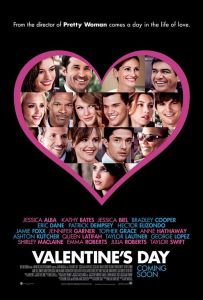 Imagine every romantic comedy cliché and sappy platitude about love stirred together into one giant gelatinous conglomeration of hollow sentiment. That’s Valentine’s Day. Regardless of your thoughts on the holiday, this movie, which aims to celebrate our national day of love, might have the opposite effect. This movie makes He’s Just Not That Into You look like When Harry Met Sally. It?s a fairly large ensemble with plenty of mega-watt stars, but it’s too bad that nobody knows what to do. Jessica Alba’s character literally runs her course an hour into the film and yet she still makes meaningless appearances. This overstuffed Hallmark card has ridiculously safe, candy-coated storylines sanded so that there is no hint of edge or wit (Anne Hathaway is the most ludicrous PG-13 phone sex operator you will ever find). The resolutions of most of these storylines will be predictable to anybody who has ever read a greeting card. Jamie Foxx is supposed to be a bitter TV reporter popping up everywhere reporting about the ills of V-Day. Think he’ll have a change of heart by the film’s end? The cast does offer their small pleasures (there are SIX Oscar nominees/winners in this movie!), except for the kid who has a crush on his teacher (Jennifer Garner). He was insufferably annoying. So was his movie.
Nate’s Grade: D+


 nathanzoebl
You must be logged in to post a comment.