Blog Archives
Harry Potter and the Chamber of Secrets (2002)
 So is Harry Potter and the Chamber of Secrets better than the first film? Well, mostly yes. The story of Harry Potter is a long and complicated one, full of numerous funny names as well. Harry (Daniel Radcliffe) is still living with his abusive relatives and barred in his room. Hes warned by Doddy, a self-abusive CGI house elf, not to return to Hogwarts School of Magic because he will be in grave danger. Fat lot of luck this does. Before you can say Jar Jar Binks, Harry’s timid friend Ron Weasley (Rupert Grint) and his flying love bug rescue Harry. They meet up with old friend Hermione Granger (Emma Watson) and begin their second year of magical education. But danger surfaces as students with Muggle (a non-magically inclined family member) blood are turning into petrified statues. Lots of other stuff is crammed in (like broomstick rugby, Nancy Drew-like detection, and spiders oh my!) but lets all be honest here, its not like a plot synopsis is going to push you into seeing this movie.
 Much of the acting responsibilities falls on the shoulders of our three young leads, and all I can say is what a world of good puberty has done them all. Radcliffe, stiff and overly subdued in the first film, has grown a deeper voice. He seems to have settled into the part nicely. Grint, playing a noble coward, goes from squeal to grimace in 3.5 seconds. Watson has a winning smile and bounces with enthusiasm but sadly sits the last half of the film out.
Some notable additions to the Harry Potter family include Kenneth Branagh as the narcissistic new professor of the Defense Against the Dark Arts. Can anyone do ham better than Branagh? I dont think so. Jason Isaacs is malevolently delicious as the aristocratic father of Harrys school rival, Draco Malfoy. You could start shivering from the icy glare this man casts.
Chamber of Secrets is better than the earlier Sorcerer’s Stone in many ways. The story has less exposition and contains darker elements that suit the story surprisingly well. The special effects are vastly improved from the first film. The child acting, as previously mentioned, is much better.
Despite lacking prolonged setup, Chamber of Secrets clocks in around 2 hours and 40 minutes — 9 minutes longer than the first! You could watch your life go by sitting through a Potter movie marathon. This might seem like an eternity to small children if they weren’t so overly obsessed with the book series.
 So remember when I said Chamber of Secrets was “mostly” better than the first film? Well that “mostly” is because the amazing adult cast is hardly seen. Gentle giant Robbie Coltrane and Maggie Smith are mere background noise to the story. Headmaster Dumbledore (played by the late Richard Harris) has a weathered feel. What Chamber of Secrets needs are more scenes with the brilliant Alan Rickman, as moody professor Severus Snape. Rickman (Dogma) is perfect and a thrill to watch. I got a fever and only more Rickman can cure it.
Chris Columbus (Home Alone) is a director with no remarkable visual flair or distinct vision. Everything that is occurring is so faithful to the book that it has no individual flavor or distance. It’s directing with your hands tied. It should be Rowling’s name for the director’s credit because she’s the one with the vision being translated.
Harry Potter is a worldwide phenomenon that is already breaking box-office records and parents’ bank accounts. Chamber of Secrets plays toward audience expectations, but all of the components involved seem to be settling in their roles. Chances are whatever you felt about the first film youll relive during the second.
Nate’s Grade: B
Share this:

The Rules of Attraction (2002)
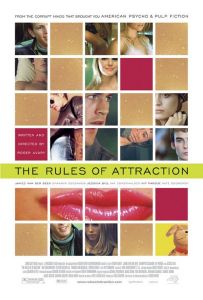 The Rules of Attraction is based on Bret Easton Ellis’ hedonistic 80s novel about boozing coked-out, aloof teenagers and their rampant debauchery. Roger Avary was Quentin Tarantino’s writing partner for years, with an Oscar sitting at home for co-writing Pulp Fiction. As a director Avary lays the visual gloss on thick utilizing camera tricks like split-screens and having entire sequences run backwards. While Ellis’ source material is rather empty, echoing the collegiate friendships bonded over substances or social lubricants, Avary does his best to represent the dazed world of college.
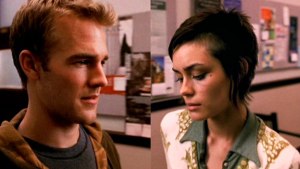 We open with Lauren (Shannyn Sossamon) getting raped by some drunk “townie” while the film buff she had her eyes on videotapes it. She’s just broken up with the bisexual and apathetic Paul (Ian Somerhalder), and both are interested in the sociopath Sean Bateman (James Van Der Beek), a self-described emotional vampire. Lauren keeps a picture book of venereal diseases to ward her from her wayward sexual urges. Her roommate Lara (Jessica Biel) needs no such book. Our introduction of Lara has her dancing down a hall, liquor bottle in each fist, bedding an entire sports team. Some attractions connect, many don’t, but the fun is watching the characters interact in their own seedy yet often hilarious ways.
The best thing that The Rules of Attraction has going for it is its about-face, against-type casting. The film is populated with the WB’s lineup of clear-skinned goody-two-shoes getting a chance to cut loose. Van Der Beek broods like a predatory hawk and bursts with spontaneous rage. Biel sexes it up as a cocaine-addicted harlot who asks if she’s “anorexic skinny” or “bulimic skinny.” Even Fred-Wonder-Years-Savage shows up briefly to shoot up between his toes! The adults of this world are no better than the kids. Eric Stoltz has an extended cameo of a duplicitous professor offering a higher GPA if any coeds are willing to go down on their morals. Swoosie Kurtz and Faye Dunaway show us that pill-popping ditherheads may likely breed drug-addled teenagers.
 Attraction may have the most disturbing suicide I’ve ever witnessed in film. After having her advances rejected a woman slips into the bathtub, razor in hand. The scene is as unsettling as it is because the camera hangs on the poor woman’s face every second and we gradually see the life spill out of her as the music becomes distorted, not letting us escape the discomfort.
Some of Avary’s surface artifice works perfectly, like Victor’s whirlwind account of an entire semester in Europe. Some of the visual fireworks are distractions to the three-person narrative but the film is always alive with energy, even when it’s depressing you. What The Rules of Attraction does get right is the irrational nature of attraction. Each character is trying to fill an inaccessible void with what they think is love but will often settle for sex, drugs, or both. The Rules of Attraction is made up of unlikable, miserable characters that effectively do nothing but find new ways to be miserable. It constantly straddles the line of exploitation and excess but maintains its footing. The movie is entirely vapid but it is indeed an indulgently fun yet depraved ride. If you’re looking for degeneracy instead of life-affirmation, then The Rules of Attraction is your ticket.
Nate’s Grade: B
Share this:

Red Dragon (2002)
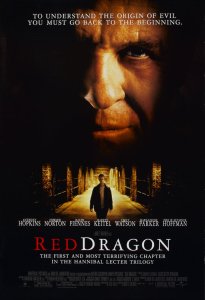 The following is a conversation overheard between two studio producers:
Person #1: So this Hannibal movie made like a ton of green. What else can we do to squeeze out some more money?
Person #2: Hey, do you remember a movie called Manhunter based on the first Lector novel?
Person #1: Nope.
Person #2: That’s fine because nobody else does.
It’s official folks: Hannibal Lector, America’s favorite cannibal, is now more comical than scary. See the element that 1991’s Silence of the Lambs carried with it was a stealthily gripping sense of psychological horror. It hung with you in every closed breath you would take, surrounding you and blanketing your mind. I mean, there aren’t many serial killer movies that win a slew of Oscars. And while the follow-up, last year’s Hannibal, gleefully bathed in excess at least Ridley Scott’s sequel was so over-the-top with its Baroque horror that it was entertaining. So what’s Red Dragon, the latest Lector flick based on Thomas Harris first novel like? Well it’s like the bastard child of Lambs and Hannibal after a drunken one-night-stand neither would be proud of in the pale light of morning.
 In an extended prologue we see the capture of the good doctor with a good appetite, Hannibal Lector (Anthony Hopkins, completing his trilogy of the character). FBI Agent Will Graham (Edward Norton) seeks his advice on a profile of a serial killer, not knowing that Lector more than fits the bill. A violent struggle ensues that leaves Graham with a long scar across his abdomen and Lector locked away for nine consecutive life sentences.
Turns out there’s another madman on the loose. The Tooth Fairy, dubbed by tabloid journalist Freddy Lounds (Phillip Seymour Hoffman), has butchered two families in their homes and inserted shards of broken mirror into their eyes. The FBI coaxes Graham out of retirement to try and track down the Tooth Fairy. But it seems in order to make any significant ground he must seek help from an old advisor – Hannibal Lector.
The crux of the film follows Graham’s attempts to figure out the identity of the Tooth Fairy, which we learn fairly fast is pretty boy Ralph Fiennes. Seems Fiennes has a cleft palette and years of physical and sexual abuse to toil over. He desires to transform into a mythical Chinese creature known as the Red Dragon. But wait, the lonely Fiennes is befriended by a lovely blind woman (Emily Watson) who identifies having people look differently at her. Can her affections melt the cold heart of a cold-blooded killer? Well, if they did thered be no other half of this movie.
What Red Dragon feels like is more of a checklist of what we expect to see in a Hannibal movie than anything of creative nourishment. It’s like a slimmer version of Lambs plot. Once again there’s an FBI agent who recruits Hannibal for advice on tracking down a serial killer. Once again there’s a disturbed killer trying to transform himself. Once again Hannibal Lector scares the crap out of anyone at will. Check, check, and check. Creative stagnation? Double check. The most disappointing aspect is the rudimentary feel this whole exercise has. Even though Red Dragon is a prequel it still seems like it’s begging to meet our expectations of two earlier films.
The first stab at the Red Dragon novel was in 1986 by director Michael Mann (Ali, The Insider) with the thriller Manhunter. William Peterson (before his work at CSI) was a more brooding Graham, Tom Noonan was a spookier Tooth Fairy, and the tension was stacked better. There were no comparative expectations.
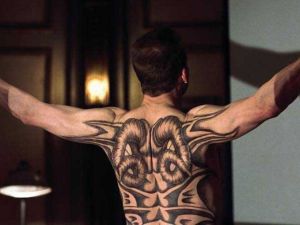 Norton is the finest actor of his generation but has certain trouble breathing life into Graham. The character is far more straight-laced than what we’ve been told is an expert at delving into the minds of killers. Grahams relationship with Lector doesn’t have any of the complexity, or interest, that Jodie Foster’s Clarice Starling had. He can even be very flat-footed in his detective work for a specialist. He stares at the home videos of the two slain families for about an hour wondering what the connection is while we in the audience shout it out to him. Lets go to the videotape Ed!
Anthony Hopkins returns as the devil in the flesh and seems to have another grand old time. Lector worked in Lambs because he was caged up, like a wild animal not meant for four glass walls. You never knew what would happen. He’d get in your head and he would know what to do with your gray matter — not that he didn’t have a culinary degree in that department with Hannibal. With Red Dragon, Hannibal is just window dressing to another serial killer. He’s a supporting character in a story that he has nothing to do with. He’s reduced to comic relief with his sudden attacks of chattering teeth and velvety voice. The amazing supporting cast of actors all do well, especially the beaming Watson who will shine in anything you put her in. Just try.
Ultimately the story of Red Dragon is far from flawless and meanders for quite a while. It would have been a marginally competent movie had it not been trying to replicate Silence of the Lambs so damn hard. So, is this the last youll see of Hannibal Lector? No as long as clinging cash registers can still be heard. Cue evil laughter.
Nate’s Grade: C+
Share this:

The Bourne Identity (2002)
 If you were in a fight who would you want to back you up? Ben Affleck has some heft. He has taken on a meteor, lesbians and even a crazed Sandra Bullock. Or maybe you’d take Matt Damon. “Wait, the same Matt Damon who stars in all those overly-serious period piece dramas?” you might reasonably ask. Well the very same Damon proves himself quite feasible as a thriller hero in The Bourne Identity and might just open a few new doors for himself – in between those overly-serious period piece films.
The flick starts off with a fishing vessel pulling a floating Matt Damon out of the Mediterranean. He has two bullets in his back; a Swiss account number embedded in his hip and no idea who he is or where he came from. He journeys to a Zurich bank where he uses the account number to unlock a safety deposit box. Inside he uncovers a series of different passports, stacks of all kinds of currency and a loaded gun. The box does however yield a name in Paris, Jason Bourne. He offers Marie (Franka Potente) a slew of dollars if she’ll transport him out of the country to where he can find his true identity and flee any police pursuits. It seems Bourne’s previous handlers do know his identity but are hurrying to dispatch other European assassins to make sure that no one else does. They’ve posted pictures of Bourne and Marie for any of their many eyes and ears to report back on.
 Damon does begin to recover certain memories and reflexes. Early on he dispatches two Zurich police officers in a park quite handily but still remains clueless to his identity. Once in Paris Damon and Potente become an inseparable team trying to elude snipers, police, and any sort of danger while attempting to fit the puzzle pieces together. The film then descends into a series of great chase scenes and action pieces with bits of story in between. We as an audience root for Damon’s triumph, even if he may well truly be a cold-blooded killer.
The Bourne Identity is a loose translation of the Robert Ludlum spy novel of the same name. The 1980 Cold War novel has been retooled to where the bad guys aren’t Ruskies but CIA bureaucrats (Chris Cooper and Brian Cox) wanting to save face. But in today’s age I think most people would actually wish that the CIA is as powerful and technological advanced as portrayed in the movie.
Damon is a stranger to the action ropes. He’s more accustomed to ride pretty horses in picturesque Texas or gaily kill people in picturesque Italy. While Affleck’s saved the world, like, three times in cinema already Damon has been playing golf. You get the idea. That’s what makes it so surprising how capable Damon is in this unfamiliar territory. He scales walls, he drives a stick shift through a high speed car chase and man does this guy know kung-fu. You just better not have any ball point pens lying around. Run Damon run!
Franka Potente, is there a lovelier woman in the world than you, of the fire head variety in Run Lola Run? She is more than just a “romantic interest” even if that’s the lot she’s been given. She’s a surprising choice to coincide with Damon but a gamble that works marvelously. Hey, it bought my ticket. The chemistry between Potente and Damon doesn’t exactly speak of sparks but they look beautiful onscreen alongside each other.
 Doug Liman is the director who put the swinger in Swingers baby. He also directed 1999’s most free-spirited thrill ride Go, so the man knows how to stretch a budget and propel an exhilarating vicarious feeling off the screen. The Bourne Identity is Liman’s first studio backed adventure and he should make his financial parents proud. He has a direct sense of mood and scale, setting the entire film amongst the wonderful backdrop of European cities. The look of the film is great, from the cool colors, the wet snow, to the luscious locales.
The film actually tries to shoehorn more profanity into a PG-13 movie than might be allowed. Potente, while in a hairy situation, will often keep muttering German profanities. After like the 30th time it becomes almost comical that studio execs or the MPAA would just let it slip through just because it wasn’t in English.
Damon eventually does come to learn of his former self as a trained CIA assassin and, as with all memory-recovery movies where the person’s previous life was dubious; they decide to be a better human being. If only more people would lose their memories.
The Bourne Identity is a slick spy caper with arresting visuals and some great propulsive action sequences, in particular a standout car chase through the back streets of Paris. Liman has crafted an intelligent spy thriller for the post Cold War era that makes perfect use of an anti-hero and his conflicts of memory.
Nate’s Grade: B+
Share this:

The Time Machine (2002)
 The Time Machine is one of the most famous works of fiction in history. It was writen long long ago by the great H.G. Wells. It presents a fantasy glimpse into our future, but in it Wells also gave readers the opportunity to ponder what would happen if they could go back and change their own lives. People have used the story as a cautionary allegory to our own times, like the 1960 film version of The Time Machine. Now, a bigger budget Hollywood remake attempts to put another spin on the Wells classic.
Alexander Hartdegen (Guy Pearce) is an absent-minded professor interested in cracking down the physics of time. He’s chided by some of his peers for crackpot theories and his fascination with any new gadget. He’s supposed to meet Emma (Sienna Guillory) at Central Park and tonight’s the big night he plans to propose to her. He eventually catches up to Emma and the two go strolling off into the park. Shortly after popping the question the two become victims of a mugging and in the fray Emma is left dead. The death drives Alex to create his fanciful time machine, which only happens to take four years time.
Alex gives his big brass LA-Z-Boy looking machine a try and travels back to that fateful night to avoid Emma’s death. Alex avoids the mugger all right, but while purchasing flowers his fiancé gets plowed over by a runaway carriage instead. It seems that one cannot change the past. Alex decides to give the future a chance and travels to a very Back to the Future 2 looking 2037. Someone astutely asks Alex if his time traveling machine makes a good cappuccino.
 When Alex hops a little further into the future the moon is breaking up because of ill-fated lunar construction. Moon rocks are hurtling toward the surface and disrupting everyone’s day. (It was in this moment that a scene of rocks smashing into the World Trade Center was cut for taste) Alex jumps back into his machine but is konked out by some lunar cheese and falls asleep at the wheel. The next thing you know Alex is in a mysterious future world.
The place where The Time Machine really bogs down is once Alex arrives in 80,000 something or other. The child-like thrills and adventure of Alex zipping between the past and near future are buried underneath the standard post-apocalyptic movie world. The people dress in loin cloths and rags (though some of the female natives wear revealing tops that look like see-through chain mail) but still have perfect teeth. When Alex doesn’t understand the linguistics of 80,000 AD the next words that he hears are English from shapely native Mara (pop star Samantha Mumba). It’s amazing that English survived 81,000 years when Latin didn’t last a mere 2,000 and change.
It turns out these people who live in huts resembling hot air balloons along the faces of cliffs are called Eloi. The Eloi don’t have anyone looking old enough to carry an AARP membership and are apprehensive to speak of why. Perhaps it’s because creatures resembling something that would belong in The Mummy Returns pop up from the sand to capture whatever slow moving prey they can and return to for an underground feast.
The creatures, called Morlocks, are the offshoots of evolution. Seems after the whole moon destruction thing (whoops!) those who took refuge below the surface have evolved into dusty hunchbacked cannibals. Their rowdy ranks are controlled by Uber-Morlock (I’m not making up that name) who resembles an albino bassist for Poison or Skid Row. It’s actually acclaimed actor Jeremy Irons under all that pancake makeup and fleshy spine-showing prosthetic. The less said about Irons the better.
It’s during this part that The Time Machine reverts into a half-baked Stargate. Alex encourages the Eloi race to stand up to their oppressors and fight for their freedom. He becomes part of the Eloi community, rallies the troops into rebellion, and also has to save the damsel in distress.
The Time Machine remake isn’t the political statement the 1960 film was on man’s folly with technology, particularly nuclear weapons. What this suped-up version is all about is special effects and plenty of them. The effects are for the most part dazzling, especially the scene where Alex travels to 2037 and we see the development of New York City with skyscrapers assembling themselves.
 Simon Wells (The Prince of Egypt) directed this remake and is actually the great-grandson of the famous adventure’s author, H. G. Wells. Trivial Pursuit fans everywhere rejoice. Wells had to sit out the last 18 days of shooting due to “exhaustion” and Gore Verbinsky came off the bench to finish the directorial duties. The film clocks in at a scant 90 minutes but there are definite moments of drag.
Pearce (Memento) is a hunky hero and for the most part is admirably gung-ho with the role. Samantha Mumba’s motivation must have been to stand and look pretty the entire film, which is all she really does. To think that Mumba might be the most talented of the recent singers-come-actors (Mandy Moore and Britney Spears) is a distressing thought all its own.
As The Time Machine kept dragging into its Mumba-filled period I began day dreaming of an alternate, darkly comic version. In my head, Pearce’s character keeps traveling back again and again to save his beloved only to lose her a different way each time. I could picture a humorous montage of his girlfriend dying an assortment of colorful deaths and Pearce just getting more frustrated and jaded. I could picture them skating only to have her plunge below the ice. I could picture the couple dining at a fine restaurant only to have her choke and Pearce just throw his napkin onto the table and sigh loudly. I was enjoying my alternate take on The Time Machine so much that I didn’t want to return to the one that was playing.
The Time Machine has its moments of thrills and excitement but they are mostly condensed to the opening third. This remake doesn’t have the political edge or wow-factor the original did. It plays more to the rules of conventional Hollywood than the wide open possibilities Wells wrote about. Pearce tries valiantly and the special effects are really something, but more often than not The Time Machine is not worth your time.
Nate’s Grade: C
Share this:

The Count of Monte Cristo (2002)
 Call it swash without the buckle. While The Count of Monte Cristo does an adequate job of telling the Alexander Dumas story (heavily editing chapters and making the leads friends in this version) the whole experience feels very rote. The sword fighting scenes are nowhere what they were billed as and the direction is surprisingly lackluster. Only the actors allow this film to arise mediocrity particularly with a devious turn from Guy Pierce (Memento). Kevin Reynolds (Robin Hood: Prince of Thieves) directed this film and proves he doesn’t need Kevin Costner to screw something up. Somewhere Costner is laughing. Actually, somewhere Costner is likely crying in his beer wondering what happened to him. “I was the king of the cinema…”
Nate’s Grade: C+
Share this:

In the Bedroom (2001)
 In the Bedroom hits all the right notes of agonizing pain, devastation and loss. The heart of the film is on the grief encompassing Matt and Ruth Fowler (Tom Wilkinson and Sissy Spacek) over the loss of their son. The Fowlers are well regarded in their cozy New England town. Matt is a flourishing local doctor and Ruth teaches a chorus of local high school girls.
In the Bedroom opens with Frank Fowler (Nick Stahl) chasing his older girlfriend Natalie (Marisa Tomei) across an open grassy field. Frank is a budding architecture student home for the summer and thinking of prolonging his time so he can stay together with Natalie. Frank and Natalie have a distinct age divide but also seem to have been given different lots in life. She has a pair of boys from her abusive husband Richard (William Mapother) that she is finalizing a divorce from. Richard is hopeful he can reconcile with Natalie if he just gets another chance, but Natalie is stern in her refusal.
 Ruth sees the relationship as a detriment to her son’s future. She’s even more upset that Matt is so casual with their son dating an older, working-class mother. Frank rushes over to calm Natalie after another of Richard’s outbursts of violence has left her house in shambles. She rushes her children upstairs just as Richard returns back. He manages to sneak in through a back door and confronts Frank in their kitchen, shooting and killing him. What should seem like a clear-cut case begins to unspool. Natalie admits she didn’t actually see the gun fire and the charges are dropped from murder to manslaughter. Richard is released on bail and free to stroll around occasionally bumping into the grieving and outraged Fowlers.
The majority of the film is the aftermath of the murder and the strain it puts upon Matt and Ruth and their marriage. Beforehand jealousy, anger, and bitterness would simply sit but slowly the tension begins to bubble to the surface. Ruth holds resentment and blames the leniency of Matt for the death of their son. Matt tries to get out of the house as much as possible, even if it means sitting in his car in their driveway at night.
One of the most harrowing scenes of In the Bedroom is also its emotional and acting centerpiece. After the mounting frustration with justice, Ruth and Matt explode into an argument that had slowly been building long before their son’s death. This is the first time they have truly talked about the whole situation and accusations fly like bullets in their first emotional confrontation. In the Bedroom could have easily fallen into the area of sticky made-for-TV land, but the exceptional performances all around by the cast and the deft and studied direction never allow it to falter.
Spacek (Carrie, Coal Miner’s Daughter) can begin writing her Oscar acceptance speech right now. Her portrayal of Ruth displays the pride and seething anger, but keeps her human throughout. She exhibits pure, raw emotion that strikes directly inside you leaving a knot in your stomach and in your throat. Her performance is truly breathtaking and so emotionally visceral to watch. Wilkinson (The Full Monty) plays Matt with passive-aggressive doubt and repression. He dominates in any scene he is in and takes the audience on a wide range of emotions. He has a commanding presence and compliments Spacek’s Ruth nicely. Perhaps the greatest thing Tomei (My Cousin Vinny, Slums of Beverly Hills) was known for was miraculously winning an Oscar and dumbfounding a nation. With ‘In the Bedroom’ she is given the ubiquitous “And” credit at the end of the opening cast list. She has less to work with and less screen time to work it, fully earning the “And”‘ credit she has.
 Todd Field is an actor-turned-director and has appeared in such a wide array of films from Twister to Eyes Wide Shut. Field has layered his film with rich symbolism and an intelligent, patient pace. Most of the action in movies is centered on what is going on in a scene, but the most telling moments of In the Bedroom are what are not going on in the scenes. Field creates such an intimate portrait that the camera almost turns into another character, catching the lingering silences and the burgeoning inner turmoil. Field also adapted the screenplay from a short story by Andre Dubus, whom he dedicates the film to.
In the Bedroom is not going to be for everyone. Some will find it slow and some might even find it boring. As it stands, it is a powerful film on the study of loss that grips you and refuses to let go. You will feel all the blame, jealousy, anger, and pain of this family and for such emotions to resonate from the screen to the audience is a great achievement.
Nate’s Grade: A
Reviewed 20 years later as part of the “Reviews Re-View: 2001” article.
Share this:

Harry Potter and the Sorcerer’s Stone (2001)
 If you don’t know about Harry Potter at this point you must be living under a stone, perhaps a Sorcerer’s stone. The little tyke with glasses and a lightning scar has become a sensation across the seas and of course a big budget movie was merely just a matter of time. The imagination of author J.K. Rowling is bustling with a complex world that has given her acclaim from children and parents all over, not to mention made her filthy rich. The movie is a meticulously faithful adaptation but this is both its strength and its weakness.
The story of Harry Potter is a long and complicated one, full of numerous funny names as well. Harry (Daniel Radcliffe) is an orphan living with his nasty aunt (Fiona Shaw) and uncle (Riachard Griffiths) who force Harry to live under the stairs. Harry is informed one night by a gigantic and bearded figure named Hagrid (Robbie Coltrane) that both Harry’s parents were magically inclined and he is to gather his own education at Hogwarts School of Magic. On his way there, after picking up supplies in a special place I have forgotten totally the name of, Harry meets and befriends the aloof Ron Weasley (Rupert Grint) and the Type-A studious Hermione Granger (Emma Watson). Once there Harry picks up a rival in Draco Malfoy, a cold glare from Professor Snape (Alan Rickman), a good scare from a poor CGI three headed guard dog, and a mastery in the art of broomstick flying. The school sessions are a barrage of characters and minute plot points that readers will just be grinning that have been included.Through later revelations it is divulged that Harry’s parents were killed by the powerful wizard Lord Voldermort. It seems that old Voldy for whatever reason decided not to kill Harry. Thus because of this Harry has worldwide fame as the boy who lived against Voldermort. It seems as well that this evil wizard is trying to achieve immortality by using the advantages of the hidden Sorcerer’s stone. It’s up to Harry and his friends to stop this from happening.
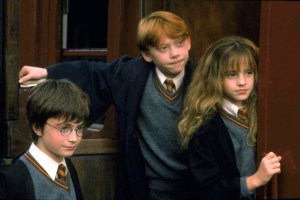 Chris Columbus (Home Alone, Mrs. Doubtfire) wrestled this franchise away from such directorial heavyweights like Spielberg, and it’s clear to see why he was selected. Rowling ordered the movie adaptation to be completely faithful to her book, and Columbus is a director with no remarkable visual flair or distinct vision. Everything that is occurring is so faithful to the book that it has no individual flavor or distance. It’s directing with your hands tied, which is fine for most people. With this project he seems like he is basically a go-between with Rowling and the studio suits. Basically it should be Rowling’s name for the director’s credit because she’s the one with the vision being translated.
Large portions of this film need to carried by the acting of several of its young stars and it’s quite a 120 million dollar weight. For the most part the child actors in Harry Potter deliver. Emma Watson is the standout as Hermione, with her extra energy and enthusiasm in every step and every smile simply winning over the audience in spades. The only real detraction acting wise in the entire film is, unfortunately, the star. Daniel Radcliffe plays Harry in a very stiff manor and spends most of the film looking overly subdued. After you experience more time with the other characters in the film one realizes how frightfully dull the character of Harry Potter really is. Any of the characters would be more exciting to watch than Harry. As characters go, he’s about as interesting or entertaining as stereo instructions.
Harry Potter contains an all-star all British cast for the fanciful faculty of Hogwarts. Everyone seems so meticulously cast that they were born to play these roles. Richard Harris becomes a gentle grandfatherly figure as the headmaster. Robbie Coltrane is a large and lovable figure that the audience can rely on again and again. Richard Griffiths is so over-the-top in a very entertaining light. Alan Rickman owns every scene he is in with such a snarling and full-of-life presence. He is perfect, as is most of the adult casting.
 The most exciting moment of the film occurs during a match of Quidditch, which is basically like rugby in the sky. Two teams on broomsticks whiz and zoom around one another in a fierce aerial competition. At this moment Columbus can declare himself the true director. The entire sequence is done that it perks the viewer’s imagination and also provides great moments of excitement. Seeing the scene itself was a testament to the wizardry of special effects.
The length of Harry Potter and the Sorcerer’s Stone clocks in around two hours and thirty minutes, which might seem like an eternity to small children if they weren’t so overly obsessed with the book series. The film is structured more like a novel than a screenplay (again with the induced restrictions), so instead of a usual three-act system it has moments that drag and moments that seem to go on endlessly (like the final near obstacle course the three kids must go through). The entire first hour or more is set-up explaining all of the characters and the world they inhabit, then they just sneak in a mention to the Sorcerer’s stone toward the end and introduce our titular story line. Hopefully, with the set-up out of the way now, the next movie will be a tad shorter.
Harry Potter is a worldwide phenomenon that is already breaking box-office records and parents’ bank accounts. The first four books have been optioned by Warner Bros. so expect to see an armada of kids dressed up in Halloween costumes around Thanksgiving for the next few years. Harry Potter is a fairly light-hearted but entertaining venture that I wouldn’t mind revisiting and reacquainting every now and then like an old friend.
Nate’s Grade: B
Share this:

Captain Corelli’s Mandolin (2001)
 We open on an island on the offshoot of Greece in the start of the 1940s. The waters are blue, the sand is white, the people are happily ethnic, and it’s basically a postcard. The island is overpopulated with idyllic beauties and friendly people and then evil evil war had to come and steal the innocence. Cruz plays a woman who has a first name that I have no clue of or remotely how to pronounce it, but I am certain it began with a P. Cruz is studying to be a doctor under the tutelage of her wise old customed father (John Hurt). She’s engaged to be wed to hunky fisherman Mandras (Christian Bale) until the war threatens their peaceful isolated world. Mandras feels the patriotic urge to go to war and thwart the advancing Italians and Cruz pines for his safe return writing letter after letter with no answer to only fear the worst.
 As the war continues the Italians do advance further and take occupation of the Greek island. Captain Antonio Corelli (Nicolas Cage) is amongst the divisions assembled to this Mediterranean isle. He is agreed to stay in Cruz’s home and, as always, begins to develop feelings for Cruz. She feels some as well but is torn on what her actions should be. Corelli, it turns out, is far more a singer than a fighter. He has a battalion of men he dubs his “opera” and they break into frequent song and an overall zeal for life. They run around drinking and singing on the beaches complete with topless women making this Italian occupation seem like summer camp.
The good times don’t last of course and the war rages closer and closer. Soon the Italian army surrenders and then the Germans come in to retake occupation of the Greek island. Corelli must decide to go home or help fight amongst the guerrillas and native people to keep their beautiful land away from Nazi hands.
Penelope Cruz seems to be heavily pushed on me by Hollywood. She is too mute at times and the emotions that we should see tearing her up are simply dampened by her staring downcast or biting her lip.
Cage is an Italian-American and yet his Italian accent is atrociously comical. His performance is like the Joker doing an Italian accent. He also kisses like he is trying to swallow poor Penelope’s tiny head. Somehow beyond my reasoning the talented Christian Bale got in this movie. He’s about as convincing as a Greek as Laurence Olivier was as a Moor. The rest of the cast is filled with Greek people portraying Greek people.
The love story of Captain Corelli’s Mandolin is a mishmash of un-involving war violence and a cloying romance that never gets into the proper gear. There are elements of guilt and affection, but they aren’t transcendent of any reality. The first time Corelli tells Cruz he loves her they have sex in a field that very moment. There is not enough groundwork laid to produce a decent romance. So the supposed “smolder” between Cruz and Cage is thematically unbelievable, and kind of a bit creepy.
 Corelli suffers from A.I. syndrome in that it desperately needed to end twenty minutes earlier than it did. The fact that Cage survives a machine gun execution because a SINGLE PERSON stood in front of him is bad, but it gets even worse for the inhabitants of the Greek island. Some get hung by their own people, some get shot in the face from Germans, and then everyone must suffer after the war by having an earthquake level half of their town. This stretch of film goes from pointless to comically absurd. It’s like John Madden fell asleep in his director’s chair and someone thought, “Well, let’s model the last act of the film after a Universal tram ride. Hey, can we have Jaws pop out of the water at some point?” Corelli has failed as a romance and during its end stretch it completely fails as any kind of cogent drama.
The direction is adequate by Madden but the script just doesn’t cut the mustard. In the end they rely on the old Hollywood principal of Nazis being pure evil, so much so they might as well have mustaches to twirl. I thought at one moment they were going to tie Cruz to a railroad track and would have preferred it if they had. This is a film caught between romance and war, and it does a disservice to both. The war is a naive afterthought and the romance lacks any credibility. The scenery sure looks nice though. In the end, Captain Corelli’s Mandolin is a film desperately out of tune.
Nate’s Grade: C-
Share this:

Along Came a Spider (2001)
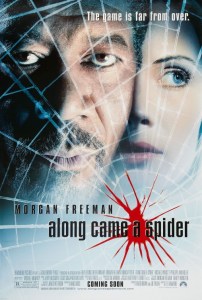 Anybody not tired of the serial killer genre yet? To that one out of the millions who raised their hand in the far back – you’re in luck! Enjoy Kiss the Girls? That same one in the back is even more fortunate. Here comes Along Came a Spider and its banality will knock you off any tuffet. Is that a word even used anymore? Spider is a continuation of the characters in Kiss the Girls (even though Spider was written before Girls). Morgan Freeman returns as Alex Cross, a hard-nosed police detective and best-selling novelist on criminal profiling. He’s suffering from Cliffhanger syndrome: the amassing of guilt from seeing someone close die in the line of duty and blaming themselves for it. See Morgan lost a female partner in a botched sting that opens the film with the worst CGI scene I’ve ever seen. He has a scene of regret then moves on to the case at hand, only to inevitably have the situation come up again and be the test of his nerves. It’s all standard cliche.
The crime that draws all our characters in revolves around the kidnapping of a Senator’s daughter at a lofty private school in Washington D.C. This is no serial killer movie, no, it’s a kidnap movie. Whatever the crime this flick centers on it still follows the superfluous serial killer movie rules to a grizzled T.
 Monica Potter plays a Secret Service agent assigned to protect the girl who becomes involved with the case with her extensive knowledge of the kidnapper, Professor Sonje (Michael Wincott). Potter has previously been seen as the sad wife in Con Air, the dead chick in Patch Adams, and the girl who stars next to the guy whose acting is all about flat-lining in Head Over Heels. So in these terms Along Came a Spider is a step up. Her character is pedestrian and un-involved. She has no edge or depth and every time she’s on screen.
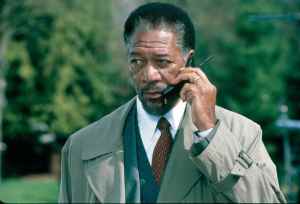
Freeman, God love him, needs to start learning how to say “no” to any serial killer (kidnap film) offered to him. He’s a great actor but the Alex Cross solves killers (kidnappers) franchise isn’t one to tie his rope around. Freeman does his best and brightens the film when it sags, but even he can’t save it. And his Executive Producer credit seems all the more ominous.
Naturally, an audience is left to disbelieve some of the absurdities of the genre but Along Came a Spider piles them too high and too fast to disbelieve. The kidnapper disguises himself as a plump British history teacher for a whole two YEARS in preparation for his act. Two years?! What would happen if she ever transferred? The worst part is his name – Sonje. Every time I hear the name it makes me giggle a bit. I cannot take anything seriously when the bad guy is named Sonje (“We’ll do whatever you want Sonje, just don’t harm the girl!”). Sprinkle unintentional laughter throughout. And for kidnappers and criminals these have got to be the dumbest since Colonel Klink. There is a scene where the kidnapper gives the detained child a meal… with a fork and knife! It’s like going to a prison and giving certain members scissors and leaving them alone for two hours.
 If you are having a serial whatever movie you must make your serial whatever man intriguing or turn the flick into a guessing game until the end credits. The serial killer (I’m saying this now because he does kill multiple people – so there!) in Along Came a Spider is bland as can be, despite the wonderfully rich and venomous voice of Wincott. How as an audience are we to be enthralled with a whiny adversary that bores us?
There are numerous other head-smacking absurdities. Like when our ace Morgan Freeman looks to a computer belonging to a suspect and instantly remembers an off-hand remark in one conversation that of course is the password. And he even spells it correctly with an inclusion of a symbol!
The movie is based on James Patterson’s novels all seeming to have nursery rhyme style titles. Directed by Lee Tamahori (Mullholland Falls, The Edge), it has moments of briskness that at least keep the pacing alive. On its whole the film still does not work. It feels like reheated serial killer (kidnapper) movie just out of a Tupperware container. Along Came a Spider is nothing new, nothing different, and nothing truly entertaining. Pray for Morgan Freeman please.
Nate’s Grade: C-


You must be logged in to post a comment.