Blog Archives
Miss Peregrine’s Home for Peculiar Children (2016)
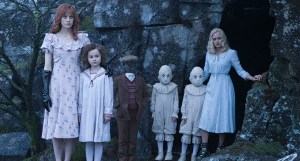
 Miss Peregrine’s Home for Peculiar Children feels like Tim Burton’s X-Men franchise, and it’s just as awesome as that sounds. Burton has always had an interest in the outcasts and misfits of society and now he has his chance to leave an imprint on the ever-present superhero phenomenon. His own personal group of gifted youngsters is looking to form a funky family and fight against fearful forces that have their sights set on exploiting these special children or worse. It’s a natural fit for a man who has become a Gothic industry unto himself over three decades of peculiar and spooky filmmaking. This is Burton’s chance to flex franchise tentpole muscles with a subject matter perfectly attuned to his offbeat sensibilities, and watching the fabulous final product is akin to watching a master musician dive into Beethoven’s Fifth. This movie was flat-out delightful.
Jake (Asa Butterfield) is reeling from his beloved grandfather’s (Terrence Stamp) mysterious death. The old man loved sharing his stories about tending to the shape-shifting Ymbryne Miss Peregrine (Eva Green) and her wards, a group of children with special abilities including starting fires, controlling plants, invisibility, and being able to float lighter than air. On a trip to Wales to investigate grandpa’s stories, Jake discovers a time portal and is taken back to the WWII era where Miss Peregrine is waiting for him. She and her children relive the same day and will never age. They’re hiding from Barron (Samuel L. Jackson) and his group of scientists who wish to hunt the children. Jake is tasked with being the new protector, as he is the only one that can see an invisible band of slender monsters known as hollows that feast on the children.
 There’s a whimsical nature to the dark elements, and the script is rife with enjoyable payoffs and fun moments that cry out for a full visual immersion. This is Burton’s best film since 2007’s Sweeney Todd (I have a soft spot for that macabre musical), arguably best since 2003’s Big Fish, and maybe his most fun movie since his 90s heyday. If you’re a Burton fan, you’ll be tickled by all the imagination and humor. I grew up on the cinema of Beetlejuice and Edward Scissorhands and The Nightmare Before Christmas (yes, directed by stop-motion maven Henry Selick but still very much a Burton film), so I’ll admit that seeing Burton in high form once again warmed my little mischievous heart.
You get a sense just how involved Burton was in the filmmaking and its details, the degree of passion and involvement, and also his commitment to being a dark movie intended for peculiar children and adults with macabre interests all over the world. I kept thinking that the 12-year-old version of myself would have adored this movie, never mind the 34-year-old version of myself who greatly enjoyed it too. This feels like a natural evolutionary step for children and adolescents who gorged themselves on the works of Edward Gorey and R. L. Stine. It’s not a significant spoiler but it’s something I feel you, dear reader, need to know in order to properly assess just how wonderfully morbid the movie can come across. There is an entire visual feast of a group of villains dining upon the delicacy of… children’s eyeballs. You read that right. It’s a silver platter piled high with severed eyeballs, and they get slurped down like it’s spaghetti. I could only cackle to myself at the audacity of the movie to embrace the fun of the darkness rather than hiding from it, mitigating it, trying to be delicate with tone. The villains want to return to a normal state that can only be achieved by consuming the eyeballs of peculiar children, and so they are hunted not for sport or prejudice but for eyeballs. That’s wonderfully squirmy, and it definitely affected me, an avowed cinema patron who gets extra squirmy with any onscreen eye trauma. There are other creepy and memorable moments, like a dead child being used as a ventriloquist doll and the slenderman-styled hallows creatures. The moments are plenty but they don’t choke the story’s momentum, which hums along with great imagination and lucidity.
There’s a lot going on with Miss Peregrine, and Jane Goldman’s (Kingsmen) screenplay juggles a lot of rules and world building without losing momentum. I was intrigued early and the movie would widen its focus, providing more texture and connection to the world in calculated doses. It was enough that I always felt like I was learning something while still being able to see how the pieces snapped together in retrospect. There’s time travel that has to be done at a very specific point, the rules of who can travel back in time to these bubbles of safety, the history of this specific day stuck in time, the non-linear history of the protectors, the fact that the bubbles are also teleportation hotspots, the history with Jake’s grandfather, the history of the Ymbryne and their powers, the powers of all the peculiars, dream prophecy, mad scientists and their peculiar ailments, the differences between the hallows and the predatory scientists, and also establishing the character dynamics of several lost children and a budding YA romance. It’s amazing that Goldman’s script is as understandable as it is considering all that heavy lifting. It’s not completely free of muddled plot points and some hazy explanations, but those instances are a clear minority to what works so effectively. I wanted to know more about this world, and once they added time travel and teleportation, I was hooked. I enjoyed the movie so much that I’m considering reading the additional books for my next freaky fix.
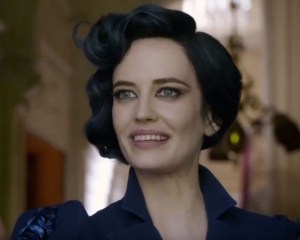 The acting ensemble is full of bright spots and none brighter than the new queen of genre gusto, Eva Green. I raved about Green’s magnetic performance in the considerably lesser 300 sequel. She was easily the best part of that movie and it suffered whenever she wasn’t on the screen. The same can be said for the too-long-in-the-making Sin City sequel. She was the best thing in Burton’s otherwise forgettable Dark Shadows feature. In short, this woman is incredible, and she digs into the vampy and ridiculous with the right degree of malevolence and glee. Green is a wonderful hostess into this magical world, and her foreknowledge gives her a caffeinated energy that makes her even a tad more peculiar. Her children are all fine actors who have uneven parts thanks to the unfair distribution of their powers. Not everyone gets super useful abilities. I felt sorry for the kid who projected his dreams from his eyeball especially during the third act scuffles. A mouth in the back of the head doesn’t seem very useful either. I enjoyed the idea that the invisible kid needs to be fully naked to be fully invisible, and everyone acknowledges this reoccurring fact with shoulder-shrug nonchalance. The standout amongst the peculiars is Ella Purnell as the winsome girl who will float away. She has an innocent and yearning quality that doesn’t sink her character. She’s more than just a love interest to Jake and Purnell helps channel great affection. Jackson (The Hateful Eight) is expectantly highly entertaining as the lead villain and Butterfield (Ender’s Game) is perfectly acceptable as an audience surrogate into this wild world.
I was duly impressed with just about every element, from the structure of the screenplay and its precision with information and intrigue, to the level of acting, to the dark and whimsical tone, to Burton’s own peculiar particulars that fill out the film with adoration. It may sound corny but there is an affection woven throughout the film, for its dispirit outcasts, for their strangeness, for the ardor of telling a spooky story that can appeal to children without pushing away adults. There’s a care that’s been absent Burton’s other recent films, especially Dark Shadows, which left me bewildered whether Burton had any genuine fondness for the source material. Miss Peregrine’s Home for Peculiar Children is a haven for fans of the peculiar, Burton’s oeuvre, and those looking for a quality children’s film that has some bite. I can only hope for more fantastical adventures.
Nate’s Grade: A-
Share this:

The Girl on the Train (2016)
 Consider it Gone Girl lite. The adaptation of the mega best-selling thriller The Girl on the Train seems to be on a runaway collision course with irony-free, amped-up melodrama and sundry “adult” sensuality reminiscent of the 90s boon of erotic thrillers like Jade and Sliver. The book by Paula Hawkins had three strong female lead characters each telling their own miserable worldview of trying to live up to social standards of motherhood and marriage. The movie seems to have shorn most of the focus on character and included every twist and turn, no matter how absurd. Take for instance just how insular this world is: Rachel (Emily Blunt) is the ex-wife to Tom (Justin Theroux) who left her for Anna (Rebecca Ferguson) who has a nubile nanny Megan (Haley Bennett) who is unhappy with her controlling husband Scott (Luke Evans), who happens to be the couple that Rachel voyeuristically observes and fantasizes domestic bliss. Megan goes missing and Rachel cannot account for her whereabouts because she has become a blackout drunk to kill her self-loathing and sense of internalized failure. The whodunit aspects of this movie can come across as rather hokey and overblown, but lacking the nasty nuance and subversive gender politics of the far superior Gone Girl. Every single person in the film has to come across like a suspect (Megan’s husband, Megan’s therapist, some guy in the road?) and talks in a curiously oblique style. The attempts at sexy lack heat but more than that they lack conviction. Director Tate Taylor (The Help) seems to think he’s directing a Hitchcockian thriller one minute and a tawdry art film the next. The screenplay is also unhelpfully nonlinear, frivolously jumping around in time and point of view and muddling the overall timeline. Anna and Megan are drastically underwritten; Megan is a sex kitten with a dark secret that’s trying too hard to be provocative, and Anna is an even more thankless role as the stand-in for Rachel’s swirling antipathy. The concluding moment of girl power feels unearned, and the answers to the mysteries leave a lot more lingering questions about train platform-sized plot gaps. The best thing this Girl has going for it is Emily Blunt, who delivers a better performance than the film deserves. She’s unrestrained, red-eyed, sloshing, and disturbing as a drunk. She’s wounded and lashing out ferociously at the world, at her self, and it’s fascinating and heartrending to watch. I bet it would be even better to read.
Nate’s Grade: C+
Share this:

The Light Between Oceans (2016)
 A melodrama through and through, The Light Between Oceans is at its core a pretty-looking movie about pretty-looking people being sad. The premise almost seems like a parody of prestige indie filmmaking in the 1990s. Tom (Michael Fassbender) is a shell-shocked WWI vet-turned-lighthouse keeper in Australia who falls in love with mainland lady, Isabel (Alicia Vikander). They marry and have difficulty conceiving, with Isabel enduring two grueling miscarriages. Then one day a dingy washes ashore with a crying baby inside and a dead man. Rather than alert the proper authorities, they decided to bury the man and raise the child as their own. Years later, the couple discovers the girl’s real mother, Hannah (Rachel Weisz), who has been racked with unanswered grief ever since. The couple is then thrown into an emotional crucible testing their ethics and moral compromises and the question of ultimately what’s in the best interest of this little girl. It’s a movie that’s geared to put you through an emotional wringer, and the actors do their part. Vikander (Oscar winner for The Danish Girl) is downright luminescent and dives deep into all of her character’s varied and heightened emotions. The scenes of her dawning realization of the miscarriages and her helplessness are heartbreaking without being maudlin. Weisz is shaken to the core when her identity is robbed from her; she’s so fragile and holding on to hope so hard you might think she’ll collapse any moment. Fassbender internalizes the most and fully communicates the inner struggle of his character’s guilt. Director and chief adapter Derek Cianfrance (The Place Beyond the Pines) has made an intimate relationship drama in a beautiful, sea-swept location, and the kind of Big Feeling classy melodrama you came to expect from Anthony Minghella. The problem is that Cianfrance’s characters are held too much at arm’s length for resonance. We empathize but not nearly as deeply as we could, and by the end the movie washes away like the surf.
Nate’s Grade: B-
Share this:

The Infiltrator (2016)
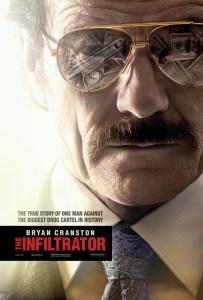 In the mid 1980s, Pablo Escobar and his cartel were responsible for billions of dollars worth of narcotics filtering into the United States. It’s the kind of work that can fill up Robert Mazur’s (Bryan Cranston) career. He works as a Florida Customs agent but his specialty is going undercover for his assignments. He’s called out of retirement with the promise of striking high in the ranks of Escobar’s ring of lieutenants. Mazur’s partner, Emir (John Leguizamo), uses an unreliable informant to start the new identity, and so Mazur poses as a money laundering expert who offers his sundry services to the Colombian cartel. After blurting out that he has a fiancé in lieu of accepting a prostitute’s services as a very 80s way of saying “thank you,” the agency must now provide him with a fake wife, played by rookie agent Kathy Ertz (Diane Kruger). The two have to rely upon one another in a world of criminals and murderers who would have no gutting them.
My main feeling once The Infiltrator had come to its natural conclusion was that everything about this movie should have been better. It’s a terrific premise as we follow the undercover travails of a man trying to stay one step ahead and keep his dual lives separated, invariably having them bleed into one another especially as danger escalates and his cover may be blown. Then you add an untrained partner and the conflict magnifies from there. Then you have Mazur work his way up the food chain to the major lieutenants of Pablo Escobar. This movie should be exploding with dramatic irony, weighty decisions, and magnificent suspense, but it’s really not. So why not?
 One reason is that the movie whiffs with its modest ambitions, namely in its shallow character study of Mazur and the lingering effects of pretending to be a very bad man. Going undercover has to be one of the most stressful jobs in law enforcement, and living two different lives has to have a noticeable psychological impact, eating away at our protagonist and affecting his relationships and sense of self. That doesn’t happen with The Infiltrator as the few glimpses we get of Mazur’s home life are mostly harmless check-ins. A red light is installed in his home to mean a secret special phone line. You would assume that some family situation has to draw out conflict from this scenario, maybe Mazur’s little girl answering the phone before he can reach it. Nothing of consequence happens with daddy’s special red light phone. The family, absent anything important to do but wait at home, becomes a drag on the narrative and doesn’t even fulfill what you would assume would be its primary service: contrast. In the world of The Infiltrator, sex, money, and drugs are rampant, but our protagonist is unaffected. He remains the same character from the beginning of the story to the end. We don’t really learn more about him other than he is skilled at going undercover. We don’t see any particular toll on him psychologically. We don’t feel the threat of what he’s going through because the movie doesn’t pretend it matters enough.
Going undercover with the Medellin Cartel should provide endless suspense scenarios. This movie should be rife with conflict, and yet it consistently finds deflating, coincidental outs to save its characters. As a good screenwriting rue of thumb, it’s acceptable to use coincidence to put your character into greater danger. It’s not a smart idea to use coincidence to save your character from danger. Example: in Donnie Brasco, a man approaches Johnny Depp’s character and clearly refers to him by his agency name, implying working together with the FBI. That’s a good use of coincidence. With The Infiltrator, Mazur’s secret recording in his briefcase is discovered by a mid-level cartel operative, for once it feels like Mazur is vulnerable. Then the movie quickly dispatches with this guy for a rash explanation and so he takes his secret to his grave. There’s another moment where Emir’s informant is about to squeal to some very bad people, with Emir in the room sweating bullets, and he too is wiped out before sharing his privileged information. The movie is filled with these frustrating solutions just when it seems like tensions is developed. The entire appeal of the undercover mob movie is the twists and turns to hide the real identity and make it out alive. I’m genuinely dumbfounded how much of this movie just skates by with little regard to drawing out effective tension.
I think I can crystallize just how poorly The Infiltrator handles its many threads of conflict with one great example. Kathy and Robert Mazur are fake getting married according o their cover stories, so what else does a fake bride-to-be do but seek out her fake husband’s tuxedo that he wore decades prior upon his real wedding to his real wife? Why does Robert need to wear the exact same tuxedo? Can his office not afford to rent a new one that likely more accurately represents his fitting size? Even if this cost-cutting measure was plausible, why must Kathy be the one to pick it up, and from Mrs. Mazur? It’s contrived and forced conflict to shove these two characters together, so that Mrs. Mazur can ask pointedly, “Are you sleeping with him?” Rather than say nothing, or dismiss the assertion, Kathy provides what has to be the most irritating and obfuscating answer: “I think you know the answer to that.” Does she? The film seems to think there is a simmering sexual tension between Kathy and Robert Mazur, but it never materializes. I guess we’re just supposed to assume a sexual tension. This scene is a pristine example of characters operating at a sub-level of intelligence because the movie wants to force contrived drama when there is already plenty of organic drama being ignored.
The last third of the movie is built around the relationship that Mazur and Kathy form with Robert Alcaino (Benjamin Bratt). With an actor of Bratt’s stature, you’d be lead to assume his character will have a significant amount of screen time; however, The Infiltrator also boasts blink-and-you’ll-miss-them performances from Amy Ryan and Jason Isaacs, so maybe not. Bratt’s character is a family man and we’re treated to several scenes with him and his wife. It’s meant to engender sympathy so that when the end comes around we can feel some conflicted emotions. Except this is another area where the screenplay cannot live up to its aims. At no point did I feel sympathy for this mobster. He’s a “family man” and we even see him with his daughter… in one scene who asks to sleep over at a friend’s. Robert preaches about the importance of trust and family in that typical way that all thinly veiled mobsters do in movies, and he even cooks, which is another personality trait I’m sure we’ve never seen in a film about mobsters. The entire last act is predicated on our undercover duo feeling guilt over setting up Robert and his family in an eventual sting, and this guilt feels entirely manufactured.
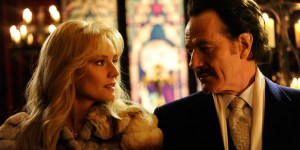 Cranston (Trumbo) is the real draw here and it’s easy enough to see how alluring the undercover gig is for an actor of immense talents. In the opening scene we get a sense of Mazur on the job, digging deep into a seedy drug dealer lounging in a bowling alley and making passes at the waitresses. It’s a meaty introduction that whets your appetites for the different personalities that Cranston will have to draw from on his next assignment. Cranston is routinely entertaining to watch but I couldn’t help but feel underwhelmed at what the film was asking him to do and what I fully know he’s capable of delivering. It’s like hiring a world famous chef and asking him to fix your plumbing. The other actors don’t distinguish themselves in their fleeting scenes except for Kruger (Inglorious Basterds) and Joseph Gilgun (TV’s Preacher) as a convict that Mazur likes to have pose as his driver/muscle. In the case of both actors, you wish that more had been made with their dynamic to the mission.
The Infiltrator is based on a true story and I assume that what I see on screen closely echoes Mazur’s real exploits and predicaments, but somewhere along the way the filmmakers lost track on what made this story tick. The psychological aspects are barely touched upon, the family conflicts are given careless lip service, the suspense sequences are clipped, under developed, and often solved by convenient coincidence, and the characters are too shallow to grow out from their stock roles. I know these are real human beings for the most part but they don’t feel anything more than genre archetypes. The Infiltrator does enough at a serviceable level of entertainment that it might pass some viewers’ lower threshold to fill an empty two-hour window. With all of its ready-made suspense possibilities and internal and external conflicts, this real-life story should be far more compelling than the one we’re given, which settles too often. It’s a genre movie masquerading as a character study except it’s blown its cover.
Nate’s Grade: C
Share this:

The BFG (2016)
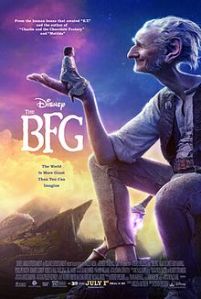 Roald Dahl is the kind of highly imaginative, inventive, and subversive children’s author that makes one wonder why more of his books don’t end up as movies. Charlie and the Chocolate Factory is the best known, and there’s Fantastic Mr. Fox, Matilda, James and the Giant Peach, and the rather spooky for kids 90s film, The Witches (it at least spooked me as a kid). For such a prolific author, it’s a little curious he has so few film credits. Steven Spielberg is one of the most successful directors of the modern era, so if anyone could wrangle Dahl’s wondrous worlds onto the big screen, he should. The BFG should be a transporting experience brought to vivid life with cutting-edge technology. All the special effects in the world, however, can’t solve a raft of nagging script problems that manage to take the fantastic and make it boring and predictable.
In 1980s London, little orphan Sophie (newcomer Ruby Barnhill) is abducted one night when she spots a giant blowing a mysterious trumpet into the windows of sleeping children. Fortunately for Sophie her captor is the BFG (Mark Rylance), which stands for Big Friendly giant, and he’s a vegetarian, having sworn off the bone-eating habits of his nastier giant peers. In Giant Country, the BFG collects and cultivates dream particles, concocting special mixtures that he then shares with sleeping children. The other giants bully and snidely dismiss the puny BFG. Sophie and the kindly BFG must work together to stop the larger giants from going back to London and dining on innocent children.
 The BFG has some pretty big friendly problems when it comes to its misshapen plot structure and its alarming lack of urgency or escalation. We’re all familiar, consciously or unconsciously, to the three-act story structure at this point, which is the principle formula for screenwriting. The BFG gets started pretty quickly, abducting Sophie and taking her to the land of giants by around the 15-minute mark, and from there the movie seems to take a leisurely stroll. I can’t really tell you where the act breaks are because the movie just sort of luxuriates in the meandering interaction between the BFG and his human pupil. There’s the initial threat that the other cannibalistic giants will discover her and this threat pops up in a handful of set pieces where Sophie has to constantly find new hiding places. Unfortunately, this threat never really magnifies or changes. She might get caught, and then she doesn’t. She might get caught, and then she doesn’t. There’s a repetition to this threat with our antagonists at no point getting more threatening. This is and a lack of a narrative motor make the movie feel rudderless, plodding from one moment to the next without a larger sense of direction. And then the third act comes (spoilers), presumably, when Sophie and the BFG travel back to London to try and recruit the Queen of England’s (Penelope Wilton) help. This sequence includes an extended breakfast that it punctuated by the memorable climax of watching the Queen fart and her little corgies fly around the room powered by their flatulence. It has to be the climax because what follows certainly doesn’t follow. Within five minutes, the BFG leads the Brits back to the land of giants and they restrain and airlift all the other giants in shockingly easy fashion. It’s a victory that feels relatively hollow because of its ease. These giants were never much of a threat to begin with, which is why we spent more time deliberating over dream ingredients than a retreat from man-eating colossuses.
Another aspect of Dahl’s novel that falls flat on screen is his verbal gymnastics and witticisms. It just doesn’t work with actors repeating the words without the text in front of your eyes. Listening to the BFG talk for any extended period of time is like being stuck with a crazy person muttering to him or herself. I would estimate that at least 60% of the BFG’s dialogue is folksy malapropisms. It’s not endearing and grows rather tiresome, especially with the unshakable stagnation of the movie’s plot. And so we get scene after scene of a big CGI creature talking verbal nonsense. Are children going to be entertained by any of this? Are they going to be engaged with the giant’s gibberish or will they find it one more impenetrable aspect of a movie and a story that seems to keep the audience at length? I couldn’t engage with the movie because it never gave me a chance to invest in what was happening. The BFG is a gentle soul and shouldn’t be bullied by his giant brethren, but that doesn’t mean I’m going to automatically love him. I didn’t.
 For a Spielberg movie this feels oddly absent his more charming and whimsical touches. There are scant moments where it feels like Spielberg is playing to his abilities in this fantasy motion capture world, like exploring the underwater land where the BFG gathers his dream ingredients, and in the narrow and messy escapes Sophie has not to be caught. It’s a shame that the creative highs of Spielberg in full imagination mode are too often absent the rest of the movie. He too feels like he’s coasting, allowing the technology and the fantasy setting to do the heavy lifting. The land of the giants is a bit too underwhelming as far as fantasy worlds go. It’s simply too recognizable except for slight peculiarities, like “snozcumbers.” It’s not an enchanting location and we’re not given enchanting characters, and with the little narrative momentum or escalating stakes. I experienced a lot more fun and whimsy from Spielberg’s other major mo-cap movie, the nearly forgotten 2011 Adventures of Tintin. The action sequences especially had such a lively sense of comic brio and imagination that was pure Spielberg. I get no such feeling from The BFG. If you told me that Robert Zemeckis had made this movie I wouldn’t have blinked. I don’t know if Spielberg was hoping to recapture that E.T. magic with screenwriter Melissa Mathison (who passed away in 2015) but this isn’t close.
I will credit the special effects department for the amount of work put into Rylance’s BFG visage, which looks eerily like the Oscar-winning actor. The range of the facial expressions is another sign that mo-cap performances are just as legitimate as live action flesh-and-blood performances. I can admire the technical feats of the character while not exactly feeling that much enjoyment from that character. The interaction between the computer elements and the real-life elements could be better, most bothersome with little Sophie interacting with the giant’s giant personal things.
I was left wondering whom The BFG is supposed to appeal to. I think kids and adults will be bored by its slow pace and stagnant, minimal stakes, weird and unengaging characters and their annoyingly impenetrable speech habits, and the overall lack of charm and wonder. It’s saying something significant when the most mesmerizing part of a fantasy movie is watching the Queen of England, her dogs, and a room full of her royal servants violently fart green clouds of noxious gas. That was the one moment in my screening where the kids in the room seemed to be awake. Otherwise the BFG character must have calmly put them to sleep with his prattling gibberish. It’s not an insufferable movie and there are fleeting moments of entertainment, but they drift away like a memory of a dream. There just isn’t enough going on in this movie to justify its near two-hour running time. Not enough conflict, not enough world exploration, not enough character bonding, not enough whimsy, and not enough entertainment. It feels too lightweight to matter and too dull to enchant. The BFG could have used more farts. That would be a sign of life.
Nate’s Grade: C+
Share this:

The Jungle Book (2016)
 It seemed like only a matter of time before those in the Mouse House started looking through the back catalogue of hits for inspiration. The Jungle Book is a live-action remake of the 1967 Disney animated film, but it’s only the first of many such translations to come. A live-action Beauty and the Beast is being filmed currently and plans are underway for a possible live-action Aladdin as well, though I pity the actor with the unenviable task of replacing the beloved Robin Williams. I was wary of director Jon Favreau’s (Iron Man) version just because it seemed, on the surface, like a quick attempt to fleece the public of their hard-earned money with a repackaged movie. What I got instead was a brilliantly executed adventure story with a beating heart, amazing special effects, and ultimately an improvement on the original. Imagine that.
Mowgli (Neel Sethi) is a boy raised by a pack of wolves. He tries to fit in with his pack but he grows a bit too slow and he can’t help himself with “tricks,” making tools. During a drought that signals a jungle wide peace between predator and prey, the feared tiger Shere Kahn (Idris Elba) lets the rest of the animals know his demands. The “man cub” is to leave or Kahn will hunt him down. The mother wolf, Raksha (Lupita Nyong’o), refuses to part with her child but Mowgli volunteers to leave to keep his pack safe. Kahn chases him deeper onto the outskirts of the jungle where Mowgli teams up with Baloo (Bill Murray), a lackadaisical bear who makes use of his partner’s affinity for tools and building contraptions. Mowgli’s new life is interrupted when he learns Kahn has attacked the wolf pack with the desire for Mowgli to return and face his wrath. Mowgli must team up with the friends of the jungle and use all his bravery and skills to defeat the ferocious Shere Kahn who has been lusting for vengeance for years.
 Favreau’s version of The Jungle Book is a thrilling and thrillingly immersive visual experience that opens up the big screen as an exciting canvas. The visual wizards have made an entire ecosystem look photo realistic to the point that if somebody said offhand that Jungle Book was shot on location in India, I wouldn’t think twice. The environments are entirely CGI and they are brilliantly brought to life in a seamless recreation I haven’t seen so effective since 2009’s Avatar. It’s stunning what can be accomplished with modern special effects, and then there’s Favreau’s smart decision not to radically anthropomorphize his animal cast. These are not some hybrid human-animal combination but rather flesh-and-blood wild creatures that just happen to speak English when they open their mouths (depending upon your territory). The animals don’t fall into that pesky uncanny valley where your brain is telling you what you’re watching is fake and unsettling to the senses (see: The Polar Express). The animals and behave like the real deal and further cement the exceptional level of realism of the movie. From a purely visual experience, The Jungle Book is a feast for the eyes that helps raise the bar just a little bit higher for the special effects industry and its proper application.
The movie would only succeed so far if it weren’t also for its engaging story. Let’s be honest about the 1967 Disney animated film: it’s not really a good movie. It’s fun and has some memorable songs (more on that below), but as a story it’s pretty redundant and flimsy. Mowgli bounces around one potential animal group to another trying to find a home only to move on to the next prospective foster situation. I never made the connection before but in a way the movie North is this plot, minus the talking animals and general entertainment value. There are long segments of the original Disney film that coast just on the charisma of the vocal actors and the animation. Certainly the Beatles parody characters haven’t aged well. There was plenty that could have been added to this story and screenwriter Justin Marks does just that, making the characters far more emotionally engaging. I felt a swell of sadness as Mowgli is separated from his wolf family, his mother declaring that no matter what he still is her son. Marks also personalizes the stakes between Mowgli and Shere Kahn. Each side has a grudge to settle when it comes to vengeance rather than Kahn rejecting the “man cub” out of general fear. This Mowgli is also a much more interesting protagonist; he’s plucky and uses his “man cub” other-ness as an asset when it comes to problem-solving. We have a better hero, a better villain, wonderfully brought to life through the velvety roar of Elba, and a small band of supporting characters that are more emotionally grounded. The wolf pack feels like a genuine family, a community. The relationship between Mowgli and Baloo becomes the backbone of the second half of a briskly paced movie, and the predictable narrative steps feel earned, from Baloo’s con job to caring for his lil’ buddy. The attention to the characters and their relationships provides a healthy sense of heart.
The vocal cast is expertly matched with their jungle creatures, notably Elba (Beasts of No Nation) and Murray (St Vincent). Murray has an innate way to make his lazy character endearing. Nyong’o (12 Years a Slave) gives a much better motion capture performance as a wolf than whatever the hell she was in The Force Awakens. Scarlet Johansson (The Avengers) is a nice addition as Ka the serpent, and as fans of Her can attest, her breathy voice can indeed be quite hypnotizing. Even the small comic relief animals are well done including the brilliant Gary Shandling in his last film role. Motion capture for non-primates seems like an iffy proposition considering that you’re either forcing the human actors to physically walk on all fours and pretend to be animals, which can be silly, or just copying the direct movements of animal models, which seems redundant then with the technological advances. I don’t know how they did it but it seems like The Jungle Book found a working middle ground that still showcases actor performances.
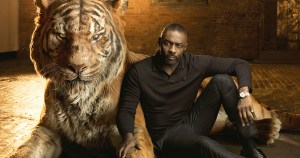
I think this picture cures infertility.
With a movie that works so well on so many levels, the few faulty areas tend to stand out, and I feel like somewhat of a cad to say that one of the biggest problems is the acting from its child star. I’ll give Sethi some leeway here considering he was never interacting with much more than a giant warehouse of blue screens, which I think we’ve shown doesn’t exactly lend itself toward the best live-acting performances (see: Star Wars prequels). When Sethi is in more action-oriented scenes, like running and jumping and generally being physically mobile, his performance improves. However, when he has to shift to portraying emotions beyond fight-or-flight that is where Sethi has trouble. When he’s playing “happy-go-lucky” early on with his wolf brethren, he’s way too animated in that way that unrestrained child actors can be without a proper anchor to moor their performance. There were moments that made me wince. I see no reason why an actor under ten should be immune to criticism when warranted. We live in an age of amazing child acting performances, notably evidenced by the incredible Jacob Tremblay in Room. We should expect better from our smaller actors. Unfortunately for Sethi, the visual spectacle is so luscious that the one human element sticks out more when he is also delivering a mediocre to poor lead performance.
The other minor detraction for Jungle Book is the inclusion of the two songs that really anyone recalls from the original Disney version, “I Want to Be Like You” and “The Bear Necessities.” I’ll even charitably give “Bear Necessities” a pass as it involves a moment of levity and bonding between Mowgli and Baloo and they’re simply singing to themselves as they relax down the river. It’s also the most famous song and if you think about it the “Hakuna Matata” of its day. “I Want to Be Like You” does not deserve the same consideration. It comes at an awkward time and undercuts the build-up of tension and does nothing short of rip you out of the world of the movie. At this point, we’ve been introduced to the hulking presence of King Louie voiced by Christopher Walken. The giant ape is portrayed like a mafia don and his sit-down with Mowgli has a real menace to it as he wants to provide “protection” for the man club at a price. It’s a moody moment and then this big orangutan starts singing and dancing. The illusion and reality of the movie is broken. At no other point does The Jungle Book come close to breaking its reality and it’s all for such an extraneous moment. There’s nothing conveyed in this song that couldn’t have simply been communicated through speech. Instead, the live-action movie makes a tortured homage to the older Disney source material, and it’s the one major misstep in its approach.
The Jungle Book is a magical movie that actually improves upon its cinematic source material. It’s a visual stunner that is completely transporting and another high-level achievement for the art of modern special effects as well as the proper usage of them in connection with fundamentally good storytelling. Favreau is able to open up a new yet familiar world and allow the viewer a renewed sense of awe. We also get characters that we care about, a strongly grounded sense of emotional stakes, and some thrilling action to go along with the CGI playhouse. I only have a few misgivings with Disney’s new Jungle book and one of those is really a function of its homage to the older Jungle Book. I’ll take the rare step and advise moviegoers to seriously consider seeing this in 3D (I did not). It’s a great visual experience, however, that would only take the movie so far if it wasn’t for Justin Marks screenplay adaptation and Favreua’s skilled direction. Now The Jungle Book can be a great visual experience, a great story, and, simply put, a great movie.
Nate’s Grade: A-
Share this:

Miracles from Heaven (2016)
 When it comes to Christian-aimed movies finding release in the mainstream multiplex, I’ll admit that my expectations are pitifully low, and sometimes even those are unmet. It’s not that I object to the message on spiritual grounds, though sometimes it can be objectionable in how it’s applied like with the hateful yet popular God’s Not Dead; my problem is that the message is the sole purpose of the movie, not the storytelling, and so everything seems to be slapdash and inconsequential. They’re not interested in telling good stories with Christian main characters; it’s about selling good Christian messages and the movies are simply a delivery system to reconfirm the faith or at times the special elevated stature (see: God’s Not Dead) of the ticket-buyers. Every now and then one of these movies seems to slip through the cracks, so to speak, and surprise me with a genuine story and a deeper exploration of its characters and their dilemmas. I was hoping that Miracles from Heaven could be something like 2014’s Heaven is For Real, a well-meaning and consciously inclusive movie. Miracles from Heaven was my own 105-minutes of hell as I endured the barest of attempt to service a feature-length story.
Based on a true story, Christy Beam (Jennifer Garner) is a loving and doting mom who checks in on each of her three daughters (Abbie, Anna, Adelynn) during their nightly prayers. Her world is turned upside down when young Anna (the heavy-lidded Kylie Rogers) has intense stomach pains and intense vomiting. She can’t keep anything down for weeks and the doctors are unhelpful until she’s finally properly diagnosed. Anna has a twisted intestine, which makes her unable to digest food, and this illness has no cure and often dooms its afflicted cases to short lives. Christy and her husband Kevin (Martin Henderson) have their hopes pinned on getting admitted to Dr. Nurko’s (Eugenio Derbez) treatment, a specialist in Boston. Even after enrolling, the long weeks apart from family, and the mounting bills, leave little hope for Anna and the Beam family. It’s the perfect conditions for a miracle of some sort to take form, wouldn’t you say?
 If you’re looking for a feel-good affirmation you might be barking up the wrong tree because Miracles from Heaven was, for me, an interminable experience of unyielding and tactless sadness pornography. Allow me to unpack my choice terminology. Any movie that features a young child stricken with a very deadly and incurable illness is going to fall upon the sadder side of human drama, but what sets this movie apart is that this emotional landing spot is the only territory it mines. Its scenes exist just to remind you how sad these characters are about their sad experiences with their sad daughter while she sadly suffers and will likely never sadly recover. The specialist in Boston only gets new patients when the old are cured or die, and they don’t get cured. I’m by no means saying that storytelling dealing with overpowering sadness is not worth exploring. I enjoy a sad movie as much as somebody who enjoys sad movies can because I want art to move me, to make me feel genuine emotions in response to the human condition. However, Miracles from Heaven failed to move me because every one of its scenes feels so carefully calculated to make its audience reach for tissues. Manipulation is also not an unforgivable sin when it comes to storytelling, but what makes this movie’s crime egregious is that it doesn’t provide any depth to justify those shed tears. You’re crying not because you feel for the characters of Anna, Christy, or the entire Beam brood, it’s because Christy is Suffering Mom dealing with Suffering Child. There is no characterization involved in this movie and instead it relies upon its simplistic setup to provide all the empathy. Why do they need to build characters when a few shots of a sick child or Garner with tears dribbling down her face will suffice? It’s lousy screenwriting and it honestly made me upset as scene after scene reconfirmed this emotional stupor.
Having some understanding that this movie wouldn’t exist if Anna didn’t miraculously heal by the end, we’re left with an enormous amount of time to fill. They don’t make miracles until the third act, folks, and this one is a tad peculiar but effective. The time between the diagnosis and the miracle would be a fine opportunity to flesh out the Beam family and learn more about them and how this illness is affecting each of them. The only thing we learn is that the oldest daughter misses her soccer tryouts. This is the only onscreen ramification of Anna’s constant medical attention affecting somebody. Everyone is suffering with dignity and poise, and even the oldest daughter isn’t that upset after the briefest of angry outbursts. These people are just not interesting screen characters. They are one hundred percent defined as Family to Sick Kid. That’s it. After forty minutes with this clan, I was overcome with a powerful malaise. I just wanted the movie to end and was mentally counting down this miracle, which always felt so infinitely far away in my theater chair. There’s no momentum in this movie. It’s about getting Anna to that specialist, then it’s about treating her, and then it’s about making her comfortable when she goes home, presumably to die. The movie lacks basic reflection and introspection, highlighted by a laugh-out-loud moment when a group of inhospitable church members ask Christy what kind of sin she, or even Anna herself, must have committed to bring upon this illness. I wanted to yell at the screen at this moment.
I genuinely felt sorry for Jennifer Garner in this movie; not her character but the actress herself. I’ve been a fan of Garner since her star-making turn in J.J. Abrams’ TV series Alias (those first two seasons are some of TV’s greatest). I enjoy her kicking bad guys in the face, I enjoy her making me feel a plethora of emotions, and I thought she could have reasonably been nominated for Best Supporting Actress in 2007 for one very affecting glance she delivers with perfection in Juno. I am a J. Gar fan, but my God did I want to save her from this horrible movie and what it was forcing her to do. It felt like Garner was held hostage and crying out for sanctuary. I can practically count on one lone hand the number of scenes that did not involve Garner crying. Every scene calls for her to be at a constant state of weeping, from angry crying to confused crying and finally hopeful weeping. She has a few angry mother monologues putting skeptical doctors in their places, but this is a performance almost entirely predicated upon crying. The emotional stakes are kept as such a fever pitch for so long that Miracles from Heaven crosses over into unintentional parody, feeling like a melodramatic Christian telenovela. I was envisioning a team with cattle prods to constantly keep Garner in a state of distress.
 The rest of the actors barely register, and there are some good people here. What is Queen Latifah doing in this to play a Boston waitress who becomes an unofficial tour guide for Christy and Anna? She has maybe three scenes and all of them are introduced and handled so awkwardly that it feels like the movie declaring, “And now, Christy’s Special Black Friend.” Derbez (Instructions Not Included) looks like he was given the directing note of performing like a slightly less inebriated Patch Adams. There’s John Carrol Lynch (TV’s American Horror Story, Zodiac) as the kindly preacher, but his words of wisdom are often rote and lack great insight. That’s because none of these people feel like they’re characters. They’re all placeholders in service of waiting for the film’s miracle and thus its faith-affirming message to “hang in there, kitty.”
I fully accept that I’m not going to be the target audience for Miracles from Heaven, and that’s perfectly fine. Filmmakers are allowed to make stories targeted at a niche audience, though I would hope they would include enough satisfactory and developed elements for a film to transcend its niche. What bothers me is that Miracles from Heaven takes its audience for granted repeatedly. They don’t bother with characterization and the examination of insurmountable grief and parental terror because instead they’ll just boil everything to its core element of Grieving Parent cries over Sick Child. It’s the same scene, over and over, bludgeoning the audience with sadness and suffering until it taps out, cries mercy, and is overjoyed for the titular miracle to chase away this dirge. Miracles from Heaven feels more like an anecdote than a film. It’s stretched far too thin. It doesn’t respect its audience enough to even bother forming characters or present a story that explores the realities of an incurable illness and the stress this unleashes on all parties. Movies have provided great empathetic exercises where we watch human beings suffer and then triumph, moved by their plight and uplifted by their spirit, perseverance, or perhaps even the frail realatability they exhibit as they tackle their oppression. The Oscar-winning film Room is an excellent example of this and a movie I highly encourage all readers to seek out and give a chance, subject matter notwithstanding. Room is a movie that celebrates the human experience but acknowledges the pain of it too. Miracles from Heaven, in sharp contrast, is a movie that barely acknowledges the need for basic storytelling and is nothing more than insulting high-gloss sadness pornography. You deserve better, America, and so does Jennifer Garner.
Nate’s Grade: C-
Share this:

13 Hours: The Secret Soldiers of Benghazi (2016)
 Michael Bay is the kind of filmmaker that naturally attracts negative attention and derision, so when he fast-tracked a movie about the Benghazi embassy attacks, and in a presidential election year too, there were plenty that cried foul. Bay’s not exactly known as the subtlest filmmaker, and many feared a Benghazi movie under his guidance would only reaffirm the worst. 13 Hours: the Secret Soldiers of Benghazi (a subtitle that never appears in the movie, by the way) is a surprisingly serious and generally apolitical action movie that reaffirms the strengths and weaknesses of Bay as a filmmaker.
On September 11, 2012, an armed mob stormed an American outpost in Benghazi, an attack that left four Americans dead. After Libya had toppled its decades-long autocrat, a power vacuum emerged and militants filled its place. An unclassified CIA annex in Benghazi was established to track the possible sale of munitions from the old regime. The CIA chief, Bob (David Constabile), has been forced to hire a security team of former Army Rangers and Navy Seals to protect his agents. Jack Silva (John Krasinski) is a family man reuniting with his old pal Tyrone “Rone” Woods (James Badge Dale), the head of the hired security team. The other guys (Pablo Schreiber, David Denman, Dominic Fumusa, Max Martini) welcome Jack, explaining the rising tensions in Benghazi and how they’re generally frustrated by the CIA know-it-all attitudes. They’re wary of the State department outpost for Ambassador Chris Stevens (Matt Letscher), wary of the security detail watching him, and wary of the Libyan local forces providing assistance. Flash forward to the night of the attack and Rone and his team are stymied in their early attempts to rescue the ambassador. Afterwards, the focal point of the fight shifts to that very CIA annex and one hellish night of intense combat.
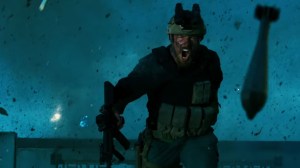
 This is Bay’s return to the realm of more “serious filmmaking,” a world he hasn’t considered since 2001’s lackluster Pearl Harbor, and while the standard Bay elements of boom are present and accounted for, the drama doesn’t stack up to the action. First, the good news is that the action in 13 Hours is often thrilling, beautifully staged and photographed by Dion Beebe (Collateral), and unlike Bay’s Transformers films, easy enough to follow along. It’s a chaotic incident where plans and communication are broken down, but Bay is able to keep the geography and the immediate and secondary goals of each action sequence clear. While the storming of the embassy isn’t quite as nerve-racking as Argo, it’s still plenty thrilling and communicates the fog of war and dawning horror of those trapped on the inside. The centerpiece is the attack on the CIA annex, which both sides anticipate and prepare for. It establishes the geography of the field of combat, the different access points, and the most likely ambushes. From there, it’s our outnumbered professionals versus a horde of armed Libyans, a standoff reminiscent in classic Hollywood action cinema. Over the course of those titular 13 hours, our security force faces wave after wave of attacks, each once becoming more sophisticated and bringing heavier firepower. Bay’s camera captures the explosions and gunfire in his usual balletic decadence. Say what you will about the man and his jingoistic tendencies, but he’s an ace visual stylist who bathes a sheen of popcorn entertainment to visceral struggle. When the action is heated, that’s when 13 Hours packs its most powerful punch.
Unfortunately, there are lulls in between the fighting, and it’s during these moments that we realize how poorly written our characters are. With the battle looming ahead, the mitigated character development emphasizes easy clichés we’ve come to expect, like the family man who needs to realize his family should come first, etc. These six guys are little more than stock characters on the screen, differentiated more by appearance and the occasional reading material than any significant personality differences. The dialogue is also rather clunky, falling too often upon tough guy speak to make up the difference. The way I was able to separate them in my head was through the actors’ previous roles (“There’s Pornstash, there’s Roy from The Office, there’s the guy from The Pacific who was the bad guy in Iron Man 3, and boy did Jim from The Office get buff”). Krasinski (Aloha) is the audience’s entry point into this world and given the most attention, so he’s ostensibly our main protagonist. He’s a strong presence to anchor the film despite the character’s shortcomings. I enjoyed watching Krasinski in such a different sort or role and started thinking about he and his wife, Emily Blunt, must have traded workout regiment advice. “Jim from The Office” with a six-pack is a surprising sight.
There’s a strange defining conflict for the first hour of the movie, namely Bay and Hogan narrowing personal clashes down to a slobs vs. snobs mentality of war. Bay has a history of fetishizing machismo and military hardware, so it should be no surprise that his movie lionizes the beefy, strapping military men serving as security. They’re placed against the eggheads of the CIA, who take every moment to remind our burly, bearded security guys that they were educated at Ivy League schools and know so much more about the Middle East. They often sound haughty when they’re scolding the security force for interfering even when it’s clear they’re saving their lives. The perspective aligns with the idea that the military-experienced, no-nonsense men of action are being ignored and looked down upon by the CIA ninnies who look at them as unnecessary babysitters. Naturally, with the hindsight of history, we know the concerns of Rone and his guys will be vindicated and the CIA snobs will be grateful they had these blue-collar American heroes. The entire role of Bob is to condescend and ignore our guys and their warnings. Bob even says early in his introduction that he’s on the brink of retirement and they won’t ruin it for him. Until the attack on September 11, we’re stuck with this reductive class warfare clash.
Another interesting aspect is that the movie makes use of its audience’s relative ignorance when it comes to the specific people involved in the Benghazi firefight. I doubt that many people know the names of the four victims excluding Ambassador Stevens. Because of that uncertainty we don’t know which of our six security characters will live, and the screenplay seems to know this, which is why it takes time to present each of the six with some sort of looming tragic back-story. We have multiple characters sending loving messages to their young children, learning they’re wife is pregnant, and making all sorts of “final” decisions, the kind that set up these characters in most movies for an early demise (if you write your girl during war or talk about your post-retirement plans, you’re guaranteed to die). I was slightly amused that the movie established each character to have a moment where it potentially sets up this tragic outcome.
 One of my big questions walking into Bay’s Benghazi movie was exactly whose version of events was the story going to follow. After eight congressional investigations, and a prominent Republican slipping by admitting one of the guiding purposes is to tarnish Hilary Clinton as a presidential candidate, I was worried that the movie was going to be a hacky, manipulative promotion of propaganda. There’s a reason that eight congressional investigations, including one that has lasted longer than Watergate, don’t seem to satisfy those calling for blood: they keep coming to the same inconvenient conclusions, namely that there was no stand down order, no conspiracy, no cover-up. There’s been a flurry of rightwing fury brewed over stoking unfounded rumors of conspiracy with Benghazi; it’s a fundraising industry unto itself for politicians. Therefore, I was initially worried that the movie was going to reinforce a version of events that eight (and counting?) congressional committees have refuted. I was relieved then that Bay’s movie keeps its focus pretty much squared on the heroism of the security team. In a way it reminded me of Black Hawk Down as it strived to recreate a series of harrowing life-and-death events with its focus more on the brotherhood and bravery of the ones in harm’s way rather than the broader political context. There is the infamous “stand down” order; however, it’s played almost incidentally, as Bob is trying to process all the chaos unfolding and the best recourse. As presented, it doesn’t sound like “stand down and let them die,” and more, “wait and let me think for a minute.” The fight to get air support from Italy doesn’t mention the fact that those Italian fighter jets sitting on the runway were not combat ready and were for flight training. There’s only one other passing dialogue exchange that touches the political, when the guys recount that the news is telling them it was a protest, which they scoff at and then let it go. That’s it. I imagine the audience that would be most excited for a Benghazi movie will be deflated. For everyone else, the sidestepping of politics lets the movie stand on its own better.
An article from Vox.com raises the issue of whether any movie about Benghazi can possibly be apolitical. It appears like the topic of Benghazi has been so cravenly politicized that any rendition of the events of that fateful day will reinforce or contradict some narrative, be it the security contractors, the CIA, the politicians on both sides of the aisle. And the absence of what others declare with certainty will only make those same people cry “cover-up.” It’s a shame that this topic is so radioactive that an objective approach celebrating the courage of those involved, mourning the loss of life, and asking for better from those in power seems impossible given the current divisive political environment. Did it have to come to this? Bay’s Benghazi is easily his most restrained movie in his bombastic career, paying reverence to the people who paid the ultimate sacrifice. The action is well staged and often visually striking, but Bay wants this movie to be more than a series of escalating action sequences. You feel he wants this to be his version of a Zero Dark Thirty-style thriller. Except it’s not. You watch the movie and sense there’s a more intelligent, nuanced, and ambiguous movie here that can make cogent points about foreign policy and the state of the Middle East. This is an action movie where the good guys shoot the relatively faceless bad guys. 13 Hours is an acceptable action movie but that’s all it ever asserts to be. Is that enough after all?
Nate’s Grade: B-
Share this:

Carol (2015)
 Have you ever watched a movie that was so understated you wanted to jump into the onscreen world and push the characters around? That’s exactly how I felt with Carol, an unrequited lesbian romance set against the closeted and intolerant era of 1950s America. Carol (Cate Blanchett) is a rich wife who meets Therese (Rooney Mara), a department store employee who assists with her Christmas shopping. They are both drawn to one another in the strange way that love works, and their possible relationship could jeopardize Carol’s custody of her young child. Because of the time period, so much of this romantic liaison is internalized and thus we get longing looks, small gestures that are meant to speak volumes, and plenty of starting and stopping, leaving the audience to fill in the blanks. I don’t have an issue with unrequited romances but Carol is one that feels like its entire world, painstakingly recreated, has been placed under glass for study. There’s no passion evident throughout the movie and I was left wondering what exactly Therese saw in Carol and vice versa. Neither woman has a particularly strong personality, though that could be a side effect of having to live publicly as a different person. I couldn’t get into them as characters and so felt little interest in seeing them together, which made the constant circling and nervous indecision even more belabored. Blanchett and Mara are quite good and director Todd Haynes (I’m Not There) handles the material with respectful subtlety, I just wish that Carol could have shaken off some of that subtlety and given me a better reason to care about these women. It’s understated to death.
Nate’s Grade: C+
Share this:

The Big Short (2015)
 Adam McKay is not exactly the kind of name you associate with a prestige picture that’s building serious Oscar heat. McKay is best known as the director and co-writer of Will Ferrell’s best movies, from Anchorman and its sequel to Talladega Nights and the underrated 2010 buddy cop movie, The Other Guys. If you stuck through the closing credits for Guys, you were treated to an animated education lesson on the size of Wall Street’s greed and accountability in regards to the 2008 financial crisis. It was impassioned, angry, and an interesting note to end an otherwise goofy comedy. The Big Short is based upon Michael Lewis’ (Moneyball) best-selling book and it’s a disaster movie where the biggest disaster is the world economy. The movie McKay co-adapted and directed is bristling with intelligence, indignation, and a clear purpose. He wants to make you very angry, and by the end if you’re not, you haven’t been paying enough attention.
In the wake of the financial collapse in 2008, the fallout was so tremendous that many people felt nobody could have seen this coming. There were a few and they made out like bandits while trying to warn others about the impending doom. In the early 2000s, Michael Burry (Christian Bale) is a hedgefund manager who sees warning signs that the housing market is a bubble ready to burst. He sees the toxicity of the majority sub-prime mortgages wrapped together and sold as a seemingly safe security, a CDO (collateralized debt obligation). His bosses think he’s mad and they’re furious when they discover Burry has gone from bank to bank making big bets against the housing market. The banks are eager to take what they believe to be easy money from a sucker. How could the housing market burst? Other Wall Street investors take notice of Burry, notably Jared Vennett (Ryan Gosling) who pitches the plan to “short” the housing market. Nobody takes him seriously except Mark Baum (Steve Carell) and his small team who works for Goldman Sachs. Baum is curious how something so large could go unnoticed, so he and his team fly to Florida and Vegas to investigate the realities of the market and what they find does not match the rosy cheerleading from Wall Street. A pair of wannabe traders (Finn Witrock, John Magaro) stumbles across Burry’s analysis and try to make their own bets, except they need a bigger name to make the trades. They reach out to an ex-Wall Street trader (Brad Pitt) who agrees to shepherd them on this quixotic quest. Are these men righteous defenders of fraud or just people trying to get their own cut of the pie?
 The brilliance of The Big Short lies in its accessibility and the virulent passion that McKay has for the subject matter. The movie is structured like a heist and an underdog story, suckering in the audience to root for the upstarts trying to fleece the big banks and profit off their greed and stupidity. For the first 90 minutes or so, the film comes across like a caper and we follow our group of misfits as they fight against the conventional wisdom that the housing market could never topple. These guys see the signs and the risks that others could not or would not see, especially since the flow of money was rich and the good times could be shared, which lead to collusion from the very same agencies designed to regulate and enforce the financial laws. For those 90 minutes the movie flies by on its sense of whimsy and are-we-getting-away-with-this good fortune, putting our band of misfits in position to win big on the losses of the ignorant and fraudulent. And then, in one swift move, it all comes down and you’re reminded, rather indignantly by Pitt’s character, that what they are benefiting from is the meltdown of the U.S. housing market and by extension the American economy. What once felt like a celebratory caper now starts to feel queasy, and it’s in the last act that The Big Short reminds you just how awful the events of the 2008 financial crisis were and how these guys did nothing more than benefit from mass misery. These are not heroes, though Mark Baum is given plenty of moral grandstanding moments that present him as the closest thing we have in the picture. These were a bunch of guys who got rich betting on a lot of other people’s bad bets, bets that almost destroyed the world’s economic systems. The concluding half hour feels like a sudden stop after a sugar rush, where you’re left to question your decision-making but also come to terms with the reality of what seemed like a fun time. McKay lures his audience in with the guise of a heist/underdog story, appealing and accessible avenues of cinema, and then serves the cold hard medicine in the concluding moments.
McKay is admirably trying to educate and advocate while he entertains, but he truly wants the audience to understand why they should be sharpening their pitchforks. At several points, characters will break the fourth wall and talk directly into the camera, admitting that certain events didn’t happen exactly as we saw, or occasionally they’ll remind us that what we watched was exactly how it happened. It’s a measure that isn’t overplayed and helps juice the spirits of the movie, becoming something of a confidant in the schemes with the onscreen participants. When things gets a little hard to understand with the mountain of Wall Street lingo, McKay will cut to celebrity cameos to help explain the more arcane instruments of the financial system. Margot Robbie luxuriates in a bubble bath and explains sub-prime mortgages, Anthony Bourdain explains CDOs, and Selena Gomez, in a rather cogent analogy, explains synthetic CDOs as an endless chain of side bets being made off one hand of blackjack. The movie goes pretty fast and a viewer might experience information overload but McKay knows when to slow things down and provide a well-timed assist so that his learned audience will see the true extent of the corruption and greed rampant in how Wall Street handled its business.
 Of the three storylines, I found Mark Baum and his team easily the most interesting and I think McKay and co-screenwriter Charles Randolph (The Interpreter) agreed, which is why he’s the biggest part of the movie. Burry gets things started but he recedes into the background after the first act, and that’s where Baum and his financial team step into the spotlight to further explore how unstable the housing market just might be. I think this is Carell’s best dramatic performance to date (I wasn’t wowed by Foxcatcher). He’s playing perhaps one of the angriest people seen on screen but that’s because he has a moral center and the bad business practices, let alone the sociopathic greed of his “peers,” constantly enrage him. He’s something like a flabbergasted crusading journalist who keeps shaking his head in stupefying revulsion at just how deep this whole thing goes. Having Baum as our entry into the moral morass of Wall Street allows the audience to feel a sense of ethical superiority, and then like Pitt’s character, it can all go away with one perfectly articulated retort. There’s a moment where Baum is lambasting a mortgage ratings officer (Melissa Leo, her only scene too) after she admits that if they don’t rate bad mortgages as good, the banks will just go to their competitor, and then she accuses Baum of being a hypocrite. His reason for the office visit is not his outrage at the fraud but the fact that this fraud is holding up his winnings. He’s not the crusader he may wish to be. Bale (American Hustle) and Gosling (Only God Forgives) are perfectly cast and provide strong supporting work in small doses spread throughout. Pitt is in 12 Years a Slave producer mode where he knows he needs to appear in the movie to better sell it to audiences, and so he’s here and rather unremarkable. There is a bevy of familiar faces (Marisa Tomei, Rafe Spall, Max Greenfield, Karen Gillan) appearing in small moments as if everybody in Hollywood wanted to get in on McKay’s party.
There is one annoying misstep in the movie and it occurs about halfway and it’s made to stretch out the stakes in a haphazard manner. The Big Short is a disaster movie where the audience knows exactly when the disaster is coming, and yet there’s a section in the middle where the characters are all left in doubt whether their big bets will pay off because of the ratings fraud. Burry is threatened with losing his job. It’s silly because we know the economy is going to crash in 2008, but the movie throws out a weak obstacle that, hey, maybe it won’t crash. It reminds me of the Hinderberg movie from the 1970s. There were several moments where it looked like that zeppelin full of hydrogen was going to go up in flames… except students of history know that moment is fated in New Jersey, so all the close calls were foolish fake-outs for a major event that was well anticipated. We all know the economy is going down so there’s no need for the manufactured doubts.
McKay and company want to wake up a fairly apathetic general public about the crimes and negligence of the Wall Street robber barons that risked the world’s economy and then managed to skip out on the tab. The tones can juggle wildly, and I’d credit McKay’s background in comedy for his ability to maintain a reliable and firm comic footing for the film without losing the significance of his message. It’s hard to nail down a genre for the movie; it’s a dark comedy, a drama, a true crime picture, and a wake-up call. You have moments that feel like a heist flick and moments that feel like a sickening journalistic expose. It’s got highs, lows, laughs, groans, and plenty of human emotions, though the most prominent would be disgust and disbelief. The Big Short is advocacy populism as pop-entertainment, and it succeeds ably. It’s an economics lesson for the public. At the end of the movie, the closing text informs us about “bespoke tranches,” which are investment opportunities that banks are flocking to ($5 billion in 2013 to $20 billion in 2014). It’s just another name for CDOs. Unless an informed public demands action from the system, it seems that Wall Street is doomed to repeat its same high-risk mistakes and that same vulnerable public is doomed to clean up the mess.
Nate’s Grade: A-


 nathanzoebl
You must be logged in to post a comment.