Blog Archives
Project Hail Mary (2026)
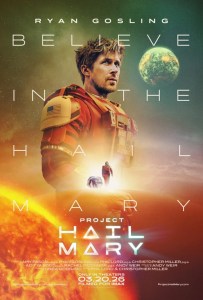
Being stranded for two hours in tight quarters with Ryan Gosling sounds like a dream come true for many. Something tells me I made this same joke except using Matt Damon’s name for the 2015 release of The Martian, another winning mixture of nuts-and-bolts scientific problem-solving and sci-fi exploration from best-selling author Andy Weir. Project Hail Mary is one of those big screen adventures that nourishes your imagination and heart. In short, it’s a rare full-package blockbuster, something to excite the senses as well as appeal to your intelligence to leave you fully satisfied. If you enjoyed the book like myself, then breathe easy, because the film has done this story a great justice. Best of all, it’s the rousing, heart-warming buddy movie you never knew you needed, and it all starts at the end of the world.
In the near future, science discovers an alien microbe that is literally eating the sun. The estimates are that our sun will dim over decades, causing widespread cooling and threatening the lives of billions. The world needs a hero. It got middle school science teacher and disgraced molecular biologist Ryland Grace (Ryan Gosling) instead, who awakens on a spaceship in a different stretch of the galaxy far, far away from Earth and its dimming sun. He has little memory of what transpired before and must piece together not just his understanding of who he is but also his world-saving mission that he now, unfortunately, is the only one who can accomplish. He’s very literally tasked with saving the world, so no pressure.
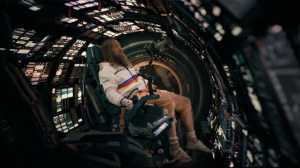
I’m going to avoid major spoilers but there is one plot development I feel needs to be discussed as it gets to the core appeal of the movie, so if you want to go into Project Hail Mary completely unspoiled, and I would advise it if you could, then end this review and come back once you’ve enjoyed the movie. For everyone else, let’s proceed ahead. Thankfully, the amnesia setup isn’t dragged out long. The film is structured to alternate between present-day problem-solving in space and flashbacks to Earth when Ryland was contacted by the top levels of the U.S. government to determine the extent of the unusual problem with water-molecule microbes somehow living and consuming the sun. The microbes are termed “astrophage” and release tremendous amounts of energy, enough so that they become the unexpected fuel for this long-shot space mission that Ryland finds himself the only survivor. He was never supposed to be mankind’s only hope (the other astronauts, the professionals, died from the induced comas for travel).
However, Ryland isn’t alone for long in the movie, and that’s where Project Hail Mary reaches a new level of entertainment and imagination. Our sun isn’t the only one affected by the astrophage, and Ryland is greeted by an alien spacecraft that has also traveled the long journey to figure out why this one sun is unaffected by the astrophage. The sense of discovery is greatly entertaining and I appreciated that there is something remarkably alien about our alien. Our intrepid alien will be nick-named “Rocky” because he best resembles a spider made out of rocks. That’s different. It’s not the old Star Trek school of slapping a forehead ridge onto somebody’s head and calling it a day. A significant and very gratifying sequence of the movie is just watching these two different lifeforms interacting and learning from one another. The language barrier has been explored before, most effectively in 2016’s grounded and somber Arrival. If Arrival was more the contemplative indie about conquering the linguistic challenges of first contact, then Project Hail Mary is the feel-good Spielbergian popcorn spectacle about saving the day and having fun. That doesn’t mean it’s a dumbed-down version; it just has different priorities, and chief among them is the winning buddy comedy of Gosling and a cuddly alien, two humble representatives of distant worlds in shared desperation for saviors. The relationship that blossoms between Ryland and our plucky, curious little space spider is naturally funny but also refreshingly serious too. Rocky is treated like an actual character, not some glorified pet or something to sell toys and Happy meals. He has a distinct perspective, learning curve, peculiarities, and determination that makes him feel more fully-developed than many human characters in terrestrial cinema. If you don’t walk away from the movie wanting your own personal huggable rock spider, then you watched a different movie than I did and, frankly, I pity you.
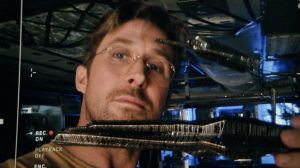
In my review for The Martian, I wrote, “There is an inherent enjoyment watching intelligent people tackle and persevere over daunting challenges, and this sets up The Martian for lots of payoffs and satisfaction. We see both sides of the problem and it provides even more opportunities for challenges and payoffs.” It’s tremendously enjoyable to watch Ryland and Rocky resolve serious scientific problems, whether it be studying the astrophage, the alien sun and its immunity to astrophage, or even just how to interact with one another when there are different systems for breathing and eating. It’s heady without being weighed down by too much scientific jargon, making the analytical discussions accessible and thus engaging. The conflict of Project Hail Mary isn’t quite as realistic as The Martian, given to more convenient cheats with “alien technology,” though the resulting resolutions still felt well-earned and satisfying thanks to the setups and payoffs that screenwriter Drew Goddard (Bad Times at the El Royale, The Martian) has layered throughout. The source material’s author, Andy Weir, has found himself a very profitable and marketable niche, dropping science whiz everymans into impossible scenarios and having them think their way out of them. At least this time the entire world is working in tandem, and spending likely trillions of dollars, to save the entire solar system instead of just retrieving one misplaced American astronaut. Weir will likely be throwing darts at what new setting someone could be stranded in next.
Now, as a film adaptation, Project Hail Mary goes the distance. This is the first live-action movie directed by Phil Lord and Christopher Miller since 2014’s 22 Jump Street (granted, they were notoriously fired from finishing 2018’s Han Solo prequel). For those worried that the movie might be more anarchic or yuk-heavy like the duo’s animated oeuvre, such as The Lego Movie and the Spider-Verse films, they have adapted their style to best suit the material. There’s plenty of humor in this movie because of the ridiculously high stakes and general odd couple nature of our buddy dynamic, but the movie never feels like it loses its focus on the bigger world-saving picture. For Ryland, he knows this mission is a one-way trip, as the capsule doesn’t have enough fuel to make the return trip to Earth. He knows this is a sacrifice, but the entirety of all living things on the planet are holding out hope that his sacrifice is successful. Lord and Miller are able to balance the comedy and dramatic elements, as well as finding appropriate spaces for the viewer, as well as Ryland, to take in the natural majesty of space in another star system. The cinematography by Greg Frasier (Dune Parts One and Two) is grand and visually sumptuous, mixing in aspect ratios and focus depth to distinguish between timelines and emotional states. The musical score by Daniel Pemberton (Spider-Man: Into the Spider-Verse) is remarkably pleasing to the ears, finding room to be rousing and immersive and awe-inspiring, perfectly aiding the gorgeous visuals. At 150 minutes long, there’s the concern about pacing, especially with a movie that has so much to explain on the go as well devoting nearly half its runtime to flashback morsels doled throughout. I never felt lag. I also never felt crushed with the exposition, as the key details are expertly elevated, then as we progress from one challenge to the next, the screenplay keeps us keyed in on what matters in that moment.

And lastly, where this movie really hinges upon is on the relationship and performances of its two leads. I’m not talking about Sandra Huller (Anatomy of a Fall) as the head of the Project Hail Mary mission, assembling cooperation among the world’s countries and experts for this longest of long-shots. Gosling (Barbie, The Fall Guy) is an immensely charming actor, self-effacing and relatably overwhelmed by the faith entrusted to him. Gosling makes us instantly connect with the protagonist, feeling the same nagging pull of his curiosity and excitement when studying something as uniquely fascinating as alien microbes, as well as the mounting trepidation of being out of your depth and having to adapt quickly or else. The film is taken to another level of entertainment thanks to Rocky, who is the clear MVP of the movie. He’s brought to vibrant life through puppeteer James Ortiz, who also provides the computer translation voice, and through the magic of empathy, we’re shedding tears for a creature without a discernible face. The dynamic between the two characters is so enjoyable, so funny, and ultimately so poignant, that it warms your heart while making you feel full by its perfect closing image.
Project Hail Mary is a crowd-pleaser to its very DNA, big yet accessible, brainy but still capable of popcorn thrills and visual fireworks, heartfelt but mordantly funny and even goofy at points, and always engaging and rewarding. It’s also a hopeful movie, something the present world could use more of. In the face of epoch-ending cataclysm, human beings are capable of working together to solve impossible problems, and heroes can emerge from the least likely places. It’s inspirational without falling into sappier, inauthentic maudlin drama, and it’s a celebration not just of teamwork but interstellar teamwork, working across enormous barriers for a common good. It’s invigorating to watch human decency and noble sacrifices prevail but also just an enviable demonstration of competency. What a wonderful world where experts are given deference and praise for their expertise and professionalism (if only this didn’t feel so tragically the stuff of “fiction” in present-day America). Project Hail Mary is a superbly made adventure movie that has a little of everything we’re looking for in mass-appeal blockbusters, and there’s a considerable skill to hold all these parts together into a movie that feels complete and enriching. Fans of heady sci-fi, buddy comedies, disaster movies, and space operas should find plenty to enjoy, but really Project Hail Mary is the kind of movie that all you need is eyes and ears to understand the appeal.
Nate’s Grade: A
Share this:

Bugonia (2025)

A remake of a 2003 South Korean movie, Bugonia is an engaging conflict that needed further restructuring and smoothing out to maximize its entertainment potential. Jessie Plemons stars as a disturbed man beholden to conspiracy theories, namely that the Earth is populated with aliens among us that are plotting humanity’s doom. He kidnaps his corporate boss, a cold and cutthroat CEO (Emma Stone), who he is convinced is really an Andromedan and can connect him with the other aliens. The problem here is that the story can only go two routes. Either Plemons’ character is just a dangerous nutball and has convinced himself of his speculation and this will lead to tragic results, or his character will secretly be right despite the outlandish nature and specificity of his conspiracy claims. Once you accept that, it should become more clear which path offers a more memorable and interesting story. The appeal of this movie is the tense hostage negotiation where this woman has to wonder how to play different angles to seek her freedom from a deranged kidnapper. Both actors are at their best when they’re sparring with one another, but I think it was a mistake to establish so much of Plemons and his life before and during the kidnapping. I think the perspective would have been improved following Stone from the beginning and learning as she does, rather than balancing the two sides in preparation. The bleak tone is par for a Yorgos Lanthimos (Poor Things) movie but the attempts at humor, including some over-the-top gore as slapstick, feel more forced and teetering. I never found myself guffawing at any of the absurdity because it’s played more for menace. The offbeat reality that populates a Lanthimos universe is too constrained to the central characters, making the world feel less heightened and weird and therefore the characters are the outliers. I enjoyed portions of this movie, and Stone’s performance has so many layers in every scene, but Bugonia feels like an engaging premise that needed more development and focus to really get buggy.
Nate’s Grade: B-
Share this:

Lilo & Stitch (2025)/ How to Train Your Dragon (2025)
 Two new live-action remakes are recreating Millennial staples, Lilo & Stitch and How to Train Your Dragon, as transparent facsimiles, and they’re both reasonably fine. If you’ve never watched either animated movie, you’d maybe even call the live-action versions pretty good for your first experiences with these stories. Both movies understand what works essentially from their predecessors and don’t reinvent the wheel. They keep things pretty safe and strict, which translates into pleasant but predictable entertainment for anyone familiar with the originals.
 I don’t even know how to fully review these entries, which is why I’m combining them together. They’re both so thoroughly fine yet one is the highest-grossing movie of 2025 so far, the popularity of which I cannot explain. My conceptual issue with the nature of live-action remakes is the implicit belief that animated films improve when they are brought into a real-world setting. I strongly disagree. Animated movies can be vibrant, stylistic, and exaggerated in such daring and artistically enigmatic ways. Translating that into real-life often strips away that style or liveliness; take for instance how un-expressive and dour the “live-action” Lion King was, a collection of possessed (cursed?) taxidermy. Animation does not require verisimilitude to be entertaining or engaging. I’m also worried over the speed of which these live-action remakes are coming, now refreshing fairly recent movies. Has there been enough distance between now and 2010 to have compelling artistic differences with the original How to Train Your Dragon? Apparently not. When the live-action Moana comes out in 2026, will it be dramatically different or better than the animated version? I strongly doubt it. We need more distance from the original animated movies so the remakes aren’t just slavish yet inferior versions of the originals. There needs to be more than simply a tracing over. I don’t see this ending any time soon considering the commercial rewards, and so the live-action Lilo & Stitch and How to Train Your Dragon continue to be good stories, just unnecessary.
Nate’s Grades: B
Share this:

The Fantastic Four: First Steps (2025)

Apparently there must have been an ancient curse that brings forth a new attempt at a Fantastic Four franchise every ten years, even further if you want to include the 1994 Roger Corman movie that was purposely made and never released just to hold onto the film rights (I’ve seen it, and once you forgive the chintzy special effects and shoestring budget, it’s actually a pretty reverent adaptation). The 2000s Fantastic Four films were too unserious, then the 2015 Fantastic Four gritty reboot (forever saddled with the painful title Fant4stic) was too serious and scattershot. Couldn’t there be a healthy middle? There has been an excellent Fantastic Four film already except it was called The Incredibles. That 2004 Pixar movie followed a family of superheroes that mostly aligned with the powers of the foursome that originally made their debut for Marvel comics in 1961. It makes sense then for Marvel to borrow liberally from the style and approach of The Incredibles because, after all, it worked. There’s even a minor villain that is essentially a mole man living below the surface. Set on an alternate Earth, this new F4 relaunch eschews the thirty-something previous films of the Marvel Cinematic Universe (MCU). You don’t need any prior understanding to follow the action, which is kept to under 105 minutes. The 1960s retro futurist visual aesthetic is a constant delight and adds enjoyment in every moment and every scene. The story is a modern parable: a planet-eating Goliath known as Galactus will consume all of Earth unless Reed Richards (Pedro Pascal) and Sue Storm (Vanessa Kirby), a.k.a. Mr. and Ms. Fantastic, give over their unborn son. The added context is that they have struggled with fertility issues, and now that at last they have a healthy baby on the cusp of being theirs, a cosmic giant wants to call dibs. It makes the struggle and stakes much more personal. It makes the foursome genuinely feel like a family trying to resolve this unthinkable ultimatum. I cared, and I even got teary-eyed at parts relating to the baby and his well-being, reflecting on my own parenting journey.

From a dramatic standpoint, this movie has it. From an action standpoint, it leaves a little to be desired. It incorporates the different powers well enough, but there are really only two large action set pieces with some wonky sci-fi mumbo jumbo. There’s a whimsical throwback that makes the movie feel like an extension of a Saturday morning cartoon show except for the whole give-me-your-baby-or-everybody-dies moral quandary. While I also appreciated its running time being lean, you can feel the absence of connective tissue. Take for instance The Thing (The Bear‘s Ebon Moss-Bachrach) having a possible romance with a teacher played by Natasha Lyonne (Poker Face). The first scene he introduces himself… and then he appears much later at her synagogue seeking her out specifically during mankind’s possible final hours. We’re missing out on the material that would make this personal connection make sense. The same with the world turning on the F4 once they learn they’ve put everyone in danger. It’s resolved pretty quickly by Sue giving one heartfelt speech. The movie already feels like it has plenty of downtime but I wanted a little more room to breathe. I was mostly underwhelmed by Pascal, who seems to be dialing down his natural charm, though his character has some inherently dark obsessions that intrigued me. He recognizes there is something wrong with him and the way his mind operates, and yet he hopes that his child will be a better version of himself, a relatable parental wish. There are glimmers of him being a more in-depth character but it’s only glimmers. The family downtime scenes were my favorite, and the camaraderie between all four actors is, well, fantastic (plus an adorable robot). Kirby (Napoleon) is the standout and the heart of the movie as a figure trying to square the impossible and desperate to hold onto the baby she’s dreamed of for so long.
The Fantastic Four: First Steps is an early step in a better direction. It’s certainly better than the prior attempts to launch Marvel’s first family of heroes, though this might not be saying much. It does more right than wrong, so perhaps the fourth time might actually be the charm.
Nate’s Grade: B-
Share this:

War of the Worlds (2025)

It’s almost refreshing when you discover a movie that is so bad it becomes a feat of amazement. Pitching a War of the Worlds remake primarily starring Ice Cube staring at his work computer sounds akin to pitching a Pride and Prejudice remake starring Jojo Siwa and it’s entirely about her gardening. You could do something like that but why would you? It’s almost like some setup for a joke. This movie was originally made in 2020 and has sat on the shelf for five years, enough so to make one wonder why anyone felt like now was the time to release it, especially in this final condition. I’m dumbfounded simply thinking about this movie. It’s so misguided in about every creative decision, from its stylistic approach to its thematic emphasis and especially making what may be the most boring alien invasion movie into an afterthought about government surveillance laws. Sheesh.
Author H. G. Wells published War of the Worlds in 1898, and it’s since been turned into many popular radio serials, movies, and TV series, including the 2005 Tom Cruise-Steven Spielberg hit. Whenever a filmmaker or production company shakes the dust off a story that we already have many versions of, the question arises what this new version will bring to the table. How will this one stand out? How will it connect in a way that the other movies had not? In short, why do we need another version? Naturally, Hollywood doesn’t think about the creative necessity of movies, only their profitability. The core difference with the new 2025 movie is that it’s a “screenlife” movie where everything we see is meant to approximate a computer screen. It’s a variation on the found footage genre. This technique was used to great effect in 2018’s Searching where John Cho tried to uncover his missing daughter’s digital footprint. That was an inventive updating of the detective thriller. Here, I cannot imagine a more boring way to illustrate an alien invasion. We’re watching one man behind a computer screen react to the news and cycle through camera feeds for exposition, having Face Time conversations with loved ones and Zoom meetings with government officials, and he apparently seems to be the only guy capable of doing his job during this war of the worlds. It reminds me of 2010’s Skyline, a smaller alien invasion movie that tried to mask its limited budget by following a group of characters trapped in an apartment that would worriedly look out the windows. It’s a bad approach, making the events feel too limited and like we’re missing out on more interesting events. Suffice to say, when the world is going to war and aliens are destroying cities, you don’t want the focus of our movie to be Ice Cube staring at you and furiously typing key commands.

Another significant blunder was making this less an alien invasion movie and more about government overreach when it comes to data mining. There will be spoilers in this paragraph, dear reader, but honestly I would actively advise you to read them anyway to just better appreciate how ridiculous this all is. The powerful aliens aren’t here for our natural resources, for turning people into food, or even a hostile takeover of the planet as their new home world. Oh, it’s far worse than that. What these dirty dirty aliens are really hungry for is… our personal data. Yes, you read that correctly. The aliens literally consume electronic data. What dull lives these creatures lead. This is less an alien invasion and more a stark literalization of data mining. These aliens are advanced enough to travel through space but need to be in such close physical proximity to harvest our data? They can’t just hack the Pentagon wifi? It turns the aliens into big dumb technological mosquitoes who just need to be directed elsewhere. I’m astounded that War of the Worlds presents an alien invasion and says that nosy government is the real problem. The movie tries to argue that these advanced aliens wouldn’t even be here if Big Government wasn’t wantonly collecting our data for their nebulous spying purposes. It’s an attack on the post-9/11 surveillance state born of the Patriot Act, but it’s also 15-20 years too late for this to be politically relevant.
The movie also picks the wrong character to serve as its moral awakening. It’s nonsensical that Ice Cube could be a trusted DHS official and be unaware of these systems and their reach. He seems to be the guy that the FBI is waiting on for door-breaching warrants that he tidily uploads as PDF files. He’s the guy NASA wants to clue in on their latest reports. He’s the guy the Secretary of Defense calls directly. He’s not the head of Homeland Security; he’s just a guy in the office, and seemingly the only guy in the building (was it a holiday weekend?). Ice Cube plays a man with some extreme boundary issues. He’s literally using government surveillance to spy on his pregnant daughter, hacking into her fridge, and I think even installing cameras into her apartment. He’s using government resources to criticize his daughter’s grocery choices. He’s overstepping his bounds and taking full advantage of that same government surveillance state that he decries at the end of the movie. At three different points someone will say incredulously about the government spying on people’s “Amazon carts,” and it’s just remarkable that something like that would politically galvanize this man when he’s already spying on his kids with that same surveillance apparatus. He’s knowingly breaking into their messages and social media and personal data. This can’t be a “what have we become?” epiphany when he’s always been there.
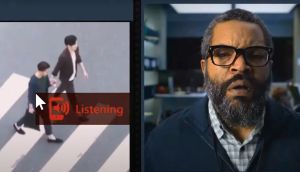
I like Ice Cube as an actor. He showed surprising depth in Boyz n the Hood, was hilariously applied in the 21 Jump Street movies as a stern sourpuss authority figure. There’s a natural intimidation factor, which was recently played for clever laughs with his appearance on The Studio. This is a performer that can be a great addition when aligned with his strengths. However, range is not a word one would readily use when describing the acting capabilities of Mr. Cube. Hinging this entire movie on Ice Cube’s emotional journey is too much of an ask. Having this man listlessly read gobs of exposition is not good for anyone. He doesn’t have that kind of arresting voice that could hypnotize us, like a Morgan Freeman or Jeremy Irons. It’s even worse when you feel the lackluster effort on his part. Strangely, despite his children being in direct danger, and the whole alien invasion backdrop, the moment that draws the most dramatic response from Ice Cube is when the aliens delete his deceased wife’s Facebook account (I would have accepted you consuming the planet, but when you delete Facebook pictures, now you’ve gone too far). The movie was filmed in the early days of the COVID pandemic and feels it, restricting everyone to their own little screens with nary the physical interaction. When you’re watching Ice Cube race through empty rooms of Homeland Security to insert a thumb-drive in the nick of time to save the world (along with shouting to the unconvincing alien special effects, “Movie bitch, get out the way”) it all just reminds you how painfully myopic and agonizingly restrictive this alien invasion approach ultimately proves to be.
Special mention needs to be made for the over-the-top Amazon product placement in this movie. The company is referenced several times, even used as a motivator for a homeless man (what computer?), but it’s much worse when one of the characters is a proud Amazon delivery driver and he’s going to use their cutting-edge drone delivery tech to make sure Ice Cube gets that all-important thumb-drive in record time. Amazon helps in saving the world thanks to their logistics in package delivery. Thank you corporate overlords, and please enjoy this movie on your life-saving Amazon Prime account, dutiful citizen.
War of the Worlds 2025 is a fascinating and maddening case study in bad adaptation choices. It feels more like an anti-government surveillance state thriller that got awkwardly grafted onto an alien invasion. The way the movie just abandons its larger scale drama for lessons in modern-day privacy laws is creatively criminal. This is an astonishingly bad movie that gets just about everything wrong at every turn. I’m almost tempted to recommend people watch it just to try and reconcile it for themselves. There have been dozens of adaptations of this classic science-fiction tale, and I feel confident in declaring this one the absolute worst even if I haven’t seen every one of them. There can’t be a worse one than this.
Nate’s Grade: F
Share this:

Superman (2025)
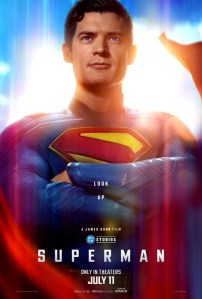 Has the world ever needed Superman more? I don’t know about you, but I could really use a symbol of good right now who represents the best of us, fighting for justice and protecting the innocent against the diabolical in power that seek to profit and prey upon the vulnerable. Vulture film critic Allison Wilmore has a fantastic headline for her review: “Superman [the movie] isn’t trying to be political. We just have real-life super villains now.” James Gunn, the quirky filmmaker who made us fall in love with a raccoon and a tree in the Guardians of the Galaxy trilogy, ascended to be head of DC movies in 2022, and he eyed reigniting Superman as the top priority, selecting himself as writer and director. It’s a lot of pressure to rebuild the DC movie brand by yourself, as there are only two other movies with scheduled release dates currently. This movie could make or break the fledgling DC Universe (DCU) rebuild soon after the smoking demise of the DC Extended Universe (2013-2023), informally dubbed the Snyderverse. Fortunately, Gunn’s take on the boy in blue is a reminder why this character has lasted so long and why the world still needs a symbol of hope.
Superman (David Corenswet) a.k.a. Clark Kent, has been a defender of Metropolis for three years now. He’s romantically involved with ace reporter Lois Lane (Rachel Bosnahan), who knows his secret identity but still chides Clark on somehow getting all those “exclusive interviews” with Superman. He’s also been a thorn in billionaire industrialist Lex Luthor’s (Nicholas Hoult) side and become an obsession of his. The world is still debating Superman’s unexpected intervention, thwarting a powerful military from invading its neighbor’s sovereign border (very reminiscent of Russian aggression). The U.S. government needs actionable proof that Superman is a threat, and Lex is determined to eliminate the alien for good.
 Amazingly, this movie feels like the second in a series rather than a reboot kickoff. From the opening text, Gunn drops us into this world already in progress. We’re skipping over the origin story, the character introductions, and all the table-setting that comprises many first films in franchises. It’s usually that second film that really takes advantage of the setup and patience of the first movie, expanding the world and deepening the character relationships and conflicts. Gunn has mercifully skipped over all that and gotten us right to the good stuff. The opening minutes of the movie drop us into a super-powered battle with the declaration that this is the first time our Superman has lost, and that beginning follows the most powerful alien on Earth having to patch up his injuries. I think that’s a very intriguing first impression, but I’ll detail more of that in a later paragraph. The world that Gunn establishes already feels well underway but the story is still accessible and the supporting characters have meaning within this world. This is a world that has been used to super heroes, a.k.a. metahumans, for some time, so when Superman finally dons his red underwear it’s not a complete shocker. This is not necessarily a reality where one super-charged character has reconfigured mankind’s entire sense of identity. The world is accustomed and adapted to extraordinary figures and monsters. This is where the Justice Gang comes in (Green Lantern, Hawkgirl, and Mr. Terrific). They’re the corporate supes, the ones called in to sign autographs, smile for pictures, and save the day for good P.R. Perhaps that’s too flippant, but the trio of established heroes doesn’t feel the same call to activism like Superman. It’s hard to fully articulate, so bear with me dear reader, but Gunn’s Superman already feels fully established, with the figure known, his relationship with Lois already in play, and Lex having already put nefarious time, research, and lots of money into combating this super obstacle with his own lethal experiments. With Gunn, there’s no time to waste. It’s already fully formed from his imagination, and the parts have their reasoning and meaning, making the whole much more satisfying.
Another way to differentiate this Superman is less from his strength than his vulnerabilities. This is a character long regarded as overly powerful, too indestructible and therefore lacking realtability. Well with Gunn’s version, here is a Superman that gets beat up. A lot. Ben Affleck’s Batman pointedly asked Henry Cavill’s Supes, “Do you bleed?” Gunn has answered in the affirmative. Much like Matt Reeves’ 2022 Batman, we get a work-in-progress superhero that is still feeling out how to best be a superhero. It’s a version that takes lots of lumps and Gunn finds interesting ways to test Superman’s limits, both emotionally and physically. The introduction of nanites into orifices certainly provides nods to Gunn’s body horror roots. While this is a Superman that gets knocked around quite a bit, his biggest vulnerability is his doubt. He’s simply trying to do good and save lives regardless of the political ramifications, but the world and its people, and especially their fears and paranoia of an Other, are more complicated. Superman explains he intervened in an international border war for the simple reason of saving lives. When Lois pushes him in a practice on-the-record interview, during one of the better scenes, about his decision-making, thinking through the consequences, consulting with world leaders and the like, he gets flustered and says there wasn’t time. All he wanted to do was save lives that would have been lost, so why is the rest of the world having a hard time with that? Over the course of those two hours and change, we watch this Superman battle through his self-doubts in a very real and compelling way that I don’t feel like any other Superman movie has better demonstrated. This is a world already rife with heroes, but is it better with a Superman? Is his existence a net positive?
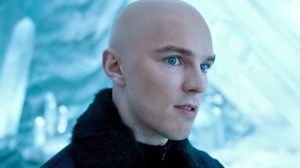 Gunn truly understands the character in a way that Zack Snyder never did. With Man of Steel and the subsequent film appearances, we were given a Superman that didn’t really want to be Superman. He was an overburdened superior being tasked with serving as mankind’s savior, and came across as annoyed. That version of Pa Kent famously told his super son that it might have been best if Clark had just let a bus full of kids die to keep his secret. Thanks for the life lesson, dad, and oh, by the way, your sacrifice was ultimately meaningless when your entire worldview was proven wrong by the end of Man of Steel. Regardless, here is a Superman that is unabashedly sincere and even a little corny. That’s who this character is, a do-gooder wanting to inspire others and wanting to save all life, even the villains, even the wildlife (my theater took special note when Superman saved a squirrel from being crushed). Snyder’s Superman was part of an entire Metropolis 9/11 of horrible collateral damage disaster porn. Gunn’s Superman works hard to make sure the giant kaiju monster, when teetering over, doesn’t fall on any building to protect the people inside. This is also a Superman that feels compelled to be a hero, to do better with his super gifts, and to keep trying even when he fails, that there can be dignity in losing a fight but continuing on because you know that fight is worth it. The depiction of Superman/Clark makes him feel much more a character worth closer examination. He’s not a detached god feeling above these petty mortals always needing saving. The real super power is his empathy and desire to help others, and that may sound corny, but Superman is too, and that’s completely fine in a world that would be better if we had more Supermans and fewer wannabe super villains.
The big question for me was whether Gunn could adapt his cheeky, irony-rich goofball sensibilities from the Guardians movies and make a Superman movie that was earnest and restrained. He has, and let this be a lesson that Gunn does not disappoint when it comes to superhero projects. There are still unmistakable elements of Gunn’s humor and style, like the ironic distance from action serving as an extended joke while characters discuss an unrelated topic, the bouncy and specific needle-drops that cue extended fight or action sequences, and of course the quippy sense of humor. I don’t agree with some of the early reviews I’ve come across that accuse Gunn of undercutting his drama with too many jokes. That is exactly why I was afraid that Gunn would be too insecure with straight drama and earnestness that he would have to rely upon an awkwardly squeezed-in ironic joke to, in his mind, balance the tone. There are jokes, some of them wild and unexpected, but this is most certainly not a movie in the same tonal space as anything Gunn has done before either as a director or a screenwriter. I did not feel that the comedy ever undercut the stakes or the sincerity of the scenes and the movie as a whole. Gunn has shown he can re-calibrate his style and comedic voice while at the same time still making things his own without copious slow-motion. The action is refreshingly staged to be immersive, with few cuts and wide camera swings in order to present everything on the screen in an easily oriented field of vision.
 Corenswet (Pearl, Twisters) has some big tights to fill, as I would argue while there have been iffy-to-bad Superman movies there hasn’t been a bad Superman. Obviously the one that all others are defined by is Christopher Reeve who was the greatest special effect the original movie had (I know the flying sequences were groundbreaking for their time, but they play out so cheesy and dated, complete with sudden Margot Kidder poetic resuscitation). Watching him switch from suave hero to clumsy Earthling in a split-second was the best. Corenswet certainly looks the part, clean-cut All-American looks, even though he’s British. He really channels the character’s big heart with his struggle to be accepted, by the public, by the media, by Lois, by even his enemies. He’s got the presence to fill out that suit but the emphasis is not on the contours of his abs but on the unfailing dedication and goodness of a character trying to do right. He won me over early, and it doesn’t hurt hat he has terrific chemistry with Brosnahan, who has been readying herself for this part for years with The Fabulous Mrs. Maisel. She’s great too. Hoult (Nosferatu) channels his smarm perfectly as a very punchable Lex who might make you think about a certain DOGE-master and his team of flunkies wreaking havoc on the rest of the country through unchecked hubris. I loved his pettiness and thinly-veiled vanity, like during an approaching apocalyptic cataclysm and he says to screw the people of Metropolis. “They chose him, let them suffer.” It sounds a lot like, “Your state voted against me, so you won’t get immediate emergency assistance.” You will cheer hard for Lex’s defeat, even more so when his plan involves literal extra-judicial forever confinement.
However, the real brreak-out star of the movie will most certainly be Krypto, the adorably jumpy super dog. Every time this pooch makes an appearance it is welcomed and he’s utilized as more than just easy comic relief. I expect a sharp uptick in the number of good boys named “Krypto” afterwards.
 James Gunn has alleviated all of my fears about him tackling the Man of Steel, and he’s created a Superman that soars above the superhero field. It’s so vibrant and funny and accessible to anyone regardless of their prior feelings or understanding of Superman. It’s also a clear-cut example of what a Superman movie can and should be, sincere and bright and, yes, a little bit corny too. We need this character, and we especially need film artists that know how to craft engaging stories with this character who’s existed for almost 90 years. There’s an inherent lasting power to Superman, and it’s his sheer goodness as an outsider, a feared alien, who has all the powers in the world but just wants to help others. Many have long viewed Superman as boring, a Boy Scout in a world that has grown too morally murky to maintain such a morally unwavering figure of truth, justice, and the American way (what does that last part even mean any more in the bleak environment of 2025?). Gunn has shown us how necessary the character can be, a balm to our troubled times, and the reality that do-gooder figures can be inspirational and aspirational no matter the circumstances. He’s made a Superman movie with an intriguing, lived-in world, one that I now believe can easily support a fuller universe of stories and side characters. He’s also made what I consider the best Superman movie to exist yet (apologies to the nostalgia of the fans of the Richard Donner/Christopher Reeve originals). I have some minor quibbles, like how Lois fades into the background for the second half, but they are only quibbles. This movie was exactly what I needed. I’m sure there are millions of others yearning for the same. Superman is proof that the DC film universe might actually have the perfect person in charge of charting their cross-franchise courses. Kneel before Gunn.
Nate’s Grade: A-
Share this:

Rebel Moon – Part One: A Child of Fire (2023)
 Creating an original sci-fi/fantasy universe is hard work. It involves bringing to life an entire new universe of characters, worlds, back-stories, rules, conflicts, cultures, and classes. There’s a reason major studios look to scoop already established creative universes rather than build their own from scratch. This is what director Zack Snyder had in mind when he pitched a darker, grittier, more mature Star Wars to Disney, who passed. Over the ensuing decade, Snyder and his collaborators, Shay Hatten and Kurt Johnstad, continued working on their concept, transforming it into an original movie series, resulting in Netflix’s big-budget holiday release, Rebel Moon – Part One: A Child of Fire, a clunky title I will not be retyping in full again. Snyder’s original results of the “darker, grittier Star Wars” are rather underwhelming and don’t make me excited for the concluding second movie being released in April. Why go to the trouble of building your own universe if you don’t want to fill in the details about what makes it important or at least even unique? I can see why Snyder would have preferred Rebel Moon as a Star Wars pitch, because they could attach all the established world-building from George Lucas and his creative collaborators as a quick cheat code.
In another galaxy, the imperial Motherworld is the power in the universe. The king and his family have been assassinated, and in the power struggle that follows, several planets have taken up arms to fight for independence. On a distant moon, Kora (Sofia Boutella) is doing her best to live a nondescript life as a farmer, helping to provide for her community and stay out of trouble. Well trouble comes knockin’ anyway with Admiral Atticus Noble (Ed Skrein) and his fleet looking for resources and powerless villagers to abuse. Kora’s history of violence comes back to her as she fights back against the Motherworld soldiers with cool precision. Her only hope is to gather a team of the most formidable warriors to protect her village from reprisals. Kora and company band together while her mysterious past will come back to haunt her reluctant return to prominence.
 For the first thirty to forty minutes of Rebel Moon, I was nodding along and enjoying it well enough, at least enough to start to wonder if the tsunami of negative reviews had been unfairly harsh, and then the rest of the movie went downhill. One of the major problems of this Part One of a story is that it feels like a movie entirely made up of Act Two plotting. Once our hero sets off on her mission, the movie becomes a broken carousel of meeting the next member of the team, seeing them do something impressive as a fighter, getting some info dump about their mediocre tragic backstory, and then we’re off to the next planet to repeat the process. After the fifth time, when a character says, “Anyone else you know?” I thought that the rest of the movie, and the ensuring Part Two, would be nothing but recruiting members until every character in the galaxy had joined these ragtag revolutionaries, like it was all one elaborate practical joke by Snyder. Some part of me may still be watching Rebel Moon, my eyes glazing over while we add the eight hundred and sixty-sixth person who is strong but also shoots guns real good. Then the movie manufactures an ending that isn’t really an ending, merely a pause point, but without any larger revelations or escalations to further our anticipation for Part Two in four months’ time. What good are these handful of warriors going to be defending a village in a sci-fi universe where the bad guys could just nuke the planet from orbit? Find out in April 2024, folks!
The entire 124-minute enterprise feels not just like an incomplete movie but an incomplete idea. This is because the influences are obvious and copious for Snyder. Rebel Moon starts feeling entirely like Star Wars, but then it very much becomes a space opera version of The Magnificent Seven, itself a remake of Akira Kurosawa’s Seven Samurai. With our humble farmer, our high plains drifter trying to turn their back on an old life of violence, and the recruitment of our noble fighters to ward off the evil bandits coming to harass this small outpost, it’s clearly The Magnificent Seven, except Snyder doesn’t provide us the necessary material to invest in this scrappy team. The characters are all different variations of the same stoic badass archetype, like you took one character mold and simply sliced it into ten little shear pieces. The characters don’t even have the most basic difference you could offer in an action movie, variation in skill and weapons. One lady has laser swords (a.k.a. lens flair makers) but pretty much everyone else is just the same heavy gun fighter. One guy doesn’t even bother to put on a shirt. Some of them are slightly bigger or more slender than others but the whole get-the-gang-together plot only really works if we have interesting characters. If we don’t like the prospective team members, it’s like we’re stuck in an endless job interview with only lousy candidates.
 The fact that Rebel Moon is derivative is not in itself damaging. Science fiction is often the sum of its many earlier influences, including Star Wars. Rebel Moon cannot transcend its many film influences because it fails to reform them into something coherent of its own. There is no internal logic or connection within this new universe. The original world building amounts to a slain royal family, an evil fascist regime, and maybe a magic princess connected to a prophecy of balance, and that’s it. All the flashbacks and expository data dumps fail to create a clearer, larger picture of how this sci-fi universe operates. The inner workings are kept so broad and abstract. We have an imperial evil and assorted good-hearted little guys. The movie begins by introducing a robot clan of knights that are dying out, and even a young Motherworld soldier who seems likely to defect, both opportunities to go into greater character detail and open up this world and its complications. So what does Snyder do? He leaves both behind shortly. Even though we visit a half dozen planets, these alien worlds don’t feel connected, as if Snyder just told concept artists to follow whatever whim they had. They don’t even feel that interesting as places. One of them is desert. One of them has a saloon. One of them is a mining planet. It’s like the worlds have been procedurally generated from a computer for all we learn about them. They’re just glorified painted backdrops that don’t compliment the already shaky world building. They’re too interchangeable for all the impact on the plot and characters and any declining sense of wonder.
Given the open parameters of imagination with inventing your own sci-fi/fantasy universe, I am deeply confused by some of the choices that Snyder makes that visually weigh down this movie in anachronistic acts of self-sabotage. Firstly, the villains are clearly meant to be a one-to-one obvious analog for the Empire in Star Wars, itself an analog for the fascists of World War II, but Lucas decided having them as stand-ins was good enough without literally having them dress in the same style of uniforms as the literal fascists from World War II. You have an interconnected galaxy of future alien cultures and the bad guys dress like they stepped out of The Man in the High Castle. It’s too familiar while being too specific, and the fact that it’s also completely transparent with its iconic source references is yet another failure of imagination and subtext. I just accepted that the Space Nazis were going to look like literal Nazis, but what broke my brain was the costuming of Skrein’s big baddie in the second half of the movie. At some point he changes into a white dress shirt with a long thin black tie and all I could think about was that our space opera villain looks like one of those door-to-door Mormon missionaries (“Hello, have you heard the Good Word of [whatever Snyder is calling The Force in this universe]?”). Every scene with this outfit ripped me out of the movie; it was like someone had photo-shopped a character from a different movie. It certainly didn’t make the devious character of Atticus Noble more threatening or even interesting. I view this entire creative decision as a microcosm for Rebel Moon: a confused fusion of the literal, the derivative, and the dissonant.
 Snyder is still a premiere visual stylist so even at its worst Rebel Moon can still be an arresting watch. He’s one of the best at realizing the awe of selecting the right combination of images, a man who creates living comic book splash pages. I realized midway through Rebel Moon why the action just wasn’t as exciting for me. There’s a decided lack of weight. It’s not just that scenes don’t feel well choreographed or developed to make use of geography, mini-goals, and organic complications, the hallmarks of great action, it’s that too little feels concrete. It feels too phony. I’m not condemning the special effects, which are mostly fine. The action amounts to Character A shoots at Bad Guy and Character B shoots at Other Bad Guy, maybe behind some cover. There’s only one sequence that brings in specifics to its action, with the challenge of defeating a rotating turret gun pinning the team down from escape. That sequence established a specific obstacle and stakes. It worked, and it presented one of the only challenges that wasn’t immediately overcome by our heroes.
The Snyder action signature of slow-mo ramps has long ago entered into self-parody territory (I’m convinced a full hour of his four-hour Justice League cut was slow motion), so its use has to be even more self-aware here, especially in quizzical contexts. There are moments where it accentuates the visceral appeal of the vivid imagery, like a man leaping atop the back of a flying griffin, akin to an 80s metal album cover come to life. Then there are other times that just leave you questioning why Snyder decided to slow things down… for this? One such example is where a spaceship enters the atmosphere in the first twenty minutes, and a character drops their seeds in alarm, and those seeds falling are detailed in loving slow motion. Why show a character’s face to impart an emotion when you can instead see things falling onto the ground so dramatically?
 The actors are given little to do other than strike poses and attitudes, and for that they all do a fine job of making themselves available for stills and posters and trailers. Boutella (The Mummy) is good at being a stoic badass. I just wish there was something memorable for her to do or make use of her athleticism. The best actor in the movie is Skrein (Deadpool) who really relishes being a smarmy villain. He’s not an interesting bad guy but Skrein at least makes him worth watching even when he’s in the most ridiculous outfit and awful Hitler youth haircut. There’s also Jena Malone (Sucker Punch) as a widowed spider-woman creature. So there’s that. Cleopatra Coleman (Dopesick), who plays one half of a revolutionary set of siblings along with Ray Fisher, sounds remarkably like Jennifer Garner. Close your eyes when she’s speaking, dear reader, and test for yourself. I was most interested in Anthony Hopkins as the voice of our malfunctioning android (literally named “Jimmy the Robot”) operating on mysterious programming that hints at something larger in place relating to perhaps the princess being alive. Fun fact: Rebel Moon features both actors who played the role of Daario on Game of Thrones (Skrien and Michiel Husiman).
Even with all the money at Netflix’s mighty disposal, Rebel Moon can’t make up for its paltry imagination and thus feels like an empty enterprise. I’m reminded of 2011’s Sucker Punch, the last time Snyder was left completely to his own devices. I wrote back then, “Expect nothing more than top-of-the-line eye candy. Expect nothing to make sense. Expect nothing to really matter. In fact, go in expecting nothing but a two-hour ogling session, because that’s the aim of the film. Look at all those shiny things and pretty ladies, gentlemen.” That assessment seems fitting for Rebel Moon as well, a movie that can’t be bothered to provide compelling characters, drama, or world-building to invest in over two to four hours, once you consider the approaching Part Two. I wish this movie had a more distinct vision and sense of humor, something akin to Luc Besson’s lively Fifth Element, but fun is not allowed in the Zack Snyder universe, so everything must be grim, because grim means mature, and mature means automatically better, right? Rebel Moon is a space opera where you’ll prefer the void.
Nate’s Grade: C-
Share this:

The Marvels (2023)
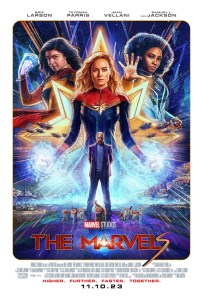
No Marvel Cinematic Universe (MCU) movie has had a bigger trail of negative buzz than The Marvels, the supposed sequel to not just 2019’s Captain Marvel but also an extension of two Marvel television series from the Disney streaming service. The film has had its release delayed three times, rumors abound that heavy portions were re-shot, and its own director, Nia DeCosta (2021’s Candyman), had already moved on to starting her next project while her last movie was still being finished in post-production (to her defense, the movie was delayed three times). The opening weekend wasn’t kind, setting an all-time low for the MCU, and the critical and fan reception was rather dismal, with many calling the movie proof that Marvel was in trouble. There is a lot going against this movie, and yet when I actually sat and watched The Marvels, I found it a flawed but fun B-movie that doesn’t deserve its intense pile-on. Although, caution dear reader, as I’m also one of the seemingly few critics who enjoyed Black Widow and most of Eternals as well.
Carol Danvers a.k.a. Captain Marvel (Brie Larson) has been absent for most of the past 30 years, trying to do right by the universe’s many alien civilizations in need. The people of Earth also feel a little left behind, notably Monica Lambeau (Teyonah Parris), who knew Carol as a child in the 1990s and is now acclimating to her own light-based superpowers (see: WandaVision). A power-hungry Kree warrior, Dar-Benn (Zawe Ashton, Tom Hiddelston’s wife in real life), is seeking a way to restore a home world for her people. She finds one super-powerful weapon, a bangle she wears on her arm that opens interstellar portals. The other bangle happens to belong to a New Jersey teenager, Kamala Khan (Iman Vellani), a first generation Pakistani-American who also moonlights as the bangled-powered hero, Ms. Marvel (see: Ms. Marvel). Through strange circumstances, Kamala, Monica, and Carol are all linked by their powers, so if one of them uses said powers they happen to swap places in space, teleporting from three different points. It makes it really hard when you’re supposed to save the day and work together to defeat the bad guy.

The core dynamic of the movie is this trio of powerful women learning to work together, and while that might sound trite for the thirty-third movie in a colossal franchise, it’s a serviceable arc for a movie that only runs 100 minutes, the shortest in MCU history. The swift running time is both a help and a hindrance, but it allows the film not to overstay its welcome while juggling three lead characters and multiple space-time-hopping action set pieces. I wish Marvel could return to an era of telling smaller stories that don’t have to feel so grandiose, with personal stakes tied more to their characters than saving the planet yet again (2017’s Spider-Man: Homecoming is a great example). Even though this too falls into the trap of world-destroying-energy-hole, it still feels lighter and breezier, and I think that is a result of its pacing and lowered ambitions. That’s not an insult to the filmmakers, more a recognition that The Marvels doesn’t have to compete with the likes of Endgame or the Guardians for emotional stakes. It can just be fun, and simply being a fun and well-paced action movie is fine. That’s what the MCU diet can use more of, especially considering the Ant-Man movies have transformed from palate cleansers to same-old bombast.
On the flip side, the speedy running time is also a very real indication of its troubled production and the attempt to salvage multiple versions into one acceptable blockbuster. There are signs of heavy editing and re-shoots throughout, from lots of ADR dialogue hiding actors visibly mouthing these patchwork lines, to world-building problems and solutions that can seem hazy. The rationale for why these three women become linked is so contrived that even Nick Fury (Samuel L. Jackson) bemoans Carol not to touch a strange unknown space light because it’s shiny. The concept of the three heroes being linked by their powers offers plenty of fun moments, of which I’ll go into more detail soon, but the execution left me questioning. Which superpower use qualified and which did not? It seems a little arbitrary which powers using light trigger the switcheroo. I don’t think the movie even knows. There’s also a late solution that feels so obvious that characters could have been like, “Oh yeah, we could have tried that this whole time.” A reasonable excuse was right within reach, blaming the inability to attempt the solution on not having sufficient power before assembling both of the bangle MacGuffins. It also, curiously, allows the villain to win in spite of her vengeful indiscriminate killing, but don’t think too much about that or its possible real-world parallels as that will only make you feel dramatically uncomfortable.

There are remnants of what must have been a fuller movie of Marvels’ past, as each character has an intriguing element that goes relatively under-developed. Monica was gone thanks to Thanos while her mother died and is also trying to square her feelings of resentment for Carol, a woman she felt so close to as a child who flew away and didn’t return for decades. So we have attachment issues and issues of closure. Carol is likewise trying to rebuild her relationship with this little girl she let down, and she has to also consider the unintended consequences of being a superhero. The Kree worlds refer to Carol as “The Annihilator,” a powerful being that doomed their civilization. She’s become a culture’s nightmare. That re-framing of heroism and perspective, as well as the larger collateral damage of the innocents from defeating villains makes for an interesting psychological stew of guilt and doubt and moral indecision. Then there’s Kamala, who worships Captain Marvel as her personal hero and wants nothing more than to join the ranks of superheroes. Her rosy version of the duties of being a hero could be seriously challenged by the harsher reality, like when Carol has to determine that saving “some lives” is more important than losing all life to save more. She could become disillusioned with her heroes and re-examine her concepts of right and wrong. And there are elements of all these storylines with our trio but they’re only shading at best. There’s just not enough time to delve into this drama when the movie needs to keep moving.
However, the fun of the body-swapping concept leads to some of the more enjoyable and creative action sequences in the MCU. DeCosta really taps into the fun comedy but also the ingenuity of characters jumping places rapidly. It begins in a disorienting and goofy way, as characters jump in and out of different fights and have to adapt. It makes for a fun sequence where at any moment the action can be shaken up, as well as forcing there to be enough action going on for three people. This also leads to some interesting dangers, as Kamala gets zapped high above her neighborhood and plummets to the ground, as these are the dangers when your two other linked superheroes can fly. The use of the powers into the action feels well thought through, and the combination of the women working together and strategizing when and where to swap places makes for creatively satisfying resolutions. The action sequences are also very clearly staged and edited without the use of jarring and confusing edits. You can clearly see what is happening and what is important, and the choreography is imaginatively spry.

There are some asides to this movie that had me smiling and laughing and just plain happy. The Marvels visit a planet where the only way to communicate with the locals is through song, and it starts out like a big old school Hollywood musical with some Bollywood flourishes. I wish the movie had done even more with this wonderfully goofy rule, possibly even setting a fight sequence that also plays into the musical quality of the weird setting. Oh well, but it was pure fun and forced the characters outside of a comfort zone (though this too had some hazy rules application). There’s also a montage involving alien cats and a life-saving and space-saving solution that had me giggling like crazy (my extra appreciation for the ironic use of “Memory”). It’s because of these sequences, the delightful exuberance of Vellani, and the above-average action sequences that make it impossible for me to dismiss the movie as a waste.
The Marvels has problems, sure, with its lackluster villain, some hazy rule-setting and application, not to mention an overstuffed plot that feels a bit jumbled from the likes of twenty other stories trying to appear as one semi-unified whole. But it’s also fun, light, and entertaining in its best moments, and even the good moments outweigh the bad in my view. I would gladly re-watch this movie over the likes of Multiverse of Madness, Love and Thunder, and Quantumania. While it can seem initially overwhelming to approach, the movie does a workable job to catch up its audience on who the other Marvels happen to be just in case you didn’t watch 17 episodes of two different TV shows. It’s mid-tier Marvel but refreshingly comfortable as such, only aiming for popcorn antics and goofy humor with some colorful visuals. It all feels like a special event from a Saturday morning cartoon, which again might be faint praise to many. Blame it on my lowered expectations, blame it on my superhero fandom, or simply call me a contrarian lashing out against what seems a very ugly strain of vitriol for this movie to fail, but I found The Marvels to be a perfectly enjoyable 100 minutes of super team-up tomfoolery.
Nate’s Grade: B-
Share this:

No One Will Save You (2023)
 Brian Duffield has been an industry screenwriting phenom for years, though it took too many years for his ribald, clever, and high-concept stories to eventually find their way as finished films, or at least finished versions of his once ribald, clever, and high-concept stories. I fell in love with him as a storyteller with 2017’s The Babysitter, and that love matured into admiration and appreciation with 2020’s Spontaneous, his directorial debut, also my top movie of that year. As hyper verbal and bracing and layered as that stylish movie with major attitude was, and brilliantly so, his follow-up is a sprint in the other direction. No One Will Save You (I keep wanting to type You Will Not Survive This as its title) is a contained thriller with hardly a line of spoken dialogue as we follow Brynn (Kaitlin Dever) battle aliens. Being a nearly dialogue-free experience puts much on the immersive visual experience, and I don’t know if the movie fully sustains this, but the combined effort is solid and sneaky fun.
This is a throwback to the early 1990s invasion thriller, the heyday of The X-Files and Fire in the Sky when the little gray guys with the big black eyes became our default model for aliens. There’s an easy dread to compile when it comes to a powerful and otherworldly entity that has decided to target you, a lowly human. Duffield is able to engineer plenty of anxious moments and jump scares, allowing the scares to luxuriate by building suspense as well as the adrenaline bursts of sudden surprise (a moment with “toes” made me squirm). He makes a key creative decision early to showcase his aliens. Usually these kinds of movies are more guarded about their monsters, confining them to the shadows or at least relying upon the viewer’s imagination to fill in the blanks before pulling back and finally revealing their true form. There’s a reason that so many filmmakers follow this model, and it’s because the final reveal usually pales in comparison to whatever unseen horror the imagination can fathom. The slender creatures do make for creepy silhouettes, and there are three or four different versions of the aliens and this allows for some additional fun design discovery. A long-limbed one reminded me of a praying mantis. The chattering sound design and ominous lighting do a lot of atmospheric heavy lifting to elevate the mood. If you’re looking for a generally well-executed home invasion thriller with some gasp-inducing moments, No One Will Save You fulfills its promise. There’s a pleasing clarity to the plot mechanics, even if you are wondering why this woman doesn’t abandon her house.
 There isn’t much that needs explaining, which streamlines its 90 minutes into a series of reactive responses to the home invasion, with some clues and inferences throughout for us to start to piece together why our heroine is so troubled and seems so isolated by her small-town community. It makes for a visceral, visual method of storytelling but it also limits how much information and depth we are going to encounter. Our main character is still suffused by her own guilt and lasting trauma from her past, and as the movies seem to magically allow, she’s going to be given an external struggle that might just allow her to finally exorcise and resolve a dicey internal struggle. The alien encounters don’t seem to give us better insight into who our protagonist used to be, who she is now, and the misplaced perception of the townspeople. She’s retreated inward. She’s resourceful. She uses what she has to better guard from further close encounters, but all she has are ordinary items found in an old farmhouse, not high-powered weapons and booby traps. She’s just one frightened young woman in an old house trying to do her best. By holding back, we’re only given so much with this character, so she can feel somewhat underwritten and kept archetypal, underpinned by her past mistakes and her current otherworldly dilemmas. I just don’t know if there’s enough going on with this character even with the repeated alien visitation.
Dever (Booksmart) is one of our best young actresses and an excellent choice to anchor our drama. Without the safety of words, much is required from her, and Dever provides a compelling presence even when I feel like the character is hitting her limits. Carrying an entire movie and doing so much with non-verbal acting techniques can be a weighty ask, but Dever relishes the challenge, and through her capable performance we are given a hero worth rooting for.
 The movie does an acceptable job of keeping us, and her, relatively in the dark while still not making the sides too overwhelming. How can one Earth girl combat a species with such advanced technology, size, and power? Well, we don’t fully know what they want, and these little green men are still made of fleshy stuff and can still be hurt and killed like any other fleshy goo-filled life form. They may be advanced but they can still get killed, and that at least gives our heroine a chance that she shouldn’t have. The aliens’ plan is generally unknowable, and just trying to piece together a fuller picture of who they are, the different species and forms, and what their purpose might be for the town is plenty of work for the rest of us that don’t speak the space language. It’s enough of a reasonable learning curve to fill out a short movie while keeping focus on the task at hand, whether it’s hiding under the bed, running around the house, or simply trying to figure out whether going into town for help is worth the effort. I wish there was a little more deliberation on her part about whether the aliens might be preferable to her neighbors. The ending isn’t exactly ambiguous but reminds me a little of 2019’s Midsommar, where letting go of one’s personal hang ups might not be the catharsis of enlightenment it may appear to be.
No One Will Save You is a throwback sci-fi thriller that speaks to the human vulnerabilities we can all feel, being helpless against overwhelming powers, be they alien or our own guilt. It’s a fun thriller with some well-wrought sequences of suspense and jump scares. I don’t know if there’s more happening beyond the visceral appeal of the experience. The character and the situation don’t provide much in the way of larger depth and analysis, and more than a few will likely be able to guess her tragic back-story, though that’s also a credit to Duffield providing the key pieces. As a change of pace, No One Will Save You proves that Duffield is an entertaining and capable storyteller no matter what restrictions he holds himself to. I just prefer my Brain Duffield stories without any restrictions because we only have one Brian Duffield.
Nate’s Grade: B
Share this:

Guardians of the Galaxy vol. 3 (2023)
 It’s taken me longer to review the third, and reportedly final, installment of the Guardians of the Galaxy trilogy because I didn’t think that I nor my family had the emotional bandwidth when the movie was originally released to herald the summer. I’ve been a big fan of writer/director James Gunn’s comic book escapade efforts with the Marvel Cinematic Universe (MCU), as well as his first DC entry, 2021’s The Suicide Squad, the best DC film of the new era, so I’ve been highly anticipating a third Gaurdians ever since the second ended six years ago. Of course all fans have had to wait a little longer after Disney fired Gunn in 2019 for offensive social media posts they already knew about before the first Guardians film in 2014, and then they came to their senses and re-hired one of the most unique voices working within their giant sandbox of superheroes. The reason I decided to wait even longer is because I had been warned by many of my critical colleagues about the heavy thematic nature of the third entry, namely the frequent sequences of animal abuse. My family had to put down their household dog of over ten years in late April, and having to re-open that wound by watching pretend animals get abused was not the best for any of our emotional states. And so I waited until it was available on digital and in the comfortable sanctity of my home, and I alone in my family watched Volume Three, partly as a harbinger of future warning over what scenes to skip over for them. It’s a fitting end to a strange and funky series of movies that taught us to feel real emotions over racoons and trees, and even though I’d rate this as last in its respective Guardians standing, it’s still a winner and a topical reminder that these big-budget blockbusters are only ever as good as when the passion is evident.
The Guardians are on a mission to save their friend, Rocket (voiced by Bradley Cooper). He’s been incapacitated and is sought after by his creator, The High Evolutionary (Chukwudi Iwuji), a maniacal man with a god complex who is trying to create a perfect life form. This forces the Guardians to learn more about Rocket’s tragic past as a cruel science experiment, and it brings back Gomorrah (Zoe Saldana), though she’s not the same woman who fell in love with Peter Quill (Christ Pratt), and he’s having a hard time reconciling the different green girls. They’ll have to work together to rescue Rocket and stop the High Evolutionary from further harm.
 This is a movie built around the back-story and emotional connections of Rocket, a character that, prior to Gunn’s first film, had fewer than a dozen comic appearances but has had an outsized influence over the movies. If the first movie was about the formation of our team, and the second was deepening the supporting characters, as well as exploring Quill’s daddy issues, then the last movie is all about how we say goodbye to the ones we love. Volume Three is clearly structured like Gunn’s fond farewell for these characters rather than merely a pause in their contractually obligated appearances (whether Marvel overrules Gunn is another matter). It makes the interaction more meaningful and also more emotionally rich, not just because certain characters might perish, but because of the journey we’ve been privileged to hop along for, how far they’ve come and how much they matter to others, and by extension us, the audience.
Case in point: the emotional evolution of Rocket Racoon. He began as a surly visual joke, a teeny mammal with a big gun and a big attitude. It wasn’t until a drunken outburst in Volume One that you got a glimpse of the trauma and pain beneath that antisocial demeanor. With Volume Three, he gets sidelined pretty early, which means the majority of the time we spend with Rocket is through a series of flashbacks with baby Rocket and his cute pals, all ongoing science experiments (one needs only to recognize the absence of these childhood friends as grown-ups to anticipate where this is inevitably heading). In some ways, it is cheap and manipulative. It’s not hard to make an audience feel extreme emotions by introducing a slew of adorable animals as well as a villain who hurts them and sees them as expendable experiments undeserving of sympathy. I wish Gunn hadn’t gone so hard in this direction because it feels excessive in the ideas that the film bluntly communicates. Yes, a storyteller will need time to establish a baseline of relationships, conflicts, and looming change, but do we need six or seven flashbacks to settle the concept of animal testing and animal cruelty being a bad thing? I credit Gunn with making his thematic intent unambiguous; this is wrong, and you will feel it explicitly. However, sidelining Rocket for a majority of the movie and having characters project onto his unconscious body, while providing more insight through a system of excessive and heavy-handed flashbacks, might not be the best model for ensuring this character gets his due when it comes to this showcase. Quill keeps calling Rocket his “best friend” and I’m trying to remember when this happened. I re-watched Volume Two this summer, and now consider it the best of the trilogy, and I cannot recall the specific events that bonded these two bickering alphas into inter-species BFFs.
 Another facet of Gunn’s relevant themes is personified in the romantic realizations of Quill. Not to get too complicated, the current Gomorrah is a past version of herself and not the one who joined the Guardians, fell in love with Quill, and died in Infinity War. She’s back, but from her perspective she never left, and this moon-eyed dolt keeps projecting his feelings onto her. I respect that Gunn doesn’t try and wave away this complication, nor does he mitigate the agency and importance of this Gomorrah not having to follow the same path as her predecessor. The easy thing would have been for Quill to wait and for this new/old Gamorrah to see the same qualities that made the old/dead Gomorrah fall in love. It would be like one of those soapy romances where a person suffers amnesia and gets to fall in love with their spouse all over again. Gunn doesn’t do that. These are different people, and despite the aching desire of Quill to rekindle what he had, it has been lost, and this needs to be acknowledged and accepted. “I bet we were fun,” she says, and it’s a bittersweet summation that extends beyond the Guardians.
There is still Gunn’s signature sense of style and humor while checking the boxes of a big-screen action blockbuster. There’s an infiltration set piece that plays like a goofier Mission: Impossible setup but in a squishy bio-mechanical facility that reminded me of the eccentric and schlocky sci-fi diversions personified in the Lexx movies and TV series. There’s an entire planet of animal-human hybrids that feels wasted as further proof of the High Evolutionary’s already established evil. The entire character of Adam Warlock (a beefed up Will Poulter) is a himbo that definitely feels lacking in larger purpose now that the Infinity Era is over. There is one signature action scene involving a protracted fight through a crowded hallway, and it’s exciting and fun. The jokes are mostly contained to sardonic banter, which can be hilarious depending upon the combination of characters, though it also can be grating when it feels forced, like Mantis (Pom Klementieff) and Nebula (Karen Gillan) butting heads. The celebrated dad rock soundtrack has moved onto 90s and early 2000s music, and as a 90s kid, it gave me a personal nostalgic lift watching scenes jamming to dreamy whoo-hoo alt-rock acts like Radiohead and Spacehog and The Flaming Lips.
 This also might be the grossest MCU movie yet, and not just from the animal abuse but a face-peeling scene that will startle most. I had to pause the screen and drag my 12-year-old stepdaughter into the room with the promise, “Want to see the grossest thing ever in a Marvel movie?” She agreed that it was indeed that. It’s reassuring that no matter the budget, Gunn’s sensibilities that make him the unique storyteller he is, the same man who began with Troma, will be there. Though this point also concerns several of my friends wondering if Gunn can abandon these silly and schlocky tendencies to tell an earnest and tonally appropriate tale for his 2025 Superman reboot.
Guardians of the Galaxy volume 3 is the end of an era for Gunn and for the MCU. As the new head of the DC film and TV universe, it’s unlikely he’ll be lending his talents to Marvel any time soon, although the characters he made us fall in love with could carry on. Gunn clearly loves these characters, and especially identifies with Rocket, the angry malcontent lashing out in pain, so it’s fitting to give this character the big stage for a final outing, and if he can throw in some animal cruelty messaging along with silly humor and pathos, then so be it. This practically feels like Marvel is giving Gunn even more leeway as an apology for firing him. The Guardians trilogy stands out from the prolific MCU assembly because of how much Gunn has personalized these movies to make them special. They have permission to be weird, to be heartfelt, and to be reflections of their idiosyncratic creator, a much more benevolent force than the High Evolutionary. Perhaps there’s even a parallel to be drawn there, a filmmaker trying to endlessly tinker with their creation in the futile pursuit of perfecting it whereas the imperfections and rough edges are often the lasting appeal of a movie. I don’t know if the MCU will contain a series quite like this again, and that adds to the feeling of this serving as a farewell. It was a fun, messy, ridiculous ride, and it was all Gunn.
Nate’s Grade: B


 nathanzoebl
You must be logged in to post a comment.