Blog Archives
Premium Rush (2012)
 It looks like the silliest movie of the summer, and that includes a film where people travel through the center of the Earth as part of their daily commute. Premium Rush is going to have some inherent silliness given that it’s an action movie about bike messengers, plus there’s the whole title that seems like a time warp to the addled surfer-speak of the early 90s (radical, dude!). There’s just something silly about the world of bike messengers in a technologically advanced world. However, once the film gets started, silliness and all, I got completely caught up in it and went happily along for the ride.
Wilee (Joseph Gordon-Levitt) is a bicycle messenger in New York City. He lives on the speed and rush of the job, riding a bicycle with fixed gears and no brakes. He’s still trying to get in good graces with Vanessa (Dania Ramirez), a fellow bike messenger and his ex-girlfriend. At the end of his shift, Wilee gets one last mission. He’s to deliver a very important envelope by 7:00. That envelope happens to carry a receipt for a very lot of money, which is the equivalent of a bank notice in some criminal circumstances. Police detective Bobby Monday (Michael Shannon) tracks down Wilee and insists that he hand over the package. Monday, you see, has some very deep gambling debts to some very angry people, and he needs that package. Wilee refuses, races off, and Monday gives chase, using his police connections to try and snag the plucky cyclist.
 Your presumptions of how silly the realm of bicycle messengers are get dashed quickly when you realize how insanely dangerous this profession can be. These guys, and gals, are speeding through downtown New York City traffic, careening around vehicles, and flying through lights. We see a few high-speed accidents but I wouldn’t be surprised if nearby hospitals have an entire organ donation pile labeled “bike messengers.” Director/co-writer David Koepp (Ghost Town) does a great job of making the audience feel the adrenaline rush of all that speed. You will get swept up in the thrills and forget all about the silliness. For a man who hasn’t directed action before, though written plenty of it, Koepp has a natural feel for developing his action and showcasing the cyclist’s impressive skills. Simply put, this is one movie where the action really speeds along.
The high-speed navigation of New York City is entertaining in and of itself, but Koepp goes one further and places Wilee in a series of dangerous predicaments where he has to determine his next split-second route. He mentally plays out the different scenarios, most of them involving him getting creamed by a car. It’s a fun visual quirk and a great opportunity for physical humor as well since some of the potential outcomes are quite worrisome. Koepp gooses his story with plenty of visual flourishes that gives Premium Rush an added degree of fun. The narrative also jumps back and forth linearly, fleshing out characters and giving us a better sense of how the pieces of the plot all snap together. It’s flashy and fun and thrilling with some great practical stunt work, and that’s more than enough to make you forget any misgivings you may have had with the premise.
Tonally, the film has a nice tongue-in-cheek sense of humor; it’s not enough to be self-aware or veer into meta territory, but it’s a concerted lightness, a springy attitude that further elevates the fun quotient. No more is this sense of humor better realized than with the villainous Bobby Monday. He’s a corrupt cop but he’s also hilariously off, just like every Michael Shannon (Take Shelter) character it seems. He’s a horrible gambler, and even he knows it, but he still comes back to the math-heavy Asian games that he’s not suited for. This character’s entire crazed demeanor has a comic desperation to it, which does temper his predatory danger. But you’ll never know what he’ll say next, or what strange, over-the-top delivery will accompany the next bon mot. In one scene, he complains about the trashy nature of primetime TV, bemoaning that he heard, during the family hour, some kid say “suck it.” He also laments how prevalent the term “douchebag” has become as an insult. It’s these little oddball touches that reminded me of the excellent 2003 action movie The Rundown, specifically Christopher Walken’s whacked out bad guy. Now there’s nothing that approaches the absurd poetry of Walken’s tooth fairy speech, but Shannon and his offbeat rhythms add another level of enjoyment.
 I salute Joseph Gordon-Levitt’s rise in Hollywood circles, now among the ranks of spry action heroes. Gordon-Levitt has long been one of my favorite actors, delivering tremendous performances in films like Brick, Mysterious Skin, (500) Days of Summer, and of course last year’s cancer dramedy 50/50. He’s got a natural charisma to him that doesn’t seem manufactured, that isn’t overworked, and he delivers committed performance after committed performance. It’s easy to like this guy and be impressed with his performances. Now, Premium Rush isn’t going to going to shoot to the top of this guy’s resume, but he makes a credible action lead that’s easy to root for. He has an affable, devil-may-care attitude, and flashbacks to his early romance with Vanessa give a peak at how overwhelmingly charming the man can be when he turns it on. I will not admit whether I have a shrine devoted to Gordon-Levitt (or “Jo Go-Lev” as I prefer to call him).
My only major complain with the film is that it becomes a tad repetitious leading into its final act. All of this effort is spent on tracking down a ticket, so you are comfortable with it changing hands repeatedly. The good guys have it. The bad guy has it. And so on. I think the film would feel less repetitious if these changes in ownership didn’t happen so frequently. It feels like nobody can hang on to this thing for more than a few minutes.
For a summer awash in disappointment, it’s nice to come across a modest action movie that’s well-executed and just plain fun. Premium Rush delivers an end-of-summer blast of fun and some neat visual whimsy. Gordon-Levitt carries the film well and the great Michael Shannon punctuates the movie with such entertaining weirdness. I was laughing routinely, getting caught up in the rush of speed, and even coming to enjoy the various silly detours, like when an army of bicycle messengers is called out for action like some gang. This is not a movie to take too seriously, but much like Battleship, it’s a summer formula action movie that sticks to its guns and finds plenty of enjoyment. I never would have thought at the beginning of the summer that an action movie about bike messengers would be one of the most entertaining offerings, but there you have it. Koepp has crafted an enjoyable, thrilling, and just plain fun movie and a fine way to close out the summer.
Now back to my Jo Go-Lev shrine.
Nate’s Grade: B+
Share this:

The Bourne Legacy (2012)
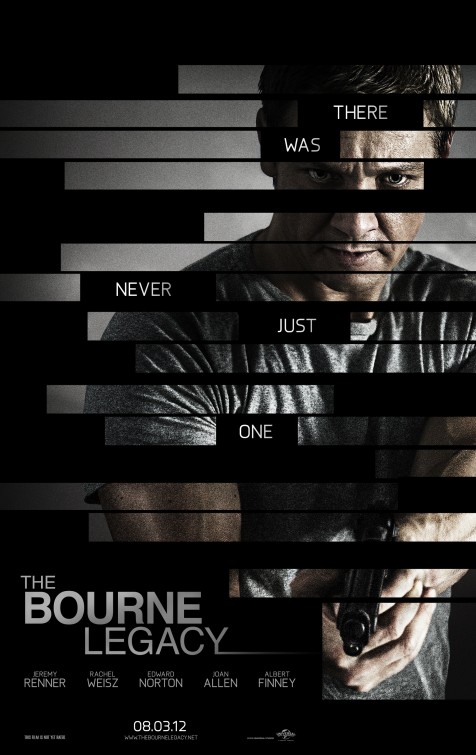 The Jason Bourne spy series has been a financial wellspring for Universal studios, so when Matt Damon and director Paul Greengrass (United 93) decided they had enough spy capers and hijinks, you can understand the studio’s concern. They elevated Tony Gilroy, a writer from the beginning of the series, to director. Gilroy has done some well-received directing gigs of his own now (Michael Clayton), so his ascent made sense from a continuity standpoint. I did wonder how much liberty the studio was going to give him, whether he was going to be boxed in to a style that had worked for the series. I never knew I should have had bigger misgivings, namely that The Bourne Legacy would ransom its conclusion and force the audience to make Legacy a hit.
Apparently Jason Bourne wasn’t alone. The C.I.A. has a team of six different super agents, each undergoing rigorous training and chemical alterations to their DNA via a series of daily pills. Aaron Cross (Jeremy Renner) is out in the Alaskan wilderness when the C.I.A., led by Col. Eric Byer (Ed Norton) and Adm. Mark Turso (Stacy Keach), burn all their agents. They plan on starting over and that means eliminating all evidence of the spy program that gave birth to Bourne. That means Cross has to go as well. That also means the chemists and scientists working on the program must also be silenced permanently, and Dr. Marta Shearing (Rachel Weisz) narrowly escapes a workplace shooting. Cross seeks her out for her medical expertise. They both have a common enemy that wants them dead. Together, the duo heads over to Manila where Shearing’s company manufactures the super meds and so Cross can become a permanent super agent.
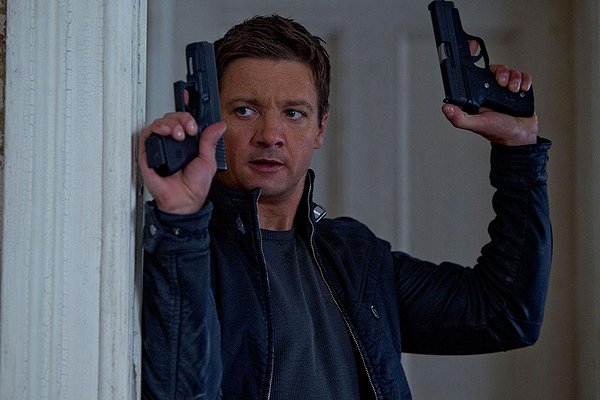 What the hell did I just watch? I know it’s labeled The Bourne Legacy. That part I get. What I don’t understand is that the filmmakers are trying to extort the viewing public into granting a Legacy sequel. Let’s cut to the chase. This movie has no ending. I don’t mean a bad ending. This movie is completely absent an ending. Not just an ending but also a third act. It’s like the filmmakers lopped off the third act and said, “If you want to see where this story ends up, you better get us a sequel.” There is no resolution for ANY STORYLINE in the entire movie. None. The good guys are still scrambling, figuring out how to blow the big bad conspiracy. The big bad conspiracy is still alive and kicking. The patsy for their wicked shenanigans is still the patsy. There is nothing that can be construed as an ending. At least the Damon Bourne movies each had a beginning, middle, and end and tied up their film plots. Sure the characters carried over and there were some larger, overarching storylines, but at least those movies felt complete. The Bourne Legacy is badly incomplete, a gaping void of a third act, and a blunder that makes me question the sanity of the filmmakers. How could you make a big budget summer action movie and not provide any semblance of closure? When the Moby tune kicked in on the soundtrack, I sat stunned, pinned to my seat in disbelief. “No, it can’t be over. They couldn’t possibly just end things here.” Oh, and they do. So enjoy 2/3 of a movie, folks.
With the anticlimactic end in mind, I now understand why the first hour felt so draggy. It’s because they had to fill out a two-hour running time. Especially for the Bourne franchise, the first hour seems to really be paced lackadaisically. For an action movie, it sure takes its time to get going. I wouldn’t have minded if I felt like we were setting up something exciting, but really the story is about a super agent who just wants to get his meds. He travels across the U.S. and the world so he can get his pills, and then he does, and then the movie abruptly ends. I’m simplifying matters in a crass way, I admit, but doesn’t this storyline just feel a tad slight? Legacy also starts to feel like a retread when it comes to its plot mechanics. The C.I.A. is burning all their super spy agents through suicide pills. They are destroying everything before Congressional oversight can reveal their true dastardly deeds. But then we need an antagonist, right? So the government goons reveal they have a SECOND even more super secret program to train super assassins/spies (“It’s Treadstone without the inconsistencies”). How far are they going to take this? Is there going to be a third super duper ultra secret level of killer spies? It’s repeating the same steps the franchise has already taken, the expert spy vs. spy clashes, but now it’s starting to get silly in a way the franchise had previously avoided.
 The action sequences are serviceable but they’re not any better than what the franchise has produced before. Cross has a few nifty escapes but nothing that reminds you of Jason Bourne’s sheer ingenuity. What other man can take down bad guys simply with a rolled up magazine or a book? Aaron Cross just can’t compete with that. The final motorcycle chase is nice but it just seems to be repeating the same danger with little variation. The best action sequence is actually a bit macabre. It involves a workplace shootout. To even call it an action sequence is a bit of a disservice since it’s actually a tense and horrific scenario that is coming eerily all too familiar in the news. Weisz’s character has to hide while her co-worker methodically guns down his fellow lab workers. Oh, and he also took off the door handles, making it dire for help from the outside to get inside. It’s a horrific sequence that’s played out to stomach-knotting levels of tension, as the dread slowly mounts and the pessimistic inevitability looms. Now, obviously Weisz was going to survive, as we know this, but the sequence still resonates with real, primal terror.
So what does The Bourne Legacy have going for it in its favor? Well the duo of Renner and Weisz is a pretty good pairing. Renner (The Hurt Locker) has been rolled out as the next thinking man’s action hero, and he finds interesting depth to his spy character in a rather routine plot. But he’s even better when he’s onscreen with Weisz (The Constant Gardener). There’s plenty of shouting matches and intensity but they have workable chemistry and Weisz’s character gets to be an essential part of the spy heroics rather than a tagalong. I cannot fault the actors for the film’s flaws.
I understand why the Universal suits felt like they needed to pump new blood into their lucrative Bourne franchise. After a while, an amnesiac super spy is going to hit a breaking point; he’s going to run out of essential memories to recall (Bourne 5: where Jason Bourne gets back the memory that he does not like Indian food). I like Renner and Weisz. I even like Tony Gilroy as a director. What I do not like is only getting 2/3 of a movie. Whose bright idea was it to just lop off the third act and provide no resolution? The ending is so unbelievably jarring, so staggeringly incompetent, that I have to dock this movie major points. I can’t say the ending out and out ruins the film considering I was only marginally liking it beforehand. The Bourne Legacy is proof that sometimes imitation is not the best substitute for ingenuity. Gilroy is no Greengrass. Cross is no Bourne. Legacy is no complete movie.
Nate’s Grade: C+
Share this:

Act of Valor (2012)
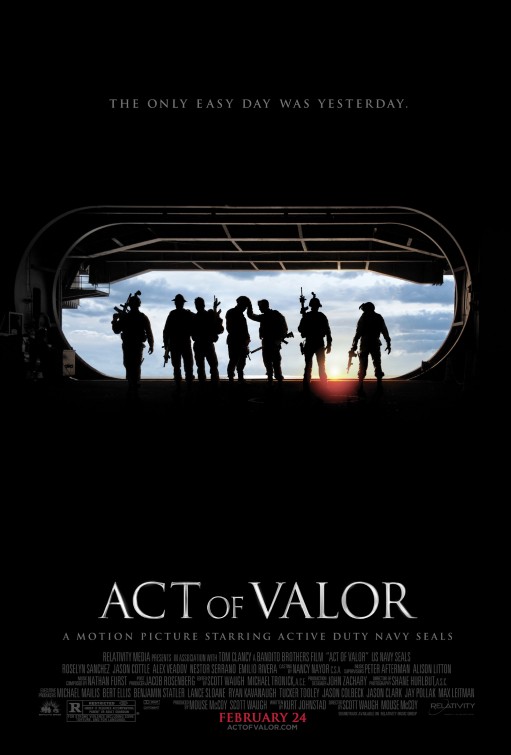 Hollywood often gets ridiculed for its tenuous connection to reality. I doubt any real U.S. Navy Seals look at 1990’s Navy Seals as a paragon of military validity. The makers of Act of Valor thought they could do one better than Hollywood. They hired real-life active-duty U.S. Navy Seals as their stars and made a movie based upon Seal combat experiences. Act of Valor was billed as the real deal. I just wish the filmmakers had spent less time on trivial yet realistic details and more time on plot, characters, and enticing action.
Who cares that the movie stars actual Navy Seals? Apparently enough people did judging by its healthy box-office returns in the spring, but really, why should a movie be any better because it has real Navy Seals pretending to be actors rather than actors pretending to be Navy Seals? Is this movie brought to a greater level of excellence because the characters know intuitively how to hold a gun properly? Was the slight difference in posture the difference maker? I suppose there is some curiosity seeing real Navy Seals go through all their training, but you know who else could be trained? Actors! Which these fellas are not. The line delivery is so flat, like the Seals were just happy to spit out all their dialogue and move along. There’s little emotion to just about any line that isn’t communicated via a bark. I can’t fault these servicemen because they never signed up to be actors; they have bigger things on their minds. Is there anything in this movie that could not have been done with actors? I doubt it. I understand the gimmick but I just can’t comprehend the appeal. Can an actor not be taught how to hold a gun, how to clear a room, how to squeeze the shoulder of his colleague to communicate move forward? I salute the Seals for trying (as well as defending our country, naturally) but I’m reminded of the old adage: it’s easier to teach an actor how to sing than a singer how to act.
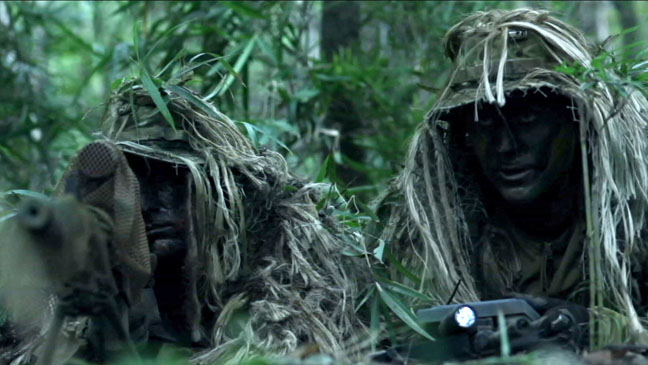 The movie seems more preoccupied with trivial details of authenticity than more important endeavors like story or character development. Here’s the most trivial detail of them all: live ammunition was used during the action sequences. WHY?! Do the guns not work with blanks? Why in the world would you dramatically escalate the danger on set and risk every shoot with live ammunition, actual gunplay? Action sequences are already a risk, so why would you exponentially increase the danger for … a slight uptick in realism? Again, it all feels like a movie in service of a gimmick. The plot is a rather cliché-filled jaunt across the world taking down terrorists, rescuing hostages, and mostly just knocking down doors, sweeping rooms, and shooting people in the head. Sure there’s a bad guy, a Chechen Islamic terrorist (double bonus: Russian and Arab!) and some other bad foreign guys with beards, but none of it ever seems to matter. I also question why a Chechen extremist would plot to attack the U.S., especially since we don’t exactly have the warmest international relationship with Russia. Surely a Chechen attack would strengthen that relationship, and the two countries might work in tandem targeting Chechnya. I’m saying this villainous plan is dumb. The good guys aren’t any deeper. Beyond their bravery, skill in combat, and impending fatherhood, we don’t know anything about these guys. A series of voiceovers try and list the various characters, but once the action starts good luck remembering any of them. In fact, good luck even keeping the two leads apart. I kept mixing them up myself.
And if that wasn’t bad enough, the action is a fairly big let down as well. Directors Mike McCoy and Scott Waugh must have studied under Tony Scott or Michael Bay, because every shot has the sleek beauty to it, the dawning sunsets, the cool gun mettle colors, the rah-rah jingoist spirit. Seriously, most of the action is just people shooting one another. That may sound like a no-brainer to anyone who bought a ticket, but the action needs to be properly thought out as well as the plot. The first mission, rescuing the tortured CIA Agent, is the best sequence because it has different points of action, organic consequences, and makes good use of geography. I’m going to hammer this point time and again until people take notice: geography is essential to well-developed action. You need to make use of your surroundings in interesting ways, otherwise what was the point of even setting the action there? The later action sequences fail to make use of any of these integral ingredients, so it becomes a rote series of people entering rooms, shooting other people, and moving to more rooms. Rather, rinse, repeat. The action has a muscular feel but it gets redundant rather quickly. That’s when your mind starts to notice how transparently the movie is working as a recruitment film for the U.S. Navy. There are sequences in this film that have no bearing on the plot (submarine visit?) other than to showcase the cool things that you, too, can do when enlisted in the Navy. There are plenty of sustained POV shots that give the illusion of a video game, war as a game. This is also why the complexities of war and geo-politics are sanded down to a series of clear-cut missions. I feel like the real servicemen deserve a more complex movie that treats their heroics as something more than clearing a video game level.
 When you get down to it, the audience that made Act of Valor a hit this past spring reminds me a lot of the audience that went to see the nearly four-hour Civil War movie, Gods and Generals. These are audiences obsessed with the details of realism. They’ll pore over the details of costumes and tactics. Whether the movie is actually any good or not, the characters engaging, the plot entertaining, is all immaterial. It’s the details they came to see. Hence the real-life Navy Seals, the missions inspired by real Seals, and the live ammunition on set. That’s what makes a movie to them. For me, I need more than realistic details; I need people and a story, and if it’s an action movie, then there better be well-developed action. It’s not like Act of Valor is a documentary people. It’s all pretend. I’ll be interested in how audiences respond to director Kathryn Bigelow’s movie about the hunt and execution of Osama bin Laden, Zero Dark Thirty. That movie uses actors and has an Oscar-winning director and screenwriter. Let’s see if anyone can tell the difference.
Nate’s Grade: C-
Share this:

Total Recall (2012)
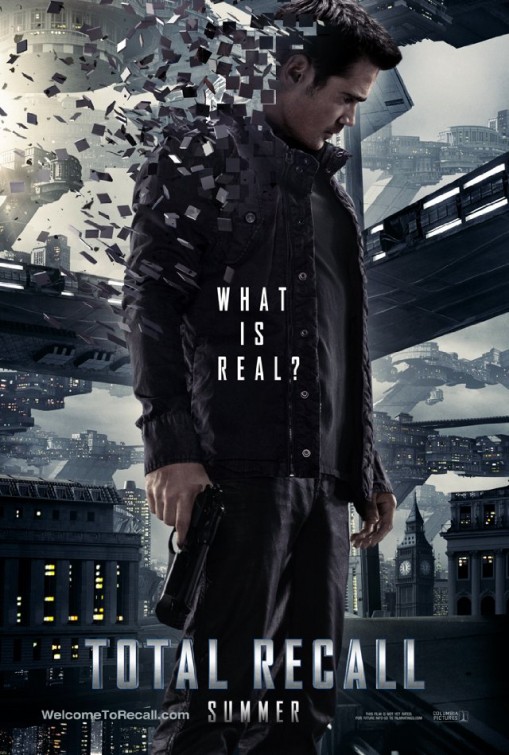 The latest needless remake takes the basic elements of 1990’s Total Recall and streamlines them into one very long chase sequence. And for those concerned males, the three-boobed lady makes a triumphant reappearance, because surely the movie wouldn’t be the same without her. Though in the age of the Internet, the sight of a three-boobed woman seems less indelible to impressionable male minds. But I digress. I was ready to dismiss this as another soulless Hollywood remake. Then I found myself enjoying Total Recall, and even the stuff that was dumb I had to also admit was cool. Take for instance a commute that goes through the center of the Earth. How exactly could such a thing be built? What does one do for maintenance? How does this not affect the Earth’s rotation? But then I forgot all about it because, in pure movie terms, it was cool. The zero gravity change-up as the transport changes directions at the core – cool. The fact that we get a zero gravity action sequence in this environment – cool. The fact that this transport system becomes a conduit for an invasion – cool. The plot mechanics are all familiar, notably the memory wipes and the super spy histories, but I didn’t care because the movie rarely lets its foot off the gas. When this thing starts, it doesn’t let up. The chase sequences are well executed amidst an imaginative array of locations, from a flying highway to a series of hanging housing developments. It’s not terribly smart but Total Recall is an entertaining escapist thriller that delivers some robust action and enough imagination in its future settings. Plus, there’s a woman with three boobs in it.
Nate’s Grade: B
Share this:

Haywire (2012)
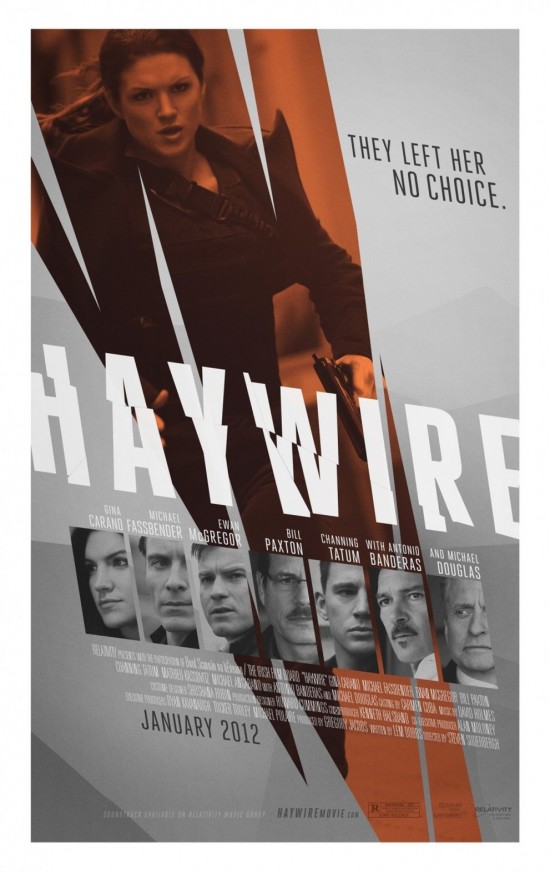 Haywire is director Steven Soderbergh’s experiment in the field of the action thriller, and it’s sparse and arty and pretty boring too. Soderbergh takes another non-actor, this time MMA fighter Gina Carano, and builds a spy thriller around the talents of this imposing fighter. Carano is no actor and her flat line delivery will routinely remind you of her limitations, but man alive does this woman just kick ass. To Soderbergh’s credit, the fight scenes occur in longer takes at a safe distance so that we the audience can watch and comprehend. Carano impresses as a physical specimen, both as a fighter and in other ways (she’s certainly got movie-star looks). I just wish this had been a more traditional action movie instead of Soderbergh’s jazzy, clinical genre experiment. There’s a handful of fights and a handful of chases, but mostly the plot is tied up in knots of who betrayed who and why. The dialogue volume is also curiously kept at a very low level, which obscures many conversations (I was forced to turn on the subtitles just to keep up). The plot itself is such a familiar rehash so why doesn’t Soderbergh pump it with more action? A bevy of stars appear in this thing (Ewan McGregor, Michael Douglas, Antonio Banderas, Michael Fassbender, Channing Tatum) but gives them precious little to do. Unless Haywire is in fight mode, it’s a rather soggy bore. The minimalism in a genre known for bombast is commendable but when that minimalism also stretches into plot and character and pacing, then you’ve entered into another Soderbergh indie experiment. For my money, Haywire is too sparse, too generic, and too dull to recommend, but I’d love to see more of Carano cracking skulls.
Nate’s Grade: C
Share this:

The Dark Knight Rises (2012)
 Let’s be honest, The Dark Knight Rises movie was never going to meet fan expectations after the high-water mark between superhero movie and crafty crime thriller that was the pop-art masterpiece, The Dark Knight. Whatever director/co-writer Christopher Nolan put together was fated not to match the pulpy big blockbuster alchemy that he worked so well in 2008. Minus Heath Ledger’s instantly iconic performance, a role that set the film on fire whenever he was onscreen, there is going to be a certain void to this capper to the trilogy. Now having seen the movie twice, including once in sphincter-rattling IMAX, I feel that I can truthfully state the most obvious: The Dark Knight Rises is not as good as the previous movies. While a fine finale for an ambitious series, this is definitely the weakest movie of the trilogy.
It’s been eight years since Gotham City last saw the likes of Batman. Bruce Wayne (Christian Bale) is an older man, hobbled by age, and living as a recluse in his mansion. His trusted friend and butler Alfred (Michael Caine) keeps encouraging Bruce to seek a life outside that of Batman. In those eight years, Gotham’s police have cracked down on organized crime thanks to the Dent Act, a law named after the late district attorney Harvey Dent (a fallen idol that only a handful know the real truth about). Commissioner Gordon (Gary Oldman) is growing sick with the secret of Harvey Dent and looks to retire from the force. Miranda Tate (Marion Cotillard) is a businesswoman eager to restart Wayne’s clean energy project, and a woman interesting in getting Bruce back on his feet. There’s also Selina Kyle (Anne Hathaway), a.k.a. Catwoman, a master thief who gives Bruce a new challenge. But then along comes Bane (Tom Hardy), a master terrorist and figure of brute strength. His goal is to fulfill the League of Shadows’ plan and destroy Gotham City and expose its rampant corruption. He sidelines Batman and takes over the city, unleashing criminals and hordes of the downtrodden upon the wealthy. There is no escape from Bane’s plan, his wrath, but Bruce Wayne must rise to the occasion and be ready to sacrifice the last of himself for the people of Gotham.
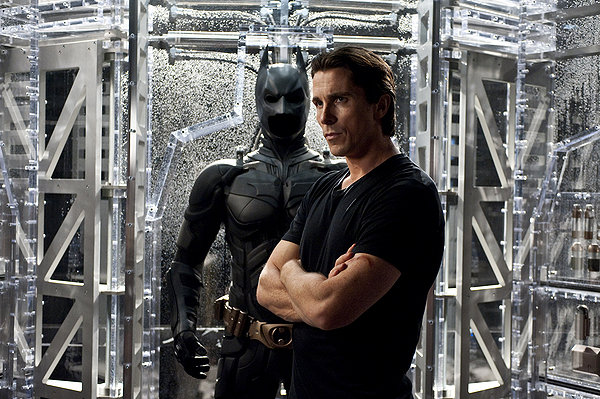 Firstly, Bane is no Joker. The bad guy lacks the fiendish charisma of Ledger’s Joker and he’s not as well integrated thematically into the movie. The Joker was an anarchist that wanted to tear down the pretensions of society and watch people “eat each other.” And we watched a city come unglued. We explore the notion of escalation and what the blowback would be for a man fighting crime in a costume. With Dark Knight Rises, Bane wants to take up the mantle of Ra’s Al Ghul (Liam Neeson) and wipe Gotham off the map. He’s got moments of being a master planner but really he’s just a big heavy. He’s the big tough guy that beats up old man Bruce Wayne, and Bane is continuously diminished in the film as it goes. A late revelation with the character completely diminishes his role and turns him into the equivalent of a mean junkyard dog. His big plan is simply to rile up the masses and wait for the inevitable. Hardy (Bronson) is a great actor prone to mesmerizing performances. This isn’t one of them. He’s super beefy but the facial mask, looking like some sea urchin, obscures half his face. It’s all physicality and eyes for his performance, along with very amped-up dialogue that you can tell was rerecorded after filming. Every time Bane speaks it’s like he has a speaker system installed in his face. And then there’s the matter of his sticky accent, which to me sounds like German mad scientist but to my friends sounded like drunken Sean Connery.
Bane keeps espousing about the corruption of Gotham but you really never get a strong sense of what that corruption has lead to. Catwoman talks about the Gotham elites living large while the rest of the city struggles; but rarely do you get a sense of this. So when Bane flips the tables, and the elite and wealthy are stripped of their decadence and put on trial by mobs, it feels improperly set up. Just because you have characters talk about wealth disparity and the city’s corrupting influence doesn’t mean it’s been established. Nolan’s Batman movies are a reflection of our modern-day anxieties in a post-9/11 world, so I wasn’t surprised to see a society rotting away from the sociopathic greed and wanton excess of the 1%. But rather than serve up a wealth disparity parable of class conflict, the movie simply turns to mob rule, a far less nuanced and interesting dissection of current events and fears. It’s like the French revolution took a trip to Gotham City (Gordon even quotes from A Tale of Two Cities). It’s a society built upon a central lie, the idol of Harvey Dent, but the movie fails to make the corruption felt. In the end, this is all pretty weak social allegory. And would it have killed Bane to be a little more brutal to stock exchange short-sellers?
 Then there’s the typical Nolan origami plot with the myriad of subplots intersecting. This is the first time in the series where the plots felt poorly developed. Rewatch Batman Begins or The Dark Knight, as I recently did, and you’ll see there is not an ounce of fat in those movies, not one wasted scene or one wasted line. Sure they got secret super ninjas and Katie Holmes, but those movies were well built blockbusters. I could have done without Bane entirely and certainly would have loved more of Catwoman. Hathaway (Alice in Wonderland) is terrific in the antihero role and brings a very interesting dynamic relationship with Batman. She may be the only person who understands him. I wanted more Catwoman, the movie needed more Catwoman, but alas she is just a plot device to connect Wayne to Bane. She has a larger role in the concluding melee but essentially becomes Batman’s reluctant wingman. The whole theme of the 99% vs. the 1% could have been generously explored with this character, and her spark and charisma would certainly be enough to get Bruce Wayne out of bed again. Then there’s the regular cop (Joseph Gordon-Levitt) doing the unheralded good deeds that so easily get overlooked. Here is an interesting character that, due to some leaps in logic, connects with Bruce Wayne on a unique level. He presents a counterbalance to all the souped-up superheroes, a recognizably regular human trying to do good. It’s then a shame that he gets entirely relegated during the third act so that the superheroes and their super toys can make some noise.
For a Batman movie there’s hardly any Batman in it. The caped crusader has been in retirement for eight years, so it takes some time before Bruce puts the suit back on. But then he’s also sidelined for a good third of the movie, stowed away in a far-off prison. The entire Indian prison sequence really could have been exorcised. It essentially becomes a Rocky training moment for Bruce Wayne to recover and a plot device to explain why there needs to be a time gap in the story. But this part of the movie just feels like it goes on forever, and we all know where it will go so we just keep waiting for the movie to get there. No one wants a Batman movie where Batman sits the middle out. The end feels relatively fitting but any fan of The Iron Giant will recognize some similar key elements.
And while I’m on the subject, let me do some estimates here. The timeline between Batman Begins and The Dark Knight is about a year, as the Joker notes to a congregation of mobsters. I’ll be generous and say that the events of The Dark Knight last two months. We learn that Batman never appeared again after the death of Harvey Dent, and now we flash to eight years later with The Dark Knight Rises. So you’re telling me that we only really got a solid year of Batman being Batman? That over the course of nine years he was Batman for only one of them? That’s very little Batman-ing for a Batman franchise.
But even with these flaws in tow, The Dark Knight Rises is still an exciting, stimulating, and mostly satisfying close to a trilogy of unprecedented ambition and scope for a modern blockbuster. The action sequences in this movie are huge and exhilarating. I loved Bane turning Batman’s armada of weapons against him. The Bat fighter plane is a nice addition that gets plenty of solid screen time. The sheer scope of what Nolan produces is epic; from a plane being hijacked in mid-flight and torn apart, to a city being leveled by explosives, to a face-off between a bevy of armored Batmobiles and the Bat plane through the streets of Gotham, the movie does not disappoint when it comes to explosive, large-scale action set pieces. This is also the first Batman movie where the climax is the best part of the film. The last half hour is solid action but also a fitting sendoff for a beloved character. Some will grumble with certain hat-tipping moments at the end, but I found it entirely satisfying. It all comes back to the central thesis of Nolan’s Batman films about becoming something more than just a man, becoming a symbol, and that symbol is meant to inspire others. By the end, you feel that the inspiration has been earned as so has our conclusion.
 I want to single out Caine (Harry Brown) who has very few scenes but absolutely kills them. He’s the emotional core of the movie, perhaps even the series, and has always been hoping that his charge, Bruce Wayne, would never return to Gotham. He’s the voice of reason in the movie, the man that reminds Bruce about the costs of a life spent seeking vengeance and sacrificing his body. I wish Caine was in the movie longer but his scenes are pivotal to the plot, as is his absence.
The Dark Knight Rises doesn’t rise to the level of artistic excellence of its predecessors, but it’s certainly a strong summer blockbuster that works as an agreeable finale to the premier franchise of the era. It’s not quite the knockout we were expecting from Nolan but it still delivers where it counts. I wish it had give a fuller, richer portrait of a city corrupt from the inside out, a society rotting away and ready for revolution, and plus I also wish we had plenty more Catwoman and plenty more shots of Anne Hathaway in her Catwoman cat suit (Michelle Pfeiffer still has nothing to fear), but these are the things of dreams. Nolan’s aim has always been to place Batman in a world that is recognizably our own, and with that comes the responsibility of bringing a stolid sense of realism with all the blockbuster pyrotechnics. This artistic ethos has given us some extraordinary movies, though some Batman purists would object that Nolan’s hyper-realism is not the Batman they grew up with. It’s hard to really get a sense of the accomplishments that Nolan and his team has been able to pull off over the course of three bladder-unfriendly movies and seven years. He’s taken the superhero movie and redefined it, brought it unparalleled psychological depth and philosophical analysis, and given a human quality to what normally gets dismissed as escapism. The Dark Knight Rises isn’t as revelatory as its previous entry but it sticks the landing and puts to rest what is indisputably the greatest superhero trilogy of all time.
Now get ready for the reboot in three years.
Nate’s Grade: B
Share this:

The Amazing Spider-Man (2012)
 It’s only been a mere ten years since Marvel’s signature web-shooting, wall-crawling super hero leaped onto the big screen and smashed box-office records, and yet he’s already getting the reboot treatment. Usually we reserve reboots for movie franchises that ended in colossal artistic failure. I don’t know anyone that will ardently defend director Sam Raimi’s Spider-Man 3, but I know of no one that puts its in the same vicinity as the atrocious, franchise-slaying Batman and Robin. Spider-Man 3 suffered in comparison to its predecessors, which formed the gold standard of super hero films (even in my review I called out for some new blood if this was any indication what we had left to expect). But then in 2010, Sony decided that it would rather start all over with its billion-dollar franchise, so Raimi was out, so too were stars Tobey Maguire and Kirsten Dunst, and 500 Days of Summer director Marc Webb was tapped to direct. The (rebooted) Amazing Spider-Man swings into theaters with a serious case of déjà vu attached. Are we far enough out to forget about Raimi’s accomplishments? My spider sense is telling me we’ve been here before and better.
Peter Parker (Andrew Garfield) is a geeky high school student living with his Uncle Ben (Martin Sheen) and Aunt May (Sally Field) ever since his parents had to vanish mysteriously one night. Peter is picked on at school and crushes on cutie-pie Gwen Stacy (Emma Stone) but all that changes when he’s bitten by a genetically engineered spider. He gains super spider-like abilities including improved dexterity and the ability to stick onto surfaces. He designs his own webbing devices that allow him to shoot long tendrils of super-strong spider webbing he can swing around with. Peter is trying to unravel the mystery of what happened to his parents and he seeks out Doctor Connors (Rhys Ifans), a notable genetics scientist who worked with Peter’s long lost dad. Peter supplies his father’s secret math formula and gives Connors the breakthrough he was hoping for in genetic replication. When injected with a serum, creature should be able to regrow lost appendages. Connors turns himself into a human guinea pig because he’s desperate to grow back his amputated right arm. But the serum causes Connors to transform into a hideous lizard creature for periods of night and only Spider-Man can stop him.

Simply put, I liked Spider-Man when it was made the first time and called Spider-Man. I understand the desire to reboot after the disappointing mess that was 2007’s Spider-Man 3, but did we need to start completely from scratch? Could we not have just eased into a Spider-Man 4 and replaced the original actors? Though I personally had no problem with Bryce Dallas Howard as Gwen Stacy (yum). I don’t need to see another version of the Spider-Man origin tale because it was already covered just ten years ago. The worldwide public is familiar enough with Spidey’s back-story that I don’t understand why we couldn’t just start with our hero already doing his business. I don’t need another hour of setup for the guy to become Spider-Man. This “sameness” seems to sap much of the energy out of Amazing Spider-Man, a competent and occasionally thrilling superhero flick. It does plenty of things well enough but you just can’t shake the feeling that the movie, at its core, is unnecessary or at least tripping over redundancy. Do we really need to see Peter Parker discover his powers again? I understand that we want to experience part of his joy at discovering his fantastic new abilities, but it just feels like all too familiar. I don’t think we would have missed anything by simply condensing all the back-story and doling it out as a series of concise flashbacks.
Despite some serious déjà vu, The Amazing Spider-Man has some other serious issues. Firstly, the tone just seems like a bad fit. This is a much darker, somber, and angsty tone for a character that was never intended to be as brooding as, say, Batman. Just because the dark tone worked for Christopher Nolan’s Batman films doesn’t mean it’s the right fit for every comic character. I’m not saying that Peter Parker doesn’t have his issues and plenty of guilt to struggle with (more on that in a moment), but this movie feels like the fun has been squeezed out. It’s a kid who was abounded by his parents, bullied at school, and he teems with repressed frustration. Peter Parker is not meant to be a brooding antihero. He’s supposed to be the high-flying jokester. Regardless, you can interpret the character however you’d like, I just don’t think this darker, gloomier incarnation works despite the best efforts from Garfield. The spirit of the movie feels like it’s being suffocated at times. Raimi’s films had their dramatic material but they never lost a sense of fun. It’s hard to tell if anyone is enjoying himself or herself for much of Amazing Spider-Man.
Now let’s talk about one of those areas of Parker’s guilt, namely his guilt over the murder of dearly beloved Uncle Ben. Peter chooses not to get involved and from that action Ben is murdered by the same criminal Peter could have thwarted earlier. In Amazing Spider-Man, it’s transformed into an inane example of being at the wrong place at the wrong time. Ben just so happens to run into the same guy and he stupidly wrestles for the man’s gun. It’s hard to make any real connection for Peter to blame himself. Spider-Man 3 did something similar by rewriting the back-story so that the Sandman was responsible for Uncle Ben’s death. I wrote: “By introducing a new killer it means that Peter has no responsibility for his uncle’s death. This completely strips away the character’s guilt and rationale for what compels him to swing from building to building to fight crime.” Now, this new Spider-Man, since he’s so edgy and dark, is only hunting for bad guys who bear a likeness to the robber who killed Uncle Ben. Yes, Peter Parker has become a vigilante defined by his all-consuming sense of vengeance. And guess what? He never finds the guy. Get used to all sorts of storylines being dropped or forgotten throughout the film (I guess we’ll have to wait for future films to explain what happened to his parents).

While I think a darker interpretation of Spider-Man is mislead, I wish the movie would see it through rather than keep having moments to break the reality of this more grounded approach. I’ll buy that Dr. Connors turns into a giant lizard creature from the magic DNA serum whatever. I’ll even buy that he goes mad with power because of it. However, what I won’t buy is that this guy, all of a sudden, decides to relocate his lab into the sewers. What? The guy has everything he needs in a giant scientific tower, and he says he “gave the staff the week off.” Well then do your crazy mad scientist science stuff in your lab. Why the sewers? Do you know how many trips this guy would have to make to haul all that equipment down into the sewers, and remember he’s only got one friggin’ arm! The entire character of the Lizard feels so poorly developed and adds no greater thematic message to the movie. And then there’s the case of Peter Parker being a world-class dweeb mocked in high school. As presented, he’s a pretty hunky, smart, athletic kid who has fabulous hair. It makes no sense that he has absolutely zero friends and that there wouldn’t be girls crawling all over this guy. Are there no alternative-style girls in this school besides the one girl with glasses we keep cutting back to for reaction shots? And how many times is Aunt May going to watch her nephew come home at odd hours and covered in bruises before she says anything?
Then there’s just the forehead-smacking number of coincidences in the movie. With most movies you accept that the characters exist in a small universe where they will regularly continue to run into one another, but in Amazing Spider-Man it’s absurd. As my pal Mike Galusick noted, you have Peter who just happens to have the last steps needed in a formula who just happens to go to Oscorp and poses as another student with shocking ease who just happens to wander off a tour and much up with lab stuff because security cameras do not exist in this universe and who just happens to meet the same scientist who is responsible for his parents missing and the guy also happens to have a head intern who just happens to be Peter’s crush and she just happens to be the daughter of the police captain (Denis Leary) trying to hunt down Spider-Man. Phew. I haven’t even mentioned the construction worker dad (C. Thomas Howell, for real) whose kid was saved by Spider-Man so he makes sure to rally all his fellow construction workers to synchronize their beams for Spidey. It is moments like this that undermine the filmmakers’ grounded approach.
It sounds like I really disliked this film, and I didn’t. Amazing Spider-Man is a completely serviceable superhero tale and the cast does a great job of covering up for many of the narrative shortcomings. The action, what there is, seems a little too rushed and missing that spark that Raimi had in abundance. There is one nifty sequence that Webb deserves credit for: in the foreground a librarian listens to classical music, which drowns out the background action as the Lizard and Spider-Man smash through shelf after shelf of books. This was the only moment in the movie where it felt fresh and exciting and I wanted to see where it would go. It’s just that the movie cannot capitalize on its potential. Take for instance a late incident where the Lizard unleashes his mutant gas and transforms a cadre of police officers into giant lizard creatures. You’d naturally expect that if you were introducing a lizard army that we’re upping the stakes and that the movie would do something with this new team of antagonists. Wrong. No ramifications. Webb’s film does benefit from advances in computer wizardry as the CGI is far more advanced and Spider-Man doesn’t resemble the cartoon character he often did in Raimi’s trilogy. The brief moments swinging through the city, feeling the rush of exhilaration with the character, are the movie’s visual highpoint. I found the Lizard’s face eerily similar to the goombahs in the reviled Super Mario Brothers movie.

Garfield (The Social Network) and Stone (The Help) certainly feel like a step up from before. Even though Garfield seems a bit old for high school, he does a more than credible job of being a super smart kid who slowly grows in confidence and demeanor. He can do it all, handle the comedy, the emotional angst, the formation of courage. Garfield is a great addition and he gets along wonderfully with Stone; the actors have great chemistry, which may explain why they started dating after the production ended. Stone brings a comedic zeal to the part and seems far more approachable and les standoffish than Dunst’s Mary Jane ever did. While the movie seems to indicate a fully formed romance for its stars, what we see on the screen plays out more like a nervous flirtation. The actors are cute when they seem to be stammering in awkwardness and mutual attraction. I wish the movie gave us more development rather than skipping ahead, but hey, these kids are great together.
The Amazing Spider-Man, when you get down to it, is less than amazing. It’s a capable super hero movie with some fancy effects and stunt work, but the mounting plot holes, incongruities, tonal conflicts, and overwhelming sense of sameness prove to be a foe even Spider-Man cannot topple. This aims to be a leaner, more emotionally engaging, realistically grounded Spider-Man, but it just can’t pull it off. Garfield and Stone are great but it’s impossible to erase Raimi’s original trilogy from your memory. His films weren’t perfect, though Spider-Man 2 came closest, but they were loving odes to the character and knew how best to link action with character for maximum impact. I can’t think of any real memorable moments in this movie, which is troublesome given its hefty budget and its hefty mission of supplanting the Raimi films. I didn’t have a bad time while watching The Amazing Spider-Man but my involvement and enjoyment was very limited. Even with a glossy reboot, I guess The Amazing Spider-Man is proof enough that sometimes it’s better to go forward rather than reliving the past.
Nate’s Grade: B-
Share this:

Abraham Lincoln: Vampire Hunter (2012)
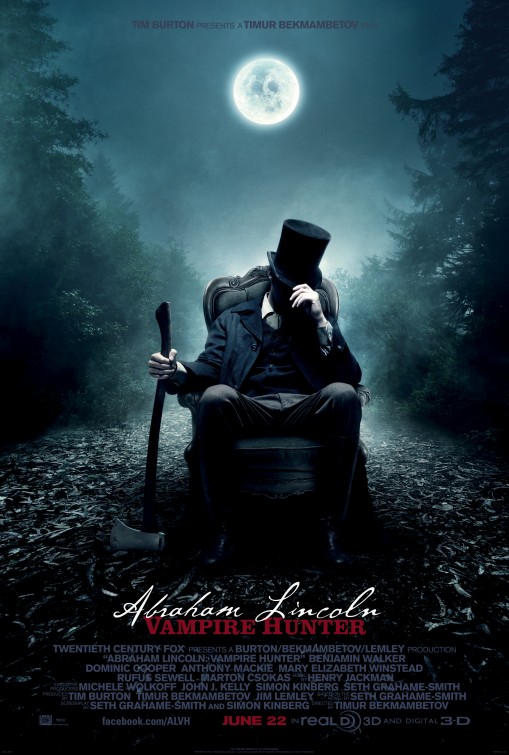 Did you know that our sixteenth president had a rather unorthodox hobby, and it was really the purpose that drove him into politics and later the White House? That’s what the gonzo best-selling book Abraham Lincoln: Vampire Hunter purports. When he was talking about a house divided not being able to stand, he was secretly talking about vampires, you see. The film version, under the tutelage of producer Tim Burton, looks like it’d be an axe-swinging good time. I realize the absurdity of wishing the filmmakers had hewn closer to the source material, a radical reinterpretation of American history, but there it is. I cannot tell a lie.
Abraham Lincoln (Benjamin Walker) is a man determined to rid this new country of the scourge of vampires. His mother was murdered by a vampire landlord, Jack Barts (Marton Csokas), when Lincoln was only a little boy. As an adult, Lincoln tries to avenge his mother’s death but Barts is too strong. Henry (Dominic Cooper) saves Lincoln and teaches him all about vampires and, more importantly, how to hunt and kill them. They strike up a partnership: Henry will provide names of vampire targets and Lincoln will dispatch them with extreme prejudice. Lincoln tries to live a solitary life but keeps building attachments; to his co-worker Joshua Speed (Jimmi Simpson), to his childhood friend Will (Anthony Mackie), who needs Lincoln’s help to forge some slave papers, and the enchanting Mary Todd (Mary Elizabeth Winstead). Abe realizes the limitations of killing vampires one by one. The vampires are exploiting Southern slavery as an all-you-can-eat buffet. Lincoln realizes the only way to foil the vampires is to eliminate slavery, and to do so he must be in a high government position, and so Lincoln retires his axe to turn to abolitionist politics.
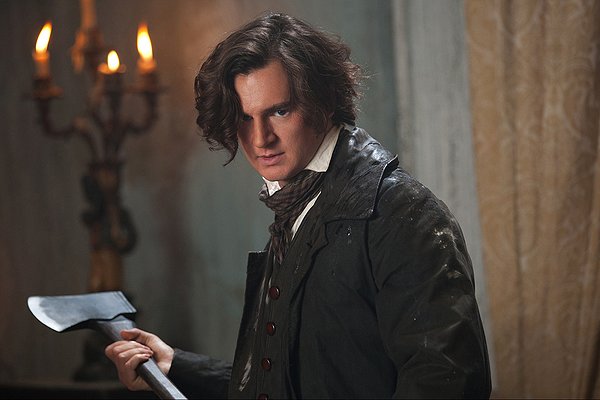 It feels that rather than embrace the courage of its convictions, the movie is trying to please as many mass markets as possible. So many characters and storylines are inserted wholesale without any connection to the book. The film is almost unrecognizable from the book. Now, I’ll quit my bemoaning for the time being because a movie has to exist on its own merits, but Abraham Lincoln: Vampire Hunter is just a mess. As far as new characters included only to appeal to broad audiences, there’s the Black Best Friend, long a staple in movies meant to say, “Hey, our lead character is hip and has no problems with race,” but really it’s always been a depressing act of pander and I always feel sympathy for the thousands of black actors who have to compete over the limited best friend parts. Giving Lincoln a black best friend seems to remind the audience that Lincoln was against slavery, you know, in case anyone didn’t know anything about the man nicknamed the Great Emancipator. Then there’s the ascension of Mary Todd Lincoln into a feisty, strong-willed, formidable ally rather than the insular, clinically depressed woman she was in real life and in the book. Mary even gets some grand hero moments taking out a vampire in slow-mo coolness. The transformation of Mary feels just as big a pander as the character of Will. Then there’s the idea that Lincoln and his small inner circle of pals are placed in the center of action, like they alone and their heroic escapades single-handedly turn the tide of war. It’s handled so ham-handedly that it all plays out like they’re the Scooby Doo gang solving the Case of the Vampire Insurrection.
Lincoln’s history is given such shrift attention, just enough to fill out the standard tortured hero’s backstory for the aims of the story. We see Lincoln as a child but just enough to establish his tragedy and hunger for revenge. Then we cut to him as an adult and going to kill Barts. That’s quite a big leap in time with little careful setup. The time before Lincoln’s presidency is just enough to supply him with a stock character posse and a plucky love interest, and then it’s right to the Civil War. So much time in between the main events just gets squeezed out, and so Abraham Lincoln: Vampire Hunter feels like it’s always one scene away from a clumsy montage.
The vampire threat, as presented, also feels too insurmountable. Not only can these vampires walk in the daylight, they’re super strong, super fast, and can make themselves invisible, a neat new trick. When they ally with the South they seem nigh unbeatable. The movie makes the mistake of making the adversary seem too powerful, so the eventual thwarting of the vampire Confederacy feels too easy and far-fetched given the magnitude of the threat. Adam (Rufus Sewell) is hinted at being like the first vampire, but then this idea is never picked up again. Why even hint at something significant if you have no intention of pursuing it? There’s another new wrinkle where vampires are incapable of killing their own kind. If this is the case then why aren’t the vampires turning every single person they can find into vampires? It shores up their side and guarantees less potential people that could kill them. I’m curious how certain swaths of southerners are going to react to seeing their beloved Confederacy teeming with devilish creatures. Then again, I think the romanticism of the Confederacy is hogwash. When insurrections win we call them revolutions of independence, and when they lose we call them treason. Guess what? The South lost.
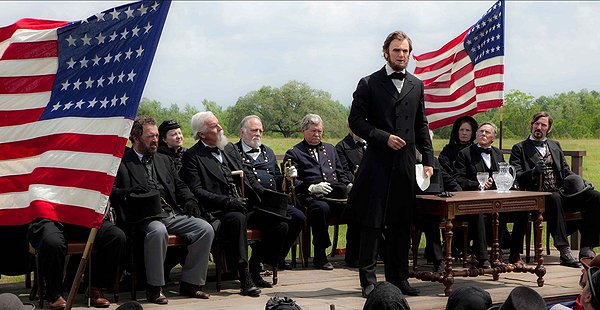 As much as I enjoyed his book, I have to lay the blame at the hands of Seth Grahame-Smith, who adapted his book into the screenplay (he’s 0-2 this summer after his disastrous screenplay for the other vampire movie this summer, Burton’s Dark Shadows). Granted, I’m sure he got intensive notes on how to alter his story for the big screen; the whole projects reeks like it had too many cooks in the kitchen. The interconnection from the book, finding clever ways to marry history and alternative history together, have been ground down to stream line Lincoln into an American super hero. Not only is he handy with an axe, this Honest Abe can leap from racing horse back to racing horse back, and even get clobbered by a horse and keep on going. The coda at the end feels like a missed opportunity to carry on the Lincoln tradition into our modern age. With the clever reworking replaced by blockbuster superficiality, the film merely takes history and has it perform the outrageous rather than finding smart ways to connect all the outrageousness to the established facts.
What the movie has to the credit of director Timur Bekmambetov is a strong visual pulse. Bekmambetov directed 2008’s testosterone-soaked Wanted, so you know you’re going to get some crazy and eye-catching images on display. The action sequences do pack a punch and I’ll admit that seeing an axe utilized as an inventive martial arts weapon is considerably cool. There are two standout set pieces. The first is a fistfight between Abe and Barts in the middle of stampeding horses. You feel right in the thick of the action, horses stampeding all around, the sun setting to offer an eerie yet beautiful glow to the ordeal. It’s one of the more reality-stretching moments, as I noted above, but man if it isn’t thrilling and lovely to watch. The other standout sequence is a climax aboard a speeding locomotive itself atop a large wooden bridge engulfed in flames. Abe and Will stand back to back, swapping the axe to kill vampires, and then hey have to outrun the collapsing train. In these moments, the movie is joltingly alive, bursting with excitement and that rare yet glorious feeling of watching something beautifully different. I just wish this sensation wasn’t so fleeting in the movie.
Abraham Lincoln: Vampire Hunter is a violent historical reworking that isn’t good enough to be properly entertaining and it isn’t bad enough to be considered camp. The film is mostly disappointing because it should feel far more engaging given its whacked-out premise the very cheeky promise of its title, and strong source material, a pulpy, ripsnorter of a read. The movie has some stellar standout moments but I think what ultimately hinders the entertainment value is how dumb everything comes across. This is not dumb in the winking, self-aware, satiric sense, but dumb in more of the blockheaded, Michael Bay, formulaic blockbuster sense. I wouldn’t even classify this movie as an enjoyably dumb, a silly summer slice of escapism like Battleship, which is looking better every week after new, disappointing summer releases (and it’s not even July yet!). The spirit of this movie is missing, the cleverness of the conceit drained, and the fun is bottled up. What this movie reminds me of is the stupid 2003 film The League of Extraordinary Gentlemen, which took classic literary characters and threw them into a genre movie. Both movies figure the exercise alone, seeing classic literary or historical figures in absurd contexts, was enough to justify entertainment. I say that you have to work harder.
Nate’s Grade: C+
Share this:

Snow White & the Huntsman (2012)
 Snow White & the Huntsman is meant to be a darker, splashier, more action-packed retelling of the classic story, and when compared with the earlier 2012 Snow White venture, Mirror, Mirror, it certainly merits all those descriptions. With Twilight star Kristen Stewart at the helm, this movie seems tailored for teens looking for some girl power. I have no problem with reworking fairy tales to suit our modern-day cultural interest, but just giving a person a shield and a sword does not instantly make them a warrior. And just plopping Snow White into a medieval war does not instantly make this a movie worth watching.
The wicked Queen Ravenna (Charlize Theron) killed the king and installed herself on the throne. She sucks the youth directly from ingénues to keep those good Theron looks of hers. She is the fairest of them all but she is warned that one day the king’s daughter, Snow White (Stewart), will overtake her in fairness. Snow’s been living in a prison cell for about ten years since her evil step-mom took power. She escapes her imprisonment and flees to the Dark Forrest beyond the castle grounds. The Queen’s powers will not carry over into the Dark Forrest (for whatever unexplained reason), so she hires the Huntsman (Chris Hemsworth) to retrieve Snow White. The Huntsman changes sides, allies himself with Snow, and some dwarves, and then everyone bands together to retake the kingdom under Snow’s stout leadership.
 Snow White & the Huntsman falls victim to that age-old screenwriting curse of failing to show us its work. I get so sick of movies, or any narrative really, that heaps praise upon some person and then never shows us any convincing evidence. If somebody is said to be a great poet, I want to hear one of his or her great poems. If somebody is said to be a great leader, then I want to see him or her inspire. To make up for the plot shortcomings, the screenplay reminds us at every moment of downtime how special Snow White is, how glorious she is, how different she is, how she is the only one to bring down the tyrannical rule of Ravenna. At no point did I believe any of this. Just because I have characters tell me, ad naseum, that someone is special doesn’t make it so. I need to see the evidence, and from what Snow White has to show, it is not that impressive. She’s somewhat resourceful, escaping from captivity, but she’s not exactly a figure of compelling strength, magnetism, or inspiration. She gives one “rally the troops” speech that gets the townspeople all fired up to go to war; it’s no St. Crispin’s Day speech, but even if we’re grading on a curve, it’s a pretty weak motivational speech. There’s no reason these people would line up behind this displaced damsel other than the fact that the plot requires them to do so. This Snow lady has, much like the infamous Bella Swan, the personality of a dead plant, and all the proclamations to the contrary will not change that fact. Snow White is just not an interesting of compelling person, period.
There are two reasons why Stewart is completely wrong for this part. First off, when we’re objectively talking about one who is “fairest of them all,” and Charlize Theron is in your movie, you’re going to lose every time. I’m not saying Stewart is wretched looking; quite the contrary. Debut director Rupert Sanders finds ways to film her that make her look lush and vibrant. Some would argue “fairest of them all” is not in references to physical beauty, which it has always been, but to the fact that Snow’s heart is so pure and good. If that’s the case, that’s just stupid. Then why even make it Snow White if the nemesis to the evil queen is simply somebody who is morally just? You could have had a commoner play the role and that would have brought about more interesting class conflicts. Secondly, Stewart is such a modern era actress, someone who has so effectively channeled the rhythms of a blasé generation of young people, that dropping her into a medieval time period is jarring. She doesn’t fit. Everything about her aloof acting style screams modern times. Maybe that’s why her speaking is kept to a minimum. She can ride on horseback, dress in Joan of Arc armor, but she’ll never strike anyone as a fitting Epic Heroine. I feel that her acting has blended with the sullen nature of Bella Swan to the point that it’s hard to separate the two. I’m not a Stewart hater at all. I actually think she can be quite a capable actress (see: Speak, Adventureland, the upcoming adaptation of Kerouac’s On the Road) when paired with the proper material. Snow White & the Huntsman is not the proper material.
Aside from casting errors, this dark fairy tale doesn’t find any time to settle down and develop anything that could approximate characterization. Case in point: all we know about Snow is that she is a princess, everyone tells us how beautiful she has always been, she runs away, and then leads a rebellion, then she become queen (don’t pester me about spoilers). What else do we know about her? She’s defined entirely by outside forces, especially the charitable words of others. Snow White is not a character but a symbol, the prophetic Chosen One. She’s really a placeholder for every lazy archetype needed for epic fantasy. Stewart cannot connect with the material, so she seems to wander around, mouth agape, almost like she’s stumbling drunk through the whole movie. It seems that Snow White & the Huntsman just provides us the familiar elements of the story (evil stepmother, huntsman, dwarves) and expects us to fill in the rest with our own wealth of knowledge over the famous fairy tale. The rote insertion of a long-lost childhood friend/eventual love interest (Sam Claffin) is made tolerable only by the fact that he does not eventually become a love interest. This Snow doesn’t need a man, and good for her.
Sanders’ background in commercials definitely shows in his superb visual palate. The man knows how to frame a beautiful shot, and the visual highpoint is Snow’s hallucinogenic shamble through the Dark Forrest. Without the narrative traction, though, the movie starts to resemble one very long, very excruciating perfume ad, particularly when Snow comes across a white horse just laying down in the surf. Some of Sanders’ “ain’t nature great” creations deeper into the forest reminded me very strongly of Miyazaki’s Princess Mononoke, especially with the godly stag. Despite its considerable faults, Snow White & the Huntsman is a great looking movie. Sanders’ crisp visuals are further enhanced by wonderfully theatrical costumes from multiple Oscar-winner Colleen Atwood (expect another award on that mantle come 2013). Queen Ravenna has more eye-catching outfits than Cher in her heyday. They seem to be made out of interesting organic elements, like a gown accented with diminutive bird skulls. She may be a ruthless tyrant, but man does that lady know how to dress. The fashion choices became so exotic and intriguing that it provided another reason for me to hope we’d get more time with the queen. The production design by Dominic Watkins (United 93) is fittingly medieval. At least there’s always something nice to look at with this monotonous bore.
I don’t really get the geography of this kingdom. By all accounts, it looks like one poorly guarded castle, one poor mud town, and a deep expanse of forest. The fact that it’s labeled as the Dark Forrest seems shortsighted, since it takes a few hours continued walking to come across all sorts of other civilizations, including our scarred matriarchal society. And then there are dwarves too. It all feels so listless, lacking any sort of connective tissue to help round out this magical world. After a while, it just becomes an assortment of cool stuff just put into a movie because it’s cool. The fact that none of these magical creatures or assorted villagers ever pop back again, except for our coronation in the resolution, means they were meaningless to this story other than being a rest stop.
 The screenplay is surprisingly rushed; rarely do we spend more than five minutes in any location. I was interested in a city of women with self-inflicted facial scars to protect themselves from Ravenna coming for them. Just as things start to get interesting, it’s like the movie gets antsy and has to keep moving, and we’re off again. It’s hard to work up any sort of emotional engagement for anyone when we just spend a few minutes with these characters. The brisk pacing also gives the impression that the characters really don’t matter in the end. If it weren’t for a scene where the Huntsman blatantly explains every feeling he has to a comatose Snow White, we’d know nothing about him. The Huntsman is grieving over the loss of his wife, and oh she just happens to have been killed by Ravenna’s creepy albino brother (Sam Spruell). The pigment-challenged dolt confesses this convenient bit of information at a strange time. Why confess to killing a man’s wife when you’re battling to the death? Confess afterwards. It’s another example of lame screenwriting and nascent characterization. Even the queen gets a bizarre throwaway bit of characterization. For whatever reason, we have a flashback to when she was a child and her mother forced her to drink the magic immortality elixir. Why did we see this? It’s too late to make her sympathetic. And yet, even this brief glimpse at Ravenna’s back-story makes her more interesting than our feckless Snow White.
The bleakly brilliant Young Adult renewed my fondness for Theron as an actress. For a while, she seems to really sink her teeth into the role, lapping up the villainy in a satisfyingly menacing manner. It’s at this lower level of burn, the quiet intensity, where Theron is most enjoyable. When the movie requires her to raise her voice is when things start to go bad. She shrieks in such a campy, over-the-top, weird overly enunciated style. Any hope of secretly enjoying this movie died with Theron’s stagy agitation. Hemsworth (The Avengers) adopts a thick Scottish brogue but does little else. At times I found that he looked remarkably like a cartoon tough guy; just something about his face lends itself to clean, burly definitions. The best actor in the movie is Bob Hoskins (Mrs. Henderson Presents) as a blind dwarf, and perhaps that sentence alone should say all that needs saying.
This film is more Lord of the Rings than fairy tale. It’s got some battles and some siege action to pacify the men folk, but this is obviously aimed at the ladies. It’s a feminist, Robin Hood-esque reworking of the Snow White tale, recasting the damsel as action heroine, and I’d have no problem with this revision if: 1) the film made her an actual character, 2) it had been played by anyone other than Kristen Stewart. It’s got all the familial elements but they have no context in this reworking; it lacks internal logic. If I did not have sufficient background knowledge about this tale, I’d be left wondering why any of this should make sense (apples are poisonous now?). At every turn, the movie has to tell us why things should matter rather than showing us. There’s no evidence onscreen why this Snow White lady deserves any fuss. Snow White & the Huntsman is a movie obsessed with appearance and precious little else. Snow White & the Huntsman is one boring, truculent, dreary chore of a movie that goes on far too long. Just because it’s darker doesn’t make it more mature or exciting. Fairest of them all, my ass.
Nate’s Grade: C
Share this:

Battleship (2012)
 On the surface, the classic board game Battleship would seem like a rather peculiar property to develop into a feature film. Unless someone was going the crafty Das Boot route, why would anybody even want to adapt the board game? And for that matter, why would anyone want to adapt the game and add killer aliens from outer space? Well actor-turned-director Peter Berg looked at the classic board game with the little pegs and the declarations of battleships sunk and said, “There’s a big summer movie in there.” With a hefty budget of $200 million, which is becoming alarmingly the norm for summer tent pole releases, Berg’s efforts have given birth to Battleship: The Movie. If it becomes a hit maybe it will start a trend. Who wouldn’t want to see Hungry, Hungry Hippos as a monster movie, or Connect Four as a searing domestic drama about alcoholism?
Off the Hawaiian Islands, the Navy is conducting an annual series of international war games in the Pacific. Oh but little did they expect to have to combat intergalactic foes. Alien spaceships crash land to Earth, emerging from the Pacific and creating a force field barrier. Along for the high seas action are the stoic Stone Hopper (Alexander Skarsgard), his screw-up little brother Alex (Taylor Kitsch), a Japanese captain (Tadanobu Asano), and a mess of other Navy personnel, including pop star Rihanna. On the other side of that force field is Alex’s girlfriend, Samantha (Brooklyn Decker), a naval physical therapist who finds herself in the middle of the aliens communications plans. The handful of Navy ships, some American and some Japanese, must figure out a way to topple the aliens before they get their communications up and running to broadcast that Earth is ripe for the taking.
 For some, Battleship will be the symbol of everything wrong with big-budget Hollywood filmmaking, a perceived slapdash effort meant to appeal to as many mass markets as possible, combining clichés and empty action sequences into a cacophony of noise deigned entertainment. And for most of those charges, I cannot defend Battleship. It has its fair share of clichés, gaps in logic, and some especially corny moments (WWII geezers save the day!). And yet, I found myself becoming entranced by Berg’s siren song, laughing at the comic relief, enjoying the stock characters enough to root for their triumphs, and having a total gas with the action sequences. I was shocked at how much fun I was having with Battleship. Perhaps that means that from a mechanical standpoint it knows all the pinpoints of the summer blockbuster model and knows how to craft a satisfying crowd-pleaser of an action movie. Or perhaps it just means I have lost my mind. Or maybe this is Berg’s expertly crafted satire of the Michael Bay School of filmmaking, brilliantly capturing the beautiful bombast and cheery jingoism of Bay’s career, especially when those salty WWII vets get to strut in slow motion. A movie based upon the board game Battleship is clearly not meant to be taken seriously, and Berg’s nautical adventure wants nothing more than to entertain the masses. Whatever the case may be, Battleship, weirdly enough works, and for some significant stretches, it works really well in the mold of summer spectacle.
I’m relieved that Berg has left behind his rigid docu-drama cinema verite approach he’s patterned after working on 2004’s Friday Night Lights. Berg’s verite style felt completely mismatched with 2008’s Hancock, an inexplicable global hit. With Battleship, Berg’s cameras settle down and give you plenty of action to soak up. Berg’s first foray into action, 2003’s The Rundown, was like the announcement of a great new talent and the herald of The Rock’s ascent in action. I’ve been waiting for Berg to return to that style he displayed with The Rundown, a slick, highly stylized flair, brimming with robust energy that popped at all the right moments. Thankfully, with his biggest budget yet, it’s like the return of the old Berg. Perhaps it’s just a reaction against the overindulgence of the “shaky cam” action style popularized by the Paul Greengrass Bourne films, but it’s nice to be able to actually follow what is happening. Berg’s cameras find different and exciting ways to frame the action. I enjoyed the speedy zoom outs to illustrate the size of the field of battle. The visuals really do feel like Berg is parlaying Bay’s shooting style, the tawny glow of people’s skin, especially women, a.k.a. sex objects, the fetishized ogling of giant toys/military hardware, the soaring camera. But unlike most of Bay’s pedigree, it’s spectacle on a mass scale without turning into a glorified video game.
The action in Battleship is huge but never dull. The scale of the demolition does not get out of hand because the movie works in shifts, focusing on pockets of action before ramping up to something even bigger and better. The alien tech, particularly the spheroids that munch through metal like the Langoliers (please, somebody tell me they remember that Stephen King TV movie), is impressively powerful without feeling completely over matched. Being totally obliterated in the movies has its own thrill, but seeing a slug fest between man and alien is more compelling. Watching the Navy go blow-for-blow and eventually triumph through ingenuity in the face of adverse odds makes for some pretty satisfying action. The Navy is learning through trial and, much, error about how to combat these alien antagonists. I enjoyed the tactile nature of the battles. I must say I found the film to be weirdly informative about the attack features of naval war vessels. I don’t know if its genius or absurd that the movie finds a way to organically squeeze in the actual Battleship game play (the alien bombs also look like pegs from the board game). The aliens are something of a mystery and kept that way. When we do see them minus their Halo helmets, you wish they kept those helmets on. They have some unexplained moral code, as we cut to alien POVs that scan for threats, choosing to spare innocent lives in other circumstances. When the alien spacecraft fist appear, they take up position in a row and wait for their Earthly challengers to strike. It reminded me of the fighting sequences in turn-based RPG video games. These aliens are more sporting than your typical interstellar advanced civilization just interested in conquest. These aliens are into turn-based RPGs. These aliens are nerds.
 With all that surprising praise now established, Battleship the movie is still chock full of ridiculous moments and a rather leaky plot. The subplot involving a double-amputee veteran getting back his groove via alien invasion never feels well grafted to the major storyline. It feels like it was crowbarred in after the producers or Berg saw real-life double-amputee Gregory D. Gadson and declared, “This man needs to be in a movie.” He’s likeable enough but over the course of 130 minutes you realize likeable isn’t the same as being a skilled actor. This entire subplot involving Gadson, Samantha, and a computer techie (the amusing Hamish Linklater) strains credulity even for a dumb action movie. The fact that three easily over matched people can take out a load of well-armed aliens with little more than a Jeep and a briefcase mitigates the life-and-death stakes at sea. If these alien bad guys can lose so stupidly, then what’s the hold up? Also, the movie inserts a lot of bizarre tension between Japan and the U.S., like it’s trying to iron out the last unresolved conflict from the Second World War. The term “inelegant” cannot come close to describing the nativsm conflict and its dopey resolution. And then there’s the fact that the movie is long giant recruitment ad for the U.S. Navy. I suppose after the Marines had their own alien-fighting flick/recruitment ad last year (Battle: Los Angeles), the other branches of the armed services felt left out. I pray no one ever enlists over something this silly. No major life decisions should be made over the big screen adaptation of Battleship, people.
There’s a paucity of solid characters here. We get the bad boy younger brother who will discover his mettle and leadership by the end (by the by: having characters keep talking about how much “potential” somebody has is the annoying non-fantasy equivalent of talking about a prophecy being fulfilled). Kitsch comes off better than he did in Disney’s costly flop John Carter, but he seems too stiff and sullen for a leading man. If Battleship sinks, expect his leading man status to get dry-docked (okay, I’ll lay off the puns). Decker (Just Go with It) is still working out the kinks of transitioning from model to actress. Her romance with Kitsch is about as contrived as these things get in big action movies, a pathetic bone thrown to a deflated female audience who would rather see Decker in What to Expect When You’re Expecting. The additional seamen, including Rihanna’s acting debut (insert your “S.O.S.” joke here), are given one-note to play for over two hours. And as far as Ms. Umbrella-ella-ella is concerned, it’s certainly not the worst acting debut by a pop star (see: Crossroads, or better yet, don’t). Most disappointing is Neeson (Taken) who spends the far, far majority of the movie on the wrong side of the force field. I want this guy kicking ass and not barking impotently into a phone.
I don’t know if I can look myself in the mirror and declare, with solemn dignity, that Battleship is a good movie by the normal standards of objective excellence. Screw it, I had far too much fun with this film to stand back and pretend the movie’s flaws are too overpowering. Berg has slapped together what may be the most formulaic, pinpointed Big Summer Movie I’ve witnessed in some time, but I’d be lying if I said it didn’t win me over. They may be pushing buttons but Berg and company pushes them so well. Plus, I’m still uncertain whether or not the entire bloated affair is really the most expensive, subversive swipe at Michael Bay ever attempted. This is probably just wishful thinking from a critic looking to justify liking this movie. It’s got plenty of action, though doled out into bite-sized portions before the ACDC “Thunderstruck” montage ramps up the finale. Every now and then, you need a movie that gives you the right kind of stupid, and Battleship is the right kind of stupid for the summer movie season.
Nate’s Grade: B-


 nathanzoebl
You must be logged in to post a comment.