Blog Archives
Godzilla (2014)
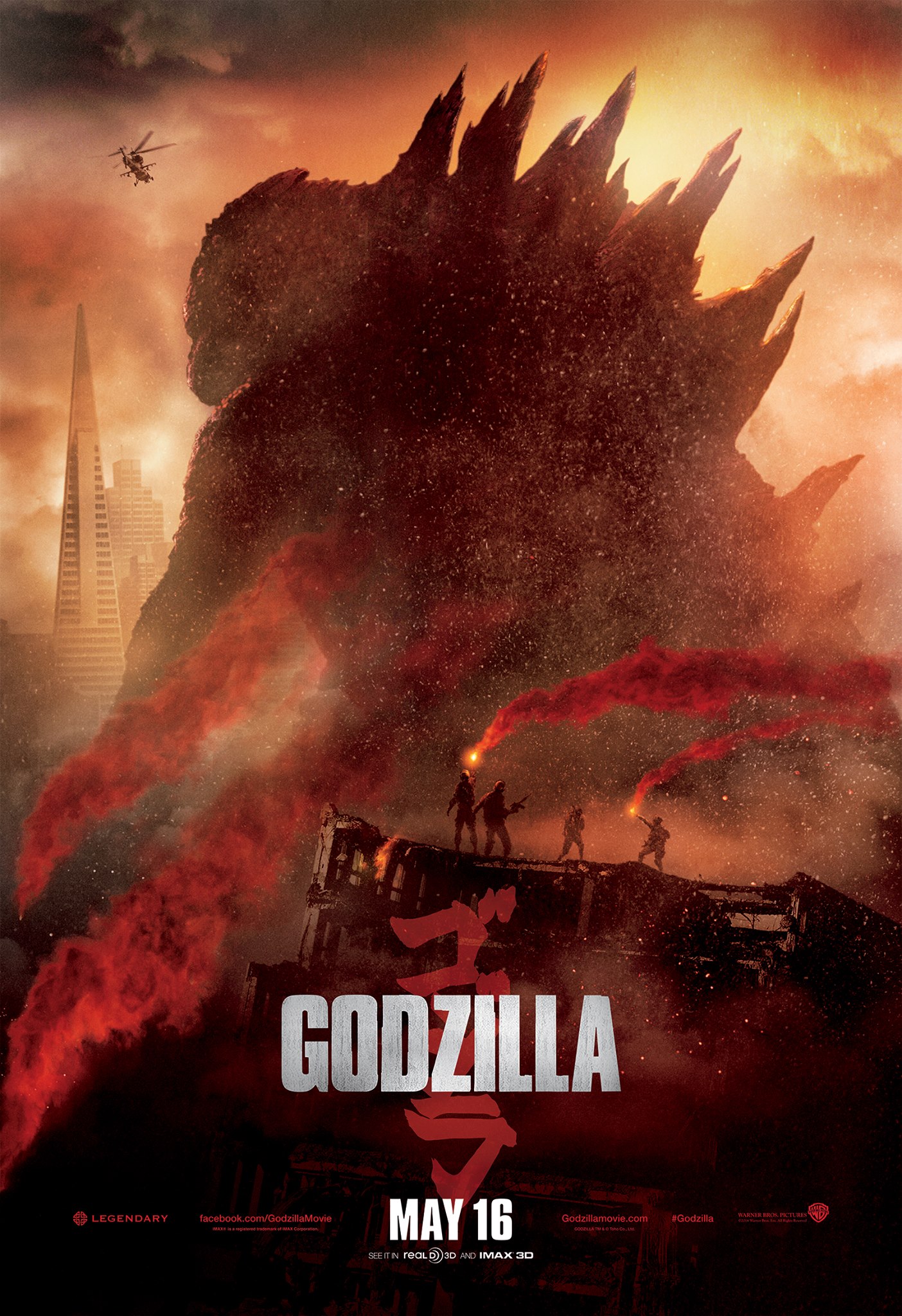 When it comes to the monsters of cinema, it’s hard to beat out Godzilla, and not just because, you know, he’s hundreds of feet high and can breath fire. The famous monster began as a cautionary tale about nuclear weapons, destroying man’s hubris and often the good people of Tokyo. The legendary beast has been hibernating as such since 1998’s not-so-spectacular big-budget return, a film that the Japanese loathed. But like all ancient being, Godzilla has been resurrected again and given a splashy new coating of CGI devastation. If only the filmmakers had decided to leave out the humans and make Godzilla the rightful star.
A scientist (Bryan Cranston) warns the Japanese government of a massive impending danger. The offspring of a giant creature, a Massive Unidentified Terrestrial Organism (MUTO), has hatched and heading straight for the United States coastline. Attracted by nuclear power, the U.S. military tries to lure it away from populated centers. Ford Brody (Aaron Taylor-Johnson) is witness to the monstrous destruction and just wants to get back home to his wife (Elizabeth Olsen) and child in San Francisco, exactly where the creature is headed. There’s also the emergence of an older creature, one that has taken to combating the MUTOs to the death. This is the legendary Godzilla.
The big guy is back in a very different approach from 1998’s Godzilla (i.e. “better” approach). Director Gareth Edwards (Monsters), an avowed Godzilla fan, has made a reverent big-budget ode to the king of all monsters; however, the resulting film is more of a disaster epic than a monster brawl. The perspective is often framed at the human-level, which grounds the film from going too overboard into disaster porn territory like, say, Man of Steel. The effect is thrilling and adds a greater sense of verisimilitude to the mass chaos and destruction. It reminded me in some ways to 2008’s Cloverfield, where a group of characters is just trying to survive the periphery of all the collateral damage of a giant monster. There are sequences that directly relate to Fukushima as well as the tsunami from 2004. It’s almost like somebody watched the stirring movie The Impossible and said, “Yeah, give us some of that in our giant monster movie.” I don’t know if these sequences are entirely necessary. Watching Ford carry around a little Japanese tyke, wondering where his parents might be amidst the confusion post-monster attack, it relates to our modern response to tragedy and worldwide disaster, but do you really want to watch Ford have to find this kid’s parents? If there is a commentary to be found in the movie, it’s the uncontrollable and destructive power of nature pushed to the brink by mankind’s own energy crises. After all, the MUTOs are attracted to and strengthened by consuming nuclear energy. Godzilla is argued to be an “alpha predator” but also a figure to bring balance back to nature. I think it means that there can be only one giant monster and Godzilla is going to eliminate the competition.
 But the real question of any giant monster movie is the degree of satisfying, smash-em-up fun it provides, and the new Godzilla is a mostly agreeable venture. The action sequences, mostly saved for the climax, are cool and well thought out, but Edwards proves to be a brilliant visual stylist than a composer of action. This is a movie where the moments stand out better than the action. Edwards’ command of cinematic visual arrangements is at Spielberg levels of being a natural showman. I can easily think back on small moments, images that pop, visual reveals that are executed with aplomb, far more so than a central example of an action piece. I loved the horror-esque reveal of the elevated train being on track to head right for the MUTO. I loved the hide-and-seek nature of Ford waiting for the MUTO to pass. I loved when Ken Watanabe’s advice was literally just, “Let them fight” (I started chanting it in my seat). My favorite part of the movie is actually what was previously shown as a teaser trailer, namely Ford and several other paratroopers diving into the destructive city scene. The eerie hum of the 2001: A Space Odyssey monolith plays over, each man has a red flare streaking from their leg, and we watch them quickly descend through the sky, nervously awaiting what is on the other side of those heavy clouds, only to discover a city on fire, glowing like a hearth, and through the goggles, a monster fight taking place. The entire sequence is a visual standout, a thrilling set piece, and a reminder that Edwards has more on his mind.
Edwards does a lot of intentional teasing of Godzilla, so much so that it can get frustrating for an audience. I understand he’s building to a payoff reminiscent of Jaws; we’ve been teased for so long that we will go nuts when we finally see Godzilla in full glory, and it works. However, it also works as a detriment. There are several points in the film where it looks like we’re about to get some exciting Godzilla/MUTO action, or even just a MUTO wrecking havoc, and then the film cuts away, often to news footage. It’s a choice that begins as artistically clever but can become maddening in time. There is a lot of visual obfuscation throughout the film, far more so than the same compliant I had with last year’s Pacific Rim. Edwards will show Godzilla’s tail just swinging behind a building, or his colossal foot coming down with authority, or the wispy shadow of giants in billowing clouds of smoke. All those near misses can add up to cinematic blue balls. And so much of the action and destruction happens at nighttime, leading to a dour color palette heavy in grey and dark blacks, making the good stuff all the harder to see. I cannot even fathom why someone would want to see this film in 3D with those darkened glasses. It’s 90 minutes of foreplay that you may start to grow restless that we’re getting a Godzilla movie that will never show the goods (shouldn’t Godzilla be in a Godzilla film?)
 The problem with a disaster movie on a human-scale is when you don’t give a damn about any of the human characters. Now, Godzilla should be the star of any Godzilla movie but I understand execs fearing that their monster movie needs some relatable human drama. The problem is that the writing doesn’t do anything with these characters, forcing them into tidy and token roles that we’ve come to expect from large-scale disaster movies. Did anyone really feel anything about whether Ford would get back to his wife and child? Did anyone feel anything for anyone in this movie, beyond a slight reservation whether they would be squished, if even that? I’m not expecting three-dimensional characters here but even Roland Emmerich films do a decent job of establishing a milieu of people at various points of the globe we know will somehow coalesce together. There is so little effort to mask the character’s grand design: exposition mouthpieces, symbols of military threats, the noble family man, the beleaguered and crying wife. Seriously, there is a great cast of actors in this movie and they are given nothing to work with. Olsen (Oldboy) gets to look realistically scared and cry but she deserves so much better. Cranston (TV’s Breaking Bad) gets all the best yell-worthy lines. But it’s really Taylor-Johnson (Kick-Ass 2) who suffers the most since he’s placed as our impassive stand-in for a human protagonist. He’s so blank throughout the film and there’s little charisma to pull you in. His character, and the performance, feels no better than an elevated extra, Grunt #13. When we have to spend 90 minutes with these lackluster characters rather than some awesome monster fights, that’s when the film flounders.
I’m conflicted about the end results of Godzilla, an entertaining, surprisingly artistic film that can nail small moments of cinematic grandeur but has trouble matching its vision. The human-scale approach grounds the action, but do we want a giant monster movie grounded from a limited vantage point? The constant teasing builds a payoff for finally seeing Godzilla, but don’t we want more actual Godzilla in a film bearing his name? The human-scale, as well as the slow dodging of showing Godzilla, mean the storytelling emphasis is on an array of human characters, but what happens when they are poorly written, poorly developed, and lacking in charisma? The movie does more right than wrong but I’m left with the unmistakable feeling that, while a step in the right direction, there is too much self-sabotage holding back the movie. It actually made me re-evaluate and appreciate Pacific Rim even more. I can’t say this movie is nearly half the fun as Rim was. The monster design of the MUTOs is rather lacking, resembling a cross between the monster from Cloverfield and more patently the arachnid aliens of Starship Troopers, down to the heads that look like staple removers. Edwards has proven himself a big screen talent with a terrific feel for grandiose visual spectacle. I just hope if there is a sequel that we can skip all the slow buildup and just get to the main event – Godzilla beating the crap out of some other lesser yet still giant monster.
Nate’s Grade: B
Share this:

The Raid 2 (2014)
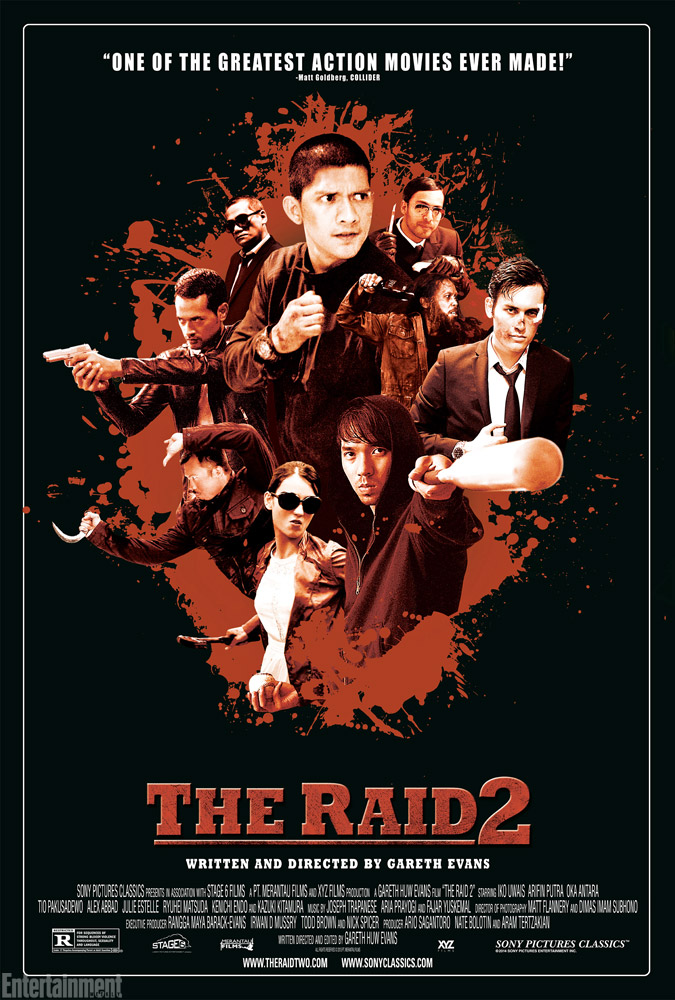 Rare is the movie that I feel I don’t even need to go into great detail rather than just scream, in a fashion suiting madness, “See this! See it!” Such is the case for The Raid 2, the sequel to the 2012 Indonesian action film that melted faces with its inventive and brutal action. The original movie had a confined location, a gang-run tenement building, and a simple premise of reaching the top and nabbing the bad guy. When people weren’t punching or shooting each other, the original Raid lagged, but director/writer Gareth Evans has solved the problem with his action-packed sequel. The world expands greatly, establishing the uneasy peace kept by powerful and warring criminal organizations. The plot ends up becoming something akin to The Departed meets A Prophet, following our hero cop from the first movie now placed undercover to gain the trust of the criminal overlords and work his way up the food chain. When the action isn’t cooking, you’re still engaged with the story and the suspense simmers in clever ways. But getting back to the film’s calling card, the action sequences are impeccably choreographed and edited, have a wide variety of locations for fun, and are bloody intoxicating. This is a movie soaked in adrenaline, and the action sequences will be hard to beat for the rest of the year. Evans finds ways to provide flair for his supporting characters, including a family duo that involves a deaf woman whose weapon of choice is hammers and a guy who prefers a baseball and a bat. The Raid 2 fires on all cylinders so well, so brilliantly filmed, that it puts just about every American action thriller to shame. It doesn’t need to be as long as it is (pushing two and a half hours), and it takes a little while to set up the players, but this is even more of an entertaining rush than the original, because now we get a sense of what Evans and his team can do with fewer restrictions. When Evans gets to Hollywood, and he will, just make sure you give him all the money to do whatever he wants.
Nate’s Grade: A-
Share this:

Captain America: The Winter Soldier (2014)
 A welcome addition to the Marvel Cinematic Universe, the second Captain America film brings the square superhero to our modern-day and presents a complicated national setting where the enemy is the U.S government. The challenge with a Captain America (played by Chris Evans) movie is just how outdated his whole sensibility seems, an irony-free nationalistic hero. Smartly, the filmmakers have pushed his loyalties to the test, and the movie transforms into something along the lines of a Jason Bourne thriller, where the government is hunting down a rogue fugitive. It’s certainly the most timely superhero film since 2008’s The Dark Knight, and the political commentary on the NSA spying and drones is a welcome big screen subversion. But the action is still what people come for and in that the Winter Soldier is quite an entertaining movie. Directed by the Russo brothers, known mostly for their comedy work in TV like Community, the movie packs quite a punch with a variety of action/thriller sequences, each well staged and well developed. My favorite might be Nick Fury under assault and desperate to escape in his car from overwhelming enemy forces. An opening sequence rescuing hostages on a boat serves as a great reminder why Captain America is indeed so super. The movie does have some issues but nothing so large as to derail the enjoyment. First off the villain is way too obvious, but also the movie lets the U.S. government off the hook, falling back on a select evil group that has been undercover perverting the government. Secondly, the Winter Soldier of the title is one plotline that doesn’t feel needed or well integrated. It’s another super soldier for Cap to combat and this guy has a mysterious link to our hero. It feels like one plotline too many, a story that deserves better attention on its own. Still, Captain America: The Winter Soldier is an engaging, thrilling, intelligent, and altogether entertaining addition into Marvel’s sprawling cinematic canvas.
Nate’s Grade: B+
Share this:

Divergent (2014)
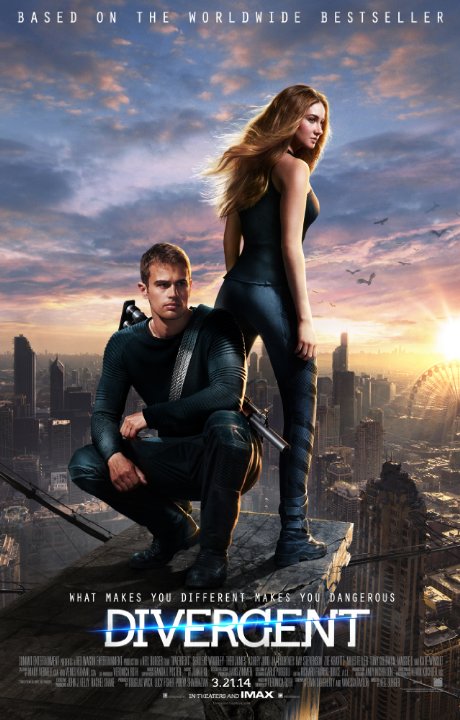 High school for many was a personal version of hell, with its class system and pressure to conform. Divergent built a whole future dystopia around this relatable concept. The problem with the movie is that the source material doesn’t think that much further.
In the future, 100 years after a great war that scarred the world, the survivors have holed up in the remains of Chicago with a large fence as their protection. The government decided to split off into five different factions, each with their important purpose. The five factions (Abnegation, Candor, Erudite, Amity, and Dauntless) work in harmony. Tris (Shailene Woodley) comes from a family of Abnegation, the selfless ones who run the government, though Jeanine (Kate Winslet), the head of Erudite, would like her faction to be on top. At the choosing ceremony, a candidate can select which faction they wish to live within. However, if rejected, that person will be factionless and on the outskirts of society. Rather than choose the comfort of her boring life, Tris decides to join Dauntless, the faction in charge of the security of the city. Before she can say goodbye to her family, she’s off joining a new one, but Dauntless has many tests to weed out the weak. Paramount in her mind is the fact that Tris is told she’s a divergent, one who doesn’t fit neatly into any one of the factions. Divergents are being singled out and executed because they are feared; they can’t be so easily controlled. Tris has to prove herself against tough competition in Dauntless while hiding her true divergent nature.
 Having not read the best-selling Young Adult books, I went into Divergent and walked away entertained enough though questioning the larger appeal. My movie partner told me that the adaptation hews closely to the book, fitting in all the major plot beats; she even said it was a better adaptation than the first Hunger Games, so fans should be relieved. What the movie came down to was one long plot about Tris getting through the Dauntless tests. It’s like a post-apocalyptic Full Metal Jacket, just minus the war half. With this tight focus, the film actually plays better and is easier to digest. The stakes are made clear and the hurdles are easy to understand. In a way it reminded me of the Ender’s Game film where we watch a recruit move up the ranks of their sci-fi training, though Ender’s was better at establishing dimension to its world. I did like the small touch that the Abnegation people won’t allow themselves to see their reflection because they see it as vain. I could have used more touches like that.
There are simple pleasures watching Tris, the plucky underdog, rising to the challenge and besting her snobby peers. The games get more intense and Tris learns from trial to trial, eventually learning how to hide her divergent nature by blending in against her nature. There’s also an intensity to this world that’s appreciated; people will die if they can’t keep up (there is one shocking sequence where a batch of jealous recruits literally try and kill Tris). The physical trials are fun but the mental ones are even more entertaining because they function around the candidate’s fears. It’s a tad lazy to simply broadcast a character’s fear for them to confront in a dream, but it provides some creepy imagery and new wrinkle for Tris to master. Even the requisite romance that every YA property has to have is handled respectfully without overdoing it. The mentor/teacher relationship with Tris and Four is a natural conduit for their budding romantic feelings, though James (Underworld: Awakening) looks way older than Woodley (The Descendants). In reality, he’s 30 and she’s 22, though she’s supposed to be… 17? 18 years old? I don’t know but it just didn’t sit right.
 Where the movie gets into problems is the larger world outside those Dauntless camps. It feels too ill defined and purposely vague. What’s on the other side of the giant electrified fence (hopefully dinosaurs)? I suppose that’s what sequels are for (they’re already filming the second Divergent for March 2015). The world just feels too small even for one city, and the history doesn’t feel integrated into the cultivations of this society. In a sense, the movie doesn’t give you enough to go on with its world building and spends far too much time dragging out its story. At a hefty 142 minutes, a time frame becoming de rigueur with YA adaptations, the film feels laboriously padded. I kept thinking the movie was going to check out at any moment, robbing me of some semblance of a complete ending. Fear not, there is an ending, though one that feels far too definite to continue a franchise. The bad guys are so obviously guilty, that even while still being at large, it’s hard to fathom a scenario that doesn’t unite everyone against the common threat. Does every YA post-apocalyptic mold eventually lead to unlikely heroes becoming the focal points of revolutions? I’m being facetious, but also highlighting just how derivative this movie is. Divergent borrows from its larger influences liberally, having enough story sense to know how to construct a satisfying tale of heroes and villains. It’s a well-polished film thanks to director Neil Burger (Limitless) but it’s also lacking necessary elements to distinguish it from the glut of dystopian imitators and predecessors.
I just can’t wrap my head around the world of Divergent. It lacks the clean clarity of, say, The Hunger Games, where the game is kill-or-be-killed and it’s very much a class warfare allegory. In Veronica Roth’s novel, the post-apocalyptic Chicago is divided into five factions but this isn’t a caste system. The different factions are looked at as equals, meant to cooperate harmoniously. So there goes any sort of class conflict when the factions are presented more as lifelong clubs. The design is that branching people off into five groups will somehow prevent the strife that lead to the unnamed war of the past. This doesn’t really make a lot of sense to me. Why would limiting people’s options for careers and lifestyles eliminate conflict? I understand the not so subtle message about conformity and the strength in controlling others, but it still doesn’t hold. Then there’s the notion that a divergent is a dangerous rogue, but it’s not like the divergent are mutants or genetically different. These are just people who don’t fit neatly into one of the five faction options. If you eliminate the conformity obsession, who cares? It’s only an aptitude test in the end, like what you take in middle school that say, “Hey, you like drawing, maybe you’d like to be a police sketch artist” (true personal anecdote of mine). It’s not something that looks deep into the souls of boys and girls and presages their future. It’s an aptitude test for crying out loud. The world of Divergent also feels strangely unfulfilled, with too many lingering questions about the logistics of how this future Chicago is able to function. There’s a confusing aura around this world and it doesn’t get explained because we spend so much time in Dauntless boot camp.
There was a weird motif I kept noticing throughout the film and that’s the future’s unsafe disregard for medical safety. The Dauntless kids are all about the running, jumping, punching each other in the face, but it all begins at their choosing ceremony. The candidates walk to the front of an auditorium, slice their palm with a ceremonial knife, and then squeeze blood into a bowl representing the faction they select. Of course they reiterate “faction before blood” so it’s a little strange that the ritual involves their blood. Anyway, what I picked up was that every candidate was using the same knife, only with he most perfunctory of wiping the blade. That is just unclean and a way for blood-based disease to spread. Then later during the mental round of testing, Four injects Tris and himself with the same needle. Clearly these post-apocalyptic people have forgotten all about AIDS and other deadly diseases. Why else would Jeanine be so calm as her hand is covered in someone else’s blood? I’m surprised she just didn’t lick it for effect.
 The actors are all well cast for their parts, with Woodley again proving herself as one of the best young actresses today in Hollywood. Her part isn’t anywhere as complex or demanding as her terrific turn in The Spectacular Now, but she’s able to slide in emotion where possible, expressing much through the power of her eyes. She’s a heroine you want to root for, and when she goes into badass mode it feels earned. James is suitably hunky while still being mysterious and broody. Interestingly enough, Miles Teller, Woodley’s onscreen beau in Spectacular Now, is here as a bully and Ansel Elgort, who plays Tris’ older brother, will soon play Woodley’s onscreen beau in The Fault in Our Stars. It’s like this weird cross-section of Woodley’s film history of boyfriends. The adults do fine jobs with their limited time, with Winslet (Labor Day) being a better realized version of what Jodie Foster was possibly going for in Elysium. My favorite adult actor was Jai Courtney (A Good Day to Die Hard, Jack Reacher) who hasn’t found the right fit for his talents, until now (he was great on Starz’s Spartacus TV show). As a no-nonsense Dauntless captain, he’s imposing in many respects and also intriguingly devious. He’s a grade-A heavy and adds a jolt to the scenes he’s in.
Poised to be the next YA breakout franchise, Divergent will likely be a hit with its target audience and reap the rewards at the box-office, though I think its flaws will hold it back from being embraced by a wider audience with no affiliation with the books. It’s an entertaining story with good actors and enough well constructed payoffs, but it’s also confusing, vague, and lacking enough urgency, class conflict, and developments to parlay into a more interesting story once Tris graduates from the Dauntless ranks. As a standalone film, Divergent works enough and duly entertains, thanks again to Burger’s visual sensibilities and the strength of Woodley. I’m just not invested at all in this world or its larger characters to compel myself to find out what happens next. I ravenously tore through the Hunger Games books, but to each their own. As a big screen sci-fi film, it’s strange that Divergent would work best in its smaller moments and settings. It’s too bad the movie doesn’t diverge enough from the pack of YA-modeled adventures. Well there is one thing to look forward to: I’ll see if I get my wish for dinosaurs in March 2015.
Nate’s Grade: B-
Share this:

300: Rise of an Empire (2014)
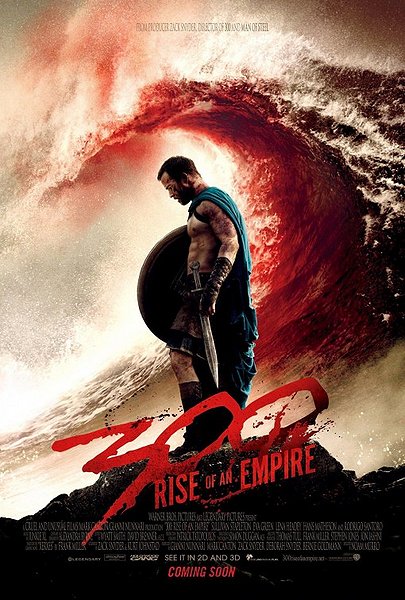 In 2007, the gory, shouty, beefcake-y action flick 300 came out of relative nowhere and took the world by storm, earning over $400 million worldwide and launching the careers of Gerard Butler and director Zack Snyder (Man of Steel, Watchmen). The movie burrowed itself into pop culture, readily mocked and parodied along with its highly stylized action. So where to go next? Also based on a Frank Miller graphic novel, though one that is incomplete as of release, 300: Rise of an Empire is a return to the same stylized excess that made careers. Except now seven years later, what once dazzled seems empty; visually alluring but hollow by all accounts.
Following the brave stand of King Leonidas and his 300 Spartans, Xerxes (Rodrigo Santoro) is pushing forward with his plans to subjugate the city-states of Greece. Long ago, Themistokles (Sullivan Stepleton) killed King Darius during Persia’s first invasion attempt. Xerxes has sworn vengeance since, goaded into action by his second-in-command, general Artemisia (Eva Green). She commands Xerxes’ mighty naval fleet, and she looks to “dance across the backs of dead Greeks.” The many city-states of Greece are squabbling over an appropriate response; Themistokles argues they should unite, while others contend for surrender to Xerxes. Themistokles rallies what armies and ships he can to meet the Persians on the sea and prevent the overpowering invasion.
 The difficulty with a follow-up to 300 is that Snyder’s highly stylized original has been copied and pasted so many times by cheap imitators, so what’s new? The film’s visual style follows the original closely, all those gauzy panoramas and human bodies lovingly showcasing in slow-mo the ugly beauty of bloodshed and violence. The rippling muscles, the glistening sweat, the geysers of blood; it’s all here and in displayed in fawning 3D detail. I didn’t see the film in 3D, but I noticed that every campfire scene was littered with annoying floating embers. However, Rise of an Empire manages some pleasant surprises because a majority of its action takes place at sea. This is a movie devoted to ancient maritime combat, and that’s pretty interesting. The scope of the action is much larger this time, with far more than 300 soldiers in play. The naval battles are brought to life with Hollywood excess but they’re still fairly exciting and fun to watch. The action is well orchestrated, usually easy enough to follow, and suitably thrilling, with each sequence differing from the last. The pumping score by Junkie XL works as a strong driving force with pounding percussion and horns (check out “History of Artemisia”). There are also less nutty monstrous evil henchmen this go-round as well, which helps bring a needed sense of internal reality to all the fantastical action. There are no goat people and blade-handed executioners this time. I don’t think anybody is going to take the movie to task for historical accuracy, but it’s appreciated all the same. Though who’s going to hire Blade Hands now? The guy has a very limited skill set for a workplace.
Plot-wise, the first 300 film was an underdog tale, a group of proud warriors fighting against overwhelming odds eventually giving their lives for the cause. It’s an early chapter in the Noble Lost Cause storytelling playbook, meant to inspire. It’s a Greek Alamo. The problem is when you pick up the story after the Noble Lost Cause. Now the Greeks have to fight the whole of Xerxes’ mighty forces with their own, and while it’s still an underdog story at its core, watching one huge army fight a huger army doesn’t have the same entertainment value. That may be why the film also works as a prequel. There are three flashbacks to fill out the first act’s worth of table setting: the initial war with Persia, Xerxes, and Artemisia. We get storylines happening concurrently with Leonidas and his men, though Gerard Butler declined to reappear in the film. You definitely miss his animalistic fire and screen presence. Ultimately, I don’t know if there’s much of a story here besides a big-screen version of Stratego, where the Greeks move, then the Persians, now everyone is dead or defeated. That’s a glib oversimplification, yes, but the plot boils down to an increasing series of episodes on how the Greeks repel the Persian invaders. Without greater characters and storylines to populate the downtime, it all becomes soulless exercises in CGI bloodshed chasing after whatever is cool looking.
The big problem with 300: Rise of an Empire, despite the ever-present sameness of it all, is that the heroes are bland and the villains are charismatic, which makes it easier to root for the bad guys, which I heartily did. The heroes are chiseled from the blandest of hunks of one-note characterization, with only three real characters being formed. There’s Leader Guy a.k.a. Themistokles, who wants to unite Greece into one power. There’s Father, a.k.a Scyllias, who has a slight scar on his jaw to better identify him, and then there’s his Son, a.k.a. Calisto, who wants to fight. Ladies and gentlemen, that is it, which is all you get when it comes to your heroes. What a shameful pittance. There aren’t even flamboyant supporting characters in their ranks. The heroes are boring, and the father/son storyline plays out exactly as you’d expect, which is a reverse from the original 300. These are not characters you’d follow into uncertain danger. These are characters leftover after all the good ones have been prematurely slain. These are some lackluster leftovers.
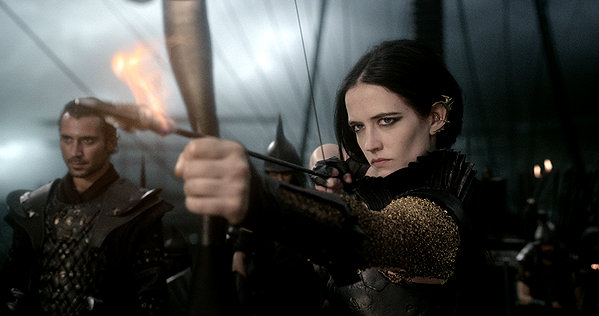 Now, let’s take a look at the enemy camp, namely with chief antagonist, Artemisia. It helps leaps and bounds that she is played by Eva Green (Casino Royale, Dark Shadows), and it’s even more helpful that Green gives it her all, sinking her teeth into the campy villainy. Artemisia is a fierce sword fighter, no-nonsense general, and overall badass supreme. She kisses decapitated heads, is not above fighting topless, and wears wicked outfits with spikes and all sorts of goodies. Every time she departs a scene, you’re left counting down the minutes until you see her again. She’s so delightfully entertaining, chomping at the bit for vengeance and Greek blood. She’s also a woman commanding warships in 500 BC, not exactly a time that recognized women as equals. Another wrong move on the filmmakers’ part was illuminating Artemisia’s back-story. We learn via flashback that Artemisia watched her family get raped and slaughtered by the Greeks. She was sold into sexual slavery at a young age, imprisoned in the bowels of a Greek ship, repeatedly raped for years. Then when these horrible men had had their fill, she was dumped onto an anonymous road and left to die. After seeing this sequence, what person isn’t going to welcome Artemisia? Does she not deserve her vengeance? I was emotionally engaged with her from that moment onward, and so I rooted for her to burn Greece down and vanquish our lame heroes.
The rest of the actors on screen are rather bad. The beefy men on screen could have used some extra work on their underutilized acting muscles. Stapleton (Gangster Squad, TV’s Strike Back) is absent any notable charisma to distinguish him from the stubbly-bearded pack of screaming male heroes. Santoro (The Last Stand) has a certain dour intensity to him, though he spends much of the film watching from a distance. The rest of the cast doesn’t even merit mentioning because the film treats them like featured extras rather than genuine characters. Only Lena Headey’s (TV’s Game of Thrones, The Purge) handful of scenes will grab your attention. It’s ironic that a film that glorifies the heroics of male soldiers, as well as the their chiseled physiques, and the only two women in the entire film are easily the most memorable and entertaining people. Dump the dudes.
While it offers enough thrills and visual power to satisfy a trial viewing, 300: Rise of an Empire is just too empty a spectacle to warrant anything beyond a cursory glance. Director Noam Murro follows Snyder’s blueprint to the best of his abilities, soaking the screen in blood, rippling flesh, and visual grandeur, but the movie goes into convulsions when somebody is forced to talk without kicking people in the face. The plot amounts to little more than a series of attacks played out like stages in a video game. While the original is no masterwork, at least it had characters that we could gravitate toward. Absent any hero worth rooting for, it’s no wonder that Green and her memorable villain reign supreme. She is excellent and has a reasonable motivation for her vengeance. If it had been her movie, 300: Rise of an Empire might have developed into a worthy spectacle anchored by its fiery heroine. Alas, the actual movie is just a Saved by the Bell: The New Class of half-naked men going off to CGI battle, and that’s just not enough.
Nate’s Grade: C+
Share this:

Non-Stop (2014)
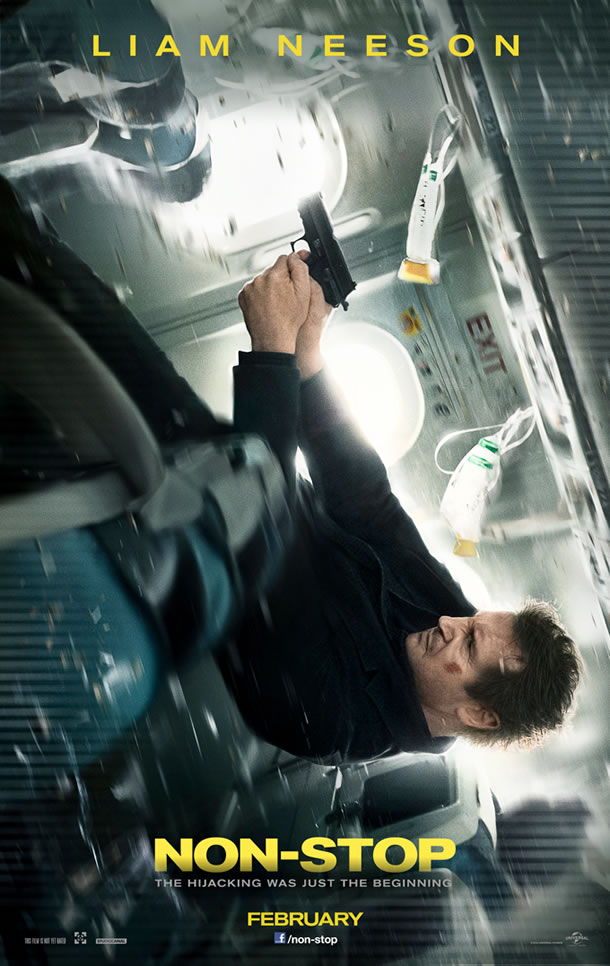 Know that I love contained thrillers, and I love suspense stories where we think alongside the characters step for step, and know that I love Liam Neeson in his career’s second life as our buttkicker in chief, and it looks like Non-Stop was the kind of film made exactly for me and my ilk. And until the final twenty minutes or so, Non-Stop kept me in the throes of entertainment.
Bill Marks (Liam Neeson) is an Air Marshal still getting over a lingering personal tragedy. On a flight from New York to London, he receives a text message on his secure Blackberry. Someone onboard is threatening to kill a passenger every 20 minutes unless $150 million dollars is deposited into an offshore account. When the bodies start piling up, Bill must find the killer but first he has to discover whom we can trust onboard.
Nobody is going to mistake this as a groundbreaking movie of any sort, but it sets about a very specific mission and executes it with vigor. You would be surprised all the different ways the film is able to squeeze out suspense in the meager confines of one airplane cabin. Just when you think you got the film figured out, it throws another twist and complicates matters in a way that is nicely escalating. I loved the fact that the killer essentially uses Bill to commit the first murder. It’s in self-defense, yes, but it also directly ties to his actions, which leaves an air of uncertainty attached to Bill. He now has to keep his own deadly actions a secret, lest he lose more trust with the airplane crew he so desperately needs to assist him. As the passengers start to become suspicious and unruly, it’s a rather plausible scenario that Bill will be subdued and arrested, if not worse. It finds ways to make the outlandish conceivably plausible, at least during the confines of the movie theater before you pick apart the plot holes.
 And let’s talk about that for just a moment. I’ve said before that plot holes only really matter when you’re not enjoying the movie, because then they consume your attention rather than the story and the whole thing falls apart. As long as I’m satisfied, I can excuse the stuff that doesn’t make sense to an extent. With Non-Stop, the movie contorts its mystery in such a way that you know it will never fully deliver on an ending that will perfectly snap together all the pieces and clues as well as satisfy. I went along for the ride already accepting the ending would more or less blow it, but beforehand I just wanted to be ably entertained, and I was thusly. In the end, without delving into too murky with spoilers, the evil plot by our onboard killer relies on such a perfect execution of so many variables that there’s no way this money grab would work. Well, there’s a reason for that, but I won’t elucidate on the details, but suffice to say it is a plan that does not make sense, would not have the intended impact, and you question exactly how somebody got parachutes onto an airplane as their carryon. Does that not strike TSA security as weird?
The screenplay by John M. Richardson, Christopher Roach, and Ryan Engle (two of those gents are an editor and executive producer for the reality show, Big Brother) does just enough right to please without offending when it gives in to the inevitably stupid reveal. In fact, this screenplay could be a prime example of the “Save the Cat” plot formula that has arisen to prominence in Hollywood: the opening scene/image tells us about the character’s metaphorical journey, he does something kindly early, this time helping a child who lost her stuffed animal, and the plot beats are all there in lockstep. The key scenario where a death emerges every 20 minutes provides a potent sense of urgency, with a payoff that comes fast. Each escalates the stakes, adding a personal element with Bill being pinned with the blame and the news leaking to the passengers via rumor and the media. Then Bill’s supervisor adds another level of conflict, and it’s enjoyable to watch all the screws turn against our hero. It’s also fun to watch Bill have to use what limited means he has to suss out the killer, and each makes him more vunerable to a passenger revolt. It’s a well-constructed thrill ride that produces enough jolts, twists, and payoffs to wholly condemn it after the third act crash and burn.
 Neeson (The LEGO Movie) has been carving out a niche for himself ever since the first Taken movie, and as my friend George would say, a movie with Neeson punching things equals his ticket bought. While the man has other great acting skills, it’s just a pleasure to watch someone of his dignity and stature, as well as with his natural sense of gravitas, bark at bad guys and punch them into unconsciousness. Would you rather watch the aging class of 1980s action stars still doing their thing, or Neeson? America has spoken. With Non-Stop, Neeson is again a solid anchor for the film and our interests. I like that his character isn’t portrayed so starkly heroic, like his concealing of personally harmful information. It gives a sense of fear to the character that we don’t ordinarily see. Then there’s the fact that Neeson has to act a third of the movie against nifty floating text subtitles, and the man still outshines others. It’s also nice to have a supporting cast of solid actors like Julianne Moore (Carrie), Corey Stoll (TV’s House of Cards), Scoot McNairy (Argo), Nate Parker (Ain’t Them Bodies Saints), Shea Whigham (American Hustle), Michelle Dockery (TV’s Downton Abbey), and a blink and you’ll miss her role for new Oscar winner, Lupita Nyong’o (12 Years a Slave).
Packed with twists, escalation, and squeezing as much suspense out of its premise as possible, Non-Stop is a contained thriller that invites you to play along for fun. It’s an entertaining ride that weaves its various characters and conflicts together in a satisfying manner that simmers with rising tension. The great supporting cast, and the unbeatable Neeson, sell the silliness, up until the end. By that time, I’ve already been having too much fun to quarrel much, though I’m sure you at home can figure out a dozen more probable and better endings. Non-Stop is an above-average thriller that makes great use of its unique location and the realities of this space to up the stakes. Premise-alone, you already know whether or not this movie is going to be your kind of film. Action fans should find enough to whet their whistle, and there are enough surprises and well-wrought suspense that I would recommend Non-Stop as the perfect antidote to a rainy day. Idea for a new action film… Liam Neeson versus the weather. Just wait.
Nate’s Grade: B
Share this:

3 Days to Kill (2014)
 Luc Besson has long been a household industry when it comes to action movies, especially in the last ten years. The man has had his hand scripting, producing, and sometimes directing the Transporter films, Columbiana, Lockout, District B-13 and its soon-to-be released American remake Brick Mansions, The Family, and most popular of all, the Taken movies. Besson’s got his fingers in just about every Parisian action movie. But with a prevailing influence there is also the challenge of keeping things fresh. It’s easy to fall back on formula, which is precisely where 3 Days to Kill finds itself stuck.
Ethan Renner (Kevin Costner) is one of the top spies for the CIA, but a rare and terminal medical condition has taken him out of the field. He seeks out his ex(?) wife (Connie Nielsen) and their teenage daughter (Hailee Steinfeld), a girl he’s mostly sent messages on her birthday as the extent of his parental involvement. While living in Paris with his family, the mysterious Vivi (amber Heard) promises a radical drug treatment to extend Ethan’s life, but in return she needs his help killing some notorious terrorists in town.
 We’ve all seen this movie before. In fact we’ve probably seen something similar enough produced by Luc Besson just in the last year or so. The formula is worked over and only the most die-hard action junkies will walk away fully satisfied. The plot is predictable from start to finish, short of the comic flourishes, and has all the trappings you’d expected with a simple middle-of-the-road genre picture. It’s a major surprise that the action sequences are lackluster and unimaginative. With Besson as co-writer, and McG as director, I expected at least a few sequences that would stand out from the crowd, some inventive takes on the action genre. Alas, it’s the same old shootouts, car chases, and the like. I’m not a huge McG fan but I can at least credit the man for his visual style, which, despite the quality of the films, was evident in Charlie’s Angels and Terminator Salvation. With this movie, you would never be able to tell that a former music video stylist directed this. There is no trace of style outside a brief series of shots inside a Parisian tattoo parlor/club that provides some PG-13-approved partial nudity. It’s workmanlike direction with few images or compositions that rise above ordinary. Like most of 3 Days to Kill, the visuals are disappointingly bland and drably familiar.
There are also sizeable plot holes that jump out immediately. I’m not even talking about the usual action film clichés, like the good guys being expert sharpshooters, etc. First off, the name implies a remote time period, a natural opportunity for a ticking clock. He’s got three days to kill the bad guy… or else. But the movie never really provides an or else, nor does it really justify the title. Why does Ethan need three days to kill the bad guy? He’s spending three days watching his daughter, but that’s it. We’re given no real sense of urgency and the characters, the spies, don’t ever seem to sweat or panic. Ethan spends most of the second act bonding with his teenage daughter, teaching her how to ride a bike, and so on. These are not the actions of a man with a ticking clock. Then there’s the premise that Ethan has a rare cancer that requires a rare treatment that only Vivi offers. Ethan injects himself with this magic substance and it seems to do the tick, that is, unless his heart level gets too high. Then he starts to hallucinate and collapse. So there you have it, the plot of the Crank films now with a French polish. The problem with this scenario is that it ONLY happens during the most stupid of times. Instead of Ethan’s heart rate getting too high in the middle of deadly shootouts and speeding car chases, it’s generally when he’s one-on-one with an unarmed bad guy. Even with this, apparently drinking alcohol will slow down his heart rate. Knowing this, why doesn’t Ethan carry a flask of liquor on his person at all times then? He’s supposed to be a professional!
Despite the overwhelming mediocrity and formula-laden efforts, there are a few surprising and effective notes in 3 Days to Kill. The humor, Besson’s tongue-in-cheek genre riffing, is spry and involving enough that I wish the film had followed this tantalizing angle and become an all-out comedy. Ethan’s attempts to balance watching his daughter with his spy hijinks bears well developed comedic moments. Take for instance an informant that Ethan is intimidating for vital intel. His daughter’s phone call interrupts the scene, and she says she needs a recipe for spaghetti sauce. It just so happens the informant is an actual Italian, and so Ethan puts him on the phone. The informant recognizes that the longer he talks the longer he might live, so he draws out relating the recipe, and keeps mentioning how much he truly loves his mother and how she has no one else to take care of her. It’s a small scene but it’s clever and a nice twist on the formula. There’s another humorous scene where Vivi and Ethan debate the difference between beards and mustaches, since she told him to kill the guy with one and not the other. Ethan also forms an offbeat relationship with another informant, a limo driver named Mitat (Marc Andreoni), that becomes so casual, he knowingly helps himself into Ethan’s car trunk, requesting to be back before 4 PM since that’s when his daughters get home. “I can’t promise anything, but I’ll make an effort,” Ethan says before slamming the trunk shut. This is the kind of stuff the film needed more of, well-crafted asides that punctuate how silly spy movies often are. If only the film just wanted to be funny.
 I think Besson and his coterie believed that Heard’s (Paranoia, Machete Kills) character was a constant source of comedy, but she’s really a hollow pinup, a video game avatar come alive. There is no character here, which may be part of the jape, because she’s all style and moody, pert sexuality. She just sort of appears whenever the movie needs a dose of sex appeal (sorry Costner fans). I think her aloof and calculating manner is meant to be taken as comedy. She’s brusque but without any real sense of joy. Not to take anything away from heard; she is a woman of stellar beauty, but just having a sexy gal make droll quips while dressed in a corset isn’t the stuff of comedy but fetish.
I have enjoyed Costner’s (Jack Ryan: Shadow Recruit) late spate of film roles and even enjoyed Mr. Brooks. But he’s all wring for this film, which looks like a modern Liam Neeson vehicle that he wisely passed on. Costner is convincing as a no-nonsense authority, but he’s not ready to take that Neeson-sized step into AARP action star. He sounds like he has a frog permanently lodged in his throat, or they filmed the entire film during a month where Costner was getting over a furious case of step throat. Perhaps he was doing his best Harrison Ford impression. Whatever the case may be, it’s not exactly winning, and while the actor sells the comedy bits easier, the badass moments lack the real punch the movie needs. Steinfeld (True Grit, Ender’s Game) has a nice rapport with Costner and she doesn’t overplay the teenage outbursts. Her character starts to grow a more intriguing dimension when she seems to possess her father’s traits, but she’s too quickly funneled back into being a helpless damsel to shriek and cry.
When it comes to 3 Days to Kill, there isn’t enough new to justify or even enough effectively entertaining to justify your valuable time. Now, if your time is less valuable, say disposable, and your expectations are low, then perhaps you’ll find a serviceable amount of entertainment in this formulaic action thriller. When the most exciting part of your movie is the comic relief, then maybe it should have been time to start over.
Nate’s Grade: C
Share this:

The Hobbit: The Desolation of Smaug (2013)
 Back to another three-hour trip to Middle Earth. While the second Hobbit film is an improvement in just about every way, it’s still a clear example of a franchise stretching to the breaking point. Peter Jackson gets the second installment moving a lot quicker, and there are several standout action sequences that are glorious on the big screen. Unfortunately it still takes almost two full hours to get to the dragon of the title, but when it does, oh does the movie become that much grander. Benedict Cumberbatch gives frightful life to Smaug (pronounced, for whatever reason, as “Smaa-oog”), and the special effects are top-notch. The last forty minutes of the movie are solid gold, as Bilbo and the dwarves work together to battle Smaug in a virtuoso development of imaginative action; it’s wonderful how many moving parts are involved in this action set piece. However, Hobbit 2 still feels needlessly padded to meet out a trilogy. Does Gandalf (Ian McKellen) need to just disappear on his own mission that accomplishes what? Do I care at all about the people of Lake Town let alone their populist revolts? Do I need a parallel storyline about an injured dwarf? And for that matter, do I need a budding lady elf-dwarf romance? J.R.R. Tolkien fans will be in heaven (though maybe just purgatory with all the changes) to gawk at the realm of Middle Earth, but I always feel antsy (“Get on with it already”). Still, The Desolation of Smaug is an entertaining and at times majestic fantasy epic, I just wish Jackson and company didn’t take so many pit stops. Well at least we won’t have to wait so long for the dragon in Hobbit 3.
Nate’s Grade: B
Share this:

Lone Survivor (2013)
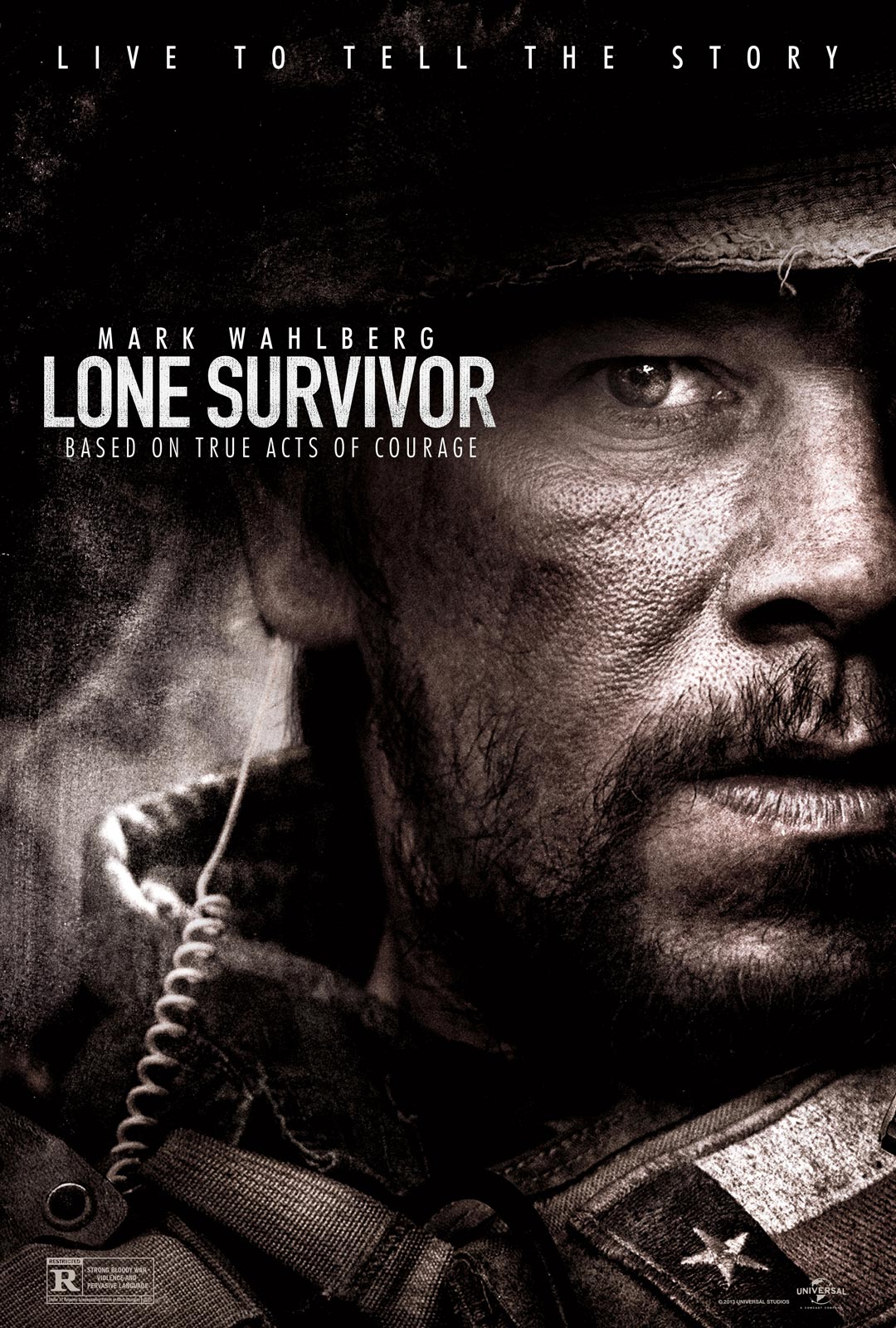 What do you do when the title of a movie is a spoiler? That’s the question with director Peter Berg’s reverential military action film, Lone Survivor. It’s the true story of a team of Navy Seals who had their mission compromised by a pair of unlucky Afghan goat herders. After deciding to set them free, rather than snuff them out, the Seals retreat to an extraction point, with a hundred Taliban fighters hot on their heels. When the action is firing, Berg is right at home, placing the audience in the middle of a visceral firefight that’s bloody and hardcore and pulse pounding. The rocky terrain of the country is just as deadly as the Taliban, as the Seals bounce around like ragdolls. The performances are all grizzled and finely attuned to keeping the terror of the moment at bay. Ben Foster (The Messenger) is the standout, which is a statement that’s been said with most Foster performances. At the end, I’m left wondering what is the film’s greater message. It’s retelling a military episode few people know about, illuminating the courage and bond between soldiers under fire. But in the end, all of these lives were lost because of one moral though arguably bad decision. Couldn’t they have just tied up the goatherds and gotten a better head’s start? Will the movie convince an audience that those innocent Afghan goatherds should have just been collateral damage? Does the movie critique the futility of America’s ongoing presence in Afghanistan? The futility of war itself? I doubt it, especially with Berg’s fervent appreciation of the armed forces putting their lives on the line (the opening credits themselves glorify the toughness of the Seals while also setting up an explanation why they could survive so many gunshots, injuries, etc.). Lone Survivor isn’t the heedless jingoistic propaganda piece that others critics have feared, but in the end it’s simply a sober and respectful tribute to the fallen, and that’s it. For many, this will be enough. For me, I was thrilled by the heroics but looking for more.
Nate’s Grade: B
Share this:

The Hunger Games: Catching Fire (2013)
 It’s been a year and a half since The Hunger Games broke box-office expectations, gifting Lionsgate studio with a formidable franchise. Based upon Suzanne Collins’ series of young adult novels, the first film was an agreeable adaptation that was occasionally hobbled by poor direction, rushed plotting, and budget limitations. Catching Fire, the second film, improves upon the established groundwork in almost everyway with the chief drawback being a terminal sense of dystopian déjà vu.
In the months after the events of the 74th Hunger Games, the two victors from District 12, Katniss Everdeen (Jennifer Lawrence) and Peeta Mellark (Josh Hutcherson), are traveling across the other districts of Panem as part of their victory tour. What better way to endear yourself than visiting other districts to remind people that their children are dead and you survived? On the tour, there is growing unrest throughout, and the people have turned Katniss as their symbol of defiance against the tyrannical Capitol. President Snow (Donald Sutherland) threatens Katniss to control her media image, to convince the people that she’s madly in love with Peeta and not a fledgling revolutionary. In order to check the power of the victors, Snow introduces a rule change for the 75th games, the Quarter Quell. This year the participants will be culled entirely from previous past victors, meaning that Katniss and Peeta will be plunged back into the deadly games and this time their competition aren’t children.
 What a difference a director with a sense of cinematic visual command can make. Early into pre-production, the original director Gary Ross (Seabiscuit, Pleasantville) decided to bow out for sequels, and so Francis Lawrence (Constantine, I Am Legend) was hired, and goodness does the movie benefit from this change at the helm. Lawrence has a much stronger visual authority, having cut his teeth in commercials and music videos (remember those, kids?) before feature films. The man couldn’t frame a lousy shot if he tried. With a stronger visual lens, the world of the Hunger Games is able to stretch, given a proper budget, and the visual grandeur unfolds around you, especially the largess of the Capitol. The movie doesn’t feel like they had to cut corners with their budget or special effects, and part of that is credited to the skill of Lawrence. And with this new visual stylist comes the demise of shaky cam. Dance and celebrate that Ross’ misapplied docu-drama approach has been abandoned; this time, when there is onscreen action, you can comprehend what is happening. I read the book years ago but even I was feeling twists of tension, notably the start of the Quarter Quell. The action isn’t terribly developed but it’s sufficient, though again the kill-or-be-killed extremity kept to PG-13 safety is starting to chafe. My only visual complaint is that much of the action within the games takes place at dawn/dusk and thus low-light environments. It feels like someone threw on a muddy filter, though perhaps this was just my theater’s light bulb-saving projection setting.
Now that the world of Panem is established, Catching Fire does a nice job of showing the various social conflicts coming to a head, bubbling into uprising. The pre-games victory tour opens up the world, allowing us into other districts and viewing the different strife befalling them. It’s jolting to watch the public defiance met with summary executions and yet the people will not be stopped. Now the class conflicts of the haves and have-nots get pushed to their breaking point. There’s a great contrast provided with a Capitol party so lavish, with food so sumptuous and plenty that the Capitol denizens have cocktails on hand to induce vomiting. That way you can continue eating (historical fact: vomitorium is actually not what you think but instead a passage below a tier of seats for easy exit, like in modern stadiums). The themes and the points aren’t subtle, that’s for sure, but they are effective and intriguing. Katniss, who only wanted to survive, has been thrust as the face of revolt, and now she has to walk a delicate line to again save her loved ones. The fascist politics and media manipulation hinted at in the first film are given more examination, providing a richer narrative. What works in the first Hunger Games is generally expanded upon and what faults the first film had have been, generally, nipped and tucked. There’s nothing as eye-rollingly awful as Peeta’s human rock sculpture camouflage. The burgeoning love story elements again are abbreviated the harshest, but when the world is coming apart, you have to spend more time on revolution than love triangles.
The film also benefits from a slew of new characters that have strong personalities. We’re introduced to other formers winners of Hunger Games past, and they make the most with their limited exposure. Joanna Mason (Jena Malone) is an axe-wielding woman given to speaking her mind with devil-may-care attitude. Her first scene in the film involves her stripping naked in an elevator with Peeta and Katniss. Malone (Sucker Punch) really has fun with the blithe approach of the character and manages to come across as comical while still being a credible badass. She’s a terrific character and you’ll be seeing more of her in the sequels to come. The other famous victor is Finnick (Sam Claflin) who bathes in the celebrity limelight, luxuriating in his media image as a suave playboy. Except there’s more under the surface and you’ll be given peaks throughout the film. I’m not as sold on Claflin (Snow White and the Huntsman) as I am on Malone; he’s got the requisite chiseled physique, but I don’t feel the charismatic pull the character demands. Also, when I close my eyes and listen to him speak I hear James Franco, and I don’t know what to make of that. Then there’s the new head game maker, Plutarch Heavensbee (Philip Seymour Hoffman), who is presented as an enigma. He leans on President Snow to spare Katniss rather than turning her into a martyr for the cause. However his alternatives are sinister and media savvy. Hoffman is one of our best working actors today but he seems to sleepwalk through the role, perhaps because he’s meant to be vague. However it’s played, it’s hard to get a read on Plutarch until the very end.
Strong as ever, Lawrence (Silver Linings Playbook) is the rock of this franchise. The Oscar-winning actress has been on a tear as of late and her acting and overall presence elevates the material. They struck gold when they hired her. There’s more fire to her and more devastation, as she’s going through the PTSD, plagued by nightmares. She’s haunted by the horror she’s escaped but also by the continuation of the threat from Snow, the ongoing charade that she will have to keep up for the rest of her life. There is no time out of the spotlight as a victor let alone a national celebrity like Katniss. Lawrence can convey so much wordlessly and she can convincingly play the different dimensions of her wounded warrior.
 Many of the criticisms one can hurl at Catching Fire are the same from Collins’ book. There is a repetitive plot structure, where the games themselves feel like too much of a retread. It feels forced to serve up what worked the first time. The problem with throwing Katniss and crew back into the Hunger Games is that all the real consequential action is taking place outside of them. We’ve been watching the stirrings of revolt all movie, watching the cracks take shape, and then the movie returns to its deadly TV competition when the audience just wants to leave to see if the revolution will be televised. Breaking free of Katniss’ first-person perspective from the book allows the filmmakers to add scenes fleshing out the world and the characters, with some nicely malevolent conversations between Snow and Plutarch. But that also means we don’t have to be locked into watching Katniss’ every move (I know this sounds like sacrilege). It’s not like the creatively torturous games are boring, but it’s hard to ignore an increasing sense of been-there-done-that. When there are so many larger, wider-reaching consequences happening outside throughout the various districts, you can’t help but feel a bit antsy. Another reason the film doesn’t break free from the games repeat is that it purposely keeps Katniss, and in turn the audience, in the dark about the larger outside machinations. The collective ignorance has a purpose but it also makes the plot frustrating.
Really, Catching Fire is more a setup for the series greater conflict rather than a complete film/story. Things are unraveling in the country of Panem, but if you want resolution you’ll have to wait until 2014 for the next movie, or more likely 2015 for its concluding half. What Catching Fire does is tease out the plot change and then transition to it, but only in the final minute. As my pal and colleague Ben Bailey notes, it ends in similar fashion to 2003’s Matrix Reloaded, and you’re left on a cliffhanger that doesn’t seem like a natural resting point for the story. Again, these critiques can be waged at the book as well as the film is a fairly close adaptation that will satisfy the die-hard fans.
From here on out, the Hunger Games movies are going to get more interesting. With two remaining films to cover the ground in one book, it should allow for greater development of characters, conflicts, dramatic themes, social commentary, or just larger kickass action sequences now that we’re in a larger arena, so to speak. Under the screenwriting expertise of Danny Strong (HBO’s Recount and Game Change) I’m anticipating a more politically astute and intellectual dystopian drama. Francis Lawrence has brought visual dynamism and stability to the franchise, just in time for when things are poised to get really interesting. As a film, Catching Fire is a step above the previous entry, ironing out some of the shortcomings and presenting more subtext when it comes to its social unrest. It introduces a bevy of intriguing new characters, escalates tensions throughout the realm, and promises greater suffering and strife ahead. However, the repetitive plot structure of throwing Katniss back into the games for an hour eats away at time that could be better spent watching the revolution ferment. It’s still a reliably entertaining film with a sharper visual gloss, so fans should go home happy and audiences should be suitably thrilled. The alterations from Collins’ book are all for the better. Catching Fire will slay the box-office with little trouble but I’m most thankful that we’ll be leaving the games behind for good.
Nate’s Grade: B


 nathanzoebl
You must be logged in to post a comment.