The Irishman (2019)
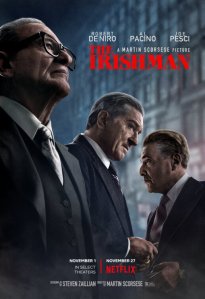 In 2018, Netflix crashed through Oscar biases with Alfonso Cuaron’s personal epic Roma and this year they have their sights set on even bigger prizes. The streaming service has built an empire of original content (and debt) and put up the $150 million budget for Martin Scorsese’s decades-spanning crime drama, The Irishman. It’s a fitting reunion for Joe Pesci, Robert De Niro, and Scorsese, and then to add Al Pacino on top, well it all makes for one supremely entertaining and occasionally striking movie experience. However, I think some critics are getting a bit too carried away with their plaudits. While entertaining throughout its mammoth 3.5 hours, this is much more Casino than Goodfellas.
We follow the life of Frank Sheeran (De Niro), a Philadelphia-based truck driver who rose to be a Teamster union rep and, reportedly, a prolific hired gun for the local mob, headed by Russell Bufalino (Pesci). Sheeran is tasked with helping Jimmy Hoffa (Pacino) with his business, which helps the larger contingent of organized crime that used the Teamsters multi-million-dollar pension as their own slush fund to pay for projects and schemes. After he loses his leadership position, Hoffa begins to think of himself on the same level as the tough guys and just as protected. Sheeran tries to turn his friend back from the self-destructive path he seems destined for, and ultimately, it’s Frank Sheeran who says he pulled the trigger killing Hoffa (is this a spoiler?).
 There are moments that just sing in this movie, buoyed by a wonderful film alchemy of the actors, the storytelling, the skill of Scorsese and his longtime collaborators like editor Thelma Schoonmaker, and it can feel exhilarating. There’s a rich world of day-to-day detail from the character interactions and mob politics, and once Hoffa comes onscreen the movie becomes something more and better. It’s just as much Jimmy Hoffa’s movie as it is Frank Sheeran’s. Here is a live-wire character bursting with unpredictability, later to his great deficit, and who pushes the other characters around in a way that creates instant tension and realignment. Considering the selling point of the movie is its perspective from the claimed killer of Hoffa, it only makes sense that these moments are allowed the most attention. Hoffa sees himself as a champion of the little guy, as an ideologue trying to make life better, never mind his own extravagance, ego, and inability to let go of grievances. Hoffa was the head of the Teamsters union for twenty years and was a well-known public figure, somebody people like Peggy Sheeran (Anna Paquin) could idolize unlike her father and his other cohorts she despised. He’s a larger-than-life figure and those theatrics find a perfect match with Pacino and his bombastic nature. It’s no wonder he steals the movie. Pacino is terrific and has the clearest arc of any character onscreen, a meaty role that gives Pacino new life. I predict he’s the front-runner for supporting Oscar gold. I was transfixed by the amount of details that Scorsese and screenwriter Steve Zallian (The Girl with the Dragon Tattoo) imbue in every scene, propelled by Frank’s narration and a dark sense of humor. It’s very easy to get immersed in this criminal underworld and its many machinations, which provides a steady stream of information points to tantalize. If one scene isn’t working, just give the movie a few minutes and another avenue might open to prove newly fascinating. It makes a difference on its running time, making 3.5 hours feel more mercifully like 2.5 hours. Of course, once it’s released onto Netflix, I feel like its size and scope will become less unwieldy for viewers.
Because of that surfeit of detail, I think The Irishman would have better benefited from being adapted into a miniseries than as a single movie that happens to be 15 minutes longer than Titanic. The finished film feels rather episodic, like three movies attached into one; the introduction into a life of crime and rising in the mob, the friendship and fall of Hoffa, and the finale as an old man. All of these segments have genuine interest and compelling drama but I think they would have been even more compelling with a larger narrative canvas to play out upon. That way each episode could have its own beginning/middle/end and play its part adding to the larger whole, which is essentially what scenes should be doing anyway for a story. The problem is that The Irishman gets a little lost in its own minutia in the middle and the plot stalls. It feels a little too taken with itself. It feels like we’re experiencing the same information just in more settings. How many moments do we need to show Hoffa pushing away sound advice, making enemies of allies, and dooming himself? Admittedly, the Hoffa portion of the movie is the most compelling, and longest, segment of the movie. It’s the best because of Pacino’s spotlight and from the personal involvement in Sheeran, pushing his loyalties to the test when he genuinely grows close to Hoffa and realizes he’ll be the one that has to eliminate his friend. It’s the most dramatic and harrowing and most interesting part of the movie (and no, not the somber final 30 minutes). I think it would have had even more punch over the course of multiple episodes of material and momentum. By going the miniseries route, the film could have also stripped its second and entirely unnecessary framing device, having the men drive their wives across the Midwest to attend Bill Bufalino’s (Ray Romano) wedding. The short scenes fail to lead to any import until it’s revealed late what also happened during this fateful weekend. It’s a long wait to justify its placement, and even after that it doesn’t feel like the occasional road trip updates were worthwhile.
 Much has been made from several dazzled film critics and online pundits about the movie’s concluding half hour, which follows the “after” of a mafioso’s life. We got a taste of this in the conclusion of Goodfellas after Henry Hill and family were relocated to schlubby mundanity through witness protection, implying the boring life that awaited, but The Irishman dedicates its conclusion to demystifying these mob men. Few of them live to old age, so already Sheeran is the exception (he died at age 83 in 2003) but he’s also incapable of introspection. That gives the final half hour a change of pace and an air of contemplation but it’s stagnated. Frank’s family wants nothing to do with him, everyone from his earlier life has passed away, and he shows little regret for his life’s actions, shocking a priest, his only regular visitor. I suppose one could surmise the self-deluded and sad existence of this man who refuses to accept accountability, but I found this final thirty minutes to be interesting, yes, but far from revelatory. I think critics are doing a fair amount of projection by searching for some kind of tidy, accumulative meaning, as if Scorsese is providing some wise, decades-earned statement on his own famed works highlighting the flashy lives of very bad people doing very bad things. People are a little too desperate for The Irishman to provide that neat hook, that definitive statement, and it’s just not there. It may have been too “movie land convenient” but I was begging for a final confrontation from Peggy.
The de-aging CGI is the source of much of the film’s gargantuan budget, which was why studios balked before Netflix welcomed Scorsese with eager arms. The first display of the de-aging effect is jarring and jarringly bad. We see Pesci and De Niro as 40-year-old men and it’s initially horrifying. The effect looks wrong, like somebody drew over their faces to provide some degree of cell-shaded dimension (think of the video game Borderlands). There are also elements that will just never look right, namely the elasticity of the skin, which looks overly smooth and polished, reminding me of the doll faces of the stop-motion film, Anomalisa. It gets better from there. Interiors and lower-light environments are better at masking the unreality. After a while you simply grow accustomed to it and the characters are aging anyway, which means the effect is rarely used after the first half of The Irishman. It’s impressive at parts but even with the digital facelift, these are still 70-year-old men moving their 70-year-old bodies with new shiny faces. There’s a moment when a younger Sheeran beats and stomps on a grocer and it reminded me of professional wrestling with the stiff movements of one participant followed by the extravagant physical overreaction of the recipient. Captain Marvel is still the champ at actor de-aging.
 There’s also the fairly strong possibility that Sheeran made all of this up. Well into his twilight years, he reportedly recounted his amazing tale to a medical malpractice lawyer before he died, and that became the 2003 book, I Heard You Paint Houses. An August 2019 article by Slate.com writer Bill Tonelli (“The Lies of the Irishman”) gives a pretty thorough rundown of the facts of the case, which align in one direction. All of the FBI agents during Sheeran’s time, as well as the local officials, and surviving criminal actors, all come to the same conclusion that Sheeran has grossly overstated his role in mob matters and outright fabricated his most sensational claims. According to Tonelli: “Most amazingly, Sheeran did all that without ever being arrested, charged, or even suspected of those crimes by any law enforcement agency, even though officials were presumably watching him for most of his adult life. To call him the Forrest Gump of organized crime scarcely does him justice. In all the history of the mafia in America or anywhere else, really, nobody even comes close.” It does seem far-fetched, but the next question is whether the enjoyment of the movie matters at all if the story it’s based upon is ninety-nine percent hooey? While I think the impact of the movie is slightly blunted with a fictional account, it plays larger into a self-aggrandizing theme and the first framing device of the movie, having Sheeran narrate his life experiences as an old man, left to rot in a nursing home. Perhaps he’s exaggerating to make himself feel more important and grant himself something of a legacy that is denied to him by a lifetime of self-serving choices that have left him abandoned by family. In this regard, there’s a strange meta-textual level that even helps support the larger tragedy and loneliness of these men, in case you needed it underlined.
There’s a delightful feeling of getting the gang back together for Scorsese’s massive, ambitious, and thrilling return to the world of gangster cinema. There are so many characters that it can be hard to keep things straight as we zip through decades, de-aging, framing devices, Boardwalk Empire supporting actors, prison time, nursing homes, and Jim Norton as a young Don Rickles. I wish the story had been parlayed into an epic miniseries rather than a movie. The finished film is certainly long and imposing but also compelling and entertaining. The personalities don’t have quite the pop as Pacino, a rollicking screen presence relishing the spotlight, but the rock star bravado has been replaced with a somber reality of self-cultivated isolation. Pesci is terrific in what might be his most nuanced, insular, and quiet role of his career. I wish he would continue acting. De Niro is suitably gruff and has a few scenes of trying to hold back a cascade of emotions, but he’s more our impassive face into a world of crime and vengeance. I don’t think the final conclusion has the power that others have claimed and is a result of projection. The Irishman is an entertaining deep dive that I only wish could have gone even deeper.
Nate’s Grade: B+
Share this:

Doctor Sleep (2019)
 Mike Flanagan has taken the mantle from Frank Darabont and become the best film adapter of Stephen King’s stories. Doctor Sleep is a sequel to The Shining but it’s a sequel to Kubrick’s movie version, which King notoriously hated for its alterations. We follow an adult Danny Torrance (Ewan McGregor) as he struggles with addiction in the wake of his family’s tragedy linked to the Overlook Hotel. He starts a new life for himself as a hospice worker, aiding the elderly into a peaceful demise (where he earns the titular nickname), and he takes it upon himself to mentor a young girl, Abra (Kyliegh Curran), who has the same “shining” powers that he has. Trouble is others are looking for these same gifted few, namely Rose the Hat (Rebecca Ferguson) and her gang of traveling undead mutant vampire people feeding off the “steam” or life force of the super-powered they kill. They’re after Abra and her abilities so Danny must rescue her and eventually head back to the source of all his nightmares. This is a relatively solid sequel that has enough intrigue and suspense to cover over the dull parts. It takes too long to get going and then finishes things up too quickly, especially with a climax at the reawakened Overlook that is beginning to hit a groove with nasty ghostly suspense. It felt like I was watching Stephen King’s X-Men with his assortment of super powered people banding together and tracking each other down. The gypsy-like caravan of villains are pretty disposable and lacking strong personality or menace. Ferguson (Mission: Impossible – Fallout) is fun to watch even if she doesn’t feel that threatening. The rules and limitations feel vaguely defined and refined. The nods to the original Shining are selective and bring their own degree of power, as does seeing different actors portray these famous characters in flashback. Flanagan has reverence for both King’s source material and the beloved 1980 film, and bridging the two is a source of enjoyment. The characterization overall is pretty slack and there aren’t much in the way of genuine scares. It’s creepy, it’s occasionally atmospheric, and it’s also really long and drawn out, clocking in at 151 minutes, which is even longer than Kubrick’s movie. It’s an epilogue that gets by on the emotional investment and resolution it provides for Danny while setting up a larger universe of super “shining” psychics. If you don’t care about one, there’s at least some degree of the other to prove entertaining albeit also being underdeveloped. Doctor Sleep (a wasted title) is a workable balance between two masters of horror.
Nate’s Grade: B
Share this:

Night Work (2019)
 As I’ve been making a concerted effort to provide thoughtful film reviews for local Ohio projects, I’ve had to acknowledge my potential bias in several circumstances, having personal or professional connections to those behind and in front of the camera. Well, when it comes to the genre comedy Night Work, this is the most biased I may ever get for a project not carrying my name. Writer/director Kyle Rayburn cast a good friend of mine, Valerie Gilbert, in a key supporting role, and I was so inspired with her character’s unique situation that I went and wrote a 9-part rom-com Web series called The Spirit Inside Me exploring that dynamic in the context of a different genre. Gilbert co-starred in my production, served as my co-creator, and Kyle not only gave us his blessing for our own independent project, he offered constant encouragement and assistance, opening his home to us to film one of the episodes (our lead actress threatened to kidnap his sweetheart of a dog). If it wasn’t for Kyle’s creativity, and later his generosity, there would be no Spirit Inside Me, and I’m very grateful for that outcome (look for the first batch of Spirit episodes in late 2019?). Now I get to review the man’s finished film that he made throughout the fall of 2018 in central Ohio and instead of just blaring, “It’s awesome, go see it,” I feel like I can better serve the filmmakers by providing as objective and professional a review as I can especially for a fun movie that deserves to be seen on the festival circuit and later on home video release.
It’s a world of monsters and men living side-by-side. The Night Work team operate as a for-hire crew to bust some ghosts, keep some creepy crawlies in line, and handle the many supernatural beasties hassling the common folk. Frank Rooker (Scott Wood) is the grizzled, hard-drinking, punch-first-ask-questions-later partner with a tragic past. His young daughter Elizabeth was possessed by a spirit and she has been missing for years. Mysterious clues start to emerge pointing toward Elizabeth being alive, and Frank enlists the help of his magic-oriented, irritable Night Work partner Chase Hardy (Virgil Schnell) and Val (Gilbert), a strong-armed bartender who offers handjobs for a fee (she’s also shares her body with a lesbian samurai). Together, this motley crew will shake down creeps and fakes to find out what really happened to Elizabeth.
 The fact that Rayburn and his company of first-time filmmakers threw themselves into the mix unabated and holding to their ambition to tell a funky indie version of True Blood meets Men in Black is impressive. They could have gone an introspective mumblecore route, or a teens-lost-in-the-woods genre slasher, but instead they went with a micro-budgeted fantasy/horror buddy film replete with monsters, vampires, and assorted lesbian samurai possessions. Given the budget, inexperience, and ambitions, I take my hat off to the entire Night Work cast and crew not just for going for broke with a twisted, silly comic vision but also seeing it through.
First and foremost, Night Work is a fun movie that seems to be bristling with weirdness and ideas. There are offhand statements that make me curious about additional stories within this universe of humans and the everyday supernatural. It feels like every scene has so much storytelling potential just around the edges, which may be one of the reasons I took a character concept on the peripheral (love story between two people in one body) and creatively ran with it, writing a whole project devoted simply to exploring that very concept. Each time we’re introduced to a new character with a special power or predicament, the world feels richer and more alive and lived in. That sense permeates the film and provides an enjoyment level no matter the scene. You’ll find something to smile about or to be intrigued over in just about every moment, and that’s because Rayburn and his collaborators have certainly given thought to this unusual world. I enjoyed that characters will make references we don’t fully comprehend (“I thought it was gonna be another Baton Rouge”) but point toward more lived-in experiences to unpack. This is a highly amusing and inherently interesting world open for deeper exploration, possibly in linked sequels, and I think that’s a strong necessity for any storyteller creating a setting different than our own.
Night Work is also a funny movie, borrowing from the likes of Sam Raimi and Kevin Smith. There’s a crude, juvenile humor to the movie, and even when characters are confronted with terrifying monsters and the unknown, they meet it with a devilish glee. If the movie could be condensed into a single expression it would be a mirthful smirk. I laughed out loud at a child getting punched in the face. There’s a playful camaraderie between the various players where they always seem on the cusp of cracking a joke. Rather than be annoying, it keeps things light even when we’re dealing with some pretty spooky stuff, allowing Night Work to maintain a ball-busting comedic tone. It’s the film’s way of telling its audience to enjoy the ride, soak up the characters, and not to be too troubled by the rest, even if there are certain implications that might be more troublesome like a diet of male phalluses. I laughed at several points but smiled even more consistently. Night Work didn’t quite have the budget to achieve affecting horror, so it dives headlong into slapstick, banter, and spunky mischievousness. This works well because clever doesn’t need a dollar amount, only a strong writer and a clearly articulated vision.
 The performers are just as enjoyable as the funny banter they’re given. Scott Wood is so damn charismatic that it feels like he simply is Frank Rooker. His line readings have such spit and shine to them that the man can find jokes that I didn’t even know were in the lines; he discovers them with his sozzled, sarcastic nonchalance. He’s a presence that kept drawing me toward him and he serves as a terrific anchor for a movie. Wood needs more film work. His onscreen partner, Virgil Schnell, plays the straight man role growing more exasperated. They have a winning chemistry and, mysteriously, if you close your eyes and listen, Schnell’s voice sounds shockingly identical to Keegan Michael-Key. Gilbert (Pinheads, and, ahem, The Spirit Inside Me) is a welcomed addition and is cheerful and wry no matter what gets thrown at her. I wished she was in the movie even more. Gracie Hayes-Plazolles makes a strong impression as a late character who jostles back and forth between innocence and wickedness and has great fun playing those contrasts.
Because of its micro-budget nature, there are certain aspects of filmmaking you simply have to be charitable over as long as they don’t blunt the overall impact of the intent. There’s not much in the way of a sound mix or advanced lighting or set dressing, and I didn’t care, because this is a movie carried by the colorful characters, weird world, and spirited performances. The fact that Gilbert is splayed with what appears to be a blast of light from God (from an open car trunk in reality) doesn’t matter as much as the excellence with how she delivers an incredulous F-bomb after getting spat in the face as part of a protective ritual. The content of ideas, and the energy and commitment, overcome most of the production shortcomings and can provide their own homespun sense of lo-fi charm. There’s a later sequence where an entire conversation and fight inside a bar occurs through the use of silent movie-style inter-titles. I’m certain it was shot and/or edited this way from the realities of not being able to record good sound in a working bar at the time. However, it’s an unexpected and memorable moment that shows a silly and adaptable side at the ready.
With all that being said, there are some limitations that do affect the overall execution of Night Work and limit where the storytelling can go. For starters, this is a very heavily expositional movie. Going into a new world with monsters and magic requires a degree of expected world building which requires an expected degree of explanation. The trick is to make it seem as natural as possible and match it to the action on screen. Night Work follows a film noir-esque storyline where we follow our heroes from spot to spot, shaking down characters, following trails, picking up clues, and this also lends itself to monologues and interrogations. With Night Work, unfortunately there are too many moments of characters just talking and talking and unloading information about the world, its history, its differences, and it can feel like we just left one scene of characters talking to the audience and entered another scene of characters talking to the audience. Again, some of this is unavoidable, but the mission is to make exposition as invisible as possible and judiciously integrated, showing and not telling. It feels a bit like reading the game manual rather than playing the game. Some of this could have been mitigated by pairing it more through action, making the exposition more fluid. Instead of a character unloading information on what something does, we see it. Instead of learning what monsters exist, we see them, maybe even sitting pretty at a bar. I circle back to Men in Black and how it was able to slowly pull back and reveal more of its droll world and how it operated as needed.
 The pacing can be strained at times and my theory is because of the effort to get the final product over the finish line of an 80-minute feature running time. Some scenes and shots feel like they go on longer than necessary to convey information or mood, and there are multiple scenes of watching people drive set to soundtrack music or watching people walk down the street, sometimes sped up, set to soundtrack music. It’s different later when we watch Frank and Chase slowly creep through an abandoned building because there’s tension and mystery, anticipation, but watching people drive while listening to music feels like mood setting at best and filler at worst. You can get away with some of this to establish a sense of style and place, but if you choose this route too often, it starts to feel like there just wasn’t enough material available.
Then this makes me think about what could have been added, namely more visual or demonstrative elements and general coverage. Val’s samurai ghost demands some form of visual insert to pair with her recounting of being visited in her dreams. Even if it was brief glimpses, something to show them “together.” Otherwise, this aspect only exists as a theoretical, with the exception of some Japanese words espoused (does the ghost assist with the handjobs?). The same goes with the tragic backstory with Frank’s family. We’re treated to a small moment of his daughter becoming possessed, but the rest is delivered via extended voice over while Frank trundles around his home. Moments that could be ten seconds are stretched to two minutes, to cover for the voice over, to cover for the running time, or simply because there weren’t other editing options. Rarely will sequences feel like there are more than two to three angles to select from, and this isn’t a problem by itself except when it comes to some edits. Without inserts or tighter shots (I can only recall a mere handful of close-ups) there aren’t opportunities to wipe clean edits, so occasionally the same shot will awkwardly dissolve to a different take of the same shot. It’s moments like that where the amateurism, which I find as a general badge of honor for the project, can become an unwanted interference.
 Night Work is a fun, ribald little movie that has its own sense of charm, from its budgetary limitations to the expansive possibilities of its strange world. As soon as it was drawing to a close, with some life-changing circumstances and reunions, I was thinking, “Man, I almost wish that movie was starting right now.” It’s a great, drama-heavy starting point for a movie, and I’d be lying if part of me didn’t wish Night Work began at that point rather than ended there. However, what we do get with Night Work feels like the first step in a larger universe of monsters and mishaps, one I hope Rayburn’s promised next project, Satanic Soccer Mom from Ohio, will synch up with, further exploring the outer edges of this dark and demented playing field. The actors are committed and highly amusing with a special commendation for Wood’s efforts. Rayburn and his entire team, populated with friends, family, and amateur craftsmen, have aimed high and mostly hit their entertainment targets, using limitations mostly to their benefit. This is a charming movie with a strong sense of itself and the desire to entertain in a broad, goofy style. Even with adjusted expectations, there should be something for fans of genre cinema, unconventional comedies, and monsters to dig into. Night Work feels like a promising beginning, both for the filmmakers and its world. Rayburn did it, he made a movie on his own, and now with one movie under his belt, I hope he keeps cranking out more genre comedies happy to be genre comedies.
Nate’s Grade: B-
Share this:

Terminator: Dark Fate (2019)
 By general consensus, it’s been 28 years since the world had a truly great Terminator sequel. What has been so challenging for filmmakers to continue this franchise? The absence of creator James Cameron is obvious, as it’s hard to find anybody with the blockbuster acumen to fill that empty director’s chair. I submit that I think it’s because the Terminator franchise is, at its core, a very limited franchise of stories (I never saw the short-run TV series starring Lena Headey as Sarah Connor). It’s about a killer robot after its target. That’s it. There’s some time travel jazz thrown in but that’s never been given tremendous contemplation, especially 2015’s brain-hurting alternative timeline reboot, Terminator: Genisys (with Headey’s Game of Thrones co-star Emilia Clarke as Sarah Connor). Now comes another attempt to revitalize this dormant franchise with Terminator: Dark Fate and this time they’re not just bringing back Arnold Schwarzenegger but also the original Sarah Connor as well, Linda Hamilton. The early trailers and ads did not exactly give me much optimism. It looked like the same. Another killer Terminator. Another good Terminator. I saw little to earn enthusiasm. Then the positive reviews poured in. I’m here to report that Dark Fate is the best of the sequels, a satisfying mix of action, character, and world building, but I’m also ready to let this series go away into its own dark fate.
Sarah Connor (Hamilton) has been hunting down different Terminators for the last twenty years. Her path crosses with Dani Ramos (Natalia Reyes), a Mexican autoworker who happens to be a very big deal to a future human resistance against future angry machines. Grace (Mackenzie Davis) is a future soldier sent back through time and given enhanced speed, strength, and endurance. She is to serve as protector for Dani, though Sarah seems to feel she has a claim to that position as well. Together the women will try and outrun a new Terminator model, the Rev-9 (Gabriel Luna) and seek shelter from an unlikely ally, a retired and reformed Terminator (Schwarzenegger).
 The Terminator franchise has been one built upon chase scenes, trying to escape a nigh unstoppable being and find refuge while it lasts. Because of that and a generally simplistic “save X to prevent future Y” goal, the franchise can often be reduced to a series of successful or unsuccessful set pieces, and as the movies continued the characterization flattened out, replaced by an influx of humor (Terminator 3), grimness (Terminator 4), or confusion (Terminator 5). What made the Cameron movies special was his magical ability to apply character to action, pushing everything forward so that every set piece felt naturally developed, with organic complications and mini-goals relating to the arcs and needs of the people on screen. The action in Dark Fate gets closest to that Cameron gold standard with some engaging sequences of big screen violence but tailoring it better to specific location and character dynamics. When Grace first rescues Dani, it’s at the factory where, oh great irony, machines are replacing human workers. The machinery of this factory floor gets utilized for the rough and tumble activity. There’s a mid-air collision that goes through a series of stages as things get worse and worse, including an extended sequence of zero gravity fisticuffs that is extremely fun to watch. The action is solid throughout.
Thankfully, the strong action under director Tim Miller (Deadpool) is aided by the storytelling core of three strong women. Arnold doesn’t even come back into the picture until much later. Each of these women has a different style to her, a different personality, and a different goal, whether it’s killing all Terminators first, spare the future leader at all costs, or looking for a sane middle ground that keeps everyone alive. It’s refreshing to watch the franchise return to its roots of strong female lead characters being given the reigns. The screenplay by David S. Goyer (Batman vs. Superman), Billy Ray (Captain Phillips), and Justin Rhodes puts the spotlight where it belongs and tweaks some of the politics of old; Dani is derisively told by Sarah that it’s a woman’s womb that presents the biggest threat to the system, as they share the notoriety of being mothers of future male saviors. There’s a level of polish given to the characters that I appreciated, providing room to have them butt heads in a manner that felt genuine. There are some significant differences that makes this trio interesting but also satisfying when they work together for their common survival. The general mystery around the back-story of our genetically-enhanced human being Grace was a plus rather than another blank slate robot bodyguard.
Hamilton is back and so is Arnold, though he was also pretty central in 2015’s failed alternate timeline reboot. Fortunately for the audience, Dark Fate actually gives them things that matter. Both are given characters going through a sense of loss and rediscovery, working together to rid the world of a common evil, one out of vengeance and duty and the other out of penance. The interplay between them is rich in dramatic potential, as is the prospect of a Terminator model that wants to be moral without having its programming fiddled with by some enterprising human. This is a Terminator that wants to change and adhere to a code of ethics and principles. That’s interesting, and adding layers of personal animus just makes it more interesting. The screenplay lets the characters have enough little grace notes, smaller moments to breathe and remind you that these action stars were also more fleshed-out characters once long ago. I’m not going to say there’s some great lost play somewhere in a Terminator movie, but I was very appreciative of some of the smaller, more contemplative moments that dwelt on accountability and redemption. It’s not just all apocalyptic doom and gloom, there can be room to explore mature characterization too.
 Another aspect I was not expecting was how politically relevant Dark Fate would become with the U.S. immigration crisis. Our heroes are traveling north via a caravan of immigrants, and for a while it felt like I was watching Sin Nombre but with killer robots. Then they have to sneak across the border and are captured and placed in crowded detention centers. There’s an entire jail break sequence with Terminators in an ICE-style prison. The evil Terminator makes use of the government surveillance network to track the other characters on their trek along the border, using the machinations of a police state to hunt down these fugitives. There’s not much in the way of commentary to be afforded beyond the simple empathy of watching other human beings struggle for a better life and being treated as less than human by an indifferent bureaucracy. There’s even a mixed-race blended family that serves as a focal point of a change of conscience. There’s a refreshing amount of diversity. I wish the movie had gone even further or staked more with commentary but I also suppose there’s a reason that none of this was seen in advertisements. I suppose the Dark Fate filmmakers didn’t want to turn away the dollars of any sensitive conservative ticket-buyers.
I have some general questions not so much for this movie, though they do apply, but for the Terminator franchise as a whole, and I figure I should address these as a separate section:
1) Why does the future only ever send one killer Terminator robot at once? If the goal is to kill one special target and it seems one Terminator keeps getting foiled, why not send more than one to accomplish the mission? Maybe there’s some technological limitation of time travel where only one machine can be sent at a time and there needs to be sufficient time to recharge. If you’re machines, you got time, and the way time travel works, it would not matter when robots were sent, just that they are arriving at the same date. I began to envision what this might look like and started composing a comedy sketch in my head where a classic Terminator T-100 knocks on a door, asks about seeing John Connor, and then an old landlord says, “Oh, he sure is popular today, come on in.” It’s here where the T-100 would come inside and be seated in a room with other Terminator robots throughout the ages. What would then proceed would be an argument among the many Terminators over who deserved to be the one to kill John Connor. One would say they were transplanted 30 years prior and had been waiting diligently until this moment in time, another would argue they are the most advanced, newer model and would have the best likelihood of success, and another would argue they had gotten the closest to him, etc. I’m sure someone may have already had this same idea but it amused me highly.
 2) We’ve had shape-shifting Terminators since the first sequel in 1991 and there hasn’t been too much variance on them after. The problem is once we enter into the liquid metal, body-reshaping era, there doesn’t seem like there’s much more advancements to be had. The Terminator in the third film could also do some technical wizardry. The fifth one made use of nanobots, I think. I’ve tried to forget much of Terminator: Genisys, including the spelling of the subtitle. With Dark Fate, we get a new Terminator who can… have its metal skeleton jump out of its body… and serve as a duplicate? I don’t really know whether once the skeleton leaves if the “body” is more vulnerable or whether there are limitations. It’s unclear world building. Also, there are tentacle-enhanced Terminator robots seen in the future that would be deadlier. Regardless, none of these updates are as big a leap as the T-100 to the T-1000 and its shape-shifting. You have a master hunter that can take on any face, so why does it keep settling on the same face even after its targets know who they should be running from? Why do the shape-shifting Terminators not adopt a host of disguises in order to get closer to their prey? If I knew one face in the crowd to run away from, I would think my predator would not want to keep that face. I can understand from a filmmaking standpoint why you’d want a default look so the audience knows which character is which visually. I feel like these killer robots are undervaluing the shape-shifting.
3) Why do the Terminators have to work harder, not smarter? You have one target, usually, to murder to wipe out futures, so why take any chances with one assassin limited by their bipedal arms and legs? Why not send a thousand drones to blow up one human from the sky? Why not place a reward on the Dark Web and see how long it might take? Or, even better, why not send a robot with a nuclear bomb in its chest? That way all the Terminator needs to do is get its target in slight visibility and boom. It’s not like the machines seem to be worried about collateral damage.
 4) No matter how many Judgment Days are averted, it seems like there will always be another down the line, so is mankind just biding its time before an eventual robot apocalypse? In the timeline of Dark Fate, mankind eventually creates a new A.I. that eventually attacks its human overlords, and it’s a new albeit delayed Judgment Day. Does this mean that the franchise is locked into an endless cycle of repetition, where victory just means postponement? A central theme throughout the series is “making your own fate,” the rejection of destiny, and the fluidity of personal choice and agency, and if the movie says, “Eh, human beings will keep making the same mistake over and over no matter how many interventions,” doesn’t that conflict?
I’m sure there are more questions for the Terminator franchise to be had but I’ll leave it at those. Dark Fate is the most accomplished of the Terminator sequels, post-T2, but this is still one franchise that feels low on creativity and interest. The prospect of another Terminator movie doesn’t fill me with any palpable degree of excitement. Even with this sequel that serves as yet another reboot, I’m not excited for further adventures. If there’s another movie, I’ll see it but mostly out of a sense of obligation. If this was the last we saw any of the original Terminator characters, it works as a fitting sendoff and as satisfying an ending as any before. What started as a special sci-fi series with one of the greatest action sequels of all time has become just another franchise on the decline with a fading brand name that studios keep picking at every few years, reassembling with new pieces that they hope might convince audiences there’s still vitality. Dark Fate is a perfectly good action movie with more thought and polish then I anticipated, finding legitimate reasons for bringing back its stars of old and giving them meaningful things to do. I had a good time with the movie but feel like this is one franchise that is ready for a merciful termination.
Nate’s Grade: B-
Share this:

Jay and Silent Bob Reboot (2019)
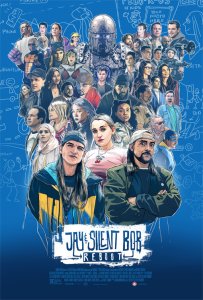 Jay and Silent Bob Reboot is strictly made for writer/director Kevin Smith’s fanbase, so does trying to play outside this cultivated audience even matter? Honestly, there’s no way this is going to be anyone’s first Smith movie, so it’s already running on an assumed sense of familiarity with the characters and stories of old, which is often a perquisite to enjoying many of the jokes (more on this later). It’s been 25 years since Clerks originally debuted and showcased Smith’s ribald and shrewd sense of dialogue-driven, pop-culture-drenched humor. He’s created his own little sphere with a fervent fanbase, so does he need to strive for a larger audience with any forthcoming movies or does he simply exclusively serve the existing crowd?
Jay (Jason Mewes) and his hetero life-mate Silent Bob (Smith) are out for vengeance once again. Hollywood is rebooting the old Bluntman and Chronic superhero movie from 2001, this time in a dark and edgy direction, and since Jay and Silent Bob are the inspirations for those characters, even their likenesses and names now belong to the studio. The stoner duo, older and not so much wiser, chart a cross-country trip to California to attend ChronicCon and thwart the filming of the new movie, directed by none other than Kevin Smith (himself). Along the way, Jay and Bob discover that Jay’s old flame, Justice (Shannon Elizabeth), had a daughter, Millennium “Milly” Falcon (Harley Quinn Smith) and Jay is the father. Milly forces Jay and Bob to escort her and her group of friends to ChronicCon and Jay struggles with holding back his real connection to her.
 One of my major complaints with 2016’s Yoga Hosers (still the worst film of his career) was that it felt like it was made for his daughter, her friends, and there was no point of access for anyone else. It felt like a higher-budget home movie that just happened to get a theatrical release. Jay and Silent Bob Reboot feels somewhat similar, reaching back to the 2001 comedy that itself was reaching back on a half-decade of inter-connected Smithian characters. There is a certain degree of frantic self-cannibalism here but if the fans are happy then does Smith need to branch out? This is a question that every fan will have to answer personally. At this point, do they want new stories in the same style of the old or do they just want new moments with the aging characters of old to provide an ever-extending coda to their fictional lives?
I certainly enjoyed myself but I could not escape the fact at how eager and stale much of the comedy felt. Smith has never been one to hinge on set pieces and more on character interactions, usually profane conversations with the occasional slapstick element. This is one reason why the original Jay and Silent Bob Strikes Back suffers in comparison to his more character-driven comedies. Alas, the intended comedy set pieces in Reboot come across very flat. A lustful fantasy sequence never seems to take off into outrageousness. A drug trip sequence begins in a promising and specific angle and then stalls. The final act has a surprise villain that comes from nowhere, feels incredibly dated, and delivers few jokes beyond a badly over-the-top accent and its sheer bizarre randomness. There’s a scene where the characters stumble across a KKK rally. The escape is too juvenile and arbitrary. A courtroom scene has promise when Justin Long appears as a litigation attorney for both sides but the joke doesn’t go further, capping out merely at the revelation of the idea. This is indicative of much of Reboot where the jokes appear but are routinely easy to digest and surface-level, seldom deepening or expanding. There’s a character played by Fred Armison who makes a second appearance, leading you to believe he will become a running gag that will get even more desperate and unhinged with each new appearance as he seeks vengeance. He’s never seen again after that second time. There are other moments that feel like setups for larger comedic payoffs but they never arrive. The actual clip of the Bluntman and Chronic film, modeled after Zack Snyder’s Batman v. Superman, is almost absent any jokes or satire. There are fourth-wall breaks that are too obvious to be funny as they rest on recognition alone. There’s a running joke where Silent Bob furiously taps away at a smart phone to then turn around and showcase a single emoji. It’s cute the first time, but then this happens like six more times. Strangely it feels like Smith’s sense of humor has been turned off for painfully long durations on this trip down memory lane. The structure is so heavily reminiscent of Jay and Silent Bob Strike Back that there are moments that repeat step-for-step joke patterns but without new context, meaning the joke is practically the repetition itself.
 The problem with comedy is that familiarity can breed boredom, and during the funny stretches, I found myself growing restless with Reboot as we transitioned from stop to stop among the familiar faces. I enjoyed seeing the different characters again but many of them had no reason to be involved except in a general “we’re bringing the band back together” camaraderie. It’s nice to see Jason Lee again but if he doesn’t have any strong jokes, why use him in this way? Let me dig further with Lee to illustrate the problem at heart with Reboot. Jay and Silent Bob visit Brodie (Lee) at his comic book shop, which happens to be at the mall now. He complains that nobody comes to the mall any longer and he has to worry about the “mallrats,” and then he clarifies, he’s talking about actual rodents invading the space, and he throws a shoe off screen. I challenge anyone to find that joke amusing beyond a so-bad-it’s-fun dad joke reclamation. I kept waiting for Smith to rip open some satirical jabs on pop culture since 2006’s Clerks II. In the ensuing years, Star Wars and Marvel have taken over and geek culture and comic books rule the roost. Surely a man who made his name on these topics would have something to say about this moment of over saturation, let alone Hollywood’s narrow insistence on cash-grab remakes. I kept waiting for the Smith of old to have some biting remarks or trenchant commentary. Milly’s diverse group of friends (including a Muslim woman named “Jihad”) is referred to like it’s a satirical swipe at reboots, but there isn’t a joke there unless the joke is, “Ha ha, everyone has to be woke these days,” which is clunky and doesn’t feel like Smith’s point of view. There are several moments where I felt like the humor was trying too hard or not hard enough. As a result, I chuckled with a sense of familiarity but the new material failed to gain much traction.
I do want to single out one new addition that I found to be hysterical, and that is Chris Hemsworth as a hologram version of himself at a convention. The Thor actor has opened up an exciting career path in comedy as highlighted by 2017’s Ragnarok, but just watching his natural self-effacing charm as he riffs about the dos and don’ts of acceptable behavior with his hologram is yet another reminder that this man is so skilled at hitting all the jokes given to him.
 Where the movie succeeds best is as an unexpected and heartfelt father/daughter vehicle, with Jay getting a long-delayed chance to mature. It’s weird to say that a movie with Jay and Silent Bob in starring roles would succeed on its dramatic elements, but that’s because it feels like this is the territory that Smith genuinely has the most interest in exploring. The concept of Jay circling fatherhood and its responsibilities is a momentous turn for a character that has previously been regarded as a cartoon. His growing relationship with Milly is the source of the movie’s best scenes and the two actors have an enjoyable and combative chemistry, surely aided by the fact that Mewes has known Harley Quinn Smith her entire existence. This change agent leads to some unexpected bursts of paternal guidance from Jay, which presents an amusing contrast. There’s a clever through line of the difference between a reboot and a remake, and Smith takes this concept and brilliantly repackages it into a poignant metaphor about parenthood in a concluding monologue. Smith’s position as a father has softened him up a bit but it’s also informed his worldview and he’s become very unabashedly sentimental, and when he puts in the right amount of attention, it works. There’s an end credit clip with the late Stan Lee where Smith is playing a potential Reboot scene with Stan the Man, and it’s so sweet to watch the genuine affection both men have for one another. I’m raising the entire grade for this movie simply for a wonderful extended return of Ben Affleck’s Holden McNeil character, the creator of Bluntman and Chronic. We get a new ending for 1997’s Chasing Amy that touches upon all the major characters and allows them to be wise and compassionate. It’s a well-written epilogue that allows the characters to open up on weightier topics beyond the standard “dick and fart” jokes that are expected from a Smith comedy vehicle. It’s during this sequence where the movie is allowed to settle and say something, and it hits big time.
The highly verbose filmmaker has been a favorite of mine since I discovered a VHS copy of Clerks in the late 90s. I will always have a special place reserved for the man and see any of his movies, even if I’m discovering that maybe some of the appeal is starting to fade. I don’t know if we’re ever going to get a Kevin Smith movie that is intended for wide appeal again. Up next is Clerks 3, which the released plot synopsis reveals is essentially the characters of Clerks making Clerks in the convenience store, which just sounds overpoweringly meta-textual. He’s working within the confines of a narrow band and he seems content with that reality. I had the great fortune to attend the traveling road show for this film and saw Smith and Mewes in person where they introduced Reboot and answered several questions afterwards. Even though it was after midnight (on a school night!) I was happy I stayed because it was easy to once again get caught up in just how effortlessly Smith can be as a storyteller, as he spins his engaging personal yarns that you don’t want to end. As a storyteller, I’ll always be front and center for this gregarious and generous man. As a filmmaker, I’ll always be thankful for his impact he had on my fledgling ideas of indie cinema and comedy, even if that means an inevitable parting of ways as he charts a well-trod familiar path. Jay and Silent Bob Reboot is made strictly for the fans, and if you count yourself among that throng, you’ll likely find enough to justify a viewing, though it may also be one of diminished returns.
Nate’s Grade: C+
Share this:

Jojo Rabbit (2019)
 Writer/director Taika Waititi has played a vampire, an intergalactic rock monster, and now perhaps the most challenging role of his career, Adolf Hitler. Coming off his meteoric success with the MCU, Waititi is using the time in between mega-budget Thor sequels to write/direct/produce/co-star in a smaller daring indie comedy. Jojo Rabbit follows a young German boy, Jojo (Roman Griffin Dais), during the last year of World War Two. He fantasizes about having an imaginary Hitler (Waititi) as the voice over his shoulder, reinforcing the teachings of adults and authority figures. His worldview is challenged when he discovers a teenager hiding in the family’s walls who just happens to be Jewish. Jojo doesn’t know what to make of Elsa (Thomasin McKenzie), nor does she know what to make of him, and Jojo decides to keep her presence a secret to spare his doting and put-upon mother (Scarlet Johansson). Jojo tries interrogating this wily girl but ends up learning more than he ever imagined.
Given the subject matter, setting, and overall tone, it’s a wonder how well Jojo Rabbit works. I was worried about what kind of tone the movie would be striving for given the delicacy of its subject matter, not that other filmmakers have shied away from incorporating comedy into Holocaust settings. I don’t mean this to be overly flippant but for portions of the movie I felt like I was watching “Wes Anderson’s Nazi Germany.” The entire Act One camp sequence feels like a warped deleted scene from Moonrise Kingdom. I was genuinely surprised how often I was laughing with Jojo Rabbit. Waititi can be hysterical as a bratty, temperamental version of the Fuhrer, but there are moments where he gets caught up in the oratory of his hateful rhetoric that serve as a reminder that even for Jojo, he realizes this man isn’t exactly best friend material. The Hitler imaginary friend goes away for long stretches in the second half as the film emphasizes more drama, which is the right choice as Jojo is coming to doubt what he has been taught from that imaginary friend. The portrayal of Hitler might be offensive to some viewers but I feel like Waititi walks a fine line to root it from the perspective of childhood fantasy. It’s taking the figure on TV and adapting it to suit the needs of a lonely kid wanting to belong. Of course he’d want Hitler to select him as the best little young Aryan that Germany has going. It’s not dismissing the evil of the man but instead serving him up through a specific prism that allows laughter not necessarily even at Hitler himself but at a youthful and immature understanding of something far more complex.
 I was also worried that the comedy might dampen some of the more dramatic turns coming, and this was so not the case. There are dramatic moments hiding under the surface thanks to seeing them from Jojo’s naïve perspective, but then there also big obvious dramatic moments of suffering that hit. As much as the whimsy prevails early, the dramatic moments are delivered in tasteful ways that do not detract from the feelings being felt by the characters as well as the willing viewers. There are a few gut punches that remind you that even with the whimsy of childhood naivete, real people are dying in awful ways because of those complicit in racist genocidal policies. The relationship between Jojo and his mother is the second most significant one, after he and Elsa, but it’s this central focus where we see the starting point of his character arc. His mother tries to shield her child from the larger terrors of their society but that’s increasingly difficult when people are being hanged in the street for helping Jews. She’s hoping to simply play her part in public, get through this terrible time, and finally have the son back that she knows, hoping he will eventually shake free from the propaganda. It’s a role that requires Johansson to play like another cartoonish adult, all bubbling energy and quirky nonchalance, while burying her increasing concern. Part of me almost wishes that she was a co-equal protagonist so we could get an even richer perspective to contrast more fully.
There’s a sprightly whimsy to the proceedings that comes from being locked into the perspective of an imaginative child. It’s not that the world is 100 percent his vision, it’s more that we know that the representation of what we’re seeing might not be a completely objective reflection of the reality Jojo is encountering. This especially includes the portrayal of many adults involved in various levels of the Nazi party. They play out like cartoons and buffoons but are still dangerous cartoons and buffoons. When Jojo’s childhood friend Yorki is talking about fighting on the front and we see him handling a rocket launcher, this is clearly an exaggeration of the desperation of the moment and a young boy’s eagerness to be involved. This creative approach allows Waititi to dabble in the fantastic and keep his audience alert, allowing them to second-guess what we’re seeing on screen and look for the reality in hiding. I laughed pretty consistently at the intended humor and incredulous nature of the adults trying to pass off wrongheaded insights and suggestions as scientific fact or common sense. It’s a movie where you laugh at the ridiculous idiots while hoping that the idiots won’t get the people we care about killed.
 The acting is very strong overall. Newcomer Roman Griffin Davis is exuberant and relatable without coming across as overly cloying or mannered, which can be a rarity for child actors. He has a very difficult role to play from a tone and perspective standpoint, and he succeeds. Another great child actor is Thomasin McKenzie (Leave No Trace) as Elsa, a young girl in an extremely vulnerable position who looks upon this new boy with equal amounts fear, disdain, and pity. She cannot be herself and must choose her words and responses carefully, so it’s a guarded performance of restraint but McKenzie is fabulous in quieter, subtler shifts. The adults are all enjoyable as broadly comical cartoons, with Stephen Merchant (Logan) earning considerable unease as an S.S. officer leading a team sweeping for Jews in hiding. Johansson (Avengers: Endgame) seems a little too eager, a little too antic, but this may pertain to her character’s nerves and desperation, trying to overcompensate her anxiety. Rockwell (Vice) gets the biggest adult role as a disenchanted military vet who sees the writing on the wall. At first his detached nihilism is a source of dark comedy and later he becomes an unexpected father figure for Jojo. I don’t quite know if his hero moments have the desired impact but he’s still an amusing presence.
However, there are also some drawbacks to being a fable, namely a lack of larger specific substance beyond general lessons and general characterization. Jojo Rabbit is being billed as an “anti-hate satire” and I definitely think that summary fits the intent, but “anti-hate” sounds like such a nebulous buzzword that seems more meaningful at first glance and less upon reflection. I would assume every responsible story set during the era of the Holocaust would adopt an “anti-hate” sensibility, because the alternative would be championing the foundations of Nazism. It’s hard for me to imagine any movie desiring a public release being anything other than “anti-hate.” Essentially, we have a character coming to see through the propaganda of the era, judging people as people rather than scary caricatures, and start to reject the teachings of manipulative authority figures. This isn’t a new formula for coming-of-age stories or tales set during times of great strife. It’s a lesson in empathy and rejecting dogma on its face. When it comes to Nazism, that should be the easy part, facilitated by any prolonged exposure to anyone previously deemed an undesirable.
My nagging issue with Jojo Rabbit is that for all its impish whimsy with such a serious historical subject, it ultimately plays things pretty safe. That’s fine, it doesn’t have to a revolutionary film, but it does dull the message a bit when the ultimate lasting takeaway is “hate is bad, Jews are people too.” It’s a bit pat, a bit simple, and a bit too easy. The characterization can also be hampered by this same ethos. The characters are pretty much exactly what you see at first blush. The only character who changes or has room to explore is Jojo. Even Elsie feels more like a stagnant person despite her unique circumstances. This may be because she’s more change agent than character, a figure for Jojo to be horrified by, then entranced with, and finally see as a friend. I still felt moments of genuine emotion for characters onscreen and for Jojo’s journey of self. The movie still works well with its stated goals and direction, it’s just a bit limited because of the simplicity of its message and the lack of greater substance for its many characters.
 The Jojo Rabbit novel was written before the rise of Donald Trump but Waititi has said that when they were filming that America’s current political climate was on his mind, and it’s not hard to make a few adaptations to apply this for the modern era. Perhaps a young boy sees Donald Trump as his imaginary friend and together they’re both all-in on trying to “make America great again” by first and foremost reporting any immigrant they see as illegal. Then later in the story he discovers his family is willfully hiding an undocumented child from being deported after they were stripped from their parents who were then deported. Now our naïve protagonist must reconcile the harsh rhetoric he has been taught with the growing empathy of connecting with another human being who doesn’t seem as dangerous or as sub-human as others claim. If you wanted to even make this parallel, it’s there, though I think that diminishes the setting. We shouldn’t need to tell movies during the Holocaust as metaphors for our modern struggles. I suppose this is another scenario where if you want to Inuit more of a relevant modern message, you can.
Jojo Rabbit (a nickname that seems forgotten after its christening) is a coming-of-age fable with equal parts charm and horror. Waititi takes a serious subject and doesn’t mitigate the evils of Nazism with his portrayal of a daffy imaginary Hitler. The production has an admirable swagger to it as it charts its own course, tackling serious subjects and young whimsy to portray a poignant story about childhood, loss, and growing up. It’s an amusing and heartfelt enterprise that I can’t help but feel could have done more than settling for some pretty safe messages and limited characterization. There wasn’t a moment with Jojo Rabbit where I wasn’t entertained, but I do wish the movie had more on its mind that reminding everyone that hate is bad.
Nate’s Grade: B
Share this:

The Current War (2019)
 The Current War has been on the shelf for two years and now finally getting a release, strangely subtitled “The Director’s Cut.” Can a movie that has never been released to the public, outside of some festival screenings, really declare its first impression a director’s cut? Aren’t these supposed to be different, and generally longer versions of the original edit? Regardless, the movie acts like a 19th century version of The Social Network with the battle over the nation’s electrical grid up for stakes between Thomas Edison (Benedict Cumberbatch) and George Westinghouse (Michael Shannon). You may think Nikola Tesla (Nicholas Hoult) is a big player in this game, but you’d be mistaken as he’s more a glorified cameo. I appreciated how the history came alive under director Alfonso Gomez-Rejon (Me, and Earl, and the Dying Girl) and his overwhelming sense of style. This is a period film that feels excitedly modern in its presentation, with lots of clever transitions, stylish camera angles, and wide angle photography to go along with a churning score that even reminded me of Trent Reznor and Atticus Ross’ Oscar-winning music. The characterization of these Great Men of Industry also finds ways to humanize them, especially Westinghouse who shuffled his employees into his burgeoning and debt-ridden electrical gambit so he wouldn’t have to fire anyone. Edison’s portrayal is decidedly charitable, positioning him as a principled family man who rebuffed a shameless J.P. Morgan (a great movie bastard) and easy money for military contracts because he refused to participate in any endeavor that would take life. There’s an ironic subplot where Edison, forced into desperation, cooperates with New York state’s implementation of a new “more humane” way of executing prisoners, and pinning the deadly results on Westinghouse’s alternating electrical current. This is certainly not the Edison of litigious infamy. I enjoyed immersing myself in this older world where the men of science and vision were akin to magicians creating miracles that dazzle. Their competitive race is doomed to be a bit one-sided if you know the history of AC versus DC (it’s hard to compete when one option is both better and cheaper) but I was still entertained by their tit-for-tat and how each man responded to pressure and expectations. The screenplay by Michael Mitnick is judicious with its information and very accessible for a lay person. The acting is solid even if many side characters are glorified extras (Tom Holland, Katherine Waterston, Tuppence Middleton). The Current War has been getting some pretty dim reviews, with even dimmer puns, and I don’t quite follow why critics are turning out the lights on this movie (sorry). It might not have the stuff of greatness but it’s a perfectly enjoyable period piece with attention to character and a panache of style to liven up the dustiest of history.
Nate’s Grade: B
Share this:

The Lighthouse (2019)
 If you’re writer/director Robert Eggers and just made a most delicious impression with your debut movie, 2016’s The Witch (or, stupidly, The VVitch), where do you go next? Apparently it was off the coast of Nova Scotia with Robert Pattinson, Willem Dafoe, and a sexy mermaid? The Lighthouse follows the story of two men, Thomas Wake (Dafoe) and Ephraim Winslow (Pattinson), as lighthouse keepers trapped during a torrential New England storm in the 1890s. This fraught relationship comes undone over the course of some very severe cabin fever. While The Lighthouse might not be as enjoyable as The Witch, nor the arthouse genre masterpiece some critics have been hailing, it is an exceptionally realized throwback with its own beguiling sense of peculiarity. They don’t really make them like this anymore, folks.
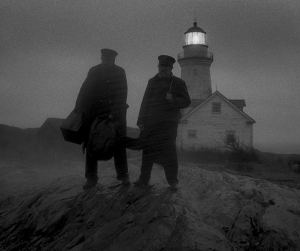
The Lighthouse feels exactly like somebody meticulously melded an episode of The Twilight Zone with an episode of Alfred Hitchcock Presents. The vision is so specific and so fine-tuned that it can be startling, like watching a high-wire act of an artist perform a feat and so well. Eggers is definitely a man with definite talent and here is a movie that serves as a strange, loving homage to an earlier age. The shooting style, camera equipment, lenses, and nearly 4:3 aspect ratio coalesce to make The Lighthouse feel like a forgotten curio of an older age. The very nature of the movie’s presentation adds to the enjoyment level of the two hours of madness. This is a highly impressive movie, first and foremost from its technical side. The black and white photography is rich and stunning, making elaborate and precise use of shadows and camera movement. You feel the grime and salt. Pattinson’s face is filmed with such heaviness, shadows draped over him, that he looks like he was carved from stone to resemble a modern-day Robert Mitchum. There are several moments that unveil themselves with startling meticulousness. There are several images that stick in my memory. There are moments of levity that had me snickering madly. Eggers has a terrific instinct when it comes to staging scenes and drawing out the suspense as well as the humor. Some scenes will cycle from horror to comedy and then back again, allowing the movie to continuously feel slippery in tone as well as effect. It’s such a handsomely mounted production that it’s easy to admire the dedication. The craft is remarkable. Eggers had a very exact style he was going for with his second film,and he commits fully to the process. Whatever you think of the lasting impression, the man achieved his vision to the bitter end.
 Being a two-hander, the entire movie is going to rest on the shoulders of our acting duo and what insights we can glean from them as they become combative and ultimately suspicious. There’s only one other credited actor for the entire film, Valeriia Karaman, as a lustful fantasy for Winslow, or maybe she’s not a fantasy? We’re stuck with two very capable thespians and they just dig into these meaty, hammy roles. The dialogue has a delightfully daffy out-of-time cadence and vernacular that adds authenticity as well as a sprinkle of approaching madness. Dafoe (Aquaman) is a delight as a soused old captain given to self-important and abrasive behavior. An insult over his cooking unleashes a ridiculous monologue where he lays out in great, poetic detail a curse, and like much in the movie, it goes from being funny to being serious to being outright impressive. It’s like watching actors get to play with Shakespeare, that’s how immensely pleasing it can be to listen to Dafoe and Pattinson deliver Eggers’ dialogue with great flourish. Pattinson (Good Time) has gotten a bad rap for being the Twilight pretty boy but he’s taken exciting chances on artistically daring and dangerous prospects (this is his SECOND 2019 indie thriller that prominently features his furious masturbation). Pattinson serves as our entry point into this secluded seaside shack, and it’s through him we watch the madness of the movie plant. He’s got a real fire he’s able to harness that makes him vulnerable, sympathetic, and dangerous. Should we root for Winslow? Being trapped alone with them never gets boring because of their characters, the revelation of secrets each man may or may not be embellishing, and their explosive confrontations.
This is also very funny movie. Eggers understands the thin line between madness and humor and uses this to his great advantage where the embrace of comedy enhances the overall feeling of WTF insanity. You’ll be forgiven for laughing but Eggers seems to invite it almost as a needed release. Much like Ari Aster did with Midsommar, the filmmaker is clearly playing with camp elements intentionally. It’s a tricky artistic maneuver to willingly invite camp and to make sure it doesn’t pervert the rest of the film and its ambitions, but I think Eggers pulls it off. There is literally an audible fart before the two main characters share a line of dialogue together. You’ll be surprised how much farting is actually in the movie (all added in post-production, the Internet trivia proudly crows, because I guess Dafoe didn’t want to go that far Method). There’s an exciting unpredictability to the movie even as it feels very much on a foreseeable collision course that you await.
 After all that artistic sturm und drang, I was left wondering what exactly there was to hold onto for clarity and substance. Firstly, the artistic exercise, dedication to a specific vision, and level of execution will likely be enough for a certain group of viewers, especially those titillated by old school horror peppered with David Lynch peculiarities. It’s a moody work of art with definite finesse but ultimately I don’t know how much there is to take away from it. The Lighthouse feels like a well-handled experiment that deserves your admiration but I don’t know what engagement exists beyond simply the experience and then the discussion it leads. There are plenty of movies that invite an active deconstruction and this interactive interpretation serves as a central selling point, but I was wondering what I should be thinking here. I don’t know if the movie is adopting Winslow’s point of view and I shouldn’t trust what I see onscreen, or I shouldn’t trust Thomas, or I shouldn’t trust either, or whether the movie was adopting either of their perspectives or neither. By the end, I don’t know what is supposed to be taken as legitimate, and this can work with plenty of movies but the majority doesn’t seem to operate on a dream-logic. It’s a dank, claustrophobic, paranoid thriller but it’s so dutiful to an older style of thriller that the eccentricities don’t take over and become the movie. It’s entirely a movie about men being stranded, going mad, and turning on one another, and that’s about it. There is a definite Promethean analogy with Winslow’s desire to “have the light” and the old man standing in his way (this is hit even harder in the very obvious, concluding image). If you cut out maybe 40 seconds of the movie it could have played on TV back in Hitchcock’s day and would fit.
It’s hard for me to articulate but The Lighthouse is an A-level execution of an idea that feels all too limited and small. It’s thrilling and accomplished and a fun movie to just get lost within and laugh at the screen when it goes overboard. I wouldn’t even mind taking another trip and getting lost in this sea-soaked curiosity. Maybe I’ll be able to impart more meaning, because while the technical craft and extraordinarily honed artistic vision shine through, the lasting power of the whole enterprise feels a bit too locked in place. It very much is a remnant of the past, a loving homage to old Hammer films and television anthologies and tales of men losing their minds when it comes to loneliness, desperation, and helplessness. There’s much to champion with The Lighthouse and I’ll assuredly be in line for whatever Eggers decides will be his next project (a quick search comes up with a tenth-century Viking revenge thriller starring Dafoe, Ana Taylor-Joy, two Skarsgards, and Nicole Kidman). When Eggers commits to a story and style, he commits completely and the results can be breath-taking. I hope he aims for more than A-level execution with his next movie and goes for an A-level story experience to match. Still, The Lighthouse is a fascinating and delightfully weird experience that will enchant and baffle.
Nate’s Grade: B+
Share this:

Dolemite is My Name (2019)
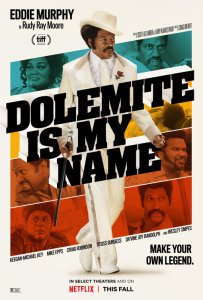 I’m a sucker for behind-the-scenes movies on scrappy genre indies, following a band of creatives come together, build camaraderie, and serve as the underdogs we root for as they put on their fun show, so Dolemite is My Name is right up my alley. It’s a biopic on Rudy Ray Moore (Eddie Murphy), who by the 1970s rebranded himself in his 40s when he began performing as an outrageous, rhyming pimp character named Dolemite. He recorded crude comedy albums, sold them out of the back of his trunk, and reached a new level of fame, but he sought a blaxploitation movie to get him to even further heights. This movie is akin to The Disaster Artist where we watch a lot of artists pull off a bad movie with little money, as well as 2004’s Baadasssss!, where Mario Van Peebles recreated the making of his father’s 1971 blaxploitation hit, Sweet Sweetback’s Baadasssss Song. Chances are, if you enjoyed either of those two movies, or the hilarious blaxploitation spoof Black Dynamite, you will be smiling aplenty with this new Netflix movie (given a short theatrical run and soon to be widely available via streaming). The movie belongs to Murphy, who hasn’t had a part in three years, and he comes roaring to life as Moore, a man who won’t let anything stand in the way of his dreams. Murphy is fully captivating in every scene as he turns the Dolemite persona on and off, sharing moments of personal insight and fear, like when he’s nervous over his physique with an upcoming sex scene for his movie. He’s a determined hustler and it’s hard not to fall for his grinning charm. The Dolemite movie has a special appeal because it was intended as a comedy, so the shoestring, scrappy nature of it works nicely with the good intentions of simply making a big, silly, kung-fu-filled action comedy with what audiences want. I’ll confess I never found any of Moore’s standup to be funny as the audiences at the time. However, the filmmakers have already answered this, as Moore and pals go see The Front Page, a movie dubbed by critics as a laugh-out-loud comedy, and the men sit stone-faced and confused throughout the pithy, erudite comedy that seems to be amusing the largely white, WASP-y crowd. Humor is subjective, but not only that it’s the kind of entertainment with the shortest shelf life. It’s naturally going to expire quickly. Comedy routines we found hilarious decades ago might not still be funny today, and that’s okay. Dolemite came out at the right time and influenced other artists and filmmakers. A behind-the-scenes film is destined to be a movie with a definite ceiling. Moore is an interesting success story but there’s only so much to be gleaned from this underdog tale. Thanks to writers Larry Karaszewski and Scott Alexander (Ed Wood, The People vs. O.J. Simpson) and the energy of Murphy, Dolemite is My Name is a fun two hours with a bunch of cut-ups.
Nate’s Grade: B
Share this:

Parasite (2019)
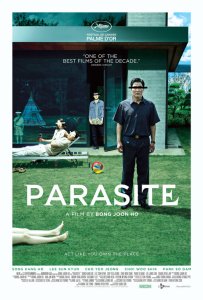 Parasite is the latest from award-winning South Korean filmmaker Bong Joon-ho (Snowpiercer, The Host, Okja) and it won the prestigious Palm D’or at the Cannes Film Festival. The filmmaker has never settled down in any genre and often goes for broke when it comes to embracing whatever genre he is dabbling in and then subverting, accelerating, and broadening that territory to show an audience what a master can do with these storytelling parameters. No movie under Bong Joon-ho’s guidance is ever limited by its genre. Needless to say, I’ve been highly anticipating Parasite, even more so since the critics started bandying about terms like “masterpiece.” Simply put, Parasite is a miraculous movie.
We follow the Kim family who live in a scummy basement apartment on a filthy street known for public urination. They scam free wi-fi off their neighbor and badly fold pizza boxes for little money. They’re barely hanging by on the outer edges of society when opportunity comes knocking. A rich family, the Parks, is in need of a new English tutor for their teenage daughter, and Ki-woo Kim (Choi Woo-sik) has the connection. He will pose as a college-educated English teacher, recommended from his friend, the departing tutor. He gets the job and sees further opportunity, eventually scheming to get each member of his family hired; sister Ki-jung Kim (Park So-dam) as an art therapist for the Park’s troubled son, father Ki-taek Kim (Song Kang-ho) as the personal driver to the family, and mother Shung-sook Kim (Jang Hye-jin) as the housekeeper and personal assistant for the family. The Kim family gains further leverage as they worm their way inside this house, but there are secrets that will force them to readjust how far they are willing to go to service this bourgeois family and keep their good lies rolling.
 Parasite just unfurls with such natural ease, building and developing outward, building its characters, their problems and deceptions, and then, like that, it effortlessly turns gears toward another tone, and you weren’t even aware it was happening until after the fact. Bong Joon-ho’s film is so exact and impeccable and calculated that the pieces are move in tandem like a well-oiled machine. The synchronicity is so amazing that I often had to acknowledge how effectively the movie had surprised or satisfied me. There isn’t a wasted moment in the 130 minutes here, which begins as a fun con game between one family of shady grifters working their way inside a rich family’s trust. From there, the movie gets even darker, more mysterious, outlandish, and even more mournful and delightful. There are moments of slapstick comedy that had me howling, divine sequences of tension that felt ready to explode, and regular emotional punches to the system that reminded you that despite everything these are still people capable of great suffering and great feeling. Parasite is a rare movie that works on near every level, each facet of filmmaking operating at such precision that it blends together to create a masterwork of tone and tenor that is universally accessible, brimming with menace and glee.
There’s a simple pleasure to be had watching a con artist at play, so there’s even more amusement when we’re watching a family of con artists all spinning lies in tandem. The process of escalation is so clean and believable in the world’s universe, with the first family member using their position of influence to manipulative the family into hiring the next family member, even if that means scheming to get rid of the Park family servant already occupying that desired position. The Park family matriarch is all about personal recommendations and using a tight circle of trust; however, the Kim family exploits the obvious loophole of what if the initial link in that chain is untrustworthy him or herself? Initially I thought the movie was going to be watching this one family worm their way into the lives of the rich and powerful and take over, and while that is true to a certain extent, the movie is thankfully even more than that. Still, the con aspect alone is highly entertaining and so naturally plotted, with each new addition feeling organic from the last. There are natural complications that provide new challenges for the family of con artists to maintain their shifting covers and having to think on their feet, and there isn’t a moment relating to these antics where Parasite is not completely compelling and darkly funny even as it veers into extremes.
 If you’re thinking that the Kim family is the obvious target of the movie’s parasitic titular allusion, slow down, my friend. While the Kim family is more obvious about their deceptions, the Park family too is filled with the deception of civility, kindness, and graciousness. At first, we laugh at them because of a general naivete that allows the Kims to flourish. As the Kims successfully roust different servants, they are routinely dismissed without much thought. Some of these people have been with the family for years and otherwise have spotless records, but all it takes is one whiff of impropriety and the Parks are already scrambling to cut them loose, usually very unceremoniously and immediately, with the misplaced idea that this will somehow be the “nice” and “respectful” way of handling a dismissal. They’re so quick to turn on people they feel are disloyal or incompetent, but really, it’s the disloyal aspect, that they can be manipulated so easily by the Kim family’s suggestions and assertions. Never once do Mr. and Mrs. Park ask for their servants’ side of the story; they accept the accusations with minimal evidence are gung-ho about removing their formally trusted help as if they have been waiting for these moments.
The movie becomes a parable of exploitation and the consequences of avarice, and I’m going to do my best to dance around some significant spoilers that reshape the film in its second half. At one point the Kims have all made themselves at home in the luxury of the Park estate while the family is away on a camping trip. It’s carefree wish fulfillment, lapping in the excess, and then over a drunken family dinner, Mrs. Kim says that if she had this kind of money that she would be as nice as Mrs. Park (appears). For her, money is like an iron and irons out all the problems of life, and as a family that has constantly been hustling for their next dollar, to be free of cares and worries would be the ultimate luxury. However, there is naturally more to this estate and the Park family, and the movie takes some dark turns into a battle over status and how far people will go to protect what they feel belongs to them. This is acted out in very personal ways and also in larger metaphorical waves, which adds to the overall class warfare satire. What starts off as a spiky little con comedy becomes something deeper and more challenging, expanding its targets to indict everyone jockeying for position in a system that seems corrupted to a fault.
 Even as the Kim family is scheming and conniving, there are still moments that remind you that they aren’t these smooth, amoral con men of the movies and are real human beings with real feelings and real insecurities. There’s one moment Mr. Kim overhears his boss casually talking about him, and it’s very complimentary except for one admission. Apparently, Mr. Kim has an odor to him that the rich man finds to be rather unpleasant (he describes it like an old radish). No matter the suits he puts on, no matter the politeness and charm he manifests, no matter his skills when it comes to being a dutiful driver, no matter the gaps that Mr. Kim feels he is surpassing, there will always be something innate to him that stops him from being accepted and integrated in this cherished, cordoned-off land of the rich. His very smell is offensive to the noses of the rich, and this is something so personal, so nasty, that it genuinely wounds the man and we feel for him. Bong Joon-ho asks his audience to embrace all sorts of uncomfortable positions, taking characters you found despicable and asking to see them as real human beings capable of great loss and shame. It stops the movie from feeling like it’s treading into cartoon territory even as its violence and physical comedy ramps up in the second half. It never loses a sense of its soul.
Ki-woo Kim asks his father, after several setbacks, what their plan is next, how they will persevere against the latest setback. Mr. Kim answers that his trick is to never have a plan, because plans will inevitably fail. This is a nice character moment but also an insight into a perspective that leads to what I would argue is the emotional climax of the movie, where Ki-woo pledges to save someone through an elaborate and years-in-the-making plan. In that moment, is he rejecting his father’s philosophy and driving forward on what will be at minimum years of hard work to reach his goal, which is motivated through reclamation and salvation rather than personal gain? Or is the very fact that he is committing such an elaborate plan an act of folly he knows will never materialize because that is the nature of plans? I love that the film leaves you, the viewer, to determine whether this assertion is optimistic or pessimistic and how that paints the film’s message.
 From a technical standpoint, the movie is another showcase of how Bong Joon-ho is brilliant at visually communicating his wonderful stories. The editing is so tightly precise to maximize tension and comedy, and sometimes both simultaneously. The photography is gorgeously composed with the use of space in the frame excellently communicating character relationships. The geography of the home is nicely utilized to ratchet up the tension of escaping around corners and hiding around furniture. There are moments that just made me want to applaud the filmmakers for their top-level craft.
Parasite is an effortlessly impressive movie that blends tones, insights, and entertainment to create one of the more unique and pleasing film experiences of the year. Bong Joon-ho once again shown himself to be a masterclass filmmaker who can tackle just about any subject and any genre and make it sing. I’d advise to avoid specific spoilers to maintain the surprise factor; however, this movie is so well executed, so astonishingly developed with precision and attention given to each of the characters and their individual whims and problems, that even knowing every single plot beat in this movie will not diminish the enjoyment factor. That’s because Parasite is a rare movie that is so sumptuously put together, so seamlessly calibrated, that to watch the movie is to simply sit in awe of how talented the filmmakers are at weaving their tale. Parasite is definitely one of the best films of 2019 and worth tracking down where able.
Nate’s Grade: A


 nathanzoebl
You must be logged in to post a comment.