Freaky Tales (2025)
 Watching Freaky Tales, an ode to 1980s Oakland California, punk, rap music, and grindhouse cinema, is like washing in someone else’s nostalgia. It’s a fun throwback experience but it doesn’t amount to much more than transitional diversions that won’t have the same appeal. This is an anthology movie following the events of a few nights in 1987 Oakland with criss-crossing characters told out of order. Given the abbreviated nature of the stories, you either have to make a strong impression with the characters, have memorable and surprising adventures, or have an intricate connection to the different stories that allows the narrative to keep reforming. Otherwise it’s a collection of shorts that don’t really add up to much else. While entertaining in spurts, there isn’t much more to Freaky Tales. The first story involves a punk rock club defending themselves against neo-Nazi bullies. It centers on a budding romance and works well with an exuberant, youthful energy and the theme of a vulnerable community standing together against hate is easy to root for especially when it results in bloody and maimed Nazis. The second story is the weakest and follows a female rap act trying to make the most of a stage show. The third story involves a mob enforcer (Pedro Pascal) trying to make a clean break and coming to terms with his past after a tragedy. It’s a story more memorable for some unexpected cameos and turns rather than supplying an antihero worthy of Pascal. The final story involves a professional basketball player seeking vengeance against the men who killed his family in a burglary-gone-wrong. It’s the most entertaining and ridiculous segment, especially as the pro player reveals the extent of his martial arts and mind powers. While each segment doesn’t quite overstay its welcome, none of the segments feel essential or cleverly integrated with the rest of the tales. As a result, Freaky Tales feels like gonzo campfire stories that don’t exactly go anywhere; pleasantly silly but missing out on greater fun.
Nate’s Grade: B-
Share this:

Companion (2025)

Confession: several years ago, my good friend and I co-wrote a movie for the Chinese film market that had several similarities with Companion. It was about a robot designed to be everything her owner desires turning on her owner. I’ll freely admit: Companion is better. While the movie doesn’t reveal that its robotic companion, Iris (Sophie Thatcher), is indeed made of circuits and screws until twenty minutes in, there are so many better twists and turns that come later. It begins with something relatively standard, a girlfriend nervous to meet the friends of her boyfriend Josh (Jack Quaid) during a lake house retreat. The film takes a dark turn that forces the characters to question how far they would be willing to go to cover up a crime as well as their own culpability. The second half of the movie becomes a very engaging and twisty cat-and-mouse game with Iris trying to escape from pursuers. Writer/director Drew Hancock (My Dead Ex) had put plenty of thought into the story mechanics of his thriller set pieces, connecting them to character decisions and the desperation of trying to outwit one another. The entire movie is elevated and then some by the terrific lead performance from Thatcher (Heretic, Yellowjackets) who becomes our emotional anchor and Final Girl worthy of rooting for. Thatcher can be heartbreaking one minute, hilariously deadpan the next, like when she’s stuck speaking German, and a tremendous source of empathy as she fights for her survival. Upon my first watch, I felt there might be too many twists and turns right up to the very end, but having re-watched Companion, I appreciate how much Hancock really thinks about move-countermove plotting, making sure that we experience many avenues from this premise. It’s a vicious take-down of viciously exploitative control freaks, with some strong satirical dark humor elbowing you in the ribs. It very much reminded me of 2019’s Ready or Not and would pair well as a double-feature of feminine empowerment amidst horror manhunts. While it might not have much on its mind as far as larger social commentary, there’s enough cooking here to keep me entertained, laughing, wincing, with my eyes glued to the screen to see where exactly it could go next. That’s a rarity. Companion is built different.
Nate’s Grade: A-
Share this:

Wolf Man (2025)
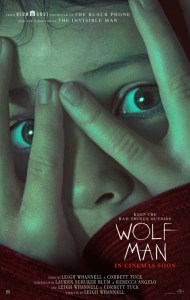 I had high hopes for writer/director Leigh Whannell’s second take on the classic monsters after how thrilling and satisfying his take on the Invisible Man was in the early months of 2020. Werewolves have served as a fertile metaphorical ground for genre storytelling to cover such varied topics like coming of age, self-actualization, and addiction. Considering Whannell was able to use an invisible man to explore toxic masculinity and gaslighting, without losing sight of a monstrously entertaining movie, I was hoping for repeated success. Wolf Man is ostensibly about inherited curses and the relationships between fathers and children, but it’s really about dealing with flaring tempers and whether or not our shortcomings are a result of our genetic inheritance. It’s also about a family trapped in a cabin helplessly watching their father/husband transform into a dangerous beast. I suppose there’s something here about the cycles of trauma and abuse, anger as a sickness, but the problem with Whannell’s Wolf Man is that it all feels like an incomplete beginning. There are definite identifiable themes here, and a scenario that would lend to slow-building dread amid losing control over one’s sanity to become a monster against their loved ones. I just kept waiting for something more. The movie runs out of steam shockingly once it strands its family in the cabin. We’re treated to many scenes of Christopher Abbott, as the beleaguered father, blankly staring and then seeing his vision where people are highlighted with neon outlines. It’s a neat visual but what does it mean? I was waiting for more development, more character work, more culminating of themes, more… anything. It’s a lot of sitting around, like this promising genre movie had been hijacked by, like, some self-sabotaging arty Godard-obsessed filmmaker trying to Say Something with all the protracted scenes, pained silences, and repetition without revelation. It’s a surprisingly boring movie and, I repeat, it’s a werewolf movie. The makeup effects also make our titular monster look more like a shaved wolf, or a goblin rather than a lupine-centric creature of the night. I don’t even think there was a single shot of a full moon in the whole movie. Regardless, Wolf Man is a disappointing a d dull monster movie that’s too shaggy for its own good.
Nate’s Grade: C
Share this:

A Minecraft Movie (2025)

I was fully prepared to dismiss A Minecraft Movie as junk for its target audience, and then a funny thing happened in fact pretty early in the movie: I was laughing. Then I laughed again. Genuine laughter. I’m here to say that the Minecraft movie is not the silly and stupid kid’s movie you may have dreaded. It’s actually a pretty pleasant fantasy adventure movie that, while aimed for kids, can still be enjoyable for like-minded adults looking for some colorful and silly escapism. It’s hip to be square, baby.
Steve (Jack Black) is a guy who loves to create, and mines for whatever reason, and finds a portal to another very cube-centrist world. In this new world, Steve finds friends and freedom, but this is ruined when a nefarious force comes through wanting to conquer this new world as well as Steve’s home world. He sends out help and seals off a portal. Years later, a pair of siblings, Henry (Sebastian Hansen) and Natalie (Emma Myers), move into Steve’s old home and discover his portal, along with an middle-aged arcade game champion and local legend, Garret (Jason Momoa), and realtor, Dawn (Danielle Brooks). These newcomers must adjust to this strange world and defend themselves against zombies, creepers, and other dangers. Fortunately, Steve serves as a valuable guide, but can they all defeat the evil forces?
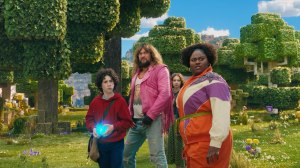
There’s a robust silliness to Minecraft that invites you to not ever take things too seriously and have fun with the vibes. Much like the Super Mario Brothers adaptation, there isn’t really a story to adapt here. There were several moments that felt like it was a satirical parody of the fantasy adventure movie while also working as examples of fantasy adventure tropes. Refreshingly, much of the humor is not derived from fish-out-of-water juxtaposition. This could have easily been a “Well, that happened” kind of nonchalant comedy, holding up the weirdness to scrutiny for easy yuks. It finds better jokes through pushing further than simple observational irony (“My dad says math has been debunked”). It’s good-natured humor that keeps things positive and goofy, channeling the open-sandbox creativity of the video game. Its “be yourself” message is easier to accept than more disingenuous kid’s movie junk like The Emoji Movie. The Minecraft world is presented less as a purchasable video game rather than a new world to explore that rewards exploration (during daylight hours). The very enemy of the movie is a sorceress (voiced by Rachel House) that hates creativity and sees it as a waste in her pursuit of always plundering and hoarding more gold. I might be reaching but there seems even like a possible A.I. reading there, with our giant pig sorceress standing in for tech bros who are trying to eliminate avenues of creativity because all they care about is wealth and cannot understand the appeal of creativity. The movie has several little comic asides that caused me to chuckle and laugh and smile, and I looked over at my adult friend beside me for my screening, and his response was the same. We both had been surprisingly taken by the genial silliness of this movie.
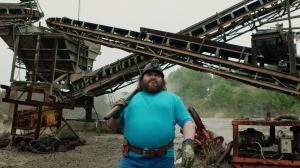
Black (Jumanji) has become a kids’ movie juggernaut thanks to his zany energy and willingness to go above and beyond no matter the request. He’s a charming and delightful performer by nature, whether he’s voicing an animated character or singing a sexually explicit song about all the positions he will execute. He dips out for the first half hour after the exposition dump that opens the movie, but once he’s back on screen, it’s easy to remember there just isn’t another actor like Black. He’s funny and completely bought-in with whatever the movie asks for, but every single line and every single gesture is at a ten. He is selling every second of this movie and I can completely understand why some people just might get overstimulated by Black’s histrionics. You can tell the filmmakers were like, “We want our own version of ‘Peaches’ to go viral,” and so we get three different moments of Black singing original songs. This aspect was the most transparent and contrived decision that felt based upon chasing after the success of another movie popular with the kids. The actor I enjoyed the most was Momoa (Fast X) who has lots of fun undercutting his own masculine image and his character’s over-inflated ego masking his insecurity.
The visuals are bright and enjoyably retro. The Minecraft video game is famously low-grade with its pixelated graphics, more akin to the visual landscape of video games from the 1990s than 2011 when it was first published (it has since become the best-selling video game of all time). Starting with that visual scheme, it allows the movie to be good looking without having to be photo-realistic with its CGI. We have a stylized world to explore that’s full of vibrant colors and characters. This is easily the best looking movie of director Jared Hess’ (Napoleon Dynamite, Nacho Libre) career. His skewed sensibilities work as a nice fit with the comic direction of the movie, and there are some engaging visual arrangements.
Regrettably, this adventure is a bit of a boys-only club. The female half of our adventurers don’t really get the attention that the boys do. Both Natalie and Dawn sit out for long stretches of the movie that I forgot they were in the movie. Usually, these kinds of stories make it so each character has some kind of arc that can be fulfilled by the end, even if it’s minor. I suppose you might be able to argue that Natalie is learning to accept the responsibility of being a parental figure to her younger sibling, and Dawn getting the gumption to quit her job to pursue her dream of running a petting zoo. I’m not keen on bestowing credit for just having a scene at the end where the characters celebrate whatever their goals had been. If you don’t see the work and the development toward those goals, then you don’t get the credit. Why can’t these women have their own adventure that meaningfully connects to the larger plot? Or, even better, why can’t they also go along and contribute to the quest along with all the boys? It’s not like I think the movie is actively trying to downplay the role and importance of women, but it’s also disappointing that there are clear tiers of the characters as far as what kinds of fun and story integration they ultimately earn.
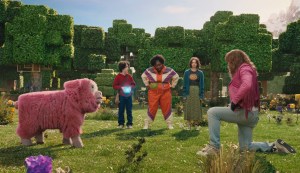
Behold, the Gen Alpha cultural epoch and its name is “chicken jockey.” By now you may have heard of this infamous scene that has caused some theaters to erupt in a calamity of noise, rowdy behavior, and throwing a live chicken at the screen. I even had a theater employee warn our audience before the movie began what is acceptable behavior and how people not abiding by these expectations would be removed from the theater. I’ve been watching movies my entire adult life and other than special screenings for movies intended for audience interaction, like Rocky Horror and The Room, I have never had a theater employee warn me about proper decorum, and this was before the Minecraft movie. It’s astounding. What’s also astounding is how ultimately meaningless this moment is. It’s a baby zombie that falls atop a chicken and rides it, and from what I’m told, this is a very rare occurrence in the game, but I guess it means something more to a generation of fans relishing a rare reference in their favorite game. While I was standing outside the restroom waiting for my own kid to return, a little girl was impatiently asking her father if he was done using the restroom, much to his growing annoyance. “Please hurry. I don’t want to miss the chicken jockey part,” she explained in desperation. I’m happy that this moment seems to be so highly anticipated for millions of fans, but as an outsider, this moment feels so incidental and flimsy that it would be like a generation excitedly waiting for Indiana Jones to lean against one particular wall.
This movie could have been so much worse, and the fact that it’s relatively breezy, funny, and entertaining for non-fans of Minecraft, such as myself, counts as a success in my book. It’s telling that the title is A Minecraft Movie and not The Minecraft Movie. It is but one story in this universe, and given the popularity, it will surely not be The Last Minecraft Movie. Its runaway success at the box-office means we’re probably headed for even more Gen Alpha-centered game adaptations, like some Roblox game you’ve never heard about if you’re over the age of twenty. Hey, it all might work somehow. This one did.
Nate’s Grade: B
Share this:

G20 (2025)
 G20 is a curious movie. There are plenty of these kinds of movies to be found dotting the landscape of straight-to-DVD action vehicles starring the likes of, say, Casper Van Dien or Dolph Lungren. Junky action movies can be their own pleasure, guilty or otherwise. What I wouldn’t expect was watching one of these kinds of movies with an actress the caliber of Viola Davis, four-time Academy Award nominee. The movie portrays Davis as America’s president (if only …sigh…) attending the annual G20 global convention of world leaders when it’s taken over by terrorists. The lead terrorist (Antony Starr, The Boys) has a master plan to appeal to the citizens of the world to divest their money from banks and invest entirely in crypto currency. That’s right, dear reader, the bad guy has a crypto scheme. I suppose the movie is meant to emulate a Die Hard-in-a formula, or more accurately an Air Force One-in-a formula since that movie also followed a cornered president acting as an avenging lone wolf. The setup is fine, it’s the execution that is shoddy and poorly developed, with the limitations of the budget that was still obviously so much bigger than almost any other direct-to-DVD action thriller. The hide-and-seek setup where we watch a character outfox and pick off the bad guys is a winning scenario, but G20 doesn’t bother to derive engaging and surprising set pieces. Each scene of characters running, fighting, or exchanging gunfire is much like the last. The president even has a pair of tech-savvy kids, and a useless husband (sorry Anthony Anderson), who are lackluster additions, serving as tools to be threatened. If you had cut out Davis and replaced her with, say, Antony Starr, this movie wouldn’t be much different from the tide of mediocre action-thrillers meant to pass the time. Davis is a credited producer on this movie, which means she is the star because she wanted to be an action hero. That’s an admirable goal but an actress of her ability shouldn’t have settled for interchangeable genre dreck.
Nate’s Grade: C
Share this:

Captain America: Brave New World (2025)

After seventeen years of constructing interconnected fables, not every Marvel movie is going to be exceptional, as each one serves as a mighty oar to propel the larger entity that is the Marvel cinematic Universe (MCU) forward. With over thirty movies, there are going to be duds and there are going to be movies that get lost in the machinery of the cinematic universe grinding onward. Consider Captain America: Brave New World one of those sacrificial offerings that nobody will remember in short order.
Sam Wilson (Anthony Mackie) has taken over the mantle of Captain America in the wake of the original, Steve Rogers (Chris Evans), retiring. General Ross (Harrison Ford) has recently been elected president and he wants Sam to reconstitute the Avengers. However, someone is triggering sleeper agents to try and kill Ross, and Sam is entrusted to get to the bottom of this conspiracy.

Brave New World is certainly trying to relive the formula that made 2014’s Winter Soldier such a genre standout, upending the status order of good versus evil through the prism of a political thriller. There’s an assassination attempt on the newly elected president, and it also happens to be brainwashed sleeper agents that can be activated at a moment’s notice. What helped make that 2014 movie work was that the sleeper agent happened to be Steve Rogers’ former best friend he thought had died back in WWII. There was a personal connection to the mystery and especially the figure of destruction. With this movie, the personal connection that Sam has to the mystery is almost immediately locked away, made to be an objective needing to be saved by eventually capturing the real bad guy in the shadows. Rather than having to face down a ghost from the past, a personal friend gone rogue, now we have Sam just chasing one shady bad guy to link to the next shady bad guy to a conspiracy that doesn’t even involve him. That was another aspect that made Winter Soldier excel, Steve’s allegiance and sense of patriotism running in direct conflict with the wishes of his government. It was personal and meaningful and challenged his perception. With Brave New World, it could have literally been any character uncovering this very limited conspiracy. That’s not a great start, making your lead character practically superfluous to the larger plot.
Much of this lingering conspiracy also hinges upon the identity of the Red Hulk, which might have been mildly surprising had Red Hulk not been such a vital element of the movie’s marketing. He’s in the TV ads, he’s in the trailers, he is the poster. This movie had more Red Hulk advertising than its titular hero. Unless you’ve walked into the theater blind, and congrats to you, for all intents and purposes this has been sold as the Red Hulk movie, and even if you’re walking in hoping for some wall-to-wall Hulk smash, then you’ll be sorely disappointed. There’s perhaps ten minutes at most of Red Hulk action, and it’s saved for the very end. It’s a climax that feels more perfunctory than satisfying, with the obvious reveal being held as something revelatory and meaningful when it’s just going through its basic blockbuster dance moves.
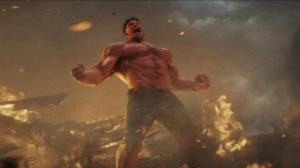
As is typically the case with movies that undergo many delays and re-shoots, Brave New World feels like it has far too many things going on and also simultaneously not enough going on. This is an unexpected sequel to 2008’s Incredible Hulk, generally regarded as one of the weakest MCU movies. The only thing that survived that movie was William Hurt (R.I.P.) as General Ross. I don’t think too many Marvel fans have been dying to have those characters and storylines picked back up after 17 years, but at long last you can see Tim Blake Nelson’s character again. Do you know what his character’s name is? Unless you’re the keeper of the 2008 Incredible Hulk fan wiki, I strongly doubt it. Quick, what’s his name without looking it up? It’s Samuel Sterns. Did you even remember Tim Blake Nelson being in the 2008 movie? The movie also has a global resource land grab to finally explain the frozen celestial body rising from the ocean ever since the events of 2021’s Eternals, a movie I fear we’ll wait an additional 17 years to get its own conclusion. This colossal being is the source of a new all-purpose element – adamantium, and that name should be instantly familiar for fans of the X-Men, as this movie pushes their inclusion that much closer. If The Marvels gave us Kelsey Grammar and Patrick Stewart’s return as Beast and Professor Xavier, this one boldly gives us… an elemental alloy (at this rate, two movies from now will introduce the X-Men’s jet as another sign to those in the know about what’s to come). It’s taking the leftovers from another movie to set up the larger scope of a branch of new movies down the road, while also tying back elements and characters from the earliest days of the MCU. It’s all a lot of table-setting unless there’s a compelling storyline with engaging characters and relatable conflicts and drama, and Brave New World does not. As a result, it’s all like watching a fast-moving assemblage of familiar parts trying to package itself together as a cohesive movie, and it just cannot. It’s one of those sacrificial movies at the altar of larger stories.
Which is a shame because there was a really fascinating and thought-provoking story at the core of Brave New World that barely gets any recognition amidst the explosions and gunfire, namely what does it mean for there to be a black Captain America? How does society respond when their patriotic symbol of American might now has more melanin? Considering how the Internet has throngs that lose their mind whenever a traditionally white male character gets changed into something different, I have to imagine there would be waves of people grumbling that this new “thuggish” Cap isn’t “their Captain America.” This is epitomized in the character of Isaiah Bradley (Carl Lumbly), a veteran who was also selected for the Army’s experimental super soldier project that gave birth to Captain America. Except because he was black during a time of segregation as the norm, he never got the adoration of Steve Rogers, and his accomplishments were ignored. In our current political climate, where diversity has become a convenient boogeyman, it would have been interesting to explore how the culture responds to a black man picking up the shield and being the next Captain America. It also would have invited a worthy conversation about where this country has let down its black populace, symbolized with Bradley’s past. Some of these themes were explored in the 2021 Disney Plus TV series Falcon and the Winter Soldier, but that doesn’t mean they couldn’t be meaningfully revisited given the elevated platform of the Captain America moniker. This was also the TV show that argued refugees could be terrorists, so there was room to grow. Unfortunately, this is only ever given passing mention, as institutional racism gets in the walk of Hulk smashing.

There was possibility with Brave New World but it too often seems to run aground with too many conflicting directions, underdeveloped ideas, and unfocused themes. The political complications, as well as evaluating the sins of the country’s past, could have made for a poignant and relevant movie with bigger things on its mind rather than getting to the next CGI slug-fest. It’s a Captain America with a new Captain America, so let’s explore what that means. It’s the franchise’s opportunity to begin anew with a different hero at its helm, and yet it feels more like an over-extended, disappointing finale to the Falcon/Winter Soldier TV series. It feels like an unneeded epilogue to an epilogue, and tying in so many disparate elements from films that people have forgotten or care less for seems like a strange creative choice when Marvel is looking to find its way in the wake of its post-Endgame walkabout. The worst crime with Brave New World is merely how boring all of it turns out to be. Far from brave, far from new.
Nate’s Grade: C
Share this:

The Monkey (2025)
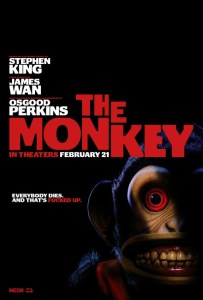 It was only minutes when I thought to myself, “I think I love this movie.” To be fair, this movie might only jibe for a very select few with a penchant for gory, outlandish horror and a demented sense of humor, but it just so happens that specific population includes yours truly. The Monkey is a dark comedy about the cruel indifference of fate disguised as a supernatural thriller adaptation of a Stephen King short story. It’s about two twin brothers (both played by Theo James as an adult) coming to terms with a family curse, a toy monkey that, when wound up, will beat its drum until the final blow correlates with the sudden, often shocking death of a random person. It’s essentially a death device and the brothers are haunted by it since losing both of their parents to it as teenagers, both grasping for meaning from their tragedy. One of them blames himself and the other blames his brother, and this has warped them into adulthood and how they view themselves, their responsibility as a parent, and their hostility to one another. The movie becomes a cagey reunion between the two brothers while also vying for power over a dangerous totem that loves elaborate Final Destination-style calamities. These deaths are over-the-top, often with bodies exploding in bloody heaps, and I found myself cackling along in response to the ridiculous violence. This is quite a change of pace for writer/director Osgood Perkins who just last year helmed the Satanic serial killer thriller Longlegs. Whereas that movie was a bit too lost in its slow-build atmosphere and a jumbled story burdened with underdeveloped plot elements, The Monkey is refreshingly straightforward and always entertaining in its contained madness. There are some bold and dark choices made and I appreciated every one of them. This is really a movie about trying to make sense of death and grief but it’s through the visage of spilled viscera and gallows humor. I didn’t think I’d walk away saying this, but I can’t wait to show my wife the movie about the killer windup monkey.
Nate’s Grade: A-
Share this:

Soul to Squeeze (2025)

It’s been some time since I’ve reviewed an Ohio-made indie (having a baby and adjusting to a new job will do that). My goal has always been to discover the rare diamonds in the rough and to provide professional film criticism to these smaller-scale movies trying to make some noise. I’ve been doing this for a few years now and I’ll admit I haven’t found that many diamonds, so to speak. My wife has long since stopped watching these movies with me and declared me a masochist for continuing this quest. What can I say, I’m still hopeful to discover what Ohio filmmakers can do when given a platform. One such filmmaker, who has since relocated from Ohio to the City of Angels, is W.M. Weikart. I reviewed his 2019 short film Pure O and we have several mutual friends. He asked me to review his next project, a feature-length movie shot with some Ohio-bred talent in front of and behind the camera, so I’m considering Soul to Squeeze as Ohio-indie-adjacent. It’s a trippy, beguiling experience, and it’s one that will prove befuddling to some but is an experience that gets better with every additional minute.
The story itself is relatively simple. Jacob (Michael Thomas Santos, CSI: Vegas) is a young coed who agrees to be the subject of a mysterious experiment. He lives in a house for days and experiences a series of bizarre auditory and visual hallucinations, picking at his mind, memories, and hidden trauma that he’s been trying to ignore for years. Or are they actually hallucinations after all? Can his mind survive?

These experimental/psychological triptych kinds of movies hinge on a few points of potential viewer engagement. First, the most obvious is simply being interesting and memorable in its weirdness. If you’re going for a crazy sensory experience, it helps if there’s actually something crazy worth watching. This was one of my biggest issues with the 2023 horror indie Skinamarink, a strange nightmare that mostly felt like the same ten boring images jumbled around for 80 very tedious minutes of dashed hopes. There’s only so much formless imagery I can watch without some larger connection, and if your movie is going to live or die based upon your outlandish nightmare imagery, then you better rise to the challenge. Skinamarink did not. Thankfully Soul to Squeeze has a larger agenda that reveals itself over the course of its 80-minute running time. We have a character trying to hide from some trauma he’d rather ignore, so we know this experience will force him to confront those feelings and, hopefully, find some way to process his intense emotions and come out the other side a better person. Or it will drive him completely mad. Either storytelling path offers intrinsic entertainment value. There’s purpose under the imagery so it’s not all abstract nonsense waiting for someone else to project meaning onto the disconnected pieces.
Now, it takes a little long to get going to begin to reveal that trauma and that connectivity. For the first forty minutes, weird things are going down without much in the way of a larger set of rules, which could have benefited the engagement, such as disturbing or confounding visions happening between certain hours of the day, allowing our protagonist time to anxiously dread their arrival. Or there could be an escalation in the intensity of the visions and their duration. There could also be the question over whether the visions are real or not, especially if they’re occurring after he’s forced to eat the provided food in the house. Perhaps he even tries to abstain from eating to then discover they still come like dreadful clockwork. Unraveling past residents of this experiment could also foretell what possible fates, both helpful and harmful, could await. Our protagonist could also try and escape as the visions get more personal and find he cannot escape. The character could be a little more active. Jacob seems very compliant for a wounded character undergoing psychological experimentation, which begs the question why he would continue with this treatment after it begins picking away at the secret he doesn’t want to face. There are other directions that the main character could have gone through while we waited for the larger thematic clarity to come into focus with the visions after 40-minutes of atmospheric noodling.

When you’re going for a more experimental narrative with heavy visual metaphors, it can be tricky to find a balance between arty and pretentious, or, to put it in other words, between David Lynch and student films. This balance is tipped toward the latter early, especially when I think a blue flower comes to life and is… a French woman… spouting platitudes before turning back into a flower. It’s stuff like that which can seem a little daft but without the intention of weird humor. In contrast, there’s a strange but amusing scene where our character comes across a sitting mermaid on display in a museum. She literally eats a pearl necklace from Jacob’s hands and then smiles mischievously as it reappears around her neck, now her own possession. There is a larger metaphorical connection here that’s revealed later, with the necklace having a connection to Jacob’s traumatic past and even the concept of the mermaid too. There’s a phone conversation that we get both sides of that ends up starting as one of the earliest points of confusion and agitation for Jacob and then, by its return, serves as an unexpected vehicle for our protagonist’s emotional growth and reflection. It’s a clever and rather satisfying creative boomerang.
Soul to Squeeze impressively masks its low-budget nature through creative choices and elevated technical craft. Weikart has a natural eye for visual composition and lighting especially, so there’s nary a moment where the movie isn’t at least appealing to the eyes. Having a director who can frame an engaging shot is a godsend when you’re primarily going to be stuck in a single location for 80 minutes. A smart and talented visual artist can really hide the limitations of a low budget well. This is also by far one of the best sounding low-budget indies I’ve heard. The sound mixing is impeccably professional and the score by Sonny Newman (Burn the Witch) is very pleasant and evocative and soothing when it wants to be. Sound design is one of the biggest areas that holds back so many micro-budget film productions, and it’s so refreshing to have a movie not only where sound has been given great attention but also incorporated into the presentation and experiences in meaningful and artistic ways. The visuals can be rather eye-catching, like when Jacob’s TV transforms into a multi-screen monster where eyeballs and a giant mouth take up residence on the various screens, and aided by a slick sound design, it all allows the sensory experience to be even more compelling and accessible. As the film progresses, the bigger picture comes into focus, which means more exposition is thrown at the viewer. Weikart and his team cleverly find ways to present the information through a series of sufficient images and sounds that imply plenty with minimal (some of the sound and picture arrangements can take on a certain true crime dramatic recreation feel). I don’t have a final budget number but it looks better than many indies I’ve seen with considerably higher budgets.

There is one very significant technical choice that I wish had been more essentially incorporated into the story of Soul to Squeeze. As its promotional materials declare, this is the “the first film ever to have a continuously changing aspect ratio throughout the entire film. It begins in a 4:3 aspect ratio and expands out to a 2.35:1 by the end.” For the layman, that means throughout the film the aspect ratio is changing from the old boxy TV standard to a wider and wider widescreen. Now, you could make an argument that this is meant to represent the progression of Jacob’s thinking, that his world is literally expanding, but if that’s the case it feels a little too metaphorical to land as an essential tool for this story to be told at its best. It’s kind of neat but ultimately feels more like a gimmick. Perhaps the nights could have been labeled sequentially, and with each additional night the aspect ratio alters, expanding the horizons. You could even make it a Wizard of Oz motif, with Jacob opening a door and coming out the other end with a different aspect ratio to communicate the transition to a new plane of thinking and reality. Without calling more attention to its changes, and without connecting it more deliberately with the onscreen action, it becomes only a slightly noticeable visual choice over time that may go ignored by most.
By design, Soul to Squeeze is meant to be mystifying and experimental, which will try some people’s patience if they don’t find the ensuing imagery and weirdness to be entertaining. I wish there was more of what I appreciated in the second half to be present in the first half, and I’ll freely admit that I might have missed some of those clues and connective tissue just due to the strange and abstract nature of the movie. I was never bored and often amused at the various ideas that animate the movie (a game show host narrating breakfast is quite surreal and hilarious). The movie looks good, sounds good, and moves along at a fitting pace. The biggest gripe I have with these kinds of movies is whether it will ever add up to anything or is every moment just another in a chain of interchangeable weirdness? With Soul to Squeeze, there is a connection to much of the imagery and hallucinations, so there is a larger design that coalesces. I think there are some specifics that would have potentially aided the overall experience, but adding specificity could deter the immersion and grasping for understanding desired from these kinds of movies. Soul to Squeeze might not be that quintessential diamond in the rough I’m in search of with these Ohio (and Ohio-adjacent) indies, but it’s still a professionally made, creatively engaging, and fairly entertaining curio that can surprise at a moment’s notice.
Nate’s Grade: B
Share this:

Flow (2024)
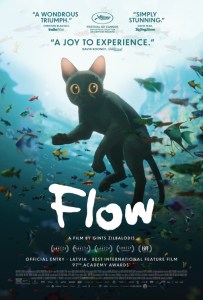 The international animation sensation from Latvia surprised the world by besting big movies from big studios to win the Academy Award for the Best Animated Movie of 2024. Flow is a wordless fable about a group of animals trying to survive in a flood-ravaged world bereft of humans. The presumptive main character is a small black cat who befriends an alliance of a Labrador, a lemur, a large bird, and even a capybara. They float around on a sailboat and take turns relying upon one another. The animation style is dream-like and painterly from Blender, a free open-source 3D software tool. There’s a sweetness to the movie that doesn’t dip into maudlin territory; it’s like Homeward Bound minus celebrity voices. However, the movie is also a bit airy and lackadaisical in its pacing. There are many sequences of the cat just observing the view underwater, and there are segments that get very abstract and metaphorical that can be confusing. The movie also ends in a very, “Oh, that’s it?” kind of fashion. Without broader characterization, we’re watching animals essentially be animals. While this doesn’t mean they are undeserving of empathy, I kept wondering if maybe we were headed for a Life of Pi-style allegory. It’s quite often a beautiful movie to watch, and I celebrate this little underdog animated movie getting the kind of platform and acclaim that larger animation houses take for granted, but it left me a bit cold. It’s an easy movie to appreciate with its mature themes and surreal imagery, but I wanted more to engage with.
Nate’s Grade: B-
Share this:

The Electric State (2025)

The fire hose that has been the Netflix cash flow may be reigning in, but that didn’t stop the streaming giant from making another attempt at a huge blockbuster to rival those Hollywood designs for the big screen. The Electric State is a $320-million sci-fi adventure spectacle from the Russo brothers, Anthony and Joe, the team that gave us the highs of the Marvel Cinematic Universe (MCU) later Avengers movies, and the lows of, well, everything after their MCU movies. Netflix is actively trying to compete with the theatrical experience brought to you at home, so they take these big expensive swings on large-scale, quippy, action vehicles like Red Notice and 6 Underground every so often to mixed results. Netflix has become the go-to place for a kind of movie that has altogether vanished in the studio sphere, the mid-tier movie for adults. We need those stories. What Netflix hasn’t done as effectively is compete with the big studios for comparable expensive action spectacle. The Electric State is further proof.
In an alternate America, robots were created and given menial tasks by mankind. Naturally, they grew tired of this and attempted a revolution for their equal rights. Mankind was on the brink when an unlikely savior emerged. Tech CEO Ethan Skate (Stanley Tucci) created an army of humanoid drones controlled via VR helmets. This disposable army of avatars was able to beat back the robots and forced their leader, literally an animatronic Mr. Peanut (voiced by Woody Harrelson), to sign a “peace treaty.” The results exiled the robots into a walled off wasteland in the American southwest, and humanity went on its merry way, now with VR-controlled avatars that allowed every American the luxury of staying on their duff. Michelle (Millie Bobby Brown, contractually obligated to be in every Netflix original not starring Joey King) is an orphan WITH AN ATTITUDE. One day she’s greeted by a pint-sized robot looking like the Cosmo cartoon character her younger brother was obsessed with. The little robot says he is her brother and Michelle realizes that maybe she has some family left after all. She and the Cosmo bot are on the run from scavengers and bounty hunters trying to stop their fateful face-to-face reunion.

The Electric State is lacking such vital creative sparks to feel anything more than the ramshackle sum of its derivative sci-fi parts. It began as a melancholy mixed media book from the same Swedish author behind Tales From the Loop and it’s become a giant lumbering mess of mediocre and familiar elements. It kind of feels like the newer Ready Player One-era Steven Spielberg trying to emulate early E.T.-era Spielberg, but then that would give us an artist on the level of Spielberg, and that’s not what we have here. It’s standard adventure fare with a brother and sister crossing the country to save the day and thwart a big evil corporation along with scrappy, rakish rogues joining them along the way for fun and life lessons. Chris Pratt’s character is so transparently a Han Solo clone but he’s an empty vest with eye-rolling quips. This is an alternate history story with a literal robot uprising but it devotes so little interest in its own world building and history. The movie essentially castigates all the robots to a forbidden zone that naturally will be visited by our plucky heroes. The majority of the movie is watching these robotic avatars (reminded me of the Geth from Mass Effect) for people who can’t be bothered to leave their VR helmets. If this new world has devolved human interaction into a series of screens (commentary!) then maybe let’s explore that with meaning. If robots are going to be an exploited labor class (commentary!) then maybe let’s explore that too. If this is a future world where robots have been exiled and feared as an Other (commentary!) then let’s explore that too. There’s one moment where Evil Steve Jobs enjoys a VR recreation of his deceased mother, except he admits that this version is the version he wishes he had, and the real figure was far less doting and far more abusive. That’s an interesting concept, that VR offers users the ability to live in a reality of their own desires. But this isn’t a movie that wants to take time to explore interesting and relevant themes, because that would get in the way of action set pieces and goofy robot action. Seriously, there’s one fight where a U.S. postal service robot is literally hurling undelivered mail at a killer robot avatar and succeeds. Because this isn’t a deep movie, we have essentially good robots and bad robots, and if you’re shocked that the robots may have been misunderstood, well congratulations on seeing your first movie. I assure you, they mostly get better from here if you give them a chance.
The inclusion of robots is so underutilized, tapped for ready sidekicks and villains, that you could have replaced them with aliens or clones or any other disposable science fiction element. In this parallel world, Walt Disney created the robots for Disney World, so wouldn’t it be worthy of exploring that history and the sense of Victor Frankenstein-style paternal obligation? Wouldn’t the robots retreat to their ancestral home of Disney World? Or perhaps they view this as the birth of their enslavement? What about different generations of robots, especially older models being replaced with newer ones, thus creating class warfare within an exploited secondary class? What about looking at robots having to subsist off junk to continue with their meager existences? What about robots still living in forbidden zones that are hunted by the government and its armada of robot drones? There are so many possible ideas and stories and characters that are open through the inclusion of robots, but the movie doesn’t have the interest or drive to make them matter. As a result, it’s mostly a swift-moving travelogue with some ugly-looking or cranky guests riding shotgun. Occasionally The Electric State will remember, oh yeah, robots can do stuff people cannot, like having one of them hack into a server or having a smaller robot inside like a high-tech Russian nesting doll.
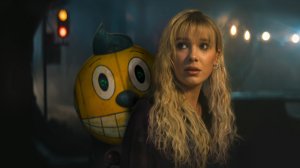
I think it was a combination of the uninvolved storytelling as well as the character design that left my emotional attachment to be null and void. I hated the Cosmo character design. He’s this big spherical head with little skinny limbs, but the head might as well be an un-moving mask. A giant toothy smile is drawn on the front and it’s so inexpressive. Also, the fact that the kid has to exclusively rely upon only using sound bytes from this canceled cartoon series makes for a quickly annoying little brother. I didn’t care about this kid, human or robot, and I didn’t care if Michelle ever reunited with her brother. Then the fact that the movie’s climax involves such a serious and emotional choice seems absurd considering what has been underdeveloped up until this abrupt shift in intended emotional stakes. It’s such an out-of-left field escalation that I almost laughed out loud at what the movie was asking me to feel, as well as what it was asking its protagonist to decide. Likewise, the betterment of robot-kind is given such little recognition, culminating in a showdown between the avatar of good robots and evil robots essentially going to revise a treaty that we don’t know much about. For a movie about how easy it can be to distance ourselves via technology, it sure fails to reasonably make the viewer care about robot equality.
Then there’s the fact that this whole enterprise cost an astounding $320 million for Netflix to platform it as its next hit movie to doze off to while in the middle of doing laundry. The Russo brothers have retreated back to Marvel to handle the next two Avengers movies, and it seems like at a time where both parties have missed and could use one another. Outside of Marvel, the Russos have delivered one super expensive action movie (The Grey Man), a super expensive spy action series (The Citadel), and one lackluster biopic that used every Scorsese stylistic trick they’ve been saving up (Cherry). With The Electric State, we have the brothers’ more familiar mixture of large-scale action and special effects in a mass appeal studio blockbuster space. However, every movie outside of Marvel has made me question their capabilities of handling these big movies. I know the Russos can be fantastic with comedy, as some of their TV episodes are the best of recent memory, and their stewardship of the big MCU movies in the wake of Joss Whedon’s departure was undeniably successful. So why isn’t The Electric State successful? It comes down to the screenplay which is so disinterested in its own ideas, world, and characters, held together by the familiarity of other adventure blockbuster staples like loose chewing gum. It’s a movie replete with famous faces and big effects but feels so devoid of life and creativity, a blockbuster automaton intended to hold the attention but rarely engage one’s imagination and emotions.
Nate’s Grade: C


 nathanzoebl
You must be logged in to post a comment.