WALL-E (2008)
 At this point, is there anything Pixar can’t do? They’ve explored the secret life of toys, what’s under the sea, the pains of rearing a family of super heroes, and of course a rat that dreams of becoming a chef. Seriously, anyone that can make that last one not only work but one of the most sparkling, imaginative, enchanting, and poignant films of the year deserves every accolade in the book. Pixar’s newest film, WALL-E, is certainly its most ambitious and potentially its most rewarding yet.
The year is 2700 and the planet Earth has long been left behind by mankind. Humans have exhausted their resources and left behind a planet that looks like one never-ending landfill. Skyscrapers are being built out of garbage cubes. The Waste Allocation Load Lifter – Earth class (WALL-E) robots have been left to toil away and clean up mankind’s mess. There is but one WALL-E robot left and it leads a solitary life of routine. It gets up, it compacts trash into cubes, and it assembles those cubes into eventual giant structures. Then one day a probe lands called EVE. This floating capsule-like robot is easily frustrated and quick on the trigger and WALL-E falls completely in love with his unexpected new companion. The two become close and then EVE is taken away unexpectedly. WALL-E hitches a ride on the ship that collects his beloved and journeys through space to save her.
 I was having reservations citing certain words of praise but this film deserves every ounce of praise; WALL-E is a masterpiece. This is a beautiful story told in a beautiful way in a beautiful looking movie. I imagine kids will be tickled by the funny robots but I really believe that this film will play much better for adults, and when was the last time a mainstream, American family film did that? Most “family” films are an excuse to do something lowbrow and cynical to make a quick buck, like the atrociously cringe-worthy trailer I saw for Beverly Hills Chihuahua (seriously, a civilization of singing/rapping Taco Bell dogs?). Pixar, and God bless them, are proving with each new release that family films need not be brain-killing hours. That reliable Pixar quality touch is never more present than with WALL-E. If you told me that a film that takes place on a trash-filled Earth, with minimal dialogue, and a romance between two robots would be the most thrilling, moving, and wonderful film of 2008, I would have scoffed.
Writer/director Andrew Stanton (Finding Nemo) relies on a universal visual storytelling language to tell the bulk of his tale. WALL-E plays like a gloriously enjoyable silent movie where body language and physicality advance the storyline and provide surprising depth; ignoring brief TV clips of Fred Willard and Hello Dolly, the movie doesn’t have actual dialogue until the 45-minute mark. And it is fantastic. The character of WALL-E is immediately empathetic and the audience will see slivers of themselves inside this independent robot that finds another reason for being. It’s a simple love story told in simple strokes, but it just so happens that Stanton has provided great emotional heft to those strokes. The film has such a huge and vibrant heart. More is said in indecipherable robot bleeps than in much of the tripe Hollywood calls dialogue. Watching WALL-E court EVE, a bit unsuccessfully at first, begins as cute, moves into being adorable, and ends up being greatly touching and flirting with the profound. How many other movies, let alone romances, end with the long-desired climax of two characters merely holding hands? This movie is a delight from beginning to end and a classic example of the power of expert storytelling.
When the film transitions into space is when the potent environmental message, and subversive satire, emerge. Beforehand we have witnessed the awe-inspiring landscape of Earth littered with garbage and empty shopping centers. Humans left the Earth to wait for the robots to do all the work and make the planet hospitable for life once again. For the last 700 years humans have been living in a heavy-duty luxury spaceship. Humans have grown to be fat, lazy, and completely self-involved; people only communicate with others through video screens, even when the other person is inches away. The movie also manages to satirize consumer culture, and in the future one corporate behemoth essentially dictates life’s choices; I found it highly amusing that the former president of the future (a live-action Willard) is also the CEO of the super corporate conglomerate. Business and government have merged completely. The social commentary isn’t as merciless as Mike Judge’s Idiocracy, nor is the environmental message subtle in the slightest, but the satire is sharp enough and blunt that some viewers might be offended, and I think that is genius.
Being a Pixar film, naturally WALL-E is resplendent to look at. The animation is superb and the imagination on display seems limitless. This is one of those films I’m certain I could watch again and again and find something new every time. I don’t really need to say much more about the visuals because they are breathtaking to behold (Roger Deakins, by the far the greatest living cinematographer, was even consulted to help with the look of the film. How awesome is that?).
 And yet even though WALL-E is primarily a love story the film also manages to be greatly exciting and equally funny. Stanton’s screenplay nimbly assembles characters and reintroduces them at key points to push his story onward. I loved that WALL-E is introduced to all sorts of unique robots on the mankind’s space ship and that he even stumbles into, more or less, a group of malfunctioning robots that come to his aid (think the Island of Misfit toys). Stanton manages to reconnect his storytelling threads so that every moment in this movie matters. The last third of the film is a back and forth cat-and-mouse struggle that manages to pump up suspense in smart ways. Stanton lays out his scenario for action and then builds organic complications. I am deeply satisfied when a filmmaker has a firm command of action that they can setup a situation, establish the rules, and then naturally construct obstacles and surprises that feel natural and germane to the story. Pixar has always been able to craft exciting action scenes that felt fully realized and WALL-E is no different.
If there is but one minor quibble I have with this near-perfect film, it is the missed opportunity to explore the mortality of robots. While WALL-E is going through his day-to-day duties he passes by older versions of other WALL-E models. The movie could have pushed just a little harder with the concept that this tiny robot is going to live to collect trash and then die like all the rest, becoming another piece of forgotten garbage. I think if Stanton had only explored this idea a little more it would have made his robo-love story even richer considering that both robots are going against their programming because they have found something that completely changed their world — love. The idea of mortality was explored to excellent effect in 1999’s Toy Story 2, so perhaps the Pixar folk didn’t want to fall into a philosophical repeat.
WALL-E is a wonderful love story, a heartfelt and immensely charming character piece, and a thrilling sci-fi tale that soars to broad heights of imagination. It’s timeless while still being rather timely thanks to its environmental message. Moments after the movie was over I wanted to see it again. I think I’ll feel the same way after the second viewing and the third. This is a phenomenal movie that will stand the test of time as one of the greats.
Nate’s Grade: A
Share this:

Get Smart (2008)
 Get Smart was a beloved spy satire that aired on television from 1965 to 1970. Don Adams starred as Agent 86 and he bungled his way through scene after scene, oblivious to his shortcomings. The show was created by Mel Brooks and Buck Henry and maintained a genial, goofball appeal as it satirized James Bond style spy movies and tweaked Cold War paranoia. And as is written in stone by Hollywood, anything that was ever once on television must eventually become a big screen theatrical version. Get Smart already produced one unfortunate movie, 1980’s The Nude Bomb (which doesn’t sound too different from the U.S. Air Force’s plan to create a Gay Bomb — true story). I’m pleased to report that the big-budget modern Get Smart retains enough of the show’s flavor even while producing something with little resemblance to the source.
The updated Get Smart exists in a world not too different from our own (the president is still a boob). CONTROL is still in operation but secretly underground. Agent Maxwell Smart (Steve Carell) is an expert analyst who specializes in knowing the enemy and compiling 400-page reports. He’s failed the field agent test several times and desperately wants to get out from behind a desk. The Chief (Alan Arkin) says that he needs more men like Max. He gets his chance when CONTROL is attacked by KAOS. Many of the Agents identities have been compromised. The only agents remaining are the dashing and hulky Agent 23 (Dwayne “The Rock” Johnson), the svelte and beautiful Agent 99 (Anne Hathaway), a group of science techs (including Heroes‘ Masi Oka), the Chief, and newly appointed Agent 86, Maxwell Smart. KAOS, perhaps thanks to the end of the Cold War, has become a group of shadowy men making ties to terrorist groups worldwide. Siegfried (Terence Stamp) and his henchmen are aiming to sell nuclear devices to terrorists. Agent 99 and Max must travel across the globe to ensure that KAOS does not fulfill its villainous schemes.
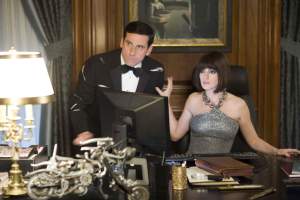 The plot is fairly workmanlike and it doesn’t really establish much in the way of an ongoing threat. As a result, the movie feels like it lives in the moment, going from gag to gag, but it just so happens that a decent number of those gags are funny. Get Smart is mostly a chuckler of a movie, sure to bring smiles and giggles but rarely hard, gut-busting laughter. I never found myself laughing too hard but I did find myself enjoying the time. Get Smart is a very amiable experience that manages to maintain a healthy level of silliness without ever falling victim to stupidity. It’s pleasantly goofy without becoming farce. Sure there is crude slapstick but the film, and Carell in general, manage to give them a slight edge that elevates them beyond your typical juvenile behavior. There may be a pee joke or a quasi-homophobic joke but Carell manages to make it worth your time.
The relationship between Carell and Hathaway provides significantly more interest than the ho-hum plot. The filmmakers find a clever way around the potentially unsettling reality of the age difference between Carell and Hathaway, who is nearly 20 years younger. The two have a spunky chemistry and their combative interaction elicits some of the most amusing laughs. Hathaway, with her doe eyes and dewy features, is just as eager and up to the task as Carell, so watching them spar and tease gives the movie a bit more juice. Kudos to the casting director because the cast is packed with capable comic actors that know when to seize the moment, and Arkin seizes every one of them (it seems that with every new film, my man crush on The Rock only grows greater).
The film is a hybrid of comedy and ramped-up action set pieces, and surprisingly they aren’t that bad. Director Peter Segal, who has directed three Adam Sandler vehicles, stages some fairly exciting action sequences with a decent degree of visual flair but the film overindulges on action. The movie should focus more on its cast of characters instead of loud, brash action sequences. It’s a little weird watching Maxwell Smart expertly shoot people like he went to a John Woo camp. The tones never fully match up, and Get Smart begins to feel like a comedy that thinks it?s a James Bond movie or an action film that thinks its overly absurd. The tonal struggle means that the comedy is handicapped by all the action interrupting and stalling the pace of jokes. There are times when Carell and Hathaway are firing one-liners at one another and then -WHAM!- they have to dodge bullets and kick bad guys. The stunts are impressive but I kept feeling a sense of disappointment when the action would cut short the momentum of the comedy. The spurts of action shortchange the humor. Segal’s direction is also blunt at times, so whenever a character thinks reflectively we have to witness a mash-up of past clips to visualize what the character is reflecting upon, in case our memories of a two-hour movie fail us while it’s still ongoing.
 Get Smart is greatly benefited by the considerable comic charms of Carrell. His Agent 86 isn’t so much incompetent as he is bumbling, but best of all the man keeps a gloriously self-deprecating and deadpan sense of humor from beginning to end. He doesn’t lack self-awareness, and is not ignorant of the feminine charms of his partner, and as a result this new version of Maxwell Smart ends up being, well, kind of smart. Carrell shoulders the film and is able to save lackluster gags by his sheer comic ability and immense likeability. The film doesn’t push the envelope in any regard but it also doesn’t condescend or try and flirt with being too clever for its own good. Thanks to Carell, Get Smart manages to be much more entertaining than it has any right to be.
Fans of the Get Smart TV show, such as myself, will find it hard to recognize the source material inside the big screen transformation. The filmmakers have turned a goofy satire of Cold War paranoia into a full-fledged summer popcorn action cartoon. The movie moves at a brisk pace, despite pushing toward the two-hour mark, and its screenplay is packed with enough enjoyably silly and smartly stupid jokes to guarantee a string of smiles. Like Carell’s 2007 entry Dan in Real Life, the movie presents such a jovial, good-natured spirit that becomes mildly infectious. You may roll your eyes a few times but you forgive and forget. Carell proves he is fast becoming one of the most capable and leading comics, and he proves yet again that his force of personality can elevate material that doesn’t meet his same qualities. I just wish that Get Smart had focused more on the yuks and less on gunplay and explosions. I guess, to quote a certain agent, you could say they missed it by that much.
Nate’s Grade: B
Share this:

The Happening (2008)
 M. Night Shyamalan is still reeling from the beating he took over 2006’s Lady in the Water, a colossal misguided attempt at a modern fairy tale. The man is trying to retain his cozy relationship with audiences that adored his earlier works like The Sixth Sense and Signs. Shyamaln’s latest, The Happening, isn’t going to dissuade the detractors. This man is a talented filmmaker and I think it’s finally time that he starts thinking of focusing on one creative job and one job only, either writing or directing.
There’s a pandemic sweeping across the Northeast United States. It first starts with disoriented speech, then moves to disoriented movement, and ends with people committing suicide. Nobody knows what is officially going on. High school science teacher Eliot Moore (Mark Wahlberg) tries to flee Philadelphia with his estranged wife, Alma (Zooey Deschanel). They travel out into the suburbs when their train stops. The conductor says that they’ve lost contact with everybody. Eliot eventually theorizes that what’s causing this pandemic isn’t terrorists, or the government testing some biological agent, but plants. Yes, plants. In their defense, the plants are releasing an airborne toxin that flips a neurological switch in human brains. Instead of self-preservation the brain is pushed toward immediate self-destruction.
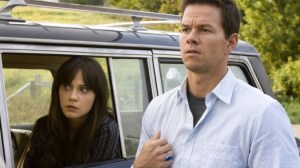 The Happening is no Lady in the Water, thankfully. The premise is pretty interesting in a feature-length Twilight Zone kind of way. Shyamalan does know how to spin an interesting idea and watch social paranoia explode. The best moments of The Happening take place during its beginning where confusion and panic reign. Shyamalan then takes a page from 2005’s War of the Worlds and follows the perspective of a handful of normal folk as the experience an apocalyptic event. We even spend the third act hiding out in the home of a crazy person (the creepy Betty Buckley). Unfortunately, we in the audience feel no involvement with the poorly written main characters. Once again Shyamalan utilizes a horrific and unique encounter as the impetus for reconciling the pains in a marriage. At a scant 99 minutes, there isn’t much time set aside for building characterization. There is not a whiff of personal connection to this tale.
Shyamalan doesn’t seem to explore the psychological ramifications of his premise. Suicide is very traumatizing and it would have swept over the East Coast in waves; millions would be dead. Yet the characters and Shyamalan never seem to focus on this point. Perhaps they’re in shock but no one seems to actually react realistically to the possible end of the world. Normal people would be freaking out. I would be freaking out. The idea that the country goes back to normal after three months is preposterous. Would anyone want to live on the East Coast again after all that death? People would be finding bodies for many months after the “happening;” just look at the slow recovery of New Orleans. Never mind the hit the economy would take from millions of people expiring.
The ecological message can also be incessantly heavy-handed. Characters run past a sign for a housing development that advertises the slogan, “You deserve this.” Oh, gee, I get it. A TV host at the very end interviews a scientist theorizing that what happened was a warning from the environment to shape up and change our ways. The TV host is so incredulous that he actually says, “Well, I’d like to believe you doc, but maybe if it just happened somewhere else again, maybe then I could believe you.” You idiot, millions of people died and there are how many witnesses? I know exactly what message Shyamalan is trying to say (wake up, we can’t ignore the signs) but having a character denying the obvious is too ludicrous given what happens in the story.
 But the story does invite further inquiries. How exactly do the plants communicate with each other? I can understand root structures but how does a bush talk to a tree unless they share root structures? Do plants speak different languages? Can a bush talk with a tree, and do French bushes speak differently than their English brethren? The plants seem to react to large numbers of people, but how do they know when there’s say enough folk running around to kill? Do they smell people? That toxin seems to not affect animals but I don’t see how that could be possible given that, as far as I know, animals inhale the air as well. Of course, if all surrounding animals and insects were to keel over then that would irrevocably harm the ecosystem and endanger the plants. This must be why the “happening” lasts a little over a day, coincidentally ending just when our protagonists are about to give up. And if Mother Nature, as a form of population control, triggers this toxin release then wouldn’t it stand to reason that some place like China or India would be hit first instead of the Northeast United States? Shouldn’t a science teacher know that still air would be filled with more toxins than when the wind blows? I’ll give Shyamalan this — he was able to make me fear a tree. There was one moment where a little girl was on a swing that was bolted into a tree limb and the constant creaking made me nervous that they would anger the tree.
Despite the flaws in storytelling, this narrative still could have worked as is if it just had a better director at the helm. Shyamalan lets everyone down on this one. Much of the marketing angle was how The Happening is Shyamalan’s first foray into R-rated material, but you can tell he doesn’t feel comfortable showing more than implying. One sequence follows a police officer’s gun as different individuals take turns shooting themselves in the head. Shyamalan shoots this sequence like the camera weighed 800 pounds, so the shot never rises above people’s feet. We see the gun fall on the ground, feet walk over to the gun, hands pick it up and lift it off screen, then a very unconvincing gunshot sound effect, then the process repeats. By not actually seeing the deadly aftermath Shyamalan risks the sequence becoming unintentionally funny and it almost happens. This directorial technique does not raise suspense, and in fact, Shyamalan botches most of the potential suspense in The Happening. Given the premise, Shyamalan doesn’t find too many sequences that make the audience squirm. A man wandering around in a lion’s cage is so fake and played in the wrong tone that it just becomes goofy even when his arms get ripped off. There’s only one protracted horror sequence that shows true gore, where a man lies down in the path of a giant lawnmower and we start to see the machine ride over him and whirl its blades. However, even this scene could have gone longer to fully draw out the shock and terror. Shyamalan just doesn’t have the temerity for R-rated material, and as a result the movie could have been a lot more terrifying had the man embraced the gruesome potential of a more mature rating.
Shyamalan’s visual storytelling is pretty rote. I kept thinking to myself how poor everything seemed to be looking. The cinematography is lackluster and the shot compositions are rather bland. Part of what makes a horror movie effective is clever visual setups that slowly leak tension like air from a balloon. Shyamalan’s idea of drawing out tension is to watch tress blow in the wind. After a while, when you realize this is the one trick Shyamalan has, it gets old and extremely boring. The Happening would have benefited from a stronger visual storyteller who could also goose the narrative with better-constructed scares. It’s disappointing because Shyamalan was able to elicit top-notch suspense in 2002’s Signs with simple sounds and the imagination. Now, when he’s given the chance to show terror he falls on his face.
 Another dent to Shyamalan’s direction is the fact that the actors all give bad performances. Wahlberg and Deschanel have given great performances in other movies so I know they are capable of more, and the blame must lie at the feet of Shyamalan. They overact with gusto and always seem to never be fully immersed in the reality of the drama. Even Wahlberg’s first line delivery raises your eyebrow because it seems too amateurish and flat. Deschanel is even worse and whatever emotion she is playing in a scene is the wrong emotion. She’s whiny and overly childlike when she should be reflective and contemplative, she’s wide-eyed and weepy when she should be tender, and she’s bad with just about every line. Alma is a weak character and seems to turn everything back to an injustice against her, even when people are killing themselves en mass. Part of the actors’ woes is complicated by Shyamalan’s wooden dialogue, which includes gems like, “We’ve just got to stay ahead of the wind” (how exactly does one do that?) and, “We’re not going to stand around like uninvolved bystanders” (who says that?). The most shocking aspect of The Happening is that Shyamalan totally betrays the trust of his very competent actors.
M. Night Shyamalan would be best served in the future by focusing on one role. He could direct someone else’s material or he could write and have someone else direct. If he had gone the latter route I’m convinced that The Happening would have worked even with a flawed script. The movie is too timid to push the horror boundaries available to a mature rating, the suspense is minute, and Shyamalan completely leaves his actors hanging out to dry. There is some laugh out loud moments of unintentional hilarity (like when Wahlberg calmly says “Oh no” upon hearing suicidal gunshots), but the movie also has moments of intrigue amidst its heavy-handed environmental message. Statistically, if there were a killer toxin there would be those who would be genetically immune to it, much like the scenario in I Am Legend. I have to say that if I was fortunate enough to survive I would whisper some threatening words to some choice flora and then I would set lots and lots of fires out of revenge. Take that, you stinking vegetation!
Nate’s Grade: C
Share this:

The Orphanage (2007)
 The haunted house spook sub-genre has mostly delivered fairly pedestrian results (Oh no, it’s only a cat), but let The Orphanage stand as undeniable proof that with patience and talent the haunted house can still be scary as hell. The film takes its time to establish a truly unnerving atmosphere where even genre clichés like creepy kids in creepy masks become compelling and scary. The haunted house usually revolves around some form of a mystery, and The Orphanage is able to tap out an interesting tale that provides plenty of emotional depth. The mystery unravels at a nice pace and the film grows in intensity and dread. Plus, the movie doesn’t spell out everything and respects the viewer’s intelligence. Invariably, this film will be compared to The Others, another superior chiller also from a Spanish filmmaker, especially given the conclusions reached by the end. But debut director Juan Antonio Bayona certainly makes a strong impression with his subtlety and ability to transform conventional creaks and surprises into effective thrills. I’d be happy to sit through more haunted houses if they were all as good as The Orphanage.
Nate’s Grade: A-
Share this:

Reservation Road (2007)
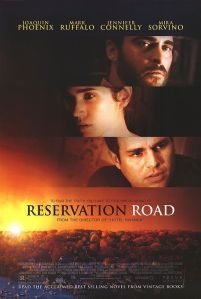 What happened here? Director Terry George was coming off of 2004’s stirring Hotel Rwanda, he had A-list talent like Mark Ruffalo, Joaquin Phoenix, Jennifer Connelly and the results end up feeling like a parody of awards-hungry prestige films steeped in grief and set in suburbia. To be fair, the acting is mostly respectable even if the characters start yelling a majority of their lines. The film moves at an absurdly swift pace that doesn’t allow much time for the actors to react reflectively about grief and guilt. The movie is kept afloat by some contrived coincidences, like Ruffalo’s lawyer being hired by Phoenix to find the culprit responsible for the hit and run that killed his son (surprise, it was Ruffalo behind the wheel!). Reservation Road doesn’t dwell too long on the plot setups it crafts and stumbles into a sudden and convenient epiphany by Phoenix. The conclusion is neither satisfying nor emotionally grueling, and the movie just kind of ends abruptly with little resolved, crushed under the weight of failed pretensions. This movie wants to dig deep and say Big Things about the human condition but it’s hard to do when you’re as emotionally inert and dramatically flaccid as Reservation Road. Seriously, what happened here?
Nate’s Grade: C
Share this:

Taxi to the Dark Side (2007)
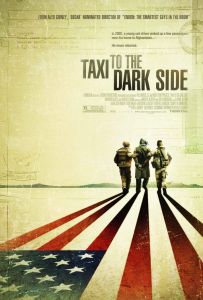 Just like he did in 2005’s excellent documentary Enron: The Smartest Guys in the Room, filmmaker Alex Gibney is able to distill a complex topic into a coherent argument. His Oscar-winning documentary Taxi to the Dark Side looks deep into the repugnant state of justice after 9/11 and the Bush Administration’s disregard for the law. It’s decidedly uncomfortable and upsetting, but Gibney’s film should be essential viewing for everyone to fully understand what questionable lessons we are sending out to the world under the guise of winning the indefinite War on Terror.
In late 2002, Dilawar drove two passengers out of town in his taxi. He was stopped at an Afghan militia checkpoint and he and his passengers were turned over to the U.S. military. The Afghan militia leader accused the trio of being responsible for rocket attacks against U.S. forces (In reality, the militia leader was responsible and just turning over innocent men to make inroads with military personnel). Dilawar was sent to Bagram prison where he was subjected to sleep deprivation, physical abuse, and made to stand for hours on end handcuffed to the ceiling. He died after two days in custody. The military coroner ruled that Dilawar’s death was a homicide. The report was swept under the rug until a New York Times journalist went searching for answers. The official who instigated the “interrogation techniques” was rewarded and sent to teach her harsh brand of degrading interrogation to another prison – Abu Ghraib. I think we all know how well that turned out.
 Like No End in Sight, which Gibney also produced, the film benefits enormously by staying away from brash finger pointing and hysterics. It slowly assembles its methodical case using hard evidence, like the prison coroner’s report and declassified memos, and a bevy of interviews from the people who were on the frontlines and behind the scenes in Washington. Gibney builds a devastating case that left me sick to my stomach and overwhelmed with the urge to weep. Taxi to the Dark Side is a powerful and masterfully assembled indictment on how far the United States of America has slid from its moral high ground. I felt sorry for the numerous innocent men plucked from their homes and tortured. I felt sorry for the soldiers being pressured to get results fast and through whatever creative means only to be turned into patsies by a government looking to pin “a few bad apples.” I felt intense shame in my own government condoning degrading and humiliating practices that stretch the legal definition of torture. And I felt burning anger at the realization that President Bush had tucked away a little provision in a bill signed into law that stated no officials in his administration could be tried for war crimes. The soldiers on the ground who followed orders set out by those officials, however, were fair game. Bush pardoned himself!
Gibney uses Dilawar’s story as a framing device that broadens the scope of the film. He explores the whole nature of torture and the questionable tactics our government and military have engaged in since 9/11 in the name of keeping the country safe. But as the film continues on we still remember Dilawar. His death casts a pall that hangs over the entire running time that serves as a potent rejoinder to any interview clip or TV segment where officials dismiss the severity of torture techniques (Secretary of Defense Rumsfeld scribbled on one memo complaining that he stands many hours a day, so how could this be torture?). Thankfully, the film also comes back to Dilawar during the closing moments to draw out the man’s humanity and shine a closer look at the personal cost of such illegal practices. It’s sad and shocking that well over 90 percent of the prisoners in Guantanamo Bay and U.S. coalition prisons were turned in by locals for money. Who knows however many innocent men like Dilawar are imprisoned without any path to see a court (recent Supreme Court rulings have said that detainees do have a right to contest their imprisonment in U.S. courts).
What is all too evident is that Bush administration officials were establishing a hazy and vague definition of torture on purpose. This of course had the benefit of not linking their names to illegal practices that could lead to war crimes. This also made sure there was no set guideline for interrogation and detention. Without any guidelines and rules the soldiers were expected to get results with no oversight. It doesn’t take a genius to figure out that being isolated in a foreign country and surrounded by a culture of machismo is going to breed cruelty if there is no enforcement of law. The U.S. skirted the Geneva Conventions by denying suspects any rights and saying they could be detained, without charge, for the rest of their lives. Vice President Cheney proudly declares that the enemy plays dirty and therefore America has to resort to the same dirty tactics. One soldier recounts a mentally handicapped prisoner who officials kept swearing was just putting on an act. “This is the new cover for al-Qaeda,” they were told even as the man ate his own feces. I’m sorry, but my country should be morally above whomever we deem an enemy. The “he started it” defense does not register for me.
 But perhaps the biggest non moral related sticking point is that torture is notorious for not generating factual claims. When someone is being tortured they will say whatever to make the situation cease, and this includes fabricating tales about terrorists and an Iraq link to 9/11. Instead of verifying and corroborating these confessions, the interrogators jot them down as fact, send them to the brass above, and that’s how the U.S. produced sources that said Saddam Hussein and Osama bin Ladin share a friendship bracelet and have brunch on Tuesdays. Even if you do not object to torture on moral grounds, and I pity you if you cannot, then a thinking person should at least object to torture on the very basis that it does not work. It produces bad intelligence, false intelligence, and in a rush to conflict that can yield terrible and far-reaching ramifications (six years in Iraq and counting, insurgent recruitment rising, the erosion of the U.S.’s standing over the world). The ends clearly do not even approach justifying the means.
After detainee abuses, President Bush declared to TV reporters that, “The United States doesn’t torture.” The asterisk to that declaration is that the U.S. rejects the internationally agreed upon definition of torture and will decide what constitutes torture, and even then we’ll just outsource it to countries that will torture. Taxi to the Dark Side is a sobering and powerful film that will serve as an important reminder for generations to come about the damning evidence of torture. The film is presented with clam and precise logic but it still manages to eradicate any argument that torture is acceptable under the right circumstances (advocates like to cite the idea of a ticking bomb and a suspect who knows the location). One interview says it all. He’s an FBI interrogator for over 20 years, and he says that to glean workable intelligence you don’t beat someone and make them fear you; you make them like you. You play “good cop” not “insane cop,” and you will gather actionable, verifiable, helpful intelligence and you have nothing to feel guilty over. If only the current administration had more men with such clarity and moral fiber.
Nate’s Grade: A
Share this:

Sex and the City (2008)
 A lady told me that the Sex and the City movie is like “the Super Bowl for women,” and I couldn’t agree more, especially with the way box office receipts are already shaping up. The smash TV show seemed to become its own brand, launching designer duds and trinkets into the mainstream for single women. I willingly saw the Sex and the City movie on opening night, and I must say it’s an interesting experience to watch the film with a packed house of estrogen. The woman next to me was on a roller coaster ride of gasps and tears, at once passing out tissue to others that she had planned ahead to bring. I was never much of a fan of the show. I found the humor to be pretty lazy and the characters to be somewhat annoying after so many episodes; truth be told, I think I can only watch three before having to walk away. I open this review detailing my biases but with that said, four years after the TV show’s finale, the Sex and the City movie feels like a deflated after party.
Carrie Bradshaw (Sarah Jessica Parker) is planning her life with her beau, Mr. Big (Chris Noth). They find a swanky Fifth Avenue apartment and he buys it for her, then she feels jitters about what might happen if they break up and she’s homeless. Naturally, this causes them to get engaged. Of course something goes wrong before the “I do’s” and Carrie must pick up the pieces of her life.
She has her three friends to reach out to. Career girl Miranda (Cynthia Nixon) is living with her husband Steve (David Eigenberg) and their son. She and Steve have had quite a dry spell when it comes to sex, and one day he strays and cheats on her. She feels violated and she immediately moves out. She won’t listen to Steve’s apologies. Charlotte (Kristin Davis) is happy with her husband and adopted Asian daughter. That’s really about it for her. Samantha (Kim Cattrall) is living out in L.A. managing her boyfriend, the hot actor Smith (Jason Lewis). She feels isolated and misses New York City. She also feels somewhat like a cat without her claws, as her sexy neighbor presents quite the temptation.
 Writer/director Michael Patrick King seems to have condensed an entire season into a movie. It feels like eight episodes packed together but with little central momentum to provide some form of cohesion. There’s no larger scope, not meat to this story, but King feels like he has a checklist of female “events”. So we get weddings, canceled weddings, fashion shoots, pregnancies, and lots and lots of shopping. Sex and the City ends up transforming into hard-core consumerist, female wish fulfillment pornography. The film is heavy with subplots and many of them feel like retreads that the TV show would have already covered and recovered after six seasons. The movie feels overly melodramatic and it isn’t much fun. Carrie spends most of the film moping and heartbroken; she spends a Mexican vacation intended to be her honeymoon in bed. Samantha has to spoon-feed her in order to get her to finally eat something. For some this will come across as moving and heartwarming, but for me it came across as pathetic. King’s idea of comedy doesn’t help. The jokes are pun-heavy and corny, and most sound like they should be followed by someone saying, “Badum dum dum, yeah.” When a film has to resort to a dog humping things over and over you know it has issues.
The movie medium is not the ideal place for these ladies. In half hour doses they come across better, but when blown up to a gargantuan 145-minute length, they become self-absorbed and vapid stereotypes. I didn’t like any of the characters. Perhaps you will. The characters come across as whiny, insecure, and pretty myopic. Miranda holds onto her self-righteous vigor about refusing to forgive her insanely ingratiating husband’s one-time affair yet she holds onto the guilt that her spur-of-the-moment comment doomed Carrie’s wedding. She doesn’t tell her friend about what she said, encouraged by Charlotte to button up out of kindness. In turn, Carrie doesn’t tell Miranda what a mistake it was to make a clean break from Steve after he cheated once. Carrie does this out of kindness to their friendship. They are prolonging each other’s misery. And later Samantha returns with an extra 15 pounds in tow thanks to her constant eating to douse her impulses to cheat. The gals react with such shocked expressions it becomes uncomfortably mean.
 Jennifer Hudson shows up after the hour mark to become Carrie’s new assistant, and she serves as a saintly reminder of how optimistic and buoyant love can be. The character is a total waste and seems tacked on to a story desperately searching for fertile narrative ground. Apparently with oodles of free time Carrie needs someone to check her e-mail for her. I don’t understand why any one of the girls couldn’t have filled this role; it would draw the characters closer together and make the movie shorter. In fact, Charlotte is given shamefully little to do in the film. Her biggest concern is how perfect her life is. Her 4-year-old child (she’s overly meek and barely speaks a word, they might want to have that looked into) is nothing but a prop. She appears in scenes of the girls talking, or shopping, or talking about shopping, but rarely if ever do we see Charlotte dealing with motherhood. Her character’s biggest moment onscreen is crapping her pants. Yes, you read that right.
The rampant consumerism is depressing, especially at such a bloated running time. I’m not going to charge the film with setting back feminism or anything but why do the main characters have to be so shallow, brand-conscious, and live to splurge? The emphasis on buy, buy, buy to make yourself feel good is a rather sad and empty message. I get that the TV show and the movie are supposed to tap into a woman’s fantasy, and the film really panders to Carrie’s princess indulgences and demands. So of course we’re going to get several montages of fashion and shopping and gads of product placement overkill. Seriously, the Sex and the City folk must be pocketing some major dough from all the fawning recommendations they make over brand names (History fact: Louis Vuitton died in 1892). But here’s the thing — the clothes don’t even look good! The difference between designer fashion and complete clownish garbs is practically nonexistent. The outfits these women wear are horrendously garish and bizarrely impractical even for high-end New York career women (high heels on NYC streets?). I’m stunned by the idea that the fashion that these characters wear is deemed glamorous.
 The movie didn’t have to be this clunky. The men are all relegated to the sidelines for giant portions of the film, only to show up and act penitent or selfish. The film’s conclusion, where Carrie and Mr. Big reconcile, looks like it might take its own advice and “write its own rules” but then it ends blandly predictable. Sex and the City could have explored the interesting dynamic of four women well into their 40s and how they navigate the waters of relationships and carnal cravings. Samantha herself turns 50 during the course of the movie and, let’s face it, she has probably gone through or is about to experience menopause. Samantha was always the most promiscuous character, so wouldn’t that be an interesting conflict and feel a bit more realistic? Then again, realism isn’t exactly what Sex and the City is about. If it were there would be no way that Carrie’s terrible, platitude-riddled writing would spawn three best-selling books.
Fans of the Sex and the City TV show will likely enjoy the big screen version of their favorite gal pals. After six seasons, I suppose a 2 hour 25-minute movie won’t feel long enough for the diehards with their cosmos at hand. I am admittedly not a fan of the show, and the movie comes across as long, draggy, aggressively shallow and a tad disingenuous. The actors mug hard, which looks bad when it’s blown up to fit a movie screen. The jokes are pretty stale and the plot spirals into too many subplots. I don’t really want to spend another 145 minutes with these women, especially if this is how they’re aging and maturing. Don’t say I didn’t warn you.
Nate’s Grade: C
Share this:

Son of Rambow (2008)
 The film takes a few notes from 2005’s Millions and presents an amateurish tale of English schoolboys making their own amateurish sequel to a Rambo film. From a visual standpoint the film looks great, it has a slightly offbeat appeal, but there just isn’t any substance here beyond the imaginative visuals. The friendship between the two boys, one a bully and the other a lonely kid apart of a strict religious sect, doesn’t draw much out of the characters or the actors. The kooky stunts and homemade moviemaking made me smile and gives the film a fun, quirky energy. But then Son of Rambow seems to butt heads when it enters more serious dramatic territory like family loss and betrayal. The tone is uneven and the mixture of slapstick and whimsy and real pain and suffering never fully works. Certain subplots like a cool French foreign exchange student (who may not be so cool after all) feel grafted onto a story that needs direction and depth. They feel like distractions. Writer/director Garth Jennings (The Hitchhiker’s Guide to the Galaxy) tries to imbue the project with a childlike spirit but the story needs a whole lot more emotional focus and a whole lot more work. This ain’t no Millions.
Nate’s Grade: C+
Share this:

August Rush (2007)
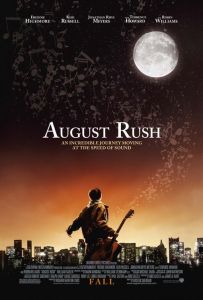 Am I too cynical for my own good? I’d like to think that I appreciate authentic works that tug at my heartstrings, and I’m a believer in the power that music can have, which are part of the reasons I named Once the best film of 2007. In comparison, August Rush tries to go all message and winds up skirting over why I should even care what happens to its characters.
In 1994 or so Lyla (Keri Russell) is a concert cellist in New York City. Louis (Jonathan Rhys Meyers) is the lead singer in a rock band touring the area. They meet atop a rooftop, look deeply into each other’s eyes, and then have sex. Parents, do not condone this behavior with your daughters and sons. But they’re separated through lame circumstances and nearly miss each other several times. This romantic encounter has spawned a son growing in Lyla’s womb. She gets into a car accident late in the pregnancy and was told by her manager/father tells her the baby has passed away. He is a liar because the baby was born and he signed it up for adoption.
 Flash forward 11 years. The child has gown up into the likes of Evan (Freddie Highmore) who lives in a boarding school for orphan boys. He knows his parents are out there in the world somewhere and he believe he can find them through the connection music. He gets lost in New York City and follows a troop of child musicians to the Wizard (Robin Williams). He looks after a gathering of orphan musicians that play on street corners. It’s like Oliver Twist meets American Idol with an extra dose of sugar. Sure enough Evan stars drawing a crowd and the Wizard wants to make sure he doesn’t lose his biggest earner.
This film is a ludicrous and manipulatively maudlin mess. August Rush plays all the big notes; the film’s script is entirely comprised of big moments that waddle and crash into one another, and as such it ignores any details. Like the fact that Evan has the ability to connect to his long-lost parents simply by strumming an instrument, but he’s never heard of musical notes or touched an instrument until he was 11. If the kid hears music everywhere, which reminded me a lot of Bjork in the superior Dancer in the Dark, wouldn’t it stand to reason he would try to, I don’t know, play music? Now I’m not saying he’d have access to every musical instrument at the boy’s boarding house but surely he could have drummed something? I find it unbelievable that a musical prodigy would wait until he was 11 before he picked up an instrument. Also, he learns what sounds are labeled as what letter notes by a cherubic little tyke with some powerful pipes of her own. He goes immediately from learning what an F sharp is to scribbling complex musical notation on blank sheets of music stanzas. How does he know all the symbols and placements and everything that the little girl did not teach him in their brief instructional moment? I’ll go back even further. How come Lyla and Louis give up trying to find each other so easily? Why does Louis wait 11 years before he searches the Internet for Lyla, who, being a world-class cellist, would not exactly be low profile? And why does a pregnant Lyla not do more to, you know, get in contact with her child’s father when he’s even in the exact same city? It’s details like these that August Rush hopes to will the audience to ignore, but to me it was proof time and again that the film’s indifference to plot, character, and maintaining any level of credibility even on a heightened “urban fairy tale” level.
If you replaced the stars then this movie would prove to the world that it belongs on the Lifetime TV network. It’s a melodramatic free-for-all that turns the topic of music into a quasi-religious experience. Now I know for many that music actually can maintain a religious level of power and sweep, but I challenge people watching August Rush to replace the word “music” in the dialogue with any other word to fully realize how cheesy the dialogue is. Let’s try replacing “music with “the force,” and now read this choice line of dialogue: “You know what [the force] is? God’s little reminder that there’s something else besides us in this universe; harmonic connection between all living beings, every where, even the stars.” And: “[The force] is all around you, all you have to do is listen.” This is the kind of film where characters can look up into the void with wistful, wide-eyed looks and somehow connect over the ether. That’s how the characters stay together and eventually reunite in a predictable and sappy manner.
The music itself is rather unremarkable. It’s well composed but I wouldn’t be able to recall it again even if I had a gun to my head. When the movie trumps the message of the transcendent power of music it doesn’t help when the music it presents is less than special.
The acting befits the same cheesy atmosphere of the movie. Highmore is pretty vacant and looks like he’s shrugging from scene to scene, that is, until he bangs his hands against a guitar neck and everyone somehow calls this genius. I think part of Highmore’s problem is that regular folks just think that honest-to-goodness geniuses don’t really have to work hard for results. This is, of course, false. Mozart was a prodigy, yes, but he didn’t just yawn and write down invisible notes that were dancing in front of his eyes waiting all day to be transcribed. He worked hard. Highmore just looks off into the distance and he seems to be in a trance. It’s annoying.
 Russell gets to pine for something just outside her reach (turns out it’s a son) but she doesn’t flash an iota of the grace and magic she showcased in Waitress. Meyers gets to “sell out” and then reunite his mid 90s alternative rock band. Here’s the thing — the sound EXACTLY THE SAME after 12 years and yet on their first gig back together they have a huge crowd? The movie is trying to tell me that the tastes of pop culture wouldn’t change in a dozen years. Williams manages to give hints about a troubled past as a musical prodigy eaten up by a system hungry for the next big thing. He also bellows and growls and comes across like a creepy Fagan for a team of street urchins.
August Rush is sticky, sappy, manipulative and maudlin feel-good rubbish. This is the kind of movie that most people will probably never get. Perhaps people who live, breathe, sleep, and eat music will feel more inspired by its message of human connection and spiritual fulfillment via the power of music. That’s swell but it still doesn’t excuse the fact that August Rush is a overly serious, laughable, syrupy work. If you’re going to dismiss its faults as the film being a “fairy tale” well then the film still doesn’t establish any hard rules for its universe. The characters are still one-note and behave in annoying and moronic ways because the plot demands it of them. And classifying the film as a fairy tale still doesn’t make the music any better. I can’t believe this stuff had a shot of beating the spectacular songs from Once for 2007’s Best Song Oscar. In fact, August Rush wishes it was Once because that low-budget charmer was able to communicate the power of music honestly and profoundly with the added benefit of beautiful tunes. I would like to recommend that all people thinking about renting August Rush.
Nate’s Grade: C-
Share this:

Indiana Jones and the Kingdom of the Crystal Skull (2008)
 I lived in New Haven, Connecticut for a year while then-partner was earning her Master’s degree at Yale. We hated it. New Haven is a college town that doesn’t know it’s a college town, so everything closes at 10 PM, there are no student prices for anything, and the people there more or less sucked. We were happy to depart from the Nutmeg State. Then the week after we were going to leave was when Steven Spielberg, Harrison Ford, and the production team for Indiana Jones and the Kingdom of the Crystal Skull were coming to town. They were going to film a motorcycle chase along Chapel Street (where I walked to work every day) and all along the Yale campus. Finally, a reason to stay in New Haven presents itself and it has to happen after we escape. It’s not often one of the most anticipated movies comes to your doorstep.
I could have been an extra in the motorcycle chase, which set in 1957, could have used a long-haired Beatnik type (played by yours truly) for an exaggerated reaction shot. I could have been sipping on an espresso and then Indiana Jones could have zoomed by on the bike snatching by hot beverage, leaving a long-haired Beatnik type (me again) to mug shamelessly for the camera. It would have worked. Alas, it was not to be, though it certainly would have made this ages-in-development sequel more enjoyable on my part.
It’s been a long time since part-time archeology professor and full-time treasure hunter Henry “Indiana” Jones (Ford) beat the Nazis. The world has gotten a lot more complicated thanks to the Cold War, the atomic bomb, and the fact that Jones is now well into his 60s. It’s been 19 years since his last adventure but the man with the bullwhip and the dusty fedora still has a knack for intrigue. Soviet KGB agents have captured Indy and his friend Mac (Ray Winstone) and taken them to the Area 51 warehouse. They’re seeking a recovered artifact of alien origins that can wield tremendous power, as they always do. Irina Spalko (Cate Blanchett) is the head KGB agent and likes to threaten her enemies with a riding crop (perhaps she earns some extra money on the side punishing bad, bad comrades). Indiana Jones manages to escape and is pursued by the Soviets and blacklisted by his government due to his perceived involvement with Russia.
 Mutt Williams (Shia LaBeouf) seeks out the help of Dr. Jones. Mutt is a greaser on a motorcycle that might be a chip off the old block. His parents are in trouble. The stepfather that raised him (John Hurt), an old archeology buddy of Indy’s, has traveled to South America and found a legendary crystal skull. The bizarre artifact would lead the way to the mythical golden city and crazy amounts of Mayan supernatural power. Unfortunately, the skull has also made him as batty as a bat and Spalko is going to kill him. Indy and Mutt fly down to South America to save the crazy old man. Oh, and Mutt’s mother is also in danger, and she would be none other than Marion Ravenwood (Karen Allen), who has plenty of romantic history with a certain swash-buckler afraid of snakes.
Seeing Ford back in action just feels right. His character has grown into a bit of a curmudgeon but he’s working the same territory Bruce Willis did last year in the long gestated Die Hard sequel. He’s an old man serving some justice to all these young punks that won’t get off his lawn. The film acknowledges his age and mostly uses it as a means for comedy (he cracks that a life of adventure isn’t “as easy as it used to be”). Ford looks more alert than he has in years.
Blanchett is one of our finest actresses on the planet but she has serious trouble maintaining her Ruskie accent; she alternates between Russian and British the whole movie. Her dominatrix-styled villainess is certainly interesting, and man does she have great posture, but the film doesn’t really know what to do with the Soviet bad guys. They become more or less Nazi stand-ins and seem to repeat the same ambitions that the Nazis carried out in two or the three previous films. Allen has aged magnificently and is a welcome return. She and Ford have terrific screwball comedy chemistry and pick up right where they left off in 1981’s Raiders of the Lost Ark. LaBeouf does a solid job even though he doesn’t have any meat to his character after his Marlon Brando-like introduction in leather jacket and motorcycle. Instead, Spielberg continuously winks at the audience about Mutt’s obvious familial line. It wouldn’t be a Spielberg movie without some family dynamic.
 I’m pleased to reunite with Indiana Jones, I like the new characters, and I even like Mutt, but the story the characters are saddled with is lousy. This is the script that Ford, Spielberg, and co-creator/producer George Lucas all agreed upon? I’m not one of those people that have an issue with aliens being the primary movers and shakers in the plot (in informal talks with friends, many are upset that little green men are the stars). The first three Indy films dealt with a religious supernatural power and now this new installment covers a space alien supernatural power, so that doesn’t concern me. What bothered me is that Crystal Skull is a murky mash-up of [i]Temple of Doom[/i] and Stargate. Once the primary characters reach their hidden temple the movie takes a nosedive. Spielberg almost crafts an anti-intellectual message, where finding out the reality behind the magic ruins the soul. The exact story behind the Crystal Skull is frustrating in how oblique it is, and Spielberg doesn’t want to offer any clarity. I’m at a loss to explain exactly why anything happened in the concluding 20 minutes, least of all how an alien race must have a very different definition of the word “gift.”
Never before has the action in an Indiana Jones film come across as so campy. This is likely the most disappointing part of Crystal Skull: the action is too tongue-in-cheek. There were moments where I thought the film was one step away from Army of Darkness. Spielberg is enough of a brilliant tactician to know how to setup and build satisfying and stylish action, which normally involves organic complications and letting the audience fully grasp what’s happening. This means no rapid-fire edits and plenty of long, high angle shots to get the big picture. And when he’s in his groove, there are few that can top Spielberg when it comes to an action sequence. There are points in Crystal Skull where the action is rollicking and joyously packed with excitement and wonder. The opening sequence inside Area 51 starts the film off with a bang, the motorcycle chase through Yale is well choreographed, and a car chase in the jungle is fantastic in the amount of back-and-forth scuffles and emerging obstacles. It’s by far the film’s high point and then there was one point where Mutt was swinging from vine to vine like freaking Tarzan and he enlisted the help of monkeys. It took me completely out of what had been a rip-roaring action sequence. Then there’s the moment where Marion drives everyone off a cliff and onto a tree that bends to drop them safely before smacking back like a rubber band. I’m not asking for complete believability in an action caper but I’d prefer it not become an embarrassing Looney Tunes cartoon. Crystal Skull is filled with little moments that will completely yank you out of the movie.
The action sequences feel too pat for the material the film wants to cover. Even that great jungle car chase could have been boosted with some extra ingenuity. The scene opens with the Soviets driving a vehicle that is slicing the forest to splinters and clearing a path for the caravan of cars to follow. Now I know the Spielberg of 1981 would never have introduced such an interesting machine in a unique setting without using it later. The Spielberg of 2008 is different because this nifty blade mobile isn’t even seen again after its initial introduction to establish how a car chase in a jungle could be possible. The action relies too heavily on distracting CGI that takes the action sequences on annoying, over-the-top detours. Just because computers can make it happen doesn’t mean it’s always a good avenue to go down. In short, the CGI is undercooked and over used.
 I also need to speak frankly about the CGI — it is terrible. However, when I watched Crystal Skull my party got a tad lost on the way to the theater so the only seats left were the third row from the screen. I spent the entire movie with my neck craned up. Perhaps if I saw the film in a position it was more intended to be seen the special effects would come across as more professionally polished, but from my neck-cramping position they looked pitifully amateurish for a major summer blockbuster with Spielberg and Lucas’s names attached. The effects work is shockingly shoddy, but the practical production design is amazing. Unfortunately, this does not balance out in the film’s favor.
I’m coming across as harsh but I only get this way when my expectations are raised because of a pattern of quality. The three prior Indiana Jones films were lively, imaginative, and deeply charming and satisfying adventures that leaned toward the exaggerated but still managed to thrill without feeling dumb. Raiders of the Lost Ark is one of the few perfect movies in existence, in my opinion, and set the standard for all action/adventure movies to follow. It’s unfair to expect the same sensation watching a sequel 19 years after its predecessor, but Kingdom of the Crystal Skull does manage to hone in on the same spirit that made the other Indy films such high-flying thrill rides. If you set your brain to a low frequency, enter the theater with lowered expectations, and already know that at one point Mutt will swing from vine to vine like freaking Tarzan, then Crystal Skull will provide the necessary popcorn entertainment you’d seek in a summer blockbuster. It is possible to think Crystal Skull ranks up with its predecessors but that requires so much contortion that I wouldn’t know how to arrive at that opinion. I suppose we should all resort to the consolation that even with E.T. taking over the plot, this thing could have been a lot worse. Just remember that if an alien offers you a “gift” to run in the other direction.
Nate’s Grade: C+


 nathanzoebl
You must be logged in to post a comment.