The Invisible War (2012)
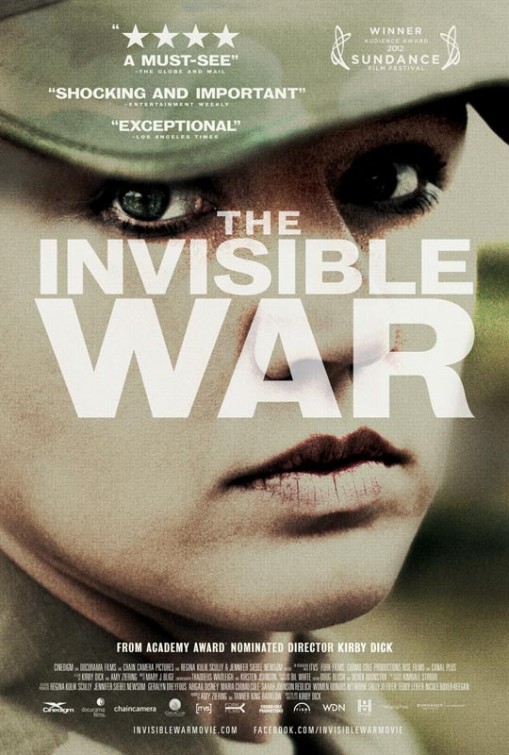 Kirby Dick is a documentary filmmaker known for picking fights with powerful institutions that operate in secrecy. In the Oscar-nominated Twist of Faith, he scrutinized the abuses of the Catholic Church covering up for sexual predators. In 2006’s This Film is Not Yet Rated, he hunted down the then-unknown members of the MPAA ratings board and delivered an overwhelming critique of their ratings hypocrisies. With The Invisible War, Dick has taken on a subject that’s even more powerful. The Invisible War, which won some awards at the Sundance film festival, examines the rampant numbers of sexual assaults and rape within the military. Through extensive, emotionally draining interviews and enraging statistics, Dick shows that most of the victims, when courageous enough to report their abuse, are met with skepticism, contempt, and injustice. One interview subject says that being raped isn’t what makes her angry the most: “It’s the commanders that were complicit in covering up everything that happened.” This is a shocking, sobering, and eye-opening documentary that deserves to be seen by every American. You owe it to the brave men and women who serve this country, to see this movie. The ugly truth needs to come out and be finally dealt with.
The upsetting statistics of sexual abuse within the military come from the Department of Defense, not an advocacy group, but our own government. Here are some of the most devastating stats:
-20 percent of all women in the military have been sexually assaulted and/or raped while serving.
-Women are twice as likely to be raped in the military rather than outside it.
-Military sexual assault/rape victims have a higher rate of PTSD than soldiers who have fought in combat.
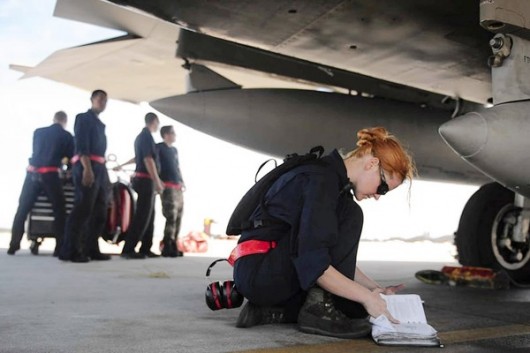 This is a profoundly revolting, morally repugnant, and infuriating story presented with damning testimonials clear-eyed logic. When I left the theater, I was radiating unquenchable fury. You could have harnessed my rage as an alternative resource. A lot of people blithely say they support the troops but we as a nation are letting these brave men and women down. The system is letting these people down, protecting rapists, training them to be better rapists, and then setting them loose upon the civilian population to continue their heinous crimes (it’s estimated the average sexual predator commits 300 acts in his or her lifetime). Listening to these heartbreaking stories can be grueling, but it is vital to listen. The women speak with such candor and bravery, befitting those ready to lay down their lives out of service for this country. But lest you believe this is merely a “women’s issue,” the film has a few interviews with male victims as well. With men outnumbering women six to one in the military, men are the majority of the victims of sexual abuse, a fact I doubt many would have known. As the experts attest, for an organization that rewards machismo, the shame for men can be compounded by the rampant homophobia within the American military culture.
It’s sadly understandable that so many of the interview subjects contemplated or attempted suicide. “Suicide or AWOL, those are your only two real options,” a military investigator laments. According to TIME’s investigative report, one Iraq and/or Afghanistan veteran commits suicide every day in America. Now remember that stat above concerning PTSD, and think about what the suicide rate must be like for victims of sexual abuse. One military man, husband to a rape victim, breaks down in sobs recounting his phone call for help while he tried to stop his wife from taking her own life. Watching proud, grown men break down into tears when they try and make sense of their institution harming their wives or daughters, it’s heartbreaking all its own. These veterans would not advise any woman to consider a career in the military, not when this is the sorry state of justice.
These victims were often handled with apathetic, callous, or downright hostile behavior, often being blamed for being attacked. These victims risked their careers to report their abuses, expecting some semblance of justice, and many times they were simply ignored or punished for “making waves.” One interview subject talks about how her commanding officer related that he had heard about three rape accusations that week and incredulously asked if the women were all in cahoots. One woman was raped and then charged with adultery; she wasn’t married but her rapist was, though he was never brought up on charges. Dick’s documentary lays a clear argument that giving the commanding officers, people often without any legal training whatsoever, the power to prosecute cases leads to plenty of ignored abuses. In 2010, the military reported 3,158 reports of sexual abuse (remember that 80 percent of cases generally go unreported), but only one-sixth of those cases lead to a court martial and only 175 of the assailants served jail time. And when they do serve jail time, it’s often knocked down to mere weeks. That way, the convicted serviceman doesn’t get charged with a felony. This also means when they leave the military, the convicted sexual offender does not have to register with a national sex offender database. When investigations do arise, they are routinely stonewalled.
 What emerges from this inflammatory documentary is that the command’s response wasn’t to protect the victims but to protect the accused, time and again. These commanders are supposed to be objective and impartial arbitrators, but this is hardly the case. It’s all about saving face, and a commander looks bad when he has a rapist in his unit, so rather than expel and punish the rapist, the military often drops the case and punishes the victim. Sometimes the commanding officer the victims are supposed to report the abuse to was in fact the perpetrator. In those instances, the victims have no possible path to justice. Major General Mary Kay Kellogg, Director of the Sexual Assault Prevention and Response Office (DOSAPRO), said victims could appeal to the Defense Department’s Attorney General, hence going over their commander’s head. Except that of the almost 3,000 cases sent to the DOD AG, not a single case was ever prosecuted. Kellogg also absurdly suggests that victims petition their Congressman. Just imagine a civilian being raped and told, “Better ask your Congressman if you want justice.”
The response to the systemic abuses has been ineffectual. The military response was to raise awareness, not sift out rapists from the ranks and protect their own soldiers from sexual predators. The ad campaign to raise awareness is jaw-dropping, with slogans like, “Wait til she’s sober,” and a horrendously ear-splitting rap song about sexual assault prevention. It’s so bad you can almost feel the seething resentment of the military. There’s also an informative video with a dramatization of a woman, fleeing helplessly after a man tries to touch her (the fact that this dramatization makes the woman look silly is intentional, me thinks). This woman runs into another serviceman who admonishes her, “Where’s your buddy?” The implication is that women should know that they can be raped at any time unless accompanied by a buddy. Does this not imply that every man in the military is capable of rape at the drop of a hat? And what if that buddy ends up being your rapist? The military builds a greater sense of camaraderie, and the men and women in uniform feel like a family. As one interview subject notes, when one soldier rapes another, it is akin to a crime of incest, a betrayal of that family. One victim was told she brought on the sexual harassment because of what she was wearing… which just happened to be her military uniform.
Dick’s film is obviously advocating a very specific side, but who cares about the idea of presenting balance given the subject? The Department of Defense spokespersons and their rote, officious responses are edited for some major points of baffled, incredulous laughter, as we contrast their company line with the testimonials of the men and women they failed to protect. Again, I return to the notion that not every story has two sides. What exactly is the other side in this epidemic of abuses? What possibly could the merits of the other side be, the status quo? This is not just some anti-military screed. In fact, many of the participants speak so highly of the ideals of the military, the duty to serve, and their genuine feelings of belonging to these hallowed institutions. This makes their disillusionment all the more distressing. Almost every interview subject has a military background, some discharged and some retired, and the movie presents its claims with clear, level evidence. The testimonials are so damming, the abuses so clearly documented, the obfuscation from justice so repeatedly maintained, that I cannot even fathom a second side to this story. When it comes to sexual assault, there is only one side to this issue.
 Dick also doesn’t overplay the obvious emotional appeals in the film. There is plenty, but he doesn’t sensationalize the drama or amplify the emotions in a self-serving manner. Instead, the film looks to clearly examine a systematic problem. Rather than deal only with potent outrage, Dick’s film is also a call to action with some strong ideas on how to better protect the victims of sexual abuses. Set up an independent system of justice outside of the commanders’ control, and work on preventing rapists from joining the military rather than cutting down the possibilities of how women can be raped. How about we punish the guilty party?
Last year, a group of veterans who had been sexually abused, initiated a class-action lawsuit against the military. This suit was dismissed by the court because, in their words, rape was an “occupational hazard of military service.” Reread that sentence again. Let it sink in. Now ask yourself is that at all acceptable given the values we profess for our country? The culture within the military is simply that rape and sexual abuses are just not that big of a deal (a Congresswoman admits that the Defense AG told her they have “other, higher priorities” to worry about), and so it all continues. The implication is that for the military to function, you’re going to have to excuse some excess, that excess being an estimated 30,000 sexual assaults a year. I’d like the military brass to explain to me what number would be unacceptable. How prevalent do these abuses need to be before proper action is taken, and not some facile PR, face-saving empty gesture, but something real? To me, one rape is one too many.
Dick’s excoriating advocacy documentary is powerful, furious, but sensitive to the victims and their horrifying ordeals. It declares that we can and should do better. In April, Secretary of Defense Leon Panetta watched The Invisible War and two days later made some changes. He took the decision to prosecute away from the commanders. It’s a start, but there’s a long way to go to fixing the military’s patronizing view of women. The movie opens with a series of advertisements targeted at women through the years, and the treatment is astoundingly patronizing and the film’s only spot of bleak humor. At one point, one of the victims asks if she and her fellow victims hypothetically deserve purple hearts for being wounded in battle too. “We’re never going to get anything,” another replies. These victims deserve recognition and justice, which has long been denied them. You won’t see a more challenging, infuriating, and compelling documentary of this year. It’s hard to watch at many points, and I cried at five separate occasions, but this is a movie that needs to be watched. I invite all readers to visit the Not Invisible site and consider joining the advocacy of this noble cause. You say you support the troops? Prove it.
Nate’s Grade: A
Share this:

Project X (2012)
 We’ve all had the fantasy of throwing an awesome party, a revelry of youthful exuberance, and cutting loose. The house party is a teenaged rite of passage. Project X is produced by Todd Phillips, the director behind The Hangover as the advertising would like to burn into your associative memory. You’d expect some wacky comedy and boorish behavior from boys living out their wildest fantasies. I felt a deep sadness watching the events of Project X. I won’t bemoan it as evidence of the decline of Western civilization but it’s certainly not helping matters.
Thomas (Thomas Mann) is a gawky, awkward, nice kid who’s celebrating his 17th birthday. His upper middle-class parents are going away for the weekend and trusting their only child with care of the home. Naturally, Thomas’ best friends, Costa (Oliver Cooper) and JB (Jonathan Daniel Brown), take this opportunity to stage a party. They invite all the popular girls at school, spread word via radio and Craigslist, and hundreds descend on Thomas’s family grounds with the intent of partying harder than Andrew W.K. Kirby (Kirby Bliss Blanton), long a friend of Thomas, is crushing on the guy and he doesn’t realize it. His attentions are on Alexis (Alexis Knapp), the school’s unattainable Hot Girl. As Costa clarifies, this party is meant to be a game-changer for their social lives. They’re supposed to reach for the stars tonight, which means groping strangers and puking in the bushes. Aim high, boys.
 This did not have to be a found footage movie, and Project X would have been better if stripped of this tedious gimmick. By making this a found footage movie, it roots the quickly escalating madness in a reality that cannot sustain it. The film’s credibility goes out the window without a thought. A wild party that rages out of control is a believable setup, but when you toss in so many out-of-nowhere outlandish elements, including an angry midget, a crazed drug dealer armed with a flame thrower, a high-story zipline (who put that there?), and the groundswell of a consequences-free riot, you strain all sense of believability. I also found it unrealistic how blasé people reacted to the presence of a camera in certain situations. I think people at a school might not want to be recorded for who knows what purpose. But easily the scene that stands out is a locker room with a bunch of guys in various states of undress. Seriously, not one character, not even a minor character, raises any issue with someone casually recording a place where men are undressing. I’ll grant the exhibitionist antics of the party (the courts of our land have ruled that flashing is not considered an “invasion of privacy”). Then there are also the lighting changes at Thomas’ house. All of a sudden certain rooms have very distinct, stylish blues and greens for lighting. Where did that come from? Did someone find a colorful bulb? These are the dumb questions that arise under the belabored pretenses of a found footage movie. There’s no reason this movie shouldn’t have ditched the found footage gimmick and simply played it straight.
Congratulations Project X, for it was you who cemented the death knell of my youth. I don’t have anything against party movies (Superbad is great, Can’t Hardly Wait ain’t bad either) and I don’t shrink from the presence of ribald, juvenile, inappropriate and/or illegal underage activity. Dazed and Confused is one of my favorite films of all time and that movie is nothing but kids getting drunk and stoned. But lo, Project X was the first party movie I’ve watched where my sympathies lay not with the party animals but with the annoyed neighbors and parents. Maybe it’s a sign of getting older; maybe it’s just the culmination of my upstairs neighbors playing heavy-bass electronica music at all hours of the night when I have to work in the morning. Or maybe it’s just a clear indication that this movie fails on any level to make me care about these moronic, annoying, unbearable characters. So when these twits are off celebrating the wanton hedonism unleashed in their backyard, I thought of the neighbor with a baby who just wants his kid to sleep. Is that an unreasonable request? The man isn’t presented as some incensed, dangerous madman, and what does he get for daring to question the noise level of this party? The man gets tazed. That’s what you get for expecting anyone to possibly be moderately considerate about their actions affecting others (I sense a God Bless America-style rant approaching). I just found this whole thoughtless, empty exercise to be exploitative, mean-spirited, and exhausting. Am I that old or is this movie simply that bad?
 You want to know how flimsy the plot is for this monstrosity? You could have written the entire thing on a napkin. Why bother with characters or story? This movie is seriously like someone took the Smashing Pumpkins’ music video for “1979” (possibly the best cruising song) and expanded it to feature length. Even at barely 80 minutes, this is one creaky movie that struggles to pad out its running time. The party mostly consists of two-second shots of people jumping around, girls shaking their asses, people smashing things, people vomiting, and the occasional boob flash to remind you how similar in tone the film is to the sleazy Girls Gone Wild series. That’s at least half the movie, if I’m being generous. What did I just describe? A music video! A music video is composed of, often, nonsensical images that serve little purpose other than to stimulate. There are plenty of segments that are nothing but pounding music and people dancing. If you buy the soundtrack (and why wouldn’t you since it’ll be ringing in your ears for days) and do some pseudo-inebriated dance movies, you’ve basically recreated the plot in your own living room. Project X is a music video writ large, not just in its style but in its single-minded execution to do nothing but string a series of rapid imagery. Good Lord, if this stuff made the final film what was left on the cutting room floor?
Project X also has the ignoble distinction of making me loathe a character not just in his very introduction but also in the very opening SECOND of the film. The first second I got of Costa told me everything I needed to know. His smarmy, irritating, faux “gangsta” machismo persona was enough. I knew this guy was going to be a douchebag. One second in, Project X, and you’ve already dug yourself a pretty significant hole. The Costa character is unfunny from beginning to end. There is not a single joke, a single one-liner, a single reaction of his that made me laugh. He is an insufferable character and a transparent combination of Superbad’s McLovin’ and Jonah Hill’s character. I hated every wretched second his face was onscreen. The other two friends didn’t make me want to punch my TV, which was the only positive thing I could say about either of them. Thomas is your typical mild-mannered, awkward teen (read: the Michael Cera role) who gets to cut loose and grow a spine of sorts. He has no personality and I couldn’t work up the effort to root for him. I can’t really say anything about JB because he adds absolutely nothing to the movie. He has no personality as well, other than his girth and desire to bed some ladies. It’s like the movie forgets he even exists. I know I did.
I know that making a feminist diatribe against this movie is a waste of time but indulge me for a moment, dear reader. I understand that this entire enterprise is untamed male fantasy and wish fulfillment. I don’t have a problem with this notion, on the surface. But why do all the women of this fantasy have to be reduced to, in Costa’s words, “drunk bitches” and “hos”? The women of this universe, which is supposed to be our own remember, are merely walking toys ready to be exploited for male entertainment. We don’t get characters; we get attractive women in great states of inebriation and exhibitionism. It’s ridiculous the amount of older, attractive women who would be enticed by… a high school party? Don’t these people have college parties they’d rather be attending? At one point JB identifies one of the girls at the party as a woman who posed for Playboy, because that’s all women are good for in this movie. Why would Alexis agree to bed Thomas just because it’s his birthday? We see no connection, and he’s certainly not a wealth of charisma. It doesn’t matter. Women are to be ogled. They are decorative furnishings.
 Then there’s the aggravating romance between Thomas and his best girl friend, Kirby. First off, if this is the quality you get with girl-next-door types then I am moving to that neighborhood. This woman is a bonafide hottie, so when the guys make dismissive comments that Kiby is just one of the guys, I question what criteria these men have for female beauty. Any of these guys would be lucky to ever interest a woman of this stature. And then there’s the fact that she so easily forgives Thomas after he makes an ass of himself and tries to hook up with another girl hours after sleeping with Kirby. It’s like the movie advertising that you, American teenage males, can have it all and with a minimum of humility and empathy.
I guess the real question is whether any of this gratuitous debauchery is fun. The whole movie runs on the caffeinated, fist-pumping highs of unchecked male ego and fantasy, but it’s trying so hard to be the most epic party ever, and that’s the only ambition the film has. This is one sleazy and off-putting movie. Even some of its egregious faults could be partially forgiven if the movie was any funny. It just isn’t. It’s loud and profane and anarchic but without interesting, relatable, or even defined characters, and the plot is so feeble I could sum it up thusly: Nerds throw party. Shit happens. They get to be cool. In between those momentous plot points is a lot of incoherent imagery of people dancing, women being objectified (by the camera, the filmmakers, the audience), and pounding music. The plot is so simplistic, so plainly an afterthought, that the entire hedonistic festivity reeks of lazy exploitation. Congratulations, Project X, you’ve turned me into my parents. Now get the hell off my lawn and get a job and make better movies!
Nate’s Grade: D
Share this:

Hope Springs (2012)
 I may be 30 years removed from the target demographic, but I found the sexagenarian romance Hope Springs to be charming, insightful, and quite well developed. The idea of Meryl Streep getting her groove back and an older couple essentially learning how to be intimate again, physically and emotionally, sounds like a hard sell (no pun intended). The central couple has settled into the complacency of a long marriage, and little divisions have turned into routines. How can you bridge the divide? I was routinely surprised at how mature and thoughtful the movie was when it came to examining relationships. In between all these personal revelations of unhappiness is a curiously playful sex comedy, and you’ll see Streep engaging in certain acts you never thought becoming of the three-time Oscar-winner (no pun intended). Streep and her reserved husband, played by Tommy Lee Jones, are terrific, and their counseling scenes are the stuff of great drama, as two people who don’t really know how to communicate reveal their true feelings and problems. I’m making the movie sound like a chore but it’s really engaging and the stuffiness of Jones makes for some enjoyable comedy. This is a small movie, dealing with a weighty but recognizable subject that’s not often handled with this care and attention. Hope Springs is practically a Hollywood version of a Bergman film, and with these results, that’s not a bad thing. I foresee Hope Springs leading to a lot of patrons going home and having sex with their spouses. It’s like an AARP aphrodisiac. Good thing for menopause, or else Hope Springs would be responsible for a baby boom all its own.
Nate’s Grade: B+
Share this:

The Queen of Versailles (2012)
 Meet the Siegels, the subjects of a Sundance-winning documentary, The Queen of Versailles. David is a real estate magnate in his 60s. Jackie is his 40-something wife, a former model, and together they have eight children. It would be an understatement to call the Siegels rich. These people are stupid rich. These are people that have so much money they don’t know what to do with it, which is why David and Jackie set out to build the biggest home in the nation. After the subprime mortgage flameout of 2008, the Siegels took a major hit in their resources. But not everyone sees worldwide economic disaster as a wake-up call. Some just keep on shopping.
The Queen of Versailles is one captivating clinical study in overreaching. In the wake of the financial collapse, politicians were eager to lambaste the poor who bought mortgages they couldn’t afford (the better to shield blame from their friends in the banking cabal). Let this film show you that even the super rich can have trouble living within their (enormous) means. I won’t lie; part of the appeal of this documentary is the continual shock of the wasteful extravagance the Siegel clan called normal. How opulent was their lifestyle? Well their 26,000-square foot home only had 17 bathrooms, so you can see why the Siegels would feel the need to build the biggest home in the nation. This 90,000-square foot fortress was modeled after the actual French palace in Versailles, so you know, it’s going to be modest. It was designed to have 30 bathrooms, 10 kitchens, a bowling alley, an ice-skating rink, and two movie theaters (for counter programming?). The large stain glass window itself cost $250,000. The total cost of the project: more or less $100 million. I repeatedly laughed to myself in disbelief at the untamed lavishness on display. I confess it’s hard for me to put myself into this vapid mindset. I just see all hat money and think of all the better things it could have been spent on. How many children could be vaccinated with $100 million? How many people could have been bought out of slavery with that money? How many low-income students could have afforded college? The kicker, what really gets my ire, is that is was all unnecessary. The Siegel family already lived in a giant mansion. Did they have to live in a giant-er mansion? When is enough just enough?
 By the end of the movie you won’t know whether to scorn the Siegels or feel sorry for them. I’m at a loss myself. There’s a certain level of schadenfreude watching a riches-to-rags story, watching the wealthiest among us find their world of easy money come crumbling down. But then you start thinking what these people are going to do now without the luxury of wealth. The Siegel children are horrified when at one point dad declares they will likely have to go to college and, gasp, earn their own living. And if these kids have to fend for themselves, it doesn’t take a genius to get a sense of what the future holds. At one point, the adopted niece discovers her pet lizard is dead. Jackie harangues her about not taking care of it. “No one takes me to the pet store!” the niece declares. “But why didn’t you at least give him water?” Jackie reasonably asks. The niece responds dead-serious: “That wouldn’t have made a difference.” And these people are going to have to fend for themselves! The horror that waits. The entire family has been wrapped up in a cocoon of wealth, insulated from the real world, and now has no real sense of how to navigate this new, blunt reality.
Adding to the sadness is the dawning realization that David Siegel cannot stand his wife. Jackie is wife number three, and a former pageant winner/model, so we all know what stood out to the older businessman. Even his kids know. Late in the film, when the weight of creditors bears down on him, David sequesters himself in his private room, shows no interest in his wife or his children, and confides to his dog that the two of them could just run away together. With the comforts of wealth stripped away, and Jackie reaching, gasp, middle age, it becomes readily apparent that David’s waning affection is not going to reverse.
But the movie belongs to Jackie, the titular queen, and she is easily the most fascinating figure in the film. It’s easy to dismiss the bleach-blonde woman with huge fake breasts and a shiny, fake life of glamor. Is she a ditz? She got a degree in computer engineering. Impressive. Is she a gold digger? She cannot help herself when it comes to buying, whether it’s at Southerby’s or Wal-Mart. Is she even a good mother? She does admit that she would not have had nearly as many children if it weren’t for the ever-present nannies. What I saw was a woman who knew she could taste the good life and then became afraid of being kicked to the curb. David is happy to fund her personal projects and let her splurge on posh buys, but for how long? Her body, impressive though top-heavy, is aging, and her model looks are naturally fading into a comfortable middle age. Such is life. However, you can tell that Jackie is terrified. Mountains of money acted like a buffer between her and her husband. That’s gone now. He keeps joking that when Jackie gets old he’s going to dump her for two twenty-year-olds. Even when the family is downsizing, Jackie makes sure to fit in her beauty stops (botox, tanning, etc.). Some might charge the woman with being toxically narcissistic, but I think that’s too simple. Her looks are her meal ticket and now they are betraying her. She knows the type of man she married, and they both seem to be failing to live up to expectations. Now that the shiny distractions are removed, they have to live with one another as-is, and as-is doesn’t really work for men of wealth and ego.
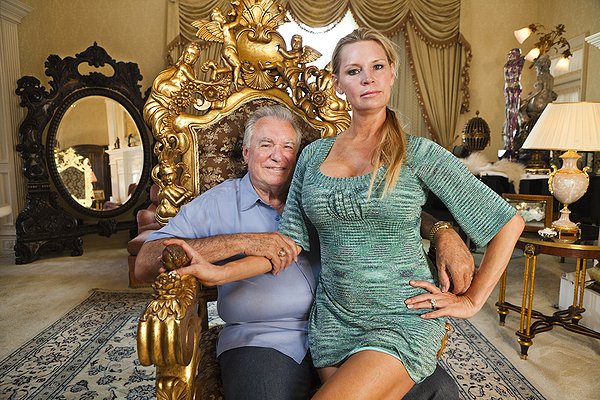 Director Lauren Greenfield (Thin) spent three years documenting the Siegel clan. She must have done something right with her finished product since David Siegel filed a lawsuit against the movie and Greenfield. The suit argues the film damages David Siegel’s credibility by positing that his company is on the verge of financial ruin. His company, Westgate Resorts, sold timeshares in the same kind of high-pressure sales tactics that lead to people buying things they cannot afford. After the 2008 meltdown, guess what? People couldn’t afford their own homes let alone a vacation timeshare. When the bankers freeze the easy money, Siegel and his company cannot pay their bills and have to downsize, sell offices, and foreclose major properties, including their signature Vegas resort. It’s hard to imagine that Greenfield went out of her way to portray a gloomy outlook on Siegel’s company when the facts are pretty black and white. He lost his access to money and lost assets he couldn’t afford any longer. The litigation just seems like desperate spin against the obvious and insurmountable.
From a documentary standpoint, not all of the storylines and messages stick together. You can tell Greenfield wants to use the Siegel clan as an allegory for the American consumerist culture. See, the movie says, even the rich overreached too. But beyond the audience feeling superior to such careless individuals, I don’t think this works. The movie never fails to be fascinating but practically in a car-crash sort of manner, as we vicariously lavish in the pornography of riches. Certainly Greenfield never condones the lifestyles of her subjects, not like the insipid, soul-deadening, vain Real Housewives reality franchise on Bravo (in a surprise to nobody, Bravo has snapped up the broadcast TV rights to Versailles). There’s plenty of derisive laughter to be had throughout, but you do wish that Greenfield had pushed further. Comparing the Siegel’s lives to their live-in nannies seems to be given superficial significance. These immigrant women bust their asses raising the Siegel brood and one of them literally lives in one of the kid’s super sized dollhouses. She literally lives in a former dollhouse. Choke on that metaphor. Then there’s a limo driver who’s had to cut back to make ends meet, but really the stars of the film are Jackie and David. Too often the film seems caught up in the “look how disgustingly rich they are” direction. This is a compelling documentary, to be sure, but it can lapse into an extended Lifestyles of the Super Rich and Famous.
David Siegel makes a very apt observation in the film. “Everyone wants to be rich,” he says. “If they can’t be rich, they want to feel rich.” Of course David Siegel’s company made a hefty profit from making people feel rich at their resorts. Everyone wanted to partake in the same illusion, the same false belief that the good times were never going to end. The Queen of Versailles is alarming, fascinating, and beyond belief at several points (why do these people keep getting more pets they won’t care for?). You’ll feel a general sense of moral superiority but that’s the movie’s weakness as well. The super rich are characterized as extravagantly wasteful, and while this is a notion that will not break any headlines, the movie too often dips into schadenfreude that doesn’t elevate the material. We’re left with the sinking impression that this clan is stuck in their ways and ultimately doomed. Since the film’s release, David Siegel has reclaimed his foreclosed super mansion, and now he’s brought the asking price down to a more reasonable $65 million. It seems that you can lose millions and still not gain a lick of sense and perspective.
Nate’s Grade: B
Share this:

The Campaign (2012)
 Broad and oafish for political satire, The Campaign has some decent belly-laughs to it with the main point that our national political environment has become a parody of itself. It’s Will Ferrell doing his usual boorish boob stuff and then there’s Zach Galifianakis as an effete, weird, family values doofus. When it gets looney, The Campaign is at its best. I loved a town hall that descended into a mob chanting their willful opposition to Rainbow Land. I enjoyed that Ferrell’s punching of innocent creatures was turned into a running gag. Having a racist old man pay his Asian maid to talk like an old black mammy because he misses the good old times? That is downright inspired and I giggle just thinking about it. The campaign commercials were perfect, and who knew Dylan McDermott could be this funny as a political ninja? The problem is that the movie works best as a series of scenes but doesn’t add up to much more. Some of those scenes are hilarious, and others are just passable lowbrow entertainment. Then the movie tries to foster a happy ending, with the evil business tycoons (an obvious avatar of the Koch brothers) foiled. I do not believe that satire can have a happy ending. It undercuts the angry, sardonic message of the movie. It’s just not the right fit for the genre. Alas, The Campaign tries to insert some pathos into the mix and it feels false and far too tidy. As for summer comedies, the movie has a few killer jokes and an amiable presence, plus a very short running time so as not to wear out its welcome. Like most politicians argue… you could do worse.
Nate’s Grade: B-
Share this:

The Bourne Legacy (2012)
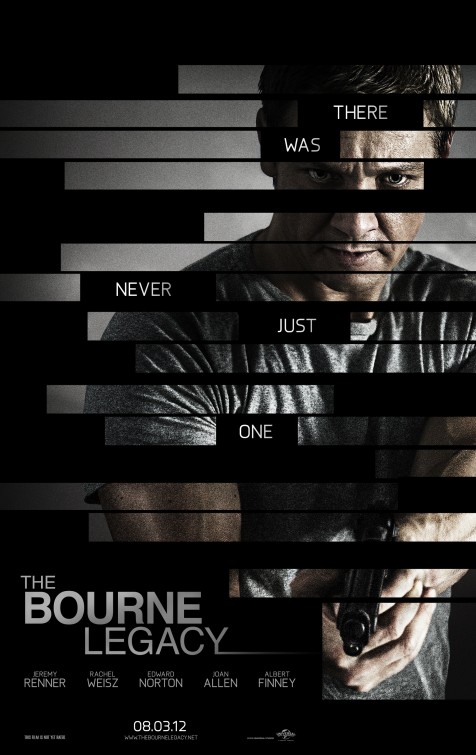 The Jason Bourne spy series has been a financial wellspring for Universal studios, so when Matt Damon and director Paul Greengrass (United 93) decided they had enough spy capers and hijinks, you can understand the studio’s concern. They elevated Tony Gilroy, a writer from the beginning of the series, to director. Gilroy has done some well-received directing gigs of his own now (Michael Clayton), so his ascent made sense from a continuity standpoint. I did wonder how much liberty the studio was going to give him, whether he was going to be boxed in to a style that had worked for the series. I never knew I should have had bigger misgivings, namely that The Bourne Legacy would ransom its conclusion and force the audience to make Legacy a hit.
Apparently Jason Bourne wasn’t alone. The C.I.A. has a team of six different super agents, each undergoing rigorous training and chemical alterations to their DNA via a series of daily pills. Aaron Cross (Jeremy Renner) is out in the Alaskan wilderness when the C.I.A., led by Col. Eric Byer (Ed Norton) and Adm. Mark Turso (Stacy Keach), burn all their agents. They plan on starting over and that means eliminating all evidence of the spy program that gave birth to Bourne. That means Cross has to go as well. That also means the chemists and scientists working on the program must also be silenced permanently, and Dr. Marta Shearing (Rachel Weisz) narrowly escapes a workplace shooting. Cross seeks her out for her medical expertise. They both have a common enemy that wants them dead. Together, the duo heads over to Manila where Shearing’s company manufactures the super meds and so Cross can become a permanent super agent.
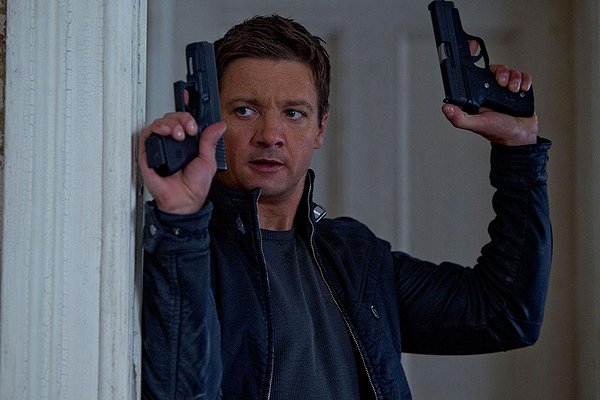 What the hell did I just watch? I know it’s labeled The Bourne Legacy. That part I get. What I don’t understand is that the filmmakers are trying to extort the viewing public into granting a Legacy sequel. Let’s cut to the chase. This movie has no ending. I don’t mean a bad ending. This movie is completely absent an ending. Not just an ending but also a third act. It’s like the filmmakers lopped off the third act and said, “If you want to see where this story ends up, you better get us a sequel.” There is no resolution for ANY STORYLINE in the entire movie. None. The good guys are still scrambling, figuring out how to blow the big bad conspiracy. The big bad conspiracy is still alive and kicking. The patsy for their wicked shenanigans is still the patsy. There is nothing that can be construed as an ending. At least the Damon Bourne movies each had a beginning, middle, and end and tied up their film plots. Sure the characters carried over and there were some larger, overarching storylines, but at least those movies felt complete. The Bourne Legacy is badly incomplete, a gaping void of a third act, and a blunder that makes me question the sanity of the filmmakers. How could you make a big budget summer action movie and not provide any semblance of closure? When the Moby tune kicked in on the soundtrack, I sat stunned, pinned to my seat in disbelief. “No, it can’t be over. They couldn’t possibly just end things here.” Oh, and they do. So enjoy 2/3 of a movie, folks.
With the anticlimactic end in mind, I now understand why the first hour felt so draggy. It’s because they had to fill out a two-hour running time. Especially for the Bourne franchise, the first hour seems to really be paced lackadaisically. For an action movie, it sure takes its time to get going. I wouldn’t have minded if I felt like we were setting up something exciting, but really the story is about a super agent who just wants to get his meds. He travels across the U.S. and the world so he can get his pills, and then he does, and then the movie abruptly ends. I’m simplifying matters in a crass way, I admit, but doesn’t this storyline just feel a tad slight? Legacy also starts to feel like a retread when it comes to its plot mechanics. The C.I.A. is burning all their super spy agents through suicide pills. They are destroying everything before Congressional oversight can reveal their true dastardly deeds. But then we need an antagonist, right? So the government goons reveal they have a SECOND even more super secret program to train super assassins/spies (“It’s Treadstone without the inconsistencies”). How far are they going to take this? Is there going to be a third super duper ultra secret level of killer spies? It’s repeating the same steps the franchise has already taken, the expert spy vs. spy clashes, but now it’s starting to get silly in a way the franchise had previously avoided.
 The action sequences are serviceable but they’re not any better than what the franchise has produced before. Cross has a few nifty escapes but nothing that reminds you of Jason Bourne’s sheer ingenuity. What other man can take down bad guys simply with a rolled up magazine or a book? Aaron Cross just can’t compete with that. The final motorcycle chase is nice but it just seems to be repeating the same danger with little variation. The best action sequence is actually a bit macabre. It involves a workplace shootout. To even call it an action sequence is a bit of a disservice since it’s actually a tense and horrific scenario that is coming eerily all too familiar in the news. Weisz’s character has to hide while her co-worker methodically guns down his fellow lab workers. Oh, and he also took off the door handles, making it dire for help from the outside to get inside. It’s a horrific sequence that’s played out to stomach-knotting levels of tension, as the dread slowly mounts and the pessimistic inevitability looms. Now, obviously Weisz was going to survive, as we know this, but the sequence still resonates with real, primal terror.
So what does The Bourne Legacy have going for it in its favor? Well the duo of Renner and Weisz is a pretty good pairing. Renner (The Hurt Locker) has been rolled out as the next thinking man’s action hero, and he finds interesting depth to his spy character in a rather routine plot. But he’s even better when he’s onscreen with Weisz (The Constant Gardener). There’s plenty of shouting matches and intensity but they have workable chemistry and Weisz’s character gets to be an essential part of the spy heroics rather than a tagalong. I cannot fault the actors for the film’s flaws.
I understand why the Universal suits felt like they needed to pump new blood into their lucrative Bourne franchise. After a while, an amnesiac super spy is going to hit a breaking point; he’s going to run out of essential memories to recall (Bourne 5: where Jason Bourne gets back the memory that he does not like Indian food). I like Renner and Weisz. I even like Tony Gilroy as a director. What I do not like is only getting 2/3 of a movie. Whose bright idea was it to just lop off the third act and provide no resolution? The ending is so unbelievably jarring, so staggeringly incompetent, that I have to dock this movie major points. I can’t say the ending out and out ruins the film considering I was only marginally liking it beforehand. The Bourne Legacy is proof that sometimes imitation is not the best substitute for ingenuity. Gilroy is no Greengrass. Cross is no Bourne. Legacy is no complete movie.
Nate’s Grade: C+
Share this:

Margaret (2011)
 The behind-the-scenes story of Margaret could make for a compelling feature all its own. It began filming in 2005. Writer/director Kenneth Lonergan had spent two years on the script. It was the follow-up to his Oscar-nominated 2000 film, You Can Count on Me. The only requirement was that Lonergan turn in a cut of the movie that was under 150 minutes. His first cut was three hours. The producers paid their own editor to chop the film down to two hours. Then came the flurry of lawsuits and countersuits between the producers and Lonergan. No less a cinematic statesman than Martin Scorsese was asked to take a look at the movie and edit it down to 150 minutes (Lonergan labored on the script for Gangs of New York). Several protracted years later, Fox Searchlight dumped the 150-minute Scorsese cut in a handful of theaters. Then a funny thing happened. The rare critics who got a chance to see Margaret flipped for it. Lonergan’s initial three-hour cut is now available on Blu-ray. It’s a happier ending than any of the participants might have imagined only a couple years ago. I’ve been eager to see Margaret for myself, to see if all these arty critics were being a bit overzealous in their praise. Days later, I can’t get it out of my head and I’m sure others would suffer the same wonderful affliction.
Lisa Cohen (Anna Paquin) is a privileged New York City teenager who usually gets what she wants. She’s on the hunt for a cowboy hat when she spots a bus driver (Mark Ruffalo) with one. She runs alongside the bus, trying to ask him about the hat. It’s just enough to distract the driver. He runs a red light and plows into a pedestrian, Monica Patterson (Allison Janney). As a crowd forms and help is called for, Lisa holds the broken woman during her final, hellish moments. Afterwards, she lies to the police to protect the driver. The guilt eats away at her. She lashes out, she hurts others, she butts heads with her stage actress mother (J. Smith-Cameron), and she’s looking for anything to cope. Eventually Lisa decides to come clean and seek justice but it just might be too late.
 Margaret is a messy, imperfect film, over-indulgent and cluttered, but man does it stick with you. It sits in your stomach. You can’t shake it. You just keep thinking back on it. And after a while, the flaws itself start to transform into virtues themselves. The film is messy and all over the place but my God does it excel at recreating, in startling spasms of uncontrollable emotion, the life of an American teenager. There is no off switch when it comes to emotions, and when you’re young everything seems like the end of the world. Like Lisa, you alternate between self-involvement and idealism, and you haven’t hardened to the way the world works just yet. The movie, thematically, latches onto the same wavelength as its heroine. Lisa is a flawed creature, deeply hurting and trying to come to terms with her own responsibility and guilt for the accident. It just so happens that she makes mistakes trying to deal with that pain, and innocent people get hurt, and people we once thought were noble reveal their own impulses and vulnerabilities. Whether she’s sympathetic as a protagonist doesn’t matter, though even when she hurt others I never found her less than fascinating. She feels everything so intensely, and those intense feelings bleed into other areas of her life. She can be woefully self-involved and callous at times, but she can also be self-possessed and fearless in a moral quagmire. At one point, a character argues that teenagers would govern better than adults because teens are still idealistic and proactive, even if their actions are dismissed as naive. Lisa wants to find justice in the world somehow, so she can make sense of this random tragedy. She still clings to the belief, even as the film becomes a messy legal battle (one of its many genres Lonergan dabbled in).
There are plenty of storylines and themes and messages that Lonergan wishes to weave into a seamless patchwork version of our intolerable, detached, self-involved culture. The film is something of a time capsule, way back in 2005, and the post-9/11 anxieties and civil insecurity is also dealt with in interesting ways. Lisa’s social studies class repeatedly descends into shouting matches, debates that reduce the opposition in the simplest terms. After a while, all we’re doing is trying to out-shout the other and no one is listening anymore. Lisa comments that our culture feels so disconnected and that people have stopped relating to one another. Of course this also extends to her as well, as she confuses her feelings and those around her. The mother-daughter dynamics are a fascinating character insight and one of the better onscreen relationships I’ve seen in years. You can clearly see where Lisa gets some of her showboat tendencies. Both mother and daughter have stopped being able to relate to one another, and Lisa can wield sarcasm like a weapon, as teenagers are wont to do to their parents. Mom is dating a man she doesn’t particularly connect with, and yet she enjoys the company and the desire to be wanted. Is that enough to fulfill her gnawing sense of loneliness? Lisa’s father is the type to run from conflict, and yet the man is just as self-absorbed and hurtful as anyone else in the film. Except he’s an adult and, theoretically, should know better. In that regard, the movie reminds me of the excellent Little Children; this is a movie of mitigated personal responsibility from people of all ages. If this is the way the world works, then why not give teenagers a chance?
 The opera is a reoccurring motif for the film, and it’s a strong artistic association for the film because Lonergan sort of gives his characters arias with which to work. The emotions are sent to overdrive, the arguments are full-blast, and the dialogue lands in that articulate, hyper-verbal territory but isn’t self-consciously snappy. It’s hard to quantify but it’s dialogue that’s painful and revealing and, while beautifully crafted, can come across as genuine. The entire movie is the same way. This is a drama where, in Spinal Tap terms, the emotions go to eleven. It’s a big bleeding heart of a movie, but it’s not corny or maudlin or mawkish or TV movie sentimental. It’s fearlessly emotional and takes you on a journey with many stops. You’ll likely be horrified, thrilled, precarious, elated, angry, saddened, and frustrated.
It may be best described as a series of potent, powerful scenes rather than a traditional screenplay with a clear through line. The most memorable scene also happens to be the one that sets everything in motion – the accident. It is horrific and awful in ways that movies rarely deal with. The first image we see is a leg pinned under the bus. Oh no, we think. But then the camera continues to pan down and we see… the rest of her in a heap. Oh no, we say to ourselves again, even more aghast. We’re there for the harsh reality, the sad realization of Monica that she’s going to die (“Are my eyes open? I can’t see…”), and the shock and confusion of the situation. There’s blood shooting everywhere, no sign of help, and the woman is fading away, confusing Lisa with her deceased daughter of the same name. Lonergan makes us stay in this traumatic scene for a long time, an uncomfortable amount of time, enough that the horrible incident is burned into our memory as well, and when Lisa crusades for justice or looks for some physical or emotional escape from the trauma, we know why. It’s one of those one-scene marvels, a byproduct of near-perfection on every technical level.
This is pre-True Blood Paquin and boy does she deliver when it comes to the dramatic feats of her character. She’s convincing as a coy, too-smart-for-her-own-good teenager, she’s devastating as a lost, dour soul lashing out at the world, looking for anything to ease the pain, and even when she stumbles, she’s fascinating. Paquin goes through a variety of moods to suit the variety of tones and storylines for the film, and her performance never falters. I’m amazed at how fast she can spit out the verbiage, while crying her eyes out, and all without gasping for breath. She’s nothing short of amazing.
 The rest of the movie is filled with recognizable actors in small parts, from Matt Damon (The Adjustment Bureau) as a nice guy math teacher with his own weakness, Matthew Broderick (Election) as a pompous English teacher, Jean Reno (Couples Retreat) as the off kilter suitor to Lisa’s mother, Kieran Culkin (Scott Pilgrim vs. the World) as the bad boy druggie who deflowers Lisa, John Gallagher Jr. (TV’s The Newsroom) as the nice guy with the unrequited crush on Lisa, Rosemarie Dewitt (The Watch) as the bus driver’s wife, Lonergan himself as Lisa’s neglectful father, and the triumphant return to screen of Jeannie Berlin (The Heartbreak Kid) who hasn’t appeared in a movie since 1990. Berlin has the juiciest part as Monica’s closest friend and eventual confidant for Lisa. She takes on Lisa’s mission for justice, but she’s still wary of Lisa and her hyperbolic nature. She accuses Lisa of making up a garish detail (the Lisa name confusion in Monica’s last moments): “This isn’t an opera! And we are not all supporting characters to the drama of your amazing life!”
The title of the film comes from a poem called “Spring and Fall” by Gerard Manley Hopkins addressed to a grieving subject named Margret: “Ah! as the heart grows older/ it will come to such sights colder/… /It is the blight man was born for/ It is Margaret you mourn for.” When you come down to it, Lonergan’s film is about the awareness of mortality, the shock of death, the realization of the end, and our pitiful attempts to turn off the feelings more fully felt. Adults, Lonergan argues, have become hardened to the world to the frailty of life, and you question if that hardening, a natural process, is a good thing. Perhaps the dubious claim that teenagers should take a chance running the world is not without some sliver of merit. Margaret is a movie that’s hard to pin down; there’s so much going on, not all of it fully realized or satisfying I freely confess, but it’s a thrill to witness an artistic vision that’s bursting with things to say, so many things that life cannot contain them all. The 150-minute running time will be a stumbling block for some, but honestly I never felt the film drag like I do most Hollywood action thrillers of that length. When you step away, and take the film’s messiness into context, then Margaret stops being an ambitious but erratic artistic miscue and starts coalescing into something bolder, richer, and thought provoking. It took a long strange journey to get here but Margaret is a movie that deserves to be savored and debated.
Nate’s Grade: A-
Share this:

Act of Valor (2012)
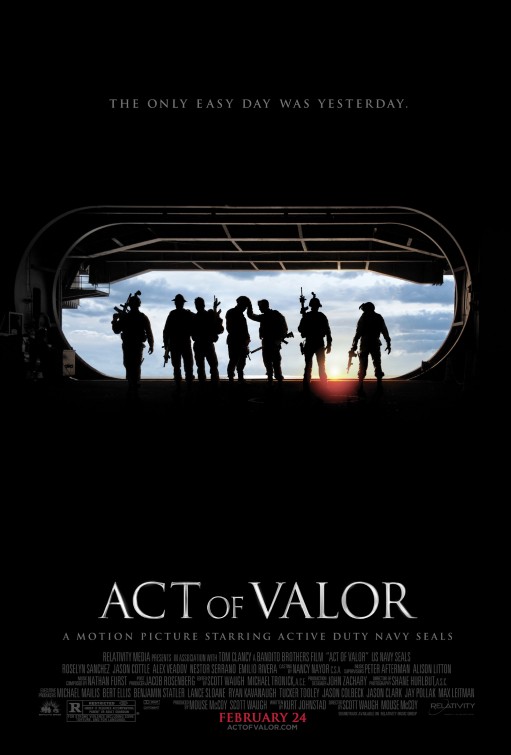 Hollywood often gets ridiculed for its tenuous connection to reality. I doubt any real U.S. Navy Seals look at 1990’s Navy Seals as a paragon of military validity. The makers of Act of Valor thought they could do one better than Hollywood. They hired real-life active-duty U.S. Navy Seals as their stars and made a movie based upon Seal combat experiences. Act of Valor was billed as the real deal. I just wish the filmmakers had spent less time on trivial yet realistic details and more time on plot, characters, and enticing action.
Who cares that the movie stars actual Navy Seals? Apparently enough people did judging by its healthy box-office returns in the spring, but really, why should a movie be any better because it has real Navy Seals pretending to be actors rather than actors pretending to be Navy Seals? Is this movie brought to a greater level of excellence because the characters know intuitively how to hold a gun properly? Was the slight difference in posture the difference maker? I suppose there is some curiosity seeing real Navy Seals go through all their training, but you know who else could be trained? Actors! Which these fellas are not. The line delivery is so flat, like the Seals were just happy to spit out all their dialogue and move along. There’s little emotion to just about any line that isn’t communicated via a bark. I can’t fault these servicemen because they never signed up to be actors; they have bigger things on their minds. Is there anything in this movie that could not have been done with actors? I doubt it. I understand the gimmick but I just can’t comprehend the appeal. Can an actor not be taught how to hold a gun, how to clear a room, how to squeeze the shoulder of his colleague to communicate move forward? I salute the Seals for trying (as well as defending our country, naturally) but I’m reminded of the old adage: it’s easier to teach an actor how to sing than a singer how to act.
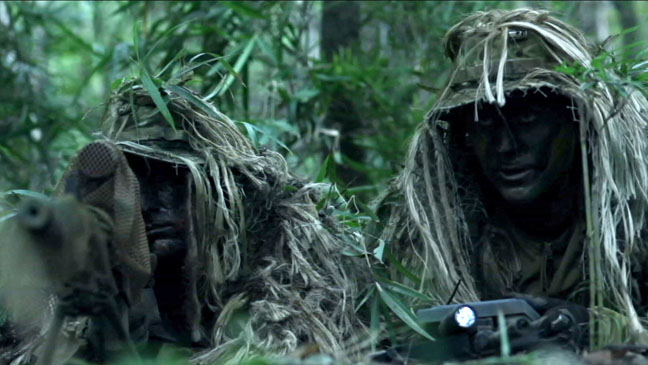 The movie seems more preoccupied with trivial details of authenticity than more important endeavors like story or character development. Here’s the most trivial detail of them all: live ammunition was used during the action sequences. WHY?! Do the guns not work with blanks? Why in the world would you dramatically escalate the danger on set and risk every shoot with live ammunition, actual gunplay? Action sequences are already a risk, so why would you exponentially increase the danger for … a slight uptick in realism? Again, it all feels like a movie in service of a gimmick. The plot is a rather cliché-filled jaunt across the world taking down terrorists, rescuing hostages, and mostly just knocking down doors, sweeping rooms, and shooting people in the head. Sure there’s a bad guy, a Chechen Islamic terrorist (double bonus: Russian and Arab!) and some other bad foreign guys with beards, but none of it ever seems to matter. I also question why a Chechen extremist would plot to attack the U.S., especially since we don’t exactly have the warmest international relationship with Russia. Surely a Chechen attack would strengthen that relationship, and the two countries might work in tandem targeting Chechnya. I’m saying this villainous plan is dumb. The good guys aren’t any deeper. Beyond their bravery, skill in combat, and impending fatherhood, we don’t know anything about these guys. A series of voiceovers try and list the various characters, but once the action starts good luck remembering any of them. In fact, good luck even keeping the two leads apart. I kept mixing them up myself.
And if that wasn’t bad enough, the action is a fairly big let down as well. Directors Mike McCoy and Scott Waugh must have studied under Tony Scott or Michael Bay, because every shot has the sleek beauty to it, the dawning sunsets, the cool gun mettle colors, the rah-rah jingoist spirit. Seriously, most of the action is just people shooting one another. That may sound like a no-brainer to anyone who bought a ticket, but the action needs to be properly thought out as well as the plot. The first mission, rescuing the tortured CIA Agent, is the best sequence because it has different points of action, organic consequences, and makes good use of geography. I’m going to hammer this point time and again until people take notice: geography is essential to well-developed action. You need to make use of your surroundings in interesting ways, otherwise what was the point of even setting the action there? The later action sequences fail to make use of any of these integral ingredients, so it becomes a rote series of people entering rooms, shooting other people, and moving to more rooms. Rather, rinse, repeat. The action has a muscular feel but it gets redundant rather quickly. That’s when your mind starts to notice how transparently the movie is working as a recruitment film for the U.S. Navy. There are sequences in this film that have no bearing on the plot (submarine visit?) other than to showcase the cool things that you, too, can do when enlisted in the Navy. There are plenty of sustained POV shots that give the illusion of a video game, war as a game. This is also why the complexities of war and geo-politics are sanded down to a series of clear-cut missions. I feel like the real servicemen deserve a more complex movie that treats their heroics as something more than clearing a video game level.
 When you get down to it, the audience that made Act of Valor a hit this past spring reminds me a lot of the audience that went to see the nearly four-hour Civil War movie, Gods and Generals. These are audiences obsessed with the details of realism. They’ll pore over the details of costumes and tactics. Whether the movie is actually any good or not, the characters engaging, the plot entertaining, is all immaterial. It’s the details they came to see. Hence the real-life Navy Seals, the missions inspired by real Seals, and the live ammunition on set. That’s what makes a movie to them. For me, I need more than realistic details; I need people and a story, and if it’s an action movie, then there better be well-developed action. It’s not like Act of Valor is a documentary people. It’s all pretend. I’ll be interested in how audiences respond to director Kathryn Bigelow’s movie about the hunt and execution of Osama bin Laden, Zero Dark Thirty. That movie uses actors and has an Oscar-winning director and screenwriter. Let’s see if anyone can tell the difference.
Nate’s Grade: C-
Share this:

Total Recall (2012)
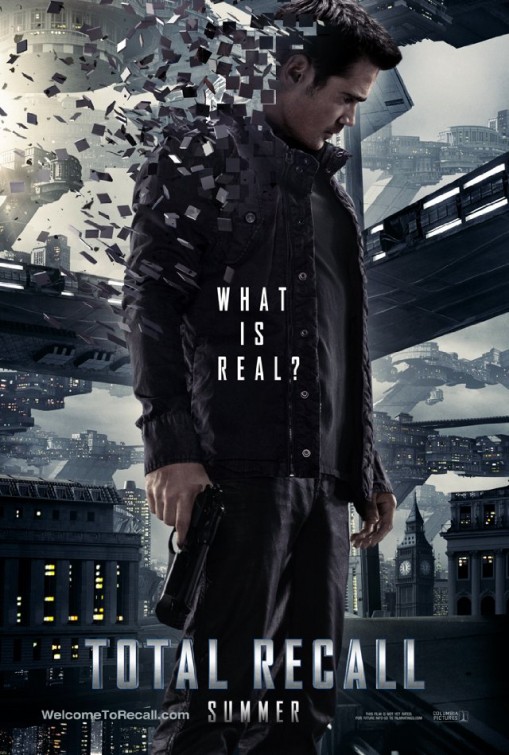 The latest needless remake takes the basic elements of 1990’s Total Recall and streamlines them into one very long chase sequence. And for those concerned males, the three-boobed lady makes a triumphant reappearance, because surely the movie wouldn’t be the same without her. Though in the age of the Internet, the sight of a three-boobed woman seems less indelible to impressionable male minds. But I digress. I was ready to dismiss this as another soulless Hollywood remake. Then I found myself enjoying Total Recall, and even the stuff that was dumb I had to also admit was cool. Take for instance a commute that goes through the center of the Earth. How exactly could such a thing be built? What does one do for maintenance? How does this not affect the Earth’s rotation? But then I forgot all about it because, in pure movie terms, it was cool. The zero gravity change-up as the transport changes directions at the core – cool. The fact that we get a zero gravity action sequence in this environment – cool. The fact that this transport system becomes a conduit for an invasion – cool. The plot mechanics are all familiar, notably the memory wipes and the super spy histories, but I didn’t care because the movie rarely lets its foot off the gas. When this thing starts, it doesn’t let up. The chase sequences are well executed amidst an imaginative array of locations, from a flying highway to a series of hanging housing developments. It’s not terribly smart but Total Recall is an entertaining escapist thriller that delivers some robust action and enough imagination in its future settings. Plus, there’s a woman with three boobs in it.
Nate’s Grade: B
Share this:

The Intouchables (2012)
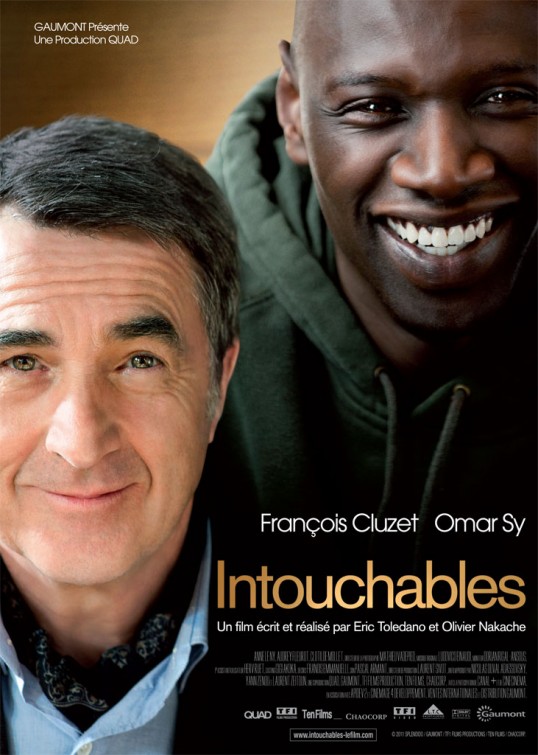 You’d never know it, but the highest-grossing film in Europe last year had nothing to do with super heroes, or sequels, or Hollywood itself. A small French film with the strange title of The Intouchablesmanages to break down just about every European box-office record last fall, sweeping across the continent and winning over hearts of numerous nationalities. The Weinstein Company bought the English-language adaptation rights, but before that gets underway they’re also releasing the original French movie to American audiences. Will subtitle-averse American audiences warm up to the little movie that has proven so hard to resist worldwide?
Philippe (Francois Cluzet) is rich quadriplegic and looking for a new caregiver to his many needs. In walks Driss (Omar Sy), a brash and headstrong man from a very different world: lower class, urban, and black. Philippe responds to the man’s irreverence and gumption and hires Driss on a trial basis. The upper-class lifestyle is like a fantasy to Driss, but the many responsibilities of caring for a man with no feeling below the neck are harder than anticipated. He objects at the very idea of having to manually evacuate the man’s… insides. The two opposites attract and the men become close friends and open one another up to new experiences.
 At its core, The Intouchables is the story of two men and their unlikely friendship. It’s told with enough weight, conviction, and character development that it’s easy to get wrapped up in the movie’s sweeping emotional tide. It’s a familiar tale, essentially that of the coming together of two people from distinctly different walks of life. You’ve seen this type of story before, where the upper class learns to cut loose and embrace life more fully, where the lower-class individual finds a path of dignity and responsibility. It’s been done before but rarely has it been done with such aplomb. Any storyline that involves a quadriplegic man and an inner city youth coming together sounds rife for after-school moralizing and sappy life-lessons. Thankfully, The Intouchables finds an angle that hits the emotional highpoints without tipping over into overt maudlin territory. Phillippe doesn’t want anyone’s pity. What is meant as good intentions can become another handicap; public perception of the individual’s limitations. Like The Diving Bell and the Butterfly, the 2007 inspirational French film about a significantly paralyzed man who could only move his left eye (what is it about French films and paralysis?), The Intouchables brings you into a world few glimpse and shows us what the perseverance of the human spirit can reap. Even a conversation that steers to sexuality can be illuminating and, for concerned male viewers, comforting that even if you can’t feel anything below the neck, the human body can adapt. In this regard, the film is a fascinating look into the life and care of a quadriplegic man (albeit an insanely wealthy one), and the fact that it’s also a moving and winning buddy comedy is yet another virtue. It’s like France’s version of a bromance.
It’s easy to see why The Intouchables has had runaway success in Europe, totaling over $300 million before ever opening in the States. This thing is a born crowd-pleaser. The characters are given room to roam, flesh out, and the interaction between two different men and their growing affection is a natural emotional foundation. We care about these characters, we smile and laugh with their interactions, the way that both men realize they need the other. It’s touching without being cloying and rich with emotional rewards by film’s end. Then there’s the fact that it’s also consistently funny without overplaying the class conflicts. There is an amusing subplot about the nebulous nature of modern art and what qualifies as “art”: the work or the knowledge that it’s from an “artist.” There’s a nice payoff with that one, but most of the humor is character-based, with the jovial Driss bouncing off the staid sarcasm of Philippe. There’s one comic subplot that seems to be hitting the same note time and again — Driss’ dogged romantic pursuit of Philippe’s assistant (Audrey Fleurot). It’s almost forgivable given the immense charms of Sy, but her character gets reduced to little more than a potential love match for Driss’ energetic libido. The humor, buoyant but also sensible, gives the film a defter touch when it comes to the more dramatic moments of loss and isolation and mourning. It’s easy to see why audiences have been falling in love with The Intouchables around the globe; they’re programmed to cry and laugh in equal measure.
And it’s that vague sense of programming that lingers. This is a film that knows exactly what chords to strike and how often. It can be accused of pandering and you’ll be able to guess every point of the plot. You think Driss will get Philippe to finally meet the woman he’s corresponding to for months? You think the upper crust will break from their immaculate stuffy prisons and learn to cut loose, spurned from Driss’ involvement? Do you think Philippe’s bratty teen daughter will learnt to shape up and fly right? Will Driss take a stand and stop his younger sibling from falling under the sway of criminal influences? Will the two men realize they truly need one another’s companionship? The answers are obvious; as are the plot turns and the happy ending, but The Intouchables goes about its business with such mass-appeal precision that you don’t really mind being manipulated. When someone can pull strings this skillfully, and quite transparently, almost daring the audience to resist, I almost admire the manipulation. Unlike Extremely Loud & Incredibly Close, another blatantly manipulative teary adult drama, at least this movie succeeds because we care about the characters rather than just bad things happening to people onscreen. The Intouchables isn’t subtle about its aims, but it is hard to resist a film this beguiling and tender and involving.
 Sy (Micmacs) is the breakout star of the movie. His gregarious, jubilant charisma instantly engenders the character of Driss to the audience. He’s constantly smiling, laughing, and cracking wise, and pushing others to be better. Sy brings such life to the movie that you instantly miss him when he’s gone. Cluzet (Tell No One), a dead ringer for Dustin Hoffman, has the more restrained role, no pun intended. His performance has to be very controlled yet believable, and Cluzet does an admirable job of building a character from the neck up. He’s a wounded man still recovering from the loss of his wife as well as his own crippling fears of loneliness. When these two are together onscreen, that’s when all the movie’s potential problems become a distant memory. The conviction in their big-hearted performances makes all the sentiment easy to swallow.
Several critics have accused the film of being borderline racist. I think the charge of racism is overdone. Just because Driss’ family lives in low-income housing doesn’t mean it’s making some blanket statement about the black experience in France. I suppose some chafe at the energetic, outspoken, and general virility of Driss. But I think critics looking for racist depictions of black males are overlooking the point that Driss had to be outspoken and energetic because Philippe is immobile and reticent. It’s in service of character contrast, not just recapitulating the figure of Loud Outspoken Black Male (a.k.a. the modern-equivalent of the age-old Noble Savage treatment). The significant part of Driss is that he has a sketchy past and comes from a low-income family struggling to get by. His race certainly plays up the contrast between the world of white privilege in France, but it’s not the central difference between these two men. Critics have also brought up the fact that the facts of the true-life story are different than what we see onscreen. Philippe’s caregiver, Abdell Sellou, was a Muslim man from Algeria, not a black man from Senegal. Does this truly bother anybody? Does the man’s heritage and ethnic background drastically alter the relationships formed or the earnest connections made? The movie doesn’t seem to think so and closes with the real-life figures onscreen, showing to each audience member the adaptation differences. Unlike something as racially questionable as The Blind Side, Driss is not rescued by saintly white people; he is an active member in his own self-actualization and not a passive receptor of the benefits of rich white people. With that said, there are still a few moments of ethnic depictions that might make you cringe, like Driss’ reaction to a night out at the hoity-toity opera.
During my viewing, I was reminded most of Scent of a Woman, another down-the-middle buddy comedy about a disabled man and his caregiver learning from one another and pushing beyond their comfort levels. It’s emotional without being too squishy and funny without going overboard, but make no mistake: The Intouchables is just as formulaic as a Hollywood production. The story and conflicts are familiar, the afflictions and backgrounds only differ. It’s feel-good, mass appeal comfort food, and when done this skillfully it’s hard to resist its call (I had a similar reaction to last year’s The Help). Its story of friendship, personal triumph, and all those happy things, but it’s also emotionally manipulative, littered with undeveloped subplots and a few uncomfortable moments of ethnic depictions. Fortunately the shining, vibrant performances from Sy and Cluzet, and their chemistry together, elevate the film’s softer and quasi-pandering sensibilities. It’s the story of two men, and by the end we greatly care for these two men, and their deep friendship and appreciation of one another. The Intouchables is a sly crowd-pleaser that dares you to defy its mass charms. And with actors this good, resistance is futile.
Nate’s Grade: B


 nathanzoebl
You must be logged in to post a comment.