The Expendables 2 (2012)
 The Expendables was a surprise hit two years ago. Sylvester Stallone collected an all-star team of aging AARP action stars and they kicked ass, took names, and didn’t apologize. It was a fitfully amusing throwback to the burly, macho action movies of the 1980s and the early 90s, a time where many of these men were kings. The nostalgia trip worked box-office magic for Stallone. A sequel was commissioned and these men of action were put back to work. There was already preliminary talk about the possible stars that could sign up for a third Expendables (Nicolas Cage and Clint Eastwood are on a wish list). Maybe people should see The Expendables 2 before getting too excited plotting out the future of this franchise. This is not a good movie even by Stallone’s standards.
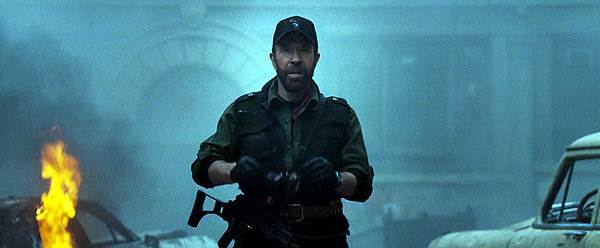
Barney Ross (Stallone) is back with the best team money can hire. No, not the A-Team, the Expendables. There are also the preposterously named team members Lee Christmas (Jason Statham), Ying Yang (Jet Li), Gunner Jensen (Dolph Lundgren), Toll Road (Randy Couture), and Hale Caesar (Terry Crews). The over-the-hill gang also has some new blood, namely Bill(y) the Kid (The Hunger Games’ Liam Hemsworth). The gang runs afoul with Vilain (Jean Claude Van Damme), a terrorist mining for plutonium to sell to the highest bidder. Barney swears to thwart Vilain and calls in help from other living action legends like Chuck Norris, Bruce Willis, and Arnold Schwarzenegger.
 What made the first Expendables enjoyable, at least for sustainable spurts, was its over-the-top nature comingled with a lack of irony. The movie felt often like a satire of the genre but you knew that Stallone was never winking at the camera. Stallone was never in on the joke. That changes with The Expendables 2, which often resorts to self-aware humor to poke fun at itself. This approach simply does not work. There’s an entire sequence where Chuck Norris even makes a Chuck Norris Internet joke, merging reality with irony. The bad guys are lousy shots and the good guys are the world’s greatest marksmen, but I don’t even know if this is intentionally self-aware or just par for the genre. Having Arnold repeat other people’s famous one-liners and quips (“Who’s next? Rambo?”) are not funny. The self-awareness never rises to the level of commentary or intentional satire, like say the underrated Last Action Hero. It’s just the same mindless violence but with the slightest of nods, the bare minimum to say, “Hey, we get it.” Except the movie feels shackled to this flawed approach and often the action fails to gestate into something larger than old guys shoot guns and make occasional wisecracks. The action sequences are really disappointing here. Little attention is given to geography, short of a climax set amidst an abandoned airport. I kept hoping for more of the gonzo, hyperbolic touches that the first film had in abundance. The best ridiculous moments this go-round are Van Damme roundhouse kicking a knife into a guy’s heart, and the piece de résistance, Norris shooting a guy onto an airport security conveyer belt where we then see the body full of lead on the x-ray machine.
Most of the Expendables teammates simply have nothing to do. Granted with a large cast the ratios of screen time are not going to be equal across the board, but I’d expect that Stallone and crew would at least give these people some reason to exist in the plot. Jet Li vanishes after the twenty minute mark and never returns. There’s truly no reason that Randy Couture and the great Terry Crews couldn’t have been Guy #5 and Guy #6. Lundgren is setup to be a chemistry genius, and then when trapped inside a mine, it looks like he’s about to utilize his chemistry knowledge to save the day. Nope. Then why would you even set this ability up if you weren’t going to do anything? Even Statham is pretty mitigated and he’s the number two guy. If you’re going to have a team-oriented action movie, then make use of the team and their unique skills. Part of the joy of these kinds of movies is watching the crew work together, like in The Avengers. With this film, we just get rapid-fire shots of the good guys shooting the bad guys, sometimes separately, sometimes together. It gets boring plenty quick.
 The plot is fairly bare-bones even more an action movie. It’s a rote revenge movie where Stallone and the boys are out to get Van Dame after he killed one of their guys (the only expendable Expendable, it seems). The plot never gets much more complicated than that. The gang encounters a group of terrorized villagers who want to rescue their husbands from Van Damme’s forced labor. Our bad guy even has a name that is a single letter away from spelling “villain” in case you needed the help. You know how he’s one evil man? He wears his sunglasses at all times even underground inside a mine. Of course this may also be a stylistic choice to hide Van Damme’s horribly Botoxed face. The Muscles from Brussels is actually the second best actor in the movie (Crews easily remains the best), good enough that I wouldn’t mind seeing the older Van Damme in more movies. Sadly his big showdown with Stallone is pretty short, with Van Damme resorting to the same roundhouse kicks before being subdued.
Stallone sat out the director’s chair and instead Simon West (The Mechanic ) takes the reins. I suppose this freed up Stallone to… focus more attention on the script? Emoting more? The visuals are fairly muddy and lack the polish of West’s other hyperactive action movies like Con Air. The opening assault sequence, where Barney and the Expendables roll through an enemy compound, literally busting through walls, is the visual highpoint for the movie. I credit the filmmakers for sticking with the R-rating and not toning down their violence. It would seem like hypocrisy to have a movie about a bunch of crusty old-timers lamenting how soft the world has gotten and then wuss out to a bloodless PG-13 rating. At least this wrecking crew doesn’t hold back when it comes to their specialty: mayhem.
The Expendables 2 should have been more than just Stallone and his peers patting themselves on the back. I’m glad Willis and Schwarzenegger graduated from cameos to supporting roles, but I wish the movie just had something for these men of action to do. There’s far too much repetition with its action, which becomes a formless montage of people shooting guns in slightly varying locations. The self-aware humor kills the development of the action and it’s simply not funny enough. It’s the kind of sad humor of old men trying to still look hip, like they’re in on the joke. Hey, they can make fun of themselves too. It’s just not a fun movie. There are only so many tried wisecracks you can endure, only so much redundant action, plotless excess, and crowbarred cameos. The Expendables 2 takes the little merits of the first film and completely loses touch, all to try and make a joke. In the end, the real joke is still on Stallone and the filmmakers. They wanted to make a movie that knew it was stupid. Instead they just made a stupid movie.
Nate’s Grade: C-
Share this:

For a Good Time, Call (2012)
 Given the success of the female-centric mega hit Bridesmaids, it was only a matter of time before we got a slew of girls-behaving-naughty R-rated sex comedies. Enter the phone sex comedy For a Good Time, Call, which has the distinction of being co-written by Seth Rogen’s real-life wife, Lauren Miller, who also stars in the film. It advertises a good time and mostly delivers, though you might not think as much about the movie in the cold light of day.
Lauren (Miller) has just been dumped by her self-involved boyfriend and fired from her job. She’s looking for a new place to live when a mutual friend sets her up with a huge New York City apartment. The catch: her roommate is Katie (Ari Graynor), an acquaintance from college she has despised ever since a very horrifying party foul of seismic proportions. Katie’s going to lose her posh home unless she gets a roommate, so the women reach a mutual understanding. Then one day, listening to Katie’s hyperactive sexual noises, Lauren discovers how her roommate really pays the bills. She’s been running a phone sex line and getting guys off for $3.99 a minute. Lauren decides to get involved in the business end, and before long the ladies have become a professional outlet and roll in their riches. Invigorated, Lauren starts experimenting herself, letting her freak flag fly, and before long she’s also getting in on the calls.
 Graynor is no stranger to stealing a movie, as she did perfectly in the sweetly unassuming 2008 teen romance, Nick and Norah’s Infinite Playlist. This girl has had the markings of a star for years and finally she’s found the vehicle to showcase her comedic vivaciousness. To say Graynor makes this movie is an understatement to her talents. Graynor is this movie’s pulse, its lifeblood, its font of energy, its wickedness, its exuberance, its very soul. This woman is amazing. She can take a simple line and with an effortless dose of comedic verve, it can become a gut-buster. I could watch twelve movies in a row with Graynor playing at this level of exciting excellence. The part is pretty familiar, the dirty girl who has problem with a filter, but Graynor makes the most of every opportunity. I loved her adorable theatricality, like a foxy, younger, brassy Bette Midler (God, did I ever think I’d string those words together?). I loved her enthusiastic hip shake, wearing large body stockings, while singing, “I’m ready to beat date rape!” Naturally, Katie gets all the best lines but her interplay with Lauren also works well. When the movie focuses on Lauren, and by extension the unremarkable performance by Miller, you start to feel things slag. Lauren is passive becoming active, but really even by the end she can still be cited as boring. Katie is active, hungry, brash, charming, and wonderfully portrayed by Graynor, and when she dominates, you’ll ask for more.
Except for the lively theatrics from Graynor, the movie can often feel hung up on generic sitcom plot devices and character generalities. The premise itself is perfectly fine, but the movie seems to exist in some randy fantasy world. We still have a main character in the world of publishing that will obviously be offered the Big Job at an inopportune personal time (as movies have shown, every human being on the planet either works in publishing, advertising, or theater). And then there’s the Bad Boyfriend, who breaks up with our heroine in the opening moments of the movie because they are “boring” together. Any guesses whether he shows up late as well, begging her back? I’d probably be more forgiving of these contrived plot turns if the movie did more to present Lauren and Katie as real characters. As written, they are pigeonholed into opposites (prude/wild woman) and rarely do we learn more about them. Lauren loosens up, Katie gains some self-respect, and they girls becomes BFFs. That development I found rather unconvincing, probably because there was little development. All of a sudden Lauren has an interest in joining the business, and one montage later, the girls have buried the hatchet. It feels like everything changed overnight. The attempts to ladle in some forced sweetness feels, in some regards, more crass than the sex jokes. I’ll credit the movie for keeping me amused while watching, but upon further reflection, the girls and their relationship feels rather slapdash and rote.
The comedy itself gets too easily complacent with all those naughty words bandied about. Oh sure there’s plenty of effective jokes about sexually frank conversations, and the inherently awkward nature of phone sex mechanics, but For A Good Time, Call seems too easily satisfied. I wish that Miller and co-writer Katie Anne Naylor had pushed their comedic setups further, had taken a few more left turns rather than settling for the familiar sex gag. Here’s an example: Lauren’s prissy parents make an unexpected visit and the girls have to hide their business particulars. That’s a fine starting point, but where else does it go? The comic tension is too easily resolved instead of escalated. Then, surprise, the parents make a SECOND unexpected visit. This time the sex decorations are prominently displayed. We’re waiting for some good comedic tension, some squirming, but again, it’s over before the good stuff can even get going (am I right, ladies?). The Justin Long (Going the Distance) flamboyantly gay friend is never as funny as the movie thinks he is. There’s a scene where Lauren is interrupted while masturbating, but we only realize after the fact when the joke is already over. Why introduce such a scenario if you were just going to settle for a weak “smelly finger” joke? Perhaps I would find the material funnier if I was a woman, relating more to the female dynamic on screen, but do you see how condescending that line of thinking gets? I unabashedly adored Bridesmaids (my #3 film of that year). I don’t think anyone needs to grade a comedy on a curve for any reason, especially if they think they’re trying to be polite.
 I’m not going to make more or less of its sexual politics than what is presented. I think there is genuine merit when women take ownership of their sexuality. Why should women feel judged for wanting equality when bedroom activities and impulses are concerned? Whatever helps people build a healthy self-image should be championed, as long as it’s between consenting adults. Watching Katie and Lauren personally grow based upon their unique entrepreneurship is welcomed. However, I can’t help but shake my feelings that there is something lurking, some deeper sub current that is not worth celebrating because the movie seems to play into male fantasy. Even though I adored Graynor, I think it would have served the film better if the more sexually-liberated character, the pro when it comes to working the phones, was actually a less attractive woman, perhaps a mousy gal you’d never expect such lurid behavior from. I think that would offer more comedic potential as well. I think this would also puncture some of the airbrushed fantasy of the film’s cheescake world of a phone sex line.
I have my complaints but I was laughing fairly regularly and enjoyed the experience, so if you’re just looking for a good time at the movies you can consider For A Good Time, Call. Watching Graynor sink her teeth into her role and go full gusto is a rowdy pleasure, and it’s easy to see that this woman is a star. The smutty jokes are fun and offer plenty of ribald laughs, but I always felt like the movie was too complacent, too settled, and curiously clumsy when it came to comic payoffs. The film is pretty flatly directed by Jamie Travis. The characters are pretty thin, and the plot feels ripped from a flimsy TV sitcom, but I laughed aplenty and found the movie difficult to dislike. It’s not the most nuanced sex comedy, or the most ribald, but For a Good Time, Call delivers enough big jokes and Graynor is too sensational to miss.
Nate’s Grade: B
Share this:

Lawless (2012)
 The bootlegging drama Lawless certainly has all the right elements to be an enjoyable movie. It’s by the men who gave us the great noir-Western The Proposition (director John Hillcoat, writer Nick Cave), it’s got a star-studded cast, plenty of bloody action, and a handsomely recreated production of the Prohibition era. But as I watched the Bondurant boys struggle against those who would like to put them in jail and/or murder them, I kept noticing something odd. I wasn’t that engaged. There was plenty of life-and-death drama, but why wasn’t I involved in the story more? Lawless feels like a series of scenes rather than a movie. Even when the plot changes it doesn’t feel like the movie is advancing. Even when things are more desperate it doesn’t feel like the momentum is building. The characters are somewhat sluggish as well, Shia LaBeouf as the scared youngest brother, Tom Hardy as the grumbly big brother who talks like his mouth is full of molasses. Jessica Chastain as the abused Good Woman who opens herself up to our Strong Hurting Man. Then you got a plot with a mobster (Gary Oldman) that weirdly climaxes with an hour left in the movie. He’s ignored for the remainder. Then there’s Guy Pearce as a colorfully fiendish and foppish special deputy that terrorizes the town. I am a Pearce fan but this guy is acting like he’s in his own weirder personal movie; it’s the kind of stuff Marlon Brando did. I appreciated that Lawless kept things gritty and bloody for realism, but I kept finding moments that ripped me out, namely the indestructible nature of Tom Hardy. Seriously, this guy has to be the Terminator. When he miraculously survives yet another seemingly fatal injury, all you can do is laugh. Lawless is passable entertainment but with its pedigree this should have been better.
Nate’s Grade: B-
Share this:

ParaNorman (2012)
 The gorgeously animated stop-motion film ParaNorman is a terrific sight for the eyes. There’s a certain magic to stop-motion, the tangible nature of it all, the knowledge that these intricate worlds actually existed. Like Coraline, the previous film by the same animation house, I thoroughly enjoyed immersing myself in this handcrafted world. The animation is so fluid, so sprightly, and displays a rich artistic tone. The story, about a kid who can see ghosts, is noticeably less ambitious. The characters are a tad one-dimensional (bratty older sister, dimwitted jock, socially awkward chubby best friend, etc.) and the plot is fairly predictable, but what really elevates ParaNorman is its sense of humor. I was laughing heartily throughout the movie, not just a giggle or a chortle but good, solid laughs. ParaNorman has an irreverent sense of humor with some surprisingly adult-oriented gags (nothing to worry about parents). With these virtues, the movie becomes an entertaining horror comedy aimed at young teens and older adults. It’s a fun movie, short of a saggy second act, and the animation is aces.
Nate’s Grade: B
Share this:

Celeste and Jesse Forever (2012)
 Celeste (Rashida Jones) and Jesse (Andy Sandberg) have been best friends ever since high school, the couple everyone admired. They’ve been married for six years but now they are in the middle of divorce proceedings. Why? Celeste loves her longtime best friend but worries he’s not maturing or stable to be her marriage partner. During their separation, Jesse admits he’s found another woman whom he cares about. Celeste professes to be happy but deep down is troubled, second-guessing her decision now that there’s a real threat she might lose Jesse. The two buds act like nothing has changed, goofing around and paling it up, but how long can they keep up this façade? Eventually, someone is going to get hurt because divorce cannot be shrugged off. Reality has a way of outliving ironic detachment.
Can you remain best friends with someone you once loved? How about someone you once knew as your spouse? Celeste and Jesse are certainly trying but their idealistic “BFF” status seems destined to meet a harsh reality. Celeste and Jesse Forever is labeled as a “loved story” and I think that’s a pretty apt description. These two characters clearly have a deep affection for one another, but after six years the feelings just aren’t enough. What happens when you marry your best friend but that just isn’t enough? I was hoping for some greater answers from the movie, or at least a harder examination on why some relationships fall apart when things look like they should work. That’s not exactly what the movie offers. For a film with an aim to be more realistic about the fallings out of love, the movie follows a familiar formula. There’s the cute guy at yoga (Chris Messina) into Celeste, but first she has to get settled. I think I wouldn’t have minded this character if he didn’t feel so much like a plot device, a hasty happy ending meant to be put in a holding pattern until called upon. The “Jesse” half of the title will be gone for lengthy chunks of the movie. His portrayal also borders on simplistic. I wish we got more of his side of the relationship, especially since he’s going through sudden change himself. After seeing the trailer, I thought I was going to find the movie immensely relatable. Maybe I just got all the recognizable personal drama out of my system with The Five-Year Engagement (double feature for bitter lovers?).
 Fortunately, the movie is also fairly funny. The comedy can feel a tad sitcomish at times with misunderstandings and catching people in embarrassing situations. The screenplay by Jones and co-star Will McCormack (TV’s In Plain Sight) is routinely amusing, settling with soft chuckles rather than anything histrionic. It fits the subdued tone of the movie, since it’s about people coming to terms with messy emotions and not whacky mishaps. Then there’s a whole subplot involving a teen pop star (Emma Roberts) that feels recycled from a whole other movie. This storyline leads to a few good jokes but it doesn’t seem to add anything of value to the plot. The comedy doesn’t overpower the dramatics, and Celeste and Jesse Forever finds a nice tonal balance between the heartache and humor. I wouldn’t say the film is necessarily quirky but it certainly operates to an offbeat comedic rhythm. There are a few cringe-worthy editions but the characters and the actors make it worth any personal discomfort.
If Jones (TV’s Parks and Recreation) needs a good boyfriend I will gladly volunteer my services. My God this woman is beautiful. I don’t want to set off any alarm bells, but this woman is a goddess. She’s also extremely talented and a naturally charming presence. Her chemistry with Sandberg (That’s My Boy) is out of this world. They are so relaxed together, so amiable, so enjoyable, that it really does come as a shock when their unamused friends have to sternly remind them they are getting a divorce. They have a wealth of in-jokes and secret couple codes, and they’re so cute together that you wonder if maybe, just maybe, they’ll reconcile by the end. Sanberg is better than I’ve ever seen him, giving a strong, heartfelt performance as a nice guy trying to make sense of his eroding situation. But this movie is Jones’ movie, and she shines. While her facial expressions can get a little overly animated at times (TV-ish mannerisms?), this movie is a terrific showcase for her dramatic and comedic talents. This woman will excite you, frustrate you, break your heart, make you laugh, but you’ll be glued to the screen.
 The tricky part is that Celeste is both our protagonist and antagonist. She is the root of her own unhappiness, and coming to terms with the fact that she was wrong is a big moment of personal growth, however, it’s not exactly the direction audiences may be happy with. It’s harder to root for a character that is sabotaging her own progress. Jessie, especially as played by Sandberg, is pretty much an adorable puppy dog throughout the whole movie; it’s hard to stay upset with him, and occasionally Celeste will lead him on and then punish him for following. She tells him to move on but then pulls him back to her when he threatens to do just that. She chastises him for not being serious enough, for not having direction, yet you get the impression throughout the movie that Celeste bares some responsibility in this situation as well. Jesse is laid back, though hardly the arrested development slackers dotting most of modern comedy these days. As one character notes, perhaps Celeste enjoyed keeping her husband grounded, limited, stuck. I don’t chalk it up as malice, more a comfortable situation that Celeste is afraid to disrupt. She’s the overachiever, he’s the underachiever, they compliment one another, that is, until Celeste decides they don’t. Then when it looks like Jesse’s growing up, she wants him back, or thinks she does, at least this newer version of Jesse. As you can see, it’s complicated. At no point would I dismiss Celeste as a callous person, but the movie is tethered to her personal growth of being able to admit fault. Her window with Jesse has passed. The movie is about her journey to realizing that.
Celeste and Jesse Forever feels like a movie of small waves. It doesn’t have the Big Declarative Moments of most rom-coms or indie romances, and that’s because it’s not a romance as much as an autopsy on why a romance went down for the count. It’s melancholy without getting mopey. It has certain hipster tendencies but nothing that rises to an insufferable level of twee; it’s routinely adorable and rather heartfelt in places, though I wish it had offered more potent insight into its characters. This isn’t going to be a movie that people build up great emotion for. By nature it’s pretty low-key, choosing to handle its emotional pyrotechnics with delicacy and the occasional comedic set piece. For a comedy about divorc,e this si surprisingly sensitive. These are nice people, good humored, and you sort of wish the movie would just scrap any indie ambitions and substitute a happy ending. You want to shout at the screen, “Just reconcile already!” Maybe that was me just using the movies as good old therapy again (see: The Five-Year Engagement review, or don’t). Celeste and Jesse Forever is an agreeable, affable, bemusing movie, with enough laughs and emotion to justify giving it a chance.
Nate’s Grade: B
Share this:

Hit and Run (2012)
 Hit and Run was a labor of love for actor Dax Shephard (TV’s Parenthood). He wrote the script, co-directed the film, did plenty of his own car stunts, edited the film, and got his longtime girlfriend, the irascible Kristen Bell (Forgetting Sarah Marshall) to co-star as his love interest. I just wish the movie were better. It’s something of a strange mix, a road chase that zips along to loping comedic rhythms, spending as much time having characters engage in self-aware conversations about a variety of topics. It’s like a rom-com with car chases. Shepard and Bell are terrific together and have a natural comedic chemistry to them, an ease that befits both of their acting styles. Then there’s some of the more troubling comedic moments, like when the villainous Bradley Cooper (The Hangover) literally ties a leash around a black man and forces him to eat dog food. It’s one uncomfortable scene to watch. Then there are sudden bursts of violence and nudity, to go along with the bizarre conversational tangents. The plot is a loose collection of near-misses and digressive asides. It wants to be one of those 70s car chase comedies, something along the likes of a raunchier Smokey and the Bandit. This movie does keep you guessing, but it rarely adds up to anything worth all the trouble. Car enthusiasts will probably enjoy all the vehicular eye candy, and I’m happy to see Bell tackle a meatier role than she seems to be offered at this time, but I can’t work up more than a half-hearted shrug for Hit and Run. It looks good but just has nowhere to go.
Nate’s Grade: C+
Share this:

2016: Obama’s America (2012)
 Dinesh D’Souza, noted conservative pundit and author, has risen to mainstream attention thanks to his documentary 2016: Obama’s America, a little movie making some big noise at the box-office. Co-written and directed by John Sullivan (Ben Stein’s Expelled), the film rationalizes that the American people don’t really know the true Barack Obama. D’Souza uses Obama’s own words from his best-selling memoir Dreams From My Father to try and decipher who the president is deep down, and D’Souza theorizes that the most powerful man in the world is really just trying to appeal to an absentee father. D’Souza visits the globe and promises to shed light on the “real” Obama, or, at least, the “real” Obama that fits into the narrative of a narrow political polemic.
After viewing 2016: Obama’s America, I am at a loss for words. This won’t last long, trust me.
This pseudo-documentary is such an intellectually dishonest, disingenuous, feeble-minded character attack, relying on heavy amounts of guilt-by-association, armchair psychology, factual whitewashing, leaps in logic, and ugly race-baited visual associations to remind its public that Obama is an “other.” I tried to be as objective as possible assessing D’Souza’s takedown on America’s first black president. I tried to analyze his rhetoric, his process of laying the case for his outlandish, paranoid claims. I tried to remove all personal politics from my assessment, and I still will attempt to keep them at bay, to simply review this as a “film.” What Obama’s America truly aspires to be is the evidence that your crackpot uncle cites as proof that his dismissive opinion of the president, that he’s not to be trusted, that he’s trying to destroy the country from the inside out, is correct. In this fashion, D’Souza is trying to give cover for the crackpots.
Let’s start with D’Souza’s fundamental thesis that supposes that Obama’s entire motivation is to live out the ideals of his father. He’s trying to impress his absent father. I cannot buy this broad generalization, and D’Souza keeps returning to it like he’s the only one who can see this obvious conclusion. I find it hard to believe that the father Obama saw once in his life is really the guiding force of his worldviews. Therefore, the more information D’Souza spills about Obama’s father the more he’s repeating the same conjecture without making any concrete connection. He interviews friends of Barack Sr. in Kenya and asks for their views of President Obama, a man they’ve never known. There is a litany of interview subjects with tenuous connection to Obama, most are always a step or two or more removed from the man himself. We get his mother’s college professor and Obama’s half-brother living in Kenya. That’s about as close as the movie gets. Often the interview subjects will disintegrate into weak hearsay (“I interviewed a guy who knew his father, so I guess I have some credibility.”). I also found it odd how when his interview subjects refer to his radical father, they keep repeating the name “Barack,” and not specifying senior or father. It happens so often that the intended association is quite transparent. Here’s a clue you’re dealing with a crank: D’Souza tries to make hay out of the fact that Obama’s book is titled “Dreams FROM My Father” and not “Dreams OF My Father.” Rarely has one preposition been given such (half-assed) psychological insight. The fact that the movie purports to get at the “real Obama,” and this is the scraps it offers, robs the movie of any desperately desired insight or credibility.
 The movie, especially the first 20 minutes, is also the story of D’Souza and his personal journey of why he feels America is the greatest land of them all. Just because the man was born the same year as Obama, got married the same year, and comes from a foreign country (though Obama is an American citizen who only spent four years abroad, but I digress), doesn’t mean somehow D’Souza has been given such psychic insight into the mind of Obama. Like Michael Moore, D’Souza inserts himself and his life story into his narrative when it’s not essential.
This would also work as an excellent case study in psychological projection. Since we don’t get people close to Obama, we get lots and lots of conjecture and people offering their “esteemed” analysis of the man. These so-called experts do what the man’s worst critics do, which is ignore the reality of Obama and project their radical interpretation of the man. An even-keeled centrist is a boring narrative, so now he becomes a Marxist, a socialist, a leftist radical, an enemy of the American way of life. This just doesn’t jibe with a pesky thing known as the facts. If Obama is really the socialist he’s labeled, then he’s a horrible socialist. No public option? Recycling the Republican health care plan from the 1990s, including the mandate? Relaxing more gun control laws than Bush did in his entire presidency? Stepping up record numbers of drone attacks in Afghanistan and Pakistan? Does that sound like a guy who’s “weirdly sympathetic to jihadists”?
D’Souza and his interview subjects even take the step of saying that Obama’s even-keeled style is really just a front, that deep down he’s a raging black man just like failed presidential candidates Jesse Jackson and Al Sharpton. The reason we don’t see this font of anger is because, and here’s the ingenious part, Obama knows how to manipulate us all! He’s secretly hiding his surplus of radical anger through emotional pragmatism. Not only that, Obama is manipulating race relations to lull us into complacency, because he knows white America wants to be assuaged of feeling racist, so we’ll appreciate and advance an African-American man of merit. Excuse me? Does that make sense to anyone, that instead of just being, you know, a pragmatist, Obama is secretly exploiting white guilt to advance, because otherwise how would this man become president unless we were all duped? None of that holds together. D’Souza’s 2010 book was called The Roots of Obama’s Rage (he also penned the 1995 book The End of Racism, so I guess he was just a little early on that one). The fact that two years, or less, into his presidency, D’Souza is ready to lambaste the man as “rageful” makes me think that D’Souza just cannot perceive objective reality like the rest of us.
D’Souza and company also take any opportunity to de-legitimize the man’s accomplishments. Obama didn’t win the presidency because he was an eloquent, charismatic, intelligent, and compelling political figure, not to mention that he got ten million more votes than John McCain. Could Obama have achieved the historic because of his accomplishments? According to this movie, Obama won the 2008 presidential election because of one thing: he was black. You see foolish reader, America as a nation wanted to assuage any collective white guilt over the transgressions of our ancestors, so we all (myself included) voted for the man as a declarative statement once and for all that we are not racist. Maybe a handful of people were motivated by such a ludicrous notion, but all 69.5 million Obama voters? This is not the film’s only simplistic generalization. We also have a psychological expert on what an absentee father does to a child. This is not a unique situation in our culture, nor is it one that prescribes a catchall response. Just because one person grows up without a father does not mean they will rigidly follow the same path in life; there are too many variables to prescribe one fate.
 The most telling moment occurs when D’Souza visits Kenya to trace Obama’s father’s life. He interviews the president’s half-brother and tries to needle him that his distant, famous relative is callous. “Why hasn’t he helped you out here?” D’Souza presses. “He has a family of his own. I can take care of myself,” the half-brother reasons, adding, “He’s got other issues to take care of.” This is the only member of Obama’s actual extended family that D’Souza manages to snag an interview with, and he shuts down his line of inquiry pretty succinctly. Later, the man gives some rather hostile views of Israel, which is meant to signal that any possible points he made should be invalidated.
Then there’s just the disingenuous and petty digs that omit key clarifying facts. D’Souza keeps railing against Obama as an anti-colonialist. First off, who in this day and age is going to champion colonialism, a system where the strong take from the weak? And why is colonialism even a relevant prism for the twenty-first century? Again, D’Souza offers little evidence to tie his theories to the man he’s critiquing. One of his key pieces of evidence is that Obama returned a bust of Winston Churchill back to England. For D’Souza, this is a sign of his distaste for Churchill as a colonialist. However, the facts are that the bust was on loan and scheduled to return to England anyway, before Obama took office, and there’s another bust of Churchill that remains in the president’s private offices. What an inconvenience the actual facts make. I’d like to share my friend and PSP colleague Ben Bailey’s thoughts on this specific matter:
“Little known fact I just learn from the Obama 2016 documentary: The bust of Winston Churchill that used to be kept in the White House was actually a magical artifact that protected this country from socialism as long as it was in America. Naturally, the Anti-Colonialist Obama’s first action upon taking office was to send that shit back. The other bust of Churchill that still resides in the White House does not have any magical powers, so it was kept.”
D’Souza also hammers home the notion that Obama opposes the British rule of the Falkland Islands, a tiny group of islands off Argentina’s coast. Another casual fact-checking venture proves this is false. The U.S. refused to endorse a declaration of Argentina’s claim of ownership. And these are just the petty examples of D’Souza’s argument approaching snide, dickish territory.
There are also the demonstrably false assertions, like Obama’s desire to destroy America’s superpower standing. D’Souza likes to obfuscate the eight years of Bush, speeding over him quickly in a timeline, lumping the national debt explosion under “Bush and Obama.” Conservative pundits like to lambaste the president for the dour economy, which has improved over the past four years, but they also conveniently forget the mess the man inherited. To ignore eight years of policies that helped lead to near financial ruin, two wars that Bush also left off budgets and Obama did not, among other things, is to remove all context. It’s like setting your house on fire and then blaming the next guy for trying to put it out: “Why haven’t you fixed everything yet, pal?” Record debt and financial ruination did not suddenly appear one day in January 2009 when a Democrat took office, despite what some choose to believe. Forgetting the eight tumultuous years of Bush, and their far-reaching complications, is a disservice to history and an ignorant understanding of how we got where we are now.
 Then there’s D’Souza’s dangerous assertion that Obama wants to weaken this country by cutting defense spending and our number of nuclear warheads. Anyone that talks about seriously reducing debt and the deficit and doesn’t offer slashing defense spending, a huge part of the pie, is simply not committed to their goal. Like not one dollar of defense spending is wasteful, and any cuts would endanger the security of American life? We’re drawing down two wars; do we need to keep spending like they’re still active? Also, Obama wants to reduce the world’s nuclear arms, and what’s so wrong with that? How many warheads do you need? Are 1,500 warheads not enough to blow up the world ten times over? The notion that any reduction in arms or spending accompanies “weakness” is fanciful. Obama doesn’t want to weaken this country by reducing America’s nuclear stockpile while the world continues to wield these weapons. He wants to reduce all the world’s nuclear arms to zero, an ambition D’Souza callously dismisses as fantasy. You know who also wanted to reduce nuclear weapons to zero? Ronald Reagan, D’Souza’s hero. As per his 1984 speech: “My dream is to see the day when nuclear weapons will be banished from the face of the Earth.” Even Superman was for limiting nuclear arms!
Now, as a piece of pure agitprop, Obama’s America suffers as well. D’Souza is no conservative alternative to Michael Moore, an expert at crafting a cohesive message with needlessly duplicitous measures. There is no subtext here; it’s all text. There are literally slasher movie violin shrieks on the soundtrack when D’Souza and an interview subject discuss the debt under Obama. There’s the image of thorn-covered vines covering the Middle East, threatening Israel to become the “United States of Islam.” There is no connecting of the dots, there’s only wide conjecture and baseless fear mongering. What this movie becomes is one long string of codes and buzzwords and dog whistles, meant to elicit a certain response from its likely audience. How many times does the phrase “Third World” need to be repeated? D’Souza even tries to turn Hawaii as a stalwart of radicalism with ONE interview from a guy who makes unsubstantiated claims. D’Souza also reminds the audience, as a wink to the birthers out there, that Obama’s birth was reported in two Hawaiian newspapers. What other purpose is there to mention this ordinary fact other than to appeal to the birthers in a coded manner? There’s a lot of juxtaposition between foreign cultures, Kenya, Indonesia, but what about the fact that Obama spent a far majority of his life in the United States? The man spent four years in Indonesia, and D’Souza makes it sound like this was the central formation of the man’s worldviews, not as he grew into maturity, went to college, and practiced law. Surely Obama became the man he was when he was seven years old, just like the rest of us.
D’Souza collects a conservative rogue’s gallery of people who must have had tantamount influence on Obama, including old targets like Bill Ayers and Rev. Wright. This is a continuation of guilt by association, a common tactic in 2008. Obama’s half-brother in Kenya talks about the West’s need to “tame Israel,” so D’Souza relies on us to make the connection just like with his father. If Obama’s family thinks this way, surely the son they have seen so rarely must be in lockstep? Because nobody ever differed in political views from his or her family.
 2016: Obama’s America, which hilariously predicts the end of the American empire circa 2016 (I guess a Republican president won’t be able to fix things), is a documentary that will convert no one. It’s constructed entirely to reinforce the alarmist notions of the president’s most fringe detractors. D’Souza doesn’t deal with facts because they get in the way of his exaggerated narrative of a fictional Obama, a man who is destroying our country in a quest to prove himself to his absentee ghost of a father. There’s plenty of logical inconsistencies, conjecture, and psychological projection and little evidence besides the expert opinions of people who knew a guy who knew a guy who knew Obama Sr. There’s plenty of unintentional comedy to be had, however, like a ludicrous racism-is-dead visual reenactment where a black man is upset because people at a bar are purposely giving him the cold shoulder (racists!). A minute later, they come out with a birthday cake and everyone in the bar, including the tattooed biker dude, erupts in applause for the heralded black man (see how wrong you were, world?). The basic assertion that Obama’s presidency is his attempt to live out his father’s ideals doesn’t stand up to scrutiny. It marginalizes a complex, educated man, saying he’s just a daddy’s boy, just like the film marginalizes the president’s historic election by saying it was simply an outpouring of white guilt (what about non-white people?).
I repeat: this pseudo-documentary is such an intellectually dishonest, disingenuous, feeble-minded character attack. It’s slimy, snide, petty, and wallows in conjecture and fear mongering. When the denizens in my theater applauded by film’s end, I felt a great sadness wash over me. If these people thought this appalling film was effective, was compelling, was informative, and was accurate, then I fear what prism these people choose to view the world through. Because 2016: Obama’s America isn’t just a horrid example of propaganda, it’s also the worst movie of the year, bar none.
Nate’s Grade: F
Share this:

American Reunion (2012)
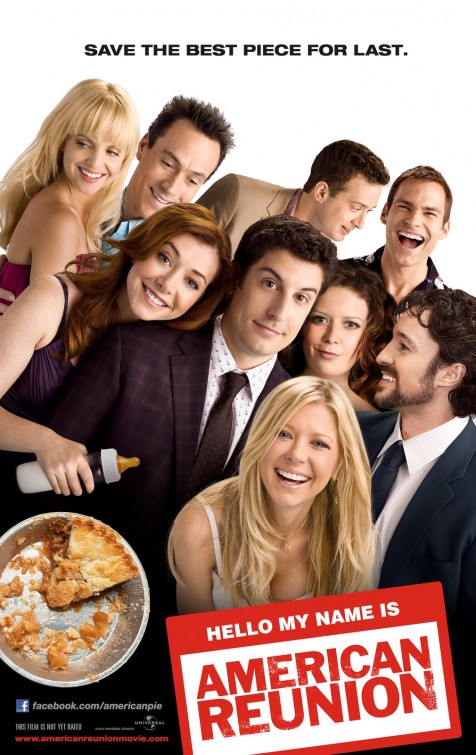 What loser doesn’t attend their 13th high school reunion? Who even organizes such an untimely event? The generally unnecessary American Reunion is being dished out to the public for a number of reasons. The studio would like to revive their once lucrative sex-comedy-meets-baked-goods franchise, and most of these actors could desperately use the work. Remember when the likes of Chris Klein, Mena Suvari, and Tara Reid were above-the-title names? What I recall, now that the gang is together again, is that I found most of these characters to be dullards. They’re in their 30s, have careers and families, and stupidly comfortable lives, yet they’re up to the same old hijinks, which just seem a bit more desperate and embarrassing this time around. Seann William Scott, the franchise’s true wild card, is still amusing as ever, but I couldn’t swallow the forced nostalgia for characters that are unappealing. Jason Biggs and Alyson Hannigan still make a nice pair, but rehashing the old gang mitigates their screen time. Comedy-wise, the movie has a few memorable gross-out moments but nothing really hilarious. I laughed from time to time but mostly I was bored, and Klein, especially in his new post-Street Fighter ironic version of himself, is rarely boring. It’s a pleasant enough experience and I suppose fans of the original films will get a kick out of seeing who ended up where and, in particular, what he hell happened to Reid’s leathery face. Otherwise, American Reunion is a gathering that nobody called for and fails to justify all the effort. Then again, my favorite of the American Pie films is the second one, so take my words with caution.
Nate’s Grade: C
Share this:

Killer Joe (2012)
 This is one nasty, alarming, but very involving movie that wallows in darkness and plays it up for laughs. Killer Joe is a dysfunctional family drama, a crime thriller, and a mesmerizing character study when it comes to the lessons of amorality. Based on the play by Tracy Letts (August: Osage County), Joe (Matthew McConaughey) is a crooked cop who works as an assassin on the side. A weasely loser (Emile Hirsch) and his family hire Joe to kill their mother for the insurance money. Things get out of hand in frequent measure, with splashes of brutal violence, healthy amounts of sex and full-frontal nudity, and a disturbing sexual act with chicken that more than earn this film its adults-only NC-17 rating. What makes the movie rise above base exploitation is its depraved, deep-fried sense of humor. There is plenty of uncomfortable laughter and guffaws. The end of the film, during a fever-pitch of violence, is so sudden, so kooky, so debauched, that my friend and I burst out laughing. Without its wicked sense of humor, and its sharp ear for working-class dialogue, the movie could be accused of wallowing in the muck. There’s also the terrific acting, chiefly from McConaughey. He gives a hypnotic performance, chilling, unpredictable, and deeply committed to retribution. When he zeroes his cold eyes on you, boy does the flesh crawl. It’s an intense performance and arguably the best of the man’s career. Directed by William Friedkin (who also directed the 2006 adaptation of Letts’ play, Bug) with brutish élan, Killer Joe is one nasty piece of work, but given the right audience, it could prove to be a perverse entertainment.
Nate’s Grade: B
Share this:

Premium Rush (2012)
 It looks like the silliest movie of the summer, and that includes a film where people travel through the center of the Earth as part of their daily commute. Premium Rush is going to have some inherent silliness given that it’s an action movie about bike messengers, plus there’s the whole title that seems like a time warp to the addled surfer-speak of the early 90s (radical, dude!). There’s just something silly about the world of bike messengers in a technologically advanced world. However, once the film gets started, silliness and all, I got completely caught up in it and went happily along for the ride.
Wilee (Joseph Gordon-Levitt) is a bicycle messenger in New York City. He lives on the speed and rush of the job, riding a bicycle with fixed gears and no brakes. He’s still trying to get in good graces with Vanessa (Dania Ramirez), a fellow bike messenger and his ex-girlfriend. At the end of his shift, Wilee gets one last mission. He’s to deliver a very important envelope by 7:00. That envelope happens to carry a receipt for a very lot of money, which is the equivalent of a bank notice in some criminal circumstances. Police detective Bobby Monday (Michael Shannon) tracks down Wilee and insists that he hand over the package. Monday, you see, has some very deep gambling debts to some very angry people, and he needs that package. Wilee refuses, races off, and Monday gives chase, using his police connections to try and snag the plucky cyclist.
 Your presumptions of how silly the realm of bicycle messengers are get dashed quickly when you realize how insanely dangerous this profession can be. These guys, and gals, are speeding through downtown New York City traffic, careening around vehicles, and flying through lights. We see a few high-speed accidents but I wouldn’t be surprised if nearby hospitals have an entire organ donation pile labeled “bike messengers.” Director/co-writer David Koepp (Ghost Town) does a great job of making the audience feel the adrenaline rush of all that speed. You will get swept up in the thrills and forget all about the silliness. For a man who hasn’t directed action before, though written plenty of it, Koepp has a natural feel for developing his action and showcasing the cyclist’s impressive skills. Simply put, this is one movie where the action really speeds along.
The high-speed navigation of New York City is entertaining in and of itself, but Koepp goes one further and places Wilee in a series of dangerous predicaments where he has to determine his next split-second route. He mentally plays out the different scenarios, most of them involving him getting creamed by a car. It’s a fun visual quirk and a great opportunity for physical humor as well since some of the potential outcomes are quite worrisome. Koepp gooses his story with plenty of visual flourishes that gives Premium Rush an added degree of fun. The narrative also jumps back and forth linearly, fleshing out characters and giving us a better sense of how the pieces of the plot all snap together. It’s flashy and fun and thrilling with some great practical stunt work, and that’s more than enough to make you forget any misgivings you may have had with the premise.
Tonally, the film has a nice tongue-in-cheek sense of humor; it’s not enough to be self-aware or veer into meta territory, but it’s a concerted lightness, a springy attitude that further elevates the fun quotient. No more is this sense of humor better realized than with the villainous Bobby Monday. He’s a corrupt cop but he’s also hilariously off, just like every Michael Shannon (Take Shelter) character it seems. He’s a horrible gambler, and even he knows it, but he still comes back to the math-heavy Asian games that he’s not suited for. This character’s entire crazed demeanor has a comic desperation to it, which does temper his predatory danger. But you’ll never know what he’ll say next, or what strange, over-the-top delivery will accompany the next bon mot. In one scene, he complains about the trashy nature of primetime TV, bemoaning that he heard, during the family hour, some kid say “suck it.” He also laments how prevalent the term “douchebag” has become as an insult. It’s these little oddball touches that reminded me of the excellent 2003 action movie The Rundown, specifically Christopher Walken’s whacked out bad guy. Now there’s nothing that approaches the absurd poetry of Walken’s tooth fairy speech, but Shannon and his offbeat rhythms add another level of enjoyment.
 I salute Joseph Gordon-Levitt’s rise in Hollywood circles, now among the ranks of spry action heroes. Gordon-Levitt has long been one of my favorite actors, delivering tremendous performances in films like Brick, Mysterious Skin, (500) Days of Summer, and of course last year’s cancer dramedy 50/50. He’s got a natural charisma to him that doesn’t seem manufactured, that isn’t overworked, and he delivers committed performance after committed performance. It’s easy to like this guy and be impressed with his performances. Now, Premium Rush isn’t going to going to shoot to the top of this guy’s resume, but he makes a credible action lead that’s easy to root for. He has an affable, devil-may-care attitude, and flashbacks to his early romance with Vanessa give a peak at how overwhelmingly charming the man can be when he turns it on. I will not admit whether I have a shrine devoted to Gordon-Levitt (or “Jo Go-Lev” as I prefer to call him).
My only major complain with the film is that it becomes a tad repetitious leading into its final act. All of this effort is spent on tracking down a ticket, so you are comfortable with it changing hands repeatedly. The good guys have it. The bad guy has it. And so on. I think the film would feel less repetitious if these changes in ownership didn’t happen so frequently. It feels like nobody can hang on to this thing for more than a few minutes.
For a summer awash in disappointment, it’s nice to come across a modest action movie that’s well-executed and just plain fun. Premium Rush delivers an end-of-summer blast of fun and some neat visual whimsy. Gordon-Levitt carries the film well and the great Michael Shannon punctuates the movie with such entertaining weirdness. I was laughing routinely, getting caught up in the rush of speed, and even coming to enjoy the various silly detours, like when an army of bicycle messengers is called out for action like some gang. This is not a movie to take too seriously, but much like Battleship, it’s a summer formula action movie that sticks to its guns and finds plenty of enjoyment. I never would have thought at the beginning of the summer that an action movie about bike messengers would be one of the most entertaining offerings, but there you have it. Koepp has crafted an enjoyable, thrilling, and just plain fun movie and a fine way to close out the summer.
Now back to my Jo Go-Lev shrine.
Nate’s Grade: B+


 nathanzoebl
You must be logged in to post a comment.