Veronica Mars (2014)
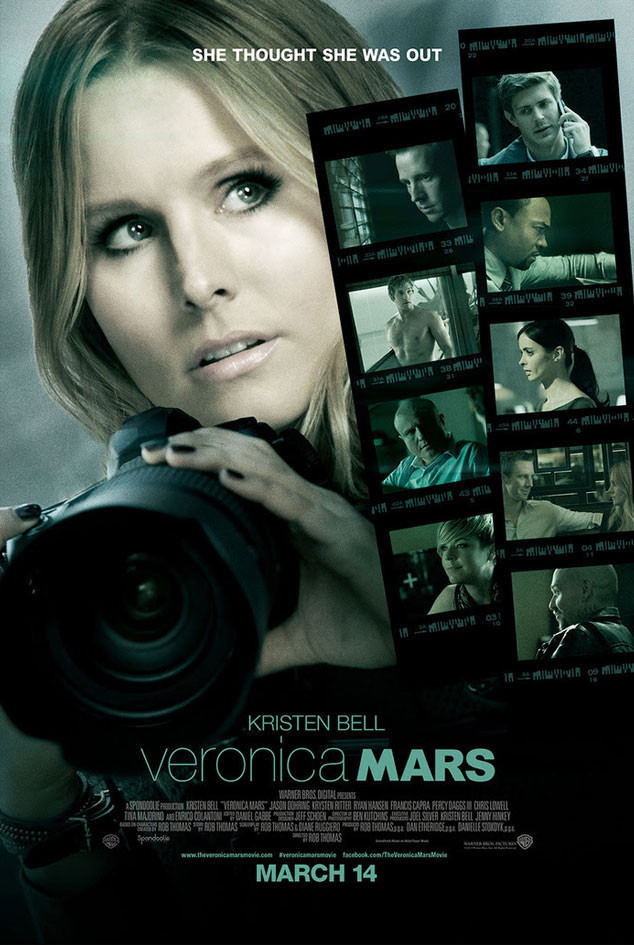 More people know the name Veronica Mars now than probably combined from its short-run on TV from 2004-2007, and that’s squarely because of its record-breaking haul brought in through the fundraising site, Kickstarter. Within hours, the project had already raised two million dollars, on its way to over five and a half million, enough for a long-awaited movie that fans have been teased with ever since the series cancellation. Creator Rob Thomas and his actors were beside themselves in gratitude to their fans (dubbed “marshmallows”). Fueled by the eager hopes of its fans, the movie went into production and is now available for digital download to many of its donors and in a handful of theaters.
Veronica Mars (Kristen Bell) has left behind her hometown of Neptune, California. She’s on the verge of signing with a major New York law firm, and an old friend comes calling. Veronica’s former flame, Logan (Jason Dohring), has recently lost his pop star girlfriend, also a Neptune graduate. He’s suspected of being the killer but he swears his innocence. With the promise of her assistance only lasting a few days, she flies back home and reunited with her old friends (Mac, Wallace, Weevil, Dick) and her father, private investigator Keith Mars (Enrico Colantoni). Veronica should go back to New York with her boyfriend Stosh “Piz” Piznarski (Chris Lowell), she should accept the job offer from the firm, but she can’t help herself fall back into old patterns. She misses the danger, the intrigue, and maybe enough, Logan himself.
 The curious case of Veronica Mars: The Movie is that it was truly made for the fans, those 90,000 people who contributed to their Kickstarter goal. It’s not made for the casual moviegoer who has no foundation with the television series. That’s not to say that Thomas doesn’t try and make the film more inclusive. The neophyte could reasonably follow along, and there is a fast-paced prologue to catch the audience up on the major developments of the series, though almost all from season one. A non-fan could watch this movie but I have no idea what they would get out of it because they would be missing all the connections and context that provide the depth. In a way, this situation reminds me of David Lynch’s Twin Peaks: Fire Walk with Me. Unless you were a fan of Lynch’s iconic thought short-lived TV series, there was no way you were going to follow along or be interesting in following along. It was a movie made for its fan base, and there’s nothing wrong with that though it always helps to provide enough entertainment to prove to the newbies why they should be fans in the first place. I don’t think the Veronica Mars film is able to achieve this. Sure, I enjoyed myself but that was because of my pre-existing fan club and my years-in-the-making desire to finally see proper closure to the characters I came to care about. I feel like someone without that devotion would watch the 105 minutes of Veronica Mars and question what all the fuss was about.
That’s because at feature-length, Veronica Mars is really more of an extended episode of the TV show, and not one of the top tier episodes. As a debut film director, Thomas does a serviceable job of recreating the series noir visuals. The mystery is sufficient if a little dull, lacking a strong sense of urgency throughout most since Logan is already walking around free of charges. The real anchor of the story is bringing Veronica back to Neptune and bringing her back into the family business. The class injustice was a hallmark of the TV series but it’s merely one more slightly malnourished storyline cluttering up the narrative. There are no real reasons to check in on so many characters beyond the fact that it provides resolution for fans. A ten-year high school reunion seems engineered just for this purpose, allowing the new old faces to all reappear again and catch us up. There are characters that appear in near-cameo form (though the surprise celebrity cameo is quite amusing). Even the romance feels mostly grafted onto the story because the core audience demands Veronica and Logan reunite, in all senses. It just becomes a matter of time waiting for the inevitable, as it is with all romantic comedies, except the romance is sidelined here until it isn’t. As a film, it doesn’t feel organically handled that Veronica would leap back into Logan’s arms, and so soon, unless, of course, you are one of those fans (I know MANY) who have been waiting seven years for that moment. Fan service is one thing but it shouldn’t detract from the internal logic of the featured story.
 What does still work are all the hallmarks of the TV show, even if they are less effectively showcased for first-timers. The plucky, sarcastic nature of Veronica still turns her into a heroine worth rooting for, a force of will that has her flaws as well. Bell (Frozen, TV’s House of Lies) can just about do it all, from goofy to heartfelt to ferocious. It’s clear how much she adores this character she helped bring to life ten years ago. The father/daughter relationship is warmly affectionate without dipping into sappy territory. The dialogue is still snappy, though having late twenty-somethings saying it rather than high schoolers has dulled some of the edge. There’s also the sleazy addition of older men hitting on Veronica now that she’s officially out of high school, so hooray. The season-long mysteries of the series, while satisfying and twisty, were secondary to the characters, and watching the overall jovial camaraderie of the cast, is a reminder at how much fans adore these people.
I can objectively critique the faults in the film, as I’ve tried to do for a couple paragraphs, but this is a movie where I set aside my critic hat and merge with the fans. I too contributed to the Kickstarter because I’ve been dying for a sense of closure for one of the best TV shows in the mid-aughts. The finale of season three left much of the show in doubt; Thomas was not counting on cancellation. While fan fiction can run rampant in these circumstances in order to cater to fan demands, it doesn’t compare to the creator being given a reprieve to tie up as many loose ends as possible. That’s the greatest accomplishment of the Veronica Mars movie is that it feels like a genuinely satisfying sense of closure for the fans. While not every storyline is wrapped up, like for instance Weevil’s path, it ends on a point where you can reasonably guess where the characters would continue from here onward if we were never to check in with them again. This is a good resting place. But given the runaway success of the Kickstarter campaign, maybe Warner Brothers could be convinced there are more stories to be told here. I’m cautiously optimistic but really Thomas has already given the fans just about everything they could want, unless they were the Veronica/”Piz” minority of shippers.
Whatever you think of the final product, Veronica Mars: The Movie has changed the way movies can get financed. Smaller boutique films with a passionate fanbase can now get the ball rolling, putting their money into a down payment on seeing their dream movie becomes a reality, convincing studio heads to roll the dice with less risk. I invite all newcomers to watch the series, since that is where it was best. As a film, it’s enjoyable enough and satisfying for the fervent fans, supplying needed closure. However, for people that don’t already have connections to these characters and this world, I don’t think there’s enough going on in the movie to attract a larger discipleship.
Nate’s Grade: B
Share this:

Nebraska (2013)
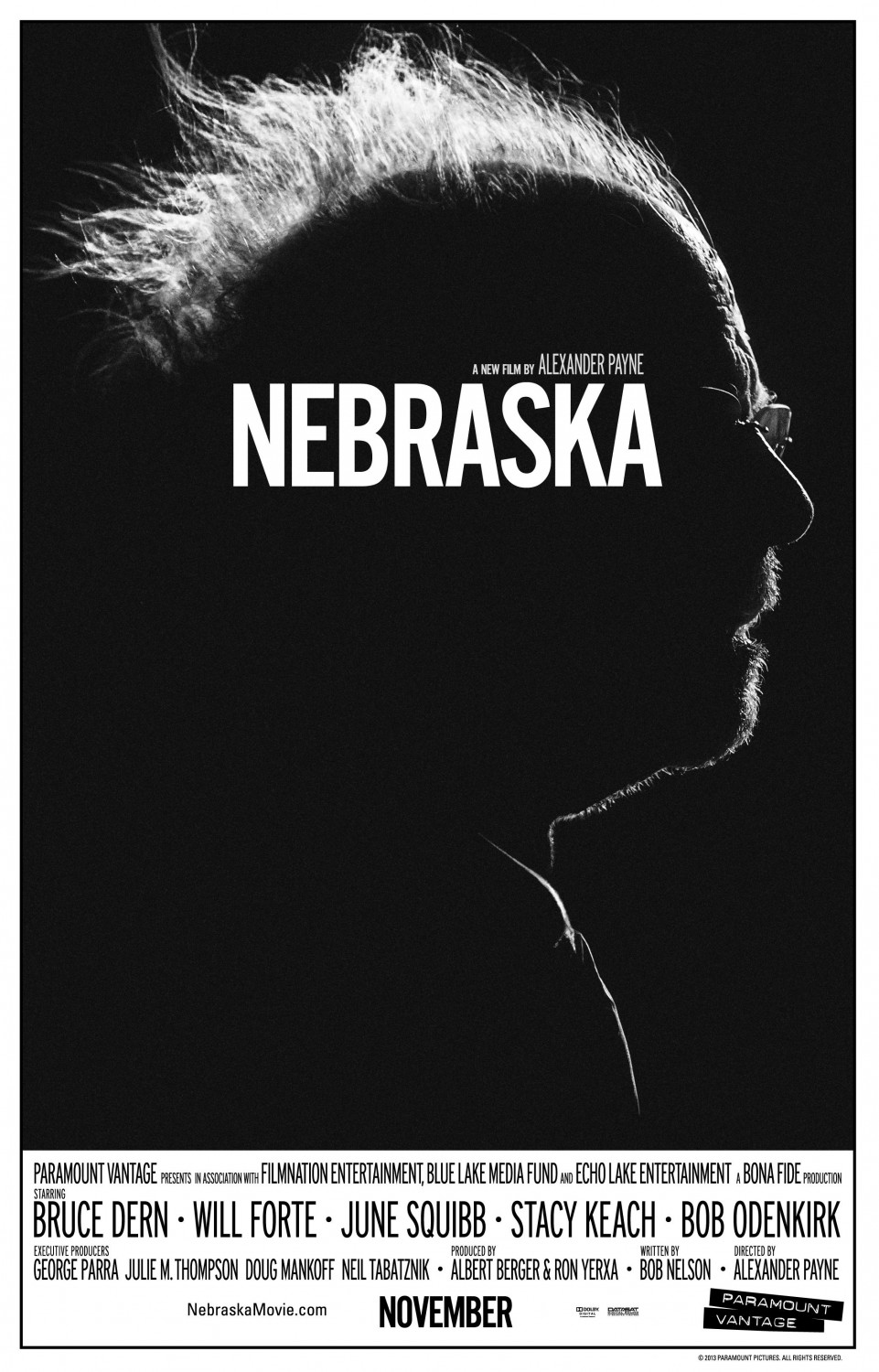 Nebraska is a slow burn, wryly-funny character study of understated proportions, highlighting Midwestern culture rarely given its big screen due. So, in essence, it’s an Alexander Payne movie.
Woody Grant (Bruce Dern) is an elderly man convinced he has won a million dollars and all he needs to do is travel to Lincoln, Nebraska to claim his loot. It’s one of those mass mailings really meant to get people to buy magazine subscriptions, but Woody will not be stopped, sneaking out to walk all the way to Nebraska from his home in Billings, Montana. David (Will Forte) is in a rut himself. He’s recently been dumped, his job is going nowhere, and his father refuses to accept his million dollars isn’t real. There’s a question of how lucid Woody is, and so to placate his old man, David decides to drive his father to pick up his winnings, to humor him before his mind may be gone for good.
 Despite the overtly sitcom machinations of the inciting incident, which even the characters dismiss, the film is really a drama about the relationship between a father and son and the culmination of our life choices. Woody and David are not close by any conventional means but over the course of their road trip, David begins to see his father in a different light; the old wounds are not forgotten, but David is learning about who his father is through others. He’s been so mad at his father for so long that it was the only identity he had for the man. Now in his deteriorating mental state and physical fragility, his father has a sense of vulnerability that brings about decidedly mixed emotions. In his fragile state, is he the same man or at least the same man David remembers? Then there are all the family revelations springing out from the situation. With a genuine millionaire in their midst, the family is coming out of the woodwork clamoring for their own pieces for all the unpaid assistance they’ve given Woody over the years. Initially, it makes Woody look like he’s been stuck trying to find his footing his whole life, as we learn about the lingering post-traumatic stress effects from his war service. Was he lazy, undiagnosed PTSD, or, as another character surmises, too ashamed to say no when others asked for help, and so he was taken advantage of in the guise of assistance from unscrupulous friends and family. The question remains who is Woody?
This is one of those observational slice-of-life films, and your enjoyment of it will depend on your threshold for the taciturn types. These are the strong silent types who keep most of their feelings to themselves. There’s a very funny sequence where Woody and his aged brothers have gathered around a TV, and to listen to the dry mostly car-related conversation bounce back and forth like a dead, floating wiffle ball, is a great comic moment but also a nice insight into an older generation and their communication. Given the perspective of the film, it’s hard to deduce whether the plainspoken people are being satirized or whether it’s a loving send-up of a specific culture. With Payne’s involvement, I lean more on the affectionate tweaking rather than a mean-spirited ridiculing of small town folk and their small town ways. There are funny situations, like David and Ross teaming up for some misplaced justice, and there are characters more broadly drawn for laughs, particularly Woody’s wife (June Squibb), but the overall interaction of the characters, their speaking vernacular, and how they viewed themselves, that is what made me laugh the most and appreciate the script. You feel like you’re dropping in on these people’s lives; every character feels like they could be a real person, not a stereotype. And boy does money really bring out the worst in people.
With Woody and his son visiting his old haunts, the movie inevitably becomes a reflection of a man taking stock of his life, regarding the choices he made and did not make. The pit stop in town opens up the character and David learns far more about his father, with old girlfriends, old business partners, and old rivals. What I appreciated further is that Nebraska doesn’t try and soften Woody; he’s not going to be some old curmudgeon who over the course of 90 minutes has his icy heart thaw and comes to realize the errors of his ways. Nope. Our views on the old man may soften when we get a fuller picture of who he is ad the life he’s lead, but the man himself is the same. He’s readily belittled, insulted, looked down upon, even by his own family members, especially his sassy wife. It’s easy for him to retreat into alcohol and wonder what if. As the family picture broadens and becomes more clear, the film approaches simply yet touching revelations about the family and the nature of legacy. There’s a father/son examination, but there’s also the discussion of what to do when your parents become too ill to take care of themselves. It’s not exactly The Savages, but there’s a circling sense of burdensome decision-making that provides an extra level of pathos to the sitcom setup. By the end, Nebraska squeezes out some earned sentiment without losing its edge or sense of identity. There’s a lot more going on then just some send-up of rubes.
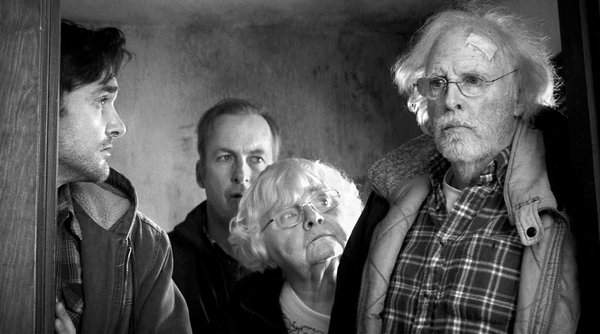 People have been raving about Dern (TV’s Big Love, Django Unchained) ever since the film’s Cannes premier, where the man earned top acting honors. The man deserves every positive words penned. He’s simply fantastic. The character vacillates between outward hostility, spacing out, and general Midwestern emotional reserve, and Dern is able to sell you on every emotional beat without breaking character. He’s unrepentant and demands to be taken for who he is, and his matter-of-fact bluntness has a certain charm to it, like when he admits to David that he never had any plans for kids. He just liked to “screw” and their mother was a Catholic (“You do the math”). I even appreciate that Woody would use the term “screw,” which seems more appropriate. As a two-man show, it’s a shame that Forte (TV’s 30 Rock, The LEGO Movie) doesn’t exhibit the dramatic chops to keep up with his onscreen pop. It’s nice to see him attempt something so different but his limitations are too evident; it’s just another gear that’s not present. At no point would I call Forte’s performance bad but he’s just unable to keep up. Squibb (About Schmidt, Meet Joe Black) is a hoot though the character seems to be permanently stuck in “wacky” mode. She’ll crack you up with her unrestrained commentary, but you may wonder if there’s any more to this character than saying outrageous, curt comments.
This was the last Best Picture nominee I’d failed to catch up with, and while it’s entertaining, funny, and unexpectedly touching thanks to terrific acting and a sharp script, but it also might be the weakest Alexander Payne film yet. This is the first film that the Oscar-winning director hasn’t written himself. Bob Nelson’s screenplay may never have even been glanced over by Payne had it not been for the state of its title (Payne’s films general take place in Omaha). It’s got Payne’s stamp, as would any film he directs, but it also feels like it’s missing something ephemeral, not to get too pretentious. This is a quality study of a cracked group of characters that, upon further review, aren’t as cracked as we may think. They’re just flawed people trying to get along as best they can. Even amidst the snide and antagonistic conversations, there’s gentleness here about the value of family that resonates above the din of the shouting. By film’s end, what started as a cockeyed sitcom transforms into a film that has more meaning and emotion, never betraying its guarded sense of self. When I say the weakest Payne film, this is not an insult but merely an observation. Even the weakest Alexander Payne film is going to be so much better than just about everything out there.
Nate’s Grade: A-
Share this:

The Hungover Games (2014)
 With so many dimwitted, half-baked, and often comically inept entries, it’s hard to remember when a spoof movie was actually something to be enjoyed. We’re beyond the era of Airplane and The Naked Gun, but even some of the early Scary Movie films had some merit, and then Walk Hard, Black Dynamite, and Wet Hot American Summer are shining examples of the best the comedy subgenre has to offer. We’ve become used to the Friedberg/Seltzer style of spoof, a machine-gun rattle of pop-culture references with no thought given to comedic instruction, just the soon-to-be-dated reference. With all of that established, I could not hate The Hungover Games. It doesn’t work well enough to recommend, but the joke-to-laugh ratio is higher than I would have thought, with about every one in five jokes landing, a few had me cracking up. Plus there’s actual critical content here, parodying the sources rather than just dull repetition. In the future, the public rises up against Hollywood because we have become sick to death of all their remakes, reboots, and unoriginal crap. And so, the twelve districts of Hollywood genres duke it out for our bloodthirsty entertainment (there’s a Johnny Depp district where even they have Depp fatigue). It’s a sharp contrast to Friedberg/Seltzer’s own inferior spoof, The Starving Games. The pacing is slippery, the content can be questionable, but with lowered expectations, you may be pleasantly surprised, or at least mildly less irritated with the results. The actors onscreen also do credible work, particularly Ben Begley, playing the Ed Helms Hangover role. He has nailed down Helms’ speech patterns, mannerisms, and he even looks like Helms. This guy deserves a better movie. With an R-rating, the film is afforded the opportunity to go weirder and dirtier than the lame brained spoofs from Friedberg/Seltzer, like the Gratuitous Nudity district or when they keep reminding us that Katniss is underage. Look, I haven’t hit my head all of a sudden; this still isn’t a good movie by conventional standards. However, spoof movie standards have gotten so low that The Hungover Games is passable. Again, grading on a curve.
Nate’s Grade: C
Share this:

300: Rise of an Empire (2014)
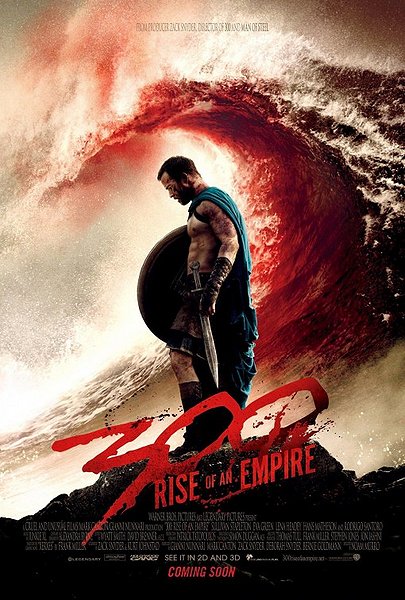 In 2007, the gory, shouty, beefcake-y action flick 300 came out of relative nowhere and took the world by storm, earning over $400 million worldwide and launching the careers of Gerard Butler and director Zack Snyder (Man of Steel, Watchmen). The movie burrowed itself into pop culture, readily mocked and parodied along with its highly stylized action. So where to go next? Also based on a Frank Miller graphic novel, though one that is incomplete as of release, 300: Rise of an Empire is a return to the same stylized excess that made careers. Except now seven years later, what once dazzled seems empty; visually alluring but hollow by all accounts.
Following the brave stand of King Leonidas and his 300 Spartans, Xerxes (Rodrigo Santoro) is pushing forward with his plans to subjugate the city-states of Greece. Long ago, Themistokles (Sullivan Stepleton) killed King Darius during Persia’s first invasion attempt. Xerxes has sworn vengeance since, goaded into action by his second-in-command, general Artemisia (Eva Green). She commands Xerxes’ mighty naval fleet, and she looks to “dance across the backs of dead Greeks.” The many city-states of Greece are squabbling over an appropriate response; Themistokles argues they should unite, while others contend for surrender to Xerxes. Themistokles rallies what armies and ships he can to meet the Persians on the sea and prevent the overpowering invasion.
 The difficulty with a follow-up to 300 is that Snyder’s highly stylized original has been copied and pasted so many times by cheap imitators, so what’s new? The film’s visual style follows the original closely, all those gauzy panoramas and human bodies lovingly showcasing in slow-mo the ugly beauty of bloodshed and violence. The rippling muscles, the glistening sweat, the geysers of blood; it’s all here and in displayed in fawning 3D detail. I didn’t see the film in 3D, but I noticed that every campfire scene was littered with annoying floating embers. However, Rise of an Empire manages some pleasant surprises because a majority of its action takes place at sea. This is a movie devoted to ancient maritime combat, and that’s pretty interesting. The scope of the action is much larger this time, with far more than 300 soldiers in play. The naval battles are brought to life with Hollywood excess but they’re still fairly exciting and fun to watch. The action is well orchestrated, usually easy enough to follow, and suitably thrilling, with each sequence differing from the last. The pumping score by Junkie XL works as a strong driving force with pounding percussion and horns (check out “History of Artemisia”). There are also less nutty monstrous evil henchmen this go-round as well, which helps bring a needed sense of internal reality to all the fantastical action. There are no goat people and blade-handed executioners this time. I don’t think anybody is going to take the movie to task for historical accuracy, but it’s appreciated all the same. Though who’s going to hire Blade Hands now? The guy has a very limited skill set for a workplace.
Plot-wise, the first 300 film was an underdog tale, a group of proud warriors fighting against overwhelming odds eventually giving their lives for the cause. It’s an early chapter in the Noble Lost Cause storytelling playbook, meant to inspire. It’s a Greek Alamo. The problem is when you pick up the story after the Noble Lost Cause. Now the Greeks have to fight the whole of Xerxes’ mighty forces with their own, and while it’s still an underdog story at its core, watching one huge army fight a huger army doesn’t have the same entertainment value. That may be why the film also works as a prequel. There are three flashbacks to fill out the first act’s worth of table setting: the initial war with Persia, Xerxes, and Artemisia. We get storylines happening concurrently with Leonidas and his men, though Gerard Butler declined to reappear in the film. You definitely miss his animalistic fire and screen presence. Ultimately, I don’t know if there’s much of a story here besides a big-screen version of Stratego, where the Greeks move, then the Persians, now everyone is dead or defeated. That’s a glib oversimplification, yes, but the plot boils down to an increasing series of episodes on how the Greeks repel the Persian invaders. Without greater characters and storylines to populate the downtime, it all becomes soulless exercises in CGI bloodshed chasing after whatever is cool looking.
The big problem with 300: Rise of an Empire, despite the ever-present sameness of it all, is that the heroes are bland and the villains are charismatic, which makes it easier to root for the bad guys, which I heartily did. The heroes are chiseled from the blandest of hunks of one-note characterization, with only three real characters being formed. There’s Leader Guy a.k.a. Themistokles, who wants to unite Greece into one power. There’s Father, a.k.a Scyllias, who has a slight scar on his jaw to better identify him, and then there’s his Son, a.k.a. Calisto, who wants to fight. Ladies and gentlemen, that is it, which is all you get when it comes to your heroes. What a shameful pittance. There aren’t even flamboyant supporting characters in their ranks. The heroes are boring, and the father/son storyline plays out exactly as you’d expect, which is a reverse from the original 300. These are not characters you’d follow into uncertain danger. These are characters leftover after all the good ones have been prematurely slain. These are some lackluster leftovers.
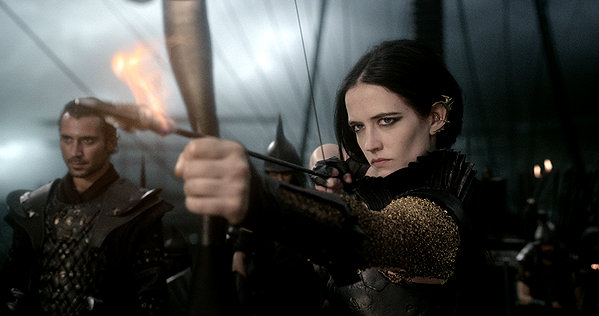 Now, let’s take a look at the enemy camp, namely with chief antagonist, Artemisia. It helps leaps and bounds that she is played by Eva Green (Casino Royale, Dark Shadows), and it’s even more helpful that Green gives it her all, sinking her teeth into the campy villainy. Artemisia is a fierce sword fighter, no-nonsense general, and overall badass supreme. She kisses decapitated heads, is not above fighting topless, and wears wicked outfits with spikes and all sorts of goodies. Every time she departs a scene, you’re left counting down the minutes until you see her again. She’s so delightfully entertaining, chomping at the bit for vengeance and Greek blood. She’s also a woman commanding warships in 500 BC, not exactly a time that recognized women as equals. Another wrong move on the filmmakers’ part was illuminating Artemisia’s back-story. We learn via flashback that Artemisia watched her family get raped and slaughtered by the Greeks. She was sold into sexual slavery at a young age, imprisoned in the bowels of a Greek ship, repeatedly raped for years. Then when these horrible men had had their fill, she was dumped onto an anonymous road and left to die. After seeing this sequence, what person isn’t going to welcome Artemisia? Does she not deserve her vengeance? I was emotionally engaged with her from that moment onward, and so I rooted for her to burn Greece down and vanquish our lame heroes.
The rest of the actors on screen are rather bad. The beefy men on screen could have used some extra work on their underutilized acting muscles. Stapleton (Gangster Squad, TV’s Strike Back) is absent any notable charisma to distinguish him from the stubbly-bearded pack of screaming male heroes. Santoro (The Last Stand) has a certain dour intensity to him, though he spends much of the film watching from a distance. The rest of the cast doesn’t even merit mentioning because the film treats them like featured extras rather than genuine characters. Only Lena Headey’s (TV’s Game of Thrones, The Purge) handful of scenes will grab your attention. It’s ironic that a film that glorifies the heroics of male soldiers, as well as the their chiseled physiques, and the only two women in the entire film are easily the most memorable and entertaining people. Dump the dudes.
While it offers enough thrills and visual power to satisfy a trial viewing, 300: Rise of an Empire is just too empty a spectacle to warrant anything beyond a cursory glance. Director Noam Murro follows Snyder’s blueprint to the best of his abilities, soaking the screen in blood, rippling flesh, and visual grandeur, but the movie goes into convulsions when somebody is forced to talk without kicking people in the face. The plot amounts to little more than a series of attacks played out like stages in a video game. While the original is no masterwork, at least it had characters that we could gravitate toward. Absent any hero worth rooting for, it’s no wonder that Green and her memorable villain reign supreme. She is excellent and has a reasonable motivation for her vengeance. If it had been her movie, 300: Rise of an Empire might have developed into a worthy spectacle anchored by its fiery heroine. Alas, the actual movie is just a Saved by the Bell: The New Class of half-naked men going off to CGI battle, and that’s just not enough.
Nate’s Grade: C+
Share this:

Non-Stop (2014)
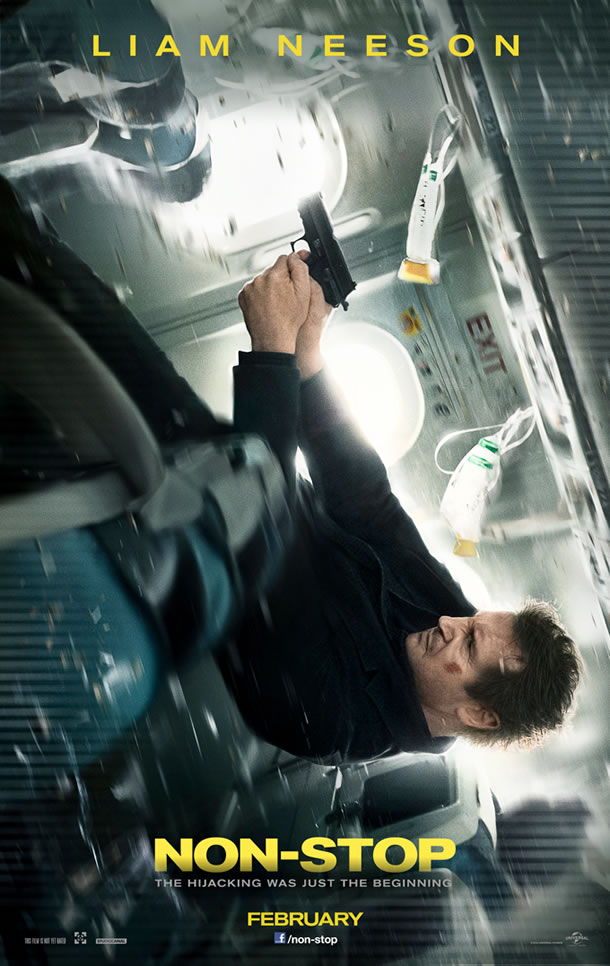 Know that I love contained thrillers, and I love suspense stories where we think alongside the characters step for step, and know that I love Liam Neeson in his career’s second life as our buttkicker in chief, and it looks like Non-Stop was the kind of film made exactly for me and my ilk. And until the final twenty minutes or so, Non-Stop kept me in the throes of entertainment.
Bill Marks (Liam Neeson) is an Air Marshal still getting over a lingering personal tragedy. On a flight from New York to London, he receives a text message on his secure Blackberry. Someone onboard is threatening to kill a passenger every 20 minutes unless $150 million dollars is deposited into an offshore account. When the bodies start piling up, Bill must find the killer but first he has to discover whom we can trust onboard.
Nobody is going to mistake this as a groundbreaking movie of any sort, but it sets about a very specific mission and executes it with vigor. You would be surprised all the different ways the film is able to squeeze out suspense in the meager confines of one airplane cabin. Just when you think you got the film figured out, it throws another twist and complicates matters in a way that is nicely escalating. I loved the fact that the killer essentially uses Bill to commit the first murder. It’s in self-defense, yes, but it also directly ties to his actions, which leaves an air of uncertainty attached to Bill. He now has to keep his own deadly actions a secret, lest he lose more trust with the airplane crew he so desperately needs to assist him. As the passengers start to become suspicious and unruly, it’s a rather plausible scenario that Bill will be subdued and arrested, if not worse. It finds ways to make the outlandish conceivably plausible, at least during the confines of the movie theater before you pick apart the plot holes.
 And let’s talk about that for just a moment. I’ve said before that plot holes only really matter when you’re not enjoying the movie, because then they consume your attention rather than the story and the whole thing falls apart. As long as I’m satisfied, I can excuse the stuff that doesn’t make sense to an extent. With Non-Stop, the movie contorts its mystery in such a way that you know it will never fully deliver on an ending that will perfectly snap together all the pieces and clues as well as satisfy. I went along for the ride already accepting the ending would more or less blow it, but beforehand I just wanted to be ably entertained, and I was thusly. In the end, without delving into too murky with spoilers, the evil plot by our onboard killer relies on such a perfect execution of so many variables that there’s no way this money grab would work. Well, there’s a reason for that, but I won’t elucidate on the details, but suffice to say it is a plan that does not make sense, would not have the intended impact, and you question exactly how somebody got parachutes onto an airplane as their carryon. Does that not strike TSA security as weird?
The screenplay by John M. Richardson, Christopher Roach, and Ryan Engle (two of those gents are an editor and executive producer for the reality show, Big Brother) does just enough right to please without offending when it gives in to the inevitably stupid reveal. In fact, this screenplay could be a prime example of the “Save the Cat” plot formula that has arisen to prominence in Hollywood: the opening scene/image tells us about the character’s metaphorical journey, he does something kindly early, this time helping a child who lost her stuffed animal, and the plot beats are all there in lockstep. The key scenario where a death emerges every 20 minutes provides a potent sense of urgency, with a payoff that comes fast. Each escalates the stakes, adding a personal element with Bill being pinned with the blame and the news leaking to the passengers via rumor and the media. Then Bill’s supervisor adds another level of conflict, and it’s enjoyable to watch all the screws turn against our hero. It’s also fun to watch Bill have to use what limited means he has to suss out the killer, and each makes him more vunerable to a passenger revolt. It’s a well-constructed thrill ride that produces enough jolts, twists, and payoffs to wholly condemn it after the third act crash and burn.
 Neeson (The LEGO Movie) has been carving out a niche for himself ever since the first Taken movie, and as my friend George would say, a movie with Neeson punching things equals his ticket bought. While the man has other great acting skills, it’s just a pleasure to watch someone of his dignity and stature, as well as with his natural sense of gravitas, bark at bad guys and punch them into unconsciousness. Would you rather watch the aging class of 1980s action stars still doing their thing, or Neeson? America has spoken. With Non-Stop, Neeson is again a solid anchor for the film and our interests. I like that his character isn’t portrayed so starkly heroic, like his concealing of personally harmful information. It gives a sense of fear to the character that we don’t ordinarily see. Then there’s the fact that Neeson has to act a third of the movie against nifty floating text subtitles, and the man still outshines others. It’s also nice to have a supporting cast of solid actors like Julianne Moore (Carrie), Corey Stoll (TV’s House of Cards), Scoot McNairy (Argo), Nate Parker (Ain’t Them Bodies Saints), Shea Whigham (American Hustle), Michelle Dockery (TV’s Downton Abbey), and a blink and you’ll miss her role for new Oscar winner, Lupita Nyong’o (12 Years a Slave).
Packed with twists, escalation, and squeezing as much suspense out of its premise as possible, Non-Stop is a contained thriller that invites you to play along for fun. It’s an entertaining ride that weaves its various characters and conflicts together in a satisfying manner that simmers with rising tension. The great supporting cast, and the unbeatable Neeson, sell the silliness, up until the end. By that time, I’ve already been having too much fun to quarrel much, though I’m sure you at home can figure out a dozen more probable and better endings. Non-Stop is an above-average thriller that makes great use of its unique location and the realities of this space to up the stakes. Premise-alone, you already know whether or not this movie is going to be your kind of film. Action fans should find enough to whet their whistle, and there are enough surprises and well-wrought suspense that I would recommend Non-Stop as the perfect antidote to a rainy day. Idea for a new action film… Liam Neeson versus the weather. Just wait.
Nate’s Grade: B
Share this:

The Great Beauty (2013)
 In the Eternal City, a.k.a. Rome, Jep Gambardella (Toni Servillo) has served as its unofficial emcee for years. The literary magazine writer has been coasting for years, living off the prestige and fame from an international hit novel he wrote in his twenties. Now at the age of 65, Jep has come to the conclusion that his life has been lacking the beauty he has sought. All the parties, the late nights, and the fast living have caught up with him. Jep explores the city and its peculiar inhabitants to examine his own life.
It’s impossible to watch The Great Beauty without conjuring images of the great director Fellini. It certainly brings to mind a modern La Dolce Vita. There’s a heightened sense of reality mingling with the surreal, the lives of the rich socialites stepping into the reaches of irony-free satire. At a small party, one rich lady compliments the jazz playing, and another lady says, “The only jazz scene worth listening to today is Ethiopian jazz.” I burst out laughing harder than I have all year. These are people living privileged lives that have lost their tenuous grasp on reality, unaware that they have become caricatures. Their silly ennui has consumed their perspectives. Like Fellini, the movie explores a cloistered world of the Roman elite and their tragicomic absurdities with a touch of the surreal and meditative. I can’t so much pinpoint a clear plot or structure that guides the film, but there are numerous moments, images, scenes that standout in my memory. A private Botox party is played as a zany spiritual gathering where applicants take waiting numbers and a doctor whisper about the great journey they are on together, and then injects botulism into your face. Nuns are everywhere, which shouldn’t be a surprise, but the sight of nuns just randomly populating scenes lends to the surreal nature. Then there’s the 104-year-old nun positioned to be a saint. She looks like a mummy, prefers to sleep on a floor of cardboard, and her mind is still capable of great insight. The ancient nun manages to thematically sum up the film’s interests in beauty, culture, religion, remembrance, and death.
 The relaxed nature of the film and the abstract plot, with little sense of linear trajectory, will certainly test the patience of several moviegoers. At my theater, after twenty minutes several middle-aged couples walked out, muttering, “This is one of the worst movies I’ve ever seen.” I don’t know what these people were expecting when they walked into a 140-minute Italian film, but there declaration is flat-out wrong. I mean, these people probably haven’t even seen InAPPropriate Comedy (cheap shot, achieved). The opening involves the death of a Japanese tourist, and then it switches over to a raucous rooftop party that rivals what we saw in last summer’s Great Gatsby. This is a slow movie but it is slow with purpose, if that makes sense. Jep’s life for so long has been about the party scene, the dulling of the senses, the rush of adrenaline and alcohol. After his sixty-fifth birthday, he’s decided he has no more time to chase after momentary thrills. The journey that follows is mostly a collection of anecdotes and ideas, but many of them have strong staying power. The most notable story is a budding romance he forms with Ramona (Sabrina Ferilli), a 40-year-old stripper with no illusions about who she is. Their relationship is sweet and it ends abruptly, far too soon than a viewer would wish. I know if Hollywood ever remade an English version of this film, they’d structure the whole movie around this relationship. I suppose another benefit of a free-floating, stream of consciousness style plot is that few storylines overstay their welcome.
Jep has come to a turning point, a stark realization that his life is empty. A nice reminder of this notion, as well as a haunting “what could have been” review, is when the husband to an old girlfriend seeks him out. She has recently died and inside her diary, she writes passionately about Jep from their romance way back when they were teenagers. She only has a passing remark for her husband of 30-some years, and it rips the poor man apart. She was always hung up on Jep, always thinking about what might have been, the path not taken, and this defined her intimately. For the first time since he was young, Jep is looking at the world with different eyes and a hunger that exceeds Earthly pleasures. His friends all suffer from the doubt that they’ve wasted their time, that they were never good enough, and they accept their defeat and leave Rome one by one. One man, so humbled, doesn’t even want to bring any furniture with him, so he leaves it all behind. The only thing he’s taking with him is the years of regret, apparently. There’s a nice moment when he’s reiterating the story of his first kiss to Ramona, which also involves this now deceased woman. He can’t remember what she said to draw him, and the look of disappointment at his failing memory, at being unable to relive a moment that meant so much to him so long ago, it crushes him. Who knows how long Jep had held onto that memory as a source of respite. Jep is examining his life’s disappointments and misanthropy but it may already be too late.
There are plenty of messages and points of contemplation throughout the film, but the major theme seems to be as simple as, “Stop and smell the roses,” And yet, that doesn’t make the film less engaging and responsive. Jep is asked why he never wrote another book after his great success. There look to be a number of reasons, but he confesses he was waiting to be inspired again by the titular Great Beauty. Naturally, by this point, we and Jep have come to realize that waiting for beauty is foolish when it is all around us at any moment (especially in Rome). Most of Jep’s adult life has been consumed with social frivolities and passing pleasures, but only now does he seem to stop and fully appreciate his surroundings and his company, naturally, when his friends are departing. It’s a universal theme and one that hasn’t gotten old and the film’s handling is anything but sop-headed sentimentalism. It even ties back to the opening, where the Japanese tourist keels over dead. The man is so busy trying to document his vacation rather than experience it, and in the end, it’s all for what?
 Like Jep, we too will fall in love with Rome as he strolls around it. Gloriously photographed, it’s a treat to experience the major works of art in Rome, so much so that it may stir your passions to see them in person. Even as the plot becomes lugubrious, you don’t mind because of how lovely Rome and its facilities look. Characters doing little and ruminating in Kansas may get boring, but characters doing little and ruminating in Rome, well at least that’s scenery worth watching.
I’ve read many differing interpretations of the film and its messages, the impact of different scenes and which hit hardest, and it reminds me what good art is meant to do; it’s meant to inspire us, entreat us, but also stir us to engage with it, and The Great Beauty does just that. It’s a bawdy, beautiful, and entertaining film but one that also takes its time, luxuriates in atmosphere, and asks the audience to ponder as Jep does about regret, lost opportunities, and the contradictions of happiness. The surreal touches can provide plenty of laughs, but it’s the smaller appreciation of side characters, ideas, and the contrasts that provide more intellectual payoffs. The film is far more free-floating and meditative than American audiences are used to, but unlike, say the works of Terrence Malick, I felt like I could celebrate the absurdities and joys of life along with the people onscreen. It’s existential without being laboriously pretentious, and the comedy and stylish flourishes help anchor the entertainment. The Great Beauty is a beguiling movie that admittedly could have been chopped down from its 140-minute running time. If you’re a fan of Fellini, or art history, then this is a must-see. For others, I’d advise giving this a try, though don’t be surprised if it takes a while to grow on you with its ponderous nature.
Nate’s Grade: A-
Share this:

Philomena (2013)
 A more family-friendly alternative to the wrenching The Magdalene Sisters, the drama Philomena is ostensibly a good movie, but woe unto thee if you thought you were in store for a crackling comedy. Philomena Lee (Judi Dench) was forced to work in a Catholic workhouse in Ireland when she became pregnant as an unwed teenager. Her child was placed into adoption into America and now, 50 years later, she wants to find her long-lost son and learn about him and his life. Helping her in her quest is Martin Sixsmith (Steve Coogan, co-writer as well), a recently unemployed journalist. Their odd couple pairing should inspire comedic repartee, as so the ads would also have you believe. The film is funny, in spurts, but it’s much more effective as an illuminating drama on the abuses of the church-run workhouses that guilted poor girls into, sometimes lifelong, slave labor. At the thirty-minute mark, when Martin comes across a makeshift graveyard of dead teen mothers, who were forced to give birth on the workhouse premises as punishment for their sins, you can pretty much abandon any hope of a ribald road trip comedy. Once your expectations are realigned, you can enjoy the film for what is has to offer: an intriguing mystery, solid characterizations, a terrific Dench performance, and an ending that doesn’t pull punches. Be warned, you will walk away from this movie wanting to punch nuns in the face. Coogan’s role is one of anger and outrage, and there’s plenty to go around with church corruption, scandals, and cover-ups uncovered. But it’s Philomena herself who is the life lesson for us all; her church fails her but her forgiveness is the model we should all strive for. It’s a moving film with as much compassion as it has criticism. Just don’t watch it in the company of a nun.
Nate’s Grade: B+
Share this:

3 Days to Kill (2014)
 Luc Besson has long been a household industry when it comes to action movies, especially in the last ten years. The man has had his hand scripting, producing, and sometimes directing the Transporter films, Columbiana, Lockout, District B-13 and its soon-to-be released American remake Brick Mansions, The Family, and most popular of all, the Taken movies. Besson’s got his fingers in just about every Parisian action movie. But with a prevailing influence there is also the challenge of keeping things fresh. It’s easy to fall back on formula, which is precisely where 3 Days to Kill finds itself stuck.
Ethan Renner (Kevin Costner) is one of the top spies for the CIA, but a rare and terminal medical condition has taken him out of the field. He seeks out his ex(?) wife (Connie Nielsen) and their teenage daughter (Hailee Steinfeld), a girl he’s mostly sent messages on her birthday as the extent of his parental involvement. While living in Paris with his family, the mysterious Vivi (amber Heard) promises a radical drug treatment to extend Ethan’s life, but in return she needs his help killing some notorious terrorists in town.
 We’ve all seen this movie before. In fact we’ve probably seen something similar enough produced by Luc Besson just in the last year or so. The formula is worked over and only the most die-hard action junkies will walk away fully satisfied. The plot is predictable from start to finish, short of the comic flourishes, and has all the trappings you’d expected with a simple middle-of-the-road genre picture. It’s a major surprise that the action sequences are lackluster and unimaginative. With Besson as co-writer, and McG as director, I expected at least a few sequences that would stand out from the crowd, some inventive takes on the action genre. Alas, it’s the same old shootouts, car chases, and the like. I’m not a huge McG fan but I can at least credit the man for his visual style, which, despite the quality of the films, was evident in Charlie’s Angels and Terminator Salvation. With this movie, you would never be able to tell that a former music video stylist directed this. There is no trace of style outside a brief series of shots inside a Parisian tattoo parlor/club that provides some PG-13-approved partial nudity. It’s workmanlike direction with few images or compositions that rise above ordinary. Like most of 3 Days to Kill, the visuals are disappointingly bland and drably familiar.
There are also sizeable plot holes that jump out immediately. I’m not even talking about the usual action film clichés, like the good guys being expert sharpshooters, etc. First off, the name implies a remote time period, a natural opportunity for a ticking clock. He’s got three days to kill the bad guy… or else. But the movie never really provides an or else, nor does it really justify the title. Why does Ethan need three days to kill the bad guy? He’s spending three days watching his daughter, but that’s it. We’re given no real sense of urgency and the characters, the spies, don’t ever seem to sweat or panic. Ethan spends most of the second act bonding with his teenage daughter, teaching her how to ride a bike, and so on. These are not the actions of a man with a ticking clock. Then there’s the premise that Ethan has a rare cancer that requires a rare treatment that only Vivi offers. Ethan injects himself with this magic substance and it seems to do the tick, that is, unless his heart level gets too high. Then he starts to hallucinate and collapse. So there you have it, the plot of the Crank films now with a French polish. The problem with this scenario is that it ONLY happens during the most stupid of times. Instead of Ethan’s heart rate getting too high in the middle of deadly shootouts and speeding car chases, it’s generally when he’s one-on-one with an unarmed bad guy. Even with this, apparently drinking alcohol will slow down his heart rate. Knowing this, why doesn’t Ethan carry a flask of liquor on his person at all times then? He’s supposed to be a professional!
Despite the overwhelming mediocrity and formula-laden efforts, there are a few surprising and effective notes in 3 Days to Kill. The humor, Besson’s tongue-in-cheek genre riffing, is spry and involving enough that I wish the film had followed this tantalizing angle and become an all-out comedy. Ethan’s attempts to balance watching his daughter with his spy hijinks bears well developed comedic moments. Take for instance an informant that Ethan is intimidating for vital intel. His daughter’s phone call interrupts the scene, and she says she needs a recipe for spaghetti sauce. It just so happens the informant is an actual Italian, and so Ethan puts him on the phone. The informant recognizes that the longer he talks the longer he might live, so he draws out relating the recipe, and keeps mentioning how much he truly loves his mother and how she has no one else to take care of her. It’s a small scene but it’s clever and a nice twist on the formula. There’s another humorous scene where Vivi and Ethan debate the difference between beards and mustaches, since she told him to kill the guy with one and not the other. Ethan also forms an offbeat relationship with another informant, a limo driver named Mitat (Marc Andreoni), that becomes so casual, he knowingly helps himself into Ethan’s car trunk, requesting to be back before 4 PM since that’s when his daughters get home. “I can’t promise anything, but I’ll make an effort,” Ethan says before slamming the trunk shut. This is the kind of stuff the film needed more of, well-crafted asides that punctuate how silly spy movies often are. If only the film just wanted to be funny.
 I think Besson and his coterie believed that Heard’s (Paranoia, Machete Kills) character was a constant source of comedy, but she’s really a hollow pinup, a video game avatar come alive. There is no character here, which may be part of the jape, because she’s all style and moody, pert sexuality. She just sort of appears whenever the movie needs a dose of sex appeal (sorry Costner fans). I think her aloof and calculating manner is meant to be taken as comedy. She’s brusque but without any real sense of joy. Not to take anything away from heard; she is a woman of stellar beauty, but just having a sexy gal make droll quips while dressed in a corset isn’t the stuff of comedy but fetish.
I have enjoyed Costner’s (Jack Ryan: Shadow Recruit) late spate of film roles and even enjoyed Mr. Brooks. But he’s all wring for this film, which looks like a modern Liam Neeson vehicle that he wisely passed on. Costner is convincing as a no-nonsense authority, but he’s not ready to take that Neeson-sized step into AARP action star. He sounds like he has a frog permanently lodged in his throat, or they filmed the entire film during a month where Costner was getting over a furious case of step throat. Perhaps he was doing his best Harrison Ford impression. Whatever the case may be, it’s not exactly winning, and while the actor sells the comedy bits easier, the badass moments lack the real punch the movie needs. Steinfeld (True Grit, Ender’s Game) has a nice rapport with Costner and she doesn’t overplay the teenage outbursts. Her character starts to grow a more intriguing dimension when she seems to possess her father’s traits, but she’s too quickly funneled back into being a helpless damsel to shriek and cry.
When it comes to 3 Days to Kill, there isn’t enough new to justify or even enough effectively entertaining to justify your valuable time. Now, if your time is less valuable, say disposable, and your expectations are low, then perhaps you’ll find a serviceable amount of entertainment in this formulaic action thriller. When the most exciting part of your movie is the comic relief, then maybe it should have been time to start over.
Nate’s Grade: C
Share this:

Assault on Wall Street (2013)
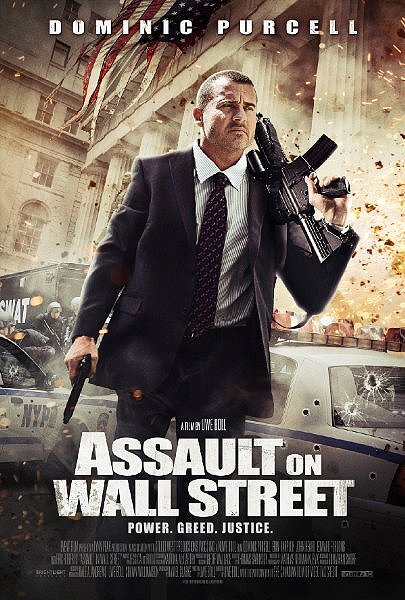 When it comes to notorious German director Uwe Boll, many are still waiting for what could be the man’s first genuinely good movie. The man has been prolific over the past ten years but sure-fire candidates for First Good Film, like Max Schmeling or Attack on Darfur, inevitably have some tragic flaw or approach that places them back in mediocrity, the company of many of Boll’s other movies. After reviewing more Boll films than a human should be allowed to willingly, I feel like I’ve been beaten down enough that when I find something that genuinely works, be it an actor or a sequence or plot turn, that I should be just as vocal as with the contingent of failure. So allow me to refreshingly applaud Boll for Assault on Wall Street, on coming up with a topic and a story structure that… actually… works. It not just works, it succeeds, and if a more polished professional screenwriter got a hold of this, I think it could actually impress the masses. If it weren’t for the surprisingly effective war drama, Tunnel Rats, I’d say without a doubt that Assault on Wall Street is the best work of Boll’s much-maligned career. And yet… it has just enough minor faults that hold it back.
Jim (Dominic Purcell) is a regular guy working as an armored security transport. His wife Rosie (Erin Karpluk) suffers from a rare tumor that requires an expensive series of injections to keep it at bay. Their insurance company won’t pay, and so they have to rely on Jim’s savings. Except those are gone as well. Jeremy Stancroft (John Heard) has ordered all his brokers to dump toxic assets, eliminating most investor savings but profiting the shareholders. Jim and Rosie are broke. Vowing vengeance, especially after some drastic decision-making by Rosie, Jim sets off to make the high-priced traders and corporate raiders on Wall Street feel the pain of what they have wrought.
 The setup is concise and Boll does a nifty job of compounding Jim’s problems and showing how all the industries are interconnected to put the squeeze on. Because of unscrupulous health insurers, his wife’s medical treatment, deemed experimental, is quite expensive and they’ve reached a cap. With the brokers pushing their clients assets into junk stocks, at the behest of the betters and for commissions, Jim loses his entire financial cushion. He hires a lawyer (Eric Roberts) but has to pay $10,000 just to retain him to fight the $60,000 penalty his broker says is owed. He goes into debt and refinances his skyrocketing mortgage (variable rate) to pay for his wife’s treatments. His employer takes notice of his perilous situation and is uncomfortable with enlisting someone in deep financial woes with guarding money. He loses his job. The bank is poised to foreclose on the house. His wife won’t get her treatments to save her life. All of this leads to a drastic and completely understood decision of desperation and sacrifice. Admittedly, Boll does a compelling job of connecting all the dots, making each new pitfall a result of the previous, each compounding the misery of Jim. It takes a little long to go through all these points, and I think Boll could have trimmed it down so that a key event happens at the Act One break point, but I was flabbergasted that the man found a story structure that succeeds.
The second half of the film is Jim planning his vengeance, and after all of the callous movers and shakers have bled him dry, you’re onboard for some sort of righteous payback. Boll takes on Wall Street and the healthcare industry (double the populist outrage). Jim as a character could be made much more compelling, but he’s really serving as a symbol for how the forces are ganged up against the little guy, how the fix is in. When confronted, the big CEO of the brokerage firm barks that it’s always the same old story, that the titans of industry were all crooks and manipulated the system to their advantage, and he’s no different. In short, the little guy always loses.
What holds back Assault on Wall Street, beside the fact that the titular assault is reserved for the last fifteen minutes of the film, is its too slick ending and Boll’s obvious transparency when it comes to his political message. After Jim suffers loss after loss, he puts together a plan pretty quickly, utilizing that Army training we’ve heard about. It’s actually too easy with little complications that can’t be solved in a David Fincher-style montage of death. It’s a full 70 minutes before he takes out his first Wall Street fat cat, and that’s just way too much dawdling. And then from there the climax involves Jim just going on a rampage in an office building, shooting several faceless employees who could very well be innocent for all we know. I think Boll is satisfied with a guilt-by-association catch-all for Jim’s fury, but it would be more satisfying just from a payoff standpoint if we saw these people in villainous lights prior, kind of like what Saw 6 did with its insurance characters before turning the tables on them. The last thing we need in our populist screed is to worry that the wrong people were dispatched. And what kind of office building fails to evacuate after a confirmed shooter has attacked?
 This storyline could have also worked in a Falling Down turn, where a man consumed with evening the scales of a system broken loses his moral bearing and lumps all guilty parties together and condemns them all. Perhaps it was meant to examine the slippery slope of vigilante justice and how this too can decay one’s sense of self, sort of like what Jodie Foster went through in 2007’s The Brave One. However, I don’t think Boll was intending this direction because he’s not very subtle about anything in the movie. Oftentimes the characters just become mouthpieces for ideological talking points: “We’re busy busting some homeless guy when the real criminals are on Wall Street.” The bad guys actually say, with no hint of self-awareness, “We all took a loss. When I told my wife we couldn’t vacation in Barbados any longer…” It’s all just a little too on-the-nose to remind you of the overall intent rather than the story. Therefore, I think Boll is just going for a sense of (misplaced?) justice in the end, in a ludicrous plan that somehow invalidates witnesses, forensic evidence, and security footage to pin the blame on someone else. It’s too clever by half that it undercuts the final payoff. It gets even worse with the Batman-esque voice over to close out the film with a promise to all evildoers.
With such a tight focus on the plot, the acting is a marked step up from previous Boll outings. Purcell (TV’s Prison Break, Killer Elite) doesn’t exactly come across as a regular Joe but he has enough onscreen presence to pull off his character’s anguish as well as the requisite badass stuff. And apparently Boll has become fond of him because Purcell is scheduled to appear in future Boll films. Karpluk, a Canadian actress best known for the TV show Being Erica, has a natural grace to her, forgoing big moments to concentrate on the gnawing guilt and concern her character feels. While she’s a bit too willfully ignorant early on, Karpluk makes you care and provides whatever depth can be applied to Jim. I’m actually curious to see her comic skills since she has a face tailor-made for romantic comedies. Heard (Sharknado, Home Alone) doesn’t seem to embrace his duplicitous CEO role with enough gusto, appearing to be annoyed when he should be menacing. This is not the kind of movie to hold back.
There are plenty of other Boll Players, including Edward Furlong (3 appearances), Lochlyn Munro (2 appearances), Tyron Leitso (5 appearances, also stars in Being Erica), Michael Eklund (8 appearances), Natassia Malthe (4 appearances), and the stalwarts of Clint Howard (6 appearances) and Michael Pare (13 appearances). It’s been 13 years since Eric Roberts (The Dark Knight) last appearance in a Boll film. Most of these are blink-and-you’ll-miss-them, but then there’s Keith David (The Thing, Cloud Atlas) in a thankless role that didn’t need to exist. But hey, I’ll take Keith David in anything.
A welcome surprise, for the most part, Assault on Wall Street is a finely structured revenge tale with clear and precise plot points and a natural buildup. It’s Boll on a soapbox and the naked transparency of his ire and populist messages limits the effectiveness of his storytelling, but you might not mind, especially if you are a person who has slogged through far less competent Boll ventures. There is a marked improvement in just about every facet of filming. It genuinely works, that is, until the pacing becomes lopsided and the end just reverts to celebratory action mode. A more professional writer could take this film and whip it into a crowd-pleasing populist thriller. It’s got so much that works, and genuinely works well, that I feel like a buzzkill to keep harping on the elements that do not succeed. But if Boll wants to earn an undisputed victory, he’s got to earn it without lowered standards. Assault on Wall Street is so tantalizingly close to being Boll’s First Good Film but it doesn’t capitalize enough.
Nate’s Grade: C+
Share this:

Winter’s Tale (2014)
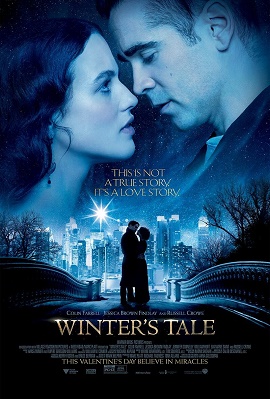 Every now and then you get to witness a special movie that doesn’t so much offend as it inspires, and what it inspires is a question you grapple with during the entirety of its run time, mainly – How did this get made? At any point, did the producers or actors or anyone stop, take a moment to reflect on the movie they were participating in, and think, “Wait, what is going on here?” Bad movies made by hacks are easy to shrug off because, well, hacks don’t know any better but bad movies (see: InAPPropriate Comedy, or better yet, bleach your eyeballs first). With Winter’s Tale, there are people who should know better, people that have been awarded Oscars. These people should resolutely know a terrible movie while they’re making it. Maybe they did. Look deep into their eyes.
In 1918, Frank Lake (Colin Farrell) is an orphan long abandoned by his family so he could have a better life in America. He hasn’t taken this message to heart. Frank worked as an expert safecracker under the employ of local crime boss Pearly (Russell Crowe), and Pearly hasn’t taken kindly to Frank leaving. Frank is able to escape Pearly’s goons and finds love with Beverly Penn (Jessica Brown Findlay), a wealthy heiress afflicted with consumption. Pearly doesn’t want Frank to get away because Pearly is really a demon in the employ of the Devil (Will Smith, yes you read that right). In the battle of good versus evil, Frank and Beverly appear to be at the focal point.
 I have to give writer/director Akiva Goldsman some credit for making an unabashedly earnest movie in an era of irony and ready-made snark. His goopy romantic fantasy longs to exist in a simpler era, but even then Winter’s Tale would fall apart on many levels. Its sheer unbending corniness is both a blessing and a curse. Magic realism is one thing (check out 2001’s Amelie as a how-to guide), but what Goldsman seems to be going for is a modern fairy tale (our maiden locked away in her tower, true love’s kiss, etc.). The film wants the audience to fall under its spell but instead will likely elicit numerous unintentionally hilarious moments; I was laughing to myself throughout, trying to comprehend all of the hokum and poor decision-making (Will Smith as the devil?).
Let’s begin with the fact that the movie is an obtuse fantasy that feels like it makes up its plot and its rules as it goes along. Bleeding fantasy and fantastical creatures into the everyday world is a marvelous conceit but it needs finesse and careful rule building. Otherwise it doesn’t so much feel like a story with a sense of internal logic as it does a bedtime story that can always just create a new shortcut or extension. The very first few minutes of the film will already push your credulity to the test. We see an adult Peter on the run from Pearly and his goons and all of a sudden he runs into… a white horse. Ah, but this is no ordinary horse, this is a magic flying horse, and Peter flies away to live another day. Yep, within minutes, we’re given a magic flying horse. No groundwork. Worse, the horse just randomly appears when the plot demands, and I think the horse is supposed to represent the side of God in this cosmic battle between good and evil. Whatever, there is a magic flying horse. From there the film gets even cornier. It’s the type of movie that posits the stars are really human beings, and so, in the end, rather than having our hero ride off into the sunset he (spoilers be damned) flies off into space on his magic flying horse and he BECOMES a new star, resting beside the star meaning to represent his beloved (never mind that these stars would be millions of light years apart). If you can read that sentence without rolling your eyes then congratulations are due.
Another problem is this massive time leap that creates far more plot holes. After Beverly succumbs to her illness, which I might add happens literally SECONDS after she’s done having sex for the first time (Colin Farrell killed her with his penis), the film leaps forward to present-day. However, Peter was given immortality through Beverly’s miracle. I suppose you could view miracles as a byproduct of sex. At first glance, this almost seems like a cruel gift; your love is dead and now you have to live forever without her. For no discernible reason, Peter also suffers amnesia, because, really, why not? All he does day after day, presumably for… 90 years, is sketch the same image of a redheaded girl in public places. In the intertwining years, why hasn’t evil Pearly picked up on the fact that Peter is still alive? He’s only been sketching the exact same image. Also, how does Peter even support himself? How does he feed himself? Who are his friends? These are the questions that arise when you take this foolish route with the plot. It could have been avoided with a simply Rip Van Winkle-style hibernation or time jump. Another problem is that Peter grew up with the 90 years of history, meaning he should know what things like the Internet and library cards are. He’s not a man out of time. The solution to Peter being confirmed is to seek out the still-living Willa (Eva Marie Saint, nice to see you again). The problem with this is that Willa should at least be over a hundred years old if you do the math. If the purpose of the leap forward was to just save another character we hadn’t seen previously, why does it have to be 2014? Why couldn’t it just have been 1940 or any other earlier period?
And the central romance between Frank and Beverly is just so boring you wish Frank would move on to someone new. Presumably they fell in love at first sight, which just so happened to be when he was in the process of robbing her home. Ah, but you see, her love redeems him because that’s really the whole role of the sick love interest in movies, to make the other figure a better person through this shared experience of grief. So in this regard it’s no surprise that Beverly lacks defining characteristics outside of her ailment. She plays the piano and falls fast for Farrell’s bushy eyebrows, but that’s all we got here. The entire second act of the film follows their abbreviated courtship, but there’s no real moment where you buy into their romance. Like most of the film’s storytelling, we’re told something is and expected to buy into it 100 percent without flinching. They’re in love, what more do you need? Well, some interesting characters would be a start.
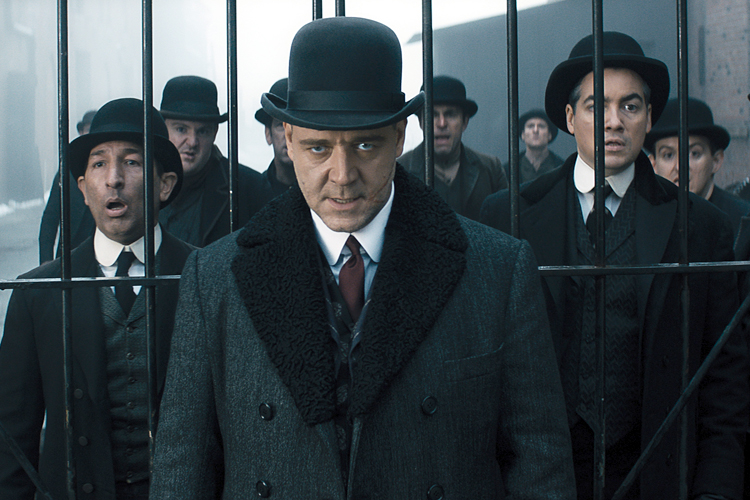 I’m fairly certain that all of these actors were doing Goldman a favor by appearing in this nonsense, but only Farrell (Saving Mr. Banks) walks away favorably. He is the best person onscreen who burrows into their character, ignoring the absurdity of every moment, yearning so hard that you almost want to give in. You won’t. Many will best remember Findlay as the Lady Sybill on TV’s Downton Abbey (she was also the reoccurring ghost on the BBC’s Misfits). Here she gets little else to do but smile and give those knowing looks that all afflicted characters give, as if their illness has opened up the secrets to the universe for them. Crowe’s performance will likely draw up comparisons to his maligned work in Les Miserables, a performance that wasn’t as bad as advertised theater snobs. This performance, however, is as bad, as his Irish brogue seems to overtake him and he comes across like a hotheaded big bad wolf. Jennifer Connelly’s appearance isn’t even worth mentioning as it is that slight beyond the fact that she’s the mother of a terminally ill child (you really thought the movie had any sense of restraint?). The film has numerous well known actors for flashes, like Kevin Corrigan, Kevin Durand, Graham Green, Matt Bomer as Frank’s immigrant father. One suspects their brief time was either a sign that the screenplay evolved as production went or that they were repaying a debt.
I will say the only saving grace in this entire blunder is the cinematography by Caleb Deschanel (The Passion of the Christ). Even when the cheesy special effects take flight, Deschanel makes sure the images are worth watching, having a special skill with the cool hues of the wintry color palette. I wanted to at least credit one redeeming aspect.
The inconsistent plotting and rules, the corny and overly wistful characterization, the overwhelming silliness of every single moment, Winter’s Tale will spark far more guffaws and derision than plaudits. It’s a movie that bludgeons you with its unrelenting maudlin nature disguised as romantic fantasy. The source material is beloved by some but it all comes across as nonsensical twaddle onscreen. Goldsman’s screenwriting credits run the gamut from award winning (A Beautiful Mind, Cinderella Man), to big budget to notorious stinkers (Batman & Robin, Lost in Space). It’s hard to judge the man’s talents with such a wide range of quality. However, I can question the finished results of Winter’s Tale and openly wonder what in the world convinced Goldsman to cash in all his Hollywood cache to direct this dreck. I’m almost tempted to encourage people to watch Winter’s Tale just to try and make sense of it themselves, to try and take in 118 minutes of earnest bad decisions. Whether it’s the magic flying horse, the 100-year-old news writer, or the fact that we’re dealing with a bad guy named Pearly, or Will Smith as Lucifer, but sometimes Hollywood unleashes a disaster that begs to be seen.
Nate’s Grade: D


 nathanzoebl
You must be logged in to post a comment.