The Maze Runner (2014)
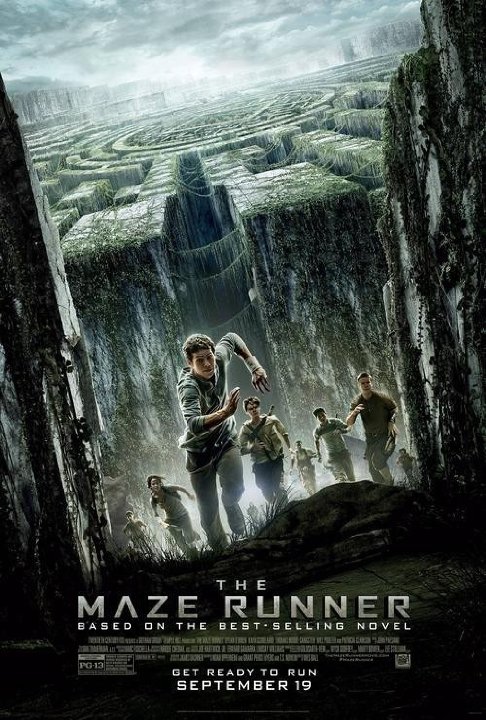 If anyone can reasonably explain to me the end of The Maze Runner in a way that makes some tangible amount of sense, I will give you money. The latest YA-franchise-in-the-making starts off with a storyline that reminded me of Rod Serling. We follow a group of teen boys, memories wiped, as they wake up in the center of a giant mechanical maze. Who put them there? Why? What’s on the other side? As long as the maze and the mystery of it are front and center, the film works, twisting in intrigue. However, when the story veers away to the characters, mostly flat archetypes, and their new society, that’s when I started getting sleepy. You got this awesome huge maze to explore, kids. The film ends up being an exercise in less-is-more restraint when it comes to sustaining a mystery and knowing what points to emphasize and which to skip over. There’s a girl brought into their camp, the first, which they say should be a big idea and change the social dynamics of a group of boys, but it doesn’t. There are silly mechanical spider monsters that scamper through the maze, as if the filmmakers felt a giant maze wasn’t a sufficient enough obstacle and selling point. Scattered flashbacks early on spoil who is responsible for the maze, but when we get to the actual ending, the rationale for who built this large contraption and for what purpose doesn’t add up, like, at all. An explanation wasn’t necessary, but if they needed a quick one I would have accepted, “Aliens did it because.” There’s already a planned sequel in the works. My idea: the kids escape the maze only to discover… they’ve just entered a larger maze. Then they escape that maze only to discover… you get the idea. The Maze Runner is moderately enjoyable. Just don’t expect to enjoy, understand, or even accept the ending and its implications.
Nate’s Grade: B-
Share this:

A Walk Among the Tombstones (2014)
 Scott Frank has only directed one movie, The Lookout, but as a screenwriter his fingerprints are everywhere in Hollywood. The man’s name is all over projects such as Out of Sight, Minority Report, Get Shorty, The Wolverine, Marley & Me, and those are just the ones that made it across the finish line. As any aspiring screenwriter knows, Hollywood is built upon an ever-amassing burial ground of unproduced screenplays. A Walk Among the Tombstones is only his second directing feature, which tells me it must have had significant personal value for this famous scribe. You can definitely tell Frank has an affinity for hard-boiled film noir of old, though the splashes of in-your-face sadism may be too much for certain audiences. It’s a genre movie all right, but it’s also a grisly one that bothers to take its time setting up character, plot, and resolution.
It’s New York City on the cusp of Y2K, and retired cop Matt Scudder (Liam Neeson) is just trying to enjoy his dinner. He’s pulled into a complex kidnapping scenario at the behest of one of his AA peers. Two men have been targeting the city’s drug traffickers, men with big pockets who cannot go to the police. These psychopaths enjoy abducting the trafficker’s wives, ransoming them for hundreds of thousands, and then slicing and dicing their victims anyway. Matt initially turns down the offer, working around the edges f the law, but the viciousness is too much to ignore. He reawakens his old detective habbits, falling back into a routine, and tracking down those responsible.
 Those expecting a regular Liam Neeson afternoon of top-draw face punching may be in for a slight disappointment, because A Walk Among the Tombstones is a gritty detective tale that swims amidst an ocean of moral decay and queasy sexual violence. It’s a detective yarn that unwinds at a casual pace but one that feels like a natural connecting of plot points. Thankfully, this isn’t a movie that treats the identity of the killers as a mystery that needs to be dragged out as long as possible, with the ultimate pained reveal being one of the otherwise harmless characters we’ve previously been introduced. We know who these two psychopaths are after about twenty minutes, so there’s no prolonged guessing game. Rather than linger on who they are we now await the ultimate satisfaction of Matt Scuder finally facing off against our two psychopathic killers, and they are indeed psychopaths. These two are very wicked men, gathering sadistic pleasure from torturing their captive women. The two men are kept as unsettling ciphers; we don’t know much about them except they have an addiction to killing. It’s not about the hundreds of thousands they scam from the drug traffickers; it’s really about the thrill of the hunt. While I wish there was more depth, they were menacing enough. I was itchy with anticipation for them to get some comeuppance. I’ve read reviews indicating that our two remorseless killers are a gay couple; if this is true it’s kept very vague for interpretation. In the age of equality, it could be homophobic to declare, in absolutes, that psychopathic killers couldn’t also be gay or lesbian. That would be… wrong?
With two strong villains, you need a strong hero to bring them down, and Neeson fits the part like a natural. To be fair, the role is somewhat stock from a passing description: the loner former cop with the tragic past, a drinking problem, the gruff style, the over-the-hill age, the man trying to adapt to a new and changing world, sometimes not for the better. It’s a role that feels ripped from the tropes of crime thrillers, a world we’ve also become accustomed to seeing Neeson. The detective role is familiar but, like most within Frank’s film, it’s given more time to breath and a surprising degree of attention. This doesn’t come close to last year’s Prisoners in the realm of character work, but it’s still an above-average entry for a genre too often ignored when it comes to realistic and satisfying characterization. Matt Scudder exists in a New York City that owes a debt to the pulpy noir page-turners of old, but it’s not exactly stylized, and neither is he. The man still uses microfilm and needs the assistance of a street-smart homeless teenager to assist him with this newfangled Internet thing. While it feels somewhat forced, the relationship with Matt Scuder and his young protégée is the strongest in the film, opening up the character’s redemptive arc. It’s always appreciated to watch Neeson get to flex his acting muscles rather than just being given action choreography and trite tough guy bravado.
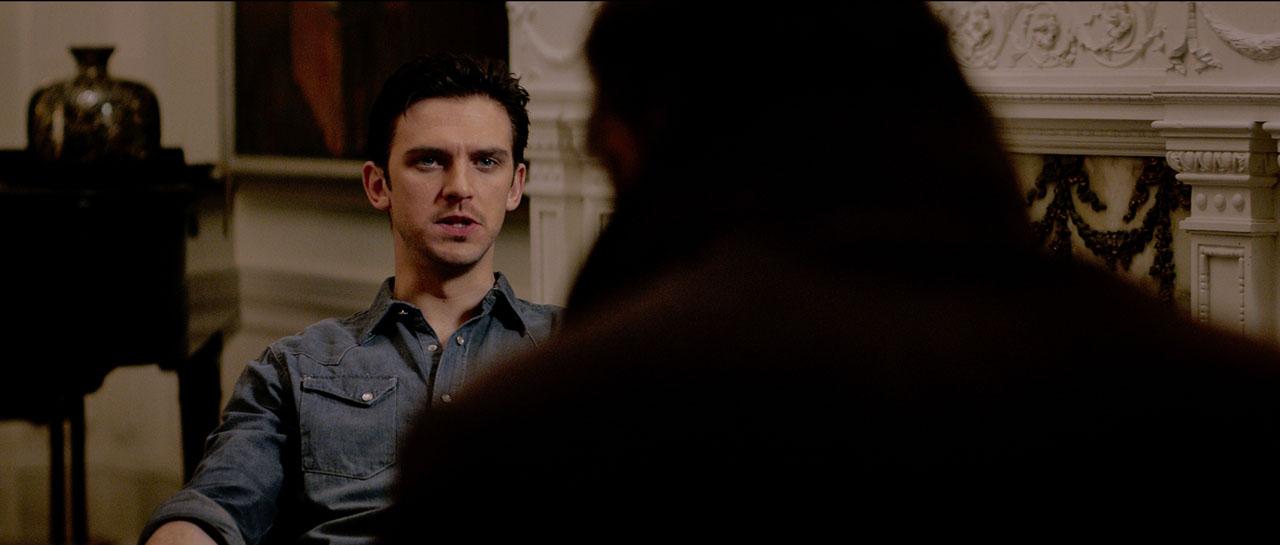
There’s one other actor I’d like to single out, and I’ll thank my mother for this. Fans of Downton Abbey (like dear old mom) may recall Dan Stevens as the dashing and departed Matt Crawley, but he is almost unrecognizable as the grieving husband/drug trafficker that kicks off our story. For one, the guy lost a decent amount of weight and his gaunt face makes him seem all the more mercurial and intense. The characters plays against type with our expectations for a drug dealer, and you may find yourself, like I did, warming to him and yearning for the man’s vengeance for his wife.
 Frank’s direction is awash in the grime and seediness of New York City, with dark shadows washing over his troubled characters, and a sense of style that, while omnipresent in tone, doesn’t distract from the story. The rich cinematography by Mihai Malaimare Jr. (The Master, Tetro) is a great asset. The film noir elements are here in abundance and with due diligence. It rains in just about every scene. Why? All the better for a moody and eerier atmosphere, though the rain does actually factor into a character-based conflict for Matt’s protégée. It’s a moody thriller that is assuredly above average for its genre. Not everything quite works (the third act is too drawn out; a montage of AA 12 steps narration over sequences of violence is more than a little heavy-handed; the explicit Y2K setting doesn’t really have a purpose other than to limit certain technological advances not becoming of the genre) but Frank knows how to draw out the strengths of the genre.
A Walk Among the Tombstones is a gritty genre throwback, but what really jumped out to me was the hook of the premise. Neeson plays a man on the outer edges of the law but a man who still bends toward the justice system he once worked for. What makes this character unique, or at least the promise of, is that he ends up becoming the private detective for the criminal world, and that I find to be fascinating. We think of criminals, especially drug traffickers, are tough men who can handle their own problems with extreme authority. But they are also just people and can get in over their head as well, and when they need someone with private eye skills, who knows how to operate inside the bounds of the law and out of them, that’s where Neeson comes in. He does such a good job that he gets recommended around the New York ring of drug traffickers. He’s like a Michael Clayton-style fix-it guy but for the criminal underworld, and I think this concept it rife with juicy potential. Tombstones is based upon a series of books by Lawrence Block, so there could be further adventures, and I would welcome them, especially if the finished product is as entertaining as this first foray.
Nate’s Grade: B
Share this:

No Good Deed (2014)
 Truthfully, I likely never would have seen No Good Deed in the theater if it weren’t for two events. It’s not that it looked especially heinous, just ordinary and not worth rushing out to see. The first event was my father’s newfound love of Idris Elba (Pacific Rim, Mandela) as an actor, an appreciation I too share for the charismatic leading man. The other event is a tad uncommon. Being part of a critics group, I regularly get e-mails from publicists about upcoming screenings. At the last minute, I received an e-mail informing me that an advanced screening was canceled, but what piqued my curiosity was the stated reason: there was a late twist/reveal that the studio did not want getting out. Really? What appeared on the surface like an ordinary home invasion thriller suddenly became a tad more intriguing, tempting my mind with possibilities. And so, with all of this achieved, I watched No Good Deed waiting to be surprised. My lack of surprise was the only real surprise, because just as I believed, this is your standard home invasion thriller that wastes the talents and time of just about everyone on screen.
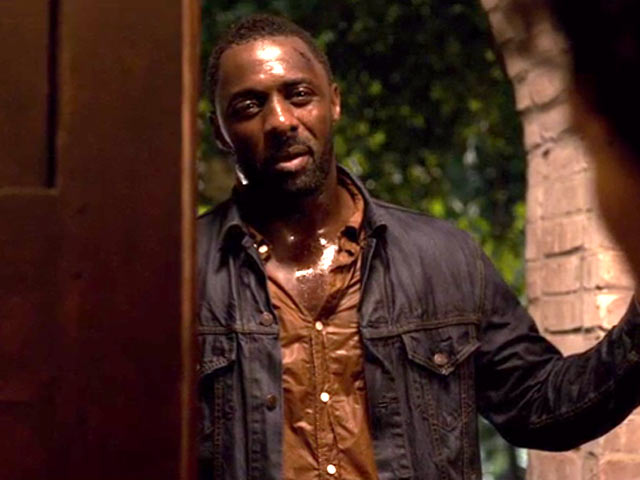
Colin Evans (Elba) is a very bad man serving a five-year prison sentence for assault, though it’s believed he’s responsible for several missing women and former girlfriends. During his parole hearing he escapes and heads to his ex-girlfriend’s (Kate del Castillo) home. Colin doesn’t appreciate that she’s moved on to another man, and so he strangles her to death. He then leaves and drives off the road, an accident as the result of a powerful thunderstorm rolling through Atlanta. He comes to the door of Terri (Taraji P. Henson), a mother and wife whose husband is away. He asks to use her phone and then take shelter from the storm. She lets him inside. Big mistake.
 Doggedly formulaic, there is nothing about this story that separates it from the rest of the tired, dim-witted thrillers that prey upon fears of home invaders. If you removed the high-wattage stars from the film it would be completely at home on the quality-starved Lifetime Network, another poorly made suspense thriller about a bad man stalking a woman with subtle allusions to punishment for viewing the man as a sensual, dangerous opportunity. I was able to accurately guess every step of this story and I imagine you will have no problem with it as well (more on that “twist” later). How come there are no news stories about an escaped and violent convict? Colin severs the phone cords… but does nobody have cell phones in the neighborhood? In the opening credits, both Elba and Henson are listed as executive producers, which means that they attached themselves to this project because they wanted it to get made. They used their collective power to ensure this story would leap ahead of the thousands of other notable and compelling scripts in Hollywood (ahem). And the big question is why? I suppose there may be some fun from an acting standpoint to play such stock thriller roles as brooding boogeyman and bewildered ingénue. Except there’s nothing to these one-note characters. The screenplay does the minimal amount of effort to establish them as victim and victimizer, but you’ll never care about them or find them slightly interesting. Terri keeps making dumb decision after dumb decision; when you bash the bad guy in the head, you don’t stop after one blow. She’s a former prosecutor who worked in the homicide division, and yet she seems absentminded when interacting with mysterious strangers that appear in the dead of night at her doorstep. She’s lacking all street smarts. There’s nothing that sets apart Colin either (that name is a non-starter as far as striking fear). For a supposedly charismatic and brilliant narcissist, he doesn’t do anything that smart.
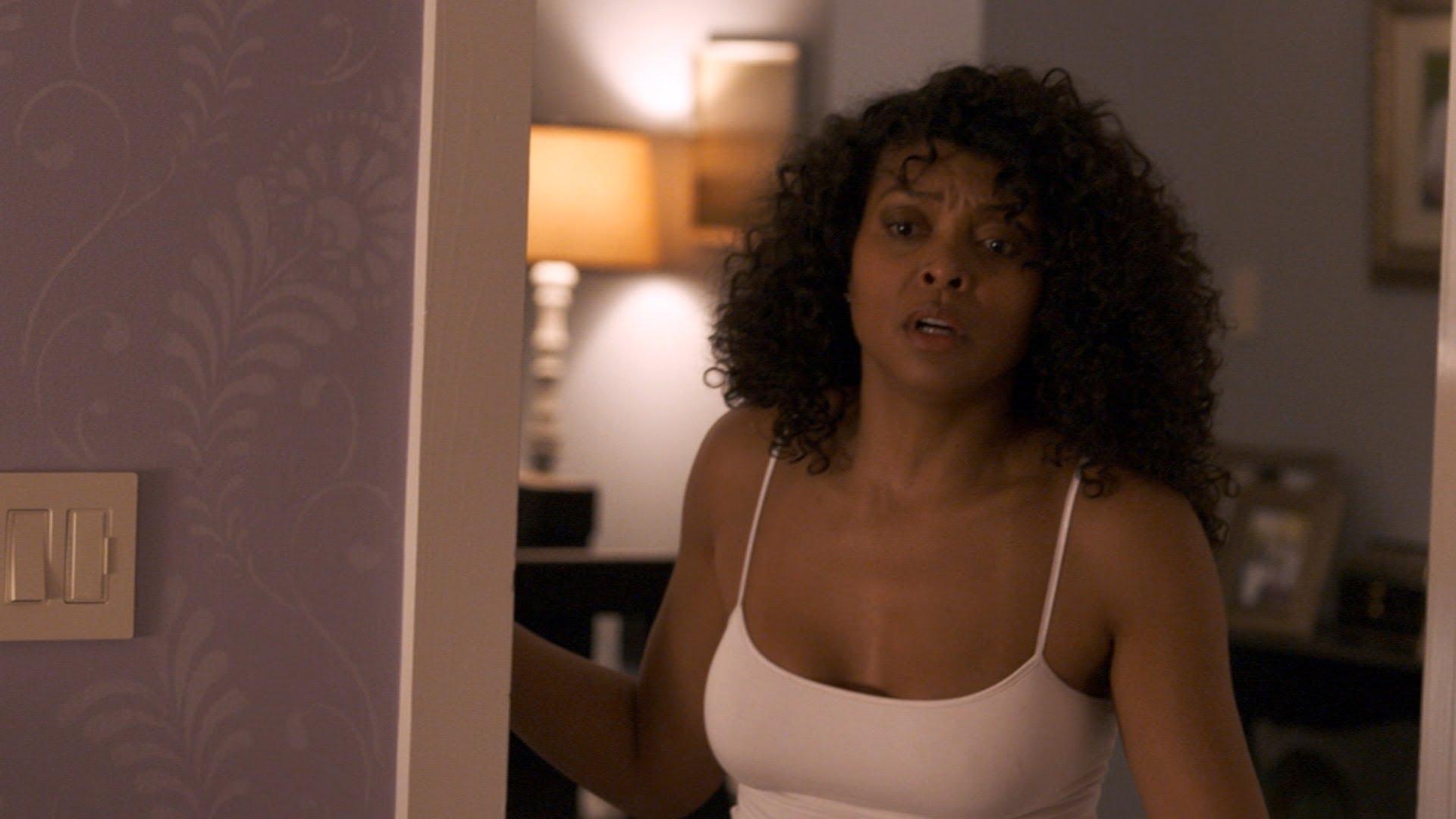
I’ll highlight the small handful of moments that stood out to me, which will include the ending and that presaged “twist.” Henson is 44 years old and a very good-looking woman, though it’s a tad odd when the movie contorts to place her in a T&A scenario. Colin, covered in fire hydrant discharge, insists she get in the shower with him so he can get clean. For the remainder of the sequence, the terrified Henson is shaking in her white tank top, her body alerting us to her cold. When was the last time a woman six years away from 50 was purposely squeezed into a moment of gratuitous titillation, let alone a non-white actress? Another part about Terri is that she’s a mother, a fact that Colin routinely relies upon with veiled threats of harm to her little ones. The funny part about all of this is when she has to sneak around the house that Terri has to grab her 4-year-old with one arm and the baby carriage with another, creating an awkwardly comical image. And it happens again and again. She sets the kids down, then goes back to carry them out, and then repeats. It made me laugh every time because it’s just so unwieldy. Another example of the botched screenwriting: Terri has a baby and at no point in the film does the conflict of keeping the baby quiet surface. She has to quiet the child or else Colin will find them. It’s a natural setup with such a young baby. Instead the baby is completely silent for the entire movie, peacefully sleeping though lots of physical activity, screaming, gunshots, a thunderstorm, and tree branches smashing through windows. This baby is unreal. How could this never be utilized? Again, more wasted potential, whatever slight potential there was to start with.
 But this brings us to the so-called twist, which I will obligingly refer to with spoilers but rest assured, if this is the working definition of twists nowawadays, we’re all getting a little too carried away. When Colin takes Terri and her kids back to his dead ex-girlfriend’s home, the recently murdered woman’s phone rings. Who’s on the other end? Shocker, it’s Terri’s husband, who has been having an affair with this same woman. And… that’s it. That’s the twist, which is really more of a plot reveal but nothing along the magnitude of a “Bruce Willis is dead” revelation. As it happened, I thought, “Okay, that can’t be it, can it?” Oh, it was. What’s even more frustrating is that No Good Deed doesn’t build off this reveal. Colin was headed over to Terri’s address to make her husband suffer, but then what? Afterwards, Terri runs around the house and eventually dispatches Colin, and the movie ends with her moving out on her own, essentially the least complicated and most boring ending it could formulate. My father had a far more morbid rewrite that I’ll share with you, dear reader. His version would climax with the husband coming home and Colin casually murdering Terri and both of her young children, leaving bad hubby to forever suffer with guilt over the repercussions of his infidelity. While this ending would be controversial, it makes more sense in connecting the plot beats and at least stands on its own. At least it would be memorable.
No Good Deed isn’t a horrendous movie. It’s just dull from start to finish, never attempting to be anything beyond a mediocre thriller. Its complete lack of ambition is even more upsetting with the quality of actors who helped to get this film made. The direction is hackneyed, the visuals are poorly lit and clumsy, and the thrills are too generic and often stupid to be entertaining. The characters are dumb, the story is dumb, and the movie is dumb. Worst of all, it’s boring, the ultimate sin for a thriller. Unless you’re hard up for some precious Taraji P. Henson T&A (and no judgment, she’s a very beautiful woman), there’s no good reason to venture out and catch No Good Deed.
Nate’s Grade: C-
Share this:

Lucy (2014)
 If you’re looking for one of the more fun summer movies that have no intention of taking itself seriously at all, might I suggest Lucy, which is one part superhero origin tale and one part wonky French existential drama. It starts off quickly, with the titular character being forced into a being a drug mule. The substance breaks in her bloodstream and the concoction transforms her from meek to a kickass vigilante of science. Lucy can now access far more of her brain’s potential, not just that meager 10 percent we plebs utilize, and who knew that we could all be superheroes if we really put our minds to it? Despite the presence of Morgan Freeman as really a talking head to let us know about the potential of the human brain, none of this really makes any sense, and thankfully the movie doesn’t pretend that it should. Lucy literally gains a new superpower every time we see her, from telekinesis to manipulating radio waves to eventual manipulation of matter and time travel. Yeah, it gets weird, but thankfully it’s also relatively entertaining, funny, fun, and short and sweet at a briskly efficient 90 minutes. The plot doesn’t exactly feel fully developed, more a gallop between events as we charge up the percentages from 10 to 20 to 30 percent, and so on. The criminals don’t seem like much of a threat despite their numbers. I’m shocked nobody assessed what happened to Lucy and said, “Hey, maybe I should ingest this drug into my bloodstream and become a super powerful being too.” While the action is well orchestrated, there is less of it than advertised, as Lucy spends a good amount of time adjusting to her new self-actualized human superiority, played by a detached yet amusing Johansson. I can’t even explain the bonkers ending except to note that maybe there’s a very good reason why human beings were not capable of using a maximum percentage of their brain’s capacity. It doesn’t make much sense but it’s pretty, entertaining with its messiness, and short enough not to waste your precious time.
Nate’s Grade: B
Share this:

Guardians of the Galaxy (2014)
 Who would have guessed that a movie that featured a talking tree and an anthropomorphic raccoon would be one of the best films of the year and one of the top grossing films of the summer? At this point for audiences, the Marvel name can do no wrong, but really it’s the degree of latitude given to Guardians of the Galaxy, an admittedly weird movie with strange characters, that allows this unique film to shine. Attaching offbeat director James Gunn (Super, Slither) to be writer and director was a risk that paid off tremendously, as Guardians is the Marvel film most entrenched with the particular personality of its creative director. This is a gleefully imaginative film that enjoys wading deep into weirdness, dancing to its adventurous Star Wars throwback beat, always with its focus set on comedy but not at the expense of quality drama or character development. Really, the characters are the focus of this entry into the franchise, and Gunn and his actors do a bang-up job of gathering the team and getting you to care about each and every one of them. Each one of these characters has a goal, several payoffs, and each is given their proper attention. In an ordinary superhero film, the archetypes would be ironclad. With Guardians, the tough guy made of muscle can also be a source of unexpected comedy with his literal-minded speech patterns. With Guardians, the talking raccoon can also be an emotionally disturbed victim of genetic experimentation who doesn’t know how to play well with others. These are damaged characters and their formation of an unconventional family unit is deeply satisfying and rather touching. I have seen the film twice and gotten teary-eyed both times. The real star of the film is Chris Pratt (TV’s Parks and Recreation), and what a breakout role he is afforded; he’s like Han Solo’s more juvenile nephew. But like the others, the part is surprising in its depth, with a well of sadness and displacement he still hasn’t processed while he scavenges the galaxy. The plot can be a bit unwieldy at times but pays off better for repeat viewings. This is a world I want to spend far more time exploring and with these characters as my merry prankster guides. With a movie this action-packed, thoroughly entertaining, and gratifying, why come back to Earth?
Nate’s Grade: A
Share this:

Boyhood (2014)
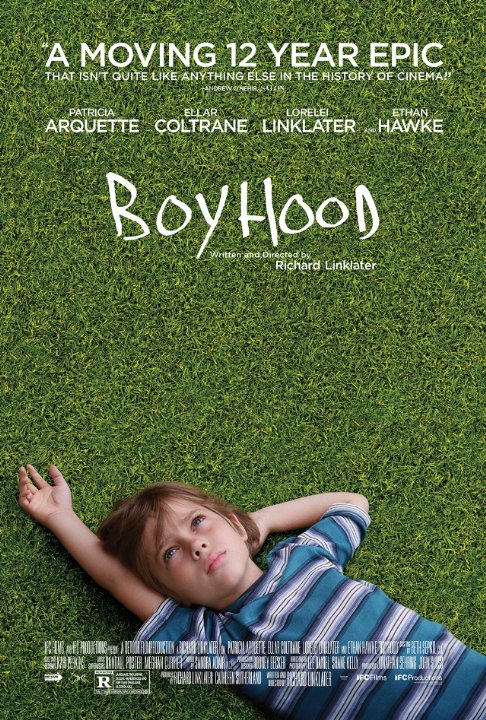 Richard Linklater is one of the most experimental filmmakers in the indie community, but just about everyone was caught unaware when he announced the completion of his newest project, Boyhood. For the past twelve years, Linklater and a small crew had been shooting a secret movie chronicling the life of a boy from age six to eighteen. The ensuing twelve years gave Linklater plenty of time to examine his narrative, and he also happened to make nine other movies while working on Boyhood. Now his covert pet project is playing to near euphoric reviews and plenty of early awards buzz. As big a fan I am of Linklater as a storyteller, especially with his brilliant Before trilogy, I feel hesitant to find fault in such an ambitious, sprawling project. This is a very good movie all around, but I have enough remaining reservations that keep Boyhood from being in the same league as Linklater’s best work.
Mason (Ellar Coltrane) and his older sister Samantha (Lorelei Linklater, the director’s own daughter) are living with their Mom (Patricia Arquette). She’s struggling to get by, with little help from their Dad (Ethan Hawke), who took off to Alaska to find work but really as a means of shirking responsibility. Dad comes back into their lives, Mom enrolls in school to provide a better life for her children, and along the way and many moves there are bad stepfathers that come in, new children and step-siblings, new schools, new boyfriends and girlfriends, and all the moments that add up to comprise a life.
Boyhood is less a film and more a cinematic experience that’s hard to replicate. It thrums with the natural rhythms of life, rising and falling on the small moments. Now there are a few larger scenes of drama, mostly concerning breakups and an abusive alcoholic stepfather, but otherwise the film follows the natural progression of not just Mason but his enter sphere of influences, namely family members, friends, girlfriends, etc. It’s a portrait of time beyond all else, and Mason’s parents are just as interesting to follow. Like their children, they too are in over their heads, looking for proper footing and a sense of identity, and in the ensuing 160-some minutes, we won’t just watch a boy become a man but two adults become responsible, accomplished, and determined caregivers. There is much to take in and to immerse one’s self in the refreshing minutia of life itself. The film feels authentic at every step, sometimes to its own detriment (more on that below), and it’s quite easy to plug into this relatable family drama and become engrossed. Don’t let the hearty length scare you, we are moving through 12 years and as such the segments don’t overstay their welcome. After every time leap, there’s a small game of trying to play catch up, noting all the differences, not just the actors growth spurts, but the new touchstones; before Mom was arranging a date with her psychology professor, and now they’re coming back from their honeymoon. It also allows us to watch the subtle transformation of characters but also watching the long consequences of anger. Dad takes Mason and Samantha out and is floored by the revelation that neither remembers a family camping outing that was filled with laughter. What they remember, starkly, are the shouting matches between mom and dad. It’s a definite wake-up call.
 Because of its in-the-moment nature, it’s difficult to single out storylines that play out significantly better than others. Each person is going to respond better to different moments, the points of relatability and comfort. I loved a scene where Dad plunges into the awkward territory of having the Sex Talk with his teen daughter. It’s just as awkward and funny as you’d expect, but they plow along and it’s a small moment where Dad shows his own growth as a responsible parent, a man who understands the world his children will enter and the pitfalls that await, who wants them to do better than he did. It’s a funny scene sure enough but it’s also a clear shift in Dad as a character. The allure of realism is rarely broken throughout the film, which imbues the film with a bracing sense of honesty in its details. There aren’t any big inspirational speeches (maybe one by a teacher), mostly talks meant to bridge the gap of understanding. There aren’t any eureka moments, in fact Mom even bemoans the absence of feeling something more significant when her children have left the nest. There aren’t any singular-defining dramatic moments because we are all the sum total of many moments, good and bad. The greatness of Boyhood is that it is a film of moments but moments you want to indulge in, like lingering nostalgic memories. It’s a richly pleasant experience.
My friend and critic colleague Ben Bailey asked me whether this story would have been irreversibly different or worse had they just cast several young actors or used makeup as a primary force to illustrate the passage of time. After giving it a good ponder as any critic should, the conclusion I came up with was a surprising… “No.” With the 7 Up documentary series, or Linklater’s own Before trilogy, the passage of time is also a reflection of us, allowing us to likewise catch up with the familiar faces but reflect upon our own lives. Plus it’s a work in progress, a series that matures and evolves and with each additional segment becomes a stronger and more compelling whole. With Boyhood, we get the entire passage of time all in one movie, and it just doesn’t play the same. With the other series I’ve mentioned, we get entire movies to dig into these people at different pit stops in their lives. With Boyhood, it’s less so. Here we get the (to our knowledge) full story, and watching the actors age is its own interesting experiment, but is this story really aided by this approach? I have my doubts, at least to the degree to justify the 12-years-in-the-making gimmick that has captured most of the media attention. It’s just as interesting to compare and contrast the other actors, notably Mason’s onscreen parents. 2002 Ethan Hawke is still the young reckless heartthrob, whereas 2014 Ethan Hawke has a bit of a paunch, lines around the eyes, and the gradual acceptance of his changing life style. But does the gimmick add any greater thematic impact to the film other than the odd notoriety of watching a visual yearbook for a select series of actors?
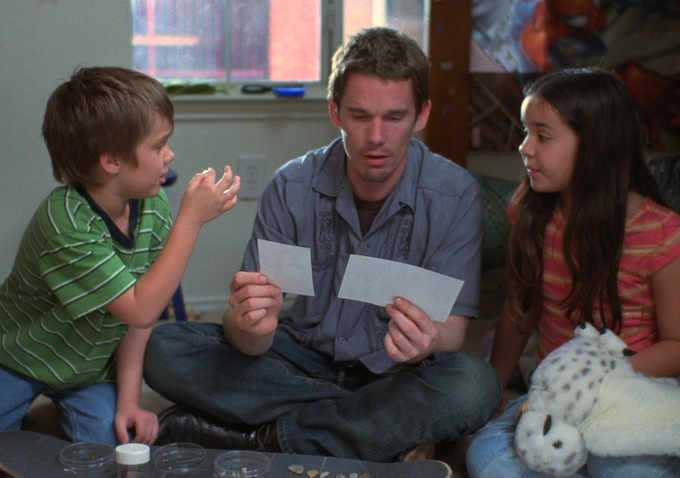 The other quibble I have is larger, mostly that the movie is tied to a character that is rather something of a bore. As a child, Mason is more reactionary to the world around him, taking in all these experiences, especially the hurtful remarks of adults and the long-term effects of all that marital discord and abusive stepfathers. He’s quiet, a bit lackadaisical, generally procrastinating and stretching rules, but he’s really just a boring kid who grows into a boring teenager. Now there are certainly plenty of relatable qualities to him that extend beyond his external situations and family conflicts. Plenty will be able to relate about the struggle to fit in, the points of self-discovery, and the initial buzz of a romantic mingling, among other coming-of-age moments. The problem is that Mason is struggling with finding his own onscreen identity. It would be foolish to have this kid suddenly know with divine clarity who he is and what he wants to be, but would it be breaking the confines of realism to give this character a personality? He ends up becoming this blank canvas for the audience to project themselves onto. If we’re going to spend nearly three hours watching the emergence of a character, it needs to be someone the audience can engage with so that their journey has a lasting emotional impact. Mason is an ordinary teenager, which means he’s an otherwise shrug-worthy figure for this massive of an undeserved spotlight.
Perceptive, funny, warmly affectionate, and well made in just about every capacity, Boyhood is an enjoyable movie from start to finish, another fine achievement for director Richard Linklater. It is a movie about a young man coming into his own, but it’s also a film about those around him doing likewise, maturing, aging, but mostly gaining some stronger sense of themselves and stepping out to make this happen. It’s a tale of life told in micro and macro, and while it lacks the cumulative impact or the 7 Up series of the Before films, it certainly has enough measured drama and honest reflections to stir a bevy of feelings with its audience. I only wish the main character was a more interesting focal point for this twelve-years-in-the-making project, especially with all that added time for Linklater and company to double back and alter their narrative. The character quibbles, and the ultimately unnecessary gimmicky nature of its conceit, are enough to blunt its overall longstanding resonance for me, but this is still a very fine movie and one that no other filmmaker working today could deliver. I just wonder what other secret films Linklater is keeping from us.
Nate’s Grade: B+
Share this:

Hercules (2014)
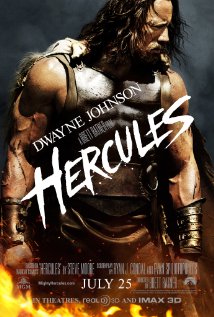 What happens if you make a Hercules movie but take out all the unique things that make the classic hero who he is? Would he still be Hercules? This question is at the heart of director Brett Ratner’s newest film, and it’s better than expected, which is a nicer way of also saying it’s not as bad as it looked like in its terrible cheesy advertising. It might be the most entertaining Brett Ratner film yet for what that statement is worth.
So, who is this Hercules? Besides looking like The Rock, he’s a mercenary who leads a band of warriors that are carefully left out of those widespread tales of his heroics and derring-do. Hercules’ nephew (Reece Ritchie) is the mouthpiece for the group, spinning the tales into epic poetry. There’s also a female archer, a sarcastic second-in-command good with throwing knives, an animalistic swordsman, and an older spearman (Ian McShane) who is given fleeting prophetic images, mostly about his own death. There’s a reason these people aren’t described much beyond their character-defining weaponry. This gang is hired by Lord Cotys (John Hurt) to protect his people from a Thracian warlord who rumor has it is a centaur. Could he be? Have you been paying attention?
 Depending upon your tastes, you may either find this new approach refreshing or feel completely ripped off. It does seem that all of those cool glimpses of Hercules going through his grueling trials, fighting giant beasts, doing generally Herculean acts, well it was all comprised to the opening two minutes, which is why I feel no spoiler guilt over revealing the true nature of the movie. It’s not really a Hercules film. Yeah, The Rock is just about the closest living example of a modern Hercules (he shouldn’t have the hobo beard, though), but it’s in name only. Whether this is a stopping point is up to the viewer. It does seem like a disappointing bait-and-switch to tease out what promises to be an epic with giant mythological beasts, and I feel like the audience has every right to be irritable they have been denied this. But if you move beyond this legitimate gripe, the resulting movie is actually serviceably entertaining, which again sounds like a backhanded compliment unless you remember how truly lousy it looked from its initial goofy trailer.
The plot is predictable at every step of the way, except one character I swore was going to be a backstabber due to pigeonhole casting surprised me when they turned out to just be another underdeveloped yet loyal sidekick. Other than that, and I apologize for the vagueness of that sentence, this is a movie you can accurately predict without having to even watch it. The mercenaries are hired for a cause, perhaps they’ll start feeling differently about what they’ve been called in to do, get more involved, and then oh no, perhaps the heroes and villains were all mixed up after all. The plot structure is at its most simplistic (mild spoilers, but really, come on): Act 1 break – they take the mission. Act 2 break – oh no, the guy was bad all along and they’ve been working for the wrong side. Act 3 is then essentially battle and vengeance against the true villains. There’s almost an admirable efficiency to its formula plot mechanics, including the tortured hero back-story over his slain family and the forced reveal of who was behind said slain family being slain. If you don’t want to overwhelm your brain, then Hercules will do.
Free of the rigors of being original or complex, the movie is open to accomplish its minimal goals of entertainment, and to this end I would call the movie a mild success. The action is involved just enough to keep things interesting, especially when Hercules and his battalion are beset on all sides by green-skinned guys who, for whatever reason, hid in holes in the ground. There’s a primal joy watching The Rock carry around a giant Captain Caveman-style club and gleefully beat people with it, especially when the recipients fly like 30 feet in the air. There’s a pleasure to be had with a stripped down and somewhat dumb action flick where everyone is running around in leather or loincloths. The action is more Hercules by way of Conan the Barbarian but without the monsters and sorcery. There’s a fun running gag where McShane’s character keeps thinking he’s come to his final moment, the death that has been prophesied, only to be denied it time and again, causing some slight frustration on his part. The pacing is also swift enough that you won’t be bored for long periods of time.
 But at its heart, this is still a rather block-headed action film with questionable choices. While scrubbing the supernatural elements from the story, this still exists in the unbelievable world of Movie Land where the good guys can do anything. The archer never runs out of arrows. The good guys never miss. At one point, Hercules topples a 100-foot tall marble statue like he’s Samson. So even though it wants to be a more grounded take on the legend, it’s still filled with all that silly impossible action movie stuff we see all the time. Then there are just small impractical things that exist only for the fact that someone thought it looked cool. There’s a secondary villain (Peter Mullan!) who prefers to use a whip made of a spinal cord. This can work in one-on-one confrontations but in the open field of battle, with men churning all around, it seems like a rather poorly ineffective weapon. Lastly, there’s a trite message about the power of believing yourself. See, Hercules needs to believe he’s a worthy hero and he’ll rise to the occasion. All you have to do is believe in yourself and anything can happen… if you happen to be The Rock or look approximately like him.
This new spin on one of the oldest heroes is generally entertaining, that is, if you can accept the bait and switch of its premise, robbing Hercules of his godlike abilities. It’s like doing an action movie about Greek mythology but taking out all the mythology and just having a bunch of dudes poking each other with spears and swords. Actually, it’s exactly like that. With Ratner at the helm, you know there’s going to be a ceiling, but the film is so unabashedly clear with its simple intentions that I found it hard to grumble, and so just soaked up an average action adventure with one of the genre’s best leading men. As far as summer action vehicles go, it’s got just enough going for it, but see all the other good films first. Make a list. Check it twice.
Nate’s Grade: B-
Share this:

Third Person (2014)
 Paul Haggis is the Oscar-winning writer/director of Crash, so a man not known for subtlety. And that can be fine, but with his latest effort, Haggis wastes his time on a sluggish triptych that doesn’t come together in any satisfying or clever manner. Like Crash, we follow multiple storylines that we expect to intersect or crisscross. Liam Neeson plays an arrogant author checked into a French hotel trying to write his next novel. He engages in a series of cruel and flirty games with his mistress (Olivia Wilde). Adrien Brody plays a fashion spy in Italy who grows a conscience to help an immigrant regain her daughter. Mila Kunis is a New York actress struggling to get her life in order so she can regain some measure of custody for her son. Right away, the characters are rather bland and remote, refusing to provide much depth or development. Then there’s the fact that the plot requires so little of them, falling into a deadly lethargy that it can’t shake free from. You keep waiting for something more significant to take place but the characters just dawdle, spouting dialogue that never feels authentic. I kept waiting for the twist spoiled by the trailer for Third Person, and by the time two hours passed, I had to note that it was not a mid-movie twist spoiled by the trailer, it was the twist ending. Did the marketing department watch their own movie? I’ve never seen that before; late plot developments, yes, but never the twist ending. There is a reason why these characters are so poorly developed but it’s still not a satisfying reason to watch blasé people blunder around with little direction for over two hours, especially when they have no discernible connection to one another beyond heavy-handed linked themes. Hey, at least Third Person has a favorable amount of Olivia Wilde nudity to keep your interest. After that’s done, though, you can check out just like this array of substandard and morose characters.
Nate’s Grade: C
Share this:

Life Itself (2014)
 I would not be a film critic or even as ardent a lover of movies if it weren’t for Roger Ebert and his towering influence on generations of curious cinephiles. Every film review is likely going to touch upon their own personal relationship with Siskel and Ebert and this one will be no different (full disclosure: I contributed online to make sure this documentary would reach completion. You can find my name last in the end credits “thanks” section. The perks of being a Z-kid). When I was young, I would sneak into my parents’ room and wake them up, eager to watch not cartoons but the latest episode of Siskel and Ebert’s take on new releases. For me, Roger and Gene opened an entire new world for me, and hearing their spirited discussions over the latest Hollywood blockbuster or indie experiment would stimulate my imagination. Therefore, Life Itself, a documentary chronicling the life and death of Roger, including those difficult final months of his fight against cancer, is a tremendously emotional and personal experience for me. Even now it’s hard for me to write this review as I have a wealth of feelings churning. It’s like watching one of your heroes ride off into the sunset; eternally grateful for those years they had on Earth to inspire. It’s fitting that Roger become a part of the movies himself with a documentary that’s one of the year’s best and most poignant films.
This was never meant to be a film about Roger’s death. It was intended to be an adaptation of his 2011 memoir, the titular Life Itself. Filmmaker Steve James, best known as the director of Hoop Dreams (Roger’s #1 film for 1994), tackles the essential biography bits we’d expect tracing the cradle-to-grave approach. What makes this film more interesting is that it too follows Ebert’s own perspective he utilized in his memoir. Rather than writing from the point of view of being in the moment, Ebert acknowledges his age and looks back on the past not as it’s happening but as an older man reflecting upon his life. The thoughts are not so linear, the consideration more meditative, thoughtful, and overall thankful. This is a man looking back and taking stock of his life, grateful for the people that have elevated his experiences. The framing device of the movie happens to be Roger’s last five months of life, going in and out of the hospital and adjusting to the ever-mounting hurdles of his deteriorating health. It can be downright shocking and horrifying to watch this Ebert, his jaw hanging loose like an ill-fitting Halloween mask. Never has the man looked more vulnerable and so mortal. It’s not how you wish to remember him, and Roger is without vanity as he wants the cameras to have access to his day-to-day reality no matter the hardships. As the months pass and Roger’s communication starts fading, everyone has to come to terms with the inevitable, and the viewer is right there too, bidding goodbye with Roger’s grieving family.
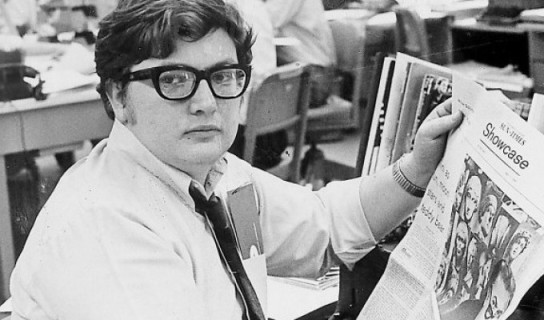 While tears will be shed, do not think of the movie as an elegiac tribute meant to fill your heart with dread for the demise of a great writer and a great man. As the title indicates, it’s a celebration of the man’s life, illuminating a figure that was much larger than his prolific publications (note: not a fat joke). Can you picture Ebert as a skirt-chasing Chicago Sun-Times reporter? How about as a guy who would get drunk and hang from the rafters, causing scenes? Many likely don’t know that Ebert has one screenwriting credit for Russ Meyer’s 1970 camp-tastic Beyond the Valley of the Dolls, a job Ebert likely took on so he could, in his words, “get laid.” There’s even a lengthy bit over their populist film critiques and whether the famous “Thumbs Up/Thumbs Down” model was helpful or harmful to film criticism. Life Itself does a fitting job tracing the roots of the man, with each chapter of his life given due development and consideration. I could have watched a four-hour documentary on the man’s life, but I’m not the general public.
The film is defined by two central relationships: Roger and Gene and Roger and his wife, Chaz. The first is the most famous. We track their initial growing pains taking the leap adapting their styles to the realm of TV. Gene was a natural, Roger less so, which only made Ebert more furious (photos of Gene “ladies man” Siskel gallivanting with Hugh Hefner are a hoot). The impact of their advocacy cannot be overstated. There are plenty of filmmakers that got their big break thanks to special consideration and publicity from these two. No matter the medium, these were the most famous critics of the twentieth century, opening up the world of movies to a new and hungry and appreciative audience. As enjoyable as it is to watch Siskel and Ebert in agreement, there was a special pleasure in watching them disagree because of the unleashed intensity. They really felt like they could convert the other person through sheer force of will. Their egos were both massive and Siskel knew exactly which buttons to push to set his cohort into aggravation. We see TV clips and unused rehearsal video and you feel like they might start a fistfight at any moment. And then that ire and ego forged into a deep admiration and love for one another, a love that Ebert reflects more tenderly of in the years since Siskel’s death in 1999. Gene didn’t want his loved ones to watch the clock, waiting for him to expire, and so he told nobody of his terminal brain tumor until the end. Roger was always wounded by this and vowed to be as open as possible if he suffered severe health setbacks.
The other relationship we get to witness come to a close right before our tear-stricken eyes. Roger met Chaz in AA, a fact she says she’s never publicly admitted before. He was over 50 when he married. He accepted her children as his own, whisking the family on faraway vacations and sharing his love of cinema with his stepchildren and grandchildren. Ebert credits Chaz with nothing less than saving his life, asserting he’d have drank himself to death without her. It’s a love story that forces us to watch the heartbreaking finale, namely Chaz coming to grips with the reality of losing her husband, of letting the love of her life go, something so profound. We’re right with her, wanting to fight on, try the next surgery, always hopeful, though in our circumstances we have the dread of foreknowledge. Then again perhaps Chaz and those close to the Eberts suspected as much as well, especially as his health faded so quickly in the spring of 2013. Just watching her talk about Roger in the past tense, you watch the ripples of pain reverberate through this woman. She’s the unexpected heart of the movie and one of many torchbearers when it comes to the legacy of Roger.
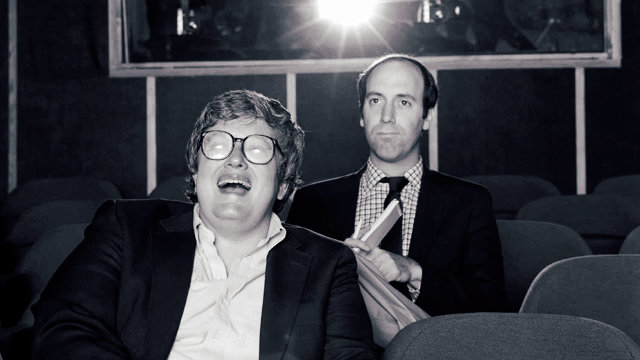 Ultimately, Life Itself is a love story. It’s a love story about two men who go from rivals to close friends. It’s a love story between a man and a woman. It’s also the love story of a man with the movies, a love that he felt eager to share with millions of his readers and television viewers, because in the end (danger: sentimentality approaching) it’s our love and passion that will ultimately outlast us all, and the people we touch are the living embodiment of our legacies. And Roger’s passing has touched many. As fans, those who grew up with him, I think we all felt like he was partly ours. Life Itself is a touching, engrossing, invigorating, and fitting tribute to a man larger than the movies.
Nate’s Grade: A
Share this:

Dawn of the Planet of the Apes (2014)
 Anyone else think the titles of these Apes prequels should be retroactively switched? Coming off the heels of the surprisingly excellent flick Rise of the Planet of the Apes, those damn dirty apes are back with another summer blockbuster that’s just as mature, engrossing, emotionally resonant, and visually remarkable. Dawn of the Planet of the Apes takes place ten years after the events of the previous entry, with mankind devastated by the “Simian Flu,” the same bug that has kick-started the evolution of the primates. Caesar (Andy Serkis in motion capture) is leading a fairly conservative life; he has a home, a family, a wife, and a community he’s trying to build. Then a group of humans wander into their territory needing access to the remains of a dam for a power supply. The apes do not trust the humans, but Caesar accepts their terms, looking to avoid war. However, fear, resentment, and hate fester on both sides, and it’s not long before it’s apes vs. humans and you witness one of the greatest things your eyeballs will ever see – an ape firing two machine guns while riding a horse. Plot-wise, this film is more a bridge to a larger conflict between the two factions. The human characters (including Jason Clarke, Keri Russell, and Gary Oldman) are given short shrift. And that’s fine because the movie belongs to the apes; they are the stars rightfully. Half of this movie is in subtitles for ape sign language. Director Matt Reeves (Let Me In, Cloverfield) dwells in the moments other blockbusters don’t have time for. He lingers in the shadows, with silences, and we slowly integrate into the world of the apes and their own power dynamics. The all-out action of the third act doesn’t feel like a natural fit for the thoughtful movie that has played out until that point. The visual effects are again top-notch and the motion capture tech captures a stunning range of human emotions that you can witness play out across the CGI creations. Toby Kebbell (Wrath of the Titans) portrays Koba, the more hawkish member of the ape tribe, and he is just as good as Serkis, which is saying a lot. I’d still call Rise a better overall film, but Dawn is a more than worthy follow-up that reminds audiences what great storytelling can achieve with the right people behind the scenes.
Nate’s Grade: A-


 nathanzoebl
You must be logged in to post a comment.