Category Archives: 2024 Movies
Love Lies Bleeding (2024)
 With 2019’s Saint Maud, writer/director Rose Glass made her mark in the realm of religious horror, but it wasn’t just a high caliber boo-movie, it was an artistic statement on isolation, on obsession, and with stunning visuals to make the movie stand out even more. Next up, Glass has set her sights on a similar tale of isolation and obsession, in the realm of film noir.
In 1989, Lou (Kristen Stewart) works as the manager of a small gym in the American Southwest. She spots Jackie (Katy O’Brian) passing through on her way to a bodybuilding competition in Las Vegas. Together, the two women form a passionate relationship and are transfixed over one another, but in order to keep the good times rolling, each will be required to commit more desperate acts, including body removal and keeping secrets from Lou’s estranged father, Lou Senior (Ed Harris), a shooting range owner who operates as a cartel gun runner.
 Love Lies Bleeding powers along like a runaway locomotive, a genre picture awash in the lurid and sundry language of film noir with a queer twist, until it goes completely off the rails by its conclusion, a pile-up of tones and ideas that’s practically admirable even if it doesn’t come together. Until that final act, what we’re given is a contemporary film noir escapade following desperate and obsessive people get completely well over their heads into danger. Reminiscent of the Wachowski’s Bound, we have a film noir that lets the ladies have all the fun playing into the tropes of the sultry femme fatales, and in this movie, both the lead characters are their own femme fatales and ingenues. Lou is the one who pushes steroid use onto Jackie, who resists at first and wants to go about building her body the old-fashioned way. Lou is also the one with the shady past and connections that come calling back at the worst time. Once fully hooked on her diet of steroids, Jackie becomes increasingly more unpredictable and desperate, leaving Lou to try and clean up their accumulating messes. They both use the other, they both enable the other, and they both project what they want onto the other even after their collective screw-ups. It’s a self-destructive partnership but neither can see through the haze of desire. They see one another as an escape, when really it’s an unraveling of self (though I suppose one could argue “living your best self,” already a subjective claim, could include being a genuine garbage human). In a way, this is a relationship that’s all rampant desire and unfulfilled consumption, and it leaves both parties always wanting more. It’s a bad romance with bad people doing bad things badly, and if that isn’t a tidy summation of most film noir, then I don’t know what is.
For the first hour, I was right onboard with the movie and its grimy atmosphere. The plot has a clear acceleration point, though the first twenty minutes is also given to some cheap “who-slept-with-who-before-they-knew-who” drama that I was instantly ready to put behind. However, once the climactic death hangs over our two lovers, there’s an immediate sense of danger that makes every scene evoke the gnawing desperation of our characters. The screenplay by Maud and Weronika Tofilska has such a deliberate cause-effect construction, and no film noir would be complete without the loose ends the characters would have to fret over. What also helps to elevate the immersion is the electric chemistry between Stewart (Spencer) and O’Brian (The Mandalorian), who worked previously in the world of women’s body building and clearly felt a kinship with this role, and she is also a born movie star. The two women are great together, enough so that the audience might start believing that these two lost souls are actually good for one another. We too might get seduced by the possibility that everything will turn out for the better, when we all know that’s not how film noir goes. I will say there are some gutsy decisions toward the end that will test audiences with their loyalty to our couple, but most felt completely in character even if their lingering impact is for you to reel back, hold your breath, and then heavily sigh.
 It would also be impossible to discuss the movie without discussing just how overwhelmingly carnal it can be. I recently reviewed Drive-Away Dolls and noted how horny this lesbian sex comedy road trip was, though to me it felt empty and exploitative. With Love Lies Bleeding, the desire of these two women, and their mutual fulfillment, serves as another drug for them to mainline and then abuse. There is a hanger to the film’s gaze that is effective without feeling overly leering. The body building aspect puts a more natural fixation on lingering on the muscles and curves of human forms, and how Jackie is intending to transform herself into a fantasy version. The sexual content begins to ebb as soon as the murder content ramps up.
Unfortunately, for a movie that gets by on some big artistic chances, not all of them work, and most of the miscues hamper the final thirty minutes. In the final act, Jackie abandons Lou and goes off on her own to her Las Vegas bodybuilding competition, and at that point it’s like she’s in a completely different kind of movie. Hers is a movie about drug addiction and hitting a wall, as she has some very public freakouts and hallucinations. Although from there, Love Lies Bleeding indulges in some peculiar imagery that emphasizes the extreme bulging muscles of Jackie like she was the Hulk. While the movie never presents these flights of fancy as magic realism meant to be taken literally, the sheer goofiness of these moments and imagery can hamper moments, especially during a climactic showdown that feels more like someone’s kinky dream. Ultimately, I don’t think the characters of Lou or Jackie are that interesting. Lou’s criminal past was deserving of more attention far earlier, and Jackie is so narrowly-focused that every scene with her after a certain point is only going to reinforce the same obsessive drive and perspective. Like other genres, film noir works with archetypes, and Love Lies Bleeding isn’t re-inventing the genre, merely giving it a very specific sapphic spin, set amidst the haze of the go-go 1980s.
Rose Glass is a hell of an intriguing filmmaker after two very different movies in two very different genres, both of which have been defined for decades by male filmmakers. This woman is a natural filmmaker with clear vision, and even through the bumps, you know you’re in good hands here with a storyteller that’s going to take you places. The cinematography is fluid and grimy to the point where you may feel the need to take a shower afterwards. Everything seems coated with dirt and sweat. The synth-heavy musical score accommodates rather than overwhelms. The performances are strong throughout, and the screenplay choices, while not always working out, are bold and in-character. Love Lies Bleeding provides just about everything you could want from a lesbian bodybuilder film noir thriller, a movie that recognizes the sizzle of its genre elements and makes grand, scuzzy use. At this point, we should all be paying attention to whatever Glass wants to do next as a filmmaker. It might not be perfect, it might not even work, but it will certainly demand our attention and time.
Nate’s Grade: B
Share this:

Godzilla x Kong: The New Empire (2024)
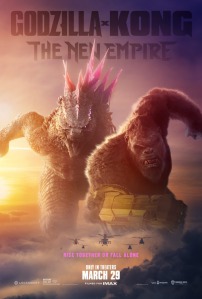 In 2021, the Monsterverse series, begat from 2014’s Godzilla franchise kickstart, finally matched up its two chief prizefighters by pitting King Kong against the mighty Godzilla. It was also by far the most successful movie in the fledgling kaiju franchise, and Warner Brothers was eager to keep the good times running. Now it’s three years later, but Kong is older and weary, living in the Hollow Earth realm below our feet but feeling very alone, the last of the giant apes. Suddenly, he discovers a new world beneath his feet, another level where there are other apes like him. However, they’re ruled in fear from the vicious Scar King, and so Kong needs to call upon his former rival and now tentative ally Godzilla for the ultimate homecoming smack-down.
Godzilla x Kong: The New Empire finds a comfortable resting place as solid disposable fun, a work that knows its real appeal and doesn’t get in the way of it, so why does this movie work for me whereas I had trouble really celebrating the 2021 predecessor? I think it comes down to streamlining and limiting the “dumb fun” to a more manageable quotient. There is still plenty of junk science and goofy moments that will likely inspire their share of guffaws, but I was more pleased this time than overwhelmed in 2021. I had plenty of friends that absolutely loved the 2021 showdown, and I’ll admit the big bouts of monster action were well developed and staged, but for me the dumb was more present than my “dumb fun” threshold could bear. Again, that’s not to say that this newest adventure doesn’t evoke similar eye-rolling. The very revelation of ANOTHER subterranean world and hidden civilization just under the feet of the other subterranean hidden world makes me wonder if every successive sequel will just keep digging downwards, discovering yet another undiscovered world, until they reach the molten core.
 This movie is broken into three storylines and only one of them has the human characters; the core of the movie is Kong’s exploration of the new subterranean world and this is told wordlessly and effectively. The 2021 movie had to juggle multiple human enclaves all having their own adventures and discovering components of our story that would ultimately prove helpful. There was the Godzilla Team and the Kong Team, but did you know that the 2021 movie included all these human characters: our unexpected lead of the Monsterverse now in Hall, the returning new characters from 2021 by Rebecca Hall, Brian Tyree Henry, and Kaylee Hottle, Alexander Skarsgard, Eiza Gonzalez, Julian Dennison, Demian Bichir, Lance Reddick, and the returning characters from 2019 by Millie Bobby Brown, Kyle Chandler, and the son of Ken Wantanabe’s deceased scientist. Top it off with the starring title bout of Kong v Godzilla, and that’s a lot of speaking roles to have to juggle over two hours of monster mash. Having only one human group and only one new significant character (Dan Stevens as a hip veterinarian) helps keep things moving and puts more emphasis on the real big star, Mr. Kong.
Godzilla is sidelined for the second movie in a row to give way for Kong, and it’s the right call as the giant ape is more of a wounded warrior, and his loneliness and desire for community is an easier emotional state to convey than anything from the large enigmatic lizard. Godzilla spends almost the whole movie, leading up to the climax, on a mission where he’s powering up, like it’s a filler Dragon Ball Z episode. It does build a sense of anticipation for his eventual return in the big arena, but it’s clear that Godzilla’s name should be second in the title. He’s presented almost like an angry cat, settling into the Colosseum as an impromptu nap den. With Kong, the emotional arc of a lonely creature seeking kinship is universal and easy to understand even without words. He believes he’s the last of his kind and then to discover a community of those like him, and adjust as an outsider, and then upset the power structure of a bully wrecking havoc. There’s even a budding stepfather-like relationship with a little ape who begins as quite an annoying little stinker and then warms up to this better paternal figure. It’s a simple story of discovery and reunification, as well as overthrowing a corrupt leader, but it’s enough to get you emotionally invested in this giant CGI monster and his giant sense of encroaching ennui.
 The biggest appeal of any monster movie is its destructive action, and Godzilla x Kong delivers in this regard while keeping things fluid and fun. Returning director Adam Wingard (You’re Next) makes sure the big brawls are easy to follow with minimal edits to better orient the viewer. The big hits feel like they matter, and the rules of the different fights and fighters and the varying geography matter. There’s a climactic fight in the Hollow Earth where gravity becomes a second thought, and it’s a tremendous visual spectacle as well as rousing sequence of excitement to watch these giants suddenly weightless and zooming through the air in combat. Wingard also knows when to give his characters their big hero moments, and the team-up between Kong and Godzilla has the same rousing satisfaction as you would wish for two titans of mayhem. I enjoyed the new orangutan villain, the Scar King, a fearsome beast that cannot match Kong for sheer brutal strength but makes up for it in speed and agility, and a whip-like weapon that controls a frost-breathing kaiju through fear and pain. It’s an interesting character at least in design and contrast from our hero kaiju, so it’s not just more of the same but with a horn or something. I have to think anyone coming for some top-tier monster wrestling will leave the movie happy.
As for the human drama, it’s mostly kept along the fringes and there to introduce necessary plot elements that a grunting ape couldn’t more adequately convey. Hall has to worry about possibly losing her adoptive mute daughter who is herself the last of an older civilization. It’s pretty simplistic but acceptable as a parallel about finding one’s place in the world from feeling alone.
Godzilla x Kong is silly and stupid and stupidly fun, appealing to any kaiju fan’s inner child, working that same primordial wonder of monsters and destructive spectacle. For my money, it’s a step above the 2021 initial brawl thanks to scaling down its many assorted plotlines dealing with too many forgettable human characters. The action is rip-roaring and proof that even more can be ceded to Kong and a lack of dialogue to tell this story in a meaningful manner. Wingard still has a natural feel for elevated B-movie material, and clearly this movie is going in a very different route than 2023’s now Oscar-winning Godzilla Minus One, a shockingly affecting post-war human drama that just so happened to have Godzilla in it. It’s a perfect blockbuster to chow down popcorn and hoot and holler along with our giant avatars of childhood glee.
Nate’s Grade: B
Share this:

Damsel (2024)
 After a decade of having a creative partner who literally has compiled over 4,000 pitches for possible movie and TV concepts, it was inevitable that Hollywood would eventually get close to some of them. This has happened before a few times, again given the significant library of my friend’s imagination, but never has it gotten as close as Damsel, Netflix’s new action fantasy film flipping the script of the shrinking violet being sacrificed to the clutches of a monster. In my friend’s pitch, the young girl is presented to a dragon with the implication that this regular offering will spare her small town from angry dragon fire. Just as she’s waiting to be eaten, the dragon undoes her bindings and they talk, because the dragon can talk, and he’s very curious why these people keep leaving him young girls every so many years. The revelation is that the dragon is not savage but intelligent, and the two bond, forming a partnership where she brings the dragon back to her community and shows them the error of their long-standing prejudices. Of course it all gets bigger from there, with warring kingdoms wanting to harness the last dragon to capture this unparalleled weapon of mass destruction. There was even a budding romance between the dragon and the young woman, with the possibility of the dragon turning into a human Beauty and the Beast-style. The title: Damsel. While my friend’s Damsel and Netflix’s Damsel have some core similarities, they do tell different stories built upon the same premise of the virgin sacrifice and the killer creature being more than what they seem.
Unfortunately, Netflix’s version is too narrow to be fully satisfying with its fairy tale script flip. We have Millie Bobby Brown as our titular damsel, Elodie, a woman trying to do well for her family, notably her father (Ray Winstone), stepmother (Angela Bassett), and younger sister. The young prince needs a bride, and the Queen (Robin Wright) isn’t too shy to still turn up her nose at her new in-laws that she sees as merely a means to an end, nothing more. Of course it’s revealed that this end is as “human sacrifice” to a dragon that has reportedly stalked the kingdom for centuries. Elodie is thrown down a vast canyon into the lair of an angry dragon (voiced by the unmistakable Shohreh Aghdashloo). From there, Elodie must use her wits to survive the dragon, escape above ground, and save her younger sister from being doomed to a similar fate.
 The premise is so strong, upending ages-old tropes of the female sacrifice and the monstrous creature, as even with Netflix’s Damsel the dragon is a victim of historical slander. There’s so many places you can go with this, especially building upon the dynamic of the two of these discarded outcasts banding together to push back against the cruelty of society. However, that’s not the movie Netflix’s Damsel becomes. It sort of is, at the very end in resolution, with a latent promise of possible further adventures, but it’s mostly a locked-in survival thriller.
I was not expecting the majority of Damsel to be Elodie’s basic survival once she’s been hurled into the pit by her recently dearly beloved (just following orders from mom, he says). It works, but it feels very constrained creatively. Now, I am generally a fan of these kinds of stories, the step-by-step survival tales where we are thinking alongside the plucky protagonist. I find them fun and follow a satisfying structure of amassing payoffs. It’s naturally enjoyable to watch a character tackle problems and succeed. However, it’s also vital that the audience understands the problem to know the challenge. In a fantasy setting, this requires more time to establish new rules and circumstances. Here we have a few sequences like when Elodie discovers bio-luminescent slugs and uses them as a light source for exploring her captivity (bonus: their sticky slime is healing). The timeline is relatively short, maybe a day at most, so it’s not like Elodie has to think about long-term survival; it’s much more immediate about escaping from the wrath of the predator. Just finding a safe hiding spot is enough. It’s engaging but by limiting the focus to an almost real-time survival cat-and-mouse game, it caps the movie’s creative possibility. I was far more interested in the prospect of eventually moving beyond the initial amity between Elodie and the dragon, where they could share their royal rage together. I kept waiting for this initial battle to give way into a different level of understanding, something to deepen and alter this relationship, but this doesn’t arrive until the very resolution of an hour after Elodie first hides from the fearsome dragon.
While I was never bored by watching Elodie think how to get over a crevasse, or how to navigate a treacherous pass, I was reminded of 2022’s The Princess, a spirited and gleefully violent feminist romp with a similar starting point of a damsel taking matters into her own hands and fighting for her freedom. With that film, the upturned premise was simple, but each new floor down the tower revealed something about our heroine, each new challenge was different and relied upon a different skill or tactic. Unfortunately, that movie was “deleted” from the Disney/Fox/Hulu library for tax purposes, though you can still rent or purchase it on Amazon but, as of now, no physical media exists. This is an excellent example of a movie with a limited scope that knows how to play to the limitations of story while still revealing character through action. While that movie lost some momentum and clarity when the princess was kicked out of her tower imprisonment, I found much to celebrate with the movie’s ingenuity and spirit. With Netflix’s Damsel, I was getting antsy to leave the cave and move things along. The twist about the true nature of the dragon, and her past with the legendary royal hero, should be obvious to most.
 Let it be said that this is where Brown (Enola Holmes) graduated to being a steely and capable adult actress. She’s the star of the movie and has to command our attention and hold it for long stretches on her own. Brown throws herself into the physicality of the role with a relish that only makes her eventual triumph feel that much more worthy. The side characters don’t amount to much but have reliably winning actors to draw our attention. Aghdashloo (The Expanse) is a wonderful scene companion even with only a smoky voice. Wright (Wonder Woman) is haughty to the point of thin-lipped camp. Although this is a criminal under-utilization of the talents of Bassett (Black Panther: Wakanda Forever), who plays the concerned stepmother. That’s what happens when most of your movie is about one girl in a cave. The other characters are confined to the opening and closing of your survival thriller.
I suppose I’m being cheeky by referring to the movie as “Netflix’s Damsel” considering there isn’t any other version out there. I’m not accusing Netflix or screenwriter Dan Mazeau (Wrath of the Titans, Fast X) of ripping off my friend; it’s more an example of parallel thinking playing around with old fantasy tropes and giving them a new spin for modern times. I mostly enjoyed Netflix’s Damsel but couldn’t help but wonder what might have been, not just with my friend’s competing take on the material but with the story possibilities not taken here thanks to its limited scope. As a survival thriller in a fantasy setting, it works. There was just more that could have been, and while I should judge the movie that exists rather than the movie that could have been, Netflix’s Damsel is a fantasy action vehicle that swings its sword ably but had so much more potential to slay.
Nate’s Grade: B-
Share this:

The Beekeeper (2024)

The Beekeeper is a ridiculous action thriller that begs for incredulous laughter but this proves to be the movie’s real appeal. Jason Statham plays a retired black ops soldier whose call sign was Beekeeper, and who belonged to the secret group known as the Beekeepers, which would be really hard to differentiate agents, and then in his retirement, he literally keeps bees. Imagine a secret spy agency known as The Window Washers, and then their top operative decides to work in retirement as a window washer (or a Grave Digger who digs graves etc.). This on-its-head literalness is part of the silly entertainment value of the movie, along with Statham continuing to make bee-related quips no matter the scenario, which just makes him seem crazy or mentally trapped in a different movie, a more satirical version that the rest of the actual movie cannot support. There are many scenes that are one wink away from self-parody, like the FBI agents on the trail and one of them starts reading up on bee science as a means of better understanding this elusive man. What sets Statham off on his journey of bee-themed vengeance is when his kindly neighbor gets her life savings stolen from online hackers who are treated like Jordan Belfort of The Wolf of Wall Street. The old lady takes her own life, and from there Statham is blowing up office buildings, cracking heads, and at one point literally becomes a national terrorist. If you stop and think about the actual implications, The Beekeeper starts to feel like madness personified. As a revenge-thriller, it still works on the simple satisfying structure of watching bad guys get their comeuppance. It can be enjoyed as an effective B-movie (or… hear me out, a “Bee-Movie”?) that hits its genre marks, but as an unintended comedy and self-parody of the stupidity of so many direct-to-DVD action titles, this is where The Beekeeper is at its buzz-buzz-best.
Nate’s Grade: C+
Share this:

Mean Girls (2024)
 Child: “I want Mean Girls [2024], mom.”
Parent: “We have Mean Girls [2004] at home.”
Consider this bouncy 2024 remake Mean Girls Plus, as the only additions from the popular high school comedy are the adaptations made to retrofit Tina Fey’s comedy for the Broadway stage. Twenty years later, the cast is more diverse, some of the jokes that have aged the worst have been removed (fewer fat jokes and no more teachers sleeping with underage Asian students), and the 97-minute original now becomes a 112-minute musical. The cast is winsome and charming but fail to disperse your memories of the original cast that featured future Oscar nominees Rachel McAdams and Amanda Seyfried or even Lindsay Lohan during the height of her career (Lohan cameos as the mathlete judge). Renee Rapp (The Sex Lives of College Girls) has got the most command as this next generation’s Regina George, a role she played during the Broadway run. Your overall impression is going to hinge entirely upon your evaluation of the pop-heavy songs, which to my ears were pleasant but unmemorable melodic pap. There is the occasional snarky line (“This is modern feminism talking/ Watch me as I run the world in shoes I cannot walk in”) but most of the lyrics and jokes are mild additions from what Fey’s movie already established. The standout musical moment might be a goofy throwaway number about all the different sexy Halloween costumes a woman should be able to dress in (“If you don’t dress slutty, that is slut shaming us”). The staging features lots of long takes and tracking shots to better appreciate the nimble dance choreography with the occasional visual addition (phone screen inserts make for modern backup singers). The memorable 2004 lines that have stuck as Millennial memes are included but treated like returning victors, but when elevated and given space for applause, it feels so strange and artificial. The 2004 movie didn’t do this. Regardless, you can do worse than a slightly updated version of Mean Girls with all-right songs, though you could also simply re-watch the original.
Nate’s Grade: B-
Share this:

Drive-Away Dolls (2024)
 Drive-Away Dolls is an interesting curiosity, not just for what it is but also for what it is not. It’s the first movie directed solo by Ethan Coen, best known as one half of the prolific filmmaking Coen Brothers, who have ushered in weird and vibrant masterpieces across several genres. After 2018’s The Ballad of Buster Scruggs, their last collaboration, the brothers decided to set out on their own for an unspecified amount of time. This led Joel Coen to direct 2021’s atmospheric adaptation of Macbeth, and now Ethan has decided that the fictional movie he really wants to make, unshackled by his brother, is a crass lesbian exploitation sex comedy. Well all right then.
Set in 1999 for some reason, Jamie (Margaret Qualley) is an out lesbian who unabashedly seeks out her own pleasures, even if it brings about the end of her personal relationships. Her friend, Marian (Geraldine Viswanathan), hasn’t had a lover in over three years and is much more prim and proper. Together, these gal pals decide to drive to Tallahassee, Florida using a drive-away service, where they will be paid to drive one way, transporting a used car. It just so happens that these women have mistakenly been given the wrong car, a vehicle intended for a group of criminals transporting contraband that they don’t want exposed. Jamie is determined to get laid and help Marian get laid all the while goons (Joey Slotnick, C.J. Wilson) are trailing behind to nab the ladies before they discover the valuable contents inside the trunk of their car.
 Drive-Away Dolls is clearly an homage to campy 1970s exploitation B-movies but without much more ambition than making a loosey-goosey vulgar comedy consumed by the primal pursuit of sexual pleasure. I was genuinely surprised just how radiantly horny this movie comes across, with every scene built in some way upon women kissing, women having sex, women talking about having sex, women pleasuring themselves, women talking about pleasuring themselves, and women talking about pleasuring other women. When I mean every scene I mean virtually every scene in this movie, as the thinnest wisp of a road trip plot is barely holding together these scenes. From a representational standpoint, why shouldn’t lesbians have a raunchy sex comedy that is so open about these topics and demonstrates them without shame? Except it feels like the crude subject matter is doing all the heavy lifting to make up for the creative shortcomings elsewhere in the movie, which, sadly there are many. The script is co-written by Coen and his wife of many years, Tricia Cooke, an out lesbian, so it feels like the intent is to normalize sex comedy tropes for queer women, but the whole movie still feels overwhelming in the male gaze in its depictions of feminine sexuality. I’m all for a sex-positive lesbian road trip adventure, but much of the script hinges upon the uptight one learning to love sex, which means much of the story is dependent upon the promiscuous one trying to then bed her longtime friend and get her off. Rather than feel like some inevitability, the natural conclusion of a friendship that always had a little something more under the surface, it feels more like a horny and calculated math equation (“If you have two gay female leads, you can get them both kissing women by having them kiss each other”).
I’m sad to report that Drive-Away Dolls is aggressively unfunny and yet it tries so hard. It’s the kind of manic, desperate energy of an improv performer following an impulse that was a mistake but you are now watching the careening descent into awkward cringe and helpless to stop. The movie is so committed to its hyper-sexual goofball cartoon of a world, but rarely does any of it come across as funny or diverting. When Jamie’s ex-girlfriend Suki (Beanie Feldstein) is trying to remove a dildo drilled onto her wall, she screams in tears, “I’m not keeping it if we both aren’t going to use it.” The visual alone, an ex in tears removing all the sexual accoutrements of her previous relationship, some of which can be widely over-the-top, could be funny itself. However, when her reasoning is that we both can’t use this any longer, then the line serves less as a joke and more a visual cue for the audience to think about both of them taking turns. It doesn’t so much work at being funny first and rather as a horny reminder of women being sexual together. The same with a college soccer team’s sleepover that literally involves a basement make-out party with a timer going off and swapping partners. It’s not ever funny but features plenty of women making out with one another to satisfy some audience urges. I will admit it serves a plot purpose of first aligning Jamie and Marian into awkwardly kissing one another, thus sparking carnal stirrings within them.
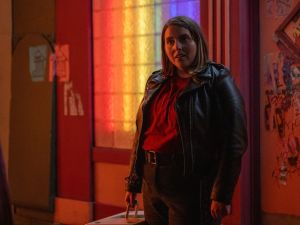 My nagging issue with the movie’s emphasis is not a puritanical response to vulgar comedy but that this movie lacks a necessary cleverness. It doesn’t really even work as dumb comedy, although there are moments that come close, like the absurd multiple-corkscrew murder that opens the movie. It’s just kind of exaggerated nonsense without having the finesse to steer this hyper-sexual world of comedy oddballs. The crime elements clash with the low-stakes comedy noodling of our leads bumbling their way through situation after situation that invariably leads to one of them undressing or inserting something somewhere. The brazen empowerment of women seeking out pleasure is a fine starting point for the movie, but the characters are too weakly written as an Odd Couple match that meets in the middle, the uptight one learning to loosen up and the irresponsible one learning to be less selfish. The goons chasing them are a pale imitation of other famous Coen tough guys; they lack funny personality quirks to broaden them out. There’s a conspiracy exposing political hypocrites condemning the “gay agenda,” and I wish more of this was satirized rather than a briefcase full of reportedly famous phalluses. If you got a briefcase full of famous appendages, I was expecting more jokes than blunt objects.
I feel for the actors, so eager to be part of a Coen movie, even if it’s only one of them and even if it’s something much much lesser. Qualley (Once Upon a Time… in Hollywood) is a typical Coen cartoon of a character, complete with peculiar accent and syntax. She’s going for broke with this performance but the material, time and again, requires so little other than being exaggerated and horny. There is one scene where her physical movements are so broad, so heightened to the point of strain, that I felt an outpouring of pity for her. It feels like a performance of sheer energetic force lacking proper direction. Viswanathan has been so good in other comedies and she’s given so little to do here other than playing the straight women (no pun intended) to Qualley’s twangy cartoon. Her portrayal of sexual coming of age and empowerment was better realized, and funnier, in 2018’s Blockers, a superior sex-positive sex comedy.
 As a solo filmmaker, Ethan Coen seems to confirm that his brother is more the visual stylist of the duo. The movie is awash in neon colors and tight closeups of bug eyes and twangy accents, but the most annoying stylistic feature, by far, is the repeated psychedelic transition shots, these trippy interstitials that don’t really jibe with anything on screen. It felt like padding for an already stretched-thin movie that can barely reach 75 minutes before the end credits kick in. That’s why the extended sequences where the intention seems exploitation elements first and comedy second, or third, or not at all, makes the whole enterprise feel like a pervy curiosity that has its empowering yet obvious message of “girls do it too” as cover. Agreed, but maybe do more with the material beyond showcasing it. Ethan Coen is a prolific writer who has written short story collections (I own his 1998 book Gates of Eden), poetry collections, and he even wrote five one-act plays before the pandemic struck in 2020. I’d love to see those plays. This man has true talent but it’s just not obviously present throughout this film.
Drive-Away Dolls is an irreverent sex comedy with good intentions and bad ideas, or good ideas and bad intentions, an exploitation picture meant to serve as empowerment but still presents its world as exploitation first and last. It’s just not a funny movie, and it’s barely enough to cover a full feature. I suppose one could celebrate its mere existence as an affront to those puritanical forces trying to oppress feminine sexuality, but then you could say the same thing about those 1970s women-in-prison exploitation pictures. It’s a strange movie experience, achingly unfunny, overly mannered, and makes you long for the day that the two Coens will reunite and prove that the two men are better as a united creative force; that’s right, two Coens are better than one.
Nate’s Grade: C-
Share this:

Madame Web (2024)
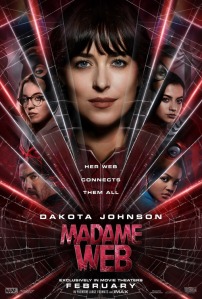 What even is this movie and who is this for? I think the real answer is to help Sony’s bottom line, but that’s generally the real reason for most studio blockbusters, the opportunity for the parent company to make more money. Sony has the rights to Spider-Man and they’re not going to let those things lapse, and while Marvel is shepherding the Tom Holland-lead Spider-Man franchise, Sony is left to their own devices to build out the Spidey universe with lesser-known solo vehicles meant to launch an interconnected web of Spidey’s rogues gallery. It’s about growing more franchises, and it worked with 2018’s Venom, a favorite Spidey villain with a sizable fan base and benefiting from the goofiness of its execution with Tom Hardy and company. It didn’t work out for Morbius in 2022 because nobody cares about Morbius as a character, just like nobody cares about Kraven the Hunter as a character (coming August 2024!), and just like nobody cares about Madame Web, who wasn’t even a Spidey villain and instead an old blind lady that saw the future. The far majority of Spider-Man villains are only interesting as they relate to Spider-Man, so giving them solo vehicles absent Spider-Man is a game in delayed gratification. Madame Web is the latest in this misguided attempt to create an enriched outer circle of brand extension. It’s a promise of a continuity of superhero movies that will never come to pass. It’s a bland return to early 2000s superhero heroics with some substantial structural flaws to its own tangled web.
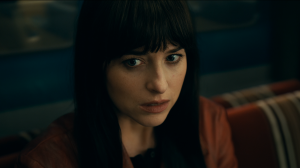
Cassandra “Cassie” Web (Dakota Johnson) is an EMT in New York City and frustrated by her humdrum life until after an accident she starts seeing the future. You see her mother was researching spiders in the Amazon before she died, and she was researching them with Ezekiel Sims (Tahar Rahim) who killed her because he needed a special spider with special properties. Her dying mother gave birth to Cassie thanks to some… mystical Amazonian spider-people? It’s rather confusing but so are Cassie’s visions. A trio of young students (Sydney Sweeney, Isabela Merced, Celeste O’Connor) is in danger of being killed by a 30-years-older Ezekiel, so she takes it upon herself to save them, as they one day will become Spider-laden superheroes themselves. This Ezekiel, however, has super strength, agility, and the ability to walk on walls, so overcoming a Spider…man’s abilities might be too much for one EMT driver/psychic.
 This movie is more Final Destination or That’s So Raven than a big superhero adventure, and that leads to lots of structural and narrative repetition. Cassie’s power involves her getting glimpses of the future, generally warnings of things to avoid or to intervene. It also makes for a very annoying structure because the movie never gives you clues about what is a vision and what is the real timeline of events. This leads to many repetitions of scenes and fake-outs, and after a while the story feels like it’s mostly jerking you around as well as treading in place. We don’t really know why these flashes happen and what larger meaning they may have. They just happen because the plot needs them to, and so they do. Early on, Cassie gets a vision of a bird flying into her window, and she chooses to open the window, signifying that she can avoid these fates. Why couldn’t Ezekiel Sims think likewise? He’s devoted his whole life to killing these mysterious girls because they’re destined to murder him, but if he’s known for years, why not strike when these girls were younger and more vulnerable, Skynet-style? Or maybe try just not being evil too? I guess that one was too difficult for him as he’s cryptically profited off his Amazon spider steal. More work needed to go into the story to make these characters important and for the fake-out scenes to feel more like horror double-takes. It just gets tiring, and you’ll likely start second-guessing anything of import is merely a vision about to rip away the consequences.
I think a big problem is our protagonist. She’s just so boring and we don’t really understand why she’s so compelled to save these three girls more than anyone else. Her entire back-story with her mother is merely the setup for how she might have super magic powers to kick in at a convenient yet unknown combination of elements and to provide motivation why she might want to kill Ezekiel. It’s all so rudimentary and mechanical, designed just to supply enough connective tissue of plot. As an EMT, finding out how to better save lives could be really useful, although I wish the movie had the gall to make her disdainful of her job beforehand and actively bad at saving lives so that way it would feel like the universe was interjecting and saying, “Here, be better.” You would think if she’s trying to prevent death, and especially the deaths of the people she knows, that it might kick in for her to warn a couple Spider-Man-related characters of note (more on this later). Instead, the Spidey girls have an extended moment learning CPR that feels forever and then tell Cassie, “Wow, you’re a really good teacher” after a rather unimpressive learning session with a motel room pillow. This character just isn’t that interesting even with her new psychic vision powers.
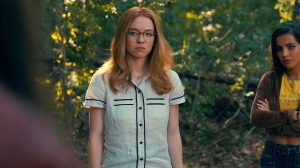 The Spidey girls are also rather uninteresting and given one note of characterization. One of them likes science. One of them has a skateboard and… attitude. One of them is Hispanic. I may have even confused about the characterization, that is how meaningless these characters are. They’re simply a glorified escort mission, a challenge for Cassie to simply keep alive. The scene where they stumble into a brightly lit diner in the middle of nowhere, after Cassie saved their lives and warned them to lay low for their own self-preservation, is immensely irritating. They take it upon themselves to stand on a table of letter jacket-wearing jocks and dance because that’s laying low. They’re annoying characters that never convince you why Cassie should go through such valiant efforts to keep alive. The flashes of them in Spider costumes are only brief glimpses of a possible future, one I can guarantee we’ll never see coming to fruition in this discarded universe.
The strained efforts to transform Madame Web into a disjointed Spider-Man prequel are distracting and generally annoying. It also reveals the doubts the studio had that anyone would be interested in a Madame Web story without additional connections to Peter Parker. Why do we need to have a pregnant Mary Parker (Emma Roberts) in this movie? Why does the climax also involve her giving birth? Are audiences going to wonder whether or not Peter Parker might be born? There’s also the prominent role of Uncle Ben Parker (Adam Scott) as Cassie’s EMT partner. He’s practically the third-leading character. The movie makes several ham-handed meta references about his eventual role in crafting Spider-Man’s development (I also guess he gets to marry Marissa Tomei, so good for you). “Ben can’t wait to be an uncle,” one person says, with, “All of the fun and none of the responsibility.” They might as well just turn to the camera and point-blankly state, “This man will eventually die and inspire Peter Parker to be a hero.” The worst moment of all this forced connectivity is when Mary demurs on picking a name and says she’ll determine when he’s born, even though the film has a “guess the name” baby shower game. Does this mean she saw her newborn babe and the first thing she thought was… Peter? The entire Spider-Man lineage feels so tacked-on and superfluous as glorified Easter eggs.
 I’m generally agnostic when it comes to product placement in movies. People got to eat and drink and drive cars, and as long as it’s not obnoxious, then so be it. However, the product placement needs to be mentioned in Madame Web for its narrative prominence, and this leads to some spoiler discussion but I’d advise you read anyway, dear reader, because this movie is practically spoiler-proof by its very conception. Ezekiel Sims is battling Cass and the Spider girls atop a large warehouse with a giant Pepsi sign built onto scaffolding. Then the engineer of Ezekiel’s doom is none other than the falling “S” from Pepsi. That’s right, the villain is dispatched through the help of Pepsi, as well as a literal sign falling from above (cue: eye-roll). Without the assistance from Pepsi (or “Pep_I”), these women might not have lived. You can’t expect that kind of divine intervention from any other cola company. Coke was probably secretly working with the villain, giving him aid and comfort from being parched (begun these Cola Wars have). Deus ex Pepsi. It’s just so egregious and in-your-face that I laughed out loud. Is it also a reference to the original Final Destination ending or am I myself reading the signs too closely?
For those hoping for a so-bad-it’s-good entertainment factor, I found Madame Web to be more dreary, bland, and confusing than unintentionally hilarious. Johnson is an actress I’ve grown to enjoy in efforts like Cha Cha Real Smooth and The Peanut Butter Falcon, also the much-derided but still enjoyable Netflix Persuasion, but she sleepwalks through this movie. I don’t blame her. I don’t blame any of the actors (poor Rahim’s performance seems entirely replaced by bad ADR lines). The character’s nonchalance already zaps the low stakes of a movie where a psychic character we don’t really have fond feelings over is trying to save a trio of annoying teenagers before a vague hodgepodge of a villain succeeds in killing them before they can kill him, which means they all need to kill him before he can kill them before they are destined to kill him. No wonder the executives decided to crassly cram in some Spider-Man relatives to make people care. Madame Web is less a bad movie and more a poorly executed and confused movie, one that doesn’t understand the desires of its intended audience. It’s barely even a superhero action movie, with few scenes of elevated action, though the director enjoys her ceiling perspective flips. There’s a moment where our villain flat-out says, “You can’t do [a thing],” and literally seconds later, through no setup or explanation, suddenly Cassie can do [that thing]. The whole movie feels like this moment, arbitrary and contrived and desperately reaching for an identity of its own. It should have stayed in the Amazon researching spiders before it was destined to die.
Nate’s Grade: C
Share this:

Night Swim (2024)
 It feels like the genesis of Night Swim was somebody saying, “We need a new way to do a haunted house movie so… what if…?” and then just pointed to different parts of the home and questioned whether it could be haunted. What I’m saying is we were probably a coin flip away from a terrifying tale of a haunted barbecue grill (working title: Dead Meat). A haunted pool would naturally lead to the question, “Well, why don’t you stay out of the pool?” and, well, we don’t really have an answer, so the pool can’t do too much because it’s immobile. There’s a possibility here with some spirit linked to the pool water seeking sacrifices and offering rewards in return, but this is downplayed so much and eventually forgotten during the muddied reasoning that concludes this confusing movie. I don’t think the film can even stick to its own rules. It needs to be either goofier, fully embracing its ridiculous premise of a haunted swimming pool, or going even darker and deeper with its back-story and rules and how this corrupts the new family, not because of some evil possession but from the simple wish-granting opportunity of feeding this monster for personal gain. There’s a way to make this concept work, specifically bringing the revelation earlier and dealing with the devil’s bargain implications and moral relativism. Alas, instead we get a movie about a husband being possessed by evil spring spirits and literally playing a game of Marco Polo with his children and, upon stalking them, pounces by ominously shouting, “You’re supposed to say ‘Polo’!” Just keep swimming, folks.
Nate’s Grade: C
Share this:

Argylle (2024)
 Knocked around by critics and tagged as the latest excuse for the Death of Filmmaking thanks to its overwhelming budget and general ironic indifference, Argylle is a goofy spy comedy that, while lesser, is an easy watch and would earn regular rotation as a TNT afternoon giant. It’s not trying to be more than a good time, and while its quippy attitude can feel forced and approaching irony overload, it’s also the kind of movie that entertains as breezy escapism. It’s fun. Enough.
Elly Conway (Bryce Dallas Howard) is a best-selling spy novelist with a dashing super spy Lothario lead character by the name of Argylle (Henry Cavill in the worst haircut of his career). She’s journeying with her pet cat, her closest relationship, when she’s stopped on a train by Aidan Wilde (Sam Rockwell). He tells her that he’s a real spy and that everything she’s written in her five novels has come true, and different covert agencies are taking notice. She’s got teams of assassins and spies coming for her, while Aidan tries his best to protect her and get her to remember key details that could save the world from nefarious forces.
 Argylle is too breezy and too predictable by half. It’s a spy thriller that I’m positive many will be able to predict the big twists miles before they occur. Why do all these spies want Elly Conway, and how could she know about the intricate world of international spy craft? The answer is exactly what you’d expect, if you’ve watched more than your share of twist-laden thrillers. Thankfully, director Matthew Vaughn (Kingsman, X-Men: First Class) and company dispatch with this central twist after an hour, providing more time to deal with the aftermath and build off of its story impact. Ah, dear reader, but there’s going to be another twist once you know the first, and again, if you can predict the first, you’re likely to predict the second, because stories about universally good people are often dull, and movies have provided a new medical maxim that characters use maladies to re-evaluate their prior life and choose to be better (oh how nimbly I’m dancing around these spoilers). What makes these predictions forgivable is that the movie seems to know you will anticipate them and has more to offer.
That’s because in this silly universe, very little seems to matter besides getting to the next scene. It’s not a satirical send-up of the genre like Vaughn’s Kingsman movies. Instead, it’s more of a generic distillation of spy thrillers, complete with bad guys walking through mission control banks of computers and barking impotent orders. The only added cleverness that sets the Argylle world apart is Elly’s writing, the fictional version of this far more bland spy universe. In the book parts, Vaughn takes note to raise the style as well as the tongue-in-cheek comedy. It’s supposed to be tone-deaf and dumb and ridiculous, because it’s the big screen version of bad genre writing. You can have fun with that, with characters so serious to the point of parody, with nonsensical technology and near escapes. But when you try to do the same thing in the so-called real world, then the movie starts to eradicate any sense of a baseline for credulity. I did like the practical advice of Aidan on how to crush the skulls of your downed enemy (“Just imagine you’re dancing The Twist.. twist and smash”). By the end of Argylle, Elly and Aidan can do just about anything because they’re practically superheroes. The entertainment of the fish-out-of-water aspect of Elly’s story is short-lived and unfulfilled because the movie becomes more of a tale of automatic self-actualization rather than growth.
 The direction feels rather drab at points, and many locations and scenes have a general sense of missing… something. Just watch any set and it appears so drastically empty that I questioned whether they cut back on the set dressers and props. Empty dance clubs. Empty streets. Empty hallways. Everything is too pristine, too sleek, and too empty and green screened (might be a result of COVID filmmaking). This carries over into the disappointing visual aesthetic, as Vaughn’s signature style feels dampened by the pesky CGI additions of many sequences, adding to the unreality rather than building out this minimalist world. If there had been an extra EXTRA twist that everything was also a story-within-a-spy-story, I would not have been that shocked, and it honestly would have explained the underwritten and underwhelming world of clandestine spy-making.
Vaughn errs in the core creative decision of having his main character mix reality and fantasy, not through the idea itself, which could be ripe, but through its confusing execution and editing. Having Elly hallucinate Agent Argylle in place of a real secret agent is fine, as we can contrast from her idealized version of a super spy, her James Bond, versus the actual grunts struggling to win the day. There are a couple problems with this execution though and firstly that the “reality” isn’t that far removed from the fantasy. This is still a world where Rockwell’s spy is able to commit amazing acts of dexterity and martial arts and balletic violence flying around rooms, but I guess he falls down more. The difference isn’t that fantastic when it’s already a hyper-stylized action world. The bigger issue is just how confusing it all plays out visually because we’re seeing Elly’s perspective and in rapid blinks Cavill will turn into Rockwell and vice versa. It makes for a jarring sequence that doesn’t fully capitalize on the comic potential while keeping the audience distant from fully engaging with the sheer simple pleasures of watching a fun fight. This happens throughout the first half of the movie and severely hampers the action scenes from being accessible. I think we needed a longer duration for this to work. We see Elly’s version for a period of time, and then we cut to the real world where Aidan is bouncing into walls, falling down, and flailing. By continuously jumping back and forth, not just in the scenes but in the same shots, Vaughn has made his movie harder to watch and harder to comprehend, and with a loud soundtrack blaring.
 There is one sequence of great filmmaking for Vaughn, but to explain such will require some spoilers, so beware, dear reader. There are three instances of the whirly-bird dance where a woman is lifted spread-eagle atop a man’s shoulders who then spins her around. The first time, it’s Agent Argylle and Legrange, played by Dua Lipa (Barbie) dripping with sexual energy. The second time is when Elly and Aidan are on a mission and he lifts her up, to her amusement and flirtation. She’s living out her fantasy version, with Rockwell standing in for Cavill and Howard standing in for Dua Lipa. We’ve gone from these stunningly attractive human specimens to people who look more ordinary, including a fuller figured woman engaging in the same sexy shenanigans as the conventional blonde bombshell. She can be her dream version of herself. Finally, the third occurrence happens during a climactic showdown where Elly and Aidan team up against an onslaught of faceless armed henchmen. With the aid of colorful smoke canisters, their offensive surge plays out like a couples’ dance routine, including holding one another for high kicks to incendiary devices. It’s all set to Leona Lewis’ cover of Snow Patrol’s “Run,” and as the music swells, it’s easy to get swept up too. Even the gunshots are set to the beats of the song, culminating in the final whirly-bird dance, except it’s not Elly being lifted, this time it’s Aidan. See, she’s not the Bond girl bombshell, she’s James Bond. It’s a silly moment but with the added setup, thematic underpinnings, and Vaughn’s virtuoso stylistic seizing of the moment, it plays out as empowerment and an expression of love. For real.
I can understand being generally disappointed with Argylle. It looks and feels like it’s been built on the parts of other better spy franchises and desperately lacks the charisma and personality of Vaughn’s Kingsman movies, themselves giddy and perverse satires. I wasn’t the biggest fan of 2017’s The Golden Circle sequel, but it’s got oodles of style to spare compared with Argylle. I wish Vaughn would push himself beyond the orbit of making cheeky, winky spy action comedies, the same genre he’s been playing in since 2015 and now for four movies. While the original Kingsman was a breath of fresh air with fun characters, a snarky attitude, and slick style, Argylle is all snark and minimal style. There’s so much comedy that feels like it should be funnier, from the travails of Elly’s CGI-enchanced cat to the floundering hand-to-hand combat. When recognizable names start showing up playing forgettable genre stock types, and then they start dabbling in accents as other genre stock types, it feels like the whole exercise is a miss. However, the central buddy relationship between Rockwell and Howard is where the movie works, and fortunately that’s the element that has the most foundational effort. This is a movie that, in the future, if it was on TV during a lazy day, you’d sit down and watch the rest and mostly be happy about it. Argylle isn’t anything new or fresh but it’s buoyed by its stars, and not the magazine cover models but its real stars, Rockwell and Howard. In their hands, even lesser spy comedies can still be fairly worthwhile escapist entertainment. Still, I must deduct some points for the movie missing a perfectly setup opportunity to have Henry Cavill and John Cena kiss onscreen at the end. It was right there, folks, and we all deserved it.
Nate’s Grade: C+


 nathanzoebl
You must be logged in to post a comment.