Category Archives: 2016 Movies
Midnight Special (2016)
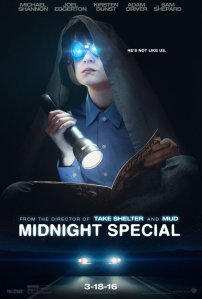 Jeff Nichols should already be a household name after Mud and Take Shelter, and with his new movie Midnight Special, the man has done nothing to break his incredible record of success with making deeply personal, ruminative, thrilling, and brilliant films. Midnight Special is a better and more earnest love letter to the cinema of Spielberg than Super 8 was. A young boy exhibits strange and supernatural powers. The religious compound he came from looks at him as a prophet. The government thinks he might be a weapon. Two different groups are on the hunt for this boy, and that’s where Nichols drops us right into the middle of, respecting the intelligence of his audience to catch up and figure things as they develop. In some ways it reminds me of Mad Max: Fury Road, an expert chase film that establishes its characters naturally as it barrels onward. The acting is wonderful all around and Nichols does a great job of finding small character moments that speak volumes, giving everyone time in the spotlight. The various twists and turns can be surprising, heartwarming, funny, but they stay true to the direction of the story he’s telling and grounded in the simple, unyielding anxiety and love of parents for their child. Michael Shannon (Nichols go-to collaborator) is directly affecting as a humble but determined father risking everything for the well-being of his son. The concluding act left me awed and felt something akin to what I think Brad Bird may have been going for with Tomorrowland. This is a thoughtful science fiction movie that allows its characters space to emote, its plot room to breathe, and yet still thrills and awes on a fraction of a Hollywood budget. It shouldn’t be long before some studio finally taps Nichols to jump to the big leagues of a franchise film, but if he wanted to keep making these small, character-driven indies on his own terms, I’d die happy.
Nate’s Grade: A
Share this:

Hardcore Henry (2016)
 Hardcore Henry is an action movie told entirely through the eyes of its silent protagonist. Some critics and fans are calling it the future of movies. Director and co-writer Ilya Naishuller strapped a team of stuntmen with facial camera masks and filmed entirely on GoPro Hero 3 cameras taking in every punch, kick, and jump. It’s an ambitious filmmaking gamble that dares to be something different, but is it worth the effort?
Henry wakes up in a science lab. Estelle (Haley Bennett) informs him/us that she is Henry’s wife and is upgrading him with a bionic arm and leg. Unfortunately, his voice hasn’t been implemented yet. Akan (Danilla Kozlovsky), a menacing albino with telekinetic powers, breaks into the lab and kills everyone but not before abducting Estelle. Henry is battered and left for dead. His only assistance comes from Jimmy (Sharlto Copley), a mysterious and helpful man who tries to direct Henry toward his mission of saving Estelle and thwarting Akan.
The draw of this movie is its propulsive and immersive visual playground, putting the viewer in the mind of its title hero as he narrowly escapes scrapes, scales buildings of dizzying heights, and kills a whole lot of bad guys with brutal efficiency. Its POV experience makes the hardcore violence all the more immersive, though after a while I was wishing we could change things up (more on this below). I must applaud director Naishuller and his crew of limber stuntmen for the sheer creative ingenuity of their stunts and action. With a relatively small budget ($10 million, or roughly the budget spent on bagels on the last Transformers flick), the ambition behind this movie can be startling, and the development of some of its more bonkers action sequences can provide a sky-high jolt of adrenaline like few movies match. The action is also very violent, with heads being blown off, limbs being snapped, bodies bent in two, eyes gouged and used to rip heads in half (this one still confuses me from a mechanical front), and near relentless bloodshed that sometimes even requires our hero to wipe it from his face. For those hungry for near non-stop action shaped to be the equivalent of a living first-person shooter game, Hardcore Henry might do enough to strap in and deliver the goods.
 I have a confession dear reader: I experienced a fierce bout of motion sickness from this movie unlike anything I’ve ever encountered in a theater. I’m usually rather immune to shaky camera movements and found footage movies. I remember reading about people getting sick and throwing up during screenings of The Blair Witch Project not because of its content but simply from its handheld camerawork. I have never had an issue up until now. After 20 minutes of Henry, I had to sit much further back in my theater. The continuous whipping camerawork caused me a great wave of nausea. I even had to leave the theater for five minutes in the middle of the movie just to re-calibrate my brain. I would warn people about sitting too close to the screen but ideally this movie’s proper place is really your home television. You can choose to take my review with some degree of skepticism thanks to this admission, but no movie ever got to me and forced me out of the theater from motion sickness before. Henry now has that dubious honor.
The gimmick does start to lose its novelty and I wanted to break free from the claustrophobic first-person perspective as well as its paper-thin story. I started thinking there were as many restrictions to the first-person perspective as benefits. It really hampers the hand-to-hand combat choreography, which often just feels like flashes and blurs, herky-jerky editing that doesn’t immerse so much as obscure. This seems to be more of an issue for the first half than the second, which relies more heavily on small arms battles. Chase scenes aren’t added by bobbing up and down from the first-person perspective. You just aren’t able to focus on the object or person of pursuit. I also don’t understand why the entire movie relies upon a fish-eye lens either, which isn’t exactly a normal part of human vision. Its distorted images, subtle but accumulative, added to my overall motion sickness. However, the worst aspect of Hardcore Henry is easily its story or what amounts to its story. This is a movie that looks like a video game and feels like a video game, except somebody else is playing it. The very opening plays out like a video game introduction cut scene, establishing the damsel in distress and the chief villain. From there it’s a series of levels and checkpoints and tips from allies and weapon upgrades and boss battles and interchangeable bad guys. The various Jimmy incarnations pop along to guide you and dole out exposition as required, and there’s even an escort mission involving keeping the real Jimmy alive while his avatars fight off the onslaught of goons. There are several scenes of the villain randomly popping up to deliver exposition, usually on a screen that suddenly comes to life. The eventual plot twists should also be rather predictable. If there is ever a video game version of this movie it should simply be a straight port of the Henry’s plot and thrifty execution.
This chosen plot structure would be less irksome if the movie provided a story or characters to follow. There’s a reason the protagonist is a mute. He is not a person but an indestructible killing machine running on a cheat code. He lacks larger goals other than flee, kill, and save the girl. Estelle is a one-note damsel in distress, a pretty face that we don’t feel a sense of history with. The villain is as completely replaceable as our hero. He’s a telekinetic albino and your guess is as good as mine about anything else. He has no personality beyond one single mode of menacing. He’s a villain that is completely defined by his outer appearance and special abilities. Simply put, he is a super lame villain, which makes the final showdown between Akan and Henry a very limited payoff. I still don’t understand how exactly Henry was able to defeat Akan and his telekinetic powers. It’s like Henry just arbitrarily overcomes them for no discernible reason, as if Henry grabbed some kind of invisible power-up. There’s no really clear reason why just about anything happens for most of the movie. It’s a chase movie where Henry has to outrun or out-murder his faceless enemies while getting objectives from Jimmy, who is easily the movie’s lone entertaining character. For the first half, you keep watching new and different incarnations of Jimmy invariably find you as if drawn by some cosmic magnet. Copley is effortlessly amusing as he goes full tilt Peter Sellers, playing the different characters with comic absurdity and droll black humor (my favorite was World War I Jimmy). There’s a genuine musical number that had me giggling. After a string of nadir-redefining miscalculated performances, it’s nice to be able to say that Copley delivers a fun and entertaining performance for the right reasons. Of course he also has the most screen time by far, so that’s probably also a clear factor. This is a movie that has prioritized the immersive action experience, but after the novelty wore off I was left with listless characters and a poorly articulated story stretched thin from breathless, bloody action set piece to set piece. It was less a movie and more a 90-minute viral video.
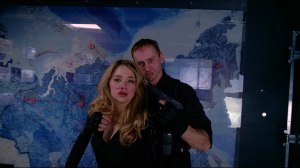 Hardcore Henry is a kinetic, propulsive, adrenaline-fueled immersive experience that ultimately is a bit too immersive and narratively flimsy. This isn’t a movie. There aren’t any characters to care about and the story is really the thinnest of tissue to connect from one action sequence (or game level) to the next, stopping at points for free-flowing exposition, weapons upgrade, or a checkpoint. It’s less a fully functioning movie and more of a visual experience, and whether that experience will ultimately justify its gimmick will depend on your threshold for the first-person POV and its scarce story. Here’s what I don’t understand about people saying Hardcore Henry is the future of movies. It’s an immersive experience but movies are already a medium that we can get lost in and transported, no first-person perspective necessary for our empathy to kick in. The recent cinematic action highs, like Snowpiercer and The Raid 2 and Mad Max: Fury Road and Edge of Tomorrow, all delivered exuberant thrills without having to strictly see through their protagonist’s eyeballs. Action moviemaking is more than a you-are-there visceral immediacy; it’s about building new worlds and blowing them up in fantastic ways. I did not feel pushed to the margins of any of those aforementioned film titles. I was completely absorbed and marveled at their ability to entertain and build payoffs. The idea is that Hardcore Henry is all payoff but if you want to wax philosophical, it’s more like an action movie’s pornographic cousin, cutting out the “boring bits” like developing characters that we care about, establishing setups, creating organic complications, and wrapping it all together in the blanket of a story that provides greater audience satisfaction. Those movies are more than just a stuntman’s sizzle reel; they’re movies. Hardcore Henry is only an experience, and it was an experience I wanted to turn off.
Nate’s Grade: C+
Share this:

10 Cloverfield Lane (2016)
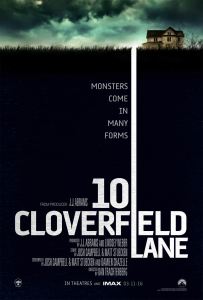 The mysterious sequel to the 2008 found footage monster movie sprung from nowhere, surreptitiously filmed without the general public having any idea of its connection to Cloverfield until mere weeks before its release. It’s the equivalent of a modern-day publicity magic act, something that J.J. Abrams is known for with his crusade against spoilers. The biggest surprise about 10 Cloverfield Lane is that the best parts of a slick and suspenseful movie are the parts that have nothing to do with Cloverfield. The majority of the film’s first two acts take place entirely in a bunker with one possibly disturbed individual played by a terrifically unsettled John Goodman. The unease and dread build nicely and the reveals are paced out in a clever manner to make us second-guess and second-guess our second-guesses. There’s a great moment during an awkward game of charades where Goodman’s character can’t conceive of calling a woman by the term “woman,” instead relying upon patronizing terms like “girl” or “princess.” There’s a darkness and a fury under the surface that should remind of Goodman’s expert turn in Barton Fink. This is a finely suspenseful and mysterious chamber piece until we leave the bunker and the movie officially connects into the Cloverfield universe. It’s a little sloppy and makes for a tonally inconsistent finale. It’s not enough to ruin the movie by any means but it certainly lessens the smartly constructed suspense and paranoia. Mary Elizabeth Winstead (Scott Pilgrim vs. the World) makes for an effective survival thriller heroine, and her line reading of “Oh come on” is a divine highlight. As a Cloverfield movie, this opens up the space for a wider variety of humans vs. monsters stories, but as a movie, it plays at peak performance when it follows its own lead.
Nate’s Grade: B
Share this:

Batman vs. Superman: Dawn of Justice (2016)
 Batman and Superman have been a collision course for a while. The two most famous superheroes were once scheduled to combat in 2003. Then the budget got a tad too high for Warner Brothers’ liking and it was scrapped. Flash forward a decade and now it seems that money is no longer a stumbling point, especially as Batman vs. Superman: Dawn of Justice cost an estimated $250 million dollars. I wasn’t a fan of director Zack Snyder’s first take on Superman, 2013’s Man of Steel, so I was tremendously wary when he was already tapped to direct its follow-up, as well as the inevitable follow-up follow-up with 2017’s Justice League. You see DC has epic plans to create its own universe of interlocked comics franchises patterned after Marvel’s runaway success. Instead of building to the super team-up, they’re starting with it and hoping one movie can kick off possibly half a dozen franchises. There’s a lot at stake here for a lot of people. That’s what make the end results all the more truly shocking. Batman vs. Superman isn’t just a bad movie, and I never thought I’d type these words, it’s worse than Batman and Robin.
Eighteen months after the cataclysmic events of Man of Steel, Metropolis is rebuilding and has an uneasy relationship with its alien visitor, Superman (Henry Cavill). Billionaire Bruce Wayne (Ben Affleck) is convinced that an all-powerful alien is a threat to mankind, especially in the wake of the dead and injured in Metropolis. But how does man kill a god? Enter additional billionaire Lex Luthor (Jessie Eisenberg) and his acquisition of a giant hunk of kryptonite. Bruce runs into a mysterious woman (Gail Gadot a.k.a. Wonder Woman) also looking into the secrets held within Luthor’s vaults. Clark Kent is pressing Wayne for comment on this bat vigilante trampling on civil liberties in nearby Gotham City, and Wayne is annoyed at the news media’s fawning treatment over an unchecked all-powerful alien. The U.S. Senate is holding hearings on what responsibilities should be applied to Superman. Lois Lane (Amy Adams) is worried that her boyfriend is getting too caught up in the wrong things. Lex Luthor is scheming in the shadows to set up one final confrontation that will eliminate either Batman or Superman, and if that doesn’t work he’s got a backup plan that could spell their doom.
 I think it’s only fitting to tackle each of the particular heavyweights in this huge showdown and devote time to dressing down why exactly the movie fails them.
Let’s start with Batman because quite frankly he’s the character that the American culture prefers (his name even comes first in the title for a Superman sequel). Ben Affleck (Gone Girl) was at the bad end of unrelenting Internet fanboy-fueled scorn when the news came out that he was going to play the Caped Crusader, but he’s one of the best parts of this movie, or perhaps the better phrasing would be one of the least bad parts. He’s a much better Bruce Wayne than Batman but we don’t really get much of either in this movie from a character standpoint. There isn’t much room for character development of any sort with a plot as busy and incomprehensible as Batman vs. Superman, and so the movie often just relies upon the outsized symbolism of its mythic characters. We have a Batman who is Tough and Dark and Traumatized and looking for (Vigilante) Justice. We only really get a handful of scenes with Batman in action, and while there’s a certain entertainment factor to watching an older, more brutal Batman who has clearly given up the whole ethical resolve to avoid killing the bad guys, under Snyder’s attention, the character is lost in the action. The opening credits once again explain Batman’s origin story, a tale that should be burned into the consciousness of every consumer. We don’t need it, yet Snyder feels indebted to what he thinks a Batman movie requires. So he’s gruff, and single-minded, and angry, but he’s never complex and often he’s crudely rendered into the Sad Man Lashing Out. He’s coming to the end of his career in tights and he knows it, and he’s thinking about his ultimate legacy. That’s a great starting point that the multitude of live-action Batman cinema has yet to explore, but that vulnerability is replaced with resoluteness. He’s determined to kill Superman because Superman is dangerous, and also I guess because the Metropolis collateral damage crushed a security officer’s legs, a guy he’s never met before. The destructive orgy of Metropolis is an excellent starting point to explain Bruce Wayne’s fear and fury. I don’t know then why the movie treats Wayne as an extremist. I don’t really understand why there’s a memorial for the thousands who lost their lives in the Metropolis brawl that includes a statue of Superman. Isn’t that akin to the Vietnam Wall erecting a giant statue of a Vietcong soldier stabbing an American GI with a bayonet? This may be the most boring Batman has ever been onscreen, and I repeat, Ben Affleck is easily one of the best parts of this woefully begotten mess.
Next let’s look at the other titular superhero of the title, the Boy Scout in blue, Superman. The power of Superman lies with his earnest idealism, a factor that has always made him a tougher sell than the gloomy Batman. With Man of Steel, Warner Brothers tried making Superman more like Batman, which meant he was darker, mopey, theoretically more grounded, and adopted the same spirit of being crushed by the weight of expectations and being unable to meet them. Cavill (The Man from U.N.C.L.E.) was a Superman who didn’t want to be Superman, where dear old Pa Kent advocated letting children drown rather than revealing his powers (Father’s Day must have been real awkward in the Kent household). It wasn’t a great step and I wrote extensively about it with Man of Steel. The problem is that Superman and Batman are supposed to be contradictory and not complimentary figures. If one is brooding and the other is slightly more brooding, that doesn’t exactly create a lot of personal and philosophical conflicts now does it? It clearly feels that Snyder and everybody really wanted to make a Batman movie and Superman just tagged along. Superman clearly doesn’t even want to be Superman in the Superman sequel, often looking at saving others with a sigh-inducing sense of duty. He’s still working as a journalist and making moral arguments about the role of the media, which seems like a really lost storyline considering the emphasis on blood and destruction. He wants Superman to be seen as a force of good even if others deify him. That’s a powerfully interesting angle that’s merely given lip service, the concept of what Superman’s impact has on theology and mankind’s relationship to the universe and its sense of self. Imagine the tectonic shifts acknowledging not only are we not alone but we are the inferior race. We get a slew of truly surprising cameos for a superhero movie arguing this debate (Andrew Sullivan?) but then like most else it’s dropped. Clark is trying to reconcile his place in the world but he’s really just another plot device, this time a one-man investigation into this bat vigilante guy. The other problem with a Batman v. Superman showdown is that Superman is obviously the superior and would have to hold back to make it thrilling. We already know this Superman isn’t exactly timid about killing. The climax hinges on a Batman/Superman connection that feels so trite as to be comical, and yet Snyder and company don’t trust the audience enough to even piece that together and resort to a reconfirming flashback.
 Arguably the most problematic area of a movie overwhelmed with problems and eyesores, Eisenberg’s (Now You See Me) version of Lex Luthor is a complete non-starter. He is essentially playing his Mark Zuckerberg character but with all the social tics cranked higher. His socially awkward mad genius character feels like he’s been patched in from a different movie (Snyder’s Social Network?) and his motivation is kept murky. Why does he want to pit Batman and Superman against each other? It seems he has something of a god complex because of a nasty father. He is just substantially disappointing as a character, and his final scheme, complete with the use of an egg timer for wicked purposes, is so hokey that it made me wince. If you’re going with this approach for Lex then embrace it and make it make sense. Late in the movie, Lex Luthor comes across a treasure-trove of invaluable information, and yet he does nothing substantive with this except create a monster that needs a super team-up to take down (this plot point was already spoiled by the film’s marketing department, so I don’t feel guilty about referring to it). If you’re working with crafty Lex, he doesn’t just gain leverage and instantly attack. This is a guy who should be intricately plotting as if he was the John Doe killer in Seven. This is a guy who uses his intelligence to bend others to his will. This Lex Luthor throws around his ego, nattering social skills, and force-feeds people Jolly Ranchers. This is simply a colossal miscalculation that’s badly executed from the second he steps onscreen. The movie ends up being a 150-minute origin story for how Lex Luthor loses his hair.
The one character that somewhat works is Wonder Woman and this may be entirely due to the fact that her character is in the movie for approximately twenty minutes. Like Lois, she has little bearing on the overall plot, but at least she gets to punch things. I was skeptical of Gadot (Triple 9) when she was hired for the role that should have gone to her Furious 6 co-star, Gina Carano (Deadpool). She didn’t exactly impress me but I’ll admit I dropped much of my skepticism. I’m interested in a Wonder Woman movie, especially if, as reported, the majority is set during World War I. There is a definite thrill of seeing the character in action for the first time, even if she’s bathed in Snyder’s desaturated color-corrected palate of gloom. Realistically, Wonder Woman is here to introduce her franchise, to setup the Justice League movies, and as a tether to the other meta-humans who each have a solo film project on the calendar for the next four years. Wonder Woman gets to play coy and mysterious and then extremely capable and fierce during the finale. One of the movie’s biggest moments of enjoyment for me was when Wonder Woman takes a punch and her response is to smile. I look forward to seeing more of her in action and I hope the good vibes I have with the character, and Gadot, carry onward.
 The last act of this movie is Snyder pummeling the audience into submission, and it’s here where I just gave up and waited for the cinematic torment to cease. The action up to this point had been rather mediocre, save for that one Batman fight, and I think with each additional movie I’m coming to the conclusion that Snyder is a first-class visual stylist but a terrible action director. The story has lacked greater psychological insights or well-rounded characters, so it’s no surprise that the final act is meant to be the gladiatorial combat Lex has hyped, the epic showdown between gods. In essence, superheroes have taken a mythic property in our pop-culture, and Batman and Superman are our modern Mt. Olympus stalwarts. This showdown should be everything. The operatic heaviness of the battle at least matches with the overwrought tone of the entire movie. It’s too bad then that the titular bout between Batman and Superman lasts a whole ten minutes long. That’s it, folks, because then they have to forget their differences to tackle a larger enemy, the exact outcome that every single human being on the planet anticipated. I’m not even upset that the film ends in this direction, as it was fated. What I am upset about is a climax that feels less than satisfyingly climactic and more like punishment, as well as a conclusion that no single human being on the planet will believe. Snyder’s visual style can be an assault on the senses but what it really does is break you down. The end fight is an incoherent visual mess with the screen often a Where’s Waldo? pastiche of electricity, debris, smoke, fire, explosions, and an assortment of other elements. It’s a thick soup of CGI muck that pays no mind to geography or pacing. It’s like Michael Bay got drunk on Michael Bay-filmmaking. What the hell is the point of filming this movie in IMAX when the visual sequences are either too hard to decipher or something unworthy of the IMAX treatment? Do we need an entire close-up of a shell hitting the ground in glorious IMAX? The Doomsday character looks like a big grey baby before he grows his spikes. I was shocked at how bad the special effects looked for a movie that cost this much money, as if ILM or WETA said, “Good enough.” Once it was all over, I sat and reflected and I think even Snyder’s Sucker Punch had better action.
Another problem is that there are just way too many moments that don’t belong in a 150-minute movie. There’s an entire contrivance of Lois disposing of a valuable tool and then having to go back and retrieve it that made me roll my eyes furiously. It’s an inept way of keeping Lois involved in the action. How does Lois even know the relevancy of this weapon against its new enemy? Then there’s her rescue, which means that even when the movie shoehorns Lois into the action to make her relevant, she still manages to become a damsel in needing of saving. She feels shoehorned in general with the screenplay, zipping from location to location really as a means of uncovering exposition. Then there’s the fact that there is a staggering THREE superfluous dream sequences, and we actually get a flashback to one of those dumb dream sequences. The most extended dream sequence is a nightmarish apocalyptic world where Batman rebels against a world overrun by Superman and his thugs. There’s a strange warning that comes with this extended sequence of future action but it doesn’t involve this movie. Batman vs. Superman suffers from the same sense of over-extension that plagued Age of Ultron. It’s trying to set up so many more movies and potential franchises that it gets lost trying to simply make a good movie rather than Step One in a ten-step film release. In the age of super franchises that are intertwined with super monetary investments, these pilot movies feel more like delivery systems than rewarding storytelling. Payoffs are sacrificed for the promise of future payoffs, and frankly DC hasn’t earned the benefit of the doubt here.
 I must return to my central, headline-grabbing statement and explain how Batman vs. Superman is a worse movie than the infamous Batman and Robin. I understand how loaded that declaration is so allow me to unpack it. This is a bad movie, and with that I have no doubt. It’s plodding, incoherent, tiresome, dreary, poorly developed, and so self-serious and overwrought to the point that every ounce of fun is relinquished. It feels more like punishment than entertainment, a joyless 150-minute exercise in product launching. By the end of the movie I sat in my chair, defeated and weary. Here is the most insidious part. Batman vs. Superman: Dawn of Justice obliterates any hope I had for the larger DC universe, let alone building anything on par with what Marvel has put together. If this is the direction they’re going, the style, the tone, then I don’t see how any of these will work. What’s to like here? “Fun” is not a dirty word. Fun does not mean insubstantial nor does it mean that larger pathos is mitigated. If you’re going to have a movie about Batman and Superman duking it out, it better damn well be entertaining, and yes fun. It’s not a Lars von Trier movie. The Marvel movies are knocked for not being serious, but they take their worlds and characters seriously enough. They don’t need to treat everything like a funeral dirge, which is what Batman vs. Superman feels like (it even opens and closes on funerals). This movie confirms all the worst impulses that Man of Steel began, and because it gutted all hope I have for the future of these oncoming superhero flicks, I can’t help but lower its final grade. Batman and Robin almost killed its franchise but it was in decline at the time. As campy and innocuous as it was, Batman vs. Superman goes all the way in the other direction to the extreme, leaving a lumbering movie that consumes your hopes. The novelty of the premise and seeing its famous characters standing side-by-side will be enough for some audience members. For everyone else, commence mourning.
Nate’s Grade: D
Share this:

Miracles from Heaven (2016)
 When it comes to Christian-aimed movies finding release in the mainstream multiplex, I’ll admit that my expectations are pitifully low, and sometimes even those are unmet. It’s not that I object to the message on spiritual grounds, though sometimes it can be objectionable in how it’s applied like with the hateful yet popular God’s Not Dead; my problem is that the message is the sole purpose of the movie, not the storytelling, and so everything seems to be slapdash and inconsequential. They’re not interested in telling good stories with Christian main characters; it’s about selling good Christian messages and the movies are simply a delivery system to reconfirm the faith or at times the special elevated stature (see: God’s Not Dead) of the ticket-buyers. Every now and then one of these movies seems to slip through the cracks, so to speak, and surprise me with a genuine story and a deeper exploration of its characters and their dilemmas. I was hoping that Miracles from Heaven could be something like 2014’s Heaven is For Real, a well-meaning and consciously inclusive movie. Miracles from Heaven was my own 105-minutes of hell as I endured the barest of attempt to service a feature-length story.
Based on a true story, Christy Beam (Jennifer Garner) is a loving and doting mom who checks in on each of her three daughters (Abbie, Anna, Adelynn) during their nightly prayers. Her world is turned upside down when young Anna (the heavy-lidded Kylie Rogers) has intense stomach pains and intense vomiting. She can’t keep anything down for weeks and the doctors are unhelpful until she’s finally properly diagnosed. Anna has a twisted intestine, which makes her unable to digest food, and this illness has no cure and often dooms its afflicted cases to short lives. Christy and her husband Kevin (Martin Henderson) have their hopes pinned on getting admitted to Dr. Nurko’s (Eugenio Derbez) treatment, a specialist in Boston. Even after enrolling, the long weeks apart from family, and the mounting bills, leave little hope for Anna and the Beam family. It’s the perfect conditions for a miracle of some sort to take form, wouldn’t you say?
 If you’re looking for a feel-good affirmation you might be barking up the wrong tree because Miracles from Heaven was, for me, an interminable experience of unyielding and tactless sadness pornography. Allow me to unpack my choice terminology. Any movie that features a young child stricken with a very deadly and incurable illness is going to fall upon the sadder side of human drama, but what sets this movie apart is that this emotional landing spot is the only territory it mines. Its scenes exist just to remind you how sad these characters are about their sad experiences with their sad daughter while she sadly suffers and will likely never sadly recover. The specialist in Boston only gets new patients when the old are cured or die, and they don’t get cured. I’m by no means saying that storytelling dealing with overpowering sadness is not worth exploring. I enjoy a sad movie as much as somebody who enjoys sad movies can because I want art to move me, to make me feel genuine emotions in response to the human condition. However, Miracles from Heaven failed to move me because every one of its scenes feels so carefully calculated to make its audience reach for tissues. Manipulation is also not an unforgivable sin when it comes to storytelling, but what makes this movie’s crime egregious is that it doesn’t provide any depth to justify those shed tears. You’re crying not because you feel for the characters of Anna, Christy, or the entire Beam brood, it’s because Christy is Suffering Mom dealing with Suffering Child. There is no characterization involved in this movie and instead it relies upon its simplistic setup to provide all the empathy. Why do they need to build characters when a few shots of a sick child or Garner with tears dribbling down her face will suffice? It’s lousy screenwriting and it honestly made me upset as scene after scene reconfirmed this emotional stupor.
Having some understanding that this movie wouldn’t exist if Anna didn’t miraculously heal by the end, we’re left with an enormous amount of time to fill. They don’t make miracles until the third act, folks, and this one is a tad peculiar but effective. The time between the diagnosis and the miracle would be a fine opportunity to flesh out the Beam family and learn more about them and how this illness is affecting each of them. The only thing we learn is that the oldest daughter misses her soccer tryouts. This is the only onscreen ramification of Anna’s constant medical attention affecting somebody. Everyone is suffering with dignity and poise, and even the oldest daughter isn’t that upset after the briefest of angry outbursts. These people are just not interesting screen characters. They are one hundred percent defined as Family to Sick Kid. That’s it. After forty minutes with this clan, I was overcome with a powerful malaise. I just wanted the movie to end and was mentally counting down this miracle, which always felt so infinitely far away in my theater chair. There’s no momentum in this movie. It’s about getting Anna to that specialist, then it’s about treating her, and then it’s about making her comfortable when she goes home, presumably to die. The movie lacks basic reflection and introspection, highlighted by a laugh-out-loud moment when a group of inhospitable church members ask Christy what kind of sin she, or even Anna herself, must have committed to bring upon this illness. I wanted to yell at the screen at this moment.
I genuinely felt sorry for Jennifer Garner in this movie; not her character but the actress herself. I’ve been a fan of Garner since her star-making turn in J.J. Abrams’ TV series Alias (those first two seasons are some of TV’s greatest). I enjoy her kicking bad guys in the face, I enjoy her making me feel a plethora of emotions, and I thought she could have reasonably been nominated for Best Supporting Actress in 2007 for one very affecting glance she delivers with perfection in Juno. I am a J. Gar fan, but my God did I want to save her from this horrible movie and what it was forcing her to do. It felt like Garner was held hostage and crying out for sanctuary. I can practically count on one lone hand the number of scenes that did not involve Garner crying. Every scene calls for her to be at a constant state of weeping, from angry crying to confused crying and finally hopeful weeping. She has a few angry mother monologues putting skeptical doctors in their places, but this is a performance almost entirely predicated upon crying. The emotional stakes are kept as such a fever pitch for so long that Miracles from Heaven crosses over into unintentional parody, feeling like a melodramatic Christian telenovela. I was envisioning a team with cattle prods to constantly keep Garner in a state of distress.
 The rest of the actors barely register, and there are some good people here. What is Queen Latifah doing in this to play a Boston waitress who becomes an unofficial tour guide for Christy and Anna? She has maybe three scenes and all of them are introduced and handled so awkwardly that it feels like the movie declaring, “And now, Christy’s Special Black Friend.” Derbez (Instructions Not Included) looks like he was given the directing note of performing like a slightly less inebriated Patch Adams. There’s John Carrol Lynch (TV’s American Horror Story, Zodiac) as the kindly preacher, but his words of wisdom are often rote and lack great insight. That’s because none of these people feel like they’re characters. They’re all placeholders in service of waiting for the film’s miracle and thus its faith-affirming message to “hang in there, kitty.”
I fully accept that I’m not going to be the target audience for Miracles from Heaven, and that’s perfectly fine. Filmmakers are allowed to make stories targeted at a niche audience, though I would hope they would include enough satisfactory and developed elements for a film to transcend its niche. What bothers me is that Miracles from Heaven takes its audience for granted repeatedly. They don’t bother with characterization and the examination of insurmountable grief and parental terror because instead they’ll just boil everything to its core element of Grieving Parent cries over Sick Child. It’s the same scene, over and over, bludgeoning the audience with sadness and suffering until it taps out, cries mercy, and is overjoyed for the titular miracle to chase away this dirge. Miracles from Heaven feels more like an anecdote than a film. It’s stretched far too thin. It doesn’t respect its audience enough to even bother forming characters or present a story that explores the realities of an incurable illness and the stress this unleashes on all parties. Movies have provided great empathetic exercises where we watch human beings suffer and then triumph, moved by their plight and uplifted by their spirit, perseverance, or perhaps even the frail realatability they exhibit as they tackle their oppression. The Oscar-winning film Room is an excellent example of this and a movie I highly encourage all readers to seek out and give a chance, subject matter notwithstanding. Room is a movie that celebrates the human experience but acknowledges the pain of it too. Miracles from Heaven, in sharp contrast, is a movie that barely acknowledges the need for basic storytelling and is nothing more than insulting high-gloss sadness pornography. You deserve better, America, and so does Jennifer Garner.
Nate’s Grade: C-
Share this:

Triple 9 (2016)
 Sometimes the most upsetting movies are the ones that have a glimmer of promise and then never take advantage of that promise, instead falling upon staid genre clichés and predictable plotting that makes you wonder how a good idea was smashed into a boring and formulaic product. Triple 9 falls into this category of film disappointment. It has a great premise: a group of corrupt cops (Chiwetel Ejiofer, Anthony Mackie) are in debt to an Israeli mob matriarch (Kate Winslet) and owe her one last score, and their solution to ensure they can get away with their crime is to arrange for a new cop on the beat (Casey Affleck) to be killed, thus providing a major distraction. The problem here is that none of these characters are at all interesting. They all have conflicts and the movie does a fine job of providing each one with some kind of pressure and general motivation, but outside of the forces against them, you can summarize them in a scant few words apiece (drug addict, war vet, single dad, etc.). The plot events also just seem to coast around until a pile-up of climaxes, all of which lack satisfying closure as the body count mounts. It’s hard to care, and the only character that seems worth following is Affleck’s newcomer sniffing out the dangers that are closing in on him. Woody Harrelson feels like he’s making a special guest appearance from a separate movie from Oren Moverman as a drug-addled and angry detective. Too often the characters feel out of orbit from one another, the storylines rarely coalescing. It feels like everyone was given the same acting note of being dour and harried. Winslet’s hammy turn as an Israeli mob boss allows her to reuse her accent from Steve Jobs. Director John Hillcoat (Lawless) provides a certain charge with how he stages the robbery sequences but it’s not enough. Triple 9 is a movie that wastes a great cast, a fine premise, and a talented director. It’s not terrible by most accounts but it’s resoundingly mediocre, and sometimes that can be even worse than bad.
Nate’s Grade: C
Share this:

London Has Fallen (2016)
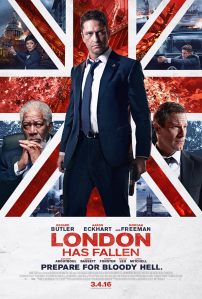 Years after the events from Olympus Has Fallen, Secret Service agent Mike Banner (Gerard Butler) is escorting President Asher (Aaron Eckhart) to London to attend a funeral. It’s there where chaos strikes and Muslim terrorists, disguised as British agents and local police, unleash a series of attacks and explosions throughout the city. Mike is able to rescue the president but the two are essentially in enemy territory looking for an escape, and the terrorists have seized London and plan on executing President Asher live on the Internet for his drone strikes in the Middle East.
The first mission for an action movie is to entertain with its action sequences, and it is here where London Has Fallen falls. The budget has been reported as high as $100 million dollars, and if this is true it may be the biggest waste of $100 million dollars I’ve ever seen on film. The movie just looks cheap. The locations (Bulgaria often doubling for London) look too vague and interchangeable with empty streets. Also, for a city that has over ten million inhabitants, why are these streets so empty? There were people milling about outdoors after 9/11, and the president wasn’t rumored to be somewhere on the streets in that scenario. Another sign of the movie’s cheapness: I’m certain that the shots of the emergency vehicles in London were stock footage. Now this wouldn’t be the first film to pad its establishment scenes with purchasable B-roll footage, but the offense is simply how poorly the movie is at hiding this fact. The footage is clearly from a lower video/film quality and not referenced as a media perspective, so the quality of the movie will suddenly drop for a brief few seconds to watch a cadre of ambulances race off. But back to these lackluster action sequences. There are very few variations on the standard run-and-shoot variety with little regards to geography. The initial escape from the first attack has some sizzle but it devolves into a series of chases and stands being made in small locations. The final assault on the bad guy’s compound unfolds as a tracking shot to kick things off and it’s here that you get a full sense of the movie’s limited ambitions. The action isn’t accelerated or given a visceral kick from the long take; it’s just guys shooting off screen, walking, shooting, with the occasional explosion. There’s no added benefit from the tracking shot, and yet somebody must have thought it would be so cool to do so and patted themself on the back.
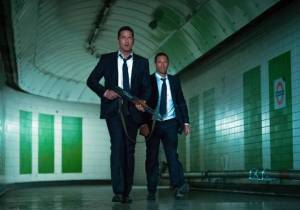 Another issue is that Butler’s character is nearly indestructible and without any vulnerability. Olympus Has Fallen didn’t wow me but it hewed closed to the Die Hard plot points and that’s a great formula to model your action movie after. In that scenario, Mike Banning was outnumbered and had to rely upon his stealth to be most effective. In the sequel, Mike has to protect the president but it’s really just the story of two buds running from place to place, having the occasional chat, and then Mike easily murdering any slew of bad guys, then repeat until the climax. It doesn’t make use of locations enough to cast out the sinking feeling of redundancy. Repetitive action sequences rely upon the concept of “more is better” when what we really demand is “more but different.” The best action movies are the ones where each sequence can stand on its own, push the story forward, makes smart use of its geography, and develops organically. There just aren’t enough of these in London Has Fallen. Our lead character is boring because he is never seen in a vulnerable position. He is told how outnumbered he is and his quippy reply is a trailer-ready line: “You should have brought more men.” This guy doesn’t sweat and only growls and stabs (lots of stabbing in this) and the R-rated violence does little to give this man anything resembling a personality. Mike is a dullard, and his personal arc of whether or not he’ll turn in his resignation from the Secret Service is one of the least believable moments of indecision you’ll ever witness. Gee, I wonder if Stabby McLoves to Stab is going to step away from his stab-heavy vocation.
With the action failing, it becomes even more apparent, and shockingly so, just how unpleasantly xenophobic and grotesque the movie’s overall political message becomes, so much so that you’d have to imagine a contingent of Trump supporters watching with baited breath and cheering mindlessly. It’s not uncommon for the bad guys in Hollywood action films to be darker-hued foreigners, so that wasn’t exactly something shocking, and the movie opens with a stab at creating a legitimate and politically pertinent grievance, a drone strike with unexpected collateral damage that obliterates a wedding party. The bad guys here have a cause that at least goes beyond blind ideology, though perhaps vengeance is actually a lesser motivation than something larger akin to ideology. They aren’t really fleshed out beyond this simple concept of vengeance or given anything larger to play with because they’re simply just villainous cardboard cutouts. And yet, most of this is expected with the territory of a typical action thriller. It’s when London Has Fallen decides to go the extra ugly mile when the movie starts becoming something far more unseemly and uncomfortable. I’m not expecting the most culturally nuanced portrayal of geo-politics, but this movie is practically a campaign ad for anti-Muslim nationalism. Our hero brutally stabs a nondescript bad guy and definitely enjoys inflicting pain. He kills another guy while screaming, “Go back to Fuckheadistan” (note to the geographically challenged: not a real standing nation as of this writing). Then it’s not enough that our hero is beating our secondary villain, he also has to deliver a speech about America’s standing and just what these pesky terrorists will never understand: “100 years later, we’ll still be here, and you’ll be dead.” What highlights these moments is that there aren’t any other political aspects in this movie, even a scant dismissive comment on something like gun control, so it feels like London Has Fallen has purposely chosen to highlight this anger and distrust of foreigners with its hero. It comes across like giving voice and credence to your crackpot uncle who, naturally, is voting for Trump to sweep them illegals and dusky-faced folk from the borders of ‘Merica.
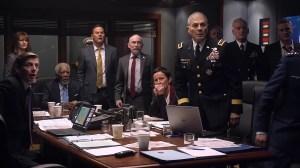 There’s an ongoing subplot in London Has Fallen that answers the question of how many Oscar nominees can you cram into a room and waste their talents. The answer, it would appear, is four, folks. Interspersed between Mike and the president on the run is Vice President Morgan Freeman (yes he has a character name but it’s really VP Morgan Freeman) deliberating in the White House with the assembled cabinet. There’s Melissa Leo (The Fighter) returning as the Secretary of Defense, Robert Forster (Jackie Brown) as a general, and Jackie Earl Haley (Little Children) as DC… something. Every time the movie has to cut back to this room full of wasted talent you’re reminded just how sad this movie is becoming. These characters don’t even have any larger bearing on the plot or any agency into the ongoing conflicts. Instead they are presented as exposition devices and reaction shots. These are some terrific thespians, including two Oscar winners, and here they are barking exposition or delivering forlorn reaction shots. We have four Oscar nominees and they’re stuck in a room, looking horrified into the camera lens, and slowly uttering lines like, “My God.” I do not begrudge actors taking paycheck roles (everybody’s got bills to pay) but this entire scenario is just an insulting waste of time.
Nobody is going to argue that Olympus Has Fallen was one of the greater works of cinema but it was a mildly enjoyable action thriller that was diverting enough to remind its rowdy audience of the Cannon genre films of the 80s. It was bloody, brutal, and fitfully entertaining (my preference was the other 2013-Die–Hard-in-a-White-House flick, White House Down). It was good enough, mostly because it hugged Die Hard closely and repeated the same plot mechanics to success. Now on its own, the sequel has to manufacture its own plotline and it doesn’t fare as well. Director Antoine Fuqua didn’t want to return for the sequel after reading the script, and this is a guy who made King Arthur and Shooter. Shooter, people! His replacement is an Iranian-born filmmaker, which just adds another level of questions for the finished product, and make no mistake, London Has Fallen is just that – product. It’s not really meant to be savored or enjoyed so much as it is processed and consumed and forgotten. The action doesn’t work well and is poorly orchestrated, often repetitive, the characters are boring, the villains are one-note, the capable actors are wasted, the overt political messages that continuously emerge are ugly and pointedly xenophobic, and the end even turns a drone strike, the same tool we saw wipe out an innocent wedding gathering to open the movie, into a crowd-pleasing climactic moment of payback. London Has Fallen is a misguided nationalistic action movie and then some.
Nate’s Grade: C-
Share this:

Race (2016)
 In 1936, Jesse Owens (Stephen James) is an American track star that seems destined for magnificent glory. Under the guidance of his coach, Larry Snyder (Jason Sudeikis), from THE Ohio State University, Owens is smashing track and field records. The culmination of his athleticism occurs at the Berlin Olympics, where Owens earns multiple gold medals and shows Adolph Hitler just how masterful his master race is.
It’s difficult to declare Race a bad movie but it’s so formulaic and by-the-numbers that I walked away thinking that Jesse Owens deserved a much better movie. I kept waiting for the movie to properly communicate the totality of what Owens accomplished, let alone in a time period where the culture at home told him he was an inferior American citizen, and it just never coalesced into a stronger message. We’re talking about a man who bested the best of the world in front of Hitler. This is ready made for cinematic drama, and perhaps that’s the problem with the screenplay by Joe Shrapnel and Anna Waterhouse (Frankie & Alice) because it always seems to fall back on the lazy and expected choice. Part of this is the reality that Owens was just that good as a runner; we only see him lose once in the entire movie. This anticlimax makes it difficult to stir up plenty of suspense around the larger and larger stages for the sports triumphs. The knowledge of Owens’ wins may be commonplace but we should still feel the stirrings of good storytelling and payoffs to well-established work, and that’s just not there. I loved watching the deluge of unhappy Nazi reaction shots to Owens’ victories (never enough footage of unhappy Nazis) but that doesn’t count as a satisfying conclusion to Owens’ story.
 The character of Owens is somewhat lost in Race. It’s reminiscent of the Jackie Robinson biopic 42 where the character of Robinson was kind of, well, boring. He’s a character who endures the suffering and indignities of others and perseveres, and this is likely why both films turn their stories of African-American tales into buddy pictures with Strong and Supportive White Men. Much of Race is presented as a buddy picture with Owens and Snyder, and both actors have such an amiable chemistry that they sort of treat the entire movie like a laid back adventure. They’re easing on through a segregated America. Too much of the movie is Owens and Snyder just cracking wise and going from scene to scene. James left a stronger impression as John Lewis in last year’s Selma. He’s too often merely stoic without more to work with. Sudeikis (We’re the Millers) is right in his comfort zone with his performance and doesn’t stray far from his range. I credit the film for not ignoring some of the messier parts of Owens’ story, namely his out-of-wedlock young daughter and him cheating on his hometown girl with a fame-seeking starlet. He’s allowed to be seen making mistakes, but the movie doesn’t allow him to live with them (note: not referring to his daughter as a “mistake”). Whenever Owens might be in a horrible predicament from his own internal decision-making, the movie almost callously breezes by without much contemplation. It’s as if every conflict is in service to the Main Conflict – sticking it to Hitler. The pressure to bow out of the Olympics to make a statement about the treatment of black people in America could have been a soul-bearing moment, but we just move along and barely feel the weight of the pressure. Yes, we know that Owens will travel abroad and win golden glory, but make the decision count.
Another aspect that dooms Race to its limited appeal is the mediocrity of its direction and, in particular, how shockingly terrible the movie is edited. Director Stephen Hopkins seems to have been in movie jail ever since 1998’s Lost in Space. He’s only shot one movie between that bomb and Race, which happened to be The Reaping, a 2007 movie I almost liked by its twist ending. He doesn’t exactly bring much to the material to elevate the races or seem that interested in taking advantageous of the suspense opportunities. There’s one great sequence where Owens first enters the Olympic stadium and the camera tracks his movements where you feel the awe. There aren’t enough moments like this that take full advantage of telling Owens’ story in a visual medium. The other technical misstep is that this is one of the worst edited movies I’ve ever watched in a theater. If you generally pay attention to the editing, it’s generally a bad sign since it’s a facet of filmmaking that is best made invisible. There is one sequence where Owens sits in Snyder’s office and the 180-degree rule is broken over ten times… in one scene! The editing will frequently flip is scene orientation, jumping back and around and creating subtle visual compositions that create incongruity in the brain. Part of this blame deserves to be laid with Hopkins, who chose to shoot his film at these uncooperative angles. It was something that bothered me throughout and would rip me out of the movie.
 The most perplexing storyline in Race involves the very positive treatment reserved for a controversial filmmaker, Leni Riefenstahl (Carice van Houten), best known for her propaganda films declaring the power and righteousness of Hitler’s Third Reich. Huh, why does a movie celebrating American heroes spend do much time positively portraying a Nazi propagandist? She becomes a translator for Goebbels and the American Olympic committee, but she’s also determined to have her vision respected when it comes to her Olympic documentary that is being produced by the Nazis. She doesn’t seem to mind about Owens trouncing the Aryan myth of racial superiority because she just wants to make the best movie and Owens is her storyline. She is portrayed as a sympathetic go-between for the Americans, someone fighting within a corrupt system to maintain her dignity and ownership in an industry that is dominated by men (she’s criticized for wearing “masculine” clothing). I’ll admit a general ignorance to Riefenstahl’s life and career outside of her most famous documentaries, which I should continue to stress are Nazi propaganda films, but this woman was a member of the Nazi party and responsible for some of the most indelible and damaging imagery justifying Hitler’s genocide, and to prop her up as a character worth rooting for and a champion to Owens just felt wrong.
Has there ever been a more self-satisfied yet facile title than Race? The double meaning is a bit too obvious and yet simple enough to be annoying. In a way, the title encapsulates the movie as a whole. It’s well-meaning but far too by-the-numbers and satisfied that it’s doing Important Work honoring an American sports legend when it’s barely giving us much of a reason to care about him as a person and less reason to root for him other than added Nazi discomfort. Owens becomes a boring centerpiece in his own movie, and his relationship with Snyder feels too ill defined, repeatedly approaching buddy comedy. The historical asides are momentarily interesting but don’t add up to much. The movie has some strikingly awful editing and lackluster direction that hobbles the storytelling. It’s a movie that hits all the checklists for sports biopic but won’t veer too far from its predicated formula. There’s a short scene at the very end that hints at what kind of better movie Race might have been. After his worldwide validation at the Berlin Olympics, Owens comes home to America and is forced to use the service entrance for his own honorary dinner. This American hero has to shamefully take the back entrance to be celebrated. It’s a stark wake-up call just how far the country had to go as far as race relations. This national cognitive dissonance, celebration and segregation, would be ripe for a searing human drama with plenty of emotion. That would be a good movie. Race is only an okay movie, and given Owens’ place in history, that’s not good enough.
Nate’s Grade: C+
Share this:

Deadpool (2016)
 Deadpool is easily the most fan service of comic characters, so it makes sense that his big screen spotlight is a movie that feels a fan service movie. The “merc with a mouth” is a character that doesn’t take himself seriously and neither does his big screen adventure, which is the biggest appeal of an otherwise standard super hero formula hiding under waves of winking irony, crass humor, and gleefully bloody violent mayhem. Ryan Reynolds plays Wade Wilson, a hired gun that undergoes a risky experimental treatment by a shady black ops organization to cure his terminal illness. It makes him generally indestructible with a rapid healing ability but his flesh is also horribly scarred and Wade is afraid his girlfriend Vanessa (Morena Baccarin), a hooker with a heart of gold, will reject him. Even in the opening credits, you know this isn’t going to be a typical super hero movie. The time is ripe for a film that knowingly ridicules the tropes of the super hero film industry, and Deadpool scores some big laughs when its making fun of itself and its super peers. The dark humor can often surprise with how go-for-broke it can get, like Wade and his Vanessa’s flirty one-upsmanship of hypothetical sexual trauma. There’s a clever montage of Wade and Vanessa’s romantic history told through sexually-specific holiday celebrations, and the inclusion of a couple of low-rent X-Men provides a comic foil for Deadpool to bounce off from. The action is fun and the movie is entertaining from its opening credits to the now-mandatory post-credits bonus. Reynolds is spiritually attuned with the irreverence of the anti-hero, finally plugging into a part that makes full use of his charm, motor mouth, and physicality. Deadpool’s runaway box-office success (grossing more than any X-Men film and on at least half the budget) will hopefully allow Hollywood to feel comfortable allowing their less than family-friendly comic titles to stay true to their intentions. Then again maybe they’ll just take all the wrong messages and think that audiences just want to hear more swearing from people in spandex. Deadpool is a super hero movie that prioritizes fun over everything else, and while it may not be for everyone, at least it’s trying to be for someone different.
Nate’s Grade: B
Share this:

Lazer Team (2016)
 What makes a disappointing comedy? It’s a question I kept thinking about while watching the sci-fi comedy Lazer Team from the online comedy collective better known as Rooster Teeth, responsible for the longest running online Web series, Red vs. Blue. These are people who know how to be funny. They have a fine resume of shorts to prove their comedy bonafides, but what was it about their first foray into features that diminished their funny? I’ll try my best to provide a critical autopsy for the case subject of Lazer Team, a disjointed and disappointing buddy comedy that died on screen.
A concerned alien species has sent a warning to Earth. A hostile alien race is heading toward our planet with the intent to conquer, pitting their champion fighter against a champion from Earth. This gladiatorial showdown inspires Earth’s military and scientists to train a select warrior (Alan Ritchson) from birth for this mission. The problem is that the wrong people get hold of that alien technology. Disrespected sheriff Hagan (Burnie Burns), his old high school has been pal Herman (Colton Dunn), redneck moron Woody (Gavin Free), and insufferable quarterback Zach (Michael Jones) come across a downed alien ship that they happened to knock out of the sky with drunken fireworks. Each of the foursome puts on a piece of the alien armor, which attaches permanently. Herman gets a pair of super fast boots, Woody a helmet that instantly makes him smarter and British, Zach an arm canon, and Hagan a retractable shield. The bickering idiots are forced to work together over the fate of the planet, and the warring alien species has sent a few of its parasitic infantry to retrieve the special suit.
 To be fair, Lazer Team is not an atrocious comedy that singes your eyeballs with pain, something along the likes of InAPPropriate Comedy or any Friedberg/Seltzer suckfest. You can tell that the Rooster Teeth squad understands the tenets of comedy and what makes for a good joke, which is what makes their final product all the more baffling. For my pal George Bailey, there’s nothing worse than a bad comedy (his worst film for 2015 was Mortdecai). A comedy has one job to do and that is to make people laugh. This should be obvious but you’d be surprised at how often this principle seems to get lost. Rarely does a larger budget make a comedy funnier, a lesson learned the hard way over and over again with Hollywood. With Rooster Teeth’s first movie, they wanted to make a throwback to the sci-fi buddy comedies of the 80s. They raised almost two and a half million dollars via the crowd-source site Indiegogo, a record until Broken Lizard’s Super Troopers 2. It feels odd to say that what amounts to a meager budget by most productions could be at fault for the ultimate disappointment, but I think it leads into the chief problem of the movie: prioritizing the action over the humor.
It’s not uncommon for the comedy to get obliterated by the action in action-comedies, but from a comedy collective I was hoping for more emphasis on the ha-ha and less on the kablooey. Lazer Team has a solid comic premise that pays homage to a pastiche of 80s inspirations and pop-culture. I wanted to laugh. I think I even compelled myself to give it some pity laughs, but after 40 or so minutes a realization could no longer be ignored, and that was that Lazer Team just wasn’t that funny. The enthusiasm of its key cast members and their amiable nature go a long way to disguise the threadbare nature of too many of their first-draft jokes. The foursome never stretches beyond the entrenched lines of their formulaic archetypes. You come to expect specific jokes delivered from them, assigned by type in a way that reminds me of TV’s The Big Bang Theory. The character will rarely surprise you, which is also because their character arcs are so transparent. Hagan will atone for his failure to act and protect Herman while Herman will learn to move on from a past misfortune. Zach will learn to be less selfish. Woody will… well he doesn’t so much have an arc because he’s instantly made smarter thanks to the lien tech. The expected is a deathblow for comedy; if you can anticipate the joke, it’s rarely funny. Lazer Team so rarely subverts your expectations, playing things too safe.
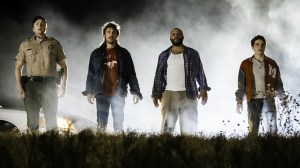 The central conflict of four losers learning to work together as a team to save the world is rife with comic possibilities, even with the locked-in archetypes, but there’s far more attention spent on the sci-fi action and special effects. It’s a low budget film but there are plenty of action set pieces and special effects, many done in-house by the Rooster Teeth team. The effects range in effectiveness but are generally passable and even impressive at turns, especially with properly calibrated expectations. The problem is that the action sequences that are eating up so much creative space aren’t remotely memorable. There’s one car chase in the middle of the film where it feels like the guys have found a tone that works, one where the action incorporates the comedy and they work. For a fleeting moment I thought, “Maybe the whole movie will resemble this new shift.” The other problem is that it feels like the Rooster Teeth squad was stuck with how to get this story to feature-length. Structurally, this thing sure feels padded with additional set pieces that lurch and fail to justify the added time, especially the ex-wife cabin sequence.
The acting foursome is the best aspect of the movie and their amiable interaction is the one thing that Lazer Team has that got me through to the end. These actors know how to sell jokes, when to mug, and their amped-up enthusiasm helps sell the lesser material. I wish this foursome had a better script. Imagine something more low-key in concept that involved less explosions and more emphasis on utilizing their comic talents? I wish less time had been spent on Jones’ obnoxious egotistical quarterback and more on Free’s redneck-turned-British genius, a setup that seems to have far more potential than just being an expositional device. The slobs vs. snobs approach only gets the movie so far, and after that we have to care about the characters, and I just didn’t. Because of how one-note the characters are it’s hard to care about them. After your good will depletes with the actors, you’re left with a bunch of running around but little funny.
Lazer Team is a movie that’s hard to hate, especially if this kind of genre comedy is a favorite launching ground for jokes. It’s nowhere near as wretched as The Watch but it can’t come close to the sci-fi comedies that influenced the Rooster Teeth creative unit. What’s even more frustrating is that these guys have the talent to tell an original and hilarious movie and are creative enough to engineer some fun sci-fi set pieces. They have the talent and expertise to do better than this, to do better than Lazer Team, a movie that is too safe, too predictable, too padded, too formulaic, and just not funny enough. I demand more from people who specialize in comedy.
Nate’s Grade: C


 nathanzoebl
You must be logged in to post a comment.