Category Archives: 2007 Movies
My Kid Could Paint That (2007)
 Prodigy, fraud, normal preschooler? This incisive and captivating documentary looks at a four-year-old who has made thousands of dollars on her modern art paintings. If she is the real deal, what does that say about modern art when a child can compete with serious artists? This intensely interesting story is given as objective a viewpoint as possible even as the filmmaker is forced into his own movie when the family he’s been documenting is looking at his film as a favorable retort to a very critical 60 Minutes segment casting doubt that the paintings are genuine. The filmmaker has his own doubts and explores the nature of journalism and storytelling and objectivity and what is art, and that’s when the documentary transcends its story and becomes about much more. I have no doubt that the child is involved in painting (the question registers with how involved her failed artist father is), but the people that are buying her paintings are buying them because they are also purchasing the story. My Kid Could Paint That, as one interview subject states, is really a story about adults seeking the limelight, because otherwise it would just be a kid having fun painting in the confines of her home. Is she exploited? Is she a genuine talent in a world of paint splashes and squiggly lines? Will she ever just be allowed to be a kid? These are just a few of the tantalizing questions this mature and insightful movie raises.
Nate’s Grade: B+
Share this:

The Namesake (2007)

Extremely heartfelt, this cross-generational family drama runs aground on some familiar territory but is boasted by strong acting. Whenever the film’s focus falls to the arranged married couple settling into a new country and a new relationship, that is when The Namesake is the most affecting and interesting. Too much time is spent on Gogol (Kal Penn) as their son who has completely embraced American culture and throws off his Indian roots. Of course he comes around in his opinion but his character never feels fully formed or completely believable, more like a composite of a prodigal son. Director Mira Nair has an obvious personal attachment to this tale of an Indian family trying to make their way in the U.S. of A, and she never misses her mark when dealing with the intensely decent and selfless father and his love for his wife. It’s a shame then that the movie shifts too much focus at the halfway point onto Gogol. The Namesake is touching and entertaining that’s a cut above thanks to sensitive performances.
Nate’s Grade: B+
Share this:

Kickin’ It Old School (2007)
 A moderately surprising comedy that’s really much more fish-out-of–water than tired You Got Served dance parody. Jamie Kennedy busts a move as a kid in a man’s body who wakes up after being in a coma for 20 years. There is an overemphasis on recreating the 80s in the early part, with a crushing amount of catch phrases, name drops, and dated toys and fashions. The rest of the film follows the sports formula closely as Kennedy reassembles his aged Funky Fresh Boys to win a dance competition for standard goals like saving his family and winning the girl of his dreams. Kickin’ It is a simpleton comedy that never aims it sights too high, but every now and then the film connects on a gag or a character that produces some real yuks (my favorite being a homeless man convinced he invented break dancing). Some of the jokes are pretty dusty and the romance is, like most of the conflict, forced and contrived, and yet I cannot hate this movie. I never grew weary watching it even though during the climactic dance-off tournament there is a dearth of even attempted comedy.
Nate’s Grade: C
Share this:

Bloodrayne II: Deliverance (2007)
 It’s been some time since infamously derided director Uwe Boll reared his head and much has changed. 2006’s Bloodrayne was his last theatrically released movie but that movie was originally shot in 2004 and pushed back. In the meantime Germany revised its tax code closing the loophole that helped finance many of Boll’s cinematic duds thanks to German financiers being able to write off their debts. Boll has finished an additional three movies that are all scheduled for release in 2008, including the star-studded (for Boll) Lord of the Rings rip-off, In the Name of the King: A Dungeon Siege Tale opening this month. Boll may never get a chance to direct a theatrically released film again, which may explain his decision to helm a direct-to-DVD sequel to Bloodrayne.
The dusty town of Deliverance, Montana is under assault from the monstrous Billy the Kid (Zack Ward). Except Billy is no ordinary bandit but a powerful vampire intent on keeping his dastardly deeds nice and quiet until the railroad moves in with a nonstop supply of fresh meat and future members of the undead. Newspaper reporter Newton Pyles (Christopher Coppola, no relation to the famous family) has ventured to Deliverance in hopes of witnessing and writing exciting tales of the Wild West, and instead he’s become the man forced to write the cover-up of Billy’s actions. The vampires have kidnapped the town’s children with the idea of feasting off them while they wait. The town’s only hope is half-human, half-vampire Rayne (Natassia Malthe). Under the guidance of rustler Pat Garret (Michael Paré), the pair gather a team to combat Billy the Kid and free Deliverance from evil.
 Stylistically, Bloodrayne II: Deliverance is Boll’s desperate attempt to ape the look and feel of HBO’s popular Western series, Deadwood. It really is rather obvious to anyone that has ever seen the show. The costumes in Deliverance look similar, the sets are dressed similarly (though they still come across as too tourist attraction stagy), the gas-lamp lighting and use of darkness seems pretty similar, and the screenplay even manages to sprinkle in a few “cocksuckers,” which any Deadwood fan would know was the term of choice for historic cowpokes. Boll has the directing habit of borrowing liberally from his sources, so I expected nothing less for his attempt at a Western. The mundane cinematography goes to great lengths to declare how handheld the camerawork is. There is a noticeable difference between following the action as it develops for a docu-drama feel and simply shaking and bobbing the camera for a misguided attempt at artistic effect. After a while you feel like the cameraman must be balancing on a unicycle. There’s an over reliance on particular camera shots and close-ups are strictly reserved for the eyes and fingers during buildups to gunfights. The lavish mountain scenery of Canada (er, I mean Montana, yeah, Montana) is probably the visual highlight of a film.
The action is surprisingly decent. The climactic shootout between the forces of good and evil isn’t going to rival anything I saw in the updated 3:10 to Yuma, however, to Boll’s credit, the action is not ineptly constructed. He develops parallel lines of action and separates Rayne’s posse to deal with separate heroic last stands. Gunfights are naturally easier to stage than sword battles (shot 1: bad guy fires, shot 2: good guy ducks then fires, shot 3: bad guy gets hit) and that might explain why Rayne doesn’t break out her signature arm-blades until the very end of the climax. Rhetorical question time: who brings an arm-blade to a gunfight, anyway?
But it is structure that weighs down Bloodrayne II. Boll finally has a handle on crafting some workable action sequences and he just blows it. Bloodrayne II has exactly three action sequences and the first two are rather puny. There is a long drought in between action and in its place are a lot of dull conversations amidst increasingly dull characters. Vampires and the Wild West is a concept that can work; fun can be had with vampire cowboys and high noon (make that midnight) duels, and yet Boll seems uneasy about embracing its supernaturally campy potential. Bloodrayne II has little blood, zero gore, no nudity, no sex, and a pitifully scant amount of action. In other words, it’s missing all of the exploitation elements that make a movie like Bloodrayne II worth watching.
Screenwriters Christopher Donaldson and Neil Every throw in a lot of side characters into the stew but then quickly dispatch them as well, which at least keeps the audience on their guard and wary that anyone that assists Rayne is destined for a sudden end. Most egregiously, they speed through one of the best segments in all of movies: the getting-the-team-together sequence. Rayne and Garret are collecting a posse that includes a con man preacher (Michael Eklund) and a drunk affectionately known as Slime Bag Franson (Michael Teigen). Part of the enjoyment of the Western is following the unifying of a team and watching relationships form, and Bloodrayne II rushes through this process. It collects its gunfighters in brief introductions and then heads right for the finish.
 There seems to be little continuity between the two films even ignoring the change at lead vampire slaying lady. The vampires in this entry behave drastically different from the older European ones in the first film. Rayne seems to have lost her healing abilities, which were what the circus folk put on display when she was their money-earning star of their own little freak show (apparently during the 100-plus year gap between films Rayne got a little hammered during Spring Break and got a lower back tattoo). I bring up the healing issue because at one point Rayne is shot several times while escaping via swimming through a river. She’s struggling to regain her strength and confesses to Garret about her true nature and her need for blood. In one of the most curious moments for a movie that pairs vampires and cowboys, Garret slices open his arm and holds it over Rayne, dripping blood all over her face. The characters even seem to catch the weirdness as they both remark how much more useful a simple cup might have been.
It wouldn’t be a Boll movie without an abundance of the bizarre, the ludicrous, and the unintentionally funny. Rayne travels great distances on horseback to Deliverance with the intention of slaying some vampires she knows are responsible for murdering her friends. She finds the reflection-free accomplice (House of the Dead‘s Tyron Leitso) and holds a stool to his windpipe, choking the bastard. Instead of finishing him off Rayne relents and lets him live because, wait for it, he let her participate in his card game. Talk about a strange shift in motivation. During the climax, the townsfolk are stirred to rise up against Billy and his vampire clan thanks to the mayor and Pyles finally growing some spines. They set out to shoot them some vampires, but really what will they accomplish? Bloodrayne II established earlier that the vampires could take being plugged with bullets unless the ammunition is combined with garlic. I doubt the townspeople know they need that key ingredient to their firearms. How do the people in 1880s Montana manage to get a copy of the Chicago newspaper Pyles writes for? The railroad hasn’t made its way to Deliverance so I’m at a loss for the speedy spread of print journalism 1,000 miles away.
But the most unintentionally funny moment comes at the end when Billy has staged an elaborate system of pulleys so that when Rayne opens a door it drops a weight that will raise a series of nooses around the captured children’s necks. The kid on the furthest right is hung to death and the children seem to be arranged according to height, which seems a little OCD even for a vampire. The tallest kid on the far left of this makeshift gallows reacts very differently. While the rest of the child actors are crying, fretting, and acting like the ropes are cutting their breathing, this kid on the far left is just standing stone-faced and still.
The dialogue is expectantly awful, including clunkers like Pyles saying, “I have a question. I came looking for stories of the Wild West,” and then never actually asking a question (what kind of reporter doesn’t know what a question is?). The best/worst example of dialogue is literally the final line spoken and it blindsides the audience like a car crash. Garret says with a glint of wisdom, “Life is like a penis. When it’s hard you get screwed and when it’s soft it can’t be beat.” Wow. Someone alert the motivational poster industry because I have a gut feeling this will rival the perilous “Hang in there” kitty.
The first Rayne, Kristanna Loken, decided she’d rather stick with her Sci-Fi TV show, which has since been cancelled, than don the arm-blades once more for Boll. Malthe (Elektra, Skinwalkers) has the acting prowess you would expect from a former Maxim magazine model. It’s not like the role of Rayne involves much emotional complexity; mostly an actress has to be able to deliver some clunky dialogue and look attractive while swinging a sword. Malthe is certainly a fine looking woman but she is a non-starter when it comes to the world of acting. Whenever she speaks it’s in the same emotionless, dry tone even when she’s supposed to be angry. She comes across like an ineffectual dominatrix who’s studied acting by watching tapes of Shannon Doherty.
 Ward is hilariously miscast and completely unconvincing as an evil bloodsucker cowboy. Ward got his start in the classic A Christmas Story and I remember him best playing the goofy, dumb younger brother on comedian Christopher Titus’ hysterical TV show, Titus. Ward tacks on a lousy Eastern European accent that comes in sharp conflict with the setting and material of the film. Are vampires immune from having accents rub off on them, because Rayne seems to have assimilated well into frontier speech patterns? I challenge others not to crack up when he yells, “Now the slaughter begins.” In his defense, Ward isn’t given many scenes to play and the screenwriters have to fall back on the cheap “kids in danger” device to establish his villainy.
The other actors don’t fare much better. Coppola annoys within minutes of appearing onscreen. A helpful bartender (Chris Spencer) is astoundingly bad even for an Uwe Boll movie. He plays the part like Ted Lange in the Wild West. Boll go-to actor Paré actually seems at home with the Western material and his curt, monotone delivery fits well with the material. He’s a good fit for this genre but that doesn’t excuse his poor performances in four previous Boll flicks. The best actor in the movie is the original sheriff-turned-vampire (John Novak) who works an impressive snarl and a natural physically intimidating presence. He would have made for a serviceable lead villain over Ward.
Bloodrayne II: Deliverance is far less fun than the original while being better in some regards and worse in others. There isn’t much artistic growth shown. Boll was naturally meant to transition to the relegated realm of direct-to-DVD movies. It’s more his terrain what with the queasy production values, bad acting, and shoddy, repackaged scripts. In the world of direct-to-DVD a movie can live on into infinity thanks to assembly line sequels. Did anyone realize there are now, thanks to direct-to-DVD releases, seven Children of the Corns, four Bring it Ons, and a whopping 13 Land Before Times. It’s here where Boll’s quick production turnarounds will yield the most gain and where he may even thrive. He’s already planning to direct a Bloodrayne 3 and producing an Alone in the Dark 2 (regrettably there was a 2005 direct-to-DVD sequel to House of the Dead though it had no Boll involvement whatsoever). I think Uwe Boll is finally where he belongs.
Nate’s Grade: D
Share this:

The Invisible (2007)
 Forget whatever the advertising and the trailers had you believe this film was about. Instead of watching a ghost solve the mystery of his own death, almost all of The Invisible consists of following an obnoxious kid mope about. There is no mystery from the start because the audience witnesses exactly what happens, knows exactly who the murderer is, so much of the film is just waiting for other characters to piece things together. It’s the cinematic equivalent of sitting on your hands. The plot holes are massive and people have the irritating habit of acting out of character or being moronic (why does the best friend, who inadvertently got his friend killed but was not an accomplice, say nothing to the police?). When the film tries to shoehorn in a laughably contrived romance between murderer and murderee, I was about ready to kill someone myself. Whole sections and characters could be wiped out and nothing would be too altered. The ending is a cop-out and makes little sense given the facts of the case (it’s never really a murder, which makes the advertising even more wrong). Watching The Invisible feels like you’re chained to an annoying emo kid who won’t shut the hell up. This is one lame, snooze-worthy supernatural After School Special.
Nate’s Grade: D+
Share this:

I Am Legend (2007)
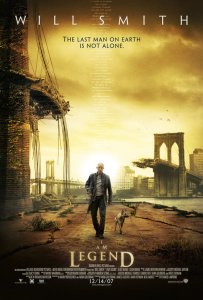 Ever wanted true and ever-lasting quiet? Be careful what you wish for. Super buff scientist Robert Neville (Will Smith) is the last known survivor of a virus that swept throughout the world in 2009. The U.S. government quarantined Manhattan and military jets blew up the bridges leading out from the island. Now in 2012, he and his lone companion, a German Shepard, must seek out supplies by day, because at night is when the “dark seekers” come out. These mutated creatures are what are left of those that fell prey to the virus; they can only come out at night and feed on blood. Smith has been capturing the creatures to run tests to see if he can crack the virus and offer a cure, except that the emerging creature hierarchy doesn’t exactly like having their members captured for scientific experiments.
Deeply unsettling, I Am Legend comes across like a post-apocalyptic Cast Away? but with vampires. I think they’re vampires, they kind of unhook their jaw like from The Mummy and have goopy gelatinous skin like from The X-Files Movie; they’re attracted to blood and burn in sunlight, therefore through my non-scientific analysis of fictional creatures, they’re vampires. Case closed. The movie shrouds the details of the end of the world in mystery that it doles out via flashbacks, and it works very well at keeping an audience intrigued without opening the door for distracting nit-picky questions. Being the last man to walk the planet presents all kinds of interesting scenarios, and simply watching Robert Neville go through his daily routine is entertaining. He picks up DVDs to watch, many of which he has seen so often he can recite line by line. He drives through the empty streets of New York trying to hunt stray deer. He tests his newest serums on infected rats. He sends out a radio message looking for survivors. The man even pumps his own gas. And then night comes and he barricades his home and sleeps in a bathtub listening to the voluminous howls of the creatures he now shares this world with. There’s a pleasing rhythm for an audience with routine, but it also helps answer the biggest question of adaptability. How would someone go about his or her daily life without another human (key word there) soul? The adjustment is part of the enjoyment. Many films and TV shows have walked this path before, hell half of the Twilight Zone episodes cover this scenario, but I Am Legend presents an awe-inspiring sight of desolation. Seeing birds-eye view angles of deserted Manhattan streets, overcome with encroaching grass and plants, is chilling and morbidly effective. The eerie quiet of the day may be even scarier than the dangers that lurk by nightfall.
 This is pretty heavy stuff for a Hollywood movie. After a taped TV interview that sets up how the virus began it immediately cuts to three years later and complete desolation. While there aren’t bodies strewn about, the lasting remnants of humanity are visible be it lines of empty automobiles or houses stockpiled with food and decorated for a new baby to arrive that never will. Death permeates every frame, and Neville dismisses the idea of “God’s plan” by declaring 90 percent of the population died immediately, 12 million proved immune and healthy, and 588 million turned into the “dark seekers.” Understandably, I Am Legend may be a bit too intense for younger kids and there are some late plot turns that will make animal lovers cringe.
Besides being an interesting what-if scenario, the movie is also a skillful, tense, and occasionally harrowing thriller filled with scares. The aforementioned moments of quiet are definitely eerie when presented on such a mass scale, and for a place as naturally noisy as New York City, but I Am Legend still has some classic spook moments that can still tingle a spine. When Neville’s dog runs into a dark building he follows, and every step becomes a great addition in terror. It’s your classic afraid-of-what-you-can’t-see scenario that horror milks, but I Am Legend invests the audience in Neville, and yes his furry companion, so that there’s genuine apprehension as we plunge into darkness. The CGI vampires won’t quicken the pulse alone, but add in the idea that every human being on the planet, your friends and family, has turned into a predatory creature and then the situation becomes more disturbing. When the vampires trick Neville and wait for the trickle of daylight to expire, the movie is downright nerve-wracking in the best way. The scene plays out at an agonizingly slow length that pins the viewer to the chair.
Smith gives a fabulous unnerved performance as, seemingly, the last man on Earth. Smith is an actor known for his wide grin and intense charisma, so plopping him down in a post-apocalyptic world doesn’t seem naturally ideal. There are long stretches where he is only acting alongside a German shepherd for companionship. Neville is dramatically lonely and befriending mannequins, including one female mannequin that he is working up the nerve to talk to in the video store. Smith is slowly breaking down from the void of human contact and he showcases how weary extreme loneliness can become. When he sees “Fred” the mannequin in an unexpected place, Smith just loses it. After such isolation, he has forgotten how to act around human beings and he is very much a casualty even as he survives. His strong relationship with his dog is occasionally touching and very reminiscent of Cast Away with Wilson the volleyball; I was more emotionally attached to this dog than I have been for entire slates of movie characters. Smith and the dog carry this movie and they both do outstanding work.
 I Am Legend is about 3/4 of an awesome movie, and then it takes a step into a more conventional direction with some new additions. The ending is satisfying and a ray of hope amongst a thoroughly bleak tale. I Am Legend flirts with the profound perspective shift of Richard Matheson’s original work but then opts for something a tad more redemptive and familiar to anyone that watched 2002’s Signs, and yet the ending still relatively works for the material. I didn’t feel cheated and I suppose that’s what counts the most when it comes to a big budget blockbuster action thriller.
I wasn’t expecting a sturdy survivalist parable mixed in with some semi-smart sci-fi and chills, so I Am Legend is a futuristic thrill ride that satisfies on different levels. Sure the last act change-up causes the movie to lose focus, and it’s not nearly as entertaining as watching Smith just go about his post-apocalyptic business. Director Francis Lawrence (Constantine) steers the movie away from camp and ramps up eerie set pieces and a strong visual command even if the CGI zombie-vampire-people look a little cheesy. The movie becomes a one-man-show and Smith, in all his quiet rage and mounting despair, is the key that holds this entire entertaining enterprise together. I Am Legend is short of legendary but it’s most certainly worth your time.
Nate’s Grade: B+
Share this:

The Golden Compass (2007)
 Beloved by many and condemned by others, Philip Pullman’s fantasy series, His Dark Materials, is widely popular. New Line Cinema placed an expensive wager in adapting the first book of the series, The Golden Compass, with the express desire of having their own Narnia-style franchise. Chris Weitz (American Pie, About a Boy) was hired to adapt and direct the enterprise. The final tally had the budget somewhere around $180 million, add in an extra $60 million for marketing, and New Line was pretty much banking their studio’s fortunes on this would-be fantasy blockbuster. Trouble is, there is not built in audience for a Golden Compass movie. The books are more popular overseas and less than ten years old, so there hasn’t been enough time to build a sense of lore or greater anticipation, like with Narnia. As of this writing, it looks like The Golden Compass is going to tap out at about $70 million domestic haul, and while I have no doubt that figure will be much higher overseas, I do not think it is a coincidence that soon after The Golden Compass fizzled New Line buried the hatchet with Peter Jackson and started the process on engineering two Hobbit movies. You see, that’s guaranteed money in the bank unlike The Golden Compass.
On a parallel Earth, people walk around with their souls in the form of animals known as daemons. These creatures serve as conscience, servant, and protector. Until a child reaches adulthood the daemon will often change form until it settles on one creature, be it a cat or a hawk or a toad. Lord Asriel (Daniel Craig) has discovered an inter-dimensional hole around the Arctic Circle, and a magical substance known as Dust is seeping through. The all-powerful Magisterium feels that they know best for others and that people need to be told what to do, and they most certainly do not appreciate Lord Asriel’s scientific discovery. They have decided to silence him permanently as he travels to the Arctic.
 Meanwhile, Lord Asriel’s niece Lyra (Dakota Blue Richards) is investigating poor orphans that seem to be vanishing around her school. The Magisterium has taken an interest in Lyra and “asked” that she accompany Mrs. Coulter (Nicole Kidman), an icy woman with a wicked monkey as a daemon. She has great hopes for Lyra, but soon the child realizes she is a prisoner in the care of Mrs.. Coulter and that the Magisterium is responsible for abducting children and conducting experiments to remove their daemons from them forever.
She escapes and heads to the North, and finds help amongst nomadic people known as Gyptians, an air cowboy (Sam Elliott), a group of flying witches led by Serafina (Eva Green, as lovely as ever), and a scarred and grumpy polar bear named Lorek (voiced by Ian McKellen) who has been exiled from the Ice Bear kingdom after losing in one-on-one combat with the cruel current king, Ragnar (voiced by Ian McShane). Lyra leads this motley crew to the Arctic where the Magisterium is keeping the absconded children for experiments.
Most noticeably absent is a sense of wonder. The Golden Compass kind of plods along, and when new magical creatures are introduced they’re done so with such matter-of-fact complacency. If they can’t pretend to be impressed then why should I? There’s a difference between playing the fantastic straight and just shrugging it off. The structure of the screenplay doesn’t help things much. Many subplots feel rushed or grafted on to a lumbering plot that collects minor characters like static cling; it isn’t until the climax that the whole slew of people combines forces. As a result, some subplots are far more interesting than others, like the world of armored polar bears. This imaginative diversion, like much of Golden Compass, reveals itself as simply a side step in a plot littered with nothing but side steps. Just as soon as the storyline has started it’s pretty much over and the movie has moved on to new ground.
The movie fluctuates between the silly and the confusing. The hardest part of any fantasy film is establishing the rules and laws of this new realm, and The Golden Compass seems a tad overburdened in trying to explain its world. Weitz’s adaptation is heavy in lugubrious exposition without the benefit of drawn-out explanation. Often some character will explain something briefly and then the audience is left to orient themselves with this new morsel of information. Cosmic dust, alternate dimensions, Magesteriums, daemons, Gyptians, polar bears, witches, prophecies, it’s a bit much to decipher for an adult let alone a child (I’m convinced that the sluggish pace and confusing jumble of a story will totally bore kids). The golden compass itself is a very awkward creation and really has little purpose or connection to the events of the film. First off, in order to pose a question a person must align three hands to varying pictures to best describe what they will ask (how many pictures do you need to ask where you left your keys?).
The book’s anti-ideology stance has been severely watered down and replaced with half-hearted euphemisms. Gone are any overt references to the church or Christianity, instead the movie couches its ire in vague authoritarian terms, a giant entity that wants to separate children from their daemons (souls) to purify them from Dust (sin). I do find it amusing that the villainess is a tall, thin blonde woman named Mrs. Coulter, though this seems more coincidence than indignation. There is a brief scene in the film where a bunch of frowning, older white men (one of them Christopher Lee) sit around a table clucking their tongues and talking up their evil scheme; that’s about as provocative as the movie gets. But by sanitizing the book’s provocative nature, Weitz has produced a movie adaptation that feels too silly to be taken at face value and too bland to be taken as anything but.
 From an effects-driven perspective, The Golden Compass is admirable even if few of the CGI works manage to truly dazzle. The special effects are sturdy for a tale with such demands as talking animals and winter icescapes. The bear battle is the film’s highlight but a climax involving a sprawling brawl, which visually indicates a person’s death by a daemon vanishing into a cloud of gold smoke, is fun to watch. Sadly, an ongoing sense of fun or enjoyment is missing from most of The Golden Compass. It feels more dutiful when it should be wondrous and timid when it should be exciting.
The Golden Compass is a less spirited fantasy adventure that skimps on what makes the genre special. It has no sense of awe and wonder, and even worse the movie is structured in a rush with little time for clarification and growing characters. The film is crammed with cheerless exposition and the bulk of the plot is built around a lame rescue attempt. Weitz has sanitized the intellectual and religious provocations of the book to appeal to greater mass audiences, but by doing so he’s robbed the audience of substantial subtext. The Golden Compass even ends on kind of an unresolved, Fellowship of the Ring, “Oh, it’s over” kind of way, finishing before even reaching the climax of the first book it’s based upon. I have read that the studio shot these scenes, and you can even see them in the original trailer and access them via the video game tie-in. They wanted to save them for the start of a second movie. It may be painfully obvious to most, but allow me to say it: there is not going to be a second movie. The Golden Compass is a slightly entertaining but mostly charmless fantasy film. Someone figure out the right three pictures to ask, “How could we have made this movie better?”
Nate’s Grade: C+
Share this:

The King of Kong: A Fistful of Quarters (2007)
 The King of Kong: A Fistful of Quarters is a short but sweet documentary that follows the lengths two men will go to set the records for the classic arcade game, Donkey Kong. We learn a whole lot about the many faces that populate the world of competitive video games, like Walter Day as official record-keeping referee, Steve Sanders as a fraudulent Donkey Kong champ in his youth who has now become a lawyer, Mr. Awesome, and the gaming world’s superstar, Billy Mitchell. He holds several world records including a score of 800,000 for Donkey Kong. Enter Washington science teacher Steve Wiebe who dutifully plays Donkey Kong in his garage. He challenges Billy’s score and videotapes himself passing 1,000,000 points; all the while you can hear his son in the background screaming to have his butt wiped.
What becomes very apparent is that the entire record-keeping system is tilted in Billy’s favor. It’s both sad and funny to watch a group of grown men who have all gravitated toward one man at video games. Billy’s claim to fame is he’s the best at video games, and he has a restaurant, a line of hot sauce, and other products that sell because he has that small sliver of fame. And this select circle of gamers essentially is a freaking tree house and they don’t like someone from the outside crashing their private party. This group of man-child sycophants is clinging to their small notoriety like a life preserver on a doomed ocean liner. It’s baffling how serious and self-involved they all come across; while on the phone with Billy, Steve Sanders, while dining, says in the most hyperbolic alertness that Steve has come into the restaurant “uninvitedly” like it’s some grave offense. It’s a restaurant! (Billy at one point literally says, “No matter what I say, it draws controversy. It’s sort of like the abortion issue.”) These few established gamers throw hurdles at Steve and even dismantle his Donkey Kong machine to snap pictures looking for some tenuous proof that his score was inflated somehow. When they find a small dew drop of glue in one corner of the control board, they claim that this, compiled with the fact that the board was given to Steve by a known enemy to Billy, is enough to disqualify Steve’s record-breaking million point score.
 They challenge him to break the record in public and that’s what Steve does, which is more than what Billy Mitchell is capable of. Steve travels to renowned New Hampshire arcade FunSpot and, under the glare of Billy lackeys, breaks 900,000 and gets to the heralded “kill screen,” where the old arcade game, because it has exhausted its memory, begins a stage simply to kill Mario within seconds. We’re told only two others have been ever known to reach a kill screen in public.
And then Brain Kuh pops in a videotape that Billy sent. The tape is a recorded game, presumably of Billy playing, where he passes 1,000,000 points on Donkey Kong and undermines Steve’s recent accomplishment. The sycophants are all abuzz, with Kuh on the phone with Billy relaying every moment in hilarious fawning detail. Apparently, it wasn’t kosher for Steve to submit a recorded video of his score but Billy doing the same thing is acceptable. This double-standard is even more dubious when you realize that Billy Mitchell is one of the deciding members on whether or not to credit Steve’s million-point tape; isn’t that a bit of a conflict of interest? Billy’s record-breaking tape has a mysterious blur that only appears on the side of the screen with the score, and the blur conveniently or coincidentally covers the score as it passes into seven digits. Surely that is more questionable than a dollop of glue on a control board, but oh well, the score stands.
The last part of the film involves the Guinness Book of World Records reaching out to Walter Day to setup a section on video game score records. The location for this showdown is even in Billy’s own backyard of Hollywood, Florida. Steve travels 3,000 miles to be there and challenge Billy head-to-head in public, but the many days go by and Billy refuses to put his skills to public scrutiny. Is he afraid to lose in public, or is there really something funny with that record-breaking tape he submitted to FunSpot?
King of Kong is pleasantly structured like a sports movie. Billy is portrayed as the villain, the establishment, and Steve is the underdog that just wants to succeed at something in a life that seems filled with disappointment. Even better, the filmmakers made a training montage set to “Eye of the Tiger.” The movie follows the expectations of a triumph-of-the-will tale, and King of Kong is all the better because of the silliness of the world of competitive old school arcade games. The sincerity and seriousness is so high that you cannot be faulted for asking whether or not this film is a mockumentary. It doesn’t seem to be real but that’s part of what makes it’s so fun to watch. Yes there’s some bias in the editing, but Billy Mitchell sure makes it easy to be characterized as a villain living high on his spoils of long ago. He openly connives and an old woman he’s helping reach a Q-Bert record even refers to him as “devious.” I think Billy even relishes the role of villain.
 King of Kong is filled with great personalities and Kuh may be one of the funniest and most pathetic real-life figures I’ve seen in recent documentaries. He’s a self-described “prodigy” of Billy’s, and he was one of the two people who ventured into Steve’s garage while he wasn’t home. He “retired” at age 30 and was one of the most vocal proponents of Steve proving his skills are valid in a public site. He says the true game player must perform in public, under pressure, with another gamer looking on, possibly playing mind games with you (he really does say this, I swear). Yet when Billy doesn’t follow suit, it’s legit. Steve was playing at the time the video was shown and asks to watch it. Kuh declines, saying it was a “one-play only show,” never mind the fact that Billy could have studied Steve’s own winning tape for hours. His hypocrisy and weasel nature aside, when he speaks directly to the camera to narrate Steve’s ongoing Donkey Kong game is where the true depth of how sad this guy is comes on display. He’s talking about how far Steve is advancing with thinly veiled envy and desperate hopes of a bad turn of events; he advises to be on alert for “wild barrels” and “aggressive fireballs.” It’s altogether pathetic. “For someone else to beat me to the kill screen would be a letdown,” he says, “but let’s see what happens, maybe he’ll crack under the pressure and maybe I’ll get my chance to do it first.”
King of Kong is a vastly entertaining documentary told with wit and visual flair. Debut filmmaker Seth Gordon has crafted a highly enjoyable little glimpse into the strange lives of competitive gaming. Following a sports movie model, it’s easy to root for the underdog and get swept up in the compelling, if bizarre, storyline. King of Kong is arresting and fascinating documentary on the agony of defeat and the thrill of competition.
Nate’s Grade: B+
Share this:

National Treasure: Book of Secrets (2007)
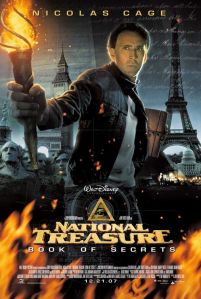 National Treasure: Book of Secrets is like a big dumb puppy that just wants love. It does a trick and thinks it deserves some form of recognition, and me with my cold heart just wants to shrug and move on with my day. How can I be so unmoved when there’s even a cartoon before the movie? For any prospective moviegoers, if you enjoyed the 2004 National Treasure, where I remind all that the U.S. Declaration of Independence had a secret treasure map on its other side, then chances are good you’ll enjoy Book of Secrets. That’s because they’re pretty much the same movie.
Ben Gates (Nicolas Cage) and his father (Jon Voight) are basking in their newfound respect from proving that their crackpot treasure schemes were in fact real. Their respectability is turned upside down, however, when Mitch Wilkinson (Ed Harris, with a dollop of a Southern drawl) has evidence that great-great-grandaddy Gates was responsible for planning President Lincoln’s assassination. He has a piece of John Wilkes Booth’s diary and a list of conspirators is jotted down, with great-great granddaddy Gates listed right there. The diary is authenticated and the Gates are devastated but ultimately unconvinced. They know their Civil War era ancestor would never betray his country and was unknowingly decoding a secret that could lead the Confederacy to an ancient golden temple, something that could help turn the tide of the war. This ancestor ripped pages out of the diary and threw them in a fire to protect the welfare of his country and was then shot by a secret Confederate soldier. In order to clear his ancestor’s good name, Ben Gates will have to find this hidden treasure, which is precisely what Mitch has wanted from the start.
 Gates re-teams with his pals from their first successful adventure, computer whiz Riley (Justin Bartha) and Abigail (Diane Kruger), who has thrown Gates out of their home due to his single-minded focus. Dating a treasure hunter is a certain path to a rocky relationship, ladies. Riley, who even wrote a book about his treasure exploits but still can’t get recognized, is game but Abigail has to be tricked into help. The group finally figures out that the only way to verify the temple’s hidden location is by getting their eyes on the mysterious President’s Book of Secrets, which only presidents can read. This means that Ben has no choice but to get the president (Bruce Greenwood) alone and beg to see a book not meant for outside eyes.
Book of Secrets is a little less dopey than the first preposterous National Treasure adventure, but that doesn’t mean it isn’t chock full of stupidity. According to these movies, apparently damn near everything in this country is built over an Indian burial ground or a giant cavern of treasure. I advise all readers to try digging in their backyards because it appears that the odds are in their favor (also: beware of your real estate company moving the tombstones but not the bodies). The clues are a little less mind-boggling, so instead of a single brick that’s been undisturbed for 200 years we get matching furniture for the Queen of England and the President of the United States. One doozey of stupidity is that one clue requires people to douse a large rock formation with water in hopes that they hit exactly the right spot and have an invisible eagle make its appearance. The plot is still structured on the clue-leads-to-other-clue template, which can be exhausting after a while because there’s never any indication of progress until the end arrives.
The subplot about kidnapping the president is ridiculous in the fact that, while already being dumb, it adds needless conflict. When Gates “”kidnaps” Mr. President he does so through a secret tunnel under George Washington’s Mt. Vernon estate. The passage closes behind them and cuts off the frantic Secret Servicemen. It is here where Gates makes his plea for the titular Book of Secrets, which the president confirms but cannot confirm publicly (well, it is a secret book of secrets). Instead of sensibly saying to his men, “Sorry guys, you know how old these places are, we got trapped, but Mr. Gates here helped get me out,” the movie tries to claim that the next course of action is that Gates will be on the run for kidnapping the leader of the free world. Huh? What makes this sequence stand out is how easily explainable it could all pass, and yet Book of Secrets figures the movie is better served by a contrived complication to add more outside pressure on Gates and his treasure hunting crew.
Of course all of the silliness and off-the-wall shenanigans would be acceptable if the film delivered some exciting action sequences that pinned you to your chair, but just like the first National Treasure, this movie is pretty much devoid of a well-thought out action sequence. Returning director Jon Turtletaub has no real visual flair and lets the material simply lay there on screen without much effort to jazz it up. Many action sequences are brief and never really flirt with complications. Usually, the script will propose a simple sequence of events like, say, “Good Guys on Run from Bad Guys” and then Turtletaub will show us exactly that, no better no worse. There’s nary a scene that actually utilizes its globetrotting destination to its advantage; most of the action is not geographic based, which means that it could happen anywhere because it doesn’t take advantage of the specifics of exotic locales. That is inexcusable to me, a big fan of good action sequences. A lengthy trip to an underground golden temple tries the patience as it rambles on and unabashedly apes the Indiana Jones series. Book of Secrets has a halfway decent car chase through the streets of London and that ends up being the highlight of the film. The trouble is that there’s more than an hour left at that point.
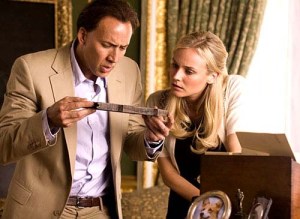 Book of Secrets is a slightly better film than the original. It jumps around in time through the lineage of the Gates clan and gives a better sense of the personal stakes for Ben and his father. Having their long-dead heroic family members linked to a dastardly assassination is good motivation for action, even if that action is ultimately finding an underground temple of gold (how A+B = C I will never know). The production design is skillful and the various European locations bring some sense of grander excitement that, sadly, will never be fully capitalized upon. The characters are still pretty shallow and one-note, but it seems like it’s less annoying this time because there’s less setup on who these characters are, which is, in short, shallow and one-note.
Cage is on autopilot and plays up his goofy mannerisms and William Shatner-esque line readings. This is a paycheck job for Cage and nothing more. Just because the first flick made tons of money is a lark to him and not an indication that he should try something different. He’s giving the people what they seemingly want, which is a wacky Nicolas Cage hamming it up with his patented version of kooky acting. Kruger is the exact copy of her character from the previous National Treasure, meaning she’s the bickering blonde counterweight to the conspiracy theorists on the journey. I suppose she plays a damsel in distress adequately. Voight gets more screen time this go-around thanks to a plump subplot involving the team seeking out the assistance of his ex-wife, played by Oscar-winning actress Helen Mirren. Yes, that Helen Mirren. Harris is given a do-nothing part as the villain and then the movie can’t even follow through on that. Everyone seems to have fun with all the nuttiness and goofy stunts, so I can’t fault them too much for faking it in a big Hollywood blockbuster.
I understand the appeal of these movies, which have found a sizeable audience willing to lap up a Cliff Notes of History along with their popcorn thrills. I imagine the fans of the original will show up in droves and make sure that National Treasure 3: The Mystery of Franklin’s Syphilis is fast-tracked for a future holiday release. I don’t mean to be a killjoy (my mother really enjoys these films) but I cannot get behind the National Treasure movement when the movies are riddled with rampant stupidity, contrived situations, convoluted conspiracies, one-note characters, and inept action sequences that never amount to much of anything beyond teetering homage to better adventure films. Book of Secrets is essentially the exact same movie reheated to take the chill off. Replace Sean Bean for Ed Harris as rival treasure hunter, add another female character, and there you have it, a mostly undisturbed formula that proved profitable in 2004.
Nate’s Grade: C
Share this:

No End in Sight (2007)
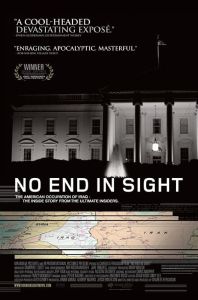 Director Charles Ferguson lived his life as a PhD political scientist, and then he felt compelled to make a movie. No End in Sight doesn’t focus much on the origins of the current Iraq War, which have been well documented and discussed in many other realms, instead the movie takes an exacting look into where the U.S. government fouled up the occupation after toppling Saddam Hussein. Because of this approach, Ferguson’s expose cannot be dismissed under false propaganda claims, and because his interviews mostly consist of the people on the ground who were responsible to stabilize the country, No End in Sight is blessed with plenty of hard-hitting first-hand accounts by the people given the hurried, thankless job of rebuilding a conquered nation.
General Jay Garner and his team, including Colonel Paul Hughes and Ambassador Barbara Bodine, were given 60 days to plan for a post-war Iraq. In contrast, FDR spent years planning ahead for an occupation of Germany. Planning was difficult because when they arrived in Baghdad the post-war looting made setting up a government a formidable task. They not only had to find means to contact people but they had to figure out ways simply to operate in an environment where looting had destroyed buildings and proper tools for communication. They were in charge of ORHA, the Office of Reconstruction and Humanitarian Assistance, which was not run through the State department, as would be normal, but run by the Defense department.
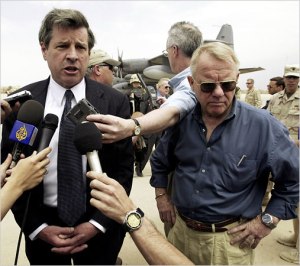 The film holds its harshest criticism for L. Paul Bremer, the man appointed to run the Coalition Provisional Authority, formerly ORHA. Bremer, like many who planned the post-war occupation and were placed in key positions within the occupation, had no military experience, no foreign policy experience with the Middle East, a notoriously tricky region, and he didn’t speak a lick of Arabic. In any other scenario, he would be judged unqualified for his heavy duty ahead. No End in Sight lays out three grievous errors that Bremer made in the summer of 2003 that gave birth to the ongoing insurgency and sent Iraq spinning out of control. The first was absolving any previous work to reach out and include Iraqis in helping to form a working provisional government. Bremer was more a my-way-or-the-highway kind of guy, which may be why he was esteemed in a presidential administration filled with these types. This alienated the Iraqi people and began Bremer’s calamitous habit of bridge burning. His second error was his decision to eliminate the Ba’ath party, Saddam Hussein’s ruling party, and bar members from any future government service. This stripped teachers, engineers, intellectuals, the very people integral to build the infrastructure of a nation, and made them permanently unemployed in Iraq. Many members had merely joined the Ba’ath party because it was the only way to secure a steady job.
But by far the most baffling and incompetent decision Bremer made was to disband Iraq’s army. This boneheaded move went against the recommendations of U.S. military figures, and in the blink of an eye, the 500,000-strong Iraqi army were without a job and an income. There were overtures from military leaders to ORHA; Paul Hughes recounts that one officer promised him 12,000 men in a week if asked. So, in a situation where the U.S. military did not have enough soldiers on the ground to even halt looting, Bremer disbanded Iraq’s best solution for restoring law and order. Half a million angry, disenfranchised, combat-trained, well-armed men were now left to fend for themselves, and if the U.S. didn’t care for their expertise then death militias would. It should come as no surprise that shortly after this colossal miscue is when Improvised Explosive Device (IED) attacks on the U.S. troops surged along with U.S. casualties. It seems like at that point the verdict had come against the U.S. occupation.
 Bremer’s decisions alienated, humiliated, and inflamed the people of Iraq, and they went against the recommendations by people that knew what they were talking about. The greatest tragedy that comes to mind is that, despite morally questionable, downright repugnant reasons for entering this conflict, the U.S. could have done this right. Saddam was indeed a bad man and the people of Iraq were initially receptive to see what the U.S. occupation would bring about. They weren’t expecting rampant unemployment, no tangible security force, being excluded from decision-making, having American private contractors bleed them dry, and an utter lack of basic human services like power and clean water. Add a long-standing religious feud into the mix and it’s no wonder the country has descended into a quagmire. No End in Sight makes the dots easy to follow and connect the cause-effect relationships into where we are today.
It’s hard to watch the film and not feel your blood boil. While No End in Sight is presented soberly and with clear-headed precision, watching the absurd miscalculations and naiveté prevail over the opinions of experts is infuriating. General Shinseki recommended to Congress that several hundred thousand troops would be required after toppling Saddam. Paul Wolfowitz, deputy Secretary of Defense, swiftly countered this assertion by claiming that it was unimaginable that it would require more troops to secure the peace rather than engage in war. “Unimaginable” is the key word here; Wolfowitz just couldn’t potentially fathom a reality that was known by most high-ranking military officials. Stabilizing a country is far more taxing than simply taking out an opposing force. Shinseki, who guided occupation forces in Bosnia and Kosovo, was ignored and pushed into “early retirement,” and Wolfowitz’s plan was followed (Wolfowitz also famously stated that the war would pay for itself thanks to Iraq’s oil revenues).
 No End in Sight does have a figure of amusement and it just so happens to be Secretary of Defense Donald Rumsfeld. The film opens with his farewell address after the 2006 midterm elections where Republicans lost control of Congress and Rumsfeld was shortly ousted from his job days later. He calls the Iraq War little understood and declares that Bush and his team’s accomplishments will one day get the full historical notation they deserve. Of course, the irony is that the designers of the Iraq War had little understanding of what they were getting into and ignored the warnings and advice of those whose opinions conflicted with the Administration line. Many clips of Rumsfeld news conferences are shown and the man comes across as flippant and disingenuous. He dismisses the looting as “stuff happens” and argues TV news is re-running the same image of a man absconding with a vase (“And you have to wonder, are there that many vases in the whole country?” he adds). The Iraq looting destroyed a museum that had artifacts dating back 7,000 years to the dawn of civilization and a library with hundreds of ancient manuscripts was burned to the ground; an entire country’s deep culture and history went up in smoke and Rumsfeld was using it as a setup to a vase joke. The clips further remind the audience that Rumsfeld, one of the chief architects of the war along with Vice President Dick Cheney and Wolfowitz, simply disregards information he doesn’t agree with, whether it may actually be right. The leaders of the Bush Administration demonstrate time and again a supreme disconnect from reality.
No End in Sight is one of the best documentaries yet on the Iraq War and a definitive indictment on the lack of substantial care given to post-war planning. No one can accuse this film of slander or pushing an agenda; this is an exacting autopsy on the current chaos in Iraq, and it has cold facts and hard truths to back up its convictions. Even if you feel that you know all the blunders tied to Iraq, this sensational film is not merely a repackaging of dogma. It’s eye-opening and intensely fascinating and one of the better films of the year; it’s an argument made on the merits of evidence and testimony, and it is damning. One soldier reflects upon the current conditions and flatly asks, “This is the best America can do? Don’t tell me that.” Then after a small pause he adds, “That makes me angry.” You are not alone, brother.
Nate’s Grade: A


 nathanzoebl
You must be logged in to post a comment.