Category Archives: 2006 Movies
The Lake House (2006)
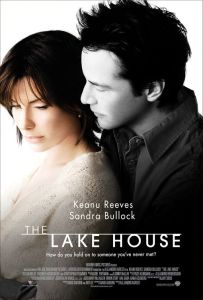 The first time I saw the trailer for The Lake House, a time-travel romance that reunites the stars of Speed, I said to myself at its conclusions, “If this lake house drops below 55 miles per hour…” I know, I’m a comedic genius, that much is obvious but what I was really reminded of was a 2002 film called Happy Accidents, a delightful gem of a movie with a similar time-travel romance. In that film you felt like anything could happen with its intricate plotting and off kilter, potentially seriously disturbed characters. Now it seems like Hollywood’s on board. The Lake House is based on an Asian film I’ve never heard of (though, in all honesty, I’ve never heard of 99.99% of them; sorry Asian cinema). This new East-West The Lake House doesn’t come across as that romantic but it’s hard to deny its points of interest.
Kate (Sandra Bullock) has taken a new job in Chicago and is moving out of a giant glass house on stilts that overlooks a lake. She leaves a note for the new resident, Alex (Keanu Reeves), an architect that struggles to fulfill his talent and his father’s (Christopher Plummer) legacy. Alex is confused; to his recollection, no one has lived in this house for years. Kate writes back and slips her notes into the nearby nostalgic mail box. But there’s something magical with this mail box. Kate is living in the year 2006 and Alex is living in the year 2004. Neither understands how it’s possible they’re even communicating by transporting letters through the mailbox. What’s even worse is that they’re falling in love with each other through their correspondence. Talk about your long-distance relationships.
 To go along with this kind of movie you really need to take it at face value. Once you start that slippery slope of questioning paradoxes of time travel or the narrative plot holes, you’ll be left in the cold for the remainder of the film. Yes, there are all sorts of logic paradoxes to clog the brain with, like the fact that every time Alex does something thoughtful, like plant a tree by Kate’s building, she won’t notice because she’s never had memories of anything being different. The characters themselves just shrug at the movie’s concept and accept this bizarre predicament. No explanation is given for this short circuit in the time space continuum, and frankly, no explanation is needed. The Lake House is not emphasizing the “why” but more the “what now?”
The Lake House is still a Hollywood romance in most senses. There’s little doubt that a happy ending is just around the corner, but at least the wrinkles and the road map to that point are not altogether predictable. The typical big moments are foreseeable, including that ever popular 11th hour misunderstanding, but The Lake House manages to tickle with surprise in the details of its journey. You don’t so much pull for the leads to get together but just see them tackle this mighty daunting obstacle before them.
The biggest flaw of The Lake House is that you never really believe these sad pretty people are falling in love. There is something indelibly romantic about falling in love with someone just from their words, constructing a potential soul mate with the few puzzle pieces given to you through long correspondence. Unfortunately, there’s nothing in those many pieces of parchment that Alex and Kate pass along that pinpoints why either pen pal would fall for the other. Both seem to have spotty luck with the opposite sex or are at least seeking more from a mate. But if The Lake House is any indication, these people have been chiefly seeking celibacy and verbosity in a mate. They talk about their lives, they talk about their pasts (in Kate’s case is a bit more extended), but it’s not too long before they start swooning and clutching those letters ever so tightly. The audience is left to fathom what invisible combination must have been unlocked that these sad pretty people have fallen for each other. While a lack of sustainable, let alone believable, romance in a romantic drama might be disastrous, at least The Lake House has a conceit strong enough to engage the brain even if it fails to engage the heart.
 The time jumps manage to keep the audience on its toes, plus there’s some fun in witnessing Alex and Kate try to locate each other and become bewildered. Director Alejandro Agresti (Valentin) and playwright David Auburn (Proof) play around with different techniques like split-screens and dissolves to present their lovers together. The conversational back-and-forth voice over does present problems; how exactly can they interrupt each other? The Lake House leans a little too hard on faith that we want to see these people end up together. Problem is that Kate and Alex are essentially void of depth; two characters defined more by the clunky subplots around them than their own personalities. Bullock and Reeves don’t help matters much, each perpetuating a vacant pretty android quality, like they’re waiting for a button to be pushed to explain human emotion.
I don’t know about you but if I was writing to someone in the past I’d use my knowledge and tell them to play certain lottery numbers or sports bets (“The Red Sox win what?”). Maybe it’s simply unromantic to start the basis of a relationship on gambling earnings. Then again, maybe it’s just unromantic to start a relationship with Keanu Reeves anyhow.
The Lake House is an old fashioned Hollywood romance but with some intriguing wrinkles and a playful structure. There’s a degree of predictability, the high-wattage stars fail to generate even low-wattage heat, but with the time-slip premise the film cannot be judge as familiar. The unusual situation and obstacles presented are more interesting than the main characters. Their love feels artificial and neither Kate nor Alex is rather deep, involving, or particularly smart (e-mail anyone?). Despite the limited help by the leads, The Lake House is a pleasant, different, if not terribly romantic Hollywood drama. For Hollywood, sometimes “pleasant and different” is enough for an enjoyable evening with the stars and someone special by your side. For everyone else, rent Happy Accidents.
Nate’s Grade: B
Share this:

Cars (2006)
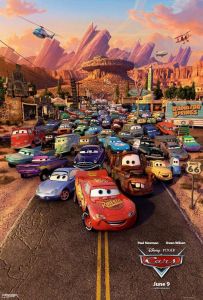 While I’d never call Pixar’s latest animated film a disappointment, it is the company’s first speed bump in their unprecedented reign of unmatched quality. Cars is technically dazzling; it’s almost redundant to say a CGI film is the best-looking ever because the technology keeps improving with time but Cars is incredible to watch. The lushly painted vistas, the way light gleams on surfaces, the blurs of color, the near-photographic likeness of cars themselves, this is a beautifully animated film, obviously. What isn’t as beautiful is the lackluster storyline. I can feel Pixar’s heart in the right place but they don’t put enough effort to touch our own hearts. Cars lacks the depth of Pixar’s other features. The two Toy Story films managed to take a kiddy concept of the secret life of toys when no one’s watching and infuse it with serious moral dilemmas and a mature insight into mortality and community. In Cars, the main storyline involves a cocky hot rod Lightning McQueen (voiced by Owen Wilson) who lives in a glitzy world that revolves around him. He goes off the beaten path and finds himself trapped in Radiator Springs, a tiny town that’s all but been dried up since the interstate took folks away from them. There, Lightning learns there’s more to life than material riches from this eclectic mix of good, honest small-town folk. What I’ve just described to you could be the plot of hundreds of movies championing the likes of small town folk. They surprisingly never really go much deeper, though Paul Newman is terrific as an old time car that had a taste of the glory and arrogance way back.
This is the first Pixar movie to exist in a world without humans, which begs the question how living automobiles were able to construct their world minus opposable thumbs. Cars themselves are weirdly inexpressive creatures.
The climax to Cars is suitable and heartfelt but the movie, at two hours in length, sputters a while in the middle. This is the first film directed by Pixar’s big cheese, John Lasseter, since 1999’s Toy Story 2, so excuse me for expecting a little more. Still, the movie is certainly fun, exciting, more cute than funny, and it has a genuine sweetness to go with its visual prowess. I just wish the 8 credited screenwriters, including Lasseter himself, had revved up their imaginations a bit more beyond the conceptual stage. Cars isn’t a great movie, but coming from Pixar, it’s still very good. Hey, anyone that can make the voice of Larry the Cable Guy tolerable deserves my thanks.
Nate’s Grade: B
Share this:

Bloodrayne (2006)
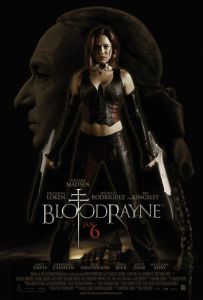 Bloodrayne is based on a video game of the same name that follows a svelte, red-haired vampire with two long pairs of swords she wields on her arms. In the video game she fights against Nazis in World War II. Now that is a movie I would love to see. Everyone hates Nazis (well, most everyone), and to see a sexy half-naked vampire run around and kill them … that just spells awesome. But then along came director Uwe Boll and his German financiers. Boll has turned back the clock and made his Bloodrayne an origin tale set amongst some old European landscape dotted with castles and vampires. He filmed in the real Transylvania in Romania. I don’t know if this location added any more authenticity. It couldn’t have made the film any worse.
In some place centuries ago, there’s a dhampir named Rayne (Kristanna Loken). A dhampir is a half-human, half-vampire hybrid, and we’re told most do not survive conception. Rayne has become a circus sideshow, where her captors torture her and then feed her blood, observing her nimble body heal itself. The Brimstone society is an organization devoted to fighting vampires. Vladimir (Michael Madsen) leads a small group, including Katarin (Michelle Rodriguez), on the hunt for Rayne. They believe she could help them defeat Kagan (Ben Kingsley), the most fearsome vampire in the land for some reason. Kagan is on the hunt for three guarded objects (an eye, a heart, and a rib) that will give him power beyond imagination. Rayne breaks free from her circus life, thanks to killing just about all of them, and joins the Brimstone group. You see, she’s got a score to settle with Kagan. He raped her mother and years later returned and killed her while Rayne watched. Complicating matters is the fact that he’s also Rayne’s biological father.
 If Bloodrayne had merely been a straight-faced, mystical, Medieval gore fest, I might have even credited it for being a decent genre flick. But it’s the assorted anachronisms and rudimentary scope that chafe Bloodrayne, never letting it settle. Take for instance the weirdest scene in the entire movie. Now, for a movie about vampires, prophecy, secret orders, and Michelle Rodriguez even attempting a British accent (one word of advice: don’t), the strangest moment is Billy Zane’s “special appearance.” The opening credits in Bloodrayne call it that, but how does someone have a “special appearance” in an open-and-shut narrative? This isn’t an ongoing TV series. Zane has two scenes. The first has him dictating a letter like a mid-level executive, straining and stretching to fill an inter-office missive. He actually says modern phrases like “No, scratch that,” and “et cetera, et cetera, et cetera, signed Your Father.” That’s it. That’s the scene. It serves little purpose other than to make you think Billy Zane sucks when it comes to personal skills.
Boll fails to curtail these anachronisms that hurt Bloodrayne’s tone and execution. His lack of interest in details or sense also puts the film at a disadvantage. There’s a late scene where Katarin suddenly is wearing a modern purple women’s jacket, like she just got it off the rack from TJ Max. Why does Vladimir wave his sword around all the damn time, but when it comes to actual combat he tosses it back and forth in his hands like a hot potato? A character has a hidden room of weapons, but it’s not much of a secret room when the lever to open this space is dubiously displayed for all to see. Domastir (Will Sanderson, making his fifth appearance in a Boll film) has a hilariously bad haircut that looks like crop circles were shaved into his head. Why, after Rayne has joined the Brimstone fighters late in the film, do we need her in a training montage? I’m pretty sure by that point Rayne can hold her own.
Kagan is never examined as to why he is so dangerous. We have no understanding why the film’s villain should even be feared. He’s on a quest for super power but what Bond villain isn’t? In fact, Bloodrayne has an altogether ho-hum view on vampires. In this movie they’re vulnerable to water as well as sunlight, but they’re also just as vulnerable to steel. The vampires fight with swords and die by them just as easily. One wonders what the allure of vampirism even is if this is all you get. There’s a scene early on where Rayne spots a female vampire chatting away in the open. She makes a come-hither motion with her finger and the lady vamp follows along obediently. Then Rayne bites her neck and drinks her dry, while the lady vamp does nothing but gets bug-eyes and goes limp. Apparently, the lack of sunlight must have negative effects on brain power and deductive thought. What Boll needs to learn is that if you’re going to have a movie where humans and vampires battle, at least give the vampires something beyond pointy teeth and bad hair. Seriously, was there a mullet discount at the wig store?
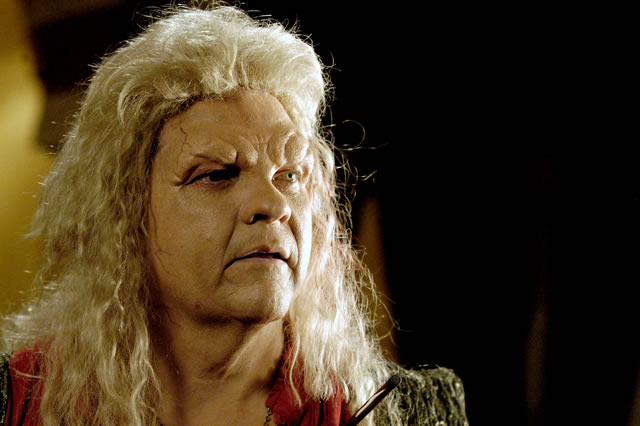 Then there’s the goofy series of one-scene actors. Meat Loaf appears as slovenly vampire pimp Leonid, surrounded by nubile nude women. He speaks like he’s taken a bottle of Quaaludes and has, what can best be described as, a dead and bleached muskrat on his head. The scene gets worse when Leonid is battling our Brimstone fighters. They take out several of the windows in his parlor and destroy Mr. Loaf by the influx of natural light. Now how stupid of an interior decorator did Leonid have? You would think a vampire running a blood parlor and place of otherworldly gathering would attempt to obscure very breakable windows. It’s the ignorance of these details and more that makes Bloodrayne ridiculous while still being pitiful of scope. If Boll is going to tell such a dull and cut-and-dry story, it’s not encouraging that he can’t even be bothered to get the details right.
The movie is poorly plotted from the start. Bloodrayne is aimless and doesn’t so much conclude as it does run out of bodies to kill. The ending will leave most scratching their heads not because it’s confusing but because the movie just peters out. More than most, Bloodrayne feels structured like a video game, with its plot points regarding the search and acquisition of super items that Kagan is after. The screenplay is credited to Guinevere Turner, co-writer of the American Psycho adaptation and frequent collaborator with director Mary Harron. I refuse to believe Turner’s responsible for the mess left on screen since Boll has the habit of rewriting whole scripts. The dialogue is unintentionally hilarious, with clichéd nuggets like, “Keep your friends close and your enemies closer,” and, “He wants a fight and a fight he shall get.”
The direction is shamelessly derivative. There’s a lot, and I mean a lot, of long exterior scenes where we see people on horseback riding along the substantial wilderness. It’s like Uwe Boll watched the Lord of the Rings series and said, “I can do that … but crappy.” These long exterior scenes conflict with the movie’s small playing field. Every town and every castle feels like a stone’s throw away, and the world feels like it’s populated by about 100 people. Boll never makes it clear what the setting of Bloodryane is. It feels like Vague Europe Land.
Boll doesn’t even manage to get his action sequences right. He’s got a bigger stage this time and some more money for effects but the results are still the same. To hide the fact that his actors had no time for fight training, Boll edits his fight scenes to the disorienting millisecond. The intent is to hide the stunt performers doing all the work. The result is that you can’t even tell what the hell’s going on in Bloodrayne. This also hamstrings his action choreography making it little beyond two figures clashing and one falling dead. The explosions of blood are overdone, with every gash shooting showers of red like the human body was connected to an off camera fire hose. Agreeably, there are a lot of splashes of blood but nothing too memorable or gruesome. It kind of has the feel of what bored teens would come up with during a sleepover with their dad’s camcorder. The violence and vampire angle are the two things that will appeal most to teenage men, but neither aspect is properly explored or satisfying. Bloodrayne presents a simple fable and doesn’t even bother to control its simple world of extraordinary creatures.
 I thought the sex scene in Boll’s Alone in the Dark was preposterously out-of-the-blue, but the gratuitous sex scene in Bloodrayne puts it to shame. Rayne is plagued by nightmares of her vampiric urges, as well as her mother being killed by Kagan. One night she has a vivid nightmare where she relives slaughtering her circus. She’s startled awake. What’s her first instinct? She grabs Sebastian (Matthew Davis), pins him against her cell bars, and proceeds to ride him like she has the upper body of a weight lifter. Maybe this is the lone benefit of being a vampire: a wider selection of sexual positions. The sex is sloppy and unerotic in its ludicrousness. Boll also manages to make sure his camera gets every loving detail of Loken’s nipples being lapped at. Boll figures that this gratuitous sex scene (it really couldn’t get any more gratuitous if they were skydiving) is meant to bond the characters into a romantic relationship. This forced romance is, like many elements in Bloodrayne, also inept. It stretches believability when this moment is all we have to go on why Rayne and Sebastian feel for one another. When they part Sebastian is crestfallen, though I think it’s more because he just lost the only girl he’ll ever meet that can perform gymnastic sex. Talk about a perfect score on the parallel bars.
The acting in Bloodrayne is about what I’d expect from a Uwe Boll movie. Loken (Terminator 3) is an attractive woman, yes, but the figure of Rayne is more a fetish fantasy than a flesh-and-blood character. There’s more attention to her revealing wardrobe than her character. Loken overplays her one facial expression, which looks precisely like she just caught wind of a fart. Her English accent is also very droning. Madsen (Species, Kill Bill) seems drunk the whole time. Rodriguez (SWAT) can do little more than scowl, but in Bloodryane she gets to scowl with a comically bungling British accent. And then there’s Sir Ben Kingsley. He spends most of his screen time confined to a throne as if he’s subconsciously trying to pass this movie like a stubborn bowel movement. He looks more like a terminally ill founding father with a penchant for silks than the evil Lord of Vampires. Kingsley hasn’t exactly been judicious with some of his film choices (Thunderbirds, A Sound of Thunder, Suspect Zero) but you’d think an Oscar-winning actor would have better sense than to work with Dr. Boll.
Bloodrayne is the best of Boll’s troika of video-game adaptations, but even that statement is without praise. This lame sword-and-sorcery tale is merely bad, instead of absurdly bad like most of Boll’s oeuvre. The difference is one tiny adverb, folks. The film is limited in scope but still careless and absent-minded with its details. The action sequences are heavy on blood and short on orientation, edited within an inch of their life. Bloodrayne is full of Boll’s typical lapses in plot and characters, and there’s plenty of stupid to go around for everybody. The plot is made up of nonsensical guest shots by slumming actors, and the villain himself seems as menacing as someone’s toilet-bound grandpa. In the world of film it’s tricky to judge films on a scale of badness, because that scale is surprisingly varied. Bloodrayne is clearly bad, but it’s also more entertaining than his previous films. Maybe Boll is learning after all, though at this rate of progression he’ll reach “mildly tolerable” by the time the sun explodes.
Nate’s Grade: D+
Share this:

The Break-Up (2006)
 Real-life couples have a rocky track record when they star together. Sure, for every Mr. and Mrs. Smith there’s also a Proof of Life, Vanilla Sky, or, God help us, a Gigli. The trouble is that what captures the fancies of two actors rarely translates to the big screen. Was anyone more the wiser why Jennifer Lopez and Ben Affleck got together on the set of Gigli? Now here comes The Break-Up, an anti-romantic comedy starring Vince Vaughn and Jennifer Aniston. They’ve been playing a coy game with the media about whether they’ve been dating since the movie wrapped a year ago. Audiences will have difficulty seeing whatever magic the two felt, because The Break-Up isn’t romantic in any sense of the word.
Gary (Vaughn) and Brooke (Aniston) meet cute at a Chicago Cubs game and begin a two-year relationship. Then one evening, after a terribly uncomfortable dinner between their folks, both decide to call off their romantic entanglement. Neither is willing to leave the condo they co-own, so each engages in a battle to convince the other to leave. Gary wardens off the living room as his space. Fine, Brooke invites her brother’s glee-club to perform in her area. He gets the pool table they had talked about waiting to purchase. She throws his clothes into the hall listening to Alanis Morissette. She invites dates over. He has a night of strip poker with actual strippers. At the same time, Brooke is questioning whether she can save their relationship and work things out.
 Audiences expecting a cheeky romantic comedy will be soundly disappointed. The Universal marketing weasels have lied to you! After the 30-minute mark, The Break-Up doesn’t have much comedy, let alone romance. This is really more of a gutsy mainstream drama that prefers to exist in a world similar to ours where heartbreak and yearning are often unresolved. This is a respectably good, if flawed, relationship drama that doesn’t pull its punches. The Break-Up has a very Chasing Amy air to it; both films present atypical Hollywood relationships and both seem to sense a happy ending would just be insulting. Actually, in another similarity, both The Break-Up and Chasing Amy have their comedy completely dissolve by film’s end.
The biggest flaw The Break-Up has is that we don?t generally care if Brooke and Gary get back together. The only good times of yesterday we see are via photographs that are shown during the opening credits. Beyond this brief photo collage, we?re basically starting at the end of their union. There’s a fair amount of gender stereotypes to go along with the characters and their behaviors (men are from Mars, women from Venus?), though it didn’t bother me as much as it would have in a typical romantic comedy. Brooke is a bit of a nag but an altogether good person who just goes about her reconciliation plans in the wrong manner (push him away to have him come back, make him jealous, the famous double-speak). Gary, on the other hand, is pretty much a jerk. The tagline for The Break-Up says, “Pick a side,” but the movie already picks for us. Gary is a lazy, egotistical, unappreciative, selfish jackass and you’re really puzzled why Brooke would keep trying to resuscitate their relationship. Again, part of this is because The Break-Up doesn’t ever show us a moment of these two crazy kids in love. We really have no interest in seeing these unhappy people be unhappy with each other for a longer period of time.
The Break-Up has a lot of intentionally pained awkwardness to it, partly because good portions of the movie is about voyeuristically watching an unhappy couple argue. The Break-Up‘s relatability, something nearly unheard of in the overly saccharine, simplistic world of romantic comedies, is a double-edged sword. Couples may wince and pass knowing looks, thinking, “We’ve had that fight. I too crossed the line like that. I too went about that the wrong way.” Audiences will see pieces of themselves onscreen, but do mainstream audiences really want to see pieces of themselves screaming at each other for a whole movie? I doubt it. I think displeased moviegoers are going to tell their friends to stay away in droves, unless they’re avid tabloid followers.

Vaughn continues his motor mouth lout shtick, though it’s somewhat impressive that he willingly puts himself in such an unflattering light. He’s also a bit puffy in the movie. Aniston is an actress I haven’t been overly enthusiastic with, to say the least, but she’s a winning personality even if she’s replaceable. She seems to be in a frazzled rut. Despite whatever real-life passion the filming ignited, the leads have little chemistry together onscreen. This would be a bigger concern if the film was starting at the end of their relationship, though. The supporting cast of Vaughn’s friends and co-workers is rich with talent. A late scene between Vaughn and Favreau about hiring a hitman to take out Brooke’s supposed new beaux is solid gold. The wonderful John Michael Higgins (Arrested Development), as Brooke’s socially inept brother, provides the biggest laughs. And for those wondering what ever happened to Ralphie from A Christmas Story, here he is all growed up and emasculated by Joey Lauren Adams.
Director Peyton Reed (Bring it On, Down with Love) has a good feel for human comedy and interesting shot selections. He normally keeps his movies brisk and airy. The dialogue is above average and feels naturalistic. I am surprised that I have heard so little about Aniston’s brief nude scene. Then again, I don?t watch that recycled Entertainment Tonight TV vomit. It’s kind of neat to note that there was a 1998 movie itself called The Break Up; they just didn’t have the hyphen. Remember that hyphen in a few months when you’re at your local video store [Author’s note: R.I.P. video stores].
I give Vaughn and the filmmakers credit for trying something challenging and attempting to have a mainstream audience go along. The Break-Up is uncomfortable in how painfully awkward and relatable it is. Whether audiences want to flock to a movie about unhappy people who don’t belong together is a good question. This isn’t as nasty a comedy as The War of the Roses; no, this film is kind of stuck in a thematic middle ground of a gutsy, if flawed, relationship drama. Those expecting promises of comedy and romance might feel cheated. The Break-Up is like a real-life experience: it’s somewhat painful, somewhat expected, and perhaps better once it’s finally over.
Nate’s Grade: B-
Share this:

Inside Man (2006)
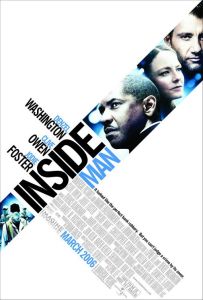 Spike Lee is one of the most recognizable names in film. Usually, the edgy, pointedly opinionated director sets his sights on racial strife, human relations, and satire. So what is Lee’s name doing attached to the Hollywood heist flick, Inside Man? For starters, it’s his most commercial film of his career, a sharp, engrossing thriller that doesn’t blunt his distinct voice.
Dalton Russell (Clive Owen) has set forth the perfect bank robbery. He and a handful of associates, dressed as painters with their faces obscured, have locked down a bank in downtown Manhattan. They’ve rounded up everyone inside, robbed them of their trusted cell phones, and ordered them to wear identical painter suits and masks. Detective Keith Frazier (Denzel Washington) is tasked with resolving this standoff, which the media is all too eager to cover in its escalation. What could the crooks be after? Well, bank owner Arthur Case (Christopher Plummer) is certainly nervous about a key document he has inside a safety deposit box, a document linking him to scratching the backs of Nazis. He pits Madeline White (Jodie Foster) to retrieve the document at any cost, and she has the tenacity to wedge herself between her political contacts and the police. All the characters keep their cards held close and try and outfox the other, while figuring out what exactly is going on inside that bank.
This movie is a born crowd pleaser. The heist and ensuing complications really grab an audience early on. There’s a certain thrill watching Dalton, so cool and clam, plot out his bank robbery like the script is still in hand. The crooks are always one step ahead of the police as well as the audience, and I mean that in the best terms. It’s great fun just wondering how Dalton’s team is going to get out of their many jams, and the results are rarely unsatisfying. Inside Man knows exactly when to tantalize with intrigue, inject humor (“Penalty of code 36DD?”), or tighten the tension. The filmmakers know exactly what button to press and at what time. For a two-hour plus film, Lee keeps the film at a swift pace and smoothly weaves his characters in and out. The draw of Inside Man is watching the tit-for-tat game between Frazier and Dalton, too stone-faced pros trying to outsmart each other. Lee smartly allows his characters and story to take center stage and refrains from goosing a strong genre flick with some annoying, superficial artistic artifice.
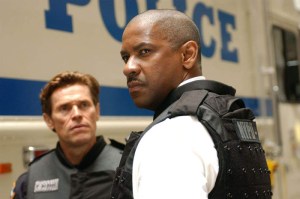 Inside Man is a heist that’s refreshingly grounded in reality. Nothing is altogether too out there or complicated to the point where you’d need a score sheet to follow along. Dalton is the movie’s star and Inside Man gives him the center stage to draw us in and keep us guessing. In fact, the flick is so grounded in the plausible that mainstream audiences might be put off by the fact that there isn’t any super twist saved for the end. I think the same audiences Inside Man is so fine-tuned to entertain will discover the lack of a last-second twist as underwhelming. I hope we’re not to the point, as an audience, where we’d rather have an illogical, forced twist ending than something that closes our story with satisfying maturity and finesse. The biggest plot hole you’ll have to swallow with Inside Man is that a businessman would keep a document that linked him to the Nazis. What’s that about? Sentimental value? I’m also still a bit hazy on the motivation of our crooks.
Even though this is a crowd-pleaser, the film is not without its missteps. Inside Man has one of the worst scores I have heard for a movie, ever. Allow me to explain why I feel so brutally, and I do. The score flashes inappropriate mood all throughout the film, robbing many sequences of drama and calling attention to itself. Take for instance a phone conversation between Frazier and Dalton; we cut back and forth between the two and each actor has a different music score. Frazier’s is a jaunty jazz riff, while Dalton’s is the more traditional brooding orchestral number. Because of the schizophrenic musical score this moment becomes funny. The best example of how this score is dreadful is during a scene late where SWAT storms inside the bank. The camera takes their point of view and creeps through the bank lobby, and then you hear a horn (trumpet?) reverberate. It gets louder and then quieter in beats, like a high school brass orchestra just whizzed by in a race car. Then it keeps going but in another direction. At first I was confused, and then I thought, “Did Dalton actually set up a horn section to distract the police?” No, it’s just the awful Inside Man score that totally takes you out of the movie. Scores should enhance the movie, not turn drama into comedy.
Lee also doesn’t help his story by including so many flash-forwards in time. They mostly rob Inside Man of key suspense points. Now we know the bank robbers get away, we know their identities are still unknown, and we know no one died. Luckily, the charisma of the leads and the clever storyline can survive Lee shooting the movie in the foot. The movie also has what feels like the longest denouement since 2003’s Return of the King 20-minute hug fest.
 The quality cast definitely gives Inside Man a boost. Washington is on autopilot but is still charming as ever while being intense and intuitive. Foster is like a female version of Mr. Wolf (Pulp Fiction) but full of steely determination. It says something when really talented actors like Willem Defoe and Chiwetel Ejiofor take tiny roles. As it should be, Owen is the standout. He’s so menacing and composed that you not only want Dalton to get away with the bank holdup, you want him to humiliate and embarrass his opponents even more. I?m convinced that in the world of film there’s no cooler actor than Clive Owen at this point. He adds a touch of badass to every role, with the notable exception of Derailed. At this point, I would pay to hear him recite the phone book and walk away going, “Wow, I didn’t know Aaron A. Anderson of 1200 West Avenue sounded so kickass!” Clive Owen is that cool.
Inside Man is a sharp, intelligent, mostly satisfying heist flick with a terrific ensemble. Lee’s most mainstream picture ever is a born crowd-pleaser, despite some missteps here and there (flash forwards, a poor score). The acting all around is top-notch, and the flick works as a tight and mature genre piece, simultaneously covering all its genre bases and playing up the smarts. I hope audiences appreciate the sense of believability with the film and don’t walk away irked that there is no super last-second twist. Inside Man isn’t anything groundbreaking but it knows how to tease an audience and tell a good guessing game of a tale.
Nate’s Grade: B
Share this:

X-Men: The Last Stand (2006)
 The story behind the making of X-Men: The Last Stand is more interesting than most. Bryan Singer had directed the first two X-Men films and had done a fine job establishing many loveable characters and the universe that housed them. Warner Brothers has been trying to get their Superman franchise flying for so long, going all the way back to 1996 when Kevin Smith wrote the script, Tim Burton was to direct, and Nicolas Cage was going to be the man in tights. Since then directors and drafts of screenplays have come and gone, including Brett Ratner, best known for directing both Rush Hour movies and a slate of mostly mediocre movies. Then Warner Brothers poached most of the X-Men 2 team to make Superman Returns, hiring Bryan Singer as director, plus X2‘s screenwriters, cinematographer, editor/composer, and maybe even the cat that licked Wolverine’s claws. Fox was left without a captain for X-Men 3. They daringly picked Matthew Vaughn (Layer Cake) but then he dropped out for family reasons. Then Fox went with their second choice … Brett Ratner. Both directors had essentially switched projects. Hollywood’s funny like that.
It’s been a few months since the events in X-Men 2. Scott “Cyclops” Summers (James Marsden) is still mourning the loss of his love, Jean Grey (Famke Jannsen), who sacrificed herself to save the rest of the X-Men. He’s tormented by her voice, whispering all around him and pleading with him to return to Alkali Lake, the site of her death. Miraculously, Jean returns from the dead but she’s much different. Her persona has broken and the Phoenix has taken over, a destructive killing force unparalleled on earth.
Magneto (Ian McKellen) has great use for such a force. There’s been news of a new drug that suppresses the gene that causes people to be born as mutants. This discovery has been dubbed a cure. The question persists, is should being different be curable and what would that even mean? Magneto sees the writing on the wall, knowing that any cure would only be voluntary for so long. He collects new mutant fighters along with his stalwarts the shape-shifting Mystique (Rebecca Romijn) and fire starter Pyro (Aaron Stanford), a former student at Xavier’s School for the Gifted.
 Over at Professor X’s (Patrick Stewart) school, the mutant students are each questioning life with a cure. Rogue (Anna Paquin) is considering it so she can finally touch her boyfriend, Bobby “Ice Man” Drake (Shawn Ashmore) without killing him. Plus, so he’ll stop spending so much time with Kitty “Shadowcat” Pryde (Ellen Page), a girl who can walk through matter. Storm (Halle Berry) and Wolverine (Hugh Jackman) are left to run the team after some disastrous setbacks. Henry “Beast” McCoy (Kelsey Grammer) is a man covered in blue fur and appointed as head of Mutant Relations for the president. He senses the growing danger and anxiety the administration has with mutants and joins the X-Men to do what he feels is right.
It feels like that in a rush to production that character development, subtlety, and subtext were chucked out the window to make time for more boom-boom action. The first two X-Men flicks juggled the characters and introductions but still managed to squeeze in one great moment for the characters we cared about. The plot moved at a mature pace, insightful and touching on elements of psychology, politics, and personal struggles to fit into a society that fears you. There was some sophisticated, relevant stuff bandied about this franchise in between the kick-ass action. But with X-Men 3, you basically have Halle Berry doing less with more. She’s got more screen time, in part to her demands, and now she can use that extra time onscreen to show us how perfectly bland her character is as the film’s most laughable moral ideologue. The idea of a cure for the mutant gene is vastly interesting with all kinds of great avenues for character introspection and socio-political debate. But X-Men 3 renders all of its debate to be merely superficial, another in a series of plot points to get the action moving quicker.
The X-Men franchise was already overpopulated with lots of characters vying for screen time, so I don’t understand the decision to add even more characters to the ensemble and cut down the running time to a brisk 100 minutes. As a result, certain characters sit out for long stretches of the film, are inactive during key moments, some are mostly forgotten, or some meet unjustifiably hasty ends. If I was still an ardent comic book fan, and a follower of the X-Men, I might view the third film as heresy. Why even bother bringing the character of Angel into the movie if he’s just going to be on for two minutes, including a forehead-smacking deus ex machine moment? The Dark Phoenix storyline is the most pivotal storyline in the comic’s history, so why even bother dragging it into X-Men 3 if it’s just going to be Zombie Jean Grey? It feels like Ratner is off screen with a pole poking Janssen whenever the story needs her to wake up and stir up some stuff.
 I hope comic fans enjoy the brief glimpses of some of their favorites, because X-Men 3 does a good job of throwing characters into a meat grinder. I had to check online to just to find out who they were, and even then my realization was followed by, “Her? Him? What?” And what the hell is up with Porcupine Face? That has got to be the worst mutant ability of all time. What’s he going to do to his enemies? “Hey, will you come a little closer. I have a secret to tell you. Closer … closer … closer still … that’s right, now please lean against my face.”
The movie trades character for action, so is the action even good? Ratner is a workmanlike director devoid of any personal style, which further brands X-Men 3 as ordinary. The action sequences aren’t anything extraordinary, there just happens to be more of them. The climax pits mutant against mutant in short-lived bursts. A battle between Ice Man and Pyro should be awesome, but Ratner stages the showdown like he was choreographing his neighbor’s kids. This battle lasts a whopping 45 seconds. The climactic end battle, the “war to end all wars,” is rather sloppy. Ratner keeps cutting back and forth between his pairing of Good mutant vs. Evil mutant (why do the two black girls seem forced to fight each other?), but his showdowns are all too quick to quicken the pulse. Wolverine’s brawls in the woods never rise up to the adrenaline-soaked fights in X-Men 2. The special effects and make-up are just as good; they’re just not being put to as good a use. If Ratner is going to dump character for action he has to make his action exceptional. The movie feels on autopilot.
Ratner is not fully to blame for the shortcomings of X-Men 3. Screenwriters Simon Kinberg and Zack Penn (Elektra) have crafted an overly rushed story that is more tailored for getting the job done than telling a good story. They present some big ideas and interesting elements, like a love triangle between Rogue-Ice Man-Shadowcat, but then most of the promise is either skipped over or dropped. They’re trying to juggle too many balls at once, and it just makes me miss Singer and the X2 screenwriters and how effective they were in defining character even in the smallest of moments. Some of the X-Men 3 dialogue is awfully stilted, like “You of all people know how fast the weather can change” and “Sometimes when you cage the beast, the beast gets angry.” There’s also a silly subplot about Storm teaching Wolverine what it means to be responsible. Try and count how many times you roll your eyes with that one. How many times are they going to have the president look blankly at a TV screen and gasp, “My god”? There’s some clever use of mutant powers during battles (mostly involving Shadowcat) but there’s just as many routine moments as well.
 The acting is all over the map. Jackman owns his role as Wolverine. McKellen and Stewart bring a needed dose of grandeur to the proceedings. The X-kids are enjoyable, and Ellen Page (knocking ’em dead in Hard Candy) makes a very nice addition to the fold. I’ve likely enjoyed Paquin the most in this series, next to Jackman of course, so it’s so frustrating that she just plays Jealous Girlfriend at Window. I think it’s criminal how little she’s examined in the movie, especially since the supposed cure has the most questions and ramifications for her. Grammer is essentially Frasier in blue fur, but that’s essentially what Beast is so it works. He has a very nice moment when he sees what life would be like minus his mutant likeness. It’s really hard to judge most of the performances because of how short they appear in the movie.
X-Men: The Last Stand is far from boring but it’s more serviceable than special, and lacks the maturity and imagination that its previous films held. This was a franchise full of limitless potential, so to see it drop to something ordinary is sad, especially if this is the rumored end of the franchise (a record opening gross over Memorial weekend says otherwise). This franchise feels dumbed down; yes it’s still entertaining on a mass market level but it doesn’t have the creativity and precision that Singer’s movies had. X-Men 3 is fast-paced and not without its great geek moments, but it’s also the least emotionally involving of the films. When the deaths and departures come you’ll probably shrug your shoulders because of how the film presents them. X-Men 3 is fine, but I expect better from this franchise.
Nate’s Grade: C+
Share this:

Poseidon (2006)
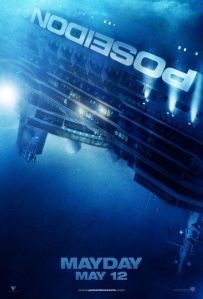 The Poseidon production design is rather fantastic and director Wolfgang Peterson (Troy) has a real handle on large-scale carnage, but Poseidon is a stripped down action flick that lacks the suspense and emotional involvement to bring strength to its attempts at harrowing survival. Some sequences, only some, are nail-biting, like a very claustrophobic escape through an air vent slowly filling with water. We’re presented a situation and then Peterson cranks up the tension and utilizes different characters working together. The sequence has the added benefit of utilizing the child to save them, unlike most films of this nature where irritating kids just become a liability to your own safety. The fact that this sequence, the film’s high point in my view, is also the least expensive of this $160 million dollar movie’s sequences is not lost on me. The film’s premise of working through the bowels of an underwater ship is filled with potential. The original Poseidon Adventure was cheesy, yes, but it was a lot of fun. This slick remake brings the action fairly early, having its “rouge wave” flip the ship at the 15-minute mark. Because of this decision the audience has no attachment to the film’s collection of characters, given fleeting seconds to establish some sense of personality. You really don’t care at all what happens to these people in the ensuing danger. The female characters add nothing to the story except to fall into the constant need of being rescued. Peterson paces his obstacles mercilessly right after the other, but he runs into the problem of killing off all his expendable (read: non-white) cast off too quickly. That lessens even the small amount of tension the film had going. Poseidon is way too big-budget and serious to go for camp. The special effects are above average and the pacing is swift. Frankly, you could do worse this summer for entertainment than spending 100 minutes watching this movie.
Nate’s Grade: C+
Share this:

The Da Vinci Code (2006)
 Dan Brown’s The Da Vinci Code has been a best selling novel for three years running. Continents of trees have been felled to produce the 50 million published copies worldwide. Brown’s novel details a centuries long cover-up of some crucial background on Jesus Christ, as well as certain omissions about the role of women in Jesus’ discipleship. The book has been condemned by Christian watchdog groups as heresy, never mind that it is clearly labeled “Fiction.” Debunking fiction is simply redundant. Now Hollywood has adapted The Da Vinci Code into a massive movie, directed by Ron Howard. I must be one of eight who have not read the book, so I entered the theater with little expectation and no idea where the story would take me. Is this a great threat to the Christian church, as some argue, or is it just another dime-store thriller that lucked into becoming a national phenomenon?
Robert Langdon (Tom Hanks) is a Harvard professor of symbolism lecturing in Paris. He’s called in by a police captain (Jean Reno) about a local murder. The curator for the famous Louvre museum has been killed and his death leads to a series of coded clues about a deeper conspiracy involving Leonardo Da Vinci. Sophie (Audrey Tautou) is an investigator, and the granddaughter of the museum curator. She helps Robert escape and the two of them set off on an adventure through France and England, finding clues that lead them closer to the location of the Holy Grail. They get help from Leigh Teabing (Ian McKellen), an old friend of Roberts that has his own theories about what the Catholic Church may be so desperate to keep hush-hush. All the while Silas (Paul Bettany), an albino monk, is on the warpath to dispatch all who know too much, including Robert and Sophie.
There are just so many harebrained, hokey moments in The Da Vinci Code that can rip you right from the movie. Why does Sophie have to pay someone to leave a park bench when she and Robert can just walk out of earshot? Why does a bank teller, with his own devious intentions, drive Sophie and Robert to safety and then threaten them at gunpoint? Surely letting them be captured by the police would have served his needs better. Oh, the bank also has a payable escape clause, like it was a Scooby-Doo mansion. But the hokiest moment comes in the opening minutes. The museum curator, an old man who couldn’t hobble away from his attacker, gets shot in the gut, a quite painful place for a bullet to lodge itself. So he’s fatally shot in the stomach, but the man still has time to scribble coded messages on three separate paintings at different points in the museum, strip down, pose, write a message on the floor and a symbol on his chest. And remember, he’s an old man on top of all this. It’s like he had a checklist he pulled out in case he was ever mortally wounded at the Louvre.
 The characters aren’t any better. There’s little to any depth to these people and most of them are irrational stock roles. The Jean Reno cop character is laughable in how doggedly he’s convinced Robert is his man. Apparently, a priest told the cop Robert confessed. Case closed? Perhaps the cop, in his furtive rush to judgment, should do some outside research. The museum curator?s time of death, something any crime scene tech could denote, would prove that Robert would be ruled out, given that the man was giving a lecture in front of hundreds of alibis. That’s verifiable science, but no matter. Would not a place as heavily trafficked as the Louvre, with so many priceless pieces of art, have security cameras? I think that alone would tell you who murdered the museum curator. These details make the Reno character stupid and unbelievable. The police work hasn’t been this sloppy since the Police Academy saga.
There’s a late scene where a character addresses another and more or less says, “No one will suspect us, my partner. Let us split our winnings together. I will take your identity to my grave. What? Yes I will take a drink from your flask you’re offering me but not drinking from yourself.” The film could not hit you over the head harder with what is to come. I’d expect these kinds of half-hearted character turns from a rote made-for-TV thriller, but The Da Vinci Code has too much intended intellectual prestige to wallow in this manner.
This is not a good film adaptation. This isn’t structured like a thriller, let alone a movie. There?s no sense of momentum and the story is really an ongoing series of mini-climaxes, sputtering out to no payoff. Puzzle-solving and word games can work on the page, with the reader feeling like they’re right along, but onscreen it cannot work in a story of images. Howard highlights certain letters a la A Beautiful Mind, but then it simply becomes less a puzzle and more just witnessing how a character’s mind breaks down the code, nothing more. As a thriller, Brown seems to do just enough to push his narrative further, but he frequently writes himself into a corner and relies on plot contrivances to save his ass. There’s a scene at Leigh Teabing’s mansion involving a gun standoff, and how does Brown get his characters out of it? By conveniently having a bird fly and distract the evil gun-bearing monk. Talk about a cheat. The Da Vinci Code‘s lame behavioral explanations and short cuts are expected in a rote thriller, but Da Vinci doesn’t want to be seen as one.
But that’s the fundamental error of The Da Vinci Code: it wants to have it both ways. The film, and I’d judge that the novel as well, wants you to shut your brain off and swallow these trite lapses in judgment and reality, forgiving the movie for zero character development and polluting the narrative with stupid genre stock roles, but then it also wants you to pay close attention and activate your brain to untangle the origins of symbols, conspiracies, and church doctrine. This flick was destined to fail at birth. You can’t be a brainy thriller and fill the story with hokey moments and lapses in thought, and likewise you can’t be an enjoyably straight forward thriller if you bookend all your action sequences with talky sit-downs to explain the minutia of your story. The Da Vinci Code is thusly pulled in two directions and grinds its gears to the very end.
 This is not a very entertaining flick, in fact is nearly put me to sleep a half dozen times. The Da Vinci Code has tiny bursts of action, and most are easily swept away before the viewer can get a grip. These moments are then succeeded by lengthy, ponderous sessions of heavy exposition. It’s like characters will breathe a sigh of relief at another ludicrous escape and then say, “Well, now let’s discuss in detail some more convoluted theories.” The dialogue reeks, and characters spout plot points whenever they’re needed. The conspiracy doesn’t even make sense. Why would the Church protect a secret that could supposedly destroy its hierarchy? If Jesus was not divine then what difference does it make to go after relatives 2000 years removed? And if Jesus did have heirs would there not be thousands in 2000 years time, not one convenient individual? Even The Da Vinci Code‘s ending seems to soft peddle its “dangerous” message, where Robert, after learning all he has, says it’s all about what you believe.
If it wasn’t for Bettany and McKellen I really would have nodded off. Silas is by far the most interesting character in the whole film, and the only one with a penetrable personality. A deeply religious albino killer monk is a great character, and Bettany makes him scary but also frightfully sympathetic. I was rooting for Silas to knock off the film’s heroes and go on a better adventure of his own. McKellen is handed most of the monologues and he gives his character all the gravitas needed. Thank God for these two actors, because Hanks is miscast and Tautou isn’t nearly as endearing as her work with Jean-Pierre Jeunet. There’s a really good international cast assembled for The Da Vinci Code and the movie manages to mishandle most of them.
The Da Vinci Code played out on the big screen is ponderous, talky, boring, poorly adapted and poorly written. Some things work better on a page than onscreen, and I guess if this is the final product than the whole damn things works better on the page. The story is brimming with lame, hokey moments you’d see in a lazy TV thriller, but then the story also wants to talk you to death with its convoluted storyline. The action sequences are brief, the dialogue is smothered by lengthy exposition, and the plot just isn’t that entertaining. The cast is mostly wasted in thankless stock roles. So let me get this straight. After seeing The Da Vinci Code, the biggest threat the Christian church is facing is … bad movies? I think they’ll be alright.
Nate’s Grade: C-
Share this:

American Haunting (2006)
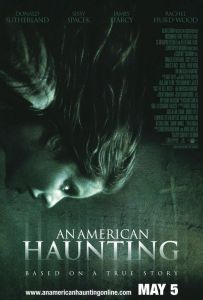 Courtney Solomon made one of the worst movies I have ever seen, 2000’s abomination Dungeons and Dragons. It is bad on a rarely seen cataclysmic scale. The shot selections were awkward, the handling of the actors was cringe-worthy, the story lightweight but ridiculously stupid, and the special effects were like something a third grade diorama contest could best. Dungeons and Dragons holds my record, in all the many films I’ve seen, as having the worst line readings of all time. Fortunately, the film is one of those so-bad-it’s-hilarious entries to stop it from being an absolute wash. Now six years later Solomon is back with An American Haunting. Normally his name alone attached to a movie would guarantee my avoidance, but I checked this out for you, dear readers. Let’s just say Solomon has a looooooong way to go before he even reaches the competence of Uwe Boll
In 1818 Tennessee, the Bell family moves into a new residence. John Bell (Donald Sutherland) has cheated an outcast woman on her land loan. This woman, branded a “witch,” curses the Bell family. Things are fine for a while, but then young Betsy Bell (Rachel Hurd-Wood) is being attacked by an invisible spirit night after night. Her father and mother, Lucy Bell (Sissy Spacek), are powerless to stop the haunting. Before you can ask, “Why don’t they let their daughter sleep in a different room?” they’ve reached out to a preacher and schoolteacher (James D’Arcy) romantically curious with Betsy. No one can stop this haunting and John Bell searches to gain atonement for his sins to spare his family.
 So, let’s get this whole thing straight, spoilers be damned. An American Haunting is marketing itself as a film based on the only medically credited murder to a ghost. Never mind how you verify that, just go with it for a second. This couldn’t be any more wrong. We learn at the end (“learn” wouldn’t be the right word since the film requires voice over to explain itself) that Betsy had been raped by her father. But wait, it gets better. Betsy had subconsciously developed a protector spirit to guard off further molestation and to punish her father. So right there the ghost in An American Haunting isn’t even a ghost, just the angry manifestation of an abused girl. There is one death accredited to the ghost, that of John Bell. However, the movie presents his wife poisoning him, not the ghost. So then the murderous ghost is neither. Plus, one has to wonder how shocking John’s loss is if he was willing to kill himself to lift the curse from his family. How believable is a “true account” of a medically documented haunting death when people were blaming demons for things for ages? I mean, there must be written accords from medical professionals of the day attributing the Black Plague to man’s sins. Just because an official said so centuries in the past does not make it medically sound today. If that were true no one would last through puberty without flogging themselves to death (and I did NOT mean it like that). An American Haunting is not true, is not about a ghost, and isn’t about a ghost committing murder.
Writer/director Solomon has made some strides in his filmmaking, but the results are still laughably the same. He’s gotten a better feel for actors and … that’s about it as far as improvement goes. An American Haunting is a creaky old timey ghost story that couldn’t scare a soul. It feels more attune to a 1970s made-for-TV flick. Solomon cribs all his scare tactics from Spook 101, which means lots of stagy jumps and creaky noises. The most annoying decision Solomon makes is that when he wants to convey the point of view of our ghost, he quickly swoops the camera down and up, spinning around the room like a paper airplane. I’m surprised more ghosts don’t get motion sickness if this is how they roll. You’ll either grab your stomach from the camerawork or the story.
 Solomon’s story is just painfully uninteresting. Some good actors do their best to liven up a pretty run-of-the-mill haunting tale. An American Haunting is insufferably boring and lame. The first half is also exceedingly repetitive, as we watch the spirit creep into Betsy’s room and beat the daylights out of her. I don’t know how many times Solomon expects us to still be entertained, let alone scared, by just repeating this scene verbatim. Apparently, if a ghost keeps smacking you it won’t wake up the people sleeping right beside you. I always did wonder. An American Haunting is lackluster and boring, but it’s the arbitrary current day scenes that open and close the film that makes it truly awful. A modern-day mommy discovers Richard’s diary of the haunting and sits herself down for a good read. Then once she gets to the end she sends her little daughter off to spend time with her ex-husband/daughter’s father. And then Betsy’s protector spirit pops up in the car, looking very sad as she’s driven away. An American Haunting is trying to make us connect that the modern-day woman’s husband is molesting her daughter, but the movie expects you to make a lot of jumps to get there. I don’t think “spirit pointing” will hold up in the court of law. And truly, if the Betsy protector spirit was really trying to be helpful, shouldn’t it be less vague and just spell it out? These modern segments feel tacked on and needless if the whole of the film is spent on the 19th century ghost story. An American Haunting requires gobs of text at its conclusion to explain that it was, technically, a ghost story by its new and expanded definition.
The only nod I can give Solomon and his tale is that they cover my number one complaint of all haunted house movies: why the hell don’t the people just leave? Your house is haunted with the spirits of the damned, so you’re just going to wait it out? MOVE people. Find another place to live! An American Haunting features a spirit that can travel outside the bounds of its house and attack carriages, no less.
An American Haunting is marketed as a true-life ghost story, the only in our nation’s history where a murder was credited to a spirit. However, this movie doesn’t have the foggiest idea how to scare an audience beyond stagy high school theatrics. It’s not a ghost story, unless you swallow whole the film’s flimsy recanting of what a ghost is, it doesn’t feature a murder by haunting, and it isn’t even true, unless you can additionally swallow ye olde folksy, biased medical accounts. I’m sorry, but I don’t buy this. This movie isn’t so bad that it’s funny; it’s just boring. People as a whole should steer clear from this dull, amateurish fright flick. The only screams you’ll hear during An American Haunting are unintentional laughter.
Nate’s Grade: D
Share this:

Mission: Impossible III (2006)
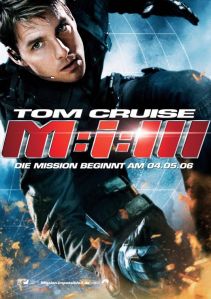 Few celebrities have had the intense flame-out Tom Cruise has experienced in a little over a year’s time. First there was the PDA-heavy relationship with Katie Holmes, never a wet tongue-kiss away from a camera. Then there was the couch aerobics on Oprah Winfrey’s set, bleating his over-the-top declarations of love like Roger Rabbit. This was followed by a series of testy interviews about his war of words on psychiatry and prescription drugs. Entertainment Weekly just ran a cover story asking, “Is Tom Cruise worth his paycheck?” He’s gone from Hollywood’s most bankable actor to a national punch line. To bring new life to Cruise’s spy series, he tapped TV mastermind J.J. Abrams to make his feature debut after Cruise churned through two seasons of spy series Alias DVDs. Abrams is a gifted franchise starter, first with Alias and then with Lost, and with Mission: Impossible III he does the best he can to erase the memory of Tom Cruise, daredevil of furniture.
Ethan Hunt (Cruise) is out of field work at the Impossible Mission Force, training recruits for the big time. He’s settled into a comfortable home life with Julia (Michelle Monaghan), a woman he’s blissfully engaged to be wed. Ethan’s happy home is disrupted when IMF needs his services. It seems one of his trainees (Keri Russell, Felicity goes badass) has been captured by an arms middleman Owen Davian (Phillip Seymour Hoffman), a man that will get any deadly force to the right bidder. Hunt reluctantly goes back into the field, assembling a team that includes Luther (Ving Rhames), Zhen (Maggie Q, quite fetching), and pilot Declan (Jonathan Rhys Meyers). Their mission goes badly and Hunt is reprimanded for his cavalier actions. He’s determined to snag Owen and get justice. This leads to an incredibly stuffed game of cat-and-mouse, each jockeying for leverage. There’s some super powerful device called the “rabbit’s foot” that everyone wants but it’s not really important. What is important is that Owen is eager to strike back at Ethan’s most vulnerable point — harming Julia.
 This movie is quite possibly one of the greatest TV adaptations of all time. No, not the Mission: Impossible series but Alias. Just like J.J. Abrams’ TV brainchild, this slick, propulsive caper puts a smart spin on familiar ground. We’ve got the flash-forward narrative trickery, the super gadgets, the undercover teamwork, the world-trotting sprawling vistas, and anchoring the whole thing with an emotional counterpoint, trying to lead a double, “normal” life and keeping your loved ones equally safe and in the dark. There’s a great scene in the middle of a mission where Ethan and Luther casually discuss the impossibilities of living a normal life given what they do. Luther warns that those close to you will only end up getting hurt, and by this point thanks to a startling, right-to-the-point opener with a gun to sweet Julia’s head, we know he’s right. That’s what makes the third go-round different: Abrams has injected some emotion into the darn thing. Ethan is pressed back into service and then becomes something of a knight in shining Kevlar, trying to save his beloved in the crossfire of international espionage. There are a handful of scenes between Cruise and Monaghan and they sell the emotional drama in tender quiet looks. As a result, the audience and Ethan are rooted to their seats beyond just the assembly line of pyrotechnics. Just like Alias (at least up until Season 3 when it jumped the shark with the long-lost sister). It’s like if True Lies was played straight and Tom Arnold was mercifully forgotten.
Ah, but what pyrotechnics they are. Things get heated with a trip to the Vatican and they literally do not let up, all the while raising the stakes by pulling Ethan’s home life closer to the danger of his job. You’ll be left breathless absorbing all the exhilarating action sequences, which to my best estimate are more than the first two flicks combined. The stunts are superbly death-defying. What makes action sequences so enjoyable, pay attention you Hollywood rubes, is when the stage is set and then we watch organic complications. Abrams has a tremendous feel for action and playfully extends virtuoso sequences of awesome carnage. An attack on a bridge is simply outstanding and gave me an overload of geeky joy. We’re given the tight, controlled setting, and then Abrams introduces the outside conflict and keeps developing it masterfully step by step. There’s air attacks, there’s running back and forth amongst the wreckage, there’s searching for guns while escaping attack, and then there’s flying leaps over gaping concrete holes. I was jumping in my seat with boyish glee. The slow-mo gun toss between Cruise and Russell? Awesome. The swing-shot jump off a gigantic skyscraper in Shanghai? Awesome. The use of Simon Pegg (Shaun of the Dead) as gadget guru? Awesome. Mission: Impossible III is, if nothing else, an incredible adrenaline rush orchestrated by a man with a finger directly on the pulse of his audience. By summer popcorn standards, Mission: Impossible III is everything you could hope for. Sure it’s highly implausible but it’s just so damn fun.
 Abrams has created quite a breakthrough for himself. Long regarded as a TV visionary for his tangled, engrossing pop-pulp like Alias and Lost, Abrams shows what he can do with a bazillion dollars and one of the world’s most recognized stars. Abrams intelligent, deft handling of his material, elevating tired genre devices with flash and reverence, reminds me of a young Steven Spielberg. This is a man that respects his material and respects his audience, but still knows how to bring home an entertaining movie. I’ve followed Abrams’ career since getting hooked on Alias in 2001, and I’m confident he will become the best friend a movie geek could ever have (Star Trek fans should be clicking their heels about Abrams’ rumored involvement). Even though Mission: Impossible III is Abrams’ film debut (and on record the most expensive ever for a first time film director) he already shows more command, more wit, and more hipness than most of Hollywood’s graying old guard.
Finally, this is the first Mission: Impossible film to utilize the team aspect of the TV show. Granted, Cruise still does most of the running, jumping, climbing trees, but thankfully this movie is more than the Tom Cruise Kicks Everyone in the Face Show a.k.a Mission: Impossible II. The supporting cast all have their one great moment and part of the fun is their interaction, seeing the pieces fit into place. Just like last summer’s Batman Begins I would like to see another movie immediately with everyone involved. Make it happen. This is the Mission: Impossible world I want to explore in greater detail.
Mission: Impossible III is not bulletproof. The movie seriously needed more time for its villain. Hoffman does a great job of bringing his bad man to grumpy life. He goes about business with a detached nonchalance, like a plumber fixing his 10,000th clog. It may sound silly but it works because Hoffman gives his character a lizardy, unscrupulous sense of ethics. He really will put a bullet between the eyes of anyone, possibly while reheating some food in his microwave. That’s the greatness of Hoffman’s villain, how ordinary he sees his line of work and what it calls him to do. Now, with such a terrific villain it would behoove Mission: Impossible III to give him plenty of screen time. Sadly, Hoffman has about three real scenes, and his end is anticlimactic and so is the film as a whole. And what does IMF have to do to curb moles? There’s been one in all three Mission: Impossible movies. Maybe they should offer better vacation plans.
Tom Cruise may have done a lot to wear out his welcome with the public but he knows to surround himself with good people. The decision to let J.J. Abrams helm Mission: Impossible III has finally given this franchise vision and sustained excitement. This movie is far more emotionally based than any other in the series and there’s a genuine emotional reason for all the fireworks this time. The team aspect is finally addressed and Hoffman makes a truly lecherous, scary villain. But the bread and butter of this flick are its breathless action sequences, brilliantly choreographed by Abrams, a name destined for even greater things. Abrams knows how to spin genre clichés into clever, loose, twisty, funny, thrilling, emotionally centered gold. I don’t care if Cruise abused a couch and the public’s good will; Mission: Impossible III is an extravagant popcorn movie and a great way to start the summer. If only they were all like this.
Nate’s Grade: B+


 nathanzoebl
You must be logged in to post a comment.