Category Archives: 2002 Movies
Catch Me If You Can (2002)
January at the theaters is a tale of two kinds of films. One type are the studio bombs (take Just Married and Darkness Falls, please take them far away). The other type are the prestige pictures expanding their releases in hopes of garnering some of that Oscar magic. A lot of prestige films were released around the holidays and though not every one could be a winner, they were all better than Kangaroo Jack. Well, except for The Hours.
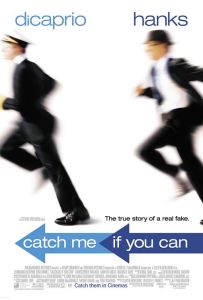 Catch Me If You Can (2002)
Premise: Successful true-life con artist Frank Abagnale Jr. (Leo DiCaprio) zips across the world posing as a pilot, doctor and lawyer all before the age of 18. A mousy Tom Hanks provides the chasing.
Results: Breezy and light-hearted, Catch is an entertaining and fun romp that works with a charming Leo (unlike in Gangs), a jazzy score and a skillful recreation of the 1960s life and mood. Spielberg hasn’t made a film under two hours since 1989, so Catch is a tad long.
Nate’s Grade: B
Share this:

Chicago (2002)
January at the theaters is a tale of two kinds of films. One type are the studio bombs (take Just Married and Darkness Falls, please take them far away). The other type are the prestige pictures expanding their releases in hopes of garnering some of that Oscar magic. A lot of prestige films were released around the holidays and though not every one could be a winner, they were all better than Kangaroo Jack. Well, except for The Hours.
 Chicago (2002)
Premise: Roxie Hart (Renee Zellweger), hungry for fame, finally grasps it when she kills her lover and is put on trial. Silver-tongue lawyer Billy Flynn (Richard Gere) stirs up the media in her defense, as well as for another starlet killer, Velma Kelly (Catherine Zeta-Jones).
Results: A song-and-dance picture thats quite toe-tappin with imaginative numbers, even if I can only remember like two songs. A surprisingly steady Zeta-Jones really shines and Gere can cut a rug. Chicago is just lively fun. Blink and youll miss Lucy Liu in it.
Nate’s Grade: B
Share this:

About Schmidt (2002)
January at the theaters is a tale of two kinds of films. One type are the studio bombs (take Just Married and Darkness Falls, please take them far away). The other type are the prestige pictures expanding their releases in hopes of garnering some of that Oscar magic. A lot of prestige films were released around the holidays and though not every one could be a winner, they were all better than Kangaroo Jack. Well, except for The Hours.
 About Schmidt (2002)
Premise: Retired and recently widowed, Warren Schmidt (Jack Nicholson) must learn to live his own life for the first time. Warren travels across the country to rediscover himself and stop his resentful daughter from marrying a man-child with a mullet.
Results: Nicholson downplays his usual shark grin to deliver one of his best performances in a funny, tragic, savage yet warm-hearted film. About Schmidt, from the creators of Election and Citizen Ruth, is one of the best films of 2002.
Nate’s Grade: A
Share this:

The Hours (2002)
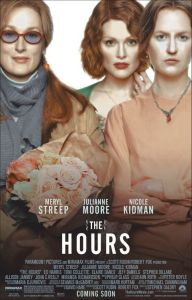 Okay, after watching the Golden Globes award show and seeing The Hours crowned with the highest prize, and hearing incessantly about Nicole Kidman’s fake prosthetic nose in the movie, it was time to venture into that darkened theater and see how good the awards-friendly The Hours was. Little did I fully realize what I was getting myself into.
Nicole Kidman plays Virginia Woolf, who is in the midst of writing her novel Mrs. Dalloway, where she proposes to display a womans entire life through the events of a single day. Julianne Moore plays Laura Brown, a housewife in 1951 having difficulty adjusting to a domestic life that she feels ill equipped for. Meryl Streep plays Clarissa Vaughan, a gay copy-editor in 2001 planning a party for a poet and former lover (an emaciated Ed Harris), who is suffering from the late stages of AIDS. These three storylines will be juggled as the film progresses, with each womans life deeply changing before the end of the day.
The Hours is a meandering mess where the jigsaw pieces can be easily identified. The attempt at a resolution for an ending, tying the three storylines together, is handled very clumsily. The film spins on and on that you start to believe the title may be more appropriate than intended. What this movie needed was a rappin kangaroo, post haste! The film is wrought with victimization and screams ”Give me an award already!” Before you know it youre being bludgeoned to death with what is profoundly the most over serious Lifetime network movie ever assembled. And there’s nothing fundamentally wrong with Lifetime movies but The Hours does not share the sensibilities of its TV brethren.
 Kidman, nose and all, gives a strong performance displaying the torture and frailty of a writer trapped within her own mind but too often relies on wistful staring or icy glares. Moore is effectively demoralized but cannot resonate with such a shallow character. Streep is the least effective of the three and fizzles among an over-stuffed assembly of characters.
The supporting cast is unjustly left for dead. The characters are seen as parody (Toni Collette as Moore’s un-liberated homemaker neighbor), extraneous (Claire Danes as Streep’s daughter, Allison Janney as Streep’s lover, Jeff Daniels as Harris ex-lover, you know what, almost anyone in the Streep storyline), one-note (the workmanlike John C. Reilly who plays yet another doting and demystified husband) or merely obnoxious (Moore’s brat child that refuses to separate from her). It appears The Hours is the three lead actress game, and everyone else is not invited to play along.
Stephen Daldry’s direction shows surprising stability and instinct after his art-house pandering Billy Elliot showed little. The technical aspects of The Hours are quite competent, especially the sharp editing and musical score, which just points out further how slickly hollow and manufactured the film is.
The Hours is an over-glossed, morose film that is too self-important for its own good. It sucks the life out of everything. And for all its doom and gloom and tsunami of tears, the only insightful thing The Hours is trying to pass off onto the public is that women are more depressed than you think.
Nate’s Grade: C
Share this:

Narc (2002)
 Stop me if you’ve heard this before. A hard-nosed and diligent cop (Jason Patrick) gets taken off the force after in accident while serving in the field. The bureau brings him back in the help of solving a case collecting cobwebs, the death of an officer undercover. This cop gets teamed up with a hothead (Ray Liotta) who doesn’t play by all the rules who becomes increasingly more suspicious that said hothead breaks more rules than enforces. Oh, and diligent cops neglected wife and child incessantly worry over his well being as he becomes consumed by the work. Whats that, you want me to stop? Well okay then.
So what do we get with Narc? Well, Ray Liotta yells. A lot. He’ll huff and puff until smoke blows out his ears and veins jump from his neck. Liotta eats scenery uncontrollably like Marlon Brando left alone at the Cheesecake Factory.
Narc attempts to tell a gritty police drama in the same manner of The French Connection but, instead, turns into every other gritty cop movie. The twists (I use this word lightly because every turn is easily telegraphed) do nothing to liven up this rote rogue copper flick. Let’s face it, every cop drama is plot driven, even the classics like L.A. Confidential and The French Connection. So if you don’t have a good story then theres no gas in this car. And Narc barely runs on fumes.
Writer/director Joe Carnahan tries to play window dressing with some superfluous camera tricks in an attempt to jazz up the proceedings. The opening handheld chase scene could give the makers of The Blair Witch Project motion sickness. The editing can at times simulate an annoying fly buzzing around your ear. The result of these tricks is like covering a turd with chocolate and selling it to the masses.
Narc won’t quicken any pulses or knock any socks out of their vicinity. So what will you get? Well Ray Liotta yelling at you, which, surprisingly, could lead to audience narc-olepsy. Even that horrible pun is better than watching the film. I think that says it all.
Nate’s Grade: C
Share this:

Gangs of New York (2002)
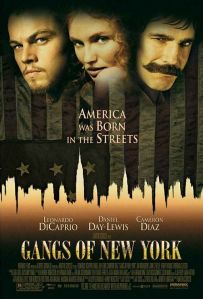 Watching Martin Scorsese’s long-in-the-making Gangs of New York is like watching a 12-round bout between two weary and staggering prize fighters. You witness the onslaught of blows, see the momentum change several times, and in the end cant really tell which fighter is victorious. This is the experience of watching Gangs of New York, and the two fighters are called Ambitions and Flaws.
The film begins in the Five Points district of 1840s New York among a vivid gang war over turf. Amsterdam (Leonardo DiCaprio) witnesses the slaying of his father, Priest Vallon (Liam Neeson), at the blade of William Bill the Butcher Cutting (Daniel Day-Lewis) and his Native Americans gang. So what does this son of a dead preacher-man do? Well he grows up, plots revenge by making a name under the wing of the Butcher becoming like a surrogate son. But will vengeance consume him?
 Watch Leo DiCaprio assemble toughs, rake heels, and ne’er do wells to his Irish gang of rapscallions with facial hair that looks to be tweezed! Witness a one-dimensional Leo suck the life out of the film like a black hole! See Leo become the least frightening gangster since Fredo. Watch the horribly miscast Cameron Diaz play pin-the-tail-on-an-accent! Witness as she tries to play a pickpocket with a heart of gold that falls hopelessly and illogically in love with Leo! Marvel how someone looking like Diaz would exist in a mangy slum! See the brilliant Daniel Day-Lewis upstage our stupid hero and steal every scene he inhabits! Witness one of the greatest villains in the last decade of movies! Watch Day-Lewis almost single-handedly compensate for the films flaws with his virtuoso performance! Admire his stove-top hat and handlebar mustache!
Witness a wonderful supporting cast including John C. Reilly, Jim Broadbent and Brendan Gleeson! Wish that they had more screen time to work with! Wonder to yourself why in all good graces this film took nearly two years of delays to get out! Speculate away!
Gangs has the sharp aroma of a film heavily interfered with by its producers. The whole exercise feels like Scorsese being compromised. Gangs is a meticulous recreation of 1860s New York that often evokes an epic sense of awe. The story has more resonance when it flashes to small yet tasty historical asides, like the dueling fire houses and the Draft Riots. But all of these interesting tidbits get pushed aside for our pedantic revenge storyline with Leo front and center. You know the producers wanted a more commercial storyline, which probably explains why Diaz has anything to do with this.
 The script is credited to longtime Scorsese collaborator Jay Cocks, Steven Zallian (Academy Award winner for Schindler’s List) and Kenneth Lonergan (Academy award nominee for You Can Count on Me). So with all these writing credentials, dont you think one of them would realize all of the dumb things going on with the story? The ending is also very anticlimactic and ham-fisted. Just watch as we segue from a graveyard to present day New York, all thanks to the Irish rockers of U2!
I know this much, Day-Lewis needs to stop cobbling shoes and act more often. Gangs is his first visit to the big screen since 1997’s The Boxer. He spent part of this hiatus in Italy actually making shoes. I don’t know about everyone else but this man has too much talent to only be acting once every five years. Somebody buy his shoes and get him a script, post haste!
Scorsese’s Gangs of New York is at times sprawling with entertainment in its historic vision and at other times is infuriating, always dragging behind it a ball and chain called stupid revenge story/love story. I’m sure the film will get plenty of awards and Oscar nods in prominent categories, and this seems like the Academy’s familiar plan: ignore a brilliant artist for the majority of their career and then finally reward them late for one of their lesser films. So here’s hoping Scorsese wins the Oscar he deserved for Raging Bull and Goodfellas.
Nate’s Grade: C+
Share this:

Lord of the Rings: The Two Towers (2002)
 My countrymen and fellow Americans, I come here not to praise Lord of the Rings: The Two Towers but to bury it. I don’t know if it’s a result of being the bridge between the beginning and end of this saga (taking the role of neglected middle child), or a result of unmet sky-high expectations, but I may be alone here in saying that Two Towers was a letdown. I’ll try and frame my reasoning as to not be attacked by hairy hobbits and men with pointy hats and long flowing beards.
1) Story structure. Unlike Fellowship of the Ring, where were introduced to a rich world and have suitable character set-up, the second LOTR film puts almost all our characters on the backburner and gives us an insufferably long subplot involving a king and his brood. The movie peters out an ending and seems to throw its hands in the air saying, “See ya a year from now.”
2) Length. This wasn’t a problem with the previous film but man did Two Towers become unbearable as it went. Some described the first film as three hours of walking; well the second could be described as two plus hours of folks hyping a battle and then — a battle. Seriously, theres a lot of talk about a significant battle and that’s it. An hour could have easily been cut from this. It got to the point where my then-girlfriend was sprawled across my lap pleading for me to somehow make the movie end.
3) Characterization. So much time is spent doing nothing you think the film would further round the characters? Oh how stupid you would be. Nothing new seems to be drawn from any character, with the exception of the treacherous yet likable Gollum. Several people from Fellowship (Liv Tyler, Cate Blanchett, Hugo Weaving, Ian McKellen) have screen time that amounts to no more than a cameo, so why in the world aren’t we getting anything more from our already established heroes? Everyone just looks friggin bored. As was I.
4) Excessive dwarf jokes.
I re-watched Fellowship and all of the reasons Two Towers suffered were not evident. So what does this tell me? Nothing particularly, except not to see the movie in the theater again. Two Towers is by no means a bad film. The cinematography, production and special effects are all breath-taking and sweeping. I’ll still look forward to seeing the next, and last, installment in Peter Jackson’s Rings epic, but Two Towers has left a bitter taste of disappointment to linger upon.
Nate’s Grade: B-
Share this:

Talk to Her (2002)
 Before one can assess Talk to Her, the new Spanish import from famed writer/director Pedro Almodovar, one must come to grips with what they have seen. It’s not every film you see that has a giant vagina. Yes, you read correctly dear reader, a gigantic yet scalable recreation of the most sensitive part of the female anatomy. Was there also a giant penis you might reasonably ask? No, but there was an incredible shrinking man that burrowed into the enormous vagina and lived the rest of his days with the labia and clitoris as his next-door neighbors. And what may be even more surreal is that all of this, thematically and metaphorically upon retrospect, makes absolute sense.
So maybe this opening salacious salvo was a bit hyperbolic, but describing Almodovar’s unusual meditation on life, love and death can prove quite ponderous. To explain the story of Talk to Her is to miss its complexity and richness. This is a film destined to spark conversation afterwards.
Almodovar’s colorful melodrama centers on two sets of relationships. Benigno (Javier Camara) is the most attentive boyfriend a woman could have. He talks to former ballerina Alicia (Leonor Watling), washes her hair and makes sure she gets plenty of exercise and attention. Oh yeah, Alicia has also been in a coma for four years. Benigno carries on like he was involved in a normal relationship, except the woman of his heart cannot return a single glance.
 Marco (Dario Grandinetti) is recovering from a former relationship when he falls completely in love with Lydia (Rosario Flores), a female bullfighter. She is having trouble competing in a very male dominated “sport” (I don’t really consider stabbing animals a sport per se). At the start of a bullfight Lydia is horribly gored and dragged around the arena like a rag doll. The results leave Lydia lying in a coma with no hope of ever waking up. It is at the hospital where Marco meets Benigno, who is one of the most helpful nurses. He helps Marco overcome his grief over his fallen love. Benigno shows that unresponsiveness and death cannot deter a man’s love. The two men bond and become very close; however, dark clouds are on the horizon, as Benigno’s fantasy cannot last much longer.
Almodovar has routinely enjoyed tweaking the establishment, especially gender roles and religion (there’s a few tacky priest molestation jokes), but with Talk to Her he attempts to forge serious drama through odd circumstances (ballerinas, bullfighters, giant vaginas, oh my!) and all without the use of irony. The result is a quietly affecting film that burrows its way inside you, much like the shrinking man burrows into … well, you remember.
The movie is darkly comic in its portrayal of Benigno’s delusional relationship, and yet Talk to Her is also a celebration of love and friendship. The affection that is shown is perplexing but also transfixing with the ability to love someone who is mentally not even there. The film questions the compensations we make for love. Some people pretend that their mate is a different person and glaze over character flaws. Could it not be possible then that someone would compensate for an entire person?
Almodovar has created a very female-centric film despite our female leads spending the majority of their screen time lying perfectly still. Talk to Her is an engrossing and intriguing character-driven story. It may start out like a sick joke but the layers of humanity Almodovar effortlessly injects into his story create the most bizarrely touching movie of 2002.
Nate’s Grade: A
Share this:

Solaris (2002)
 A most amazing thing occurred when I sat down in my theater to watch Steven Soderbergh’s sci-fi remake, Solaris. The majority of the theater was women, no small part Im sure to George Clooney and the promise to see his posterior not once but twice. As the film progressed I kept hearing the rattling of seats and the exit doors. When the lights came back on more than half my theater had walked out on Solaris. I have never seen this many walk outs for any film before, and if one has to hold this title Solaris certainly does not deserve this dubious honor.
Clooney plays Chris Kelvin, super future psychologist who is struggling to overcome the grief over the suicide of his wife, Rheya (Natascha McElhone). Clooney is dispatched to a space station orbiting the mysterious glowing planet Solaris. Seems strange goings on, are, well, going on. When he arrives he finds that the station head has taken his own life and the two remaining crew members on board could use more than a few hugs. Clooney goes to sleep (in a bed resembling bubble-wrap) and is startled awake when his dead wife is suddenly lying right beside him. But is it his wife? Is it merely his memories being recounted? Is it Solaris messing with his gray matter? Does Rheya have consciousness of the past or of her self? What are her thoughts on her new materialization? Good luck Steven Soderbergh, existentialist party of one.
It’s not that Solaris is necessarily a bad film, it’s just that it’s plodding, mechanical and overly ambitious. There are long periods of staring, followed by brief exposition, then more staring, sometimes earnestly but mostly slack-jawed. Solaris is attempting to be an existential meditation on identity and self, but what really occurs is a lot of nothingness. For a movie that was over three hours in its original 1971 Russian conception, and a mere 93 minutes in its slimmer Soderbergh size, I could likely get this movie done in 6 minutes. It could be argued that its arduous pacing amplifies its methodical subject matter but whatever.
 Clooney has said in interviews how Solaris was the most challenging role of his career. To this I make a collective noise of disagreement. Clooney turns from grief-stricken to confusion, then back to grief-stricken with nary a line of dialogue. The effect is more dampening than emotional. Clooney’s conscious gets even worse when he banishes New Rheya into the cold vacuum of space then Another Rheya appears the next night. He just can’t escape this dead woman.
I’m very pleased to see the glassy-eyed, apple-cheeked beauty McElhone in movies again. She seemed to be on the cusp of mainstream acceptance after prominent roles in 1998’s Truman Show and Ronin, yet she just disappeared. McElhone is a wonderfully expressive actress and deserves to be a leading lady.
Soderbergh’s take on existential dread could be described as a noble failure. Solaris is the type of overreaching, underachieving film only really talented people could make. And for anyone wanting to leave after the double dose of Clooney’s derriere, they both happen in the first 30 minutes. You can go after that if you so choose.
Nate’s Grade: C+
Share this:

Die Another Day (2002)
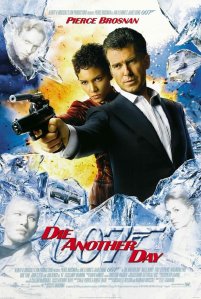 Pierce Brosnan returns for his forth outing as super-spy James Bond, this time trying to thwart, here goes, a former North Korean militant who has switched genes to look like a wealthy Anglo-Saxon playboy. And what does this stupid evildoer want? To erase minefields in Korea with a giant reflective mirror in space that channels a giant solar beam
of DOOM! Commence smacking of the forehead.
Pierce Brosnan returns for his forth outing as super-spy James Bond, this time trying to thwart, here goes, a former North Korean militant who has switched genes to look like a wealthy Anglo-Saxon playboy. And what does this stupid evildoer want? To erase minefields in Korea with a giant reflective mirror in space that channels a giant solar beam
of DOOM! Commence smacking of the forehead.
Berry may have an Oscar but she is not terribly great in Die Another Day. She is so awful that if she sucked anymore she would physically implode. Heres an example: she literally stabs someone with a book and glibly says, ”Read that, bitch.” Ugh. Want another? When asked by a diamond-studded baddie, whom sent her, Berry’s defensive reply is, “Your Mama.” How in the world did this person become a secret anything?
The Bond series has always been great escapist fare but its age is becoming much more apparent. Die Another Day starts with a montage of Bond being tortured in Korea. When he’s released our dapper gentleman looks exactly like the American Taliban, with flowing hair and beard. He’s been abandoned by his people out of the fear he has confessed vital info while under 14 months of torture. Yes, that’s right folks, 14 months of torture. You think an agent like Bond, who has foiled devious plots 19 previous times, would be worth retrieving.
Brosnan is dandy and a charming actor but even he is showing some gray. It may be time to tap another into the martini-swilling shoes. Dame Judi Dench and John Cleese provide stable supporting bits, but what is Michael Madsen doing in this?
 Director Lee Tamahori has directed one of the best films on self-abusive relationships ever (Once Were Warriors) and also directed one of the worst thrillers ever (Along Came a Spider). Tamahori surprisingly brings some slick touches to Bond and seems to be trying to tinker with the stagy formula, and when he gets away with it Die Another Day is thrilling. A car chase set atop a glacier is visually stunning and pulse pounding. Then this chase continues into a melting ice palace. Brilliant if not a tad bizarre. What do ice palaces go for on the open market? Whats the upkeep like?
Die Another Day is the most self-conscious of the Bond franchise with numerous homages and in-jokes. Berry’s introduction is a direct reference to Ursula Andress classic bikini-clad ashore entrance in Dr. No. Bond confesses his relationships with women never seem to make it to second dates, despite the vigorous sex, and a female agent (Rosamund Pike) even jabs, “I know you, sex for dinner, death for breakfast.” The flaccid villain runs a diamond company and actually has a magazine headline that states: ”Diamonds Are Forever.” At least the multiple writers were having some fun.
The producers that hold the Bond rights are likely as stingy about following set guidelines as the ones behind the scenes at Harry Potter. Yes James Bond always has one foot planted in the fantastic, and the emphasis will still be on girls, gadgets and gargantuan explosions, but this formula cries out for some tinkering before more damage can be done. The robust derring-do occasionally lightens Die Another Day but the franchise is starting to look like it needs mouth-to-mouth resuscitation if it is to survive in our Mountain Dew, XXX world of tomorrow.
Nate’s Grade: C+


 nathanzoebl
You must be logged in to post a comment.