Author Archives: natezoebl
People We Meet on Vacation (2026)
 I’ll readily confess, I enjoy a good romantic comedy. I’ve even written a few rom-com Web series. Who doesn’t want to be captivated by charming characters, witty, banter,, and a yearning for a romantic coupling? The Sony-by-way-of-Netflix-acquisition People We Meet on Vacation is based on popular author Emily Henry’s 2021 breakthrough novel of the same name. I was expecting lots of fizz and frivolity, which can be had in doses, but I think the adaptation makes a few key mistakes that hampered my rom-com good time vibes. People We Meet on Vacation is not whom I was expecting, and maybe that’s me being too demanding, or maybe my travel companions made me think about switching seats.
I’ll dispense with the exact plot details further into this review, but the story in general is thus: Girl and Guy are friends but maybe also secretly like each other but also sometimes have other people, boyfriends.girlfriends, that they’re supposed to like more instead. Eventually, they grapple with these confusing feelings while also visiting global tourist destinations as “platonic vacation buddies.”
 First, I didn’t buy the main characters as close friends. We’re introduced to them as they travel home to small-town Ohio together for the holidays from their freshmen year at Boston College, and they’re immediately bickering and annoying and can’t stand one another. The film is following a friends-to-lovers path, but I guess at first it decided to become an enemies-to-friends storyline. Even as the animosity thaws, I never really bought what compelled these characters to be best friends, so much so that they make a plan to make a trip every summer across the world together (the disposable income these newly indebted college grads have access to blows my mind; he’s a teacher!). The premise is workable, and as you would expect there are feelings that begin to get messy over the years of vacation, but I never felt the core friendship, so whether or not they ruined it with a burgeoning romance never felt like a credible threat for me. What is there to ruin exactly? We’re jumping from vacation to vacation summers apart, the gaps are meant to serve as storytelling glue; we’re meant to just assume, “Oh, they became good friends,” without seeing it for ourselves. I think this misstep could have been avoided simply by making the two of them less acrimonious in their earliest introduction. Make the friendship credible, and even better, make me like them together and see that they bring out other sides in one another that others fail to elicit.
This could also be a factor of my second misstep, namely the casting. I did not feel a flicker of chemistry between Emily Bader (My Lady Jane) and Tom Blythe (young sexy Snow in 2023 Hunger Games prequel), and I think it’s mostly the guy’s fault. I was getting 2011 Oscar hosting flashbacks. Here me out, dear reader. In 2011, Anne Hathaway and James Franco were hired as hosts to have the awards show appeal to a younger demographic (begin knowing laughter). Franco’s energy was so low that critics joked he might have been stoned the whole time. As a result, Hathaway had to overcompensate for his dearth of charisma and energy and was stuck doing far too much. In People We Meet on Vacation, our female lead, Poppy, is a chatterbox extrovert, and our male lead, Alex, is a sullen introverted homebody. Naturally, opposite personality dynamics can make for engaging relationships, but the work needs to be careful. I found Alex to be a bore. The most he gets pushed out of his comfort zone is by skinny dipping and, separately, pretending to be on a honeymoon for free drinks. That’s it. That’s Mr. Wild on Vacation (more on that next). Most of the time he’s just converting oxygen to carbon dioxide on screen. As a result, Bader has to go above and beyond, talking circles around her taciturn scene partner and bowling him over with personality, so much so that her outsized personality begins to flirt from charming to dangerously annoying. The misaligned character dynamics and characterization form a ceiling of my engagement.
 Thirdly, I was expecting more of a flirty freedom from the premise. Poppy works as a travel writer and fantasizes about being someone completely new on vacation. With that concept, you would assume the story would explore that dichotomy, the woman who uses these trips to reinvent herself, try on different versions of herself that can be dramatically different, adopting new personas and exploring aspects of herself that she didn’t feel comfortable embracing as regular ole Poppy. This seems like the most obvious direction to take the story with a title like People We Meet on Vacation (the new people we meet are… ourselves). Astonishingly, the movie is not that. There is only one instance of Poppy and Alex leaning into the freedom afforded to them through their vacations to pretend to be different people. While in New Orleans, they pretend to be newlyweds and this grants them free drinks, and this new persona gets Alex to dance provocatively; he even does The Worm. Does this different version of Alex lead to anything more? No. It would make sense with all their free drinks for this to be the moment that Alex and Poppy get even closer, imitating newlyweds, and cross a line of their friendship. Does this happen? No. That’s a whole other international vacation where the characters aren’t pretending to be other people. We can break this down on an even smaller level. Maybe the characters have events in these vacations that push them out of their comfort zones and challenge them in ways that change them as people, like discovering an aspect of themselves they hadn’t given thought to before. If you’re going to Tuscany, do something that’s unique to Tuscany. Do something that matters. It never feels like the travel is actually making an impact on these two characters. Rather, the vistas change but the focus is always on their will they-won’t they, which isn’t dependent on their setting. They could have just gone down the block for the same results. At 118 minutes long, some of these various vacations might have been consolidated if they are so inconsequential.
Lastly, when the movie isn’t separating itself from the pack by embracing its unique story elements, it falls back on the familiar cliches of the genre. I’m talking stuff that even a layman to rom-coms would even know, things like the big kiss in the rain, the big Act Three dash, usually out of an airport. It’s stuff like that, and cliches by themselves are not inherently bad but they have to feel authentic to the characters and stories. It might be a cliche to simply say that you need to make the cliches your own. If I genuinely cared about the characters, and felt their chemistry, then I wouldn’t be nitpicking and noticing the cliches as much. It just so happens that a shaky adaptation can make reliance on genre cliches more noticeable.
 Now, I know the majority of this review has been critical of People We Meet on Vacation, and that’s mostly because I think this movie could have been better from some pretty obvious missteps. The version of People We Meet on Vacation is… fine. It’s consistently cute and amusing and harmless, an afternoon movie that can pass the time well enough especially for those predisposed to romantic comedies. It’s a fairly good-looking movie with an impressive war-chest for music licenses, including Ms. Taylor Swift. My middling frustrations with the movie seem to be echoed by many of Henry’s fans, that whatever made this story special seems to have been emptied, replaced with cozy genre cliches. I liked the ending, cliches and all, because it felt fitting for those characters, their different dynamic, and felt it had been sufficiently set up to serve as a payoff. I wanted more moments like this, that felt unique to this story, to these characters, and actually made use of their specific settings. No other characters in this movie matter other than our leads, so it’s a shame that I didn’t feel particularly excited for their eventual coupling. I didn’t find their characters repellent or mean-spirited, just ordinary, lacking a distinct personality. They were blandly likeable but the kind of people you’d meet and forget easily, vacation or no. People We Meet on Vacation is an agreeable movie that had the possibility for more, and that’s what lingers longest for me.
Nate’s Grade: C+
Share this:

The Rip (2026)
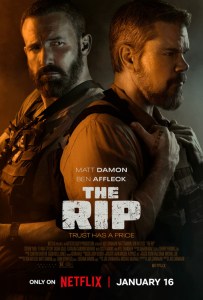
Director Joe Carnahan (The A-Team, Narc) excels at machismo, and I mean that not as a detriment. He makes muscular action-thrillers, often about corrupted men coming to terms with their ruination. 2012’s The Grey is still one of the best movies I’ve ever seen released in January. Well here comes The Rip, also released in January, starring Matt Damon and Ben Affleck as combustible Miami cops who follow a tip to a cartel stash house that holds a cache of twenty million dollars. The cops are supposed to follow protocol, call it into their superiors, but with that kind of money, much more than what the tip reported, it’s hard to resist the life-altering implications of indulging in that kind of haul. I thought The Rip, named after the seizure of contraband, was going to be a modern-day Treasure of the Sierra Madre, where the power of greed is irresistible and leads to betrayals and murder among our characters. It does that, with each questionable decision going against protocol making us question who might be most susceptible and who might be heading for a collision. The movie, co-written by Carnahan, is strictly genre boilerplate. The characters are never more than archetypes, the dialogue is aggressively expository often reminding us of all the conflicts and characters on the periphery that haven’t been brought back yet, and the majority of the film is a contained thriller awaiting trouble at the stash house. And yet I was entertained from start to finish thanks to the cast and a simmering tension that Carnahan unleashes between his paranoid characters. There are some late plot turns that I don’t know if they’re actually clever, convoluted, or both. It’s the kind of thing that’s meant to excuse bizarre behavior that we’d have no reason to assume differently, so it feels a little bit like being jerked around. However, The Rip is a fairly fun way to blow through two hours built upon movie stars unleashing their swagger.
Nate’s Grade: B-
Share this:

It Was Just an Accident (2025)

Iranian writer/director Jafar Panahi (The White Balloon, The Circle) is an example of an artist literally willing to put it all on the line for his art. He’s been banned by the authorities of Iran from making movies, and then Panahi secretly made a documentary of himself serving as a taxi driver in 2015. Scanning his filmography, all of his movies after 2000 were either made “illegally” or banned in his home country before their release. He was sentenced to a six-year prison sentence in 2022 and was released shortly after undergoing a hunger strike. Panahi filmed his latest movie, It Was Just an Accident, in secret without knowledge by the Iranian Authority, which makes sense considering how openly critical it is about the regime. It won the Palm D’or, the top prize, at the 2025 Cannes film festival and has been one of the most acclaimed movies of the year. It’s also likely going to make life much harder for Panahi, who was also sentenced in absentia by Iran to another prison sentence for “propaganda activities.” Yet his art persists, and It Was Just an Accident is easily one of the finest movies of 2025 and it’s no accident.
It begins simple enough. A middle-aged man and his family have car trouble after accidentally hitting a stray dog (sorry fellow animal lovers, but at least you don’t see it). They are taken into a nearby garage and that’s where the owner overhears the family man’s voice and then freezes in terror. He sounds EXACTLY like the man who interrogated and tortured him for the Iranian government years ago. Could it be the same man? How can he verify? And if so, what does he plan to do with his possible former captor?

What a brilliantly developed and executed movie this is, taking a concept that’s easy to plug right into no matter the language and cultural barriers, and then to unfold in such contemplative, bold, and unexpected ways. It captures mordant laughter, poignant human drama, and a nerve-wracking thrills. Most of all it’s terribly unexpected. As more and more people get brought in on the kidnapping, and more reveal their personal trauma from their shared captor, I really didn’t know what the fate would be for anyone. Would they kill this man? If so, what would that say and how would they view themselves after? If not, what lessons might they have learned from this ordeal and what lessons might their former captor have learned? It really kept me guessing and because it’s so exceptionally well developed and written, the script could have gone in any direction and I would have likely found satisfaction. There’s even the question over whether or not all these people are mistaken and projecting their fury onto an innocent man. However, I will say, the movie flirts with Coen-essque dark comedy, almost at a farcical level for its first half as these amateurs stumble their way through a kidnapping plot they are not equipped to control (a woman is stuck in her wedding dress for the entirety of these vigilante deliberations). Then in its second half it transitions into a really affecting moral drama about the lengths of trauma and the desire for forgiveness as a key point toward processing grief and preparing oneself to move forward. Even though the circumstances are specific to Iran, the movie is emblematic of accountability and reconciliation, and those elements can be easily empathized with no matter one’s cultural borders.
As you might expect, this is a movie brimming with anger, but it’s not suffused with bitterness, which is a remarkable feat given its subject matter. This is a movie that unfolds like a crime thriller, with each scene unlocking a better understanding of a hidden shared history. Each new character provides a larger sense of a bigger picture of oppressive state control and abuses, with each new person adding to the chorus of complaints. Naturally, many of these victims want to seek the harshest retribution possible for a man who tortured them with impunity. It’s easy to summon intense feelings of outrage and to demand vengeance. The filmmakers have other ideas in mind that aren’t quite as tidy. It’s easy to be consumed by anger, by outrage, that surging sense of righteous indignation filling you with vibrant purpose. It’s another matter to work through one’s anger rather than simply serve it. I’m reminded of the masterful 2021 movie Mass, a small indie about two groups of parents having a lengthy conversation; it just so happens one couple’s son was killed in a school shooting and the other couple’s son was the gunman responsible. It was a remarkably written movie (seriously, go watch it) and a remarkably empathetic movie for every character. It’s easy to pick sides of right and wrong, but it’s so much more engaging, intriguing, but also humane to find the foundations of connections, that every person lives with their own regrets and guilt and doubts. It Was Just an Accident follows a similar moral edict. Every character is a person, and every person is deserving of having their perspective better known, and we are better having given them this grace.

I think the movie is also especially prescient about this time and place in American history. It very well may prove a sign of the future, detailing a populace of the abused and traumatized and the former aggressors who worked for an authoritarian agent and administered cruel violence to cruel ends. It’s not difficult to see a version of this movie set in, say, 2035 America, with a ragtag group of characters discovering a retired ICE agent who they all have an antagonistic relationship with. In many ways the movie is about Iran and its history of an oppressive government turning on its own people, but in many ways it can also be about any system of power abusing that power to inflict fear and repudiation. It’s about a reckoning, and that’s why I think while the movie is clearly of its culture and time it’s very easy to apply the movie’s lessons and themes and larger ideas to any country, It’s all about characters coming to terms with harm and accountability, and sometimes it takes a long time after the fact for the perpetrators to accept that harm has been done, especially if they can fall on the morally indefensible “just following orders” defense. In the near future, will ICE agents, especially the ones who joined up after Trump took office for the second time, argue the same as the Nazis at Nuremberg? Will they rationalize their actions as just fulfilling a job to pay a mortgage? It might even be overly optimistic to believe a reckoning would even occur in the not-so-distant future, not to the profile of the Nuremberg trials but even just an individual accounting of individual wrongdoing. That assumes an acceptance of wrong and ostensibly a sincere request for forgiveness. As I write this, with an ICE officer whisked away to the protective bosom of federal government after executing a woman shortly after dropping her child off at school, it’s difficult for me to even accept that those in power and so eager to impose their bottomless grievances upon the vulnerable and innocent would ever allow themselves to accept the possibility of blame or regret. But then again this is perhaps what the citizens of Iran felt and they’re presently marching in the thousands to protest their authoritarian government in 2026, so maybe there’s hope yet for we Americans in 2026 too.
There is a deliberate sense to every minute of It Was Just an Accident, from its long takes to its interlocking sense of discovery, to the questions it raises, answers, and leaves for you to ponder. It’s a movie that drops you into a fully-realized world with rich characters that reveal themselves over time. If there’s one pressing moral for Panahi, I think it’s that every person matters, even the ones we’re told have less value. This is an insightful, searing, and ultimately compassionate cry for justice and empathy. It will be just as effective no matter the date you watch it, but with a movie this good, why wait?
Nate’s Grade: A
Share this:

HIM (2025)
 Setting a horror movie in the world of competitive sports, especially American football with its fandoms akin to dangerous cults of zealots, is a smart concept that could have so much possible commentary, from the sacrifices and exploitation of the players for the blood-lust of the fans, to the conspiracy of a cadre of white owners profiting from the labor of black athletes, to even the blinding psychopathy of extreme tribalism as an identity and dividing line. HIM does little to none of this, and being produced by Jordan Peele, I expected so much more than what I got. We follow a college phenom quarterback who wants to be the greatest, so he accepts an offer to train with a famous champion (Marlon Wayans) who puts him through a series of intense trials to prove whether he has what it takes. The horror elements are more confusing and surreal than unsettling, often crashing into unintentional comedy, like watching mascots with sledgehammers. This is one of those movies that seems to shift from scene to scene, with murky elements meant to keep the main character guessing but really just keeps the viewer guessing if this will ever come to something meaningful. The horror grew tiresome and repetitive. I was hoping for more scenes like where our young QB’s misses in practice lead to other players being physically abused, but mostly HIM hinges on tired occultly leftover furnishings, including an ending that is simultaneously underwhelming and predictable, a shrug meant as catharsis. An electrifying horror movie can certainly be made about the world of football. HIM isn’t it, let alone the possible GOAT.
Nate’s Grade: D
Share this:

No Other Choice (2025)
 The title of the Korean movie No Other Choice is spoken, in English actually, a few minutes into the movie. It’s the brief, unhelpful reasoning from an American exec that just bought a South Korean paper company and is reducing the local labor force. Our main character, Yoo Man-su (Lee Byung-hun), has been work-shopping his spirited speech about how important these jobs are to appeal to the American businessmen, and then when it comes time to deliver, he’s reduced to chasing them down as they quickly depart. Before he can even get into a second poorly-formed sentence, the exec cuts him off by saying, “No other choice,” and then sidles into the protective safety of a chauffeured vehicle. The implication is that this business has to reduce its labor force to stay profitable, and yet rarely is this so simple. In legendary director Park Chan-wook’s (Old Boy, Decision to Leave) latest, characters will often repeat the title of the movie as a deference to guilt, that they were forced to make hard decisions because those were the only decisions that could be had. Unfortunately, as this mordantly funny, exciting, and intelligent movie proves, people have a way of deluding themselves when it comes to finding justifications for their bad behavior and greed.
 The real plot of No Other Choice is Man-su’s readjustment. In the beginning, we see the life he’s built for his family, his wife Lee Mi-ri (Son Ye-jin), stepson Si-one, and daughter Ri-one, with their two big dogs. After a year of job searching, Man-su is bouncing from one job to another, and the family has been forced to make cutbacks to their lifestyle (“No Netflix?!” the son says in shock). Lee Mi-ri takes on a part-time job as a dental assistant to a hunky doctor. The dogs are shipped to Lee Mi-ri’s parents. Ri-one might have to stop her expensive cello lessons, which is a big deal as her teacher says the Autistic child is a prodigy, but her parents never hear her play. The paterfamilias needs to find a good job fast. That’s when Man-su gets the idea to post a fake job for a paper company manager to better scope out his competition. He takes the top applicants, the guys he acknowledges would be hired ahead of him, and creates a list. From there, Man-su pledges to track them down and eliminate them so his own odds of being rehired climb up.
The movie keeps shifting in new directions and tones with each new target, and it creates a much more fascinating and intriguing experience. I loved how each of the targeted rivals is treated differently and how each of these men come across as people who are struggling, hopeful, and quite like our beleaguered protagonist. There are good reasons why this movie has been described as Chan-wook’s Parasite, his culminating condemnation on the pitfalls of capitalism, how it pits peers against one another when they should be allies. Man-su views each man as his competition, impediments to him getting that prized position. However, each of these people is far more complicated than just their resume. At any time the movie could stop on a dime and just have two strangers, one of them intending to possibly kill the other, just have a heartfelt conversation about the difficulties of providing for your children and knowing that there are hard limitations that cannot be overcome. One man is struggling to adapt to a new marketplace after working in the paper industry for twenty years, and Man-su even echoes the complaints from the man’s wife, chiefly that he could have applied himself to other industries and jobs, that he didn’t have to be so discriminating when it came to a paycheck. Now, from her perspective, she’s arguing this point because she feels he is not casting a wider net for promising non-paper job opportunities. From Man-su’s perspective, he’s chiding the man because he doesn’t want to kill him but the guy’s intractability has put him in Man-su’s crosshairs. The unspoken comment is that Man-su is doing the same thing. At no point does he really consider getting a different job and thus being in a position where he does not feel forced to literally eliminate his best competition. He too is just as stubborn and blind to his own intractability. The system has a way of turning men against one another in order to boost a corporate balance sheet. This movie is just taking things a little further to the extreme when it comes to cutthroat competition.
 I also appreciated that the movie has a larger canvas when it comes to charting the ups and downs of its conspiracy. Man-su’s wife is not kept as some afterthought, you know the kind of movie where the husband goes on these wild journeys of the soul and his wife is just as home going, “Where have you been?” She’s an active member of her household and she is not blind to their financial shortfalls nor her husband’s increasingly worrying behavior and absences. She’s worried her husband may have begun drinking again after years of sobriety and peace. She makes attempts to reconnect with her distant husband, who is becoming more consumed with jealousy about her boss and his desirability. She’s not just the doting spouse or concerned spouse. She’s a resourceful character who recognizes problems. When another threat to their family materializes, Lee Mi-ri takes it upon herself to find a solution. Naturally, given the premise, whenever you have one member of a couple doing dastardly deeds, whether they get caught by their partner is a primary point of tension, as well as if so, how will their partner respond. I think the track that Chan-wook and co-writers Lee Kyoung-mi, Don McKeller, and Le Ja-hye decide is perfect for the story that has been established and especially for the darker satirical tone of the enterprise.
Despite the murder and gnawing guilt, No Other Choice is also a very funny dark comedy as it channels the absurdity of its premise. It’s always a plus to have amateur murderers actually come across as awkward. Just because they decide to make that moral leap shouldn’t translate into them being good at killing. There’s unexpected humor to Man-su’s amateur stalking and preparations. He’s also not immune to the aftereffects of his actions, getting queasy with having to dispose of these men and thinking of the best ways to obscure his physical presence from crime scenes (there was one moment I was literally screaming at the screen because I thought he forgot a key detail). Lee Byung-hun (Squid Games) is terrific as our lead and finds such fascinating reactions as the movie effortlessly alters its style and tone, one minute asking him to engage in silly slapstick and the next heartfelt rumination. I don’t think the film would be nearly as successful without his sturdy performance serving as our foundation. You really do feel for him and his plight, and perhaps more than a few viewers might feel the urge for Man-su to get away with it. The culmination of the first target is a masterful sequence where three characters all have a different misunderstanding of one another as they literally wrestle for a gun inside an oven mitt. It’s one of those moments in movies where you can stop and think about all the small choices that got us here and appreciate the careful plotting from the screenwriters. I found myself guffawing at various points throughout the movie and I think many others will have the same wonderfully wicked reaction.
 I could go on about the movie but hopefully I’ve done enough to convince you, dear reader, to give No Other Choice the ultimate decision for your potential entertainment. It’s a movie that covers plenty and leaves you deeply satisfied by its final minutes, feeling like you’ve just eaten a full meal. The ending is note-perfect, but then I could say just about every scene beforehand is also at that same artistic level. I won’t go so far as some of my critical brethren declaring this as Chan-wook’s best movie; I’ll always fall back on 2016’s The Handmaiden, also an adaptation of an English novel, much like No Other Choice (would you believe the source materiel is from the same author who gave us the novel for Play Dirty?). Regardless, this is exceptional filmmaking with a story that grabs you, surprises you, and glues you to the screen because you don’t know what may happen next (Patricia Highsmith would have loved this film).
Nate’s Grade: A
Share this:

The Secret Agent (2025)
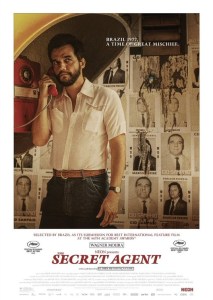 The Secret Agent is a hard movie to fully categorize. It’s set in 1977 Brazil and with its title you might think it’s about some clandestine espionage operation or fighting against a corrupt government, and it does fit those descriptions but not in a traditional Hollywood way. We follow Wagner Moura (Narcos, Civil War) as a former grant-supported energy scientist who comes to clash with a powerful businessman who then hires an assassination team to kill this know-it-all. It’s also about entrenched police corruption and coverups, a found family of people seeking protection and new lives, the search for memory and proof of life, a father wanting to connect with his son in the wake of his mother’s death, and then there’s a running story about a severed leg that goes into the wildest, most unexpected places. It is a leisurely paced movie at almost two hours and forty minutes in length, but each scene is its own luxurious moment to dwell in. Take for instance the opening scene where Moura drives his car to a dusty, rural gas station and finds a dead body covered in newspaper. Nobody wants to come claim the corpse, and then the police do arrive but they take particular interest in Moura, wanting to search his car and ask him questions. Do they know something? Who is this man? A similar early scene involves the police investigating a dead shark where a severed human leg was found inside its mouth, and the way it unfolds and escalates is so naturally fascinating. The Secret Agent juggles many different tones, from nostalgic drama to crime thriller, but every scene is so expertly written and paced by writer/director Kleber Mendoca Filho (Aquarius, Pictures of Ghosts). You may grow weary by its length, but when I was in every scene, I didn’t want it to end because it feels so well-realized in its moment. There’s a subversive switch-out with its climax that reminded me of No Country for Old Men, and the ending coda ties together the flash-forwards and hits hard with the theme of uncovering and honoring the past. This is a lot of movie, much of it I admired more than I outright loved, but it’s such a fascinating balancing act that I would recommend The Secret Agent as a sprawling dive into Brazilian history, culture, and its own political reckoning.
Nate’s Grade: B+
Share this:

Hamnet (2025)
 It’s the sad Shakespeare movie, and with Paul Mescal (Gladiator II) as Will, it could just as easily be dubbed the Sad Sexy Shakespeare movie. Hamnet is a fictionalized account of Will and his wife Agnes (Jessie Buckley) processing the death of their young son, Hamnet, which we’re told in opening text is a common name transference for Hamlet. Right away, even before co-writer/director Chloe Zhao (Nomadland, Eternals) brings her usual stately somberness, you know what kind of movie you’re in for. It’s pretty (and famous) people in pain. The entire time I was watching this kid Hamnet and just waiting for the worst. It doesn’t arrive until 75 minutes into the movie, and it’s thoroughly devastating, especially the circumstances surrounding the loss. This is less a Shakespeare movie and more a Mrs. Shakespeare movie, which is more illuminating since she’s typically overshadowed by her verbose husband. She’s an intriguing figure who shares some witchy aspects, communing with nature and even foretelling her future husband’s greatness and dying with only two living children, which presents a pall when she has three eventual children. Once Will finds success as a London playwright, he feels like an absentee father and husband, briefly coming in and out of his family’s life in Stratford. However, the final act is what really doesn’t seal the movie for me. I don’t think it’s really a spoiler to admit the final 15 minutes of the movie is basically watching Hamlet performed on stage, with Agnes as the worst audience member, frequently talking through the show and loudly harassing the actors before finally succumbing to the artistry of the play and finding it a fitting outlet for her grief. In short, the movie is meant to provide more personal insight and tragedy into this famous play, asking the viewer to intuit more meaning (“Oh, Hamlet is his dead son, Hamnet! I get it”), but ultimately the ending is just watching Hamlet. I don’t feel like we get any meaningful insight into William Shakespeare as a person besides his irritation at being a Latin teacher, and frustratingly, Agnes is constrained as well, held in a narrow definition of the grieving mother. This is a shame since she showed such fire and individuality in the first half. Buckley (The Lost Daughter) is terrific, ethereal, earthy, and heartbreaking and a shoo-in for an Oscar. I found her final moments, especially reaching out to her son, so to speak, especially poignant. Hamnet is a good-looking, well-acted movie about sad famous people who then rely upon the arts to help heal their gulf of sadness. There’s not much more to Hamnet than that, but with such exceptional professionals and artists at the ready, it might be more than enough for most.
Nate’s Grade: B-
Share this:

Regretting You (2025)
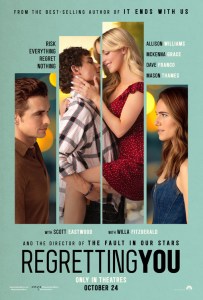 I do not care for Colleen Hoover as an author. She exploded thanks to social media and has, as of 2024, sold over 34 million books, primarily romantic dramas, primarily featuring wounded women trying to get back on their feet. She is a full-blown publishing phenomenon. Hoover has become so prolific and successful that she takes up an entire shelf. She’s already joined the ranks of your James Pattersons, Stephen Kings, Danielle Steels, the familiar names of authors that can be found in grocery checkout lanes. Her popularity is indisputable. Her quality is another matter, and that’s where I have trepidation with Hoover as a storyteller. Admittedly, I have never read any of her novels, so take all criticisms with a degree of incredulity. I’m making my judgement based entirely on the movie adaptations of her novels. Again, this might be an unfair guide considering if I did the same thing for, say, Stephen King, it would be easy to form a scathing opinion of the man’s literary work. 2024’s It Ends With Us made me deeply uncomfortable with its misplaced attempts to romanticize domestic violence. It wasn’t just misguided but it offered little insights into the mentality of abuse victims, instead slotting this disturbing story element into the awkward love triangle expected from the genre. It wasn’t good. Next, we have Regretting You, based upon Hoover’s 2019 novel of the same name. At this point, I’m wondering if I need to hold a regular spot in my annual worst of the year lists for the slew of Hoover adaptations to come.
In 2007, Morgan Grant (Allison Williams) and her friend Jonah Sullivan (Dave Franco) are clearly in love. I guess it’s too bad they’re seeing other people. Both are also dealing with pregnancies. Morgan marries Chris (Scott Eastwood) and has her baby, Clara. Jonah abandons his pregnant girlfriend, Jenny (Willa Fitzgerald) but comes back many years later to have another baby together (I guess Jenny terminated her earlier pregnancy but it’s never really dealt with). Cut to present-day, and teenage Clara (Mackenna Grace) is smitten with the charming film school aspiring Miller Adams (Mason Thames), a guy ripped out of a quirky rom-com. Then the big tragedy happens: Jenny and Chris die in a car accident, the same car, and it’s revealed the two were engaging in a longstanding affair. Morgan and Jonah must try and navigate these complex feelings of betrayal while also determining how much to tell Clara.
 Just glancing through that brief plot synopsis, there are a LOT of elevated, dangerously soapy story elements packed into a two-hour movie, and that’s not including Clancy Brown as a cranky grandfather who Miller feels indebted to take care of as he’s scheduled to begin chemotherapy. There’s a lot going on here, and I’ll just state that there are two movies jostling for dominance that should have been split. The teen storyline does not fit next to the adult storyline. Every time it jumps from one to another, it was tonal whiplash and it became so much more dissonant. That’s because the teen storyline is awash in the burgeoning feelings of new love that we see in many YA tales and teen-centric rom-coms. It’s new and hopeful and very familiar for the teen drama genre. The adult storyline is awash in grief and betrayal, with both spouses trying to make sense of their pain and heartache and uncover what they can of what they didn’t know. One of these stories is bubbly and sunny and comedic, and one of these stories is tragic and searching and painful. They do not work in tandem, each taking away from the appeal of the other.
In particular, the adult drama deserved its own showcase to really explore the details of its complex feelings. Discovering after death that your spouse was not who you thought they were is so conflict-rich, especially that they were linked to another person experiencing that same shock and loss and confusion, it’s a recipe for real anguish and an unknown path of healing. Morgan and Jonah should never have known one another, let alone had an unrequited romance that hangs over them as adults. All this does is set up the obvious coupling, cruelly killing their spouses so these two can finally be together as destiny demands. It would have been far more intriguing for them to discover one another through this shared betrayal, but then again that might remind people of Random Hearts, but then again I doubt anyone recalls much about this 1999 movie that has an 18% rating on Rotten Tomatoes. This is where the real drama lies, but like much else of Regretting You, it’s unexplored and replaced with tropes and predictability. The exploration of grief and anger isn’t even given its proper due. Morgan primarily sits on her couch and drinks wine throughout the day. Jonah at one point rejects his new baby thinking he’s not the biological father. This conflict is, like many others, resolved so simply, merely having Morgan tell him to man up. These characters should be discovering unexpected aspects of themselves through this unique circumstance. These two characters should be striving to process their varied emotions but it’s all too easily distilled into a predictable payoff to their decades-in-the-making romantic matching. It’s reductive and boring.
 The YA-styled romance is also too familiar and underdeveloped as its adult drama. Miller (I hate that his first name is “Miller” – apologies to all first-name “Miller”s out there reading) is the kind of kid who loves movies but never seems to talk about what he loves about them or even make references to them. He wants to be a filmmaker but we don’t see his projects. That’s because Miller isn’t so much a character but being a dreamy ideal boyfriend, a sweetheart who is always concerned for Clara’s well-being and is so respectful of her boundaries and desire to wait to be intimate. He requests help moving a town limits sign a couple blocks every so many days with the intention of eventually having the ability to order from his favorite pizza place that said his home was out of their delivery zone. This is the kind of cute, whimsical activity we expect from the Manic Pixie Dream Girls of romantic comedies. If you think harder about this it actually becomes nonsensical. Why would the pizza shop change their earlier refusal because now there is a sign in front of Miller’s home that says it’s within city limits? It’s only a single sign. The house hasn’t physically moved, the distance is still the same, and the store’s GPS would still indicate as such (“But-but there’s a sign, and even though the sign is inaccurate, you should abide by it”). This is only a silly detail that I don’t mean to harp on but it’s indicative of the lackluster character writing. Because of this there’s really no genuine conflict between the two young lovers. He’s a dull dreamboat ideal.
Really, the only drama present with Clara is when she will discover the harsh truth about her father, and so you’re just waiting for this eventual Sword of Damocles to fall, to have her question why her mom would make this choice. In some regard it makes sense, to hide a painful truth from her daughter, to delay further having to process it herself, but it’s also something that cannot be contained forever. She’s going to find out eventually, and then she’s going to be additionally upset that her own mother withheld this news from her. It’s not like Morgan has complete ownership of this information. It likely would be common knowledge that they died together, in the same car, and it’s hard to believe rumors would not emerge, with classmates snickering behind her back through the school hallways or taunting her directly. It’s a shame that this looming hard truth is the only thing that Clara has going for her in this movie. Their relationship is generally conflict-free, or what conflicts there are are so easily resolvable. She’s young, in love, and her dreamy boyfriend easily ditches his girlfriend, the one obstacle to their union. This is because Clara is not her own character, not even a reflection of her mother; she is only a plot device to be plucked into tears.
 There are a few creative decisions that caused me deep confusion. Chief among them is the choice to have the same actors play their mid-to-late 30s selves as their high school selves. The opening high school graduation just establishes the four characters’ relationships, the obvious fact that Jonah and Morgan feel something for one another but oh well, and that there are unexpected pregnancies. From there the movie makes a sizable time jump but doesn’t make that clear this has happened. So we went from Morgan at a graduation party to Morgan chatting with Clara, and I thought she was a younger sister. Why would I have automatically assumed this is now the 16-year-old daughter that we had just confirmed was a zygote in the previous scene especially when Williams is made to look exactly the same over those 17 or so years? I don’t think the opening was even necessary. They could have established these character histories without a direct flashback where Jonah literally says that maybe they’re with the “wrong people” as he stares deeply into her eyes. This is also the kind of movie that has no faith in its audience, and yet we’re intended to catch the big time jump. Clara sees a movie at Miller’s theater, and he asks her why she’s crying at the conclusion of a Mission: Impossible sequel. She says it’s because her dad took her to a lot of movies. We get it. She associates the movies with her father who she dearly misses. But then the movie adds an additional line where she literally says, “That’s why I’m crying.” Thanks, movie. Ugh.
Something amusing to me that I doubt anyone else would really notice is the design of the movie theater. Miller works at an AMC movie theater so there are a few sequences, including the big rom-com rush to greet one another and have the big swooning kiss moment. Because the movie is a Paramount production, there are only posters present promoting other Paramount movies, 2025 releases like The Running Man and the latest Mission: Impossible, but then also classic movies like Sabrina and The Godfather. God forbid a movie theater advertise other titles from competing film studios. Perhaps this is just a very singularly loyal theater. Anyway, as a person who worked at a movie theater for over a decade, this little incongruous detail stuck with me. It’s the same thing with Miller’s bedroom. All of his posters are Paramount movies, which means he just loves that studio so much. Maybe that’s why he works at a movie theater that plays exclusively Paramount movies (the corporate synergy reminds me of young Christian Grey having a Chronicles of Riddick poster in his childhood bedroom brought to you by Universal). Perhaps somehow Miller doesn’t even know the existence of non-Paramount movies and is in for a world of shock when film school students talk about stuff like Godard and Cassavetes and Fincher and Tarantino, and he’ll just be so pitifully confused.
 With a title like Regretting You, it allows for so many ready-made quips, especially when the finished movie isn’t quite up to snuff. The term “soap opera” is usually referenced as a pejorative, that a movie has so much heightened incidents to be distanced from the nuance of adult reality. However, just because something is soapy in scope doesn’t mean it cannot be fascinating and engrossing in execution. The films of Pedro Almadovar (All About My Mother, Talk to Her, Parallel Mothers) are often, on paper, a random assembly of soap opera histrionics, and yet the man’s creativity and empathy finds, almost without fail, ways to really open up and explore the details of his characters and their unique emotional states. The premise of Regretting You could have done this, but the desire to be appealing to teenagers with the YA-styled teen romance, sabotages the exploration of grief and betrayal into a clipped and frustratingly tidy little package. It’s not good storytelling, folks, but it had some potential to be. There are two more Colleen Hoover film adaptations slated for 2026, and most definitely more even after, so it’s best to prepare dear reader because It Ends With Us wasn’t actually predictive with its title. It only begins.
Nate’s Grade: C-
Share this:

Sentimental Value (2025)

It’s an old cliche to say “they don’t make movies like this anymore,” but with our current media environment, there’s a reluctant truth to the fact that many genres, particularly adult dramas, romantic comedies, and non-action comedies, have declined steadily from their studio heyday. And yet Sentimental Value is also proof against this adage, as this wonderful movie is the kind of engrossing, mature, and thoroughly artistic original adult drama that Hollywood would have positioned decades ago to prominent award glory, like your Terms of Endearment or Rain Mans. I guess the caveat is that Sentimental Value comes from Norway, so outside the Hollywood system, and it’s reminding every movie lover not just of what we’ve lost in recent times with studio output of rich adult dramas, but it reminds us why we love the movies. Sentimental Value is easily one of the best movies of the year and a triumph all around of acting, writing, directing, and editing. It’s so thoroughly well-realized that it feels like we’ve been dropped into the realm of a classic novel brought to stunning life with a level of care, insight, and artistry that is rare to experience in any medium. I knew right away I was in for something truly special.
We begin by tracing the history of a house in Oslo, particularly the Borg family that has lived there for generations going back to pre-World War II. The father, Gustav (Stellan Skarsgard), is a famous film director who divorces his wife when their two daughters are young. The oldest daughter, Nora (Renate Reinsve), grows into a talented but neurotic theater actress, one beholden to stage fright even after all her accolades. Her younger sister, Agnes (Inga Ibsdotter Lilleaas), has married, has a young son, Erik, and she works as a historian researching specifically her grandmother who was tortured by the Nazis. After the death of their mother, Gustav resurfaces in their lives after a long absence working in Hollywood. He has plans. He has written a semi-autobiographical screenplay about the life of his mother, and he wants to film it in their family house, and he wants Nora to play the starring role. The sisters are resentful and wary of their father, but could this entire artistic enterprise be a push for reconciliation and better understanding for everyone?

I’m talking mere seconds into the movie, director/co-writer Joachim Trier (The Worst Person in the World) had already grabbed me with his deft storytelling. A narrator provides the complicated history of this house, treating it like a living vessel that itself has been an observer to the many generations residing within. The details are so precise and telling, like a novel giving you a larger sense of the world that exists beyond the margins of what we can see and hear. To say the movie is a complex family drama is only scratching the surface. Let’s just unpack some of the layers inherent from its premise. Gustav’s world is cinema and he wants to make what might be his last movie his greatest and most personal. He’s telling his story, asking his own daughter to play his own mother. When Gustav was a child, he was the last person to speak to his mother before she decided to take her own life by hanging herself. Think about the psychology at work here, a father trying to reconnect with his estranged daughter through the means of her playing his own mother and possibly better understanding his loss that has haunted him since childhood. Then Gustav also wants Erik, his grandson, to play the younger version of himself in the movie, though Agnes is against the idea. There are so many intriguing layers at play with all of this, the use of art to process grief and trauma, the mirrors of family members portraying other members as engines of empathy, and the act of filmmaking as recovery. I’ll slightly spoil the movie to say that Nora turns down the role. The rest of the movie is about how she gets to “yes.”
In the wake of Nora’s rejection, Gustav offers the role to an American actress, Rachel Kemp (Elle Fanning), a hot commodity that convinces Netflix to get involved. However, with the streaming giant attached, there are several compromises that Gustav must endure. He intended the project to be in his native tongue but now it’s in English. He isn’t allowed to bring back older members of his crew he’s worked with for decades, like a retired cinematographer who is infirm to the point where he needs to walk around with a cane. With each compromise, you can see Gustav making a mental cost-benefit equation. He envisions this movie as his most important, and possibly his last, and it becomes a gauntlet of what shape it might eventually take to get made and if that shape is too malformed and unrecognizable from his original artistic vision. When you consider this movie could also be his vehicle to better understand his own mother, as well as an amends to his daughters, then every new compromise bears even more significance. Rachel is eager to please a director as well-regarded and as famous as Gustav, but she also recognizes her vulnerabilities and shortcomings. She can’t shake the feeling that she’s not right for the part, that Nora is the rightful pick, and she’s struggling to get a better grip, plus there’s the whole Norwegian accent that she has to master as well. Fanning (Predator Badlands, A Complete Unknown) has a few standout scenes but even she recognizes she’s the interloper to this family.

Reinsve has been a collaborator of Trier’s all the way back to 2011’s Oslo, August 31st, but it was her starring role in 2022’s The Worst Person in the World that cemented her international stardom. She’s a wonderfully intuitive and expressive actress, inviting us in with every scene to study her character’s guarded emotional responses and occasional outbursts, like her stage fright hysteria. As the older sister, Nora has built more resentment against their father, whom she blames for everything that her family lacked back in Norway while her father was off in Hollywood making movies with celebrities. Nora is wary about filmmaking, viewing the theater as more of a pure artistic and worthy medium for acting, though you could even view this designation as a division she has drawn: “this is my territory, and that is my father’s territory.” Now he wants to bring her into his world, and she can’t help but be skeptical after all their time apart. Why now? Why this? While this is a splendid ensemble drama with great attention paid to many characters, for all intents and purposes, Nora is our protagonist, and Reinsve keeps us compelled to examine every internal development of this character.
Every actor is at the top of their game, contributing to a marvelous ensemble that makes this family so richly felt. Skarsgard (Dune) is used to playing heavies, stooges, and bad dads, and the role of Gustav allows him to tap into all of those mercurial skills to bring to life a man who is trying to take stock of his life late in its run and make some changes, notably who is allowed inside his cherished circle. Skargsard is mournful but still egotistical, reaching for reconciliation but not begging for it, using the enterprise of the movie and particularly the leading role offer as the unspoken apology. However, Gustav is more than just an absent father, as in the screenplay, by Trier and longtime collaborator Eskil Vogt, he’s also still suffering from his own trauma with the loss of his mother. This movie is an attempt to better understand her and perhaps her psychology that would lead her to make such a heartbreaking decision to end her life. It’s an honest attempt to bring back to life a woman he dearly misses while also discovering a path of forgiveness, while he seeks his own act of forgiveness with his own adult daughters. I told you, there are layers all over this movie.

As the younger sister, Agnes has a more charitable view of her father, and she even acted for him in one of his earlier movies and fondly recalls how warm his attention and affection felt. She’s wary about his desire to have her son, who has professed an affinity for filmmaking but not acting, play the role of young Gustav. She’s worried about her child going through the same level of attachment and disenchantment that she experienced when she was younger and wanting to grow closer to a man who had kept his distance from his family. Agnes’ story is one of uncovering the history of her grandmother, a member of the Norwegian resistance who was taken into custody during Nazi occupation and endured all kinds of torture. Her grandmother is indicative of an entire generation of resistance, and by re-examining one person it provides a larger statement about the sacrifices of those who deserve not to be forgotten, whose memories persist even after the horrors they survived. The movie makes an implicit line between her suffering and eventual suicide but making it a direct line of cause and delayed effect is not so simple. People are complicated by nature, and Agnes fits this bill as well, as demonstrated by Lilleaas’s commanding supporting performance. I think she has what may be the most affecting scene in the movie, a sisterly heart-to-heart that strikes you right in your own heart.
Reminiscent of Ingmar Bergman and Francois Truffaut, Sentimental Value is a richly realized drama with such engrossing and complex characters told in a richly entertaining fashion. There are stylistic touches, like the recurring omniscient narrator, but the movie is more grounded in the simple pleasures of transporting us into the lives of other people and to embrace their flaws and hopes and desires. The actors are incredible and bring such startling life to these characters and their nuances. I could have endured an entire series in this world but at a little over two hours, Sentimental Value feels complete and satisfying. It’s the kind of movie “they don’t make anymore,” to our detriment, so when you discover a film as beautifully executed as this one about the relatable issues that drive many families apart and can bring them back together, then you thank your lucky stars that we still have filmmakers dedicated to making complex adult dramas without any high-concept gimmick to couch their real intentions. This is a marvelous movie about life. Full stop. See it, reader.
Nate’s Grade: A
Share this:

Marty Supreme (2025)
 Marty Supreme is like the Oscar bait version of 2019’s Uncut Gems. Director/co-writer Josh Safdie, one half of the Safdie brothers that literally gave us Uncut Gems, has applied that same panic attack-inducing formula to a more broadly friendly combination of elements (example: this movie doesn’t open on a colonoscopy). Timothee Chalamet plays the titular Marty, a young man in 1952 New York City with a dream of being the best ping pong player on the world stage. He’s so supremely confident of his abilities that he never seems to plan beyond the immediacy. He’s a born hustler, and the majority of this 150-minute exercise is watching him work multiple schemes to gather the funds to secure a plane ticket to Japan. Reminiscent of Uncut Gems, it’s a movie of antic episodic events, with a charismatic but self-destructive lead spinning collapsing scheme upon collapsing scheme, one ending while another begins, and struggling to keep them all spinning and paying out. It makes for a frantic, propulsive experience, and even though there are some shady characters eventually and threats of violence, the stakes feel less dramatic and therefore more accessible to endure for so long. This is the kind of movie where, upon finally getting an item that will pay for that ticket, Marty’s own uncompromising hedonism has to be satiated in that moment of supposed triumph, all for it to get taken away again. In many ways, Marty is his own worst enemy when it comes to actually achieving his goals.
The whole thing is built upon the performance of Chalamet, who dominates the movie. There’s maybe five total minutes where Marty isn’t on screen. It’s a movie that needs a charismatic anchor. Chalamet digs in as the smooth-talking, impulsive, manipulative con man literally looking for his big ticket to stardom. It’s a brash performance of bravado, and it’s easy to get carried away by the actor, or at least intrigued to see how Marty is going to get out of all these crazy jams of his. The whole movie kind of takes a note from its lead to be bold. There’s digressions upon digressions. There’s key supporting roles for Tyler the Creator and Kevin O’Leary, yes, the bald guy from Shark Tank. There’s an opening credits sequence following sperm fertilizing an egg. The last 20 minutes is almost all ping pong action. There’s anachronistic music throughout. It’s remarkable how much of it works, but the frantic, anxious nature of the plotting covers up the hollowness of Marty. Perhaps he’s always yammering because a second of silence could force introspection. I don’t know if this man is capable of reflection, despite what the final image might infer. It’s a wild, whirling, consistently surprising movie that blends in so many characters and incidents to keep you entertained, but I don’t know if, much like Marty, there’s anything deeper under the surface of that desperation
Nate’s Grade: B


 nathanzoebl
You must be logged in to post a comment.