Blog Archives
Emperor (2013)
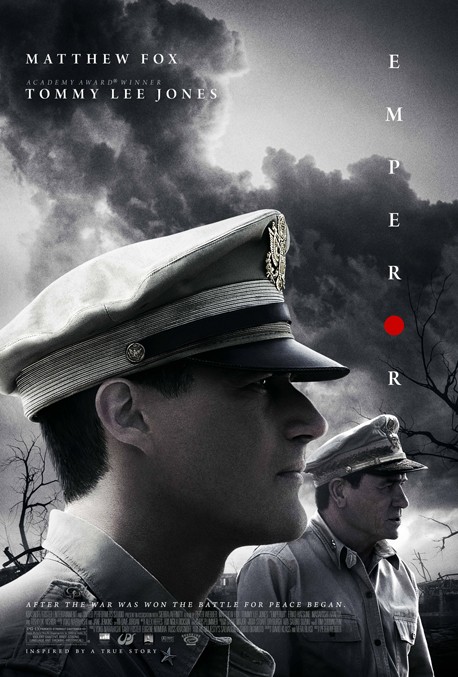 When you’re tasked with retelling an interesting part of history, a story that few are familiar with, it’s best to get out of the way. You don’t need to gussy it up if the history, itself, is interesting enough to warrant a movie. Such is the case with Emperor, a drama set in Japan weeks after their surrender to Allied forces in WWII. General Douglas MacArthur (a stodgy, scenery-chewing performance from Tommy Lee Jones) will rely upon the advice of one man (Matthew Fox) whether to try the Japanese emperor for war crimes for his possible involvement in the Pearl Harbor attack. The country is still recovering from the shock of nuclear bombs, its people could rebel against foreign occupiers, and the future of the country feels precariously on the brink. All of this makes for a good setting for a story, but Emperor doesn’t stick this out. It keeps falling back to a lame love story about Fox’s college days when he was smitten with a Japanese woman. So, now in Japan again, he desperately looks for her, having amber memories to times where he chased her around wooded areas (they must have done this a lot as a couple since it makes up the majority of his flashbacks). You keep thinking, isn’t there a bigger story at work here than one guy’s failed college romance? The rest of the movie is treated so cursory, with stiff-lip TV procedural attention, so that the details are all we get and the people get lost. Ultimately, Emperor is a movie that crushes us with the wrong history, misses out developing all the meaty stuff, and thinks what we truly want is Fox chasing after his lost love. It’s a shame the movie is so boring while the history is not.
Nate’s Grade: C
Share this:

Abraham Lincoln: Vampire Hunter (2012)
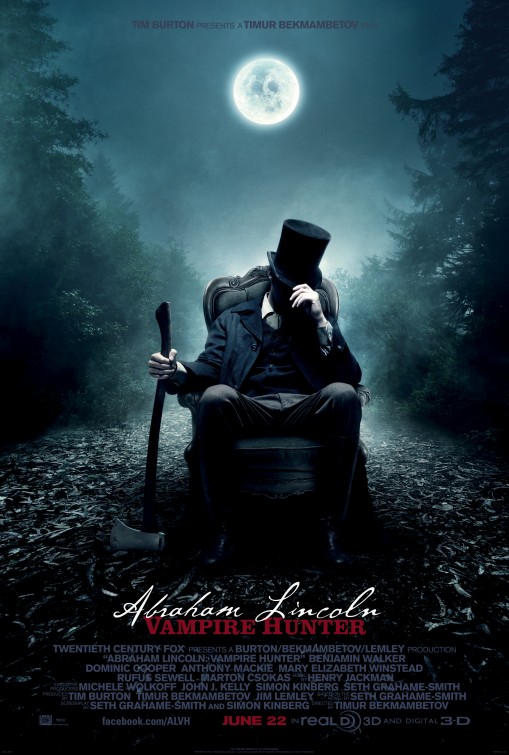 Did you know that our sixteenth president had a rather unorthodox hobby, and it was really the purpose that drove him into politics and later the White House? That’s what the gonzo best-selling book Abraham Lincoln: Vampire Hunter purports. When he was talking about a house divided not being able to stand, he was secretly talking about vampires, you see. The film version, under the tutelage of producer Tim Burton, looks like it’d be an axe-swinging good time. I realize the absurdity of wishing the filmmakers had hewn closer to the source material, a radical reinterpretation of American history, but there it is. I cannot tell a lie.
Abraham Lincoln (Benjamin Walker) is a man determined to rid this new country of the scourge of vampires. His mother was murdered by a vampire landlord, Jack Barts (Marton Csokas), when Lincoln was only a little boy. As an adult, Lincoln tries to avenge his mother’s death but Barts is too strong. Henry (Dominic Cooper) saves Lincoln and teaches him all about vampires and, more importantly, how to hunt and kill them. They strike up a partnership: Henry will provide names of vampire targets and Lincoln will dispatch them with extreme prejudice. Lincoln tries to live a solitary life but keeps building attachments; to his co-worker Joshua Speed (Jimmi Simpson), to his childhood friend Will (Anthony Mackie), who needs Lincoln’s help to forge some slave papers, and the enchanting Mary Todd (Mary Elizabeth Winstead). Abe realizes the limitations of killing vampires one by one. The vampires are exploiting Southern slavery as an all-you-can-eat buffet. Lincoln realizes the only way to foil the vampires is to eliminate slavery, and to do so he must be in a high government position, and so Lincoln retires his axe to turn to abolitionist politics.
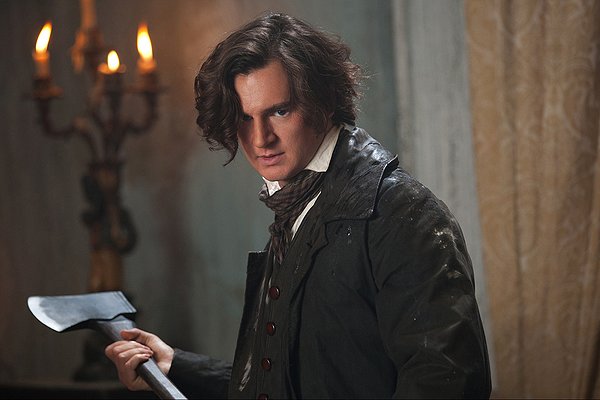 It feels that rather than embrace the courage of its convictions, the movie is trying to please as many mass markets as possible. So many characters and storylines are inserted wholesale without any connection to the book. The film is almost unrecognizable from the book. Now, I’ll quit my bemoaning for the time being because a movie has to exist on its own merits, but Abraham Lincoln: Vampire Hunter is just a mess. As far as new characters included only to appeal to broad audiences, there’s the Black Best Friend, long a staple in movies meant to say, “Hey, our lead character is hip and has no problems with race,” but really it’s always been a depressing act of pander and I always feel sympathy for the thousands of black actors who have to compete over the limited best friend parts. Giving Lincoln a black best friend seems to remind the audience that Lincoln was against slavery, you know, in case anyone didn’t know anything about the man nicknamed the Great Emancipator. Then there’s the ascension of Mary Todd Lincoln into a feisty, strong-willed, formidable ally rather than the insular, clinically depressed woman she was in real life and in the book. Mary even gets some grand hero moments taking out a vampire in slow-mo coolness. The transformation of Mary feels just as big a pander as the character of Will. Then there’s the idea that Lincoln and his small inner circle of pals are placed in the center of action, like they alone and their heroic escapades single-handedly turn the tide of war. It’s handled so ham-handedly that it all plays out like they’re the Scooby Doo gang solving the Case of the Vampire Insurrection.
Lincoln’s history is given such shrift attention, just enough to fill out the standard tortured hero’s backstory for the aims of the story. We see Lincoln as a child but just enough to establish his tragedy and hunger for revenge. Then we cut to him as an adult and going to kill Barts. That’s quite a big leap in time with little careful setup. The time before Lincoln’s presidency is just enough to supply him with a stock character posse and a plucky love interest, and then it’s right to the Civil War. So much time in between the main events just gets squeezed out, and so Abraham Lincoln: Vampire Hunter feels like it’s always one scene away from a clumsy montage.
The vampire threat, as presented, also feels too insurmountable. Not only can these vampires walk in the daylight, they’re super strong, super fast, and can make themselves invisible, a neat new trick. When they ally with the South they seem nigh unbeatable. The movie makes the mistake of making the adversary seem too powerful, so the eventual thwarting of the vampire Confederacy feels too easy and far-fetched given the magnitude of the threat. Adam (Rufus Sewell) is hinted at being like the first vampire, but then this idea is never picked up again. Why even hint at something significant if you have no intention of pursuing it? There’s another new wrinkle where vampires are incapable of killing their own kind. If this is the case then why aren’t the vampires turning every single person they can find into vampires? It shores up their side and guarantees less potential people that could kill them. I’m curious how certain swaths of southerners are going to react to seeing their beloved Confederacy teeming with devilish creatures. Then again, I think the romanticism of the Confederacy is hogwash. When insurrections win we call them revolutions of independence, and when they lose we call them treason. Guess what? The South lost.
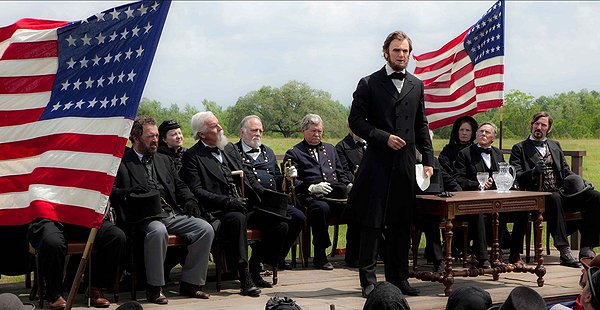 As much as I enjoyed his book, I have to lay the blame at the hands of Seth Grahame-Smith, who adapted his book into the screenplay (he’s 0-2 this summer after his disastrous screenplay for the other vampire movie this summer, Burton’s Dark Shadows). Granted, I’m sure he got intensive notes on how to alter his story for the big screen; the whole projects reeks like it had too many cooks in the kitchen. The interconnection from the book, finding clever ways to marry history and alternative history together, have been ground down to stream line Lincoln into an American super hero. Not only is he handy with an axe, this Honest Abe can leap from racing horse back to racing horse back, and even get clobbered by a horse and keep on going. The coda at the end feels like a missed opportunity to carry on the Lincoln tradition into our modern age. With the clever reworking replaced by blockbuster superficiality, the film merely takes history and has it perform the outrageous rather than finding smart ways to connect all the outrageousness to the established facts.
What the movie has to the credit of director Timur Bekmambetov is a strong visual pulse. Bekmambetov directed 2008’s testosterone-soaked Wanted, so you know you’re going to get some crazy and eye-catching images on display. The action sequences do pack a punch and I’ll admit that seeing an axe utilized as an inventive martial arts weapon is considerably cool. There are two standout set pieces. The first is a fistfight between Abe and Barts in the middle of stampeding horses. You feel right in the thick of the action, horses stampeding all around, the sun setting to offer an eerie yet beautiful glow to the ordeal. It’s one of the more reality-stretching moments, as I noted above, but man if it isn’t thrilling and lovely to watch. The other standout sequence is a climax aboard a speeding locomotive itself atop a large wooden bridge engulfed in flames. Abe and Will stand back to back, swapping the axe to kill vampires, and then hey have to outrun the collapsing train. In these moments, the movie is joltingly alive, bursting with excitement and that rare yet glorious feeling of watching something beautifully different. I just wish this sensation wasn’t so fleeting in the movie.
Abraham Lincoln: Vampire Hunter is a violent historical reworking that isn’t good enough to be properly entertaining and it isn’t bad enough to be considered camp. The film is mostly disappointing because it should feel far more engaging given its whacked-out premise the very cheeky promise of its title, and strong source material, a pulpy, ripsnorter of a read. The movie has some stellar standout moments but I think what ultimately hinders the entertainment value is how dumb everything comes across. This is not dumb in the winking, self-aware, satiric sense, but dumb in more of the blockheaded, Michael Bay, formulaic blockbuster sense. I wouldn’t even classify this movie as an enjoyably dumb, a silly summer slice of escapism like Battleship, which is looking better every week after new, disappointing summer releases (and it’s not even July yet!). The spirit of this movie is missing, the cleverness of the conceit drained, and the fun is bottled up. What this movie reminds me of is the stupid 2003 film The League of Extraordinary Gentlemen, which took classic literary characters and threw them into a genre movie. Both movies figure the exercise alone, seeing classic literary or historical figures in absurd contexts, was enough to justify entertainment. I say that you have to work harder.
Nate’s Grade: C+
Share this:

War Horse (2011)
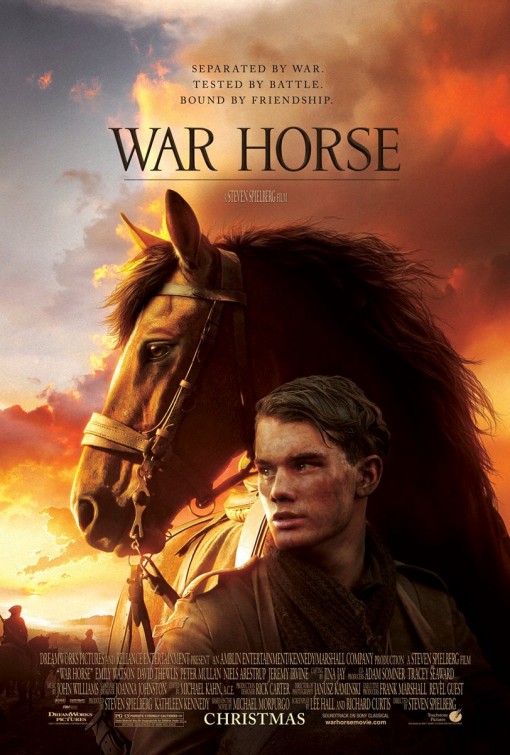 Steven Spielberg and war seem like a dynamite combination. The popular director puts away his childish things and becomes a much more mature, thoughtful artist, with the obvious exception of 1979’s 1941. War Horse is the adaptation of a children’s book-turned-Tony-Award-winning play, where the title star was brought to life on stage via skilled puppeteers. And lo, did people weep for that puppet horse on stage, and lo will they likely weep for the flesh-and-blood version on the big screen. However, I’d hardly call this movie a mature examination on the horrors of World War I. It’s more of a touchy-feely, stodgy, vignette-heavy drama that brings out the worst in Spielberg’s sentimental side.
We’re introduced to our young horse early on, where young Albert (Jeremy Irvine) spies the colt and forms an instant bond. Albert’s father Ted (Peter Mullen) buys the horse on a whim, even though the family could really use a plow horse. Albert names the horse Joey and is determined to prove everybody wrong who doubts the both of them. Together they indeed plow that rocky field and Albert’s family keeps their farm. Then World War I breaks out across Europe and the family ends up losing the horse. Joey is confiscated by the English cavalry and goes on a fantastic journey, switching sides over the course of the war (and allegiances?). Albert enlists in the military so that he can find his long-lost horse. I guess they’ll be no “Dear John” letter when your beloved only has hooves.
 War Horse is a throwback to old-fashioned Hollywood epics. It’s like John Ford took control of this movie from beyond the grave (note to self: premise for a supernatural comedy). My theater was filled to the rafters with old people. It was like the nursing home emptied out for the Greatest generation’s couples night. It’s easy to see why the movie would appeal to such an older crowd. It’s a simple story told with its emotions squarely on its sleeve like a badge of honor (mixed metaphors!). It’s so unflappably earnest and sentimental that it can occasionally fall into cornball territory. There’s the greedy landlord who wants to kick the poor family off their farm. Being a Spielberg movie, no expense is spared in milking as many emotions as possible. Spielberg demands tears and you will deliver them, or so help him. It’s all about Joey the horse prancing through people’s lives, touching hearts, bringing enemies together. The movie is primed for mass (older) audience appeal; for God’s sake there is a sassy goose that Spielberg can’t help himself but continue to include. Sassy goose equals money in the bank. This is the only movie I can imagine where plowing is treated as a point of dramatic catharsis. Suffice to say, War Horse is a stodgy war drama that won’t offend anyone with delicate sensibilities.
I wasn’t expecting War Horse to be the equine version of The Red Violin (if you unfamiliar with the masterful 1999 film The Red Violin, go see it immediately instead of watching this flick). We see the horrors of war through a series of vignettes as Joey passes from owner to owner, each befalling some unfortunate fate, though I don’t think the horse is to blame (or is he…?). The vignettes run about 15-20 minutes or so apiece and because the one constant is the horse, that means we have to feature characters talking out loud explaining everything they do and feel. The horse just kind of takes in everyone’s secrets, probably wishing these people would stop their yapping. The characters are drawn rather broad so we get the German brothers who desert their posts, a French girl wanting to learn to ride a horse, and a noble English cavalry marshal, amongst others. It’s hard to get attached to such disposable characters that fail to leave a modest dent. I thought maybe all these characters would converge in the end for an emotional climax, but then I remembered that many of them were dead, so nope. It’s a strange screenwriting shortcoming when the most engaging character for most of the movie is on four legs and never says a word.
It’s hard not to emote when Spielberg lathers on the sentimentality with aplomb. But if you took away John Williams’ earnest score, Spielberg’s sappy staging, and all those close-ups of animals, would you feel anything for this story or these characters; would you feel anything without all the reminders to feel? I doubt it. Don’t count me heartless, for I’ll have you know I bawled like a baby who just watched another baby hit with a shovel at Marley & Me, but does the life of one horse matter so much more than the millions of lives lost at war? We watch all those boys, many not old enough to be called men, run into the unforgiving gauntlet of war, but someone the life of one horse is supposed to outweigh the countless death. I understand a tight narrative focus so that large, unfathomable horrors can feel personable and better felt. Shindler’s List is that kind of movie. War Horse is not. This isn’t even Black Beauty or National Velvet. One of the English soldiers chides the sobbing Albert with a sharp quip: “It’s not a dog, boy, it’s just a horse.” I felt sad when the horse was in danger; I’m not a heartless bastard.
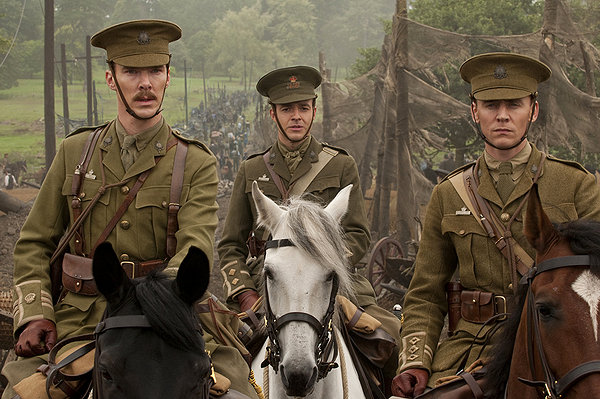 And oh does this horse seem to be Spielberg’s symbol of purity, mankind’s ultimate accomplishment, or, you know, something Big and Important. At one point, Joey gets tangled in a mess of barbed wire and the English and Germans all come to some sort of uneasy truce to work together to free this beautiful animal (if only more hapless horses had gotten lost in No Man’s Land maybe the war would’ve been over sooner – now I sound heartless). The horse is supposed to represent some messianic cost of war, where we destroy nature, turning majestic creatures into weapons of war, etc. I don’t really know what the message/symbolism is striving for but it’s constantly grappling, looking for a suitable sticking point. Honestly, if Joey was supposed to represent purity, goodness, nature, then that filly needed to get turned into glue by film’s end (spoiler alert). I erroneously predicted War Horse to be the “Marley & Me of war pictures.” The horse lives, rejoice America. Never mind the millions of people who died horribly. You can’t have a messianic symbol without martyrdom. If Spielberg wants to drive home the loss of innocence that many underwent thanks to the War to End All Wars (oh, if only), then the horse, a symbol of innocence and nature, needed to die at the machines of war. Otherwise the movie becomes an episodic journey of a single horse, an equine Forrest Gump. I can’t imagine that’s what Spielberg had in mind. I envisioned an M. Night Shyamalan-esque ending wherein the horse does eventually die, get turned into glue, and that glue is sued to construct a bomber plane for World War II. That plane? The Enola Gay. Cut to end credits. War Horse!
This movie has deteriorate in my mind the more I think back, picking away its cornball earnestness and stodgy sensibilities. When the horse is your greatest character then your war drama has some problems. War Horse is not a bad movie by most counts. It looks swell, the emotions are big, and hey horses are pretty aren’t they? But for any discerning moviegoer looking for a strong narrative, incisive commentary on the war, or even moderately appealing characters, well I hope you like looking at horses.
Nate’s Grade: B-
Share this:

Captain America: The First Avenger (2011)
 In the summer of superheroes, you’ll be excused for feeling some fatigue when it comes to men in tights. Captain America: The First Avenger is a surprisingly enjoyable sepia-tinted action film that flexes enough might to pleasantly hark back to the days of 1940s adventure serials. Taking place almost entirely in the era of World War II, the film, and its hero, and unabashedly square and earnest. Steve Rogers (Chris Evans) begins as a 90-pound weakling determined to fight for his country and gets transformed into a behemoth of beefcake by the Army. Captain America is devoid of the dark brooding that has come to encapsulate modern superhero movies, but it’s also playing its B-movie silliness straight. The flick has more in common with Raiders of the Lost Ark and Sky Captain than most other superhero product. Better yet, the movie finesses the in-your-face patriotism of the title character. I mean the guy is called Captain America. Yet the film finds a way to resonate a sincere nationalistic pride without falling back into Michael Bay-level jingoism. And who’s going to make for better villains than Nazis? Director Joe Johnston (The Rocketeer, Jurassic Park 3) turns out to have been the perfect choice to helm this rah-rah retro enterprise. The pacing is swift, the acting is engaging, the special effects are terrific particularly Evans’ transformation into a weakling, and the film is unexpectedly emotional at points. This is a comic book movie that would appeal to an older generation not normally interested in superheroes, namely people like my dad.
Nate’s Grade: B
Share this:

X-Men: First Class (2011)
 Marvel’s X-Men franchise had some serious damage it needed to undo. The once mighty superhero series had been harmed by that age-old foe – bad sequels. The collective stink from 2006’s X-Men: The Last Stand and the 2009 Wolverine debacle, the franchise had lost some serious luster. While the recovery was not nearly as deep and cataclysmic as what the Batman franchise had to deal with in the wake of 1997’s Batman and Robin, a film that flirted with salting the earth, the X-Men needed some kind of facelift. Enter director Matthew Vaughn (Kick-Ass, Stardust), the man who was going to save the series back in 2006 when original director Bryan Singer flew away to direct a different man in tights. Vaughn was originally tapped to direct Last Stand but he dropped out and was replaced by the hack Brett Ratner (Rush Hour). Thus began the slide toward mediocrity. Now Vaughn is back to tidy up unfinished business, taking the series back to its historical roots in the 1960s. It seems that a trip back in time was just what was needed to make the X-Men fresh.
Back in 1944, Erik Lehnsherr is a prisoner in a Polish concentration camp when Dr. Schmidt (Kevin Bacon) discovers the young boy’s great potential. When enraged, Erik can control anything metallic. In upstate New York at the same time, young Charles Xavier discovers a young shape shifter named Raven. She’s blue from head to toe and afraid. They’re delighted to find one another, fearing they were the only ones “different” in the world, children of the “atomic age.” All three of these people are headed for a collision course. In 1963, Charles (James McAvoy) has become an Oxford professor, Raven (Jennifer Lawrence) has followed him to England, and Erik (Michael Fassbender) has been systematically hunting down the Nazis responsible for his pain and suffering. Dr. Schmidt has now become Sebastian Shaw, a younger-looking playboy with the intent to push the Soviets and Americans to nuclear war. Shaw has his own team of mutant henchmen, including telepath Emma Frost (January Jones, proving once again that she can really only ever be good as Betty Drapier) who walks around in white lingerie the whole movie. Together with CIA agent Moira MacTaggert (Rose Byrne), Charles and Erik assemble their own team of young mutants to thwart Shaw.
Similar to 2009’s Star Trek, this film provides the opportunity to reboot a franchise by going back in time. It transports the series back to the beginning of the friendship between Charles and Erik, and spends the next 130 minutes filling in the rationale for the “why” of their varying personal philosophies. By dialing back, we’re able to play around with 40 years of back-story and histories. While we know the end results, that these two giants will become enemies, that Charles will lose the ability to walk, and that Raven/Mystique will eventually side with Erik, that doesn’t mean there isn’t pleasure to be had in watching the journey. There are all sorts of self-aware in-jokes for fans and a few nifty cameos that left me howling with glee. The script, credited to Vaughn, his writing partner Jane Goldman (Kick-Ass), and four others, smartly moves the film forward; no scene seems at a waste. Even better, the film strikes a tone that manages to take its real-world implications seriously (nuclear brinksmanship, Holocaust, and fighting for equality and acceptance) without diminishing its popcorn thrills.
As a summer movie, X-Men: First Class has enough razzle-dazzle to compliment its intelligent social pontification. Vaughn and his screenwriters have composed action sequences that neatly incorporate the mutant abilities of its subjects while building the tension and smartly utilizing the contours of geography. I hate action sequences that don’t play to the potential of location and subject. An evil teleporter (Jason Flemyng) finds a fiendishly clever way to dispatch 20 CIA agents. Magneto efficiently takes out former Nazis residing in Argentina in one chilling sequence (“I’m Frankenstein’s monster,” he tells one man). Shaw makes for an actual formidable opponent for our fledgling heroes. The personal connection he has with Erik, on top of Bacon’s devilish glimmer of villainy, makes Shaw a strong antagonist that the audience can rally against. Vaughn has a splendid reveal with Shaw. Back when he was a Nazi doctor, he asks young Erik to move a coin with his abilities. The shots consist entirely from one side of his office, showcasing it to be a bookish study. Then when Shaw calls the Nazi guards to bring in Erik’s mother for a little more direct incentive, the camera flips position. We see the opposite side of the room, a medical station on the other side of large glass panels. Inside is a torturous display of medical cutlery. It’s a fantastic reveal that kicks up the tension while adding to the terrifying character of Shaw. The action highpoint, a mutant vs. mutant battle amidst the Soviet and American naval fleets, provides plenty of parallel action to follow that keeps the movie alive and kicking.
The film mixes a frothy, James Bond-esque spy thriller feel in production design and whatever-goes plot savvy, but then recomposes real life events as mutant enhanced. Alert the history textbooks, because the Nazi scientists experimented on mutant children and that mutants averted World War III. Some will chafe at the alternative history approach, but I find it to be more interesting, suspenseful, and a natural fit with the overall Cold War paranoia feel of the setting. Melding the X-Men into history makes for a more intellectually stimulating adventure, tipping its hat at various historical revisions that payoff as small rewards for a well-informed audience. I’m not saying that the movie is like Noam Chomsky’s take on X-Men by any means, but it’s certainly the most heady film in the series since the departure of Bryan Singer (he serves as producer on this flick). Indeed, this is a rather talky X-Men adventure with plenty of philosophical debates and speeches. But then it’s got naked women in blue too. But you see, it’s not just naked women in blue, it’s that a naked woman in blue can become a political statement – man!
And it’s on that note I’d like to say a few words. Mutants have always been a central metaphor for the oppressed, be they Jews, African-Americans, homosexuals, whatever minority group you’d like to slot in. That’s been one of the secrets to the continued success of Marvel’s flagship series – anybody can identify with the fear of being judged, feared, and despised because of who you are. That’s why the character of Raven/Mystique, short of Magneto, is the most fascinating character in the movie. Her true form, scaly and blue, is what keeps her feeling like an outcast. She doesn’t have an invisible power like her surrogate big brother, Charles. She constantly disguises herself in order to fit in, albeit her disguise is the alluring natural figure of Jennifer Lawrence (Winter’s Bone). “Mutant and proud,” she says in disdain when she stares at her bluish reflection in the mirror. It is through Erik hat she begins to believe in this mantra, gaining pride that “blue is beautiful” and she need not even wear clothes to cover who she is up. Raven/Mystique is the figure torn between the two philosophies argued by Charles and Erik. She is the central figure that has to struggle with reality vs. idealism. It’s also a little funny that a movie piggybacking the civil rights movement of the 60s (mutant rights!) also trades in the casual misogyny of the 1960s (women in lingerie as outfits, regularly practiced sexism). I suppose some of this is intentional. I guess the women’s movement will be saved for a sequel.
While the retro setting ties in nicely with the series’ core metaphor about being different/disenfranchised, the dichotomy of ideas presented by Charles and Erik are not given equal measure. That’s because, quite frankly, Erik is a much more powerfully interesting character and more sympathetic than a rich kid who can read people’s minds. Charles Xavier and Magneto have always represented a comic book version of Martin Luther King Jr. and Malcolm X when it came to the ideas of integration, equality, and representation. Charles believes that mutants should assimilate and that humanity will accept in time; peaceful and hidden. Magneto, on the other hand, takes a more militant stance and feels that mutants need not hide who they are out of fear or shame, that they are the dominant species and should not be threatened by the weaker Homo sapiens. But where X-Men: First Class runs into some trouble is that the ideological deck is completely stacked in Magneto’s favor. He’s the one who suffered through concentration camps, Nazi experimentation; he’s seen the worst of what mankind of capable of. He’s a tormented man seeking vengeance, which is character motivation that is easy for an audience to fall behind. Then, even after the mutants save mankind’s bacon during the Cuban Missile Crisis (the first person who tells me this is a spoiler gets a history book thrown at them), they still get treated as the enemy. Almost everything that plays out onscreen aligns with Magneto’s ideology, which makes it hard not to be on Team Magneto as the movie draws to a close. I suppose the film utilizes our knowledge of future events to counterbalance Magneto’s pessimistic world philosophy.
The other issue that lends more credibility to Magneto than perhaps the filmmakers were hoping for is the fact that he’s the most interesting character in the movie, easily. The X-kids are a pretty bland bunch of boys and gals. This is the first class the filmmakers chose? Did they have recruiting violations at the school? Havok (Lucas Till), a goy who can shoot energy beams, Banshee (Caleb Landry Jones), a guy who can scream loudly and fly, somehow, Angel (Zoe Kravitz), a gal with fairy wings and an acid tongue, and then Darwin (Edi Gathegi), a guy who… adapts? Darwin’s power is so obtuse to explain, it’s no wonder he doesn’t last long in service to his country (it’s a bit tacky that when one character says “slavery” the edits have to cut back to the one black mutant for a reaction shot). Each one of these teenagers has a different reaction to their powers. Some are ashamed, some are afraid, others proud or apathetic. But they are all singularly uninteresting. Once they establish their power, they become less a character and just another piece on a game board to be positioned. And Lenny Kravitz’s kid in fairy wings? Plus she spits little fireballs? I’m sorry but that should have been the first thing removed from rewrites. This crew makes it sure that we empathize even more with Magneto as he refines his powers to reach his personal vengeance, which is the film’s pre-designed payoff. We’re not really looking for the team to band together, which they inevitably do, but we’re awaiting that splash of vengeance. And when it does come, it’s satisfying, stylish, and dramatically fitting (“At the count of three, I’m going to move the coin.”). The fact that the movie still has like 15 minutes of material afterward is almost inconsequential.
Vaughn certainly delivers the spectacle, it’s the actors that produce the real fireworks. This is a vehicle for McAvoy (Atonement, Wanted) and Fassbender (Ingloruious Basterds, Jane Eyre), and both men provide admirable gravitas. McAvoy’s role offers a more jocular performance, showing Charles to be a bit of a lady’s man in his younger years, harnessing his telepathic powers to bed him some beauties. Then again, as I’ve been told from my female friends, looking like McAvoy will certainly also help matters. But this is Fassbender’s show. He has a chilly intensity to him, rather than just being cold and indifferent like January Jones. His performance captivates you from the start, and his slow-burning hatred consumes the man. It’s a dramatically rich performance given the material. After being discriminated against for being a Jew, than a mutant, he has to sell that his character, haunted and rage-filled, would ironically follow the same social Darwinism that his Nazi tormentors evoked. And Fassbender sells every bit of an iconic Marvel villain coming into his destiny. However, his Irish accent slips out in the film’s final reel, and I’m really curious why the studio couldn’t have shelled a few bucks to fix that with ADR. Rushed for time, or revealing that Magneto has unheard of Irish lineage?
Going back in time manages to open up all sorts of possibilities for the X-Men franchise. There could be a whole slew of sequels that play around with the rich, complex back stories of the X-Men without having to serve the aging stars of the original trilogy. Vaughn keeps the proceedings amazingly fluid, stylish without being overtaken by visual artifice, and the swinging 60s provides a groovy backdrop. The action delivers when needed, the smart script doesn’t downplay the clash of ideas to go along with the clash of fists, and the special effects are relatively up to snuff as summer escapism goes. The movie is not without its misses, including a cadre of lackluster junior mutants. But Vaughn has re-energized a flagging franchise and given hope for a future (past?). In the pantheon of X movies, I’d place X-Men: First Class as an equal to X2, the best in the series. It may not be at the head of the class, but this superhero flick earns is stripes with a solid effort and strong potential.
Nate’s Grade: A
Share this:

The King’s Speech (2010)
 Public speaking is a nerve-racking position. Nobody wants to seem like a fool but it can be hard to do anything else when all eyes fall upon you with expectation. There was a poll a few years ago that asked Americans what their top fears were, and death came in second to public speaking. The Grim Reaper should feel relieved. Now imagine that you’re the leader of a country during a time of duress and you have a speech impediment. That’s the grueling circumstances for King George VI (affectionately known as “Bertie” to family), leader of Britain on the eve of World War II. The King’s Speech tells the inspirational true story of one of the most powerful men in the world finding his own voice.
Before becoming king of his country, Bertie (Colin Firth) was the Duke of York and a man suffering from a debilitating stutter. When stressed, it was difficult for Bertie to even read a statement. This speech impediment is made all the more troublesome now that the world has entered into the radio age; kings and presidents are now expected to speak to their peoples, no longer content to just be a striking figurehead. Elizabeth (Helena Bonham Carter), future Queen Mother, seeks out different speech therapists but the traditional methods are getting her husband nowhere. Then she comes across Lionel Logue (Geoffrey Rush), a self-taught speech therapist who worked with shell-shocked WWI soldiers in his native Australia. His methods are unorthodox but he’s the first to begin to get results with Bertie. The demands of his position get even greater when Bertie’s father, George V (Michael Gambon), dies in 1936 and Bertie’s older brother, Edward VIII (Guy Pearce) abdicates the throne. Now Bertie is expected to lead his nation, that is, if he can string two sentences together in public.
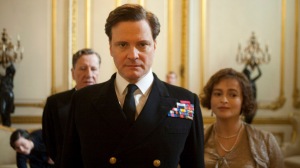 The King’s Speech is really the heartwarming story of the unlikely friendship between a king and a quirky Australian commoner. Their warm, humane friendship allows for several scenes of great humor and great drama. Watching the irreverent Lionel bounce off the proper and isolated Bertie supplies plenty of comedy. It’s essentially an odd couple comedy mixed with a true-life historical drama. There’s great pleasure in watching the chilly relationship between classes thaw, the men grow closer together, and Lionel’s unconventional tactics make progress. Each time Bertie discovers a new practice that removes his stutter, whether it is speaking while listening to music or speaking in the cadence of a song. This is a film that follows the English tradition of understatement even given the dramatic setting, principle characters, and a speech impediment. The characters don’t go around blurting their feelings, leaving the actors room to explore oodles of subtext. There’s a signature scene where Lionel coaxes Bertie into opening up by promising to allow him to paint a child’s model airplane (a treat for a man of title never allowed such toys). As he paints away, Bertie reveals a damaging truth about a neglectful childhood nanny. The truth is so painful that Bertie is forced to reveal it through the cadence of song, which somehow makes the revelation more sad and tragic. Their ongoing relationship is deeply satisfying and emotionally rewarding.
You won’t see a better-acted movie all year, thanks to Firth and Rush. More than following a checklist of gimmicks, Firth inhabits his character from the inside out. He feels like a living, breathing, somewhat broken person instead of a collection of ailments. Firth doesn’t overdo his stutter and treats the character, and the ailment, with a deep sense of compassion. Firth gives what is likely the greatest acting performance by any male in 2010. He is magnificent, commanding, and empathetic in every scene. Likewise, Rush doesn’t overpower as a personality foil. His character manages to be irreverent but without being flippant; he finds a reverent irreverence, if you will. Lionel is treating the future King of England, and the gravity of this stately relationship is not lost on him. Both men hide an inner melancholy, perhaps one of the things that ultimately bonds them together. Rush is flush with vigor and merriment, truly delightful to watch. This is his finest onscreen performance since he won his Oscar in 1996 for Shine.
The enormity of the king’s duties is given due care. You feel the weight of the crown that awaits Bertie and empathize with his quaking hesitation. Ever since childhood, his family looked down on Bertie. His father felt a stern tone would best aid the young stammerer, and his older brother would often belittle Bertie with cruel taunts. You see flashes of this unhealthy dynamic when Edward cuts down his little brother after their father passes.
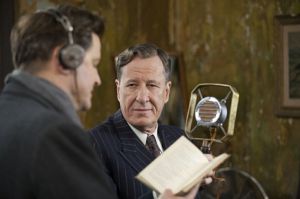 Bertie was seen as unimportant. Edward was the one set up for the throne. And yet Edward is the one who shirks his responsibilities in the name of love (a twice-divorced American woman). Edward refuses to become the leader of his people if the ancient rules forbid him from marrying a divorced woman. Bertie cannot buckle under the tremendous pressure and expectations that wait. Even when the rather passive Bertie lashes out, you feel like his anger is a moment of achievement. King George VI also had to deal with the fact that his brother is still alive and well and an alternative to the throne if Bertie is deemed incapable. Firth makes it easy to feel the remarkable pressure of being a leader not born or elected, merely expected. And even if an audience is clueless about British monarchy history and the rules of royal succession, The King’s Speech is easy to follow and comprehend for a daft American like myself.
Truth be told, The King’s Speech is a little stagy, a little square, and a little too fastidious for its own good. Hooper and crew are too content with making a pleasant moviegoing experience that the film lacks any slight form of edge. It’s all just a little too safe, a little too staid. While rated R, this movie could easily be a PG-13 family film, maybe even a PG one, sans the two sequences where Bertie unleashes a torrent of profanities in frustration (he discovers that he does not stutter while swearing). I feel like a curmudgeon for dinging a movie for being, essentially, too nice and gentle, but it clips the ambition of the movie when crowd-pleaser is the zenith of accomplishment. The fateful speech to the nation, on the eve of war with Germany, is even given an extra oomph thanks to the background music of Beethoven. A larger story of triumph seems reduced to the Oscar favorite storyline of Man Overcoming Physical Adversity. The direction by Hooper has some curious tics to it, like sequences of two people talking where they will never share the frame despite sitting side by side. I assume Hooper is trying to communicate some form of emotional distance or wariness, or perhaps it’s just a nod that different actors had unworkable schedules and could not be filmed together. Hooper is a talented director, as anyone who saw the massive undertaking of the masterful HBO miniseries John Adams can attest. However, like John Adams, Hooper is prone to TV-movie staging. His direction limits the cinematic power of the film. It looks like any ordinary episode of Masterpiece Theater.
The King’s Speech is pretty much everything you’d wish for in a movie groomed for awards consideration. This is prime Oscar bait. You may tear up at points, you’ll probably smile in many places, and your spirit will definitely rise. Plus it features some of the finest acting you’ll witness all year. And yet it’s that conscious need to please, to uplift, that can occasionally distract you from the many charms that The King’s Speech offers. The fact that the story is predictable is not a detriment, but the fact that the film doesn’t push harder, dig deeper, or expect more from its audience is a missed opportunity. The material is so rich, but a terrifically acted, smartly written film isn’t a bad consolation. Especially when that film happens to be one of the most rousing and rewarding theatrical experiences of the year.
Nate’s Grade: A-
Share this:

Inglourious Basterds (2009)
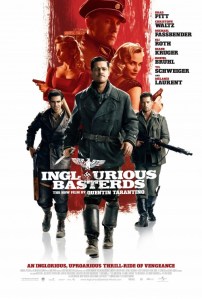 Quentin Tarantino has always been an artist that thumbs his nose at convention. Just as critics accused his last film, Death Proof, as wallowing in exploitation muck, here comes Inglourious Basterds, very loosely based on the correctly spelled 1978 Italian movie. War movies seem like a natural fit for the QT mold with their staunch violence, tough guy bravado, and vengeance-filled storylines. Tarantino has been working on the script for this film for over ten years, taking a break to produce the Kill Bill features. The finished product is a bloody alternative history wish-fulfillment fantasy with little conscience. This isn’t any sentimental, well-meaning, reflective war movie. This is war Tarantino-style and a celebration of war movies in general. Cinema becomes the weapon we win the war with.
In 1944, Lt. Aldo Raine (Brad Pitt) is given a unique mission. He is to assemble and lead a crew of Jewish-American soldiers for one purpose — to kill Nazis. They will be dropped into German-occupied France and will use guerilla tactics to dismember Nazis and strike fear into the higher ranks. Aldo personally assigns each soldier with the task of collecting 100 Nazi scalps. “And I want my scalps,” he commands. The “basterds,” as they’re called, face steep opposition. S.S. Colonel Hans Landa (Christoph Waltz) has earned the nickname “Jew hunter” for his terrifying precision at sniffing out Jews hiding along the French countryside. In the film?s terrific opening sequence, he systematically interrogates a French farmer into giving up the Jews he is hiding. Shoshanna (Melanie Laurent) is a Jewish teenager who manages to miraculously escape this bloodbath.
Years later, she owns and operates a movie theater in Paris. The German high command wants to screen their newest propaganda masterpiece, Nation’s Pride about the exploits of sniper Fredrick Zoller (Daniel Brühl), in Shoshanna’s theater. Finally she can plot her vengeance, except that Landa will be providing security for the special screening. Meanwhile, Aldo and the basterds scheme to meet up with German actress Bridget von Hammersmark (Diane Kruger), who is secretly working with the British as a spy for Operation Kino. The top-secret mission involves attending the movie premier at Shoshanna’s theater and then killing all the high-ranking brass in attendance, thus ending the war.
 Those looking for a rip-roaring good time of watching Pitt prance through the countryside dispatching evil Nazis will be disappointed to learn that Inglourious Basterds is, after all, a Tarantino movie. That means there is talking. Lots of talking, but it’s great, glourious talking with deep undercurrents of menace. The movie boils down to about six set pieces and most of that time involves long, drawn out conversations where the tension percolates underneath the surface. The characters play a cat-and-mouse game of deception, and the conversation transforms into a slow fuse waiting to go off. The characters engage in an “I know, and you know I know” bout of play acting, going about their business as if all is calm, when each is waiting for the next move. Tarantino turns dialogue scenes into slow-burning combat, and eventually those lit fuses do finally go off and the scene will erupt in a great splash of violence. Then we are left to assess the situation and collect our bearings, much like the characters if they are fortunate enough to be alive. This is a talky war movie, and Tarantino does fall in love with his dialogue rhythms and allow his characters to overindulge and circle the same plot points more than is needed, like the sequence with von Hammersmark in the bar, but the naysayers looking for an action romp that complain nothing goes on are missing the point. A tremendous amount is going on, you just have to look beneath the surface, lie in wait, and luxuriate in the simmering tension that Tarantino plays like a pro.
Tarantino has an encyclopedic knowledge of film that allows him to blend and deconstruct genres, and Inglourious Basterds feels like an homage not to World War II but war movies in general, with a dash of spaghetti westerns. When the French farmer watches Landa drive up to his home, linked with the great Enrico Morricone’s score, you definitely feel like you’re in a western transported into mid-twentieth century Europe. The conversations feel like high-noon showdowns. Tarantino’s direction feels less stylized and idiosyncratic this time. He still plays around with time and back-story, even recruiting Samuel L. Jackson to be a God-like narrator, but Ingloruious Basterds is mostly a literal and linear pop deconstruction of war movies. When Tarantino deviates sharply from the known historical timeline, it feels within reason given the cracked mirror world he?s created. Tarantino can turn World War II into a campy Warner Brothers cartoon, replete with goofy over-the-top caricatures of Hitler and Goebbles. He can also takes digressions and hard right turns with his story, allowing characters to chew over the finer intricacies of German silent cinema. It’s bloody, messy, but boy is it entertaining as hell.
 Any conversation over Inglourious Basterds is inevitably going to gravitate to its fascinating central villain, Hans Landa. German actor Waltz plays the infamous “Jew Hunter” and he is astounding to watch; he enlivens every moment onscreen and won a Best Actor award at the Cannes Film Festival. Landa is an extremely intelligent and polite inquisitor. He comes across almost like a diabolical S.S. version of Colombo: he’s three steps ahead, feigns ignorance, circles his prey, and finally strikes after mentally tearing down the suspect. Waltz is practically giddy in some sequences, enthusiastic for such sick endeavors. He likes to screw with people and make them nervous. And yet, thanks to the wily brilliance and magnetism of Waltz, you develop a perverse appreciation for the man. Despite the horrors he is responsible for, you may actually find yourself liking Landa. He has moments of great cunning, like his deliberate reasons for switching to English with the French farmer or his off-the-cuff destruction of von Hammersmark’s alibi. When he suddenly and fluently launches into his fourth language, it is one of the film’s finest “oh crap” moments. This is a truly memorable character that dominates every scene, and Waltz gives an astounding star-making performance destined to be remembered when it comes time to draw Oscar nominees.
The rest of the actors do well but no one approaches the planet that Waltz resides on. Pitt seems to knowingly be shooting for parody with his performance. His accent is twangy and coats every word in a honeyed glaze; you almost expect him to wink at the camera after each line. He’s still amusing to behold in the rather few instances that Aldo graces the movie. Laurent (The Beat That My Heart Skipped) and Kruger (National Treasure) both have intriguing albeit underwritten roles, and both actresses give the best performances in the film after Waltz. Eli Roth (writer/director of Cabin Fever, one of my favorite movie indulgences) looks the part as the commanding “Bear Jew” with his lean physique and Louisville slugger, but I couldn’t tell what he was doing with his accent. Is he supposed to be from New York or Boston? In war movies, there was usually a colorful collection of characters but Inglourious Basterds doesn’t really do much to accentuate its second tier players. The only basterd that leaves an impression is Til Schweiger (Driven, Far Cry), all humorless resolve and flinty stares. And what happened to the basterds in the final act? Where did everybody go? Yes, that really is Mike Myers doing one of his Austin Powers-esque British impressions.
 What is truly surprising is that Basterds unflinchingly looks at all the ugly aspects of war. The movie doesn’t neatly categorize the villains and the heroes. Zoller is a German sniper that killed 300 Allied troops and yet he is portrayed as grounded and romantic, a film lover able to chip away at Shoshanna?s steely reserve. To the basterds, they refuse to see past the uniform and armband; there is no difference between a Nazi and a German soldier. They will mutilate both on principal. Tarantino also gives time to examining the collateral damage of war, watching innocents gunned down in the name of duty. Shoshanna’s plot for vengeance involves the horrific deaths of scads of people whose only sin may have been being German in Paris. Operation Kino is described by Landa as a “terrorist plot” and isn’t it, really? But then Aldo disputes that a “Nazi ain’t got no humanity” and that collaborators and bystanders are just as culpable. Aldo and his basterds march through France committing what could sensibly be described as war crimes, and these are the good guys! Even with all the camp and stylized violence, there may be moments where you want to cringe and ask yourself, “Am I supposed to be enjoying this??
There are those that bemoan that Tarantino is wasting away his remarkable talents on such low-rent enterprises. He is too caught up in genre filmmaking, they claim. He needs to go back to his earlier audacious works, like Reservoir Dogs and Pulp Fiction, films of startling intelligence and playfulness. He needs to stop making collages of movies and go back to making real movies, they cry. Ingloruious Basterds will not please these critics. This is a verbose deconstruction of war movies that runs over 150 minutes and mostly involves characters seated and chatting. It will clearly not be for everyone, especially those sold into thinking Basterds was going to be a more graphic version of The Dirty Dozen. This movie is more Cinema Paradiso than The Dirty Dozen. If Tarantino wants to keep making high-gloss genre goofs, that’s fine with me as long as the end results are as creative and entertaining as this movie. Who else is going to make a World War II fantasy with excellent use of David Bowie’s song “Cat People”? No one makes movies like Tarantino. I rest my case.
Nate’s Grade: A
Share this:

Waltz with Bashir (2008)
 A mix between animation, documentary, and war drama, this Israeli film is something uniquely different and remarkable. Filmmaker Ari Folman interviews fellow veteran servicemen from Israel’s 1982 invasion of Lebanon in hopes of jogging his memory. He has blocked out the painful memories of war but his mind is reawakened as he reexamines the truth about the conflict and eventual massacre of Lebanese Arabs. Folman utilizes a rotoscope style of animation, which gives it a heightened reality and an intoxicating painterly beauty. He also takes advantage of the fact that atrocities can be easier to stomach when presented through the barrier of tasteful animation. However, it will be hard to keep from being affected (a scene of dying horses got to me bad). The realms of reality, fantasy, nightmare, and memory can crash together in fascinating ways, and eventually the movie transforms outright into a full-fledged documentary that melts away any last obstacle of empathy, ending with real disturbing footage of the massacre’s aftermath. Waltz with Bashir does not come with an agenda in tow, which allows the movie to explore the ambiguities of being young, nationalistic, confused, and armed in a hostile land. Folman is trying to peel away at the unbiased truth of the matter and cleanse his curiosity and, perhaps, his conscience. His filmic journey to that elusive and painful truth is a movie that crosses cultures and redefines what a documentary can be.
Nate’s Grade: A
Share this:

War Inc. (2008)
 What is the point of this movie? I think I get it, at least get what they were going for. The military industrial complex is bad and can mislead countries into needless conflict just for corporate profits at the expense of human life. Sure, got that, then what the hell is with the storyline of a Eurasian popstar (Hilary Duff) who has daddy issues? War Inc. is a farce but it doesn’t have much of string to connect it all. It’s all so scattershot, from lampooning politicians and corporations to squeezing in contrived romance and peculiar and almost nonsensical flashbacks with a fast-talking Ben Kingsley who sounds like he’s doing an impression of Foghorn Leghorn. This movie feels like a collection of discarded scenes that someone pasted together. The movie’s cynicism is almost repellent, and this is coming from a self-described cynic. It isn’t the cynicism that bothers me but it’s the lack of any bigger point. The satiric targets are all cheap and easy, which would be acceptable if the movie did more with the material. War Inc. is remarkably tone deaf when it comes to satire. The Duff sequences are superfluous and are begging to be scandalous, which then undercuts the movie’s potshots about exploiting teenagers for sex. The movie just utterly collapses from the inside out by the end. The most memorable and headline-grabbing moment of War Inc. is when Duff drops a scorpion down her shorts. Does that sound like an enviable creative highpoint?
Nate’s Grade: C-
Share this:

Tunnel Rats (2009)
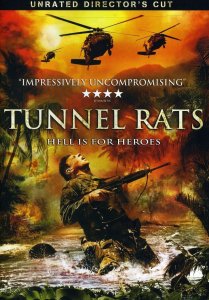 Uwe Boll does a Vietnam War film? It certainly sounds like a recipe for profound disaster. In 1968, as the intrusive prefix to the title tells us, the U.S. military had a unit of soldiers with the special mission to discover and infiltrate the miles-long underground tunnels by the Viet Cong. These “tunnel rats” were tasked with clearing out these deadly and cavernous mazes, where the Viet Cong ate, slept, and even walled up their dead within. Sergeant Vic Hollowborn (Michael Pare, who else?) heads the unit and has to shape up the new recruits into formidable fighters. Hollowborn lectures his young men on the dangers of “Charlie” and even orders them to execute an enemy prisoner. “Charlie’s gonna kill you just for being here,” he warns. “He doesn’t care if you’re a nice guy.” This nugget of wisdom is proven true over the 90-minutes of the film. The Tunnel Rats unit finds a new tunnel and this discovery eventually leads to the camp being decimated over the course of one hellish night in Vietnam.
When the action goes underground is when the movie gets, remarkably, pretty good. The labyrinthine tunnels dug out by the Viet Cong is an incredibly interesting subject that no Vietnam film has yet to cover with any substantial attention. Did you know that the Viet Cong could smell the smoke or aftershave of a man in those tunnels? They can even tell the brand of cigarette supposedly. Boll’s movie fails to take full advantage of its intriguing wartime setting. I wanted to know more about the particulars of the duties entrusted to the Tunnel Rats, a real unit of the armed forces with a high mortality rate. I wanted to know about the incredible construction of these tunnels and the dangers they posed to the U.S. armed forces. I wanted to know about the day-to-day lives of men who specialize in the tunnels, and I really wanted to learn about the unique minutia of hand-to-hand combat within such confined space. Fighting for your life in such limited space, now that’s interesting stuff.
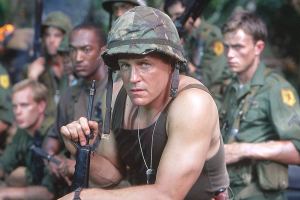 While Boll’s war movie fails to explore the tunnel setting in detail, Tunnel Rats has its fair share of quality suspense, mostly thanks to the claustrophobic quarters. It’s hard to make such limited space exciting for so long, but Boll manages to crank up the tension by pressing in on his actors. Watching the soldiers crawl on their hands and knees, possibly for miles, never knowing what trap might be in wait, well it makes for some intense feeling of dread. There are two standout scenes involved in the tunnels. The first involves a soldier that discovers a tautly wound tripwire leading to a grenade. Boll carefully follows the soldier steadily try to diffuse the booby trap and it almost reaches a nerve-wracking sense of unease. The second standout scene involves a solider that killed a Viet Cong member in the tunnel. The U.S. soldier has to use a simple knife to pulverize the corpse of the Viet Cong member just so he has enough room to pass by inside the tunnel. The scene is shot in tight close-ups as we watch the sickening repetitive motions of the soldier doing his best and bloodiest work just to move on by. It’s harrowing and empathetic. The above ground stuff has all the requisite chaotic explosions and soldiers being gunned down, but it’s the action underground that is surprisingly steady and consistently well designed.
The cinematography by Boll regular Mathias Neumann is a great strength. It takes a page out of Janusz Kaminski’s playbook, Spielberg’s long-time cinematographer, by layering in streams of milky light. The colors are muted and the camerawork is mostly handheld. Sure the visual aesthetic is a tad derivative (it made me wonder if Boll rented Tigerland before filming) but it’s a fairly good copy. The South African location shoot makes for a pleasing facsimile of Vietnam. Neumann also finds new and interesting ways to film the tunnels so that the setting doesn’t lose any of its unsettling power. Watching soldiers crawl along the inky blackness with but a flimsy flashlight provides for some spooky imagery that doesn’t even have to resort to cheap scare tactics. However, there are far too many spinning low-angle shots that do little more than stare at the tree canopies above. It’s like the cameraman is in the constant process of nearly passing out.
 The war as hell metaphor is familiar and potent, but Tunnel Rats lacks a deeper message. The film wallows in war clichés, particularly in its opening 20 minutes. The bland stock soldiers are interchangeable. They wax philosophically about the nature of God and war, talk about their hopes and dreams back home, and recount stories about laying under the stars and enjoying mom’s home cookin’. They bond, they share pictures of their respective sweethearts, and then they naturally meet a grisly end. One newbie even asks, in all seriousness, “You ever get scared out there?” The dialogue is pretty lousy and rife with clichés. The movie isn’t too subtle with some of its metaphors either, like when a Viet Cong woman literally tries washing the blood off her hands after executing a U.S. soldier. While the film is clearly told from the perspective of American soldiers, and the Viet Cong are antagonists, Boll takes time to show fairness to the enemy. One female warrior (Jane Le) fights to protect her young children. Another Viet Cong soldier fights to avenge the honor of a woman who was raped by American troops. The only message that appears to emerge from the movie occurs in the final minutes, when Boll seems to cram in a heavy-handed attempt at moralizing, a “we’re in this together, folks” kind of message that involves nearly four minutes of uninterrupted digging. But then Boll subverts that message and kills it, ending the film with the same sense of hopelessness. Tunnel Rats doesn’t bother to explore human insights and the nature of war and feels decidedly minor, following one all-out skirmish on one day of the Vietnam War. I wish Boll realized the potential his narrative had, which is not something you’ll likely often see me write. Tunnel Rats seems to be too content to be an effective horror movie dressed up as a war flick.
What is it about war movies that seem to excuse exploitation? It seems that a filmmaker can showcase tremendous gore and horrific bloody violence when they can cloak the material under the illusion of being true to life. Somehow filmmakers believe that wallowing in blood and guts is honoring the valor of those who served. This can be true, like the opening onslaught of Saving Private Ryan. But this can also be rubbish. War films can be just as exploitative as any other genre of film. Tunnel Rats has just as gruesome violence as Boll’s other horror movies, but because it has a war setting does not automatically give the violence and gore more integrity or meaning.
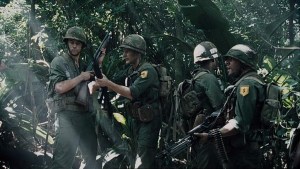 Tunnel Rats is a resounding achievement for the talents of Uwe Boll. It cannot even be passive-aggressively complimented as being “competent.” No, this is actually a halfway good movie that has some unsettling moments amid the suspense and chaos. The underground tunnel sequences manage to find an eerie intensity and are the best part about the movie. Thankfully Boll seems to realize this, which is why a majority of the movie alternates between various soldiers finding their way amongst the underground maze. The acting is actually some of the strongest yet in a Boll movie. Tunnel Rats would have greatly benefited from more attention being spent on the details of the life of a tunnel rat (it seems like a suicide mission). The movie never really feels fully realistic but at the same time it eschews being campy. It’s not as nearly as serious and artistically daring as the pinnacle Vietnam War flicks, but then again the movie is also better than plenty of other recent war films that have the tendency to either be jingoistic or fetishize the brutality of war.
In a twist of fate, Boll is actually developing a first-person shooter video game based upon his Tunnel Rats movie. The man who takes video game properties and makes crummy movies out of them has now made a decent-to-somewhat-good movie and developed a video game from it. Now it’s only a matter of time before Boll adapts the game into another crummy movie.
Nate’s Grade: B-


 nathanzoebl
You must be logged in to post a comment.