Blog Archives
The Fighter (2010)
 Somewhere along the line, the boxing film became the perfect metaphor for the underdog story. Two men at battle with only their fists and iron wills. Somehow this match up has come to symbolize man’s eternal struggle against himself and society. From Body and Soul to Rocky and Raging Bull, it’s hard to imagine the filmic landscape without the tropes of boxing. It’s also a pretty staid and tired genre, where filmmakers often rely on those tropes to fill in the gaps for lazy storytelling. The Fighter is a true story that star Mark Wahlberg has been nursing for years trying to get it off the ground. It’s the knockout acting and attention to character that separates The Fighter from the competition. Rarely has such a sedate formula felt so freshly presented.
In the mid 1990s, Mickey Ward (Wahlberg) is a man trying to come to grips with his life. His welterweight boxing career has stalled thanks primarily to his trainer, his unreliable half-brother Dicky Eklund (Christian Bale). Big brother used to be the pride of Lowell, Massachusetts, once fighting Sugar Ray Leonard and boasting about knocking the giant down (this claim is in dispute as replays show that Leonard may have simply tripped). Dicky’s boxing career went away about the same time that Dicky became addicted to crack cocaine, spending long hours inside Lowell’s many crack houses. An HBO documentary crew is following around Dicky, which he mistakenly believes is a ticket to his comeback. Mickey’s mother, Alice (Melissa Leo), also serves as manager to both her boys. Dicky is clearly the apple of her eye and Alice enables his destructive behavior. Mickey is pushed into fights to feed his extended family (eight siblings), and the thrill is gone. Then one day he’s approached by a promoter who will give Mickey one more chance. The only catch is that Mickey has to cut his family loose.
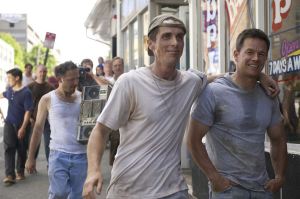 Truth be told, The Fighter isn’t really much of a boxing movie. Sure that’s the selling point and it allows for a rousing, crowd-pleasing finish, but Mickey could just as easily be striving to open a deli or striving to go back to school. The real story is the family. The boxing is only a backdrop, and if it weren’t for the true-story basis I would say it serves as little more than a metaphor for the punishment Mickey has taken in life. The Fighter is about a man working up the courage not to step into the boxing ring but to break away from his self-destructive family weighing him down in misery. This is a dysfunctional family drama disguised as a Rocky-style boxing redemption picture. The boxing aspects are small, mostly contained to the final act as Mickey’s career finally begins to gain some traction. For some, this will be disappointing news. But for me, I loved the family drama stuff. This is a fractured family with deep lines of division, nursing grudges, resentment waiting to boil over, all the marks of meaty drama. The focus is on Mickey trying to break away from the pull of his harmful older half-brother and his boorish mother. His mother enables Dicky, her favorite child, to the detriment of the rest of her brood. Her relationship with Dicky is fascinating and complicated, like a mother sacrificing the rest of her clan to help her most damaged child. You can catch some of the invisible ripples from these decisions, like the seven sisters all forming one unified hive-mind to survive. They’re like a block of cheerleaders for mother, only able to get attention and some form of affection by doing so. The extensive family unit revolves around Leo’s matriarch, fiercely protective and fiercely myopic. She refuses to remove herself from Mickey’s management team, and thus Mickey and his career suffer. It’s downright Oedipal. If only he can escape the clutches of his family, perhaps Mickey can taste success that has eluded him so long. The family drama makes up a good majority of The Fighter, and that’s just fine with me when I get characters this damaged and complicated.
And all of this is blissfully entertaining. Director David O. Russell is miles away from his other films like Three Kings and I Heart Huckabees. This is different kind of redemption story where the main guy winning a title is nice, and we can all celebrate, but it’s really his separation from a harsh family dragging him down. The film also produces an engaging romance for Mickey, which gives him a renewed sense of purpose to finally break free of his family. Amy Adams (Enchanted, Doubt) is a bartender at a local hangout with some college under her belt, a point that irritates Mickey’s family. The Eklund sisters lash out at Mickey’s squeeze in childish ways. Adams, playing Charlene, shies away from the daffy or genteel roles of her past. She gets to spit profanities with glee. Her relationship with Mickey serves as a foil to his family, showing what strength a positive, healthy relationship can achieve. But while the family is presented in an antagonistic sense, they are not blithely demonized. Russell and his team of writers and actors use humor to find surprising pockets of warmth amidst all the darkness and shattered dreams. This isn’t an addiction story that plumbs the depths of human weakness. The production feels bathed in authenticity and the city of Lowell, Massachusetts and its lived-in, blue-collar culture feels like another vital character. When the HBO documentary finally airs, you feel the cloud of hurt that covers the entire town in shame. Nobody wants to be known as a town famous for crack addiction (you can watch the 1995 doc online for free).
 The acting is also some of the best you’ll see all year. Wahlberg is a sturdy center, used to the abuse and underplaying his character’s transformation from punching bag to assertive human being. This is Wahlberg’s home turf, and he’s been shopping the story for years in Hollywood, so it’s no surprise that everything comes so natural for the Beantown kid. But his understated work is going to get obscured with the flamboyant performances from both Bale and Leo. Bale (The Dark Knight, Rescue Dawn) has long been considered one of the finest actors of his generation, his Method devotion and versatility a godsend. In The Fighter, he’s a live wire, a bundle of energy in a haunting skeletal frame. He’s a figure of lost promise, of tragedy and bruised ego, trying to live vicariously through his younger brother. He’s deluded himself into thinking that this HBO documentary will launch a comeback at 40. Bale excels with the bombastic bits, practically bouncing off the walls, but then he nails the quieter, smaller moments of his character, where Dicky realizes that he’s wasted his gifts. Leo (Frozen River) could easily fall into an outsized monster of large hair and nicotine-stained fingers, but the Oscar-nominated actress finds exciting ways to tap into her character’s humanity. She fully knows that her beloved child is a crack addict, but watching her rationalize and justify her actions is exciting.
The Fighter is a meaty family drama, stirring tale of redemption, and a showcase of superior acting. In an awards season where it feels like many films are missing some secret ingredient, The Fighter has it all together. It’s an underdog story of a different flavor that manages to be authentic, entertaining, charitable, and engrossing even while staying within the boundaries of a predictable framework. We all know that Mickey will triumph in the ring; otherwise his tale would never have caught the notice of Hollywood producers. This is a fresh take on old material. The focus is on the fractured family dynamic and the many characters, not on a simplistic rising through the rankings of sport. It’s because of the tremendous acting and character work that the first half of the film easily outshines the second. Once the family is sidelined, and Mickey’s boxing career takes off, The Fighter turns into a more conventional genre picture, though still engaging. The movie ends on a satisfying note of uplift that feels fully earned without a twinge of naiveté. This Oscar season, expect audiences and voters alike to find something to cheer about in this return to the ring.
Nate’s Grade: A-
Share this:

The Social Network (2010)
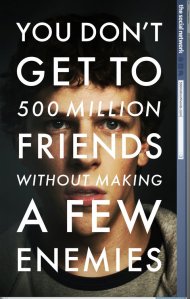 Dismissively branded as “the Facebook movie,” the whip smart and hypnotic, yet poorly titled, The Social Network is much more than a rote TV-movie on the start of a popular website (coming out next year: Twitter: The Musical in 144 Characters). Yes, the film chronicles the people responsible for the Internet’s most ubiquitous time waster and their very varying accounts of who was responsible and who was unscrupulous. But the backdrop could be just as much any start-up business. Truth be told, the “Facebook movie” bares a striking resemblance to Citizen Kane. It is the story of one man who may be a genius in some regards but can?t help but push everybody he cares about away. It’s about powerful men who don’t know what to do with power. It’s about ambitious men who dedicate their lives to that ambition. It’s not about terabytes and html coding, this is a movie about people, betrayal, ego, greed, jealousy, and the great irony that Mark Zuckerberg created the world’s most dominant social network and yet he himself cannot hold onto a single legitimate friend.
In 2003, Zuckerberg (Jesse Eisenberg) is a Harvard student obsessed with getting into the prestigious clubs and fraternities on campus. But he’s not well connected or athletic or close to being rich. So after being dumped on night, he goes home and hacks into various Harvard sorority websites and steals pictures of coeds. He then creates the crude website Facemash (while also drunk, mind you) where Harvard undergrads rank their fellow classmates side-by-side two at a time. It’s an immediate hit and crashes the Harvard server. Zuckerberg is then approached by Cameron and Tyler Winklevoss (Armie Hammer and Josh Pence), handsome blue-blooded WASP twins who have an idea. They want to create their own social website just for Harvard students to communicate with each other. They are impressed with Zuckerberg’s tech skills and want to hire him to build the site. Zuckerberg takes the idea to his roommate and best friend Eduardo Saverin (Andrew Garfield), proposing to make their own site with Saverin’s limited means.
From there is where the different parties diverge on their versions of truth. Zuckerberg secretly works on his own side project while stalling and dodging the Winklevoss twins. He offers to have Saverin be CFO of the company and split the stakes. Then as success mounts, the Facebook website gets the attention of Sean Parker (Justin Timberlake), notorious for co-founding Napster at age 19. Parker immediately has the ear of Zuckerberg, and it isn’t long before Saverin starts feeling on the outskirts of his own company, and then eventually shut out completely. The Winklevoss twins and Saverin each file multi-million dollar lawsuits accusing Zuckerberg of intellectual theft and underhanded business tactics.
 Watching The Social Network feels like you?re downloading an entire semester?s worth of information directly to your brain. Adapted by uber wordsmith Aaron Sorkin (TV’s West Wing, Charlie Wilson’s War), this is a story that gallops at full speed and leaves you spinning. The dialogue flies by so blazingly quick that it?s easy to get left behind. I would not advise eating any concession snack with this movie or else you might miss reams of dialogue. Sorkin smartly weaves together a murky and litigious tale of alternate truths, showing different sides when it comes to the creation of Facebook. Was it really stealing or did the Winklevoss twins merely inspire Zuckerberg? Is he truly indebted to them? “Does a guy who makes a chair have to pay a fee to every person who ever made a chair before in history,” Zuckerberg snaps. How deep did Saverin?s involvement go, and was he naïve or just thinking too small in scope? How much is a friendship worth in dollars and cents? Sorkin gives a definite impression to these answers, and it should surprise nobody that Saverin comes across as angelic and the obviously wronged party here. But the script as a whole is meticulous with detail, characters, and dates. It almost feels like the content of a miniseries has been squeezed into a brisk two-hour time frame. The characters are just as layered as the plot. The opening scene where Mark is dumped by his girlfriend (Rooney Mara, soon to be Lisbeth Salander in Fincher’s remake of The Girl with the Dragon Tattoo) sets the tone of the movie. The dialogue feels like an assault and it is unrelenting. You openly wonder how Eisenberg can breathe reciting his verbose lines with such lightning speed. Mara is aghast at her hyper-literate yet bitter boyfriend spewing bile at the elite and yet unashamedly pining for that life. He’s brilliant and cutting but socially awkward and unable to understand the feelings he’s hurting. Mara has had enough and dumps him right there, spurring Zuckerberg into a drunken night of revenge that will set the stage for Facebook. Sorkin can pretty much start clearing shelf space for his Best Adapted Screenplay Oscar right now.
Many will find Zuckerberg to be unlikable from the get-go, but I never could bring myself to actively dislike or loathe the man. He’s really more of a figure of Greek tragedy. Zuckerberg is a blissful conundrum of a character, a walking contradiction. He can be sullen and wounded one minute and the next casually cruel. He seethes at deposition hearings; unable to control the contempt he has for others. Zuckerberg’s anger boils over, and his beady-eyed glares communicate an incredulous, “You are worlds below me.” He can?t stand people who have easy breaks, the select and privileged, and yet he nakedly longs to be apart of that group and meet their approval. He can be childish and narcissistic, insular and insecure, and then he can be charitable. Zuckerberg created a music application that Microsoft was willing to purchase. “Why didn’t you sell?” asks one of the Winklevoss twins. Zuckerberg just shrugs his shoulders. He doesn’t want to sell ad space on Facebook and get rich quick because it would ruin the site experience. He is a champion of the democracy of the World Wide Web; a modern-day Thomas Paine? Probably not, but Zuckerberg’s hard-driven ambition and crooked tactics make him a modern-day robber baron, a titan of industry. Rockefeller and Carnegie and J.P. Morgan are all men that don’t seem any different in practice than Zuckerberg, though they probably had more family money as a starting point. That’s not an excuse for Zuckerberg’s behavior, but I want to add some perspective before the world tars and feathers the guy. Zuckerberg is the Internet’s first self-made billionaire, but what are the costs? By sacrificing all, and burning personal relationships, Zuckerberg may have advanced Facebook to unparalleled heights. But whom does he get to share his success with? It’s a little simplistic to boil such a complex film to the greeting card-esque moral “It’s people that matter most?” but the film always circles back to the question of cost. It’s also rather simplistic to chalk up the creation of Facebook as a means of impressing a girl, but then operas have been written, art has been sculpted, and wars have been fought over the need to impress a woman. Zuckerberg is a fascinating creature and brilliantly played by Eisenberg. This is a character Ayn Rand would love.
 It seems that Zuckerberg’s instincts about human obsession with being apart of something exclusive were right on the mark. What separated Zuckerberg’s site from the likes of MySpace and Friendster is that you needed a college-based web address to get inside. It was a closed community, which made it cool and desirable. It started as a restricted club that all the cool kids wanted to belong to, then everyone joined, and now it’s damn near impossible to resist. First it was college kids, then college kids from other countries, then high school kids, then adults, now everybody on the planet has a Facebook page making sure the world doesn’t miss a single detail about their personal lives. I resisted as long as I could but broke down and got a Facebook account earlier this year. The Social Network is not concerned with the business angle of success unless it related directly to how it impacts the characters. You’re not going to find many insights into why Facebook took off or became entrenched in our navel-gazing society, which is a pity. The film also doesn’t concern itself with outright social commentary. Sure by exploring the micro personal struggles and betrayals of Mark and Eduardo the film marginally comments on the macro idea of generational self-absorption and ego, but so much more could be said about society as a whole. The film’s one clear moment of social satire is when Eduardo’s girlfriend berates him about his Facebook relationship status remaining single. She’s incensed and wants to know what he truly means by this outrageous declaration. He says he’s embarrassed but he doesn’t know how to change it, plus he’s hardly ever on the site. She responds to this by setting his gift on fire. Ah, petulant and jealous and self-absorbed concerning what a few scraps of digital bits say rather than direct, personal, face-to-face communication. It’s a brief, albeit nice slam on the myopic self-absorption of millennials, who came out of the womb with something electronic attached to their fingertips. The film doesn’t even touch the idea of millennials’ free sense of privacy and over sharing. This is not a generation -defining movie, folks.
This is all strange ground for director David Fincher (Seven, Zodiac), a visual stylist with few peers. Nerds creating a website doesn’t exactly strike anybody as fertile ground for a visually exciting drama, and yet Fincher proves once again that he is a masterful artist. The film looks beautifully sleek from beginning to end with Fincher’s typical green tinted, deep focus cinematography. Fincher also makes the best use of special effects I’ve seen this year. The Winklevoss twins were not played by actual twins. Hammer had his face digitally placed onto a stand-in’s (Pence) body. The digital cut-and-paste was remarkable in Fincher’s Benjamin Button but it also called attention to itself. Nobody would walk in believing Brad Pitt’s face somehow was on the body of a three-foot tall old man. However, in The Social Network, you would never once doubt that there are two twin actors on screen the whole time. Hammer manages to make each twin distinct and frustrated without coming across as jerky or entitled. The rest of the actors do fantastic work as well, and special notice to Timberlake who plays his mercurial role with glee.
 So what does the real Mark Zuckerberg think about all this attention? Well, in a surprise to people who do not have a firm understanding of the word, Facebook has declined all advertising for The Social Network and is staying mum on the film, hoping to ride out the critical storm. I don’t think anyone is going to be using Facebook less now that they have learned the ethically murky beginnings of the website. But Zuckerberg and his Facebook crew might want to think of formulating some response strategy because this movie, and talk of this movie, isn’t going away any time soon (Zuckerberg recently donated $100 million to Newark city schools on Oprah coincidentally the same week Social Network was opening). It’s rare to find a studio film that is as polished across the bard as this film. The writing is sharp, the direction is sleek, the acting is top-notch, the film rollicks with intrigue and suspense and juicy drama, and the film can’t help but be relevant in our modern society. You do not have to know a lick about coding and websites and whatever to get absorbed in this high-stakes drama. It may not be the generation defining experience some critics are wetting themselves over in hype, but The Social Network is easily one of the best films of 2010. Perhaps the Academy will give it the ultimate “friend request” come this winter. In the meantime, log off and get yourself into a theater to see this great American movie.
Nate’s Grade: A
Share this:

The Men Who Stare at Goats (2009)
 This movie was a big letdown given the cast, the strange true origins of this fantastic tale, and even with the title. This odd little film feels tonally off. The material feels mishandled, mixing broad humor and with military satire and the dark realities of the war in Iraq. The premise is solid — a Pentagon program training psychic soldiers, men convinced they could run through walls or terminate goats through the power of thought. Why then does the movie feel so misguided and rudderless and, ultimately, boring? Never has such an outlandish concept, based on true events, felt so devoid of edge. The satire picks safe targets and the comedy remains farcically broad. I think the film’s downfall can ultimately be traced to the decision to turn this material into a fictional narrative. I would have preferred an actual documentary detailing the men, women, and goats involved in the real Pentagon program. If truth can be stranger than fiction, why dress it up and then dull it through fiction?
Nate’s Grade: C
Share this:

The Informant! (2009)
 Stephen Soderbergh’s comic farce is highly amusing from start to finish. I even watched it twice and still found myself shaking my head and chuckling in bafflement. That’s the best way to describe the tone of the film — baffled laughter. Matt Damon stars as Mark Whitaker, a corporate whistleblower whose grasp on the truth is tenuous at best. Damon’s character is a cut-up and his delusions of being a spy plus his scatter-brained narration are as fascinating as they are hilarious. This guy thinks he’s James Bond. And yet the film, while deeply comic, never comes across as snide or condescending even if most of the laughs come from Whitaker’s disconnect from reality. The film has a deliberately ironic tongue-in-cheek vibe, from the silly yet undeniably jaunty kazoo-aided score by Marvin Hamlisch to even the amber-colored cinematography (like the film was shot through the prism of a honey jar), the movie is an entertaining series of blunders and revelations. Damon is charismatic and deeply funny and Whitaker makes for such an interesting main character exactly because he is so unpredictable and unreliable. He doles out the truth in pieces like a kid caught. The Informant! is light and breezy but with some well-honed psychology of rationalization and self-deception. I don’t know how true this supposed true-life tale really is, but it’s a hell of a fun tale.
Nate’s Grade: B+
Share this:

The Blind Side (2009)
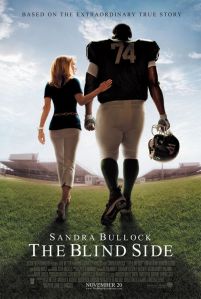 Based on a true story, The Blind Side tells the true-ish story of Michael Oher (Quinton Aaron) who was a lost, homeless black youth in Tennessee. He was adopted s a teenager by the Tuohy clan, a rich White family led by no-nonsense matriarch Leigh Anne (Sandra Bullock). Her husband (Tim McGraw) is a restaurant franchise owner, so they don’t have to worry about money or food budgets for Michael’s large appetite. The gentle giant is grateful but wary. He’s admitted into a private school because of his football potential, but at first they envision the hulking teenager on defense. Leigh Anne is the one who sees his protective instincts and assists in the switch to offensive tackle, whose job is to protect the quarterback’s blind side. With Leigh Anne’s steady influence and a stable home environment, Michael begins to feel like he has a loving family. Eventually Michael Oher becomes an All-American player in college and was drafted by the Baltimore Ravens in the first round of the 2009 NFL Draft.
The Blind Side might just sneak up and, forgive me, blindside you. Well, that?s not accurate, because this movie will not sneak up on anyone. There is not a single moment of surprise to be had. Michael Oher is portrayed as a gentle giant who is very tight-lipped. Much of his performance is in body movement and those dark, sad eyes of his, which means that the audience has to intuit a lot from the character. That might be why the most affecting moments come from Oher’s stunned, grateful reactions. It’s hard not to be affected by such an outpouring of earnestness. Stay during the end credits, watching the photos of the real family at the 2009 NFL Draft and try not to feel a smidge of their happiness.
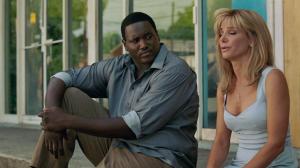 Bullock seems like a natural fit for this character and this material, and she does give the Southern spitfire life. She’s the heart of the movie and pretty much the driving force for the film, so it helps that Bullock taps her natural charms to make the character feel less like a cartoon and more like some approximation of a person. She’s formidable and brassy and pretty much gets her way on everything. The movie has the faulty belief that Leigh Anne saying anything folksy is funny, which is not the case. However, Bullock makes the character likeable and embraceable, and plus, she doesn’t fall down once. It must be a first for a Sandra Bullock movie.
Every scene is played into a moment of uplift and eventual triumph, which can be tiring but also has a respectable batting average for success. Structurally, the movie doesn’t have any overarching sense of conflict, which seems bizarre given the circumstances of an insanely wealthy white family adopting a troubled black youth in Tennessee. You might think Michael would take some adjusting, or that the students of privilege might not fully accept someone so different, or that the Tuohy children might need more convincing to suddenly add a new member. There are a few raised eyebrows and some slight hesitation, but the characters just barrel forward like what they are doing is common. The family is just resoundingly good-hearted and full of such moral clarity, though the husband seems to be content to be a powerless pawn to his vociferous wife. There is no real internal conflict within this family despite the burdens they tackle, and even worse the movie doesn’t really show any change occurring. At a lunch with her rich girlfriends, Leigh Anne remarks that Michael is changing her life. How? She seems like the same kindly woman from the beginning. Instead, the movie is packed with tiny little conflicts that get easily resolved and then move along. Will Michael feel at home? He does. Will he get his grades up? He does. Will he figure out the game of football? He does. Will he play well in a game? He does. Will he graduate? He does. Will he get a scholarship? He does. Will he reject the lifestyle of crime? He does.
Big Mike is sidelined in his own story by the firecracker of a character that is Leigh Anne. The saintly Tuohy family is yet another example of Hollywood feeling the need to tell a compelling African-American story framed as the story of helpful, White characters. Why can’t he film’s emphasis be on Michael instead of Leigh Anne, especially since she remains the same good Christian woman from the start? It’s probably because Oher, as portrayed on film, doesn’t have much of a personality. He’s a nice if soft-spoken kid but he mostly just shuffles his feet. Off the football field, he is written merely to take up space. He serves as the ongoing results to Leigh Anne?s teaching experiments.
 If you peel away the movie’s sentiment, it does have some niggling, potentially troubling aspects to the story. It sings the praises of insanely rich Southern Christians and makes us say, “How nice and rich of them.” Leigh Anne is the kind of woman with enough mettle to venture into the ghetto and even stand up to taunting gang members. She even threatens to shoot one of them. Every one of these “ghetto” sequences feels transparently written by somebody whose only understanding of an urban environment is from movies and TV. I wasn’t expecting The Blind Side to be as accurate as The Wire, nor would I normally care about the inaccuracy, but when it’s in the service of comparison (the comfy world of rich White people vs. the hopeless existence of poor blacks) the portrayal becomes ham-handed and morally questionable. Just to rub it in how good Michael’s got it, the movie resorts to ending with a montage of newspaper reports detailing gang slayings in Oher’s old neighborhood, highlighting every character we saw onscreen. The movie says they had no choice to end up as criminals because they could not escape the nightmares of the ghetto. If only those unfortunate black youths could have found rich families to adopt them.
Perhaps the funniest moment for me, as an ardent college football fan (go Bucks!), was a montage of South Eastern Conference coaches trying to recruit Oher in 2005. He’s visited by the head coaches for South Carolina (since retired), Tennessee (since fired), Auburn (since fired), Arkansas (since fired, now coach of Ole Miss), Louisiana State (left for NFL, now coach of Alabama), Auburn (since fired), and Ole Miss (since fired). The turnaround in just a four-year period is astounding for a major college conference. The coaches look like they’re having fun in the movie, probably because they get to pretend to be coaches again.
The Blind Side is a straight-down-the-middle genre picture that plays every expected note, it?s manipulative and formulaic for a sports drama, but I’d be lying if it didn’t get to me from time to time. If you go into The Blind Side under the right frame of mind, which means essentially ignoring the flagrant manipulations, then this movie will work on its sentimental sports genre sensibilities.
Nate’s Grade: B-
Share this:

Public Enemies (2009)
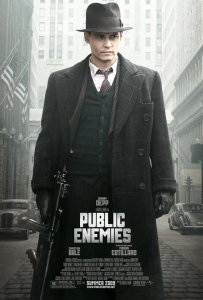 Considering the talent in front of and behind the camera, it’s hard not to describe Public Enemies as anything but a letdown. This Depression-era gangster film is heavy on period details and very tight-fisted when it comes to characterization. You’d think given 140 minutes and the natural charisma of Johnny Depp that an audience would come to some kind of understanding with notorious bank robber John Dillinger. Nope. The characters remain perfunctory the entire time, pushed into conflicts by a brisk pace that manages to squeeze in three bank robberies, two prison breaks, and many police shootouts. Because the movie barely takes time to breathe, the love story between Dillinger and Billie Frechette (Oscar-winner Marion Cotillard, a dead ringer for pop singer Katy Perry) is never credible, the tension never feels palpable, and director Michael Mann (Heat, Collateral) seems overly smitten with his distracting high def digital photography. You never really feel any sense of danger or interest. The characters on screen feel like strangers even after 140 minutes. Depp makes the movie more tolerable than it would be without his presence. Mann, one of three credited screenwriters, seems to assume the audience is well versed in Dillinger history and so he skips over plenty of fertile territory. Public Enemies certainly hums with plenty of polish but it comes across as mostly mundane due to such flimsy character work. It’s a collection of good scenes that fail to make up a satisfying whole.
Nate’s Grade: B-
Share this:

Changeling (2008)
 This is one crackerjack of a story. The true-life tale of a mother, Christine Collins (Angelina Jolie), who loses her son, only to have the LAPD give her a different boy is easily gripping. The pace is a bit elegiac but the movie never gets boring, partly because Christine is beset by a multitude of adversity by the corrupt members of the 1920s LAPD who want the case to go away. Changeling can seem to fall prey to outrage cinema, and the audience is clearly going to demand some justice after watching Christine undergo a torture chamber of abuse. And justice is what we get. The last 45 minutes of this movie is protracted courtroom sequences where the antagonists get stomped upon with righteous fury. It just keeps going on and on, as if to compensate for the massive grievances Christine endures. Writer J. Michael Stracynzski (Babylon 5) makes the drama stick close to the facts of the case, which is admirable but it also makes Changeling anchored to reality when there is nothing, repeat nothing, subtle in this movie. It’s hardcore melodrama all the way through, but I didn’t mind one bit. Jolie’s frantic performance suits the melodramatic material. She leaves it all on the floor, as they say in sports. Clint Eastwood doesn’t seem to be too enraptured by the material, routinely slipping into his understated direction that seems at odds with such a juicy story. Changeling feels like a tremendously fascinating story that isn’t necessarily presented in the best fashion. Still, this is fine stuff.
Nate’s Grade: B+
Share this:

Frost/Nixon (2008)
 The adaptation of the hit stage play, with its original leads, is an intellectually stimulating experience and a fluid adaptation from stage to screen, thanks to director Ron Howard. The acting is top-notch; Frank Langella may not readily resemble President Richard Nixon but he inhabits the man completely. In a surprising twist, Frost/Nixon is not a heavy-handed story that merely beats up on an antagonist that can no longer defend himself. Nixon’s faults are not excused but the man is presented in a deeply humanistic portrayal. This isn’t a mustache-twirling rogue but a man who came from abject poverty, who rose above his critics who dismissed his humble beginnings, and who has regret and shame for what transpired while he was in office. And he’s funny. Nixon is a funny man. Characters are not just political punching bags here. Peter Morgan’s screenplay, based upon his stage play, brings tremendous excitement to the art of debate, framing it like a boxing match. The sparring side notes present some of the more fascinating details between the series of four interviews between Nixon and British personality David Frost (Michael Sheen). But here’s the thing. Frost/Nixon is an entertaining movie but once it’s over it completely vanishes from your brain. It leaves little impact. The movie tries to make Frost’s coup a bigger deal than it was. The film is constantly trying to convince you of its importance. It’s a swell time for two hours but after that, what? Obviously the grilling of the president for getting away with crimes in office is supposed to be a statement on the outgoing President Bush, but what? Should we hope that an unassuming figure much like Frost will be able to get Bush to open up his soul? Get Regis Philbin on the phone.
Nate’s Grade: A-
Share this:

The Bank Job (2008)
 An intelligent and rather crackling heist movie that also happens to be based on a true story. The 1971 British bank heist has so many characters involved that you may need a helpful cheat sheet, especially when it comes to varied loyalties. There are three separate groups all playing their own game, and when the heist doesn’t go exactly according to plan, and then the movie gets even more complicated. It’s a flavorful and funny heist movie that also doesn’t ignore the severe repercussions and life-and-death stakes. The Bank Job is an engrossing crime caper that still manages to thrill and surprise an audience.
Nate’s Grade: B+
Share this:

21 (2008)
 Glitzy, breezy, and 100 percent predictable, 21 is a simple con movie that goes through the motions with hyper realism. The most interesting part of the film, by far, is learning the systems that help these coeds fleece Vegas for thousands of dollars. In fact, the true story is far more interesting than this typical tale about a good kid who gets a big ego, pushes his true friends away, is humbled, and then learns a lesson while getting the girl too. What’s a MIT engineer want to go to Harvard med school for? And for that matter, you’re telling me there are no scholarships out there to brainy MIT students? Whatever the case, 21 will pass the time nicely without damaging your brain. The card games are ramped up with zooming camerawork and flashy special effects by director Robert Luketic (Legally Blonde), but it’s all window dressing to an interesting story that was white washed into a bland but undeniably commercial movie. It’s a fine time but, like Vegas, will leave you empty in the end. Still, you could do worse than overly stylized con movies about math whiz card sharks.
Nate’s Grade: C+


 nathanzoebl
You must be logged in to post a comment.