Blog Archives
Mickey 17 (2025)
 Bong Joon Ho is one of those filmmakers that has earned the right to make any movie he wants. Hollywood might not feel the same, but the filmmaker behind Snowpiercer, The Host, and the triumphant Oscar-winning Parasite, the first time an international movie won Best Picture, is an amazingly versatile storyteller who seamlessly blends different genres and tones into unique and mesmerizing film experiences. If he’s interested in telling a story, then that guarantees I’m interested in watching it. This is especially true if he steps into the realm of science fiction. After the worldwide success of Parasite, Bong Joon Ho was given $100 million dollars and final cut from a big studio to make whatever he wanted, and he chose an adaptation of Edward Ashton’s novel, Mickey 7, telling the story of the world’s most/least fortunate expendable in a fledgling space colony. I read the book last year and it was quite good, so my anticipation was even higher for the feature film Mickey 17, especially after Warner Brothers delayed the movie an entire year. Now, after the long wait, we can all finally enjoy Bong Joon Ho with peak artistic freedom, a position that will likely not be repeated. It’s a grand movie with big ideas, vision, satire, and also enough underutilized ideas and distracting characters and performances to quibble over “what if’s.”
In the distant future, Earth is overrun in population and low on natural resources, so the next space race is to find habitable colony worlds. Mickey (Robert Pattinson) gets in over his head to shady loan sharks and looks for any possible way off of the planet. The only position he can sign up for is that of an expendable, a person who can be cloned from a biological printing machine. These expendables are put in dangerous jobs and different science tests because, well, if they die, you can start over. It’s a terrible job, one that involves dying repeatedly, and Mickey agrees to be the human crash test dummy. He’s on a multiyear colony ship traveling across space to find a habitable world. The planet they land on is bitterly cold, impossible to farm, and crawling with its own crawly wildlife. Mickey 17 is left for dead after falling down a chasm but he survives, trudges back home, only to discover another Mickey in his bed. They’ve assumed Mickey 17 died and already printed out his replacement. There’s a rule about there not being multiples and, if discovered, both expendables would be killed. They have to hide their secret and work together while still vying for dominance over one another and staying out of the crosshairs of buffoonish yet powerful political leaders Kenneth Marshall (Mark Ruffalo) and his wife, Yifa (Toni Collette).
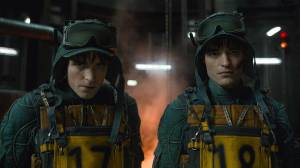 Mickey 17 is a smart, weird, and consistently fun and thoughtful movie. It doesn’t waste any time getting started, literally with Mickey 17 on the cusp of dying with his looming interaction with the aliens. Bong Joon Ho adapted the screenplay and has a nimble way of dealing with the conflicts and setting. I appreciated that he doesn’t prolong different storylines beyond their point of interest. He’s always got another development or joke or set piece to provide. There’s a fun sense of discovery with the movie as well as satisfaction to watch how he slides all the pieces into place. I appreciated how he imbues character notes so easily with supporting characters, giving this universe a larger personality that resonates. I love the setting and the reality it presents of a long-voyage space colony fighting for resources and struggling to keep the lights on. The sets and photography are gorgeous to behold but also filled with details to help make the world feel lived-in. I loved that even in the far-flung future, technology can still work in fits and starts, like watching Mickey slide out of the printer conveyor belt only to lurch backwards before going forward again, like the printers of the 1980s. I love the alien creature design that resembles an armadillo crossed with the subterranean worms from Tremors. I loved how they were able to defend their queen/mamma in Act Three. I love the goofy comic flourishes too, like the fact that there’s a guy just walking around in like a pigeon mascot costume that is never really explained. This is also the same movie where characters constantly ask Mickey what it’s like to die and you realize that every version of Mickey doesn’t know because he’s never experienced it personally, only born from the aftermath. The way this movie is capable of marrying big ideas with silly visual jokes and slapstick and explosions is impressive and a reminder that certain artists will prosper on big stages when given ultimate freedom. Come for the star power and slapstick, stay for the existential dread.
Pattinson presents another wildly weird performance that reminds me how exciting he is as an actor. He’s got these movie star good looks but he really wants to play all the weirdos he can with the most eclectic filmmakers, and I love it. His Mickey 17 and Mickey 18 may be constructed from the same DNA but they come across as vastly different iterations of our hero. This provides a more assertive version of Mickey to try and shape up our more passive Mickey into standing up for himself, taking chances, and taking charge when the situation calls for it. He’s like a mentor. Mickey 18 isn’t featured that often in the story, and truthfully he wasn’t featured that often in the book as well. It’s mostly the story of the hapless and whiny-voiced Mickey 17 and his journey of self. It’s a familiar yet enticing formula to watch a character gain agency and go from pushover to defender of the vulnerable. Pattinson finds little sparks to grab onto with the character, little pieces of weirdness that really help crystalize our understanding of Mickey. Of course the human lab rat would have the fight bred out of him through resignation, and it’s still gratifying to see him stay who he is while also rising to the challenge of the moment. In interviews, Pattinson has said that he modeled his two Mickey performances after the cartoon characters Ren and Stimpy. This actor is perfect for the wacky, tone-blending worlds of Bong Joon Ho. He’s game for everything.
 It’s not hard to see the entire enterprise as a crafty critique of capitalism, not exactly a new point in the Bong Joon Ho movie universe. Mickey’s value to his mission is the literal exploitation of his body. He’s callously tested upon for vaccines and weapons and whatever the scientists may cook up. Because they know they can download another Mickey, it changes how they view the current iteration: he’s not a person, he’s only whatever they want him to be at whatever moment. His value is what he can offer to them as a test subject, as a pile of flesh to be experimented upon. Therefore, the casual cruelty in the name of science and “progress” is yet another example of how we can easily dehumanize our fellow man in a system that profits from their labor and exploitation. Bong Joon Ho also provides a more compassionate view of the downtrodden Other, in particular the indigenous alien species on the colony world (to be fair, as is pointed out by another character, the humans are the actual aliens in this scenario). The creatures are viewed as unworthy of co-existence, in the way of man’s intergalactic manifest destiny, and so they must be wiped out for greater conquest. It’s not a huge surprise that the aliens might not be the stupid and scary creatures that they’ve been projected to be, and this is revealed very early when a collective herd saves the wounded Mickey 17. He views this as an insult, that he’s not even seen as worth eating, but the reading should be obvious to everyone in the audience. Thus we spend the rest of the movie for the other characters to realize the reality of these strange creatures. I did appreciate that the end of the movie coincides with a battle for primacy versus cooperation and compassion, which centers some of the major themes and ties the movie’s character arcs and significant messages together. Plus there’s also explosions.
And yet, there are ideas that could have been explored for even more depth and contemplation. There’s a very intriguing question concerning the different personalities of Mickey 17 and Mickey 18, which begs the follow-up question whether or not they are indeed one hundred percent replicas. Their personalities are such wild swings away from one another, with one being much more the laconic pushover and the other being the aggressive and assertive ideal Mickey. The next Mickey is built upon the recorded memories of the previous memories, so in theory there wouldn’t be many significant differences. However, the big personality differences are not explored or even questioned. This is a missed opportunity that could have gotten to something deeper philosophically and with the revelations of its world-building tech. Perhaps the cloning device doesn’t actually work as advertised and each new Mickey is a close proximity but there are minute yet distinct differences, meaning each new Mickey is his own person deserving of identity. This could then also further connect with the religious objection to cloning that one body should only have one soul. This could lead to Mickey 17, and even 18, debating whether or not they have souls of their own and their conception of life and sacrifice, being more than just the living equivalent of a punching bag. It could also bring into a spiritual element about possibly having a celestial reward after their extra-solar toils, at least the hopeful belief. There were real thematic qualities to explore and provide meaningful texture to the whole movie, and yet they’re disappointingly ignored.
 The Trump buffoonery avatar stuff is a little harder to take in early 2025 with the fallout of a second Trump presidency still having its far-reaching, chaotic, despotic consequences. The character and his wife are invented entirely for the movie by Bong Joon Ho, and clearly he had some things he wanted to say about the former and now-current president (there are even followers wearing those signature red caps). I just don’t know if there’s anything of real substance to this portrayal. He’s a cartoonish idiot villain overcome with vanity, ego, overconfidence, and craven manipulation, but there’s not much that is gained from his multiple appearances. Ruffalo is doing fine work jutting out his jaw and making sure to show those upper teeth as often as possible. It’s just that the character is an exaggerated all-purpose blowhard villain, and it makes for a character you desperately want to see brought lower, to be exposed as a fraud, to get their cosmic comeuppance. The problem is that the appearances are all hammering away at the exact same point that I began to tune Marshall out. In our current political landscape, with the intended target taking up every iota of oxygen in the public sphere, it just becomes another reflection point of the exhaustion felt from the Trump administration. One character verbally lambastes the political bully as a world-class idiot and says, “That’s why you lost the elections.” Plural. It’s then I recalled Mickey 17 was delayed a year, and this would have played differently for me in early 2024 than 2025.
There’s also a very late sequence I would like to analyze why it doesn’t quite work as conceived, but this will enter into some spoilers, so skip to the next question if you’d like to remain pure, dear reader. During the epilogue or coda, Mickey is seemingly remembering something from his past until it’s revealed to be a nightmare and thus having little consequence beyond insight into Mickey’s subconscious anxiety. In this nightmare, Mickey stumbles upon Yifa in the midst of her printing out a new version of her husband through the cloning machine. We’d been previously told that after her husband’s death that Yifa had been locked away and supposedly slit her own wrists. This raises the question whether the Yifa that we see at the machine is her or a clone, and that tantalizing possibility unlocks a new world of story for the movie that seems completely natural and essential. It’s the kind of twist hiding in plain sight that could have worked, that there were two Yifas at the same time there had been two Mickeys or long predating. This is because once you start thinking of this possibility it’s too obvious that it would happen. Of course the rich and famous blowhards who regard themselves as more important than others would see the expendable process as a means of living forever, or at least having a back-up plan. Of course the Marshalls would be hypocrites about their moral righteousness against cloning being an affront to God and creation. Of course these people would use whatever means they could to extend their power and their lives. Just like that, the very end of the movie has an extra layer to it that also provides more purpose for Yifa as a character. Then, just like that, it’s revealed as a nightmare, and all that intriguing possibility is wiped out, and I was left wondering why even produce this moment after the duplicating machine has been destroyed?
 Mickey 17 is an engaging, funny, enraging, and silly example of what science fiction can do. It can explore existential and essential questions about what it means to be human while also employing cartoonish slapstick, as well as cartoonish political satire. Not everything comes together smoothly; it’s a true jumble of tones and ideas, a Bong Joon Ho staple, but he’s typically so skilled at hiding the transitions and seams so you don’t even notice the genre movement until it’s already happened. There are intriguing directions and ideas I wish the movie had explored more, and the climax is a little conveniently tidy but suitably fitting as an invention for a showdown. As a reader of the novel, I can say that it’s an entertaining and fitting adaptation but also one that works on its own while I can still encourage people to read the novel. Mickey 17 is ambitious and messy and also very human, finding grace inside the darkness and absurdity. It’s not perfect but it is worth celebrating, just like each of the put-upon Mickeys.
Nate’s Grade: B+
Share this:

Juror #2 (2024)
 Clint Eastwood’s possible last movie as a director (the man is 94 years old, people) was buried at the theater through a limited release by its studio, which is a shame because Juror #2 is a fairly solid adult drama with some grueling tension built right in. I was wondering how screenwriter Jonathan Abrams was going to make this premise work, where a recovering alcoholic and expectant father, Justin Kemp (Nicholas Hoult), is impaneled on a jury for a murder case and discovers, over the presentation of evidence, that he might actually be the culprit. That same night, at the same location of where the supposed murder took place, is where Justin thought he hit a deer. What follows is a soul-searching account of one man being torn apart as far as what he should do. Does he let this other man take the blame so Justin can live out his life with his new baby and wife? Or does he come forward and admit his own firsthand knowledge of the events would present a very reasonable doubt for this trial? The movie becomes an extended balancing act of how long Justin can keep this secret and what angles he will work, trying to push the jury one direction or another through persuasive appeals. It’s familiar dramatic territory to anyone who grew up on 12 Angry Men, though with an extra high-concept twist. It’s a fairly straightforward drama that allows the story to take center stage and puts the focus on one man’s personal crisis. The acting is strong all around with Hoult (Nosferatu) being the predicted standout, showing the heavy weight of his guilt wirh every pained expeession. I think the ending does a disservice to the kind of movie that came before it, namely that it should be more definitive in its conclusion and provide a fitting resolution. This isn’t exactly the kind of movie that benefits from prolonged ambiguity, so the abrupt ending feels like a miscalculation and hampers a bit of the ending’s impact. However, Juror #2 is a good squirm session.
Nate’s Grade: B
Share this:

Nightmare Alley (2021)
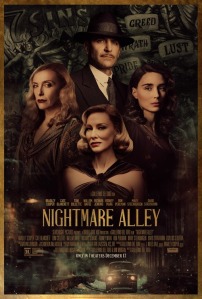 I’ve now watched both versions of Nightmare Alley, the 1947 movie and the 2021 Guillermo del Toro remake, and I guess I just shrug at both. Based upon the 1946 novel by Lindsay Gresham, we follow an ambitious yet troubled man, Stanton (Bradley Cooper), who finds refuge in a traveling carnival, mentors as a phony mentalist, and then uses his skills of manipulation to fleece the rich and privileged while possibly losing his own soul in the process. I kept watching this 150-minute movie and waiting for it to get better, to hit another level, and I had to keep asking, “Why isn’t this playing better for me?” It’s del Toro, an early twentieth-century freak show, a dashing of film noir, and a star-studded cast (Cate Blanchett, Willem Dafoe, Rooney Mara, Toni Collette, David Strathairn), and all those enticing elements should coalesce into something special and dark and adult and transporting, like del Toro’s 2017 Best Picture-winning Shape of Water. However, for me it just feels so turgid and overly melodramatic. I wish the movie had stayed with the traveling carnival and the colorful weirdos that it ditches halfway through. I think it’s because the movie plays to your exact expectations. You expect it to be beautifully composed, and it is, with a flair for the grotesque, a del Toro specialty, and the beats of its film noir-heavy story with femme fatale and double crosses comes across so predictably but minus substantial depth to compensate. I kept waiting for the themes to deepen, to be a better reflection of ourselves, but it’s one man’s circular downfall that doesn’t play too tragic because he’s already an unrepentant scoundrel. Cooper also just seems too old for the part, especially when everyone refers to him as a “young chap.” You might not see a better looking movie from 2021. The cinematography, production design, costumes, and stylish panache that del Toro trades in are all present and glorious to behold. I just wish I could get more from Nightmare Alley besides an admiration for its framing and less about what is happening to the characters within such doting artistry.
Nate’s Grade: B-
Share this:

I’m Thinking of Ending Things (2020)
 I expect strange from a Charlie Kaufman movie; that goes without saying. I also expect some high concept turned inward and, most importantly, a humane if bewildered anchor. His other movies have dealt with similar themes of depression (Anomalisa), relationship entropy (Eternal Sunshine), identity (Being John Malkovich), and regret from afar (Synecdoche, New York). However, no matter the head-spinning elements, the best Kaufman movies have always been the ones that embrace a human, if flawed, experience with sincerity rather than ironic detachment. There’s a reason that Eternal Sunshine is a masterpiece and that nobody seems to recall 2002’s Human Nature (ironic title for this reference). 2015’s Anomalisa was all about one man trying to break free from the fog of his mind, finding a woman as savior, and then slowly succumbing to the same trap. Even with its wilder aspects, it was all about human connection and disconnection. By contrast, I’m Thinking of Ending Things is all about a puzzle, and once you latch onto its predictable conclusion, it doesn’t provide much else in the way of understanding. It’s more a “so, that’s it?” kind of film, an exercise in trippy moments intended to add up to a whole, except it didn’t add up for me. I held out hope, waiting until the very end to be surprised at some hidden genius that had escaped me, for everything to come together into a more powerful whole, like Synecdoche, New York. It didn’t materialize for me and I was left wondering why I spent two hours with these dull people.
A Young Woman (Jessie Buckley) is traveling with her boyfriend Jake (Jessie Plemons) to meet his parents for the first time. It’s snowy Oklahoma, barren, dreary, and not encouraging. In the opening line we hear our heroine divulge the title in narration, which we think means their relationship but might prove to have multiple interpretations. It only gets more awkward as she meets Jake’s parents (David Thewlis, Toni Collette) and weird things continue happening. The basement door is chained with what look like claw marks. People rapidly age. The snow keeps coming down and the Young Woman is eager to leave for home but she might not be able to ever get home.
 The title is apt because I was thinking of ending things myself after an hour of this movie. Kaufman’s latest is so purposely uncomfortable that it made me cringe throughout, and not in a good squirmy way that Yorgos Lanthimos (The Lobster) has perfected. Kaufman wants to dwell and drag out the discomfort, starting with the relationship between Young Woman and Jake. She’s already questioning whether or not she should be meeting his parents and their inbound conversations in the car are long and punctuated by Jake steering them into proverbial dead ends. He’s a dolt. You clearly already don’t feel a connection between them, and this is then extended into the family meet and dinner, which takes up the first hour of the movie. I’m Thinking of Ending Things tips its hand early about not trusting our senses and that we are in the realm of an unreliable narrator. Characters will suddenly shift placement in the blink of an eye, like we blacked out, and character names, professions, histories, and even ages will constantly alter. The Young Woman is a theoretical physicist, then a gerontologist, then her “meet cute” with Jake borrows liberally from a rom-com directed by Robert Zeemckis in this universe (my one good laugh). Jake’s parents will go from old to young and young to old without comment. All the surreal flourishes keep your attention, at least for the first half, as we await our characters to be affected by their reality, but this never really happens. Our heroine feels less like our protagonist (yes, I know there’s a reason for this) because her responses to the bizarre are like everyone else. The entire movie feels like a collection of incidents that could have taken any order, many of which could also have been left behind considering the portentous 135-minute running time.
There are a lot of weird moments and overall this movie will live on in my memory only for its moments. We have a lengthy choreographed dance with doubles for Jake and the Young Woman, an animated commercial for ice cream, an acceptance speech directly cribbed from A Beautiful Mind that then leads directly into a performance from Oklahoma!, an entire resuscitation of poetry and a film review by Pauline Kael, talking ghosts, and more. It’s a movie of moments because every item is meant to be a reflection of one purpose, but I didn’t feel like that artistic accumulation gave me better clarity. There’s solving the plot puzzle of what is happening, the mixture of the surreal with the everyday, but its insight is limited and redundant. The film’s conclusion wants to reach for tragedy but it doesn’t put in the work to feel tragic. It’s bleak and lonely but I doubt that the characters will resonate any more than, say, an ordinary episode of The Twilight Zone. Everything is a means to an ends to the mysterious revelation, which also means every moment has the nagging feeling of being arbitrary and replaceable. The second half of this movie, once they leave the parents’ home, is a long slog that tested my endurance.
 Buckley (HBO’s Chernobyl) makes for a perfectly matched, disaffected, confused, and plucky protagonist for a Kaufman vehicle. She has a winsome matter of a person trying their best to cover over differences and awkwardness without the need to dominate attention. Her performance is one of sidelong glances and crooked smiles, enough to impart a wariness as she descends on this journey. Buckley has a natural quality to her, so when her character stammers, stumbling over her words and explanations, you feel her vulnerability on display. After Wild Rose and now this, I think big things are ahead for Buckley. The other actors do credible work with their more specifically daft and heightened roles, mostly in low-key deadpan with the exception of Collette (Hereditary), who is uncontrollably sharing and crying. It’s a performance that goes big as a means of creating alarm and discomfort and she succeeds in doing so.
I know there will be people that enjoy I’m Thinking of Ending Things and its surreal, sliding landscape of strange ideas and images. Kaufman is a creative mind like few others in the industry and I hope this is the start of an ongoing relationship with Netflix that affords more of his stories to make their way to our homes. This is only the second movie he’s written to be produced in the last decade, and that’s far too few Kaufman movies to my liking. At the same time, I’m a Kaufman fan and this one left me mystified, alienated, and simply bored. I imagine a second viewing would provide me more help finding parallels and thematic connections, but honestly, I don’t really want to watch this movie again. I recall 2017’s mother!, an unfairly derided movie that was also oft-putting and built around decoding its unsubtle allegory. That movie clicked for me once I attuned myself to its central conceit, and it kept surprising me and horrifying me. It didn’t bore me, and even its indulgences felt like they had purpose and vision. I guess I just don’t personally get that same feeling from I’m Thinking of Ending Things. It’s a movie that left me out cold.
Nate’s Grade: C
Share this:

Knives Out (2019)
 Rian Johnson is a filmmaker who likes to dabble across genres and put his high-concept stamp on them. His debut film, 2006’s Brick, was a moody noir-flavored mystery set in a modern high school. His next film, 2009’s The Brothers Bloom, was a whimsical con artist movie with cons-within-cons, and then Looper took time travel and twisted it into knots. From there the man was tapped to not only direct a new Star Wars movie but write one, and 2017’s The Last Jedi proved so divisive that Russia literally created robotic accounts to exploit raw feelings to better sow discord among Americans and undermine democracy. Johnson must have needed a detox from that galaxy far far away, and Knives Out is his version of an Agatha Christie-styled parlor mystery. Once again Johnson has taken an older genre, subverted its form, and made it his own in a way that feels reverent while also fresh, fun, and thoroughly entertaining.
Harlan Thrombey (Christopher Plummer) is a world-renowned mystery writer with a publishing empire in the millions. Then on the night of his birthday party, Harlan is found dead and every family member is a suspect. Could it be Marta Cabreara (Ana de Armas), the nurse who was last seen taking care of the old man? Could it be the daughter, Linda (Jamie Lee Curtis), eager to get out of her marriage to a cheating husband (Don Johnson, having a moment this fall)? Could it be the son Walt (Michael Shannon) who was going to lose his position of power in control of the family publishing empire? Could it be grandson Ransom (Chris Evans) who didn’t show up on time for the party but showed up early for the will reading? The local police detective (Lakeith Stanfield) is doing his best to navigate the many suspects. And then there’s the famed private eye, Benoit Blanc (Daniel Craig), hired by an unknown benefactor to discover foul play, who interrogates each family member, investigates the corners of the estate, and uncovers the truth.
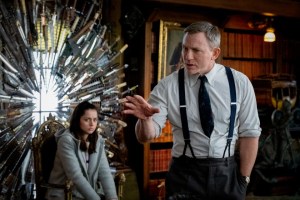 Knives Out is an incredibly fun movie to watch fly by for its extended 130-minute running time. The guessing game is enjoyable and there is a plethora of suspects and red herrings. Johnson is clearly a fan of the genre and doing his best to send it up in his own way while still staying true to its roots. Just look at the silly, Dickensian names and you can tell Johnson is enjoying himself (there’s a character named “Ransom”). The mystery is clever but it becomes something more than a whodunnit (more on that below) and that’s when Knives Out becomes special. Johnson has been repeatedly accused of being too clever by half, looking to produce some meta gymnastics to subvert audience expectations but to what end? This was an issue with the very end of Brothers Bloom and many had this same complaint with The Last Jedi. It’s not enough to subvert expectations if the alternative isn’t as compelling. Still, the choices that Johnson makes with Knives Out best serve to improve the emotional involvement in the story. That quality seems like a rarity when it comes to murder mysteries, because it’s all about solving the crime and not necessarily how it affects the people on a more human level. It’s a problem to be solved, an equation on the board, and the process eliminates the variables systematically. Except with Knives Out, Johnson opens up the central figure of Marta in such a way that she becomes a symbolic figure for the immigrant experience in this country, fighting for dignity and recognition. The political commentary isn’t deep, and some of the shots feel a little cheap, but where Johnson succeeds is treating Marta as an empathetic stand-in for an often-invisible class.
A half-hour or so into the proceedings, Johnson makes a very conscious choice that changes how we understand the mystery and especially how we’re involved. I’ll be careful about spoilers but suffice to say we get some very crucial information that makes us look at the murder differently. For the first act it feels like it’s heading into a whodunnit with our clan of suspicious relatives, but it does something else, and I would argue something better. The problem with an Agatha Christie-style whodunnit is that the film is structured toward solving one central mystery and other important dramatic elements can fall by the wayside. Once you know who the killer is, was the journey to unmask them worth the twists and turns? Johnson instead lets the audience in on crucial information so that Knives Out alters, and the “who” is less important than how this information affects our relationship with a set of characters. It becomes less who is the killer and more will this culprit get caught and how will they beat the encroaching investigation. It transforms the entire structure, where instead of everything leading to one reveal, now it becomes a series of mini-panics and scrambles to stay ahead of a trap. This made me that much more personally involved and Johnson doubled the dramatic irony and tension of scenes. It becomes more a series of obfuscation where we’re involved, remembering what clues might be the ones that ultimately prove too inescapable. There is a downside to this approach, letting out some big reveals early also serves to downplay the vast majority of the supporting players. These people are all given motives and suspicions early on, but once Johnson unloads his twists too many of these same characters just fade into the background, their story use extinguished.
 Another cheerful aspect of Knives Out is simply how much fun its cast is having, none more so than Craig (Spectre). I never really gave much thought to Craig as a comedic actor until 2017’s Logan Lucky, where he seemed to be unleashed, digging full bore into a charming and kooky supporting character, and it was downright joyful to watch him cut it up onscreen. He’s given such serious, macho roles but he really excels in the right comedic role, and he just has the time of his life playing Blanc. His southern-fried accent, penchant for theatricality, and garrulous nature all contribute to both tweak the idea of the clever inspector while playing into those clichés as well, steering into the fun we have with them. There were several moments I was left breathlessly cackling because of how Craig was delivering his lines with such relish. His explanation of the mystery being “a donut hole inside a donut hole” might be one of the best film scenes of the year. It also helps that Blanc has an affectionate working relationship with Marta, the heart of our movie, which makes this eccentric even more endearing to the audience. Just as Kenneth Branagh is continuing the adventures of his mustachioed private eye, I would happily watch another murder mystery featuring Blanc if Rian Johnson felt so inclined (pretty please).
The other actors do fine work even if many of them end up being underwritten figures either meant to be threatening suspects or cartoonish buffoons. Armas (Blade Runner 2047) is the lead actress and often the contrast for our rich elites and their out-of-touch perspectives; she’s the sounding board for their pettiness, acrimony, entitlement, and thinly-veiled racism. Armas just shines in the role as this figure who routinely makes the right choice even when it costs her. She’s a relatable, hard-working, kind character trying to keep her moral bearing in this high-stakes contest. Evans (Avengers: Endgame) is enjoyably smug and a welcome force to antagonize and puncture the egos of his fellow family members. Shannon (The Current War) has his effective moments of conveying menace and being laughably impotent. Every other actor does good work but too many of them barely make a blip. I forgot Riki Lindhome (Garfunkel and Oates) was in this movie from scene to scene. It’s a big cast so the goal is to make the most of their moments, and there isn’t a bad performance in the bunch, though some are far more broad.
Knives Out is a fun experience and further proof that when Rian Johnson really sets his mind on a certain genre, good and clever entertainments sprout. I want this man to tell the stories that excite him because there are still many more genres that could use the Rian Johnson stamp.
Nate’s Grade: A-
Share this:

Hereditary (2018)

Hereditary has built up a great roaring buzz from film festivals and its oblique marketing. Numerous critics are hailing writer/director Ari Aster’s debut film as one of the scariest movies of a generation. The studio, A24, which has built up a fine reputation for art movies and genre fare, is releasing it. Except A24 has some trouble when it comes to its horror thrillers. Last year’s It Comes at Night was similarly beloved by critics yet audiences generally disliked it, angered by the misleading marketing that framed it as a supernatural horror (there was none, no titular “it” to come at night). I wonder if A24 learned their lesson and that’s why the trailers and ads for Hereditary have been intentionally hard to follow. After watching Hereditary and feeling let down, I wonder if A24 is in for another disparity between critics and audiences. This is a sloppy, unfocused film with little sense of structure, pacing, or payoffs. It’s a movie of moments and from there your mileage will vary.
Annie (Toni Collette) and Steve (Gabriel Byrne) are ordinary middle-class parents living with two teenage children, the older Peter (Alex Wolff) and the younger Charlie (Millie Shapiro), a girl given to peculiar habits. Following a tragic accident, the family is struggling to come to terms with their loss and their new lives. Annie seeks out comfort from a group meeting, and that’s where she meets Joan (the great Ann Dowd) who shows her how to contact the spirits of the dead via a handy incantation. From there, Annie tries to establish a connection to the realm beyond and possibly unleashes a spirit targeting her family.

With the rapturous critical acclaim that Hereditary has garnered, I was expecting something far more engrossing and far less sloppy. Structurally, this movie is a mess. It feels very directionless from a story standpoint, like the movie is wading around and blindly looking for an escape route into the next scene. Rarely will scenes have lasting impact or connect to the following scene; you could literally rearrange the majority of the scenes in this movie and not affect the understanding whatsoever. That’s, simply put, poor screenwriting when your scenes lack a more pertinent purpose other than contributing to an ongoing atmosphere of paranoia (more on that later). I’m struggling to make broader connections or add lasting thematic relevance to much of the plotting, and that’s because it feels so convoluted and repetitious for so long, until Aster decides it’s time to throw the audience the most minimal of lifelines. There is a moment late in the second act where a character finds a convenient exposition dump by looking through a photo album and a book that is literally highlighted. That at least explains the intent of the final act, but even as that plays out, by the end it’s still mostly confounding. The film ends with another exposition dump, this time as voice over, and I got to thinking that if it wasn’t for these two offhand moments you would have no idea why anything is happening. I had a friend whose girlfriend had been bugging him for Hereditary spoilers for months, so I carefully explained the movie to them as precisely as I could. By the end, he told me, “I still don’t get it.” Yeah, I didn’t get it either and I was actively trying.
There is a type of horror fan that will lap up Hereditary, namely the kind that places the creation of dread and atmosphere and memorable moments above all else. If you’re a gushing fan of David Lynch movies or Dario Argento and their sense of strange dream logic, you’ll be more ready to prize the sum rather than the whole of Hereditary. The aesthetics are pleasurable thanks to crafty production designer Grace Yun (First Reformed) and the moody photography from Pawel Pogorzelski (Tragedy Girls) that maximizes the space and draws out the anticipatory dread. There are effective moments where I gasped or squirmed, but there were also moments where I wanted to laugh. The key term is “moments.” Without a structure, sense of development, and attachment to the characters and their lives, Hereditary left me chasing fleeting entertainment.

Now when it comes to horror moments, I’ll again admit that everyone’s mileage will vary. Some people will watch Hereditary and be scared stupid. Others will shrug. That’s a deeply personal response. I can look at a movie like A Quiet Place and point to its intricate structure and execution to explain why its suspense was so affecting and satisfying. With Hereditary, because all it supplies is moments, I can’t explain why something will work or won’t for a person. Maybe you have a thing against headless corpses. Maybe you have a thing for jump scares (there are more than a few). Maybe you have a thing for invisible girls making clicking noises with their tongues. Then again maybe you’d enjoy a narrative that gave you a better reason to care and that organically built meaningful scares through tangible circumstances.
If you can hang onto the final nightmarish act, that’s when Hereditary is at its best, finally picking up a sense of momentum and finality. The first forty-five minutes of this movie more closely resemble something like Manchester by the Sea, a family unit becoming undone through grief and guilt, simmering grievances just under the surface. It’s well acted, especially by Toni Collette (Krampus) as a mother barely escaping the pull of her boiling anger at her son and the universe as a whole. She gets a few quality moments to blow up and it feels like years of painful buildup coming out. The awkward family interaction is chilly but missing greater nuance. It has marked elements that should bring nuance and engagement (Personal Tragedy, Mental Instability, Blame, Guilt, Obsession), but with Aster’s undercooked screenplay those elements never coalesce. This is a movie experience that is never more than the sum of its spooky parts. Byrne (The 33) is essentially just there, and the fact that the 68-year-old actor has two teenage children is a little hard to swallow. Wolff (Jumanji: Welcome to the Jungle) does a fine job of showing his deteriorating mind late in the movie. The problem is that these characters just aren’t that interesting, so when the supernatural acceleration creeps in, there’s already a ceiling as far as how much we, the audience, will care about what befalls them. What are the stakes if you don’t understand what’s happening and don’t genuinely care about the central characters?

My pal Ben Bailey chided me after seeing Hereditary that I was trying to do the movie’s work for it by looking for deeper connections and foreshadowing clues. Is there some greater meaning for the headless women motif? Is there a larger reason why the dollhouse God imagery is prevalent? Is there a reason, after finding out about the haunting, that the family still leaves their beleaguered son alone? Is there a mental illness connection or is it all a manifestation of hysterical grief? The English teacher discusses the Greek tragedy of Iphigenia (see: a better movie following this model, 2017’s Killing of a Sacred Deer) and whether being predestined for sacrifice is more tragic than choosing your own self-destruction, and is that a glimpse at thematic relevance in a way that seems almost half-hearted? The problem with a long, incoherent story built upon a heaping helping of creepy imagery and atmosphere is that it can often fall into the lazy trap where the filmmaker will just throw up their hands as if to say, “Well, it’s up for interpretation.” I don’t mind a challenging movie experience (I was on the side that enjoyed, if that’s the correct term, Darren Aronofsky’s mother!). I can appreciate a movie that’s trying to be ambiguous and ambitious. However, the pieces have to be there to form a larger, more meaningful picture to analyze and discuss, and Hereditary just doesn’t offer those pieces. It’s an eerie horror movie with its moments of intrigue and dread but it’s also poorly developed, too convoluted, and prone to lazy writing and characterization. I’ll highlight it for you, Hereditary-style: if you’re looking for more than atmosphere and tricks, seek another horror movie.
Nate’s Grade: C
Share this:

Krampus (2015)
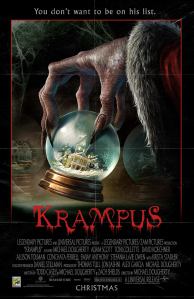 Not quite funny enough and not quite scary enough, Krampus is a holiday antidote that wants to be a modern-day Gremlins but needed to be nastier, darker, or some variant with the suffix of –er. Writer/director Michael Dougherty has been down this holiday road before with Trick ‘r Treat, a superb horror anthology genre gem that was buoyed by a twisted sense of humor and a clever criss-crossing set of storylines that pollinated plenty of payoffs. Krampus begins with a brilliant opening credit sequence that sets a high bar o promise the movie will ultimately be unable to deliver, watching slow-mo stampeding shoppers fighting over Black Friday discounts set to a classic Bing Crosby yuletide tune. From there it’s more a Griswald dysfunctional family gathering until one of the young boys rips up his letter to Santa in disillusionment, calling forth Krampus and his minions. From there the family is terrorized and come closer together in struggle, trying to understand their predicament. There are a few great character designs for the minions, especially a jack-in-the-box whose face unhinges into a sarlac pit of teeth. The PG-13 rating keeps the film from getting too gory or too wicked, which also belies the fact that at heart it’s really an old-fashioned Christmas morality play about loving one another. I was ready to groan with what appeared to be the ending but Dougherty at least subverts the expected and makes sure that there are lasting consequences for bad behavior. This isn’t going to be remembered as a holiday classic but if you’re looking for a fun horror comedy, Krampus at least has something to offer before you feel left wanting.
Nate’s Grade: B-
Share this:

The Way, Way Back (2013)
 A throwback to the youthful summer movies of the 80s, The Way, Way Back is a delightful coming-of-age film that manages to excel at both comedy and drama. Oscar-winners Jim Rash and Nat Faxon (co-writers of 2011’s The Descendants) graduate to directors, guiding the famous cast with ease yet squeezing enough satisfying emotional truth into the formula of a screwy, Meatballs-style comedy. We follow 13-year-old Duncan (Liam James) as he spends the summer with his mother (Toni Collette) and her bully of a boyfriend (Steve Carell). My one gripe is that the film spends far more time than it needs to establish just how unequivocally awkward Duncan is. You will likely cringe. When Sam Rockwell enters the picture as a charming goofball water park employee who takes Duncan under his wing is when the movie ascends to a new level of comedy. The Way, Way Back hums along with its own sense of charm, presenting familiar characters/scenes but giving them added texture and relatability. You will be surprised at how much you feel for these characters, you may get a bit misty at points, especially when they behave like people and not zany cartoons. Carell as a bad guy is a real eye-opener; he’s a passive aggressive bully rarely seen in movies. James is an authentically awkward teen but you also buy every step of his journey. It’s just such a sweet, enjoyable, and cute movie, exuding charm and sincerity. Here is a movie that just makes you smile. You’ll leave The Way, Way Back feeling warm and fuzzy, and Rash and Faxon have another winner on their hands.
Nate’s Grade: B+
Share this:

Fright Night (2011)
 Horror is a genre that’s been notoriously cannibalistic, especially as of late. I don’t mean flesh-eating, I mean the glut of remakes that has polluted the horror market in recent years. After remakes of Halloween, A Nightmare on Elm Street, Friday the Thirteenth, The Hills Have Eyes, House of Wax, Prom Night, My Bloody Valentine, The Amityville Horror, The Fog, The Texas Chainsaw Massacre, Black Christmas, Sorority Row, Dawn of the Dead, The Crazies, Don’t Be Afraid of the Dark, I Spit on Your Grave, Last House on the Left, The Thing, and scads more, you’d be forgiven for believing that the remake of 1985’s Fright Night would be another soulless cash grab. It turns out that it’s way better than even the original and quite an entertaining movie that got lost in the shuffle.
In a quiet little suburb outside Las Vegas, students are going missing. Ed (Christopher Mintz-Plasse) suspects that there is a vampire in town. Ed’s former friend, Charley Brewster (Anton Yelchin), dismisses this idea, especially since the would-be vampire in question is his new neighbor, Jerry (Colin Farrell), a home construction worker who seems to work at night mostly. But lo and behold, after Ed goes missing, Charley concludes that his old friend was right all along. Jerry has his eyes set on Charley’s single realtor mom, Jane (Toni Colette), and maybe even Charlie’s sprightly girlfriend, Amy (Imogen Poots). The only ally Charley can muster is a drunken Vegas magician in the Criss Angel tradition. Peter Vincent (David Tennant) has been studying vampires for years due to his tragic personal connection to vampires, notably Jerry.
 Fright Night finds that horror sweet spot, equal parts scary and funny. Credit screenwriter Marti Noxon who cut her teeth on TV’s seminal show (yeah, I said it) Buffy the Vampire Slayer; there’s even a reference to a “Scooby gang” for we Buffy fans. Noxon does a terrific job of establishing a suspenseful situation and then developing it nicely, teasing it out. There’s a sequence where Charley is trying to rescue a neighbor lady that just involves a series of hiding places but uses a simple setup of ducking around corners so well. When our plucky protagonist checks in with Vincent for some assistance, we’re introduced to an array of exotic vampire-hunting weapons and artifacts that the Vegas magician has under glass. With a setup like that, you better believe we’re going to be using those weapons later, and how. The character development is richer than most teens-battle-monster genre films. The relationship between Charley and Ed, and the awkwardness and resentment of two friends growing apart, feels rather believable even dropped into the middle of a vampire adventure. The standard girlfriend role is given a bit more weight, as she’s the one who feels confidant and aggressive. She knows what she wants, and as played by the adorably named Imogen Poots (Solitary Man), you want to be what she wants. Seriously, this actress is striking in her Grecian features and I like a woman who knows how to handle a mace. There are also small touches that I really enjoyed that helped round out the movie. At one moment, a woman is being fed on by Jerry and she spots Charley hiding behind a door. Rather than cry out for help, she carefully draws a shaking finger to her mouth, wishing him to keep quiet and not to save her. The resolution of this rescue attempt is shocking in all the right ways. It’s a surprise that feels completely within reason, and organic twists and turns are always the most satisfying.
Noxon’s script continually surprises even when it starts to follow a by-the-numbers plot. Instead of an axe lopping off a vampire’s head, it just goes about halfway through thanks to the rigidity of bone. That’s a nice touch, but then when that same vampire tries to bite our hero and can’t move his fairly severed neck closer, then that’s when Noxon has capitalized on her cleverness. And she capitalizes often enough for Fright Night to be a real step above most vampire action flicks. Noxon also finds clever spins on vampire mythos; to get around the whole can’t-enter-without-an-invitation rule, Jerry just attempts to blow up the Brewster’s home to drive them out (“Don’t need an invitation if there’s no house”). There’s a particularly ingenious method to light a vampire on fire. And the entire character of Peter Vincent, played brilliantly by Dr. Who actor David Tennant, is a hoot and a great addition. He’s a riot as a cynical, profane, and selfish stage performer. His character is such an enjoyably comic foil, and Tennant plays him with aplomb, that you almost wish for a Peter Vincent spinoff movie.
Director Craig Gillespie shows that he is shocking adept when it comes to staging a horror film. I would not have expected this level of competency from the director of Lars and the Real Girl. It embraces its R-rating and the bloodshed is plentiful though the gore is restrained. Gillespie draws out scenes with judicious editing, letting the dread build steadily. The tension of something simple like Jerry standing in a doorway, waiting for any verbal slipup to come inside, can be terrific. Gillespie also has some nifty visual tricks up his sleeve to complement Noxon’s crafty screenplay. There’s one scene where Jerry walks into a hotel lobby and is confronted by a security guard. The camera pans over a series of security monitors that do not pick up Jerry. Then in the background we see Jerry hurl the guard to the ground to bite him and in the foreground we see the security footage minus Jerry. There’s an ongoing tracking shot inside a fleeing minivan that’s not exactly Children of Men but still a good way to feel the fever of panic. The final showdown between Charley and Vincent versus Jerry is suitably climactic and rewarding, nicely tying back elements that were introduced earlier and giving Poots an opportunity to vamp out, literally and figuratively.
 Farrell (Horrible Bosses) is a charming, sexy, alluring menace as Jerry, which is exactly what you’d want in a vampire (sorry Twilight fans). Vampires are supposed to be seductive; they’re inherently sexual, what with all that biting and sucking and sharing of body fluids. If Jerry is going to be dangerous, he also has to be seductive, and Farrell is exactly that. With his swaggering walk, with his pose-worthy stances, with his grins, he’s a great ambassador for vampire kind. But this guy does more than preen; he’s also a credible threat. He’s the bad boy that is actually quite bad. Farrell’s enjoyment of his villainous role is noticeable. Jerry taunts Vincent: “You have your mother’s eyes.” He shoots and misses the big bad vamp. “And your father’s aim,” he add, chillingly. Having a strong villain can do wonders for an action movie, and Jerry is a formidable foe played with great relish by Farrell.
Not everything goes off without a hitch. The special effects can be dodgy at times, especially when Jerry goes into full CGI vampire face. The vampires tend to look like shark people, with long exaggerated jaws and rows of gnarly teeth. It’s not a particularly good look. While Noxon’s script excels in most areas, there is still enough dangling plot threads. Charley’s mother is really never a figure of significance. Her potential romance of her neighbor/vampire is a storyline that is never capitalized upon, oddly enough. That seems like the kind of storyline you’d build a whole movie around. She’s written out of the movie in hasty fashion, immediately going from a sequence of driving to being unconscious in a hospital bed. How did that happen exactly? After the Brewster house explodes, nobody seems to make a big deal out of this, like it’s just some regular neighborhood occurrence. What kind of neighborhood watch is this?
Fright Night is just a fun night out at the movies. It’s got plenty of laughs thanks to Noxon’s clever script, plenty of scares thanks to Gillespie, and plenty of sex appeal oozing from Farrell (though “sex appeal” and “oozing” don’t sound like an advisable linguistic match). It’s not much more than a vampire action flick but it’s a really good vampire action flick, clearly a cut above the dreck that usually just relies on its audience’s understanding of genre convention to cover up for its shortcomings. There’s no reason you cannot be a good movie with this genre, and Fright Night is proof of that. Convincingly acted, cleverly staged, and surprisingly well-executed, this is one genre movie that hits the right vein.
Nate’s Grade: A-
Share this:

Evening (2007)
 A chick flick crammed with lots of bona fide stars and A-list talent that manages to squander all talent. It slogs on and on, the back and forth nature of the plot does little to keep an audience alert, and the story it tells in the past is so pedestrian, so minuscule, and ultimately so mundane that you can’t help but wonder why an old woman on her deathbed would be flashing back and remembering it. This high profile weepy never finds the right tone and often settles for maudlin and predictable plot turns. Evening is the kind of movie that kills the chances for a large, female-driven film to get made in Hollywood.
Nate’s Grade: C-


 nathanzoebl
You must be logged in to post a comment.