Blog Archives
Oblivion (2013)
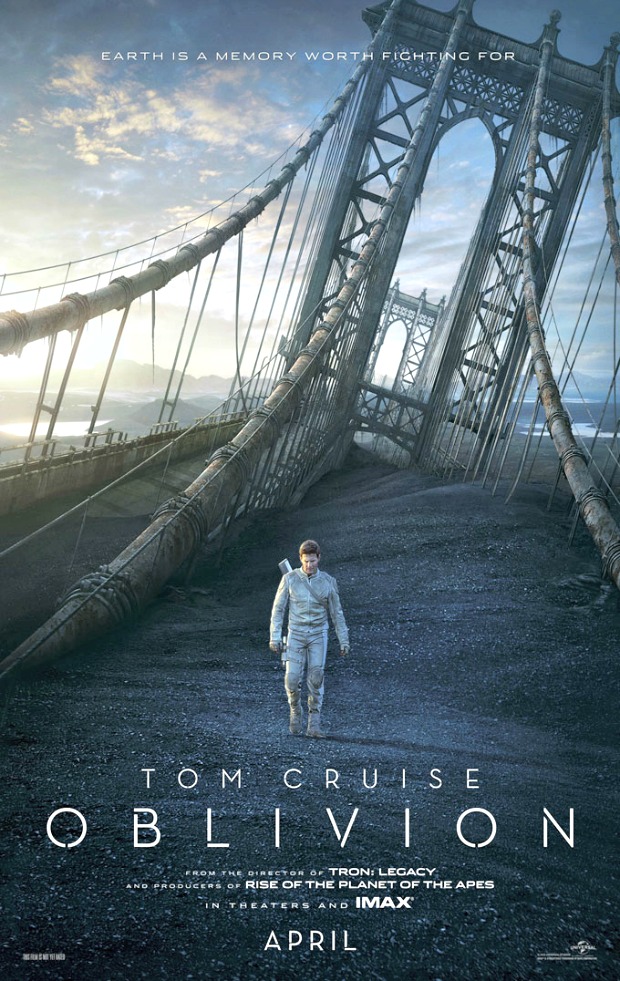 It’s late in the twenty-first century, decades after humanity battled an alien species in a war for the planet, and while humanity won the war Earth is desolate. The moon destroyed. The remaining members of humanity live on a starship around Saturn’s moon, Titan, and the oceans of Earth provide the energy resource. Jack (Tom Cruise) and Victoria (Andrea Riseborough) are the team stationed with repairing drones, the flying machines that protect the energy plants. There are still pockets of alien scavengers that need to be dealt with. Jack and Victoria make a great team, and dip into romantic companionship, until Jack meets a mysterious woman (Olga Kurylenko) professing to be his wife. Jack begins to doubt the purpose of his mission and wonder if the alien scavengers are the enemy.
If you’ve been keeping up with sci-fi cinema in the last couple decades, you’ll likely recognize more than a few elements with Oblivion. From its themes to its plot points to its revelations, there’s little here to designate as original. So the real question remains how derivative can we take? I think when the execution is nimble then it’s one of the easiest sins to remember. Especially in the realm of sci-fi cinema, it’s hard to put together a new story, let alone one set up as a Hollywood star vehicle, without borrowing from other established movies. This in itself is not an issue. Tarantino is a master borrower but he always recontextualizes his artistic influences into something new and different, and while we critics lament his less original career path of late, the man’s box-office profits have never been better in his career. I think when we feel like we’re getting a good story we don’t care when that story has been told before in other manners. Star Wars, after all, has many cultural fathers, but it was a rollicking good time with characters we cared about, so nobody seemed to mind. Likewise, Oblivion has many forbearers from Independence Day to I Am Legend to 2001 to an indie film from a few years ago I shall refrain from mentioning because even the very mention will spoil key plot points. Some will decry the film as a rip-off of superior, headier fare, but I never minded. I was having too good of a time and found the movie too satisfying to quibble.
 I won’t say the movie is smart per se but it’s far more measured than I would have expected. The advertising makes it look like Cruise fights a bunch of aliens and robots, and while there is that aspect, it’s almost an afterthought to a slow-burning mystery that patiently parcels out its revelations, even to the very end of the film. I’m trying to be cagey about certain plot points to avoid spoilers. It’s a film that has more on its mind than explosions, but when it goes into explosion mode, director Joseph Kosinski (TRON: Legacy) makes it count. The larger action elements are well staged and polished with some above average special effects. The sight of the moon dashed across the sky is definitely an evocative image. I love the overall look of the film, Kosinki’s clean, spare, bubbly Apple-esque aesthetics. The drones themselves manage to have personality even with a limited, streamlined design and some choice sound design. The man knows how to hold onto an image and when to keep pushing. The action is suitably thrilling and the drama suitably suspenseful. Actually, better than suitably. I enjoyed the details of this world. It’s probably the spiffiest post-apocalyptic landscape you’ll ever see. This is an entertaining movie that finds nice ways to satisfy, and given the particulars of its sci-fi plot, finds a way to have its cake and eat it too. As a result, Oblivion is a sci-fi flick that offers enough to engage the mind and audience demands for big effects and big thrills.
 I’ve never been a Cruise hater. I even thought the man tried his damndest to make a movie like Rock of Ages worth watching (a valiant effort but not enough). His character is pretty affable at first and we get to watch as everything he knows comes undone. It’s a role that would lead to overacting, but Cruise underplays the part, more alarmed naïf than flinty action hero. I’m not expecting Oscar-caliber performances in every role but Cruise does a fine job of anchoring the audience and selling his character’s journey. He also has good chemistry with not one but two ladies. Kurylenko (Seven Psychopaths, To the Wonder) is an actress of great beauty and questionable talent, but perhaps being paired up with a genuine star like Cruise brings out the best in her. They’re good together, though my preference was for Riseborough (W.E., Never Let Me Go), an actress who brings a tremulous vulnerability to an otherwise underwritten and confused character that’s more a plot device. Riseborough makes the character so much more than she is on the page. She’s still a relatively new actress so I look forward to her future performances. There are other familiar faces, like Morgan Freeman and an especially unsettling Melissa Leo, but it’s really a three-person acting exercise.
Oblivion is a visually alluring sci-fi thriller that also manages to have enough heart and smarts to leave a satisfying impression. The pacing is more deliberate but offers plenty rewards, doling out revelations up until the end, unpacking its mystery with finesse. The first twenty minutes or so, establishing the particulars of this world and the routine of our protagonists, is downright exceptional. The rest of the film doesn’t quite live up to that start but it continues to be an engaging and entertaining movie with some top-notch visuals. The musical score by electronic band M83 also provides a stirring counterpoint to the glossy, clean visuals (the band’s song “Outro” was also very effectively used in that lovely five-minute trailer for Cloud Atlas). You may figure things out as you watch, but you won’t mind, at least I didn’t. The more I step away the more I think back with renewed enthusiasm for the film. It’s smarter, slicker, and just a more satisfying film than we’re accustomed to with this kind of budget and from Hollywood.
Nate’s Grade: B
Share this:

Jack Reacher (2012)
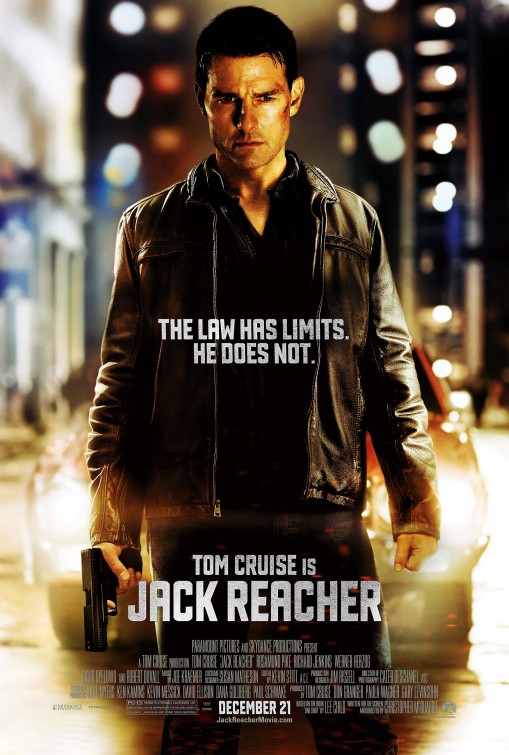 The Jack Reacher of the best-selling novels is a hulking, blonde haired, blue-eyed, 6’4” man of flinty justice. The Jack Reacher of the film of the same name is played by Tom Cruise, an actor who fits none of those descriptions. He is a movie star, however, and those are in short supply. The character is a former MP who operates like a drifter, leaving little trace, and inserting himself as needed to dispense his own sense of justice. The plot of the movie involves Reacher looking for a sniper responsible for a massacre, and hey is that German filmmaker Werner Herzog as the arch villain? Why yes it is. It’s a pretty standard mystery/investigation, complete with crooked cops and inept crooks. What elevates the movie is Cruise’s lone wolf intensity and writer/director Christopher McQuarie’s (The Way of the Gun) ingenuity with clichés. You’ve probably seen this sort of movie before, but McQuarie finds creative and clever ways to stand out, delivering a nifty car chase and a nifty escape as well. It’s just fun watching Cruise outfox his adversaries, via his wits or his fists. Where the movie becomes annoying is how it consistently has to remind you just how badass Jack Reacher is. At every turn, someone will say what kind of exceptional man he is, how he follows his own rules, etc. Reacher even gets the requisite “I’m not a hero so be afraid” speech. After a while, it just feels like the movie is overcompensating, trying to quell the irate fans of Lee Child’s novels who probably envisioned The Rock in Reacher’s shoes. Unlike Reacher the character, Jack Reacher the movie is not the best at what it does, but with a charismatic Cruise in control, it’s at least good enough to see once.
Nate’s Grade: B-
Share this:

Les Miserables (2012)/ Rock of Ages (2012)
 I have no qualms with my heterosexual nature to make the following statement: I love a good musical. Why shouldn’t I? None other than Martin Scorsese said any true film lover is a fan of horror movies and musicals, two genres uniquely suited to the visual flourishes of cinema. My tastes tend to run toward the more offbeat, like Avenue Q and Hedwig and the Angry Inch and Sweeney Todd and Dancer in the Dark. My favorite movie musical of all time is 1952’s Singin’ in the Rain, but that’s probably because I’m a movie lover first and foremost. A well-done movie musical can sweep you off your feet. The polarizing Moulin Rouge! is still my favorite film of 2001; I love every messy, ambitious, transporting second of it. And that’s what the best musicals and, in general, best films achieve: they transport us to another realm. Since the success of 2002’s Chicago, there’s been a run of hit-or-miss movie musicals proliferating the big screen. It’s hard to think of any longstanding Broadway hits that have yet to make the leap (you’ll get your turn, Book of Mormon). Of course it also works the other way, with plenty of movies being adapted into Broadway musicals, like Shrek, Elf, Ghost, Catch Me if You Can, Newsies, A Christmas Story, Sister Act, Legally Blonde, Bring it On, and Tony-winner for Best Musical, Once. Then you get movies turned into musicals and back into movie musicals, like The Producers and Hairspray. It seems like Broadway and Hollywood are stuck in a loop, feeding off one another’s spoils.
In 2012, two high-profile musicals got the big screen treatment: Rock of Ages and Les Miserables. The former is from 2009 whereas the latter is one of the most successful Broadway shows of all time, beginning in 1980 and spanning continents. Rock of Ages was savaged by critics and bombed at the box-office, whereas Les Miz is soaring this holiday season and is seen as a major Oscar contender. Of course one of these films is about the outrage of the lower classes being exploited by an unfair system that benefits the rich, and the other has Tom Cruise and a monkey named “Hey Man.” Having seen both films recently, and Les Miserables more than once, I think they present an interesting discussion on the pitfalls of adapting a popular theatrical show to film. You won’t have to wait long to figure out which movie succeeds and which falters badly.
 Les Miserables, based on Victor Hugo’s novel, is set in early 19th century France. Prisoner Jean Valjean (Hugh Jackman) is nearing the end of his twenty-year sentence for stealing a loaf of bread. Inspector Javert (Russell Crowe) is convinced Valjean will never reform and go back to a life of crime. After help from a kindly bishop, Valjean flees his parole and sets up a new life as a businessman. Fantine (Anne Hathaway), one of Valjean’s workers, gets thrown out and tumbles down a chain of regrettable circumstances. She becomes a prostitute to support her young daughter, Cosette. Valjean recognizes poor Fantine on the street and, horrified at his own neglect leading her to this path, takes it upon himself to care for her and her daughter. Years later, the teenaged Cosette (Amanda Seyfried) has fallen for the young revolutionary Marius (Eddie Redmayne). Marius enlists his good friend Eponine (Samantha Barks) to help find out who Cosette is, all the while ignorant that Eponine is clearly in love with him. The young people of France are riled up about class abuses and exploitation, and the spirit of revolution is in the air. Javert is also becoming suspicious of Valjean’s true identity, so Valjean feels the need to flee once again. However, Cosette’s love and the bravery of the young revolutionaries makes Valjean decide to stop running from his past.
Oscar-winning director Tom Hooper (The King’s Speech) made the ballsy but ultimately brilliant decision to have his performers sing live. Every line, every note, every performance is captured in the moment; there is nary a second of lip-synching. I cannot overstate how blessed this decision was. It places the emphasis on the performances, and that’s exactly what something as big and deeply felt as Les Miserables required for the big screen. Look, Hollywood actors are never going to be able to outdo trained and professional theatrical singers. What I expect from movie stars is movie-star level performances, and Hooper understands this. These actors aren’t playing to the cheap seats, belting the tunes with power and over exaggerated dramatics (note: there is absolutely nothing wrong with this style given the theatrical setting). In many ways, this is a more intimate Les Miserables, and it still maintains its charms and magic. There is no choreography, short of perhaps the more jovial “Master of the House” number, and Hooper puts us right in the muck of life in a 19th century impoverished slum. This is one dirty movie with lots of grimy period details, creating a reality that can only be implied on stage. The more visceral version of Les Miserables demands performances that are more naturalistic and less bombastic, to a degree. I am a cinephile first but I genuinely prefer my musicals with trained actors to trained singers. A great actor can add so much inflection and personality through the prism of song, whereas a great singer is concentrating on the notes first and foremost. I value performance over nailing the mechanics, and more movie musicals should follow Hooper’s path. This, ladies and gentlemen, is how to do the movie musical experience right.
 I don’t know if Hooper was exactly the right man for the job but he certainly does the beloved stage show justice. Hooper’s visual tics are still present. The man loves to film in close-ups and at all sorts of tilted Dutch angles; he also loves filming a conversation between two people where neither one will be in the same shot. It’s a peculiarity that I never really warmed up to. However, Hooper generally has the best interests of his movie at stake, capitalizing on the large outpouring of feeling. This is a Big Musical with big emotions, and it’s easy to be swept up in its exuberant earnestness and humanism. It even has a famous concluding line, “To love another person is to see the face of God.” It’s the kind of stuff you roll your eyes at under lesser circumstances. Now, thinking back, you’ll realize that many of these people were simply painfully naïve and that there was a slew of death for no good reason. Purists may chafe at some altered lyrics and truncated songs, but really this is pretty much the closest version of the famous stage show you’ll ever see adapted. Not one of the songs has been cut (in fact a new one was written for the film by the original composers), and at a lengthy 157 minutes, it’s practically as long as the stage show, and just about sung through every moment. There are probably ten total lines that are merely spoken. I predict hardcore Les Miz fans will lap up every second.
Les Miserables also boasts some fortuitous casting (Taylor Swift at one point was rumored to be up for a role… shudder), none more than Anne Hathaway (The Dark Knight Rises). She is nothing less than perfect as Fantine. There isn’t a false note during any of her acting. Her performance of “I Dreamed a Dream” is so powerful, so breathtaking, so intensely felt, that it ranks up there with some of the best moments in all of 2012 movies. And oh can this woman sing her ass off too. You feel every flicker of anger and devastation, the grain in her voice, on the verge of tears and fury. This woman deserves every accolade they can come up with this year. This woman is a total lock for Best Supporting Actress. She’s wonderful during every moment of her screen time and the lengths and emotional ferocity of her performance, and subsequent pitfalls the character endures, left me reaching for the tissues at several points.
The other standout amidst a pretty stellar cast is Barks. This is her first film work though she has plenty of experience with her character, portraying Eponine in the 25th anniversary run of Les Miserables. Her singing is terrific, as you’d imagine, but her acting is just as strong. Her rendition of “On My Own” is a showstopper of a number. Barks naturally transitions to the demands of film. I was completely on Team Eponine and found her to be an infinitely better catch than Cosette. After people get a glimpse of this woman, she is going to get plenty more acting offers, and a few concerned inquiries into the size of her waist, which at times looks like it might be the size of The Rock’s neck. Hooper also has the good sense to film both “I Dreamed a Dream” and “On My Own” in unbroken takes; focus tightly pinned on our outstanding actresses, letting the skill of their performances sell the big emotions.
 Of course the crux of the tale rests on two men, Valjean and Javert, and the rest of the cast does kind of get saddled in underdeveloped roles made more apparent as a movie. It seems blasphemous to say I was a little disappointed with both lead actors. Crowe (Robin Hood) is easily the weakest singer of the cast but that doesn’t mean he’s bad. He has a lower register and sings his parts like a rock musician rather than a Broadway player. Fans of the stage show will have to adjust their expectations for a more subdued Javert. Still, having an actor of Crowe’s talents is definitely a plus even if his singing is adequate. Jackman (Real Steel) is a Tony-winning thespian, so I held him to a higher standard. He’s got a lot of heavy lifting to do as Jean Valjean, and Jackman does an admittedly fine job with the bigger emotional parts. I just expected more from his vocal abilities but it’s not a major detraction. As my mother noted, it’s not too difficult to spot the classically trained singers in the cast. Also, for eagle-eyed Les Miz fans, look for the original Jean Valjean, Colm Wilkinson, as the Bishop in this movie.
There is the tricky nature of translating a Broadway production into some variance of period reality. There’s plenty of relevance with the class struggle illustrated in the second half of the movie (Bane would approve). It’s an obvious statement but film is a different medium than the theater and affords different opportunities. The depressing reality of lower class life and the vultures that preyed on others is striking, yes, but sort of conflicts with the comic relief characters represented by the scheming Thenadiers (Sacha Baron Cohen, Helena Bonham Carter). When the seriousness of the period is inflated, they feel like they sort of belong in a different movie. Then there’s just the conflict between stage reality and film reality. On the stage we’ll accept Marius falling madly in love with Cosette at first sight. When it’s on film, the guy comes across as a callous chump, oblivious to Eponine’s pining. He ignores the friend he’s had for years for some blonde in a bonnet. And the final number, reuniting all the dead cast members, works better as a curtain call than a finale to a film. These are just the quirks of theater one must just accept. I wouldn’t say the songs and music is in the same category as Sondheim or Webber, but there are definitely some hummable tunes here made all the more swooning. You’ll have a fine pick of songs to get stuck in your head for days (mine: “Look Down”).
 Earlier this year, Rock of Ages came and quickly left the box-office, failing to make a splash with the American public despite a healthy enough run on Broadway and touring the country. The stage show is a jukebox musical set to the head-banging tunes of 1980s hair metal. Adam Shankman, the director behind the bouncy and thoroughly entertaining 2007 Hairspray movie musical, was tasked with bringing Rock of Ages to the screen with the same finesse. Cherie (Julianne Hough) a hopeful singer just off the bus from Oklahoma, meets up with Drew (Diego Boneta), a nice kid who gets her a job at The Bourbon Room, a rock club running afoul with the mayor (Bryan Cranston) and his moral crusading wife (Catherine Zeta-Jones). The club owners (Alec Baldwin, Russell Brand) are relying on fickle, burned-out, taciturn, and overall mysterious rock legend Stacy Jaxx (Tom Cruise) to save their club from financial ruin. Along the way, Cherie and Drew look for their big breaks, fall in love, get pulled apart, and reunite in time for one final sendoff to leave the audience tapping their toes.
 Allow me to elucidate on my main problem with the rise in jukebox musicals: I find them to be, with rare exception, exceedingly lazy. The musical number is meant to advance the narrative and give insights into character and situation, just like any other aspect of plot. You’ll find great original tunes that do this. When you’re dealing with pop songs that the public is well familiar with, then your job becomes even harder, and I find many are just not up to the task. Too often jukebox musicals are designed to merely string together a pre-packaged and time-tested number of hit songs, utilizing the faintest of narrative threads to get from one song to the next. The appeal of jukebox musicals lies not with the story or characters but waiting for the next recognizable song and wondering how it will, poorly, fit into this new context. You’ll notice that these jukebox musicals seem to have twice as many song numbers. They know their selling point, and more singing means less time spent developing characters and story. And so my impression of the jukebox musical is one of a cynical cash grab following the bare minimum of narratives to achieve the status of musical so it can be resold with low risk. I’m simplifying things in my ire, yes, but there’s a definite reason that jukebox musicals have sprouted like mad in the past few years. They don’t require as much work and the audience seems to hold them to a lesser standard. Much like the worst of Friedberg and Seltzer (Disaster Movie, Meet the Spartans), it seems just recognizing the familiar has become the core draw of entertainment.
And this is one of the main problems with Rock of Ages. I’ve never seen the stage show, but my God for something that purports to live the rock and roll lifestyle, it’s certainly so tame and scrubbed clean of anything dangerous. This feels like your grandparents’ idea of what “modern” rock music is. After a cursory search online, I’ve found that the movie makes some significant changes to convert a story about rock and roll hedonism into sanitized family friendly fare (spoilers to follow, theatergoers): apparently in the stage version, Cherie and Jaxx had sex, Jaxx remains a creep and flees the country on statutory rape charges, though before that he and Cherie share a lap dance/duet to “Rock Me Like a Hurricane,” the family values crusader characters were new inventions, the Rolling Stone reporter (Malin Akerman, the best singer in the film) is considerably beefed up to provide Jaxx his happy ending, and they don’t even use the song “Oh Cherie.” I’m not a stickler for adaptation changes, but clearly it feels like Rock of Ages had every edge carefully sanded down to reach out to the widest array of mainstream filmgoers (Shankman says he cut Cherie’s lap dance number because it tested poorly with mothers). The funny part is that the movie lambastes a slimy manager (Paul Giamatti) for playing to demo numbers, shooting for pandering mass appeal rather than the art, man. Feel the hypocrisy.
 The first hour of Rock of Ages is mildly passable mostly because of the goofy supporting cast, but then the movie just keeps going, getting more and more tedious with every protracted minute. The second half involves Cherie and Drew apart and finding new lows; for him it’s selling his soul to join in a boy band, and for her it’s selling herself, working as a stripper. Let’s look back at that sentence. One of those life choices is not nearly as upsetting as the other. Nothing against the hard-working strippers in this country, but Cherie taking to the pole is definitely more of a moral compromise for the character than whatever the hell Drew endures. It’s this leaden second hour that made me lose faith that Rock of Ages would even provide a morsel of cheesy entertainment. It has the misfortune of two of the blandest leads I’ve ever seen in a musical. Hogue (Footloose) and Boneta (Mean Girls 2) are both physically blessed specimens of human genetics, but oh are these kids boring boring boring. Their love story is completely malnourished and you couldn’t scrape together one interesting thing about them combined. The fact that Rock of Ages further strips away any interesting personality from Cherie (see above) makes them even more disastrously boring. To be stuck with these two for another hour of vapid griping, only to magically get back together, is interminable. Thank God they pumped up the side characters because that is the only time when Rock of Ages even challenges for your attention. Cruise isn’t the best singer but he’s pretty good belting out 80s rock hits, and the man has his natural charisma and stage presence to spare.
So I guess where Rock of Ages goes wrong, and where Les Miserables succeeds, is thinking of how best to translate the experience of the stage to the medium of film. Shankman does a pitiful job staging his musical numbers, with lackluster choreography that rarely takes advantage of the sets and characters. Worse, Shankman feels like he strays from the tone and angle of the stage show, sanitizing the rock and roll lifestyle and looking for ways to squeeze in bland happy endings. In other words, he doesn’t capture enough of the essence of the original stage show to please neophytes and fans of the Broadway show. With Les Miserables, I think most fans of the stage show, and they are legion, will walk away feeling satisfied with the results, content that real artists treated the long-running musical with justice. Hooper opens up the world of the stage show, utilizing the parameters of film, and the emphasis on performance over singing mechanics maximizes the unique power of film. Les Miserables is a grand movie musical smartly adapted to the opportunities of film. Rock of Ages is a sloppy, neutered, criminally boring mess poorly developed and poorly translated to the silver screen. Let this be an educational resource for future generations. Take note, producers, and learn from the mistakes of Rock of Ages and the accomplishments of Les Miserables. Oh, and guys, if you see Les Miserables, it will get you super laid with your girlfriend (I have anecdotal evidence).
Nate’s Grades:
Les Miserables: B+
Rock of Ages: C-
Share this:

Mission: Impossible – Ghost Protocol (2011)
 In the span of three months, two Pixar vets will be making their live-action filmmaking debuts. Andrew Stanton (WALL-E, Finding Nemo) is directing Disney’s big-budget John Carter of Mars adaptation, which will be released this March. But first is the awkwardly punctuated, colon-hoarding Mission: Impossible: Ghost Protocol (henceforth referred to as M:I 4), directed by Brad Bird. Any fan of The Incredibles (and who isn’t) knows that Bird is a terrific visual stylist who can compose remarkably exciting action without overlooking characterization. If anyone was ready for the leap into live-action, surely it was this man. Bird is the real star of the movie, and he aces his debut. I think he’s finally living up to the potential he showed with TV’s Family Dog (please note the tongue firmly planted in cheek here).
Ethan Hunt (Tom Cruise) and his IMF squad are on the run. They’ve been framed for an explosion that took out the Kremlin. The president has invoked “ghost protocol” meaning that the IMF no longer exists, and every member is cut loose. That means Ethan and his newest team, techno wizard Benji (Simon Pegg), feisty Jane (Paula Patton), and the mysterious Brandt (Jeremy Renner), have no backup. They are considered rogue agents and Russian’s own special police force is hunting them down as well. Hunt and his team must track down and stop an international terrorist, Hendricks (Micheal Nyqvist, the Swedish Girl with Dragon Tattoo series), who sees the global benefit of nuclear catastrophe (I suppose surviving would be the catch). Hendricks has gotten hold of Russian nuclear launch codes and now is looking to put the final pieces together to initiate a war between the United States and Russia, plunging the world into disaster. Hunt’s team travels around the globe to stop this bad man and his bad plan.
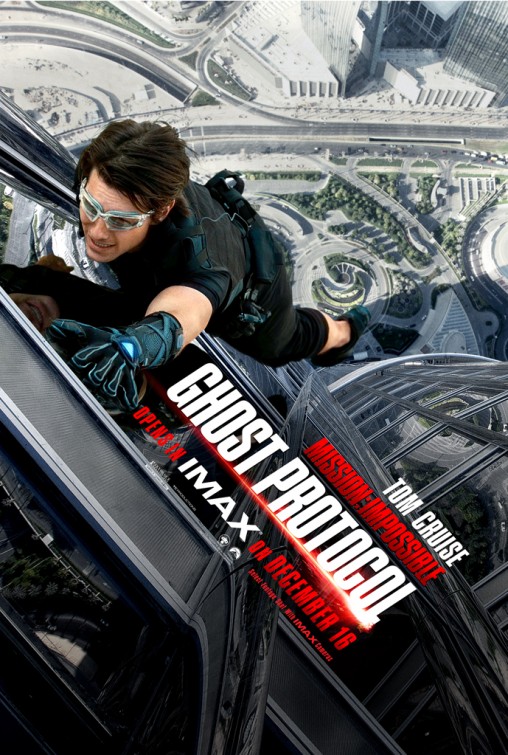
 Bird delivers in a major way in his live-action film debut. The man behind two of the best animated films of all time and Ratatouille, has shown that his keen skills of directing animation have easily translated to real people and real-ish explosions. Bird is a mad genius when it comes to staging elaborate action sequences; he teases out his action with organic consequences and his camera makes adept use of space and geography, and best of all you can easily follow what’s going on in the frame. So when we have an action sequence that takes place in the tallest skyscraper in the world, you know Bird is going to make fine use of this fact to accentuate his action. And the man does so in spades. The Dubai sequence is probably the how-did-they-do-that? standout that people will be most talking about. Hunt has to climb the outside of the aforementioned tallest building in the world using nothing but some special sticky gloves that don’t always work right. He has to climb several stories up, and then there’s the matter of going back down without them. But M:I 4 doesn’t rest on its laurels, because immediately after this sequence we have a feast of thrills. We segue right into a meeting between two parties where Hunt’s team has to pose as each member of this sit-down, orchestrating two separate simultaneous false meetings with the real bad guys. The two meetings dovetail one another as far their needs, making for a blissful parallel of escalating suspense. And then even after this, we get a foot chase into a sandstorm, which then becomes a dangerous car chase into a sand storm. And there are even more great stunts and spectacular action to come, notably a fight in a futuristic car park where the cars tumble from level to level.
Bird has such a firm command of his action, exercising his inspired imagination and all the tools in the special effects paint box. The screenwriters deserve recognition as well, Josh Applebaum and Andre Nemec, both of whom honed their writing chops on J.J. Abram’s sublime spy show, Alias. Their opening sequence, an escape from a Russian prison, sets the stage with Bird’s smart execution; setting up a problem and then letting the situation play out in surprising yet logical and clever ways. It may not have the epic scope of a Michael Bay flick, but Bird’s action is cool without having to be exhausting or noxious. The frenetic pacing rarely lets room for breathing. One of the film’s quiet moments ended in such a jarring fashion that it startled me and I kicked the patron sitting in front of me. I must also credit Applebaum and Nemec for producing the only Mission: Impossible movie that did not involve a turncoat. I was starting to think that IMF’s Human Resources department was in needing of a good housecleaning. Bird, and the screenwriters, has delivered a Mission: Impossible movie so good, with such kinetic and rewarding action sequences, logically utilized gadgets, sexy cars, sexy gals, and exotic locales. They’ve basically made the best Bond movie not to bear 007’s likeness.
Like the previous Mission: Impossible flick, this one emphasizes the team aspect, which makes a more fulfilling and interesting set of missions. M:I 2 became the “Ethan Hunt kicks people in the face for two hours movie,” which Chuck Norris might approve but otherwise was lacking. When J.J. Abrams got on board in 2006, the brand finally got back to its roots. And a team working together with individual strengths makes for a much more satisfying mission that also allows for multiple points of action. Simply out, if you have three people that need to do stuff in synchronicity, it plays out much better than watching Cruise kick people in the face. Choreography is always better when you have more dancing partners. Anyway, with M:I 4 we get some terrific teamwork that can be just as thrilling as the action sequences. Besides the breathless Dubai sequence, there’s a great sequence where the team has to infiltrate a sleazy Indian businessman’s (Anil Kapoor, the TV host from Slumdog Millionaire) cocktail party to get some special satellite codes. Jane is tasked with seducing the sleazy guy, Benji is left to operate a mechanical rover with a powerful magnet that will levitate Brandt, in a metal suit, across the system’s super hot inner mainframe, and Hunt is trying to lose his Russian pursuers. It’s a great sequence where all the pieces come together for maximum effect.
 Cruise has done plenty in the last five years to destroy audience good will, so it’ll be interesting to see if audiences warm back up to the man with the million-dollar smile. Cruise has always been an actor of ebullient energy and charisma, and this has always aided him in action settings and M:I 4 is no different. He’s still a credible action hero and a born movie star, whatever audiences think about his increasingly polarizing personal activities. Lessening Cruise’s load is a smart move, and Pegg (Paul) can provide needed comic relief while Patton (Precious) supplies the sizzle. My goodness can this woman fill out a dress in marvelous ways. Not to be completely sexist, she does a fair amount of ass-kicking too. Her fight with the French femme fatale agent (Lea Seydoux) was all kinds of awesome. Renner (The Town) seems groomed as a potential heir apparent for the franchise. His character is given a small amount of depth to work with, the guilt of a mission gone wrong that has a very personal connection to Hunt. At this point, Renner can do no wrong as an actor in my book. Although there’s only a nine year age difference between Cruise and Renner, so I don’t know how much more mileage that gives you as a franchise. Regardless, Renner is an actor of great conviction and intensity even when he’s silent.
In terms of the franchise, I’d say this fourth installment is just as good as Abrams’ M:I 3, though Abrams had a much better villain and the added emotional urgency of hunt’s wife in distress. Seriously, this is one really boring and completely interchangeable villain. For a movie about the world being on the brink of thermonuclear Armageddon, why do the stakes feel so low? It’s probably because the movie has deliciously orchestrated and eye-popping set pieces but very little urgency. World War III has never felt so ho-hum. Still, it’s hard to fault an action movie when it delivers such high amounts of adrenaline, perfectly packaged in well-developed action beats. This is a high-flying popcorn spectacle of the top order, a grandiose piece of Hollywood escapism. Mission: Impossible 4 is pretty much everything you’d want in a summer blockbuster, only shuttled to winter. I think Bird’s future is limitless, in animation and live-action, and I think the Broccoli family would do us all a favor by tapping Bird to direct a Bond movie. M:I 4 is a pretty good resume for the gig. That would be one mission to die for.
Nate’s Grade: A-
Share this:

Knight & Day (2010)
 Imagine a James Bond movie from the point of view of the Bond girl. That’s the premise for the curiously titled Knight and Day, a mostly breezy action movie that really resembles a romantic comedy with guns. It works thanks to the chemistry between Cameron Diaz (Bond girl) and Tom Cruise (super agent). She’s engulfed in a sketchy international spy caper that is replete with typical stock characters (sleazy agents, kooky scientists, angry authority figures). The movie, under the direction of James Mangold (3:10 to Yuma), tried too hard to be lighthearted and can veer from confidant to indifferent. The film is told from Diaz’s point of view, which means there are chunks of the movie where the action occurs off screen, which will naturally disappoint people. There’s one montage where Diaz has been drugged and she keeps going in and out, waking up to a different dangerous situation. It’s meant to be satiric but it might also frustrate. The action sequences, on whole, are well paced and make use of their exotic locales. Knight and Day doesn’t fully work due to its leaps in tone from satire to sincere romance, the on/off switch for the law of physics, and introducing a secondary antagonist far too late in the film. Cruise lays out a full-on charm offensive. You’re reminded that this man is a movie star, and Cruise has fun tweaking that image as well as the public perception over his mental state. His character may be crazy after all, but Cruise is having serious fun and you might too watching the man with the million-dollar smile.
Nate’s Grade: B
Share this:

Tropic Thunder (2008)
 Ben Stiller has been kicking around the idea for Tropic Thunder for nearly 20 years. It took a lot of time to get the script in fighting shape, but the time was well worth it. Tropic Thunder is tasteless and occasionally appalling but it is also wickedly, deliriously funny.
Set inside modern-day Vietnam, Hollywood is filming another epic war movie but this one’s in trouble. It’s over budget, behind schedule, and the first-time director (Steve Coogan) can’t control his actors. Tugg Speedman (Stiller) is a fading action star looking for another hit. Jeff Portnoy (Jack Black) is a crass comedian who’s after some real acting credibility. He’s also addicted to heroin and worries that people will only ever see him as a funny man who farts. Kirk Lazarus (Robert Downey Jr.) is a five-time Oscar-winning actor who, thanks to makeup and a lot of hubris, is playing the film’s African-American sergeant. Alpa Chino (Brandon T. Jackson) is a rapper breaking into acting and is steamed that the Hollywood producers gave the sizeable black role to a white guy.
The director is at his wit’s end and being bullied by producers back in America. He is advised by “Four Leaf” Tayback (Nick Nolte), the Vietnam vet whose story the film is based upon. Tayback says to get real emotion and real fear that the actors should be stranded in the jungle without their precious handlers and demands. So the director takes Speedman, Portnoy, Lazarus, Alpa, and newcomer Kevin Sandusky (Jay Baruchel) in a helicopter and out into the wild. Trouble is, the actors have been left in the middle of an actual drug war, except they think it’s all apart of the script.
 Tropic Thunder is all things to all comedies. It could be tagged as being a bit incoherent but that’s because the movie has so much going on. It’s a sharp satire of Hollywood moviemaking and the raging egos of actors, it’s a send-up of Vietnam war movies and their bloody clichés, it’s a fairly worthwhile action film, and it’s a stupendously politically incorrect comedy with plenty of crude humor mixed side-by-side with genuine wit. It’s a comedy that has the potential to leave you aching from slapstick humor one second and biting satire the next. This feels like a complete comedy and not merely a series of sketches. Every character has an arc, some great moments, and each actor brings something different and something wonderful to the fray. This is clearly Stiller’s greatest achievement as a director.
The focus of Tropic Thunder is all over the place, and no one is safe from Stiller and his co-writers Etan Cohen and actor Justin Theroux. This is a brutal insider satire that plays it broad and loud. There are great jokes that ridicule the pomposity of the entire movie industry and the pitfalls of celebrity as a whole. I loved the jabs at celebrities going overseas and adopting children like they’re souvenirs. The movie has caught flak from disability groups that are mad about the movie’s liberal use of the term “retard.” I don’t want to say these people are missing the point of satire, or the fact that an R-rated comedy should offend on some level, but the joke is clearly on Hollywood and how movies exploit those with mental handicaps under the guise of telling their harrowing and inspiring stories. Movies have long been chronicling the adventurous lives of those with disabilities, which also has the side effect of making these people seem less like, well, just people. In the film, Speedman stared in a movie called “Simple Jack” about a mentally challenged boy who thinks he can talk with animals. Then the character has to pop up later in the film, complete with hysterical dialogue that blows apart just how exploitative these movies are (“I’ll see you in my head movies, but this is one head movie that makes my eyes rain”). It’s performed in just the right tone to make you laugh at the industry and the individual and not because of any disability.
The way the film establishes character back-story is genius. Tropic Thunder introduces all four major characters through fake commercials and trailers, like Grindhouse. The trailers are hilarious and a great way to kick off the movie. Stiller stars in a sinking action franchise where the world keeps being overtaken by fire (“Now, the one man who saved the world five straight times — will have to do it again”). The action franchise’s idea is to just reverse the scenario and, as sequels do, make everything bigger. Black’s trailer revolves around an obese family of super flatulent idiots all played by Black. The sequence is constant farting but it’s so over-the-top and pumped with contempt for lame-brained Hollywood comedies. The best trailer is the one that gives us Downey Jr.’s character, the esteemed Kirk Lazarus. Set in an Augustine monastery around the Middle Ages, Downey plays a monk who finds that he must conceal his inflamed passions for another man of the cloth (a figure I won’t spoil). Think of it as a 12th century Brokeback Mountain, and Stiller and company know exactly where to hammer Hollywood: the go-go eye stares, the hesitant naughtiness, and the ridiculous marketing angles – the title is inexplicably Satan’s Alley. The opening collection of fake trailers serves as perfect comedy bon mots for the feast that is to follow. They whet your appetite and may be the greatest opening 10 minutes of any comedy in memory.
 Downey Jr. gives an unforgettable performance comprised of sheer brilliant comedic bliss. I loved every second he was onscreen and I fully expect the man to get an Oscar nomination for his work here. Now, the role of a Method actor playing a black actor naturally presents a tightrope that needs to be walked just the right manner to maintain a satiric tone that doesn’t turn ugly. Let me state clearly that blackface is never funny. It is repugnant and Hollywood has a rather depressing history with the unsavory practice (Gene Kelly and even Bing Crosby sadly did it). Tropic Thunder is not a Stepin Fetchit-style minstrel show where Downey makes eye-rolling racist stereotypes. The joke is not that Downey is playing a black man, the joke is that he is such an arrogant and egotistical actor that he thinks he can play anyone. Besides, Jackson chides him throughout the film for his unorthodox portrayal, which tells you where the filmmakers stand. Downey elevates every scene he steps into and gives a performance, like the film, that is densely layered with comedy. He never breaks character even when the cameras aren’t filming and even when he’s alone. He’s two steps removed; channeling a performance as a heralded Australian actor playing his idea of a 1970s black male. When Alpa derogatorily drops the N-word, Lazarus slaps him and then begins a speech with, “For over 400 years they have been using that word to keep us down,” and ends it reciting the lyrics to the theme song from The Jefferson’s. In that span of time, Downey takes you along on every stop in the dense, hilarious mind of Lazarus.
While the rest of the actors don’t ascend to Downey’s heights (years ago this would have doubled as a drug reference), the ensemble of Tropic Thunder works together smoothly and they help make the film so much more enjoyable. Black is great when he’s trying to be seen as a “serious” actor when they are filming. I love his rushed and hushed line deliveries. But he’s even funnier after going through the wringer of heroin withdrawal. A sight gag involving Black digging through his speedo had me in stitches. Stiller is playing his usual dimwitted blowhard but propels the plot forward. He knows exactly how to oversell for laughs, like when he’s being riddled with bullets in dramatic slow-mo or when he’s playing Simple Jack. Baruchel is a nice counter foil to the uncheck bravado and craziness of the other actors. Jackson has fun voicing his mounting vexation with Lazarus. Coogan and Nolte provide good small moments, and Danny McBride steals his scenes as a pyrotechnic special effects expert that wants to “make Mother Nature piss her pants.”
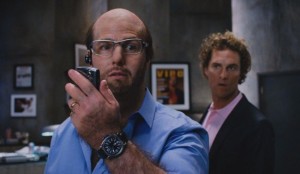 By now you’ve likely heard all about Tom Cruise’s small role in the movie as an irate, bald, fat, extremely hairy studio executive. It’s nice and amusing but I could have done with something different. Downey is unrecognizable in both physical appearance and through his speech; he fully inhabits a character that fully inhabits characters. Cruise, on the other hand, is instantly recognizable even with glasses, a paunch, and a shiny dome. It’s Tom Cruise playing a profane asshole but the joke wears thin. Cruise either needed to do something different or just be seen less, including his hip hop dance moves. And yet, Tropic Thunder has a running joke about Hollywood taking its beautiful A-listers and thinking that, through the power of makeup and superficial physicality, they can play any role. We’ve had a streak of Best Actress Oscar winners that have won accolades by stripping away their beauty and packing on the pounds (check out Charlize Theron in Monster). It seems like even the pretty girls are getting the ugly girl roles now; what’s a homely actress to do nowadays? So, in a way, Tropic Thunder is making fun of this line of thinking, that fat suits and some makeup are the great equalizer, but then it has Tom Cruise more or less falling into the same trap. He puts on a fat suit, a bald cap, but it’s still him and you hear Tom Cruise in every utterance. Maybe it would have been funnier if Cruise were playing a parody of himself since he is a studio executive at United Artists.
Tropic Thunder is a wildly funny movie that takes no prisoners when it comes to its sprawling satire. Stiller and company cut down the self-absorbed lifestyle and mentality inside the film industry and insecure actors. The film really shares the spotlight and each actor provides something different and welcome, and there isn’t a weak link in the bunch. Downey Jr. gives a brilliant comedic performance that will be long remembered. The movie is rude, crude, stupid, smart, and all over the place thanks to such a broad comic canvass. It took many years for Stiller to finally get Tropic Thunder off the ground but the wait was worth it. This is a rare comedy that eels loose, hits hard, and may warrant multiple viewings just to catch all the jokes-within-jokes. This is a movie with plenty on its mind, perhaps too much, but I wish more comedies were as well executed and skillful in their gags about gas passing.
Nate’s Grade: A
Share this:

Mission: Impossible III (2006)
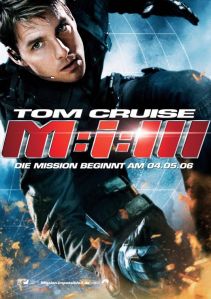 Few celebrities have had the intense flame-out Tom Cruise has experienced in a little over a year’s time. First there was the PDA-heavy relationship with Katie Holmes, never a wet tongue-kiss away from a camera. Then there was the couch aerobics on Oprah Winfrey’s set, bleating his over-the-top declarations of love like Roger Rabbit. This was followed by a series of testy interviews about his war of words on psychiatry and prescription drugs. Entertainment Weekly just ran a cover story asking, “Is Tom Cruise worth his paycheck?” He’s gone from Hollywood’s most bankable actor to a national punch line. To bring new life to Cruise’s spy series, he tapped TV mastermind J.J. Abrams to make his feature debut after Cruise churned through two seasons of spy series Alias DVDs. Abrams is a gifted franchise starter, first with Alias and then with Lost, and with Mission: Impossible III he does the best he can to erase the memory of Tom Cruise, daredevil of furniture.
Ethan Hunt (Cruise) is out of field work at the Impossible Mission Force, training recruits for the big time. He’s settled into a comfortable home life with Julia (Michelle Monaghan), a woman he’s blissfully engaged to be wed. Ethan’s happy home is disrupted when IMF needs his services. It seems one of his trainees (Keri Russell, Felicity goes badass) has been captured by an arms middleman Owen Davian (Phillip Seymour Hoffman), a man that will get any deadly force to the right bidder. Hunt reluctantly goes back into the field, assembling a team that includes Luther (Ving Rhames), Zhen (Maggie Q, quite fetching), and pilot Declan (Jonathan Rhys Meyers). Their mission goes badly and Hunt is reprimanded for his cavalier actions. He’s determined to snag Owen and get justice. This leads to an incredibly stuffed game of cat-and-mouse, each jockeying for leverage. There’s some super powerful device called the “rabbit’s foot” that everyone wants but it’s not really important. What is important is that Owen is eager to strike back at Ethan’s most vulnerable point — harming Julia.
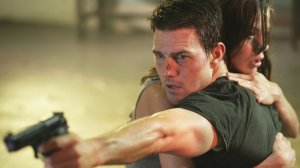 This movie is quite possibly one of the greatest TV adaptations of all time. No, not the Mission: Impossible series but Alias. Just like J.J. Abrams’ TV brainchild, this slick, propulsive caper puts a smart spin on familiar ground. We’ve got the flash-forward narrative trickery, the super gadgets, the undercover teamwork, the world-trotting sprawling vistas, and anchoring the whole thing with an emotional counterpoint, trying to lead a double, “normal” life and keeping your loved ones equally safe and in the dark. There’s a great scene in the middle of a mission where Ethan and Luther casually discuss the impossibilities of living a normal life given what they do. Luther warns that those close to you will only end up getting hurt, and by this point thanks to a startling, right-to-the-point opener with a gun to sweet Julia’s head, we know he’s right. That’s what makes the third go-round different: Abrams has injected some emotion into the darn thing. Ethan is pressed back into service and then becomes something of a knight in shining Kevlar, trying to save his beloved in the crossfire of international espionage. There are a handful of scenes between Cruise and Monaghan and they sell the emotional drama in tender quiet looks. As a result, the audience and Ethan are rooted to their seats beyond just the assembly line of pyrotechnics. Just like Alias (at least up until Season 3 when it jumped the shark with the long-lost sister). It’s like if True Lies was played straight and Tom Arnold was mercifully forgotten.
Ah, but what pyrotechnics they are. Things get heated with a trip to the Vatican and they literally do not let up, all the while raising the stakes by pulling Ethan’s home life closer to the danger of his job. You’ll be left breathless absorbing all the exhilarating action sequences, which to my best estimate are more than the first two flicks combined. The stunts are superbly death-defying. What makes action sequences so enjoyable, pay attention you Hollywood rubes, is when the stage is set and then we watch organic complications. Abrams has a tremendous feel for action and playfully extends virtuoso sequences of awesome carnage. An attack on a bridge is simply outstanding and gave me an overload of geeky joy. We’re given the tight, controlled setting, and then Abrams introduces the outside conflict and keeps developing it masterfully step by step. There’s air attacks, there’s running back and forth amongst the wreckage, there’s searching for guns while escaping attack, and then there’s flying leaps over gaping concrete holes. I was jumping in my seat with boyish glee. The slow-mo gun toss between Cruise and Russell? Awesome. The swing-shot jump off a gigantic skyscraper in Shanghai? Awesome. The use of Simon Pegg (Shaun of the Dead) as gadget guru? Awesome. Mission: Impossible III is, if nothing else, an incredible adrenaline rush orchestrated by a man with a finger directly on the pulse of his audience. By summer popcorn standards, Mission: Impossible III is everything you could hope for. Sure it’s highly implausible but it’s just so damn fun.
 Abrams has created quite a breakthrough for himself. Long regarded as a TV visionary for his tangled, engrossing pop-pulp like Alias and Lost, Abrams shows what he can do with a bazillion dollars and one of the world’s most recognized stars. Abrams intelligent, deft handling of his material, elevating tired genre devices with flash and reverence, reminds me of a young Steven Spielberg. This is a man that respects his material and respects his audience, but still knows how to bring home an entertaining movie. I’ve followed Abrams’ career since getting hooked on Alias in 2001, and I’m confident he will become the best friend a movie geek could ever have (Star Trek fans should be clicking their heels about Abrams’ rumored involvement). Even though Mission: Impossible III is Abrams’ film debut (and on record the most expensive ever for a first time film director) he already shows more command, more wit, and more hipness than most of Hollywood’s graying old guard.
Finally, this is the first Mission: Impossible film to utilize the team aspect of the TV show. Granted, Cruise still does most of the running, jumping, climbing trees, but thankfully this movie is more than the Tom Cruise Kicks Everyone in the Face Show a.k.a Mission: Impossible II. The supporting cast all have their one great moment and part of the fun is their interaction, seeing the pieces fit into place. Just like last summer’s Batman Begins I would like to see another movie immediately with everyone involved. Make it happen. This is the Mission: Impossible world I want to explore in greater detail.
Mission: Impossible III is not bulletproof. The movie seriously needed more time for its villain. Hoffman does a great job of bringing his bad man to grumpy life. He goes about business with a detached nonchalance, like a plumber fixing his 10,000th clog. It may sound silly but it works because Hoffman gives his character a lizardy, unscrupulous sense of ethics. He really will put a bullet between the eyes of anyone, possibly while reheating some food in his microwave. That’s the greatness of Hoffman’s villain, how ordinary he sees his line of work and what it calls him to do. Now, with such a terrific villain it would behoove Mission: Impossible III to give him plenty of screen time. Sadly, Hoffman has about three real scenes, and his end is anticlimactic and so is the film as a whole. And what does IMF have to do to curb moles? There’s been one in all three Mission: Impossible movies. Maybe they should offer better vacation plans.
Tom Cruise may have done a lot to wear out his welcome with the public but he knows to surround himself with good people. The decision to let J.J. Abrams helm Mission: Impossible III has finally given this franchise vision and sustained excitement. This movie is far more emotionally based than any other in the series and there’s a genuine emotional reason for all the fireworks this time. The team aspect is finally addressed and Hoffman makes a truly lecherous, scary villain. But the bread and butter of this flick are its breathless action sequences, brilliantly choreographed by Abrams, a name destined for even greater things. Abrams knows how to spin genre clichés into clever, loose, twisty, funny, thrilling, emotionally centered gold. I don’t care if Cruise abused a couch and the public’s good will; Mission: Impossible III is an extravagant popcorn movie and a great way to start the summer. If only they were all like this.
Nate’s Grade: B+
Share this:

War of the Worlds (2005)
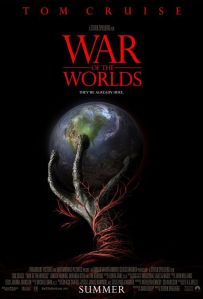 Steven Spielberg is America’s favorite director. He’s made films about alien encounters before (hell, it was most of the title of one movie), but Spielberg has never tackled evil aliens. Alien movies either involve cuddly little green men or the kind that want to destroy our planet. The latter is usually more interesting and finally Spielberg takes the trip with War of the Worlds.
Instead of focusing on high-ranking government officials, War of the Worlds concentrates on an everyday man just trying to save his family. Ray (Tom Cruise) is a New Jersey dock worker and a divorced pop. His ex-wife (Miranda Otto) has dropped off the kids (Dakota Fanning, Justin Chatwin) for the weekend. Ray isn’t exactly father of the year and his sullen kids remind him of this fact. Meanwhile, there seems to be a series of lightning storms hitting the world that then leave an electronic magnetic field that eliminates all the electricity in the area. A storm hovers over New Jersey and lightning strikes not once but over twenty times in the same spot. Ray goes to investigate the site. The ground beneath trembles and caves in. A giant machine with three tentacle-like legs emerges from the earth and starts zapping any humans it can find. Ray escapes, packs up the kids in the only working car in town, and runs, runs, runs, all with the aliens just a step behind ready and waiting for a people zappin’.
 There are three things an audience will have to put behind them in order to enjoy what War of the Worlds has to offer.
1) The film has no plot. War of the Worlds spends the first 15 minutes setting up its handful of characters and their misery with each other. After that, it’s nothing but all-out alien attacks. That’s really it. Ray and the kids run to one place and think they’re safe. The aliens come and attack. Ray and the kids escape to a new place. The aliens come and attack. Lather, rinse, repeat. There is little more to War of the Worlds.
2) Spielberg has pretty much forgotten how to make good endings. I think A.I. was the nail in the coffin. Routinely Spielberg films seem to run out of gas or end rather anticlimactically, but A.I. really cemented the glaring fact that Spielberg cannot sit still with an unhappy ending. So, yes, War of the Worlds both ends anticlimactically and with an abrupt happy ending. Of course the H.G. Wells novel ends in the same fashion so there’s less to gripe about, until, that is, until you reach the implausible reunion. Spielberg can’t keep well enough alone and forces the story to be even happier at the cost of logic.
3) Ignore whatever feelings you hold about Tom Cruise. Off-screen, many feel that Cruise is becoming an obnoxious, pampered, self-involved, couch-jumping cretin. No matter what your feelings about Cruise and his self-taught knowledge about the history of psychiatry, that is not who is in War of the Worlds. He is playing a character. I never understood the argument that because you dislike an actor as a person it invalidates all their acting. I’ve read magazines that actually say people are staying away from Cinderella Man because people think Russell Crowe is a grump. In War of the Worlds, Cruise plays a deadbeat dad who finds his paternal instincts during the end of the world. The character isn’t deep and acts as a cipher for the audience to put themselves in the scary story. Plus it’s not like Cruise is a bad actor; he has been nominated for three Oscars.
 Since this is a large Hollywood horror film, the acting consists mainly or healthy lungs and frightful, big-eyed expressions. So it seems natural that little Dakota Fanning would play the role of Child in Danger. Cruise somehow finds some points in the story to exhibit good acting. There’s a moment right after Ray and his kids escape to their mother’s home. He tries making them food out of whatever they saved which amounts to little more than condiments and bread. His kids rebuff his offer and he throws the sandwiches against a window and repeats to himself to breathe. In lesser hands this moment would just be some light comedy, but Cruise turns it into an opportunity to see the character’s desperation. Tim Robbins shows up late playing a nutball going through some self-induced cabin fever.
War of the Worlds, at its core, is a post-9/11 horror film on a mass scale. Spielberg plays with our paranoia and anxiety and creates a movie that is fraught with tension and an overriding sense of inevitable annihilation. The aliens are so advanced and so powerful. The deck definitely seems to be stacked against Earth. I felt great amounts of dread throughout the film knowing that the aliens will find you, they will get you, and it’s only a matter of time. And that’s the recipe for a perfectly moody horror film. War of the Worlds is chilling in its depiction of worldly destruction, and yet it becomes even more terrifying by how realistic everything seems as the world falls apart when its under attack. The introduction of huge, human-zapping aliens is expected to be scary, but who knew human beings at their wit?s end could be just as scary? A crowd of people turns into a violent mob fighting for any last bit of space in Ray’s working car. A man sitting on top of the hood is actually ripping away chunks of windshield with his bare, bloody hands.
War of the Worlds really benefits from awesome special effects. As stated before, we live in a jaded age where most special effects have lost feeling special. Computer advancements have also created a more advanced audience able to point out the big screen fakery at a faster pace. If you don’t believe me, look back at some movies from 1995 or so and see if you’re still wowed. War of the Worlds marvelously displays destruction on such an incredible scale. City streets ripped apart, houses blown up, cars flipping through the air, ferries plunged into the water, and it all looks as real as can be. There are moments I know that have to be computer assisted, like seeing miles and miles of stranded vehicles and people on the side, but it looks like they filmed it for real. The only thing that seemed hokey was people being vaporized by alien ray guns and having their clothes remain. I don’t know if Spielberg was going for a veiled Schindler’s List reference or they thought anything more grim could rock their PG-13 rating.
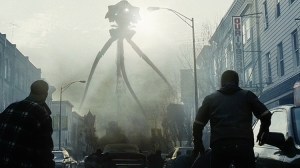 Due to all of this realism, War of the Worlds is not a film to take young children to see. The startling realism and suffocating sense of dread will keep kids up for weeks with nightmares, maybe some adults too. There’s more than a passing reference to 9/11, and that may be a wound too fresh for some. Thousands of people walk the streets as homeless refugees. There are large tack boards with hopeful missing fliers of relatives. One of the most horrifying images consists of a flowing river filled with floating corpses. There’s also a grand set built around the remains of a downed airplane. When Ray is trying to explain the situation at first, his son interjects, “Were they terrorists?” Spielberg calculatingly uses our memories of 9/11 to create a true-to-life horror story that doesn’t feel exploitative. “War” implies some kind of even ground. This is a massacre, and one parents should be wise not to bring youngsters to.
With War of the Worlds, Spielberg has crafted a chilling, realistic, post-9/11 horror movie. The action is big, the destruction is bigger, and the dread is at a near breaking point. Sure the movie is plotless and the ending is anticlimactic and forcibly happy, but War of the Worlds should appeal to those looking for the safe way to witness the end of the world. Spielberg invented the big summer movie and War of the Worlds is a taught return to form. It’s not much more than watching aliens destroy things but for many that will be plenty for a summer movie.
Nate’s Grade: B
Share this:

The Last Samurai (2003)
 The Last Samurai (2003)
Premise: Alcoholic Civil War vet (Tom Cruise) is hired by the Japanese emperor to modernize his army. After being captured by samurai, he finds solace and fights alongside his former enemy against the emperors modernized army.
Results: A miscast Cruise is not turning Japanese, no matter if he really thinks so. The Last Samurai is a conservative by-the-book epic the limply transports the framework of Dances with Wolves and effectively creates Dances with Japanese People. Dont believe me? Lets go to the videotape. Civil War vet (check) haunted by massacre of Native Americans (check), finds peace with a foreign culture (check), falls in love with one of the foreign women (check), and must battle the invading former culture that threatens his new happiness (check). The film does have lovely cinematography and production design, if that means something to you.
Nate’s Grade: C+
Share this:

Vanilla Sky (2001)
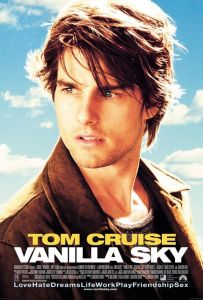 Talk about a film’s back story. Tom Cruise signed on to do a remake of the 1997 Spanish film Abre Los Ojos (Open Your Eyes) which was directed by Alejandro Amenabar. During the filming the romance between Cruise and Penelope Cruz (no relation) got a little hotter than expected onscreen and broke up his long-standing marriage to Nicole Kidman. At the time she was finishing filming The Others which is the second film by Amenabar. This, by the way, is much more interesting than Vanilla Sky unfortunately.
Cameron Crowe’s remake starts off promising enough with Tom Cruise running around an empty Times Square like a Twilight Zone episode. Afterwards the film begins to create a story that collapses under its own weight. David (Cruise) is a rich boy in control of a publishing empire inherited through his dear old deceased dad. He has the time to throw huge parties where even Spielberg hugs him, and even have crazy sex with crazy Cameron Diaz, whom he tells his best friend (Jason Lee) is his “f*** buddy.” David begins to see a softer side of life with the entrance of bouncy and lively Sophia (Cruz) and contemplates that he might be really falling in love for the first time. But this happiness doesn’t last long as jealous Diaz picks up David in her car then speeds it off a bridge killing her. Then things get sticky including David’s disfiguration, his attempts to regain that one night of budding love and a supposed murder that he committed.
 Crowe is in over his head with this territory. His knack for wonderful exchanges of dialogue and the perfect song to place over a scene are intact, but cannot help him with this mess. Vanilla Sky is an awkward mish-mash of science fiction. The film’s protagonist is standoffish for an audience and many of the story’s so-called resolutions toward the end are more perfunctory than functional. The ending as a whole is dissatisfying and unimaginative. By the time the wonderful Tilda Swinton shows up you’ll likely either be asleep or ready to press the eject button yelling “cop out!”
Seeing Vanilla Sky has made me want to hunt for Amenabar’s Abre Los Ojos and see what all the hype was about, because if it is anything like its glossy American counterpart then I have no idea why world audiences went wild for it.
Nate’s Grade: C
Reviewed 20 years later as part of the “Reviews Re-View: 2001” article.


 nathanzoebl
You must be logged in to post a comment.