Blog Archives
Mission: Impossible – The Final Reckoning (2025)

It’s not just the increasing age of producer and star Tom Cruise, the Mission: Impossible movies have become victims of their own outlandish success, and this might have led to their ultimate end. This franchise has become known for its amazing stunts and placing Cruise in the thick of them. After every gasp-inducing, eyeball-popping stunt, the inevitable question arises, “What could top that?” And so writer/director Christopher McQuarrie, who has steered the franchise for a decade straight, has placed himself in a filmmaking arms race of action set pieces, and these budgets keep getting bigger and bigger, to compensate for the increasing scope and scale. As a result, these movies need to make an even higher amount of money to break even to cover their expanding expenses, and it doesn’t look like the M:I franchise has reached that next level of success (six of the previous seven movies have grossed between $175 million and $220 million domestically). As a result, Final Reckoning is the winding down of the franchise, or at least this incarnation, and it has enough to satisfy long-time fans, yours truly included, but it’s also a reminder of how things have gotten away from the series in the name of chasing spectacle.
Agent Ethan Hunt (Cruise) is tasked once again by the Impossible Mission Force (IMF) to save the world. In a continuation from the 2023 movie, Dead Reckoning, an evil A.I. known as The Entity is taking over the world’s complex computer networks and taking over control of nuclear missiles. It’s only a matter of time before the last four nations fall victim as well, so Ethan and his team (Simon Pegg, Ving Rhames, and now Hayley Atwell as Grace) must work together to get the only code that can kill The Entity.

Final Reckoning is the Scream 6 of the Mission: Impossible franchise. For those who never saw the sixth entry in an irony-drenched, self-reverential slasher series, it was intended to be the final entry in the franchise, and in doing so that made it try to tie back as many elements and moments as possible to the previous five movies. It was meant to feel not just final but full-circle for the fans. Naturally, the problem for Scream 6 is that it wasn’t going to be the final movie, and so a sequel is scheduled in 2026, and all that finality and franchise-reflection seems a bit like misguided internal stargazing. Coincidentally, the Mission: Impossible franchise also began the same year as the first Scream, 1996, and so this movie is intended to (possibly) close the door on the 30-year franchise and on (possibly) Ethan Hunt’s career as the best damn agent the IMF has ever had and yet whom they always doubt his motives in every movie.
M:I 8 takes far, far too much time trying to set up its stakes, which were already set up in M:I 7, which at the time was titled Dead Reckoning Part One before the “Part One” was scrubbed. Seriously, the first 45 minutes or so is awash in M:I clips from the previous seven movies and sloppy attempts to connect everything back together. Now the evil A.I. threatening the world has been revealed to be born from… the “Rabbit’s foot,” the undetermined MacGuffin from the third Mission: Impossible in 2006. Is that better? Does anyone really care about that? How about one of the cops being the son of a previous character? Does that change your opinion of Chasing Cop #2? How about the one guy in the first movie who found Ethan’s knife after he broke into the CIA in that movie’s most memorable sequence? Did you ever wonder what happened to him? Did you ever care about his well-being? I strongly doubt it. These Easter eggs to the older movies would be less egregious if this supposed final movie didn’t squander its first 45 minutes going over its own history as a means of trying to convince the audience This Stuff Really Matters. It’s even more egregious when the running time is 165 minutes long. All of this backward-looking ret-coning and clip show montages feel like an attempt to add weight to a franchise that never needed it. Let the stunts and set pieces stand for themselves. I don’t need all this nostalgic congratulatory back-patting.
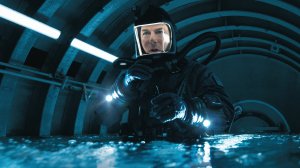
And there is a truly outstanding action set piece that anchors this movie, so much so that it actually comprises a full hour of the film. Set up in the preceding movie’s prologue, we know the only way to kill the evil A.I. is by securing a code located in a Russian submarine at the bottom of the Bering Sea. Just planning to find the location is the first hurdle that Ethan and the team have to surmount. Then there’s getting onto a clandestine U.S. submarine and launching out its tubes to swim to the bottom of the ocean, securing passage inside the fallen sub, and working one’s way through the different chambers, filled with frozen dead bodies, while the sub rolls around, tumbling further and further along the ocean floor. Each smaller sequence has a clearly defined series of mini-goals and organic complications, the kind of exciting escalations that make these set pieces so much better. It’s not enough for the pros to come up with a comprehensive plan, there needs to be unexpected complications that force them to improvise. A foolproof plan that goes perfectly is anathema to action cinema. This sequence has it all, which is why I have no qualms about its length because McQuarrie has justified every link in this set-piece chain. It’s also fantastic visually and really taut, especially as Ethan is tumbling through the innards of the sub with torpedoes falling over and pinning him underneath. This is a prime example of the maximalist virtuoso blockbuster filmmaking excellence that people have come to expect from the franchise.
The problem is that there’s an entire hour after this sequence and, once again, an M:I movie has peaked early. I think only Fallout and Dead Reckoning have their best moments during their actual climaxes. It hurts that Gabriel (Esai Morales) is the weakest villain the franchise may have ever had. I don’t care that the prior film tried to ret-con younger Gabriel into killing Ethan’s love and thus motivating him for vengeance and entering into the IMF. That personal connection and tragedy is a transparent attempt to make this character more important and menacing, and frankly, I am still astounded that this guy… THIS GUY… killed Rebecca Ferguson’s Ilsa. I can confirm, sadly, she is still dead, a reality that astounds me in the realm of a spy thriller where people assume identities. It’s she that Ethan should be fantasizing about in what could be his final moments, not Grace, and I will stand by that (no disrespect to Atwell, who is a genuinely fun and flirty addition to the team as an expert thief).

Regardless, back to Gabriel, who is just an empty suit of a villain, partly because the real villain is the scary A.I. conquering the world’s nuclear arsenals. It’s hard to really vilify a computer code for a movie, so enter this human handler, but he was uninspiring, so they added the secret back-story connection. It doesn’t work. I don’t really care about this guy being defeated, nor do I find him particularly threatening, miraculously killing Ilsa notwithstanding. The ultimate fight atop warring biplanes is visually impressive with its aerial photography, but the conclusion feels anticlimactic and the thrill of the set piece feels even slightly redundant when we remember Cruise has already hung from the side of a plane in M:I 5 and dangled from a helicopter in M:I 6. There’s yet another ominous timer ticking down, yet another deadly device with wires needing to be cut, and yet another side character possibly bleeding out to death. It feels rather par for the series, perhaps a thematic distillation of all those clips. There’s also some extra Fail Safe-style political hand-wringing at the highest levels of the U.S. government whether to give Ethan the benefit of the doubt or resort to some unorthodox methods for added stakes. It just adds up to a final hour of some strong moments in passing and too much of the same for a franchise that chartered new heights.
Placing it through the M:I pecking order, Final Reckoning is probably the weakest of the McQuarrie Era and arguably lesser than Mission: Impossible III, but it is leagues better than the first two Mission: Impossible entries. Realistically, this isn’t the end of the Mission: Impossible franchise, which has grossed close to five billion dollars over the span of its eight movies, but it is the end of Cruise as our star. The franchise was already previously engineered to hand off to Jeremy Renner in 2011’s Ghost Protocol, but then the movie proved too popular to persuasively function as writing off Ethan Hunt (unlike the other franchise also trying to hand off to Renner at the time, 2012’s Bourne Legacy, which proved so unpopular that Matt Damon came out of Bourne retirement). Cruise is now 63 years old and probably aware that these kind of death-defying stunts might be behind him even at his pace. Though I think the three separate shirtless scenes with Cruise are intended to dissuade you about the limits of his age (hey, I hope I look as good as Cruise’s abs when I’m 63). Final Reckoning is another chance to bid goodbye to its seminal action hero, which may be why there’s so much looking back and connecting unnecessary dots. This franchise is a celebration of the highs of big–budget action storytelling with the most game superstar with a death wish Hollywood could provide, so it’s bittersweet to see it reach some form of an end. McQuarrie, the David Yates of the franchise, has been an excellent shepherd with a kinship with Cruise for grand popcorn entertainment. It’s not the best entry but even a lesser M:I movie still rises above just about most studio action cinema. It’s definitely underdeveloped, too long, and structurally questionable with its pacing and climax, but at its best, it still reminds you why this franchise rose above the rest.
Nate’s Grade: B
Share this:

Mission: Impossible – Dead Reckoning Part One (2023)
 I was a nominal fan of the Mission: Impossible series after three movies, and it seemed like the American public was feeling the same. After 15 years, it felt like the franchise was considering a soft reboot/shift with 2011’s Ghost Protocol, setting up Jeremy Renner as the heir apparent to Tom Cruise’s super spy, Ethan Hunt (weirdly, Renner was also set up to be another franchise replacement for Matt Damon’s Jason Bourne in 2012). Except what may have been initially planned as a franchise hand-off became a franchise renewal, with a delightfully twisty plot, fun teamwork as they scramble to adapt, and a show-stopping action set-piece that remains the franchise’s high-point, the scaling of the towering Burj Khalifa skyscraper. It also reminded us that not only does Cruise love to run but the man has a death wish when it comes to performing his own amazing stunts. With Cruise firmly back in place as lead, and Renner jettisoned (which also happened after 2012’s The Bourne Legacy), the franchise was further boosted by two of its best additions: actress Rebecca Ferguson and writer/director Christopher McQuarrie. The Oscar-winning Hollywood screenwriting staple was not known as much for his directing efforts, but he became a Cruise confidant after 2008’s Valkyrie, and he’s worked almost exclusively on Cruise projects ever since. He earned the man’s trust and proved a fantastic action director. 2018’s Mission: Impossible Fallout is just blockbuster filmmaking at its high-stakes finest. I was bouncing in my chair with excitement and simply luxuriating in action thriller nirvana.
This time Ethan Hunt (Cruise) and his select team of trusted friends and colleagues are battling a villain terrifyingly relevant to our modern times, especially in light of the screenwriters’ strike – artificial intelligence. The big bad is an A.I. that can control the world’s security apparatus, and it’s become self-aware and resentful of its human overlords. It exists inside a computer console inside a Russian submarine at the bottom of the Arctic ocean under a wall of ice, and the A.I., known as “The Entity,” doesn’t want to ever be found (must be an introvert). If only it was that easy. The world is racing to be the first to claim this unparalleled prize, and the Impossible Missions team has to ensure they can find the location, which of course involves a MacGuffin, this time two interlocking keys to access the A.I. sub station. Can Ethan get there first and can he even trust his own government to do what’s best with access to this kind of power?
 Mission: Impossible – Dead Reckoning Part One is a mouthful of a title. We got a colon, a dash, and a “part one,” a presumptuous gamble that after 160 minutes the audience is going to be ravenously hungry for a continuation in a series that has never had a two-parter before. In short, the movie is a lot, a lot of the same action and renowned stunt work we expect, and a lot of setup and extension that might have been better trimmed by focusing on one movie rather than setting up two. McQuarrie has done this before and been successful without the need of a direct two-parter. For all intents and purposes, Fallout is a direct sequel to 2015’s Rogue Nation, carrying over the same villain for the first time in the series and the ongoing relationship between Ethan and Ilsa Faust (Ferguson). Both of those movies feel complete and satisfying and well-designed in structure and development without needing one part to complete the other. With Dead Reckoning Part One, henceforth known as M:I 7 to spare me from writing this title every time, it feels like an overlong setup. By the end of the movie, our characters know where the A.I. is located but they still don’t know where the sub is or how to get there, which means the entire movie could have been collapsed into a more streamlined venture. Part of this may be the production troubles where they had to shut down and rejigger the plot multiple times from COVID outbreaks, as M:I 7 is the last of the big Hollywood movies to release that was shutdown in 2020 by the devastating pandemic. It all feels a bit overstretched and absent a satisfying conclusion.
The draw of the franchise, and chiefly its 2010s renewal back into the zeitgeist, is still the eye-popping stunts and set-pieces and Dead Reckoning still delivers. Most viewers will likely find the final action sequence aboard a speeding train to be the high-point, and it’s got some wow moments, my favorite is when the train is hanging over a blown bridge and Ethan has to leap from train car to train car before it plummets, oh and it’s all at an incline. It turns each car into a new obstacle to overcome utilizing its specific dynamics, like a dining car with a falling piano to a kitchen with vats of hot grease to avoid. The standout stunt involves Cruise driving a motorcycle off a mountain in a desperate effort to parachute onto this speeding train. However, this whole train sequence didn’t excite me too much, outside of its beginning stunt and the end. Watching men chase one another atop the speeding train, let alone wrestle and fight with knives, only serves to limit what can be done and it reminds me how fake the moment is for a franchise that has made its mark on its daredevil realism. That extended middle feels a bit too much like other Hollywood thrillers and action movies, and that’s what made it disappointing for a series I consider the current gold standard of franchise action.
 A much less heralded sequence around the forty-five minute mark was my favorite, where Ethan is running around the Abu Dhabi airport while the following takes place: 1) Ethan trying to evade federal agents (the dependable Shea Whigham) looking to arrest him, 2) Ethan is trying to find the owner of one half of the MacGuffin keys who happens to be a pickpocket that keeps giving him the slip, 3) Ethan’s team, Luther (Ving Rhames, the only other actor who has appeared in every M:I film) and Benji (Simon Pegg) trying to find a nuclear bomb in a suitcase through the maze of baggage claim and disarm it, 4) the introduction of our villain Gabriel, well, our primary lackey to The Entity, who also happens to be a former IMF turncoat who killed Ethan’s girlfriend and essentially “made Ethan Hunt who he is” following Batman logic. This entire sequence is pure McQuarrie splendor, where it introduces the different characters, several at cross-purposes, lets them loose and then finds organic complications and specific turns that take advantage of the geography as well as the character’s emotional states. I loved it, and it made me hopeful that after a bit of a slow start that M:I 7 was now cooking and would be the prolonged deluge of near-perfect set-pieces that was Fallout. Not so much, but this sequence was indeed good fun.
Another issue I had was that our villain, again more like chief lackey, is so bland. I like Esai Morales (Ozark) as an actor, but the character of Gabriel is such a non-starter. Even giving him the personal history with Ethan feels like an admission that this bad guy has little to offer on his own. I think it’s part of how the character is written but I think it’s also a reflection that he’s the number two behind the all-powerful, scheming A.I., and then he too has a number two (number three?) played by Pom Klementieff (Guardians of the Galaxy vol. 3), and she is so much more engaging as an antagonistic presence. She’s the one driving through cars and stonework throughout Rome to chase down Ethan. She’s the one who fights him in a narrow alleyway, a nicely claustrophobic change-of-pace action moment for a series that gorges on scale. If the true villain is going to be an A.I., why can’t Pom simply be its number two hench-person? Gabriel is redundant and boring and his fight sequences don’t feel believable against this crew.
 There are a couple other storytelling choices that I wasn’t happy with, but I’ll save delving into those for the sake of spoilers. Suffice to say, I hope Dead Reckoning Part Two in 2024 course corrects and we have some welcomed returns. It’s kind of fun to see Kittridge (Henry Czerny, Ready or Not) make his first reappearance since the 1996 M:I and also get so much screen time. He’s essentially the face of the U.S. government infrastructure for the duration of the movie. His clenched-jaw consternation is a nice foil to the always rogue super spy.
Dead Reckoning – Part One is a good but not great Mission: Impossible movie, conceived as two parts and suffering some of the consequences of its over-extension. The thrills are still there, the sturdy production values, the emphasis on the spectacular stunts and fun action set pieces, so any fan of the franchise will find enough to enjoy over 160 minutes. The addition of Hayley Atwell (Avengers: Endgame) as the wily pickpocket who has stumbled into international espionage is great, though she cannot escape feeling like an Ilsa replacement while Ferguson is off-screen for too long. Cruise is still the movie star who delivers the most from film to film, and his high-wire efforts are appreciated. By the end of the movie, the sub is still at the bottom of the ocean, our characters are still in a race to find it, and I wondered why we couldn’t have ditched “Part One.” The answer, as much in Hollywood, is of course money, but I wish this Part One made me more psyched for Part Two.
Nate’s Grade: B
Share this:

Top Gun: Maverick (2022)
 Until just the other day, I had never seen Top Gun. Growing up in the 80s into the 90s, I was familiar with the film as it was a staple in friends’ homes, as was the lousy Nintendo video game, and one of the major pillars of Tom Cruise becoming a superstar, but I was too young when it came out and then it got buried behind other movies I always intended to catch up with. Honestly, as I got older, I just didn’t have much interest in rote military thrillers the likes of Tom Clancy (I dub them “dad movies,” as they’re my father’s long-standing Clancy-loving preference). Then came the 2022 sequel, Top Gun: Maverick, and it became Cruise’s highest-grossing movie of his blockbuster career and the fifth highest-grossing movie of all time. I’m probably one of the last few people on the planet to finally catch Maverick and I’m a little befuddled what made this movie as highly praised, to the point where it’s a given it will be nominated for Best Film awards and even stands as populist chance of winning. Maverick is a perfectly enjoyable action movie with satisfying character arcs. It’s an example of what big-budget moviemaking can accomplish when the right artists are aligned. However, let’s not start jumping on any couches and going nuts here. It’s a solid sequel elevated by a great finish.
We follow Maverick, a.k.a. Pete Mitchell (Cruise), as he’s tasked with training the next generation of top guns for a very specific, highly dangerous aerial assault mission to take out a foreign nuclear arms lab. The big issue is that one of these pilots, Rooster (Miles Teller), is the son of Maverick’s former wingman, Goose (Anthony Edwards), who died in the 1986 original movie. Mav has been denying Rooster senior-level opportunities out of fear of being responsible for the death of father and son, but Rooster will not be ignored and denied, and they’ll square their feelings of guilt and resentment over the course of this impossible mission.
 I can see why this movie would be successful. It plops our older hero down in a teaching role which allows the satisfying arc of building a team, gaining his own feet as a teacher, and the two-way transmission of respect. It’s a formula that works. We watch the younger pilots grow and become more capable, we watch Maverick settle into a natural teaching role, reaching out to others, and we also watch him and his team stick it to the naysaying Naval authority with every victory. It’s all there and developed with enough precision by screenwriters Ehren Kruger, Eric Singer Warren, and Cruise-lifeline Christopher McQuarrie to operate smoothly. In the 1986 movie, we had hotshot pilot Maverick learning personal responsibility and teamwork, though much of that original movie was preoccupied with so… many… characters telling young Mav how gosh darn special he really is and how the U.S. Navy needs him so bad. The emotional reconciliation also works between Maverick and Rooster (I guess the name and the mustache are affectionate odes to dear deceased dad) and serves as an effective emotional foundation for old fans and new. The drama works and the legacy elements and cameos feel better incorporated, though the “Great Balls of Fire” piano bar singalong was awkwardly forced nostalgia bait. The romance with Jennifer Connelly’s single mother barmaid even feels a little wiser and more honest rather than setting her up as a good-looking woman cheering our hero onward. Nobody’s going to leave the film citing the prerequisite love story as their favorite part, but it’s at least more thoughtful and less tacked-on than I was dreading. For all these reasons, Top Gun: Maverick has the tools to succeed as a sequel that can transcend its initial nostalgic fandom.
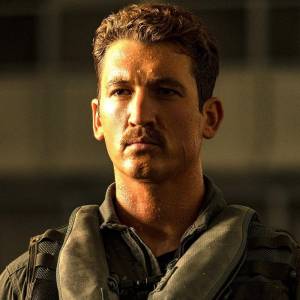 Where the movie really takes flight is in its action photography and the final act. Director Joseph Kosinski (Oblivion, Spiderhead) filmed the aerial sequences with IMAX cameras and the in-cockpit perspectives make the action far more immersive and thrilling. The actors were charged with being their own camera operators while flying in their planes, so Kosinski would wait on the ground and then review the footage and then send the actors back up in the air for further takes. It’s a painstaking process, made more so by Cruise’s obsessive insistence on making things as real as possible, and it pays off remarkably. The dazzling footage within the cockpits as they swoop and swerve has an exciting verisimilitude that can’t be replicated by computer effects. The dogfights are easy to understand and follow thanks to the careful visual orientation from Kosinski, smooth editing that doesn’t become jumbly, and clearly stated goals and mini goals within the mission training (McQuarrie is so good at this stuff). It made me wish that they never got out of the air. It also made me envious of the grandiose IMAX presentation.
It’s the final act that really seals the deal from an entertainment standpoint. The team tackles their mission at the 90-minute mark, and it’s thrilling and everything you’d want in an action set piece. The way the mission is structured in well-defined pieces working in tandem reminded me of the Mission: Impossible franchise during its 2010s swing into becoming the best studio action franchise. It makes for a satisfying and thrilling conclusion, and it’s not a real spoiler to say that the team of underdogs defies the great odds and succeeds, but then the movie surprised me. There was still twenty minutes left, and Top Gun: Maverick says, “Oh, you think we’re done? We’re not going to just give you a good climax, we’re going to give you a buffet of action peaks, each somehow elevating the movie even higher while still working with the established character arcs.” It is a feat of deft studio action construction. After the mission, there’s a personal behind-enemy-lines rescue and escape that literally hinges upon a recognition of nostalgia as intrinsic value. I won’t explain the exact particulars, but the characters literally survive relying upon the devices and training of old, surely a reassuring nod to the older generation audience members. It’s like the movie has taken Cruise’s penchant for showmanship to heart and wants to give you everything it can. The results are a good action movie flying off the charts by the end with a fantastic finish.
 Still, it’s hard for me to join the cheering masses declaring Top Gun: Maverick as one of the best films of recent years. It’s slickly made, solid in its storytelling and emotional foundation to produce satisfaction, and it’s filmed with visual panache from its commitment to practical effects and realism. The final act is a fabulous sendoff that shows the heights of blockbuster popcorn cinema. Maverick is without a doubt the superior Top Gun movie. The original had its own sense of style from director Tony Scott, one that became synonymous as the visual vocabulary of Hollywood military thrillers for decades. It’s also hard to watch the movie in 2022 and not see the dozens and dozens of imitators that came after, making the movie feel less enticing and more simply the progenitor of a genre formula that isn’t my favorite to begin with. Maverick improves in every way and sheds the worries of being a late-sequel nostalgic cash-grab. It’s a good and effective movie with a rousing and uncommon finish, and maybe that’s enough. Maybe people are looking for something that feels like comfort food done right, and I suppose that could be Top Gun: Maverick for many, as the box-office numbers would chiefly indicate. I might not be in its inner fandom but I can see what others would celebrate, even if I do less.
Nate’s Grade: B+
Share this:

Vanilla Sky (2001) [Review Re-View]
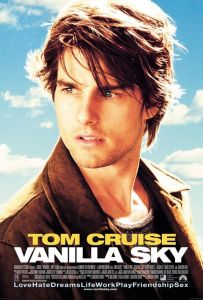 Originally released December 14, 2001:
Talk about a film’s back story. Tom Cruise signed on to do a remake of the 1997 Spanish film Abre Los Ojos (Open Your Eyes) which was directed by Alejandro Amenabar. During the filming the romance between Cruise and Penelope Cruz (no relation) got a little hotter than expected onscreen and broke up his long-standing marriage to Nicole Kidman. At the time she was finishing filming The Others which is the second film by Amenabar. This, by the way, is much more interesting than Vanilla Sky unfortunately.
Cameron Crowe’s remake starts off promising enough with Tom Cruise running around an empty Times Square like a Twilight Zone episode. Afterwards the film begins to create a story that collapses under its own weight. David (Cruise) is a rich boy in control of a publishing empire inherited through his dear old deceased dad. He has the time to throw huge parties where even Spielberg hugs him, and even have crazy sex with crazy Cameron Diaz, whom he tells his best friend (Jason Lee) is his “f*** buddy.” David begins to see a softer side of life with the entrance of bouncy and lively Sophia (Cruz) and contemplates that he might be really falling in love for the first time. But this happiness doesn’t last long as jealous Diaz picks up David in her car then speeds it off a bridge killing her. Then things get sticky including David’s disfiguration, his attempts to regain that one night of budding love and a supposed murder that he committed.
 Crowe is in over his head with this territory. His knack for wonderful exchanges of dialogue and the perfect song to place over a scene are intact, but cannot help him with this mess. Vanilla Sky is an awkward mish-mash of science fiction. The film’s protagonist is standoffish for an audience and many of the story’s so-called resolutions toward the end are more perfunctory than functional. The ending as a whole is dissatisfying and unimaginative. By the time the wonderful Tilda Swinton shows up you’ll likely either be asleep or ready to press the eject button yelling “cop out!”
Seeing Vanilla Sky has made me want to hunt for Amenabar’s Abre Los Ojos and see what all the hype was about, because if it is anything like its glossy American counterpart then I have no idea why world audiences went wild for it.
Nate’s Grade: C
——————————————————
WRITER REFLECTIONS 20 YEARS LATER

Movies have long resorted to being interactive puzzles, inviting audiences to unravel the mystery and hunt for clues as detectives. That’s essentially what Vanilla Sky is at its best, a messy mishmash of a movie that aims a little too high and pins its hopes with a generally unlikeable lead. This psychodrama is meant for dissection, not in a dreamy, obtuse way that David Lynch films invite but more in a canny re-calibration of pop-culture homages and fantasies. The big twist of the movie is that David (Tom Cruise), a rich publishing scion recovering from a savage accident, has elected to live in a simulation, a lucid dream that has been his home for the last hundred-plus years (how kind of the multiple generations of knob-turners to keep things operating). Other stories have followed a similar Twilight Zone-esque twist on the same territory, including the beloved “San Junipero” episode of Black Mirror (that’s right, spoilers, spoilers all around for older sci-fi). Writer/director Cameron Crowe has stated there are over 400 pop-culture connections and references to be had with this movie. The movie is wall-to-wall cultivated jams, as expected from a Crowe picture, but the homages and recreations go beyond simply placing a piece of music to a scene or name dropping an artist. The visual language of the movie is intended to be deconstructed, built upon twentieth-century album covers, music, movies, and plenty more. It’s a dense artistic gamble and, ultimately, I question who is even going to care enough to dive into this movie? Who is going to want to watch Vanilla Sky as a detective?
 This American remake of a 1997 Spanish movie was, in hindsight, the beginning of the end of Crowe’s career as a major director of studio movies for adults. Crowe had just experienced the apex of his career with 2000’s luminescent Almost Famous, a warm hug of a movie, and he had won the Oscar for Best Original Screenplay. It makes sense to try for something big, reunite with his Jerry Maguire star, and go outside his comfort zone with a wide artistic berth of freedom. The 2001 movie just did not work, though not strictly because of Crowe’s game efforts. This is not a miscalculated folly, an artist flying too close to the sun and getting burnt by their arrogance. I think the major flaw comes down to pinning the mystery on the recovery of the romantic and social life of a disagreeable lead character. Early on, David is established as rich, careless, and smug. He keeps his responsibilities as fleeting as his relationships with women. When his on-again-off-again paramour, Julie (Cameron Diaz), drives off a bridge with David inside, part of you might be thinking he deserves what he got for being so callously indifferent with other people. That’s harsh, I realize, but people will not like David, and this is amplified by the general public’s diastase for Cruise himself. Therefore, watching a movie where he tries to overcome him disfigurement and disability and stop being a jerk to everyone in his life is not a journey that invites the viewer to come aboard. He’s just not that interesting as our centerpiece. What’s happening to him can prove interesting, especially as the movie plays with our mind, but at no point will the extended pity party for poor rich David feel compelling as its own drama.
This is the problem with movies that are built around Big Twists: limited replay value. After you know the super twist, very often these movies fail to justify another two-hour investment. Take for instance 1997’s The Game, the forgotten David Fincher movie. It’s a thriller where Michael Douglas is on the run and doesn’t know who is responsible for chasing him. Then the movie says, “Surprise, it’s [blank],” and then it ends. Not every twist unlocks a new and exciting prism of how to view the preceding hours, like a Sixth Sense or Fight Club. Most movies built upon a big reveal as their conclusion tend to deflate immediately. There’s no real reason to watch The Game a second time if you already know what is happening. There’s no real reason to watch 2003’s Identity again once you know all the ridiculous secrets. There’s no real reason to watch Vanilla Sky once you know the explanation for all the strange little hiccups along David’s fraying mental state.
 Look, tons of movies are built around extended mysteries, from Agatha Christie to Knives Out, but the pleasure goes beyond simply solving of the puzzle. It’s the characters, the red herrings, the inspectors or detectives or chief solver of mystery. There is more there for entertainment. With Vanilla Sky, what we’re left with is a lackluster romance of a former pretty boy moping over his slightly adjusted privilege. It’s not like David’s character arc is illuminating or insightful. It’s not like we’re watching the battle over his soul here. He’s just kind of an affable jerk, and then David becomes a scarred jerk, and then he decides to wake up and be a jerk in real life. Progress?
There is a discussion to be had about how much of the movie is a dream, or where real life ends and the dream begins, and apparently even Crowe has determined there are six general interpretations, from the movie’s true and when Tech Support (Noah Taylor) says he switches over is when the dream occurs, to the unfulfilling “it was all a dream” interpretation. I suppose this could be fun for others but again I don’t think there are enough enjoyable components in the movie to incentivize the debate.
In some ways, this is one of Cruise’s most vain-free performances, yet there is an undercurrent that only seems even more vain. First the obvious; he plays a womanizer who also wears a mask for half of the movie to cover his scarred Phantom of the Opera visage. There’s a lack of vanity playing an annoying, arrogant, unpleasant person, something Cruise has done before and quite well, especially in his extraordinary Oscar-nominated turn in 1999’s Magnolia. He’s even played characters with physical disabilities before, like 1989’s Born on the Fourth of July. However, this “lack of vanity” really plays out as a vain attempt to be even more impressive as a respected thespian. The movie was positioned for a mid-December release, and with Crowe and Cruise on board, it seemed like a legitimate awards contender, until that is it opened wide. While Cruise’s performance is fine, his time under the mask doesn’t proverbially unmask his character for our better consumption.
 Vanilla Sky is mostly known as the big American debut of Penelope Cruz. She was already a muse for Spanish director Pedro Almodóvar and known well in the indie circuit, but from here she became Hollywood’s newest It Girl, only to be stranded in mediocre studio movie after mediocre studio movie (Does anyone remember Captain Corelli’s Mandolin?). It wasn’t until Almodóvar’s 2006 film Volver that studio execs seemed to finally understand how best to utilize her great talent. She won an Oscar for 2008’s Vicky Christina Barcelona and was nominated the following year for the musical Nine. She recently reunited with Almodóvar for 2021’s Parallel Mothers and again is wowing audiences. From early on, she definitely has a spark, an effervescence to her performance in Vanilla Sky. She’s also fighting against being forcibly elbowed into the swampy Manic Pixie Dream Girl category, a term that was originally coined for Crowe’s follow-up film, 2005’s Elizabethtown. Crowe loves writing women under these quirky conditions, however, the movie is told from a flawed male dream perspective, so it also makes sense if its portrayal of David’s idyllic dream woman happens to flatten her down.
It’s true that the story behind the scenes of Vanilla Sky proves more intriguing than the film itself. Cruise and Nicole Kidman were the Hollywood power couple. The ensuing tabloid feeding frenzy over their breakup and Cruise/Cruz relationship outlived the legacy of Vanilla Sky. This was the most ambitious and experimental movie in Crowe’s tenure as a writer/director, and he would never again return to science-fiction as a genre, keeping to the familiar lane of prestige dramas declining in prestige with each new film. My original review in the closing weeks of 2001 was pretty minimal in analysis. I knew this movie didn’t quite work then and it still doesn’t work now. If you’re eager for a dissertation-level analysis on its pop-culture fantasia, then God’s speed to you and your infinite free time.
Re-View Grade: C
Share this:

Val (2021)

Watching the documentary Val, comprised from thousands of hours of home videos shot by actor Val Kilmer over the course of 30 years, may make you realize just how little you know about the actor. His reputation is that he’s difficult to work with, conceited, and Method to the point of losing himself in roles and pushing his co-stars to the brink of sanity. Coming from his own words, narrated by his son Jack, naturally allows the most empathetic read of the man and his rationale for his personal and professional decisions. I never knew about his family life, losing his teenage brother who was an inspiration and early collaborator. I never knew Kilmer wrote his own plays, including a student production at Juliard that broke new ground. I never even knew he was an early adopter of technology and had a warehouse filled with his self-documentation and behind the scenes footage (Kilmer is even credited with the doc’s cinematography). You get the sense of a wounded and restless soul, a handsome movie star who so rarely found a film role that allowed him to feel like an artist in his element. Kilmer can be one of his generation’s greatest actors, as evidenced in classics like Heat and Tombstone and as Jim Morrison in The Doors, still one of the greatest acting performances I’ve ever watched. Kilmer languished through plenty of studio dreck as well. His time as Batman is marked by dejection and loneliness, stuck playing the straight man in a movie of oddballs and trapped in a suit of limited mobility and an inability to hear (actors and crew started avoiding him in the Bat suit because he couldn’t respond). Strewn throughout the movie is contemporary footage of Kilmer after beating throat cancer, though the subsequent surgeries have left his speech haggard. Listening to the labored and tortured sound of his voice is a direct jab to your sympathy. Given that this is produced by Kilmer from his own archives, and narrated by his son, the documentary isn’t as critical as it could have been. I wish the movie provided more self-analysis for Kilmer, especially on some of his rockier relationships and onset disruptions, like for the notorious Island of Doctor Moreau. I don’t think you can still fall back on his deceased brother for decades of his behavior. There’s a limit to the level of insight because it feels a bit like Kilmer managing his reputation and legacy within the industry. Still, for nearly two hours, Val can be a poignant and illuminating expose of an actor with a reputation for equal parts trouble and brilliance.
Nate’s Grade: B
Share this:

Mission: Impossible – Fallout (2018)
 Coming down from the surging adrenaline rush, I was trying to determine when was the last time an action movie made me feel the immersive, delirious highs that Mission: Impossible – Fallout offers in spades, and what I came up with 2015’s Mad Max: Fury Road. Simply put, this is the best straightforward action movie in three years. It’s the best Mission: Impossible movie in the series, which, if it hadn’t already, has assumed the peak position of the most consistent, most entertaining, and best action franchise in Hollywood. Allow me to explain how returning writer/director Christopher McQuarrie (Jack Reacher) makes an action movie that demolishes the competition.
Ethan Hunt (Tom Cruise) has been pulled back into spy action thanks to the lingering fallout (eh, eh?) of the capture of Solomon Lane (Sean Harris), whose followers, nicknamed The Apostles, have stolen three plutonium cores. It’s Ethan Hunt’s fault the nuclear cores got loose, and so he and his team, Luther (Ving Rhames) and Benji (Simon Pegg), must clean up after their mess. The CIA sends its own asset, the burly August Walker (Henry Cavill), to help oversee the mission and specifically Ethan Hunt, who must pose as a shadowy terrorist broker to maintain appearances with important figures in the criminal underworld. In order to get the nuclear parts, Ethan Hunt has to retrieve Solomon Lane and release him back into the open. Complicating matters further is Ilsa Faust (Rebecca Ferguson) who needs Solomon dead to clear her own spy debts.
 Every action movie lives or dies depending upon its unique set pieces, often the first thing constructed by a studio and then the plot mechanics are ladled on merely as the barest of connecting tissue. They need to have stakes, they need to have purpose, they need to be memorable, and they need to be understood and develop organically. Mission: Impossible – Fallout could be taught in filmmaking schools about how to properly build action set pieces. They are brilliant. McQuarrie finds interesting ways to set them up, complicate them, and just keep the escalation going in a manner that still maintains the believability of the moment. Take for instance a foot chase where Ethan Hunt is trying to nab a bad guy through downtown London. Where McQuarrie pushes into the extraordinary is by having that foot chase on a multi-level terrain. Ethan Hunt has to chase after his target but multiple stories above the ground, and so he’s leaping out windows, jumping over rooftops simply to keep up. It’s a simple twist that takes what we’re familiar with and, literally, elevates it to new heights. Or take for instance the mission in Paris to capture Solomon Lane. At first it’s capture, then it’s flee police, then it’s flee another assassin. There are multiple stages to this sequence, each with a new goal, each with new complications, and each with new eye-popping stunts and escapes. The action finds natural points to progress, making smart use of the geography, and keeping different elements at play to come in and out to add more problems. This is how you do action right. As soon as the half-hour mark settles in with the arrival of Walker, the movie is practically nonstop in its set pieces until the very end. At a steep 147 minutes, this is the longest Mission: Impossible movie yet but it’s breathless in its execution.
Amazing set pieces that are cleverly designed is one aspect of a great action movie, but if you can’t tell what’s going on, what’s the point of all that cleverness? Fortunately, McQuarrie understands this and adheres to a visceral depiction of the action that creates gloriously immersive and pulse-pounding sequences. The set pieces are terrific, so it stands to reason the stuntwork should be terrific, and to make sure you appreciate the stuntwork, McQuarrie makes sure the photography highlights the verisimilitude. It’s a symbiotic (or as the Venom trailer tells me, “sym-BI-oat-ic”) relationship but when done correctly, as evidenced in this film, it’s the key to truly kinetic action sequences. Take for instance a parachute jump that marks the start of the second act. McQuarrie films it as a sustained long take, and as the camera plummets to the ground chasing after the two men, our brains can tell us that there is some special effects trickery to mitigate the dangers, but our senses are overwhelmed with the sustained illusion of tension. The fight choreography is equally up to the challenge. A bathroom brawl with Ethan Hunt and Walker and another man becomes a lesson in how many things can be smashed and what can be used as a weapon. A high-speed motorcycle chase through Parisian streets gets even more frantic when Ethan Hunt drives against traffic, and the scene becomes even more exciting when McQuarrie’s lens allows us to see the danger in all its glory.
 The Mission: Impossible franchise has been notable for its insane stuntwork but also, chiefly after the second installment, its edict to practical effects and maintaining the believability of its reality. It’s still movie spy shenanigans and globetrotting adventures, yes, but the moment-to-moment thrills feel like they’re really happening. The Fast and Furious franchise has gained great acclaim for the bombast of its physics-defying spectacle, and the Mission: Impossible franchise seems to have gone purposely in the opposite direction. It’s real Tom Cruise jumping off that building, it’s real Tom Cruise riding through traffic on a motorcycle, and it’s real Tom Cruise falling and climbing up a speeding helicopter during the thrilling finale. Cruise has had a death wish when it comes to throwing himself into the high-wire stunts of his franchise, but even at 56 years old he’s still at it, essentially trying to commit suicide on film for all of our amusement. Cruise is one of the few remaining movie stars and his commitment is without question.
This is also the first Mission: Impossible film that feels like the characters matter. It’s a direct continuation from the previous film, 2015’s Rogue Nation, bringing back the (somewhat lackluster) villain, the newest spy counterpart/potential love interest, the CIA and IMF brass, and the essential supporting team members from prior engagements. Because of this it feels more like what happened previously was establishment for a new story building upon that foundation. Rather than starting all over, the characters find ways to deepen their relationships, and the film opens up Ethan Hunt as a character and the toll his duty takes on those closest to him. There are some nice quiet moments that examine these characters as actual people. Several complications are as a direct result of personal character decisions, some good and some bad. I was joking with my pal Ben Bailey beforehand about wondering whether they’d find a way for Ving Rhames to matter, since he hasn’t been much more than “a guy in the van” for four movies, and by God they make him matter. They make each team member matter, finding moments to give them, mini-goals they’re entrusted with. During the dizzying helicopter chase in the finale, supporting players are left with their own task. Luther has to defuse a bomb but doesn’t have enough hands. Benji has to find something valuable in a very needle-haystack situation designed to torment and waste precious time. Ilsa is at cross-purposes for most of the film, not wanting to harm her fellow allies but also being given her own orders to prove her loyalty and protect her future. All of this comes to a head and it makes the parts feel as important as the whole. That’s great storytelling.
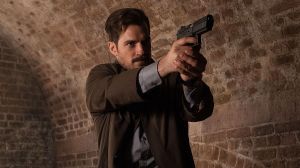 Let’s talk about that million-dollar mustache of Cavill’s. It was a year ago that Justice League re-shoots required Cavill and the Mission: Impossible team refused to allow their actor to shave his mustache, thus leading to that unsettling fake baby lip Superman was sporting in a majority of his scenes in the haphazard Justice League film. I just read an AV Club interview with McQuarrie where he for the first time discusses the whole mustache brouhaha and apparently Paramount estimated that it would have cost them three million for the effects to uphold Cavill’s upper lip continuity. Warner Brothers refused to pay up and so went down that ill-fated CGI mustache-removing route. It was shortly afterwards that Cruise shattered his ankle in a roof-leaping stunt (that is in the finished film and advertisements) and the production had to shut down for a month. If only Warner Brothers had waited, perhaps we all could have avoided this mustache mess.
Mission: Impossible – Fallout is a new highpoint for the best action franchise going in movies today (I’m still waiting for a third Raid film, Gareth Evans). The set pieces are memorable and unique, leading from one into the next with exquisite precision and thought. The action sequences are stunning and shot with stunning photography, highlighting the stunning stuntwork by the best death-defying professionals. It’s the first Mission: Impossible movie that doesn’t climax at its middle; in fact there’s a pretty obvious reveal that feels like it was going to be a late Act Three twist, but McQuarrie recognizes the audience thinking ahead, and there’s like a whole other exciting 45 minutes after. The stakes are better felt because the characters matter and are integrated in meaningful ways. This is the most I’ve enjoyed Henry Cavill in a movie (with possible exception of another spy movie, Man From U.N.C.L.E.), and you know what, his mustache works too. While the vertigo-inducing Burj Khalifa sequence is the best set piece in the franchise, Fallout has everything else beat at every level. Mission: Impossible – Fallout is a reminder that there are few things in the world of cinema better than a properly orchestrated, properly filmed, and properly developed action movie operating at full throttle. This is one of the reasons why we go to the movies, folks. See it in IMAX if possible. Soak it up.
Nate’s Grade: A
Share this:

American Made (2017)
 American Made is a movie that floats by on the sheer enjoyment of Tom Cruise’s charismatic, devil-may-care performance as Barry Seal, a man who flew secret missions for the CIA, Colombian drug cartels, and Nicaraguan contras. It’s an appealing story with fun anecdotes of a scoundrel playing all sides against each other. Seal is unrepentantly without introspection and is simply having the time of his life. Under Doug Liman’s direction and Cruise’s sly performance, the movie flies by on good vibes until its inevitable crash once Seal cannot get out of the mess he’s made for himself. The film doesn’t have much in the way of depth or commentary on Seal’s actions or the CIA’s. Domnhall Gleeson (The Revenant) plays the enigmatic CIA handler who brings Seal into action and plots behind the scenes, and I wish he had a larger presence in the film. His character is the closest the film approaches legitimate satire. Other supporting characters leave little impression or have such limited roles, from Sarah Wright’s complicit wife, to Caleb Landry Jones’ bizarre screw-up of a brother-in-law, to Jesse Plemons as a small-town sheriff, to Jayma Mays as a frazzled prosecutor who can’t take down Seal. The near-escapes and comical skirting of legal consequences provide enough interest without making the film seem episodic. I’m even struggling to say more about the film because that’s how quickly it evaporates from memory. American Made isn’t going to make much more than a fleeting impression, but it’s fun while it lasts and a reminder about how entertaining movies can be when paired with a magnetic actor cutting loose.
Nate’s Grade: B
Share this:

The Mummy (2017)
 In my many years as a film critic, it’s always interesting to discover when I veer from the critical herd, whether liking a movie others do not or having issues with a movie that others lionize like La La Land. After seeing an avalanche of bad reviews, I was fully prepared to dismiss Tom Cruise’s The Mummy as another example of Hollywood hubris, but as the movie continued I found myself enjoying the proceedings. I left the theater completely dumbfounded why my critical brethren disliked it so vehemently. One critic even said this was Tom Cruise’s worst movie of his career. I can’t understand the hate for what is essentially a fun B-movie, so my review is going to be a little different. I’ve read through a bevy of bad reviews and lifted the major criticisms leveled at the film. I’ll be addressing them one-by-one and why I disagree or think the broadsides are overblown.
Here’s a quick plot synopsis for some general context. Thousands of years ago, Ahmanet (Sofia Boutella) was next in line for the Egyptian throne, and then her pharaoh father had a son. Rather than be sidelined, Ahmanet made a deal with the god Set to kill her family with a magic knife and become an all-powerful being. She was thwarted in the middle of the human-sacrifice ritual and she’s sentenced to being buried alive. She was buried thousands of miles away and the magic jewel, needed to complete the magic knife, was buried in England in a Crusader’s crypt. In present-day Iraq, Nick Morton (Tom Cruise), his sidekick (Jake Johnson), and his love interest (Annabelle Wallis) stumble upon the tomb of Ahmanet. They’re transporting her sarcophagus back to England when a cloud of crows attacks their Army plane. The plane crashes, with Nick on it, but he awakens unscathed on a morgue slab. Apparently Nick is marked by Ahmanet as her chosen vessel.
 1) “Cinematic universe fatigue.”
This is the number one indictment in all the critiques but it feels more like critics just used The Mummy as a jumping off point to add to a thesis statement on the dearth of originality in a franchise-obsessed Hollywood. I get it. In the wake of the Marvel Cinematic Universe’s unparalleled run of success, it’s not just about franchises now but also about a series of inter-connected franchises forming a universe of stories. There is also DC’s failed efforts to try their own universe, a possible Hasbro Universe (Transformers, G.I. Joe), the ongoing and morphing X-Men universe, and now the emergence of the Dark Universe, a studio’s attempt to repackage the classic monster properties of old. When done poorly, the cinematic universes reek of nakedly obvious crass commercialism. However, just being opposed to these cinematic universes on principle alone feels misguided. It’s presumptuous. It all depends on whether or not the stories can exist on their own. Batman vs. Superman and Suicide Squad didn’t crash and burn merely because they were overextended by tie-ins to other movies. They failed because they were bad stories and were terribly executed, and yes being overextended was a component but not the only one by far. Movies still need to be good.
The Mummy only gives a sense of a larger universe through the appearances of Dr. Henry Jekyll (Russell Crowe) the leader of Prodigium, a S.H.I.E.L.D.-esque agency tasked with monitoring the world of “gods and monsters.” That’s about it, a preview of a larger world of monsters with some visual Easter eggs scattered here and there. The character of Jekyll is a learned scientist that can unload a larger picture, and his institution also provides a setup for false security. He is organically placed into the narrative and Prodigium actually supplies a credible reason why they don’t just smash the key crystal that Ahmanet needs for her resurrection purposes. Crowe (The Nice Guys) is one of the best parts of the movie, and when he gets to slip into Hyde mode the movie allows him to have a malicious sense of fun. I don’t think the visual element of Hyde quite works but it doesn’t sabotage the scenes. Not all of Crowe’s exposition is necessary, especially the opening sequence finding the buried Crusaders, but he provides a stable presence, until he also presents Prodigium as a pragmatic threat. This is why I think that the most critics are condemning the idea of the Dark Universe and what it stands for in broader terms and not on the actual merits of how it set up its larger universe.
 2) “Cruise is miscast as the lead.”
I’m a fan of Cruise as an actor and especially as the lead in action movies. The man is a natural movie star and he gives his all with every performance. As a paying moviegoer, I respect that work ethic. Having Cruise play a rakish surveyor of antiquities seems like a good fit for his abilities. He’s played charming, dangerous rogues before. Here’s the thing that critics don’t seem to be processing: Cruise’s character is meant to be a jerk. He’s self-centered and prone to making impulsive decisions, like shooting a rope keeping a sarcophagus suspended in liquid mercury. Plus if you don’t like Cruise as a person or an actor he’s routinely beaten up in the movie to fine comic results. His character arc is about him becoming the kind of person who’s willing to think about others and a greater good. It’s simple but it works. I do think The Mummy goes too far in trying to explain the signposts of his character arc. Occasionally they undercut the moment to great effect. There’s a scene where Wallis (Annabelle) tries to encourage Norton that she knows there’s a good man inside him. After all, he gave her the only parachute as the plane went down. He then sheepishly says, “I thought… there was another one.” I laughed out loud so hard. The movie does work a little too hard to announce Nick’s swaggering Lothario ways (“Me thinks the lady doth protest too much”), and there’s a 25-year age gap between Wallis and Cruise, but these aren’t faults invented by only this movie. Cruise was an enjoyable lead for me and his ease with comedy, action, and drama prevailed.
3) “Tone issues abound.”
Critics are lambasting the film for being too many things with too many tones, but much like cinematic universes, it all comes down to execution. The Mummy has elements of action, horror, especially its zombie-mummies, dark comedy, like Johnson showing back up as zombie comic relief a la An American Werewolf in London, and even some inspired slapstick. When Nick is fighting a batch of zombie-mummies, he thrusts his fist through one skull and hangs another sideways against a wall, and both keep on fighting. The different elements added to my entertainment rather than detracting from it. I enjoyed that the movie could be suspenseful or silly depending upon the scene. The action sequences are serviceable to good, the highlight being the zero gravity plummet within the body of the plane. Alex Kurtzman (a writer responsible for Star Trek, Transformers, and other big studio pictures) makes an adequate director without any distinguishing sense of style. I feel like the more memorable aspects of the action are from Kurtzman thinking as a writer. Take for instance a scene where Nick is swimming underwater and we watch subterranean tombs open. The zombie-mummy Crusaders then start swimming after Nick, providing a terrific visual. The action sequences vary and develop and make good use of their geography. I also appreciated that the third act does not fall into the superhero standard of CGI monster slugfest that loses perspective and scale (even Wonder Woman suffers from this). Also, apparently in the time since Stephen Sommers’ campy 1999 Mummy film, everyone championing that movie seems to have forgotten that it was a mess of tones as well. The Brendan Frasier mummy movies were a fun, spirited, winking big-budget B-movies with style and personality. I don’t think Cruise’s Mummy film reaches those same heights but there are enough positive similarities.
4) “Underwritten female characters.”
 This is a legitimate criticism when discussing Wallis’ character. She offers very little to the overall story except to verbally explain exposition or character beats. The fact that she needs rescuing is a given. It’s an underwritten role and clearly just an excuse for a good-looking actress to be at Cruise’s side during moments of peril and derring-do. However, this accusation overlooks Boutella’s character, Princess Ahmanet. Her very back-story involves a woman striking back against a patriarchy that wouldn’t value her unless it had no alternative. She’s a killer but she has her reasons, but more importantly she’s an interesting antagonist even if her overall goal is basic world conquering. Boutella (Star Trek Beyond) has a magnetic presence on screen and seems to enjoy stretching herself with different physicalities from an alien to a mummy to a blade-legged henchwoman. She enjoys playing kickass women who lead by example, and Ahmanet is no exception. I was pleased that Ahmanet was not going to be reserved as a strictly Act Three villain. She’s prominent throughout the narrative and burrowed inside her marked man’s head, leading to dessert flashbacks and a general repetition of Boutella’s partial nude scene. The filmmakers are getting the most out of one shadow-draped PG-13 nude scene.
Suffice to say, in my view The Mummy does not deserve its savaging by the critical community. I think too many critics are assailing larger points (Tom Cruise as a person, cinematic universes) and losing sight of the actual movie itself. The Mummy is not a perfect film by any stretch but it’s a movie that has a strong sense of its identity and how to meet its goals. The Mummy is a modest B-movie with a sense of fun that offers enough surprises, suspense and action sequences, and clever visuals to entertain. If this is the start to the Dark Universe then I feel optimistic about where else the newest creature features will lead. I recommend giving this one a chance once the dust settles. You may be just as surprised.
Nate’s Grade: B
Share this:

Mission: Impossible — Rogue Nation (2015)
 Not as outlandishly crazy as the Fast and the Furious series, not as beholden to tradition as the Bond series, the Mission: Impossible series doesn’t get the same notoriety but I’d declare it the most consistent and best action franchise going today. Each new film is a distillation of their director’s strengths, keeping things fresh, and the mainstay is Tom Cruise in prime action hero mode and risking his life like a madman. While not as dizzyingly entertaining as 2011’s Ghost Protocol, Rogue Nation is another fun and action-packed spy thriller with terrific and memorable set pieces. The plot involves Ethan Hunt (Cruise) and his team on the run, again, as their agency is shut down for its reckless methods. A rival agency known as The Syndicate is plotting political assassinations, so Hunt and his team (Simon Pegg, Jeremy Renner, Ving Rhames) must work along the fringes to save the day. The newest addition is Swedish actress Rebecca Ferguson as a mysterious ally and antagonist for Hunt. She’s smart, formidable, and not treated as a romantic interest or overly sexualized (progress). After Alicia Vikander’s superb performance in Ex Machina, and now Ferguson’s steely turn, it’s quite a booming year for Swedish imports. The series’ star is still Cruise and his cavalier treatment of his 50-year-old body in the pursuit of the daredevil stunts. The opening with Cruise attached to the outside of an ascending cargo plane is a stunning image jolted by the charge of realism. An underwater vault break-in is wonderfully developed. The snazzy car chases, motorcycle chases, and foot chases all benefit from Cruise being front and center. Say what you will about the man but he’s a movie star. The biggest problem with Rogue Nation is much like Ghost Protocol in that it peaks in the middle. The last act takes place entirely in London and it just can’t compare with what came earlier, which leaves the movie lumbering to a close with its rather substandard villain. Even with a less than stellar conclusion, Rogue Nation is another entertaining, fun, and thrilling action movie that would be the best the summer has to offer if it weren’t for the highs of Mad Max.
Nate’s Grade: B+
Share this:

Edge of Tomorrow (2014)
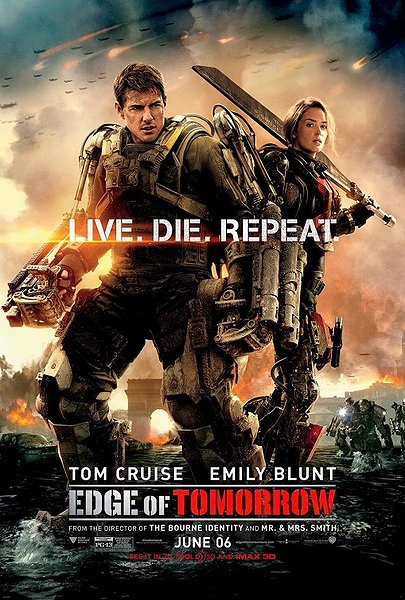 I’ve always been one able to separate the art from the artist, so while Tom Cruise may annoy people in real life because he jumped on a couch one summer, that doesn’t halt my enjoyment of the man’s movies. It seems with every new Cruise vehicle that under-performs at the box-office that I must be in the minority. Cruise hasn’t had a hit to his name since 2011’s suitably awesome Mission Impossible: Ghost Protocol. Both Oblivion and Jack Reacher, perfectly solid action movies, failed to make over $100 million domestically, further calling into question the drawing power of Tom Terrific. It seems that his latest, Edge of Tomorrow, is going to suffer a similar fate. This is a shame. As my critical colleague Ben Bailey said in his own review for the film: “Edge of Tomorrow might just be the most critically acclaimed box-office bomb of 2014.”
William Cage (Cruise) is chiefly an Armed Forces PR flak. He goes on TV to push the talking points of the United States military, which is in a heap of trouble. Aliens have landed in central Europe and spread quickly, proving to be nearly unstoppable. There was one soldier who was able to lead a successful counter attack. The “Angel of Verdun” is Rita (Emily Blunt), a soldier Cage proudly chirps only spent a day in her mechanical fighting suit beforehand yet proved to be so deadly. After vaguely threatening a high-ranking official rather than report for a doomed counter assault, Cage is shipped to the frontlines as a deserter. In hours he and a motley crew of ground forces are flown to the beaches of France, where the aliens will slaughter them. In the firefight, Cage is covered with alien blood and gains their special power. The reason the aliens have won every battle, save one, is because they have the power to reset time. They learn from their errors, which is why they always anticipate humanity’s attacks. Now Cage has this power. Every time he dies, the day resets and he starts over, trying once again to survive. The only person who understands him is Rita, who once had the same power. Together, with some extensive training, they may be able to thwart the alien invaders for good.
 Edge of Tomorrow is the ultimate video game movie, and while I would normally mean this in a pejorative sense, it is actually a compliment. With every death, Cage gets to start over, looking for a way to complete the next stage of the next level, learning from his costly mistakes and hoping to get to the boss battle that usually closes the level. From a structure standpoint, it’s a pure video game, albeit an older sidescroller (remember those, kids?). The visuals and mechanical battle suits also further support the video game comparisons. But really, Edge of Tomorrow is Groundhog Day meets Starship Troopers but brilliantly executed. There is something deeply satisfying about the Groundhog Day formula, namely getting seemingly endless chances to fix one’s mistakes, to try out new paths. It’s also inherently satisfying as an audience member because you watch your hero fail time and after time but they’re still active, they’re still trying to achieve a goal, or a new goal, and thus when they do succeed it’s even more triumphant and gratifying. We get to learn alongside our protagonist. Also, it allows the narrative to explore new material without going stale. In most stories we have one set path, but in films like this one with a time loop, it’s like we get to see all the wheels-within-wheels, the stories just offscreen happening simultaneously. It opens up the world in more interesting and playful ways, providing more payoffs than just one set narrative destination. We get assorted answers to our “what if”’s. Plus we get more screen time with Bill Paxton (2 Guns) as a comically hardass master sergeant. Edge of Tomorrow mines all these areas expertly. This is a movie that embraces the possibility of its sci-fi premise. It’s constantly clever, fast-paced, lively, and expects its audience to keep up with the pace.
It’s great to see director Doug Liman flex his action-thriller abilities again, ineffective or dormant since 2005’s Mr. and Mrs. Smith. The man has an innate ability to orchestrate action without losing sight of character. The beach invasion sequences have plenty going on, enough so that you won’t be bored after multiple trips, and unlike last summer’s disappointing Elysium, this is one movie that knows how to make proper use of a mech suit. These suits don’t look that impressive but they pack some mighty firepower. It’s rather cool when Cage, after a litany of failed trips, has the beats of combat to memory, knowing to shoot in this direction at the right second. It’s like watching a man harness the omniscient power of God (“I said I was a god. Not THE God.”). Under Liman’s guidance, the action is big and exciting and fun, more so than any other Hollywood action movie I’ve seen this year (The Raid 2 is still in a class its own).
The action sequences and special effects are all relatively good, but it’s just the sheer fun of the movie that makes it special for a summer would-be blockbuster. It’s like you get multiple movies smattered together but the eye is always forward to the goal, taking out the alien brain/host. The structure is almost foolproof: by the end of Act 1 he gets the time-tripping powers, and by the end of Act 2, he loses them and the heroics to close the movie have to count for real. I wish the final boss battle didn’t happen to take place in the bowels of a famous landmark/destination, but I suppose Liman and company needed a change of pace from all the beach activity. While the movie covers plenty of ground repeatedly it never feels old or directionless; while it has its share of sticky exposition and silly plot mechanics, it never overwhelms the story or the entertainment factor. The basics of who the aliens are, how they attack, what their magic blood does, what the rules are for utilizing said alien time-repeating power, you would imagine that they would be too silly or bog things down, but they don’t. Except for the very end (the concluding two minutes), the movie plays within its own system of rules. That also means no unrealistic romantic entanglement. Sure we expect movie stars to fall for one another, especially in peril, but for Rita, every day is the first day she’s ever met Cage. He develops feelings for her but she credibly keeps thoughts of romance at bay.
 It’s also a mordantly mirthful movie. Cage can only reset when he dies; if he is just wounded and passes out, he’ll lose his special reset power. So every insurmountable roadblock, wrong choice, or crippling injury must be met with one conclusion, namely Cage being snuffed out. Rita carries out most of the executions in the second half, with a blasé sense of routine duty, like a plumber fixing a clog. It doesn’t really get old and Liman utilizes montage well to give the comedy an extra punch. It lightens a movie more or less centered on human annihilation and mortality. And for the legions of Tom Cruise haters, there’s got to be some degree of entertainment value in watching the man die again and again and again and, well you get the point.
Cruise ably shows again that he is more than capable of carrying an action film (he’s over 50 now too). The man still has enough energy and physical stamina of an action hero in his 30s, and his charisma is still there in spades. It’s also interesting to watch Cruise play a cowardly character. I should have expected it considering that Cage’s arc has to start somewhere before he becomes the super soldier. However, the movie would never have been as good if Cruise didn’t have a strong leading lady, and the surprisingly buff Blunt (Looper) is an excellent match for her costar. She’s tough and can beat the snot out of you. Just her very walk exudes confidence and determination (is it too late for her to be Wonder Woman in the next Superman film?). Having walked in Cage’s shoes before with the time-replay power, she has an extra weariness to her, a certain devil-may-care attitude, especially in battle. The two actors make a winning team and Cage’s recruitment of Rita is another mission with another worthy payoff.
The original title was All You Need is Kill, based on a Japanese graphic novel, and I can’t help but think how much of a better, striking title that is to describe this movie. It’s a wonderfully entertaining movie, with its action spectacle tempered with an intelligence rare for a summer blockbuster that doesn’t have Christopher Nolan’s name attached as director. Here is a playful sci-fi movie that doesn’t downplay its sci-fi, doesn’t dumb down its plot, and explores the richness of its world one dead Cruise at a time. It’s clever and satisfying and brings all the visual fireworks you’d demand. It’s a rotten shame that Edge of Tomorrow appears destined for the cinematic scrapheap. We need more movies like this one. Reverse the tide people and see this movie on the big screen while you can. It’s everything we want in a summer blockbuster fully realized.
Nate’s Grade: A-


 nathanzoebl
You must be logged in to post a comment.