Blog Archives
Love Lies Bleeding (2024)
 With 2019’s Saint Maud, writer/director Rose Glass made her mark in the realm of religious horror, but it wasn’t just a high caliber boo-movie, it was an artistic statement on isolation, on obsession, and with stunning visuals to make the movie stand out even more. Next up, Glass has set her sights on a similar tale of isolation and obsession, in the realm of film noir.
In 1989, Lou (Kristen Stewart) works as the manager of a small gym in the American Southwest. She spots Jackie (Katy O’Brian) passing through on her way to a bodybuilding competition in Las Vegas. Together, the two women form a passionate relationship and are transfixed over one another, but in order to keep the good times rolling, each will be required to commit more desperate acts, including body removal and keeping secrets from Lou’s estranged father, Lou Senior (Ed Harris), a shooting range owner who operates as a cartel gun runner.
 Love Lies Bleeding powers along like a runaway locomotive, a genre picture awash in the lurid and sundry language of film noir with a queer twist, until it goes completely off the rails by its conclusion, a pile-up of tones and ideas that’s practically admirable even if it doesn’t come together. Until that final act, what we’re given is a contemporary film noir escapade following desperate and obsessive people get completely well over their heads into danger. Reminiscent of the Wachowski’s Bound, we have a film noir that lets the ladies have all the fun playing into the tropes of the sultry femme fatales, and in this movie, both the lead characters are their own femme fatales and ingenues. Lou is the one who pushes steroid use onto Jackie, who resists at first and wants to go about building her body the old-fashioned way. Lou is also the one with the shady past and connections that come calling back at the worst time. Once fully hooked on her diet of steroids, Jackie becomes increasingly more unpredictable and desperate, leaving Lou to try and clean up their accumulating messes. They both use the other, they both enable the other, and they both project what they want onto the other even after their collective screw-ups. It’s a self-destructive partnership but neither can see through the haze of desire. They see one another as an escape, when really it’s an unraveling of self (though I suppose one could argue “living your best self,” already a subjective claim, could include being a genuine garbage human). In a way, this is a relationship that’s all rampant desire and unfulfilled consumption, and it leaves both parties always wanting more. It’s a bad romance with bad people doing bad things badly, and if that isn’t a tidy summation of most film noir, then I don’t know what is.
For the first hour, I was right onboard with the movie and its grimy atmosphere. The plot has a clear acceleration point, though the first twenty minutes is also given to some cheap “who-slept-with-who-before-they-knew-who” drama that I was instantly ready to put behind. However, once the climactic death hangs over our two lovers, there’s an immediate sense of danger that makes every scene evoke the gnawing desperation of our characters. The screenplay by Maud and Weronika Tofilska has such a deliberate cause-effect construction, and no film noir would be complete without the loose ends the characters would have to fret over. What also helps to elevate the immersion is the electric chemistry between Stewart (Spencer) and O’Brian (The Mandalorian), who worked previously in the world of women’s body building and clearly felt a kinship with this role, and she is also a born movie star. The two women are great together, enough so that the audience might start believing that these two lost souls are actually good for one another. We too might get seduced by the possibility that everything will turn out for the better, when we all know that’s not how film noir goes. I will say there are some gutsy decisions toward the end that will test audiences with their loyalty to our couple, but most felt completely in character even if their lingering impact is for you to reel back, hold your breath, and then heavily sigh.
 It would also be impossible to discuss the movie without discussing just how overwhelmingly carnal it can be. I recently reviewed Drive-Away Dolls and noted how horny this lesbian sex comedy road trip was, though to me it felt empty and exploitative. With Love Lies Bleeding, the desire of these two women, and their mutual fulfillment, serves as another drug for them to mainline and then abuse. There is a hanger to the film’s gaze that is effective without feeling overly leering. The body building aspect puts a more natural fixation on lingering on the muscles and curves of human forms, and how Jackie is intending to transform herself into a fantasy version. The sexual content begins to ebb as soon as the murder content ramps up.
Unfortunately, for a movie that gets by on some big artistic chances, not all of them work, and most of the miscues hamper the final thirty minutes. In the final act, Jackie abandons Lou and goes off on her own to her Las Vegas bodybuilding competition, and at that point it’s like she’s in a completely different kind of movie. Hers is a movie about drug addiction and hitting a wall, as she has some very public freakouts and hallucinations. Although from there, Love Lies Bleeding indulges in some peculiar imagery that emphasizes the extreme bulging muscles of Jackie like she was the Hulk. While the movie never presents these flights of fancy as magic realism meant to be taken literally, the sheer goofiness of these moments and imagery can hamper moments, especially during a climactic showdown that feels more like someone’s kinky dream. Ultimately, I don’t think the characters of Lou or Jackie are that interesting. Lou’s criminal past was deserving of more attention far earlier, and Jackie is so narrowly-focused that every scene with her after a certain point is only going to reinforce the same obsessive drive and perspective. Like other genres, film noir works with archetypes, and Love Lies Bleeding isn’t re-inventing the genre, merely giving it a very specific sapphic spin, set amidst the haze of the go-go 1980s.
Rose Glass is a hell of an intriguing filmmaker after two very different movies in two very different genres, both of which have been defined for decades by male filmmakers. This woman is a natural filmmaker with clear vision, and even through the bumps, you know you’re in good hands here with a storyteller that’s going to take you places. The cinematography is fluid and grimy to the point where you may feel the need to take a shower afterwards. Everything seems coated with dirt and sweat. The synth-heavy musical score accommodates rather than overwhelms. The performances are strong throughout, and the screenplay choices, while not always working out, are bold and in-character. Love Lies Bleeding provides just about everything you could want from a lesbian bodybuilder film noir thriller, a movie that recognizes the sizzle of its genre elements and makes grand, scuzzy use. At this point, we should all be paying attention to whatever Glass wants to do next as a filmmaker. It might not be perfect, it might not even work, but it will certainly demand our attention and time.
Nate’s Grade: B
Share this:

The Beekeeper (2024)

The Beekeeper is a ridiculous action thriller that begs for incredulous laughter but this proves to be the movie’s real appeal. Jason Statham plays a retired black ops soldier whose call sign was Beekeeper, and who belonged to the secret group known as the Beekeepers, which would be really hard to differentiate agents, and then in his retirement, he literally keeps bees. Imagine a secret spy agency known as The Window Washers, and then their top operative decides to work in retirement as a window washer (or a Grave Digger who digs graves etc.). This on-its-head literalness is part of the silly entertainment value of the movie, along with Statham continuing to make bee-related quips no matter the scenario, which just makes him seem crazy or mentally trapped in a different movie, a more satirical version that the rest of the actual movie cannot support. There are many scenes that are one wink away from self-parody, like the FBI agents on the trail and one of them starts reading up on bee science as a means of better understanding this elusive man. What sets Statham off on his journey of bee-themed vengeance is when his kindly neighbor gets her life savings stolen from online hackers who are treated like Jordan Belfort of The Wolf of Wall Street. The old lady takes her own life, and from there Statham is blowing up office buildings, cracking heads, and at one point literally becomes a national terrorist. If you stop and think about the actual implications, The Beekeeper starts to feel like madness personified. As a revenge-thriller, it still works on the simple satisfying structure of watching bad guys get their comeuppance. It can be enjoyed as an effective B-movie (or… hear me out, a “Bee-Movie”?) that hits its genre marks, but as an unintended comedy and self-parody of the stupidity of so many direct-to-DVD action titles, this is where The Beekeeper is at its buzz-buzz-best.
Nate’s Grade: C+
Share this:

Eileen (2023)
 Based upon the novel of the same name, and adapted by the novelist and her husband, Eileen is an affectingly broody unrequited romance awash in noir trappings and feelings. It’s set in a prison facility in 1960s Boston, and one young worker Eileen (Thomasin McKenzie) becomes enraptured with her new co-worker Rebecca, a psychologist with an exceptional sense of confidence and hunger, played by Anne Hathaway. For a solid hour, the movie becomes something akin to 2015’s Carol, a lesbian romance where the social norms of the time force both participants to speak in codes and glances and gestures. Eileen is given to flurries of intense daydreams, often sexual, and sees a fellow creature in Rebecca, who doesn’t so much as walk through rooms as slinks, doesn’t so much as stare but smolders. Hathaway is in full-on femme fatale seduction mode here and enjoying it. It is following along this path of possible mutual connection, of finally acting upon these hidden desires, and then the movie takes a SHARP LEFT TURN and stays there for the rest of the duration. The twist works, and forces the audience to reconsider our notions of obsession and perspective, but it also feels like we’ve abandoned the prior movie into this new even pulpier, slightly more manic movie, and I don’t know if I wanted to leave so suddenly. If this twist were to stand, I think it needed to be introduced sooner, especially if it obliterates the prior dramatic work, and allow more time to deal with its myriad consequences. There is a powerfully gripping and deeply devastating monologue by Marin Ireland that might be the best part of the movie. Eileen the movie is a little like Eileen the character, gliding on appearances and secretly something much darker at its core.
Nate’s Grade: B-
Share this:

Leave the World Behind (2023)
 Apocalyptic thrillers can oddly enough serve as a therapeutic means for dealing with our fears of being helpless against forces well beyond our control, but they’re also reflections of our current state of anxiety as well. There’s more than just giant hurricanes or earthquakes breaking records on the Richter scale, it’s about how we respond to the momentous and alarming changes and what that says about The Way We Live Now. The new Netflix apocalyptic thriller Leave the World Behind, based on the 2020 book of the same name, has some big mysteries that I feel safe to say won’t fully be explained by the end. There is a possible explanation but it’s a movie more consumed with how people respond to tumult than the tumult. I found the majority of the movie to be gripping and engaging, and while it doesn’t exactly nail the landing, writer/director Sam Esmail (Mr. Robot, Homecoming) crafts a paranoid thriller with flair. It’s an apocalyptic thriller at crossroads with a paranoia thriller and a disaster movie, and the biggest challenge of them all is ultimately being able to trust another person during a time of remarkable uncertainty.
Amanda (Julia Roberts) and her husband Clay (Ethan Hawke) have elected to take a spur-of-the-moment family vacation out of New York City and onto a lavish home in Long Island. Everything seems so placid until the phones no longer get a signal, the TV broadcasts are strictly limited to a blank emergency screen, and two strangers show up (Mahershala Ali, Myhal’la) saying this is their house and they would like to stay inside. They claim that the U.S. is under a cyber assault and there’s more to come.
 Leave the World Behind has two intriguing questions to keep the audience hooked: what is actually happening and who are these new people? Most disaster movies put you in the thick of the action, from presidential boardrooms to scientific outposts keeping up with the changing data and going over the options to prevent further loss of life. This movie purposely leaves you in the dark in a well-kept Long Island home and the first thing that goes is the expediency of knowing things from our phones. When two new people come knocking at the door to say the world is falling apart and this is our home, trust us, it’s hard not to hold some level of suspicion. Can we take these people at their word? What kind of agenda could they secretly have? And if so, what does that say about what has happened or what is happening in the outside world? They seem like they know more than what they’re letting on, so how much do they know themselves? It’s the slow drip of information that makes the movie simmer in such an anxious predicament of looking at every new piece as another new question. This places the viewer uncomfortably in similar territory as Amanda, who despite her prejudices might be right not to trust the newcomers. We’re stuck on the outside wondering what has happened and what may be left. The movie is carefully crafted to only give us so much to work with while our minds start reading and rereading everything for more connection and meaning, running rampant and going stir crazy just like the characters. While the second big question naturally gave way and could only produce so much tension, the main thrust of the movie kept me hooked and excited and worried and actively questioning just what exactly was going on.
I appreciate how Esmail is a restlessly ambitious filmmaker. He took on directing duties for the entire second season of Mr. Robot and from there continued coming up with new challenges. There was an episode meant to be told as an episode-length elaborate tracking shot. There was an episode that was told almost without any spoken words, entirely through visual action. There was an episode that was presented like a five-act stage play and it was enthralling. While these are the easy to recall gimmick episodes, Esmail’s directing vision for his series never eclipsed the series itself. It elevated the episodes but the emphasis was still on the significance of the characters and their emotional states (highly recommend Mr. Robot, one of my favorite 2010s TV shows, to anyone who has yet to watch). With Leave the World Behind, only his second feature after 2014’s parallel universe rom-com Comet, Esmail refuses to let any sequence pass without some kind of visual flourish. His camera is constantly swooping through the visual landscape, flipping and spinning and craning above the characters from on high. It reminded me of Brian DePalma, who also loves the high angle pans across rooms and also abides by the dogma that there should be no uninteresting shots in a movie. It’s easy to appreciate but without an engaging story can quickly become a distracting exercise in empty artifice, which is also how I view most DePalma. Here, much like Esmail’s accomplished prestige TV work, the style makes me better appreciate how much effort and thought Esmail has put into his presentation and his ideas. The man wants you to see his work, and there’s no fault in that as long as you’re enjoying the experience, which I was for the most part.
 There are some supremely well-crafted moments played to a breaking point of intensity. Early on, as the family relaxes on the beach, they see a ship in the distance, an ordinary sight on a seemingly ordinary day. Then hours pass and it’s getting closer, and closer, and finally the realization begins to settle in that this thing is now a danger and they need to very much run very much now. Esmail’s camerawork keeps the scene feeling kinetic, with a long take that establishes the colossal danger as the tanker runs aground and the family has narrowly fled in time. In many ways this moment also serves as an ecological metaphor, with problems looming in the distance but ignored until they are at their most dangerous and right on top of us. Another sequence involves Clay venturing outside and discovering what appears to be a dust storm the color of blood. It’s getting closer and closer and the movie is testing how much we can take before you start hitting an imaginary gas pedal to strongly suggest Clay out of there. There’s another sequence that’s a literal pile-up of driver-less cars coming to the same nexus point like they’re all migrating. It makes for an immediately eerie sequence that becomes extra horrifying once the Teslas become unmanned missiles.
The themes of disconnection aren’t exactly subtle but that doesn’t mean they are misguided. This movie is about as subtle as an oil tanker heading straight for you, but I didn’t mind because of the skill of the storytellers and the ongoing mysteries that kept me begging for every new morsel. The messaging isn’t exactly complex. At one point Amanda has a speech that might as well be titled “This is Why Humans Are Terrible and We Deserve This.” Following this, another character tells her that they may not agree on much but she agrees with every word she just uttered with her speech, so you know this is the kind of pessimistic monologue that can reach across the doom-scrolling aisle. The movie almost frustratingly ends without a larger sense of clarity over what has been happening, a fate that would have greatly angered my wife. Esmail gives you something that can work as an explanation without making it definitive; it’s merely a theory but it’s enough to hold onto if you desperately need an explanation. However, the way the movie ends feels less conclusive and more like the conclusion of a season of television where the characters, now grouped together, are in for something fierce next year so stay tuned. The nature of this story is designed to leave you hanging, and that’s why I circle back on it mattering more on how these characters respond to this apocalyptic event versus what is clearly happening.
 Chilling and effectively plotted to keep you guessing until the end, Leave the World Behind is an apocalyptic thriller that really simmers in the anxiety of the unknown. It’s not perfect but it’s pretty good, as long as you can accept not having all the answers. The acting is strong but it’s the control and finesse that Esmail exhibits as director and screenwriter that really makes the material engaging and impactful. It’s an apocalyptic thriller where the scariest proponent might be having to live with one another.
Nate’s Grade: B
Share this:

Saltburn (2023)

Promising Young Woman was easily one of my favorite films of 2020. It used the structure of a rape-revenge genre movie to tell a hard-hitting drama and pitch-black comedy. Writer/director Emerald Fennell was nominated for Best Director and won the Oscar for Best Original Screenplay, so I wasn’t alone in singing her praises (my critics group declared it the top film of 2020, huzzah). It was, in short, pastiche elevated into something jarring and relevant and daring. With her follow-up Saltburn, she has taken the British class drama of an outsider trying to fake their way in the world of the rich and powerful, a Vanity Fair or Brideshead Revisited if you will, and attached a whole lot of salacious campy nonsense. If Promising Young Woman was elevating a trashy genre movie with vision and daring, then Saltburn is taking the soapy costume drama and degrading it with cheap shock, and “degrade” is quite the appropriate term.
Oliver Quick (Barry Keoghan) is a young Oxford student who doesn’t quite fit in with his peers. He doesn’t come from money and instead from a broken home, but he’s set his sights on success, and that includes winning over the handsome Felix Catton (Jacob Elordi). He’s popular and athletic and from a rich family, and Felix takes a liking to Oliver, even defending him against his posh peers. Oliver is infatuated with Felix and convinced that he’s in love. After a personal tragedy, Felix invites Oliver to summer at Saltburn, his family’s enormous private estate in the country. Oliver amuses Felix’s parents (Richard E. Grant, Rosamund Pike) and sister (Alison Oliver) and settles into the black-tie dinners and racchous parties. He might not ever want to leave, and he might not be able to leave, and he might not ever want to be able to leave.
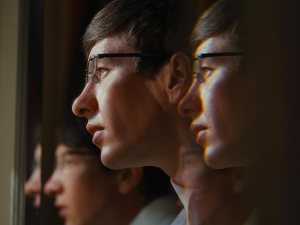
Saltburn is like if The Talented Mr. Ripley was made by the auteur of tawdry trash Larry Clark (Kids, Bully). It’s trashy nouveau camp that works as a sour class comedy until it becomes too sour and most definitely doesn’t work as any sort of engaging character piece or legitimate thriller. I don’t really know what Fernell was going for here and it doesn’t feel like she does either. I think back on the similar tale of Mr. Ripley as an advantageous upstart who got a taste of the good life and didn’t want to give it up. Like Saltburn, we know about our lead’s duplicitous and untrustworthy nature early, but with that movie we could see why others could be charmed by Tom Ripley, and we understood why he would want to stay in this privileged life. With Saltburn, when the rich are treated as shallow twits practically bored with one another from their opulence, the question remains what exactly is the appeal beyond simply attaining more? Also, the appeal of watching con artists slip into a world not their own includes seeing how they will get away with everything, how they’ll cleverly avoid all the traps that materialize. With Saltburn, there is no thrill of clever escapes because the insidious force is obvious and the other characters are too stupid to recognize because they’re meant to be satirical send-ups. It’s a would-be thriller that has gutted all its thrills by eliminating a foreboding sense of consequences.
However, the movie cannot work because all of the surprises were alleviated through poor character development of Oliver and in the performance of Keoghan. I don’t think anyone who ever watches this movie will be even the slightest surprised that Oliver isn’t quite the noble and honest young coed that he may have appeared to be. Except after maybe a couple of early scenes of nerdy awkwardness, Oliver has been depicted as an obvious predator. From the beginning, as he’s sharing his sad family back-story, I was already shaking my head in skepticism and predicting that the truth would be something ordinary and boring that he would choose to cover-up. It’s just too obvious where this scheming, covetous character is going, and Fennell doesn’t do anything to counter this overwhelming and, again, transparent assessment. If you have a character acting all weird and shifty and literally slurping up spent bathwater belonging to the target of his obsession, you shouldn’t then make the later machinations a big reveal. I wanted to laugh that Fennell thought the audience would need flashbacks to better clarify Oliver’s scheming nature behind a series of tragic events. I always assumed it was him because who else would it be? It’s an obsessive young man with oblique and yet obvious motivation to have what he desires from the privileged. We get it. The problem is that the movie never really better examines this desire from his outsider status. We already know he’s the malignant force.
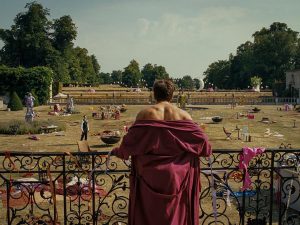
Keoghan is a great actor but “naif” is not a comfortable role for the man. By his casting alone, you’re already looking at Oliver with measured distance and scrutiny. He’s already got a leer that will set people ill at ease. The way the character is written only further confirms this judgment. If Tom Ripley was acting this outlandishly bizarre and creepy from the get-go then he would have been arrested immediately. It’s not even a lack of nuance that hurts Oliver. Not all villains and screen psychos require a full three dimensions, but the characterization is just so lazy and unexplored. He’s just a font of unchecked lust. At least in 2017’s Killing of a Sacred Deer, where Keoghan also played a malevolent young man tearing apart a family unit, his character was meant to have a mythic quality of inescapable retribution, like the Greek tragedy its title was in reference to. With Saltburn, he’s just a creepy perv, but he’s also a boring and redundant creepy perv by the ongoing refusal to provide other context. He’s less a character than a proverbial set of hands to prod characters and poke the viewer in the eye. He’s a recycled program of tedious provocation.
Given how masterfully Fennell utilized and subverted salacious elements in Promising Young Woman, I’m shocked there wasn’t much more than empty shock value. Whatever intended satirical value of this movie is glancing and fleeting. Did you know rich people can be, wait for this, superficial? Saltburn becomes a gross-out game of how far this daft creeper will go with his deadly obsessions, and on that front it all feels too annoyingly flimsy, constructed merely to be transgressive for its own provocative sake. Watching the lengths Oliver will go to prove his disturbing bonafides, it overwhelms the movie and simply becomes the movie’s purpose itself, a measurement between how far Fennell can repulse you before you reach a breaking point. It’s not merely that the characters are easy jokes, it’s that they’re bad jokes. I will say though that the ending shot is so joyously performed that I wish the rest of the movie had this kind of entertainment.
I do think there is an audience for Saltburn, the kind of people who celebrate Harmony Korine’s art-trash movies (Gummo, Spring Breakers), the kind of people who love candy-colored stylistic excess and tongue-in-cheek provocations, and people that seek out twisted love stories and dark romances. Satburn styles itself as a romance, at least early, but it’s clear that there’s nothing romantic about watching a predator set his sights on his prey and work through the family. Sadly, there’s also nothing truly entertaining here either, other than wondering when the next extreme yet desperate attempt at shock value would appear. The characters are too thin and unexplored to support this movie, and the antagonist is too obvious, as are his machinations, though his motivation remains cloudy and also undeveloped. This movie would be akin to watching a bad flu work its way through a family for all the personality Oliver offers. Fennell is a talented storyteller and exceptional at spinning genre pastiche into something so much more, so it’s quite disappointing that Saltburn is so much less than even the sum of its sundry parts.
Nate’s Grade: C
Share this:

The Killer (2023)
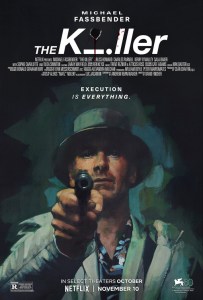 Were you even aware that David Fincher had a new movie? The celebrated director has been very mercurial since 2014’s Gone Girl, only helming one other movie. His partnership with Netflix has afforded the notoriously perfectionist director a lot of creative latitude, though sadly not a third season of Mindhunter. But even the artistic cache of a new Fincher movie isn’t enough for Netflix to change its business model. The Killer only played in theaters for two weeks before beaming into millions of homes. You would think this streaming giant would want to leverage its big names and their new projects, but I’m reminded of how much money Netflix likely left aside forgoing Glass Onion’s theatrical run. Alas, The Killer is an intriguing if cold and unsatisfying thriller that epitomizes the limits of surface-level living.
Our titular killer (Michael Fassbender) is hired to kill a Parisian businessman and botches the job. He’s on the run and fears for his well-being from his employers wanting to eliminate any loose ends. His girlfriend in the Dominican Republic is beaten and threatened, and the lead killer realizes he’s going to have to out-kill all the other killers after him if his loved ones don’t get killed. Through five chapters, each ending in a death, the killer works his way up the food chain.
 Fincher is attempting to strip out the movie-cool mythos of the world of hired assassins, to subvert the entertainment value that can come with expert murderers leading to blood and death. The Killer is Fincher’s stubborn subversion of what a trained assassin movie should be, and his main takeaway, beyond stripping the misplaced glamor from the profession, is how tedious it would all be in real life. In the movie world, being a trained killer involves all sorts of exciting derring-do and acrobatics and the like. In the possible real world, being a trained killer is more like a paid security guard; it’s a lot of protracted sitting and waiting and watching, and it’s easy to understand just how overwhelmingly boring all this would be. The opening twenty minutes quite convincingly strips the cool factor away from this profession. It doesn’t make you feel the weight of the culpability, like 2018’s You Were Never Really Here (more on that later), but what it makes you feel is just how maddening and boring this whole job must be and what kind of dedicated people would succeed. It’s like Fincher is making a bet with a mainstream audience that he can find a way to make a boring assassin movie, and while doing so can be seen as subversive to some degree, bleeding much of the thrills out of the picture, it also feels like a bet gone wrong. You made the main character boring on purpose to prove a point, but regardless of intent, your protagonist is still boring. Victory?
As physically inactive as Act One proves, watching our title killer sit and wait and watch, it is conversely hyperactive in narration. This is wall-to-wall narration as our lead character expounds upon his regiment to keep his mind and body ready when his eventual window materializes. It reminded me of the narration of Patrick Bateman from American Psycho, about his methodical lifestyle routines. Except that character was being satirized from their first moments, whereas the emptiness of our killer here is the larger point, that he’s fashioned himself into an unfeeling weapon. Here is a character that feels he is only effective if he strips everything human away, if he only focuses on the job regardless of politics or consequences, and lives his spartan existence. I’m sure he envisions himself as some noble modern-day samurai, living a code others cannot keep. Except the movie reveals throughout that he might not be the best killer in the phone book. First off, he misses shooting his target, which sets everything into motion. All his narration about focus and yoga and dedication and even I know you shouldn’t fire while someone else is in front of your target. There’s a jarring scene where he fires nails into the lungs of a character and theorizes the man has six or seven minutes left to live before his lungs fill up. Nope. The man dies within one minute max. For all his resourcefulness, which is benefited by the long reach of capitalism, the man also doesn’t live up to his self-image. His paranoia keeps him from returning to his home on time and allows the attack on his girlfriend to happen in his absence. There might be an even deeper commentary on how even the lead is confusing his life for a movie.
 My favorite scene is a sit down with a competing hired hitman played by Tilda Swinton (Three Thousand Years of Longing). She’s one of the two competing assassins responsible for targeting his girlfriend, so she presents a threat. He meets her at a fancy restaurant and she already accepts that she will not be making it to dessert. She is the exact opposite of our main character, a woman who has found a way to live a normal life in the suburbs, marry a man, and enjoy the luxuries of a life afforded by her wealth. She’s not living out of storage units or purposely dressing like a German tourist to stay under the radar. In some ways, this has allowed our more single-minded assassin to get the jump on her, to take advantage of her complacency. However, it’s also an indictment on the stripped-down, isolationist life our lead killer has prioritized. Here is a woman who has embraced allowing herself to enjoy things. She’s not eating McDonald’s breakfast sandwiches minus the slimy egg patty. She’s not slumming it for her “art.” She sees no value in abstinence. This stark contrast, as well as a sustained conversation between two foes, is the highlight of the film. It’s also interesting to watch Swinton’s character go through her own mini-grieving process accepting the likelihood that this will be her final meal, and so she savors it without fear.
Being a David Fincher movie, you can rightly assume that the technical elements are nearly flawless. The visual arrangements are beautiful, the cinematography is chilly and atmospheric, and the editing is precise and smooth. The first attempted kill has a nice degree of tension simply from shifting audio levels, going from diegetic to narration, never allowing the viewer to properly adjust during such a heightened point of paying attention. It’s naturally unsettling and effectively raises the tension of a moment we’ve been waiting over twenty minutes to arrive. There is an extended hand-to-hand fight sequence that’s exceptionally well choreographed and carries on from room to room, transforming with each new location and utilizing the geography of each space nicely (the John Wick folks would approve). The overall movie feels more in keeping with the likes of Fincher’s Panic Room or The Game, a more straightforward thriller that lacks simply extra levels and commentary, like Zodiac or Gone Girl. There’s nothing wrong with a well-executed and developed thriller purely designed to be a good time. It’s just at this stage of Fincher’s career, the expectations are raised, fairly or unfairly, with every new release. The Killer is a polished thriller meant to be pared down to its essential parts and can be enjoyed as such.
There is little to hold onto here emotionally though, so we’re left with the intellectual curiosity of watching a so-called professional go about their business and see how he gets around obstacles. Very often it’s dressing up in a delivery outfit and simply waiting on other polite strangers to open doors for his unassuming facade. One could argue that the character arc is about a man who rejects empathy, argues that it is weakness, comes around to accept empathy, and embraces it on his way out. I can see some of this, as the motivation for his trail of vengeance is to protect his loved one from being harmed again. There’s even a moment where he demonstrates a sliver of sympathy to a victim, albeit still utilizing gruesome violence. Except I don’t believe that easy assessment of this being a journey of embracing empathy. This doesn’t come across as a character changing who they are but instead as a character cleaning up their own mess. The main character keeps reiterating to “stick to the plan, don’t improvise,” but I don’t think he’s reflecting at any point on his actions beyond a clinical cause-effect relationship. He’s stripped all the complexities of humanity out from himself but recognizing fault isn’t the same as building and maintaining a sense of empathy. I also think the reading that many critics are making of Fincher standing in for the main character, a dedicated tactician who tries to do it all, is a little too cute and desperate for meta-narratives to derive a better lens to analyze the overall vacancy of the lead character.
 This is very different from Lynn Ramsay’s You Were Never Really Here, a film that also subverted the same hitman sub-genre and made the audience re-examine its own bloodlust. As I wrote in 2018: “The focus of the movie is on the man committing the acts of violence rather than how stylish and cool and cinematic those acts of violence can be. …Ramsay offers discorded images and brief flashes and asks the audience to put together the pieces to better understand Joe as a man propelled and haunted by his bloody past…. It’s not all tragedy and inescapable dread. Amidst Joe’s tortured past and troubled future, there’s a necessary sense of hope. You don’t know what will happen next but you’re not resigned to retrograde nihilism.” This is not the feeling I took from The Killer, and I recommend everyone watch Ramsay’s movie too.
The problem with making a boring assassination thriller on purpose is that, at the end of the day, you still have a boring assassination thriller. Fassbender (who hasn’t been on screen since 2019’s Dark Phoenix killed the X-Men franchise) can be compelling for two hours doing just about anything, and a performance that is minimal in spoken dialogue does not mean a minimal performance. He’s great to sit and watch, the running commentary of his narration serving as a starting point to assess all the concentrated, nuanced acting under the surface. The Killer has sheen and skill, much like its title character, but it too also misses the mark where it counts.
Nate’s Grade: B-
Share this:

Five Nights at Freddy’s (2023)
 I’ve learned so much more about pre-teen horror video games in the years since I’ve become a parent. There is no shortage of horror-themed games, many of them available through Roblox, that act as gradual entry points for burgeoning new horror fans that might not be emotionally ready for more intense horror (for my money, the creepy smiley creatures with dozens of teeth are more frightening than Michael Myers on any day). This brings me to the Five Nights at Freddy’s movie based on the insanely popular video game series that essentially said, “What if Chuck E. Cheese was, like, evil?” The game involved shifting between security cameras to keep watch on some frisky animatronics that have a hard time staying put, and of course jump scares and bloodless deaths. It’s a game about alternating camera feeds and waiting, and so the big screen version is also a movie very much about waiting for the creatures to stir. That’s probably why a quarter of the feature is watching Josh Hutcherson (The Hunger Games) travel into a dream-space to try and communicate with mysterious children to figure out what must be some of the more obvious plot revelations that he just can’t seem to grasp about this sleepy town and its history of missing kids. Why are we spending this much time on the human character’s back-story when we have killer robots to maim dumb teenagers? There are more scenes with the ghost kids than the animatronics of fame. The protagonist’s motivation seems wishy-washy since he’s putting his life on the line to keep his little sister and then makes an ill-advised bargain with the robots to get rid of her because… we need a moment for him to realize what really matters most? Huh? The scenes of horror rely much more on impressions, favoring shadows and implied violence than featuring anything too overt. I found the revelation of the ultimate villain to be laughable, no matter if it matches up with whatever the convoluted lore is for a game that, again, is flipping through TV channels and trying not to get eaten. There just isn’t a whole lot going on here, and the human drama of Hutcherson trying to win custody of his little sister feels a bit too dramatic and real for something this silly. He can’t get any other job than guarding an abandoned pizza parlor? Why does anyone just not enter the restaurant? He keeps returning to the job even after he realizes the danger. Unless you’re a diehard fan thrilled to just see live-action versions of your favorite furry friends, Five Nights at Freddy’s fees like four nights too many.
Nate’s Grade: C
Share this:

Retribution (2023)
 Liam Neeson has had one of the most unexpected second acts, from an esteemed dramatic thespian to Boomer action hero. The man’s natural gravitas elevated 2009’s Taken, plus the undiscovered thrill of watching Oskar Schindler karate chop goons in the neck, and ever since the Liam Neeson Action Vehicle was a 2010s Hollywood staple. He has been a downtrodden father, ex-husband, CIA agent, FBI agent, air marshal, border patrol agent, cop, ex-cop, ex-hitman, wolf-hunting marksman, snow plowman, ice road trucker, usually an alcoholic or recovering alcoholic, and always the beleaguered fighter called back reluctantly into action. But by the turn of the next decade, the Neeson Action Vehicle shifted from playing on the big screen to the small one, as the direct-to-DVD/streaming phase may likely extend to the remainder of the man’s career. He’s approaching his Geezer Teaser era (71 years old), though he has already made an appearance in an Expendables sequel, practically a subsidy for AARP action castoffs
I haven’t watched many of these latter Neeson action movies but the premise of Retribution intrigued me. Reminiscent of Speed, Neeson is Matt Turner, another beleaguered father who spends ninety percent of the movie in the confines of his car thanks to a pressure-triggered bomb that will explode if anyone exists. Unfortunately, Matt’s teen son and daughter are along for the ride in the backseat. They’re beset by antagonizing phone calls from a mysterious culprit with an escalating set of demands and orders. Can Matt save his family and maybe even his car too?
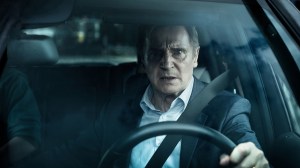 Apparently the third remake of a 2015 Spanish movie of the same name, Retribution moves along on a wholly predictable yet efficient plot as we’re introduced to supporting characters who will inevitably only serve one function. You don’t hire a famous name and then relegate them to one scene to get blown to smithereens. Likewise, there’s always an authority figure investigating the pieces who always has a supportive ear no matter the wild predicament of our hero. The kids are pretty much interchangeable as disaffected family members who will, over the course of 90 minutes of fantastic events, come to see that dad maybe cares after all and they shouldn’t be so rude to their old man. On the flip side, Matt will also come to better understand, through the intervention of a mad bomber, the importance of family he has been heretofore ignorant thereof. It’s all fairly mechanical clunky genre stuff, and if you’ve ever watched any relatively lower budget, straight-to-DVD action movie, especially the Geezer Teasers, then it’s all predictable. The viewing experience thusly comes down to finding nuggets of something memorable or different, something to hold onto unless the movie simply slips into a morass of mediocrity.
Retribution has one such moment and it just so happens to be its ending, so there will be spoilers ahead but I cannot fathom the person who would watch something like this, so formula-laden and familiar, and chafe at spoilers. Still, be warned, dear reader. It’s revealed by the end that our villain is none other than Matt’s business partner, a.k.a. The only other person that could profit off their personal bank stash who also happens to be played by a name actor (Matthew Modine, collect that paycheck). I don’t know why he personally sneaks into the backseat to threaten Matt at gunpoint when he’s been fine making threats from afar on the phone. Why the gun too when there’s already a bomb in play? Seriously, is it supposed to be surprising that Modine turns out to be our real villain, even after he fakes his own death as an elaborate fake-out? Anyway, after monologuing, Matt goes into full angry dad mode, growling a one-liner, and drives his precious car into the guardrails of a bridge, turning the car on its side. If Matt were to detach his seat belt, he would tumble into the river waters below, utilizing gravity as his savior from the potential blast radius (I suppose just forget about shrapnel or the real prospect of the car falling on top of him from the explosion). It makes for a satisfying if slightly clever (grading on a curve) comeuppance for our smarmy villain. Ending with your best moment is a sign that the filmmakers recognized what they had as a payoff. The movie literally ends seconds after, with Matt treading water, deserting any family resolution, admitting it was all just dross anyway.
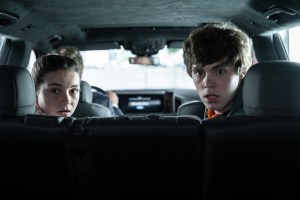 What’s funny is how inconsequential the family drama is that is intended to underpin the high-stakes peril. We find out mom is talking to a divorce attorney, and this news is a bigger bomb than the one under the seas. Suddenly the squabbling children realize the love of their family, even gruff dad, and they want things to stay the same. This storyline is so underwritten, really just serving as a catalyst for the kids to shut up and stop being jerks, that it all feels like self-parody that a mad bomber terrorizing a family has helped facilitate their renewed bonds.
As a late career action vehicle for an actor getting long in the tooth, the blandly titled Retribution is a relatively forgettable thriller that asks too little of its star and its audience. There are all sorts of directions a story can go with the concept of a man being unable to leave his car, so it’s disappointing that Retribution does so little, tying events to an obvious conspiracy with few complications. Imagine the funnier version of this movie, where Matt lives the rest of his life in the car. He gets drive-thru fast food for every meal. His daughter’s wedding has to be outdoors and near an easily accessible parking lot. He begins to see the car as an extension of himself and refers to the both of them in the third person. It takes a Titane-esque twist, and he wants to become the car itself. Then, as a decrepit 101-year-old man, the car breaks down on the side of the road and he has no choice but to leave it, and he accepts his fate with open arms. Then again maybe that isn’t as funny to anyone but me. Even Neeson’s weathered gravitas can only do so much when all the movie asks of him is to stay upright and look forward.
Nate’s Grade: C-
Share this:

No One Will Save You (2023)
 Brian Duffield has been an industry screenwriting phenom for years, though it took too many years for his ribald, clever, and high-concept stories to eventually find their way as finished films, or at least finished versions of his once ribald, clever, and high-concept stories. I fell in love with him as a storyteller with 2017’s The Babysitter, and that love matured into admiration and appreciation with 2020’s Spontaneous, his directorial debut, also my top movie of that year. As hyper verbal and bracing and layered as that stylish movie with major attitude was, and brilliantly so, his follow-up is a sprint in the other direction. No One Will Save You (I keep wanting to type You Will Not Survive This as its title) is a contained thriller with hardly a line of spoken dialogue as we follow Brynn (Kaitlin Dever) battle aliens. Being a nearly dialogue-free experience puts much on the immersive visual experience, and I don’t know if the movie fully sustains this, but the combined effort is solid and sneaky fun.
This is a throwback to the early 1990s invasion thriller, the heyday of The X-Files and Fire in the Sky when the little gray guys with the big black eyes became our default model for aliens. There’s an easy dread to compile when it comes to a powerful and otherworldly entity that has decided to target you, a lowly human. Duffield is able to engineer plenty of anxious moments and jump scares, allowing the scares to luxuriate by building suspense as well as the adrenaline bursts of sudden surprise (a moment with “toes” made me squirm). He makes a key creative decision early to showcase his aliens. Usually these kinds of movies are more guarded about their monsters, confining them to the shadows or at least relying upon the viewer’s imagination to fill in the blanks before pulling back and finally revealing their true form. There’s a reason that so many filmmakers follow this model, and it’s because the final reveal usually pales in comparison to whatever unseen horror the imagination can fathom. The slender creatures do make for creepy silhouettes, and there are three or four different versions of the aliens and this allows for some additional fun design discovery. A long-limbed one reminded me of a praying mantis. The chattering sound design and ominous lighting do a lot of atmospheric heavy lifting to elevate the mood. If you’re looking for a generally well-executed home invasion thriller with some gasp-inducing moments, No One Will Save You fulfills its promise. There’s a pleasing clarity to the plot mechanics, even if you are wondering why this woman doesn’t abandon her house.
 There isn’t much that needs explaining, which streamlines its 90 minutes into a series of reactive responses to the home invasion, with some clues and inferences throughout for us to start to piece together why our heroine is so troubled and seems so isolated by her small-town community. It makes for a visceral, visual method of storytelling but it also limits how much information and depth we are going to encounter. Our main character is still suffused by her own guilt and lasting trauma from her past, and as the movies seem to magically allow, she’s going to be given an external struggle that might just allow her to finally exorcise and resolve a dicey internal struggle. The alien encounters don’t seem to give us better insight into who our protagonist used to be, who she is now, and the misplaced perception of the townspeople. She’s retreated inward. She’s resourceful. She uses what she has to better guard from further close encounters, but all she has are ordinary items found in an old farmhouse, not high-powered weapons and booby traps. She’s just one frightened young woman in an old house trying to do her best. By holding back, we’re only given so much with this character, so she can feel somewhat underwritten and kept archetypal, underpinned by her past mistakes and her current otherworldly dilemmas. I just don’t know if there’s enough going on with this character even with the repeated alien visitation.
Dever (Booksmart) is one of our best young actresses and an excellent choice to anchor our drama. Without the safety of words, much is required from her, and Dever provides a compelling presence even when I feel like the character is hitting her limits. Carrying an entire movie and doing so much with non-verbal acting techniques can be a weighty ask, but Dever relishes the challenge, and through her capable performance we are given a hero worth rooting for.
 The movie does an acceptable job of keeping us, and her, relatively in the dark while still not making the sides too overwhelming. How can one Earth girl combat a species with such advanced technology, size, and power? Well, we don’t fully know what they want, and these little green men are still made of fleshy stuff and can still be hurt and killed like any other fleshy goo-filled life form. They may be advanced but they can still get killed, and that at least gives our heroine a chance that she shouldn’t have. The aliens’ plan is generally unknowable, and just trying to piece together a fuller picture of who they are, the different species and forms, and what their purpose might be for the town is plenty of work for the rest of us that don’t speak the space language. It’s enough of a reasonable learning curve to fill out a short movie while keeping focus on the task at hand, whether it’s hiding under the bed, running around the house, or simply trying to figure out whether going into town for help is worth the effort. I wish there was a little more deliberation on her part about whether the aliens might be preferable to her neighbors. The ending isn’t exactly ambiguous but reminds me a little of 2019’s Midsommar, where letting go of one’s personal hang ups might not be the catharsis of enlightenment it may appear to be.
No One Will Save You is a throwback sci-fi thriller that speaks to the human vulnerabilities we can all feel, being helpless against overwhelming powers, be they alien or our own guilt. It’s a fun thriller with some well-wrought sequences of suspense and jump scares. I don’t know if there’s more happening beyond the visceral appeal of the experience. The character and the situation don’t provide much in the way of larger depth and analysis, and more than a few will likely be able to guess her tragic back-story, though that’s also a credit to Duffield providing the key pieces. As a change of pace, No One Will Save You proves that Duffield is an entertaining and capable storyteller no matter what restrictions he holds himself to. I just prefer my Brain Duffield stories without any restrictions because we only have one Brian Duffield.
Nate’s Grade: B
Share this:

Talk to Me (2023)
 If you were at a party and were told that if you shake hands with a severed hand you could allow a ghost or spirit or whatever into your body, would you agree to this? I may be naive but I think most free-thinking adults would pass on this opportunity, but then again people are chasing all sorts of dangers as distractions or coping mechanisms, so perhaps I’m dead wrong. Now, if you present this same question to teenagers, I’m positive of different results. This is the kickoff for Talk to Me, the new hit horror movie of the summer. Mia (Sophia Wilde) discovers that this magic hand can allow her to see and talk with her mother, who killed herself about a year prior. How far will she go to reach out to her mother and what consequences is she willing to bear?
Reminiscent of Smile, the small horror hit from last year, Talk to Me is a small-scale horror thriller that might not have much extended thematic commentary but it knows how to goose an audience and ratchet up your sense of dread and compiling unease. The premise is gloriously straightforward and creepy from the start, allowing a possibly malevolent spirit to inhabit your body as a thrill. There are plenty of places to go with this premise, as flirting with the “other side” has been a staple of horror movies, just as much as teenagers making bad decisions. It’s a possession movie by way of an addiction metaphor, finding a new and impossible to replicate high, and this too as a vehicle for our protagonist to try and obliterate her grief. The characters feel downright euphoric afterwards, having communed with someone or something, and it certainly makes for fun spectator viewing. The vulnerability of losing control, and especially to a power that you have little understanding of, is a potent direction for the story. Naturally, once we’ve established “safe parameters,” we must then break them and suffer the consequences, and Talk to Me does a truly excellent job of making you feel that omnipresent trepidation. This is a creepy movie that makes fine use of practical effects and an engaged sound design. It’s nothing new from a technical standpoint but it’s yet another example of someone knowing what to do with their tools to create an affecting and uncomfortable atmosphere of uncertainty. It’s more a well-engineered thrill ride, much like my assessment of Smile, but when it’s this well done, you’re just happy to have a conductor who is operating on such a high level of execution.
 There isn’t much in the way of commentary with the movie besides some fleeting criticisms of transforming personal pain and discomfort into a spectator brand. The movie doesn’t have much to say on this front other than teenagers are predisposed to make bad decisions, and giving them cell phones, social media, and a magically cursed totem might be a damning combination. The different characters treat the possessions like a party, everyone with their phone ready to record the crazy and unexpected results, many of which they cannot fully understand. There’s something there about messing with forces beyond your control and feeling protected, possibly even nigh invincible, because you’re a bystander and not a direct participant, that holding a screen in front of your face somehow stops you from being complicit in the activity. The movie utilizes the severed hand as more of a plot device than a starting point for intriguing dimensions of social commentary. Thanks to how well executed the movie is, I forgave the oversight.
I wish the movie had explored some of its intriguing avenues a little further, but one area I’m glad we didn’t need to delve into was the origin of the severed hand. Many of these curse movies push the protagonist to investigate the mysterious origins of the Evil Thing and try to find the beginning of the chain of death and destruction, such as The Ring, Smile, and It Follows. There may be a fascinating story behind this totem but I’m more than comfortable just accepting it on its own vague terms as our catalyst for unrest. I don’t require its unholy backstory. This devotes more of the 90 minutes to focusing on the characters and their emotional turmoil, which allows the grief metaphors to really simmer. It also makes for an intriguing dilemma because Mia has been granted access to her deceased mother through these very unusual circumstances. She misses her dearly and is willing to break rules to continue that connection, which puts others at risk and brings about lingering consequences. Once mom is back, it becomes an ongoing game of whether or not this could be her real mother or something malevolent manipulating her. I found this storyline to be more compelling than a series of clues connecting to more clues to reveal the history of the severed hand, likely learning about a litany of prior owners who have experienced tragedy and ruin. This centered the movie more as an extension of our main character’s grief and the limits and risks she was willing to meet in order to find closure.
 The directors have been a mainstay on YouTube for a decade as the popular RackaRacka channel, and the Australian twin brothers Danny and Michael Philippou make a seamless transition into big screen horror. They don’t overload their movie with stylistic distractions, and the editing is very confident and patient to better build a sense of dread. It’s that atmosphere that proves to be the best element of Talk to Me, as the second half pushes the audience to question what we’re seeing and whether it’s reality or hallucination (also like Smile). When there are stylistic flourishes, it’s almost like its own form of a jump scare, a break from the normal. The opening house party sequence is filmed like one continuous tracking shot and it succeeds in building your unease and anticipation that some very bad things will be happening soon enough. I was especially impressed by the ending, which I won’t spoil in any significant sense, except to say that it’s a fitting and humbling conclusion that also provides a nicely morbid reversal.
If you’re in the mood for a spooky spine-tingler that delivers the goods with a streamlined story and extra emphasis on its protagonist’s fraying emotional state, then Talk to Me is for you. It’s nothing revolutionary but it is creepy and quite effective and evidence that the filmmakers have been taking careful notes about what makes horror stories and movies succeed. Sequels and prequels are likely inevitable, though I don’t know if the premise supports an extended universe of lore and complications, but I’m willing to be wrong. Go ahead. Take hold.
Nate’s Grade: B


 nathanzoebl
You must be logged in to post a comment.