Blog Archives
Wake Up Dead Man (2025)
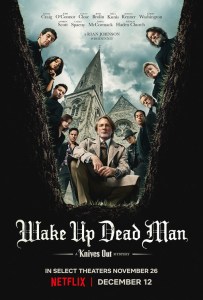 Being the third in its franchise, we now have a familiar idea of what to expect from a Knives Out murder mystery. Writer/director Rian Johnson has a clear love for the whodunit mystery genre but he loves even more turning the genre on its head, finding something new in a staid and traditional style of storytelling. The original 2019 hit movie let us in on the “murderer” early, and it became more of a game of out-thinking the world-class detective, Benoit Blanc (Daniel Craig). With the 2022 sequel Glass Onion, the first of Netflix’s two commissioned sequels for a whopping $400 million, Johnson reinvented the unexpected twin trope and let us investigate a den of tech bro vipers with added juicy dramatic irony. With his latest, Wake Up Dead Man, Johnson is trying something thematically different. Rather than adding a meta twist to ages-old detective tropes, Johnson is putting his film’s emphasis on building out the themes of faith. This is a movie more interested in the questions and value of faith in our modern world. It still has its canny charms and surprises, including some wonderfully daffy physical humor, but Wake Up Dead Man is the most serious and soul-searching of the trilogy thus far, and a movie that hit me where it counts.
In upstate New York, Pastor Jud (Josh O’Connor) has been assigned to a church to help the domineering Jefferson Wicks (Josh Brolin). The congregation is dwindling with the exception of a few diehards holding onto Wicks’ message of exclusion and division. The two pastors are ideologically in opposition, with Pastor Jud favoring a more nurturing and welcoming approach for the Christian church. Then after one fiery sermon, Wicks retires to an antechamber and winds up dead, with the primary suspect with the most motivation being Pastor Jud. Enter famous detective extraordinaire Benoit Blanc to solve the riddle.
 I appreciated how the movie is also an examination on the different voices fighting for control of the direction of the larger Christian church. Wicks is your traditional fire-and-brimstone preacher, a man who sees the world as a nightmarish carnival of temptations waiting to drag down souls. He sees faith as a cudgel against the horrors of the world, and for him the church is about banding together and fighting against those outside forces no matter how few of you remain to uphold the crusade. Pastor Jud rejects this worldview, arguing that if you think of the church as a pugilist in a battle then you’ll start seeing enemies and fights to come to all places. He’s a man desperate to escape his violent past and to see the church as a resource of peace and resolution but Wicks lusts for the fight and the sense of superiority granted by his position. He relishes imposing his wrath onto others, and his small posse of his most true believers consider themselves hallowed because they’re on the inside of a special club. For Pastor Jud, he’s rejecting hatred in his heart and looks at the teachings of Jesus as an act of love and empathy. It’s not meant to draw lines and exclude but to make connections. These two philosophical differences are in direct conflict for the first half of the movie, one viewing the church as an open hand and the other as a fist. It’s not hard to see where Johnson casts his lot since Pastor Jud is our main character, after all. I also appreciated the satirical tweaks of the church’s connections to dubious conservative political dogma, like Wicks’ disciples trying to convince themselves the church needs a bully of its own to settle scores (“What is truth anyway?” one incredulously asks after some upsetting news about their patriarch). It’s not hard to make a small leap to the self-serving rationalizations of supporting a brazenly ungodly figure like Trump. At its core, this movie is about people wrestling with big ideas, and Johnson has the interest to provide space for these ideas and themes while also keeping his whodunit running along pace-for-pace.
There is a moment of clarification that is so sudden, so unexpectedly beautiful that it literally had me welling up in tears and dumbstruck at Johnson’s capabilities as a precise storyteller. It’s late into Act Two, and Blanc and Pastor Jud are in the thick of trying to gather all the evidence they can and chase down those leads to come to a conclusive answer as to how Pastor Jud is innocent. The scene begins with Pastor Jud talking on the phone trying to ascertain when a forklift order was placed. The woman on the other side of the line, Louise (Bridget Everett, Somebody Somewhere), is a chatty woman who is talking in circles rather than getting to the point, delaying the retrieval of desired information and causing nervous agitation for Pastor Jud. It’s a familiar comedy scenario of a person being denied what they want and getting frustrated from the oblivious individual causing that annoying delay. Then, all of a sudden, as the frustration is reaching a breaking point, she quietly asks if she can ask Pastor Jud a personal question. This takes him off guard but he accepts, and from there she becomes so much more of a real person, not just an annoyance over the phone. She mentions her parent has cancer and is in a bad way and she’s unsure how to repair their relationship while they still have such precious time left. The movie goes still and lingers, giving this woman and her heartfelt vulnerability the floor, and Pastor Jud reverts back to those instincts to serve. He goes into another room to provide her privacy and counsels her, leading her in a prayer.
 The entire scene is magnificent and serves two purposes. This refocuses Pastor Jud on what is most important, not chasing this shaggy investigation with his new buddy Blanc but being a shepherd to others. It re-calibrates the character’s priorities and perspective. It also, subtlety, does the same for the audience. The wacky whodunit nature of the locked-door mystery is intended as the draw, the game of determining who and when are responsible for this latest murder. It’s the appeal of these kinds of movies, and yet, Johnson is also re-calibrating our priorities to better align with Pastor Jud. Because ultimately the circumstances of the case will be uncovered, as well as the who or whom’s responsible, and you’ll get your answers, but will they be just as important once you have them? Or will the themes under-girding this whole movie be the real takeaway, the real emotionally potent memory of the film? As a mystery, Wake Up Dead Man is probably dead-last, no pun intended, in the Knives Out franchise, but each movie is trying to do something radical. With this third film, it’s less focused on the twists and turns of its mystery and its secrets. It’s more focused on the challenging nature of faith as well as the empathetic power that it can afford others when they choose to be vulnerable and open.
Blanc doesn’t even show up for the first forty or so minutes, giving the narration duties to Pastor Jud setting the scene of his own. Craig (Queer) is a bit more subdued in this movie, both given the thematic nature of it as well as ceding the spotlight to his co-star. Blanc is meant to be the more stubborn realist of the picture, an atheist who views organized religion as exploitative claptrap (he seems the kind of guy who says “malarkey” regularly). His character’s journey isn’t about becoming a true believer by the end. It’s about recognizing and accepting how faith can affect others for good, specifically the need for redemption. Minor spoilers ahead. His final grand moment, the sermonizing we expect from our Great Detectives when they finally line up all the suspects and clues and knock them down in a rousing monologue, is cast aside, as Blanc recognizes his own ego could be willfully harmful and in direct opposition to Pastor Jud’s mission. It’s a performance that asks more of Craig than to mug for the camera and escape the molasses pit of his cartoonish Southern drawl. He’s still effortlessly enjoyable in the role, and may he continue this series forever, but Wake Up Dead Man proves he’s also just as enjoyable as the second banana in a story.
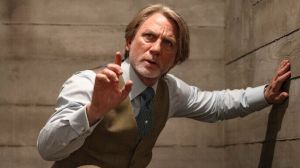 O’Connor (Challengers, The Crown) is our lead and what a terrific performance he delivers. The character is exactly who you would want a pastor to be: humble, empathetic, honest, and striving to do better. It’s perhaps a little too cute to call O’Connor’s performance “soulful” but I kept coming back to that word because this character is such a vital beating heart for others, so hopeful to make an impact. It’s wrapped up in his own hopes of turning his life around, turning his personal tragedy into meaning, devoting himself to others as a means of repentance. He’s a man in over his head but he’s also an easy underdog to root for, just like Ana de Armas’ character was in the original Knives Out. You want this man to persevere because he has a good moral center and because our world could use more characters like this. O’Connor has such a brimming sense of earnestness throughout that doesn’t grow maudlin thanks to Johnson’s deft touch and mature exploration of his themes. O’Connor is such a winning presence, and when he’s teamed with Blanc, the two form an enjoyable buddy comedy, each getting caught up in the other’s enthusiasm.
Johnson has assembled yet another all-star collection of actors eager to have fun in his genre retooling. Some of these roles are a little more thankless than others (Sorry Mila Kunis and Thomas Haden Church, but it was nice of you to come down and play dress-up with the rest of the cast). The clear standout is Glenn Close (Hillbilly Elegy) as Martha, the real glue behind Wicks’ church as well as an ardent supporter of his worldview of the damned and the righteous. She has a poignant character arc coming to terms with how poisonous that divisive, holier-than-thou perspective can be. Close is fantastic and really funny at certain parts, giving Martha an otherworldly presence as a woman always within earshot. Brolin (Weapons) is equally fun as the pugnacious Wicks, a man given to hypocrisy but also resentful of others who would reduce his position of influence. The issue with Wake Up Dead Man is that elevating Pastor Jud to co-star level only leaves so much room for others, and so the suspect list is under-served, arguably wasted, especially Andrew Scott (All of Us Strangers) as a red-pilled sci-fi writer looking for a comeback. The best of the bunch is Daryl McCormack (Good Luck to You, Leo Grande) as a conniving wannabe in Republican politics trying to position himself for a pricey media platform and Cailee Spaeny (Alien: Romulus) as a cellist who suffers from deliberating pain and was desperate for a miracle delivered by Wicks. He’s the least genuine person, she’s hoping for miraculous acts, and both will be disappointed from what they seek.
Wake Up Dead Man (no comma in that title, so no direct command intended) is an equally fun movie with silly jokes and a reverent exploration of the power of faith and its positive impact, not even from a formal religious standpoint but in the simple act of connecting to another human being in need. This is the richest thematically of the three Knives Out movies but it also might be the weakest of the mysteries. The particulars of the case just aren’t as clever or as engaging as the others, but then again not every Agatha Christie mystery novel could be an absolute all-time ripper. That’s why the movie’s subtle shifts toward its themes and character arcs as being more important is the right track, and it makes for a more emotionally resonant and reflective experience, one that has replay value even after you know the exact particulars of the case. If you’re a fan of the Knives Out series, there should be enough here to keep you enraptured for more. Because of that added thematic richness, Wake Up Dead Man has an argument as the best sequel (yet).
Nate’s Grade: A-
Share this:

The Peanut Butter Falcon (2019)
 It’s a beguiling little buddy movie about a wrestling fan with Down syndrome (Zack Gottsagen) escaping his care facility, joining forces with a runaway screw-up (Shia LaBeouf) in over his head, and the nursing home assistant (Dakota Fanning) looking to find her charge so they can all sail down the river and meet an old wrestling coach (Thomas Haden Church) who may or may not exist. It’s an episodic journey that hearkens to Mark Twain and 90s indie cinema with its unorthodox family dynamics. The real pleasure of the movie is watching LaBeouf and newcomer Gottsagen bond, whether it be building a raft, channeling larger-than-life wrestling personas, running away from a vengeful criminal (John Hawkes), getting baptized by a blind man, and simply finding time to become friends. It’s one of those “journey, not the destination” films because by the end The Peanut Butter Falcon is nice but rather unremarkable. It’s amusing and sweet but the advertising was filled with heightened exclamations such as, “The sweetest damn film of the decade.” As I sat in my theater, I was wondering if there was something wrong with my ticker; it wasn’t exactly feeling too full from the onscreen proceedings. It felt like there were core elements here that could have been further built upon, further developed, to turn The Peanut Butter Falcon from a relatively good movie into a great one. It’s well acted and the photography of the South can be gorgeous. LaBeouf (American Honey) is genuinely terrific and carries the movie on his back as a beleaguered soul still wounded from personal tragedy. The way he becomes the biggest supporter and advocate for his new friend is heartening without feeling overly trite or saccharine. However, by the end, I didn’t feel too uplifted or moved by the accumulative adventures. I enjoyed myself, but much like a Twain story, it’s more the teller than the tale, and by its winding conclusion I felt like there was too much left behind unexplored.
Nate’s Grade: B-
Share this:

Killer Joe (2012)
 This is one nasty, alarming, but very involving movie that wallows in darkness and plays it up for laughs. Killer Joe is a dysfunctional family drama, a crime thriller, and a mesmerizing character study when it comes to the lessons of amorality. Based on the play by Tracy Letts (August: Osage County), Joe (Matthew McConaughey) is a crooked cop who works as an assassin on the side. A weasely loser (Emile Hirsch) and his family hire Joe to kill their mother for the insurance money. Things get out of hand in frequent measure, with splashes of brutal violence, healthy amounts of sex and full-frontal nudity, and a disturbing sexual act with chicken that more than earn this film its adults-only NC-17 rating. What makes the movie rise above base exploitation is its depraved, deep-fried sense of humor. There is plenty of uncomfortable laughter and guffaws. The end of the film, during a fever-pitch of violence, is so sudden, so kooky, so debauched, that my friend and I burst out laughing. Without its wicked sense of humor, and its sharp ear for working-class dialogue, the movie could be accused of wallowing in the muck. There’s also the terrific acting, chiefly from McConaughey. He gives a hypnotic performance, chilling, unpredictable, and deeply committed to retribution. When he zeroes his cold eyes on you, boy does the flesh crawl. It’s an intense performance and arguably the best of the man’s career. Directed by William Friedkin (who also directed the 2006 adaptation of Letts’ play, Bug) with brutish élan, Killer Joe is one nasty piece of work, but given the right audience, it could prove to be a perverse entertainment.
Nate’s Grade: B
Share this:

John Carter (2012)
 John Carter has been in the longest development hell of any movie project in the history of cinema. If nothing else, that’s at least an accomplishment. Author Edgar Rice Burroughs first published his tale of interplanetary adventure in “A Princess of Mars” way back in 1912. It was his first published work, even before the phenomenon that would make him a star, Tarzan. Ever since 1931, filmmakers have been trying to realize Burroughs’ grandiose sci-fi vision but have never been able to finish. In the last decade, the movie has gone through different stages of development, with Robert Rodriguez, Kerry Conran (Sky Captain and the World of Tomorrow), and Jon Favreau attached as director at different points. Then Disney snatched up the rights and hired one of its own, Pixar director Andrew Stanton, to do what nobody has been able to do for 80 years –bring Burroughs’ vision to the big screen. It doesn’t hurt when Disney gives you a reported $250 million to spend.
John Carter (Taylor Kitsch) is a Civil War veteran haunted by his past. He’s chased by a group of bandits and stumbles into a cave that transports him to Mars, known as Barsoom to the natives. Carter discovers that he’s found himself in the middle of another civil war, this time between the cities of Zodanga and Helium. The Tharks are a race of 10-foot tall four-armed warrior creatures, and their leader, Tars Tarkus (Willem Dafoe), sees Carter as the turning point in getting his people’s lands back. Carter will also help solidify Tars Tarkus’ place as leader to his people. John Carter is a coveted free agent on the red planet. Princess Dejah Thoris (Lynn Collins) wants John to help her people survive against the Zodangans, lead by Sab Than (Dominic West). Dejah’s father (Cirian Hinds) has brokered a shaky peace on the promise that she and Sab Than will marry. The mysterious Therns, lead by Matai Shang (Mark Strong), are the real power players on Mars. They have offered a powerful new weapon known as the “ninth ray” to give Sab Than the upper hand. All John really wants to do is return home, but first he has to find a way back.
 John Carter is an amusing, entertaining throwback to old-fashioned B-movies. Even the depiction of life on Mars is charmingly retro, what a future would look like to a man from the early twentieth century perspective. As a result, the aliens fight with Bronze era weapons and guns that behave like trinkets from a Western. Even the minimalist alien design, the Roman-esque costumes, the fact that everyone can breathe air, and low-grade technology of these advanced species (flying machines that look like Da Vinci designed them) come across as nostalgic, vestiges of the past more so than insights into the future. It’s like watching those old sci-fi TV shows from the 1950s and how they predicted man would have colonized the solar system by now and already have a working lunar colony (Newt Gingrich is trying his best). The movie channels the spirit of old adventure serials and captures a certain gee-whiz, childlike sense of fun. There are moments where Stanton has a playful sense of storytelling, like a near montage of Carter’s determined escapes from officer Powell (Bryan Cranston? Why not?). While being PG-13, there is still a feeling of the Disney-fication of the tale, complete with tamer outfits for Dejah Thoris (do a Google image search) and an adorable alien “dog” sidekick that befriends John.
The best moments are easily the scenes where John integrates into the indigenous Thark tribes, finding a sense of community and a bonding with Tars Tarkas. If the movie had only featured this alien race instead of all those warring people-who-have-red-henna-tattoos-on-so-they-must-be-aliens-right, I think the movie would have succeeded better. One alien race focuses the narrative but instead we get four (three?). When our climax does come into view, the pieces have all fallen into place and the action is suitably thrilling. Stanton’s live-action debut isn’t the homerun that Brad Bird’s Mission: Impossible 4 was, but the large-scale action is satisfying and imaginative enough. The payoffs work and Stanton has nicely intertwined his storylines so that everything comes to a head. The Earthbound framing device, with Edgar Rice Burroughs (Daryl Sabara) reading the diary of his rich departed Uncle John, enriches the narrative once the full context is revealed, gearing up the audience for a long-awaited reunion to end the movie on a perfect high note.
What John Carter also has going against it is the pull of time. It’s hard not to see how derivative the story and characters are; Burroughs’ original novels were hugely influential to science fiction writers, and you can see similarities in Star Wars, Avatar, and other works. Scenes in this movie will feel like rip-offs from other movies, like an arena battle with giant alien hordes from Attack of the Clones, riling up a native alien species against its imperial antagonists in Avatar, Deja Thoris clearly has her DNA all over Princess Leia, and the dynamics of jumping through space travel via gateways made me think of how excellent a movie Stargate was (watch it again; it’s terrifically executed). Carter can easily be credited as the predecessor to superheroes. Now it’s unfair to say that John Carter rips off these other sci-fi movies when every one of them was released long after Burroughs’s novels had been widely published. It’s unfair, but you can’t help but feel the way you feel, and I was feeling a fairly resounding sense that I had seen much of this tale before and better. The actual terrain of Mars is a little less than inspiring. Its rocky vistas don’t make it feel too noticeably alien. We don’t ever really get a good view of alien culture outside of the Tharks. John Carter’s one big addition is that the character, given his physiological makeup and Mars’ gravity, can leap to impressive heights that were only previously known by Italian plumbers in video games. This means we get a lot of John Carter jumping up, jumping around, jumping like a Martian jumping bean. But just because you can jump really high, doesn’t that mean you’d be plummeting at a high rate of force? Wouldn’t John seriously break his legs leaping 500 feet in the air and then landing?
 The script, credited to Stanton, Mark Andrews (co-director of Pixar’s upcoming Brave), and Pulitzer Prize-winner Michael Chabon, is weighed down with expositional slog that it cannot break until the third act. I was expecting a better and more graceful story given Stanton’s previous film, WALL-E, which could be taught in film classes as a textbook example of elegant visual storytelling. With John Carter, it feels like we’ve been hit with the Martian phone book. We’re inundated with unfamiliar names and given scant time to adjust. While a gamble that the audience intelligence will catch up, it also makes for a confusing half of a movie. It’s hard to keep track of all the different names; Tharks this, Hellium that, Zodanga this, Jeddak that, Therns here, Barsoom there, etc. The movie doesn’t gradually expand its Martian history, it just plops us, along with Carter, right into the middle. The opening structure is also a bit confusing, as we’re jumping around time without any proper setup. Still, the movie cannot be accused of being stupid; hokey and convoluted, yes, but not stupid.
And boy do we get a lot of talking for an action movie set on Mars. The middle section is quite heavy with yapping. Kids who came thank to their trust of the Disney name will probably be bored as the movie explains to us things we already know and things we don’t care about knowing. For a two-hour plus film that has a lot of political infighting, I’m surprised that the movie is pretty pedestrian when it comes to its politics. It all really comes down to an arranged marriage to broker peace. That’s not very complicated. The main villains, the ghostly Therns, are completely incomprehensible when it comes to motivation. I have no idea what they stood to gain. If they have a gateway that can take them to Earth, or they have their own copies on Earth, why aren’t they using this to their advantage? Why aren’t they grabbing more Earthmen to form an army of jumping Jacks? Why the significance of the “ninth element” when we all know the fifth element is love? But more importantly, as last year’s Green Lantern proved, it hurts your movie when your hero can’t be bothered to be heroic. It takes far too long for John Carter to seem like he gives a damn about anything. I understand he’s a war-weary vet, but the movie feels like 90 minutes of him shrugging while everyone on Mars desperately pleads with him to save them.
Kitsch (X-Men Origins: Wolverine) is going to be having a fairly big breakout year given his mug appearing in several high-profile, high-budgeted movies. The guy has already proven with steady work on TV’s Friday Night Lights that he can act, though the results are not so convincing with John Carter. I think he was going for some sort of gruff, Clint Eastwood-esque loner but he just comes across as wooden. Add his character’s reluctant nature, and it makes for a pretty uninvolving hero. Fortunately for Kitsch (what an unfortunate last name), the supporting cast is there to pick up the slack. Collins (TV’s True Blood) is the real breakout star of the movie. She’s feisty and strong and passionate and altogether easy on the eyes she could give Leia a run for her money in a metal bikini competition. Collins’ performance is filled with urgency, like she’s compensating for our taciturn lead actor. When she’s on screen you feel engaged in the story. Dafoe (Spider-Man) finds the right mixture of humor and pathos as the leader of the Tharks. West (300) has such a slimy sneer to him, it’s magnificent to watch. I’m starting to think that Strong needs to take a break from playing villains (I count eight bad guy roles sine his breakout in 2008’s RocknRolla) except that he’s so good at playing them. I think if Mark Strong ever plays himself in a movie about his own life, he’ll inevitably be the bad guy.
John Carter is an entertaining throwback to the adventure serials of old, a retro sci-fi action film that falters somewhat from a talky, uneven, exposition-laden script. When this movie works, it works quite well. There’s just too much stuff in this movie, too many alien races, too much exposition, and too many other movies that make John Carter feel derivative. What was once amazing and imaginative in 1912 will not have the same effect on audiences in 2012, especially those who have grown up on pop culture inspired by John Carter. I don’t think anyone can say the final product was worth the wait, but John Carter is a modestly fun adventure. I wouldn’t mind taking another trip to Mars, just as long as it doesn’t take 80 years.
Nate’s Grade: B-
Share this:

Easy A (2010)
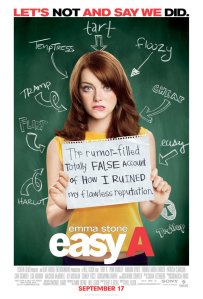 Usually when I think “teen comedy” I think lowest common denominator and a pitch straight down the middle of the plate. Will there be fart jokes? Probably. Will the climax taken place at the prom? Absolutely. Does Easy A do either? Not a chance. This is the sort of teen comedy that would have greatly appealed to me back in my own days of high school institutional education.
Olive (Emma Stone) is a high school senior that gets good grades, behaves well, and spends her weekends hopping around her bedroom and singing a song she can’t get out of her brain. She’s not into parties or idiots or anything remotely dangerous. Then her world turns upside down when she fibs about losing her virginity. Suddenly Olive is branded as the school’s hussy. Inspired by Nathaniel Hawthorne’s famous character, Olive decides to embrace the rumors, accessorizing her wardrobe with plenty of scarlet “A”s along the corseted bust line. Olive’s gay friend asks her for a huge favor: he wants to use her fake notoriety to lose his virginity. The two will attend a party, find a room, and dramatically interpret animated sex. It works like a charm. Her pal is given a free pass, some extra popularity, and it isn’t long before other downtrodden high school rejects seek a similar deal. Outraged at Olive’s lack of shame is Marianne (Amanda Bynes), the school?s busybody and leader of a vocal Christian abstinence program. She doesn’t know whether she wants to save Olive or banish her.
 All hail the coming of Emma Stone, comedy goddess and future heartbreaker. Easy A is a fantastic showcase of the many strengths of this irresistible actress. After several supporting roles in films like Superbad and The House Bunny, this is the first opportunity for Stone to have a film where she gets to be the lead, and trust me folks, this won?t be the last one. Stone has a great way of becoming instantly empathetic and, much like the film, being brainy and playfully risqué at the same time. Watching the success of Stone is like watching the road not taken by Lindsay Lohan (be careful whose advice you take, Emma). Stone makes her good times seem effortless, like she really is having a blast playing up her bad girl image. Her facial expressions and sarcastic, know-it-all line readings help push her comedic range even further, and yet she remains completely empathetic the entire time. Stone is the kind of girl that other girls would want to hang out with and guys would crush on. It is impossible to not love this actress, and she makes Easy A easily enjoyable and downright effervescent at times.
The rest of the cast is having just as much fun with the material as Stone. Chief among them are Stanley Tucci and Patricia Clarkson as Olive’s hyper-literate parents. They may seem like they stepped off the train from a Diablo Cody movie at first, but you will quickly get used to their glib rapid-fire repartee. Some might dismiss them as kooks. Thomas Haden Church (Sideways) tries to make the glamorous movie idea of the Hip Teacher into a droll square and succeeds admirably. There’s even Lisa Kudrow (TV’s Friends) as a guidance counselor and Malcolm McDowell (Halloween) as a blasé principal (“This is public school. If I can keep the girls off the pole and the boys off the pipe, I get a bonus”). Then there’s Bynes (Hairspray, She’s the Man) in what was billed as her final film performance before hastily retiring from acting, and then following in the footsteps of other famous retirees like Michael Jordan, Stephen King, Jay-Z, and Brett Farve, and hastily un-retired. She has her cutesy, dimple-faced shtick she cling to, but what happened to her? Her face looks very swollen, like she had an allergic reaction on every day of shooting. It looks like someone inflated her head with the plot to turn her into a Macy’s Day balloon. I started to get concerned for Bynes by the end.
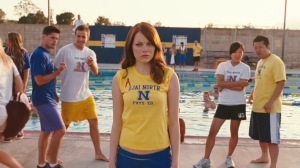 While Stone is the number one, two, and three reasons for seeing this movie, Easy A doesn’t let down her efforts. This is a teen comedy that might just be light years ahead of the pack. There are jokes guaranteed to go over the heads of a majority of audience members, from wisecracks about Sylvia Plath to French wordplay to the Kinsey scale. You’re not going to find any of that stuff in your typically brain-dead Freddie Prinze Jr. vehicle (is it just pathetic to keep holding onto a 10-year-old anti-FPJ grudge? The answer is, “No!”). Though I died a little inside when the movie resorts to explaining the plot of The Scarlet Letter to Joe Public; however, this intellectual Cliff Notes salve was saved by Stone bemoaning the idiotic 1995 Demi Moore film that takes some of the sharpest deviations I’ve ever seen from a classic literary adaptation (“If I have to grade one more paper talking about Hester Prynne taking baths all the time?”). The dialogue is routinely snappy and occasionally barbed, which is a bit of a surprise. It’s witty, a little cheeky, but it doesn’t go over the line or play for the easy gross-out gag. It?s a well-constructed, well-executed teen comedy that has a playful zing, a facetious tone that celebrates literature and makes being smart sexy.
While sex is at the forefront of the plot, the film does not treat the serious subject matter with flippancy. There’s some heavy stuff about what it means to sell out your ideals, prostituting yourself in more ways than the obvious. Olive begins her crusade as a means of taking ownership of her reputation and as an amusing character to play. But then as she dives ahead, accepting gift cards for her imaginary yet cred-boosting favors, the bloom of idealism dims and the meaning of her crusade become murky. What point is she trying to prove, exactly? In the end, is there a sharp difference between being a prostitute and being a “prostitute”? How big of a distance can irony give you? Easy A may have its fun when it comes time to doing the deed (I was howling with laughter about Olive chastising her first “client” about his comment on the aroma of sexual intercourse), but this is a teen movie ready to accept the consequences of its actions with a clear and level head.
 Not everything hums with precision. Easy A can be faulted for being too reverential and referential to 1980s teen comedies. Its ambition to be a modern-day member of this group is a bit too in-your-face. The abstinent Christian opposition feels too broadly drawn and setups for cheap shots and some downright mean punchlines. This movie is better than stooping to tin-eared caricature. The relationship between Olive and her best friend (Alyson Michalka) is vastly underdeveloped. The emergence of a Herpes outbreak also seems a little tacky, especially given its salacious carrier (trying hard not to spoil plot reveals). Then there are simply questions of believability. I?m not expecting a journalistic document of the American educational system, but since when was a high school student losing their virginity scandalous gossip? Why would Olive become the talk of the town by doing something that, according to the CDC, 80% of men and 75% of women have accomplished by age 19? Now, later in the film, the whiff of prostitution would definitely create a stir in the social gossip machine, and with technology, a rumor can spread at the speed of texting.
The film follows a well-worn path and owes a serious debt to the teen films of the 1980s, but Easy A is a winning teen comedy thanks to a snappy script, a playful sense of the taboo, and the courage to shoot for a higher level joke, also Stone’s charismatic comedic performance makes the grade. The entire movie has this bustling, quirky energy to it that feels un-labored. They make it all look so easy. Despite being a thorough genre flick, it is lifted thanks to its zesty writing and acting. In the most simplistically crass terms, Easy A scores.
Nate’s Grade: B
Share this:

Spider-Man 3 (2007)
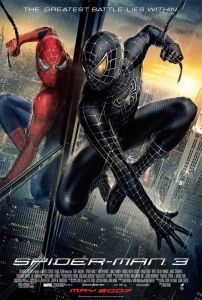 Who the hell are you Spider-Man 3 and what have you done with the franchise I loved? After the massive commercial success of first two Spider-Man chapters, my expectations had been raised fairly high. The more time that passes the more I reflect on how disappointing Spider-Man 3 sadly is. Part of my dashed hopes are because the 2004 Spider-Man sequel was a wonderful follow-up to a pretty swell introduction, and I placed that movie in my Top Ten list for the year and consider it one of the best comic book movies of all time. There’s some great popcorn entertainment to be had with Spider-Man 3, but man is this film just beside itself in wasted potential, a lack of focus, and some really poor choices.
Things are going pretty well for Peter Parker (Tobey Maguire). He plans on asking Mary Jane (Kirsten Dunst) to marry him and New York City is planning a parade out of appreciation for Spider-Man. But the good times can’t last long. Harry Osborn (James Franco) has accepted his fate and become a second generation Green Goblin villain, out to avenge his father’s death at the hands of Spider-Man. But Peter also has to be on the lookout for his job at the newspaper. Eddie Brock (Topher Grace) is an unscrupulous photographer out to replace Parker and nab a picture of Spider-Man caught in a bad light. An alien substance has also hitched a ride to Earth via meteorite and sought out Peter Parker. The black goo attaches itself to Peter and forms a black Spidey suit, one that gives him intoxicating power and a slimy menace. The new Peter cavalierly flirts with bouncy lab partner Gwen Stacy (Bryce Dallas Howard), hurts his friends, and loses his do-gooder ways.
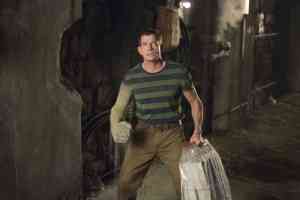
Meanwhile Flint Marko (Thomas Haden Church) has escaped from prison. It seems the police got it wrong and now inform Peter that Marko confessed to being the one who killed Peter’s uncle. While on the run Marko happens to tumble into an open pit that is a science experiment and becomes fused at a molecular level with sand. He uses this new power to rob banks in order to save his sick daughter at home. Peter, with the power of the alien suit, hunts the Sandman to get his own slice of sticky vengeance.
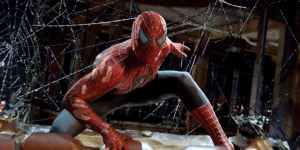 The film has way too much on its plate. There are too many characters, too many undeveloped storylines, too many coincidences, too many contrivances (Amnesia? Really? Really?), and too many aborted moments of drama. Spider-Man 3 is an undisciplined mess. The film practically stumbles from one scene to the next and lacks the coherency and intelligence of the earlier entries in the series. The third film tries to do too much and please too many interests, and as a result it may end up pleasing few fans. I had some trepidation when I learned that there was going to be upwards of three villains for this movie, but I swore that it could work since Batman Begins confidently worked around a trio of big bads. Three villains do not work in Spider-Man 3. Let me dissect this rogue’s gallery and where they fall short.
1) The Sandman is kind of a lame idea from the start. His power seems to limit his available locations, and I’m surprised that he wouldn’t stick to beach areas as a means of playing to his sandy strengths. Regardless, the character plays no part in almost anything that happens, and the Sandman is given one note to play. He’s got a sick daughter and he robs to try and pay for her medicine. That’s great on paper but it never really seems to give the character any sense of urgency or frustration. If he got special sand powers why not sneak into banks through cracks in walls instead of forming as a giant sand monster? Church attempts to imbue the character with a sad soul but he just comes across as being wooden. If he was really on the hunt for money to save his daughter then why does he just slouch around all the time? Wouldn’t it be easier to rob a city not patrolled by a web slinging super hero? How can he say he’s a misunderstood victim of luck just minutes after he tried killing Peter? He seems like a dull lunkhead. The Sandman is given a tiny wisp of character detail (sick kid!) and that’s it. He doesn’t get any other characterization and is kept on the run and pops up whenever the film needs him. He becomes a token character until the very end where Church is given 2 minutes to pour his heart out to Peter. Two minutes of character at the start, two minutes at the end, and a gaping center. The Sandman isn’t so much a character as the ideal of some issue that the filmmakers want to have Peter work through.
And what is that issue? Why vengeance and forgiveness. You see, Spider-Man 3 foolishly rewrites its own history and now it was the Sandman hat killed Peter’s Uncle Ben. This revision does not work at all and actually legitimately damages Spider-Man. Just like Bruce Wayne is tackling crime to alleviate his guilt, so too is Spider-Man, who can never shake the fact that he could have prevented his uncle’s death had he done the right thing moments before. By introducing a new killer it means that Peter has no responsibility for his uncle’s death. This completely strips away the character’s guilt and rationale for what compels him to swing from building to building to fight crime.
 2) Eddie Brock/Venom is wasted as well. Director Sam Raimi has said before he’s not a fan of Venom and doesn’t get the character, and I feel that his contempt carried over into the film. Venom and the black alien goo are given about the same abysmal care as other half-baked plot points. Eddie Brock has about three total scenes before he gets to transform into Venom thanks to the alien substance, and none of these scenes fully flesh out who the character is or justify his relationship with Peter Parker. When we do see Venom in the finale its all too rushed and hokey. The effects make him look less like alien and more like a wax figurine (I suppose there could be intelligent wax life amongst the stars). For whatever dumb reason the alien suit has to retreat so we can see Grace’s face while he taunts and mocks with bad vampire teeth that are meant to inspire what exactly? The character is rushed and underdeveloped and should have been saved for the next sequel instead of being given lip service in this one. Venom is supposed to be the evil doppelganger to Spider-Man, not some smart-alleck with frosted hair that gets about 15 minutes of screen time. I like Grace, I really like him a lot and envision him as his generation’s Tom Hanks, but he does not work in this movie. He could, but I get the sneaking suspicion that Raimi sabotaged the Venom role on purpose or at least subconsciously. The villain goes out with a whimper and it feels like a giant, foolish wasted opportunity that becomes more maddening the more I discuss it. The presence of Venom feels like a shallow attempt to placate a younger generation of comic fans and to sell more action figures.
The alien goo suit is supposed to tempt Peter and bring out his wicked wild side. So what does he do? He acts like he’s auditioning for the lead in The Mask. This embarrassing sequence is painfully goofy and will make you cringe and shield your eyes. Peter flirts with girls and dances at a jazz club, and this is supposed to be the dark side of Spider-Man? What the hell? I acknowledge that Peter has always been an unpopular dork and would be a dork even if he ventured to the dark side, but how does this square with the more serious and edgier tone the film is grasping for? Evil Peter seems more like a broody emo kid, with shocks of black hair in his eyes and traces of eyeliner. The dark side of Spider-Man, much like the rest of the film, is given little time or thought. Peter’s trials with the symbiotic suit last about a reel or two and then it’s abruptly finished.
 3) Harry should have been the main focus of this sequel and it?s a shame the filmmakers had to cram so much crap into a story already heavy with plot leftovers. Harry has the most obvious arc through the three movies and deserves better than to be knocked out of commission by amnesia. The conflict between Peter and Harry is where the film finds its emotional core and it would have been wise to expand this section and eliminate one of the other underutilized villains (my vote: both Venom and Sandman). Harry’s vow to avenge his father is far more interesting than what the other two villains have as motivation, and plus Harry requires no extra time-consuming setup to slow the pacing down. I’m glad the final battle encouraged Harry to come out and play; the film finally gives Franco the screen time he deserves, but it should have been more. The worst plot device in the film involves Harry’s all-knowing butler who has some vital information he most certainly should have shared years ago. So much time is spent on storylines that go absolutely nowhere, and the musical chairs of villains, that the film resorts to having a freakin’ butler tap someone on the shoulder and say, “Excuse me sir,” just to tie things up in the most awkwardly shrift way possible. And even if what the man says is true, how does his perspective add any clarity to the situation? Think about it. I have.
The romance between Peter and Mary Jane feels awfully trite and meandering. Spider-Man 3 lacks the tight focus of the second film. It throws contrivances to place a wedge in their relationship, like the fact that Mary Jane is fired from her Broadway gig but doesn’t tell Peter, or the fact that they never seem to answer the phone on time when the other person is apologetic. Gwen Stacy is less a character than simply a dimwitted blond tool to make Mary Jane jealous and sulk. The ups and downs in this relationship feel pretty forced and some moments defy all human understanding. At one point Mary Jane is forced by Harry to break up with Peter to spare both their lives. So she breaks the news in a park, and Peter is devastated, but why in the world does she never say anything again? Why would she not clear things up after time had passed to explain her actions? Spider-Man 2 ended with Peter finally getting the girl but also on a hint of doubt, and it was marvelous. Spider-Man 3 just sort of ends with everyone presumably in the same place they started.
Spider-Man 2 really succeeded on how focused it was and how it related its action with character. Spider-Man 3 has to resort to cheap and lazy devices to cover its storytelling pitfalls. Don’t even get me started on the fact that the film has to resort to a newscaster narrating our final battle where he actually asks, “Is this the end of Spider-Man?” This might be the end of the quality associated with Spider-Man.
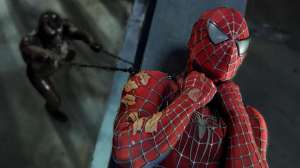 After having spent a whole slew of words detailing in length where the film goes wrong, allow me to illustrate some of what the film does right. Whenever it sticks to action, that’s when Spider-Man 3 works, and Raimi has cooked up some wonderful whiplash-inducing action sequences. The first battle between Peter and Harry is intense and sets the film on the right path, but the action as a whole isn’t as closely tied to Peter’s domestic life and emotional troubles as it was in the other films. A high-rise rescue from a crumbling office building will stir some 9/11 memories but it is awesome to behold. The effects have improved and the swinging shots through New York look the best they ever have. The greatest moment in the film is perhaps the birth of the Sandman as he rises grain by grain from a pile of sand and attempts to reform himself. Aided by some lovely music, the moment takes on a beautiful and unexpected poignancy. This is where Raimi and the CGI wizards hit it out of the park. Nothing rivals the train sequence in Spider-Man 2, though.
It might be dangerous to say, but I feel jilted from this film and either new blood needs to be brought in or the filmmakers need more time and control to make a Spider-Man sequel worthy of its name. This is the gold standard for super hero movies and its been tarnished and sullied. Spider-Man 3 has moments to dazzle and excite but it also feels battle fatigued from carrying the dead weight of extraneous characters and half-baked storylines. There are too many balls in the air for Raimi to juggle. This Spidey chapter squeezes too many ideas in too short a space. After obliterating box-office records, Sony has stated that they plan on three more Spider-Man sequels. If this film is the tipping point, then I’m afraid of what will be swinging down the pipe in years to come.
Nate’s Grade: C+


 nathanzoebl
You must be logged in to post a comment.