Blog Archives
Final Destination 3 (2006)
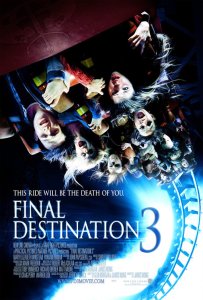 Isn’t the title Final Destination 3 itself problematic? How could it be final if it’s the third? It reminds me of 1998’s terrible I Still Know What You Did Last Summer, which wasn’t even correct with the film’s time setting (it must be stated that a 2006 sequel, and I’m not kidding, will be called I’ll Always Know What You Did Last Summer). Perhaps the best title comes from the worst movie of all time, Manos: The Hands of Fate, notoriously lampooned on Mystery Science Theater 3000. “Manos” is actually Spanish for “hands,” so the title is Hands: The Hands of Fate. Titles are fun. Oh yes. Final Destination 3, on the other hand, isn’t really fun.
A senior class is partying and enjoying the thrill rides of an amusement park. There’s an especially menacing looking roller coaster begging to be ridden by teenagers. There’s even a giant devil in front of the ride’s entrance. The ride fills up with your general high school characters (popular snots, Goth kids, cocky jocks, etc.) and then the safety bars become loose, flinging riders this way and that to splatter against broken rails and track. It’s all so horrifying … but it’s just a vision of Wendy (Mary Elizabeth Winstead). She goes into hysterics and gets off the coaster before it ships out. Other students follow her, including Kevin (Ryan Merriman), the boyfriend of Wendy’s best friend. Sure enough, the coaster crashes, those on it die, and death has been averted. For now. Just like previous installments, death seeks out the souls that escaped its cold clutches. Now death is taking out the survivors in the order they would have died and Wendy and Kevin must try and figure out a plan before it gets to them.
 Let’s not mince words, the true star of the Final Destination franchise is death itself. The appeal rests entirely on the fiendish, outlandishly complicated deaths and the misdirection over what will prove deadly. The audience is holding their breath for the next spectacular death. There’s a certain fatalism linked to this, knowing that the entertainment value is witnessing teens eventually get sliced and diced. But the franchise’s appeal also seems to be its downfall. The Final Destination films are stuck trying to out top themselves, and each film opens with a big centerpiece of disaster that inevitably serves as the film’s best moment. The rest of the movies never seem to match the opening melee, and it’s generally not a good idea for a movie to peek in the first reel.
Admirably, Final Destination 3 doesn’t even waste time with having its batch of characters theorize how to outfox the specter of death. We just watch, one after the other, the bloody, clever deaths like an assembly line of carnage. Final Destination 3 knows what its audience wants. Curiously, there’s no parental or police presence at all, even after the mounting coincidental deaths. Seriously, everywhere that Wendy and Kevin go, death is right beside them. Probably the funniest tidbit in Final Destination 3 is that shortly after another failed attempt to warn a doomed teen, Wendy and Kevin are in different, non-bloody clothes as they walk back to their car. They actually brought a change of clothes just in case. That’s hilarious. Little else seems amusing (the 9/11 reference is overwhelmingly tacky).
I once thought that the Final Destination concept could live forever in the annuls of horror, but the seams are definitely starting to show with this franchise. In 2000 it was fresh and unpredictable, and now it just seems exhausted and old hat. I thought the third film regaining the original writers and director would infuse Final Destination 3 with a bit more imagination. I was wrong. Glen Morgan and James Wong seem to go overboard to sate their blood-hungry audience, creating the most gruesome, torturous deaths yet. Seeing people eviscerated is one thing, but tantalizingly lingering on the sight of a busty teen being cooked alive, her skin boiling and exploding from the heat, is too much. It’s like this time death is really pissed, saying, “I gotta go through all this again!” The movie feels too mean-spirited, too vengeful, and a shade too cynical. I think the concept feels spent and even Morgan and Wong realize this, which is why they ratchet up the gore because the suspense is gone. The “gotcha” ending was pitch-perfect in the first Final Destination, but now it’s just another expectation feebly met.
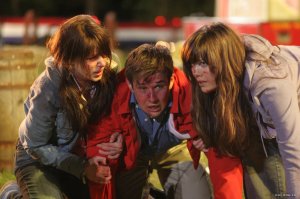 Of course, all the characters (with the possible exception of Kevin) are nitwits, horn dogs, jerks, and just plain unlikable, which make rooting for their demise easier. There’s no subtlety here either. The two shallow, popular girls are incredibly shallow and ridiculously stupid. The idiot pervert has a one-track mind that never takes a break. They’re all stock, they’re all one-note, and there’s even a moment where the token black character says, “That’s what I’m talkin’ about!” No wonder death is the star. At least in the previous Final Destination flicks you felt like the kids deserved a fighting chance.
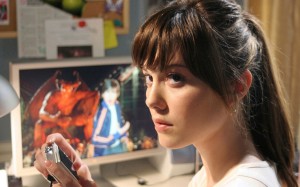
There is one neat addition to the formula. On the night of the accident, Wendy took several pictures and each photograph predicts that person’s demise. This allows the audience to try to decode the clues they’re given and correctly guess the next horrific death. It’s the most fun aspect of the franchise.
Final Destination 3 knows exactly what its audience wants, which is more of the same preposterously complicated deaths. The concept once felt fresh but now it seems worn out. I doubt new blood could revive this franchise because audience expectation has become too demanding. We already know the rules and know the characters can’t really escape death, so the only lasting suspense is what will kill them, and even that is fleeting. The return of creators Glen Morgan and James Wong still can’t infuse the right touches of imagination. It’s more grisly teenage carnage, nothing more, nothing less, nothing special anymore. Fans of the previous Final Destination flicks will likely find some entertainment, but the movie feels creatively spent. It’s probably time for this sadistic peep show to bow out before things get even uglier.
Nate’s Grade: C
Share this:

The Skeleton Key (2005)
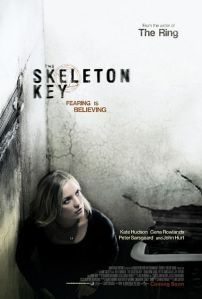 The marketing said it was horror (voodoo, creepy kids), but it’s less a horror movie and more a Twilight Zone tale. It has its share of jump scares and tries to draw out an atmosphere of dread. You see a lot of how doors work from inside locks. The Skeleton Key tries to be overly clever despite its plot holes, but at least the film runs its course. It wasn’t trying to throw out a contrived ending. Kate Hudson needs better roles than these do-nothing parts; she’s far too cute to languish. And how many times did she inspect late-night noises in her underwear? The most entertaining aspect of The Skeleton Key may be gazing at a pre-Katrina New Orleans.
Nate’s Grade: B-
Share this:

The Brothers Grimm (2005)
 Director Terry Gilliam is one of the true artists working today in movies. His manic, off kilter, visually grand imagination has crafted wonderfully vivid fantasias, but it also has given Gilliam a reputation for being the captain of a sinking ship. The Adventures of Baron Munchausen is regarded as one of Hollywood’s bigger failures, unfairly I might add. A fascinating 2003 documentary called Lost in La Mancha detailed the bizarre circumstances and implosions that forced Gilliam to shut down production of his pride and joy, a film about Don Quixote. We’re talking things as out of control and unlucky as acts of God conspiring to doom this project. But then, Gilliam has always been fighting someone or something his whole film career. The studio refused Gilliam’s cut of Brazil so he sneaked out a print, showed it to the Los Angeles film community, and they dubbed it the best film of that year. Gilliam is a man governed by his idiosyncrasies. He’s blessed with a unique voice but cursed with the prospects of not having anywhere to say something (would he not make simply the most divine Harry Potter film yet?). And so Gilliam strikes his hands at something a bit more commercially minded with the action/comic fable, The Brothers Grimm.
Will (Matt Damon) and Jakob (Heath Ledger) Grimm are nineteenth century ghostbusters, so to speak. They travel from town to town ridding the villagers of evil spirits, witches, and all sorts of demonic creatures. Trouble is it’s all a lie. The Grimm brothers and their pals set up the spooks and rob the town blind. Will enjoys the fame, and especially the women, but Jakob feels apprehensive. It?s the Napoleonic wars, and the French have occupied the Germanic lands. A snooty general (Jonathan Pryce) plans to behead the two Grimm brothers unless they solve a strange case in a rural town. A slapsticky, torture-loving commander (Peter Storemare) is sent to watch over the “Grimmies.” At the village, Will and Jakob discover the town has had 10 of its daughters kidnapped with little explanation. With the help of a free-spirited woman (Lena Headey), the brothers encounter giant wolves, moving trees, lickable frogs, and the giant tower of the Mirror Queen (Monica Bellucci). The Queen was given eternal life but not eternal youth. In order to gain eternal youth, the Queen needs to take the lives of 12 hearty girls, and only the bumbling Grimm brothers stand in her way.
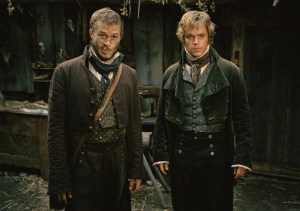 The acting is an example of the film’s messy feel. Ledger talks with marbles in his mouth. He’s putting more detail into the character than it deserves. Damon seems like he’s sleepwalking through the film, and his accent fluctuates wildly. He’s sort of a grinning straight man to Ledger’s tic-heavy daydream believer. Belluci is a ravishing beauty and proof positive for Hollywood that women over 40 don’t need to be put out to pasture. Too bad all she’s expected to do is look pretty and seductive in The Brothers Grimm. Pryce plays his role like a cartoon caricature. Stormare has already given one crazy performance this year (Constantine), and his frenzied, nearly indecipherable performance seems to be the closest to Gilliam’s whacked-out wavelength. Stormare is entertaining in every scene he’s in but can be found guilty of chewing scenery like it was a delicious candy house.
The Brothers Grimm is a gorgeous looking film. The sets are massive and greatly detailed. The location shoots in Prague seem like the perfect environment for Gilliam’s beyond-this-world landscapes. Gilliam experiments with advanced computer graphics for the first time and adds his oddball touches. A child has her eyes taken by a glob of mud, and then the mud reshapes itself into a lumbering gingerbread man. A horse spits out a spiderweb and ensnares a child. And it looks really freaking creepy. The Mirror Queen’s defeat is another standout effect as she breaks apart like shattered glass. The look of The Brothers Grimm is outstanding, but it’s what takes place inside those pretty pictures that dooms the film to mediocrity.
 The Brothers Grimm is an unfocused mess. It has disjointed subplots and several story elements that just don’t fit. The wacky French occupation feels like a leftover from a different movie. It just doesn’t work and grinds the movie to a screeching halt with every resurfacing. The Brothers Grimm will routinely work its way into a narrative corner and then use a “magic” cheat to escape (magic axe, magic mirror, magic kiss). Gilliam has always been a master maestro of chaos and visual oddities, but this time he’s tackled a film with a very weak script by Ehren Kruger (Ring Two). Kruger doesn’t bother laying the groundwork of his magical world or establish the rules. Therefore anything can happen and rarely feels satisfying. The characters are one-note, each given a single character trait to play with (skeptic, believer, idiot, etc.). The pacing is pretty sluggish. The first act takes an eternity to set up the film’s characters, plot, and yet it still feels sloppy. The twists and turns are easily telegraphed and unexpectedly boring. The plot is frustrating, shortsighted in scope, and far too conventional for Gilliam’s tastes. When The Brothers Grimm reaches its happy ending you’ll swear you can hear Gilliam gagging somewhere.
Gilliam adds a worthy macabre tone to the film. There will be touches that you know are pure Gilliam, like a woman skinning a rabbit as she talks, or a cat flying into the blades or a torture device. In fact, The Brothers Grimm has a lot of humor involving the comic demise of animals. This isn’t exactly a film appropriate for young children despite the appeal of a fairy tale background. The film wants to tweak fairy tale legends like the two Shreks, but Gilliam wants to make them disturbing nightmares, not something of irreverence. This puts the film’s tone at odds. One minute you’ll have a scene that?s morbid, darkly funny, and unconventional, and then the next minute you’ll have a scene that’s cliché, dull, and whimsically misplaced.
The Brothers Grimm feels like a Terry Gilliam film under glass. The script is weak and plodding, the characters barely leave a dent, and the tone is uneven. The plot is pulled in too many directions and lacks momentum. There are a handful of fun comic diversions but the movie feels like a loose collection of disjointed story elements. There are flashes of grim humor and visual elegance but more often than not the film is just stupendously boring. The Brothers Grimm feels the same way the Coen brothers’ Intolerable Cruelty felt: a unique vision compromised and downsized by studio conformity. You can see the indie spirit but the heart just isn’t beating. The Brothers Grimm is mediocre at best. How very grim indeed.
Nate’s Grade: C
Share this:

The Ring Two (2005)
 I loved The Ring. Loved it. So I had some trepidation when I found out they were making a sequel. Surely it wouldn’t have the punch of the first film. To see Ring Two I went to a theater frequented by somewhat affluent teenagers and pre-teens. Big. Mistake. People were chattering away the entire time, laughing stupidly, and shouting ridiculously lame jokes: (on seeing a damp bed: “Oops, somebody wet the bed”). There were two managers that had to patrol the theater to keep order. Worst of all was a team of easily riled prepubescent girls that sat behind me, shrieking like banshees even during movie trailers. The same thing happened to me when I went to see The Village at the same theater. I must attract the most annoying people in the crowd. The sound quality in my theater was also very poor. Now, I can’t help but think that this was some divine act to warn me how bad Ring Two was going to be.
Rachel (Naomi Watts) has taken her son Aidan (the creepy David Dorfman) to a new town to start a new life. It’s been years since the incident with the videotape, and Rachel feels guilt about her role in spreading the killer tape. She’s got a new job at a small town newspaper but yet she can’t escape her past. A teen has been found with a contorted face, soggy floor, and a certain videotape. Rachel finds the tape and burns it. Samara, the evil young girl who started the evil tape, is none too pleased. Seems the evil tyke wants to be a real girl with a real mommy, and is slowly taking over Aidan. His temperature is dropping, he’s not sleeping, and bad things are happening. Rachel confronts more of Samara’s history to learn what it takes to stop her and get her son back.
 Everything that worked in the first film feels forced and meaningless when rehashed in Ring Two. In the previous film, there was context for the image of a tree on fire and Rachel yanking a fly right out of a TV screen. In Ring Two, these plot points are now reduced to being contrived signs of doom. There’s a scene where we’re supposed to be scared because a single fly comes out of a faucet. Huh? The fly and the tree made sense in The Ring, but in the sequel they are stripped of their context and seem alien. And dumb. After everything fit so tightly together in The Ring, it’s disappointing that little makes sense in the sequel.
Watts is such an enormously appealing actress that even in dreck like this she can come off as luminescent. With the two Ring films and Peter Jackson’s upcoming King Kong, Watts could establish herself as the scream queen of her generation. She’s a gifted actress and melts into whatever role she plays.
Ring Two‘s director, Hideo Nakata, knows a thing or two about the territory. He did direct the original Japanese Ringu films, which the American remakes are based upon. Nakata generates a fun sense of anticipatory dread. He also lucks into the occasional eye-opener like a bathtub whose water flows up and fills the ceiling. Nakata has a confidant touch but I miss the sheen of Gore Verbinsky’s direction.
What’s sorely missing is a killer premise like in The Ring. The premise was razor sharp, presenting a videotape as a virus and human nature’s willingness to taste forbidden fruit as the vehicle for its spreading. There was a sense of urgency because of the looming seven-day death deadline. In Ring Two there is no sense of urgency at all. In fact, the film takes an overly leisurely pace. It’s quite awfully boring. Samara wants a mommy and can?t really be stopped until a late revelation. This leads to a lot of impotent pacing and waiting. Except for a snappy opening, Ring Two completely ditches the videotape virus storyline that made its predecessor so compelling. As a result, it also ditches suspense and most of its intelligence.
 The Ring had a strong central mystery and a sense of urgency, which both blended to create tightly wound tension. Ring Two sputters around and relies on gimmicky jump scares as its main source of spooks. We see a character look into a mirror, look away, and then look back and something else is right there! Does this really work for anyone still? I just assume when a character ducks out of the way of a mirror that something’s coming. It’s these kinds of creaky, transparent tricks that Ring Two goes back to over and over to goose an audience. Because the story isn’t engaging the filmmakers have to resort to gimmicks. Since we’ve seen the results of Samara’s murders (the grotesque facial distortion) is it even scary to see it again when we know exactly what we’re about to see? The essence of horror is the unexpected. Finding the expected is about as scary as looking at leftovers in the fridge.
There’s a great moment early in Ring Two. Rachel and Aidan are driving through a forest and are followed and then attacked by a horde of deer. It’s the lone sequence in this sequel that feels different and exciting. It’s somewhat crazy, somewhat marvelous, and very weird. Too bad Ring Two relapses from there on into a turgid horror flick.
The Ring was a smart, tense, expertly crafted film that rose beyond genre conventions. Ring Two is nothing but genre conventions and repeatedly goes back to the well to drub up scares that aren’t there anymore (unless you’re the prepubescent girls that sat behind me). Watts is still in fine form and there are some visually striking moments. However, Ring Two is bereft of excitement and scares and has become just another tired, languished sequel. When I walk out of a horror moving saying, “I guess the best thing about that film was either Sissy Spaceck’s crazy cameo or deer,” then you are in a world of bad. Ring Two is meek, dumb, and boring. Let this one go straight to video.
Nate’s Grade: C-
Share this:

Constantine (2005)
 I’ll admit it; I’m a sucker for Christian mythology played against thriller and action settings. I may be the only person to have watched all of The Prophecy flicks, and probably the only person that eagerly chows down on the cheesy sequels to The Substitute, yet shy away from seeing the first film. I’m captivated by the imagery, the discussion of Heaven and Hell and its mythical logistics, and just the psychology of supernatural biblical beings. With this in mind, I was strongly anticipating the release of Constantine. What I got wasn’t exactly what I expected but I’d be lying if I said I wasn’t entertained.
John Constantine (Keanu Reeves) is a very troubled man. Since his youth he’s had to live with his gift that allows him to see through earthy disguises and witness angels and monstrous demons walking among us. He’s parlayed this ability into a modest side job of exorcising demons and sending them back to Hell. Constantine figures his loyal service should grant him passage into the pearly gates, but Archangel Gabriel (Tilda Swinton) reminds him that that’s not how it works. Constantine is doomed to go to Hell because he tried taking his own life, and if that’s not enough he also has terminal lung cancer from smoking like a chimney. “In other words, you’re f***ed,” Gabriel confides to Constantine.
 Police detective Angela Dodson (Rachel Weisz) is investigating the suicide of her twin sister (also Weisz). She swears her mentally disturbed sis wouldn’t do such a thing, and she seeks out the help of Constantine. He challenges her beliefs, stating that God and the Devil (Peter Stormare) have a wager over the souls of mankind but cannot directly interfere. But now something is breaking this rule and it looks like demons may be getting closer to entering our plane, and it looks like Angela’s dead sister may have known more than people would have thought.
The plot of Constantine is rife with contrivances, aborted subplots, underwritten and nearly forgotten supporting characters, and sketchy logic (staring at a cat can transport you to Hell? No wonder I’m a dog person). Often the film feels overwhelmed by good special effects, as they seem to be the crux of the film?s purpose of being and not, on the other hand, a theological playground of ideas. Constantine gives veiled glimpses of something smart, but routinely shuts that door to focus more on annoying jump scares.
In fact, Constantine seems rather old-fashioned with its theology, still clinging to the Roman Catholic belief that suicide is a one-way ticket to the fiery abyss. I understand its use as motivation for our lead, but will progressive audiences accept something they may find archaic? I suppose it could be worse. Constantine could have briefly gone to Hell for eating meat on a Friday.
It’s interesting that after spending two years making The Matrix sequels, Reeves would choose to attach himself to another big-budget theological action flick. His acting never really rises beyond morose loner but somehow he does make for a satisfying, brooding hero. Reeves? low-key monotone speaking voice allows him to spout cheesy dialogue with a straight face and mercifully keeps the audience grounded.
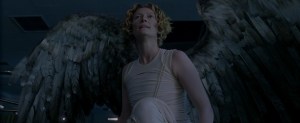 The true stars of Constantine are the memorable supporting players in this celestial smack down. Swinton uses her androgynous looks to forge what David Bowie might be like as an angel: angular, mysterious, waif, and somewhat creepy. Stormare delivers a performance so kooky and tic-heavy, that it could only be compared to the weirder moments of Christopher Walken. Both actors liven up the film and seem to be having the most fun by far with their cheeky roles.
The genius of Constantine is in its one-upsmanship game it holds with the audience. Granted, suspension of disbelief is needed to even go along for the ride, but when we start learning that Hell has its own line of bibles (and they’re longer) we’ve gone beyond suspension of disbelief and into wacky Anne-Heche-speaks-to-aliens land. While sitting through Constantine, we the audience think, “There’s no way this movie could get any sillier.” And then it does! We think, “Alright, that was crazy. Now there’s no way after that this film could get any sillier.” And then it does! Constantine is an amazing ascent into movie madness. After a while, I became drunk from the film’s insanity and wanted it to get even crazier, if possible. It almost seems like there’s a drinking contest between the movie and the audience, and Constantine isn’t afraid to piss its pants to win.
By the time Lucifer shows up, clad in all white like Tom Wolfe, and the Dark Lord appears to have Tourette’s Syndrome and/or a speech impediment, Constantine has hit the bottom of its Kool-Aid cup. Sure the film’s cinematography is slick, and the premise is intriguing, but the real draw of Constantine and the real enjoyment of the flick is how bat-shit crazy it is. I cannot even think of comparable films. I hope David Lynch was taking notes if he saw this.
For a while there, it seems director Francis Lawrence wanted Constantine to be a companion to Wesley Snipe’s Blade character. Maybe the two of them can set up a play date and go destroy otherworldly creatures. There’s a visually striking sequence late in the film involving Constantine in a room full of demons. He’s “contaminated” the water system by placing a giant cross inside, thus holy-fying the water before he can bottle it and sell it to the masses. He holds a lighter to the sprinkler system, demons growling all around him ready for their kill, and then water sprays down across the room. “Holy water?” one female demon says in a stunned voice, watching her flesh sizzle away. Then Constantine marches through the wet room blowing away demons into splashes of ash with his comically unwieldy cross-shotgun. It’s filmed wonderfully with dark hues and is a great idea; however, it’s a bit of a rip-off of the opening sequence in the first Blade.
 This seems to be a repeated sentiment in Lawrence’s direction. He has a sharp visual eye and several camera angles come from odd yet exotic places, but his film is borrowing so heavily from so many other films. What you’re left with is the impression of a stylish if very derivative looking action film. One exception is when Lawrence shows us glimpses of the blistering burnt orange world of Hell. It seems Hell is an exact model resemblance of Earth, only with the fire, brimstone, and crawling demons with their heads sliced open (there is a scary level beneath the surface where we witness a sea of people being tortured). The second or third time we traveled to Hell, I began to wonder what my house would look like and the logistics of upkeep for the homeowner in Hell. Surely the heating bills wouldn’t be the same.
Constantine is funny, frustrating, confusing, gorgeous, and just plain insane in the ole membrane. The film exhibits a rare and engaging form of insanity that may glue audience eyeballs to the screen to see what happens next. I’ve seen Constantine twice (don’t ask why) and even though I knew all the weird plot turns I still found myself getting an enjoyable contact buzz from the film. Who knows how long such a novelty can sustain itself, though. Comic book fans, especially those with a spiritual bent, should get a kick out of Constantine as will anyone else searching for a pristine example of how wonderfully out of control Hollywood moviemaking can be. Sometimes in a good way.
Nate’s Grade: B-
Share this:

The Haunted Mansion (2003)
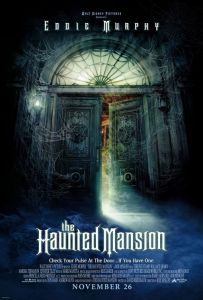 The best way to describe Disney’s third movie based on a theme park ride is this: its exactly like the ride. Which means it’s nice to look at but little else is there. Eddie Murphy, in his soul-selling kid friendly phase of his career, is a real estate salesman who cant pass up the prospect of a mansion. Never mind it’s haunted. He brings the family along, which includes a drop-dead beautiful wife, Sara (Marsha Thomason), and two annoying kids. There’s some storyline about Sara being the one to break the curse of the mansion, something about love never dying and a mystic key which leads to a mystic chest … I know, I’m bored already too. Despite being a mere 98 minutes The Haunted Mansion has sluggish pacing and some cheesy special effects. This is the kind of movie someone has a fear only because they need a moment to overcome that fear to save others. Murphy mugs for the camera and occasionally its funny, but he has the expression that even he doesn’t believe hes funny. Never good for an actor. Terrence Stamp is amusing as the butler. Jennifer Tilly is a highlight at the floating gypsy head in the crystal ball. The direction by Rob Minkoff (Stewart Little 2) is solid, and his opening sequence of the film’s back-story being played across the credits is the highlight. But what does it say when the highlight of the film is the opening titles? I don’t know who this film is for. It’s a bit too scary for young kids. Tweens won’t want to see a “Disney scary movie” and would rather see some of the PG-13 scares, like The Ring. It certainly isn’t for adults. Who is this movie for Disney? And I may be the only one, especially after recent events in the news, but when all the skeletons came out of their crypts … I thought Michael Jackson was going to come out and theyd all dance.
Nate’s Grade: C
Share this:

Brother Bear (2003)
 Kenai (voiced by Joaquin Phoenix) is the impulsive younger brother in a tribe of Native Americans living in Northern America. Where exactly? Well, I don’t know but someplace where Kenai and his brothers can surf wicked glaciers dude. Kenai wants to be accepted into his people more than anything. Too bad hes a screw-up. Some fish he leaves out attracts a bear that inadvertently kills Kenai’s older, wiser brother. Kenai swears revenge against the bear and kills it. But lo, this upsets the spirits of nature and they turn Kenai into a bear himself. Oh the irony. Kenai must learn all about coping in the animal kingdom while looking after a young cub Koda, whose looking for his lost mother. Take a guess what happened to his mother. No, seriously, go on and guess. I’ll sit here and wait. Done? Okay then.
The story of Brother Bear has as much life as a bearskin rug. Once again we have a hotheaded jerk that walks a mile in someone else’s paws and learns valuable life lessons through their bizarre transformation. The only thing this movie is missing is Rob Schneider in the main role.
I don’t know what the makers of Brother Bear were intending. Is this for young kids? Well there is endless slapstick and cutesy woodland creatures. However, the first part of the story is quite dark and all about family loss. Great way to start a family film huh? With some family killings? If this is also intended for kids I’m pretty sure they’ll be bored at the preachier moments talking about animal cruelty and tolerance.
Disney once again plays it too safe and by trying to please everybody they end up likely pleasing nobody. This is 20,000 leagues below the artful Finding Nemo. Why does it seem like when the Diz does things in-house theyre so adverse to risk? What the audience is left with is a formulaic piece of fluff thats only memorable attribute is being extraordinarily ordinary.
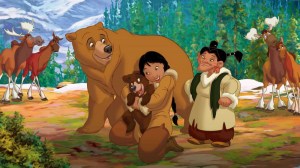 The ending is so bad that its beyond belief, so allow me to spoil it. Kenai transforms back into a human after hes learned his valuable lesson. He then chooses to remain a bear to watch after Koda. What? Why dont they turn Koda into a boy? Or turn everyone into bears? Or why not turn everyone in the audience into people watching a different, better movie?
The animation of Brother Bear is clunky and awkward amidst a crayola-colored backdrop. The visuals often seem drab or like the templates for a better movie. The human characters appear so stocky. The best element of Brother Bear is the voice work of Dave Thomas and Rick Moranis doing a moose variation on their McKenzie brothers.
Phil Collins provides the painfully monotonous pop claptrap thats cued whenever a montage is needed. How the hell did this man win an Oscar for Best Song over the likes of Aimee Mann, Sarah McLachlan, and the creators of South Park? The best way to describe Collins collection of unmotivated ditties is that theyre like soup for the ears: runny, bland, forgettable, and dreadfully unsatisfying. If you cant tell, I dont really care for soup (Soup is too a food!).
Brother Bear is yet another half-hearted effort from the Mouse House. The story, animation, and voice acting are all sub par. Its the same sing and dance al over again, except this time its in the woods, and this time the sing and dance is your senile grandfather with his pants around his ankles doing the jitterbug. Yeah. You get the idea.
Nate’s Grade: C
Share this:

Pirates of the Caribbean: The Curse of the Black Pearl (2003)
 Johnny Depp is THE MAN. But then, we already knew this. Can’t wait to see more.
Nate’s Grade: A
Share this:

The Ring (2002)
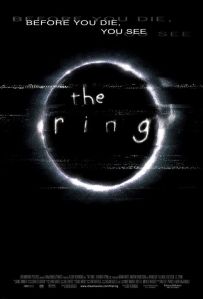 So have you heard the one about the videotape where you die seven days after you watch it? No it isn’t a new late fee ploy by Blockbuster. It’s the great premise for the entertaining new horror movie The Ring. After you watch this eerie video your phone rings. A raspy voice on the other end tells you that you have seven days, then, one week later to the minute, you die. How cool is that?
Seattle reporter Rachel Keller (Naomi Watts) learns of this urban legend at the funeral of her teenage niece, who died suddenly and mysteriously. Through research she observes that her niece’s three friends all died at the same hour on the same day, though through different circumstances. She recovers pictures of the four of them at a campsite, where they had watched the video, except their faces are blurred in pictures taken after they had watched the tape.
The Ring has its shares of creepy scares but midway in it makes an unexpected turn. Rachel, being the good journalist she is, goes to the camp and pops in the dreaded videotape. She watches it and makes us watch it too! Afterwards, working against the death clock here, she tries piecing together clues left on in the tape’s grisly and stark images to solve the mystery of who is behind it. It’s at this moment that The Ring turns into an extended beyond-the-grave episode of Law & Order.
As with most mysteries, the intrigue and questions are more interesting than the eventual answers. As Rachel’s investigation picks up steam we start to lose interest. Of course it wouldn’t be a supernatural thriller these days without a Sixth Sense-like twerpy kid. This one features Rachel’s son (who looks like the lost Culkin child) who has premonitions of death.
 Watts, who wowed critics with her breakout role as the good girl/bad girl in Mullholland Drive, is luminescent as a leading lady. Watts can deliver parts passion, fright, curiosity and concern without blinking an eyelash. She is an exciting actress to see develop.
The Ring is directed with a vibrant sense of foreboding by Gore Verbinski (The Mexican). He delivers some definite cover-your-eyes moments but also creates a wonderful atmosphere of fear throughout with illuminating visuals. There is an absence of gore and any real violence, just an emphasis on intense atmosphere like what the classic horror films would achieve.
The scares that The Ring can conjure are genuine and the film has a nightmarish undertone to it. This Hollywood remake of the Japanese cult classic can stand on its own legs with confidence, even with an overextended ending that you may require initiating another person to explain to you. So, anyone want to watch a killer movie?
Nate’s Grade: B
Share this:

Donnie Darko (2001)
 Donnie Darko (Jake Gyllenhaal) is your normal malcontent teenager in late 1980s Reagan America. He bickers with his older sister, worries over the right moment he’ll kiss his new girlfriend, and tries to ignore the advice of many imprudent adults. Donnie’s your typical teenager, except for his imaginary friend Frank. Frank is a sinister looking six-foot tall rabbit that encourages Donnie into mischief and gives a countdown to the impending apocalypse. And I haven’t even gotten to the time travel yet.
One night as Donnie wanders from his home at the behest of Frank, an airline engine mysteriously crashes through the Darko home and lands directly in Donnie’s room. The airlines are all at a loss for explanation, as it seems no one will take responsibility for the engine or knows where it came from. Donnie becomes a mild celebrity at school and initiates a relationship with a new girl, Gretchen Ross (Jena Malone). One of his classes consists of watching videos of self-help guru and new age enlightenment pitchman Jim Cunningham (Patrick Swayze). His school has even, under the persistence of self-righteous pain Kitty Farmer, persuaded Cunningham to speak and try to help students conquer their “fears.”
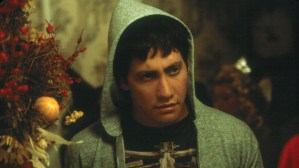 Donnie is also seeing a therapist for his emotional problems and taking medication for borderline schizophrenia. Around this time is when Donnie starts to inquire about a strange old woman, obsess over the possibilities of time travel, as well as see weird phosphorescent pools extend from people’s chests. He also floods his school at the urging of Frank. This is no Harvey type rabbit.
The longer Donnie Darko goes on the more tightly complex and imaginative the story gets. First time writer-director Richard Kelly has forged an excitingly original film that is incredibly engaging with charm and wit. He masterfully mixes themes of alienation, dark comedy, romance, science fiction, and a sublime satire of high school. Donnie Darko is the most unique, head-trip of a movie unleashed on the public since Being John Malkovich. Kelly has a created an astonishing breakthrough for himself and has ensured he is a talent to look out for in the future.
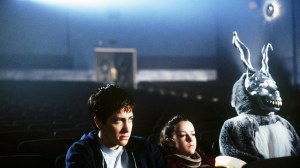 Gyllenhaal (October Sky) is superb as disenchanted Donnie, a Holden Caulfield for middle suburbia. His ghastly stare conveys the darkness of Donnie but his laid-back nature allows the audience to care about what could have merely been another angst-ridden teenager. Swayze is hysterical as the scenery-chewing Cunningham. The rest of the cast is mainly underwritten in their roles, including stars Drew Barrymore (who was executive producer) and ER‘s Noah Wyle, but all perform admirably with the amount they are given. Not every plot thread is exactly tidied up but this can easily be forgiven.
Donnie Darko is a film that demands your intelligence and requires you to stay on your toes, so you can forget any bathroom breaks. The film is one of the best of 2001 but also one of the funniest. You’ll be honestly surprised the amount of times you laugh out loud with this flick. The theater I saw this in erupted every half a minute or so with boisterous laughter.
Donnie Darko is a film of daring skill and great imagination. You don’t see too many of these around anymore.
Nate’s Grade: A
Reviewed 20 years later as part of the “Reviews Re-View: 2001” article.


 nathanzoebl
You must be logged in to post a comment.