Blog Archives
Terminator: Dark Fate (2019)
 By general consensus, it’s been 28 years since the world had a truly great Terminator sequel. What has been so challenging for filmmakers to continue this franchise? The absence of creator James Cameron is obvious, as it’s hard to find anybody with the blockbuster acumen to fill that empty director’s chair. I submit that I think it’s because the Terminator franchise is, at its core, a very limited franchise of stories (I never saw the short-run TV series starring Lena Headey as Sarah Connor). It’s about a killer robot after its target. That’s it. There’s some time travel jazz thrown in but that’s never been given tremendous contemplation, especially 2015’s brain-hurting alternative timeline reboot, Terminator: Genisys (with Headey’s Game of Thrones co-star Emilia Clarke as Sarah Connor). Now comes another attempt to revitalize this dormant franchise with Terminator: Dark Fate and this time they’re not just bringing back Arnold Schwarzenegger but also the original Sarah Connor as well, Linda Hamilton. The early trailers and ads did not exactly give me much optimism. It looked like the same. Another killer Terminator. Another good Terminator. I saw little to earn enthusiasm. Then the positive reviews poured in. I’m here to report that Dark Fate is the best of the sequels, a satisfying mix of action, character, and world building, but I’m also ready to let this series go away into its own dark fate.
Sarah Connor (Hamilton) has been hunting down different Terminators for the last twenty years. Her path crosses with Dani Ramos (Natalia Reyes), a Mexican autoworker who happens to be a very big deal to a future human resistance against future angry machines. Grace (Mackenzie Davis) is a future soldier sent back through time and given enhanced speed, strength, and endurance. She is to serve as protector for Dani, though Sarah seems to feel she has a claim to that position as well. Together the women will try and outrun a new Terminator model, the Rev-9 (Gabriel Luna) and seek shelter from an unlikely ally, a retired and reformed Terminator (Schwarzenegger).
 The Terminator franchise has been one built upon chase scenes, trying to escape a nigh unstoppable being and find refuge while it lasts. Because of that and a generally simplistic “save X to prevent future Y” goal, the franchise can often be reduced to a series of successful or unsuccessful set pieces, and as the movies continued the characterization flattened out, replaced by an influx of humor (Terminator 3), grimness (Terminator 4), or confusion (Terminator 5). What made the Cameron movies special was his magical ability to apply character to action, pushing everything forward so that every set piece felt naturally developed, with organic complications and mini-goals relating to the arcs and needs of the people on screen. The action in Dark Fate gets closest to that Cameron gold standard with some engaging sequences of big screen violence but tailoring it better to specific location and character dynamics. When Grace first rescues Dani, it’s at the factory where, oh great irony, machines are replacing human workers. The machinery of this factory floor gets utilized for the rough and tumble activity. There’s a mid-air collision that goes through a series of stages as things get worse and worse, including an extended sequence of zero gravity fisticuffs that is extremely fun to watch. The action is solid throughout.
Thankfully, the strong action under director Tim Miller (Deadpool) is aided by the storytelling core of three strong women. Arnold doesn’t even come back into the picture until much later. Each of these women has a different style to her, a different personality, and a different goal, whether it’s killing all Terminators first, spare the future leader at all costs, or looking for a sane middle ground that keeps everyone alive. It’s refreshing to watch the franchise return to its roots of strong female lead characters being given the reigns. The screenplay by David S. Goyer (Batman vs. Superman), Billy Ray (Captain Phillips), and Justin Rhodes puts the spotlight where it belongs and tweaks some of the politics of old; Dani is derisively told by Sarah that it’s a woman’s womb that presents the biggest threat to the system, as they share the notoriety of being mothers of future male saviors. There’s a level of polish given to the characters that I appreciated, providing room to have them butt heads in a manner that felt genuine. There are some significant differences that makes this trio interesting but also satisfying when they work together for their common survival. The general mystery around the back-story of our genetically-enhanced human being Grace was a plus rather than another blank slate robot bodyguard.
Hamilton is back and so is Arnold, though he was also pretty central in 2015’s failed alternate timeline reboot. Fortunately for the audience, Dark Fate actually gives them things that matter. Both are given characters going through a sense of loss and rediscovery, working together to rid the world of a common evil, one out of vengeance and duty and the other out of penance. The interplay between them is rich in dramatic potential, as is the prospect of a Terminator model that wants to be moral without having its programming fiddled with by some enterprising human. This is a Terminator that wants to change and adhere to a code of ethics and principles. That’s interesting, and adding layers of personal animus just makes it more interesting. The screenplay lets the characters have enough little grace notes, smaller moments to breathe and remind you that these action stars were also more fleshed-out characters once long ago. I’m not going to say there’s some great lost play somewhere in a Terminator movie, but I was very appreciative of some of the smaller, more contemplative moments that dwelt on accountability and redemption. It’s not just all apocalyptic doom and gloom, there can be room to explore mature characterization too.
 Another aspect I was not expecting was how politically relevant Dark Fate would become with the U.S. immigration crisis. Our heroes are traveling north via a caravan of immigrants, and for a while it felt like I was watching Sin Nombre but with killer robots. Then they have to sneak across the border and are captured and placed in crowded detention centers. There’s an entire jail break sequence with Terminators in an ICE-style prison. The evil Terminator makes use of the government surveillance network to track the other characters on their trek along the border, using the machinations of a police state to hunt down these fugitives. There’s not much in the way of commentary to be afforded beyond the simple empathy of watching other human beings struggle for a better life and being treated as less than human by an indifferent bureaucracy. There’s even a mixed-race blended family that serves as a focal point of a change of conscience. There’s a refreshing amount of diversity. I wish the movie had gone even further or staked more with commentary but I also suppose there’s a reason that none of this was seen in advertisements. I suppose the Dark Fate filmmakers didn’t want to turn away the dollars of any sensitive conservative ticket-buyers.
I have some general questions not so much for this movie, though they do apply, but for the Terminator franchise as a whole, and I figure I should address these as a separate section:
1) Why does the future only ever send one killer Terminator robot at once? If the goal is to kill one special target and it seems one Terminator keeps getting foiled, why not send more than one to accomplish the mission? Maybe there’s some technological limitation of time travel where only one machine can be sent at a time and there needs to be sufficient time to recharge. If you’re machines, you got time, and the way time travel works, it would not matter when robots were sent, just that they are arriving at the same date. I began to envision what this might look like and started composing a comedy sketch in my head where a classic Terminator T-100 knocks on a door, asks about seeing John Connor, and then an old landlord says, “Oh, he sure is popular today, come on in.” It’s here where the T-100 would come inside and be seated in a room with other Terminator robots throughout the ages. What would then proceed would be an argument among the many Terminators over who deserved to be the one to kill John Connor. One would say they were transplanted 30 years prior and had been waiting diligently until this moment in time, another would argue they are the most advanced, newer model and would have the best likelihood of success, and another would argue they had gotten the closest to him, etc. I’m sure someone may have already had this same idea but it amused me highly.
 2) We’ve had shape-shifting Terminators since the first sequel in 1991 and there hasn’t been too much variance on them after. The problem is once we enter into the liquid metal, body-reshaping era, there doesn’t seem like there’s much more advancements to be had. The Terminator in the third film could also do some technical wizardry. The fifth one made use of nanobots, I think. I’ve tried to forget much of Terminator: Genisys, including the spelling of the subtitle. With Dark Fate, we get a new Terminator who can… have its metal skeleton jump out of its body… and serve as a duplicate? I don’t really know whether once the skeleton leaves if the “body” is more vulnerable or whether there are limitations. It’s unclear world building. Also, there are tentacle-enhanced Terminator robots seen in the future that would be deadlier. Regardless, none of these updates are as big a leap as the T-100 to the T-1000 and its shape-shifting. You have a master hunter that can take on any face, so why does it keep settling on the same face even after its targets know who they should be running from? Why do the shape-shifting Terminators not adopt a host of disguises in order to get closer to their prey? If I knew one face in the crowd to run away from, I would think my predator would not want to keep that face. I can understand from a filmmaking standpoint why you’d want a default look so the audience knows which character is which visually. I feel like these killer robots are undervaluing the shape-shifting.
3) Why do the Terminators have to work harder, not smarter? You have one target, usually, to murder to wipe out futures, so why take any chances with one assassin limited by their bipedal arms and legs? Why not send a thousand drones to blow up one human from the sky? Why not place a reward on the Dark Web and see how long it might take? Or, even better, why not send a robot with a nuclear bomb in its chest? That way all the Terminator needs to do is get its target in slight visibility and boom. It’s not like the machines seem to be worried about collateral damage.
 4) No matter how many Judgment Days are averted, it seems like there will always be another down the line, so is mankind just biding its time before an eventual robot apocalypse? In the timeline of Dark Fate, mankind eventually creates a new A.I. that eventually attacks its human overlords, and it’s a new albeit delayed Judgment Day. Does this mean that the franchise is locked into an endless cycle of repetition, where victory just means postponement? A central theme throughout the series is “making your own fate,” the rejection of destiny, and the fluidity of personal choice and agency, and if the movie says, “Eh, human beings will keep making the same mistake over and over no matter how many interventions,” doesn’t that conflict?
I’m sure there are more questions for the Terminator franchise to be had but I’ll leave it at those. Dark Fate is the most accomplished of the Terminator sequels, post-T2, but this is still one franchise that feels low on creativity and interest. The prospect of another Terminator movie doesn’t fill me with any palpable degree of excitement. Even with this sequel that serves as yet another reboot, I’m not excited for further adventures. If there’s another movie, I’ll see it but mostly out of a sense of obligation. If this was the last we saw any of the original Terminator characters, it works as a fitting sendoff and as satisfying an ending as any before. What started as a special sci-fi series with one of the greatest action sequels of all time has become just another franchise on the decline with a fading brand name that studios keep picking at every few years, reassembling with new pieces that they hope might convince audiences there’s still vitality. Dark Fate is a perfectly good action movie with more thought and polish then I anticipated, finding legitimate reasons for bringing back its stars of old and giving them meaningful things to do. I had a good time with the movie but feel like this is one franchise that is ready for a merciful termination.
Nate’s Grade: B-
Share this:

Hustlers (2019)
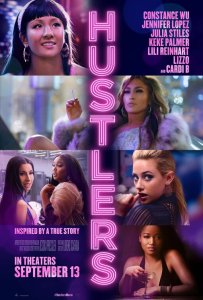 Think of it as a feminist companion piece to The Wolf of Wall Street or The Big Short. Inspired by a true story, Hustlers follows a diverse group of strippers who wine and dine Wall Street middlemen and execs, feeding off the spoils of their feeding frenzy, and then eventually upping their game, drugging them and fleecing them for one wild night that they’ll be too embarrassed to report that next morning. The story grabs you early on and is stuffed full of interesting details about the ins and outs of the stripping industry as well as how to service and manipulate the wealthier men who frequent said clubs. Hustlers becomes a combination of a crime caper, a con artist thriller, and a class-conscious drama about the haves and have nots, but it really becomes a showcase for the talents of one Jennifer Lopez, a woman who does not seem at all close to her fifty years on this planet (her introduction is quite the jaw-dropper). Lopez plays Ramona, the alpha leader of the group, a loving single mom with a healthy distaste for the hand she’s been dealt. She is sensational and delivers the best performance of her long career. Even when she’s doing bad things, even when she’s taking bold risks, there is a moral center to that woman, an unbreakable heart for the people she chooses to let into her life, and it does not budge, which was a poignant note. In many ways she is more the main character than Constance Wu (Crazy Rich Asians), a figure that serves as more entry point than fully-fleshed out character. I enjoyed learning the various tricks of the trade writer/director Lorene Scarfaria (Seeking a Friend for the End of the World) peppers throughout with her love of montage and stylish transitions, but it really picked up after the 2008 financial crash where the women cross over into direct criminality. At first they figure they’re just skipping ahead, drugging with MDMA rather than waiting for their marks to get drunk (“Drunk enough to order the bill but sober enough to sign the check,” Ramona cautions). Then things get escalated and sloppy and the women are in trouble. It’s a fun ride watching the ladies get theirs, and I was challenged to muster much of any sympathy for their Wall Street marks. Part of me wishes more women would be inspired by this movie and follow suit, fleecing the people who fleeced our economy. The movie rides that wave of the good times you know can’t last, prolonging the fall we’re all anticipating coming. The supporting characters can be a bit weak; several of the other girls involved in the scheme merit one note of description, and some of the humor feels a bit out of place, like a running joke where one of the women nervously vomits often (this is like her single character trait, and it’s weird). It’s also likely the stripper-centric movie with the least nudity I’ve ever seen, thanks to Scarfaria treating a sensational story with candor rather than exploitation. Hustlers is a glitzy drama that will entertain you with its flash and then surprise you with its edge. And all hail, Jennifer Lopez, ageless wonder and underrated actress getting her due.
Nate’s Grade: B
Share this:

Ready or Not (2019)
 Ready or Not is like the twisted lovechild of the home invasion thriller You’re Next and the meta-horror funhouse that is Cabin in the Woods, and it’s a total blast. This is no game.
Grace (Samara Weaving) is marrying into a rich family of socialites, famous for their family’s history with board games. Grace’s husband is reluctant about his bride joining the family he had walked away from for years. There is one big tradition: every new member of the family has to play a game upon their wedding night, dating back to the great grandfather who founded the family company through a chance encounter. Grace pulls a random card that says hide and seek, and that’s the game they must play. She’s bemused at being enlisted into a child’s game but little does she know that the family is arming themselves to find and murder her. They fear that if they cannot kill her before dawn, they will all be doomed thanks to an old curse.
 The movie is entertaining from beginning to glorious ending thanks to finely developing its unorthodox premise and staying consistent tonally, whether it’s dark humor or tension. This is a very funny movie. In fact, I laughed more and harder during this film than I have with movies sold as comedies. It’s not afraid to spin its macabre premise for fun, but it impressively doesn’t lose sight of character and scenario along the way. That means that the screenwriters are deriving their humor from the absurdity of their situations and finding organic wellsprings of comic relief. The humor doesn’t detract from the danger of the moment while also enlivening the rest of the movie. The incredulity of the situation leads to some wonderfully ironic moments, like one relative studying YouTube videos for how to operate a crossbow, someone looking up on Google whether or not deals with the devil are real, and a running gag of the estate’s maids meeting horrible accidental deaths. And then there’s the ending, which finds a wonderful way to essentially have its cake and eat it too. I won’t spoil it but the ending to Ready or Not is a fist-pumping, cheering, clapping, highly memorable closer, and one of the best endings in years. It’s one of those endings you can’t wait to talk about with others.
All of the various family members have little notes to play and character beats that provide a more realized glimpse into their histories and the family dynamics than I would have anticipated. It made me feel like the filmmakers had given great consideration to even the smallest of details in what is, at its core, a murderous version of a children’s game. There’s the wife to Adam Brody’s character who is all-in on whatever it takes to maintain this family because she hints at what kind of horrible life predated her new life here. Then there’s the patriarch of the family who is all about ceremony and staying true to the rules until he has to experience the smallest challenge and wants to use whatever cheats he can at his disposal, arguing that great grandfather would use security cameras too if he could and why should they be penalized for simply playing the game in a more technologically advanced era. He’s just another rich douchebag who drops his pretenses the moment something isn’t handed to him. The characters are varied so that you can never feel relief when anyone is in a room, and that even includes the children, who seem destined to become new participants in this cycle.
 Even with its tongue-in-cheek humor and premise, there is a lot of clever thinking put into Ready or Not. There are plenty of setups that connect to later payoffs, including that amazing finish. The screenplay by Guy Busick and Ryan Murphy thinks things through step-by-step so that it’s always ahead of the audience. If any of us found ourselves in this scenario, we would likely try and escape as quickly as possible to an outside refuge. They provide an explanation for that hurdle. Then when Grace finds a way out, the screenplay finds a logical yet clever way to curtail that escape. There is a gruesome sequence where Grace suffers a specific injury and then has to pull herself out of a bad situation, and the movie sets up a gnarly out that connects to that injury, and I sat with baited breath just waiting for the puzzle pieces to connect, and Ready or Not has several moments like this. It’s a fun movie because while it doesn’t take itself that seriously it’s very serious about its storytelling and structure.
Weaving deserved to be an A-list actress after her star-making performance in Netflix’s The Babysitter. This woman is so magnetic and so great at roles that require a tightrope of tone; she sizzled as the darkly advantageous yet lovable babysitter in that other movie, and with Ready of Not she’s our increasingly baffled heroine just trying to make sense of the insanity. The audience gravitates toward Grace pretty quickly as a grounded woman who seems genuine about her desire to have the family that she never formed as a foster child. There’s a latent tenacity that emerges from Grace as she pushes herself through one survival scenario after another. Unlike the similarly themed You’re Next, Grace is not some secret badass raised by crafty survivalists. She’s a normal person thrust into a very abnormal situation, and her responses stay reasonable and formidable when called upon. She is our center for the fun and she makes a winning heroine, and Weaving is so good at the heavy moments, the gross moments, the sly moments, that she deserves to have great material handed to her because she is ready, Hollywood.
Ready or Not is a sneaky, nasty, delightfully dark little movie that left me hooting, hollering, squirming, and grinning with satisfaction. It’s a late summer surprise that delivers everything I was hoping for and has great, delicious fun with its humor and violence. It’s smartly paced, smartly structured, with supporting characters that leave a mark as well as thematic questions over culpability and group think. This is the kind of movie I wish Hollywood was making more of, with screenwriters that can take a premise and write the best possible version of that and with the best possible ending. Any misgivings I have for this movie are small quibbles, like maybe more specific payoffs linked to onscreen deaths, but even that would detract from later events and payoffs, so even my quibbles can be excused. Ready or Not deserves to be seen with a raucous crowd that will appreciate it to its full extent. I look forward to the Twister-heavy sequel.
Nate’s Grade: A
Share this:

The Kitchen (2019)
 Mob movies are culturally beloved. I could watch Goodfellas every time I see it on TV. We know these movies, we know this lifestyle, in so much as it’s been demonstrated in our art. A feminine perspective is often the dame, the moll, the panicked wife who worries her husband will never come home and see his bratty kids again. Rarely in mob movies are there roles for women that can be considered three-dimensional. Even Diane Keaton gets shortchanged in The Godfather series. In comes Oscar-nominated Straight Outta Compton screenwriter Andrea Berlof, tackling her directorial debut and adapting a graphic novel about three mob wives fighting the system. It’s about time this under-represented perspective in some of our favorite movies got its due spotlight. It’s too bad then that The Kitchen finds ways to still leave the women behind where it counts.
Set in the Hell’s Kitchen neighborhood of New York City in the late 70s, three mobsters get arrested one evening by the FBI and sent to prison. Their wives are now left alone to raise their families, struggle for employment, and to not be forgotten with the new pecking order of those mobsters left behind. Ruby (Tiffany Haddish) and Kathy (Melissa McCarthy) think they should take over their husband’s rackets while their men are indisposed. Claire (Elisabeth Moss) is more worried about what will happen when her abusive husband comes back from prison. The three women work together to make a stake at their own claim, butting heads against the existing power structure of dismissive men who don’t think organized crime is any place for a woman.
 The Kitchen has such potential but it’s too often running off the fumes of other mob movies. Beyond the obvious similarities with last year’s more refined and polished Widows, this is a movie that gobbles its mafia movie clichés like a heaping helping of pasta (more clichés!). The characters aren’t terribly well defined and the story oddly moves in starts and stops, with moments either feeling too long or too short, and especially abruptly transposed, using montage to hurdle through what should have been needed onscreen development. People rightfully complained about the final season of Game of Thrones skipping over needed steps along a character’s journey to get to its intended destination, and The Kitchen is deserving of the same charge. We want to see these women in charge and others afraid, except the movie doesn’t show me any reason why these women would rise in power and what sets them apart from their steely competition. I get that they’re underestimated and they are determined, and that works in a general sense, but by the half-hour mark they’re already successful mobster entrepreneurs and I’m unsure how. Even after their rise, there is little that seems to deter them. Every new obstacle is comically taken care of in such casual fashion that you never worry for their well-being. It feels like Berloff wants to skip through all the hard work and just get to the enjoyable desserts or a life of crime, but moving up the ladder is an essential part of any power struggle story. As a result of the sloppy plotting and pacing, there is an over-reliance on clichés to stand in place, relying upon the audience’s warm understanding of the genre territory and what to expect to relieve the movie from having to do more work. It’s all telling and hardly any show.
The characters are kept as archetypes as well, at least 2/3 of the leads. Both McCarthy and Haddish seem miscast for their roles. Both are splendid comic actresses and have dramatic capabilities beyond what they get credit for, but they seem to rely upon comic instincts to get through their underwritten scenes, which further hampers the lack of tension. Each actress gets one solid scene to open up their character but it’s just so little. Ruby has a sit down where her mom credits beating the “soft” out of her daughter for Ruby’s success. That little glimpse into her past and her fraught relationship with her mother served as a tantalizing hint at what could be explored further with the Ruby character. The same with the fact that she’s a black woman who married into a very rigid Irish-American family set in their prejudices. There’s such dramatic potential to be had there. Alas, she’s tasked with being a hardass and that’s all The Kitchen asks of Haddish, treating her more as symbol than person. For McCarthy, there’s a late scene where another character tries to soft-peddle her involvement in crime, saying she did what she had to for her children, and Kathy corrects, saying, no, she did it all for her. She was tired of being a deferential doormat and wanted to feel important. That degree of self-empowerment through selfishness could be a fascinating character angle to explore, but we don’t get that. She clarifies the lens for us to view her with but by that point it’s far too late. The film is top-heavy with underwritten women and that’s a shame.
 The most interesting character by far is Moss’ abused wife-turned-budding killer. Claire is the one starting at the lowest point and the one who takes to the life of crime as means of salvation. These characters are doing some pretty heinous acts but with Claire I felt the most empathy for her plight, bullied by her husband and feeling trapped, more worried about the impending release and her return to being the scared woman cowering in the corner again. She doesn’t want to go back to that life and I believed every moment of Moss blurting out her despair and desperation. That’s why her relationship with another oddball killer played by Domhnall Gleeson (The Last Jedi) was what I cared about most in the movie. You watch them grow together, him mentoring her on how to cut up a body and dispose of it down river, and you watch how each of these two people finds something missing in the other. They may not even be good for one another, enabling their darker impulses and past a point of no return, but it’s the only evolving relationship we were given an entry point to empathize with fully. This segment is also criminally underwritten but it’s clearly where the focal point of the movie should have been. This was the perspective the movie should have been locked into and the character’s journey we follow through every step.
The Kitchen isn’t a bad movie at all. The production design and period appropriate costumes are to die for. There’s always going to be a visceral enjoyment watching the underdogs move ahead and topple their doubters and competition. The ensemble doesn’t have a bad actor in the bunch. Bill Camp (Molly’s Game) shows up with a real sense of veiled menace as a Brooklyn mobster both irritated and impressed by the ladies’ advancement. The soundtrack is packed with Scorsese-riff-approved tunes, including three instances of Fleetwood Mac. There are pleasures to be had. It’s just that the ingredients to a better movie were all there, plain as day. If you’re a fan of mob movies in general, you may find enough to satisfy with The Kitchen, which has its moments but ultimately feels too much like an under-cooked dish you’ve had one too many times before (metaphors!).
Nate’s Grade: C+
Share this:

Escape Room (2019)
 If you’ve ever been looking for a PG-13 Saw movie, then Escape Room might just be the film for you. It follows a group of strangers who have been invited to a next-level escape room, one of those group challenges where people work as a team to solve a series of puzzles to “escape” from a locked room with a variety of dangers. The movie version kicks things up by making the Escape Room essentially Cube, filled with a series of elaborate death traps that pick off our characters outlandish room by outlandish room. The enjoyment of the movie is the curiosity of the rooms and the various challenges. The production design is inventive and impressive for its minor budget. The puzzles aren’t exactly things that an audience can solve in the moment. They mostly involve clues that won’t make sense because we can’t explore the room, so it’s just waiting for characters to solve things and make connections. The fun doesn’t come from the puzzles but more what the rooms will do next. The assorted characters have a personal connection that is flimsy and leads to a late reveal of who is responsible for this wicked game. The movie is fun as you’re watching it as long as you accept that little will make sense. Once it extends beyond the rooms and tries building a mythology and a conspiracy behind the rooms, that’s where Escape Room starts to fall apart. It’s a relatively minor but enjoyable thriller that lives in the moment and, in the future, should find more time to spend in the rooms and the crazy challenges. Much like The Maze Runner, once the characters are outside the maze, I just don’t care. It works enough that I wouldn’t mind more, if the filmmakers get their priorities right.
Nate’s Grade: B-
Share this:

Late Night (2019)
 Late Night follows the fictional long-running TV talk show host Katherine Newberry (Emma Thompson) who has been informed by her network exec that his current season will be her last season. She will be replaced and the show will be retooled. Along comes Molly (Mindy Kaling), an aspiring comedy writer who works in a chemical plant. She’s hired on the spot to serve as a token and offer more diversity in Newberry’s all white, all-male writers room. She has to find herself, find her voice, stand up for herself, and try to get the show to change with the times if it’s going to potentially survive the eager network axe.
For fans of the inner workings of show business, and the ups and downs and push and pull of creatives, Late Night was made for you. I’ve always been fascinated by the nuts-and-bolts of creative ventures in the entertainment industry and especially a writer’s room where people hash out ideas, build out a storyline, and generally bring our TV to life. I enjoyed the short-lived show where Jim Rash would interview different TV showrunners about their writer’s room processes and how they would resolve creative decisions. It’s one reason I loved HBO’s The Larry Sanders Show, a deeply satirical and self-deprecating look at the bowels of Hollywood. So if you’re like me and enjoy the inner workings of creative people working in tandem, then Late Night is already starting on fertile ground for you. Kaling’s world is informed by her years of television writers room experience, as well as running her own show, and that experience better informs the reality of Late Night, from the joke-writing process, to the wariness of content that may push away sponsors, to the means of staying relevant in a vastly changing landscape of how people get their media and entertainment. You feel Molly’s sense of triumph, and disappointment, when her first joke is placed into the monologue and then removed. The movie feels informed and real to its tiniest detail, which makes it all the more interesting.
 The film is consistently funny because Kaling is writing with such a sharp grasp of her characters. Right away the dynamic between Katherine, a cynic with an acid tongue, and Molly, an idealist but a novice who is pushing for reforms, establishes so much wonderful conflict and eventual resolution. It’s universally enjoyable watching a character come into her own, transform the lives of others for the better, and to have characters who butted heads form a mutual friendship and understanding. That’s all present, but with Kaling’s command of writing the characters come first. They drive the story, and while the destination is rather predictable with this sort of thing, that doesn’t make the journey any less satisfying. The character of Katherine Newberry is interesting because she’s a woman who has established her own perch in late night, but she’s still older, white, and from an elitist, privileged bubble. She’s stuck in the middle, which makes her such an interesting character to explore and push into new territory. Kaling has mined some talk show headlines for her story’s drama and it doesn’t feel cheap. Past mistakes are given weight and force characters to reckon with them in a way that acknowledges the extent of the ramifications and the people that have been hurt. Kaling also has a generous sense of writing for her supporting players, giving many a small moment to make an impression and enough for serviceable secondary character arcs.
There’s a definite message afoot with Late Night and it goes about it in a way that makes it far more accessible — as entertainment. Rather than dragging out a soapbox, the movie does the smarter ploy by demonstrating why a homogeneous writers room of the same kind of voice/perspective can be limiting and potentially regressive. Molly is the long-overdue change agent to the show, to the characters, and to the old ways of thinking of what television, and by extension the entertainment industry, had to be simply because it had always been that way. The film’s sense of advocacy for representation is strong and a central tenet, but this doesn’t get in the way of telling a good story with enjoyable characters. By demonstrating through its tale, Kaling has smartly packaged her movie as an empathy test designed to expand the perspectives of its audience, to get them to think how difficult it may be for a woman, let alone a woman of color, to find work in her chosen field. It’s the kind of movie you could take your grandparents to and have them nod along in approval.
Allow me to get a little personal here as I reflect on the topic of representation. I think recognizing one’s self and one’s stories is a huge deal. The power of empathy is potentially endless but that doesn’t mean that all stories need to be told from the familiar template of a straight white dude encountering conflict and change. With good storytelling, anybody can feel for anybody’s plight, but that doesn’t mean that those in the industry should stop trying to give voice to others who have historically been marginalized. TV, and particularly late night TV, is something of a boy’s club and needing more women. A recent analysis on late night TV concluded, with the exception of TBS’ Samantha Bee, that the typical late night talk show writing staff is only one quarter female. More people deserve more opportunities to shine because we, as a society, benefit when we have a plurality of stories from a plurality of voices and perspectives. It makes us all better.
 During the summer of 2018, I wrote a rom-com Web series (The Spirit Inside Me) that was told from the perspective of a bisexual woman and dealt with an eventual romance with another woman. You better believe I consulted with my queer friends to make sure every script didn’t feel like it had been written by a straight dude. Then we started to make it a real thing throughout the fall and winter of 2018/early 2019, and the mission statement of the series, and for me, was to try and get as many women involved in the production as we could. There were nine total episodes and I wanted to try and line up as many female directors as possible (if able all of them would be directed by women). Our show was from a feminine perspective, concerning an unorthodox LGBTQ relationship, and I wanted a feminine perspective to imbue as many facets of the production as possible. We put out notices for crew and emphasized that we were looking for women first. You would have thought I had just insulted people’s mothers the way some men responded back. They told me this was “reverse discrimination” and insulting and that the best talent should win out. I dismissed these whiny grievances and continued to seek and hire women. I know many women, even in our small community of filmmaking, don’t get as many opportunities as men. I wanted to give them those experiences. I felt it would make our series better and, personally, it just felt like the right thing to do because I could. With the show currently in editing (stay tuned!), it’s actually one of my happiest decisions as I really enjoyed seeing several women rise to their opportunity and shine. I’m not writing this to pat myself on the back or seek woke plaudits. This is such a slight example of mine over the overwhelming obstacles women face breaking through in a male-dominated industry that doesn’t want to share, but I felt it was worth sharing, dear reader.
Late Night was a movie that kept me smiling and feeling good all over. It warmed my heart, it made me laugh, and it gave me a group of characters to latch onto that earned my affections. Thompson is tart and witty and wonderful. Kaling is lovable and charming and hopeful. They make for a dynamic, combustible combination. Late Night is a fine example about the benefits of diversity, representation, and empathy, and it’s also a cute and funny movie that will make you happy by the time the credits roll. Tune in.
Nate’s Grade: B+
Share this:

Men in Black International (2019)
 Men in Black International is a perfectly fine movie but it’s hard not to feel the franchise going through the motions in an attempt to recapture the elusive magic that made the original 1997 movie the standout it was. This time we’re introduced to new agents and new agencies, with Thor Ragnarok stars Tessa Thompson and Chris Hemsworth decked out in black and on the hunt for rogue alien life forms in Europe and the Middle East. The two actors are charming and Thompson’s character is a great re-introduction to this hidden world, a woman who has devoted her life to finding and becoming a Man in Black. As we went from scene to scene, it felt like an MIB spy thriller evoking the undercover missions, arms dealers, shady informants, potential agency mole to expose, exotic locales, and crackling banter of that genre, and that’s something none of the sequels have done before. However, I also noted just how forced everything felt. What should be jaunty and droll came across as flat or overly exaggerated, trying to recreate the energy and style of the original but falling short. It feels like when someone is trying to retell a joke but has lost the rhythms that made it so amusing in the first place. The pieces are there but they don’t feel right. I also kept noting how it should be funnier. Many of the jokes are barely touched upon or developed for more potential. The set pieces are pretty humdrum and even the integration of the strange, otherworldly elements and aliens feels lacking. With that said, Hemsworth and Thompson remind you how winning an onscreen pair they are, and even with their charm kept at a lower, simmering level they are still enjoyable to watch. There’s a predictable storyline about an alien invasion and a predictable turncoat reveal, but it’s all played rather innocuously that it’s hard to get upset. Men in Black International is an intermittently amusing movie that’s hard to hate and hard to love. If you’re a fan of the series, or got a couple hours to obliterate, it should provide enough entertainment, but much like one of those handy-dandy nueralizers, you won’t remember much after.
Nate’s Grade: C+
Share this:

Booksmart (2019)
 Booksmart is the directorial debut of actress Olivia Wilde and it’s a hilarious, heartfelt, and often delightful teen sex comedy that has more on its mind than studying. The focus is on two overachieving best friends (Beanie Feldstein, Kaitlyn Dever) who realize, on the last day at school, that they haven’t cut loose for their entire high school careers. They pledge to find a big party, make a move on their crushes, and show all the popular kids just how much fun they can be too. The concept might resemble Superbad (including starring Jonah Hill’s sister, Feldtsein) but this is much more than simply a “female Superbad.” The movie doesn’t do anything revolutionary in the teen movie mold, but it adapts to its new settings. There’s a prominent gay first love storyline that leads to elation and heartache. There’s a strong feminist undercurrent about what expectations are placed on women, fairly and unfairly. There’s also a wider sense of empathy and complexity to the whole movie; the large ensemble of supporting players get considerate shading, which makes them more than how they’re casually perceived. It all relates to a larger theme that people are more than their appearances and reputations. It’s also wonderfully funny and had me laughing routinely from beginning to end including some big moments and set pieces that were smartly developed. There are fantastic running jokes and great surprises, while not losing the grounded sense of what makes the film special. The humor is also character-based and there’s a genuine honesty to its depiction of the reality of being young in modern America. Dever and Feldstein are a terrific pair and feel like legitimate best friends. The whole movie floats along with such effortless charm, tying up our wide ensemble of characters in a concluding graduation ceremony that feels downright joyous. I really cared about these women by the end. Booksmart is the kind of movie more teen comedies should aspire to be, and it’s worth definitely worth checking out.
Nate’s Grade: A-
Share this:

Long Shot (2019)
 Secretary of State Charlotte Field (Charlize Theron) is preparing for the moment she feels her whole life has been leading up to: a presidential run. the current president (Bob Odenkirk) has decided not to run for a second term and wants to endorse her. Charlotte and her team of dogged, loyal assistants (June Diane Raphael, Ravi Patel) are sifting through ways to improve her negatives as a candidate, and that’s where Frank Flarsky (Seth Rogen) comes in. He’s an activist journalist that has just been fired and he also happens to personally know Charlotte; she was his babysitter. He comes aboard her campaign with the condition that she really fights for what’s important and not cave to the powerful lobbies and interest groups. He rewrites her speeches and the two of them grow closer together, bonding over their past and a possible future, not just as president but as boyfriend-girlfriend. They must keep their feelings a secret for the time being. If the press found out it might kill her candidacy before it ever really began.
The film’s biggest strength is the emphasis with the leading characters and the crackling chemistry between Rogen and Theron. It’s a fairly familiar dynamic between the more buttoned-up personality learning to cut loose and the more wild and impulsive personality learning a degree of self-restraint and responsibility. And to be fair Long Shot does pull from this familiar foundation for a starting point with its odd couple dynamic. However, it goes further by making their differences more attuned to politics and compromise. Fred is unwilling to back down for the things he knows are right and would rather have nothing than a watered-down version of the important issue he had been fighting for. Charlotte is more the political animal and used to working with others, including scoundrels and morons, in order to affect change. She’s about incremental, pragmatic change for the greater good and he’s about ideological purity as a moral imperative. This isn’t just a small character quick either; it’s a defining conflict between both characters and a subject that gets further examination as Charlotte confronts the realities of running for president and the many compromises of self and vision may or may not be needed.
 Being a woman running for president is an obstacle course of having to deal with latent sexism and other people’s expectations of what is socially appropriate. Charlotte is going to be judged harsher for the same behaviors men will be excused for; this isn’t a new observation by any means (apply your favorite double standard here) but the film makes you understand the pressure and scrutiny that befalls her at every turn. It defines her character, which is why finding someone she can unwind with and be her true self away from the cameras is such an understandable and desirable escape valve. She’s running to inspire little girls that they too can be president but at she also has to assess the cost of how much she’s willing to hide or lose from herself in order to get across that finish line, and if she does, what will be left? That’s the role for Alexander Skarsgard, the Justin Trudeau-like Canadian prime minister, who represents what is left of a person after bowing to opinion polls. Again, this isn’t new material, especially as anyone who can recall the 2016 presidential election will recall the questions of physical and mental fortitude that only seemed attached to one candidate and not as much the other. What this political reality does is provide a relevant substance for the romance and comedy portions of the film, making the characters feel more human. When Fred is articulating just what he must do to serve as a secret boyfriend for Charlotte, and a potential future they would have, you can hear his heartbreak with each new syllable. You also realize that he shouldn’t have to endure that and maybe these two are destined not to be together because of how unfortunate our politics and media environment have become.
Rogen and Theron are a blast together and have a fun rhythm they play off each other for unexpected comedy beats. His mellow vibes and good-natured joviality, as well as general awkwardness around people in power, are a nice fit with her sterner self. The best parts of the movie are just watching both of these actors enjoy their company. I won’t say that the romantic spark became overly apparent but what was undeniable was how well they paired as an onscreen buddy duo. With each new movie and every different role, Theron proves she’s one of the best actors of her generation. She can kick your ass, she can make you cry, she can win your heart, she can make you bust a gut. In short, Charlize Theron can do anything. She has several disarmingly funny moments, like when she’s high on ecstasy and pulled into an international crisis and has to maintain her cool. Rogen could easily fall back on his ease playing the oafish, insecure, crass characters of his past, but he does a fine job imbuing his charm, energy, and authenticity with Frank. Rogen is an anxious and generous scene partner who typically elevates his costars, and he and Theron as so good together that it sells their romance even better than the writing.
 Thankfully, Long Shot is consistently funny and bases much of its humor on the characters and their needs and developments. The movie isn’t just a retread of the incredulous fantasy of some ugly dude successfully romancing a beautiful woman. We’ve already had this dynamic explored in another Rogen comedy, 2007’s Knocked Up (in another universe where Katherine Heigl’s career didn’t stall, I could have seen Long Shot serving as an unofficial reunion for her and Rogen). There are jokes to be had about the unbelievable nature of this central romance and Rogen’s overall appearance, and that’s expected. What made me happier was that these wisecracks served a purpose to highlight how professionally damaging this potential relationship could be for Charlotte’s chance of winning office. They didn’t just feel like gratuitous put-downs. The joke emphasis is heavily tilted in favor of our two leads but there are nice moments with the supporting cast, like Raphael’s constant passive-aggressive comments, Bob Odenkirk’s buffoonish sense of betrayal with TV being turned against him, Randall Park’s frankness, and Skarsgard’s awkward and obsequious flirting. I don’t think the filmmakers fully knew what to do with O’Shea Jackson Jr. and provide some last-minute character shading that felt clumsy.
Long Shot follows the Judd Apatow rom-com formula closely and demonstrates that if you get funny, talented people together, provide them solid characterization and realistic conflicts, you can produce a winning romantic comedy that matters. Rogen and theron make an excellent team, the political content is savvy without getting too far into the weeds, and the romance is sweet and agreeable, with two genuinely enjoyable people coming to realize what they would be willing to risk for the other person. Long Shot is a reliably funny, bawdy, and heartwarming little movie with a little more on its mind than gross-out comedy set pieces. It’s worth seeking out this summer. I’d happily vote Theron for anything, especially if she was running for elected office as Furiosa. That’s a candidate that get results.
Nate’s Grade: B
Share this:

Us (2019)
 I think it’s important to state that Us is not Get Out and that’s perfectly okay. Not every movie can be a Get Out, an experience that was so refreshing, socially relevant, wickedly fun and dynamic that I immediately wanted to see it again and tell everyone I know to join in. Writer/director Jordan Peele shed his funnyman past and flexed his impressive genre know-how to make a knockout of a movie with an amazingly structured story, allowing all of the pieces to snap together with clever precision. It was my own second favorite film of 2017 and I was highly looking forward to Peele’s follow-up in the realm of what goes bump in the night. Don’t go into Us expecting Get Out. It’s not quite the sum of its parts and has some storytelling shortcomings that limit the impact of its visceral thrills. It’s an engaging horror movie, but it’s far more allegorical and far less tidy and satisfying.
The Wilson family is spending their summer vacation at a rental home in Santa Cruz, California. Adelaide (Lupita Nyong’o) and her husband Gabe (Winston Duke) are trying to enjoy a getaway with their children, teenage daughter Zora (Shahadi Wright Joseph) and young son Jason (Evan Alex), when strange coincidences keep occurring. This is the same beach town where many years ago Adelaide had a traumatic childhood experience getting lost from her bickering parents. Then one night Jason informs his family that there’s another family standing in their driveway. The Wilson family is hounded by mysterious doppelgangers, each a cracked mirror version of themselves. This new family wants what the Wilsons have and will use any bloody means to see that they get it.
 Us is more a straight horror film and has plenty of excellent, terrifying, and smartly directed scenes to make an audience squirm in their seat. Peele has established in two movies a strong instinct for horror and how to expertly stage a scene. His camera is judicious in what it does and does not show the audience, holding onto moments to escalate tension and providing no escape for an eager audience. The majority of the second act is a home invasion thriller and these scenes and subsequent chases and escapes can be nerve-wracking. Each character has their own opponent and each has their own method of trying to outsmart or out maneuver their downtrodden doppelganger. I was getting plenty of Funny Games vibes, a movie I downright despise, but what it could have been if the creator actually cared about the inhabitants. The family and their bonding is a strong empathetic anchor for the audience, so we watch each member of the family battle a literal incarnation of their inner demons. Peele also assembles an effective collection of spooky imagery, from caged rabbits, to the slice of golden scissors, to a carnival funhouse, to even the nature of that 80s social event, Hands Across America. You can sense Peele’s love of horror and the entertainment value horror movies afford. There’s a strong central mystery to guide the narrative and the sense of discovery from Act Two onward keeps things fresh as we learn more and more about these doubles.
From a technical craft standpoint, Us has the upper hand over Get Out. This is a movie that wants to scare you and Peele has devoted great consideration into his artistic elements to achieve that key principle. Peele knows exactly how to craft a particular mood and what genre elements to pepper in and to what amount for the right response. The photography by Mike Gioulakis (It Follows) is evocative and makes great use of limited light to capture an eerie and unsettling feeling. The musical score by Michael Abels is also exceptional, making the most of each heightened scene and doing wonders with a dark, operatic version of the chill 90s song “I Got 5 On It” by Luniz. It makes for a fun, frightening, and favorable film experience in the moment-to-moment sequences of build and release.
The performances are another strength, with each member of the family getting extra range thanks to their dual roles. Nyong’o (Black Panther, 12 Years a Slave) is the standout and emotional center of the movie. Her double is the leader of her clan and the only one that has the ability to speak, except speaking isn’t quite the right word. It’s more like the words escape her throat, raspy and without intonation. It’s a remarkable commitment on her part and she tries a lot of weird character tics, most of them work, from her herky-jerky to robotically possessed physical movements, unblinking eyes, and then there’s that startling voice. Duke (Black Panther) finds his footing as a comedic foil, starting as a corny but loving dad and thrust into a family defender that gets more and more tired of the horror movie nonsense he endures. The kids all do solid, effective work with what they’re given, seizing their moments. Elizabeth Moss (The Handmaid’s Tale) plays a bourgeoisie friend and has a fantastic moment with lip gloss that made me horrified and entranced all at once.
 This is where the merits of the film start running into conflict with Peele’s muddled intentions and messy execution toward the finish. As I said, it’s far more allegorical in approach; meaning for the longest time it seems to be a film outside the bounds of literal interpretation. That’s fine since many horror films rely upon a heaping helping of metaphor for larger implications. I was prepared for Us to stay in this creative territory. Except Peele makes a late decision to squeeze his movie into a bizarre and distracting middle ground, where it feels like the metaphor is the real message, if you can decode it. Once you stand back and assess the full Us, it doesn’t hold together in allegory or explanation.
Even hours after seeing the movie, I cannot say whatsoever what the intended theme is for Us, and this really befuddles me since Get Out was laser-focused in this regard. Peele isn’t just cranking out fun, throwaway genre movies, he’s trying to make statements through horror and elevating the genre in artistic ways. Get Out postulated how being a black man in America was like living in a horror movie and a Stepford Wives-meets-Being John Malkovich commentary on the usurpation of minority agency and the commodification of black bodies. It’s not every day that a horror movie wins an Oscar for Best Original Screenplay, let alone deserves it, and Peele’s treatise on race relations was perfectly structured, each piece snapping together and better informing the whole, with setups and payoffs galore, and at its heart was its relevant message. With Us, I don’t really know what Peele is trying to say here. There’s a simple duality theme but that seems pretty weak and underdeveloped. There may be a have/have not inequality discussion but this gets into trouble in the final act (more on that below). I don’t think race even factors into the overall message, as a late turn reveals that the doppelgangers extend beyond our central African-American family. What is Peele trying to say with Us? I’m at a real loss and I’m trying to process that confusion and my own expectations.
This might have worked better had Peele not elected to supply a hasty sci-fi explanation for why things are the way they are, and in the process he strands his film in a contentious middle zone that tries to find a logical context to plant his allegory. I won’t get into what exactly the details of this explanation are but suffice to say it doesn’t really hold together and invites far more questions, each one picking apart the reality of the film, which disintegrates at an ever-increasing speed. How far-reaching is this conspiracy? What is the ultimate goal? How do these people think they will win? Why now? There’s also a big twist ending that should be obvious for anyone paying attention, but what makes this decision worse is not that it’s predictable but that it hardly sheds any new dimension to what came before. It doesn’t really change our reading of certain people because of the time it happened and so the big meaning is its existence as a twist. It doesn’t redefine the narrative in the way that great twists should. It might play into a larger thematic point except, as described above, that area is hard to ascertain. The last third of Us gives a sense of scope and rationale but the movie also loses its form, trading in dream logic and then trying to provide a new real world context that cannot hold.
 Friends have already asked me whether Us is a good movie, and I’ve found myself saying, “Yes, but…” Peele’s follow-up left me with more questions than answers and a nagging sense of dissatisfaction that began to eat away at my otherwise good time in the theater. Us has some fantastic moments and tense scares but I cannot say what its muddled theme is, the hazy explanation doesn’t really work, and the overall intent left me perplexed. It’s an evocative horror movie with solid to great performances from a very game cast of characters. Given its more free-floating plot, it feels like the kind of movie that would hold together by a strong thematic core. I think most people will leave Us somewhat scratching their heads and wondering what it was all about, but not as an accessible puzzle to decode. It’s more a puzzle that doesn’t resemble the picture on the box and is frustratingly missing a few too many pieces to come together.
Nate’s Grade: B


 nathanzoebl
You must be logged in to post a comment.