Blog Archives
Gravity (2013)
 Director Alfonso Cuaron spent over four and a half years developing his latest film, Gravity. The tale of two stranded astronauts had to invent technology to fully realize Cuaron’s zero gravity vision, carefully programming precise camera movements into a room full of LED flat screens to orient the harnessed actors and light them properly. It could have gone stupendously wrong in so many ways. Instead it’s the biggest leap forward in movie technology since 2009’s Avatar and surely one of the best science fiction films since 2006’s Children of Men, Cuaron’s last movie. It is a thrilling, awe-inspiring, astonishing, illuminating, and altogether brilliant film. Films like Gravity are the reason we go to the movies.
High above planet Earth, astronauts Mike Kowalski (George Clooney) and Ryan Stone (Sandra Bullock) are repairing the Hubble telescope when a field of satellite debris crashes into their shuttle. Both of the astronauts are adrift in space and have to maneuver to the safety of a space station. The debris storm circling the Earth is gathering size and force, and these two are running out of oxygen and safe places to hide.
 Gravity is one of those movies that you feel like ordinary English adjectives do it a disservice. I can refer to it and visually resplendent, awe-inspiring, and borderline transcendent, but my words will ultimately prove fruitless, because the experience of Gravity is beyond description. This is the reason we go to the movies, to be amazed, to feel something new, and Cuaron has taken the next great leap forward in technical moviemaking while also retaining the artistic soul of an engaging thriller. You could simply view Gravity as a visual feast and be content, or you could view it as a harrowing survival thriller and be content, or you could view it as Cuaron’s spiritual exploration on the perseverance of life against all odds (more on this later). Any way you shake it, it’s hard to come away from Gravity being disappointed, though I know with every lofty word of praise I inject that the bar is set even higher in audience expectations.
From a visual standpoint, Cuaron has crafted a truly immersive film going experience that puts you in the center of the action. The signature long takes amaze just as much as the visuals, both of which give you the sensation of what it’s like to be in space, weightless, free-floating, and oh so vulnerable at a moment’s notice. It’s been almost 45 years since Stanley Kubrick’s 2001 showed the visual poetry of zero-gravity acrobatics, and the sheer visual still has plenty of potency left. But coupled with Cuaron’s blinkless long takes, the illusion is rarely broken, especially in the first twenty minutes, which establishes the stakes and the reality of survival in space. Ignoring all aspects of the plot and acting, you could sit through the entirety of Gravity and find it a sumptuous, invigorating experience purely from the cutting edge special effects. There is a real sense of majesty to the views from space, overlooking our blue orb, the vastness of it all. It would be overwhelmingly beautiful if it weren’t also simultaneously terrifying. Space, much like nature itself, has an indifferent cruelty to it, and Cuaron does an exceptional job of presenting both the grandeur and the inherent dangers of space.
My nerves were racked throughout those tense 90 minutes of intense orbital activity. As a thriller, Gravity is a very well constructed setup with pristine execution. Each problem is dealt with in the immediacy, the unique particular of space allowing us a new perspective on the survival/disaster thriller model. First she has to stop floating. Then she has to get more oxygen. Then she has to get to a more safe location. Then she has to get back home. It may sound like not enough little plot pit stops but each one is pivotal and a remote respite from jeopardy. The wholeness of space is so complete that it feels like the odds are forever stacked against Stone. I was breathless through many of the suspense sequences, nervously tapping my feet, urging the onscreen characters onward. Cuaron and his son, co-writer Jonas, make it clear early the steps of her journey, and each feel like a natural result of the dire changing circumstances. The accumulative debris is given a 90-minute countdown for return, so we’re always wary that Stone will be caught back in the orbiting mass of projectiles. The sense of peril is kept on high and doesn’t relent, leaving you feeling like every nerve is spent by the conclusion. It’s a top-notch thriller that doesn’t involve the use of a single gun or car chase.
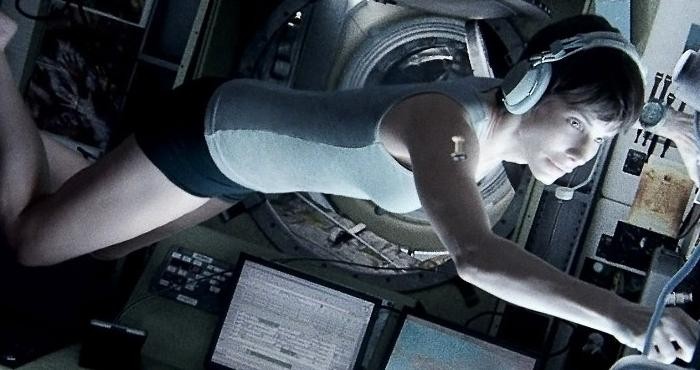 If there is one complaint, I suppose it could be over the somewhat thin back-story and characterization of Stone. I don’t know what a medical officer is exactly doing in space fixing the Hubble telescope but oh well. Cuaron keeps the audience firmly stuck in Stone’s predicament; we do not cut away to any flashbacks of life on Earth, and so it makes fleshing out a central character notable difficult. People don’t usually open up into revealing monologues while they’re trying to fight for immediate survival. She’s got the standard tragic back-story, losing a daughter, but for me this was enough to work with. I don’t necessarily need Stone to be a thriving, complex, emotionally nuanced character because my empathy was already there as soon as the peril began. I wanted her to survive because she was a person; I didn’t have to relate to her on a deeper fundamental level to root for her survival. There are some nice late scenes where Stone reflects on the existential crisis, on knowing her imminent death, on the fog she’s been trapped within since her daughter’s accidental death. Bullock (The Heat), in her best performance to date, is able to pull you in. If faced with your imminent end, how would you attempt to make peace of things, let alone stranded away from all human contact? It’s a strong awards-caliber performance and while her character isn’t given much development, she still has an arc, and I think there’s a greater thematic link with her crossing.
I’m no fan of Terrence Malick (Tree of Life, To the Wonder) but I understand people’s assertion that the man is a film theologian, making the theater a borderline religious experience for his faithful fans. In my eyes, Gravity has an unmistakable spiritual subtext that it can be viewed in different directions. Firstly, it’s hard not to feel an overpowering sense of awe when taking in the sheer magnitude and beauty of the incalculable universe. But then there’s Cuaron’s opening text that prefaces how outrageously impossible life in space is, contemplating all the harsh realities. And yet, here we are. Whether you chalk that up to something religious like God or just the fortune of the cosmos, it’s still a remarkable journey. The evolution of Stone is also reminiscent of that of life on Earth. When she finds refuge in the space station, she removes her suit, curling up in a fetal ball, while the camera centers her and she slowly rotates. The womb imagery is obvious but still effective. There’s also a third act assist that seems like direct divine intervention by most accounts. Then, spoilers, as she lands on a hospitable planet, she emerges from the sea, triumphant, taking her first steps onto land. Triumphant against all odds, against the cruel vacuum of space, life proves to be the winner. Again, whether you ascribe this to a creator God or a wonder of lucky evolutionary forces, it’s hard to escape Cuaron’s spiritual subtext tugging away at you, making the personal survival of Stone a greater analogue for the genesis of mankind and the emergence of humanity.
This is one of the few films I would recommend seeing in 3D. Cuaron has spent four and a half years translating his vision to the big screen and you’ll do yourself a disservice if you don’t see Gravity on the biggest screen possible. It is a film experience to be savored that will not measure up when you are forced to watch such outsized splendor on your puny home TV. This is an expertly made thriller, a visually transcendent, cutting-edge trip to space, and a revitalizing time at the movies. It’s as awe-inspiring as it is terrifying. It’s bursting with stimulation for the senses as well as a reawakened sense of spirituality, of something greater to be thankful for. I am in awe of Curaron as a filmmaker and I am in awe of his finished product. It was worth the wait. Now I hope I never have to wait another seven long years again before I see the words “directed by Alfonso Cuaron” again.
Nate’s Grade: A
Share this:

Short Term 12 (2013)
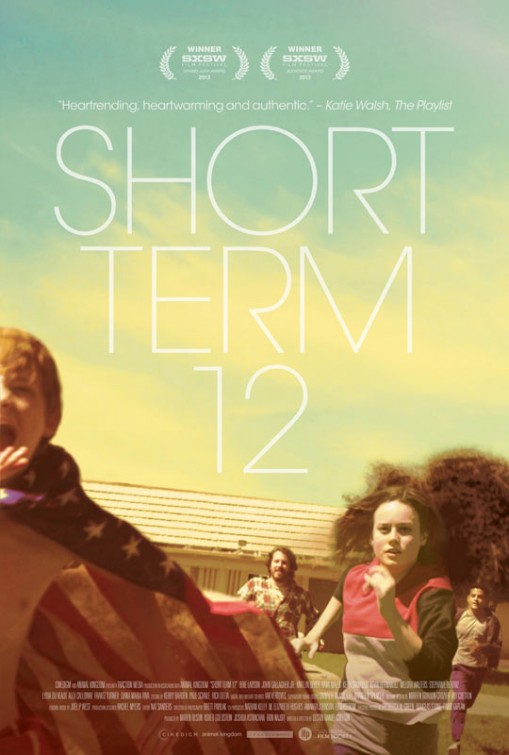 It’s rare for a movie to be emotionally devastating while also being overwhelmingly inspirational and hopeful, but Short Term 12 achieves the nigh impossible.
Short Term 12 follows the inhabitants of a small foster care center in Middle America. Many of the kids have been taken from their biological parents because of abuse, neglect, imprisonment, or death. Many have never known a stable home life. And many will age out of the system at 18 and be trusted to make something on the outside by their lonesome. Grace (Brie Larson) is the lead counselor for the center. She’s dating a co-worker, Mason (The Newsroom’s John Gallagher Jr.) and pregnant, unsure of where to go from here. As the center prepares for Marcus’ (Keith Stanfield) age-out departure, they welcome Jayden (Kaitlyn Dever) to their abode. Jayden’s well-connected father is getting his life in order for full custody, but it also becomes clear that her home life is a danger to her well-being. Grace fights to get Jayden to open up, then she fights to keep her safe, all the while forcing Grace to deal with her own long hidden pain.
 It’s so easy to get engaged in this movie. The very setting calls for plenty of drama and pain to be explored, and it will be, but that doesn’t mean that the film goes overboard with histrionics. The characters are written with such naturalistic ease, allowing an audience to understand them without judgment. These people, be they the foster kids or the counselors, feel refreshingly, exceedingly, magnificently like flesh-and-blood people. The characters feel lived in, their struggles feel real, and their responses are sincere. The foster care system in this country is grueling. A counselor needs a big heart, thick skin, and an immeasurable supply of patience. There are a lot of abused kids in the system, just hoping to find an adult who wishes to love them, to nurture them, to care. The kids don’t want pity; they are perturbed when they’re referred to as “underprivileged youth.” What they really want is respect and sincerity. Highly charged emotions are a given considering the circumstances of the characters, but what makes Short Term 12 exceptional is that they are fully earned. We don’t just feel for these kids because they’ve suffered, we feel for them because they are presented as characters instead of martyrs. I was emotionally moved throughout, tearing up several times, feeling heartbroken at turns and then brimming with buoyant hope at others. It’s a balancing act the movie masters.
Writer/director Destin Cretin (actually remaking his 2008 short film of the same name) explores these characters in gentle waves, allowing the characters to open up in ways that don’t feel forced. You learn about these characters and their history bit by bit, sometimes through creative expression where one must read between the lines. Marcus might seem to be one character, then his rap song he writes reveals an aching degree of personal pain, and then the revelation for why he wants to shave his head, which at first just seems like an average teenage compulsion, will break your heart all over again. You yearn for these kids beyond measure, wanting them to taste delayed happiness in this world, but you also understand why they’re so guarded, why the system grinds together as it does. This is no polemic overburdened with speechifying and soapboxes. It doesn’t really make any larger points about foster reform or the people who run the system. Instead Cretin gives every participant in the film complexity, empathy, and humanity. Even Grace’s supervisor, easily set up for quick blame about decision-making, is allowed empathy. You feel the man’s plight as he tries to make the best out of a bad situation, which is exactly what the counselors are trying to do themselves with their charges. Cretin’s emphasis is on his characters and not necessarily on making overt political attacks. I knew within minutes that I was in for something special. You can feel it with the dialogue, how easily Cretin is shaping character without splurging on exposition. These people come alive under Cretin’s watch, and you’ll be pulled in within mere moments.
This is also fundamentally a star-making performance for Larson. The young actress has had visible roles in Scott Pilgrim vs. the World, 21 Jump Street, and TV’s The United States of Tara, but nothing prepared me for the power of her performance. Larson’s character has plenty of personal pain and secrets and a gnawing sense of futility, but she pushes forward, trying to make a difference somehow in this world. You feel her intensity and determination but you also feel her setbacks and uncertainty. Larson never strays outside the emotional bounds of her character, staying true to her aims. Grace is no saintly and selfless figure. She’s paying a real price keeping her own pain bottled up, focusing completely on others so that she doesn’t have to assess her own damage, but Jayden forces her to examine her own history. Larson serves as the dependable emotional anchor of some very choppy waters. In a just world, Larson’s name would be bandied about come awards season, but the overall small, understated nature of Short Term 12 and its limited release leaves me in doubt. However, there is no doubt that Larson gives a deeply humane, gripping, heartfelt and marvelous performance.
 The character relationships are just as compelling and provide a rich texture to this world. The dynamics within the foster center are interesting, nothing as simplistic as slotting kids into staid high school types. There are divisions within the home, chiefly between Marcus and an antagonistic Luis, but it’s also invigorating when you witness the various kids come together in solidarity and community, when they look out for one another. Jayden is surly at first but won’t let on how truly hurt she is that her father missed her birthday. Marcus leads the other kids and they all make a slew of birthday cards to cheer her up, make her feel that someone out there cares. It’s a small gesture, and yet when it plays out it hits with a wallop. The relationship between Grace and Mason is sweet and frustrating, representing a romantic coupling of two people with an obvious connection but also enough baggage to derail potential long-term success. Gallagher Jr. is a nice fit for the part. I really enjoyed how Mason is developed as the film progresses. Initially he seems like a pseudo-cool authority figure, then a scruffy screw-up, then a sincere and grateful individual worried about Grace and aggravated by his inability to help her.
There are movies that feel true in a broad sense but clumsy with the fine details, and vice versa, but Short Term 12 is that rare movie that feels so authentic that it could have been a documentary. Sure there is convenient plot developments and a tidiness that life just doesn’t want to provide, but the overall impression is remarkably genuine. The characters feel like actual people, their world feels recognizable, and their struggles feel familiar and relatable and raw. Short Term 12 doesn’t glorify the counselors, nor does it demonize or sanctify the kids under their care. Here is an unblinking look at the sheer weight of the work of trying to provide for those in need. The movie is a potent drama with several heartbreaking incidents, but I don’t want to scare people off with the impression that Short Term 12 is all artsy doom and gloom. On the contrary, the film is resolutely hopeful in the face of such dire adversity. The perseverance of the counselors, as well as the kids striving for independent lives, is what I walk away with. Not the abuse, not the systematic neglect, but the indomitable perseverance of the human spirit to transcend damage and to succeed anew. This is the long-lasting impact of this superb movie. It’s not about the pain inflicted, rather the human connections forged and the optimism of recovery. Not everything will get its happy ending, but it is inspiring to watch people put it all on the line, thanklessly. Short Term 12 is the kind of movie you bug your friends until they finally watch it. Ladies and gents, commence bugging.
Nate’s Grade: A
Share this:

Kick-Ass 2 (2013)
 It’s hard for me to discuss Kick-Ass 2 without sounding like a hypocrite. I enjoyed the first film’s visceral thrills, style, and satire of superhero tropes. The sequel gives me more of the same except not nearly as well polished, and in typical sequel mentality, it goes bigger, expanding the world and the height of the sick puppy violence. Kick-Ass (Aaron Taylor-Johnson) and Hit Girl (Chloe Grace-Moritz) are trying to live ordinary lives but keep feeling the need to don their suits and fight crime. Kick-Ass joins a ragtag team of other costumed vigilantes to battle a super villain team, lead by the former Red Mist (Christopher Mintz-Plasse). For long stretches, the movie seems like an unwanted Heathers knockoff as Hit Girl attempts to fit in at high school. She has some particularly nasty vengeance against a popular bully, and if there is a line, it may have been crossed here. I don’t know what it says about me, but I guess I’m fine with a pint-sized kid slicing up bad guys and cursing like a sailor, but making a woman simultaneously vomit and defecate herself, watching both projectile streams spray out her ends, is too much for me. This is a darker, cruel, and mean-spirited feel with the material, and writer/director Jeff Wadlow fails to compensate for the lack of creativity this go-round (I miss you Matthew Vaughn). The humor is still lively, but the plot is predictable at every step, the characters behave in ways that don’t make sense, and the action sequences are poorly filmed, leading to an anticlimactic ending that simply peters out. Kick-Ass 2 won’t be knocking anyone out.
Nate’s Grade: C+
Share this:

You’re Next (2013)
 There has been a notable rise in home invasion thrillers in recent years but I am doubtful we’ve hit the crest just yet (this may also be hope speaking since I co-wrote one). Perhaps in an age of real-life anxiety on the news, the invasion of our personal sanctuary strikes an even more horrific chord. Whether you argue the upswing began with Panic Room, or Funny Games, or even the old Audrey Hepburn feature Wait Until Dark, the message is universal: nobody likes having their stuff messed with. This year we’ve already had The Purge make a splash at the box-office, and I’m sure Lionsgate is hopeful that their indie horror flick, You’re Next, which has been reaping great buzz along the festival circuit for years now, will make a similar splash. For me, You’re Next checked every box I would want in an effective horror film: good thrills, good humor, and a good ending. That adds up to one hell of a good time at the movies.
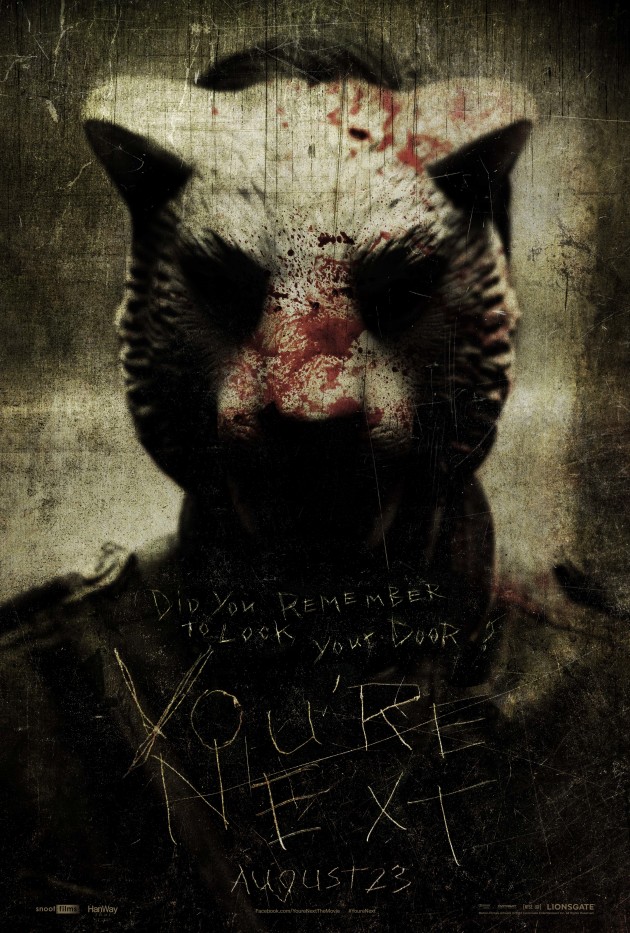
Crispian (AJ Bowen) is traveling all the way upstate for a family reunion at his parent’s palatial mansion in the woods. He’s also going to introduce his new girlfriend, Erin (Charni Vinson), an Australian graduate student that used to work as his teaching assistant at his college. Crispian’s rich family includes his excitable younger sister, his obnoxious older brother, his youngest detached brother, everyone’s boyfriend and girlfriend, and mom and dad. In between a lively family discussion/argument at the dinner table, arrows start flying through their window. Three mean wearing ominous animals masks are stalking outside, armed, and with every intent to kill everyone inside. The masked killers leave ominous messages painted in blood, noting, “You’re next” (I know they’re senseless murderers, but points for using the correct form of “you’re”). Erin snaps into survival mode and assembles a system of defenses but there are more threats than anyone imagined.
 To take nothing away from the artistic merits of You’re Next, the biggest selling point, and its greatest attribute, is that it knows how to properly work over an audience. While nowhere near the genre deconstruction that was last year’s Cabin in the Woods, nor as clever, here is a movie that knows it’s a horror movie, knows you’ve seen these movies before, and knows what you’re looking for as an audience member. And once the killing starts, the movie also gains a delightfully macabre sense of humor, an impish darkness that will leave you chuckling. I heartily recommend seeing this movie in a packed theater because the collective response will add to your enjoyment, or at least it did mine. Never have I experienced a movie where the audience cheered the plugging in of an ordinary kitchen appliance with such reckless enthusiasm. Thanks to director Adam Wingard and screenwriter Simon Barrett, the movie packs great payoffs in its second half, as our prototypical Final Girl outflanks her attackers. There are enough twists and turns to keep things interesting and the pacing swift. Once those arrows pop, this thing just flies by, moving at a speed that keeps you satiated with scares, thrills, and humor. In essence, You’re Next knows how to have fun with an audience, and for whatever reason, with the glut of dank home invasion horror thrillers, this is a surprise. With all the family trauma and killing, watching their loved ones cruelly slip away in horrific fashion, it’s worth praise that Wingard and Barrett find a happy tonal middle-ground that doesn’t blunt the horror or the comedy. The laughs don’t feel out of place with the screams. They make this work. And there are some really sick laughs to be had too.
My only familiarity with Wingard is from his involvement in the horror anthology series V/H/S and The ABCs of Death. It’s also somewhat entertaining to note that all three movies, both V/H/S and its sequel, have been released before You’re Next, a film that was completed two years prior. His anthology segments didn’t point to the same level of promise on full display with You’re Next. Wingard does a great job of orienting his audience to the geography of the play area, so to speak, while juggling different simultaneous threats and maintain a sense of clarity. He knows when to hold back, and he knows when the audience needs a peak of something gruesome. Initially, with the animal masks and the attack on the wealthy, I thought the film was gearing up for a dose of environmental social commentary, as if the killers were extreme defenders of Mother Nature. I’m actually relieved that the film never picks up any ham-handed political subtext.
 As a horror movie, it’s far more effective than most genre deconstructions that will undercut the terror for the chance at a good joke. Even Cabin in the Woods was like this. Again, You’re Next can be riotously funny, especially in the last act, but it can also, and often is, quite suspenseful as well. Once the game get sunder way, you start playing along as well, guessing which of our participants will indeed be next. They place themselves in precarious positions often, especially early, which makes it all the more suspenseful, because you’re suspecting anything can happen at any time. You’re lying in wait, and Wingard does an excellent job of drawing out that tension to a peak level before hitting the horror or gore. There are some gruesomely bloody moments in the film but it doesn’t lovingly linger on the deconstruction of the human body. And just when it seems like the number of housemates fighting for their lives has gotten so low that the thrills would have to be successfully all wrung out, You’re Next supplies a twist that changes gears, introducing a new threat and a new level of dramatic tension. When Erin assembles an ax to smash into the skull of whoever opens the front door, you’re eagerly waiting for that Chekov’s gun to fire (Can we rename it Chekov’s Ax to the Face?). The fact that the movie is almost designed as a Home Alone for demented adults is ingenious.
The acting is a bit hit or miss but the standout, by far, is Vinson (Step Up 3D). She’s our lead heroine, yes, but she takes charge in a way usually reserved for men in these types of movies. She has all sorts of crafty experience with wilderness survival and setting up traps, plus she is able to marshal the family from a bunch of WASPs screaming their guts out into something of a fighting force. And plus, Vinson just has an awesome screen presence to her. It’s a great role for her but credit the actress for knocking it out, giving the audience a strong, extremely capable, and empathetic hero. It’s satisfying to watch the masked killers be outfoxed by their prey. Many of the actors in the film are filmmakers themselves (Joe Swanberg, Ti West, Amy Seimetz), and they’ve collaborated on numerous projects, including other lo-fi horror features, the new Splat Pack if you will.
If you’re looking for a fun horror movie with a dark sense of humor, then You’re Next should be next on your list. It’s savvy, scary, and knows how to goose an audience at just the right moments. Wingard and Barrett know how to give an audience what they want without pandering, and that’s what elevates You’re Next from its peers. This is a horror film that can scare you one minute, make you laugh uncomfortably the next, and then ultimate leave you cheering the vengeful dismemberment of human life with kitchen appliances. It is a more than effectively put together horror thriller from beginning to end.
Nate’s Grade: B+
Share this:

The Heat (2013)
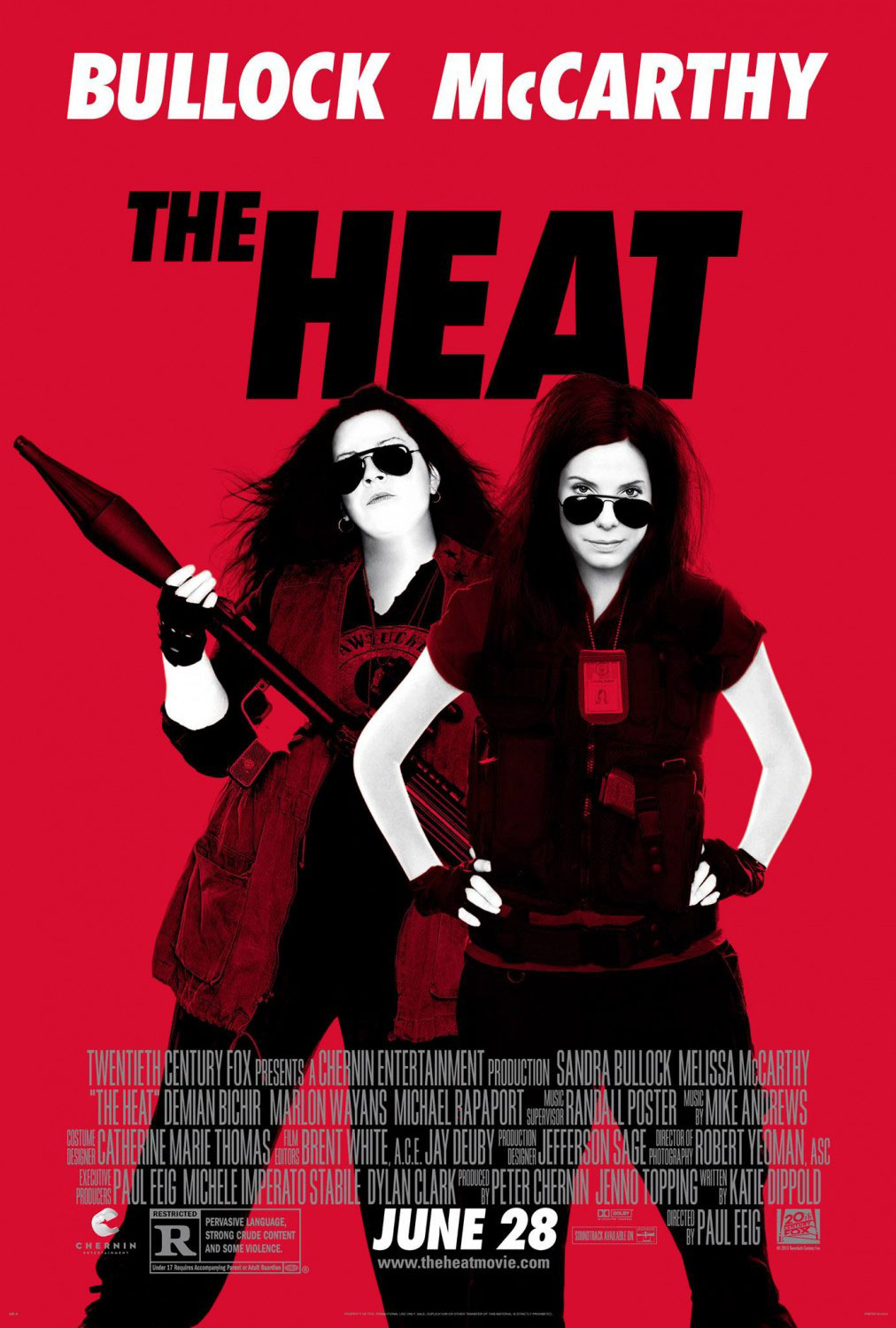 Essentially a buddy cop movie with the typically macho roles swapped out to women, The Heat is an intermittently enjoyable action comedy thanks to the chemistry between Sandra Bullock and Melissa McCarthy. The joke ratio of hits to misses has a lot of whiffs but I laughed solidly every ten minutes or so, some of the comedic set pieces were well developed, and McCarthy’s strong ability to improv saved many flailing scenes. I enjoyed that these two women were seen as professionals and didn’t need to be bogged down with the kind of plot elements you’d find in your standard Katherine Heigl vehicle. There isn’t a romantic interest nor a love story; in fact, various guys come up to McCarthy throughout asking why she hadn’t called them back after a one-night stand. It’s a little thing but it establishes that a woman like McCarthy’s can have a fruitful love life and have it be no big deal. The overall plot about a dangerous drug baron with a mole inside the government is given more complexity than necessary, and I’m not sure the action bits feel well integrated into the movie as a whole. Part of this may just be because director Paul Feig (Bridesmaids) seems much more interested in grounded, human comedy, but I think it’s mostly because we’d rather be spending more time with our leads arguing. Bullock and McCarthy are an engaging team, their comedic styles nicely ping-ponging off one another, and there are enough ribald gags to justify watching it. The Heat isn’t revolutionary by any sort but maybe, in the end, that’s the point. Also it’s got Dan Bakkeddahl (TV’s Veep) as an albino DEA agent. So there’s that too.
Nate’s Grade: C+
Share this:

The Impossible (2012)
 On December 26, 2004, an underwater earthquake triggered one of the deadliest tsunamis on record, devastating coastal cities along the Indian Ocean. Over 230,000 people are believed to have perished from the waves and resulting damage. The Impossible tells the harrowing and ultimately inspiring true-story of one family and their vacation from hell. We follow Marie (Naomi Watts) and Henry (Ewan McGregor) as well as their three sons, from oldest to youngest, Lucas (Tom Holland), Thomas (Samuel Joslin), and Simon (Oaklee Pendergast). They’re vacationing in Thailand for the holidays and then the tsunami hits, separating Marie and Lucas from the group. They are swept away by the punishing waves and Marie is badly hurt. Henry is desperately searching for his loved ones, Lucas is desperate to get his mother proper medical attention, and there are thousands just as desperate and just as in need.
It’s nigh impossible to watch this movie and be unmoved. It’s not very subtle when it comes to its themes and messages, but man is it ever effective. The family struggle could have easily descended into melodrama with a sappy, maudlin reunion, punctuated with swelling music to hit you over the head. It’s a fairly simple story with little to its plot. The family gets separated and then they desperately search for one another and, surprise, they reunite. It is after all based on a true story and they all lived, so there’s that. It’s the startling level of realism, the exceptional performances, and the poignant moments of human kindness and grace that suckered me in big time. I was an emotional wreck throughout this movie but in the best way possible. I cried at points, sure, but my tears and my emotions always felt genuinely earned. There’s no doubt that this is one manipulative movie. It knows what strings to pull, what buttons to push, and it does so with finesse. Last year I decried Extremely Loud & Incredibly Close for being overly manipulative and overdosing on false sentiment. However, with this movie, my investment was never in jeopardy. I was completely absorbed by the story and felt great empathy for the array of characters as they persevere. The horror of that 2004 tsunami is told in one small story, personalized, and giving an entry point for an audience to engage without feeling overwhelmed by the magnitude of destruction and death.
 Let me go into further detail about that wall of destruction, given astonishing, terrifying realism. The recreation of the tsunami ranks up there as one of the most frightening sequences I’ve ever seen in film. It’s a solid ten minutes of chaos, and you will feel the frenzy of that chaos. You’re put in the middle, floating along with mother and son as they helplessly try and cling to one another. The scope of the disaster will leave you gasping. I know they must have used sets and water tanks but I’m left stupefied how it all came together to look so seamless. It sounds macabre to compliment the marvelous recreation of mayhem, but director Juan Antonio Bayona (The Orphanage) and his team have turned disaster into world-class drama. It’s not just the powerful waves as well, there’s the field of debris just under the surface to contend with. When the first wave hits Maria, we experience her complete disorientation. The sights and sounds are blurs, the water oppressive, and the debris sudden, jolting, unforgiving. It’s the closest any person would ever truly want to get in the middle of a tsunami.
The majority of the film is about the family coming back together, and while their reunion is indeed a tearjerker, I found the film littered with many small moments that just soared emotionally. When a disaster of this magnitude hits, I’m always struck by the wealth of human kindness and cooperation that emerges in response. There’s something deeply moving about helping your fellow man in need, even if you cannot understand his or her language. Maria is aided by the Thai locals who do not treat her differently because she’s a white woman. She is just another person in need.
Whenever disaster strikes, we think of the people who plunge into the middle as heroes, but simple acts can be just as comforting and thoughtful. There are small moments of kindness, like lending a stranger your cell phone to call home, that speak volumes. In that one instance, Henry is so distraught, the weight of everything hitting him as he tries to put it into words, and his call is abrupt and somewhat incomprehensible thanks to his rising emotions. Henry is urged to call back, not to leave it at that, to leave his relatives dangling with such precious little and the alarm in his voice. So he’s given the phone again, and in a more measured demeanor, Henry is able to talk about the situation and promise to find his wife. It’s such an everyday gesture made invaluable to Henry. There’s a woman talking to Thomas about the stars in the sky, how we don’t know which are dead but they continue to live on, and the subtext is a bit obvious but it’s still heartfelt. Then there’s Lucas’ mission of organizing the triage center, scouring the grounds looking for missing family members. He takes it upon himself to make a difference rather than sitting idle. It’s that human connection in the face of adversity that proves most uplifting.
 Watts (J. Edgar) gives a performance of tremendous strength and fragility. The tenacity and resilience she has to keep pushing through is remarkable. She’s so strong but vulnerable at the same time, showing you the fine line she walks to stay above the fray for her child. She endures great physical trauma, a gnarly gash in her leg peeling off like tree bark. Then there’s the emotional burden of trying to be a mother to a child desperately in need of a sturdy parent. Watts could have readily played to the heights of the emotions, resorting to hysterics, but the quiet strength of her character makes her underplay the burdens she endures. She can’t simply just break down. You don’t get a true sense of the toll she has suffered until her life-and-death struggles at the very end.
The supporting team around Watts also deserves accolades. McGregor (Salmon Fishing in the Yemen) has several heartbreaking and heartwarming scenes, striving for hope. Lucas has to rise to maturity when his mother is wounded, protecting her, supporting her. Acting novice Holland rises to that challenge with great courage, though there are moments that still remind you he’s only a boy, like when he bashfully turns his back upon seeing his mother’s exposed breast. That awkward, indecisive moment where a young boy doesn’t know how to handle the sight, seeing his mother so exposed and vulnerable, is quite effective. The other actors who round out the family (Joslin and Pendergast) are quite superb as well. The family feels like a cohesive, loving unit, and every performance feels believable.
The Impossible is based upon the true experiences of a Spanish family, and yet the onscreen family we follow is white, so what gives? It’s not surprising for Hollywood to whitewash a story to appeal to a wider audience. Should we have any more sympathy for this family’s plight because they are white? Would we feel less if they were Spanish? I think the perils and victories would be the same regardless of language or ethnicity.
Watching the unflinching and stunning events in The Impossible, you will likely shed some tears, be they from horror, sadness, or happiness at the family’s reunion. While the ending is never in doubt, the movie has plenty of other potent and poignant small moments to keep your emotions safely stirred. It’s a visceral experience that will shock and exhilarate. There were moments where I felt like I had to cover my eyes. But The Impossible is not disaster porn, ogling over the suffering and endurance of the misfortunate. It’s as much about the response to tragedy as it is the wallop of that cruel tragedy in 2004. The perseverance, the open-hearted help of one’s fellow man, the strength of human connection, the long ripples of kindness, it all comes together to form one compelling, often moving, and quite memorable film experience. Add some formidable performances, top-notch direction, and tremendous technical achievement, and The Impossible is a rousing drama that speaks to the best of us even in the worst conditions (think of it as the antithesis of Ayn Rand’s philosophy). It may be manipulative, it may be somewhat straightforward, and it likely climaxes too soon, but when the results are this powerful and emotionally engaging, then I’m happy to have my buttons pushed.
Nate’s Grade: A-
Share this:

Zero Dark Thirty (2012)
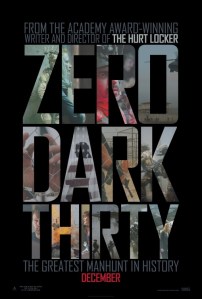 Director Kathryn Bigelow and journalist-turned-screenwriter Mark Boal, Oscar winners for 2009’s Best Picture-winner war film The Hurt Locker, were hard at work on their next movie when fate intervened. They were about to start production on a film about a 2001 incident where U.S. Special Forces almost nabbed Osama bin Laden, the notorious mastermind behind 9/11. Then on May 1, 2011, the world learned that Seal Team Six stormed bin Laden’s secret compound in Pakistan and executed the most wanted man in the world. Bigelow and Boal scrapped all plans and rewrote their movie from scratch. Now they had the ending we’d all demand; isn’t a movie where we get bin Laden way better than one where he narrowly escapes? Zero Dark Thirty (military terminology for well after dark) is the stunning result of Boal’s impressive reporting and condensing, Bigelow’s masterful direction, and a great supporting cast that brings history to vivid life. If you’re like me, you’ll walk out of the theater whistling to yourself, speechless at the spellbinding artistic achievement of the movie. This, ladies and gentlemen, is what essential, invigorating, quality filmmaking is all about.
We may know about Seal Team Six and the lead presented from tracking the courier, but few people know of the CIA analyst at the heart of the manhunt. Maya (Jessica Chastain) is a young agent stationed in Afghanistan who desires nothing more than to be the one who helps ensure that bin Laden gets killed. We follow her decade-long quest as she chases down leads, interrogates prisoners, and successfully presses the CIA brass for action, resulting in the fateful raid that took out bin Laden.
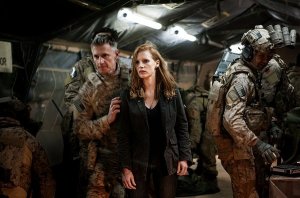 You can tell early on that Zero Dark Thirty is going to be an excellent film. Given the pedigree of is creators, my expectations were enormously high. I rated their previous collaboration as my top film of that year. I knew I was in capable hands when the film opens on September 11, 2001 but skips any visuals. We sit and watch a minute of a blank screen while the sounds of desperate 911 calls become a wall of sound. It’s enough to reassert the stakes while still being restrained. Bigelow’s directorial command is astonishing, pitting you in the thick of the action. There are a lot of moving parts with a movie like this, wheels within wheels, and Bigelow keeps everything moving and focused. It helps that the bigger manhunt is broken up into a series of mini-missions over the ten years. Bigelow and her talented production team have recreated the ends of the world to bring this story to life. That added sheen of verisimilitude gives every moment a sense of magnified power, an electric sense of relevancy. You’ll get goose bumps as they start circling the actual location of bin Laden. Bigelow, who won an Oscar for her virtuoso work on The Hurt Locker, still knows how to play every one of your nerves. There’s a clandestine meet up with a possible turncoat that is stuffed with dread. Every checkpoint, every safety procedure waved, you’ll be biting your nails, the voice in your head clearly saying, “Oh no, this isn’t going to go well.” Zero Dark Thirty is more crime procedural than the action thriller. Even so, Bigelow’s direction is top-notch and brings an intense, churning verve to the film, down to the smallest detail.
The film plays out like an absorbing, hard-hitting piece of investigative journalism, recreating the steps and false turns over the ten-year manhunt for bin Laden. There is a lot of information to process and over 100 speaking roles, and Boal and Bigelow do not stoop to pander to the less intelligent in the audience. You will be expected to catch up or fall behind. It can get confusing at points but Boal does an exceedingly articulate job of narrowing the particulars of the bin Laden case and presenting a clear through line. It’s a story that hops around the globe through a series of mini-missions, from a meet up with a possible al Qaeda spy to locking down a phone number to trace a courier in Pakistan. You see every step, every deal, and every effort that it takes to land the big break, namely tracking down bin Laden’s trusted courier to his Abbottabad compound. Boal even separates his narrative with titled sub-sections like a lengthy piece of journalism. We all know where the story is going to end up, but Boal’s supreme talent is making every step meaningful and tense leading up to that fateful raid May 1, 2011. The level of reportage detail is completely enthralling and will be relatively unknown to most filmgoers. Beyond 9/11 and the London bombings, I confess to being ignorant of the other al Qaeda attacks highlighted throughout. Therefore, not only is Zero Dark Thirty an exciting manhunt, it’s also an educational endeavor for most Americans.
 The proceeding two hours are an engrossing manhunt, but when Zero Dark Thirty gets to the raid sequence, that is when the movie ascends to a level of cinematic excellence unsurpassed this year at the movies. There is nothing else in 2012 that comes close to matching the 30-minute raid on bin Laden’s compound. My heart was in my throat the whole time. I was physically shaking. I was pinned to my chair. The conclusion, nabbing bin Laden, is one of the most riveting sequences in film I have ever seen. It’s like Bigelow has complete control of your senses, and even though we all know how this story ends, you’ll be glued to the screen, pulse racing, anticipating every step. After the film ended, I told my friend Eric that I felt like I needed to start smoking, thus was how exhilarated I felt leaving the theater (message to kids: don’t smoke, even if you see Zero Dark Thirty). My head was bustling afterwards. All I could think about was the masterful conclusion to a very good movie. The raid sequence is brilliantly recreated and just about portrayed in exacting real time; you feel like you’re right there along with the members of Seal Team Six. For a civilian, it’s fascinating jut to watch the minutiae of what went down, but under Bigelow’s taut direction, it’s the moment every American has been waiting for since September 11, 2001. Bigelow is also careful not to portray the death in any sort of jingoistic, fist-pumping context. She sticks with her docu-drama approach, avoiding sensationalism, and you don’t even see the shot that takes down bin Laden. The film is also very careful not to linger on bin Laden’s dead body or even reveal his face; she doesn’t, as President Obama said, “spike the football.” Bigelow deserves a second Oscar just for her superlative handling of those unparalleled 30 minutes of pure filmmaking bravado. Plus, it’s the best ending of the year at the movies.
Let me address the brewing controversy ensnaring the movie regarding its depiction of torture. Zero Dark Thirty does demonstrate torture but it never glorifies it or presents it as anything less than dehumanizing and morally repugnant. But torture did happen (I’m sorry Dick Cheney… “enhanced interrogations”) and to whitewash this regrettable period of time from the historical record is a disservice to the truth. This country, as well as any other, engages in extreme and detestable measures; we only hope that our leaders have the moral clarity to make these ethical lapses as few and far between as possible. Now, the politicians and bloggers have attacked Bigelow’s movie as tacitly condoning torture, indicting that it was successful in getting that big break. This is not the case. Zero Dark Thirty shows a variety of methods being used, and yes we get a heavy helping of torture and humiliation, but it’s when Maya and others start treating the detainee like a human being again, offering food and conversation, is when the progress is made. The film does not explicitly declare one interrogation method successful, however, I can see where people will draw their own (wrong) conclusion. If anyone wants to read my exact stance on torture, just check out my lengthy review of the 2007 Oscar-winning documentary, Taxi to the Dark Side. In short, torture does not work and Zero Dark Thirty does not purport that it does, though many may conclude otherwise. It seems to me that the critics don’t have enough faith in the audience to accept ambiguity.
2011’s breakout actress, Chastain (The Help), is the focal point of the movie and she delivers. Her character has no life outside of doggedly hunting for bin Laden. She’s completely driven by the goal of killing him, and as such she gets to uncork some dandy angry monologues dressing down her colleagues for their failing dedication. Chastian does a fine job of keeping a veneer around Maya, shrouding her emotions into a mysterious calm, which seems realistic given the nature of the character but also makes it tricky to connect with her emotionally. This movie is not the great character study that The Hurt Locker was, and so Maya gets some rather shrift characterization: she’s a workaholic fighting for credibility. The real star of the movie is the story so all the characters take a back seat to Boal’s journalism. While Chastain is quite good, I have to shrug my shoulders at the various critics groups throwing Best Actress accolades her way (go Jennifer Lawrence).
 The supporting cast doesn’t have a weak link amongst them, from Kyle Chandler (Super 8) as an outpost boss, Mark Strong (Tinker Tailor Soldier Spy) as a CIA superior screaming at the bin Laden team to “find me targets to kill,” Jennifer Ehle (Contagion) as Maya’s closest friend in a hostile land, James Gandolfini (TV’s Sopranos) as CIA director Leon Panetta, Stephen Dillane (Game of Thrones’ Stannis Baratheon) as a skeptical NSA head, and Chris Pratt (TV’s Parks and Recreation) as a member of Seal Team Six. That’s right America, TV’s Andy Dwyer helps cap bin Laden. But the real standout is Jason Clarke (Lawless) as an interrogator who eventually leaves the field for an office but still makes headway for Maya.
Much like The Hurt Locker, here is a movie that transcends politics and genre. Zero Dark Thirty is a nerve-wracking thriller, it’s an intelligent crime procedural, and it’s an engrossing and powerful work of relevant art. It operates on such a high level of artistic achievement that little else from 2012 even comes close. This thorough, intense, provocative, thought-provoking, morally ambiguous, thrilling, and generally tremendous movie is taken to a whole other level with its concluding act, brilliantly recreating the raid that took down Osama bin Laden, the most cathartic and satisfying ending of the year. You’ll be liable to whistle in awe at how accomplished Zero Dark Thirty is. Of course audiences should not accept every thing they see in the movie as unimpeachable gospel, as dramatic license is needed to help shape a formidable narrative. This is still a movie that desires to entertain and yea does it entertain. I look forward to the American public getting a chance to experience the same riveting theatrical experience that I had with my critical brethren, as well as the sense of catharsis and relief by film’s end. Zero Dark Thirty forgoes sensationalism for modulation, eschews moral righteousness for ambiguity, and expects the audience to keep up with its retinue of information. And you’ll be grateful to be given the chance to tag along. Run out and see this remarkable movie when you have the chance. Movies don’t get much better than this, folks.
Nate’s Grade: A
Share this:

Margaret (2011)
 The behind-the-scenes story of Margaret could make for a compelling feature all its own. It began filming in 2005. Writer/director Kenneth Lonergan had spent two years on the script. It was the follow-up to his Oscar-nominated 2000 film, You Can Count on Me. The only requirement was that Lonergan turn in a cut of the movie that was under 150 minutes. His first cut was three hours. The producers paid their own editor to chop the film down to two hours. Then came the flurry of lawsuits and countersuits between the producers and Lonergan. No less a cinematic statesman than Martin Scorsese was asked to take a look at the movie and edit it down to 150 minutes (Lonergan labored on the script for Gangs of New York). Several protracted years later, Fox Searchlight dumped the 150-minute Scorsese cut in a handful of theaters. Then a funny thing happened. The rare critics who got a chance to see Margaret flipped for it. Lonergan’s initial three-hour cut is now available on Blu-ray. It’s a happier ending than any of the participants might have imagined only a couple years ago. I’ve been eager to see Margaret for myself, to see if all these arty critics were being a bit overzealous in their praise. Days later, I can’t get it out of my head and I’m sure others would suffer the same wonderful affliction.
Lisa Cohen (Anna Paquin) is a privileged New York City teenager who usually gets what she wants. She’s on the hunt for a cowboy hat when she spots a bus driver (Mark Ruffalo) with one. She runs alongside the bus, trying to ask him about the hat. It’s just enough to distract the driver. He runs a red light and plows into a pedestrian, Monica Patterson (Allison Janney). As a crowd forms and help is called for, Lisa holds the broken woman during her final, hellish moments. Afterwards, she lies to the police to protect the driver. The guilt eats away at her. She lashes out, she hurts others, she butts heads with her stage actress mother (J. Smith-Cameron), and she’s looking for anything to cope. Eventually Lisa decides to come clean and seek justice but it just might be too late.
 Margaret is a messy, imperfect film, over-indulgent and cluttered, but man does it stick with you. It sits in your stomach. You can’t shake it. You just keep thinking back on it. And after a while, the flaws itself start to transform into virtues themselves. The film is messy and all over the place but my God does it excel at recreating, in startling spasms of uncontrollable emotion, the life of an American teenager. There is no off switch when it comes to emotions, and when you’re young everything seems like the end of the world. Like Lisa, you alternate between self-involvement and idealism, and you haven’t hardened to the way the world works just yet. The movie, thematically, latches onto the same wavelength as its heroine. Lisa is a flawed creature, deeply hurting and trying to come to terms with her own responsibility and guilt for the accident. It just so happens that she makes mistakes trying to deal with that pain, and innocent people get hurt, and people we once thought were noble reveal their own impulses and vulnerabilities. Whether she’s sympathetic as a protagonist doesn’t matter, though even when she hurt others I never found her less than fascinating. She feels everything so intensely, and those intense feelings bleed into other areas of her life. She can be woefully self-involved and callous at times, but she can also be self-possessed and fearless in a moral quagmire. At one point, a character argues that teenagers would govern better than adults because teens are still idealistic and proactive, even if their actions are dismissed as naive. Lisa wants to find justice in the world somehow, so she can make sense of this random tragedy. She still clings to the belief, even as the film becomes a messy legal battle (one of its many genres Lonergan dabbled in).
There are plenty of storylines and themes and messages that Lonergan wishes to weave into a seamless patchwork version of our intolerable, detached, self-involved culture. The film is something of a time capsule, way back in 2005, and the post-9/11 anxieties and civil insecurity is also dealt with in interesting ways. Lisa’s social studies class repeatedly descends into shouting matches, debates that reduce the opposition in the simplest terms. After a while, all we’re doing is trying to out-shout the other and no one is listening anymore. Lisa comments that our culture feels so disconnected and that people have stopped relating to one another. Of course this also extends to her as well, as she confuses her feelings and those around her. The mother-daughter dynamics are a fascinating character insight and one of the better onscreen relationships I’ve seen in years. You can clearly see where Lisa gets some of her showboat tendencies. Both mother and daughter have stopped being able to relate to one another, and Lisa can wield sarcasm like a weapon, as teenagers are wont to do to their parents. Mom is dating a man she doesn’t particularly connect with, and yet she enjoys the company and the desire to be wanted. Is that enough to fulfill her gnawing sense of loneliness? Lisa’s father is the type to run from conflict, and yet the man is just as self-absorbed and hurtful as anyone else in the film. Except he’s an adult and, theoretically, should know better. In that regard, the movie reminds me of the excellent Little Children; this is a movie of mitigated personal responsibility from people of all ages. If this is the way the world works, then why not give teenagers a chance?
 The opera is a reoccurring motif for the film, and it’s a strong artistic association for the film because Lonergan sort of gives his characters arias with which to work. The emotions are sent to overdrive, the arguments are full-blast, and the dialogue lands in that articulate, hyper-verbal territory but isn’t self-consciously snappy. It’s hard to quantify but it’s dialogue that’s painful and revealing and, while beautifully crafted, can come across as genuine. The entire movie is the same way. This is a drama where, in Spinal Tap terms, the emotions go to eleven. It’s a big bleeding heart of a movie, but it’s not corny or maudlin or mawkish or TV movie sentimental. It’s fearlessly emotional and takes you on a journey with many stops. You’ll likely be horrified, thrilled, precarious, elated, angry, saddened, and frustrated.
It may be best described as a series of potent, powerful scenes rather than a traditional screenplay with a clear through line. The most memorable scene also happens to be the one that sets everything in motion – the accident. It is horrific and awful in ways that movies rarely deal with. The first image we see is a leg pinned under the bus. Oh no, we think. But then the camera continues to pan down and we see… the rest of her in a heap. Oh no, we say to ourselves again, even more aghast. We’re there for the harsh reality, the sad realization of Monica that she’s going to die (“Are my eyes open? I can’t see…”), and the shock and confusion of the situation. There’s blood shooting everywhere, no sign of help, and the woman is fading away, confusing Lisa with her deceased daughter of the same name. Lonergan makes us stay in this traumatic scene for a long time, an uncomfortable amount of time, enough that the horrible incident is burned into our memory as well, and when Lisa crusades for justice or looks for some physical or emotional escape from the trauma, we know why. It’s one of those one-scene marvels, a byproduct of near-perfection on every technical level.
This is pre-True Blood Paquin and boy does she deliver when it comes to the dramatic feats of her character. She’s convincing as a coy, too-smart-for-her-own-good teenager, she’s devastating as a lost, dour soul lashing out at the world, looking for anything to ease the pain, and even when she stumbles, she’s fascinating. Paquin goes through a variety of moods to suit the variety of tones and storylines for the film, and her performance never falters. I’m amazed at how fast she can spit out the verbiage, while crying her eyes out, and all without gasping for breath. She’s nothing short of amazing.
 The rest of the movie is filled with recognizable actors in small parts, from Matt Damon (The Adjustment Bureau) as a nice guy math teacher with his own weakness, Matthew Broderick (Election) as a pompous English teacher, Jean Reno (Couples Retreat) as the off kilter suitor to Lisa’s mother, Kieran Culkin (Scott Pilgrim vs. the World) as the bad boy druggie who deflowers Lisa, John Gallagher Jr. (TV’s The Newsroom) as the nice guy with the unrequited crush on Lisa, Rosemarie Dewitt (The Watch) as the bus driver’s wife, Lonergan himself as Lisa’s neglectful father, and the triumphant return to screen of Jeannie Berlin (The Heartbreak Kid) who hasn’t appeared in a movie since 1990. Berlin has the juiciest part as Monica’s closest friend and eventual confidant for Lisa. She takes on Lisa’s mission for justice, but she’s still wary of Lisa and her hyperbolic nature. She accuses Lisa of making up a garish detail (the Lisa name confusion in Monica’s last moments): “This isn’t an opera! And we are not all supporting characters to the drama of your amazing life!”
The title of the film comes from a poem called “Spring and Fall” by Gerard Manley Hopkins addressed to a grieving subject named Margret: “Ah! as the heart grows older/ it will come to such sights colder/… /It is the blight man was born for/ It is Margaret you mourn for.” When you come down to it, Lonergan’s film is about the awareness of mortality, the shock of death, the realization of the end, and our pitiful attempts to turn off the feelings more fully felt. Adults, Lonergan argues, have become hardened to the world to the frailty of life, and you question if that hardening, a natural process, is a good thing. Perhaps the dubious claim that teenagers should take a chance running the world is not without some sliver of merit. Margaret is a movie that’s hard to pin down; there’s so much going on, not all of it fully realized or satisfying I freely confess, but it’s a thrill to witness an artistic vision that’s bursting with things to say, so many things that life cannot contain them all. The 150-minute running time will be a stumbling block for some, but honestly I never felt the film drag like I do most Hollywood action thrillers of that length. When you step away, and take the film’s messiness into context, then Margaret stops being an ambitious but erratic artistic miscue and starts coalescing into something bolder, richer, and thought provoking. It took a long strange journey to get here but Margaret is a movie that deserves to be savored and debated.
Nate’s Grade: A-
Share this:

Haywire (2012)
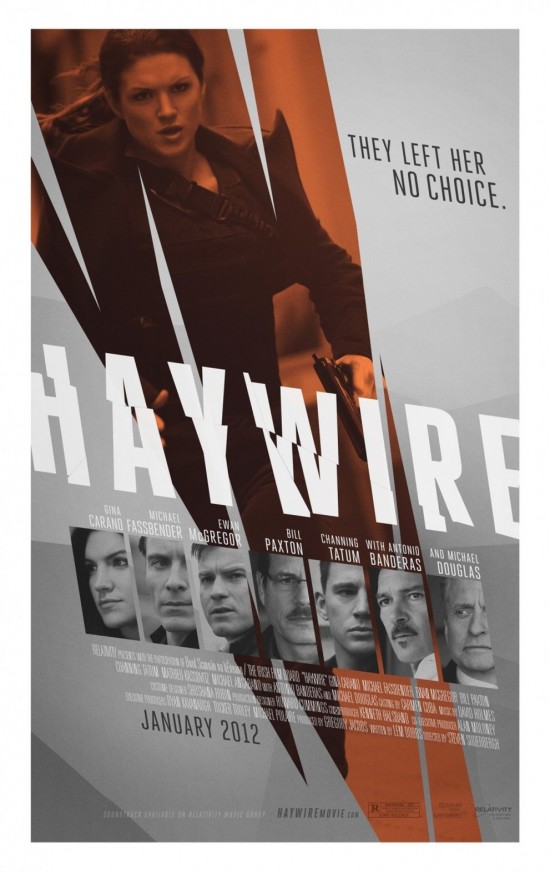 Haywire is director Steven Soderbergh’s experiment in the field of the action thriller, and it’s sparse and arty and pretty boring too. Soderbergh takes another non-actor, this time MMA fighter Gina Carano, and builds a spy thriller around the talents of this imposing fighter. Carano is no actor and her flat line delivery will routinely remind you of her limitations, but man alive does this woman just kick ass. To Soderbergh’s credit, the fight scenes occur in longer takes at a safe distance so that we the audience can watch and comprehend. Carano impresses as a physical specimen, both as a fighter and in other ways (she’s certainly got movie-star looks). I just wish this had been a more traditional action movie instead of Soderbergh’s jazzy, clinical genre experiment. There’s a handful of fights and a handful of chases, but mostly the plot is tied up in knots of who betrayed who and why. The dialogue volume is also curiously kept at a very low level, which obscures many conversations (I was forced to turn on the subtitles just to keep up). The plot itself is such a familiar rehash so why doesn’t Soderbergh pump it with more action? A bevy of stars appear in this thing (Ewan McGregor, Michael Douglas, Antonio Banderas, Michael Fassbender, Channing Tatum) but gives them precious little to do. Unless Haywire is in fight mode, it’s a rather soggy bore. The minimalism in a genre known for bombast is commendable but when that minimalism also stretches into plot and character and pacing, then you’ve entered into another Soderbergh indie experiment. For my money, Haywire is too sparse, too generic, and too dull to recommend, but I’d love to see more of Carano cracking skulls.
Nate’s Grade: C
Share this:

One for the Money (2012)
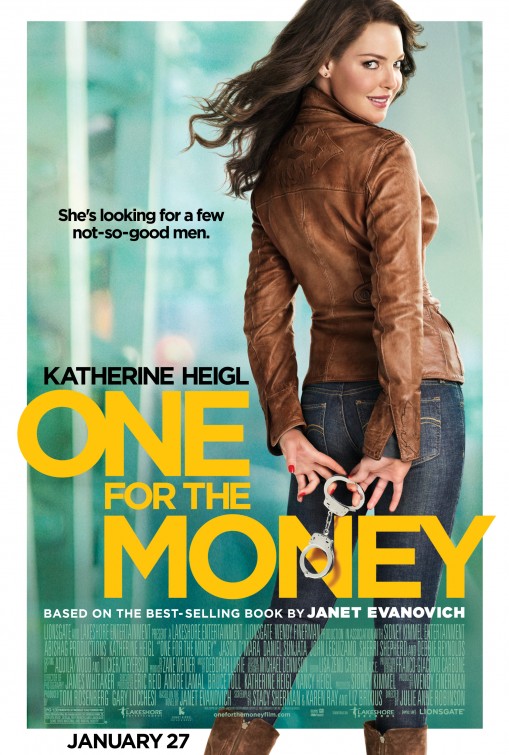 I think it’s about time we all conduct an intervention for actress Katherine Heigl, whatever it takes to stop her from starring, and producing, such middling junk like One for the Money. Heigl plays a novice bounty hunter, a Jersey girl on hard times who is tracking down her ex-boyfriend for a big payday. Yes, it’s essentially a gender reversal of the loathsome Jennifer Anniston movie, The Bounty Hunter, but at least this movie doesn’t foster a forced romance. I give the movie some credit for presenting two potential love interests for Heigl and by film’s end she’s still on her own. Bravo. The rest of the movie, however, is all strictly by the book, including the colorful characters that Heigl seems to collect. One for the Money isn’t particularly funny or particularly good. It also isn’t particularly offensive; it’s just the standard pap you expect from Heigl at this point. Here’s a confession: I really, truly enjoy Heigl as an actress. She’s terrific at comedy and has star-power charisma, and even in junk she’s still effortlessly enjoyable to watch. This woman has talent, she just doesn’t have taste when it comes to picking movie roles. Or maybe she’s content with churning out a mediocre rom-com every year or so for her fans. I just wish Heigl would gain some confidence and bounce from the ghetto of rom-coms, or at least poorly written, blandly formulaic ones. She’s taken the rom-com crown that once belonged to Julia Roberts, Meg Ryan, and Sandra Bullock, but look to them as example. You will have to adapt or die, because eventually Hollywood will find the next Katherine Heigl and supplant the old one.
Nate’s Grade: C


 nathanzoebl
You must be logged in to post a comment.