Blog Archives
RED 2 (2013)
 Pretty much more of the same, RED 2 feels too safe, too breezy and light-hearted, and while still fun in spots, you garner the impression that what was once sufficiently silly has gone overboard. The jokes feel flat and the characters aren’t properly integrated, especially Helen Mirren and a vengeful hired killer (Byung-hun Lee). The villains are a tad bland, but we’re here for the wacky retired special agents, so it’s forgivable. However, the good guys feel like they’d rather be elsewhere. Too much of the story is taken up by the frustrating Bad Girlfriend Plot wherein our hero Frank (Bruce Willis) is harangued by his girlfriend, Sarah (Mary-Louise Parker). I’m not even saying that her character is nagging or shrewish or anything like that, but the movie treats her like she’s dragging him down. We’re also treated to many comedic setups of Sarah trying her hand as a spy to mixed results. Parker is actually the best part of the movie, and maybe because she’s the only character that gets to do something different. RED 2 lacks the visual style of the first film and, inevitably, the freshness of its cavalier old fogies. The action is passable but is that really the adjective you want for a movie? I don’t know what more I was expecting since the first RED felt like a well-executed lark, but at least it had enough style and an impish attitude to leave me entertained. Its sequel is likeable but mostly trying to get by on your good feelings for the last movie.
Nate’s Grade: C+
Share this:

Skyfall (2012)
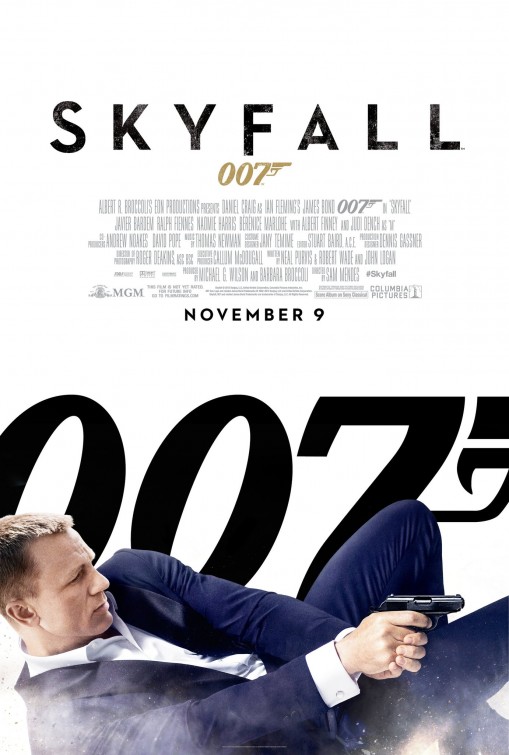 The James Bond franchise, one of the most enduring of all time, has been open to criticism since it came back in a big way with 2006’s Casino Royale. Fans have started to whine that the Bond movies are no longer the Bond they remember, and they’re probably right. In 2006, the producers decided to go back, reboot the series, and introduce a more grounded Bond, a man with more demons than quips. This backlash to a successful reboot seems so funny to me, especially considering the dubious nature of these older Bond movies. Can we all just take a moment and objectively admit that half of the Bond movies are absolutely awful? Skyfall is the third in the new Daniel Craig Bond era, and it’s received universally ecstatic reviews. It’s a fine work, surprising and satisfying in equal measure, but it’s no Casino Royale for me, but what can be?
James Bond (Craig) is recovering from a serious injury after a fellow agent, Eve (Naomie Harris), accidentally shoots Agent 007. In her defense, he was atop a speeding train battling a baddie and her boss, M (Judi Dench), ordered her to fire. In the weeks that follow, Bond is struggling to adapt. He’s lost a step physically and now has to deal with his own doubts. Naturally, this isn’t the most opportune time for crises of faith. MI6 is under attack by one of their own, a former agent turned powerful techno-terrorist named Silva (Javier Bardem). The man has a serious grudge against M and is exposing MI6 undercover agents to punish her. After an attack at MI6 HQ, the agency is left scrambling and sends Bond out to nab Silva, even if Bond isn’t physically ready to return to field duty. Silva is determined to kill M and destroy the agency that left him for dead.
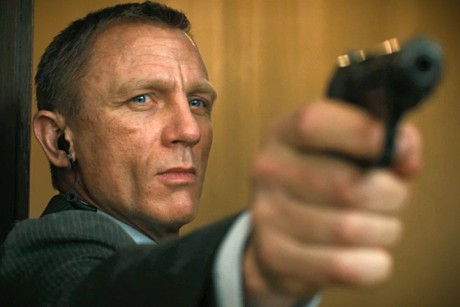 While Skyfall is indeed a good Bond movie and worlds better than 2008’s Quantum of Solace, it still cannot meet the rapturous applause it’s receiving among critical circles. It starts off strong with a nifty action sequence in Istanbul (the go-to action setting for 2012). Bond is chasing a bad guy, and we go from foot chase to car chase to rumbling on top of a speeding train. And there are natural complications that take advantage of geography! When Bond hops on the train, he climbs into a construction crane to fight back, smashing open the back of the train car. It’s a terrific opener that gets things starts briskly, and the sexual chemistry between Craig and Harris (28 Days Later) is palpable. Then the movie pretty much deflates in the second half. There’s a build-up to the villain and his master plot, but once that plot is revealed the film can’t live up to the hype. There are enough plot elements that feel important but eventually get discarded. Here’s a minor example: Bond is given a handgun programmed to his palm print, so it will only fire with Bond wielding it. It’s the only gadget in the movie, so you’d expect it to be utilized in a significant way. One nameless thug uses it then gets eaten by a Komodo dragon. That is it. Seems like an awful waste of funds for it to be thrown away so casually.
The last act has a protracted finale in Scotland, exploring Bond’s ancestral home and his tragic backstory. I’d like to think the insights we’re offered are important but I don’t believe they are. Bond was an orphan (the best recruits, says M) and Albert Finney (Big Fish) was his quasi-father figure/caretaker. It’s not enough to compensate for the slack pacing and encroaching boredom present. The good guys are holed up in an estate, waiting. And that’s what you want in a Bond movie, let alone any action film, for the heroes to sit and wait. An action movie should be building to a climax of intensity, thematically as well as plot-wise. Skyfall is that rare Bond film that flirts with coming undone; each passing action sequence seems less interesting than the one before.
With Mendes directing and Roger Deakens, the greatest working cinematographer, at his disposal, this has to be the best looking Bond movie. The shot compositions are often stunning, making fine use of the visual space and the balance of light and shadow. There are even some shots that might remind you of Mendes previous films like American Beauty or Road to Perdition. Added with some above average action, it makes the thrills an even better sight. There was a fight sequence in a Chinese high-rise almost completely in unbroken silhouette, with the neon tentacles of advertisements dancing in the background. It’s a wonderful image. Even when the movie was losing me at points, I could at least admire the visuals. I was worried that Mendes would not have a deft feel for action. After all, another indie director mostly known for dramatic work, Marc Foster, helmed Solace. That selection did not work out so well, though the script was notably weak. Mendes, on the other hand, can stage some pretty exciting action sequences with judicious editing, allowing the audience to follow along with ease. He’s not exactly a knockout when it comes to constructing action sequences, but the results are more than adequate for a guy whose last two movies were Away We Go and Revolutionary Road.
For the previous Craig entries, it feels like the movies have borrowed more from Jason Bourne than Bond. They’ve gone for a grittier, darker, more realistic portrayal. Skyfall takes a very interesting angle with the character, showing a Bond coming to terms with his physical limitations. It’s a Bond that has to confront his most nefarious foe: aging. Mallory (Ralph Fiennes) tells the agent that the whole spy business is “a young man’s game.” In the old days, you needed men with lairs in volcanoes and giant doomsday lasers. Now you can send the world into irreversible chaos with a laptop. Skyfall is at its most engaging when it confronts the old world of spies and the scary new world of technology. Can the Queen and MI6 compete or will they be left behind? Bond and his organization must confront their limitations and mortality, and this added dimension of vulnerability makes the series far more emotionally resonant.
 Here’s my main problem with the villain: it’s a bait and switch affair that leads to unfulfilled potential. Silva has been spoken of with such awe, a man who could bring governments to their knees with the click of a button. He’s made out to be this dangerous cyber-terrorist genius. So what happens for the second half of the movie? He chases people around and shoots guns. It’s like Skyfall completely forgets what made their villain special. Bardem gives a flamboyant performance with an extra dash of actorly nuttiness, but it’s nowhere near the memorable menace of 2007’s No Country for Old Men. That’s an unfair comparison, I know, but where the movie really starts losing it is when Silva loses it. He becomes just another garden variety psychopath, though one with a creepy oedipal complex. Psychopaths do not work in the James Bond universe. Agent 007 needs a foil that is smart, not crazy and a mad genius rather than mad. I recognize that Silva’s psychological shambles is meant to be a sign of the potential fate of all agents, let alone agents that are given up by M. That doesn’t mean you abandon all the traits that make the villain who he is. The problem with Silva, despite a rather jarring monologue about the effects of surviving a cyanide capsule, peaks with his first appearance. He has a grand entrance and places Bond in a very precarious position, forcing him to confront his physical failures. That’s the villain I want to see. And the awkward handsiness of Silva will also lead many to question whether he’s gay, which wouldn’t matter if the movie wasn’t so clunky.
It also feels like Skyfall may be the conclusion to this incarnation of Bond. I know Craig has been signed for two more films, and that’s great news as he’s fully made the character his own at this point, but the movie seems to setup the Bond we’re better acquainted with. We started from scratch with Casino Royale and now the familiar world, with the reemergence of familiar characters, is coming into focus. The scenes with the new Q (Ben Wishaw), a gangly whiz kid, are enjoyable and they contribute thematically to the old vs. new/age vs. youth conflict at heart. This feels like a transition film, meant to pass from the bruising realism into the polished pyrotechnics of the franchise’s past. There’s a reason the famous gun barrel shot happens to conclude the movie, because by the end of those 142 minutes, it now feels like the formation of James Bond has completed. There are also plenty of in-jokes and references for Bond aficionados to lap up. Even the (lackluster) title song by Adele is in the vein of the old Shirley Bassey numbers.
While not living up to the exultant hype machine, Skyfall is certainly a good Bond movie, though not nearly good enough to be in the conversation of the best. The action starts strong but is prone to diminishing returns especially as the movie transforms into a more ordinary action thriller. The most memorable sequence is in the opening, which isn’t a very good sign for the rest of the movie. It’s still a suitable action movie, and one that pays closer attention at character for a character that’s lived for 50 years in various film incarnations, but just because it pays more attention to character doesn’t mean it does it well. Perhaps I’ve just become spoiled after the artistic and commercial heights of Casino Royale. This is still an entertaining movie that often looks great and has some great actors doing suitable work. We’re still far and away from the loonier Pierce Brosnan episodes, so there is that. I imagine audiences will be more favorable than I am and make Skyfall the most successful James Bond film in history. That’s fine because it feels like, with everything established, that we’re about to hit a new and exciting phase with Craig’s version of the character, and that will leave me shaken and stirred.
Nate’s Grade: B
Share this:

The Bourne Legacy (2012)
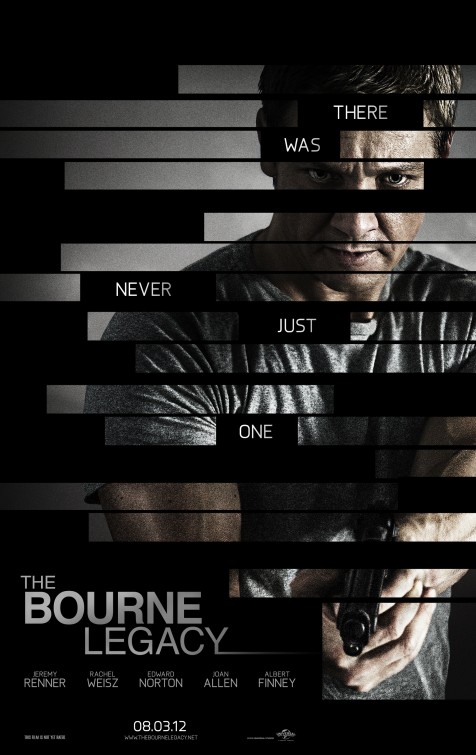 The Jason Bourne spy series has been a financial wellspring for Universal studios, so when Matt Damon and director Paul Greengrass (United 93) decided they had enough spy capers and hijinks, you can understand the studio’s concern. They elevated Tony Gilroy, a writer from the beginning of the series, to director. Gilroy has done some well-received directing gigs of his own now (Michael Clayton), so his ascent made sense from a continuity standpoint. I did wonder how much liberty the studio was going to give him, whether he was going to be boxed in to a style that had worked for the series. I never knew I should have had bigger misgivings, namely that The Bourne Legacy would ransom its conclusion and force the audience to make Legacy a hit.
Apparently Jason Bourne wasn’t alone. The C.I.A. has a team of six different super agents, each undergoing rigorous training and chemical alterations to their DNA via a series of daily pills. Aaron Cross (Jeremy Renner) is out in the Alaskan wilderness when the C.I.A., led by Col. Eric Byer (Ed Norton) and Adm. Mark Turso (Stacy Keach), burn all their agents. They plan on starting over and that means eliminating all evidence of the spy program that gave birth to Bourne. That means Cross has to go as well. That also means the chemists and scientists working on the program must also be silenced permanently, and Dr. Marta Shearing (Rachel Weisz) narrowly escapes a workplace shooting. Cross seeks her out for her medical expertise. They both have a common enemy that wants them dead. Together, the duo heads over to Manila where Shearing’s company manufactures the super meds and so Cross can become a permanent super agent.
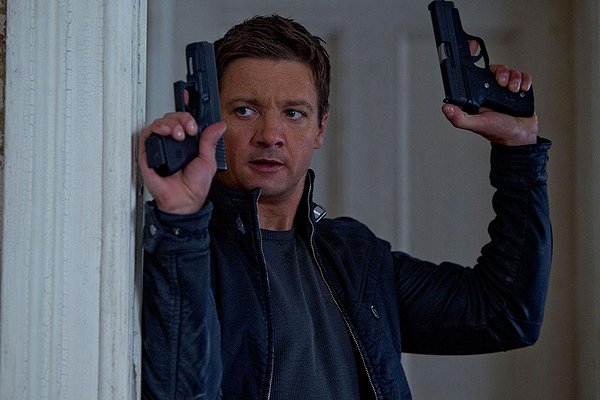 What the hell did I just watch? I know it’s labeled The Bourne Legacy. That part I get. What I don’t understand is that the filmmakers are trying to extort the viewing public into granting a Legacy sequel. Let’s cut to the chase. This movie has no ending. I don’t mean a bad ending. This movie is completely absent an ending. Not just an ending but also a third act. It’s like the filmmakers lopped off the third act and said, “If you want to see where this story ends up, you better get us a sequel.” There is no resolution for ANY STORYLINE in the entire movie. None. The good guys are still scrambling, figuring out how to blow the big bad conspiracy. The big bad conspiracy is still alive and kicking. The patsy for their wicked shenanigans is still the patsy. There is nothing that can be construed as an ending. At least the Damon Bourne movies each had a beginning, middle, and end and tied up their film plots. Sure the characters carried over and there were some larger, overarching storylines, but at least those movies felt complete. The Bourne Legacy is badly incomplete, a gaping void of a third act, and a blunder that makes me question the sanity of the filmmakers. How could you make a big budget summer action movie and not provide any semblance of closure? When the Moby tune kicked in on the soundtrack, I sat stunned, pinned to my seat in disbelief. “No, it can’t be over. They couldn’t possibly just end things here.” Oh, and they do. So enjoy 2/3 of a movie, folks.
With the anticlimactic end in mind, I now understand why the first hour felt so draggy. It’s because they had to fill out a two-hour running time. Especially for the Bourne franchise, the first hour seems to really be paced lackadaisically. For an action movie, it sure takes its time to get going. I wouldn’t have minded if I felt like we were setting up something exciting, but really the story is about a super agent who just wants to get his meds. He travels across the U.S. and the world so he can get his pills, and then he does, and then the movie abruptly ends. I’m simplifying matters in a crass way, I admit, but doesn’t this storyline just feel a tad slight? Legacy also starts to feel like a retread when it comes to its plot mechanics. The C.I.A. is burning all their super spy agents through suicide pills. They are destroying everything before Congressional oversight can reveal their true dastardly deeds. But then we need an antagonist, right? So the government goons reveal they have a SECOND even more super secret program to train super assassins/spies (“It’s Treadstone without the inconsistencies”). How far are they going to take this? Is there going to be a third super duper ultra secret level of killer spies? It’s repeating the same steps the franchise has already taken, the expert spy vs. spy clashes, but now it’s starting to get silly in a way the franchise had previously avoided.
 The action sequences are serviceable but they’re not any better than what the franchise has produced before. Cross has a few nifty escapes but nothing that reminds you of Jason Bourne’s sheer ingenuity. What other man can take down bad guys simply with a rolled up magazine or a book? Aaron Cross just can’t compete with that. The final motorcycle chase is nice but it just seems to be repeating the same danger with little variation. The best action sequence is actually a bit macabre. It involves a workplace shootout. To even call it an action sequence is a bit of a disservice since it’s actually a tense and horrific scenario that is coming eerily all too familiar in the news. Weisz’s character has to hide while her co-worker methodically guns down his fellow lab workers. Oh, and he also took off the door handles, making it dire for help from the outside to get inside. It’s a horrific sequence that’s played out to stomach-knotting levels of tension, as the dread slowly mounts and the pessimistic inevitability looms. Now, obviously Weisz was going to survive, as we know this, but the sequence still resonates with real, primal terror.
So what does The Bourne Legacy have going for it in its favor? Well the duo of Renner and Weisz is a pretty good pairing. Renner (The Hurt Locker) has been rolled out as the next thinking man’s action hero, and he finds interesting depth to his spy character in a rather routine plot. But he’s even better when he’s onscreen with Weisz (The Constant Gardener). There’s plenty of shouting matches and intensity but they have workable chemistry and Weisz’s character gets to be an essential part of the spy heroics rather than a tagalong. I cannot fault the actors for the film’s flaws.
I understand why the Universal suits felt like they needed to pump new blood into their lucrative Bourne franchise. After a while, an amnesiac super spy is going to hit a breaking point; he’s going to run out of essential memories to recall (Bourne 5: where Jason Bourne gets back the memory that he does not like Indian food). I like Renner and Weisz. I even like Tony Gilroy as a director. What I do not like is only getting 2/3 of a movie. Whose bright idea was it to just lop off the third act and provide no resolution? The ending is so unbelievably jarring, so staggeringly incompetent, that I have to dock this movie major points. I can’t say the ending out and out ruins the film considering I was only marginally liking it beforehand. The Bourne Legacy is proof that sometimes imitation is not the best substitute for ingenuity. Gilroy is no Greengrass. Cross is no Bourne. Legacy is no complete movie.
Nate’s Grade: C+
Share this:

Haywire (2012)
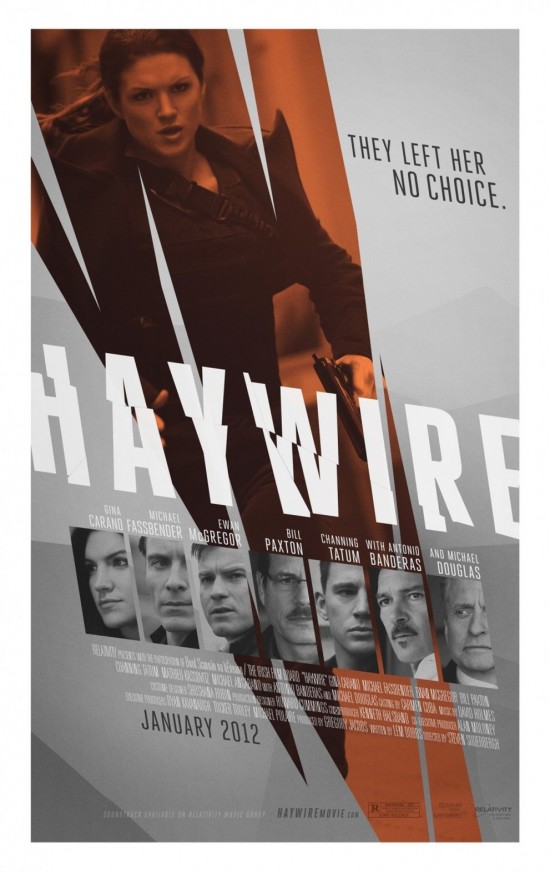 Haywire is director Steven Soderbergh’s experiment in the field of the action thriller, and it’s sparse and arty and pretty boring too. Soderbergh takes another non-actor, this time MMA fighter Gina Carano, and builds a spy thriller around the talents of this imposing fighter. Carano is no actor and her flat line delivery will routinely remind you of her limitations, but man alive does this woman just kick ass. To Soderbergh’s credit, the fight scenes occur in longer takes at a safe distance so that we the audience can watch and comprehend. Carano impresses as a physical specimen, both as a fighter and in other ways (she’s certainly got movie-star looks). I just wish this had been a more traditional action movie instead of Soderbergh’s jazzy, clinical genre experiment. There’s a handful of fights and a handful of chases, but mostly the plot is tied up in knots of who betrayed who and why. The dialogue volume is also curiously kept at a very low level, which obscures many conversations (I was forced to turn on the subtitles just to keep up). The plot itself is such a familiar rehash so why doesn’t Soderbergh pump it with more action? A bevy of stars appear in this thing (Ewan McGregor, Michael Douglas, Antonio Banderas, Michael Fassbender, Channing Tatum) but gives them precious little to do. Unless Haywire is in fight mode, it’s a rather soggy bore. The minimalism in a genre known for bombast is commendable but when that minimalism also stretches into plot and character and pacing, then you’ve entered into another Soderbergh indie experiment. For my money, Haywire is too sparse, too generic, and too dull to recommend, but I’d love to see more of Carano cracking skulls.
Nate’s Grade: C
Share this:

Tinker, Tailor, Soldier, Spy (2011)
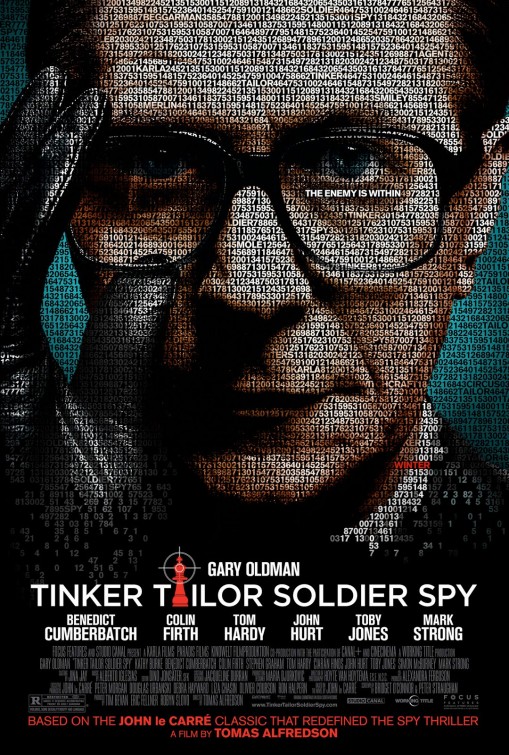 Billed as one of the most dense films of the holiday season, I was startled to discover that Tinker, Tailor, Soldier, Spy is not nearly as puzzling as people have protested. The adaptation of John le Carre’s famous novel follows retired British spy George Smiley (Gary Oldman) performing a clandestine investigation to flesh out a mole in the highest level of the agency. Directed by Tomas Alfredson (Let the Right One In), condensed form a 7-hour BBC miniseries, and stuffed with a wealth of terrific Brits, the movie is tricky, clever, and rather brainy, ultimately coming to the conclusion that these little communities of intelligence knew little. The movie has a rich array of characters and teases out back-story in flashbacks, meaning the film hops around time wise and will also take turns with different perspectives. It demands your attention but, honestly, I found it easy enough to follow. But in the end, what does all that narrative trickery and obfuscation get you? It’s a fairly dispassionate film about dispassionate people played out in a dispassionate manner. For some this will be hailed as a virtue, communicating the duty-first sacrifices and compartmentalization of these secret spies. For me, that just sounds like a cop out. Beyond the mystery, it’s hard to get involved in the movie. The reveal of the mole is anti-climactic, though the resolution, set to the tones of Julio Iglesias, is aces. The meticulous production design is stellar, including an agency meeting room that looks like it was wallpapered with checkerboards. The details of the ins and outs of the agency are absorbing. I’m debating whether I should watch the movie again, looking for nuance I must have missed. Tinker, Tailor, Soldier, Spy is an espionage thriller with a bit too many stiff upper lips.
Nate’s Grade: B
Share this:

Mission: Impossible – Ghost Protocol (2011)
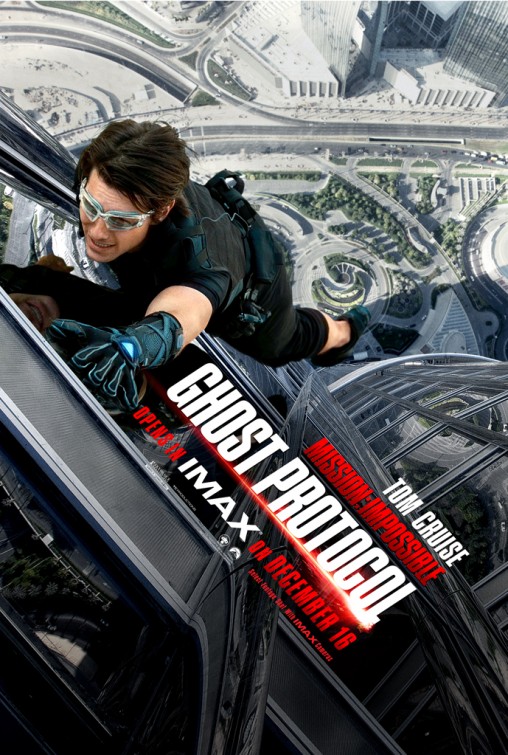 In the span of three months, two Pixar vets will be making their live-action filmmaking debuts. Andrew Stanton (WALL-E, Finding Nemo) is directing Disney’s big-budget John Carter of Mars adaptation, which will be released this March. But first is the awkwardly punctuated, colon-hoarding Mission: Impossible: Ghost Protocol (henceforth referred to as M:I 4), directed by Brad Bird. Any fan of The Incredibles (and who isn’t) knows that Bird is a terrific visual stylist who can compose remarkably exciting action without overlooking characterization. If anyone was ready for the leap into live-action, surely it was this man. Bird is the real star of the movie, and he aces his debut. I think he’s finally living up to the potential he showed with TV’s Family Dog (please note the tongue firmly planted in cheek here).
Ethan Hunt (Tom Cruise) and his IMF squad are on the run. They’ve been framed for an explosion that took out the Kremlin. The president has invoked “ghost protocol” meaning that the IMF no longer exists, and every member is cut loose. That means Ethan and his newest team, techno wizard Benji (Simon Pegg), feisty Jane (Paula Patton), and the mysterious Brandt (Jeremy Renner), have no backup. They are considered rogue agents and Russian’s own special police force is hunting them down as well. Hunt and his team must track down and stop an international terrorist, Hendricks (Micheal Nyqvist, the Swedish Girl with Dragon Tattoo series), who sees the global benefit of nuclear catastrophe (I suppose surviving would be the catch). Hendricks has gotten hold of Russian nuclear launch codes and now is looking to put the final pieces together to initiate a war between the United States and Russia, plunging the world into disaster. Hunt’s team travels around the globe to stop this bad man and his bad plan.
 Bird delivers in a major way in his live-action film debut. The man behind two of the best animated films of all time and Ratatouille, has shown that his keen skills of directing animation have easily translated to real people and real-ish explosions. Bird is a mad genius when it comes to staging elaborate action sequences; he teases out his action with organic consequences and his camera makes adept use of space and geography, and best of all you can easily follow what’s going on in the frame. So when we have an action sequence that takes place in the tallest skyscraper in the world, you know Bird is going to make fine use of this fact to accentuate his action. And the man does so in spades. The Dubai sequence is probably the how-did-they-do-that? standout that people will be most talking about. Hunt has to climb the outside of the aforementioned tallest building in the world using nothing but some special sticky gloves that don’t always work right. He has to climb several stories up, and then there’s the matter of going back down without them. But M:I 4 doesn’t rest on its laurels, because immediately after this sequence we have a feast of thrills. We segue right into a meeting between two parties where Hunt’s team has to pose as each member of this sit-down, orchestrating two separate simultaneous false meetings with the real bad guys. The two meetings dovetail one another as far their needs, making for a blissful parallel of escalating suspense. And then even after this, we get a foot chase into a sandstorm, which then becomes a dangerous car chase into a sand storm. And there are even more great stunts and spectacular action to come, notably a fight in a futuristic car park where the cars tumble from level to level.
Bird has such a firm command of his action, exercising his inspired imagination and all the tools in the special effects paint box. The screenwriters deserve recognition as well, Josh Applebaum and Andre Nemec, both of whom honed their writing chops on J.J. Abram’s sublime spy show, Alias. Their opening sequence, an escape from a Russian prison, sets the stage with Bird’s smart execution; setting up a problem and then letting the situation play out in surprising yet logical and clever ways. It may not have the epic scope of a Michael Bay flick, but Bird’s action is cool without having to be exhausting or noxious. The frenetic pacing rarely lets room for breathing. One of the film’s quiet moments ended in such a jarring fashion that it startled me and I kicked the patron sitting in front of me. I must also credit Applebaum and Nemec for producing the only Mission: Impossible movie that did not involve a turncoat. I was starting to think that IMF’s Human Resources department was in needing of a good housecleaning. Bird, and the screenwriters, has delivered a Mission: Impossible movie so good, with such kinetic and rewarding action sequences, logically utilized gadgets, sexy cars, sexy gals, and exotic locales. They’ve basically made the best Bond movie not to bear 007’s likeness.
Like the previous Mission: Impossible flick, this one emphasizes the team aspect, which makes a more fulfilling and interesting set of missions. M:I 2 became the “Ethan Hunt kicks people in the face for two hours movie,” which Chuck Norris might approve but otherwise was lacking. When J.J. Abrams got on board in 2006, the brand finally got back to its roots. And a team working together with individual strengths makes for a much more satisfying mission that also allows for multiple points of action. Simply out, if you have three people that need to do stuff in synchronicity, it plays out much better than watching Cruise kick people in the face. Choreography is always better when you have more dancing partners. Anyway, with M:I 4 we get some terrific teamwork that can be just as thrilling as the action sequences. Besides the breathless Dubai sequence, there’s a great sequence where the team has to infiltrate a sleazy Indian businessman’s (Anil Kapoor, the TV host from Slumdog Millionaire) cocktail party to get some special satellite codes. Jane is tasked with seducing the sleazy guy, Benji is left to operate a mechanical rover with a powerful magnet that will levitate Brandt, in a metal suit, across the system’s super hot inner mainframe, and Hunt is trying to lose his Russian pursuers. It’s a great sequence where all the pieces come together for maximum effect.
 Cruise has done plenty in the last five years to destroy audience good will, so it’ll be interesting to see if audiences warm back up to the man with the million-dollar smile. Cruise has always been an actor of ebullient energy and charisma, and this has always aided him in action settings and M:I 4 is no different. He’s still a credible action hero and a born movie star, whatever audiences think about his increasingly polarizing personal activities. Lessening Cruise’s load is a smart move, and Pegg (Paul) can provide needed comic relief while Patton (Precious) supplies the sizzle. My goodness can this woman fill out a dress in marvelous ways. Not to be completely sexist, she does a fair amount of ass-kicking too. Her fight with the French femme fatale agent (Lea Seydoux) was all kinds of awesome. Renner (The Town) seems groomed as a potential heir apparent for the franchise. His character is given a small amount of depth to work with, the guilt of a mission gone wrong that has a very personal connection to Hunt. At this point, Renner can do no wrong as an actor in my book. Although there’s only a nine year age difference between Cruise and Renner, so I don’t know how much more mileage that gives you as a franchise. Regardless, Renner is an actor of great conviction and intensity even when he’s silent.
In terms of the franchise, I’d say this fourth installment is just as good as Abrams’ M:I 3, though Abrams had a much better villain and the added emotional urgency of hunt’s wife in distress. Seriously, this is one really boring and completely interchangeable villain. For a movie about the world being on the brink of thermonuclear Armageddon, why do the stakes feel so low? It’s probably because the movie has deliciously orchestrated and eye-popping set pieces but very little urgency. World War III has never felt so ho-hum. Still, it’s hard to fault an action movie when it delivers such high amounts of adrenaline, perfectly packaged in well-developed action beats. This is a high-flying popcorn spectacle of the top order, a grandiose piece of Hollywood escapism. Mission: Impossible 4 is pretty much everything you’d want in a summer blockbuster, only shuttled to winter. I think Bird’s future is limitless, in animation and live-action, and I think the Broccoli family would do us all a favor by tapping Bird to direct a Bond movie. M:I 4 is a pretty good resume for the gig. That would be one mission to die for.
Nate’s Grade: A-
Share this:

Cars 2 (2011)
 Universally regarded as the least involving and nuanced film in Pixar’s illustrious catalog, Cars was the last film I thought would get the sequel treatment. Was it a creative tale that yearned to be told on the big screen, or is this just a business decision motivated by the sound of merchandizing coffers? Those talking cars seemed pretty content by the end of the 2006 original film. It doesn’t take long to realize that Cars 2 was done strictly for the cash. A sequel to the least involving Pixar film, with an even less involving storyline and elevating the most annoying character (Mater the tow truck) to lead status provides little in the realm of adult entertainment. The storyline, a mistaken identity spy thriller, seems like a rejected plot for a lesser direct-to-DVD sequel. While the visuals are still outstanding, the humor is stuck in neutral, overloaded with motor vehicle puns and groan-worthy visual gags. The message about accepting your uncouth friends no matter what their bad behavior might be seems rather misguided. That’s the message? Congrats Pixar, for providing cover for irresponsibility and incivility. The environmental message and its connection to a Big Oil conspiracy feels tacked on as an afterthought to try and crowbar in something more meaningful than a mediocre spy farce. I think cars are rather limited in their anthropomorphic expressions. There’s only so much they can do. And a world populated completely by living, breathing, gas-guzzling (can they get drunk on ethanol?) vehicles begs for an examination on how this world operates without any opposable thumbs. After a magical slate of films that dealt with serious mature themes and danced with storytelling finesse, it’s a shame that daring run comes to an end with such a rudimentary roadblock. Little kids will be entertained by all the bright colors and simplistic storytelling, but I cannot foresee too many fans of Cars even justifying the sequel’s existence. It’s not out rightly bad it’s just so pitifully pedestrian. Cars 2 has so little going on under its hood, you’ll swear it came from a different maker.
Nate’s Grade: C+
Share this:

The Tourist (2010)
 It seems to have all the right elements aligned: two mega-watt stars, a gorgeous location, and an Oscar-winning director whose last film, 2006’s The Lives of Others, was a tense, meaty, humane drama. Add a mistaken identity plot and The Tourist should feel like a light-hearted romp. The truth is that the final product is resoundingly dim and dull is deeply disappointing. All that Hollywood glamour and this is the best they could come up with? The movie is too mechanical, joyless, without much in the way of pacing or a pulse, and the direction feels like a languid tourist trip itself, placidly soaking up the scenery and waiting for a plot to shamble into frame. The action sequences are bereft of tension. Angelina Jolie and Johnny Depp have too few scenes together, too mild a sexual tension, and sleepwalk through their performances. Depp could easily have been replaced by any actor. You’ll see the twists telegraphed a mile away, but by that time your eyes will have already glazed over thanks to the dead weight of a script credited to THREE Oscar-winning screenwriters. With this much talent behind and in front of the camera, I expected a lot more than a sluggish, bland, hermetic thriller that would more like to get lost in scenery than quicken a pulse. The Tourist feels like it needs a map just to know what it’s doing, and the finished product deserves a one-way ticket to the bargain bin.
Nate’s Grade: C-
Share this:

Quantum of Solace (2008)
 We pick up things almost immediately from where we last left James Bond (Daniel Craig). He’s been wounded by being betrayed by his deceased lover, Vesper (Eva Green). A shadow organization known as Quantum kidnapped Vesper’s boyfriend and threatened to kill him if she did not get close to Bond and then betray him. So now Mr. 007 is on the hunt for anyone associated with this secret club responsible for his lover’s demise. Dominic Greene (Mathieu Amalric) is a slimy businessman who fronts an environmental company but really wants to control world resources. He’s a bigwig with Quantum and Bond follows along, leaving a trail of bodies behind that makes his agency believe he’s gone rogue. But Bond isn’t alone when it comes t seeking vengeance. Camille (Olga Kurylenko) is out to avenge the murder of her family by a Bolivian general, a close ally to Greene. She and Bond form a partnership that naturally extends into the bedroom.
Quantum of Solace feels less like a sequel than a plot hangover. Nothing remarkably new is thrown into the mix, and the story is drilled down to the brass tacks of finding whoever was responsible for Vesper’s betrayal and untimely death. Revenge is a fine motivating factor, and many great movies have been developed around the idea of vengeance, but Quantum of Solace barely takes a breath from the action because it really doesn’t have anything else holding together its tale. By the end of this caper we know precious little more than what we started with. We know there is a big bad shadow organization that “has people everywhere,” as big bad shadow organizations are wont to do in the Bond universe, and we know it’s name is Quantum and that it does bad things. That’s just about it, people. There’s even one plot point that is such a huge rip-off of an iconic image from Goldfinger that I’m baffled that either nobody caught it or they were naïve to think it would be a well-received homage (you’ll know it the instant you see it). The movie is the shortest Bond film ever, barely cracking 100 minutes, a full 40 minutes shorter than Casino Royale. It’s as if the filmmakers are expecting everyone’s good feelings from Casino Royale to cover up for the fact that the story is a leftover. It’s like the plot for Quantum was accomplished by the previous movie; therefore, this flick can be nothing but brawn and steely nerve. I’m not expecting my Bond movies, or even my action movies, to dazzle me with nuanced screenwriting, but I do expect there to be a little more something going on than, “Man chases intel. Gunshots and explosions occur. End.”
 Naturally any hiccups or lapses in plot would be overlooked if the action sequences were something to get excited about. Quantum has taken the Bourne mantra to heart, far more so than its Bourne-flavored predecessor, and that means lots of bursts of action but told through quick-cuts that assault the senses. Now, I’m not one of those who complain about the Bourne fighting style and its infamous editing, but imitators generally fail to find the same pizzazz. The flick is front-loaded with 45 minutes or so of solid action but there’s never really any set-up to the action; it just sort of happens. What really hurts the movie is that none of the action sequences is truly memorable. I can easily recall three or four sequences from Casino Royale, but the only sequence in Quantum that I think will stick in my mind is a fight sequence over scaffolding where the camera follows the plunging actors. There are car chases, boat chases, airplane chases, foot chases, and it all has a more realistic vibe without the assistance of technological wizardry. The stunt work is still sterling but it?s fleeting moments of awe in a landscape of forgetful action sequences.
Making the franchise more closely mirror our own world is an interesting and mildly refreshing decision; it sure has helped the Batman franchise. But there are problems when the typical over-the-top fantastical Bond elements sneak back into the movie. The villainous organization Quantum is pretty vague. They look to rule the planet by some means, but then again if the Bond franchise is taking a more realistic approach then having a world-wide secret organization that can infiltrate loads of covert agencies is pushing it. The baddie of this go-round is an effete Euro trash businessman, fine, but don’t give him an axe and pretend that he’s going to be an effective force against Bond. Also, what’s the point of having a glass hotel in the middle of a desert? Why to blow it all to hell, of course. It reminded me a bit of the ridiculous ice palace in 2002’s Die Another Day.
 Craig is still one of the best decisions the Bond producers ever made. He brings the same level of intensity he did to his blockbuster introduction to the series. Craig is all bruises and determination, doing whatever he can to get his answers. He does his best to show the humanity beneath the brutality, but the script fails him. He’s more reactionary this time and seems to behave like a missile that’s in search of its target ready to explode. The caged fury is still there but it seems put to less good use. Kurylenko (Max Payne) is less a Bond girl than an ass-kicking sidekick. She’s given some minute amount of back-story but she’s essentially the pretty face that gets to handle the big guns. Amalric (The Diving Bell and the Butterfly) can be a sleazeball thanks to his natural bug eyes and he doesn’t get much more to do than sneer. He never comes across as being a fierce threat. Gemma Arterton (RocknRolla) is a fairly pedestrian Bond girl with a fairly tame name, Strawberry Fields. She plays the role like a hot librarian coming alive after being seduced by the sexiest man on the planet. Her time in the movie is so short that I question what significance she had other than supplying a requisite sex scene. Dame Judi Dench is still holding her head high amongst all the spy hijinks.
I think I have figured out a way to make Quantum of Solace feel like its own movie, though it does require some creative license. Pretend that Casino Royale ended shortly after Bond was freed from his naked genital torture (it still hurt to think about it). Now, imagine that the opening of Quantum of Solace is the last twenty minutes of Royale, where Bond and Vesper are canoodling in Venice before the bad stuff happens. That sets up Qauntum‘s conflicts and provides a plausible plot trajectory that makes the movie more its own entity; Vesper establishes the conflict, the conflict is resolved by the end of minute 100 (though it would be minute 120 if we’re adding and subtracting parts). Wouldn’t that be a better Bond movie? At least the film would then have one memorable action sequence, albeit the sequence was stolen from another movie.
I suppose my disappointment is coming across more than I intend, because Quantum of Solace is a rather solid action caper with exotic locations, some nifty camerawork, and a brutal efficiency when it comes to pacing out the action. I certainly was entertained and had a fun time with Quantum of Solace, and I?m sure most filmgoers will echo that experience. But in the age of a realistic James Bond cribbing from the Bourne franchise, I was expecting more than a leftover from an earlier albeit terrific movie.
Nate’s Grade:C+
Share this:

The Bourne Ultimatum (2007)
 I think the best aspect of the The Bourne Ultimatum, the third in the memory-troubled spy series, is how kinetically improvised it feels. Jason Bourne (Matt Damon) is a human weapon and he thinks constantly with his body, feeling the situation and his environment, and he comes up with improbable weapons, be them pens, magazines, or kicking ass with just a book (knowledge is power). Bourne doesn’t rely on fancy gadgets or a caustic wit; he just outsmarts the competition by reading his world and reacting instinctively, and that is thrilling to watch. The Bourne films have separated themselves from other spy series like James Bond and standout because of how viscerally realistic they play out. That said, Bourne still survives scrapes that would kill any mortal. At this point, we know just about all we need to know with most of the characters, so Ultimatum is one long, fantastic, and gripping series of chases between Bourne and the CIA operatives that want to rub him out. Ultimatum is Paul Greengrass’ (United 93) second film in the series and he enhances the excitement through his docu-drama style of shooting. The editing is constantly roving and perfectly channels the nervous wariness of a spy that is constantly looking over his shoulder. The action sequences are stellar and raft with suspense and top notch stunt work amongst exotic locales. Ultimatum tacks on some awkward political commentary (black hoods, secret CIA torture, breaking the law to “win” the battle against terror) and tries squeezing its story into a fight between Bourne and the dangerous and lawless elements of the American government that have flourished under President Bush’s watch. It doesn’t quite work in the context of a summer action movie, but thanks for trying. The Bourne Ultimatum is a spry and refreshing action movie that serves to cleanse the summer palate of huge special effects blockbusters.
Nate’s Grade: A-


 nathanzoebl
You must be logged in to post a comment.