Blog Archives
Mission: Impossible – The Final Reckoning (2025)

It’s not just the increasing age of producer and star Tom Cruise, the Mission: Impossible movies have become victims of their own outlandish success, and this might have led to their ultimate end. This franchise has become known for its amazing stunts and placing Cruise in the thick of them. After every gasp-inducing, eyeball-popping stunt, the inevitable question arises, “What could top that?” And so writer/director Christopher McQuarrie, who has steered the franchise for a decade straight, has placed himself in a filmmaking arms race of action set pieces, and these budgets keep getting bigger and bigger, to compensate for the increasing scope and scale. As a result, these movies need to make an even higher amount of money to break even to cover their expanding expenses, and it doesn’t look like the M:I franchise has reached that next level of success (six of the previous seven movies have grossed between $175 million and $220 million domestically). As a result, Final Reckoning is the winding down of the franchise, or at least this incarnation, and it has enough to satisfy long-time fans, yours truly included, but it’s also a reminder of how things have gotten away from the series in the name of chasing spectacle.
Agent Ethan Hunt (Cruise) is tasked once again by the Impossible Mission Force (IMF) to save the world. In a continuation from the 2023 movie, Dead Reckoning, an evil A.I. known as The Entity is taking over the world’s complex computer networks and taking over control of nuclear missiles. It’s only a matter of time before the last four nations fall victim as well, so Ethan and his team (Simon Pegg, Ving Rhames, and now Hayley Atwell as Grace) must work together to get the only code that can kill The Entity.

Final Reckoning is the Scream 6 of the Mission: Impossible franchise. For those who never saw the sixth entry in an irony-drenched, self-reverential slasher series, it was intended to be the final entry in the franchise, and in doing so that made it try to tie back as many elements and moments as possible to the previous five movies. It was meant to feel not just final but full-circle for the fans. Naturally, the problem for Scream 6 is that it wasn’t going to be the final movie, and so a sequel is scheduled in 2026, and all that finality and franchise-reflection seems a bit like misguided internal stargazing. Coincidentally, the Mission: Impossible franchise also began the same year as the first Scream, 1996, and so this movie is intended to (possibly) close the door on the 30-year franchise and on (possibly) Ethan Hunt’s career as the best damn agent the IMF has ever had and yet whom they always doubt his motives in every movie.
M:I 8 takes far, far too much time trying to set up its stakes, which were already set up in M:I 7, which at the time was titled Dead Reckoning Part One before the “Part One” was scrubbed. Seriously, the first 45 minutes or so is awash in M:I clips from the previous seven movies and sloppy attempts to connect everything back together. Now the evil A.I. threatening the world has been revealed to be born from… the “Rabbit’s foot,” the undetermined MacGuffin from the third Mission: Impossible in 2006. Is that better? Does anyone really care about that? How about one of the cops being the son of a previous character? Does that change your opinion of Chasing Cop #2? How about the one guy in the first movie who found Ethan’s knife after he broke into the CIA in that movie’s most memorable sequence? Did you ever wonder what happened to him? Did you ever care about his well-being? I strongly doubt it. These Easter eggs to the older movies would be less egregious if this supposed final movie didn’t squander its first 45 minutes going over its own history as a means of trying to convince the audience This Stuff Really Matters. It’s even more egregious when the running time is 165 minutes long. All of this backward-looking ret-coning and clip show montages feel like an attempt to add weight to a franchise that never needed it. Let the stunts and set pieces stand for themselves. I don’t need all this nostalgic congratulatory back-patting.
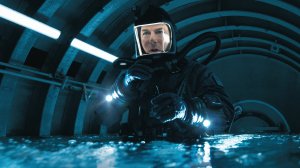
And there is a truly outstanding action set piece that anchors this movie, so much so that it actually comprises a full hour of the film. Set up in the preceding movie’s prologue, we know the only way to kill the evil A.I. is by securing a code located in a Russian submarine at the bottom of the Bering Sea. Just planning to find the location is the first hurdle that Ethan and the team have to surmount. Then there’s getting onto a clandestine U.S. submarine and launching out its tubes to swim to the bottom of the ocean, securing passage inside the fallen sub, and working one’s way through the different chambers, filled with frozen dead bodies, while the sub rolls around, tumbling further and further along the ocean floor. Each smaller sequence has a clearly defined series of mini-goals and organic complications, the kind of exciting escalations that make these set pieces so much better. It’s not enough for the pros to come up with a comprehensive plan, there needs to be unexpected complications that force them to improvise. A foolproof plan that goes perfectly is anathema to action cinema. This sequence has it all, which is why I have no qualms about its length because McQuarrie has justified every link in this set-piece chain. It’s also fantastic visually and really taut, especially as Ethan is tumbling through the innards of the sub with torpedoes falling over and pinning him underneath. This is a prime example of the maximalist virtuoso blockbuster filmmaking excellence that people have come to expect from the franchise.
The problem is that there’s an entire hour after this sequence and, once again, an M:I movie has peaked early. I think only Fallout and Dead Reckoning have their best moments during their actual climaxes. It hurts that Gabriel (Esai Morales) is the weakest villain the franchise may have ever had. I don’t care that the prior film tried to ret-con younger Gabriel into killing Ethan’s love and thus motivating him for vengeance and entering into the IMF. That personal connection and tragedy is a transparent attempt to make this character more important and menacing, and frankly, I am still astounded that this guy… THIS GUY… killed Rebecca Ferguson’s Ilsa. I can confirm, sadly, she is still dead, a reality that astounds me in the realm of a spy thriller where people assume identities. It’s she that Ethan should be fantasizing about in what could be his final moments, not Grace, and I will stand by that (no disrespect to Atwell, who is a genuinely fun and flirty addition to the team as an expert thief).

Regardless, back to Gabriel, who is just an empty suit of a villain, partly because the real villain is the scary A.I. conquering the world’s nuclear arsenals. It’s hard to really vilify a computer code for a movie, so enter this human handler, but he was uninspiring, so they added the secret back-story connection. It doesn’t work. I don’t really care about this guy being defeated, nor do I find him particularly threatening, miraculously killing Ilsa notwithstanding. The ultimate fight atop warring biplanes is visually impressive with its aerial photography, but the conclusion feels anticlimactic and the thrill of the set piece feels even slightly redundant when we remember Cruise has already hung from the side of a plane in M:I 5 and dangled from a helicopter in M:I 6. There’s yet another ominous timer ticking down, yet another deadly device with wires needing to be cut, and yet another side character possibly bleeding out to death. It feels rather par for the series, perhaps a thematic distillation of all those clips. There’s also some extra Fail Safe-style political hand-wringing at the highest levels of the U.S. government whether to give Ethan the benefit of the doubt or resort to some unorthodox methods for added stakes. It just adds up to a final hour of some strong moments in passing and too much of the same for a franchise that chartered new heights.
Placing it through the M:I pecking order, Final Reckoning is probably the weakest of the McQuarrie Era and arguably lesser than Mission: Impossible III, but it is leagues better than the first two Mission: Impossible entries. Realistically, this isn’t the end of the Mission: Impossible franchise, which has grossed close to five billion dollars over the span of its eight movies, but it is the end of Cruise as our star. The franchise was already previously engineered to hand off to Jeremy Renner in 2011’s Ghost Protocol, but then the movie proved too popular to persuasively function as writing off Ethan Hunt (unlike the other franchise also trying to hand off to Renner at the time, 2012’s Bourne Legacy, which proved so unpopular that Matt Damon came out of Bourne retirement). Cruise is now 63 years old and probably aware that these kind of death-defying stunts might be behind him even at his pace. Though I think the three separate shirtless scenes with Cruise are intended to dissuade you about the limits of his age (hey, I hope I look as good as Cruise’s abs when I’m 63). Final Reckoning is another chance to bid goodbye to its seminal action hero, which may be why there’s so much looking back and connecting unnecessary dots. This franchise is a celebration of the highs of big–budget action storytelling with the most game superstar with a death wish Hollywood could provide, so it’s bittersweet to see it reach some form of an end. McQuarrie, the David Yates of the franchise, has been an excellent shepherd with a kinship with Cruise for grand popcorn entertainment. It’s not the best entry but even a lesser M:I movie still rises above just about most studio action cinema. It’s definitely underdeveloped, too long, and structurally questionable with its pacing and climax, but at its best, it still reminds you why this franchise rose above the rest.
Nate’s Grade: B
Share this:

Black Bag (2025)
 It’s Steven Soderbergh’s second movie of 2025, also with screenwriting vet David Koepp, and this time they’re tackling the spy thriller, centering on a marriage between two spies. Michael Fassbender and Cate Blanchett play a couple who both have clandestine lives, and when either one ventures into sharing sensitive details, they utter the code “black bag” as a conversation-ender. There’s a mole in the agency and Fassbender is tasked with uncovering the identity of the culprit, but he worries this investigation might ultimately point toward his own wife and then what’s a man to do? Black Bag is one of those more realistic, exacting spy thrillers, which means it’s churning at a very slow pace with minimal stakes before things ratchet up late. The parallels between trust in a marriage and trust in a spy agency are there but never explicitly explored for thematic richness. You know where the ultimate goal is, finding the mole, but every scene plays out more like a couples drama of squabbling, unhappy upper class winos with secrets and grudges. I had to occasionally remind myself, “Oh yeah, these are spies.” I never fully got on board the wavelength of this movie, finding its detached sexy vibe to be more glossy and meandering. The characters just weren’t that interesting to me. I kept waiting for things to pick up, and even when characters are murdered the tension level still feels unchanged. It’s all a little too heavily submerged under the icy tranquil surface for me. Black Bag is a sedate spy thriller presented as sophisticated but comes across a tad too detached and ultimately tedious.
Nate’s Grade: C+
Share this:

Argylle (2024)
 Knocked around by critics and tagged as the latest excuse for the Death of Filmmaking thanks to its overwhelming budget and general ironic indifference, Argylle is a goofy spy comedy that, while lesser, is an easy watch and would earn regular rotation as a TNT afternoon giant. It’s not trying to be more than a good time, and while its quippy attitude can feel forced and approaching irony overload, it’s also the kind of movie that entertains as breezy escapism. It’s fun. Enough.
Elly Conway (Bryce Dallas Howard) is a best-selling spy novelist with a dashing super spy Lothario lead character by the name of Argylle (Henry Cavill in the worst haircut of his career). She’s journeying with her pet cat, her closest relationship, when she’s stopped on a train by Aidan Wilde (Sam Rockwell). He tells her that he’s a real spy and that everything she’s written in her five novels has come true, and different covert agencies are taking notice. She’s got teams of assassins and spies coming for her, while Aidan tries his best to protect her and get her to remember key details that could save the world from nefarious forces.
 Argylle is too breezy and too predictable by half. It’s a spy thriller that I’m positive many will be able to predict the big twists miles before they occur. Why do all these spies want Elly Conway, and how could she know about the intricate world of international spy craft? The answer is exactly what you’d expect, if you’ve watched more than your share of twist-laden thrillers. Thankfully, director Matthew Vaughn (Kingsman, X-Men: First Class) and company dispatch with this central twist after an hour, providing more time to deal with the aftermath and build off of its story impact. Ah, dear reader, but there’s going to be another twist once you know the first, and again, if you can predict the first, you’re likely to predict the second, because stories about universally good people are often dull, and movies have provided a new medical maxim that characters use maladies to re-evaluate their prior life and choose to be better (oh how nimbly I’m dancing around these spoilers). What makes these predictions forgivable is that the movie seems to know you will anticipate them and has more to offer.
That’s because in this silly universe, very little seems to matter besides getting to the next scene. It’s not a satirical send-up of the genre like Vaughn’s Kingsman movies. Instead, it’s more of a generic distillation of spy thrillers, complete with bad guys walking through mission control banks of computers and barking impotent orders. The only added cleverness that sets the Argylle world apart is Elly’s writing, the fictional version of this far more bland spy universe. In the book parts, Vaughn takes note to raise the style as well as the tongue-in-cheek comedy. It’s supposed to be tone-deaf and dumb and ridiculous, because it’s the big screen version of bad genre writing. You can have fun with that, with characters so serious to the point of parody, with nonsensical technology and near escapes. But when you try to do the same thing in the so-called real world, then the movie starts to eradicate any sense of a baseline for credulity. I did like the practical advice of Aidan on how to crush the skulls of your downed enemy (“Just imagine you’re dancing The Twist.. twist and smash”). By the end of Argylle, Elly and Aidan can do just about anything because they’re practically superheroes. The entertainment of the fish-out-of-water aspect of Elly’s story is short-lived and unfulfilled because the movie becomes more of a tale of automatic self-actualization rather than growth.
 The direction feels rather drab at points, and many locations and scenes have a general sense of missing… something. Just watch any set and it appears so drastically empty that I questioned whether they cut back on the set dressers and props. Empty dance clubs. Empty streets. Empty hallways. Everything is too pristine, too sleek, and too empty and green screened (might be a result of COVID filmmaking). This carries over into the disappointing visual aesthetic, as Vaughn’s signature style feels dampened by the pesky CGI additions of many sequences, adding to the unreality rather than building out this minimalist world. If there had been an extra EXTRA twist that everything was also a story-within-a-spy-story, I would not have been that shocked, and it honestly would have explained the underwritten and underwhelming world of clandestine spy-making.
Vaughn errs in the core creative decision of having his main character mix reality and fantasy, not through the idea itself, which could be ripe, but through its confusing execution and editing. Having Elly hallucinate Agent Argylle in place of a real secret agent is fine, as we can contrast from her idealized version of a super spy, her James Bond, versus the actual grunts struggling to win the day. There are a couple problems with this execution though and firstly that the “reality” isn’t that far removed from the fantasy. This is still a world where Rockwell’s spy is able to commit amazing acts of dexterity and martial arts and balletic violence flying around rooms, but I guess he falls down more. The difference isn’t that fantastic when it’s already a hyper-stylized action world. The bigger issue is just how confusing it all plays out visually because we’re seeing Elly’s perspective and in rapid blinks Cavill will turn into Rockwell and vice versa. It makes for a jarring sequence that doesn’t fully capitalize on the comic potential while keeping the audience distant from fully engaging with the sheer simple pleasures of watching a fun fight. This happens throughout the first half of the movie and severely hampers the action scenes from being accessible. I think we needed a longer duration for this to work. We see Elly’s version for a period of time, and then we cut to the real world where Aidan is bouncing into walls, falling down, and flailing. By continuously jumping back and forth, not just in the scenes but in the same shots, Vaughn has made his movie harder to watch and harder to comprehend, and with a loud soundtrack blaring.
 There is one sequence of great filmmaking for Vaughn, but to explain such will require some spoilers, so beware, dear reader. There are three instances of the whirly-bird dance where a woman is lifted spread-eagle atop a man’s shoulders who then spins her around. The first time, it’s Agent Argylle and Legrange, played by Dua Lipa (Barbie) dripping with sexual energy. The second time is when Elly and Aidan are on a mission and he lifts her up, to her amusement and flirtation. She’s living out her fantasy version, with Rockwell standing in for Cavill and Howard standing in for Dua Lipa. We’ve gone from these stunningly attractive human specimens to people who look more ordinary, including a fuller figured woman engaging in the same sexy shenanigans as the conventional blonde bombshell. She can be her dream version of herself. Finally, the third occurrence happens during a climactic showdown where Elly and Aidan team up against an onslaught of faceless armed henchmen. With the aid of colorful smoke canisters, their offensive surge plays out like a couples’ dance routine, including holding one another for high kicks to incendiary devices. It’s all set to Leona Lewis’ cover of Snow Patrol’s “Run,” and as the music swells, it’s easy to get swept up too. Even the gunshots are set to the beats of the song, culminating in the final whirly-bird dance, except it’s not Elly being lifted, this time it’s Aidan. See, she’s not the Bond girl bombshell, she’s James Bond. It’s a silly moment but with the added setup, thematic underpinnings, and Vaughn’s virtuoso stylistic seizing of the moment, it plays out as empowerment and an expression of love. For real.
I can understand being generally disappointed with Argylle. It looks and feels like it’s been built on the parts of other better spy franchises and desperately lacks the charisma and personality of Vaughn’s Kingsman movies, themselves giddy and perverse satires. I wasn’t the biggest fan of 2017’s The Golden Circle sequel, but it’s got oodles of style to spare compared with Argylle. I wish Vaughn would push himself beyond the orbit of making cheeky, winky spy action comedies, the same genre he’s been playing in since 2015 and now for four movies. While the original Kingsman was a breath of fresh air with fun characters, a snarky attitude, and slick style, Argylle is all snark and minimal style. There’s so much comedy that feels like it should be funnier, from the travails of Elly’s CGI-enchanced cat to the floundering hand-to-hand combat. When recognizable names start showing up playing forgettable genre stock types, and then they start dabbling in accents as other genre stock types, it feels like the whole exercise is a miss. However, the central buddy relationship between Rockwell and Howard is where the movie works, and fortunately that’s the element that has the most foundational effort. This is a movie that, in the future, if it was on TV during a lazy day, you’d sit down and watch the rest and mostly be happy about it. Argylle isn’t anything new or fresh but it’s buoyed by its stars, and not the magazine cover models but its real stars, Rockwell and Howard. In their hands, even lesser spy comedies can still be fairly worthwhile escapist entertainment. Still, I must deduct some points for the movie missing a perfectly setup opportunity to have Henry Cavill and John Cena kiss onscreen at the end. It was right there, folks, and we all deserved it.
Nate’s Grade: C+
Share this:

Mission: Impossible – Dead Reckoning Part One (2023)
 I was a nominal fan of the Mission: Impossible series after three movies, and it seemed like the American public was feeling the same. After 15 years, it felt like the franchise was considering a soft reboot/shift with 2011’s Ghost Protocol, setting up Jeremy Renner as the heir apparent to Tom Cruise’s super spy, Ethan Hunt (weirdly, Renner was also set up to be another franchise replacement for Matt Damon’s Jason Bourne in 2012). Except what may have been initially planned as a franchise hand-off became a franchise renewal, with a delightfully twisty plot, fun teamwork as they scramble to adapt, and a show-stopping action set-piece that remains the franchise’s high-point, the scaling of the towering Burj Khalifa skyscraper. It also reminded us that not only does Cruise love to run but the man has a death wish when it comes to performing his own amazing stunts. With Cruise firmly back in place as lead, and Renner jettisoned (which also happened after 2012’s The Bourne Legacy), the franchise was further boosted by two of its best additions: actress Rebecca Ferguson and writer/director Christopher McQuarrie. The Oscar-winning Hollywood screenwriting staple was not known as much for his directing efforts, but he became a Cruise confidant after 2008’s Valkyrie, and he’s worked almost exclusively on Cruise projects ever since. He earned the man’s trust and proved a fantastic action director. 2018’s Mission: Impossible Fallout is just blockbuster filmmaking at its high-stakes finest. I was bouncing in my chair with excitement and simply luxuriating in action thriller nirvana.
This time Ethan Hunt (Cruise) and his select team of trusted friends and colleagues are battling a villain terrifyingly relevant to our modern times, especially in light of the screenwriters’ strike – artificial intelligence. The big bad is an A.I. that can control the world’s security apparatus, and it’s become self-aware and resentful of its human overlords. It exists inside a computer console inside a Russian submarine at the bottom of the Arctic ocean under a wall of ice, and the A.I., known as “The Entity,” doesn’t want to ever be found (must be an introvert). If only it was that easy. The world is racing to be the first to claim this unparalleled prize, and the Impossible Missions team has to ensure they can find the location, which of course involves a MacGuffin, this time two interlocking keys to access the A.I. sub station. Can Ethan get there first and can he even trust his own government to do what’s best with access to this kind of power?
 Mission: Impossible – Dead Reckoning Part One is a mouthful of a title. We got a colon, a dash, and a “part one,” a presumptuous gamble that after 160 minutes the audience is going to be ravenously hungry for a continuation in a series that has never had a two-parter before. In short, the movie is a lot, a lot of the same action and renowned stunt work we expect, and a lot of setup and extension that might have been better trimmed by focusing on one movie rather than setting up two. McQuarrie has done this before and been successful without the need of a direct two-parter. For all intents and purposes, Fallout is a direct sequel to 2015’s Rogue Nation, carrying over the same villain for the first time in the series and the ongoing relationship between Ethan and Ilsa Faust (Ferguson). Both of those movies feel complete and satisfying and well-designed in structure and development without needing one part to complete the other. With Dead Reckoning Part One, henceforth known as M:I 7 to spare me from writing this title every time, it feels like an overlong setup. By the end of the movie, our characters know where the A.I. is located but they still don’t know where the sub is or how to get there, which means the entire movie could have been collapsed into a more streamlined venture. Part of this may be the production troubles where they had to shut down and rejigger the plot multiple times from COVID outbreaks, as M:I 7 is the last of the big Hollywood movies to release that was shutdown in 2020 by the devastating pandemic. It all feels a bit overstretched and absent a satisfying conclusion.
The draw of the franchise, and chiefly its 2010s renewal back into the zeitgeist, is still the eye-popping stunts and set-pieces and Dead Reckoning still delivers. Most viewers will likely find the final action sequence aboard a speeding train to be the high-point, and it’s got some wow moments, my favorite is when the train is hanging over a blown bridge and Ethan has to leap from train car to train car before it plummets, oh and it’s all at an incline. It turns each car into a new obstacle to overcome utilizing its specific dynamics, like a dining car with a falling piano to a kitchen with vats of hot grease to avoid. The standout stunt involves Cruise driving a motorcycle off a mountain in a desperate effort to parachute onto this speeding train. However, this whole train sequence didn’t excite me too much, outside of its beginning stunt and the end. Watching men chase one another atop the speeding train, let alone wrestle and fight with knives, only serves to limit what can be done and it reminds me how fake the moment is for a franchise that has made its mark on its daredevil realism. That extended middle feels a bit too much like other Hollywood thrillers and action movies, and that’s what made it disappointing for a series I consider the current gold standard of franchise action.
 A much less heralded sequence around the forty-five minute mark was my favorite, where Ethan is running around the Abu Dhabi airport while the following takes place: 1) Ethan trying to evade federal agents (the dependable Shea Whigham) looking to arrest him, 2) Ethan is trying to find the owner of one half of the MacGuffin keys who happens to be a pickpocket that keeps giving him the slip, 3) Ethan’s team, Luther (Ving Rhames, the only other actor who has appeared in every M:I film) and Benji (Simon Pegg) trying to find a nuclear bomb in a suitcase through the maze of baggage claim and disarm it, 4) the introduction of our villain Gabriel, well, our primary lackey to The Entity, who also happens to be a former IMF turncoat who killed Ethan’s girlfriend and essentially “made Ethan Hunt who he is” following Batman logic. This entire sequence is pure McQuarrie splendor, where it introduces the different characters, several at cross-purposes, lets them loose and then finds organic complications and specific turns that take advantage of the geography as well as the character’s emotional states. I loved it, and it made me hopeful that after a bit of a slow start that M:I 7 was now cooking and would be the prolonged deluge of near-perfect set-pieces that was Fallout. Not so much, but this sequence was indeed good fun.
Another issue I had was that our villain, again more like chief lackey, is so bland. I like Esai Morales (Ozark) as an actor, but the character of Gabriel is such a non-starter. Even giving him the personal history with Ethan feels like an admission that this bad guy has little to offer on his own. I think it’s part of how the character is written but I think it’s also a reflection that he’s the number two behind the all-powerful, scheming A.I., and then he too has a number two (number three?) played by Pom Klementieff (Guardians of the Galaxy vol. 3), and she is so much more engaging as an antagonistic presence. She’s the one driving through cars and stonework throughout Rome to chase down Ethan. She’s the one who fights him in a narrow alleyway, a nicely claustrophobic change-of-pace action moment for a series that gorges on scale. If the true villain is going to be an A.I., why can’t Pom simply be its number two hench-person? Gabriel is redundant and boring and his fight sequences don’t feel believable against this crew.
 There are a couple other storytelling choices that I wasn’t happy with, but I’ll save delving into those for the sake of spoilers. Suffice to say, I hope Dead Reckoning Part Two in 2024 course corrects and we have some welcomed returns. It’s kind of fun to see Kittridge (Henry Czerny, Ready or Not) make his first reappearance since the 1996 M:I and also get so much screen time. He’s essentially the face of the U.S. government infrastructure for the duration of the movie. His clenched-jaw consternation is a nice foil to the always rogue super spy.
Dead Reckoning – Part One is a good but not great Mission: Impossible movie, conceived as two parts and suffering some of the consequences of its over-extension. The thrills are still there, the sturdy production values, the emphasis on the spectacular stunts and fun action set pieces, so any fan of the franchise will find enough to enjoy over 160 minutes. The addition of Hayley Atwell (Avengers: Endgame) as the wily pickpocket who has stumbled into international espionage is great, though she cannot escape feeling like an Ilsa replacement while Ferguson is off-screen for too long. Cruise is still the movie star who delivers the most from film to film, and his high-wire efforts are appreciated. By the end of the movie, the sub is still at the bottom of the ocean, our characters are still in a race to find it, and I wondered why we couldn’t have ditched “Part One.” The answer, as much in Hollywood, is of course money, but I wish this Part One made me more psyched for Part Two.
Nate’s Grade: B
Share this:

Heart of Stone (2023)
 Heart of Stone is pre-molded for the Netflix formula of star-driven action vehicles and spy thrillers that are meant to pass the time and do little else to stimulate your thinking or entertainment. These expensive and generally disappointing genre movies feel remote and mechanical, as if the almighty Netflix algorithm thought, after housing and documenting thousands of action movies, that it too could make a competent spy thriller.
Rachel Stone (Gal Gadot) belongs to MI-6 but also another organization, The Charter. They’re a clandestine peace keeping force powered by a super A.I. known as The Heart. Super hacker Keya (Alia Bhatt, RRR) is after the Heart, and she’ll wreck havoc until she gets it.
There are plenty of recognizable genre elements and inspirations here, but the problem with Heart of Stone is that it never gets beyond feeling like another bland summation of its formula-laden parts. You’ve seen bits and pieces of this movie before, so the viewing experience becomes a personal guessing game of how long it will take for Heart of Stone to utilize this genre cliche or that cliche. There’s no surprise or verve or quirk to be had here. Everything is pulled from a big bucket of cliches and then reassembled to best simulate a genre movie that you mostly remember seeing before. This lack of effort and finesse can make the movie quite a slog to sit through. The lack of imagination translates even to its generic title. See, her last name is Stone, and she works for a secret organization where people have code names after playing cards. Do you get it? This clunky name generator title feels like something that some feeble social media post would ask as it really intends to steal your identity from security questions.
 I keep going back to the very core construction of the plot and scratching my head in confusion. Stone is part of MI-6, a spy agency, but she’s also part of ANOTHER even more secret spy agency, which she must keep secret from her fellow secret keepers already doing their spy thing. Why do we need the extra layer of subterfuge? What does this add? The situation where the very deadly and skilled person is hiding in plain sight, the Superman pretending to be the bumbling Clark Kent, is already there with her being a hidden spy, so why do we need a second layer? It’s a complication that doesn’t add anything of value. She’s already on a mission and getting tech help from her own spy team and agency, and she’s also given even more secret tech help from the other more secret spy agency. It’s redundant. It’s not like TV’s Alias or Hydra in the Marvel movies where there was an opposition force within the spy agency, actively working against its aims. It also has the detriment of prolonging the eventual revelation and inevitable betrayal from within the team (don’t act like you didn’t see this coming from the opening mission). We all know it’s coming, so then I think that perhaps the filmmakers will use this extra time with these co-workers to better develop them, give them intriguing dimensions, or at least complicate the relationships with our protagonist who is actively lying to them about who she is. Nope. She does take care of one guy’s cat.
Another element that made little sense to me was the chosen villain. Spy and action movies lend themselves to larger-than-life characters that aim at world destruction and big swings. This movie introduces us to a super hacker who excelled in her field. Okay, and? The character feels more like a hostage than the antagonist that is masterminding the world-trotting schemes. There’s nothing of interest to this Keya character; she’s practically amorphous, so poorly defined that any other character can project onto her. I kept waiting for the motivation for why she’s resorted to her schemes, what she would want to do with the secret supercomputer, something to better add dimension or at least context for this character. Her motivation is just as frustratingly vague as the rest of her, as it’s revealed quite late that she wants the supercomputer to right the wrongs of the world, though what exactly those are, and whether she has a personal connection, who knows? She’s so bland as a villain that (mild spoilers) when she’s eventually deposed by another villain, I felt a little surge of relief that maybe someone else could do better villainy.
Even familiar genre movies can be saved with well constructed and exciting action, like those Chris Hemsworth Extraction movies that coast off the fumes of the most tortured military action cliches. Alas, there is no relief for Heart of Stone. The action is supremely bland and lacking better connections to the characters and their plights. It’s usually just chases and shootouts. There’s one sequence that takes place inside a floating satellite station, and I thought that for once things might get interesting. The subsequent action is just another fist fight and beating the other person to grab a thing before everything explodes from a gas leak. This could have just as easily taken place in a warehouse or a boat or a house or a basement or anywhere. Why introduce a fantastical setting and then ignore utilizing those unique aspects? I guess it does lead to a debris chase that reminded me of Black Widow’s finale. There is a mid-movie chase through the streets of Libson that has some life to it as we watch cars careen at high speeds, but it’s also nothing we haven’t seen before and better in a dozen other movies with more conviction than this one.
 Gadot has rocketed to fame from her Wonder Woman status and she can be a charming screen presence, but let’s acknowledge there are definite acting limitations as well. I challenge you, dear reader, to think of a beloved Gadot performance outside of her Amazonian warrior woman. Were you floored from Triple 9? Or Keeping Up with the Joneses? Or Death on the Nile? There’s a reason the producers decided to just make everyone on Wonder Woman’s ancient island mirror Gadot’s Israeli accent. With that said, Gadot seems so thoroughly bored here. It might be the groan-inducing dialogue that confuses what constitutes banter and quips; take for instance a moment when a member of the spy team remarks about her haphazard driving, “Are you trying to kill us?” and Gadot woodenly replies, “Actually quite the opposite.” The movie is filled with these lackluster quotes and genre buzzwords but without any real meaning behind the words. It’s a movie going through the motions, and Gadot is following suit. It’s not that she’s bad here. She’s never asked to really try.
The conclusion of this review is as good a place as any to talk about the implications of the story, something that Heart of Stone doesn’t seem slightly interested in. The “heroes” of the super secret spy agency have a supercomputer that makes scarily accurate predictions, enough so that the spy agency takes them on blind faith as operating orders. Nobody really asks whether this is a good thing, except for a scant reference by our antagonist before they decide to jump ship and join Team Follow the A.I. Nobody explores the more existential question of whether these things are accurate because the machine was right or because the people were just doing what the machine said, thus making these things become accurate because of the engineering direction. There’s a Minority Report aspect about free will and abdicating this to machines that is begging to be better explored. Unfortunately, this all-knowing supercomputer is just any other disposable spy thriller element jumbled together to best resemble another disposable product. I read that Netflix intended for this to be the start of a franchise, and without an intriguing world, lead character, spy agency, or set of ongoing conflicts, it’s hard for me to envision anything Heart of Stone could offer that people would request a return visit. If you need something loud and derivative to take a drowsy nap to, then Heart of Stone is the next The Grey Man.
Nate’s Grade: C-
Share this:

Ghosted (2023)

Have you ever watched a movie that felt like it was created by soulless robots? That was the overwhelming feeling I had with Ghosted, a supposed “romantic” “comedy” and spy thriller debuting on Apple Plus with big stars and a big budget and lacking anything that feels recognizably human. 2023 has been a year of exciting and precarious technological advances, and the emergence of A.I.-assisted chat and performative generators, from art to stories, is a Pandora’s Box that will not go away, especially for an industry looking to cut corners wherever possible to save a buck. Super producer Joe Russo has bleakly predicted it’s only a matter of time before studios lean into A.I. programs to help them write bankable screenplays. When that dark day arrives, if we haven’t already crossed that Rubicon, I imagine those A.I. ghostwritten scripts will feel a lot like Ghosted, a movie that feels like it was constructed from imperfect observers.
It all begins when boy meets girl at a farmer’s market. Cole (Chris Evans) refuses to sell a potted plant to Sadie (Ana de Armas) because her job keeps her away for up to months at a time. He cannot, in good conscience, sell this woman a plant he knows will be neglected. From there, they spend a whirlwind first date getting to know one another in and out of the bedroom. Then Sadie never returns Cole’s messages and calls again. He frets that he’s yet another modern dating victim of being ghosted when strange men kidnap him and ask him scary questions about things he has no clue about. He’s rescued from this interrogation by none other than a gun-toting Sadie. She reveals she’s really a secret C.I.A. agent and somehow her enemies have mistaken Cole for “The Tax Man,” a dangerous and mysterious assassin that’s actually Sadie. Now they’re on the run and Cole has to learn the ropes of spy business or else, and maybe he can get a second date while he’s at it.

The premise alone is a workable high-concept we’ve seen comedy variations of before, from Charade to Knight and Day to The Spy Who Dumped Me (remember that movie, anyone?). It’s the perspective of the novice being plunged into the chaotic and overwhelming world of spy-craft and having to rapidly adjust to a world they thought was just the stuff of movies and beach reads. It’s the kind of story that pokes fun at spy movies while embracing them as well, and it posits what would happen if one of us normies ever accidentally found ourselves in this high-stakes world. Where Ghosted doesn’t work is that the characters are both awful versions of the Novice and the Expert. There’s a slight amusement watching Evans plays out of his depth in action contexts, running counter to a decade of Marvel heroics, but this is short-lived. He eventually begins to be a capable partner for Sadie as she learns to trust another, which is the most expected and basic character arc for each of these people. However, Sadie is also boring, and even when the truth about her profession is revealed, it doesn’t make her that much more interesting. I was already doubtful when we opened with her talking to her therapist over her car’s phone and this was the first scene. She’s been slotted as Killing Machine with Trust Issues, and he’s been slotted as Too Afraid to Seek His Dreams, and so their conclusions are predictable and bland. There’s even a lack of a technique that Sadie teaches Cole that comes into play at a pivotal moment. That’s the most basic thing and they miss that.
There is also a notable absence of chemistry between the leads. While de Armas and Evans have co-starred in two prior films, they were opposed in 2019’s Knives Out and 2022’s The Grey Man. Actor chemistry is one of those ineffable qualities that you can tell pretty quickly whether it’s evident or lacking, and within minutes of the tortured house plant meet-cute, I sensed a gaping black hole of palpable chemistry. It’s even more obnoxious when MULTIPLE characters in MULTIPLE scenes implore the two to “get a room” because their supposed sexual tension is off the charts. Sure thing, movie.
Another quality that becomes very apparent is how forced everything in Ghosted feels. The romance feels forced but the comedy especially feels forced. The four screenwriters include the writers behind the Deadpool, Zombieland, Ant-Man, Spider-Man, and recent Jumanji movies, so we know these credited writers have a keen understanding of comedy. It makes the results on screen all the more mystifying and disappointing. The jokes generally feel off (“He expected a hottie not Mata Hari,” womp womp), the rhythm and tone feel a little too much, too forced, like the actors are desperately trying to compensate. It comes across like they were instructed to speak at a more fast-paced and clipped rate to attempt to emulate screwball comedy patter, but the material isn’t there to match the hyperactive verbal presentation. The music is also another factor in trying to better compensate. It’s trying to provide a jaunty, breezy energy level that isn’t sustained in the movie by its comedy, action, or romance. The number of needle drop song selections can also be insufferable and dumbfounding. The characters will start a gun fight and then “My Sharona” will crank up or, even more inexplicably, “Uptown Funk.” The relentless fallback of familiar pop and rock ditties intruding over the action doesn’t so much elevate the moment as make you realize just what would be missing without the song. I’m all for the clever use of music to jazz up a scene, but the final action sequence shouldn’t have to rely on Bruno Mars for any nascent fun.

There are a handful of moments and ideas here that could have worked in a better movie. I enjoyed a stretch in the middle where Sadie and Cole are ambushed by one bounty hunter with an absurd name after another, and each is a cameo from a familiar face and each gets dispatched swiftly. The movie also takes pains to make fun of Cole’s smothering qualities, including his snapping a picture of Sadie while she slept in his arms post-coitus and unaware. I wish this line of criticism would pick up more momentum but there’s only so much heat that Cole will take when he still needs to be the handsome and appealing lead. I also liked the idea of a villain, played by Adrien Brody like his copy of the screenplay didn’t have a single joke inside it, who is simply trying not to be revealed to be incompetent. I think there was especially more room to mine with the confusion over which character was the infamous Tax Man. The assumption that it must be a man could have opened up a broader and interesting subplot over sexist gender assumptions, with nobody believing that a g-g-g-girl could be such an accomplished trained killer (alas, the “girls can do it too” message seems to be all the movie offers in response).
Ghosted is not a good action movie, as it’s poorly sourced and edited, it’s not a good comedy, as the jokes are iffy and delivered in such an exaggerated and clunky manner, and it’s not a good romance, with two bland and under-developed genre character cliches portrayed by two actors who have a startling lack of chemistry together. The music is obnoxious and trying to compensate for the flagging energy level and forced comedy, the movie runs too long at almost two hours, and director Dexter Fletcher (Rocketman) has no feel for action or romance. It’s the comedy that made me most depressed, as no character talked like a semblance of a real human being, nor was their fast-paced, quippy dialogue truly zingy and entertaining. t was like watching a desperate person try and prove they are not, in fact desperate, but with every word only proving more and more their desperation. I’m sure some people out there will find this movie passably breezy or charming or at least inoffensive for two hours of inattention. It all felt so forced and inauthentic and tired to me. It’s best to just ghost this film in real life.
Nate’s Grade: C-
Share this:

The Gray Man (2022)
 Two movies removed from the Marvel Cinematic Universe (MCU), I’m starting to wonder if the brotherly directing duo of Joe and Anthony Russo are absent their own vision. Cherry was an exhausting and annoying experience overloaded with self-conscious stylistic choices that dominated the movie and squeezed it from its dramatic potential. Now we have The Gray Man, based upon the 2009 book by a former Tom Clancy writing collaborator, and it looks indistinguishable from any other big-budget spy thriller. It feels like The Russos doing their version of Michael Bay doing his version of the Jason Bourne series. It’s an expensive movie for Netflix, in the range of $200 million, and it just made me think about 2019’s Six Underground, their $200 million collaboration with Bay where he had creative freedom to make the most bombastic, hyper masculine, and tedious movie of his career. If you’re going to devote a fifth of a billion dollars for a Michael Bay-esque action movie, you might as well hire the real deal again. The Gray Man is a passable action movie, especially in its middle, but it’s wholly derivative and coasting off your memories of better spy thrillers and better characters.
The titular “Gray Man” is a super-secret Sierra agent given the code name Six (Ryan Gosling). He’s been the government’s indispensable tool for taking out bad guy and keeping the world safe for 18 years, working time off his prison sentence. Then it all goes wrong when, of course, his callous boss (Rege-Jean Page, Bridgerton) demands he “take the shot” even if it means the death of an innocent child in the process. Six declines, the covert assignment becomes much messier, and he learns that his target was a former agent from the sane secret Sierra cabal. The dying man gives Six a MacGuffin necklace that the big bad boss really wants. Six goes on the run, with the help of some allies like another agent (Ana de Armas) and his retired handler (Billy Bob Thornton), and the CIA sends every professional killer to get their man. This includes the mustachioed Llyod Hansen (Chris Evans), a ruthless private mercenary who brags about being kicked out of the C.I.A. academy for his lack of ethics and impulse control issues.
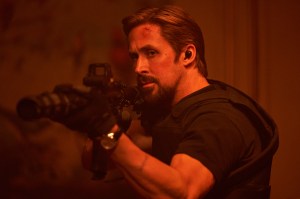 If you’re just looking for an action vehicle that provides enough bang and sizzle, The Gray Man can suffice. I’ll champion the highlights first before equivocating on them. There’s a recognizable blockbuster elan to the movie with enough energy to keep your attention. There is a significant uptick in the middle that gave me a false sense of hope that The Gray Man had transformed into a better movie. Again, this occurs well into an hour into a slightly under two-hour movie, but credit where its due, there is a nicely developed sequence of substantial action. For being a spy thriller, a majority of the movie takes place in and around Berlin. Six is handcuffed by German police to a park bench in the middle of an open square. Lloyd sends in vans of powerfully-armed goons that take out the police and then set their sights on Six. He’s trapped to the bench but still mobile, to a point, but he’s also unarmed. Watching the character react to these limitations and adapt is greatly pleasing. This is the stuff of good action cinema; supermen get boring without having to overcome legitimate obstacles and/or mini-goals. He’s able to escape and thwart his attackers and hides in a tram. This then becomes the next level of our action, and he has to utilize close-quarter combat to tease out his new attackers. And then a speeding truck with a rocket launcher shows up. And then de Armas shows up with a sports car for Six to try and leap into. And then both of those vehicles do battle while Six climbs atop the speeding tram and uses the reflection in a passing building to line up his shot to take out a goon inside the train underneath his feet. This entire middle action set piece is top-notch. It’s exciting, stylish without being too derivative, and there’s a clear set of cause-effect escalation. This is good action writing, and it’s a shame that this is also the peak with still 40 minutes left.
The beginning and closing of The Gray Man blunt whatever enjoyment I could gather. The film is oddly structured and uneven from reliable screenwriters Christopher Markus and Stephen McFeely (Avengers: Endgame). The opening scene watching Thornton recruit Gosling in his jail cell seems completely superfluous as something that could have been explained in passing, or needed no setup, but it’s at least short. There’s also a lengthy flashback in the middle of the movie that sets up Six’s allegiance to Thornton’s niece (Julia Butters, the little girl from Once Upon a Time… in Hollywood) as he babysits and saves her from kidnappers. Again, I don’t think we needed to have a set up why our protagonist would deign to save a child, but even if the movie wants to add more emotional heft to their relationship, why drop this in the middle of the movie? Why not even have this open the movie instead of the jailhouse recruitment? I like their scenes together. It reminded me of 2016’s underrated The Nice Guys. It’s just not enough to hang onto because there is no heart to this film; it is all quips and speed and flagging genre imitation. Just re-read the plot description. The genre cliches are all there, and we even have the old chestnut where the villain monologues that they and the hero are not so different.
 There’s also a questionable series of shorter flashbacks of Six as a kid surviving his abusive father’s rigorous “training,” including burning a kid’s arm with a cigarette lighter or dunking his head underwater. Again, I doubt we needed to visualize these scenes when Six could have explained his traumatic upbringing with Gosling’s acting. I was worried, and I’m still not dissuaded, that The Gray Man was establishing the parental abuse as having trained Six for these unique circumstances, that dear old bad dad somehow saved his adult son’s life. Do we need a flashback of his dad holding his head underwater to convey that Six, as his head is held underwater by Lloyd, does not like this? It reminded me of 2017’s Split when Shyamalan questionably had his character survive her captor because he recognized that she too had been abused. Did her trauma save her? The needless jumping around in time feels like The Gray Man attempting to be cleverer, or perhaps aping more of the genre expectations from an action movie of this size. The finale also lacks either the emotional catharsis or action climax that can serve as a satisfying conclusion. The last act is a compound assault set piece but it’s really just a series of interconnected gunfights and explosions. The mini-goals and engaging cause-effect escalation from before is absent.
There are a few commendable moments or choices among the blockbuster cruise control. I enjoyed that this was not just a Knives Out reunion between de Armas and a villainous Evans but it was also a Blade Runner 2049 reunion between de Armas and Gosling. I think de Armas deserves her own spy vehicle, especially after being one of the highlights of 2021’s No Time to Die (granted, it helps having Phoebe Waller-Bridge writing your character). I liked a hand-to-hand combat scene where Six utilized flares both to obscure his presence as well as an offensive weapon. Evans is fun to watch as a preening peacock of a villain, though there’s so little to his character beyond a bad mustache and smarmy attitude. There are some decent drone shots, though the dipping of the camera makes them feel more like point of view aerial assault shots. The Russos really, really like their drone shots in this movie (how much of the budget did this suck up?). However, the drone shots just made me think of the better drone shots from 2021’s Ambulance, Michael Bay’s newest movie, and it further cemented The Gray Man feeling like a clunky combination of other movies and artists. If you’ve seen any espionage action movie of the last ten years, you’ve seen enough to recognize all the key pieces of The Gray Man, and while its competent enough to satisfy the most forgiving of genre fans, it’s really just more empty noise.
Nate’s Grade: C
Share this:

The King’s Man (2021)

In 2015, I was completely on board with a Kingsman franchise. Based upon the Mark Millar comics, the film was a hip, transgressive, action-packed, and refreshingly modern remix of stale spy thriller tropes. It also followed a satisfying snobs vs. slobs class conflict and a My Fair Lady-stye personal transformation of street kid to suave secret agent. In short, I loved it, and I said co-writer/director Matthew Vaughn used big studio budgets smarter than any other blockbuster filmmaker. Flash forward to 2017, and the Kingsman sequel started to show cracks in my resolute faith in Vaughn, and now with the long-delayed Kingsman prequel, I just don’t know if I care any more about this universe. It feels like the appeal of the franchise has been stamped out by its inferior additions. This one chronicles the origins of the Kingsman tailors/secret agency, a question nobody was really asking. It’s the beginnings of World War I, and a comical cadre of super villains, such as Mata Hari, Rasputin, and future assassin Gavrilo Princip, is meeting to plot doom and destruction and goad the world’s powers into war (in a goofy but appreciated comical touch, Tom Hollander plays the leaders of England, Germany, and Russia). Ralph Fiennes plays Orlando Oxford, a pacifist leading a special team trying to thwart the drumbeats of war by taking out the shadow brokers. The Kingsman movies were known for its attitude and cheekily crossing the line from time to time, but that willful perversity seems so desperate with this new movie. During the Rasputin mission, the disheveled madman literally stuffs an entire pie into his face, tongues Oxford’s wound on his upper thigh, and lasciviously promises more to come for him and Oxford’s adult son. The sequence is almost astonishing in poor taste and grotesque, and it just seems to go on forever. And yet, thanks to the sheer audacious energy of Rhys Ifans as the pansexual cleric, this actually might be the best or at least most entertaining part of the 130-minute movie. The problem is that The King’s Man doesn’t know whether it wants to commit to being a ribald loose retelling of history or a serious war drama. It’s hard to square Rasputin cracking wise and sword fighting to the 1812 Overture and an interminable 20-minute tonal detour that seriously examines the horrors of trench warfare. It jumps from silly comic book violence to grisly reality. That entire episode is then washed away with a joyless climax that feels like a deflated video game compound assault. I’ll credit Vaughn for dashes of style, like sword-fighting from the P.O.V. of the swords, but this movie feels too all over the place in tone, in ideas, in execution and lacking a dynamic anchor. Fiennes is a dry and dashing leading man, though I was having flashbacks of his 1998 Avengers misfire at points. It’s a story that doesn’t really accentuate the knowledge base of future Kingsman, and it’s lacking a sustained sense of fun and invention. It needed more banter, more subversion, more over-the-top and less formulaic plot turns. In my review of The Golden Circle, I concluded with, “It would be a shame for something like this to become just another underwhelming franchise.” That day has sadly arrived, ladies and gentlemen.
Nate’s Grade: C
Share this:

The 355 (2022)
 The most interesting part of The 355 is its inception and the reference of its title, a reveal that doesn’t come to light until the literal final minutes of this clunky two-hour spy thriller. I don’t know why this clarifying detail was withheld so long, as if it was its own spoiler or twist; the title is in reference to a female spy that reported to George Washington during the Revolutionary War, the identity of whom is still a mystery to this day. Maybe co-writer/director Simon Kinberg was afraid explaining this historical spy fact would make the audience envious of the story of Washington’s secret female spy being the movie they watch instead. The other point of interest is that The 355 began when actress/producer Jessica Chastain pitched Kinberg on the set of 2019’s Dark Phoenix to develop a female-lead Mission: Impossible-style spy team. It seems like a no-brainer of a concept, enough so that Universal bought the pitch for $20 million in May 2018, but the question I have is what about the production of Dark Phoenix, the woeful final whimper of the X-Men franchise, made Chastain want to re-saddle with Kinberg as a genre-action director? The 355 is a thoroughly mediocre spy thriller that recycles every trope and cliché imaginable, but this time it’s got a badass gang of women leading the charge. Is that considered genuine progress by most standards?
Mason “Mace” Browne (Chastain) is a secret agent still mourning the loss of her partner/best friend/possible lover (Sebastian Stan) during a mission gone bad in Paris. Her department director has told her, in coded terms, that he has to ground her, but if she went off on her own to seek vengeance, then he would understand. Mace recruits her old pal Khadijah (Lupita Nyong’o), a retired agent trying to live a normal life as a professor of technology. Together, they butt heads against Marie Schmidt (Diane Kruger), a German secret agent targeting Luis Roja (Edgar Ramirez), a Colombian officer who came into possession of a world-destroying device and attempted to sell it to the highest bidder. Graciela (Penelope Cruz) is a psychologist hired by Roja’s agency to bring him back and return the dangerous device. She gets swept up into the mission after becoming the only key to opening the device. She joins Mace, Khadijah, and Marie, along with a Chinese national (the previously incarcerated by the Chinese government Bingbing Fan), to retrieve the device at all costs.
 The 355 isn’t the worst movie by far to ever bear the spy thriller label, it’s just so disappointingly rote and predictable, even down to the double-crosses and secret villains. If anyone has watched more than one spy thriller, they will recognize so many familiar elements and settings. Why not throw in a missile silo and factory warehouse that doesn’t seem to produce anything other than sparks? The McGuffin is treated as essentially meaningless, and the fact that it’s a program only on one hard drive would make you think any villain with an iota of sense would at least make a copy. The opening prologue of how the McGuffin got into a Colombian officer’s hands is entirely superfluous. Apparently, the genius son of a Colombian cartel boss has created the world’s most dangerous technological weapon, and nobody seems to think this is worth a conversation. If this kid can develop a super weapon at this age, what more could he do? If I was his morally corrupted father, I would hug the boy, let him know how proud I was, and rather than sell it to the first scuzzy villain who will obviously murder you, I would place my son in a fortified palace nobody knows and tell him to just keep creating technological marvels that could improve the world. All of this is my way of saying the mechanics of how this came into being are unneeded and just another complication. Speaking of complications, if you cannot guess who the surprise villain is going to be immediately, then congratulations, this must be your first spy thriller, and you could do better.
A spy thriller lives and dies depending upon its action set pieces. The reason I have adored the Mission: Impossible films, especially since 2011, have been their eye-popping set pieces, stunt work, and masterful action orchestration. I’m not coming back for the characters. Good action sequences can redeem a fairly rote and predictable story with lackluster characters. Unfortunately, there is nothing on display in The 355 that will make you forgive its flaws. I’m unconvinced that Kinberg has a real feel for how to stage action. He’s written action sequences for decades as a high-concept Hollywood screenwriter but filming them in an exciting manner is another matter entirely. There are foot chases, fist fights, and shootouts galore, but none of them are ever filmed in an exciting or surprising way. Kinberg has adopted the shaky handheld Bourne-style camerawork to juice the sequences but to no avail. There’s one action scene that takes place in the dark broken up by the strobe of gunfire, and it doesn’t feel so much stylish as a quick fix around poor fight choreography. The editing and composition of the action will often deflate the action tension. It’s not in the ADD-drenched Michael Bay realm, but the editing and arrangement just feels so perfunctory. Some moments are even a little embarrassing, like punches that are wildly oversold that needed to be cut around better. It’s no better than what you might get from any run-of-the-mill direct-to-DVD effort, and if your movie cost $70 million and it plays no better than Bruce Willis’ fifth movie of the month, that’s bad. There’s a notable absence of fun like the movie was taken too seriously to be allowed fun.
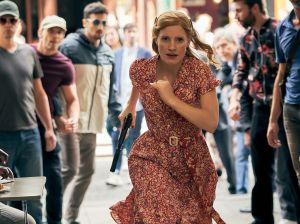
 The “girls can do it too!” vibe of the production is laudable but also feels stagnant and dated, not that we have it our threshold of exciting and capable women in action roles, but that’s its entire reason for being is to take a script and replace [generic male character] with [generic female character]. For some viewers, that might be enough to satisfy their genre cravings, and for some it might even prove empowering, which I assume was Chastain’s intention when developing the project. However, these powerful women feel less like human beings than gender-swapped one-note action staples. They will make quips about women having to clean up the messes men make, but these are no better than the quips in a 1990s action movie trying to earn cheap back-pats for being feminist in the least meaningful ways. The goons in the movie make fun of one another for losing fights to women. I guess in the opening mission, the fact that Mace is running around in a long sundress is meant to break the mold, but I also just kept wondering how much she would have preferred pants. The women of The 355 are routinely defined by their relationship to men. Mace is looking for vengeance because her best friend/lover was killed in the opening mission. Marie is bossed around by a glowering superior who explains, to the benefit of the audience, that she’s “good at everything except taking orders.” Graciela and Khadijah are defined by their familial connections and the one skill they have; one of them is the tech guru, the other is an agency psychologist. The male love interests are threatened, and even seriously harmed, as no more than a means to provide further motivation of Act Three vengeance. It’s bad storytelling when it’s featuring men, and it’s just as bad when it’s featuring women. If the movie was going this route to be satirical or even critical of the treatment of women in these kinds of genre fare, that would be something laudable and interesting. Atomic Blonde went there with gusto and pulled it off. This movie has nothing really to say. Taken together as a whole, it all makes any feminist aims of The 355 feel halfhearted.
There was a way to make this movie better and it was so obvious: making Cruz the lead. Her character is the only one not familiar to the world of spy craft and action, so she would serve as the best entry point for the audience. Why not make her perspective the main one? If the ensemble of characters is an ensemble of one-note stock characters, without personality to engage, then why not limit them further? Why make it an ensemble of bland characters? The character of Graciela has by far the most potential on paper, the woman pulled into a world she doesn’t understand and feels ill-equipped to survive within and then her learning to acclimate. This would have improved the screenplay by giving us more attention on a central character that has more clear vulnerabilities and points of empathy and intrigue. She has a family, she was never intended to be in this life, and she has to adapt quickly or there will be severe consequences. That is far more of an interesting start and arc than watching a group of grim-faced girl boss robots.
 Formulaic to a fault, The 355 reminded me of 2017’s The Great Wall, a $150-million Chinese-set action movie directed by Zhang Yimou and starring Matt Damon. It was a suitable action spectacle but I concluded with this question: “It’s not much better or worse than other empty-headed big-budget action cinema from the Hollywood assembly line, but is that progress? Is making an indistinguishable mediocre B-movie a success story?” That same question hangs over my analysis of The 355. It’s indistinguishable from other bland spy thrillers but this time with a group of lead characters played by women, several of them in their 40s at that. Maybe that’s progress considering the budget and representation, or maybe we can expect more than what we got here, a movie that recycles the same dated and tired tropes but now – with women! The action is middling, the characters are dull, the villain is predictable, and it finds itself in a frustrating middle-ground where it takes itself too seriously but doesn’t have the substantial material to cover. The 355 wastes its fab cast, possible points of intrigue, and proves that tropes without comment or exception are still as boring no matter the gender, race, or identity of those involved.
Nate’s Grade: C
Share this:

No Time to Die (2021)
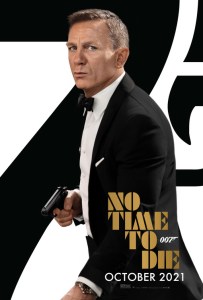 One cannot talk about No Time to Die without talking about finality. I’ll try and dance around significant spoilers but the movie by design is meant to serve as the capper to the Daniel Craig era filling out the world’s favorite martini-drinking British secret agent. I thought that 2015’s Spectre was the swan song for Craig as it brought back a famous franchise villain Blofeld (Christoph Waltz) made the man Bond’s secret half-brother, and it tried to explain how every bad thing that seemed to befall Bond was the machinations of an evil conspiracy, and then it literally ends with Bond driving into the sunset in his classic car with his girl (Lea Seydoux) by his side. It felt like the end, and it felt very much like everyone was just done and tired. And then the Bond producers wanted one more shot, or more likely one more lucrative franchise entry, to send an even older, battle-tested Craig on his way. I was wary of another Spectre-like entry, one that was tying back to the elements of decades-old for empty homage. Does anyone really care that the villain is meant to be Blofeld who means next to nothing to audiences in this era? After watching all 160 minutes of the longest Bond on record, for an actor who has portrayed 007 for 15 years, I have to say that No Time to Die is a terrific action movie and a welcomed second chance at a sendoff for the modern era of Bond that has gone through great artistic rebirth.
Bond’s cozy retirement is short-lived. Spectre agents have found him and Madeleine (Seydoux) and now Bond is forced to ship off his love for her safety. Years later, Lyutsifer Safin (Rami Malek) is determined to take down the last vestiges of the Spectre organization, the same group responsible for murdering his family. Bond is recruited by the newest 007 agent, Nomi (Lashana Lynch), to help MI-6 locate a kidnapped scientist with a powerful nanobot poison that can be genetically targeted to a specific person. Bond agrees especially once he realizes that Safn and his dangerous organization are targeting Madeleine, who has a big surprise of her own.
 As an action movie, I will argue that No Time to Die is better than 2012’s Skyfall, the Bond film that is widely seen as the high point of Craig’s tenure but one I find overrated. Director and co-screenwriter Cary Fukunaga, the second director ever given a writing credit for a Bond film, has crafted a beautiful movie with a real sense on how to showcase the majesty and suspense. Nothing will likely rival the superb cinematography by the legendary Roger Deakins on Skyfall, but this movie gets as close as you can get. It’s a remarkably beautiful looking movie. I mean that not just in the exotic locales and scenic vistas but simply in its depiction of action. The visual arrangements are noticeably several levels higher in quality, elegantly composed and lit to make each scene so pleasing to the eyes even before the information of the scene translates. Fukunaga (True Detective) frames the action in clear shots and clean edits so the audience is oriented with every shot and each patient edit point. For an era that began by trying to adopt the Paul Greengrass-style of docu-drama edits popularized with the Bourne sequels, it’s quite a welcomed change. I appreciate that action directors have creatively gone more in a direction of longer takes, wider shots, and a conscious effort to showcase the ingenuity and skills of its action choreography. Let us enjoy watching the masters of action operate at their highest level. Fukunaga understands this, and while the action might not be the best in the series, it is lovingly orchestrated and displayed.
There is a delightful mid-movie set piece that deserves its own attention mainly because of how actress Ana de Armas (Knives Out, Blade Runner 2049) steals the show. She plays Paloma, a CIA agent working in coordination with Bond, and the two of them wreak havoc across a Cuban neighborhood while wearing their finest evening wear. She immediately leaves a favorable impression and struts her stuff while operating heavy machinery with confidence. This part feels the most aided by co-screenwriter Phoebe Waller-Bridge’s contributions. Craig personally requested that Waller-Bridge, best known for award-winning TV like Fleabag and the first season of Killing Eve, come aboard and help polish the script, including characterization and dialogue. This sequence feels the most in keeping with her past spy thriller work and penchant for strong female characters who are meant to take the lead. de Armas is so memorable, and her segment so self-contained, that it feels like a backdoor spinoff to set up her own character’s franchise, and one that I wouldn’t hesitate to watch.
 If you thought Spectre was getting convoluted with how it tried to bend over backwards to explain how one man and one villainous conspiracy were manipulating all of Bond’s many miseries and setbacks, well then things are going to get even worse for you to keep up with. I’ll credit returning screenwriters Neal Purvis and Robert Wade, who have been with the storied franchise even before Craig’s 2006 debut, with attempting to make the continuity matter for a franchise that often throws up its hands at continued emotional stakes. By stretching backwards with ret-cons and added flashbacks, every new Bond movie tries to better evaluate the previous ones including the poorer movies, like Spectre and 2008’s Quantum of Solace. It’s like saying, “Hey, you didn’t like those bad guys in that movie? Well, these are the real bad guys,” or, “Well, maybe you didn’t like them, but their heinous actions gave rise to these new bad guys.” However, a consequence of continuing to add further and further clandestine machinations, and spiraling consequence from those machinations, is that Bond has now become a tangled web that is more convoluted without offering much in the way of payoff. I don’t think much more is gained introducing a new villain saying, “It was me all along,” when we don’t have an established relationship or interest with these new villains. Imagine introducing the Emperor back in Episode 9 of Star Wars and saying he was secretly behind everything… oh wait.
There are also benefits to this approach and No Time to Die crafts a sendoff unlike any other final entry for a Bond actor. This is a franchise going back sixty years, but the 007 brand has endured because no one actor is bigger than the brand. The franchise is regularly resetting with each new addition. The hyperbolic bombast and tongue-in-cheek frivolity of the Pierce Brosnan years (1995-2002) was replaced with a more grounded, gritty, and psychologically wounded Bond, made even more so by giving him personal attachments and then taking them away. I would argue this decade-plus with Craig (2006-2021) has involved the most mature and personal movies of the franchise;s history. It’s fitting then for the final film to pay service to that elevated take on the character. If you’re treating the secret spy as more of a person than a suit and a gun and a wisecrack, then that character deserves an ending that stays true to prioritizing more human elements of the character. To that end, No Time to Die works as a final sendoff, and I feel pretty confidant saying Craig is officially done now.
After a year and a half of delays from COVID, as well as its parent company, MGM, being bought for billions by Amazon, we finally have the final Bond movie in Daniel Craig’s successful run, and it’s a worthy finale for an era of the franchise becoming relevant again. I don’t know if that many people are emotionally attached to the character, likely more so just the nostalgia and the franchise, but if ever you were going to tear up from a James Bond thriller, this would be the one. It’s an exceptionally strong visual caper, with smooth and steady direction from Fukunaga, and while overly long and convoluted and a dull villain, it comes together for a worthy and celebratory conclusion that stands with the best of Bond. I’ll still cite 2006’s Casino Royale as the best Craig Bond, and one of the best ever, but No Time to Die is a solid second-place entry, and it does what few other Bonds ever could: fitting finality. Until, naturally, the popular series inevitably reboots with the next handsome leading man sipping a signature vodka martini (shaken, not stirred).
Nate’s Grade: B+


 nathanzoebl
You must be logged in to post a comment.