Blog Archives
42 (2013)
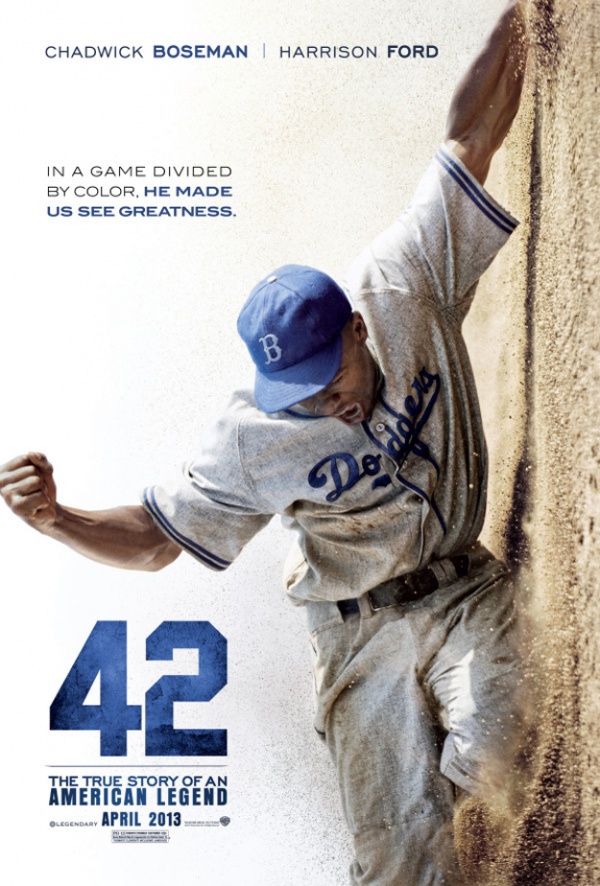 Staid and square, a bit like its lead, 42 is a biopic on Jackie Robinson breaking the color barrier in baseball, and while it’s reverential to a fault, it could have used more life. As a character, Robinson is simply not terribly interesting because he’s being trapped within a limited prism of inaction. Robinson the man could be fascinating, but Robinson the character of this movie is a bit of a bore. That’s why the film is just as much about Brooklyn Dodgers owner Branch Rickey (Harrison Ford), a far more colorful character that gets to chomp cigars and lecture people with countless speeches accompanied by heroic piano cues. 42 is crammed to the gills with messages but they’re so transparent and overdone, occasionally ham-fisted, where every important thought is spelled out and underlined and repeated for the audience. The corny sentimentality clashes with the danger and hostility Robinson bravely faced. We got stuff like a little kid praying to God that Robinson hits a homer to “show what we can do,” a white guy trots up to Robinson and he seems dangerous… only to want to wish him well, and then there’s all the white players learning lessons of tolerance, treating Robinson as if he’s some prop for their own self-actualization. The greatest acting in the movie, a bit that may take your breath away, is from Alan Tudyk who plays a competing team manager. He is like a racist Foghorn Leghorn and he just… keeps… going. This sequence is the film’s best because it feels earned, complete, and lastly emotionally resonant. 42 is an acceptable biopic, effectively triumphant where it counts, but it feels too dated, too safe, and overburdened with doling out a slew of messages rather than telling an engaging and difficult story.
Nate’s Grade: B-
Share this:

Warrior (2011)
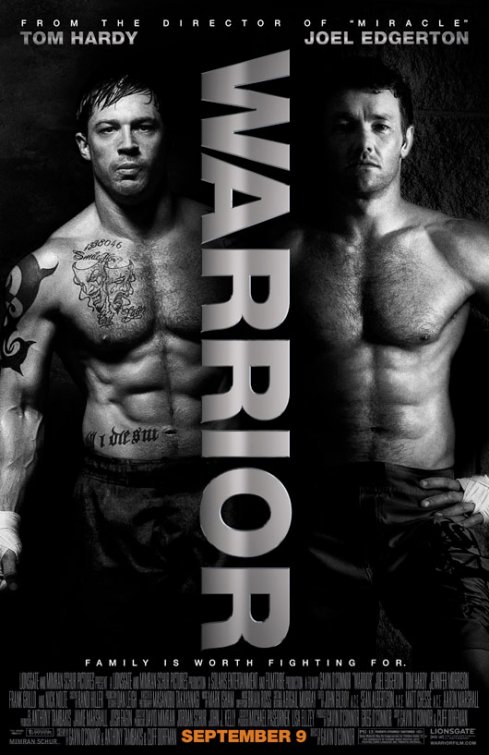 This may be a mixed martial arts (MMA) movie in appearance, but really Warrior is put together like a traditional boxing movie. Director/co-writer Gavin O’Connor (Miracle) takes a kitchen-sink approach to storytelling; just about every damn dramatic thing you can think of, short of emergency baby deliveries, is stuffed into this movie. You’ve got two brothers, one a hard luck school teacher (Joel Edgerton) trying to save the bank from taking his home (his family is broke due to his sick daughter’s medical condition), and the other (Tom Hardy) an Iraq War vet who saved lives and wants no glory, for he’s haunted by the men in his platoon who did not survive. Add a drunken father (Nick Nolte) trying to live life on the straight-and-narrow who wants to get back in his sons’ good graces, the teacher’s community rallying around him, the Marine’s comrades in service rallying around him, and some major personal issues between brothers (Hardy feels that his bro abandoned him and their sick mother), and two competing underdog tales, and my God, it’s hard not to feel beaten into submission. But damn if it isn’t effective stuff. I was tearing up at multiple points, completely sucked into the drama, riveted by the brutal, adrenaline-pumping MMA fight scenes, and pining for family reconciliation. Hardy and Edgerton flex more than their muscles on screen; each gives terse, heartbreaking, completely convincing performances as broken-down men struggling for redemption. You don’t have to no a lick about MMA to get hooked by the heavy emotional beats of the movie. Warrior is by no means a subtle movie, but it pushes all the sports genre buttons expertly, presenting a gratifying, affecting meat-and-potatoes drama that grown men are given permission to get weepy over.
Nate’s Grade: A-
Share this:

Real Steel (2011)
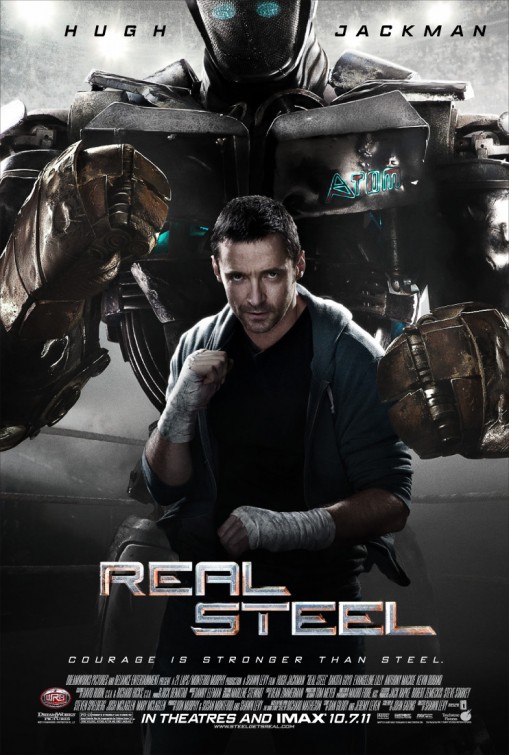 In the future world of Real Steel, set in 2020, robot boxing has become a huge sensation. It seems that audience bloodlust was not being satisfied with flesh and blood hitting the canvas, so robot brutality will do. Whatever happened to mixed martial arts, a sport arguably more popular than boxing in this day and age, popular enough it even got its own uplifting sports drama earlier this year (the overlooked Warrior). I strongly doubt that in only nine years we’d have giant fighting robots and that this “sport” would be nationally recognized. Did anyone see Comedy Central’s mechanical Coliseum showdown, Battlebots? There’s your answer, America.
In this future world where trucks have glass panels to show the world your feet (why? Because it’s “futuristic” you fool), Charlie Kenton (Hugh Jackman) is a has been. He enjoyed a fleeting career as a professional boxer before the mechanical men came into popularity. Now he goes from town to town trying to scrounge up some petty money with small-market robot boxing rings. His only pal is Bailey (Evangeline Lilly), his former flame and the owner of the boxing ring/chop shop that Charlie calls home. Charlie owes plenty of money to plenty of not nice people. His solution arrives in the form of his 11-year-old son, Max (Dakota Goyo). Charlie ran out on Max and his mother when Max was a baby, but now mom’s dead and custody is being discussed. Mom’s aunt (Hope Davis) and her rich hubby want Charlie to sign away his parental rights, which he agrees to do for the right price. Max spends one last/first summer with his estranged father before going off to live with his auntie. The two bond when Max discovers a beat-up old sparring robot when father and son are skimming parts illegally at a junkyard. The old bot, which Max names Atom, becomes a champion fighter. Father and son ride the success all the way to a championship bout with Zeus, a legendary robot that destroys all challengers. Can they stun the world? Can father and son bury the hatchet? If these answers are in doubt, I advise you to see any sports movie ever released.
J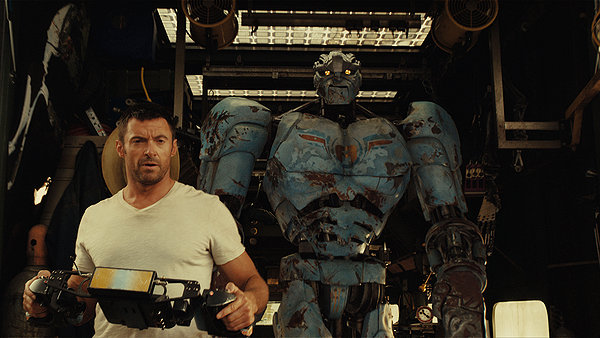 ust in case you stood clueless and slack jawed at the film’s storytelling prowess, you’re in luck because every character will take great pains to explain the significance of plot points, key metaphors and symbols, and personal motivations. Usually this stuff is tucked away as subtext, but Reel Steal decided that it would rather rub the audience’s nose in the architecture of its screenplay. Characters will just go around speaking blurting out their feelings in the most transparent way possible: “I can’t be with you again, I’m afraid of being hurt again, and seeing you in that ring is like seeing my father again in that ring, and fighting this fight is your attempt to regain redemption and prove yourself wrong, and the robot is old and busted but still has some fight in it left, just like you Charlie…” It gets tiresome. Max squeals, “All I’ve ever wanted was for you to fight for me!” Your dad’s kind of a lout, kid. You’d be better off being adopted by your preposterously rich aunt, which is really the moral we learned from Annie. Who talks like these people? It’s astounding how blatant the film is about explaining its sotry mechanics so that the dumbest common denominator in the audience can walk away feeling like Roger Ebert (“Did you notice how the robot was a metaphor for Charlie? I did.”).
Never in my life would I have anticipated that someone would watch Over the Top and say, “What if we added robots?” This movie essentially is a souped-up version of Sylvester Stallone’s 1987 flick where a dad fights for the custody of his kids through the weirdly court-approved process of the gentleman’s game of arm wrestling. First off, who in their right mind would make a movie about professional arm wrestling? There’s a reason this specific sports genre still stands with one entry. Charlie finds redemption over one summer spent with the kid he abandoned and then sold. The strange thing is that Max knows from the start that he’s more a commodity than a valued son. Yet he still bonds with dear old dad though he’s still going off to live with his rich aunt by the end. The father/son relationship becomes the heart of the movie, but what good can come from two annoying characters learning to get along? They’re still too annoying for me.
Charlie’s fight to become a better father is hampered by the fact that I wanted to strangle his kid. There was rarely a moment that passed where I didn’t want to punt this little brat. From the moment he first steps on screen, Max is surly and aggravating. Given that he’s meeting the father who abandoned him, I’d expect some confrontation but this little twerp cops a bratty attitude throughout. He hops on the boxing ring mic and walks around with a phony swagger and challenges the biggest baddest robot. The kid seems like a chip off the ole block, falling victim to hubris just like dead. When Goyo (Thor) screams it becomes a high-pitched caterwaul that caused me to writhe in physical pain. The subplot of Max teaching the robot how to dance is just embarrassing. You better believe the kid teaches his metal friend how to do the robot. The young actor deserves a fair share of the blame. Goyo flounders, overselling every emotion and hovering at a persistant petulant level of acting. I do not advocate the endangerment of children, obviously but I’d be lying if I failed to admit that I would have slept soundly had Max tumbled to his death in the robot junkyard. Goyo is so powerfully awful that he may well be the tarred as the Jake Lloyd of this decade (Lloyd infamously played the twerpy kiddie Darth Vader in the first of the regrettable Star Wars prequels). It’s hard for me to root for the reunion of father and son when I’d rather see father bury son in the ground.
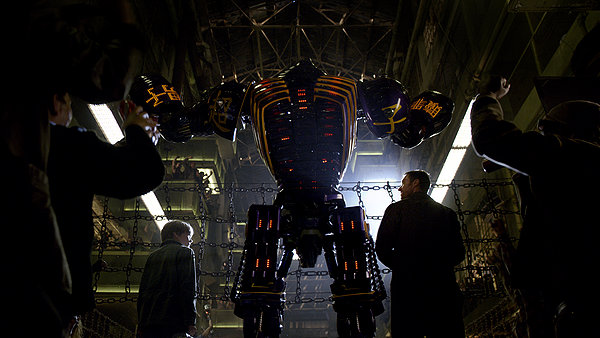 Real Steel is littered with nonsensical or dropped subplots, the worst offense being Atom’s secret. It’s revealed midway into the film that Atom is not just a sparring robot but a sentient being. It’s faking that it can only shadow human movement. When Charlie “teaches” Atom how to box he really is teaching the robot, though conveniently Atom seems to keep this knowledge to itself. Even when it’s being battered mercilessly, Atom doesn’t employ the skills it’s been taught. Maintaining his cover is more important than self-preservation, so suck on that Asimov. The fact that Atom is sentient is the filmmaker’s desperate attempt to add empathy to the robot. Without sentience, the robot is just a junky avatar that can be scrapped. It’s a piece of equipment but if sentient it becomes a character we can feel for. You don’t share empathy with a coffee maker. I kept waiting for this secret to somehow get out because it’s kind of a monumental deal. But it never does get out. The story never once revisits this gigantically important revelation. What does this mean about other robot boxers? Are they too sentient? What do they think about destroying each other for sport? There are important questions here that are ignored. What’s the point of making Atom sentient if you never do anything with it? It’s only a ploy to drum up empathy, but at no point does Atom feel like a character, only a collection of parts. It’s a coffee maker on steroids.
The movie borrows liberally from other sports movies, taking the emotional beats from Rocky and the family drama from a film like The Champ, though loses the downer ending. Everything is too recognizable, too formulaic, as if it was assembled on a factory floor. The only points of surprise are when Real Steel just carelessly drops plotlines, as mentioned above. What’s the point of introducing a plot point like the robots can malfunction if hit correctly in Act One and not have it resurface in Act Three? Jackman (X-Men) acts with all the power his neck veins can afford. He seems to be constantly growling or on the precipice of said growling. The romantic subplot with Bailey is an undeveloped thread only meant to tie back together into a pretty bow at the plot’s earliest convenience. Lily (TV’s Lost) plays the “girl,” which means all she’s given to do is remind the hero of his potential and be the warm body waiting in bed. But this is a family film, so we stop at late-night cuddling. Then Max ends up being a savant at mechanical engineering and electronics because… he plays video games? Give me a break. And it just so happens that every character we’ve been introduced to will be in attendance for the big fight, even the Texas bookie (the great and underutilized Anthony Mackie). Wouldn’t Detroit bookies take umbrage to this?
Do you like reaction shots? Real Steel is chock full of them: people wincing, people yelling and clapping at TVs, people muttering under their breath the optimistic instructions, “C’mon, c’mon, c’mon.” You accept some reaction shots as part pf the terrain of the sports movie, but when they’re presented in excess then it becomes a crutch, the director reminding the audience what to feel with the subtlety of a sharp stick to the eye. Then again subtlety was never the forte of director Shawn Levy, he of Date Night and Night at the Museum fame. The special effects are strong and the boxing sequences even have some livened suspense to them, though why would anyone build a robot boxer with two heads? What advantage does that offer other than two things to hit? Levy gets lost in the special effects and treats the actors with the same indifferent level of care that the humans show the robots.
Real Steel wants to be a rousing, family-friendly crowd pleaser; it just won’t ever let you forget that this is its primary function. This outlandish sports flick is much like its robotic pugilists: big, dumb, loud, and prone to malfunction. The film has no faith in its audience’s intelligence so every feeling and symbol is plainly explained with unwanted diligence. The characters are unlikable or underwritten, the story is shackled by lockstep devotion to formula, and Goyo’s wretched performance makes it damn near impossible to sympathize with the father/son reunion. Filled with unresolved plot setups and a mystifying similarity to Over the Top, Real Steel is just like every other boxing movie on record except this one has robots. I’m fairly certain the screenwriters were robots too. Why else would they make a robot becoming sentient seem like no big deal? Obviously this is propaganda to lull us into complacency before the impending robot war. Real Steel is a classic example of a movie done by committee; it feels like it was crudely assembled from the spare parts of other, better movies.
Nate’s Grade: C
Share this:

Moneyball (2011)
 Moneyball, based on the non-fiction book by journalist Michael Lewis (The Blind Side), finds a new way to reinvent the David v. Goliath tale with a man who reinvented the business model of baseball.
In 2001, the New York Yankees (team payroll: $125 million) have just knocked the Oakland As (team payroll: $41 million) out of the playoffs. Oakland General Manager Billy Beane (Brad Pitt) also has to suffer a summer where his biggest players leave the team to sign hefty free-agent contracts with bigger teams. He’s left with sizeable holes, a meager payroll, and the expectations to carry on winning. Beane is convinced that his group of paid scouts will be of no help. They’re men of an older era, sticking to the old ways of selecting talent (why the hell do these guys even calculate stuff like “good face” and “ugly girlfriend”?). Beane finds a kindred spirit in Peter Brand (Jonah Hill), a Yale grad with a degree in Economics. Brand’s mathematical data focuses on one all-important stat – on-base percentage. Without getting on base a player can’t score runs, and no runs make it hard to win a game. Brand and Beane calculate a series of players undervalued by other teams. Their more cost-efficient model for success becomes known as “moneyball.” Together they put together a team of castoffs and misfits to contend for a championship against teams that have three times the Oakland As’ payroll.
Moneyball could be described as a baseball movie for people who don’t like baseball, but that’s a little too glib by half. It’s very much a sports film but it takes the underdog approach in a new, sleekly modernized manner. It’s about a guy bucking the traditional mode of thinking, the established order, and the chaffing and nay saying of those entrenched in the traditional, outmoded, establishment. There’s always something inherently entertaining about an innovator fighting the system and eventually being proven right after all the trials and tribulations. And with Pitt, a major movie star, giving a movie star-caliber performance, self-effacingly charming with a twinkle and a swagger, Moneyball just seems to fly by like a spirited caper. We’re watching a smooth operator work the room, playing other general managers off one another and secretly accruing his talent while duping his peers. At its best moments, Moneyball feels almost like a breathless con game. The intelligent, stats-heavy dialogue doesn’t stoop for much exposition. The stats and acronyms whiz by, with Social Network-style crispness thanks to Oscar-winning screenwriters Steven Zallian and Aaron Sorkin. It’s a pleasure listening to top actors savoring the smart dialogue. You just want to kick up your heels and relax like you’re watching a game at home, rooting for your team to pull out an unlikely coup. Moneyball plays best for baseball fans who won’t bat an eye at the stat-heavy chat. For non-fans of the game, well, you can watch Pitt spit chewing tobacco into a cup a lot.
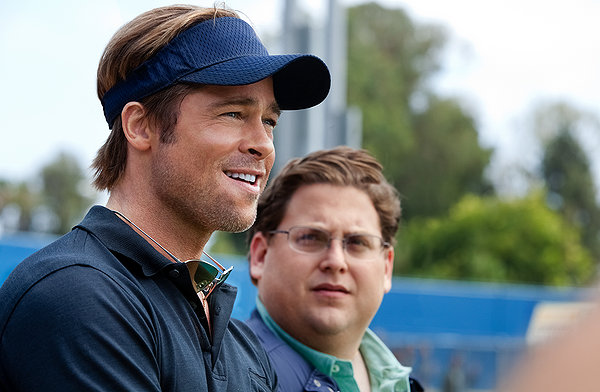 Beane chooses not to get to close to his players so that eventual roster cuts and trades will be all the easier without emotional involvement. The movie kind of follows suit. The characters are kept at a surprising distance. The movie seems practically ambivalent about people. Moneyball seems to lack an emotional center; and people thought The Social Network was cold. Beane is given flashes of back-story about his flameout in the majors, which supposedly provides the guy a motivation to prove himself against his legion of detractors. But these flashes are not enough. Director Bennet Miller (his first film since 2005’s Capote) incorporates way too many scenes where we watch Beane driving, silently contemplating his life-changes. The feud between Beane and his curmudgeon manager, Art Howe (Phillip Seymour Hoffman with the unkindest of haircuts), never comes to a head. Howe is upset at the thankless job of corralling a team of misfits and cast-offs into a competitive team. But like many other conflicts, the movie ducks from finding a real purpose for its integration. Howe just seems to be another naysayer who shakes his head at Billy. Surely the relationship between GM and manager should be more complicated than as presented. The Beane family flashbacks and his scenes with his daughter (the adorable Kerris Dorsey) are attempts to further humanize a man who has abandoned the advice of people for spreadsheets.
It’s easy to get caught up in the romanticism of the nation’s oldest sporting games, but Moneyball’s tone seems to toggle between reality and romanticism. For Beane, there are no small victories. Even success is deemed failure under the metrics of championship-or-nothing. “People only remember your last out,” he says despondently. So when the Oakland As fail to make a run into the playoffs (is a 2002 playoff series considered a spoiler?) the movie is left with a listless conclusion. Brand tries to prove to his boss the significance of what they have accomplished on their meager payroll, at one point winning a record 20 games in a row. But a winning streak of 20 games is not the same as a championship. Moneyball rightly proclaims the game of baseball as a rigged sport, where the divide between “haves” and “have nots” is vast. It is the only major league sport without a salary cap. The teams with the big pockets can afford the marquee talent. There’s a reason Lewis’ book has the subtitle “The Art of Winning and Unfair Game.” The implications of Beane’s accomplishments are unclear. His cost-efficient, stat-heavy approach was co-opted by the Boston Red Sox and turned into championships in 2004 and 2007. Is that a real vindication for Beane? It seems to me that the game’s issue of wealth disparity is still in full effect. Even if teams follow Bean’s approach, it still means that the bigger city, wealthier teams like the Red Sox or the Yankees can still outspend their competition. So it seems like to me that Bean’s moneyball approach simply meant that the focus changed on less costly talent. It did nothing to alter who could outbid their peers for the now-cheaper talent. It’s hard to squeeze a happy ending out of a story that concludes with the rich getting richer.
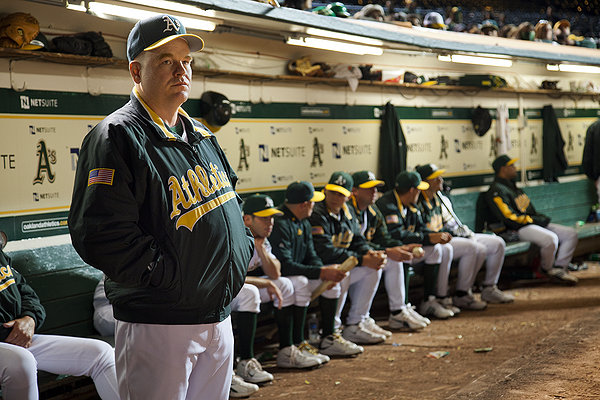 The movie is pretty much a buddy comedy, granted Beane is a much more dominate personality. Pitt feels like he’s coasting on charisma, though the actor gives a greatly entertaining performance. It’s not so much nuanced but he’s enjoying himself. The man looks eerily to be aging into Robert Redford, which begs the question about the nature of time travel. Hill (Superbad, Get Him to the Greek) gives a surprisingly adept dramatic performance. The comedic actor seems subdued next to the charisma of Pitt, like the character is continually awed by Billy. The Oscar-talk for the comedian seems a tad premature. He’s good but just because Hill delivers a good dramatic performance does not mean people should automatically start fielding his name as an award contender. That’s like saying let’s give an award to Paris Hilton because she could remember her lines. It’s also fun watching actors like Chris Pratt (TV’s Parks and Recreation) portray players that are still recognizable.
Moneyball says that baseball is not a game about heart, sweat, or the love of the game. It’s about numbers. That’s something of a cold message but Billy Beane is not one for false comforts. At its best, the film is a breezy caper with crisp dialogue and slick editing, but it’s also hamstrung by an inconsistent tone, a methodical pacing (133 minutes!), and a dearth of strong characterization. Beane was destined to be a baseball star but it wasn’t to be. Baseball is the most mental of all national sports, and it’s hard to crack such an insular model of play. That’s why baseball movies resort so much to romantic staples about the lore of this game. This is not a romantic movie; it toys with romanticism but ultimately sides with the science and number crunching. The emotion seems to have been squeezed out of the story thanks to the statistics. Moneyball is a baseball movie that fantasy baseball nerds have been waiting for. I’m not particularly a baseball fan (too slow), but I still found the movie to be a rewarding night out sans crackerjacks.
Nate’s Grade: B+
Share this:

Win Win (2011)
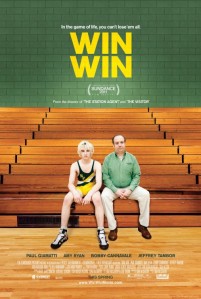 After two stellar movies (The Station Agent, The Visitor), writer/director Thomas McCarthy has proven that he may be one of the greatest humanist voices working in cinema today. He writes wonderful stories about people who find connections via unorthodox family units. McCarthy can spin bizarre elements into deeply felt human dramas. Win Win is another hodge-podge of storytelling elements. It follows the life of Mike Flaherty (Paul Giamatti), a midwestern lawyer and high school wrestling coach struggling to get by. Then a sullen teenager (Alex Shaffer in his acting debut) lands on his doorstop looking to see his grandfather in Mike’s guardianship. The kid also happens to be a gangly wrestling phenom. Things are going great for Mike, that is, until the kid’s mother comes looking for him and wants him back. Win Win assembles a great group of flawed, empathetic, relatable characters that make conflicted choices that they then have to abate. Giamatti is reliably fantastic as the center of McCarthy’s humanist universe. He can communicate so much despair and relief just with his expressions. Teamed up with a cast that includes Amy Ryan, Bobby Cannavale, Burt Young, and Jeffrey Tambor, the movie works best when you can just sit back and take in great actors relishing playing great roles. Win Win doesn’t all come together in the end like other McCarthy films; there’s definitely a missing ingredient feeling to the movie. Shaffer’s limitations as an actor hamper some of the later dramatic moments. The end is satisfying, but I felt like I should have felt more. While it doesn’t strike the same seamless balance of comedy and drama as The Station Agent, this is certainly a film that should be winning for most audiences.
Nate’s Grade: B+
Share this:

The Tillman Story (2010)
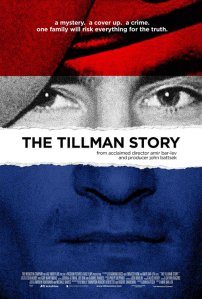 Perhaps better than any movie I’ve ever seen, the searing documentary The Tillman Story explores the nature of shared grief and whether a family is even entitled to privacy when the world feels like it has a shared pain in their loss. This documentary focuses on former NFL star Pat Tillman who enlisted in the Army Rangers in 2002 and was killed in 2004 in the mountains of Afghanistan. He was hailed as a hero of battle, saving his men from enemy ambush, but the truth was really far less sensational but just as damaging. Tillman was killed by friendly fire, a fact the Army admitted only with their backs against the wall. Tillman was their most famous soldier and became a recruiting poster for the post-9/11 armed forces. The doc recounts Tillman’s family struggling to get a straight answer from Army officials and government goons who felt the truth could not compare to a good story. While recreating the events that lead to Tillman’s death in a mostly commanding manner, the doc’s real draw is exploring the idea of a family who has had their private mourning torn away, who are trotted around the nation to events memorializing their son, turning him into whatever symbol best serves personal agendas (conservative pundits are seen in stubborn disbelief when it comes to processing the news that Tillman read Noam Chomsky, thought the Iraq War was illegal, and was going to vote for John Kerry in 2004). What gets lost in all that patriotic maneuvering is a complicated man who didn’t want to become a myth.
Nate’s Grade: B
Share this:

The Karate Kid (2010)
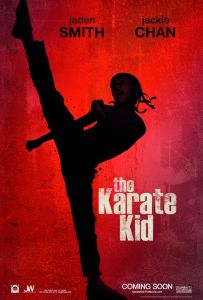 Was this ever a refreshing revelation. This transplanted Karate Kid remake takes the basic elements of the seminal 1980s underdog sports film and makes a rousing, satisfying, and surprisingly emotional experience. It sounds like sacrilege to take on a classic and fill it with an aged Jackie Chan and Will Smith’s progeny, but by God it works. It all works. It’s clear that pint-sized Jaden Smith (The Pursuit of Happyness) is a chip off the old block; he’s got a natural charm and feels like he can turn it on at will. His acting doesn’t come across as forced, and the kid can even tackle the heavier dramatic stuff with shocking ease. The other benefit to Smith is that he LOOKS like a true 12-year-old kid, gangly and scrambling for protection and self-confidence. Ralph Machio was in his early 20s when he was waxing on, waxing off. Smith and Chan have a bristling chemistry, and I ended up eating my words when Chan channeled a succession of teary emotions. The teacher/student dynamic leads to enough satisfying moments to feel like you’ve gotten your money’s worth. The same lessons of discipline get a fresh coat of paint. There’s no real reason that a Karate Kid remake needed to be made (it feels like China funded it as an unashamed tourist commercial) especially since there were three sequels of varying quality. While a little long with an overextended kung-fu tournament, Karate Kid is a family film that won’t melt your brain.
Nate’s Grade: B
Share this:

Big Fan (2009)
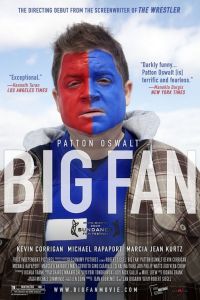 The directorial debut from the screenwriter of The Wrestler follows another down-on-his-luck loser. Patton Oswalt gives a surprisingly dark and affecting performance as Paul, a 35-year-old tollbooth worker that still lives with his mother. Paul’s life is devoted to his favorite sports team, the New York Giants. He spends his evenings meticulously planning his call-in statements to the nightly sports radio show. He’s so devoted to his team that when Paul gets brutally beaten by his favorite Giants player he blames himself. The player gets suspended and the Giants start piling up losses, and Paul can’t deal with the crushing guilt he feels. Big Fan is an intriguing exploration of how absorbed people can get with fandom; I always thought it a bit odd when people refer to a team’s accomplishments with “we” like they had something to do with it. Paul’s fragile world is coming apart and he breaks down with it. Obviously, Paul has a few screws loose in order to make him unpredictable, which gives the last twenty minutes some serious unease. Paul goes undercover as a Philadelphia Eagles fan (his disgust at putting on the enemy jersey is palpable) to hunt out his gloating sports radio nemesis Philadelphia Phil. Big Fan is occasionally funny in an under-your-breath kind of way, but really it’s more of a small-scale psychological study on a hapless individual whose religion is sports and who feels he has sinned before his almighty God. At a mere 86 minutes, the movie doesn’t press too hard into the twisted psychology, nor does Paul leave much of a dent as a character as the film doesn’t make judgment on his obsessive behavior. This isn’t as poignant as The Wrestler, pure and simple. Yet, Big Fan is buoyed by a strong performance by Oswalt and some interesting insights into a flawed fan willing to go all the way for his team.
Nate’s Grade: B
Share this:

The Blind Side (2009)
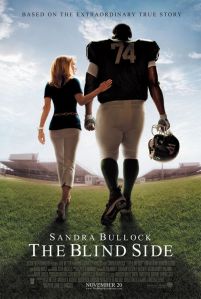 Based on a true story, The Blind Side tells the true-ish story of Michael Oher (Quinton Aaron) who was a lost, homeless black youth in Tennessee. He was adopted s a teenager by the Tuohy clan, a rich White family led by no-nonsense matriarch Leigh Anne (Sandra Bullock). Her husband (Tim McGraw) is a restaurant franchise owner, so they don’t have to worry about money or food budgets for Michael’s large appetite. The gentle giant is grateful but wary. He’s admitted into a private school because of his football potential, but at first they envision the hulking teenager on defense. Leigh Anne is the one who sees his protective instincts and assists in the switch to offensive tackle, whose job is to protect the quarterback’s blind side. With Leigh Anne’s steady influence and a stable home environment, Michael begins to feel like he has a loving family. Eventually Michael Oher becomes an All-American player in college and was drafted by the Baltimore Ravens in the first round of the 2009 NFL Draft.
The Blind Side might just sneak up and, forgive me, blindside you. Well, that?s not accurate, because this movie will not sneak up on anyone. There is not a single moment of surprise to be had. Michael Oher is portrayed as a gentle giant who is very tight-lipped. Much of his performance is in body movement and those dark, sad eyes of his, which means that the audience has to intuit a lot from the character. That might be why the most affecting moments come from Oher’s stunned, grateful reactions. It’s hard not to be affected by such an outpouring of earnestness. Stay during the end credits, watching the photos of the real family at the 2009 NFL Draft and try not to feel a smidge of their happiness.
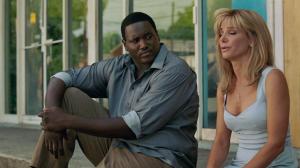 Bullock seems like a natural fit for this character and this material, and she does give the Southern spitfire life. She’s the heart of the movie and pretty much the driving force for the film, so it helps that Bullock taps her natural charms to make the character feel less like a cartoon and more like some approximation of a person. She’s formidable and brassy and pretty much gets her way on everything. The movie has the faulty belief that Leigh Anne saying anything folksy is funny, which is not the case. However, Bullock makes the character likeable and embraceable, and plus, she doesn’t fall down once. It must be a first for a Sandra Bullock movie.
Every scene is played into a moment of uplift and eventual triumph, which can be tiring but also has a respectable batting average for success. Structurally, the movie doesn’t have any overarching sense of conflict, which seems bizarre given the circumstances of an insanely wealthy white family adopting a troubled black youth in Tennessee. You might think Michael would take some adjusting, or that the students of privilege might not fully accept someone so different, or that the Tuohy children might need more convincing to suddenly add a new member. There are a few raised eyebrows and some slight hesitation, but the characters just barrel forward like what they are doing is common. The family is just resoundingly good-hearted and full of such moral clarity, though the husband seems to be content to be a powerless pawn to his vociferous wife. There is no real internal conflict within this family despite the burdens they tackle, and even worse the movie doesn’t really show any change occurring. At a lunch with her rich girlfriends, Leigh Anne remarks that Michael is changing her life. How? She seems like the same kindly woman from the beginning. Instead, the movie is packed with tiny little conflicts that get easily resolved and then move along. Will Michael feel at home? He does. Will he get his grades up? He does. Will he figure out the game of football? He does. Will he play well in a game? He does. Will he graduate? He does. Will he get a scholarship? He does. Will he reject the lifestyle of crime? He does.
Big Mike is sidelined in his own story by the firecracker of a character that is Leigh Anne. The saintly Tuohy family is yet another example of Hollywood feeling the need to tell a compelling African-American story framed as the story of helpful, White characters. Why can’t he film’s emphasis be on Michael instead of Leigh Anne, especially since she remains the same good Christian woman from the start? It’s probably because Oher, as portrayed on film, doesn’t have much of a personality. He’s a nice if soft-spoken kid but he mostly just shuffles his feet. Off the football field, he is written merely to take up space. He serves as the ongoing results to Leigh Anne?s teaching experiments.
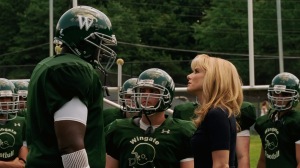 If you peel away the movie’s sentiment, it does have some niggling, potentially troubling aspects to the story. It sings the praises of insanely rich Southern Christians and makes us say, “How nice and rich of them.” Leigh Anne is the kind of woman with enough mettle to venture into the ghetto and even stand up to taunting gang members. She even threatens to shoot one of them. Every one of these “ghetto” sequences feels transparently written by somebody whose only understanding of an urban environment is from movies and TV. I wasn’t expecting The Blind Side to be as accurate as The Wire, nor would I normally care about the inaccuracy, but when it’s in the service of comparison (the comfy world of rich White people vs. the hopeless existence of poor blacks) the portrayal becomes ham-handed and morally questionable. Just to rub it in how good Michael’s got it, the movie resorts to ending with a montage of newspaper reports detailing gang slayings in Oher’s old neighborhood, highlighting every character we saw onscreen. The movie says they had no choice to end up as criminals because they could not escape the nightmares of the ghetto. If only those unfortunate black youths could have found rich families to adopt them.
Perhaps the funniest moment for me, as an ardent college football fan (go Bucks!), was a montage of South Eastern Conference coaches trying to recruit Oher in 2005. He’s visited by the head coaches for South Carolina (since retired), Tennessee (since fired), Auburn (since fired), Arkansas (since fired, now coach of Ole Miss), Louisiana State (left for NFL, now coach of Alabama), Auburn (since fired), and Ole Miss (since fired). The turnaround in just a four-year period is astounding for a major college conference. The coaches look like they’re having fun in the movie, probably because they get to pretend to be coaches again.
The Blind Side is a straight-down-the-middle genre picture that plays every expected note, it?s manipulative and formulaic for a sports drama, but I’d be lying if it didn’t get to me from time to time. If you go into The Blind Side under the right frame of mind, which means essentially ignoring the flagrant manipulations, then this movie will work on its sentimental sports genre sensibilities.
Nate’s Grade: B-
Share this:

The Wrestler (2008)
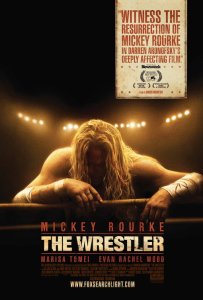 The Wrestler came out of nowhere to be hailed as one of the most stirring dramas of the year. Who would have possibly guessed that a movie that stars Mickey Rourke in spandex would be one of the best films of 2008?
Randy “The Ram” (Rourke) was one of the biggest professional wrestlers in the 1980s. His pay-per-view battle with “The Ayatollah” in 1988 is legendary to wrestling aficionados. But nobody ever stays on top forever. Twenty years later, Randy is a self-described “old broken down piece of meat.” He’s barely staying afloat working at a supermarket during the day. On weekends he adorns his old tights and fights in wrestling bouts at VFW halls, where small numbers still flock to see the scripted carnage. Randy is fighting against the ravages of time and is determined to stick it out with the profession that has both made him a super star and also left him broken and lonely. He can relate to Cassidy (Marisa Tomei), a 40-something stripper that gets disrespected by customers because of her age. Randy seeks out his teenage daughter (Evan Rachel Wood) to attempt to be a father for the first time in the girl’s life. Then a wrestling promoter wants to stage a twentieth anniversary rematch between Randy and “The Ayatollah” (who runs a successful used car business in Arizona now). The opportunity means Randy has one more shot in the limelight before his health sidelines him for good.
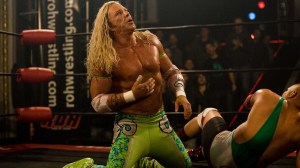 There isn’t a note in The Wrestler that feels misplaced or a moment of drama that feels false or contrived. The scenes of emotional revelation feel genuine and aren’t delivered with deliberate emphasis, like Randy’s moving speech where he tells his neglected daughter how rotten of a father he was, which he accepts bitterly, but he pleads to fashion enough understanding just for his little girl not to hate him. The Wrestler skews against convention and ends on its own terms, following the fated trajectory of its tragic hero. This isn’t a generic or sentimental tale of uplift and redemption. Randy is eager to make amends for a lifetime of bad decisions but he is also keenly aware that he has little to offer and that the outside world has little place for him. The Wrestler is a tender tale about a man trying to find his place in a world no longer familiar to him. Randy tells Cassidy at one point that the only place he ever truly feels pain is outside of the ring.
The film skillfully explores what is fake and what is real in the wrestling world. The matches may be predetermined but the injuries are very real. These muscled warriors are essentially pro stuntmen with some charisma and their bodies are their offering to the screaming masses. They give everything they have for the crowds but what do they get in return once the applause dies down? After witnessing the bloody aftermath of an especially brutal match, which included Randy being lacerated with barb wire and having a staple gun decorate his back, it’s easy to wonder why any sane person would subject themselves to this kind of punishment and for so long. Cassidy is in another profession that tends to grind up and spit out its star attractions. She reaches out to Randy not out of romance (a lesser film would have demanded she fall in love with the big lug) but out of a desire for human companionship, for something real. These two characters are both at a crossroads and must come to grips with the cold realization that the world has passed them by.
 The script by Robert Siegel came alive for me in the details. I love discovering that Randy endures shame that his real name is the more effeminate-sounding Robin. I love that the film shows a scene where a batch of old wrestlers sit next to folding tables and hawk tapes of their greatest matches that no one wants to relive but the old timers. I loved that Randy’s long walk through the bowels of the supermarket to greet his “fans” at the deli counter mirrors his entrances to wrestling bouts.
Astonishingly, Darren Aronofsky directed this movie. The film departs sharply from Aronofsky’s highly artistic yet stylistically mannered previous films, like Requiem for a Dream and The Fountain. He strips away the style pyrotechnics and follows a no-frills docu-drama approach. This dynamic helps accentuate the raw and harsh reality of the film. It’s the most relaxed direction the man has ever done. He’s able to churn the myriad of emotions and broken dreams into a powerful character study that never feels manipulative. The Wrestler feels remarkably intimate and emotionally bruising.
The Wrestler is built to be a one-man show and it’s a terrific show. Rourke’s performance is invigorating and the former Hollywood bad boy channels his own personal history of regret and missed opportunities. The line between character and individual is noticeably blurred. Rourke’s busted and mangled face tells a long history for Randy. The physical shellacking that the 52-year-old Rourke takes is brutal, and you realize that he throws his body into the performance with wild abandon for a man his age. I cannot imagine this film working or having nearly the poignancy with Nicolas Cage in the lead role, which is what was originally planned (Cage might have had a more bizarre haircut). Rourke is the role. It is a perfect marriage of actor and character. The character of Randy is the latest in the long film tradition of the noble loser that must fight to reclaim his victory, which makes for a deeply empathetic experience. Randy is a gentle giant, courteous even to the people that insult him and his glory days. You will feel the man’s every high and low. When he’s working at the deli counter and begins to have fun, joking around with customers, you’ll feel his sense of revelry too. When he’s lonely and invites a neighbor kid over to play an old 8-bit Nintendo video game featuring Randy, you’ll feel the same ache of sadness to connect. When Randy screws up, you’ll feel the same angry disappointment. When Randy is out shopping for wrestling props and playfully involves others in “testing” them, you’ll feel the man’s amusement and sense of peace. Other actors might have given in to the setting and played Randy as a caricature, but Rourke plays with subtlety when he could have gone big. He’s reflective and somber and has a well of repressed anger buried deep within. It’s a performance for the ages and cements Rourke’s cinematic comeback.
 The Wrestler is a rich and engrossing character study that aches and wheezes with the pain of real life. Randy is a man that’s lived a hard life, by design, but at his core he is a kind and decent man. The film takes after its star and proves to be quiet, unassuming, brutally honest, and deeply affecting. Rourke bares his own tortured soul by playing Randy, and his performance is unquestionably one of the best of the year. This is a surprising, heartfelt, and equally heartbreaking movie that finds many truths through the self-dawning of its title hero. It’s not the wrestling matches that I’ll remember most, no sir. I will remember the small interludes, like Randy dancing with his daughter, the beer he shares with Cassidy as they lament the 1990s, the love and brotherhood backstage between with the wrestling opponents, Randy delighting the kids in his trailer park by pretending to fight them. Randy may not find solace or stability outside the ring but the people around him prove that Randy was bigger than “The Ram.”
Nate’s Grade: A


 nathanzoebl
You must be logged in to post a comment.