Blog Archives
Project Hail Mary (2026)
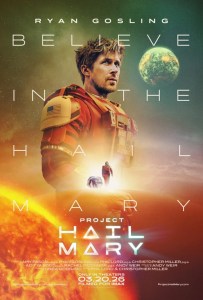
Being stranded for two hours in tight quarters with Ryan Gosling sounds like a dream come true for many. Something tells me I made this same joke except using Matt Damon’s name for the 2015 release of The Martian, another winning mixture of nuts-and-bolts scientific problem-solving and sci-fi exploration from best-selling author Andy Weir. Project Hail Mary is one of those big screen adventures that nourishes your imagination and heart. In short, it’s a rare full-package blockbuster, something to excite the senses as well as appeal to your intelligence to leave you fully satisfied. If you enjoyed the book like myself, then breathe easy, because the film has done this story a great justice. Best of all, it’s the rousing, heart-warming buddy movie you never knew you needed, and it all starts at the end of the world.
In the near future, science discovers an alien microbe that is literally eating the sun. The estimates are that our sun will dim over decades, causing widespread cooling and threatening the lives of billions. The world needs a hero. It got middle school science teacher and disgraced molecular biologist Ryland Grace (Ryan Gosling) instead, who awakens on a spaceship in a different stretch of the galaxy far, far away from Earth and its dimming sun. He has little memory of what transpired before and must piece together not just his understanding of who he is but also his world-saving mission that he now, unfortunately, is the only one who can accomplish. He’s very literally tasked with saving the world, so no pressure.
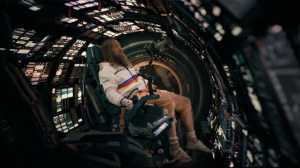
I’m going to avoid major spoilers but there is one plot development I feel needs to be discussed as it gets to the core appeal of the movie, so if you want to go into Project Hail Mary completely unspoiled, and I would advise it if you could, then end this review and come back once you’ve enjoyed the movie. For everyone else, let’s proceed ahead. Thankfully, the amnesia setup isn’t dragged out long. The film is structured to alternate between present-day problem-solving in space and flashbacks to Earth when Ryland was contacted by the top levels of the U.S. government to determine the extent of the unusual problem with water-molecule microbes somehow living and consuming the sun. The microbes are termed “astrophage” and release tremendous amounts of energy, enough so that they become the unexpected fuel for this long-shot space mission that Ryland finds himself the only survivor. He was never supposed to be mankind’s only hope (the other astronauts, the professionals, died from the induced comas for travel).
However, Ryland isn’t alone for long in the movie, and that’s where Project Hail Mary reaches a new level of entertainment and imagination. Our sun isn’t the only one affected by the astrophage, and Ryland is greeted by an alien spacecraft that has also traveled the long journey to figure out why this one sun is unaffected by the astrophage. The sense of discovery is greatly entertaining and I appreciated that there is something remarkably alien about our alien. Our intrepid alien will be nick-named “Rocky” because he best resembles a spider made out of rocks. That’s different. It’s not the old Star Trek school of slapping a forehead ridge onto somebody’s head and calling it a day. A significant and very gratifying sequence of the movie is just watching these two different lifeforms interacting and learning from one another. The language barrier has been explored before, most effectively in 2016’s grounded and somber Arrival. If Arrival was more the contemplative indie about conquering the linguistic challenges of first contact, then Project Hail Mary is the feel-good Spielbergian popcorn spectacle about saving the day and having fun. That doesn’t mean it’s a dumbed-down version; it just has different priorities, and chief among them is the winning buddy comedy of Gosling and a cuddly alien, two humble representatives of distant worlds in shared desperation for saviors. The relationship that blossoms between Ryland and our plucky, curious little space spider is naturally funny but also refreshingly serious too. Rocky is treated like an actual character, not some glorified pet or something to sell toys and Happy meals. He has a distinct perspective, learning curve, peculiarities, and determination that makes him feel more fully-developed than many human characters in terrestrial cinema. If you don’t walk away from the movie wanting your own personal huggable rock spider, then you watched a different movie than I did and, frankly, I pity you.
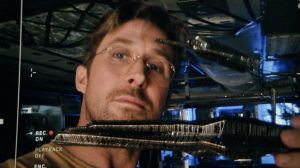
In my review for The Martian, I wrote, “There is an inherent enjoyment watching intelligent people tackle and persevere over daunting challenges, and this sets up The Martian for lots of payoffs and satisfaction. We see both sides of the problem and it provides even more opportunities for challenges and payoffs.” It’s tremendously enjoyable to watch Ryland and Rocky resolve serious scientific problems, whether it be studying the astrophage, the alien sun and its immunity to astrophage, or even just how to interact with one another when there are different systems for breathing and eating. It’s heady without being weighed down by too much scientific jargon, making the analytical discussions accessible and thus engaging. The conflict of Project Hail Mary isn’t quite as realistic as The Martian, given to more convenient cheats with “alien technology,” though the resulting resolutions still felt well-earned and satisfying thanks to the setups and payoffs that screenwriter Drew Goddard (Bad Times at the El Royale, The Martian) has layered throughout. The source material’s author, Andy Weir, has found himself a very profitable and marketable niche, dropping science whiz everymans into impossible scenarios and having them think their way out of them. At least this time the entire world is working in tandem, and spending likely trillions of dollars, to save the entire solar system instead of just retrieving one misplaced American astronaut. Weir will likely be throwing darts at what new setting someone could be stranded in next.
Now, as a film adaptation, Project Hail Mary goes the distance. This is the first live-action movie directed by Phil Lord and Christopher Miller since 2014’s 22 Jump Street (granted, they were notoriously fired from finishing 2018’s Han Solo prequel). For those worried that the movie might be more anarchic or yuk-heavy like the duo’s animated oeuvre, such as The Lego Movie and the Spider-Verse films, they have adapted their style to best suit the material. There’s plenty of humor in this movie because of the ridiculously high stakes and general odd couple nature of our buddy dynamic, but the movie never feels like it loses its focus on the bigger world-saving picture. For Ryland, he knows this mission is a one-way trip, as the capsule doesn’t have enough fuel to make the return trip to Earth. He knows this is a sacrifice, but the entirety of all living things on the planet are holding out hope that his sacrifice is successful. Lord and Miller are able to balance the comedy and dramatic elements, as well as finding appropriate spaces for the viewer, as well as Ryland, to take in the natural majesty of space in another star system. The cinematography by Greg Frasier (Dune Parts One and Two) is grand and visually sumptuous, mixing in aspect ratios and focus depth to distinguish between timelines and emotional states. The musical score by Daniel Pemberton (Spider-Man: Into the Spider-Verse) is remarkably pleasing to the ears, finding room to be rousing and immersive and awe-inspiring, perfectly aiding the gorgeous visuals. At 150 minutes long, there’s the concern about pacing, especially with a movie that has so much to explain on the go as well devoting nearly half its runtime to flashback morsels doled throughout. I never felt lag. I also never felt crushed with the exposition, as the key details are expertly elevated, then as we progress from one challenge to the next, the screenplay keeps us keyed in on what matters in that moment.

And lastly, where this movie really hinges upon is on the relationship and performances of its two leads. I’m not talking about Sandra Huller (Anatomy of a Fall) as the head of the Project Hail Mary mission, assembling cooperation among the world’s countries and experts for this longest of long-shots. Gosling (Barbie, The Fall Guy) is an immensely charming actor, self-effacing and relatably overwhelmed by the faith entrusted to him. Gosling makes us instantly connect with the protagonist, feeling the same nagging pull of his curiosity and excitement when studying something as uniquely fascinating as alien microbes, as well as the mounting trepidation of being out of your depth and having to adapt quickly or else. The film is taken to another level of entertainment thanks to Rocky, who is the clear MVP of the movie. He’s brought to vibrant life through puppeteer James Ortiz, who also provides the computer translation voice, and through the magic of empathy, we’re shedding tears for a creature without a discernible face. The dynamic between the two characters is so enjoyable, so funny, and ultimately so poignant, that it warms your heart while making you feel full by its perfect closing image.
Project Hail Mary is a crowd-pleaser to its very DNA, big yet accessible, brainy but still capable of popcorn thrills and visual fireworks, heartfelt but mordantly funny and even goofy at points, and always engaging and rewarding. It’s also a hopeful movie, something the present world could use more of. In the face of epoch-ending cataclysm, human beings are capable of working together to solve impossible problems, and heroes can emerge from the least likely places. It’s inspirational without falling into sappier, inauthentic maudlin drama, and it’s a celebration not just of teamwork but interstellar teamwork, working across enormous barriers for a common good. It’s invigorating to watch human decency and noble sacrifices prevail but also just an enviable demonstration of competency. What a wonderful world where experts are given deference and praise for their expertise and professionalism (if only this didn’t feel so tragically the stuff of “fiction” in present-day America). Project Hail Mary is a superbly made adventure movie that has a little of everything we’re looking for in mass-appeal blockbusters, and there’s a considerable skill to hold all these parts together into a movie that feels complete and enriching. Fans of heady sci-fi, buddy comedies, disaster movies, and space operas should find plenty to enjoy, but really Project Hail Mary is the kind of movie that all you need is eyes and ears to understand the appeal.
Nate’s Grade: A
Share this:

The Fantastic Four: First Steps (2025)

Apparently there must have been an ancient curse that brings forth a new attempt at a Fantastic Four franchise every ten years, even further if you want to include the 1994 Roger Corman movie that was purposely made and never released just to hold onto the film rights (I’ve seen it, and once you forgive the chintzy special effects and shoestring budget, it’s actually a pretty reverent adaptation). The 2000s Fantastic Four films were too unserious, then the 2015 Fantastic Four gritty reboot (forever saddled with the painful title Fant4stic) was too serious and scattershot. Couldn’t there be a healthy middle? There has been an excellent Fantastic Four film already except it was called The Incredibles. That 2004 Pixar movie followed a family of superheroes that mostly aligned with the powers of the foursome that originally made their debut for Marvel comics in 1961. It makes sense then for Marvel to borrow liberally from the style and approach of The Incredibles because, after all, it worked. There’s even a minor villain that is essentially a mole man living below the surface. Set on an alternate Earth, this new F4 relaunch eschews the thirty-something previous films of the Marvel Cinematic Universe (MCU). You don’t need any prior understanding to follow the action, which is kept to under 105 minutes. The 1960s retro futurist visual aesthetic is a constant delight and adds enjoyment in every moment and every scene. The story is a modern parable: a planet-eating Goliath known as Galactus will consume all of Earth unless Reed Richards (Pedro Pascal) and Sue Storm (Vanessa Kirby), a.k.a. Mr. and Ms. Fantastic, give over their unborn son. The added context is that they have struggled with fertility issues, and now that at last they have a healthy baby on the cusp of being theirs, a cosmic giant wants to call dibs. It makes the struggle and stakes much more personal. It makes the foursome genuinely feel like a family trying to resolve this unthinkable ultimatum. I cared, and I even got teary-eyed at parts relating to the baby and his well-being, reflecting on my own parenting journey.

From a dramatic standpoint, this movie has it. From an action standpoint, it leaves a little to be desired. It incorporates the different powers well enough, but there are really only two large action set pieces with some wonky sci-fi mumbo jumbo. There’s a whimsical throwback that makes the movie feel like an extension of a Saturday morning cartoon show except for the whole give-me-your-baby-or-everybody-dies moral quandary. While I also appreciated its running time being lean, you can feel the absence of connective tissue. Take for instance The Thing (The Bear‘s Ebon Moss-Bachrach) having a possible romance with a teacher played by Natasha Lyonne (Poker Face). The first scene he introduces himself… and then he appears much later at her synagogue seeking her out specifically during mankind’s possible final hours. We’re missing out on the material that would make this personal connection make sense. The same with the world turning on the F4 once they learn they’ve put everyone in danger. It’s resolved pretty quickly by Sue giving one heartfelt speech. The movie already feels like it has plenty of downtime but I wanted a little more room to breathe. I was mostly underwhelmed by Pascal, who seems to be dialing down his natural charm, though his character has some inherently dark obsessions that intrigued me. He recognizes there is something wrong with him and the way his mind operates, and yet he hopes that his child will be a better version of himself, a relatable parental wish. There are glimmers of him being a more in-depth character but it’s only glimmers. The family downtime scenes were my favorite, and the camaraderie between all four actors is, well, fantastic (plus an adorable robot). Kirby (Napoleon) is the standout and the heart of the movie as a figure trying to square the impossible and desperate to hold onto the baby she’s dreamed of for so long.
The Fantastic Four: First Steps is an early step in a better direction. It’s certainly better than the prior attempts to launch Marvel’s first family of heroes, though this might not be saying much. It does more right than wrong, so perhaps the fourth time might actually be the charm.
Nate’s Grade: B-
Share this:

Mickey 17 (2025)
 Bong Joon Ho is one of those filmmakers that has earned the right to make any movie he wants. Hollywood might not feel the same, but the filmmaker behind Snowpiercer, The Host, and the triumphant Oscar-winning Parasite, the first time an international movie won Best Picture, is an amazingly versatile storyteller who seamlessly blends different genres and tones into unique and mesmerizing film experiences. If he’s interested in telling a story, then that guarantees I’m interested in watching it. This is especially true if he steps into the realm of science fiction. After the worldwide success of Parasite, Bong Joon Ho was given $100 million dollars and final cut from a big studio to make whatever he wanted, and he chose an adaptation of Edward Ashton’s novel, Mickey 7, telling the story of the world’s most/least fortunate expendable in a fledgling space colony. I read the book last year and it was quite good, so my anticipation was even higher for the feature film Mickey 17, especially after Warner Brothers delayed the movie an entire year. Now, after the long wait, we can all finally enjoy Bong Joon Ho with peak artistic freedom, a position that will likely not be repeated. It’s a grand movie with big ideas, vision, satire, and also enough underutilized ideas and distracting characters and performances to quibble over “what if’s.”
In the distant future, Earth is overrun in population and low on natural resources, so the next space race is to find habitable colony worlds. Mickey (Robert Pattinson) gets in over his head to shady loan sharks and looks for any possible way off of the planet. The only position he can sign up for is that of an expendable, a person who can be cloned from a biological printing machine. These expendables are put in dangerous jobs and different science tests because, well, if they die, you can start over. It’s a terrible job, one that involves dying repeatedly, and Mickey agrees to be the human crash test dummy. He’s on a multiyear colony ship traveling across space to find a habitable world. The planet they land on is bitterly cold, impossible to farm, and crawling with its own crawly wildlife. Mickey 17 is left for dead after falling down a chasm but he survives, trudges back home, only to discover another Mickey in his bed. They’ve assumed Mickey 17 died and already printed out his replacement. There’s a rule about there not being multiples and, if discovered, both expendables would be killed. They have to hide their secret and work together while still vying for dominance over one another and staying out of the crosshairs of buffoonish yet powerful political leaders Kenneth Marshall (Mark Ruffalo) and his wife, Yifa (Toni Collette).
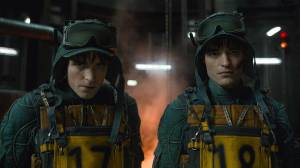 Mickey 17 is a smart, weird, and consistently fun and thoughtful movie. It doesn’t waste any time getting started, literally with Mickey 17 on the cusp of dying with his looming interaction with the aliens. Bong Joon Ho adapted the screenplay and has a nimble way of dealing with the conflicts and setting. I appreciated that he doesn’t prolong different storylines beyond their point of interest. He’s always got another development or joke or set piece to provide. There’s a fun sense of discovery with the movie as well as satisfaction to watch how he slides all the pieces into place. I appreciated how he imbues character notes so easily with supporting characters, giving this universe a larger personality that resonates. I love the setting and the reality it presents of a long-voyage space colony fighting for resources and struggling to keep the lights on. The sets and photography are gorgeous to behold but also filled with details to help make the world feel lived-in. I loved that even in the far-flung future, technology can still work in fits and starts, like watching Mickey slide out of the printer conveyor belt only to lurch backwards before going forward again, like the printers of the 1980s. I love the alien creature design that resembles an armadillo crossed with the subterranean worms from Tremors. I loved how they were able to defend their queen/mamma in Act Three. I love the goofy comic flourishes too, like the fact that there’s a guy just walking around in like a pigeon mascot costume that is never really explained. This is also the same movie where characters constantly ask Mickey what it’s like to die and you realize that every version of Mickey doesn’t know because he’s never experienced it personally, only born from the aftermath. The way this movie is capable of marrying big ideas with silly visual jokes and slapstick and explosions is impressive and a reminder that certain artists will prosper on big stages when given ultimate freedom. Come for the star power and slapstick, stay for the existential dread.
Pattinson presents another wildly weird performance that reminds me how exciting he is as an actor. He’s got these movie star good looks but he really wants to play all the weirdos he can with the most eclectic filmmakers, and I love it. His Mickey 17 and Mickey 18 may be constructed from the same DNA but they come across as vastly different iterations of our hero. This provides a more assertive version of Mickey to try and shape up our more passive Mickey into standing up for himself, taking chances, and taking charge when the situation calls for it. He’s like a mentor. Mickey 18 isn’t featured that often in the story, and truthfully he wasn’t featured that often in the book as well. It’s mostly the story of the hapless and whiny-voiced Mickey 17 and his journey of self. It’s a familiar yet enticing formula to watch a character gain agency and go from pushover to defender of the vulnerable. Pattinson finds little sparks to grab onto with the character, little pieces of weirdness that really help crystalize our understanding of Mickey. Of course the human lab rat would have the fight bred out of him through resignation, and it’s still gratifying to see him stay who he is while also rising to the challenge of the moment. In interviews, Pattinson has said that he modeled his two Mickey performances after the cartoon characters Ren and Stimpy. This actor is perfect for the wacky, tone-blending worlds of Bong Joon Ho. He’s game for everything.
 It’s not hard to see the entire enterprise as a crafty critique of capitalism, not exactly a new point in the Bong Joon Ho movie universe. Mickey’s value to his mission is the literal exploitation of his body. He’s callously tested upon for vaccines and weapons and whatever the scientists may cook up. Because they know they can download another Mickey, it changes how they view the current iteration: he’s not a person, he’s only whatever they want him to be at whatever moment. His value is what he can offer to them as a test subject, as a pile of flesh to be experimented upon. Therefore, the casual cruelty in the name of science and “progress” is yet another example of how we can easily dehumanize our fellow man in a system that profits from their labor and exploitation. Bong Joon Ho also provides a more compassionate view of the downtrodden Other, in particular the indigenous alien species on the colony world (to be fair, as is pointed out by another character, the humans are the actual aliens in this scenario). The creatures are viewed as unworthy of co-existence, in the way of man’s intergalactic manifest destiny, and so they must be wiped out for greater conquest. It’s not a huge surprise that the aliens might not be the stupid and scary creatures that they’ve been projected to be, and this is revealed very early when a collective herd saves the wounded Mickey 17. He views this as an insult, that he’s not even seen as worth eating, but the reading should be obvious to everyone in the audience. Thus we spend the rest of the movie for the other characters to realize the reality of these strange creatures. I did appreciate that the end of the movie coincides with a battle for primacy versus cooperation and compassion, which centers some of the major themes and ties the movie’s character arcs and significant messages together. Plus there’s also explosions.
And yet, there are ideas that could have been explored for even more depth and contemplation. There’s a very intriguing question concerning the different personalities of Mickey 17 and Mickey 18, which begs the follow-up question whether or not they are indeed one hundred percent replicas. Their personalities are such wild swings away from one another, with one being much more the laconic pushover and the other being the aggressive and assertive ideal Mickey. The next Mickey is built upon the recorded memories of the previous memories, so in theory there wouldn’t be many significant differences. However, the big personality differences are not explored or even questioned. This is a missed opportunity that could have gotten to something deeper philosophically and with the revelations of its world-building tech. Perhaps the cloning device doesn’t actually work as advertised and each new Mickey is a close proximity but there are minute yet distinct differences, meaning each new Mickey is his own person deserving of identity. This could then also further connect with the religious objection to cloning that one body should only have one soul. This could lead to Mickey 17, and even 18, debating whether or not they have souls of their own and their conception of life and sacrifice, being more than just the living equivalent of a punching bag. It could also bring into a spiritual element about possibly having a celestial reward after their extra-solar toils, at least the hopeful belief. There were real thematic qualities to explore and provide meaningful texture to the whole movie, and yet they’re disappointingly ignored.
 The Trump buffoonery avatar stuff is a little harder to take in early 2025 with the fallout of a second Trump presidency still having its far-reaching, chaotic, despotic consequences. The character and his wife are invented entirely for the movie by Bong Joon Ho, and clearly he had some things he wanted to say about the former and now-current president (there are even followers wearing those signature red caps). I just don’t know if there’s anything of real substance to this portrayal. He’s a cartoonish idiot villain overcome with vanity, ego, overconfidence, and craven manipulation, but there’s not much that is gained from his multiple appearances. Ruffalo is doing fine work jutting out his jaw and making sure to show those upper teeth as often as possible. It’s just that the character is an exaggerated all-purpose blowhard villain, and it makes for a character you desperately want to see brought lower, to be exposed as a fraud, to get their cosmic comeuppance. The problem is that the appearances are all hammering away at the exact same point that I began to tune Marshall out. In our current political landscape, with the intended target taking up every iota of oxygen in the public sphere, it just becomes another reflection point of the exhaustion felt from the Trump administration. One character verbally lambastes the political bully as a world-class idiot and says, “That’s why you lost the elections.” Plural. It’s then I recalled Mickey 17 was delayed a year, and this would have played differently for me in early 2024 than 2025.
There’s also a very late sequence I would like to analyze why it doesn’t quite work as conceived, but this will enter into some spoilers, so skip to the next question if you’d like to remain pure, dear reader. During the epilogue or coda, Mickey is seemingly remembering something from his past until it’s revealed to be a nightmare and thus having little consequence beyond insight into Mickey’s subconscious anxiety. In this nightmare, Mickey stumbles upon Yifa in the midst of her printing out a new version of her husband through the cloning machine. We’d been previously told that after her husband’s death that Yifa had been locked away and supposedly slit her own wrists. This raises the question whether the Yifa that we see at the machine is her or a clone, and that tantalizing possibility unlocks a new world of story for the movie that seems completely natural and essential. It’s the kind of twist hiding in plain sight that could have worked, that there were two Yifas at the same time there had been two Mickeys or long predating. This is because once you start thinking of this possibility it’s too obvious that it would happen. Of course the rich and famous blowhards who regard themselves as more important than others would see the expendable process as a means of living forever, or at least having a back-up plan. Of course the Marshalls would be hypocrites about their moral righteousness against cloning being an affront to God and creation. Of course these people would use whatever means they could to extend their power and their lives. Just like that, the very end of the movie has an extra layer to it that also provides more purpose for Yifa as a character. Then, just like that, it’s revealed as a nightmare, and all that intriguing possibility is wiped out, and I was left wondering why even produce this moment after the duplicating machine has been destroyed?
 Mickey 17 is an engaging, funny, enraging, and silly example of what science fiction can do. It can explore existential and essential questions about what it means to be human while also employing cartoonish slapstick, as well as cartoonish political satire. Not everything comes together smoothly; it’s a true jumble of tones and ideas, a Bong Joon Ho staple, but he’s typically so skilled at hiding the transitions and seams so you don’t even notice the genre movement until it’s already happened. There are intriguing directions and ideas I wish the movie had explored more, and the climax is a little conveniently tidy but suitably fitting as an invention for a showdown. As a reader of the novel, I can say that it’s an entertaining and fitting adaptation but also one that works on its own while I can still encourage people to read the novel. Mickey 17 is ambitious and messy and also very human, finding grace inside the darkness and absurdity. It’s not perfect but it is worth celebrating, just like each of the put-upon Mickeys.
Nate’s Grade: B+
Share this:

Rebel Moon: Director’s Cut (2024)
 What a rarity for a movie to potentially appear twice on my worst of the year list, and such is the destiny of Zack Snyder’s Rebel Moon, originally released in 2023 and the first half of 2024, and now with added lengthier director’s cuts. So what do you get in the newest “Snyder cuts” besides fewer hours in your day? Let’s tackle the opening sequence demonstrating the power and villainy of our evil empire as they invade a crumbling city in resistance. Within short order we’ve witnessed: 1) female priestesses being forcefully disrobed and having their breasts branded, 2) an adorable little CGI pet become a literal suicide bomber, 3) a son brutally beating his father’s brains out of his skull to spare their family only for them all to be massacred anyway. Yikes. While there is a little more world-building absent from Snyder’s prior cuts, like a religious sect that turns the teeth of their conquered victims into a decorative washboard, even the extra time, and it is literally hours over the course of the two parts, feels strained and still poorly developed to better understand the world, the characters, the conflict, the history, anything that could make Snyder’s hopeful franchise its own universe. Theres now a giant metal goddess whose tears fuel space travel. All right then. One of the more interesting characters, the samurai-esque loner robot, is given more material but he’s still just as inscrutable. There’s plenty more cruelty here, slow-motion head shots painting the screen in sticky viscera. There’s also plenty more breathless and awkwardly extended sex scenes, but hey, at least those are consensual, so there’s that. I’m just stunned why Netflix would want different versions of these movies when they’re ultimately all housed under the same banner. It sure feels like the “Snyder cut” brand is now an expected marketing ploy to be exploited for added publicity. After all, why watch one long slightly bloody poorly written sci-fi space opera, when you could watch TWO versions, one of which being even bloodier and more miserable? Will there be an even Snyderier Snyder cut, adding more scenes of side characters suffering and even more festishized gore in even slower motion? Will the whole movie just be played in slow motion, now requiring nine hours? Where does it even end, Netflix?
Nate’s Grade: D
Share this:

Alien: Romulus (2024)

I will maintain that over the course of forty years that there have been no bad Alien movies. While 2017’s Alien Covenant gets the closest, I think each of the four Alien movies from 1979 to 1997 are worthy of praise for different reasons. The Alien franchise is unique among most sci-fi blockbusters in that each of its movies feels so radically different. The groundbreaking first movie is the hallowed haunted house movie in space; the 1986 sequel set the foundation for all space marine action movies, with Sigourney Weaver earning a Best Actress nomination, a real rarity for any sci-fi action movie; the much-derided third film from 1992 is much better than people give it credit for, and while flawed it has really intriguing ideas and characters with a unique setting and a gutsy ending; the fourth film from 1997 might just be the most fun, going all-in on schlocky action and colorful characters. Each of them is different with a style and tone of their own, and each is worthy of your two hours. Enter director/co-writer Fede Alvarez’s Alien: Romulus, meant to take place between the fifty-year time span between Alien and Aliens. It was intended to be a Hulu streaming movie but got called up to the big leagues of theatrical release, and while it has some underwritten aspects and clunky fan service, Romulus is another worthy sequel for a franchise that admirably keeps marching to its own beat.
It’s 2142 and life on an off-world colony isn’t exactly the adventure advertised. It’s a mining colony that’s slowly poisoning its huddled masses. Rain (Cailee Spaeny) has just finished her two-year contract only to be informed by her greedy company that, because of worker shortages, she’s locked in for another two years of indentured servitude. She’s also in charge of her adoptive brother, Andy (David Johnsson), a malfunctioning android that her late father reprogrammed. An ex-boyfriend comes back into Rain’s life with a plan: there’s an old derelict research station that they can scavenge and retrieve the cryo chambers, which can make long-term travel to a new life in a new system a possibility. There’s also a catch: they need Andy because only he can open the ship’s locked gates. The ragtag crew flies out to the derelict ship orbiting a ringed planet and, of course, discovers far more than they bargained for as the ship, of Weyland-Yutani origins, is crawling with face-hugging fiends just waiting for new faces.

Despite my grumbles, I found Alien: Romulus to be a very entertaining new entry that had the possibility of genre greatness. The setting and central character dynamic are terrific. The Alien franchise hasn’t exactly been subtle about its criticisms of multi-faceted corporations and their bottom-line priorities, but it’s even more effective to see the dinghy world of this mining colony. It’s a bleak existence of dystopian labor exploitation and you get an early sense of the desperation that motivates the characters to flee at any opportunity. Eventually, the evil corporation’s big plans for the “perfect organism,” a.k.a. the xenomorph, are to replace the depleting labor force. Humans, it turns out, aren’t built to work in space long-term, and the human cost is felt effectively in Act One. Another key part of what made the movie so immediately engaging for me is the sweet surrogate brother-sister relationship between Rain and Andy. He’s vulnerable, an older android model who needs some repairs, but he’s loyal and kind and loves pun-heavy jokes. This central relationship hooked me and gave me something to genuinely worry over as things get more dire, and it’s not just the scary aliens. Once onboard, Andy uploads the programming of a different android, and the competing objectives make him become a different person, all wonderfully played by Johnsson, who was supremely appealing in Rye Lane. While literally every other character is remarkably underwritten (this one doesn’t like robots, this one is pregnant, this one is… Buddhist?), the genuine bond between Andy and Rain grounded me.
Romulus also has some sneaky good set pieces that kept me squirming in my seat or inching closer in excitement. Alvarez (Don’t Breathe, Evil Dead) can concoct some dynamite suspense sequences and knows how to draw out the tension to pleasingly anxious perfection. This is the best Alien movie yet to really sell the danger of the springy face-huggers. There’s a taut sequence where the humans have to slow their movements to walk through a face-hugger minefield lest their spike in temperature alert the deadly creatures. There’s another later sequence that ingeniously utilizes space physics to escape the xenomorph acid blood. I loved how well it was set up and then the fun visuals of zero-gravity acid blood. The practical effects make for lots of great looking in-camera effects, and the production design is incredibly detailed while achieving a chilling overall mood of dread. Alvarez leans upon the visual frameworks of Ridley Scott and James Cameron, as who doesn’t, but finds ways to make his Alien movie his own. I really appreciated the dedication to the sprawling vistas of space, like extended shots outside the ship that really translate the sheer majesty and terrifying scale of space. The last-second threat of demolition is made all the more arresting by crashing into the rings of the planet. I think most people confuse a planet’s rings like it’s some kind of water vapor when instead it’s like a crowded highway of debris.
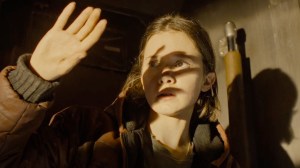
However, there are some misguided nods toward fan service that go overboard and become groan-inducing. There’s a fine line between homage and back-bending fan service, and Romulus skirts over occasionally into the dangerous territory, given over to references to the other movies that lack better context to make them anything more than contrived callbacks. Take for instance a triumphant killing of a xenomorph where a character utters, “Get away from her,” which itself would have sufficed, as any Alien franchise fan knows this reference point. Then the character continues, in an awkward pause, almost stumbling over the words and translating the awkwardness directly for us, as they add, “…You bitch.” Why? Why would this character need to say this exact same line (although, timeline-wise, this is now the first use of the phrase as Ripley is still in hypersleep)? The moment doesn’t call for this specific line; it could have been anything else, but they made it the line we all know from Aliens. There’s also the familiar ending where the characters think they’ve won and, wouldn’t you know it, there’s one more tussle to be had with a xenomorph who has snuck onto the escape ship. I’m less bothered by this continuation as it’s almost a formula expectation for the franchise at this point, though keeping Rain in her sleeping undies for the final fight seems like another unnecessary nod to the 1979 original. They even tie back the mysterious black goo from the Engineers via Prometheus, though as a vague power-up when, if I can recall, it was a biological weapon of mass destruction, but sure, now it’s a power-up elixir.
But the worst and most misguided act of fan service is where the movie literally brings a performer back from the dead (some spoilers ahead, beware). When Rain and the gang stroll through the derelict company ship, they discover the upper torso of a discarded android, like Ash (Ian Holm) in the original Alien. Not just like Ash because for all intents and purposes it is Ash, as the filmmakers resurrect Holm (who passed away in 2020) and use Deepfake A.I. technology to clumsily animate the man. This isn’t the first instance of a deceased actor brought back to screen by a digital double, from Fred Astaire dancing with a mop to Peter Cushing having a significant post-death supporting role in 2016’s Rogue One. Here’s the thing with just about all of these performances: they could have just been a different actor. Why did it have to be Grand Moth Tarkin (Cushing) and not just any other obsequious Empire middle manager? With Alien: Romulus, why does it have to be this specific version of an android when it could have been anyone else in the world besides the dearly departed Holm? I just can’t comprehend why the filmmakers decided to bring back Holm in order to play A DIFFERENT android who isn’t Ash but might as well be since he’s also been torn in half. Why not have the android be another version of Andy? That would have presented a more direct dichotomy for the character to have to process. The effects reanimating Holm are eerie and spotty at best, apparently built from an old scan from The Lord of the Rings. It’s just a distracting and unnecessary blunder, the inclusion of which can only be justified by trying to appeal to fans by saying, “Hey, remember this character? Even though he’s not that character. Well. Here.” We used to readily accept other actors playing the same character before the rise in technology. Nobody watching The Godfather Part II wondered why Robert DeNiro wasn’t a slimmed-down Marlon Brando.

As an Alien movie, Romulus starts off great and settles for good, but it still has several terrific set pieces, its own effectively eerie mood and style, and a grounded character dynamic that made me genuinely care, at least about two characters while the others met their requite unfortunate ends. It doesn’t have the Big Ideas of a Prometheus or the narrative arcs of Aliens, or even the go-for-broke schlock of Alien Resurrection, but Romulus delivers the goods while also feeling like its own movie, a fact I still continue to appreciate with the Alien franchise. It’s an enjoyable genre movie that fits in with the larger franchise. I wish some of the clumsy nods to fan service, especially the resurrection of a certain character, had been reeled back with more restraint to chart its own course, but it’s not enough to derail what proves to be a winning sequel.
Nate’s Grade: B
Share this:

Borderlands (2024)

I’ve never played the popular looter-shooter video game that Borderlands is based upon, but I have to say that the fan base certainly deserved more than a low-rent combination of Guardians of the Galaxy merry pranksters with Mad Max freakazoid wasteland gangs. You can clearly tell the specific X-Meets-Y of the pitch, although apparently writer/director Eli Roth (Cabin Fever, The House with a Clock in the Walls) was auspiciously inspired one day by, literally, watching his dog squat over and poop and said, “This, this has to be in the movie.” So, from those noble creative origins comes a movie that labors so hard to be breezy and fun but feels so gassed and desperate. In this future sci-fi universe, there’s a special planet that is populated with different space crooks and gangs all fighting to discover a hidden vault of legend. The world is overrun by masked marauders known cheerfully as “psychos.” There’s also a prophecy about a chosen one, a kidnapped daughter to a very dangerous man, and Jack Black voicing one of the most obnoxious sidekicks in recent memory. That’s the thing about Borderlands: everyone is obnoxious or trying badly to be so indifferently cool. It doesn’t work. Cate Blanchett is not the right fit for the lead character of Lilith, a blase bounty hunter/for-hire killer that finds herself gathering a band of bickering bandits. The movie wants us to see them as a dysfunctional family of lovable losers, but each mediocre character is distilled to an underwhelming essence of quips, snark, and stylish killing. If there was a whiff of personality to be had with the different characters, their different and conflicting perspectives, this universe and its interesting locations for world building, even the unique weapons and fighting abilities, there might be even some fleeting entertainment to be had. Alas. It’s not funny. It’s not exciting. It’s not visually appealing. It’s not interesting. It’s not surprising. It’s just sort of loud with capital A-attitude and a forced sense of jocular PG-13 whimsy. It’s not… a lot of important things. Instead, Borderlands only makes me reflect how much better James Gunn has proven himself with these kinds of funky found families.
Nate’s Grade: C-
Share this:

Dune: Part Two (2024)
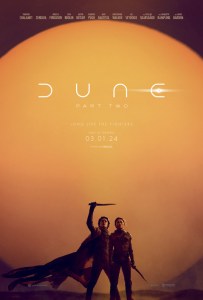 I wasn’t fully taken with the first Dune movie when it arrived in 2021. It was visually sweeping, with dense world building and careful development of characters and themes, but then it just hit the pause button without any certainty there would be a conclusion. Thankfully, director Denis Villanueuve was able to complete his vision, and what a spectacular science fiction landscape this man has fashioned, visually resplendent but also with a story that deepens and improves on all the promise and setup from 2021. The triumphant of Paul (Timothee Chalamet) becoming a hero and avenging his father from their betrayers is tempered by the tragedy of Paul, becoming the false messiah that will bring about mass genocide. The movie doesn’t hold back in its criticisms of its hero while also providing complexity that makes us root for him but uneasily dread what might become. The narrative structure is easy to follow with Paul ingratiating himself with the native culture, rising to power and influence, and organizing a resistance against the well-funded imperial overlords of Arakis. This is the kind of sumptuous, big screen spectacle with intelligence that is so rare in the Hollywood system, and Villaneuve once again shows his ability to perform artful blockbusters that put him in a rarefied class with hew others. After the first Dune, I was hopeful but a little wary. After the second Dune, I feel like all of my concerns were wiped away.
Nate’s Grade: A-
Share this:

Rebel Moon – Part Two: The Scargiver (2024)
 Back in December, Zack Snyder offered his very Snyder-y holiday take on big-budget space operas with Rebel Moon, a project that began as his Star Wars pitch that was turned down. It was what you would expect from a Snyder movie: big, loud, silly yet played completely serious, and drained of all vibrant color. Rebel Moon Part One was on my worst of 2023 list and I felt was a waste of two hours. I was not looking forward to the concluding Part Two. I was worried it would be two more hours of the same, and now having seen Part Two, a.k.a. The Scargiver, the edgy nickname of our lead rebel Kora (Sofia Boutella) fighting the good fight against the Evil Empire, I can now say that the Rebel Moon duology is now a dreary waste of four of your waking hours.
Saying Scargiver might be minimally better than Child of Fire (did you remember that was the subtitle for Part One? Don’t lie to me, dear reader, you know you didn’t) is a nominal victory. There’s more action and a clearer sense of climax, with our underdogs planning their guerrilla war against the overpowering forces approaching (we’re basically watching the training of a Vietcong-like insurgency) and then pulling off their unexpected victory. The problem is that we’re still stuck with all the same characters from Part One, few of which will prove to be emotionally engaging or intriguing. We’ve assembled our fighting force thanks to the events of Part One, but far too many of them are interchangeable and punishingly free of personality besides the default character creation setting of “stoic badass.” There’s one lady who has laser swords so at least that sets her apart. When it comes to attitude, personality, perspective, and even skill level, these characters are awash, which makes the action falter when it comes to any sort of meaningful emotional involvement. The bare bones story is so plain with broadly drawn good versus evil characters from its obvious cultural influences. The fact that it’s derivative is not itself a major fault, it’s the fact that it does so little with these familiar pieces that the movie feels like it’s trying to skate by on your familiarity. After four hours, it’s clear to me that Snyder and his co-writers composed this not as a living, breathing universe with its own lore and history and intrigue, but as a story where he could have used the Star Wars universe to fill in the gaps.
 Snyder can be a first-class visual stylist but his sense of fluid and engaging action stops at “cool images,” like living splash pages from comic books. Like Part One, there is no sense of weight to these action sequences. Things are just happening, and then in the next shot things are just happening. Occasionally there will be a sliver of relation, but whether it’s 60 minutes or 6 minutes, the effect is still the same. The action feels like it’s all happening in a vacuum, and the momentum we feel the upstarts are gaining is hampered. We went through the trouble of explaining their counter-offensives, so why does so much of it feel like it’s just watching a jumbled, ashen group of characters fire guns? This is best epitomized by Jimmy the robot (voiced by Anthony Hopkins) who has gone rogue from his programming and sits out much of the action for reasons entirely unknown. Then he arrives, takes down a few evil tanks, and I guess decides to sit back out. If this is our fighting force, what exactly has it amounted to? This makes the entire movie, and its predecessor, a frustrating viewing even for forgiving action fans. Things blow up good, and there are a few impressive visual orchestrations, but it’s so fleeting and slim.
Over the course of two two-hour movies, totaling four hours, with the promise (threat?) of more, it’s clear that what we really had here was perhaps one underdeveloped movie at best that has been unfortunately spread out over two (and counting) movies of time. Part One was entirely about assembling the team of rugged defenders, and this could have served as the first 45 minutes of the overall movie, with the events of Part Two filling in the rest. With Scargiver, the defenders don’t even start training the villagers until 40 minutes into the movie and the big battle doesn’t kick in until a full hour. Structurally, this doesn’t feel like we’re using our time wisely, and this is best evidenced by the fact that after AN ENTIRE MOVIE of character back-story, Snyder still stops the action to have his characters sit around and share their sad back-stories. Did these characters just not talk at all to each other after initially gathering person-by-person? Tarak (Staz Nair) still hasn’t put a shirt on. I felt like yelling at my TV as the character took turns, and another 15 minutes, for each member to share their tortured back-story again but with different visuals. I was almost worried that right before the battle another character would say, “Wait, before it all really goes down, I need to share, yet again, more of my back-story.” It’s not like these extra glimpses give us new understanding or even meaningfully differentiate their characters; they’re all just victims of an abusive space government that imposes its terrible will most forcefully.
 There is one tragic back-story that does separate itself from the pack, notably because it literally separates itself from the pack and is told well before our group share. Kora explains her part in the assassination of the royal family, securing the military coup that left the Evil Empire extra evil, and I guess the guy named Balisarius as supreme leader (oh how this man must have been teased for his name as a schoolchild, which might be his own tragic back-story that we’ll get three helpings of with an eventual Part Three). This betrayal is personal and stands out, with Kora being the one to shoot the little princess, a girl who, in her dying breath, says she forgives Kora. That’s rough. This is actually a good sequence from a character standpoint as it establishes Kora’s accountability and guilt convincingly. However, Snyder makes some baffling creative choices that blunt the impact of this sequence. During the assassination, the musical score favors a string quartet, which is an emotionally plaintive choice. However, the music is actually diegetic to the scene, meaning it’s coming live from the room. There is literally a string quartet of musicians playing in the room while the royal family is betrayed and slaughtered. These guys are really dedicated to their art to keep playing throughout, and I assume they must also be part of the conspiracy or else big bad Balisarus (snicker) would kill them too. You might as well have them also start stabbing the royal family with their bows. It’s details like this that trip up Snyder, a man beholden to images and ideas but lacking the finesse to make them work.
An issue I had with this conflict was the disparity in scale between the forces, mainly my nagging question of why put together a ragtag group of space adventurers to defend this town if the Evil Empire could just nuke the planet from space? Well Snyder attempts to answer this early with Part Two, and the answer appears to be… grain. This community theorizes that the empire needs their grain yield so badly that they wouldn’t do anything to damage it, so their plan is to harvest all their wheat, turn it into grain, and then use the grain like human shields, hiding behind the valuable resource as cover and distributing it across the village. This is beyond silly. First, this isn’t like an entire planet harvesting grain, it’s one little village on the outskirts. It’s not like we’ve seen a giant warehouse that goes for miles and miles stockpiled with thousands if not millions of deposits of this food. Also, we’re talking grain here (stay tuned for my exclusive Rebel Moon-related podcast called “Talkin’ Grain”). It’s not like we’re talking about some super rare mineral or substance that is only found on this one planet, something linked toward like the power source for an ultimate weapon or space travel. We’re talking about grain here. Grain. You think this Evil Empire won’t nuke the planet because they’re worried they won’t get enough grain, the same crop that can be harvested on multitudes of other planets? How about they just kill everyone and then repopulate the planet with robots to harvest the precious grain? Or how about this simple village make some upgrades as we’re in a future world with space travel and artificial intelligence but people are still harvesting wheat by hand like they’re the Amish. Regardless, I hope you love slow-mo montages of grain harvesting because that’s what you’re getting for the first 40 minutes, as if Snyder is rubbing your face in his silly non-answer.
 In the conclusion to Rebel Moon Part Two, once the dust has settled, and long since that grain has been harvested, the last five minutes sets up a would-be Part Three, informing us that an unresolved storyline is next up on the docket. The characters gang up for their next adventure, and you’re expected to be chomping at the bit for this continuation. I openly sighed. Every movie feels like a tease for the next adventure, and it seems to promise that this one will be the real one you’ve been waiting for, but it feels like franchise bait-and-switch. It’s more than incomplete or lazy storytelling, it’s a scheme to leverage interest in a world and series that deserves little. The universe of Rebel Moon is not interesting. The characters of Rebel Moon are not interesting. The visuals of Rebel Moon are fine, though some of the costume choices again can rip you right out of the reality of this universe (a guy fighting in blue jean overalls?!). In short, not enough has been established, developed, or even paid off to make Rebel Moon an interesting and satisfying movie, let alone two, let alone three, let alone however many Snyder wants to leech out of Netflix. I would say Part Two is better because at least it provides an ending but it doesn’t even do that, merely an intentional passing of the baton to the next movie, and round and round we go. Rebel Moon is a living poster stretched to its breaking point. Leave this shallow universe behind.
Nate’s Grade: C-
Share this:

Solaris (2002) [Review Re-View]
 Originally released November 27, 2002:
A most amazing thing occurred when I sat down in my theater to watch Steven Soderbergh’s sci-fi remake, Solaris. The majority of the theater was women, no small part I’m sure to George Clooney and the promise to see his posterior not once but twice. As the film progressed I kept hearing the rattling of seats and the exit doors. When the lights came back on more than half my theater had walked out on Solaris. I have never seen this many walk outs for any film before, and if one has to hold this title Solaris certainly does not deserve this dubious honor.
Clooney plays Chris Kelvin, super future psychologist who is struggling to overcome the grief over the suicide of his wife, Rheya (Natascha McElhone). Clooney is dispatched to a space station orbiting the mysterious glowing planet Solaris. Seems strange goings on, are, well, going on. When he arrives he finds that the station head has taken his own life and the two remaining crew members on board could use more than a few hugs. Clooney goes to sleep (in a bed resembling bubble-wrap) and is startled awake when his dead wife is suddenly lying right beside him. But is it his wife? Is it merely his memories being recounted? Is it Solaris messing with his gray matter? Does Rheya have consciousness of the past or of her self? What are her thoughts on her new materialization? Good luck Steven Soderbergh, existentialist party of one.
It’s not that Solaris is necessarily a bad film, it’s just that it’s plodding, mechanical and overly ambitious. There are long periods of staring, followed by brief exposition, then more staring, sometimes earnestly but mostly slack-jawed. Solaris is attempting to be an existential meditation on identity and self, but what really occurs is a lot of nothingness. For a movie that was over three hours in its original 1971 Russian conception, and a mere 93 minutes in its slimmer Soderbergh size, I could likely get this movie done in 6 minutes. It could be argued that its arduous pacing amplifies its methodical subject matter but whatever.
 Clooney has said in interviews how Solaris was the most challenging role of his career. To this I make a collective noise of disagreement. Clooney turns from grief-stricken to confusion, then back to grief-stricken with nary a line of dialogue. The effect is more dampening than emotional. Clooney’s conscience gets even worse when he banishes New Rheya into the cold vacuum of space then Another Rheya appears the next night. He just can’’t escape this dead woman.
I’m very pleased to see the glassy-eyed, apple-cheeked actress McElhone in movies again. She seemed to be on the cusp of mainstream acceptance after prominent roles in 1998’s Truman Show and Ronin, yet she just disappeared. McElhone is a wonderfully expressive actress and deserves to be a leading lady.
Soderbergh’s take on existential dread could be described as a noble failure. Solaris is the type of overreaching, underachieving film only really talented people could make. And for anyone wanting to leave after the double dose of Clooney’s derriere, they both happen in the first 30 minutes. You can go after that if you so choose.
Nate’s Grade: C+
——————————————————
WRITER REFLECTIONS 20 YEARS LATER

I think Steven Soderbergh is the perfect film artist to discuss the topic of the “noble failure.” That’s what I dubbed his remake of Solaris in 2002, and having re-watched it twenty years later I would still concur. Soderbergh is the ultimate idiosyncratic indie auteur who, miraculously, found himself Hollywood success and power. Soderbergh is probably best known for the Ocean’s Eleven trilogy of slick, star-powered heist movies, or his Oscar-winning 2000 movies Traffic and Erin Brockovich. The last time a person scored two Best Director nominations in the same year was 1938 (Michael Curtiz for Angels with Dirty Faces and Four Daughters, if you are dying to know). Soderbergh has never rested on his many laurels, and every new mainstream success inevitably saw the man flirt with new narrative and technical experimentation. It seems like Soderbergh gets restless every so often and needs to find a different reason to excite him about a filmmaking challenge. He made a small indie about workers in a decaying doll factory that was released same day on DVD as it was in theaters. He made a two-movie political epic on the rise and fall of revolutionary Che Guevara to showcase the amazing capabilities RED high-definition digital camera. He created an action vehicle for MMA fighter Gina Carano because he saw a future star-in the-making in her bouts. He filmed a movie entirely on an iPhone camera because he could. He made a movie about male strippers based upon Channing Tatum’s past experiences and it became one of the most successful movies of his career.
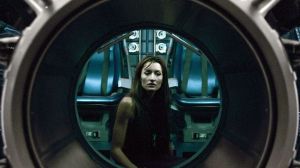 In short, Soderbergh is a restless artist who always seems to be trying to challenge himself. However, many of those experiments don’t always work. 2018’s Unsane would have been forgettable minus its iPhone gimmick. 2006’s The Good German would have been forgettable without its pastiche to older Hollywood style. Even when his movies do not fully work, you feel Soderbergh’s passion to experiment and push his boundaries. It’s with this context that I re-watched 2002’s Solaris, based upon the 1972 meditative and melancholic sci-fi movie by Russian filmmaker Andrei Tarkovsky. It’s amazing to me that Soderbergh, right after his twin Oscar noms and the box-office success of 2001’s Ocean’s Eleven gave him artistic cache, said, “I want to remake a three-hour Russian movie from thirty years ago.” And the studio said, “Oh, well, keep it under 50 million and half as long and we don’t care.” In 2002, Solaris was one of my more memorable theatergoing experiences, as I detailed in my original review. I’ve had walkouts during other divisive movies but nothing like what happened for Solaris. I’m fairly certain it was a matter of the crowd being sold a sci-fi movie with Clooney’s handsome mug, “from the director of Ocean’s Eleven,” and the promise of catching some Clooney rear nudity (12 days prior, the movie had received an R-rating before successfully appealing to a PG-13). They weren’t expecting a very minimalist, cerebral, and slow movie about grief and identity (it got a rare F grade from opening weekend Cinemascore audiences). By the end of the movie, the majority of patrons in my theater had left early. I thought maybe revisiting this movie twenty years later would perhaps allow me to find new artistic merit into this box-office dud. I have not.
There are ideas here worth exploring and unpacking, especially once the main conflict is fully established, namely Clooney’s dead wife Rheya (Natascha McElhone). Why is she coming back is less an interesting question, and thankfully the screenplay by Soderbergh ignores answering. It’s all about the effect it’s having on her husband and whether or not she is who she is. There’s an existential question of whether or not she constitutes living and what aspects do we hold onto to prove we are who we are? Is this the real Rheya, has she been plucked back from an afterlife? Is this a Rheya who has access to her earlier memories? Or is this Rheya merely a composite of her husband’s memories and personal and flawed interpretations? The mind boggles.
It’s that final question that presents the most intriguing exploration, as it presents Rheya less a fully-dimensional character and more a prisoner to her husband’s perspective. His view of Rheya can be biased, flawed, filling in gaps with assumptions and speculations, like his speculation that the real Rheya was so remorseful about aborting her child that she took her own life after being confronted by her husband. This leads the Solaris-rebooted version of Rheya to be more undone by depression and suicidal impulses. I enjoyed this portion because it shifted the criticism onto Clooney who refused to let her be gone. He even plans on taking Rheya back to Earth, even though that might not be possible. Will she evaporate if she gets too far away from the orbit of Solaris? We’ve gone beyond whether or not Rheya is a hallucination because the other crew mates (Jeremy Davies, Viola Davis) see her too. The movie flirts with the confrontation of Clooney’s character’s implicit control, that he’s literally dreaming a version of her for his emotional needs and he doesn’t care whether or not it’s the real Rheya. It begs the question of how well anyone can truly know another person. There will always be some observer distance, unable to fully delve into every hidden quarter of another person’s mind and heart. Clooney accepting his loss would have been a fine ending point, or refusing to, and Solaris does end on a similar downer ending, though with more radiant ambiguity. It’s interesting but it doesn’t really open up thematically or character-wise, keeping Clooney’s mournful space psychologist at a unsatisfying clinical distance. Just because we see moments of characters longing and looking emotionally bereft does not mean we know them. Maybe, in the end, that was Soderbergh’s meta-textual in-movie criticism.
 At 93 minutes, there’s not much to Solaris beyond its intriguing questions that feel only fitfully toyed with. There is a lot of empty space here for diving deeper into the characters and the relationships and big questions, but the movie feels too weighed down with its overwrought import. Scenes don’t play out so much as escape from the ponderous atmosphere. There are intriguing questions here but there isn’t enough story material to keep me connected. As a result, I became restless myself, zoning out while I watched a person stare off into the distance for the eleventh time, this time knowing that their internal thinking had to be different, somehow, from the ten other times. It’s a sci-fi movie without big special effects or action sequences. It’s starring George Clooney in, possibly, his most insular, minimalist role of his career. It was never going to be a jaunty crowd-pleaser. I haven’t seen the 1972 Russian movie but given its lengthy running time and the fact that it’s reflective of a Russian cultural experience, I have to assume there is more substance there and an adequate foundation to tease out these questions, but I’m free to admit my assumptions, much like Clooney’s character, could be all wrong.
As for my original review in 2002, I got to hand it to my twenty-year-old self. This is a solid analysis and with some snappy wordplay to boot. I’m impressed by this review. Solaris is another of Soderbergh’s “noble failures,” a project that cannot quite grasp its reach, but I’d rather artists like Soderbergh keep trying and litter the cinema with noble failures than inundate us with the same-old same-old.
Re-View Grade: C+
Share this:

Lightyear (2022)/ Luck (2022)
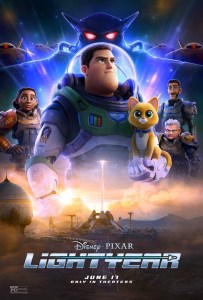 After two years and three movies sent straight to Disney’s burgeoning streaming service, Pixar returns with a theatrical movie that taps back to the very beginnings of this storied storytelling company. We’re told, via opening text, that Lightyear was Andy’s favorite movie and thus the reason he was so excited to bring home a Buzz Lightyear action figure in the first Toy Story. However, if this is Andy’s “favorite movie,” then this kid needs to be exposed to more movies. It’s an acceptable sci-fi story about Buzz (voiced by Chris Evans) learning the value of others and that being vulnerable is not the same as being weak. He’s a space ranger stranded on an alien world. Every time he attempts to restart their fuel system, it jumps him forward in time four years, and soon enough he’s a man out of time and those stranded have built a colony civilization over 100 years. There’s a band of misfits, who aren’t terribly funny, and some laser fights and action sequences, which aren’t terribly exciting, and the third act twist is predictable. The animation is top-notch, but the storytelling is definitely a few notches below infinity and beyond. What astounds me is that Andy could watch this movie and want a Buzz toy instead of the real breakout, the robotic cat Sox (voiced by Peter Sohn) who is wonderfully droll. I cannot fathom anyone watching this movie and desiring owning another character above this delightful supporting character. This movie makes me think a little less of Andy as a discerning arbiter of pop-culture zeitgeist. Lightyear is fine as escapist entertainment but too facile and inessential to the Toy Story universe.
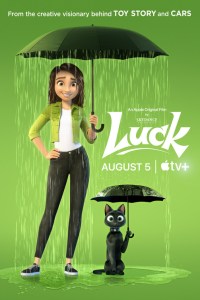 Luck is the first animated feature from Skydance, a production company that entered the animated realm by hiring former Pixar head John Lasseter as their chief creative executive. In some ways, Luck feels reminiscent of early Pixar movies, exploring the “secret life of” those in charge of dictating the forces of luck. The problem with Luck is that it is overwritten and overburdened with world building that crushes the emotional core. We follow a young woman aging out of the foster system and she’s been besieged with bad luck all her life. She follows a talking cat and discovers a hidden world where workers mine luck crystals and have lucky pennies as portal generators and there’s a dragon, for some reason, as the CEO of Good Luck, and to get back home she needs to team up with the cat to find a thing, but to find that thing they need to go to a place, but to go to that place they need to – and you get it. The plot is overworked with a chain of tasks that explain more of this world’s mechanics without connecting to the emotional journey of the character, like in 2015’s Inside Out. I was amazed that this woman lacks even a shred of bitterness about her own trenchant bad luck. There’s a nice message about accepting the bad with the good in life, and how both are opportunities for growth, but I kept wondering why our hero didn’t once lash out at those responsible. I’m also a little hesitant about using whether a little girl will be stood up by her potential new foster family as the stakes of completing the good luck reset goal. That seems pretty heavy for wackiness. The animation isn’t quite at the level of Pixar, or the best of Dreamworks, but it’s colorful and bright even if lacking more advanced lighting and texture. Luck lacks enough gravitas and development to really appeal to adults but it’s also probably too busy and convoluted to entertain small kids.
Nate’s Grades:
Lightyear: B-
Luck: C+


 nathanzoebl
You must be logged in to post a comment.