Blog Archives
The Last Stop in Yuma County (2024)
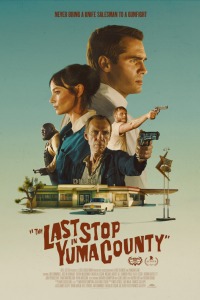
As a general rule of thumb, if some movie is described as “Coen-esque,” I must watch it. The Last Stop in Yuma County is a blend of Coen darkly comic malevolence, as well as Tarantino’s knack for the menace of dramatic irony and boiling tension waiting to explode, and it’s a firecracker of a debut for writer/director Francis Gallupi. It’s a relatively contained tale, sticking mostly to one rustic roadside diner and gas station along the dusty Arizona byways. On this day, two of its patrons happen to be recent bank robbers on the run, and they’re holding the other diner patrons captive until the gas pumps get fixed to fuel up and escape. The first hour then becomes a dread-filled game of waiting for things to go very badly. Our two main characters, a traveling knife salesman (Jim Cummings) and a waitress (Joceline Donahue) who happens to be the wife of the town sheriff, are working together to try and elicit help without endangering their lives, all the time more people keep entering the diner and inadvertently joining the simmering hostage situation. The way Gallupi writes his different characters is sharp and efficient, and the dread compounds in such organic complications, showing how fiendishly well-developed he’s made his potboiler. It also has a clear eye for style. Around the Act Two break, the movie becomes something else, which it intimated through a very specific film reference in conjunction with a specific character reference. It still proves compelling, but the overall sense of darkness and tragedy wore me down a little by the end. By the conclusion of its 90 minutes, I was hearing the saintly voice of Marge Gunderson in my head, shaking her head at the preventable body count and bad choices (“And all for a little bit of money. There’s more to life than money, don’cha know?”). The Last Stop in Yuma County is a twisty and twisted little macabre morality play in the guise of familiar Coen-esque capers. Welcome to the big leagues, Gallupi.
Nate’s Grade: B+
Share this:

The Station Agent (2003) [Review Re-View]
 Originally released December 5, 2003:
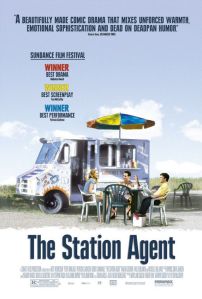
This is the most charming film of 2003, and Im not just saying this because I had an interview with one of its stars, Michelle Williams (Dawson’s Creek). Fnin McBride (Peter Dinklage) is a man with dwarfism. With every step he takes every look he gives, you witness the years of torture hes been through with glares and comments. Hes shut himself away from people and travels to an isolated train station to live. There he meets two other oddballs, a live-wire hot dog vendor (Bobby Cannavale) and a divorced mother (Patricia Clarkson). Together the three find a wonderful companionship and deep friendship. The moments showing the evolution of the relationship between the three are the films highlights. Its a film driven by characters but well-rounded and remarkable characters. Dinklage gives perhaps one of the coolest performances as the unforgettable Fin. Cannavale is hilarious as the loudmouth best friend that wants a human connection. Clarkson is equally impressive as yet another fragile mother (a similar role in the equally good Pieces of April). The writing and acting of The Station Agent are superb. Its an unforgettable slice of Americana brought together by three oddballs and their real friendship. You;ll leave The Station Agent abuzz in good feelings. This is a film you tell your friends about afterwards. There’s likely no shot for a dwarf to be nominated for an Oscar in our prejudiced times but Dinklage is deserving. The Station Agent is everything you could want in an excellent independent movie. It tells a tale that would normally not get told. And this is one beauty of a tale.
Nate’s Grade: A
——————————————————
WRITER REFLECTIONS 20 YEARS LATER
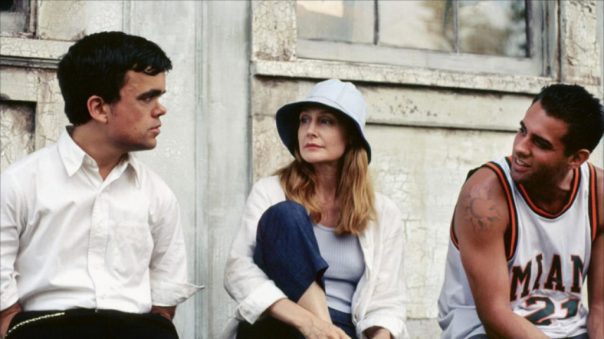
Tom McCarthy didn’t invent the quirky, found family indie but he sure seems to have nearly perfected it, starting with 2003’s The Station Agent. This little gem of a movie is so subdued, so relaxed, and so gentle that it seems to adopt the very personality of its lead character, Fin (Peter Dinklage), a dwarf who just likes trains a lot and wants to live his life in solitude. He’s an unassuming man who keeps to himself as a means of survival, because almost every time he goes into public life Fin is met with stares, snickers, and harassment (the convenience store lady gets his attention to take his unsolicited picture). Very few will get to know this man beyond his superficial physical characteristics, so he retreats within himself, perhaps purposely obsessing over an antiquated hobby as a means of escape to the past. He’s a lonely man and the movie is about him finding his clan, his place in the world, by slowly lowering his defenses. It’s a simple sort of story that is lifted by the strength of its characters and its wonderful ensemble cast.
With such a taciturn main character we need a contrasting character, a much more talkative person with high energy, and this is beautifully embodied by Bobby Cannavale. He plays Joe Oramas, a coffee truck operator who exemplifies joy de vie. He’s charming, garrulous, and relentlessly upbeat, which makes for a magnificent odd couple contrast with Fin, and it allows both characters to gradually change and grow attached to one another’s mutual friendship. Finn allows himself to become more vulnerable and form bonds and Joe starts to see the world from Fin’s point of view, allowing himself to slow down and appreciate the smaller things he might have missed in his excitable and irascible activity. Dinklage’s dry understated performance is a perfect counterpoint to the churning energy emanating from a grinning Cannavale. This is a fine showcase of both actors, who would go on to win six Emmys between them in the years ahead.
The third member of this found family is Olivia, played by Patricia Clarkson, and I actually think the movie might have worked better without her character. She does provide a point of view that our two guys lack; she’s experienced significant grief over a lost child and her life is in shambles as she tries to discover what she wants from her cratering marriage to a young-er John Slattery. Clarkson is also wryly enjoyable and gets some of the best lines in the movie, so she’s not at fault here. I think it’s because I’m confused about how this character is treated, especially compared to the natural opposites-attract dynamic of Fin and Joe’s friendship. Olivia feels like a broken thing that the boys need to try and help get better, but we were already covering this with Finn’s reserve from a lifetime of feeling ostracized. The possible romance between Fin and Olivia is also awkward because there are obvious implications that she sees Fin as a replacement son, even having him sleep in her son’s old bed. At one point, in her anger, she yells at Fin that she’s not his mother, but it feels much more like she’s the one who is looking for a surrogate son, and just because Fin is a dwarf and perhaps of similar heights makes the whole thing feel uncomfortable and ill-advsied. I’m not going to refuse an added Patricia Clarkson in my movie, but upon my re-watch twenty years later, it’s hard not to feel like McCarthy didn’t have as much envisioned for this part.
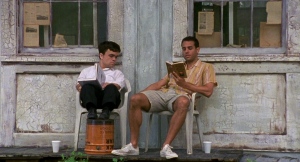 McCarthy’s movie acclimates the viewer to the simple charms of its people and the small town, getting to know the various characters and their foibles and hopes, getting used to the rhythms of this life and adjusting much like Fin. There are small victories that are payoffs, like Fin finally getting a library card, or speaking in front of a school class about his affinity for trains. It works so well. McCarthy continued his found family writing with 2007’s The Visitor and 2011’s Win Win, both anchored by the emotional enormity of sad, lonely men learning to open up to companionship. There were some dips in the road but McCarthy worked his found family magic to the biggest stage with 2015’s Best Picture winner, Spotlight, which McCarthy directed and co-wrote. His only follow-up theatrical movie was 2021’s Stillwater, where an oil rig dad (Matt Damon) tries to save his daughter overseas from a very ripped-from-the-headlines scandal (Amanda Knox was very unhappy). There is also a 2020 Disney Plus movie about a kid detective and his imaginary polar bear best friend (that actually sounds adorable). I guess I figured a Best Picture Oscar on your resume, as well as a history of working within the studio system and world of indies, would have given McCarthy more work than directing a handful of episodes for 13 Reasons Why and creating Alaska Daily. I’ll always be looking for the next McCarthy project when I can.
McCarthy’s failures can be just as intriguing as his successes. The Cobbler is just such an astounding idea that it’s hard to imagine anyone thinking it would work out, with Adam Sandler as a magic shoe-maker. However, this same pessimistic mentality probably prevailed when McCarthy was trying to raise money for The Station Agent. His indie successes proved that he could take any jumble of strange characters and turn it into a functional movie. Maybe that hubris, well-earned along with his contributions to the Oscar-nominated Up script, finally caught up with 2014’s The Cobbler. I would pay good money to one day watch that un-aired footage of the original Thrones pilot, the one the producers themselves acknowledged to be deeply troubled. After retooling the show and cast, bringing in Michelle Fairley and Emilia Clarke, McCarthy departed, though is credited for helping to secure Dinklage’s involvement, and it’s impossible to think of the zeitgeist-defining excellence of the HBO series with anyone else playing the iconic role of Tyrion Lannister.
 Re-evaluating The Station Agent twenty years hence, its many charms are still abundant and I appreciated how gentle and relaxed everything felt. When indie movies deal with heavy amounts of quirk and oddities, it can often be heavy-handed and abrasive, never letting the audience forget for a second just how special and strange and different the movie must be (here comes 2024’s look at Napoleon Dynamite). McCarthy’s movie almost feels like a writing exercise where he plucked three very different characters out of a hat and challenged himself to build a grounded movie built upon their unexpected friendships. It’s a movie confident to just let the characters speak for themselves. It’s more a slice-of-life glimpse at people who feel far more real than most Sundance indies built upon oddballs and quirk. I would slightly lower the grade from an A to an A minus simply because of the Olivia character. Clarkson is great but her role feels undeveloped, somewhat redundant, and a little sloppy. Still, the enjoyable performances, the observational detail, and the simple pleasures of a story well told with characters you genuinely care about are what shines through even twenty years later.
Author’s note: In my original review, I cite having interviewed Michelle Williams (yes, surprise, she plays the small-town librarian). While I was my college newspaper’s film critic from January 2002 to May 2004, I did have the opportunity to interview several actors and directors through phone cattle calls with other collegiate journalists. These names include Angelina Jolie (Tomb Raider 2), Billy Bob Thornton (Bad Santa), Kevin Smith (Jersey Girl), and the late Paul Walker (Timeline). However, my school schedule was not accommodating for the Williams interview, so I had my dormitory neighbor and friend Tim Knopp call in and ask my question. It wasn’t me. I’m coming clean after twenty years, folks. I also recall having him quote a line her character says in The Station Agent, saying Fin had “a nice chin,” and being told that she was baffled and blanking on the reference. I’m sorry, eventual multi-Oscar nominee Michelle Williams, for trying to be clever.
Re-View Grade: A-
Share this:

Jerry & Marge Go Large (2022)
 It’s the lowest of low stakes movie but a simple story with agreeable actors and a sweet enough core can be enough to fulfill 90 minutes of entertainment. Jerry & Marge Go Large is inspired on a true story of a retired couple who figured out a flaw in their local lottery and brought in the whole town to make an eventual windfall of over $27 million large. The draw of the movie is its cast, including Bryan Cranston and Annette Benning as our titular couple, and watching them generally make one another smile. This would not be out of place on a Hallmark Channel rotation. It’s simple, it’s sweet, and the town is full of aw-shucks nice people who all band together without anything in the way of larger conflict or rivalry or disagreement. However, the movie is also so slight to the point that it feels like an extended news magazine piece. There’s no real tension until a smug Harvard math whiz discovers the same lottery flaw tries to apply pressure to good old Jerry to get out, a storyline that feels like a fictional inclusion to add some degree of opposition to what is otherwise a story about a smart guy discovering a loophole and winning big for his whole town. It’s an interesting story but the real emphasis could have been as a character study for Jerry, a man who studies numbers for hidden insights but has difficulty connecting with people including his own adult son. We get glimpses of this as Cranston monologues or looks askance, but all these personality conflicts are resolved so tidy to the point that it feels offhand. The details of the true story are interesting enough, and everyone is coasting on such a mild and mellow vibe, that it’s easy to just relax and find comfort with the film’s small comforts.
Nate’s Grade: B-
Share this:

Mr. Deeds (2002) [Review Re-View]
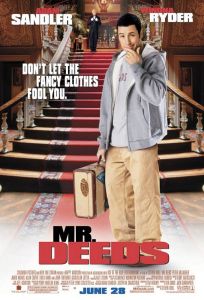 Originally released June 28, 2002:
Adam Sandler seems like the reason they created the “no shirt no shoes” policy for restaurants. His niche is playing the lovable goodhearted goofball that triumphs over the pretentious jackass and somehow wins the heart of the fawning one-dimensional love interest. Sandler appeals to the masses as our nation’s greatest warm-hearted simpleton. He’s the Jimmy Stewart of slobbery. So why mess with that? Well for starters, if you want entertainment anymore you might want to.
Mr. Deeds, Sandler’s latest idiot opus, is disastrously, even tragically unfunny. In the film Sandler stars as the only known heir of a multi-billionaire media mogul. Longfellow Deeds (Sandler) is a simple New Hampshire pizza delivery boy who treats people with respect and kindness. However, the mantra “cruel to be kind” must be alive and well because Sandler mercilessly beats people to about an inch of their life throughout Mr. Deeds for brutish comic effect.
Peter Gallagher and his monstrous eyebrows serve as the stand-in villain. Hes a greedy tycoon who wants the Deeds fortune all to himself. Gallagher actually plays his part well and seems to at least have some fun with the broad comedy role. Winona Ryder, on the other hand, does not. Ryder has never proven she can handle any comedy other than black, and slapstick just ain’t her thing. She painfully goes from scene to scene clueless as a tabloid journalist hiding her identity so she can get the scoop on Deeds, only to fall madly in love with him.
The film has some glimmers of comedy, mostly from its supporting cast including John Turturro as a very sneaky Spanish butler. It’s nice to see Turturro in something this high profile and get some recognition this journeyman deserves. There’s also a really funny cameo served up by a former tennis giant himself known for his boorish temperament. Steve Buscemi should be charged with grand theft movie because his three minutes on screen as the crazy-eyed local are funnier than anything with Sandler onscreen.
 The movie becomes far too redundant of Sandler’s other comedies to the point where seeing former stars like Rob Schneider in his Big Daddy character is somehow supposed to be funny. This kind of stuff is strewn throughout the film. It feels like everyone’s going through the motions. Now I’m not a total Sandler basher, because I do believe the man can be funny when worked right. Billy Madison is still hysterical to me upon every viewing and I do get some fun watching The Wedding Singer, but Mr. Deeds is sub-par Sandler even for Sandler.
I’m sure most of the people buying tickets for this have no idea that the concept is based upon the Frank Capra film starring Gary Cooper. But what good is Gary Cooper? He didn’t write cutesy greeting cards or save a litter of kittens from a raging inferno like Sandler’s Deeds. In the end, this mostly laugh-free comedy is short on imagination, energy, and entertainment.
Nate’s Grade: C-
——————————————————
WRITER REFLECTIONS 20 YEARS LATER
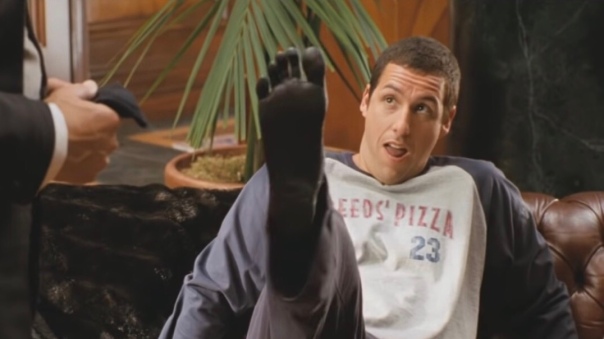
Adam Sandler became his own industry. The Saturday Night Live funnyman became a movie favorite starting in 1995’s Billy Madison, still my favorite of the early Sandler era, finding the right balance of stupid, irony, absurdity, and crass humor. His ribald comedy albums were must-owns for any teenager in the 1990s. By the early 2000s, he had accumulated a team of collaborators of directors (Steve Brill, Frank Coraci, Dennis Dugan) and writers (Tim Herlihy, Fred Wolf, Steve Koren) who would churn out comedies on a near yearly basis. From 1998-2015, Sandler starred in 20 movies that can be deemed Sandler vehicles, a soft-spoken schlub with a heart of gold who is prone to explosions of violence and seems endlessly underestimated or misunderstood by a larger world of condescending, out-of-touch elites. There is a wild spectrum of quality during this period, and as the years progressed Sandler began to transform from the slovenly goofball provocateur to the laid-back, wisecracking family man trying to convince non-believers of his righteous old-fashioned wisdom. His once outsider status had calcified into a sentimental, middle-aged “these kids today don’t get it” laziness. Many of his later movies felt like glorified excuses for his family and friends to take extended vacations around the world. Since 2016, Sandler has migrated his slob squad to Netflix and continued his usual schtick to lesser publicity. The only time Sandler seems to have broken through since he hit that late 2000s plateau is his occasional dramatic performance, like 2019’s intense and gritty Uncut Gems. He’ll even star in a basketball drama for Netflix this month (Hustle). The real reason I picked Mr. Deeds to re-watch for this month was so I could better compare and contrast for a later re-watching of 2002’s Punch-Drunk Love, Sandler’s first dramatic acting revelation thanks to Paul Thomas Anderson. As for Sandler’s take on Frank Capra, it never overcomes his trademark laziness.
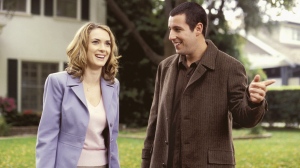 The story of Mr. Deeds began as a heartwarming tale about a small-town man whisked away to the big city who provides a little small-town good charm to those in need. 1936’s Mr. Deeds Goes to Town was nominated for five Academy Awards including Best Actor for Gary Cooper, Best Picture, which it lost to The Great Ziegfeld, and Capra winning the Oscar for Best Director. It’s a well-regarded and wholesome movie that champions many of the major themes prevalent in Capra’s popular filmography. To take this starting point and say, “what if we made Adam Sandler the star and he just assaults people before convincing people to follow their dreams?” The problem with Mr. Deeds is that everything comes at great ease for our protagonist, who is never asked to change or think differently; no, it is the world that needs to change and be a little more like Longfellow Deeds (Sandler). He’s a humble man-of-the-people who will literally carry the elderly on his back to help them cross the street. The New York City natives just view him as a small-town rube but he’ll convince them all that his simple ways are the real way to live. Except if you watch this movie and think, “I need to pattern myself after that guy,” then you are either wholly susceptible to the slightest influence or you’re looking for an excuse to hurt others with impunity. Mr. Deeds regularly beats the crap out of people who he feels have crossed a line. His newfound riches essentially inoculate him from any consequences (as is the American way). I guess the slapstick is supposed to be riotous but it just made me uncomfortable and bored. Apparently, when Sandler tackled Allen Covert to the ground to beat him silly, Covert really did hit his head against the pavement and went unconscious for a minute. The entire concept of the movie rests upon Deeds being a likeable fellow others wish to emulate, but under the guise of Sandler-ification, he comes across as the kind of guy you’d walk across the street to avoid.
Let me use one example to highlight the failure of the Deeds character. He’s in a fancy restaurant and is hailed over by a gathering of rich elites who want to hobnob with the newest moneyman. For whatever reason, their suck-up turns into broad insults, which is confusing considering how many of them are financially dependent on his company. As they yuk it up in sycophantic laughter, Deeds shakes his head and says, “You all invited me here so you could look down on me. Well, let me tell you that here you may all laugh at me, but down in Mandrake Falls we would laugh at you all.” Examine that for just a little bit longer, dear reader. He’s not saying that the good people of his hometown would act better than these big city folk, accepting others for who they are and being welcoming and sincere. No, he’s saying if they were in Mandrake Falls, they would be laughed at and made fun of for being all different. It’s less a declaration that his small-town way of life is better and more wholesome and more a confessed threat if they ever found themselves in the minority. I think Sandler and company thought they had their hero on a moral high ground, but this line proves otherwise, and then he just physically assaults them all too.
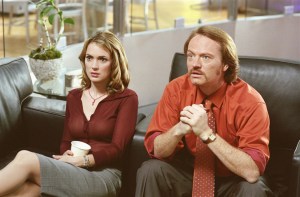 The comedy is predictable and lackluster, and the longer the movie went the further I sank into a general state of apathy. The poems by Mr. Deeds are supposed to be lame, so I guess the comedy is just how bad they are? That just sounds like excuse-making, though thankfully it’s just one trifling example and not much is hinged upon Deed’s greeting card dream. Much of the movie revolves around the budding romance with an undercover reporter, Babe (Winona Ryder), who comes to love the man for some reason unknown to anyone observing. It becomes a bit of a screwball comedy with her attempts to keep her cover, but by the end she’s meant to serve as the audience surrogate and convince us that this man was worth our investment. The only parts of Mr. Deeds that made me smile or come close to laughing were the absurd supporting characters getting little moments. I loved Steve Buscemi, who became a Sandler regular, as a crazy-eyed town weirdo spouting bon mots like, “Time heals all wounds… except these crazy eyes.” I enjoyed John Turturro’s commitment to his sneaky yet helpful Spanish butler. I enjoyed the John McEnroe cameo and night on the town indulging their boorish behavior. I enjoyed watching Jared Harris go broad comedy as an obnoxious newsman. The actor has such innate, weathered pathos to him that I cannot even recall ever seeing him in another comedic role. I liked Eric Avari (The Mummy) as the second-in-command guy who chums it up with Deeds. I enjoyed moments that didn’t involve Sandler or Rider, but those are the two main stars, so time away from them was fleeting though appreciated. The general unfunny nature didn’t offend me like some other bad comedies, but it sapped whatever care and energy I had for the movie.
In the realm of Sandler cinema, Mr. Deeds is on the lower end. It’s not among the worst of his worst. It’s passable to watch if you’re just skimming for the occasional comedy nugget. I didn’t feel insulted but I was also coming to this movie with decades of hindsight of the Sandler cinematic universe, able to discern his more prominent themes and cliches and reflexes. I’ve never watched the 1936 Capra movie though I’m curious to do so now for the simple reason of seeing just how far away Sandler’s version veers. They also turned the Mr. Deeds story into one season of a 1970 TV series starring Monte Markham (Captain Don Thorpe on Baywatch!). There’s something inherently engaging about a moral person placed in a new environment and how the environment changes to that person rather than the other way around. It’s essentially the plot of WALL-E, one of my favorite movies. It works. Except with Sandler’s version, the filmmakers were on Sandler autopilot, a condition he rarely broke free from (Drew Barrymore collabs seem to be the exception). From here, the Sandler movies got lazier and stodgier and more sentimental yet also phonier. I haven’t watched a Sandler-lead comedy since 2016’s The Ridiculous Six, his first Netflix release. I genuinely wish he would stick to more dramas. He has real acting strength, first explored in Punch-Drunk Love (you can’t get here soon enough), and I’m hoping I’ll only better appreciate that movie having re-watched a shining example of what Paul Thomas Anderson was aiming to deconstruct.
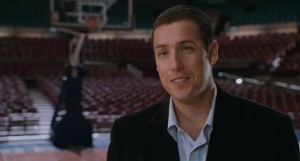 As for my earlier review in 2002, it’s entirely accurate. Everything I said still applies, even the C-minus grade. You could charitably say Mr. Deeds was where the Sandler formula became fully entrenched. It was a big hit ($170 million worldwide) and vindication after Sandler attempted something truly weird and different that flopped (2001’s Little Nicky). You can see the gears turning, and so the next decade-plus brought us more of the same Sandler schtick. For one of the most dangerous comics, he became safe and sated and all too happy to pack it in for mass appeal. Consider this otherwise forgettable movie a footnote in the arc of Sandler’s comedy oeuvre, and that’s about it. Mr. Deeds is just as shrug-worthy in 2022 as it was back in 2002.
Re-View Grade: C-
Share this:

Ghostbusters: Afterlife (2021)
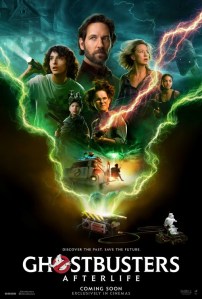
As I stated in my review for the 2016 Ghostbusters, allow me to wax nostalgic and explain my own private history with the franchise: “Growing up in the 80s, other kids had Transformers, or G.I. Joe, or He-Man, but I was a Ghostbusters kid. I fell in love with the 1984 original movie, slept below the poster for most of my childhood, and obsessively collected all of the action figures and toys, watched with glee the animated TV series, and hold the world and its characters in a special personal place.” This franchise means something to me. I think about the hours I spent playing in this world and my imagination and my own stories illustrated with marker and crayon, and it makes me extremely happy as well as reminds me how I fell in love with weird storytelling and macabre, ironic humor. I’ve been waiting for more Ghostbusters movies for my adult life. The 2016 movie was fine, I wasn’t enraged by it in the slightest, but it didn’t scratch that itch. While replicating some of the same plot beats, the 2016 movie was not reverent to its source material. Now the 2021 Ghostbusters, delayed over a year and a half from COVID, goes completely in the other direction. Ghostbusters: Afterlife is reverent to a fault, and while it has been met with mixed reviews and complaints of overdosing on slavish fan nostalgia, I found it to be a charming and fun family adventure that left me laughing, cheering, and even crying.
Egon Spangler (Harold Ramis, R.I.P.), original Ghostbuster, is dead, killed by a malevolent spirit. His estranged adult daughter, Callie (Carrie Coon), and her two teen children, Trevor (Finn Wolfhard) and Phoebe (Mackenna Grace), are shocked to learn of his death and their unexpected inheritance: a dirt farm in small-town nowheresville Oklahoma. They don’t know much about their grandfather and the kids are not exactly excited about relocating to a secluded mining town. Phoebe starts discovering weird pieces of technology hidden in the old house of her grandfather’s. A presence seems to be reaching out and trying to get the family to understand their real legacy. It appears that Gozer the Gozerian was not fully defeated on top of that New York City skyscraper in 1984, and Phoebe and her family must learn about the past in order to make sure we all have a future.
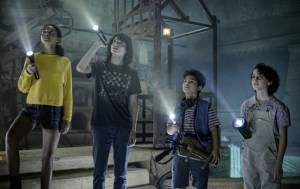
I can understand the charges of Afterlife being too nostalgic, but I don’t understand the charges of it being so enamored with its past that it poses a disservice to the movie standing on its own. This movie is intended at its very DNA to live within the shadow of the original films. The director and co-writer, Jason Reitman, is the son of the original films’ director, Ivan. It’s going to be reverent but that’s not an automatic bad thing. Whereas the 2016 reboot shrugged at past convention and went completely comedic, this edition takes the opposite approach, hugging onto the lore and past of Ghostbusters with heartfelt affection. If you’re a fan of the franchise, this adoring approach will likely be more favorable, not that the 2016 film is wrong for eschewing the established canon of the franchise and trying something new. If Afterlife had been a completely original story set in a Ghostbusters universe, I would have happily accepted that. However, just because something is outwardly nostalgic, or taps into fan service, does not mean it is destined to be an exclusive retread that only satisfies the hardcore base. I didn’t need the gratuitous Easter eggs of passing shots of a twinkie or Crunch bar, but they’re blink-and-you’ll-miss-them moments that don’t really relate to anything of consequence, so I can excuse them. Afterlife is similar to The Force Awakens in that it uses familiar plot beats to mirror events of its predecessors to ease back fans and new members to the fanclub, most especially in Act Three where Gozer’s demonic pooches are unleashed. I can understand many chaffing at this, but I feel that Afterlife does enough to justify its own creative existence even in facsimile rather than as some insular, facile, fan-stroking cash-grab.
This is, by far, the most dramatic of the Ghostbusters movies, a series that has existed in the realm of comedy. The prior movies were never spooky on adult terms, but they reached back into a primal, childlike curiosity and anxiousness over the unknown that made them creepy when they wanted to be. I don’t understand the umbrage some have expressed over Afterlife being more of a drama. First, the comedy is present throughout the movie with the characters making specific and wry observations that feel fitting for their situation. The humor is not as forced as the loping line-a-rama improv jazz riffs of Paul Feig’s 2016 film. I think this universe can sustain different kinds of stories being told, and I think that drama is perfectly acceptable as long as it’s earned, just like the comedy or horror elements. The central premise involves an estranged family coming to know the secret life of an absentee relative who abandoned them, so the more they learn about his Ghostbusting past and responsibilities, the closer they come to uncovering a clearer picture of who this man really was as well as their connections to him. Reitman and co-screenwriter Gil Kenan (Monster House) have smartly connected the investigation of the past into the development of personal relationships. We in the audience know the significance of the Ecto One and the ghost traps, but the new characters do not. We await them to understand the knowledge we already attain, but the movie doesn’t play this as characters dawdling. Each discovery unlocks new potential for the characters to shape who they choose to be, and each one gets them closer to their grandfather and reshaping their conception of the man who they wrongfully believed abandoned them for folly.
This all leads to a climax that had me genuinely in tears. I won’t exactly spoil it but Afterlife’s conclusion is less concerned with beating the Big Bad Gozer yet again and saving the universe. Reitman and company have smartly placed the real climax as an emotional catharsis; it’s more in keeping with Field of Dreams than some huge Marvel apocalyptic showdown. The ending is personal, emotional, and reaches into our universal desire for closure, for having that one last moment with a beloved who we no longer have any moments left to share, Reitman is clearly missing Ramis, a close family friend and inspiration who died in 2014, and this is his own way of processing his personal grief, offering an emotional output for the fans to share in, and allowing a grieving character/surrogate to find that needed release. It serves as a fitting conclusion and a special end note for any Ghostbusters fan who has held this franchise close to their heart for several decades, especially if shared with a paternal figure who may be gone.
The film also successfully channels a childhood perspective of awkward and awesome. It’s hard to create a story where a group of precocious adolescents discover strange things cooking in their sleepy small town without suggesting Stephen King and Stranger Things, but this isn’t necessarily a total negative. The earlier movies were always from a more cynical adult perspective. Yes, there were characters like Ray (Dan Ackroyd) and Egon who were true believers, but they were often set up for easy laughs. The tone of the series was mostly tied to the irony of the character of Peter Venkman (Bill Murray) that looked at the supernatural with droll detachment. This is the first Ghostbusters entry where the primary perspective is from children, and there’s something hopeful and heartfelt about a younger point of view with the supernatural material. These kids are excited and eager to learn more about the somethings strange in their neighborhood. It becomes endearing to ride along with them as they get to jump into the action. I loved the concept of a sidecar gunner seat for the Ecto One and how it felt like a childhood dream coming true. But it’s more than fan service because it serves as a point of progression for Phoebe’s sense of self, of embracing her scientific interests and roots, and taking charge in the face of unknown danger. It’s a coming out of sorts. When the kids are driving through (the always empty?) town and chasing a runaway ghost, wrecking storefronts from the boom of the proton pack, it’s a blast for them and us.

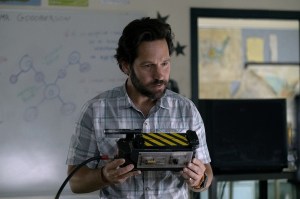
This is Reitman’s most commercial and mainstream film of his Oscar-nominated career. It’s interesting to me that this indie darling, who was on such a hot streak in the late 2000s, hit some speed bumps with the critical misfires of 2013’s Labor Day, 2014’s Men, Women, and Children, and 2018’s The Front Runner, so the next movie is a retreat to a big-budget franchise film. Reitman doesn’t necessarily have the best feel for large-scale spectacle, but he knows intimate character dramas and guides his actors well. Grace (Gifted, Haunting of Hill House) is wonderful as our plucky lead. Unfortunately for Wolfhard (It, Stranger Things), his dull character has nothing to do but pine for a local girl, scoff at his family, and then fix up the old ghostbustin’ mobile. Paul Rudd (Ant-Man) is as charming as ever as the school science teacher, especially as he nerds out over interacting with the Ghostbusters paraphernalia like an excitable fanboy living out his childhood dream. I wish Coon (The Leftovers) had more to do, but that’s my primary complaint in any movie where Carrie Coon is a supporting actress. Her chemistry with Rudd is strong and they could have done so much more together as adults trying to make sense of madness. They could have eliminated Wolfhard’s mopey older brother character entirely and given us more time with the goofy adults too. One feels like there is some secret contract where anything relating to 80s nostalgia requires the hiring of Wolfhard on hand.
Ghostbusters: Afterlife will not be the best movie of 2021. There are areas that could have been improved and streamlined and better developed. However, Ghostbusters: Afterlife will most assuredly be my favorite film experience of 2021. It’s a heart-warming continuation for fans with enough wit and whimsy to charm while owning its obvious and intended connections to the original. I may not be the most objective source on this particular matter, but I know what I like, and this movie had moments of pure happiness that just shot right through to my dopamine center. We’ll see if this movie can restart the dormant franchise, and strike more on its own, but even if this lone 2021 entry is all that we eventually get, I’m happy I got to experience this magic once again. I can’t wait to see it again with my dad.
Nate’s Grade: B+
Share this:

False Flag (2019)
 Imagine the U.S. government is rounding up citizens, detaining them, and robbing them of their rights with the idea of installing a system of fear and compliance. No, it’s not the news on abuses of power via unchecked bodies like ICE, this is the plot of False Flag, a low-budget found footage action movie that happened to film in Ohio and is now widely available online as well as being carried on your friendly neighborhood Wal-Mart shelf. I congratulate them on getting their movie out there to the masses. The finished film has some narrative and execution issues but can still be an enjoyable experience, especially for genre fans of military thrillers. Strap in.
We open with a fringe conspiracy host as the frame story, telling his audience what they’re about to see is real footage compiled together to indict the U.S. government. In the small Ohio town of Madison, brothers Mark (Sean Mount) and Ash (Justin Rose) are feuding with old grievances and new, including Mark getting married to Stephanie (Olivia Vadnais). Ash has brought along his YouTube-eager pal Donny (Andrew Yackel), who is obsessed with recording everything for his fledgling channel. Then all of a sudden there is a high-pitched shriek, military vehicles roll into town, and citizens and protestors alike are rounded up and beaten. Ash, Stephanie, and Donny seek shelter with a conspiracy journalist (Jennifer Andrada) and some local militiamen armed and ready to combat what they viewed as the eventual tyrannical government takeover. Over the course of one long night, our people try and escape and get their story told.
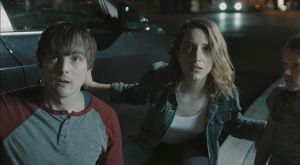 Before I go into further detail on some of the shortcomings of False Flag, allow me to highlight its positive aspects. This is a pretty good-looking movie for being a low-budget action thriller, and the cinematography has a nice color balance to many scenes. A race through a maze of school hallways at night is made all the moodier by the professional aesthetic, and many of the action scenes are pretty solid and staged well. The larger riot sequences and chaos that erupts are coordinated well with the background action giving way to whatever blocking our main characters need. The use of the military vehicles also helps lend to the credence of the “it could happen even here” reality. The acting overall is pretty solid without a bad performance. Surprisingly enough, writer/director Aaron Garrett (Foxcatcher) gives one of the more memorable performances as a local mechanic by day and would-be Rambo when called upon. The movie gets markedly more entertaining when he comes into the picture and is able to even the odds. He has a smoothness to his performance that grabs your attention. Yackel (Swamp Thing) has a pleasant presence and a squirrely demeanor that can be endearing. Andrada (Macabre Manor) stands out early as the on-location correspondent for the Alex Jones fringe TV show. She has an affectation that makes her talk very directly, quoting often, but it counts as a viable personality and a pointed perspective that helps butt up against others.
False Flag is the kind of movie that seems like its intended audience are the doomsday preppers and gun hoarders that envision themselves as a Hollywood action star waiting for the eventual government tyranny to give them their time in the spotlight. This premise can be done with skill but absent that it feels like a misguided wish fulfillment that encourages radical thinking in fringe people. I’m not saying the movie is irresponsible. I’m saying that False Flag exists in the same kind of universe of a “Jade Helm” takeover, where it only makes sense for the people who already think along these lines. At one point one character asks a prepper what’s in it for the government to perform its false flag operation, and he responds, “Global totalitarianism.” What does that even mean? Are the police acting in conjunction with the military? Have the military infiltrated the ranks of small-town police officers? It’s rather nebulous. All we know is that someone is taking over for vague reasons and there doesn’t seem to be enough of them.
Eventually it’s theorized that the government is doing this in a small-town to blame on terrorists and justify further military action. But… why is any of that necessary? The United States public has already accepted the idea of going after terrorists, especially on foreign soil and in the age of drone warfare. The U.S. military doesn’t need more public support to go after this already targeted target. If it’s to blame political activists as domestic terrorists, then this plan sure is sloppy. Nobody in Madison we see attempts to call for help, post their recordings, or even watch TV until seemingly hours after the start of the martial law, which is insane. It takes away from the seriousness if characters aren’t immediately trying to make outside connections. When the characters break into a school where prisoners are being detained in a cage (very reminiscent of our current concentration camps along the border) and there are NO GUARDS whatsoever in this room to watch. This is one incompetent government takeover. There is one moment that I had to stop the film and walk around my home because it simply astonished me (some spoilers to follow). The characters cut open a chain-link fence keeping people inside their detention cage… and the other people… stay put. I guess they realized what an important moment this would be to reunite the brothers and didn’t want to ruin it for the cameras. These people act with no urgency when they can flee, and I am still reeling from this moment.
 The very ending tries to flip the script but by that point it feels too late and too confusing. I’m at a greater loss what the whole operation was for, who benefited, and who was playing along. There’s some ire toward media manipulation but it feels too late to switch gears with who the recipient of the film’s condemnation is going to be. There’s a five-minute epilogue that throws everything in doubt and leaves you questioning what you saw, but I don’t know what the supposed agendas are and who is playing who and why. Good luck.
The dialogue is pretty plain, which is fine, but its use of exposition is heavy and rather inarticulate. Exposition is a tricky issue because any writer needs to make it as invisible as possible and think about what is essential and when it can unfold to the audience in a hopefully natural manner. There are easy ways around this like the ole answering machine message that fills in the blanks. Here is a sample from about a half hour into False Flag after the first big riot with police:
Stephanie: “…So your mom’s a doctor?”
Little Girl: “Yeah, so, she’s not home that much. But it’s okay I guess.”
Stephanie: “What about your dad?”
Little Girl: “John… I don’t know. He works for the government as a translator or something like that. He and my mom split up while I was young. We were actually on our way to DC to meet him before all this.”
Stephanie: “Sorry.”
Little Girl: “Don’t be.”
Stephanie: “Do you have any brothers or sisters?”
Little Girl: “Nope.”
Stephanie: “Must be tough being alone all the time.”
Little Girl: “Not really. I grew up pretty fast.”
Stephanie: “I can see that. You’re a pretty strong girl. How long have you lived in Madison?”
Little Girl: “I know you feel like you have some responsibility to keep me safe or keep my mind off what happened but you don’t. I can take care of myself.”
This example stunned me with how transparent the exposition was, which forced characters to speak like they were more machines built to espouse helpful context. Real people do not blab everything about themselves in case someone may be watching who doesn’t know the key parts of their background. Real people do not talk like every moment is a job interview. The problem with False Flag is that there are too many scenes likes the one above, where characters vomit out the necessary info in such a transparently clunky way that it further breaks the film’s reality.
The found footage conceit provides more problems that are not addressed. Firstly, the nature of found footage means there has been a hidden editor and this is all the more relevant because the showcase for this footage is the Alex Jones-style show, which means someone has intended for it to be broadcast for an audience. This brings up the same questions of why the mysterious editor elected to install a narrative. Why is it important to set up these people like they are characters when the important parts, the government’s supposed false flag entry, is the big deal? Furthermore, why is this mysterious editor splicing in flashbacks from an earlier recording of the two brothers running around in a park? This was cleverly done in 2008’s Cloverfield but that’s because it was taped over a previously existing recording, allowing for the good times of a former relationship to sneak in for contrast. But if the intent is the broadcast and to highlight government abuse, why has the mysterious editor chosen again to bend toward a narrative?
 Then there are things that simply break the reality of the found footage conceit, enough that they took me out of the movie and I had to start cataloguing them. The general idea is that we have Donny with a handheld camera and Ash with a body camera attached to his ear like a Bluetooth device, but you better believe every scene has the characters adequately framed, which means Ash is awfully cognizant of how he needs to turn and tilt his head in order to get a workable camera angle from his vantage point. When the camera gets passed to other characters, why do they continue recording? Ignoring even that since the movie needs it to carry on, there are moments that shatter the illusion of found footage, like one of those park flashbacks where we see Mark run into a clearing to help his brother and he sets the camera down not on the ground but on… something. When we saw him running there was no rocks, no trees, nothing to be seen, which means I have no idea what this camera is resting on. The most egregious is a conversation where the camera literally racks focus as the woman is talking. She doesn’t move out of her position and it happens even before she turns around, as if the camera KNEW the attention should be on the people in the distance who Donny was referring to. If you’re going to go the found footage route, things like this cannot crop up.
As far as low-budget action thrillers go, False Flag can sate your moderately checked expectations. It provides some thrills and with a professional presentation and uniformly solid acting. The story is pretty threadbare and the found footage conceit feels too minimally thought through, serving a larger point that ultimately is muddled by its rushed and twisty delivery. I think this premise and even the found footage approach could have been a dynamite combination, but it required a bit more development and consideration. False Flag is not a bad movie and I admire much of its technical grit but it is pretty standard thriller stuff, which means it’s hard for it to distinguish itself against the glut of other low-budget direct-to-DVD action lining the catalogues of streaming and shelves.
Nate’s Grade: C
Share this:

The Dead Don’t Die (2019)
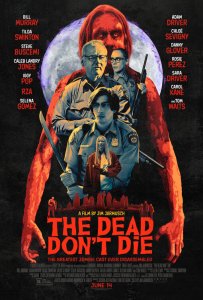 If you’re a Jim Jarmusch fan, you can probably stop reading now. I encourage you to continue but I don’t know if anything will be of help for you from here on out because, frankly, I don’t understand you. Jarmusch is a longtime staple of indie film and I’ve watched three of his films (Only Lovers Left Alive, Broken Flowers, Ghost Dog) and disliked all three to varying degrees, and that’s fine. There are plenty of hallowed names in filmmaking that are just beyond me, like Terrence Malick and Nicolas Refn, but I can at least partially understand what the fans of those auteurs value, an immersive visual, sensory experience at the sacrifice of narrative and coherency. When it comes to Jarmusch, I just don’t understand the appeal whatsoever. This is a man who found a way to make vampires crushingly boring, and now he finds a way to do the same with zombies. The Dead Don’t Die is the widest release of his career and it might be the worst movie I’ve seen in a theater all this year. It certainly feels like the longest.
In a sleepy small Ohio town, the police force consists of Chief Robertson (Bill Murray), Ronnie (Adam Driver), and Mindy (Chloe Sevigny). They’re going about their typical day, warning Hermit Bob (Tom Waits), listening to the alarmist worries of Farmer Frank (Steve Buscemi), and picking up supplies at the hardware store run by Hank (Danny Glover) and Bobby (Caleb Landry Jones). There’s a traveling group of students, lead by Zoe (Selena Gomez), as well as a group of kids in a juvenile detention center. Then the dead come back and small-town life will never be the same.
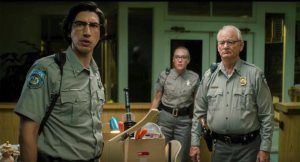 Anyone walking in expecting a zany comedy from the premise and cast, not to mention marketing materials, will be sorely disappointed, because what The Dead Don’t Die better resembles are the humorless anti-comedies of late-night Adult Swim blocs. It’s not so much that there are jokes, it’s more the absence of jokes, and somehow that might be the joke? The humor is stuck in one mode throughout the film. A character will slowly say something understated or obvious (Example: “That’s not good”) and then the reaction of others will be delayed, and then after that nobody will say anything for several painful seconds later. That’s about it, folks. It’s hard to find humor with that. The deadpan jokes are too obvious and too uniform to really strike any potent comedy targets. The consumer “satire” is brittle to the point of breaking. Various zombies will shamble around and say one-word items of whatever was important to them, ranging from “Coffee,” to, “Fashion,” to, “Chardonnay.” It’s like the one-word utterances are the entire joke (Hey, this dead guy liked fishing, isn’t that a riot?). It’s not satire and it’s not funny. How about the characters of Rosie Perez and Tilda Swinton being named Posie Juarez and Zelda Winston? Is that the kind of humor that sounds appealing? How about Tilda Swinton flexing a samurai sword to slice and dice the undead. Is that supposed to be cool? Is it supposed to be funny? Is it supposed to be funny that it’s trying to be “cool”? What is anything?
Later, the film inserts a new comedy element with meta asides where people seem to know they’re in a movie, and yet again the jokes are obvious and uniform, except now it’s even lazier, relying upon the meta recognition to simply stand in the place of a joke. If anything can happen in the small town, especially toward its crazy end, then why do these things have to happen? Or better yet why don’t better things happen? Because of the deadly pacing it makes every attempted bad joke feel that much more unbearable.
This movie is only 105 minutes but it felt so much longer. the pacing not just as a whole but scene-to-scene and even line-to-line from conversations is deadly still. Every moment feels stretched out but it doesn’t ever feel like you’re going anywhere. Characters will be introduced and given meet-cute moments and little indicators they might be significant players later, and then we’ll just find them dead. Other characters will be introduced and then never leave their locations, having no bearing on the larger story. It’s rare that I could honestly say there are entire supporting swaths of this movie that could be cut completely and not impact the story at all. It makes the many storylines we hopscotch across feel like they don’t matter and are generally wasting our valuable time.
 Then there’s the ending where Jarmusch just instructs Tom Waits to unleash a torrent of narration bemoaning how society deserves whatever downfall it incurs and that we’re all just zombies anyway. It’s so clumsy and overbearing and unearned after an entire movie where the cultural criticism amounted to a racist saying he doesn’t like his coffee black and then pointedly staring at the only black man in the movie. Even if we got more moments like that I might say some of the ending vitriol is justified, but the commentary gets muted in the middle until Waits has to finally tell us what the point is. There are scant political and environmental references but they feel like tossed asides themselves.
I don’t blame the cast for any of this although I can’t say what on the page must have seemed attractive. Murray is always going to be an amiable screen presence and Driver is a fun partner, slipping into a skillful deadpan and straining to find humor where there is precious little. Everyone feels wasted on screen because even if you’ve never seen these actors before you know, instantly and instinctively, that they have been far better.
The Dead Don’t Die is further proof that I am not a Jim Jarmusch fan. I can’t fathom how someone can actually be a fan of this writer/director. I was tempted to walk out at several points but I held in there. The jokes are too obvious and barely jokes, the pacing is awfully slack, and the whole movie is reprehensibly boring. Even when it has moments of weirdness it finds ways to make it boring. The structure does little to nothing with a large ensemble of very good actors. The movie and premise had potential. The idea of a zombie outbreak in a small town where everybody knows everybody is ripe for comedy and tragedy. Ultimately The Dead Don’t Die feels like one egregiously long in-joke that the audience isn’t privy to. The joke’s on us, folks.
Nate’s Grade: D
Share this:

Brightburn (2019)
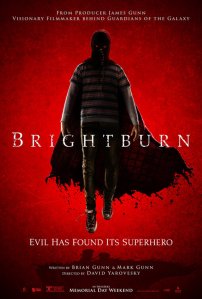 Many writers and artists have re-imagined the origin of Superman, the alien orphan sent to Earth and raised by the Kents into a thoughtful young man who empathizes with the humans he has come to identify with. What if that alien child, blessed with powerful abilities, didn’t decide to become a hero and instead saw himself as superior? That’s the premise of Brightburn which looks at the Man of Steel through the lens of The Omen.
In the small Midwestern town of Brightburn, Tori (Elizabeth Banks) and Kyle Breyer (David Denman) are a couple struggling to conceive, and then one fateful night a spaceship crash lands on their farm. Inside is a baby boy they decide to raise as their own son. Flash ahead a decade and Brandon Breyer (Jackson A. Dunn) is a normal kid except he’s never been sick, he cannot be cut, and he’s starting to develop even more powers thanks to his spaceship seeming to activate something within him. It also fills his head with an alien message, one not too friendly for the people of Earth. Tori and Kyle must reconcile how far they’re willing to go to protect their son and whether it’s at the expense of the well-being of billions.
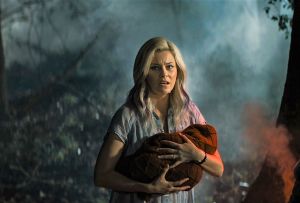 Brightburn takes its thought exercise to the limit, fully developing its intriguing angle of what if the story of Superman went in a much darker, much bleaker direction. Instead of representing a hope for mankind, what if this alien son represented its demise? As I was sitting back and watching, each element felt well placed and well thought out, contributing to a feeling of satisfaction that the screenwriters have given considerable thought to telling not just a good story but the best version of their story. There’s a very early science reference to wasps that tells you exactly where the film is going. I have some small quibbles when it comes to motivations, in particular the flip in Brandon, but these are minor and honestly could have been smoothed out with one or two added scenes. I appreciate that writers Brian Gunn and Mark Gunn (cousins to James) start things rather dark and see it through. This is the kind of movie you pray doesn’t go soft and squishy by the end, where the irredeemable monster is reached through the power of love. This is not that movie. With an all-powerful monster, it would be a cop-out to somehow slide in a happy ending. The entire trajectory of the movie feels appropriate, quibbles over rushed motivation aside, and where we end up feels predictable but right.
The biggest comparison I can make with the film isn’t any of the Superman adventures but a little indie, 2011’s powerful character study, We Need to Talk About Kevin. For those unaware, that movie followed a woman whose son grows up to be a school shooter who also kills her husband and daughter. The movie skips around in time and in doing so reveals through flashes of memory key incidents, flashpoints, where mom realizes something just isn’t right with her dear old son. It’s a test of a parent’s love but it’s also a test of how far a parent can ignore the warning signs that are amassing like a cancer. Like that film, Brightburn demonstrates the limits of parental love and rationalization. For much of the movie, Tori refuses to accept her son’s darker impulses and the reality that is getting harder to ignore. Her son was a gift from the sky and that needs to mean something. Her love and parenting should be enough to keep her child on the path of good and responsibility, she reasons. This only delays the intervention that might have made a difference, but then again, when you’re dealing with a kid with invulnerability and laser eyes, is there any intervention to turn things around? Are some too far gone? There are moments that even touch upon the creepy loner status of deranged spree killers. I genuinely felt sorry this one teenage girl ever showed a glint of kindness to Brandon because all it does is place her and her family into his obsessive fixation to control.
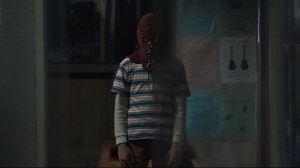 I do believe that your enjoyment of Brightburn will partly rest on your prior knowledge of the Superman mythos and its clever, darker reworking. Considering this is an essential aspect of its premise and execution, I don’t see this as a fault, though it will limit the audience that can simply plug into Brightburn and enjoy it as is. The film leans heavily on the iconography of Superman and purposely twists it as a perverse thought experiment. If you’re indifferent or unfamiliar with Superman, it may play out as an efficient thriller with some solid acting and gross-out effects. However, if you’re a canny follower of the Superman origins, then it becomes a meta commentary with even more to unpack. How does one exactly keep a god grounded in the ways of morality? I don’t mean to make it seem like Brightburn is inaccessible to non-comic book fans. It’s not, but part of the enjoyment for me was how it took something familiar and twisted anew.
Those gore effects are impressively gross. This is a movie that doesn’t shy away from the destructive power of its super demon seed. It builds in intensity and is actually pretty restrained, all things considered, but when it wants to pack a punch, the movie does. There was one extended bit of eye trauma that made me shield my face. How in the world can a person have that much glass shard lodged that far into one eyeball? It causes me shudders even thinking back on it. There’s another scene where a person’s jaw is dislodged like they were the Tin Man from The Wizard of Oz, a lanky part that stubbornly won’t stay put. The person even holds their hand over their face, knowingly teasing the audience. As the film hurtles toward its final act, if you can think of a way that Superman could kill a vulnerable mortal, this movie covers it. Super speed splattering a person? Check. Laser eyes boring a hole through a skull? Check. There’s even a scary sense of visual poetry to one kill that goes flying into the heavens in slow motion. The gore and grisly deaths are another aspect that reminds me how well developed the film is.
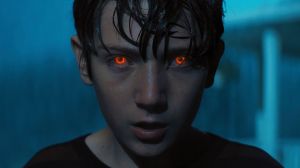 The acting may be better than you’re anticipating. The screenplay doesn’t simply rely on the main characters being stand-ins for their Superman analogues. While they don’t feel like three-dimensional characters, care has been put to give them more substance so that the drama of their choices can be compelling on its own. Banks (Lego Movie 2) and Denman (16 Hours) debate their increasingly fraught choices with clarity. He’s convinced their son isn’t right and poses a danger, and she doesn’t disagree but refuses to abandon their son after all these years together. Early on, they feel like a real family, and that only makes the tragic events feel much more resonant as things spiral out of control. Banks and Denman are certainly not playing any scene for a knowing wink. To them and the rest of the production the events are very real and very scary. Dunn (Avengers: Endgame) is eerily spooky with his stares and glares, but there are also moments that remind you he is or was still a kid and experiencing the same desire to belong.
This is not going to be a movie for everyone but if you’re intrigued by the premise and/or have an affinity for Superman what if scenarios like Red Son, then it should be right up your alley. It’s a clever and satisfying thriller that appeals to fans with darker desires. It’s about as well executed as its premise could go, and I left my theater thoroughly satisfied with only some minor quibbles for motivation clarity and an extended epilogue (I don’t know if Billie Eilish fits for the end credits but that’s just a personal preference). Brightburn takes the Superman mythos and twists it into a creepy horror film, the origin of a super villain, and an apocalyptic death sentence for the rest of humanity. It’s actually a lot of fun to watch even as it’s disturbing you and leaving you wincing.
Nate’s Grade: B+
Share this:

Pet Sematary (2019)
 I already know my computer’s spell check is going to hate this review. In the wake of the box-office bonanza of It, prolific author Stephen King is a hot property once again for studios and everything old is new again. Pet Sematary (yes it’s intentionally misspelled) is a remake of a 1989 that was a hit back in the day. It was never regarded as a good movie but had its campy entertainment, so there was some room for improvement. Early reviews were positive and I raised my hopes for the 2019 edition, but after having seen the finished product, maybe some movies too are better off left dead.
Louis (Jason Clarke) and Rachel (Amy Seimetz) have moved to small-town Maine for a little peace and quiet and to spend more time with their children, nine-year-old Ellie (Jete Laurence) and their toddler, Gage. They happen to live next to a busy road with dangerous drivers speeding at all hours. An accident claims the life of their beloved family cat, but the kindly old neighbor Jud (John Lithgow) has a piece of advice. Beyond the “pet sematary” in the woods is a place where the buried dead come back to life. The cat comes back, though is mean and different. Later, another accident takes the life of Ellie, and Louis cannot let her go. He buries her in the hallowed grounds, she comes back, but she’s not daddy’s little girl any longer, and people will pay a high price.
 Eschewing a sense of camp, the film risks being overrun by its own sense of seriousness, which only works if there is room given to explore the ramifications of grief, the choices people make when they’re hurting, and the irony of good intentions. If you’re going to go in a serious direction then you need the confidence and dedication to play to that decision, and that’s not the case with the 2019 Pet Sematary. It’s lacking those important moments of contemplation or even dwelling with the horror of bringing back a loved one from the dead. There’s only so much evil hissing cat you can have before you hit a limit and start saying, “What else you got?” There’s going to be an escalation, I don’t think it’s much of a spoiler, considering the nature of the premise but also its predecessor being 30 years old, that one of the children will die only to be brought back. It’s also an easy speculation that they will “come back wrong” but the drama is processing this decision and trying to mitigate the mounting consequences. How far will a parent go to protect their child even if that child is an undead murderer? The trials should strain the moral resolve or our protagonist while reveling in the grotesque.
Because every viewer is going to already expect this much, it’s the film’s job to develop this premise in a satisfying manner and/or provide surprises from our expectations. Pet Sematary 2019 unfortunately does neither, barreling through the dramatic downtime when it could be developing its horror and unleashing standard slasher jump scares. When Louis is brushing his daughter’s tangled hair he runs his fingers over the metal staples in the back of her skull holding her head together. It’s a stark reminder that she is not the same, and it goes beyond her scraggly voice and unyielding stares meant to convey the same information. The film needed more moments like this, small details to unnerve and remind, rather than making her essentially The Ring girl from the start. The movie voluntarily eliminates its own storytelling runway, giving it little room to ramp things up and being forced to simply jump to the big bad killer demon girl. The filmmakers try and compensate somewhat by giving Rachel her own independent haunting, seeing hallucinations of her dead, twisted deformed sister. Those sequences reminded me of the slow stirring sequences in 2017’s It, drawing in the audience to dread what will happen next. It’s a side plot that could be eliminated entirely and I enjoyed these sequences the most because it was at least something pregnant with possibility.
 Many of the new additions feel like the filmmakers are fumbling for something else to be scary because they’ve consciously or unconsciously admitted defeat with their zombie. She’s creepy, sure, but she starts at full creepy and stays there. We get things like animal masks reminiscent of 2013’s home invasion thriller You’re Next. We get the spooky visions of ghosts that the child can see. We get Rachel’s taunting visions that never feel fully integrated into the larger whole with any thematic value. It could have tapped into her guilt praying for the demise of her sister for a well-earned sense of relief, and this same feeling coming ahead anew with her reanimated child, challenging her to reconcile her past actions and personal culpability and goad her into action. But like most aspects of the supernatural be-careful-what-you-wish-for parable, it’s given precious little deliberation and instead it’s more standard thriller moments to goose scares. I do appreciate that the film takes its sense of bleakness to the very bitter end, departing from the 1989 original for an even darker conclusion. The only problem is that it left me wanting the sequel. By the end, I think many viewers will agree that they wish a Pet Sematary movie, at least one under this oh-so-serious-slasher direction, had started at this end point instead and gone forward, exploring the full ramifications of the larger world.
As is wont for the Internet, there has been some gnashing of teeth over the fact that the remake kills a different child, but I think this is the smart move. It allows the remake to stand apart from the original and chart a path of its own, not that it’s very far. It also boosts the practicality of what it can do for horror. As any parent may attest, there’s more to worry about what a nine-year-old can do than a two-year-old. Even reanimated and filled with supernatural power, it’s still a small child that can be overwhelmed. An evil pre-schooler has a bit more limited mobility for their murder rampages.
For fans of King, or fans of genre horror, there may be enough standard thrills and chills to enjoy the new Pet Sematary. In the extremely spotty spectrum of King movie adaptations, it’s definitely somewhere in the middle, not bad per se but nothing special.
Nate’s Grade: C+
Share this:

Welcome to Marwen (2018)
 When I saw the trailer for Welcome to Marwen my first response was pained wincing. Robert Zemeckis is one of the most daring, inventive, and imaginative filmmakers working today, but this movie just looked misguided with its approach. Welcome to Marwen is so fascinating, so tonally off, that I might almost recommend people watch it.
Mark Hogancamp (Steve Carell) was a war illustrator until the day he was attacked by a gang of neo Nazis. In the ensuring months, Mark has lost portions of his memory, is unable to use his hands to illustrate any longer, and has become something of a shut-in. He has gained notoriety through his new artistic outlet. Mark has created a WWII era Belgian town called Marwen with a group of dolls fighting evil Nazis. We escape into fantasy sequences where Mark imagines himself as Cap’N Hogie and his gang of supportive ladies. Nicol (Leslie Mann) moves in next door to Mark and he takes an immediate interest in her (she even appears in Marwen in doll form). Mark must grapple with his feelings and work up the courage to attend the court hearing to make sure the men who hurt him stay in prison.
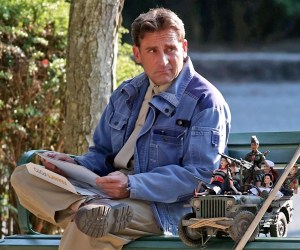 I was amazed at how miscalculated Welcome to Marwen plays out. It feels like Steve Carell’s Patch Adams, a sentimental movie where every step seems strange, mistaken, maudlin, and false. Firstly, this is the second documentary that Zemeckis has taken and adapted into a live-action film, as if the man is spending the wee hours of his nights pouring over award-winning documentaries of the past and determining which he can add a little razzle dazzle to with visual whimsy. Look out The Cove because maybe an undersea realm of talking dolphins will open up that horrifying Oscar-winner to a whole new mainstream audience. I’d have less of an issue with Zemeckis remaking the documentary if it didn’t seem like his entire rationale was the fantasy interludes.
The original documentary is about one man and his unique brand of healing through art. He is becoming further whole by building an intricate world through his imagination. By visualizing the fantasy worlds, Zemeckis is turning the doll segments into literal escapism that becomes tedious, obvious, and often redundant. The doll segments are about his gang of girls supporting him, expressing his interest in his kind new neighbor, and tackling the Nazis in a safe space where he can win. Every time we cut to the doll sequences it feels like the movie is spinning its wheels with these ill advised fantasy cut scenes. It gets boring watching the doll segments without any sense of stakes. The special effects are creepy and there are aspects that amplify this, like one doll’s penchant for having her top ripped off in combat, revealing her stout, rounded chest. Keep in mind that the female dolls, with the exception of one, are all analogues for people in his life, so then Mark is consistently indulging in stripping one woman of her clothes. Even though the movie sets this character up to be a potential love interest, it’s still not a good choice. Zemeckis intends to literalize Mark’s struggles and fears so that he can triumph over them, but it feels like it’s minimizing the complexity of trauma into digestible whimsy. With every trip to Marwen, I was eager to return back to the land of human beings where they might still be over-the-top but at least I wouldn’t have to watch creepy doll CGI.
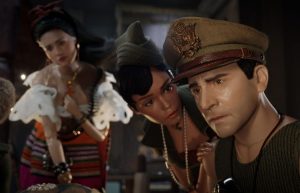 The most significant doll is the blue-haired Deja Thoris (Diane Kruger) who is meant to represent Mark’s suicidal impulses. He keeps her atop his wall so that she can watch over him, and in his sleep he dreams about her whispering in his ear, “Nobody will ever love you like I do. You should just end it now.” Oh man, that’s heavy, but when applied through the prism of a talking Barbie doll it loses its sense of seriousness. If you don’t lose yourself in the central conceit and take the dolls seriously, the movie will fall flat. Take for instance the cross-dressing aspect of Mark, which is what lead to his brutal beating. It’s a delicate subject and something easy to get muddled, and that’s exactly what happens in the presentation of this movie. The shoe fetish is initially portrayed as wacky and then becomes serious and then becomes like an artifact of horror. It’s another sign that the tone for this movie is mismatched. These things require a delicate touch with some ambiguity and sensitivity. Welcome to Marwen turns these into a loud, noisy cartoon that bumbles into its messages. Things that are meant to be charming or endearing or emotional can come across as goofy or campy or even uncomfortable.
I felt bad for so many of the actors. Carell (Vice) is trying to maintain his character’s sense of dignity throughout, but the story often goes into contrived contortions to force him into dramatic confrontations. It turns out the court appearance is rescheduled to be the same day of Mark’s photographic exhibit. Will he be able to triumph over these forces to stand up for himself? Carell is a capable dramatic actor but he’s struggling here to find stable footing because of the mish mashing tones. The development of Mark makes him come across as a creep in some moments, like his one-sided advances for Nicol, and a simpleton at other moments, where he might have sustained brain damage. Mann (Blockers) is sweet and gentle but strangely the movie hides her most interesting character aspects, like the prospect of a deceased child. You would think overcoming tragedy would be a tool for Nicol and Mark to bond. Merritt Wever (Godless) is another sweet and gentle woman in a world that seems overstocked with them. It feels like everyone in this small town exists just to be nice to Mark. She’s clearly romantically interested in Mark but he doesn’t care until the very end. She deserves better than being someone’s runner-up choice, especially only after he was turned down.
 A movie that deals with delicate issues through fantasy escapism can work, but it requires a precise hand with tone and with its storytelling detours. Guillermo del Toro has been able to prove he can tell rich, adult stories with the assistance of whimsical, weird fantasy elements. Charlie Kaufman has been able to weird the mundane and the fantastic. It can be done and Zemeckis has done it himself before, best evidenced by the masterpiece, Who Framed Roger Rabbit?. However, Welcome to Marwen is a sizeable tonal misfire. The serious elements don’t blend well with the fantasy elements, and even worse, they are made less serious and approach the realm of camp. The fun, fantasy elements are given bizarre and unsettling contexts that make them creepy and inappropriate. Escaping into Mark’s imagination winds up stripping him of much of his agency, and literalizing his psychological push-and-pull feels like a misguided examination on depression. I left my theater in a daze, trying to make sense of what I had just witnessed. The filmmakers and cast certainly mean well and want the film to be a triumph of the human spirit. I found it to be two meandering hours of watching somebody play with their disused toys.
Nate’s Grade: C-


 nathanzoebl
You must be logged in to post a comment.