Blog Archives
Paul (2011)
 This sci-fi comedy by the guys behind Hot Fuzz and Shaun of the Dead, though absent director Edgar Wright (Scott Pilgrim came a callin’), is an irreverently fun flick that lovingly sends up just about everyone in its sights. Simon Pegg and Nick Frost play a pair of British sci-fi geeks road tripping through the American southwest when they come across Paul (voiced by Seth Rogen), an alien on the run. Together they outrun various pursuers, from government agents to angry rednecks, and Paul transforms into a delightful road comedy with the different characters ping-ponging back and forth, narrowly missing but still in the hunt. It’s a cheeky even rollicking action comedy in the vein of a Midnight Run, though with way more stoner jokes. The plot nicely weaves these various elements and characters together, creating a satisfying escalation in suspense and comedy. The characters are pretty familiar and some of the gags are below the caliber of talent onscreen (really, more “people think we’re gay” jokes?), but the final product is unabashedly fun and it’s easy to feel Pegg and Frost’s enthusiasm. Paul is a light-hearted, funny, even tender sci-fi comedy that borrows from better movies but still manages to charm.
Nate’s Grade: B+
Share this:

Star Trek (2009)
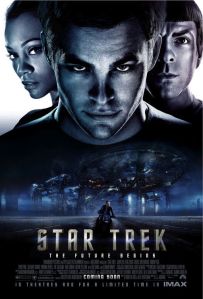 Star Trek has a hold on geek culture like no other franchise. It’s lasted over forty years, sustained five television series, and ten feature films (about four of them good), and let’s not forget the plethora of fanatical merchandise that includes everything from Trek cologne to Trek coffins. Star Wars has all the box office clout, but Trek has followers so devoted that they will create and learn a separate language, Klingon, that almost assuredly will never be spoken by anyone else outside of the festival circuit (you will never see a written Klingon exam that asks you “Where the library is?”). The Star Trek fans have been a foundation of geek culture for over four decades. People take this stuff very seriously. Trek has always been a headier brand of sci-fi, more devoted to ideas and moral dilemmas than shoot-outs and space chases, though Captain Kirk did teach the universe how to love, one green-skinned buxom alien babe at a time. 2002’s abominable Star Trek: Nemesis was meant to open up the franchise to a wider audience, but the film was the low-point for a franchise that also included William Shatner writing and directing the fifth flick (Nemesis also broke the odd/even movie curse).
When director J.J. Abrams approached Star Trek with the purpose of reinvigorating the flagging film series, you would think the man would wade into such a storied franchise with trepidation. Nope. He openly said he was making a “Star Trek movie for people who weren’t fans of Star Trek.” He was even going to change Trek canon. I imagine Trekkies (and no, I will never use the preferred nomenclature “Trekkers”) were nervous about an outsider, the author of the cinematic classic Gone Fishin’, meddling with hallowed ground. As I suspected, these fears were unfounded. The newest Star Trek does more than put a new coat of paint on an old franchise. This movie boldly goes where none of the Trek movies have gone before — turning reverent geek culture into a grand populist entertainment smash.
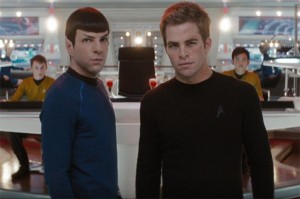
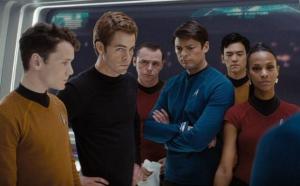 This new incarnation looks backwards, explaining how the crew of the U.S.S. Enterprise came together. The movie shows the path of Jim Kirk (Chris Pine), from troubled youth to eventual starship captain. Kirk’s father captained a starship for about 10 minutes, but he managed to save 800 lives under attack, including the birth of his son. Captain Pike (Bruce Greenwood) recruits Kirk to Starfleet Academy with the promise of doing something more with life. We also witness the boyhood of Spock (Zachary Quinto), who is teased for being half-Vulcan and half-human. His human mother (Winona Ryder) encouraged Spock to embrace his human emotions instead of cutting them off, Vulcan-style. Kirk and Spock clash at the Academy, and then an emergency requires all the recruits to saddle up for their first mission in space. Nero (Eric Bana) is a dastardly Romulan who has traveled back in time. In the future, he blames an older Spock (Leonard Nimoy) for the destruction of his home planet and the deaths of billions of Romulans. To ensure this does not happen, Nero is going to eradicate Starfleet home planets, starting with Vulcan and then Earth.
J.J. Abrams is a geek’s best friend. He understands geek culture, and yet the man is able to take genre concepts and make them easily accessible to the unconverted while still making a finished product that is respectful, playful, and awesome. Abrams is an expert on the pop culture catalogue, and he knows how to make genuinely entertaining productions that succeed on brains as well as brawn. He brought tired spy conventions into the twenty-first century with the cool, twisty Alias and Mission: Impossible III, which was really an extravagant two-hour episode of Alias, and I mean this in the best way. He has an innate understanding of action sequences and knows well enough that an audience needs to be engaged emotionally, so he makes the action as character-based as much as possible. Abrams has a terrific imagination behind the camera, and he reminds me of a young Steven Spielberg in his ability to marry artistic integrity with big-budget crowd pleasers. Abrams and his screenwriters Alex Kurtzman and Roberto Orci (Transformers, TV’s Fringe) have crafted a stellar Trek that will appeal to die-hards and those who couldn’t tell a Romulan from a Vulcan (I fall somewhere in between).
 The time travel storyline could have used more juice, however, it serves its purpose by establishing a parallel Trek universe to work with. Beforehand, Trek had established so many previous stories that it hamstrung writing new stories because they had to be extensively researched to make sure they did not conflict with 40 years of canon. Abrams and company wrestled free from the grip of the established history and can now play around unencumbered to a degree. I mean, fans don’t want to see something radically inauthentic, but Uhura and Spock as a couple? Sure, why not? The fan favorite character catch-phrases (“She’s givin’ it all she’s got,” “Dammit Jim, I’m a doctor?,” etc.) are organically worked into the story so that they don’t become falling anvils.
Star Trek‘s pacing can be whiplash inducing. It speeds through two hours of action and setup while still maintaining an emotional connection to the characters involved. The movie has a boyish enthusiasm for adventure and it’s fun watching well-known characters assemble and amble into new and interesting directions. The action is routinely thrilling and I enjoyed Abram’s small touches, like watching a crew member get sucked out into space and cutting all sound to illustrate the cold, empty vacuum. The amount of humor injected into the movie can be distracting at times, not because it isn’t funny but because of the brisk tone breaking. One second it’s a life-or-death scenario and the next Kirk is running around with giant goofy hands. Still, it’s good to see some humor in the Trek universe that isn’t related to alien culture clashes.
The young ensemble is amazingly well cast. I didn’t think a younger generation of actors would be able to step right in and play such lived-in characters, but they pull it off. The hardest shoes to fill are unquestionably Kirk’s, and Pine (Smokin’ Aces, Just My Luck) carries that same cocksure bravado without stooping to a stilted Shatner impersonation. His performance feels at times like Han Solo and Luke Skywalker rolled into one, and he’s an appealing presence that captures the essence of a dashing and rebellious scrapper. This Kirk is still an adventure-seeking, skirt-chasing 1960s kid at play. Quinto (TV’s Heroes) is blessed to look remarkably similar to Nimoy, but the actor also gets to explore the human side of Spock. He feels compelled to harness emotion, like all Vulcans, yet it’s intriguing when certain emotions slip out and build a bigger picture about what’s going inside the mind of a being dominated by logic. Quinto has less to work with by design and yet the man finds interesting ways to ensure Spock can be recognizable. Each of the supporting actors has their moment, but my biggest surprise was Karl Urban as Dr. Leonard “Bones” McCoy. Urban has mostly been confined to lame action movies as of late, like Doom and Pathfinder. But he’s really funny and his performance captures DeForest Kelly’s mannerisms down without turning into a caricature.
 If there is a main weakness to Abrams’ Trek outing it’s that it feels far more like the opening act of a larger movie. Nero is a fairly weak villain, though Bana gives him a nicely polished glower. The villain is really just a tie-in for the time travel storyline, which is also a narrative quirk to secure an open field for further stories. Meaning, that much of the movie can be seen as assembling the pieces to simply move forward on their own. It’s an expensive set-up movie, and Abrams makes sure that the audience sees every dollar of the splashy visuals onscreen. Personally, I was also getting tired of the cinematography decision to fill the screen with as many light flares as possible. It seemed like every other moment had a blast of light beam in from some direction. After a while it sort of felt like an eye exam where the optometrist shines a flashlight back and forth. And it takes far too long for Scotty (Simon Pegg) to appear in the movie.
J.J. Abrams does more than hit the restart button. He has made a Star Trek that manages to be respectfully reverent but at the same time plays along to the mainstream visual sensibilities of modern cinema. It’s fun without being campy, reverent without being slavish, and this Trek never forgets to entertain from the opening assault on a starship to the Michale Giacchino’s closing credits score. This is an enjoyable rush of sci-fi escapism. The Star Trek series was always deeply hopeful and humanistic, believing in the best for humanity and that man, in cooperation, could achieve greatness. I think further escapades with this cast and Abrams at the helm could reach greatness. For now, I’ll be happy with this rollicking first entry into a franchise that seemed adrift in space. Bring on more of the green-skinned women.
Nate’s Grade: A-
Share this:

Mission: Impossible III (2006)
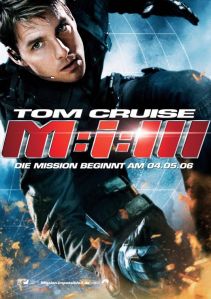 Few celebrities have had the intense flame-out Tom Cruise has experienced in a little over a year’s time. First there was the PDA-heavy relationship with Katie Holmes, never a wet tongue-kiss away from a camera. Then there was the couch aerobics on Oprah Winfrey’s set, bleating his over-the-top declarations of love like Roger Rabbit. This was followed by a series of testy interviews about his war of words on psychiatry and prescription drugs. Entertainment Weekly just ran a cover story asking, “Is Tom Cruise worth his paycheck?” He’s gone from Hollywood’s most bankable actor to a national punch line. To bring new life to Cruise’s spy series, he tapped TV mastermind J.J. Abrams to make his feature debut after Cruise churned through two seasons of spy series Alias DVDs. Abrams is a gifted franchise starter, first with Alias and then with Lost, and with Mission: Impossible III he does the best he can to erase the memory of Tom Cruise, daredevil of furniture.
Ethan Hunt (Cruise) is out of field work at the Impossible Mission Force, training recruits for the big time. He’s settled into a comfortable home life with Julia (Michelle Monaghan), a woman he’s blissfully engaged to be wed. Ethan’s happy home is disrupted when IMF needs his services. It seems one of his trainees (Keri Russell, Felicity goes badass) has been captured by an arms middleman Owen Davian (Phillip Seymour Hoffman), a man that will get any deadly force to the right bidder. Hunt reluctantly goes back into the field, assembling a team that includes Luther (Ving Rhames), Zhen (Maggie Q, quite fetching), and pilot Declan (Jonathan Rhys Meyers). Their mission goes badly and Hunt is reprimanded for his cavalier actions. He’s determined to snag Owen and get justice. This leads to an incredibly stuffed game of cat-and-mouse, each jockeying for leverage. There’s some super powerful device called the “rabbit’s foot” that everyone wants but it’s not really important. What is important is that Owen is eager to strike back at Ethan’s most vulnerable point — harming Julia.
 This movie is quite possibly one of the greatest TV adaptations of all time. No, not the Mission: Impossible series but Alias. Just like J.J. Abrams’ TV brainchild, this slick, propulsive caper puts a smart spin on familiar ground. We’ve got the flash-forward narrative trickery, the super gadgets, the undercover teamwork, the world-trotting sprawling vistas, and anchoring the whole thing with an emotional counterpoint, trying to lead a double, “normal” life and keeping your loved ones equally safe and in the dark. There’s a great scene in the middle of a mission where Ethan and Luther casually discuss the impossibilities of living a normal life given what they do. Luther warns that those close to you will only end up getting hurt, and by this point thanks to a startling, right-to-the-point opener with a gun to sweet Julia’s head, we know he’s right. That’s what makes the third go-round different: Abrams has injected some emotion into the darn thing. Ethan is pressed back into service and then becomes something of a knight in shining Kevlar, trying to save his beloved in the crossfire of international espionage. There are a handful of scenes between Cruise and Monaghan and they sell the emotional drama in tender quiet looks. As a result, the audience and Ethan are rooted to their seats beyond just the assembly line of pyrotechnics. Just like Alias (at least up until Season 3 when it jumped the shark with the long-lost sister). It’s like if True Lies was played straight and Tom Arnold was mercifully forgotten.
Ah, but what pyrotechnics they are. Things get heated with a trip to the Vatican and they literally do not let up, all the while raising the stakes by pulling Ethan’s home life closer to the danger of his job. You’ll be left breathless absorbing all the exhilarating action sequences, which to my best estimate are more than the first two flicks combined. The stunts are superbly death-defying. What makes action sequences so enjoyable, pay attention you Hollywood rubes, is when the stage is set and then we watch organic complications. Abrams has a tremendous feel for action and playfully extends virtuoso sequences of awesome carnage. An attack on a bridge is simply outstanding and gave me an overload of geeky joy. We’re given the tight, controlled setting, and then Abrams introduces the outside conflict and keeps developing it masterfully step by step. There’s air attacks, there’s running back and forth amongst the wreckage, there’s searching for guns while escaping attack, and then there’s flying leaps over gaping concrete holes. I was jumping in my seat with boyish glee. The slow-mo gun toss between Cruise and Russell? Awesome. The swing-shot jump off a gigantic skyscraper in Shanghai? Awesome. The use of Simon Pegg (Shaun of the Dead) as gadget guru? Awesome. Mission: Impossible III is, if nothing else, an incredible adrenaline rush orchestrated by a man with a finger directly on the pulse of his audience. By summer popcorn standards, Mission: Impossible III is everything you could hope for. Sure it’s highly implausible but it’s just so damn fun.
 Abrams has created quite a breakthrough for himself. Long regarded as a TV visionary for his tangled, engrossing pop-pulp like Alias and Lost, Abrams shows what he can do with a bazillion dollars and one of the world’s most recognized stars. Abrams intelligent, deft handling of his material, elevating tired genre devices with flash and reverence, reminds me of a young Steven Spielberg. This is a man that respects his material and respects his audience, but still knows how to bring home an entertaining movie. I’ve followed Abrams’ career since getting hooked on Alias in 2001, and I’m confident he will become the best friend a movie geek could ever have (Star Trek fans should be clicking their heels about Abrams’ rumored involvement). Even though Mission: Impossible III is Abrams’ film debut (and on record the most expensive ever for a first time film director) he already shows more command, more wit, and more hipness than most of Hollywood’s graying old guard.
Finally, this is the first Mission: Impossible film to utilize the team aspect of the TV show. Granted, Cruise still does most of the running, jumping, climbing trees, but thankfully this movie is more than the Tom Cruise Kicks Everyone in the Face Show a.k.a Mission: Impossible II. The supporting cast all have their one great moment and part of the fun is their interaction, seeing the pieces fit into place. Just like last summer’s Batman Begins I would like to see another movie immediately with everyone involved. Make it happen. This is the Mission: Impossible world I want to explore in greater detail.
Mission: Impossible III is not bulletproof. The movie seriously needed more time for its villain. Hoffman does a great job of bringing his bad man to grumpy life. He goes about business with a detached nonchalance, like a plumber fixing his 10,000th clog. It may sound silly but it works because Hoffman gives his character a lizardy, unscrupulous sense of ethics. He really will put a bullet between the eyes of anyone, possibly while reheating some food in his microwave. That’s the greatness of Hoffman’s villain, how ordinary he sees his line of work and what it calls him to do. Now, with such a terrific villain it would behoove Mission: Impossible III to give him plenty of screen time. Sadly, Hoffman has about three real scenes, and his end is anticlimactic and so is the film as a whole. And what does IMF have to do to curb moles? There’s been one in all three Mission: Impossible movies. Maybe they should offer better vacation plans.
Tom Cruise may have done a lot to wear out his welcome with the public but he knows to surround himself with good people. The decision to let J.J. Abrams helm Mission: Impossible III has finally given this franchise vision and sustained excitement. This movie is far more emotionally based than any other in the series and there’s a genuine emotional reason for all the fireworks this time. The team aspect is finally addressed and Hoffman makes a truly lecherous, scary villain. But the bread and butter of this flick are its breathless action sequences, brilliantly choreographed by Abrams, a name destined for even greater things. Abrams knows how to spin genre clichés into clever, loose, twisty, funny, thrilling, emotionally centered gold. I don’t care if Cruise abused a couch and the public’s good will; Mission: Impossible III is an extravagant popcorn movie and a great way to start the summer. If only they were all like this.
Nate’s Grade: B+
Share this:

Shaun of the Dead (2004)
 This British import was described as a “rom-zom-com” (something tells me that genre is rather spare). Director Edgar Wright and star/co-writer Simon Pegg plunk down an assortment of typical British sitcom characters and then throw zombies into the mix. Shaun of the Dead is hilarious from start to finish. Pegg and his batch of survivors go through the strange scenario with wit, grit, and a genial sense of irrelevance. It’s as if even flesh-eating zombies can’t ruin their day (Shaun devises a plan that involves killing his zombie step-dad and drinking a cup of tea). Shaun of the Dead gives a knowing wink to the Romero films but also tweaks the zombie genre’s rules and clichés. Wright has a clever sense of visuals and the film does provide some sticky, gory goods for horror fans. If more films were this much fun I’d probably never see natural light again.
Nate’s Grade: A-


 nathanzoebl
You must be logged in to post a comment.