Blog Archives
Layer Cake (2005) [Review Re-View]
 Originally released June 10, 2005:
Layer Cake may be the least intimidating name ever for a crime movie. It conjures images of bridal showers, cooking shows, and birthday parties. It does not necessarily bring to mind thoughts of gangsters, assassins, drug trafficking, and the seamy underbelly of London’s criminal underground. Unless you’re watching some really awesome cooking show I don’t know about. The “layer cake” in question refers to the hierarchy of criminals. This isn’t unfamiliar territory for Matthew Vaughn, who produced Guy Ritchie’s Lock, Stock, and Two Smoking Barrels and Snatch. This time it’s Vaughn sitting in the director’s chair and the results are exceptionally entertaining. Layer Cake is a cinematic treat.
Daniel Craig (Road to Perdition) plays our untitled lead, referred to in the end credits as “XXXX.” He’s a cocaine dealer but not a gangster by any means. He wants to make his money, not step on any important toes, and then walk away on top and without any gaping holes in his body. Craig is summoned by his boss Jimmy (Kenneth Cranham) and given two missions, whether he wants to accept them or not. The first is to relocate the missing daughter of a very powerful friend of Jimmy’s. The second, and far more dangerous job, is to secure a package of millions of stolen ecstasy pills and make a profit. Complicating matters is the angry Serbian mob that the pills were stolen from. They’ve dispatched a deadly assassin known as Dragan to track down their stolen drugs and kill anyone involved. Craig is left to juggle the investigation, find a buyer, stay ahead of Serbian hitmen, get some time in with a hot new girl, and all the while keeping his higher-ups content enough not to kill him themselves.
 Layer Cake should be the film that makes Craig the star he so rightfully deserves to be. This man is a modern day Steve McQueen with those piercing blue eyes, cheekbones that could cut glass, and the casual swagger of coolness. Craig grabs the audience from his opening narration as he explains the ins and outs of his business. We may never see Craig sweat but he still expresses a remarkable slow burn of fear so effectively through those baby blues. He’s in over his head and the audience feels his frustrations. In an interesting character twist, when Craig does resort to killing, he’s actually tormented and haunted by his actions.
As with most British gangster flicks, there are a batch of colorful characters that leave their mark. Dragan (Dragan Micanovic) is a wonderfully enigmatic ghost of an assassin always one step ahead of Craig and the audience. Morty (George Harris) and Gene (Colm Meaney) add heart and bluster as Craig’s trusted right hand men. But the actor who steals the whole film with a malevolent glee is Michael Gambon (Harry Potter and the Prisoner of Azkaban). He plays Eddie Temple, the man behind the men behind the scenes. Gambon delivers the harshest of speeches with a velvety pragmatic calm. We don’t know what runs deeper with Eddie, his tan or his scheming.
Sienna Miller plays the thankless love interest to Craig. She’s pretty, sure, but there isn’t much acting ability on display in Layer Cake beside some smoldering glances. We never really know what Craig sees in her besides being another cute blonde to choose over. Miller isn’t alone in the “underwritten character department.” Layer Cake is crammed with secondary characters that pop in and out when it’s necessary. It’s not too annoying but it does mess around with an audience?s ability to follow along coherently.
Layer Cake is not one of the slick, whack-a-mole ventures Ritchie has given us (pre-Madonna). No sir, this is a brooding, serious and nearly terrifying look at the old adage “crime doesn’t pay.” Very few crime centered films express the day-to-day anxiety of just being a criminal. Jimmy reminds Craig that he’ll never be able to walk away because he’s too good an earner for his higher-ups. In Layer Cake, you can get killed for being too greedy, being too careless, being too good at your job, and even just being in the wrong place. Eddie sums it up best whilst describing Faust: “Man sells his soul to the devil. It all ends in tears. These things always do.”
 Vaughn has a polished visual sensibility that doesn’t overwhelm the viewer. He keeps the camera fluid and steady with a minimal amount of cuts. A nifty opening scene involves an imaginary drug store (stocked with pot, cocaine, and the like) melting into a real drug store (one hour photo, impulse items at the register). When the tension does mount Vaughn knows just how to turn the screws. A late sequence involving a chase between the SWAT team and our batch of criminals had me on the edge of my seat. For a first time director, Vaughn also has great patience. He doesn’t rush his storyline and he doesn’t suffocate his movie with visual flourishes. He also has a great deal of faith in his audience’s intelligence. This isn’t as lively as Snatch or Lock, Stock, but that’s because Vaughn’s film is also much more serious and dangerous.
This is an intricate and gripping film but it might be a little too complex for its own good. Twists and double-crosses are expected in this genre, but writer J.J. Connolly has so many characters running around and so many hidden agendas that it’s nearly impossible to keep track. Some of the subplots and back stories add very little like the inexplicable “Crazy Larry” flashbacks. I left the theater still confused about plot points but refreshingly satisfied nonetheless.
Layer Cake is the most thoroughly exhilarating time I’ve had at a theater this year. This pulpy daylight-noir caper is full of memorable hoods, plenty of twists and turns, and a star making performance by the steely-eyed wonder that is Daniel Craig (rumored to be the next 007, though in my heart I’ll always root for Clive Owen). Fans of Ritchie’s frenetic gangster flicks should be entertained. Anyone looking for a clever and exciting potboiler that treats violence and crime seriously should start lining up immediately. If you’re suffering from the cinematic wasteland that 2005 has shaped up to be so far, then have yourself a generous helping of Layer Cake and thank the Brits.
Nate’s Grade: A
——————————————————
WRITER REFLECTIONS 20 YEARS LATER

Back in 2005, Layer Cake was really a proof of concept movie for many items. It was proof that someone could take a Guy Ritchie-style crime pot boiler with colorful Cockney criminals and plenty of twists and unexpected violence and play it straight and serious. It was proof of Matthew Vaughn as a director, who had previously served as a producer of those early Ritchie films. It was proof of Sienna Miller as the next It Girl, a proclamation that carried her for years despite mixed results with the movies. Most of all, it was proof of its lead, Daniel Craig, as being so suave he should be considered the next possible 007. James Bond producer Barbara Broccoli has gone on the record saying this movie is what officially put Craig on their radar and got him the gig that has defined his career trajectory. Twenty years later, Layer Cake is still a potent and smooth little thriller that glides right by on its intelligence, sex appeal, and Craig’s charisma
I find myself agreeing with so many of my original points from 2005 so I don’t want this re-examination to be merely a “ditto” without some additional critical analysis. Even though it’s based on a book by J.J. Connolly, who adapted his own novel, the movie feels very much in the company of those early Guy Ritchie movies that Vaughn began producing. Ritchie burst onto the international scene with 1998’s Lock, Stock, and Two Smoking Barrels, a brash and stylish crime comedy with outlandish characters, violence that alternated between visceral and slapstick, and twisty plots that often left your head spinning. It was like a mixture of Tarantino and a more lewd Looney Tunes cartoon. While the early Ritchie films, including my favorite, 2001’s Snatch, have their share of characters with grounded stakes, the reality is exaggerated, with the appeal being these grandiose personalities butting against one another. No one would confuse one of these Ritchie movies with a realistic portrayal of London criminals. They’re fun. What Layer Cake does so well is take a Ritchie-esque premise with plenty of low-life screw-ups and hardasses and plays it straight. It takes this middle-level drug distributor and makes his life less a comedy of errors and more a never-ending anxiety attack about how he can become undone from any angle. The movie sure doesn’t make a life of crime look appealing.
 Craig’s character, named XXXX, is a smart guy just trying to keep his head down and do his job. The problem for him is that he’s too good at earning money for bad men who like money. In this life, you can get killed for any number of reasons, some of them logical and pragmatic, and others rash and illogical: not being a good enough criminal, being too good of a criminal, thinking he’s too good of a criminal, someone else wanting to make a name for themself and establish cred by going after you, dumb luck, etc. XXXX has his rules and standards to live by to ensure he limits his risk, but when your profession is literally dealing with money and unscrupulous types, there is no absolute zero in that risk. He may be smart and measured but he’s also working with plenty of stupid people who don’t know they’re stupid, and then you mix in vice and avarice with that, and it can be a combustible cocktail of dangerous idiots intruding on whatever peace and distance XXXX has cultivated for himself. In the movie, XXXX is burdened with competing tasks. He’s been offered a stash of stolen ecstasy pills, and his slimy boss wants them sold no matter what, but the assassin hired to retrieve them definitely wants them back too. Either way, our lead character is endangering himself by making someone unhappy. He’s dropped into the sticky morass of power plays and competing interests that will challenge his intended neutrality.
I think the ending for Layer Cake is brilliant and very fitting. For almost two hours, we’ve followed XXXX through hell and back and it looks like he’s found a way out, siding with the right hoodlums and eliminating different risky angles needing to be resolved. He’s kept to his stated retirement of not going out on top and instead going out while comfortable and capable. He’ll leave the business to his associates because he’s tired of looking over his shoulder. And as he walks out with his pretty lady (Sienna Miller) around his arm, that’s when he abruptly gets shot by Sidney (Ben Whishaw – yes, the future James Bond is killed by his future Q). This isn’t some tough or some hotshot; he’s a lanky nephew to another gangster, and he hasn’t exactly shown anything close to a killer instinct. In his brief appearances beforehand, he’s seemed out of place, like a latchkey kid who wandered into a criminal enterprise and everyone has been humoring him for good measure. The only thing he has is… was… the blonde girlfriend (Miller) who’s clearly not interested in him. After playing it so cool and calculated, he’s taken out by this twerpy nobody because he had the audacity to try and steal “his girl.” Even if you are the smartest guy in the room and you’ve made all the right moves, all it takes is one twitchy trigger finger and one grumbling grievance to take you from living to dead. Our hero is denied his happy ending driving off into the sunset with his modest sums of money and his newly acquired pretty woman. Try as he might, XXXX, gunned down mid-sentence as he reveals his real name, becomes just another unfortunate corpse.
 Vaughn’s skilled direction immediately made him an attractive target for bigger studio fare. He was originally attached to direct 2006’s X-Men: The Last Stand but left weeks before filming for stated “family reasons.” In 2023, Vaughn revealed that he left because of the tight production timeline, going from pre-production to a complete movie in under a year, but it was really the shady behavior of Fox execs that pushed him out the door. Apparently one exec put together a fake script to lure Halle Berry back, including scenes of her character Storm saving vulnerable children in Africa to appease Berry, scenes that were never intended to ever be filmed. It was a ploy to trick her into signing onto the film. After two more geek-friendly adaptations, 2007’s Stardust and 2010’s Kick-Ass, Vaughn was courted yet again back to the X-Men franchise. Once again there was a tight one-year turnaround deadline but Vaughn stayed on board and delivered what I consider to be the best X-Men movie, 2011’s First Class. It revitalized the declining franchise, enough so to lure Bryan Singer back. Singer had departed in 2005 to make his Superman movie, opening the door for Vaughn’s first foray with the world of mutants. Now that Vaughn had reinvigorated the franchise with a new cast of younger actors, Singer was ready to take it back to helm 2014’s Days of Future Past. Vaughn was rumored as one of the potential names to make the first new Star Wars movie in ten years. Instead, he made his own action franchise with 2015’s Kingsman. Granted it was based upon the comic by Mark Millar, the same author behind Kick-Ass and Wanted, but it was Vaughn’s signature all over this new spy franchise. Vaughn had constructed a new Bond for a new age. At this point, I was dubbing Vaughn the best working director to use studio money. Each movie was different but made with style and panache with great structure and payoffs. And then…
I think he got so enraptured with the world of Kingsman that he’s now trapped himself creatively. In the ensuing years, he’s made one Kingsman sequel and one prequel, both of them varying degrees of underwhelming, and another action spy-thriller that might as well be called Kingsman-lite, 2024’s Argyle. For an artist that was dabbling with so many genres beforehand and finding sure footing and a way to make his stamp within each, he now feels stuck, finding diminished returns with each iteration of yet another swanky spy action movie with snark. I’m not even an Argyle hater, a movie that appeared on numerous Worst of the Year roundups but one I consider perfectly fine as a TNT Sunday-afternoon kind of chill entertainment. I loved Kingsman when it was originally released in 2015, but looking back, it appears like this was Vaughn building his own prison brick by brick. Maybe he was too preoccupied with turning it into a franchise with many tendrils stretching all over. I truly wish Vaughn would hop genres once again and leave the realm of spy action to others at this point. Maybe he needs a return to something straight akin to Layer Cake without its tongue already so firmly implanted in-cheek.
 But this movie will forever be known as the movie that secured Craig as the next James Bond. He had been working in movies for a while with some high-profile supporting roles like 1998’s Elizabeth and 2001’s Tomb Raider and 2002’s Road to Perdition, but this was a platform that showcased the suave presence of this actor like nothing before. He was so magnetic and a perfect choice for this character, and just listening to him try and talk his way out of jams with so many loose canons was as impressive and entertaining as any high-stakes chase or shootout. These sort of star-making roles are rare and even more rare when they do indeed prove to be star-making. It becomes an artifact to analyze what qualities people with money and influence were won over by. It’s interesting that Craig’s character is so anti-guns and wanting nothing to do with the more unsavory and violent aspects of his profession. When he does hold a gun for the first time, one he compliments as being “really pretty,” he holds it out and strikes a pose, dashing through a hallway like he was James Bond, and it’s just especially funny with hindsight.
The movie is also filled with familiar faces that would become even more familiar over the years, including Tom Hardy, Sally Hawkins, Whishaw, Burn Gorman, and some Vaughn regulars, alums from Snatch and Lock, Stock, Jason Flemyng and Dexter Fletcher. Flemyng became Vaughn’s lucky charm, appearing in his first four movies in some capacity, much like Greg Grumberg does for J.J. Abrams. There you go, an SAT-style relationship sentence I never thought I’d write: Jason Flemyng is to Matthew Vaughn as Greg Grumberg is to J.J. Abrams. My original review in 2005 highlighted Michael Gambon as the biggest honcho, the top tier of this criminal layer cake. I wrote: “He plays Eddie Temple, the man behind the men behind the scenes. Gambon delivers the harshest of speeches with a velvety pragmatic calm. We don’t know what runs deeper with Eddie, his tan or his scheming.” He’s so good at being so malevolent without ever having to raise his voice or anything outwardly hostile.
 This movie has a personal factor for me because I was so highly anticipating it that, during a trip through the British Isles with my father in May 2005, I bought it on VHS overseas. I naively thought that while DVDs had different regions to thwart piracy, that VHS tapes would be rather universal considering it’s just tape being read. I got home, popped it into my American machine, and the thing wouldn’t work. This was one of the biggest souvenirs I got for myself during that trip, which my father wanted to embark as something memorable we could share together, and now that he’s recently passed, I do think back on those experiences and part of me wishes my 23-year-old self would have been more actively appreciative. So now with Layer Cake, part of me will always think about that VHS tape, and that trip, and my father, and it will make me miss him more, but I am glad we got to share that experience.
Ever since I’ve been doing this re-review project, now going on five years, it’s a relief to see my twenty-year-younger self having written a smart and articulate review, especially when I mostly agree with it even so many years later. Again, I find myself nodding along to just about everything I had written with my past critique, from singing the praises of Craig and the general examination of day-to-day anxiety, to shaking my head at the underdeveloped Sienna Miller character served as little more than a trophy for our hero to take with him into retirement. It still is a movie overstuffed with characters and storylines and antics that probably could have been trimmed around the edges, but that same burdensome feeling connects with the emotional state of our lead, the anxious feeling of having too much to do and not enough time to achieve it, so in a way, it’s excusable. I don’t know if I think the movie is quite at the same level, calling it “thoroughly exhilarating” seems a bit much, but Layer Cake is still a movie that proves fresh even twenty years later, and one worth a second helping.
Re-View Grade: A-
Share this:

Horizon: An American Saga – Chapter 1 (2024)
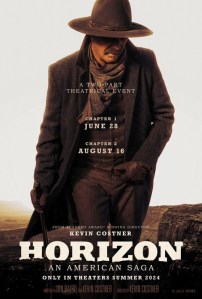
I admire Kevin Costner throwing out all the stops to achieve his passion, a four-part, twelve-hour film series to showcase a sprawling Western epic. The man put a hundred million of his own money into the first two parts of Horizon: An American Saga, and the time devoted to this project was so all-consuming that Costner quit the Yellowstone series, a cable TV juggernaut getting bigger ratings every season. It’s ballsy all right, to abandon a monumentally successful series at the height of its zeitgeist popularity so he can direct not just one but four throwback Westerns that will ultimately be as long as the Lord of the Rings trilogy. It’s rare to see this level of sheer chutzpah in Hollywood. Horizon’s first part was released in June, with its completed second part intended to be released a mere two months later in August. After the poor box-office of Part One, the studio decided to pull Part Two from the release schedule, ostensibly to give people more time to catch the first movie. Will we ever see Part Two in theaters? Will we ever see Part Three, which Costner is currently filming, or Part Four, which Costner is currently raising money for? Costner intended to release the whole saga as a miniseries upon completion, and this might be the best case scenario. As a movie, albeit one quarter of an intended whole, Horizon Part One feels far more structured as an incomplete and rather prosaic TV series.

Upon the completion of the 170 minutes, I was left wondering what was here that would make someone want to come back for a lengthy second part, let alone a third and a fourth. It doesn’t feel like a complete movie or even a completed chapter, and again let me cite Peter Jackson’s Lord of the Rings series. Released over the course of three years, each movie had its own form of a beginning, middle, and end, with each climaxing around some event that left one satisfied by its conclusion. They didn’t just feel like chapters linking to the next; they felt like completed stories that pushed forward a larger overall story. Now, with Horizon Part One, it doesn’t feel like a three-hour movie, rather like three one-hour episodes of a TV series. Each of those hours feels too separate from the other. I’m reminded of television in the streaming era, where producers anticipate viewers binging through multiple episodes in speedy succession. This tacit assumption lends itself toward the general pacing issues I find with too many streaming series, where the filmmakers take far too long to get things moving in a significant manner. I’m reminded of a joke by Topher Florence that back in the day a show like Surf Dracula would feature its lead character surfing in weekly adventures, but the streaming age version would take its entire first season showing how he got his surfboard and then spend five minutes surfing in the finale. When you’re pacing out only one quarter of your possible intended story, calling it slow and lacking development and payoffs is an obvious hazard, which is why every movie needs to be its own thing, to provide a sense of conclusion even if it’s not the final conclusion.
Part One is divided into three parts: 1) the early settlers of Horizon, in the San Pedro Valley, being massacred by the Apache, 2) an old gunslinger (Kevin Costner) tasked with protecting a woman and child on the run from vengeful gunmen, 3) a wagon train of settlers headed to Horizon. Now, from that very streamlined synopsis, which of those storylines sounds the most exciting? Which of those storylines sounds like it can lend itself toward having an in-movie climax? Which of these storylines feels the most fraught with danger and intrigue? It’s the one starring Costner himself, of course, fitting naturally into the role of a tough curmudgeon.

I’m confused why the entire first hour of this movie is devoted to following the frontier town when we’re only going to get two survivors total that go forward. As far as its narrative importance, this entire section could have been condensed to a terrifying flashback from Frances Kittredge (Sienna Miller) and her daughter after the fact. The majority of this hour is spent watching the fine Christian folk of the early days of Horizon die horribly. We’re confined inside the battered Kittredge home that serves as the foundation of a siege thriller, with the band of various townspeople trapped and trying to fight off their indigenous intruders. The attack is prolonged and unsparing in its violence, eliminating all these nice, smiling faces from before. What does it add up to? It’s the tragic back-story for Frances, but it also makes her conveniently romantically unattached so that the nice cavalryman, Trent Gephart (Sam Worthington), can swoon and she can Learn to Love Again. It also sets up a young Apache warrior, Pionsenay (Owen Crow Shoe), making aggressive moves that his elders disagree with in their continued efforts to find some balance with the American settlers grabbing their territory. It also sets up what serves as the only possible character arc completion, with young Russell (Etienne Kellici) escaping the massacre in the beginning to then witness a massacre of Apache, and as he observes the scalping butchery, it galls him, not providing the relief of vengeance he had sought. Now that’s a conceivably emotional storyline, but Russell isn’t the primary character, or even one of the most essential supporting characters. You might genuinely forget about him like I did.
Something else I forgot an hour in was that Part One opens with Ellen Harvey (Jena Malone) shooting her abusive husband and running out. This prologue eventually comes back to setting up the present-day conflicts of the second hour, where Ellen has started a new life as Lucy with her young son. She lives in the Wyoming territory with a prostitute, Marigold (Abbey Lee). This storyline picks up significantly with new characters coming into the mix and disrupting the status quo. The first is Hayes Ellison (Costner) who finds himself attracted to Marigold, perhaps recognizing a woman in over her head. The second are the Sykes brothers (Jamie Campebell Bower, Jon Beavers) who have come looking to retrieve Lucy and her child, the son of their dearly departed pa who was slain in the opening. I am astounded that Costner decided to make the audience wait an hour for this segment because it feels like a much better fit to open Part One. There’s an immediacy to the looming danger and the consequences of actions, and what would serve as the Act One break is when Hayes has to intervene at great risk. This is, by far, the best segment of Horizon Part One. The ensuing on-the-run segment doesn’t get much further, setting up ongoing antagonism between the two sides that presumably will come to blows again. It’s not exactly reinventing the wagon wheel here: drifter reluctantly becoming protector for the vulnerable and reckoning with his shady past and trying to make amends. However, for this first movie, at least this storyline provides a sustained level of engagement with needed urgency.

The weakest portion is the wagon train led by Matthew Van Weyden (Luke Wilson). The most significant conflict during this section isn’t even the protection of the wagon train, it’s whether or not the hoity-toity British couple (Tom Payne, Anna and the Apocalypse‘s Ella Hunt) will assimilate to life on the prairie. They’re privileged, though at least he seems to recognize this. She bathes in the drinking water supply in an extended sponge bath sequence that feels so oddly gratuitous and leery. Two scouts are caught eagerly peeping and this seems like the most significant conflict of this whole section. They’re headed for Horizon, the setting of tragedy and indigenous conflict we know, but the entire wagon train lacks any feeling of dread or even the opposite, a feeling of yearning for a new life. It’s just a literal pileup of underwritten characters in movement without giving us a reason to care.
Costner’s Western eschews the trappings of modern revisionism, deconstructing the heroism and Manifest Destiny mythology of popular Wild West media. This isn’t a deconstruction but a full blown romantic classical Western, embracing the tropes with stone-faced gusto. In some ways it feels like Costner’s version of a Taylor Sheridan show (1883, Yellowstone). He left a Sheridan show to make his own Sheridan show. It’s more measured in its portrayal of the Native Americans even as it shows them massacring men, women, and children as our first impression. I wager Costner is showing that the evils of violent tendencies pervade both sides of the conflict, with a troop of American scalp-hunters that don’t really care where those scalps come from. It’s hard to fully articulate the themes given this is only one-fourth of the overall intended picture. The expansive settings are stunning and gorgeously filmed. I can understand why Costner would want people to watch this movie on the big screen with scenery this beautiful from cinematographer J. Michael Muro, who served as Costner’s DP on 2003’s Open Range, another muscular Western. Fun fact: Muro also served as a Steadicam operator on Costner’s Best Picture-winning Dances with Wolves, so their professional relationship goes back thirty-five years and covers Costner’s love affair with Westerns.

During its conclusion, Horizon: An American Saga runs through a wordless montage of clips that serves as a trailer for the forthcoming Part Two. It’s not edited like a trailer, more so a very leisurely preview with clips that look good but, absent context, can be shrug-worthy. Oh look, a character looking out a window pensively. Oh look, a character walking along a trail. Oh look, a character dismounting from a horse. Oh look, another character looking out a window pensively. It’s hard for me to fathom this truncated preview getting too many people excited for what Part Two has to offer, but then I think that’s the same problem with Part One. It doesn’t serve as a grabber, with characters we really care about, with conflicts that keep us glued, and with revelations and character turns that can keep us intrigued and desperately wanting more. It’s hard for me to think of that many people walking out of Part One and being ravenous for nine more hours. I accept that stories might feel incomplete and characters might feel disjointed, but Horizon is perhaps a Western best left in the distance, at least until you can binge it in its completed form, whatever that may be, though I doubt we’re going to get four full movies. Ultimately, Costner’s opus will need to be judged as a whole rather than as consecutive parts.
Nate’s Grade: C
Share this:

21 Bridges (2019)

21 Bridges would have been a more interesting movie if it had simply been a conversation between the police detective, Andre David (Chadwick Boseman), and the mayor of New York City as he proposes shuttling all twenty-one bridges leading out of Manhattan to catch a pair of cop killers. My pal Ben Bailey surmised it should go with the mayor flatly refusing and telling them they should use actual police investigative work to catch the criminals, like all casework, instead. It’s not like Manhattan houses millions of people with deep subway networks and somebody could remain unseen for some time, or the fact that there are more ways off an island than bridges. This concept doesn’t even factor into the story in a meaningful way; the police could have just as easily used the bridges as checkpoints for the difference it makes. This eliminates the ticking clock factor. Another miscalculation was splitting so much of the narrative between the two sides, Andre and the cops doing the hunting, and the criminals trying to run away. I’m not emotionally invested in these guys escaping, and it doesn’t ratchet tension as the cops get closer. If anything it alleviates tension as I know we’re closer to them being captured. The shootouts, foot chases, car chases, and machismo barking are all serviceable from director Brian Kirk, a veteran of television. It’s fine if this is a genre you enjoy but there isn’t anything new in 21 Bridges, or anything new that works, to open up that entertainment for anyone else. It’s entirely predictable every step of the way, enough that I was correctly guessing the real villains before the movie even started. The actors all do respectable work. It’s all competent from top to bottom, but it’s in service for a forgettable by-the-numbers cop thriller. I have to believe the original script for this was something more daring, perhaps opening up Andre’s character and his reputation as a “cop killer killer” and what effects that has had on him. He really shouldn’t be the hero. He should be the guy who comes to learn his culpability in being part of a corrupt system of justice, pushing him toward an anti-hero reclamation arc. What we get isn’t even close to that level of character exploration, so I must believe 21 Bridges was noted to death by studio exec mismanagement. Otherwise what did the star of Black Panther and the directors of Avengers: Endgame see in this story that urgently had to be told on the big screen? It feels like some relic from the 90s that would have starred Wesley Snipes and absent any modern commentary on the role of a police state in urban communities. Alas, you get what you get with 21 Bridges, which could have been 18 Bridges, but some exec must have said, “No, that’s not enough bridges. But 30 is too many. Gentlemen, were gonna stay up all night if we have to in order to solve this number-of-bridges conundrum.” If you have a soft spot for this kind of thriller, you might find some fleeting moments of entertainment. Everyone else can look away.
Nate’s Grade: C+
Share this:

Live by Night (2016)
 With only three films, Ben Affleck has successfully reinvented himself as one of Hollywood’s most talented directors when it comes to adult crime thrillers. It’s not just his superb directing chops; the man also serves as producer, lead actor on most films as well as a screenwriter, and Affleck’s ability to write flawed yet deeply human characters within genre parameters has accomplished actors flocking to work for him. Beyond his 2012 film Argo winning Best Picture, Affleck has gotten three different actors supporting Oscar nominations (Amy Ryan, Jeremy Renner, Alan Arkin). He’s an actor’s director and a man who knows how to satisfy an audience hungry for authentic genre thrills and interesting characters. His latest film is an adaptation of Dennis Lehane’s novel and is Affleck’s most ambitious film yet and it’s gorgeously brought to life. There’s still plenty to like and entertainment to be had with his Prohibition era gangster flick Live by Night, but it’s also unquestionably Affleck’s weakest film yet as a major director.
 Joe Coughlin (Affleck) is a hardened WWI veteran who says he came back to Boston as an “outlaw” (he seems to turn up his nose at being called a “gangster”). Joe settles into an easy life of crime with the local Irish gang lead by Albert White (Robert Glenister). Unfortunately, Joe’s lover, Emma Gould (Sienna Miller), happens to be White’s main squeeze. Joe and Emma sneak around and carry on their relationship without proper discretion. Their secret is found out, Emma is dealt with, and Joe escapes with his life, serving a prison sentence and then enlisting in the Italian mob under local boss Maso Pescatore (Remo Girone). Joe is sent to Tampa to manage the rum-running business, starting his life over. The area is ripe for expansion and it isn’t long before Joe is making friends and enemies over his exploits. He falls in love with Graciella (Zoe Saldana), a fellow criminal with a working operation of Hispanic bootleggers. Joe warms to a local police chief (Chris Cooper) and his daughter, Loretta (Elle Fanning) a girl who experiences the darker side of vice and becomes a troublesome born-again leader. All the while Albert White has relocated to Miami, and the specter of vengeance looms just within reach.
It’s a Prohibition gangster flick and Affleck makes sure to check as many boxes as he can when it comes to audience expectations for a pulpy hardboiled action drama. The production design is aces and the cinematography by Robert Richardson (The Hateful Eight) is beautifully composed with its use of light, shadow, and framing. There are shots of violence that are exquisitely rendered so as to be their own art, like a man falling down a stairwell with a Tommy gun blasting above bathed in light. The production details are a sumptuous aspect that Affleck and his team put supreme effort into to better make their movie transporting. The action sequences have a genuine delight as they pop. A shootout throughout the grounds of a mob-owned hotel is an exciting climax that finds fun ways to provide genre thrills. The rise-and-fall structure of the story, mingled with a simple revenge motivation, is a suitable story vehicle for the audience to plug into. There are fun characters, fun moments, and sizzling action, all decorated in handsome period appropriate details. While Live by Night has its share of flaws, a dearth of entertainment is not one of them.
Tone and coherency end up being Affleck’s biggest obstacles he cannot overcome. It’s somewhat of a surprise considering his other directorial efforts brilliantly melded several genres while telling invigorating stories. I think the main fault is a screenplay trying to do too much when more streamlining was optimal. The specific goal that sets Joe in motion is a bit hazy and fails to provide a larger sense of direction for the arc of the tale. Affleck’s previous films were rock-solid in crafting overarching yet specific goals that propel the scenes onto a natural narrative trajectory. With Gone Baby Gone, it’s finding the missing girl. With The Town, it’s getting closer to a bank employee without having that relationship discovered by his cohorts. With Argo, it was rescuing the hostages. With Live by Night, it’s mostly getting vengeance against Albert White, though we don’t know how. In the meantime, we have episodic incidents failing to register connective tissue or at least a cause/effect relationship where it feels like a natural order of organic conflicts. The opening act in Boston that sets up Joe’s tragic love, jail time, and enmity with White could be removed entirely. I’d miss the thrilling 1920s car chase, which is also unique in that it’s the first period car chase I can think of that utilizes the mechanical limitations of the vehicles for extra tension, but it’s at best a moment of flash. Having the story pick up with Joe putting his life back together in sunny Florida would have been a cleaner entrance into this world for an audience. Once Joe ingratiates himself into this new world, the audience has to play another game of character introductions and assessing relationships and the balance of power. It feels a bit redundant after having our previous act pushed aside to reboot Joe’s world.
 It feels like Affleck is trying to corral so many historical elements that he loses sight of the bigger picture. Joe’s criminal path seems comically easy at times as he builds a fledgling empire along the Floridian west coast. First it’s the law and then it’s the KKK and then it’s religious revivals that need to be dealt with. Each incident feels like a small vignette that observes the historical setting with an angle that will be perfunctorily dropped in short order. The conflicts and antagonists don’t feel sufficiently challenging and that lessens the intended suspense. When Joe is dealing with the KKK, it feels like he’s restraining himself out of politeness rather than a series of organic restrictions. The elements and tones don’t really seem to inform one another except in the most general sense, which leads to the film lacking suitable cohesion. It’s easy then for Affleck to overly rely on stock genre elements to provide much of the story arrangements.
The characters have difficulty escaping from the pulp trappings to emerge as three-dimensional figures. Graciela gets the worst of it, proving to be a capable bootlegging criminal in her own right who loses all sense of personality, agency, and import once she becomes romantically entwined with our hero. It’s as if she erased herself to better heal his broken heart. How kind of her. The religious revival element is ripe for further examination but it’s kept at a basic level. We’re never questioning the validity of Loretta’s conversion and sudden celebrity. Chris Cooper’s pragmatic lawman has the most potential as a man trying to keep his morals amidst the immoral. The character isn’t utilized in enough interesting ways that can also flesh out his dimensions, and his conclusion suffers from that absent development. The characters serve their purpose in a larger mechanical sense but they don’t feel like more recognizable human beings.
Affleck’s innate talent with actors reappears in a few choice moments, just enough to tantalize you with the promise of what Live by Night could have been. The standout moment for me is a sit-down between Joe and Loretta where she unburdens her self-doubts. This is a woman who has been preyed upon by others, had her hopes dashed, and is trying to reinvent herself as a religious leader, but even she doesn’t know if she believes that there’s a God. The scene is emotional, honest without being trite, and delivered pitch-perfect by Fanning (The Neon Demon). It’s the kind of scene that reminded me of The Town and Gone Baby Gone, how Affleck was deftly able to provide shading for his characters that opened them up. Miller (American Sniper) has immediate electricity to her performance and reminds you how good Affleck is at drawing out the best from his actors. British TV vet Glenister is so good as a villain that seems to relish being one that you wish he were in the movie more. He has a menace to him that draws you in closer. Maher (The Finest Hours) is a memorable cretin who you’ll be happy to be dealt with extreme prejudice. There isn’t a poor casting choice in the film (hey Clark Gregg, hey Anthony Michael Hall, hey Max Casella) except possibly one, and that’s Affleck himself. I know part of the reason he selects his directing efforts is the possibility of also tackling juicy acting roles, but this time he may not have been the best fit. He’s a little too calm, a little too smooth, a little too out of place for the period, and his director doesn’t push him far enough.
 A strange thing happened midway through, namely how politically relevant and vicariously enjoyable Live by Night feels specifically for the year 2017. It’s a movie largely sent in the 1920s with characters on the fringes of society, and yet I was able to make pertinent connections to our troubled times of today. After a contentious presidential election where many feel that insidious and hateful extremist elements are being normalized and emboldened, there is something remarkably enjoyable about watching a murder montage of Klansmen. The Tampa chapter of the KKK takes aim with Joe’s business that profit from fornicators, Catholics, and especially black and brown people. They’re trying to shake Joe down for majority ownership but they’re too stupid, blinded by their racist and xenophobic ignorance, to accept Joe’s generous offers, and so they can’t help but bring righteous fury upon their lot. There is something innumerably enjoyable about watching abusive bigots brought down to size with bloody justice. I could have seen an entire movie of Joe and crew tearing through the Florida chapters of the KKK and just cleaning out the rabble. This sequence whets the appetite for what comes later. Without going into specific spoilers, the climax of the movie involves the put-upon minorities rising up against their bosses who, like the Klan, felt they were too powerful, too indispensable, and too clever to be seriously threatened. In its own way, it’s like a dark crime actualization of the American Dream. Unpack that if you will.
Live By Night is Affleck losing the depth of his world to its surface-level genre pleasures and they are indeed a pleasure. This isn’t a bad movie by any measure, only one of slight disappointment because it had the markings and abilities to be much more than the finished product. The tonal inconsistency and storylines provide episodic interludes and enticing moments, whether in action or acting, but they don’t blend together to form a more compelling and impressive whole. It’s a gangster movie that provides the gangster genre trappings but loses sight of what makes the characters in these movies so compelling, the moral complications, shifting loyalties, the impossible positions, and enclosing danger. I don’t think you’ll sweat too much over whether the main character will come out on top, which somewhat hinders the intensity of the action. When your movie is more predicated on those genre thrills than character or story, that’s an even bigger hindrance. It’s a fun world worth visiting but it doesn’t have the staying power of Affleck’s better efforts.
Nate’s Grade: B
Share this:

High-Rise (2016)
 Watching High-Rise left me in an agitated state of bafflement. I was desperately trying to fumble for some kind of larger meaning, or at least some kind of narrative foothold from this indie movie about a high-rise apartment complex where the rich reside at the top and the lower classes below. I was holding onto hope that what came across as messy, incoherent, and juvenile would magically coalesce into some sort of work of satiric value. This hope was lost. Director Ben Wheately’s (Kill List) movie is disdainful to audience demands, disdainful to narrative, disdainful to characters that should be more than vague metaphorical figures against the British class system. The social class commentary is so stupidly simple. At one point, the upper floor rich talk about how they have to throw a better party than the lower floor plebs (slobs versus snobs!). The movie lacks any sort of foundation but just keeps going; I would check how much time was left every fifteen minutes and exclaim, “How is there still more left?!” This is a chore to sit through because it’s so resoundingly repetitive and arbitrary. You could rearrange any ten minutes of the movie and make nary a dent in narrative coherence. There are some striking visuals and weird choices that keep things unpredictable; it’s just that I stopped caring far too early for anything to have mattered. Tom Hiddelston plays a doctor in the building and becomes the intermediary between the oblivious rich and the rabble rousing and vengeful poor. I can’t tell you why anything happens in this movie. I can’t say why the characters do what they do, why the events happen, why anything. It’s all just weightless materials for Wheatley’s empty impressionistic canvas. As society breaks down, things get violent and yet the movie is still boring. I was hoping for something along the lines of Snowpiercer but I got more of a pulpy Terence Mallick spiral of self-indulgent nothingness. High-Rise is a highly irritating and exasperating movie and I know it’s destined to be a future favorite of the pretentious. If anyone says it’s one of his or her favorite movies of all time, please kindly walk in the other direction as fast as you are able and then tell an adult.
Nate’s Grade: D
Share this:

American Sniper (2014)
 When killing is a man’s gift, what effect does that have on the man? American Sniper follows the real-life heroics of the most prolific sniper in United States history. With director Clint Eastwood attached and awards buzz building, you’d expect that the film would get at the heart of a complex man who placed himself back into danger by choice. For a biopic on Chris Kyle, the man seems to get lost in the fog of war (movies).
Chris Kyle (Bradley Cooper) enlisted in the military right before 9/11 and served four tours of duty in Iraq. He served as cover for many missions, protecting thousands of soldiers. The troops just felt better knowing that Kyle had their back. Kyle got married and had several kids with his wife (Sienna Miller) but he kept leaping back into the fight, the place he felt he belonged.
 From the opening sequence on, American Sniper is often a gripping suspense piece. The opening moral dilemma sucks you right in. Should Chris shoot the mother and child? Are they a threat or is there just a misunderstanding? Will they change their minds and turn away? Is there time to debate all this with advancing U.S. troops? Eastwood does a great job of drawing out the tension with shot selections and the precise editing. The bulk of the movie hews closer to a conventional action movie, with Chris and his team clearing out Iraqi insurgents. We get to know a bit about the mechanics of sniper warfare. But Kyle gets restless being the guardian angel of death for the ground troops, and he goes down to their level and clears neighborhoods. This causes some conflict with his superiors because Kyle is far more valuable as a sniper. His reputation for killing is also getting him notoriety with his enemies. There is a price on Kyle’s head and skilled snipers are seeking him out for the prize. This is a natural way to build suspense as Kyle keeps returning back into Iraq with multiple tours, every tour increasing his personal danger. It allows for real consequences for the increasing prowess of our super sniper. There’s a sense of collateral damage to every kill, as every dead body creates more enemies and those enemies grow more incensed to take him out. Even if you know how exactly Kyle met his untimely end, there’s still plenty of suspense and well-orchestrated action sequences to please casual fans of the genre and true-life military thrillers.
It does feel like the complex story of Kyle, as well as the Iraq War, are being simplified into action movie fodder. There’s a steady supply of interchangeable supporting players, soldiers and spotters and the like, all of them without much to distinguish them as characters. They’re here to be sacrificed, to watch the splatter of red, and to increase the sense of loss because we know that Chris Kyle will not be taken down so we need other expendables. As expected, Miller gets rather short shrift as Kyle’s wife who gets to alternate between worry and unease. The screenplay by Jason Hall sets up some excellently harrowing suspense sequences but seems better engineered like its establishing video game stages of combat than complex people. As a result, when we lose characters it doesn’t feel like we’ve lost people we care about. It doesn’t have an impact beyond sudden shock, and even that is tempered in time with the sniper angle. You start expecting characters to get popped in mid-sentence.
 Where the film leaves you lacking is at its center with the man who is supposed to be the focal point of American Sniper. At the start we’re told that Kyle is the deadliest sniper in U.S. history and by the end that’s about all we know about the guy. He’s an ace killer. The movie has some top-notch suspense sequences with Kyle killing people. The early scenes with Kyle’s family do the bare minimum to establish a sense of pride in not backing down from a fight. There’s a scene where his girlfriend explains to him and the audience exactly why he’s difficult. It’s pretty transparent exposition but it’s also the last bout of clear characterization you’ll get until the end. There’s a slight nod to the mounting PTSD that is transforming Kyle into a man who feels whole only on the battlefield, but these are notes of characterization that are only cursory. It’s only at the very end does the movie remember to flesh out Kyle as a person rather than as an action hero, and by then there’s only enough time to hint at elements we’ve seen explored better in other war movies, particularly The Hurt Locker. As an action film, the movie works and works quite ably, but as a biopic on Chris Kyle it forgets what makes him human, instead focusing on his superhuman killing ability.
Cooper (American Hustle) bulked up a considerable amount of muscle to portray Kyle. He fits the part well and has the acting ability to communicate the troubled psychology of a man making sense of his old world after the trauma of war. It’s then a shame that he’s not given more opportunities to use those acting muscles. There is one phone call where Cooper wordlessly finally breaks down, allowing all the scar tissue to finally be seen on his haunted character, but it’s a moment rather than a culmination.
If you go into American Sniper hoping for an elevated thriller with some well-wrought suspense, then you’ll mostly be pleased with the film as a slice of entertainment. As a war commentary or a psychological study of the horrors of war, it comes up lacking, falling back on the action tropes of its genre and neglecting to properly build around its characters. The action is often biting, and a late sequence involving an oncoming sandstorm is an intense climax. However, it’s also emblematic of the shortfalls of the film. While it’s a sequence of action entertainment, it also reduces war into a video game and reminds you that the characters onscreen are not so much portrayed as people but holders of weapons. Kyle was a complex man who was more than his uncanny ability to kill, but you won’t get more in American Sniper. The nature of his death demands a more insightful exploration of the lasting effects of PTSD and what kind of treatment, or failure of treatment, many servicemen receive once they come home.
Nate’s Grade: C+
Share this:

G.I. Joe: Rise of Cobra (2009)
 While plenty stupid, the big-budget G.I. Joe movie is actually passably entertaining. Sure the characters are one-note, the motivations and romances are strained, the acting is abysmal, Dennis Quaid looks to be in particular pain, the plot has too many unneeded flashbacks, the special effects are cheesy, and the movie is crammed with deliberate toy merchandizing connections, but I had fun with this flick. Director Stephen Sommers (The Mummy) works the right kind of stupid, the loud noisy kind that manages to tickle a childlike sense of glee like watching an eight-year-old’s imagination blown up on screen. The scale of weapons and special vehicles and special suits and special ladies in special leather outfits for engaging in criminal activity should delight younger film goers. The action is frenetic (if there is a pane of glass within 100 miles, the movie assures that you will see it shatter) and the international collateral damage is colossal, so much so that G.I. Joe almost comes across as a goofy, straight-laced version of Team America. Certainly the benefactor of rock-bottom expectations, G.I. Joe: Rise of Cobra is a brash blast of acceptable action movie stupidity. Grab a big bag of popcorn, shut off your brain, and enjoy the film’s cartoonish yet entertaining qualities.
Nate’s Grade: C+
Share this:

Stardust (2007)
 Director Matthew Vaughn is about as far away from his previous film as he can get. 2005’s Layer Cake is about as far from princesses and unicorns and pixie dust as can be expected. He turned down X-Men 3 to helm this adaptation of famed comic scribe Neil Gaiman’s graphic novel, Stardust. In style with one of the film’s characters, allow me to say to Vaughn, well played, sir.
In turn of the century England, Tristan (Charlie Cox) is trying to woo Victoria (Sienna Miller), the haughty town hottie in the small village of Wall. The town is called such because there is a winding stonewall that runs alongside that people are forbidden to cross. He’s given seven days to retrieve a fallen star for Victoria to prove his affection for her. In order to do so, he needs to venture beyond the wall, and beyond the wall is another world altogether. The fallen star is a result of an dying king (Peter O’Toole) hurling his enchanted necklace to the heavens. The jewelry collides with a star and causes it to crash to earth. But it’s no smoldering rock taking refuge in that crater; the star has actually taken the form of a slender, long-haired blonde woman named Yvaine (Claire Danes). I can only hope other astral bodies that crash into this planet will result in the same lucky outcome. But Tristan is not the only one after the fallen star. Three very old witches have taken notice and seek to cut out the star’s heart and consume it, which will grant them youth once again. The oldest witch (Michelle Pfeiffer) uses the last bit from the previous star to shed her wrinkles, but every time she uses a speck of magic she loses part of her much-desired youth. Also on the hunt for the star are the king’s ruthless sons, each trying to retrieve their father’s necklace and declare themselves the next king, and each trying to bump off their family competition.
 Stardust is very much in the fractured fairy tale style of The Princess Bride, complete with nudges and winks. The movie works more with the macabre, but this only seems to heighten its magical qualities. I loved the ongoing wisecrack-filled commentary from the increasing number of ghost princes (“Well played”), and I loved that each was stuck in limbo Beetlejuice-style looking as they did when they died. Stardust is stuffed with hocus pocus hokum but it never seems foolish; the movie takes great steps to present the rules and characters of its universe, and as all of the assorted creatures race toward a showdown, Stardust makes total sense. It doesn’t betray the logistic parameters it establishes for such a fantastical parallel world. It means that if you can accept the opening 20 minutes than you should be fine for the duration of Stardust. The film spins a familiar tale of hidden princesses, races against time, battles over a throne, and wicked witches, but it handles the material with aplomb. Stardust‘s biggest asset, beyond the cheeky sense of humor Vaughn instills, is that literally anything could happen next. Suddenly there’s a flying pirate ship out to harness lightning, or a goat-turned-inn keeper, and it’s all so exciting what could be waiting around the corner next.
Vaughn assembles a lot of pieces and then keeps the momentum strong. He makes judicious use of special effects and keeps the audience involved with all the story’s moving pieces. Vaughn has taken the usual fantasy quest framework and channeled the imagination and dry wit of Gaiman. Not every moment runs as smooth as possible, and some are downright awkward, but Stardust stokes a nice balance between high-flying adventure and doodle-on-your-notebook romanticized love. Vaughn’s steady control and vision allow the material to really shine because the audience can open themselves to the magic of the movie.
The acting ensemble brings a lot of enjoyment to this enchanted tale. Pfeiffer is a bewitching villain and relishes her bad girl role; she’s a devious delight but is even better when dealing with the physical comedy of her increasingly aging body. De Niro is immeasurably enjoyable thanks to a role that conflicts with audience expectations for the famous force of movie masculinity. I was howling with laughter watching him cross-dress, swish, and become a giant exaggerated gay stereotype. It might seem trite or offensive to some had it not been for the setup and the film’s tolerant philosophy. Danes delivers a performance that seems to teeter on camp. She ramps up her vocal inflections thanks to her hyper English accent and seems to perform like she’s in front of a mirror and testing out all of her facial muscles. A bit odd. Cox fits snugly into the Hollywood slot of bland male lead.
 The one main drawback for the film is that the screwball bickering between Tristan and Yvaine never really works. The constant arguing rarely comes across as funny and is too poorly veiled to camouflage the film’s romantic intentions. The romantic setup is pretty formulaic. The audience will know right away that Tristan is not meant for his conceited and high-maintenance village girl, and that true love is staring him in the face along the course of his most fantastic voyage. We know from the first second of their meeting that their combative relationship will in time transform into a romantic relationship. But that’s not to say Stardust isn’t a romantic fable. Its heart is simple but it is genuine. While its path is predestined and unshakable, this does not stop the audience from feeling something between Tristan and Yvaine and their eventual coupling. I may be going soft, or perhaps Stardust just won me over completely, but I found myself even slightly moved by the romantic climax.
Stardust is assembled, like most fairy tales, from the working parts of other tales. It’s rather predictable with its big moments (boy meets star girl, boy loses star girl, boy regains star girl), but oh what a fun time the film has from point to point. Stardust is vibrantly alive and cheerfully creative and watching the film almost becomes a dizzying experience. It has a sweet and gentle romance at heart, and its knowing whimsy and charms are hard to resist. You’ll never look at Robert De Niro the same way again.
Nate’s Grade: A-
Share this:

Layer Cake (2005)
Layer Cake may be the least intimidating name ever for a crime movie. It conjures images of bridal showers, cooking shows, and birthday parties. It does not necessarily bring to mind thoughts of gangsters, assassins, drug trafficking, and the seamy underbelly of London’s criminal underground. Unless you’re watching some really awesome cooking show I don’t know about. The “layer cake” in question refers to the hierarchy of criminals. This isn’t unfamiliar territory for Matthew Vaughn, who produced Guy Ritchie’s Lock, Stock, and Two Smoking Barrels and Snatch. This time it’s Vaughn sitting in the director’s chair and the results are exceptionally entertaining. Layer Cake is a cinematic treat.
Daniel Craig (Road to Perdition) plays our untitled lead, referred to in the end credits as “XXXX.” He’s a cocaine dealer but not a gangster by any means. He wants to make his money, not step on any important toes, and then walk away on top and without any gaping holes in his body. Craig is summoned by his boss Jimmy (Kenneth Cranham) and given two missions, whether he wants to accept them or not. The first is to relocate the missing daughter of a very powerful friend of Jimmy’s. The second, and far more dangerous job, is to secure a package of millions of stolen ecstasy pills and make a profit. Complicating matters is the angry Serbian mob that the pills were stolen from. They’ve dispatched a deadly assassin known as Dragan to track down their stolen drugs and kill anyone involved. Craig is left to juggle the investigation, find a buyer, stay ahead of Serbian hitmen, get some time in with a hot new girl, and all the while keeping his higher-ups content enough not to kill him themselves.
Layer Cake should be the film that makes Craig the star he so rightfully deserves to be. This man is a modern day Steve McQueen with those piercing blue eyes, cheekbones that could cut glass, and the casual swagger of coolness. Craig grabs the audience from his opening narration as he explains the ins and outs of his business. We may never see Craig sweat but he still expresses a remarkable slow burn of fear so effectively through those baby blues. He’s in over his head and the audience feels his frustrations. In an interesting character twist, when Craig does resort to killing, he’s actually tormented and haunted by his actions.
As with most British gangster flicks, there are a batch of colorful characters that leave their mark. Dragan (Dragan Micanovic) is a wonderfully enigmatic ghost of an assassin always one step ahead of Craig and the audience. Morty (George Harris) and Gene (Colm Meaney) add heart and bluster as Craig’s trusted right hand men. But the actor who steals the whole film with a malevolent glee is Michael Gambon (Harry Potter and the Prisoner of Azkaban). He plays Eddie Temple, the man behind the men behind the scenes. Gambon delivers the harshest of speeches with a velvety pragmatic calm. We don’t know what runs deeper with Eddie, his tan or his scheming.
Sienna Miller plays the thankless love interest to Craig. She’s pretty, sure, but there isn’t much acting ability on display in Layer Cake beside some smoldering glances. We never really know what Craig sees in her besides being another cute blonde to choose over. Miller isn’t alone in the “underwritten character department.” Layer Cake is crammed with secondary characters that pop in and out when it’s necessary. It’s not too annoying but it does mess around with an audience?s ability to follow along coherently.
Layer Cake is not one of the slick, whack-a-mole ventures Ritchie has given us (pre-Madonna). No sir, this is a brooding, serious and nearly terrifying look at the old adage “crime doesn’t pay.” Very few crime centered films express the day-to-day anxiety of just being a criminal. Jimmy reminds Craig that he’ll never be able to walk away because he?s too good an earner for his higher-ups. In Layer Cake, you can get killed for being too greedy, being too careless, being too good at your job, and even just being in the wrong place. Eddie sums it up best whilst describing Faust: “Man sells his soul to the devil. It all ends in tears. These things always do.”
Vaughn has a polished visual sensibility that doesn’t overwhelm the viewer. He keeps the camera fluid and steady with a minimal amount of cuts. A nifty opening scene involves an imaginary drug store (stocked with pot, cocaine, and the like) melting into a real drug store (one hour photo, impulse items at the register). When the tension does mount Vaughn knows just how to turn the screws. A late sequence involving a chase between the SWAT team and our batch of criminals had me on the edge of my seat. For a first time director, Vaughn also has great patience. He doesn’t rush his storyline and he doesn’t suffocate his movie with visual flourishes. He also has a great deal of faith in his audience’s intelligence. This isn’t as lively as Snatch or Lock, Stock, but that’s because Vaughn’s film is also much more serious and dangerous.
This is an intricate and gripping film but it might be a little too complex for its own good. Twists and double-crosses are expected in this genre, but writer J.J. Connolly has so many characters running around and so many hidden agendas that it’s nearly impossible to keep track. Some of the subplots and back stories add very little like the inexplicable “Crazy Larry” flashbacks. I left the theater still confused about plot points but refreshingly satisfied nonetheless.
Layer Cake is the most thoroughly exhilarating time I’ve had at a theater this year. This pulpy daylight-noir caper is full of memorable hoods, plenty of twists and turns, and a star making performance by the steely-eyed wonder that is Daniel Craig (rumored to be the next 007, though in my heart I’ll always root for Clive Owen). Fans of Ritchie’s frenetic gangster flicks should be entertained. Anyone looking for a clever and exciting potboiler that treats violence and crime seriously should start lining up immediately. If you’re suffering from the cinematic wasteland that 2005 has shaped up to be so far, then have yourself a generous helping of Layer Cake and thank the Brits.
Nate’s Grade: A


 nathanzoebl
You must be logged in to post a comment.