Blog Archives
The Expendables 2 (2012)
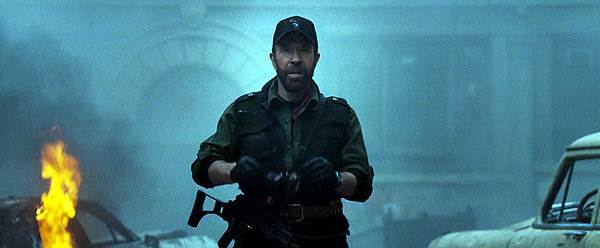
 The Expendables was a surprise hit two years ago. Sylvester Stallone collected an all-star team of aging AARP action stars and they kicked ass, took names, and didn’t apologize. It was a fitfully amusing throwback to the burly, macho action movies of the 1980s and the early 90s, a time where many of these men were kings. The nostalgia trip worked box-office magic for Stallone. A sequel was commissioned and these men of action were put back to work. There was already preliminary talk about the possible stars that could sign up for a third Expendables (Nicolas Cage and Clint Eastwood are on a wish list). Maybe people should see The Expendables 2 before getting too excited plotting out the future of this franchise. This is not a good movie even by Stallone’s standards.
Barney Ross (Stallone) is back with the best team money can hire. No, not the A-Team, the Expendables. There are also the preposterously named team members Lee Christmas (Jason Statham), Ying Yang (Jet Li), Gunner Jensen (Dolph Lundgren), Toll Road (Randy Couture), and Hale Caesar (Terry Crews). The over-the-hill gang also has some new blood, namely Bill(y) the Kid (The Hunger Games’ Liam Hemsworth). The gang runs afoul with Vilain (Jean Claude Van Damme), a terrorist mining for plutonium to sell to the highest bidder. Barney swears to thwart Vilain and calls in help from other living action legends like Chuck Norris, Bruce Willis, and Arnold Schwarzenegger.
 What made the first Expendables enjoyable, at least for sustainable spurts, was its over-the-top nature comingled with a lack of irony. The movie felt often like a satire of the genre but you knew that Stallone was never winking at the camera. Stallone was never in on the joke. That changes with The Expendables 2, which often resorts to self-aware humor to poke fun at itself. This approach simply does not work. There’s an entire sequence where Chuck Norris even makes a Chuck Norris Internet joke, merging reality with irony. The bad guys are lousy shots and the good guys are the world’s greatest marksmen, but I don’t even know if this is intentionally self-aware or just par for the genre. Having Arnold repeat other people’s famous one-liners and quips (“Who’s next? Rambo?”) are not funny. The self-awareness never rises to the level of commentary or intentional satire, like say the underrated Last Action Hero. It’s just the same mindless violence but with the slightest of nods, the bare minimum to say, “Hey, we get it.” Except the movie feels shackled to this flawed approach and often the action fails to gestate into something larger than old guys shoot guns and make occasional wisecracks. The action sequences are really disappointing here. Little attention is given to geography, short of a climax set amidst an abandoned airport. I kept hoping for more of the gonzo, hyperbolic touches that the first film had in abundance. The best ridiculous moments this go-round are Van Damme roundhouse kicking a knife into a guy’s heart, and the piece de résistance, Norris shooting a guy onto an airport security conveyer belt where we then see the body full of lead on the x-ray machine.
Most of the Expendables teammates simply have nothing to do. Granted with a large cast the ratios of screen time are not going to be equal across the board, but I’d expect that Stallone and crew would at least give these people some reason to exist in the plot. Jet Li vanishes after the twenty minute mark and never returns. There’s truly no reason that Randy Couture and the great Terry Crews couldn’t have been Guy #5 and Guy #6. Lundgren is setup to be a chemistry genius, and then when trapped inside a mine, it looks like he’s about to utilize his chemistry knowledge to save the day. Nope. Then why would you even set this ability up if you weren’t going to do anything? Even Statham is pretty mitigated and he’s the number two guy. If you’re going to have a team-oriented action movie, then make use of the team and their unique skills. Part of the joy of these kinds of movies is watching the crew work together, like in The Avengers. With this film, we just get rapid-fire shots of the good guys shooting the bad guys, sometimes separately, sometimes together. It gets boring plenty quick.
 The plot is fairly bare-bones even more an action movie. It’s a rote revenge movie where Stallone and the boys are out to get Van Dame after he killed one of their guys (the only expendable Expendable, it seems). The plot never gets much more complicated than that. The gang encounters a group of terrorized villagers who want to rescue their husbands from Van Damme’s forced labor. Our bad guy even has a name that is a single letter away from spelling “villain” in case you needed the help. You know how he’s one evil man? He wears his sunglasses at all times even underground inside a mine. Of course this may also be a stylistic choice to hide Van Damme’s horribly Botoxed face. The Muscles from Brussels is actually the second best actor in the movie (Crews easily remains the best), good enough that I wouldn’t mind seeing the older Van Damme in more movies. Sadly his big showdown with Stallone is pretty short, with Van Damme resorting to the same roundhouse kicks before being subdued.
Stallone sat out the director’s chair and instead Simon West (The Mechanic ) takes the reins. I suppose this freed up Stallone to… focus more attention on the script? Emoting more? The visuals are fairly muddy and lack the polish of West’s other hyperactive action movies like Con Air. The opening assault sequence, where Barney and the Expendables roll through an enemy compound, literally busting through walls, is the visual highpoint for the movie. I credit the filmmakers for sticking with the R-rating and not toning down their violence. It would seem like hypocrisy to have a movie about a bunch of crusty old-timers lamenting how soft the world has gotten and then wuss out to a bloodless PG-13 rating. At least this wrecking crew doesn’t hold back when it comes to their specialty: mayhem.
The Expendables 2 should have been more than just Stallone and his peers patting themselves on the back. I’m glad Willis and Schwarzenegger graduated from cameos to supporting roles, but I wish the movie just had something for these men of action to do. There’s far too much repetition with its action, which becomes a formless montage of people shooting guns in slightly varying locations. The self-aware humor kills the development of the action and it’s simply not funny enough. It’s the kind of sad humor of old men trying to still look hip, like they’re in on the joke. Hey, they can make fun of themselves too. It’s just not a fun movie. There are only so many tried wisecracks you can endure, only so much redundant action, plotless excess, and crowbarred cameos. The Expendables 2 takes the little merits of the first film and completely loses touch, all to try and make a joke. In the end, the real joke is still on Stallone and the filmmakers. They wanted to make a movie that knew it was stupid. Instead they just made a stupid movie.
Nate’s Grade: C-
Share this:

American Reunion (2012)
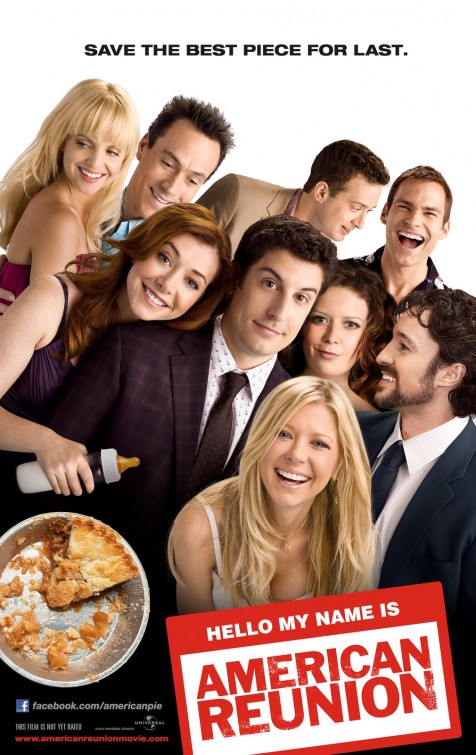 What loser doesn’t attend their 13th high school reunion? Who even organizes such an untimely event? The generally unnecessary American Reunion is being dished out to the public for a number of reasons. The studio would like to revive their once lucrative sex-comedy-meets-baked-goods franchise, and most of these actors could desperately use the work. Remember when the likes of Chris Klein, Mena Suvari, and Tara Reid were above-the-title names? What I recall, now that the gang is together again, is that I found most of these characters to be dullards. They’re in their 30s, have careers and families, and stupidly comfortable lives, yet they’re up to the same old hijinks, which just seem a bit more desperate and embarrassing this time around. Seann William Scott, the franchise’s true wild card, is still amusing as ever, but I couldn’t swallow the forced nostalgia for characters that are unappealing. Jason Biggs and Alyson Hannigan still make a nice pair, but rehashing the old gang mitigates their screen time. Comedy-wise, the movie has a few memorable gross-out moments but nothing really hilarious. I laughed from time to time but mostly I was bored, and Klein, especially in his new post-Street Fighter ironic version of himself, is rarely boring. It’s a pleasant enough experience and I suppose fans of the original films will get a kick out of seeing who ended up where and, in particular, what he hell happened to Reid’s leathery face. Otherwise, American Reunion is a gathering that nobody called for and fails to justify all the effort. Then again, my favorite of the American Pie films is the second one, so take my words with caution.
Nate’s Grade: C
Share this:

The Dark Knight Rises (2012)
 Let’s be honest, The Dark Knight Rises movie was never going to meet fan expectations after the high-water mark between superhero movie and crafty crime thriller that was the pop-art masterpiece, The Dark Knight. Whatever director/co-writer Christopher Nolan put together was fated not to match the pulpy big blockbuster alchemy that he worked so well in 2008. Minus Heath Ledger’s instantly iconic performance, a role that set the film on fire whenever he was onscreen, there is going to be a certain void to this capper to the trilogy. Now having seen the movie twice, including once in sphincter-rattling IMAX, I feel that I can truthfully state the most obvious: The Dark Knight Rises is not as good as the previous movies. While a fine finale for an ambitious series, this is definitely the weakest movie of the trilogy.
It’s been eight years since Gotham City last saw the likes of Batman. Bruce Wayne (Christian Bale) is an older man, hobbled by age, and living as a recluse in his mansion. His trusted friend and butler Alfred (Michael Caine) keeps encouraging Bruce to seek a life outside that of Batman. In those eight years, Gotham’s police have cracked down on organized crime thanks to the Dent Act, a law named after the late district attorney Harvey Dent (a fallen idol that only a handful know the real truth about). Commissioner Gordon (Gary Oldman) is growing sick with the secret of Harvey Dent and looks to retire from the force. Miranda Tate (Marion Cotillard) is a businesswoman eager to restart Wayne’s clean energy project, and a woman interesting in getting Bruce back on his feet. There’s also Selina Kyle (Anne Hathaway), a.k.a. Catwoman, a master thief who gives Bruce a new challenge. But then along comes Bane (Tom Hardy), a master terrorist and figure of brute strength. His goal is to fulfill the League of Shadows’ plan and destroy Gotham City and expose its rampant corruption. He sidelines Batman and takes over the city, unleashing criminals and hordes of the downtrodden upon the wealthy. There is no escape from Bane’s plan, his wrath, but Bruce Wayne must rise to the occasion and be ready to sacrifice the last of himself for the people of Gotham.
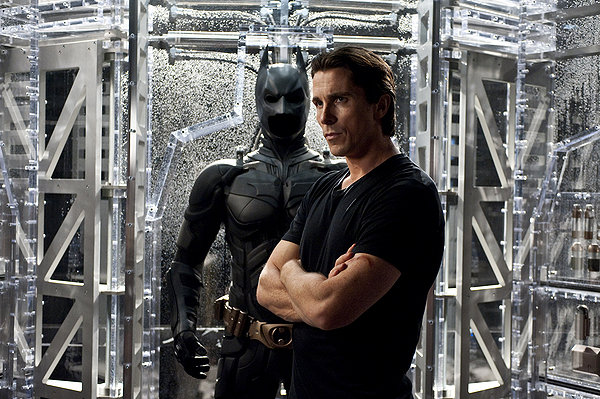 Firstly, Bane is no Joker. The bad guy lacks the fiendish charisma of Ledger’s Joker and he’s not as well integrated thematically into the movie. The Joker was an anarchist that wanted to tear down the pretensions of society and watch people “eat each other.” And we watched a city come unglued. We explore the notion of escalation and what the blowback would be for a man fighting crime in a costume. With Dark Knight Rises, Bane wants to take up the mantle of Ra’s Al Ghul (Liam Neeson) and wipe Gotham off the map. He’s got moments of being a master planner but really he’s just a big heavy. He’s the big tough guy that beats up old man Bruce Wayne, and Bane is continuously diminished in the film as it goes. A late revelation with the character completely diminishes his role and turns him into the equivalent of a mean junkyard dog. His big plan is simply to rile up the masses and wait for the inevitable. Hardy (Bronson) is a great actor prone to mesmerizing performances. This isn’t one of them. He’s super beefy but the facial mask, looking like some sea urchin, obscures half his face. It’s all physicality and eyes for his performance, along with very amped-up dialogue that you can tell was rerecorded after filming. Every time Bane speaks it’s like he has a speaker system installed in his face. And then there’s the matter of his sticky accent, which to me sounds like German mad scientist but to my friends sounded like drunken Sean Connery.
Bane keeps espousing about the corruption of Gotham but you really never get a strong sense of what that corruption has lead to. Catwoman talks about the Gotham elites living large while the rest of the city struggles; but rarely do you get a sense of this. So when Bane flips the tables, and the elite and wealthy are stripped of their decadence and put on trial by mobs, it feels improperly set up. Just because you have characters talk about wealth disparity and the city’s corrupting influence doesn’t mean it’s been established. Nolan’s Batman movies are a reflection of our modern-day anxieties in a post-9/11 world, so I wasn’t surprised to see a society rotting away from the sociopathic greed and wanton excess of the 1%. But rather than serve up a wealth disparity parable of class conflict, the movie simply turns to mob rule, a far less nuanced and interesting dissection of current events and fears. It’s like the French revolution took a trip to Gotham City (Gordon even quotes from A Tale of Two Cities). It’s a society built upon a central lie, the idol of Harvey Dent, but the movie fails to make the corruption felt. In the end, this is all pretty weak social allegory. And would it have killed Bane to be a little more brutal to stock exchange short-sellers?
 Then there’s the typical Nolan origami plot with the myriad of subplots intersecting. This is the first time in the series where the plots felt poorly developed. Rewatch Batman Begins or The Dark Knight, as I recently did, and you’ll see there is not an ounce of fat in those movies, not one wasted scene or one wasted line. Sure they got secret super ninjas and Katie Holmes, but those movies were well built blockbusters. I could have done without Bane entirely and certainly would have loved more of Catwoman. Hathaway (Alice in Wonderland) is terrific in the antihero role and brings a very interesting dynamic relationship with Batman. She may be the only person who understands him. I wanted more Catwoman, the movie needed more Catwoman, but alas she is just a plot device to connect Wayne to Bane. She has a larger role in the concluding melee but essentially becomes Batman’s reluctant wingman. The whole theme of the 99% vs. the 1% could have been generously explored with this character, and her spark and charisma would certainly be enough to get Bruce Wayne out of bed again. Then there’s the regular cop (Joseph Gordon-Levitt) doing the unheralded good deeds that so easily get overlooked. Here is an interesting character that, due to some leaps in logic, connects with Bruce Wayne on a unique level. He presents a counterbalance to all the souped-up superheroes, a recognizably regular human trying to do good. It’s then a shame that he gets entirely relegated during the third act so that the superheroes and their super toys can make some noise.
For a Batman movie there’s hardly any Batman in it. The caped crusader has been in retirement for eight years, so it takes some time before Bruce puts the suit back on. But then he’s also sidelined for a good third of the movie, stowed away in a far-off prison. The entire Indian prison sequence really could have been exorcised. It essentially becomes a Rocky training moment for Bruce Wayne to recover and a plot device to explain why there needs to be a time gap in the story. But this part of the movie just feels like it goes on forever, and we all know where it will go so we just keep waiting for the movie to get there. No one wants a Batman movie where Batman sits the middle out. The end feels relatively fitting but any fan of The Iron Giant will recognize some similar key elements.
And while I’m on the subject, let me do some estimates here. The timeline between Batman Begins and The Dark Knight is about a year, as the Joker notes to a congregation of mobsters. I’ll be generous and say that the events of The Dark Knight last two months. We learn that Batman never appeared again after the death of Harvey Dent, and now we flash to eight years later with The Dark Knight Rises. So you’re telling me that we only really got a solid year of Batman being Batman? That over the course of nine years he was Batman for only one of them? That’s very little Batman-ing for a Batman franchise.
But even with these flaws in tow, The Dark Knight Rises is still an exciting, stimulating, and mostly satisfying close to a trilogy of unprecedented ambition and scope for a modern blockbuster. The action sequences in this movie are huge and exhilarating. I loved Bane turning Batman’s armada of weapons against him. The Bat fighter plane is a nice addition that gets plenty of solid screen time. The sheer scope of what Nolan produces is epic; from a plane being hijacked in mid-flight and torn apart, to a city being leveled by explosives, to a face-off between a bevy of armored Batmobiles and the Bat plane through the streets of Gotham, the movie does not disappoint when it comes to explosive, large-scale action set pieces. This is also the first Batman movie where the climax is the best part of the film. The last half hour is solid action but also a fitting sendoff for a beloved character. Some will grumble with certain hat-tipping moments at the end, but I found it entirely satisfying. It all comes back to the central thesis of Nolan’s Batman films about becoming something more than just a man, becoming a symbol, and that symbol is meant to inspire others. By the end, you feel that the inspiration has been earned as so has our conclusion.
 I want to single out Caine (Harry Brown) who has very few scenes but absolutely kills them. He’s the emotional core of the movie, perhaps even the series, and has always been hoping that his charge, Bruce Wayne, would never return to Gotham. He’s the voice of reason in the movie, the man that reminds Bruce about the costs of a life spent seeking vengeance and sacrificing his body. I wish Caine was in the movie longer but his scenes are pivotal to the plot, as is his absence.
The Dark Knight Rises doesn’t rise to the level of artistic excellence of its predecessors, but it’s certainly a strong summer blockbuster that works as an agreeable finale to the premier franchise of the era. It’s not quite the knockout we were expecting from Nolan but it still delivers where it counts. I wish it had give a fuller, richer portrait of a city corrupt from the inside out, a society rotting away and ready for revolution, and plus I also wish we had plenty more Catwoman and plenty more shots of Anne Hathaway in her Catwoman cat suit (Michelle Pfeiffer still has nothing to fear), but these are the things of dreams. Nolan’s aim has always been to place Batman in a world that is recognizably our own, and with that comes the responsibility of bringing a stolid sense of realism with all the blockbuster pyrotechnics. This artistic ethos has given us some extraordinary movies, though some Batman purists would object that Nolan’s hyper-realism is not the Batman they grew up with. It’s hard to really get a sense of the accomplishments that Nolan and his team has been able to pull off over the course of three bladder-unfriendly movies and seven years. He’s taken the superhero movie and redefined it, brought it unparalleled psychological depth and philosophical analysis, and given a human quality to what normally gets dismissed as escapism. The Dark Knight Rises isn’t as revelatory as its previous entry but it sticks the landing and puts to rest what is indisputably the greatest superhero trilogy of all time.
Now get ready for the reboot in three years.
Nate’s Grade: B
Share this:

Men in Black III (2012)
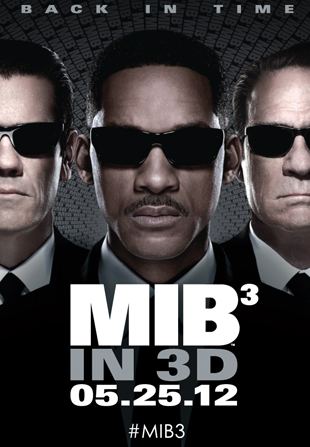 It wouldn’t be a Men in Black film without script problems. The first film languished for some time, originally taking place in Kansas of all places, before director Barry Sonnenfeld became attached and insisted upon a New York City location. The 1997 sci-fi buddy cop comedy was a hit, and rightfully so, and Will Smith became a megastar. Then the 2002 sequel’s climactic action sequence had to be rewritten due to the fact that it was originally going to take place in the World Trade Center. If only that lackluster sequel had gone through more extensive creative revisions. However, these past hiccups don’t seem to come close to Men in Black III, which to Sonnenfeld’s admission, started shooting in late 2010 without a finished script. It had a beginning, an ending, but nothing definite to tie together. So the whole production took eight months off to work on the meat of that movie sandwich. Hollywood movies, especially modern films of huge-scale budgets and set release dates, have routinely started production without completed scripts, including Gladiator, Jaws, Apocalypse Now, and Lawrence of Arabia. Naturally, those are the exceptions to the rule.
Boris the Animal (Jermaine Clement) has escaped from pison and out to seek revenge on the man who put him away and took his arm – Agent K (Tommy Lee Jones). Boris travels back to July 1969, when a young Agent K (Josh Brolin) thwarted the big bad Boris. Boris kills Agent K and alters the future. The Earth is now vulnerable to an alien invasion from Boris’ species. Agent J (Smith) has to travel back in time to save his old partner and the planet.
It’s been ten years since the spotty Men in Black II and almost four years since Smith has been seen in a movie. Where did the time go? Fortunately, this third movie hews closer to the droll brilliance of the first film. Part of that is a sharper story with a more clearly defined goal and a return of the playful exuberance that belies the franchise. Also, I must say that absence has made the heart grow stronger, because I’ve missed Smith’s effortless charisma onscreen. Agent K is such a natural fit for the guy and it’s just fun to watch him stumble through strange alien encounters (this time we learn all super models are aliens; listen good, young women of America who punish themselves to fit this image of beauty). Time travel is usually employed when a franchise seems like it’s all out of gas; it’s usually more focused on the comic fish-out-of-water possibilities, which there are a few in Men in Black III. As one characters notes, 1969 wasn’t exactly a great time for black people in America, and J combats casual racism, black panic, and ignorance with a defiant attitude that is amusing to watch. I’m glad the whole race-relations reality was addressed, though it’s also for the best that the movie doesn’t get bogged down with scenes of Agent J conflicting with bigoted authority. Men in Black III remembers that we’re here to have fun, and the screenplay by Etan Coen (Tropic Thunder) has a light-handed touch. I enjoyed the opening jailbreak sequence with Boris, though I would have thought a lunar prison would have better security. Bill Hader (Superbad) has a fun cameo as a self-hating Andy Warhol, really an undercover MIB agent, though the idea that Warhol’s Factory artists as aliens seem a tad simple. The glaring cameo omission was Jon Hamm (TV’s Mad Men) as a scotch-drinking MIB ladies man of legend.
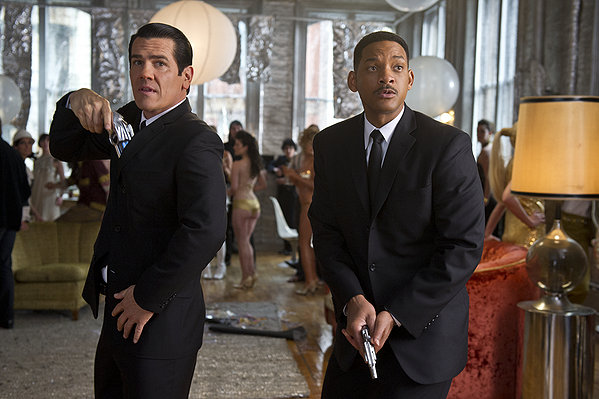 As evidenced from the trailers and marketing, Men in Black III is really Brolin’s movie. The guy establishes an uncanny Tommy Lee Jones impersonation. The eerie brick-faced stoicism, the melodic lilt of his voice, the syncopation of his speech patterns; Brolin nails it all. Watching his interaction with K are the film’s most enjoyable segments. At this point in the series, Agent J and K have gone beyond the rookie/mentor phase and now have something of a friendship, though their arguments at year fifteen of their partnership sound more like the arguments they would have in year two (you need to “open up” and be less grumpy, sounds elementary). Still, there is a personal connection to this case that eluded the last movie, and it gives the film a sense of urgency even when the comic shenanigans seem to hog the spotlight. The personal reveal in the last act didn’t have as much emotional power for me, mostly because I did the math and realized whom a certain unseen character of significance was before we got their true identity. The end does give the film series a circuitous sense of finality.
For a franchise that seems like it can go anywhere at any time with limitless possibilities, the worst thing you can do is be shut off to better avenues of storytelling. Take for instance the climax at Cape Canaveral, which itself is a rather anticlimactic sequence involving the launch of Apollo 11 (don’t they know that alternative 1960s history was sooo summer of 2011?). J has his time travel doohickey that lets him travel back. He gets to use this device once during the climactic fight, allowing him to travel back one minute in time so he knows how to properly duck. That is it. What a fantastic waste. If you’ve got a device that essentially allows for unlimited do-overs, then I want this device to be an integral part of the climax. I want J to have to regularly use it to fix past mistakes and learn more and more from each time jump. Just memorizing how to duck is lame. The entire subplot with Agent O (Emma Thompson in the present, Alice Eve in the past) and her dalliance with K is so carelessly thrown away that I wonder why the filmmakers even bothered to include it. Then there’s our villain, Boris, whose name itself is even lazy. He’s just a bad dude with some sort of insect that lives in his hand and shoots spikes. That is it. He’s a guy who can fire projectiles. So what? What about that makes him interesting? An unrecognizable Clement (Flight of the Conchords) does his best but the character just doesn’t have anything about him that deserves special attention; he could have been any villain (I think Vincent D’Onofrio was undervalued in his go-for-broke physical performance as the first film’s villain). I did like the idea of Present Boris arguing with Past Boris, but like most promising ideas in Men in Black III, this space-time sparring is never fully realized. While enjoyable, there’s little you’ll be able to think back on with Men in Black III and say, “That was well developed.”
Paradoxically, I think Men in Black III has a character that might simultaneously be the best and worst thing about the film. Allow me to explain. About halfway in, we’re introduced to the alien Griffin, played by the great Michael Stuhlberg from A Serious Man and TV’s Boardwalk Empire. He’s a creature who can see nigh unlimited timelines, all the variations of choice and possibility play out before his eyes, one after another. He never knows which timeline he’s in until the moment occurs, thus he’s constantly worried about every moment to come in his life. This foreknowledge sounds like a wretched curse, and with Stuhlberg gives a forlorn edge to his character’s eccentricity. So when J and K meet the guy, there are some clever moments, like when Griffin details every peculiar aspect of chance that lead to the 1969 Mets World Series victory. The moment, and by extension the character, is a nicely reflective idea that every moment is a miracle of causation. Griffin is just an interesting character. Here’s where the worst part comes in. Rarely is he treated as a character because, you see, Griffin is really a magic plot device. He can tell the Men in Black agents whatever they need to do at any point, instantly providing a narrative cheat. When in doubt, just ask the guy who sees the future and he’ll steer you without fail to the next necessary plot point.
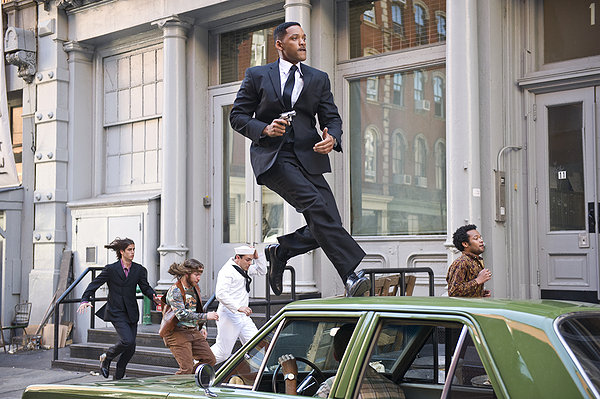 I saw this movie in 3D, not by choice mind you, and for the first half hour it felt like one of the better 3D conversions out there. Sonnenfeld’s camera plays a lot with depth of field and primarily forward-backwards movement, which made for a slightly elevated viewing experience. But somewhere around the halfway mark, I swear the movie forgot it was supposed to be 3D and the dimensional differences became negligent. It never really recovers, and so I advise all potential ticket-buyers to skip the 3D screenings.
With most time travel escapades, there’s going to be some plot holes. Working with a flurry of alien technology, it would have been exceptionally easy for the filmmakers to just explain away the plot holes with some magic device, much like the Paradox Machine in Dr. Who. Hey, there’s a machine that makes sure we don’t have paradoxes? Good enough for me. It’s like in Thank You for Smoking when Rob Lowe’s character explains why actors would be able to smoke in an all-oxygen space environment: “It’s an easy fix. One line of dialogue. ‘Thank God we invented the… you know, whatever device.’” The fact that Men in Black III doesn’t even address its biggest plot hole astounds me. If Agent K is killed in 1969, then he was never alive to recruit Agent J into the service. Let’s even assume that J’s credentials would still get him noticed and staffed with the MIB; if Boris killed Agent K in the past, then there was no reason for Boris in the future to travel back in time to kill Agent K. Again, these aren’t nit-picky gripes, these are major, easily understood plot holes, and I’m dumbfounded why no characters even address them. I could nit-pick over why Boris decides to go to 1969 when he just as readily could have gone to a time when K was a child and thus more vulnerable. Surely a child is easier to dispatch than a 29-year-old man.
Men in Black III is a far improvement over its stilted predecessor, but it still ends up falling well short of the potential it flashes. It’s intermittently amusing with some fun cameos and some visual panache, but this movie should have been stronger, stranger, and more playful with its central time travel conceit. It’s hard to work up that much distaste for the movie, especially since it has such a lively, jocular feel. Not all of the jokes work, but enough do, and the movie maintains an overall pleasant sensibility, zigzagging in imaginative directions that most Hollywood movies never beckon. It’s the stuff that works that illuminates the potential left behind as it goes into summer blockbuster territory. Men in Black III is an example of diminished returns, yes, but some franchises start so high that even latter, lesser sequels will have more entertainment value than their competitors. While it won’t set the world on fire, Men in Black III exceeds expectations and provides enough entertainment that it’s worth a look and little else.
Nate’s Grade: B
Share this:

Wrath of the Titans (2012)
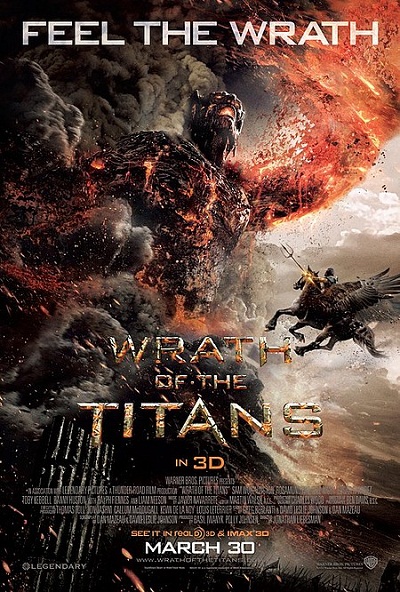 The 2010 Clash of the Titans made some sizable sums of money but it really became famous for one reason – the beginning of the 3D fleecing and the public’s souring on what was supposed to “save the movie going experience.” Clash was converted to 3D in post-production, and its lack of foresight and rushed conversion showed. After the high of Avatar, it only took approximately three months for the public to feel ripped off by 3D. Certain Hollywood bigwigs are concerned that bad 3D conversions will kill the golden goose, and it is having an effect. The percentage of movie audiences seeing big releases in 3D has slipped steadily from 2010. Whether it is the added cost or the underwhelming conversion, movie audiences are warier of the third dimension. And it was Clash of the Titans that destroyed a nation’s innocence. Two years later, the sequel is out and, surprise surprise, you also have the ability to see it in 3D. Either way, this movie will cause you a headache.
In the wake of Perseus successful slaying of the Kraken, he is now a widower with a young son, living their lives quietly, trying to avoid the daring heroics of his earlier life. Fat chance, kid. The gods are at war, particularly Hades (Ralph Fiennes) and Aries (Edgar Ramierez) versus Olympian head honcho Zeus (Liam Neeson), Perseus’ absentee father. The titan Kronos will be unleashed from his prison, Tartarus, and this powerful behemoth will lay waste to the armies of mankind. The gods have grown weak due to mankind’s dwindling faith, and as such they cannot conquer Kronos without the help of man. It’s up to Persues, Queen Andromeda (Rosamund Pike), and Poseidon’s demigod son a (Toby Kebbell) to track down the right magic artifacts to take down Kronos.
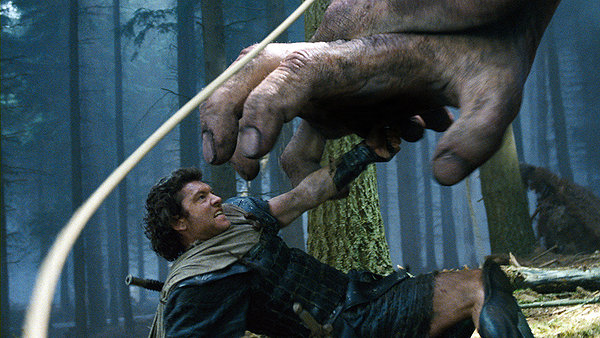 Once again we have a threadbare story that involves running from one location to another to find a clue that leads to the next location; the plot is just a series of magic-item gathering missions, much like a video game. Greek mythology made regular use of magic weapons to slay great monsters, but the myths at least gave their audience heroes worth fighting for. Worthington’s scowling rendition of Perseus is a bore, and giving him a son doesn’t help much. Just because the guy keeps insisting he has someone to protect doesn’t fill his void of characterization. He’s so free of charisma, so gruff and without any defining personality, that you wish he could find some magic shortcut to find his dumb magic items faster. The whole setup with our villain is also vague, beyond the very specialty of the god in question. And then there’s the whole concept of the gods dying, which was also featured in last fall’s glorious-to-look-at-but-empty-on-the-inside Immortals, another cinematic tussle with the titans. What’s the point of being a god anymore if the defining quality, immortality, can be ripped away? I suppose the screenwriters wanted to raise the stakes when Zeus and other gods enter the fray, dangling the threat that they too could perish. “We may not have weapons, but we’ll fight how long we can,” Zeus declares with modesty, and then he proceeds to zap enemies with lightning bolts. I don’t think a club is going to outrank a giant projectile of electricity. Realistically, I think the whole death-of-the-gods angle, which cold have brought some real somber and existential weight to the film, was just a setup to allow the producers to recast future sequels with less costly actors (goodbye, Neeson and Fiennes; they’ll be no more Kraken-releasing for either of you).
Director Jonathan Liebesman (Battle: Los Angeles) isn’t going to wow anybody with his addition to cinema, but he can put together a serviceable sequence of action. My favorite sequence in the entire film is when Perseus and crew enter the underground maze of Tartarus. The stone walls are constantly shifting around and the characters are zooming all around the room. It reminded me of the moving staircases in the Harry Potter world or think of it as the real prequel to Cube. And yet, even this nice sequence is limited because Liebesman and the screenwriters don’t take full advantage of their situation. We have a constantly shifting three-dimensional maze, and nobody gets lost at all? And the heroes, after discarding the map, easily find their way to the other side? What kind of design flaw is that? Liebesman prefers a lot of handheld camerawork and low angles, which can be jarring at times. Worse, the action favors a visceral chaos rather than steady development. There are plenty of people dying, columns exploding, fireballs tossing, but little of it adds up to much. It’s all disparate shots, like every character is in a separate movie. Such a shame because the special effects are rather good. If you’re going to spend this kind of money on a Greek mythology spectacle, at least make us care beyond a “fire pretty” level of tepid enjoyment.
The movie is in some breech of false advertisement since the title clearly states a plurality of titans, but by my modest account we only really have one titan to deal with, the giant lava beast Kronos (do the smaller creatures and Cyclops count as titans? I doubt this). Now we all love how fire looks, though some love it a bit too much. And lava itself has long been a childhood adversary. Who amongst us has never pretended the floor was once lava and but a handful of couch cushions were the only stepping-stones to safety? It’s hard to get an exact feel for how massive Kronos is considering he emerges from a mountaintop and seems to extend even higher into the sky. It’s intended to be a threatening and horrifying sight, but I kept thinking of a Marine ad from the 1990s where prospective recruits displayed their mettle by combating giant lava creatures (“Marines: Keeping the U.S. safe from lava men since 1916”). Instead of being awed by Kronos, I started picking apart the logistics of being a lava man. I suppose when you’re a god, or a titan for that matter, you don’t have to really eat or drink or do the things we mortals must for sustenance. But how does a lava creature work when part of his fiery M.O. is how drippy and malleable he can become? Perseus flies into the mouth of the lava beast but why does a beast, which needs no food or drinks, even needs a mouth? It’s not like this guy is speaking beyond a ground-shaking mumble. The entire face is almost superfluous. It’s not like a lava creature has eyes or a working circulatory system. Now I could apply these same annoying ticky-tack questions to any monster or mythological creature. The reason I did this is because the monster of monsters is no more intimidating, or satisfying, as the array of giant monsters that Godzilla would fight (or for you youngins – the Power Rangers). When your ultimate bad guy, and lone titan, can just as easily be blown up in the same manner as the Death Star, then we have a problem.
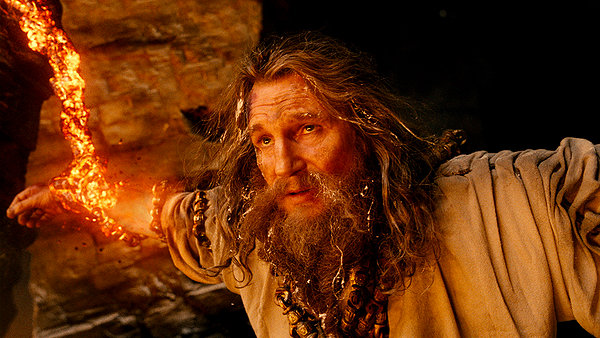 There’s a certain level of entertainment watching dignified actors in something so inherently campy. Neeson (The Grey) and Fiennes (Harry Potter and the Deathly Hallows: Part Two) are a long way from their Shindler’s List collaboration. The two men lend a level of gravitas to a movie that is leagues below their talents. Perseus proves to be such a dull demigod, that I wish the entire movie had followed the warring gods instead. That approach would have been much more interesting considering that they must confront mortality. Worthington (Avatar) still has a notable screen presence in the realm of action cinema, but his constant scowling is just getting tiresome. Hollywood, give this man something to do other than scowl and he may surprise you, like in The Debt. Pike (Doom) is unconvincing as a warrior princess, and her forced romance with Persues could not be more contrived (did somebody say, rebound?). The best actor in the movie is Bill Nighy (Underworld) who shows up as a daffy version of Hephaestus, the god of metallurgy and blacksmiths. Nighy understands how completely cheesy the whole getup really is and delivers a performance on the comic wavelength that the entire movie should have held.
While not nearly as humorless and joyless as the 2010 edition, Wrath is still a fairly block-headed romp through the noisiest parts of Greek mythology. After two movies with “titans” in the title, it’s somewhat remarkable that we only witness one single titan in the entire combined 245 minutes. It’s all CGI sound and fury with little cohesion to make anything feel important, despite huge mythological creatures demolishing cities. From an action standpoint, Wrath packs enough serviceable, escapist sights for the eyes to please diehards of Greek mythology and genre fans with low expectations. I wish there was a more compelling reason to run through all this stuff than big monsters needing to be killed; this hero’s quest needs more motivation or at least a grander sense of awe. The demise of the gods due to mankind’s mounting religious doubt seems like a juicy subject that could have opened these characters up. But then the theological discussions would get in the way of people hitting made-up CGI monsters. If you like your cheese feta, then Wrath of the Titans will provide enough wrath for your bucks, though found lacking in titans.
Nate’s Grade: C
Share this:

Fast Five (2011)
 The fifth movie in the gearhead Fast and the Furious series unapologetically eschews logic and physics to deliver an energetic, over-the-top, stupidly entertaining action movie. This thing’s got swagger to spare. Credit Justin Lin, director of the last three films in the series, who has a tremendous knack for orchestrating mass chaos into eye-catching sequences. The plot is practically inconsequential but involves Vin Diesel and his team planning an Ocean’s 11 style heist against an evil Rio de Janeiro crime lord. Diesel, that black hole of charisma, sticks to what he’s good at: grunts and glares. It was a smart move to introduce The Rock as a dogged DEA agent. His added brashness and command of cool gives the series a boost in star power. The final act of this film is an exceptional chase sequence where Diesel’s crew drags a large bank vault through the streets of Rio, destroying just about every car in sight. The stunt work is phenomenal and the special effects feel seamless, never ripping the viewer out of this hyperactive, preposterous reality. Sure, it can get bogged down in its teenage horndog worship of hot cars and hot gals (Rio is in no short supply of physically ample women), but Fast Five delivers in spades when it comes to junky popcorn thrills. I can’t believe I’d ever write these words, but I’m actually looking forward to more Fast and the Furious hijinks. Just as long as Lin and The Rock return.
Nate’s Grade: B+
Share this:

In the Name of the King 2: Two Worlds (2011)
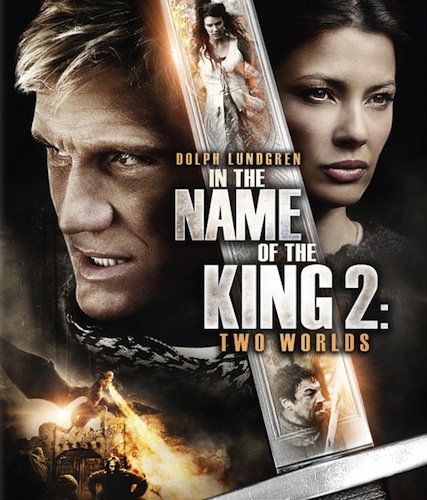 In the Name of the King 2: Two Worlds has a tenuous at best connection to the original 2008 In the Name of the King, noted as the most star-studded Uwe Boll film and the last Boll film to get a theatrical release. I think that highest-profile belly flop, and the revision of the German tax code loopholes, is what banished Boll to the little league of direct-to-DVD movies. I suppose the movie does involve things happening in the name of a king, but that’s being overly generous. There’s barely a mention of Jason Statham’s (The Transporter) character from the first flick, a commoner who arose to become king and who was slain by an enemy that is pathetic and embarrassing. The only meaningful connection lies in the title and the prospect of Boll trying to draft attention to his sequel off the momentum of his pitiful predecessor.
Granger (Dolph Lungren) is a former Special Forces soldier who has retired and runs a karate studio for kids now. Then one day he stumbles upon a mysterious woman being chased by ninjas (Vancouver’s ninja crime rate has skyrocketed since 2008). A portal to another world is opened and Granger gets sucked back to a feudal kingdom. The King (Lochlyn Munro) has awaited for a special visitor who would restore balance to the kingdom, drive away the Dark Lords. The prophecy says that Granger is their man. He’s a little skeptical and even turns down the services of a concubine, though still accepts a little cuddling. Manhatten (Natassia Malthe) is the king’s medic of sorts and accompanies Granger on his journey to defeat the evil sorceress and save the Kingdom of Whatever.
 After having viewed 19 different Boll movies, all to certain degrees of willingness, I can safely say that this is the most boring of the bunch, and hopefully those words will still have meaning. The plot never really evolves further than its premise, another rehash of A Connecticut Yankee in King Arthur’s Court, or to genre fans, a rip-off of Army of Darkness, or to idiots, a rip-off of Black Knight. Granger goes back in time, bumps around some rather stock characters, gets told about prophecies and destiny, and then there’s a fight and a dragon and a jump back to Earth and we’re done. In between is very little to care about. This is the first movie I’ve seen that feels completely constructed as one long saggy middle. Just about every scene takes place in the forests of Vancouver (I mean… whatever the hell the other world is called). It gets repetitious very quickly, never seizing on the fish-out-of-water comedic possibilities or just giving in completely to the genre elements of a medieval sword and sorcery flick. It’s all just irritating blather; a “chosen one” here, a “dark one” there, something something “prophecy.” When people badmouth fantasy, they think of this kind of stuff. I kid you not at one point Malthe’s character says, “You are the villain of this tale” to the said villain. Thanks for clarification, but the third act betrayal was telegraphed well over an hour ago.
The writer, Michael Nachoff, has written exactly one other movie, Bloodrayne 3, and served previously as an office coordinator, post-production assistant, and in material serving. That last one sounds like a made-up job or some kind of finessing that a prostitute would put to make her resume sound more professional. Whatever the case, Nachoff has shown that after two movies he cannot be counted on to deliver anything resembling a competent plot. This is the laziest more yawn-inducing hero’s journey I’ve ever witnessed. The movie literally put me to sleep. There are all sorts of dropped setups and subplots, including the notion that Granger must complete three trials, though we only ever get one. That’s bad sooth-saying, but then again the seer gets murdered so I can’t imagine she was first in her class at prescience. Nachoff keeps using the phrase “time travel,” and so do I, but I think what they really mean is dimensional travel. I’m fairly certain that Granger is not just from the future but an altogether different world. Yet at one point a character says, “Your fear will carry you to the pits of hell.” Ah, I see that Christian missionaries must have visited this alternate dimension. Oh well, the character also seem to keep erroneously saying “biological weapon” when clearly the bad guy assembled it out of various powders and chemicals. They even refer to his skill as alchemy, which of course is all about biology, right?
The action is mirthless and hastily thrown together, often becoming incomprehensible because the villains, the Dark Lords, wear dark cloaks and our heroes too wear dark clothes. Good luck deciphering who’s who on the battlefield. Maybe you’ll be like me and just become crippled by apathy. Granger isn’t a very compelling hero either. Under Nachoff’s compliant attention, he is strictly stock: 1) he is retired, 2) he helps kids, 3) he has a past that haunts him, 4) he drinks to cope, 5) he is entirely boring. If you’re going to go fish-out-of-water, at least have your guy be funny. Granger’s quips just seem too surreal even given the nature of the movie. After killing a baddie and sampling his stew: “Underdone.” On entering the Black Forest: “Given the name, bigger is probably better,” and brings a larger broad sword. Oh boy. Nobody’s gonna miss you, are they?
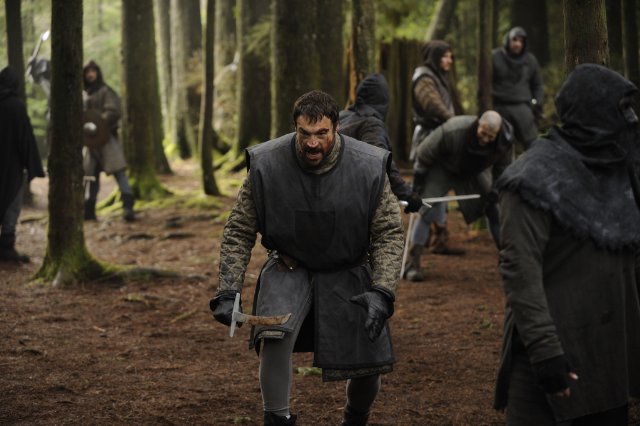 The production seems to be taking a cue from Lungren (The Expendables), who is unfazed from beginning to end despite some strange goings-ons. The man just sleepwalks through the whole film, cracking wise in the same somnambulant tone. It’s like Lungren swallowed an entire bottle of Quaaludes. Lungren isn’t exactly the most charismatic or expressive actor on the planet given that he’s made a living being tall and beating up smaller men, but I would have hoped for some life in the guy. He’s so straight-laced that it’s absurd. It drains any potential interest from the character, sapping our time-traveling hero of empathy. Who cares if he can’t be bothered to care? Malthe (Bloodrayne: The Third Reich) is just as uninspiring as his sidekick. She’s just so impassive, probably because she doesn’t get to wear a corset in this Boll movie to highlight her assets. Letting her speak medieval vernacular and syntax was a mistake. Usually actors can at least adequately hide their displeasure about their participation in a lousy movie. Either these actors aren’t even good at that or they just don’t care, take your pick.
And now it’s time for my regular reoccurring segment in a Boll film review – who got ripped off this time? Allow me room to pontificate. The concept of a fantasy world mixed with some adult themes, like strong bloody violence, nudity, sex, profanity, and darker themes, would lead me to believe that Boll was inspired by HBO’s hit fantasy reinvention series, Game of Thrones. Then again Boll shot this movie in December 2010, a full four months before Thrones’ aired its excellent pilot episode. Then again who’s to say that Thrones didn’t influence Boll during the editing stage or at least make him itchy for some reshoots to tart up this tedious movie. At least that would give the viewer something worthwhile to look at besides an oft-used castle exterior that LARP-ers would howl at.
In the Name of the King 2: Two Worlds just reeks of lethargy and indifference. Devoid of interesting characters, an engaging story, even tasty genre elements, this low-budget fantasy flick would falter in comparison to the cheesiest Sci-Fi Channel original movie. I cannot overstate how boring this movie is. I’m struggling even to effectively communicate how monotonous this movie is; I’m tempted to just write “boring” a thousand times but you, dear reader, deserve better. And so I rack my brain to come up with more specific and sarcastic criticism of what is execrably an awful movie. Boll’s no stranger to awful movies, but In the Name of the King 2 is the first time where I felt like even he didn’t give a damn about his final product in any shape. And it shows.
Nate’s Grade: C-
Share this:

Final Destination 5 (2011)
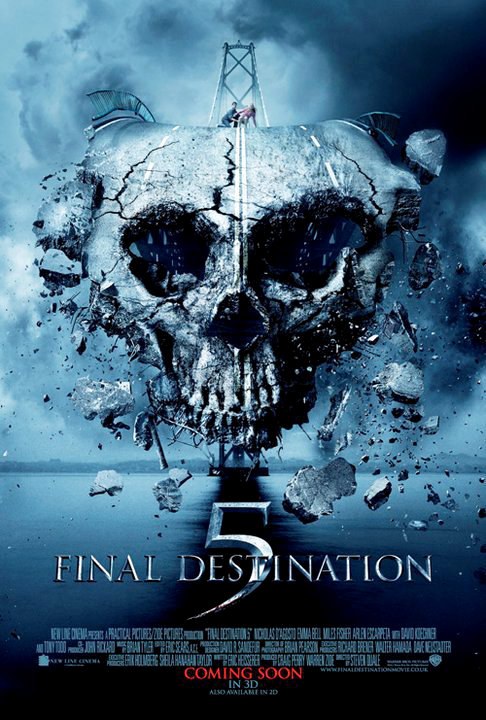 If there was any cosmic justice the Final Destination franchise would have been KO’d by death a long time ago. The initial interest of bizarre, fiendishly clever deaths and the constant macabre misdirection was fun, but now, after five movies, feels creatively exhausted. Once again a group of unremarkable characters survive a remarkable disaster, this time a collapsing bridge. And once again we have to follow them figuring out the rules of the movie series and that they’re all marked for death. The in-between stuff is some of the worst drama ever captured on screen. It makes you impatient for death to get off its duff and kill more teenagers so I don’t have to listen to their whiny, unrealistic problems. Coming off a limp fourth installment that was the highest-grossing one yet, the filmmakers once again turn to 3-D as their savior, which does not play well at all on your TV (a sailboat mast becoming an instrument for impaling?). It’s more annoying than anything. But the real draw of this movie is the gruesomely elaborate deaths, and they’re probably the weakest of the series (a gymnast’s body practically exploding once she hit a padded mat seems absurd even for this movie). There is one sequence that freaked me out but that’s because I’m quite squeamish when it comes to eye trauma. What ends up slightly redeeming Final Destination 5, as far as cheap horror movies go, is a surprising third act that breaks from the doldrums of the franchise formula. For once, the people decide to take life to save themselves when death comes calling, and they set their sights on each other, resentful that one of their own survived in the premonition staple. I think this horror franchise took a turn for the worst when it gave into its target audience’s cynical bloodlust, and I doubt there’s anything “final” about this series. At least the Saw franchise had the merit to die.
Nate’s Grade: C
Share this:

Sherlock Holmes: A Game of Shadows (2011)
 Delivering pretty much more of the same, Sherlock Holmes: A Game of Shadows isn’t exactly an improvement over the classic detective’s first foray into out-and-out Hollywood action cinema. The real treat of the budding franchise is the comic interplay between Holmes (Robert Downey Jr.) and Watson (Jude Law). Their harried banter makes for the best moments. Once again the plot is overwrought, the side characters underdeveloped (poor original dragon tattooed girl, Noomi Rapace, given absolutely nothing to do but run in a gypsy skirt), mysteries that you give up and just wait for Holmes to explain, and a villain that proves to be lackluster. For Moriarty (Mad Men’s Jared Harris) to be the nemesis, the intellectual equal of Holmes I’m going to need to see much more than this. There is a fine sequence at the very end where Holmes mentally envisions the steps of his attack and then Moriarty joins in: “You think you’re the only one who can do that?” They hold an entire duel fought step-by-step in the imagination. I wanted more experiences like this, but director Guy Ritchie (Snatch) falls back on his signature stylized action sequences of fast whooshing and quick spinning. The action is a step up from the first Holmes, and that will be enough for most ticket-buyers. I’ll admit there is a certain meta-literary charm at watching Arthur Conan Doyle’s signature detective fighting his way through an armed body of baddies. Whatever your feelings were for the 2009 Sherlock Holmes, I’m fairly certain you’ll revisit them in their entirety with Game of Shadows. I know I did.
Nate’s Grade: C+
Share this:

Mission: Impossible – Ghost Protocol (2011)
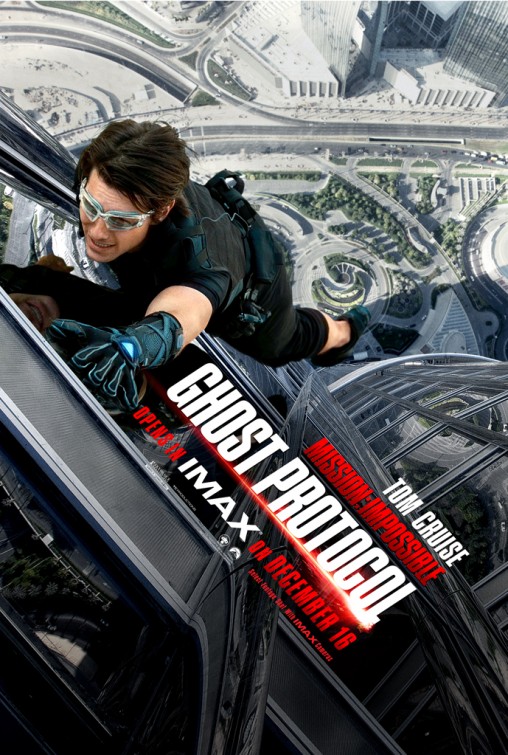 In the span of three months, two Pixar vets will be making their live-action filmmaking debuts. Andrew Stanton (WALL-E, Finding Nemo) is directing Disney’s big-budget John Carter of Mars adaptation, which will be released this March. But first is the awkwardly punctuated, colon-hoarding Mission: Impossible: Ghost Protocol (henceforth referred to as M:I 4), directed by Brad Bird. Any fan of The Incredibles (and who isn’t) knows that Bird is a terrific visual stylist who can compose remarkably exciting action without overlooking characterization. If anyone was ready for the leap into live-action, surely it was this man. Bird is the real star of the movie, and he aces his debut. I think he’s finally living up to the potential he showed with TV’s Family Dog (please note the tongue firmly planted in cheek here).
Ethan Hunt (Tom Cruise) and his IMF squad are on the run. They’ve been framed for an explosion that took out the Kremlin. The president has invoked “ghost protocol” meaning that the IMF no longer exists, and every member is cut loose. That means Ethan and his newest team, techno wizard Benji (Simon Pegg), feisty Jane (Paula Patton), and the mysterious Brandt (Jeremy Renner), have no backup. They are considered rogue agents and Russian’s own special police force is hunting them down as well. Hunt and his team must track down and stop an international terrorist, Hendricks (Micheal Nyqvist, the Swedish Girl with Dragon Tattoo series), who sees the global benefit of nuclear catastrophe (I suppose surviving would be the catch). Hendricks has gotten hold of Russian nuclear launch codes and now is looking to put the final pieces together to initiate a war between the United States and Russia, plunging the world into disaster. Hunt’s team travels around the globe to stop this bad man and his bad plan.
 Bird delivers in a major way in his live-action film debut. The man behind two of the best animated films of all time and Ratatouille, has shown that his keen skills of directing animation have easily translated to real people and real-ish explosions. Bird is a mad genius when it comes to staging elaborate action sequences; he teases out his action with organic consequences and his camera makes adept use of space and geography, and best of all you can easily follow what’s going on in the frame. So when we have an action sequence that takes place in the tallest skyscraper in the world, you know Bird is going to make fine use of this fact to accentuate his action. And the man does so in spades. The Dubai sequence is probably the how-did-they-do-that? standout that people will be most talking about. Hunt has to climb the outside of the aforementioned tallest building in the world using nothing but some special sticky gloves that don’t always work right. He has to climb several stories up, and then there’s the matter of going back down without them. But M:I 4 doesn’t rest on its laurels, because immediately after this sequence we have a feast of thrills. We segue right into a meeting between two parties where Hunt’s team has to pose as each member of this sit-down, orchestrating two separate simultaneous false meetings with the real bad guys. The two meetings dovetail one another as far their needs, making for a blissful parallel of escalating suspense. And then even after this, we get a foot chase into a sandstorm, which then becomes a dangerous car chase into a sand storm. And there are even more great stunts and spectacular action to come, notably a fight in a futuristic car park where the cars tumble from level to level.
Bird has such a firm command of his action, exercising his inspired imagination and all the tools in the special effects paint box. The screenwriters deserve recognition as well, Josh Applebaum and Andre Nemec, both of whom honed their writing chops on J.J. Abram’s sublime spy show, Alias. Their opening sequence, an escape from a Russian prison, sets the stage with Bird’s smart execution; setting up a problem and then letting the situation play out in surprising yet logical and clever ways. It may not have the epic scope of a Michael Bay flick, but Bird’s action is cool without having to be exhausting or noxious. The frenetic pacing rarely lets room for breathing. One of the film’s quiet moments ended in such a jarring fashion that it startled me and I kicked the patron sitting in front of me. I must also credit Applebaum and Nemec for producing the only Mission: Impossible movie that did not involve a turncoat. I was starting to think that IMF’s Human Resources department was in needing of a good housecleaning. Bird, and the screenwriters, has delivered a Mission: Impossible movie so good, with such kinetic and rewarding action sequences, logically utilized gadgets, sexy cars, sexy gals, and exotic locales. They’ve basically made the best Bond movie not to bear 007’s likeness.
Like the previous Mission: Impossible flick, this one emphasizes the team aspect, which makes a more fulfilling and interesting set of missions. M:I 2 became the “Ethan Hunt kicks people in the face for two hours movie,” which Chuck Norris might approve but otherwise was lacking. When J.J. Abrams got on board in 2006, the brand finally got back to its roots. And a team working together with individual strengths makes for a much more satisfying mission that also allows for multiple points of action. Simply out, if you have three people that need to do stuff in synchronicity, it plays out much better than watching Cruise kick people in the face. Choreography is always better when you have more dancing partners. Anyway, with M:I 4 we get some terrific teamwork that can be just as thrilling as the action sequences. Besides the breathless Dubai sequence, there’s a great sequence where the team has to infiltrate a sleazy Indian businessman’s (Anil Kapoor, the TV host from Slumdog Millionaire) cocktail party to get some special satellite codes. Jane is tasked with seducing the sleazy guy, Benji is left to operate a mechanical rover with a powerful magnet that will levitate Brandt, in a metal suit, across the system’s super hot inner mainframe, and Hunt is trying to lose his Russian pursuers. It’s a great sequence where all the pieces come together for maximum effect.
 Cruise has done plenty in the last five years to destroy audience good will, so it’ll be interesting to see if audiences warm back up to the man with the million-dollar smile. Cruise has always been an actor of ebullient energy and charisma, and this has always aided him in action settings and M:I 4 is no different. He’s still a credible action hero and a born movie star, whatever audiences think about his increasingly polarizing personal activities. Lessening Cruise’s load is a smart move, and Pegg (Paul) can provide needed comic relief while Patton (Precious) supplies the sizzle. My goodness can this woman fill out a dress in marvelous ways. Not to be completely sexist, she does a fair amount of ass-kicking too. Her fight with the French femme fatale agent (Lea Seydoux) was all kinds of awesome. Renner (The Town) seems groomed as a potential heir apparent for the franchise. His character is given a small amount of depth to work with, the guilt of a mission gone wrong that has a very personal connection to Hunt. At this point, Renner can do no wrong as an actor in my book. Although there’s only a nine year age difference between Cruise and Renner, so I don’t know how much more mileage that gives you as a franchise. Regardless, Renner is an actor of great conviction and intensity even when he’s silent.
In terms of the franchise, I’d say this fourth installment is just as good as Abrams’ M:I 3, though Abrams had a much better villain and the added emotional urgency of hunt’s wife in distress. Seriously, this is one really boring and completely interchangeable villain. For a movie about the world being on the brink of thermonuclear Armageddon, why do the stakes feel so low? It’s probably because the movie has deliciously orchestrated and eye-popping set pieces but very little urgency. World War III has never felt so ho-hum. Still, it’s hard to fault an action movie when it delivers such high amounts of adrenaline, perfectly packaged in well-developed action beats. This is a high-flying popcorn spectacle of the top order, a grandiose piece of Hollywood escapism. Mission: Impossible 4 is pretty much everything you’d want in a summer blockbuster, only shuttled to winter. I think Bird’s future is limitless, in animation and live-action, and I think the Broccoli family would do us all a favor by tapping Bird to direct a Bond movie. M:I 4 is a pretty good resume for the gig. That would be one mission to die for.
Nate’s Grade: A-


 nathanzoebl
You must be logged in to post a comment.