Blog Archives
Final Destination: Bloodlines (2025)
 A funny thing happens once you conclude a Final Destination movie. You start to see the world differently. After I finished watching Bloodlines, the first new film in the franchise since 2011, I found myself elevated by creative paranoia. I was holding onto an empty aluminum can and thought, “What if placing this on the counter will create a chain of events that leads to disaster?” Then I was washing our kitchen sink and looking at how close other electrical devices were to the faucet spray. Then I began thinking of all the dog toys that could position themselves underfoot and cause me to hit my head against our tile, perhaps then having that aluminum can fall on my head as a finishing move. If you’ve ever seen one of these movies, they are games of misdirection and dramatic irony, anxiously anticipating that any little item will contribute to a Rube Goldberg-esque wave of death. In many ways, the franchise brings an outlandish fear home and makes you just as crazy as the doomed characters. Final Destination: Bloodlines is a return to form for a franchise that never should have been on the brink of death. As long as people can come up with clever deaths and misdirects, there should be sequels.
Having watched and enjoyed every Final Destination movie, I will readily admit that while each of the five previous entries can be gory good fun they cannot be described as great movies, and that’s okay. They are delivery systems for amusement and absurd deaths, asking the audience to try and guess the ridiculous series of events that will contribute to the demise of whomever fills the screen. It’s a reliable formula that can be replicated again and again, where death itself is the main villain, or star, and where the appeal of the franchise is the winking game the movies are knowingly playing with the viewers. We’re here for the over-the-top machinations and dark humor of trying to guess what combination will succeed. The later sequels were populated with repellent or powerfully bland characters that we happily awaited their fateful demise, but the deaths were also getting stale, becoming more mean-spirited or more flimsier in design, giving to obvious obliteration options and then cheap shock alternative as mini-twists. If you’re going to have a game, it’s better to play by your rules. That’s where things began to go sour with me, but that doesn’t mean good writers who fully understand this franchise cannot revive it. I just thought it would have taken less time considering the inherent rebooting potential at play.
 This brings us to Bloodlines, by far the most ambitious of all Final Destination movies. It attempts to really explore the mythology and history of the franchise while also grounding the characters and their drama in a surprisingly emotionally resonant manner. I’m not saying anyone is going to confuse this movie with, say, Sophie’s Choice, but the filmmakers have put in the work to make us actually care about the doomed characters and their fledgling efforts for survival. Usually these movies follow a group of strangers along with a small friend group that becomes our core. This is the first movie where all of the characters in peril are family members across generations. Watching your mother or aunt or brother die horribly before your eyes and knowing that someone else in your family is next is just more impactful than if the relationships were based on high school friendships, work colleagues, or strangers. That kind of trauma just hits differently. Also, the ages of the family dynamic present a clear direction for the path that death is planning to take, going from oldest to youngest, although death seems to put this chronological pecking order on hold to wipe out a line of siblings. Excuse the math word problem setup of what will follow. Let’s say you have Oldest Child and Youngest Child and both have two kids but Oldest Child’s kids were both born after Youngest Child’s kids. Rather than killing the descendants in descending chronological order, death would wipe out Oldest Child’s offspring first even though they are younger than the children of Younger Child. As always, it appears death is a stickler with its rules.
The opening sequence is an all-timer for the franchise, and because it sets everything in motion I don’t feel like discussing it is particularly spoiler-y, but you may decide otherwise and can skip this paragraph. According to the new mythos, this is the event that sets the entire Final Destination universe into effect. It’s a spectacular disaster set in a high-rise restaurant 400 feet in the air atop one of those Sky Needle skyscrapers. The entire sequence is brilliantly executed and edited with extremely heightened periods of dread. These first ten minutes introduce us to a young romantic couple and get us invested enough to feel bad about what’s to eventually come. They also set up the stakes as well as the twisted gallows humor to follow. I loved tracing the different elements at play, from the cracking glass dance floor, to a loose chandelier shard (if one little chandelier piece could cause cracks then this must be the weakest floor in history), to a loose penny causing mayhem all because of a snotty little brat, the real villain of the franchise. The cross-cutting between the different incidents as things ratchet up is wonderful, and the clever cuts to the creme brule being broken as that glass dance floor is cracking is just superb. This is more than just a sequence in vertigo terror. There’s a gas explosion, a falling elevator, a Titanic-esque splitting of the restaurant, and the use of a grand piano as a slapstick coup de grace that left me cheering. This opener lets you know you’re in bloody good hands with Bloodlines and it also begins to emotionally ground the film too.
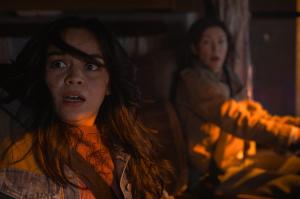 This is the most self-aware of the Final Destination movies but I think it works considering it’s the sixth entry, so having characters essentially be voices for the audience’s frantic clue-guessing is appropriate. One of the better sequences in the movie is when our protagonist, Stefanie (Kaitlyn Santa Juana), is walking through her neighborhood and trying to absently predict the everyday dangers on a garbage day. It begins as absurd and then it becomes even more absurd when everything she predicted lines up, though not as we might have expected. The whole thing plays out like a demented and extended joke setup with death as the punchline. Thankfully, it doesn’t take long for the family to get on board with this crazy idea that death is after them, so the second half of the movie is more their scrambling to plot how to cheat death established by the previous movies by either dying and being brought back or by taking a life and getting that person’s remaining time. There’s a gasp-inducing joke where characters, after discussing these rules, glance at a maternity ward and consider, “Could we actually kill a baby?” before shaking away the dark idea and going back to their original plan. It’s self-aware without being overly meta, working through the rules and expectations but without an ironic detachment that can cheapen the enjoyment of the drama and thrills. That’s important because this might be the Final Destination movie with the lowest amount of deaths after the big opener. Part of that is because we’re setting the story decades after that establishing catastrophe, where death has been busy chopping away the survivors before coming back around to our core family (there’s got to be a mathematical formula here how long it took death to catch up). You’ll have to wait longer for some kills, and a few are just haphazardly thrown together, but there’s still plenty of dreadful squirm and rueful chuckles to be had.
Considering its runaway success at the box-office, out-grossing all of the previous Final Destination movies, I doubt we’ll have to wait anywhere close to another 14 years for more franchise mayhem. These movies are perfect vehicles for twisted entertainment when they have the right people calibrating them. They may not always be great but they can be consistently great fun, and under the right mindset, exactly what you need to wash away the blahs and laugh at the absurdity of death and fate. It will also make you re-examine your home decorative plan for your own pre-emptive protection. Feng shui or die, ya’ll.
Nate’s Grade: B
Share this:

Thunderbolts (2025)
 I will tell you right now, dear reader, that I’m never going to include the asterisk when I type the title of the Marvel Cinematic Universe’s (MCU) newest epic entry, Thunderbolts. The reveal one week into its theatrical release that the team was rebranded “The New Avengers” seemed at best like a peculiar marketing gimmick to try and boost ticket sales after its opening weekend. “Oh, there’s an ‘Avengers’ in this movie title? Well I’ll go see that now,” said likely nobody ever. It just felt like a marketing ploy and the presence of the asterisk in the title, meant to symbolize and facilitate that identity transition, is just a symbol of trying to be too cute by half. Just be the Thunderbolts. Accept yourself as the Thunderbolts. Isn’t that part of the lesson of the movie, finding acceptance despite your misgivings and doubts? Refreshingly, while there are the occasional action sequence and general fisticuffs, Thunderbolts proves to be a much more probing and psychological MCU entry and entertaining beyond just the escapism.
Yelena (Florence Pugh) feels adrift as a secret black ops agent doing the government’s dirty work. Her handler, Valentina Allegra de Fontaine (Julia Louis-Dreyfus), has promised to let her retire after one last job. It just so happens that job is a scheme to have all of Valentina’s black ops killers to take each other out to spare her any embarrassing details coming out while she’s under Congressional investigation. That includes John Walker (Wyatt Russell), a disgraced Captain America place-holder, and Ghost (Hannah John-Kamen), the villain of Ant-Man and the Wasp who could phase through matter, and some mysterious man named Bob (Phillip Pullman) who suffers from amnesia and seems out of place. Along the way they’ll pick up other characters, like Bucky Barnes (Sebastian Stan), who is serving as a freshman Congressman, and Alexei a.k.a the Red Guardian (David Harbour), Yelena’s adopted father who is eager to support his daughter and bridge a divide that has grown between them recently. The constantly bickering group of malcontents, antiheroes, and misanthropes band together to survive as well as figure out Bob’s importance for a person as dangerous and manipulative as Valentina.
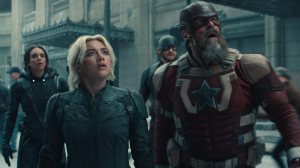 Thunderbolts is about a group of screw-ups who know they’re screw-ups, who know the world sees them as screw-ups, trying to be something more, and it doesn’t take much to see larger themes surrounding depression, loneliness, and community. There’s long been a pleasure in watching oddballs, let alone an unorthodox team of them, find solace and camaraderie they have been missing. It’s satisfying under most circumstances. It also helps when we are given the understanding of why these characters feel so alone and so useless. I’ll freely admit, in the first months of 2025 with the current government doing everything in its power to make people feel scared and alone and useless, I connected with the themes and eventual uplift of Thunderbolts perhaps at a level I might not have had the movie been released in 2023 or, say, under a President Harris. Regardless, I found this movie engaging because it focused less on the literal and metaphorical strengths of its characters and more on their weaknesses and fragility and needs. There is no giant sky beam, nor any faceless easily disposable swarm of CGI robots or aliens, nor any real world-ending apocalypse they have to thwart in that final climax. It really all comes down to combating an epidemic of loneliness, and the only way to do so is to willingly open one’s self to the possibility of pain, of disappointment, of embarrassment, or rejection, and to do so anyway because the alternative is just too grim and self-defeating an option. It forces characters with very real pain and regrets to confront that pain and to still keep trying. The scary enemy is not resolved through a punch but through a genuine hug. You can’t punch out depression. For me, that’s far more engaging and emotionally resonant for the thirty-sixth movie in the MCU than just more punching and explosions amidst a CGI-laden morass.
This is proof that Florence Pugh (Dune: Part Two, Oppenheimer) can power anything with her acting chops and charisma. Her character was a breakout scene-stealer in 2021’s Black Widow, and I’ve been glad every time since she’s popped onscreen. I find Pugh to be such a compelling actor, but she’s driven by movies that tend to put her through an emotional wringer so much I’m worried her face will permanently lock into a sob. She’s great, but it’s also just nice to watch her cut loose and have fun playing a character too. Even though Yelena has a darkness to her, and I would argue qualifies as depressed, this is still a role that allows Pugh to play with lighter elements, giving her a sardonic bounce that makes her even more appealing. This is a character worthy of headlining the team, and Pugh shines once again given an even bigger Marvel spotlight. I also want to sing the praises of Dreyfus (HBO’s Veep) and Harbour (Stranger Things) as near-perfect encapsulations of their respective characters. She’s all blistering cynicism and he’s a blustery teddy bear.
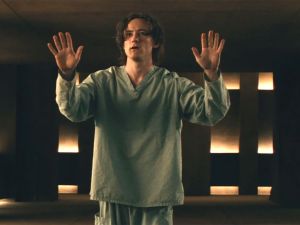 Another refreshing aspect for Thunderbolts is how it feels like a real movie. Obviously the other 35 MCU entries are movies by definition, but here is a movie that feels more authentic. It looks and sounds better in presentation. You can tell there are real locations. The cinematography is by Andrew Doz Polermo, the same man who photographed The Green Knight. The musical score is by Son Lux, the same composer responsible for the eclectic and sensational music for Everything Everywhere All at Once. The co-writers are from Netflix’s acclaimed miniseries Beef, as is the director, Jake Schreier, whose first film was the 2012 amiable indie dramedy Robot & Frank. There is a genuine effort to do something a little different from the factory setting of modern Marvel movies. It was just nice to actually take in real surroundings, real terrain, natural light, and composed by such a skillful director of photography. The technical elements are blockbuster level but also infused with a little indie sensibilities, bringing a different visual flavor to this studio tentpole. It might sound like a backhanded compliment (“Oh, a movie that is, gasp, made outside a giant green screen warehouse or LED screen”) but I am genuinely grateful. This is a Marvel movie whose Act Three chase takes more notes from Being John Malkovich and its jaunt through repressed memories than any standard superhero action climax. After so many MCU entries, you celebrate the ones that not only try something different but succeed, especially after the impulse to be more of the same is so strong.
That’s not to say that there still isn’t more that could have been done to better shape and develop Thunderbolts. Ultimately it feels like a more solid idea with some good characters and themes than a fully realized screenplay making the best use of its two hours. The movie isn’t quite the ensemble it may appear from the outside. One of the characters is removed so unceremoniously early that I question why this character was even brought back, especially since nobody would qualify this specific character as a favorite. I suppose it’s to present the appearance of elevated stakes, but it just reminds me of the 2016 Suicide Squad that introduced Adam Beach (Windtalkers) as Slipknot, the man “who could climb anything,” who just gets his head blown off so casually before their first mission even begins. However, with Thunderbolts, the movie really has a top tier of characters, primarily Yelena and John Walker and Bob. There’s another lower tier of characters that kind of come and go and provide moments, either levity or convenience, like Ghost and Red Guardian. Then there’s another lower tier of characters with even less time who pop in to scramble things or remind everyone of the exposition or stakes, like Bucky and Valentina. It doesn’t feel as fully integrated as an ensemble as the best Marvel team movies, like James Gunn’s Guardians films, so it can be a little frustrating when we’re celebrating the value of a community but not everyone is pulling their own narrative weight. I’m sure I could fall in love with Ghost as a character, but when she just poofs in and out and her whole arc is, “Hey, she came back,” that’s not going to do it. I also find the whole superhero science experiment a little late in the MCU to be introduced. We have characters talking about being in grade school when the Battle for New York, the centerpiece fight of 2012’s Avengers, took place, like Millennials today speak about where they were on 9/11, so it seems very late for the government to be trying to produce their own superheroes they can control. Weren’t they already making superheroes in the 1940s anyway with the likes of Captain America? This is old hat.
 The MCU has been in a bit of a slump since the conclusion of Endgame, though I would also maintain the “death of the MCU/superhero fatigue” storyline has been over-dramatized and beaten to death. Thunderbolts has some very appealing and refreshing elements, focusing more on its characters and their faults so that their eventual triumphs will feel even more emotionally resonant. It’s nice for the action to support the characters and their drama rather than the other way around, and especially refreshing for the climax to be one about acceptance and vulnerability rather than over-powering some physical menace. I liked the Thunderbolts characters and their combustible energy and banter and would have liked them even more if more of them felt more fully integrated into the movie and given richer arcs. Still, it’s hard to reinvent any franchise thirty-six movies deep, and Thunderbolts, or The New Avengers depending upon what Disney decides to do with its titling from here out ( a real Live, Die, Repeat situation), takes what works with quirky oddball team-ups and makes it work with refreshing artistic sensibility. It won’t be for everyone but it’s got enough going for it that, damn, these crazy kids might just make something of it.
Nate’s Grade: B+
Share this:

The Accountant 2 (2025)
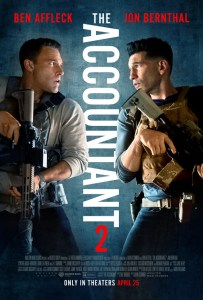 I’m going to start this review by doing what everyone loves to read, the author patting themself on the back. Back in 2016, I found The Accountant to be an enjoyable thriller with a compelling main character that answered the question, “What if Jason Bourne was actually interesting as a character?” I concluded my original review with this observation: “It’s rare that a movie leaves me wanting more, and it’s even more rare when a movie leaves me wanting to watch a weekly variation of Christian Wolff living as whiz kid accountant by day and enforcer of justice by night.” Over the years, The Accountant became one of the most popular streaming movies, a real word-of-mouth sensation that gave it life long after its theatrical release. It was enough that another studio, Amazon MGM, wanted to buy the rights to pay Ben Affleck to produce a sequel that hit theaters and now is available on streaming, thus ready to be the next great movie that dads fall asleep to. It took longer than expected but The Accountant 2 does fulfill my request, showcasing what a regular series could be, for better and worse.
Christian (Affleck) is like Batman if Batman had Autism and did his own taxes. He has a multi-million-dollar foundation that looks for wrongs to right, and this time he’s called back into the action by the sudden death of Ray King (J.K.Simmons), the retired agency head who was tracking the elusive accountant for years. Ray was obsessed with a family lost to human trafficking and hoped to find the missing child. Christian takes up the case and invites his once-again estranged brother Braxton (Jon Bernthal) to help.
 The positives from the original Accountant still shine through, namely the entertainment value of Christian as an outsider character trying to fit into the larger world. He’s an unexpected and often funny person but also a man with his own code of justice, and it’s a treat to watch him bomb through a marathon of speed dating one moment and punch guys in the throat the next moment. Affleck is still enjoyably dry as the lead, and the movie is at its best in the moments where Christian and Braxton are butting heads. It takes a longer than it should to reintroduce Braxton and bring him back into Christian’s orbit, but once the brothers are together, the movie coasts on a chummy buddy comedy dynamic that can reliably work no matter the setting. That’s one of the features that led me to apply the movie into a TV adaptation; the characters are what make ordinary encounters that much more entertaining, and TV is the premiere realm for characters. We tune in on a weekly basis because we want to discover what the characters we love will do next. While The Accountant 2 is certainly a few steps behind its predecessor, the core dynamic that made it enjoyable for so many should still prove appealing to those same legions of fans.
The movie also demonstrates some creaky choices and execution that manages to make it feel less like a full and vital sequel and more like an iffy showcase for turning the franchise into that weekly TV series. The central mystery feels lifted from any generic crime procedural about discovering a human trafficking network. The particulars aren’t that interesting or complicated or even that surprising given the general public’s understanding of human trafficking nowadays. I was waiting for this storyline to give us a little insight into the people most affected, the vulnerable families being exploited as they risk everything to search for a better life or more stable employment. I was waiting for something extra that felt like this storyline would be anything more than a ripped-from-the-headlines rescue mission, and it just doesn’t materialize. Much like 2023’s Sound of Freedom, the complex issue of human trafficking gets boiled down to whether or not our characters can save one unfortunate child. Hilariously, during the climax, the movie keeps cross-cutting between the brothers riding to liberate the kids from their imprisonment and an excavator digging a hole intended to be the kids’ mass grave. One inclusion is enough for us to understand the stakes, but the movie keeps cutting back repeatedly, as if anxiously asking, “Oh no, will the bad guys get the grave completely finished in time for the kids to be dumped inside?”
Already it feels like we’re sanding things down in order to fit a formula. Another indication is the relationship between the brothers. Apparently the brothers have not seen nor spoken with one another since the events from the first movie eight years ago. This is odd considering much of that movie’s story was divided with the Braxton character in parallel and finally recognizing his long-lost brother. After all their years apart it feels more likely that they would have stayed in touch or better. By not going that route, the sequel gets redundant reuniting the brothers again, but this time they’ll actually stick it out because they’ve gone line dancing together and killed even more dudes, the two most brotherly-bonding activities possible. It feels like setting up the team for more fun adventures.
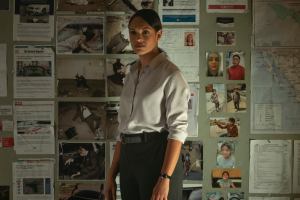 Although redundancy is part of what holds back the movie. Take for instance back-to-back introduction scenes for Braxton. Our first scene is him trying to psych himself up, and we may think it’s for a date or to talk to a woman he likes, but it’s actually to ask whether or not he can adopt his selected puppy even earlier. Funny, sure, and gets to his loneliness. The next scene he’s trying to have a conversation with a woman who is clearly not as interested and this perturbs him, and upon him leaving we see the trail of bodies he has left behind in the aftermath of some job. Both of these scenes are accomplishing the same thing: Braxton has difficulty connecting with others and is lonely. Why did we need the first scene when the second conveys the same information plus his formidable nature? Braxton even brings up his desire to get a dog later and Christian considers his brother more a “cat person” because he lacks the stable job and responsibility to care for a canine. This moment could have been the first time the film introduced Braxton’s desire for a pet. We don’t gain much from knowing this already. This may seem slight but it’s indicative of a movie that is filling time (hence the mass grave cutaways). For a movie over two hours, there is a surprising amount of fat that could’ve been reduced for narrative redundancy and pacing.
The most obvious sequel idea for a special-skilled accountant would be to meet his match, and The Accountant 2 does and doesn’t do this (some spoilers to follow in this paragraph). Much of the movie is about locating two people, the child stuck in human trafficking and a mysterious woman (Danielle Pineda) who the bad guys are after. She is linked to the missing child but she’s also a highly-skilled killer who is seeking vengeance of her own. It turns out this woman, who I won’t identify, had a traumatic experience and has now become a savant action superhero. This revelation is meant to explain how an ordinary woman could become this badass killing machine, but it awkwardly feels like a ret-con to try and apply Christian’s condition to anyone under unique circumstances (you too could transform, kids). Except the first Accountant made it abundantly clear that Christian was as skilled and methodical as he is because of being on the Autism spectrum, allowing him a unique dedication and attention to detail. Obviously, Autism is not some shortcut to super powers. If it were, RFK Jr. would actually try and read something relevant about medicine. But it was established that the same skills that Christian uses to be such an exacting accountant are the ones he taps into to become a crushing crusader. As someone who has worked with many on the Autism spectrum, I didn’t see this portrayal as insulting or insensitive, especially since much of the movie is about humanizing people with differences and showing how their capabilities can rise above the preconceived perception of others. It wasn’t saying Christian was like all people with Autism, but this is, again, only my nuer typical perspective. I don’t know if in the ensuing eight years that returning screenwriter Bill Dubuque (Ozark) decided that it was less problematic to have the secret formula be the brain’s response to trauma rather than being on the spectrum. It opens up the movie to other highly-powered super spy assassins, but it also takes away something from the premise.
 The actual bad guys are a rather uninspired gathering of goons and shadowy business types. At no point will you feel like our characters are genuinely under threat, and at no point will you remember anything about these villains except for their rote application in the plot. The main trafficker is an evil Boston crime boss (Robert Morgan) that could have been ported over from any other generic crime thriller. His one quirk is that he whistles “Pop Goes the Weasel,” even when he’s murdering migrants in the desert. So there’s that. His main muscle is just… some guy. Literally there is no even cursory attempt to provide any point of characterization for this guy, and he’s supposed to be one of our biggest threats? They could have given this guy, bare minimum, like an eye-patch or an affinity for pop songs, anything. As a result, we have two sets of antagonists, one of which is revealed as an avenging antihero while the others are so disposable to be laughable. At least the first Accountant film gave us a real opponent who, granted, ended up being the younger brother to our main character, but there was a real question what could happen when their paths crossed. Would they use their skills to eliminate the other?
The Accountant 2 might not add up to the same degree of entertainment and thrills that its first outing offered, and there are several missteps and redundancies that take away the edge and uniqueness of that original, but as long as Christian is still determined to help others, I’ll always find this possible franchise worth watching. Now look out for that eventual Amazon TV series to be scheduled right after Reacher.
Nate’s Grade: C+
Share this:

Heart Eyes (2025)/ Fear Street: Prom Queen (2025)
Slasher movies have been a popu;ar staple of horror, enough so to go through different phases of resurgence and ironic reinterpretation. They rose to prominence in the 1980s but are still wildly popular today, perhaps proving that there’s something timeless about a masked maniac chasing after dumb teenagers with his or her weapon of choice. Mix in heavy amounts of blood and gratuitous nudity, and it’s easy to see why this cost-effective entertainment strategy continues to endure. Two new 2025 slasher movies show the highs and middling lows of this horror genre known for its graphic kills and little else.
 Heart Eyes is ostensibly about a romance-hating masked killer who stalks happy couples on Valentine’s Day and gets all stabby with their insides. However, it’s really a pretty charming romantic comedy that just so happens to also have a healthy amount of gore. The clever screenplay follows many of the same tropes we come to expect from the rom-com genre but now with a twist. It’s Boy Meets Girl, as Jay (Mason Gooding) and Ally (Olivia Holt) are forced to work together to save a romantic ad campaign gone wrong. It’s Girl getting over the pain of her recent breakup with the emergence of a handsome new man in town. It’s Guy and Girl butting heads before creating sparks. And then they’re chased repeatedly by the masked killer. They yell, “We’re not even a couple,” but it makes no difference; their chemistry is just that undeniable. In that regard, this murder menace is actively driving these two would-be lovebirds together, forcing them to rely upon one another for survival, and revealing parts of themselves. If you cut out all the horror parts, it would still work as a romance, but it’s even more entertaining to watch how the two genres, both beholden to their formulas, mash so bloody well. The banter is witty, the silly are over-the-top gory, and this is a rare movie that could be loved by gorehounds and foolish romantics. It’s an elevation that is self-aware but not obnoxiously, more silly tongue-firmly-in-cheek. You can tell there is a love for both of these genres from the filmmakers. Heart Eyes is a fun and refreshing spin on the old.
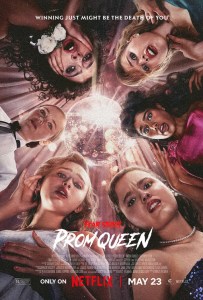 The newest Fear Street movie, based on the scream teen novels by R.L.Stein, is by far the weakest in the Netflix horror anthology series. Prom Queen is a pretty straightforward rehash of your 1980s high school movie staples of horny teens, bitchy popular girls, the less popular girl striving for Prom Queen and having to reconcile the changes she’s willing to make to be a winner, and a knife-wielding killer. Ah, the nostalgia. The issue is that there’s nothing separating this movie from, say, Prom Night, either the 1980 original or the PG-13 remake in 2008. The most thought put into this movie is the gruesome kills with some decent gore, but the whole movie doesn’t even play like a cartoon. It plays like a TV special you’ve watched before, something not just outdated but that’s been iterated upon iterations, a bland copy of a copy of a copy. The mystery of who might be the killer has some slight fun but the culprit should be easy enough to suss out when you take into account what actors have names that you remember. There’s nothing wrong with emphasizing the more gruesome exploitation elements of the genre, but the kills aren’t that memorable or clever, nor are the characters that interesting even as generic stock roles. I found myself confusing many of the multiple Prom Queen candidates (why are there so many pale brunettes?). The previous Fear Street movies released in 2022 had an interesting gimmick connecting them with the history of the town going back centuries to explain its crushed nature. Prom Queen just exists in this space without doing anything to connect to the larger Shadyside mythos and cross-generational storytelling. It feels so dreary and perfunctory and rather boring, shuffling along like a zombie wearing the husk of Fear Street. It’s just not fun. It’s not outlandish enough to be silly and too dumb to be self-aware. It’s mostly unimaginative cliches warmed over and unrelated to a far more stylish and ambitious horror series. This is a Prom Queen that deserves a bucket of blood and social ostracism instead of any accolades.
Nate’s Grades:
Heart Eyes: B+
Fear Street: Prom Queen: C-
Share this:

Another Simple Favor (2025)
 The sly 2018 original was a tart breath of fresh air, chronicling a friendship between two moms, one of means and one of lesser means, that unraveled a conspiracy of death, lies, secret twins, ransom, and murder. It was an enjoyable diversion that was elevated by snappy banter, a combustible chemistry between Anna Kendrick and Blake Lively, and some dishy twists. I wasn’t expecting a sequel, but with the same director and principal cast returning, I was at least a little intrigued as to what they would cook up. Instead Another Simple Favor is a warmed-over retread of the original. This time we travel to scenic Italy where Emily (Lively) has been released from prison and is now marrying a wealthy Mafia scion and wants Stephanie (Kendrick), her old frenemy, to be her maid of honor. At its best, the sequel has glimmers of the spiky fun of its predecessor thanks to the serviceably witty banter and ongoing fun between its lead actresses. Mostly, it’s a tangled mess chasing after what made the original entertaining and adult. I can pretend I fully understood the plot with its assault of soapy revelations, character intersections, and convoluted machinations, but that would be a lie. There are times where the movie feels like an overburdened runaway “yes and…” improv game, where anything and anything is accepted and absorbed into the script. I wonder if every additional movie is just going to add more versions of a certain character. If you’re a fan of the 2018 original there might be enough here to prove fleetingly engaging, like the fabulous villas and extravagant costumes, but mostly Another Simple Favor doesn’t feel like it’s doing anyone a real favor.
Nate’s Grade: C+
Share this:

Captain America: Brave New World (2025)

After seventeen years of constructing interconnected fables, not every Marvel movie is going to be exceptional, as each one serves as a mighty oar to propel the larger entity that is the Marvel cinematic Universe (MCU) forward. With over thirty movies, there are going to be duds and there are going to be movies that get lost in the machinery of the cinematic universe grinding onward. Consider Captain America: Brave New World one of those sacrificial offerings that nobody will remember in short order.
Sam Wilson (Anthony Mackie) has taken over the mantle of Captain America in the wake of the original, Steve Rogers (Chris Evans), retiring. General Ross (Harrison Ford) has recently been elected president and he wants Sam to reconstitute the Avengers. However, someone is triggering sleeper agents to try and kill Ross, and Sam is entrusted to get to the bottom of this conspiracy.
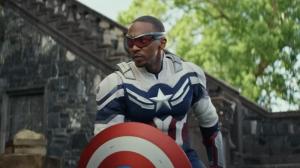
Brave New World is certainly trying to relive the formula that made 2014’s Winter Soldier such a genre standout, upending the status order of good versus evil through the prism of a political thriller. There’s an assassination attempt on the newly elected president, and it also happens to be brainwashed sleeper agents that can be activated at a moment’s notice. What helped make that 2014 movie work was that the sleeper agent happened to be Steve Rogers’ former best friend he thought had died back in WWII. There was a personal connection to the mystery and especially the figure of destruction. With this movie, the personal connection that Sam has to the mystery is almost immediately locked away, made to be an objective needing to be saved by eventually capturing the real bad guy in the shadows. Rather than having to face down a ghost from the past, a personal friend gone rogue, now we have Sam just chasing one shady bad guy to link to the next shady bad guy to a conspiracy that doesn’t even involve him. That was another aspect that made Winter Soldier excel, Steve’s allegiance and sense of patriotism running in direct conflict with the wishes of his government. It was personal and meaningful and challenged his perception. With Brave New World, it could have literally been any character uncovering this very limited conspiracy. That’s not a great start, making your lead character practically superfluous to the larger plot.
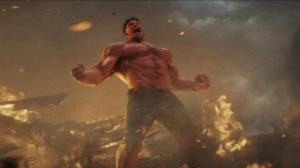
Much of this lingering conspiracy also hinges upon the identity of the Red Hulk, which might have been mildly surprising had Red Hulk not been such a vital element of the movie’s marketing. He’s in the TV ads, he’s in the trailers, he is the poster. This movie had more Red Hulk advertising than its titular hero. Unless you’ve walked into the theater blind, and congrats to you, for all intents and purposes this has been sold as the Red Hulk movie, and even if you’re walking in hoping for some wall-to-wall Hulk smash, then you’ll be sorely disappointed. There’s perhaps ten minutes at most of Red Hulk action, and it’s saved for the very end. It’s a climax that feels more perfunctory than satisfying, with the obvious reveal being held as something revelatory and meaningful when it’s just going through its basic blockbuster dance moves.
As is typically the case with movies that undergo many delays and re-shoots, Brave New World feels like it has far too many things going on and also simultaneously not enough going on. This is an unexpected sequel to 2008’s Incredible Hulk, generally regarded as one of the weakest MCU movies. The only thing that survived that movie was William Hurt (R.I.P.) as General Ross. I don’t think too many Marvel fans have been dying to have those characters and storylines picked back up after 17 years, but at long last you can see Tim Blake Nelson’s character again. Do you know what his character’s name is? Unless you’re the keeper of the 2008 Incredible Hulk fan wiki, I strongly doubt it. Quick, what’s his name without looking it up? It’s Samuel Sterns. Did you even remember Tim Blake Nelson being in the 2008 movie? The movie also has a global resource land grab to finally explain the frozen celestial body rising from the ocean ever since the events of 2021’s Eternals, a movie I fear we’ll wait an additional 17 years to get its own conclusion. This colossal being is the source of a new all-purpose element – adamantium, and that name should be instantly familiar for fans of the X-Men, as this movie pushes their inclusion that much closer. If The Marvels gave us Kelsey Grammar and Patrick Stewart’s return as Beast and Professor Xavier, this one boldly gives us… an elemental alloy (at this rate, two movies from now will introduce the X-Men’s jet as another sign to those in the know about what’s to come). It’s taking the leftovers from another movie to set up the larger scope of a branch of new movies down the road, while also tying back elements and characters from the earliest days of the MCU. It’s all a lot of table-setting unless there’s a compelling storyline with engaging characters and relatable conflicts and drama, and Brave New World does not. As a result, it’s all like watching a fast-moving assemblage of familiar parts trying to package itself together as a cohesive movie, and it just cannot. It’s one of those sacrificial movies at the altar of larger stories.
Which is a shame because there was a really fascinating and thought-provoking story at the core of Brave New World that barely gets any recognition amidst the explosions and gunfire, namely what does it mean for there to be a black Captain America? How does society respond when their patriotic symbol of American might now has more melanin? Considering how the Internet has throngs that lose their mind whenever a traditionally white male character gets changed into something different, I have to imagine there would be waves of people grumbling that this new “thuggish” Cap isn’t “their Captain America.” This is epitomized in the character of Isaiah Bradley (Carl Lumbly), a veteran who was also selected for the Army’s experimental super soldier project that gave birth to Captain America. Except because he was black during a time of segregation as the norm, he never got the adoration of Steve Rogers, and his accomplishments were ignored. In our current political climate, where diversity has become a convenient boogeyman, it would have been interesting to explore how the culture responds to a black man picking up the shield and being the next Captain America. It also would have invited a worthy conversation about where this country has let down its black populace, symbolized with Bradley’s past. Some of these themes were explored in the 2021 Disney Plus TV series Falcon and the Winter Soldier, but that doesn’t mean they couldn’t be meaningfully revisited given the elevated platform of the Captain America moniker. This was also the TV show that argued refugees could be terrorists, so there was room to grow. Unfortunately, this is only ever given passing mention, as institutional racism gets in the walk of Hulk smashing.

There was possibility with Brave New World but it too often seems to run aground with too many conflicting directions, underdeveloped ideas, and unfocused themes. The political complications, as well as evaluating the sins of the country’s past, could have made for a poignant and relevant movie with bigger things on its mind rather than getting to the next CGI slug-fest. It’s a Captain America with a new Captain America, so let’s explore what that means. It’s the franchise’s opportunity to begin anew with a different hero at its helm, and yet it feels more like an over-extended, disappointing finale to the Falcon/Winter Soldier TV series. It feels like an unneeded epilogue to an epilogue, and tying in so many disparate elements from films that people have forgotten or care less for seems like a strange creative choice when Marvel is looking to find its way in the wake of its post-Endgame walkabout. The worst crime with Brave New World is merely how boring all of it turns out to be. Far from brave, far from new.
Nate’s Grade: C
Share this:

Moana 2 (2024)
 It’s hard not to see the DNA of its original incarnations as a TV series for Disney Plus, as well as the awkward adjustments to slap this together into a feature film. Unless you’re a super fan of the original Moana who needs any additional content, you’ll likely have a less than impressive response to Moana 2. It feels quite episodic from villains and storylines popping up for small increments of time only to go away and be replaced by a new storyline, to a new batch of characters meant to hold our attention while other main characters, in particular Maui (Dwayne Johnson), sit out for long stretches. The animation is a notable step down as well, and while it’s still pleasing to watch and far from bad, it’s lacking the detail and refinement of the feature team, especially with lighting, as everything in this world lacks shadows with such high key lighting washing everything out. Without Lin-Manuel Miranda returning, it’s obvious the songs will not be nearly as catchy and enchanting, and the tunes for Moana 2 are pretty instantly forgettable. I’m struggling to rethink any melody right now as I write this. It’s hard not to feel like everything is so slight, from the storytelling to the visuals to the songs to the inclusion of the beloved characters from the original. I loved Moana and consider it the best of modern-day Disney, and I’m clearly not alone from the box-office dominance that the sequel was able to achieve. I actually think I would have preferred future Moana adventures as a TV series because the mythology and world has more to explore. But that version of new Moana has been transformed, Frankenstein-style, into a releasable feature film, one that suffers in the transformation into something it’s not suited for. Disney made a billion dollars from this gamut, but the rest of us are left with a Moana 2 that had much further to go.
Nate’s Grade: C
Share this:

Smile 2 (2024)
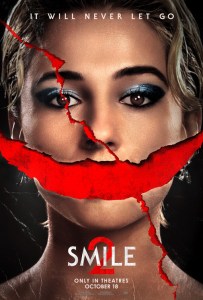 In 2022, thanks to genius viral marketing and the acknowledgement how deeply unnerving happy people can be, Smile was a surprise horror smash hit. Writer/director Parker Finn expanded on a previous short film and made serious money, which meant a sequel was a given. Finn returns to lead Smile 2 to even creepier genre pastures, this time following the mental demise of a pop star, Skye Riley (Naomi Scott) trying to make sense of this malignant curse. As much as I enjoyed the first Smile for its careful development and visceral intensity, I think Smile 2 might be even better.
From the opening sequence, it’s clear that we’re in the hands of a filmmaker that knows exactly what they’re doing. This is not merely another paycheck for Finn. He’s thought about how a sequel can build from its predecessor, stand on its own, incrementally build out the mythology, but mostly how to be an expertly made horror thriller designed to get under your skin. There were multiple sequences where I kept muttering variations of , “No,” or, “I don’t like that at all,” enough so that my wife in the other room would inquire what was directing these responses. Finn is tremendous at setting up the particulars of a scare sequence and allowing the audience to simmer in that anxious period of dread as we wait for something sinister to happen. He reminds me of James Wan and his ability to set up a nasty little scenario and then traps you inside awaiting the worst. There are sequences that compelled me to look away, not simply because they were overpowering, though the gore and makeup effects can best be described as impressively gross, but because the movie was finding different ways to make me uncomfortable, but in that good horror movie way. Finn’s camera makes what we should fear very clear, and his editing is precise. This is a movie that wants you to see the darkness and persistently worry about what’s coming just out of the frame.
 One of my minor complaints with the first Smile was that there wasn’t much below its grinning surface. Sure, the entire premise of a curse that spreads through witnessing horrific acts of self-harm lends itself toward the discussion of how trauma begets trauma, but beyond that the first film was more reliant upon supreme craft and well-engineered scares. There’s nothing wrong with a movie that exists primarily as a thrill ride as long as those thrills deliver upon their promise. However, with Smile 2, Finn uses the character of Skye Riley as a beginning point to discuss the toxic relationships that come with fandom. It should be very obvious for every viewer that Skye is going through some serious issues. She’s overcoming addiction, physically rehabilitating her body as well as socially rehabilitating her image, and trying to learn all her new choreography for an intense world tour. This is a woman who could use a significant break. And yet, as the movie progresses, you start to sense that there is this large machinery around her that needs her to perform because that is how she makes them all money. Even her own mother-as-manager (Rosemarie DeWitt) can seem questionable as far as her motivations; is she pushing her child because she knows it’s what best for her to focus on for recovery, or is she pushing her because the tour pays for her lifestyle? As the movie progresses, the characters fret that Skye’s increasingly bizarre behavior is going to ruin the tour first and foremost, and concern for her actual well-being is secondary at best. All these people have their paychecks attached to this woman fulfilling her contractual obligations. You can also extrapolate the intense pressure the industry places on people with mental illness and self-destructive personalities to conform to standards that are unfair and often un-meetable. You might question why more pop stars don’t have head-shaving outbursts.
Because we know that the evil entity has the power to alter our sense of sight and sound, it means the viewer must be actively skeptical about what is happening. Is this really happening? Is this sort of happening but elements are different? Or is this completely a hallucination? It makes the plot the equivalent of shifting sand, never allowing us to be comfortable or complacent. This can lead to positive and negative feelings. It keeps things lively but it can feel like the plot never really moves forward, at least in a cause-effect accumulation. It can often feel like the movie is moving in starts and stops, and if you’re not onboard for the craft, the acting, and the scares, then the results can likely feel frustrating, especially when large swaths of time are canceled out. For me, I enjoyed the extra sensory game of keeping me alert because it led to a barrage of surprises and rug pulls, some of them admittedly annoying, especially losing what amounts to maybe an entire act of the movie, but also they were a definite way to keep upending the narrative certainty. This sneaky approach also very viscerally places us in the paranoid mindset of our protagonist, as we too are unable to trust our senses and tense up with certain unsettling auditory cues. Mainly, I was having too much fun with the devious twists and turns, and some wickedly disturbing imagery from the director, that I felt like it was an ongoing thrill ride through a funhouse of insanity that kept me guessing.
 In a just world, Scott (Aladdin, Charlie’s Angels) would be at the front of the pack in the discussion for the Best Actress Oscar. This woman is put through the proverbial wringer and she showcases every frayed nerve, every degenerating thought with such verve and command. It’s essentially a performance of a woman completely breaking down mentally, but Scott doesn’t just go for broke, putting every ounce of effort into inhabiting the breakdown, she creates a character that reveals herself through the breakdown. It’s not just screaming hysterics and histrionics; there are different levels to her dismantling psyche, and Scott portrays them beautifully. I felt such great levels of dread for her because of how successfully Scott was able to anchor my emotional investment. She’s also portraying different versions of Skye, and some key flashbacks reveal just how toxic her former addict self was that she’s trying to put to rest. It’s a performance about metaphorical demons and literal demons haunting a woman, as well as guilt that is eating her alive. Scott allows us the pleasure of watching a first-class performance through her shattering.
There’s a curious motif to the movie that many will probably ignore but my wife and I fixated on, and so I feel the need to briefly discuss this so that, you too dear reader, can have this fixation as well. There are at least four scenes where Skye drinks a large bottle of water in a manner that can be best described as monstrously destructive. She drinks that bottle like a lost man in the desert finding his first drink of water. She attacks it. My best analysis is that this is a character detail about Skye’s addictive personality and sense of dependency, projecting the same all-consuming need onto water that she had previously for narcotics. One of the best laughs is when a doctor takes stock of Skye and says how dehydrated she is. Regardless, take in how desperately Skye Riley drinks and think about perhaps applying that technique next time you need a refreshing drink.
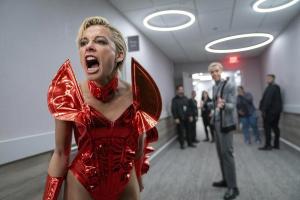 By its nightmarish conclusion, Smile 2 finds a fitting and satisfying end stop that promises a possible even bigger and more disturbing escalation for a Smile 3. Finn has established himself with two movies as a major horror filmmaker who can work within the mid-major studio system and still keep a perspective and integrity. I’m pleased that Smile 2 isn’t just more of the same old Smile, and in fact very few instances involve strangers with that signature facial expression. By the time you’re seeing the smile, it’s usually too late. I enjoyed the choice to find menace and darkness in a world of pop music brightness (the fake pop songs actually sound indistinguishable from what currently airs on the radio, bravo). I enjoyed the continuing tradition of casting famous Hollywood scions, like Jack Nicholson’s son playing Skye’s dead boyfriend (that family grin is uncanny, also bravo). What I really enjoyed was Scott’s uncompromising performance. Smile 2 has convinced me that Finn is the real deal, Scott might be one of our best modern scream queens and young actors, and to confirm introverted habits to avoid anyone who looks directly at me and smiles.
Nate’s Grade: A-
Share this:

Gladiator II (2024)
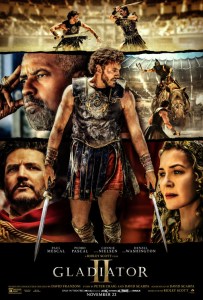 It’s been twenty-four years since Russel Crowe, in his Oscar-winning role, bellowed, “Are you not entertained?” We were, we really were, and Gladiator was a huge hit in 2000 but has also held up as a twenty-first century classic that revived the sword-and-sandals epic. The late sequel hews quite closely to the path of the original Gladiator, a rare example of a movie that was quite literally writing the script as they went and succeeded wildly. The second go-round has a strong same-y feel, which is natural with sequels, but it also has trouble simply standing in the shadow of its superior predecessor.
This time we follow Paul Mescal (Aftersun) as a Roman expat who’s been living abroad as a simple man of the people, except when violence is called upon. His land is conquered by Rome, his beloved is killed, and he’s sold into slavery only to be selected to be trained as a gladiator and only to become a fan favorite who could possibly unseat the Emperor(s). Sounds familiar, right, plus with the revenge motivation? Mescal is playing Lucius, the adult nephew to the late emperor played by Joaquin Phoenix. He’s all grown up and with abs. This Maximum stand-in is actually the blandest character in the film, a scolding figure who says little and doesn’t want to be in any position of leadership. It makes for a lackluster hero especially compared to the presence and magnetism of Crowe in his leading man prime. Fortunately there’s entertaining side characters, notably Denzel Washington (The Equalizer) as a bisexual wheeler-dealer who manipulates his way to the top of the Roman Senate, even garnering the attention of the hedonist twin emperors. The script utilizes a lot of conveniences, from revelations of bloodlines to an adjacent crypt that just so happens to have old Maximus’ armor and sword. Washington’s schemes, more loose-goosey and the benefit of convenient luck than machiavellian plotting, provide the missing entertainment value from Mescal’s underdog-seeking-vengeance arc. Director Ridley Scott returns and stages some fun Colosseum action set pieces, including an aquatic based naval battle with literal sharks. The opening siege against a coastal city by the powerful Roman army is wonderfully visualized. I was never bored but I can’t say that the movie is operating at close to the same level. The second half kind of creaks to a close, with a final one-on-one that feels too lopsided and unfulfilling. The emotional resonance of the prior movie is sufficiently lacking. While Gladiator II can still get your blood moving, it’s also an exercise in rote blood-letting as diminished franchise returns.
Nate’s Grade: B-
Share this:

Joker: Folie à Deux (2024)
 Movie musicals can be sweeping, invigorating, and at their very best transporting, They mingle the high-flying fantasies and visual potential of cinema, and we’ve gone through many waves of kinds of musicals. Today, we’re in an outlandish world of the outlandish musical, an experience in ironic air quotes, where stories that you never would have thought could be musicals would then dare to be different and attempt to be musicals. The much-anticipated Joker sequel, Folie a Deux, dares to be a challenging jukebox musical of old favorites. The French movie Emilia Perez tells the story of a cartel leader that undergoes a sex change and tries to do good with her second life. Both movies are deeply interesting messes as well as experiences I don’t think actually work as musicals.
Joker 2, which I will be referring to it as for the duration of this review mostly because I don’t want to type out Folie a Deux, and not due to some explicit dislike of the French, is a fascinating misfire that comes across as downright disdainful of its audience, its studio, and its very existence. The last time I felt this way from a sequel was 2021’s Matrix Resurrections, another fitfully contemptuous movie that was alienating and self-erasing and also from Warner Brothers. The first Joker movie in 2019 was a surprise hit, grossing over a billion dollars, which meant that the studio wasn’t going to sit idly by and not force a sequel for a movie clearly intended to be one complete movie. While the first movie cost a modest $50 million, the sequel cost close to $200 million, with big pay days for Joaquin Phoenix, Lady Gaga, and co-writer/director Todd Phillips, who I have to remind you, dear reader, was actually nominated for a Best Director Oscar in 2019. Having gotten their paydays, it feels like Phillips and his collaborators have set out to scorch all available earth, going so far as to even insult fans of the earlier movie. Add the bizarre musical factor, and I don’t know how else to describe Joker 2 but as an alienating and miserable protracted exercise in self-immolating artistic hubris. It’s so rare to see this level of artistic clout used to proverbially stick a finger in the eye of every fan and studio exec who might have hoped there could be something of value here.
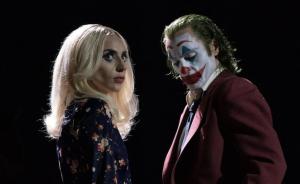 Let’s tackle the plot first, as we pick up months after the events of the 2019 film where lowly Arthur Fleck (Phoenix) is being tried for the murders he committed, most famously on a TV talk show where he debuted his stand-up comedian persona as Joker in full regalia. There’s an (un)healthy contingent of the rabble that idolize Arthur, finding the Joker to be some kind of mythic hero of class-conscious revolution, pointing out how society is failing all the little guys getting crushed by the rich and powerful and privileged, like that dead Wayne family. One of those fans is Lee (Gaga), a.k.a. Harleen Quinzel, a disturbed young woman obsessed with getting closer to Arthur, and he is extremely appreciative of the fawning attention. The defense case hinges upon whether or not Arthur was acting on his own accord or had a psychotic break, disassociating as “Joker,” and thus cannot be held accountable for the murders. Except it seems “Joker” is all the people of Gotham want to talk about, whether it’s the media or the public, and what about poor lonely Arthur?
If I had to fathom a larger thematic point, it feels like Phillips is trying to put our media ecosphere and comics fandom into judgement. He’s pointing to his movie and saying, “You wouldn’t have cared nearly as much about this project had it just been some other spooky, disturbed man losing his sanity and lashing out. You only care because he would eventually become the notorious Batman villain or lore, and that’s why you’re back.” Well, to answer succinctly, of course. When your movie’s conceptual conceit is all about providing a gritty back-story for a famous supervillain, don’t be surprised when there’s more attention and interest. This would be the same if Phillips had made a searing drama about teenage nihilism and easy access to guns and then called it Dylan Klebold: The Movie (one half of the Columbine killers, if you forgot). Stripping back layers to provide setup for a famous killer will always generate more interest than if it was some fictional nobody. It’s an accessible starting point for a viewer and there’s an innate intrigue in trying to answer the tantalizing puzzle of how terrible people got to be so terrible.
I found the 2019 movie to be a mostly interesting experiment without too much to say with its larger social commentary. It felt like Phillips relied a bit too heavily on that assumed familiarity with the character to fill in the missing gaps of his storytelling. It was a proof of concept for that proved successful beyond measure (a billion dollars, 11 Oscar nominations, including THREE for Phillips). This time, Phillips is taking even less subtlety with his blowtorch as he actively annihilates whatever audiences may have enjoyed or appreciated in the first movie.
 And in order to fully appreciate the scope of this movie’s active distaste for its own existence, I’ll be treading into some major spoilers, so jump forward a paragraph if you wish to remain unspoiled, dear reader. The conclusion of this sequel is a miserable succession of hits that degrades Arthur. At the conclusion of the 2019 original, at least you could say he was becoming a more realized version of what he wanted to be, albeit a disturbed murderer, but one who became the face of a revolution and gained a legion of adoring followers that he desperately craved. At the end of Joker 2, Arthur pathetically admits in his trial there is no alternate Joker persona and that he’s just a sad loser. Then Lee admits that she was only ever interested in “Joker” and wants nothing to do with Arthur the sad loser. And then upon returning to prison, another inmate confronts Arthur, apparently feeling personally betrayed for whatever reason. This irate prisoner stabs Arthur to death and then laughs in a corner, slicing a smile into the sides of his mouth, Heath Ledger-style. The movie literally ends with Arthur laying in a pool of his own blood, staring dead-eyed into the camera, with Phillips metaphorically painting emphatically at his corpse and defiantly saying, “Look, he’s not even the Joker now! Do you still care? Do you?” These movies were designed to be the untold history of the man who would be Joker, and they now have ended up being four hours about the guy whose idea maybe inspired a criminal lunatic to improve upon what he felt was another guy’s brand. What’s even the point? We followed two movies about the guy who isn’t the Joker? Seems pretty definitive there won’t be a third Arthur Fleck movie, as there’s nothing left for Phillips and his anarchic collaborators to demolish to smithereens.
When I heard that Joker 2 was going to be a musical, I actually got a little excited, as it felt like Phillips was going to try something very different. Now the curse of many modern movie musicals is trying to come up with an excuse for why the world is exploding in song and dance, like 2002’s Chicago implying it’s all in Roxy’s vivid imagination. Joker 2 takes a similar approach, conveying that when Arthur is breaking out into song that it’s a mental escape for him, that it’s not actually happening in his literal reality. Except… why are there sequences outside Arthur’s point of view where other characters are breaking into song, notably Lee? Is this perhaps a transference of Arthur’s perspective, like he’s imagining them on the outside joining him in tandem? The concept fits with his desperate desire to forge meaningful human connections with people that see him for who he is, and having another character harmonize with him provides a fantasy of validation. Except… there’s no meaningful personal connection between Arthur and the allure of movie musicals. It’s not like he or his domineering mother, the same woman he murdered if you recall, were lifelong fans of musicals and their magical possibilities. It’s not like 2001’s Dancer in the Dark where our lonely protagonist dreamed of being in a movie musical as an escape from her depressing life of exploitation and poverty. It just happens, and you’re listening to Phoenix’s off-putting, gravelly voice straining to recreate classics like “For Once in My Life” and “When You’re Smiling (The Whole World Smiles With You).” It’s also a criminal waste of a perfectly game Gaga.
 Phillips’ staging of his musical numbers are so lifelessly devoid of energy and imagination. Most of our musical numbers are merely in the same setting without any changes besides now one, or occasionally two, characters are singing. There’s one number that becomes a dance atop a roof, and several duets that appear like a hammy Sonny and Cher 1970s variety TV show, and that’s all you’re getting folks in the realm of visual escapism and choreography. In retrospect, it feels like the musical aspect of the sequel might have been a manner to pad it to feature-length, adding 16 performances and over 40 minutes of singing old standards. There’s a good deal of repetition with this sequel, as much of the plot is restating the events of the first film; that’s essentially what the courtroom drama facilitates as it trots out all the previous characters to recap their roles and point an accusatory finger back at Arthur.
There is one lone outstanding scene in Joker 2, and it happens to be when Arthur, in full Joker makeup, is cross-examining his old clown entertainer work buddy, Gary Puddles (Leigh Gill). Arthur admonishes Gary, saying he spared him, and Gary painfully articulates how hellish his life has been as witness to Arthur’s killing, how little he sleeps, how it torments him and makes him so afraid. For a brief moment, this character shares his vulnerability and the lingering trauma that Arthur has inflicted, and it appears like Arthur is wounded by this realization, until he settles back into the persona he’s trying to put forward, the “face” for his defense, and goes back to ridiculing Gary’s name and turning the cross-examination into an awkward standup session. It’s a palpable moment that feels raw and surprising and empathetic in a way the rest of the movie fails to.
Is there anything else to celebrate with Joker 2’s troubled existence? The cinematography by Lawrence Sher can be strikingly beautiful, especially with certain shot compositions and lighting contrasts. It makes it all the more confounding when almost all the musical numbers lack visual panache. The Oscar-winning composer returns and while still atmospheric and murky the score is also far less memorable and fades too often into the background, like too many of the technical elements. Joker 2 has plenty of talented people involved in front of and behind the camera, but to what end? What are all their troubles adding up to? It practically feels like a very expensive practical joke, on the audience, on the studio, and that is genuinely fascinating. However, it doesn’t make the end product any better, and the film’s transparent contempt sours every minute of action. Even if you were a super fan of Joker or morbidly curious, steer clear of Folie a Deux, a folly on all of us.
Nate’s Grade: D


 nathanzoebl
You must be logged in to post a comment.