Blog Archives
One Battle After Another (2025)
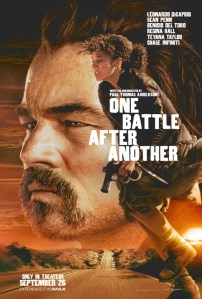
Over his thirty-year career, writer/ director Paul Thomas Anderson (PTA) has developed a mystique and reputation like few other auteurs working in cinema. He’s a visionary filmmaker whose first few movies count among my favorites of all time (Boogie Nights, Magnolia) and whose latter output can leave me shrugging and sighing (Licorice Pizza, Inherent Vice, The Master). My decade-plus-long observational bon mot has been that Anderson decided to make amends for his plot-heavy early movies with more airy, far less plotted vibes-movies. One Battle After Another is something far different from Anderson. He’s making his own version of a $150-million studio action movie, with big ideas and Leonardo DiCaprio as lead (DiCaprio has long regretted passing on Dirk Diggler, still Mark Wahlberg’s acting high-point, so thanks Leo). PTA is using the big-budget storytelling of action cinema to tell something new and personal and politically relevant behind all the gunfire and daring car chases. It’s been dubbed the movie of the moment and perhaps the one to beat for the 2025 Academy Awards. Now that I’ve finally watched all 150 minutes of Anderson’s opus, I’m not as high on it as others but do acknowledge it is a thrilling, engrossing, and occasionally frustrating work from a visionary artist.
Bob (DiCaprio) used to run with a leftist military group known as the French 75. He fell in love with Perfidia (Teyana Taylor), one of the leaders of the group, and together they had a baby, little Willa. Perfidia runs off, unable to settle down, leaving Bob to raise their daughter under a different identity. Sixteen years later, that old life comes back to Bob. It so happens Colonel Steven J. Lockjaw (Sean Penn) had an ongoing sexual tryst with Perfidia during one of their stings. There’s a chance that Willa (Chase Infiniti), now a teenager wanting to live a normal life, is actually his biological daughter. He needs to capture her under any circumstance and possibly dispose of her in order to be admitted to an exclusive white supremacist cabal within the U.S. government. Bob is forced back to action to find and protect Willa but he’s not exactly in the best shape. He’s been a burnout for so long. Can he now be a hero?

While the movie was filmed throughout 2024, and supposedly has been in the works for over twenty years by Anderson, One Battle After Another feels extremely timely and relatable in these troubled political days of ours (even the title expresses what it’s like to get up and try and process the daily barrage of horrifying news in this Trump Administration 2.0 Era). Anderson’s screenplay, loosely adapted from Thomas Pynchon’s 1990 novel Vineland, proposes a right-wing U.S. government swept up in fascist impulses that is highly militarized and declares war on immigration, rounding up primarily Hispanic men, women, and children and locking them away in camps. It’s also a law enforcement unit that pose as protestors to create a rationale for enacting physical violence and intimidation against peaceful protestors. At the core is a secret society of white supremacists running the show. Short of a concurrent documentary, it will be harder to find a movie more politically topical to the status of life in 2025, especially for the many shaking their heads and wondering how exactly we got here. Pynchon’s original novel was about the transformation of 1960s America to the 1980s, and it feels highly relevant to our 2025 times where there yet again seems to be great upheaval and conflict over those in power operating said power against the governed. It’s impossible to watch One Battle After Another and not think about the headlines. It’s not exactly the escapism many might be seeking. There’s never been a leftist paramilitary group as organized and as successful as the French 75 (they have their own affiliated convent – nuns with guns). The movie isn’t leftist wish-fulfillment to take down the current administration. It’s more a father-daughter battle to reunite in the face of state terror. It certainly has its fiery political commentary, but it’s more a family striving to stay together.
I did quite enjoy that the movie undercuts Bob as our hero, using him more as an entry point into other characters in this story, others who have a much larger impact and prove more capable. The character of Bob serves as a gateway for the other characters to really take over and shine, and it’s smart to use the familiar archetype of the old gunslinger being called back into action past his prime to atone for the sins of the past. We’ve seen this kind of character before, but Bob is kind of hapless and far out of his depth, and it makes the movie so much more entertaining. The rest of the movie exists in a more familiar action-thriller setting, albeit with some fun house mirror edges for pointed satire, but Bob is this bumbling, stumbling dope from a stoner comedy whose been copy-pasted into a different genre. He provided explosives for the French 75 but that doesn’t mean he’s got a wealth of clandestine knowledge and cunning at his disposal, especially since he’s normally inebriated. Now sixteen years later, the archetype would typically have to pull out their old skills that have calcified over a long hibernation, but Bob doesn’t have those skills. When he has an opportunity to take the big heroic shot, he misses. When he has the opportunity to make a daring escape, he falls off the side of a building. When he has to remember the coded exchanges of old, he can’t remember all of the parts. The climax doesn’t really even involve him as he’s playing catch-up for most of the extended conclusion. He’s more like the Big Lebowski waking up in, say, No Country for Old Men and desperately seeking shelter.

However, Anderson’s empathy for his characters of all stripes shines through, and while Bob is presented as diminished or bumbling, he’s not a complete moron without any redeeming qualities. His most resounding positive quality is his complete dedication and love for his daughter. We’ve seen this kind of story before, the overbearing parental figure trying to drill their child to be prepared for when danger inevitably arises, and the child growing resentful and distant to the parent because of that demanding and limiting home life. Then trouble strikes and the child has to rely upon those seasoned skills they practiced while that paranoid and obsessive adult was ultimately proven right for their unorthodox parenting. Bob’s love for Willa is what has shaped his life for these past sixteen years. He’s the parent who stayed, the one who settled from his old life to take on the responsibility of raising a child as a new life. He’s the one who changed her diapers, the one who shows up for parent-teacher conferences even if it’s to lecture the teachers about the curriculum while lighting up a joint. His love for his daughter is the thing that drives him forward and keeps him going. You feel that love between them, and in the climax of the movie, it becomes something poignant about the connection between these two over such extreme circumstances. There’s an ongoing question over the paternity of Willa but this never for a second changes Bob’s view of his daughter or his willingness to do anything to save her. If he was a Liam Neeson-styled master spy with a particular set of skills, the journey wouldn’t feel as rewarding. With Bob being punched down by the universe again and again but still going, it makes us root for him more.
Penn is completely enthralling as Lockjaw. His danger is never downplayed, and he’s frequently shown as a man who will use his considerable means of power to get what he wants, but Anderson also finds interesting ways to lampoon him and complicate him. I loved that the secret white supremacist society Lockjaw is so eager to join is called the Christmas Adventurers Club. It’s so stupidly anodyne that it sounds like a rejected title for a Boxcar Children novel. The members even pledge, “Merry Christmas. Hail Saint Nick.” It’s so stupid but so are many of the associative slogans of these right-wing groups (I learned the Proud Boys are named after a cut song from Disney’s animated Aladdin, “Proud of Your Boy,” and no I am not kidding). These men are indeed dangerous but they’re also not insurmountable, and I think that’s an important distinction. They’re small, angry, racist men trying to forcibly reshape the world but they are a minority of a minority clinging to power to reject progressive reforms. Lockjaw’s big problem is that he has a tremendous attraction to African-American women, the type of people he should see as inferior. The movie’s momentum is kicked into gear all because Lockjaw wants to be accepted in this special club. Penn is incredible in how he brings to life the snarling contradictions of this man, someone so aggressively challenging but who is also given to gnawing insecurities. Even the way Penn holds his body and walks is an indication of who this man is, with stick firmly planted in rear. He’s scary but he is also stupid, a fine encapsulation of our present political quandary. I’d expect him to be the current front-runner for Best Supporting Actor at the Oscars but it is still plenty early for predictions.

I do wish those engaging supporting characters had more to do besides Lockjaw. Even at 150 minutes, there isn’t much development for Willa to really grow as a character. She’s the target for the chase, and she’s the one trying to understand what is happening as it happens. It would make sense for her to have been the protagonist as she has the most to learn. For far too much of the movie she’s just a passive passenger, being shipped from one location to another. I wish we had more moments to really grapple with her perspective and her shifting opinion about her father and his past. I do enjoy that she’s the real star of the climax but at that point I wished we had seen far more of her resilience and determination and making use of what her father had been teaching her, not simply trading coded conversations. If she is the future, the possibility of turning this world around as someone declares by film’s end, then maybe let’s spend a little more time with her being active and reflective and taking more ownership of her survival. It’s as much her movie as it is Bob’s but he gets far more generous screen time over those 150 minutes.
The same can be said for Willa’s mother, Perfidia. I never found her that interesting as a character. She’s a true-born revolutionary from a family of revolutionaries, but some part of her is drawn back to Lockjaw, whether it’s simply the transactional exchange of sex for protection and assurances, or maybe something more, perhaps the power play of dominance over the very kind of bad men in power she wanted to control. She runs away from a domestic life with baby Willa because she knows she’s ill-suited for it. From there, she gets captured and turns on her former comrades to enter Witness Protection, which she runs away from. I kept waiting for her to resurface in a meaningful way in the story since we’re shown that she escapes into Mexico (Lockjaw lies that he killed her rather than admit she ran off). However, Anderson only utilizes the character as a catalyst, a means of entangling the two men into a paternal showdown. It’s disappointing that Perfidia is reduced to such a nothing of a character when there was much to explore.
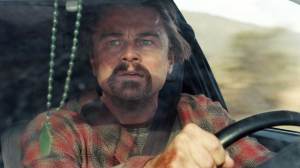
And now comes the part of the review where we talk about Anderson’s bold leap into action filmmaking. He’s not the first prestige indie darling to make a grand genre jump into action-thriller bravado. One thinks of Sam Mendes tackling Skyfall with aplomb, Paul Greengrass with the Bourne series, Patty Jenkins going from Monster to Wonder Woman, Lee Issac Chung going from Minari to Twisters, and of course the big man himself, Christopher Nolan. It can be done with the right filmmaker understanding the key tenets of action, in particular how to connect the various set pieces and conflicts with the characters and their emotional state and chain of needs and priorities. I was impressed with Anderson’s sense of scope and his ability to wring tension. There aren’t really many strict action scenes. Much ink has been spilled on the climactic chase that utilizes a series of rolling hills as the focal point of this battle, and it’s immersive and exciting and different. I’d also be lying if I said I wasn’t a little disappointed by it. This is because this sequence, up until the very very end, is all about one car tailing another. It’s taut and extremely well photographed, but ultimately it amounts to two cars following one another until one clever conclusion. It’s not really a sequence that changes and finds organic complications. It has the makings of a great action sequence but stalls. I thought back to 2014’s Snowpiercer and the sniper shooting match at two different points in the train, where each participant was waiting for the train to curve just so to better facilitate their shot. That was geography as advantage. Overall, Anderson is definitely making his version of an action movie but I don’t feel like he’s fully committed to the planning and development of those sequences. It feels more like ironic subversion when the genuine article would have been more appealing and impactful and just novel.
While One Battle After Another doesn’t rise to the capital-M masterpiece that so many of my critical brethren are falling over themselves to proclaim, it is a good movie with bold artistic swings. It thrums with energy and empathy. It’s probably PTA’s most accessible movie since There Will Be Blood or arguably Boogie Nights. I enjoyed the different characters and the brimming conflict and how much of the movie is grounded on the character relationships and their perspectives. There is a clear command of craft here like every PTA movie. He’s definitely passionate about bringing this world to life, which is eerily relevant to our own politically tumultuous times, but he still finds room for satirical mockery that doesn’t diminish the tension of the villains. It’s a universe I wanted more explanation and exploration, and the most interesting character by far is Benicio del Toro as a humble town sensei who is at the forefront of an immigrant underground railroad. I was never bored and often quite entertained but I stepped away wanting more, and maybe that’s greedy of me or an entitlement of the viewer. One Battle After Another flashes such terrific intrigue and personality that I wanted more refinement and development to better accentuate its mighty potential.
Nate’s Grade: B
Share this:

Daddio (2024)
 A lengthy conversation playing out in real-time between two strangers who open up to one another over the course of one taxi drive from the airport. If it feels Richard Linklater-adjacent, that’s because writer/director Christy Hall (I Am Not Okay With This) has certainly been influenced by the chatty likes of Linklater, as she sticks us in the cab for the entire duration of that 90-minute ride and movie. We have Dakota Johnson as the fare, a woman returning home after visiting family with secrets and shame that she’ll reveal over the course of this cab ride. We have Sean Penn as the cab driver, a seen-it-all cynic who keeps pushing for more answers and conversation from his passenger. The problem with movies based solely around conversations is that the conversation has to be mesmerizing, exhibiting great care to impart artful and authentic character details that make us reconsider these people, and hopefully provide challenges to preconceived norms and ingrained perspectives that can foster reflective growth. Nobody wants to watch a movie about a trivial conversation over 90 minutes. The problem with Daddio is that it’s not really a two-way conversation; Penn acts more as an interrogator, slowly chipping away at the layers that Johnson’s young woman feels comfortable presenting publicly. The dialogue is fine but unremarkable, eschewing overly stylized verbosity for something more natural, but even with that choice the details we are granted are clumsy and minimal. Get ready for lots of protracted pauses awaiting texting replies. The acting is fairly solid throughout, especially Johnson since it is a whole showcase for her in that backseat. If we’re going to be riding shotgun on a 90-minute conversation, I guess I’m just looking for far more scintillating details, whether it’s from the characters, their conflicts, or just their gregarious dialogue. If we’re stuck with two people, let’s be stuck with two people we actually might want to share a cab with.
Nate’s Grade: C+
Share this:

Licorice Pizza (2021)

It took me many months but I’ve finally watched the last of the 2021 Best Picture nominees, and now I can safely say, I just don’t understand all the love for Licorice Pizza. It’s writer/director Paul Thomas Anderson’s (Phantom Thread, Boogie Nights) nostalgic L.A. hangout movie, but the axiom of hangout movies is that they only really work if you actually want to hang out with the participants. I’m not certain I needed or wanted to watch either of our lead characters navigate the curious bounds of their possible romantic entanglement. Alana Haim plays Alana, an under-achieving 25-year-old looking to better define herself, and Cooper Hoffman, son of the late Phillip Seymour Hoffman, who appeared in five prior PTA movies, plays an over-achieving 15-year-old that is in a hurry to grow up and conquer the adult world. He’s crushing on her, she’s flattered but says it’s not appropriate, and over two hours we watch a series of meandering episodic adventures that test their will-they-won’t-they determination. I found Haim’s character to be generally unlikable and, worse, uninteresting. She’s petulant, needling, prone to jealousy but also clearly likes the attention but doesn’t know how far to test it. Hoffman’s character, based in part on Tom Hanks’ childhood friend and producing partner Gary Goetzman, is like a human puppy dog, so overwhelming and sunny and anxious to be liked, but I can’t see any more depth to him or her. They’re just kind of annoying and maybe that’s the point about looking back. I don’t see the larger thesis or theme in many of Anderson’s small and unfunny asides. He’s trying so delicately to recreate a feeling of time and place of early 1970s Los Angeles, but the movie doesn’t succeed in answering why anyone else should really care about this personal PTA slice of nostalgia. The best part of the movie, by far, is the segment where Bradley Cooper plays the lascivious and self-absorbed hairdresser-turned-producer John Peters. Too many of the other misadventures feel like table anecdotes brought to overextended life with technical pizazz and minimal emotional accessibility. Licorice Pizza left me cold and unfulfilled.
Nate’s Grade: C+
Share this:

Val (2021)
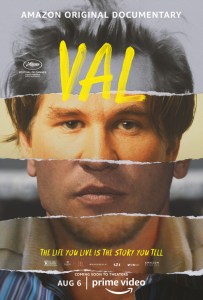
Watching the documentary Val, comprised from thousands of hours of home videos shot by actor Val Kilmer over the course of 30 years, may make you realize just how little you know about the actor. His reputation is that he’s difficult to work with, conceited, and Method to the point of losing himself in roles and pushing his co-stars to the brink of sanity. Coming from his own words, narrated by his son Jack, naturally allows the most empathetic read of the man and his rationale for his personal and professional decisions. I never knew about his family life, losing his teenage brother who was an inspiration and early collaborator. I never knew Kilmer wrote his own plays, including a student production at Juliard that broke new ground. I never even knew he was an early adopter of technology and had a warehouse filled with his self-documentation and behind the scenes footage (Kilmer is even credited with the doc’s cinematography). You get the sense of a wounded and restless soul, a handsome movie star who so rarely found a film role that allowed him to feel like an artist in his element. Kilmer can be one of his generation’s greatest actors, as evidenced in classics like Heat and Tombstone and as Jim Morrison in The Doors, still one of the greatest acting performances I’ve ever watched. Kilmer languished through plenty of studio dreck as well. His time as Batman is marked by dejection and loneliness, stuck playing the straight man in a movie of oddballs and trapped in a suit of limited mobility and an inability to hear (actors and crew started avoiding him in the Bat suit because he couldn’t respond). Strewn throughout the movie is contemporary footage of Kilmer after beating throat cancer, though the subsequent surgeries have left his speech haggard. Listening to the labored and tortured sound of his voice is a direct jab to your sympathy. Given that this is produced by Kilmer from his own archives, and narrated by his son, the documentary isn’t as critical as it could have been. I wish the movie provided more self-analysis for Kilmer, especially on some of his rockier relationships and onset disruptions, like for the notorious Island of Doctor Moreau. I don’t think you can still fall back on his deceased brother for decades of his behavior. There’s a limit to the level of insight because it feels a bit like Kilmer managing his reputation and legacy within the industry. Still, for nearly two hours, Val can be a poignant and illuminating expose of an actor with a reputation for equal parts trouble and brilliance.
Nate’s Grade: B
Share this:

The Secret Life of Walter Mitty (2013)
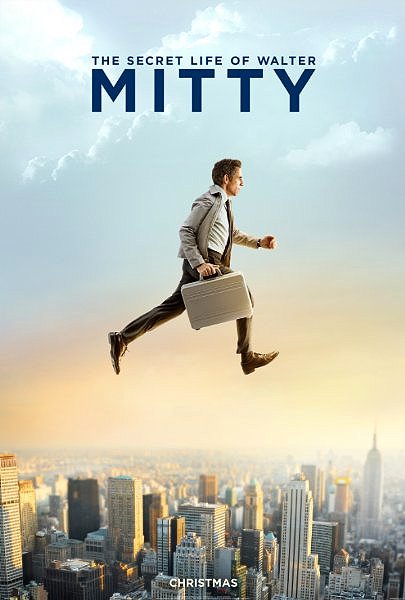 The Secret Life of Walter Mitty, based on James Thurber’s short story, is a property that has long beguiled Hollywood. The idea of escaping one’s ordinary life with fantasy, where we’re the hero. It was turned into a 1947 film starring Danny Kaye, which is rather entertaining, but has yet to be remade in all that time. It’s the kind of attractive project that has attached big name talent at different stages of development, including Steven Spielberg and Jim Carrey. It was never able to get off the ground, that is, until Ben Stiller stepped in, not just as director but also as the lead actor. Given Stiller’s directorial track record, there was suitable reason to anticipate what he could accomplish with Mitty, but the film too often feels like Stiller hamstrung, ably trying to marry a sincere indie sensibility to a mainstream sentimental holiday-released excursion for families. Stiller’s Walter Mitty never quite takes off.
Walter Mitty (Ben Stiller) is a man who has trouble filling out an online profile. He doesn’t have too many experiences or places traveled. It may be why he frequently “zones out,” as his family terms it, escaping into fantastical daydreams. In real life he works as a photography assistant for LIFE magazine, a publication that is transitioning to a digital-only existence. The enigmatic photographer Sean (Sean Penn) has sent a collection of film negatives to Walter, making special note of how Negative #25 is his life’s masterpiece. However, Walter cannot find it and is having trouble getting in contact with Sean, who is overseas on assignment. Without that much-hyped negative/picture, Walter will surely be fired, and then he’ll never have a chance to ask out his co-worker, Cheryl (Kristen Wiig). Walter sets out to Iceland and beyond to find the negative, stop daydreaming and finally live his life.
 The very tone of the movie feels like a miscalculation. It’s the story of a daydreamer, a man who retreats into his head and lives out preferable fantasies that are whimsical and far-fetched. We all knew this going into the film. It’s the same as Thurber’s story. The problem is that when Walter gets the courage to embrace life, his life is full of whimsical and far-fetched moments. He jumps out of a helicopter in shark-infested waters, where the sharks are ravenously active. He also hops into a car and has to outrun an oncoming ash cloud from an exploding volcano. And then in the third act, he travels across a mountain range all by himself and manages to miraculously find one guy. I don’t think this approach works if his real-life adventures are on par with his whimsical fantasies. I suppose one could argue that this serves a point to make real life seem just as appealing as his mental retreats, but I think it harms the very execution of the movie. First, if there’s a parallel, it means that his fantasy sequences aren’t going to be too fantastic, squashing the potential of Walter’s imagination. The only fantasy I enjoyed was a Man of Steel-esque brawl with a bearded Adam Scott (TV’s Parks and Recreation). Secondly, it means that the serious “go get ‘em” message of the movie is occurring within a medium that ordinary citizens have little connection with. Make no mistake, Walter Mitty is clearly meant as a mainstream feature meant to inspire the masses with its sentimental stripes, but is the story of a superhero doing super deeds any more relatable to the common man?
Another problem plaguing Mitty is the illusion of depth. Beyond the simplistic platitude of “get out and live your life,” there really isn’t much more of an idea explored here. It’s not like this idea hasn’t been explored in, oh, hundreds of other stories. Regardless, the film often just becomes a two-step process of Old Walter feeling timid, and then, what’s this, the hip soundtrack with the likes of Arcade Fire and Of Monsters and Men starts pulsating, and Mitty boldly shifts into New Walter, the go-getter, the guy who’s going to take charge of his own life. It’s a strong soundtrack in all senses. This process is repeated throughout the second act of the script where most of Mitty’s overseas journeys take place. Also, it may sound petty, but let’s focus for a moment on the applicability of the movie’s message compared to the practicality of what is onscreen. Live your life, but how many of us can afford to go globetrotting on a whim? I understand the larger canvas meant to evoke Mitty’s growing sense of discovery, so I’ll let it slide. The theme of Walter Mitty isn’t so much developed as it is repeated. There’s not enough substance here. In the end, the movie feels like 100 minutes of a soundtrack and a message in search of a better movie.
Allow me illustrate one of those “go out and live, Walt” moments in the film. Walter is in Greenland (though filmed in Iceland) and needs to get to a fishing vessel. The man next to him is a helicopter pilot. Great. But he’s also drunk, so Walter understandably refuses to fly with the man. This seems like a very rationale decision, but then he fantasizes Cheryl coming through, urging him on through song (through song!), and the soundtrack starts pumping, and Walter runs out and literally jumps inside the ascending helicopter. It’s meant to be portrayed as a triumphant moment of embracing the uncertainty of life’s adventure, but in reality the movie just pressured its title character into getting into a flying vehicle with a drunken pilot. What? That’s irresponsible.
And then there’s just the lackluster characters and plotting. Walter Mitty is a nice enough guy but too milquetoast to be that appealing, relying upon the comic graces of Stiller to provide the filling. The character of Walter is basically a hodgepodge of other Stiller characters in previous movies, but the character feels too restrained for an actor of Stiller’s talent. I understand that the arc has to travel from passive to active, but it feels like the funny Stiller we’re all accustomed to is being held in check thanks to the film’s broad appeal feel-good sentimentality. There’s one brief moment of the anarchic, silly Stiller that we loved so much in Tropic Thunder, and it involves a weird fantasy where Walter suffers the reverse-aging Benjamin Button disorder. It doesn’t fit at all with the tone of the film, and that’s why it stands out. Walter is a nice guy but rather boring. He pins his journey of self-discovery on getting the girl, and then when presented with one minor obstacle at the start of Act Three, rather than speak with her, he assumes the worst and just gives up. The narrative requires one of those eleventh-hour misunderstandings to keep the guy and girl apart, but it’s a frustrating decision that makes me like Walter less.
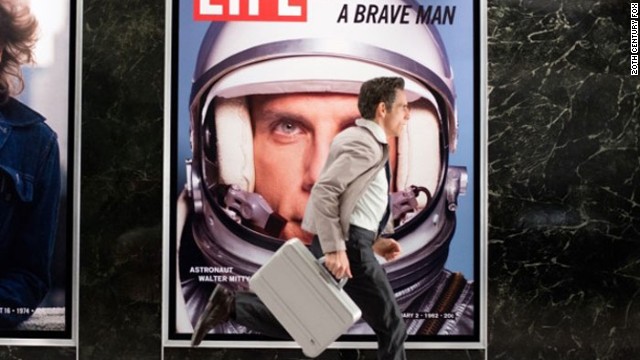 The Secret Life of Walter Mitty is also filled with blunt product placement and some strange plot elements that don’t blend together. I’m not generally offended by product placement in movies when they make it oblivious; hey, a character has to drink something so why not a (insert product here)? But the fact that the Walter Mitty team actually makes Water’s teenage stint at Papa John’s a reveal about his character, and that the very store is meant to stand in as a reminder of his own deceased father, is just wrong. Then there’s the fact that Walter works as a negative corrector (analog job) at a magazine (troubled industry), and that magazine happens to be LIFE (which shuttered in 2000). Why all the analog contexts? Is it meant to convey Walter’s reluctance to change or adapt? The whole notion of the magazine downsizing gives the film a real-life aspect that just doesn’t feel appropriate for the movie. The fact that Walter’s journey is propelled by a quest for a single missing negative feels a tad too facile for the man’s transformation, but it’s made worse when the answer to the location of the negative is so transparently obvious from the get-go. It was so obvious I almost talked myself out of it. Most of the supporting characters in the film serve little effect on any of the events. They’re there just to provide minor details about Walter and that’s it.
The movie is so earnest and you can tell Stiller is trying hard, but The Secret Life of Walter Mitty ends up being a disappointing feel-good message lacking substance and much entertainment. The filmmakers have conviction, I’ll give them that, but it’s misplaced, and the film’s tone has too many distracting elements. The fact that real life mirrors Walter’s fantasy visions seems like a miscalculation from the start. Thurber’s short story didn’t have that much to it to begin with but we need more than this, an office schlub learning to live his life through improbable adventures meant to inspire the rest of us common folk. As a slice of escapist entertainment, it’s not fanciful enough, not creative enough, and not funny enough. As a motivational, heart-tugging ode to living one’s life, it falls into too many traps to feel applicable, insightful, or engaging. It looks beautiful and the people behind the film obviously mean well, but good intentions and nice camerawork are not the same as an effective movie built from the ground up, namely the lackluster story and characters. The Secret Life of Walter Mitty feels like it has as much depth as a glossy, idealistic commercial, and perhaps for some this will suffice, but I found this Walter Mitty’s secret life not worth investigating.
Nate’s Grade: C+
Share this:

Gangster Squad (2013)
 It’s hard to mention the action thriller Gangster Squad without a passing reference to the Aurora, Colorado movie theater shooting in the summer of 2012, the reason for the film’s five-month delay and reshot action sequence. Gone is a shootout at the movies and now we have a confrontation in the streets of Chinatown. I wish they hadn’t stopped there. If given the opportunity, and remember they did have an additional five months, I would have scrapped Gangster Squad almost completely and started fresh.
In 1949, former boxer Mickey Cohen (Sean Penn) has seized control of Los Angeles organized crime. His influence extends even into a police, which forces Chief Parker (Nick Nolte) to go to desperate measures. He asks Sgt. John O’Mara (Josh Brolin) to assemble a team of enforcers to fight back. They won’t have badges but they will be pushed to use whatever means necessary to carry out their mission, which means blurring the line between what is considered lawful. O’Mara assembles a super group of former officers and one of them, Sgt. Jerry Wooters (Ryan Gosling) gets into even deeper danger when he starts seeing Mickey Cohen’s main squeeze, Grace Faraday (Emma Stone).
This movie is like if The Untouchables and L.A. Confidential had an illegitimate child and then abandoned it in a sewer where degenerate hobos raised it. Gangster Squad rips off other gangster movies with liberal abandon that I can’t even begin to list the lifts. I’d be less offended if I felt that the movie had more on its mind than just replicating the tone and look of noir cinema. Actually, it feels more like what they want to replicate is the tone or style of the video game L.A. Noir.
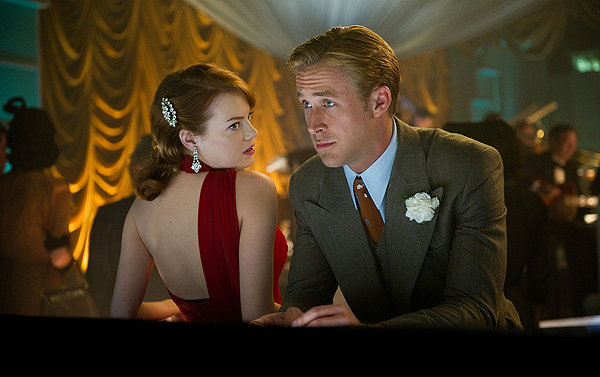 The main problem is that Gangster Squad really only has the skeletal outline of a plot. It’s missing any essential character and plot development. Here, I’ll summarize the barebones plot for you: Mickey Cohen is a bad guy. O’Mara forms a team. They have a montage taking out bad guys. Mickey takes out one of them. They have a showdown. That, ladies and gents, is it. There really aren’t any scenes that diverge from those scant descriptions. It felt like only five minutes passed from one of O’Mara’s guys getting killed (and just like The Untouchables, it’s the nerdy one) to them descending on Cohen’s headquarters and duking it out. Why does the film introduce the conflict of Wooters seeing Cohen’s girl if he never finds out? There isn’t even one scene presented to take advantage of this conflict. It just ends up being another half-baked plotline. It feels like the only development we get with Gangster Squad is through montages. What is also apparent is that O’Mara and his team really don’t have anything resembling the faintest notion of a plan. We watch them take out some bad guys via fights and shootouts but there’s no higher plotting to it. You get a sense that these former cops are just playing it by ear, looking for a fight every night. It’s hard to imagine that these people, even with their law enforcement and war experience, could be effective in the long term. Without any formative organization or greater planning, these guys just seem like dull bruisers bouncing from fight to fight with no sense of direction.
Then there’s the paucity of character work, relying solely on genre archetypes to do its work for the movie. O’Mara is the determined family man but his team can best be described by one-word classifications: The Black Guy (Anthony Mackie), The Nerdy Guy (Giovanni Ribisi), The Mexican Guy (Michael Pena), The Young Guy (Gosling), The Old Guy (Robert Patrick). That’s about it, though I suppose they do have different weapon preferences meant to supply all that missing characterization. Oh look, Officer Harris (Mackie) brings a knife to gunfights. That’s pretty much the beginning and end of his character. Wooters is so lackadaisical he feels like he’s on drugs, and Gosling’s soft-spoken, mealy-mouthed line delivery only adds to the effect. It feels like Gosling, in a stretch to find something interesting out of the mundane, said to himself, “I wonder if I could give a whole performance where I only speak under a certain vocal register.” Then there’s the woefully miscast Stone (The Amazing Spider-Man) as the femme fatale/mol to Mickey. I love Stone as an actress, but man-eater she is not and sultry seductress doesn’t fit her well either. Perhaps with the aid of a sharper script and a greater depth of character she could rise to the challenge. At no point does Gangster Squad really even attempt to make these people multi-dimensional. They never reflect on the moral turpitude of their own vigilante justice or the ramifications of their actions. There’s no room for ambiguity here.
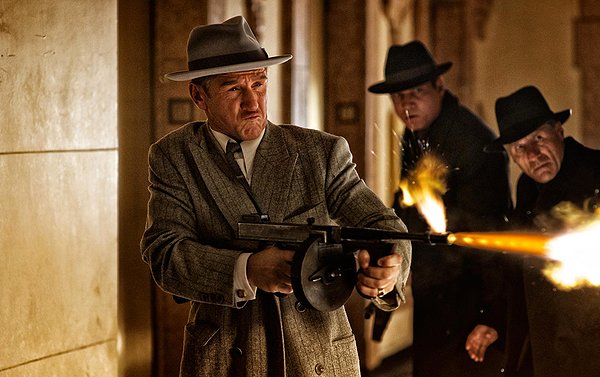 Finally, we must speak of Mr. Sean Penn (Milk). The man’s actorly gumbo goes into campy overdrive. In these rare circumstances, you aren’t watching Sean Penn Esteemed Actor so much as Sean Penn Human Vortex of Overacting. Normally I would criticize Penn for going over the top but over the course of 110 minutes, he single-handedly becomes the only entertaining thing in the movie. He’s chewing scenery up a storm, yes, but at least he’s channeling the pulpy silliness of the whole movie. I came to enjoy his antics and outbursts and thus became more empathetic of Mickey Cohen and his efforts than I did with O’Mara. Such is the danger screenwriters run when they spend more time crafting an interesting villain than a hero.
Gangster Squad is what happens when a movie is sold on title and genre elements. To be fair, it’s a bang-up title. The plot is half-baked at best, really only serving as a thin outline of a gangster movie, but instead of adding complexity and intrigue and characterization, they just ran with it. The actors are either camping it up or out of their element, the action and shootouts are pretty mundane, and the story is just uninvolving, even for fans of film noir like myself. It’s a good-looking film from a technical standpoint, but that’s as far as I’ll go in my recommendation (it could be an odd pairing with Milk considering the two shared actors). It feels like it just wants the setting elements of film noir, the atmosphere, and then figures just having good guys and bad guys shoot it out will suffice. That glossy, high-sheen period look just seems like a cool façade, and a cool façade seems like the only ambition of Gangster Squad. I can’t really recall any signature action sequence, snappy quote, plot development, or peculiarity worthy of remembering. It may be one of the most forgettable gangster movies Hollywood has produced.
Nate’s Grade: C
Share this:

Milk (2008)
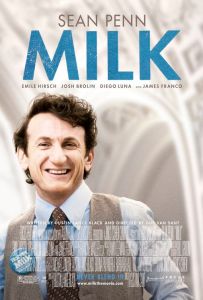 The biopic of America’s first openly gay elected official is stirring, thoughtful, and occasionally limited. Sean Penn gives a wonderful performance as the captivating and tragic Harvey Milk, assassinated in 1978 by fellow San Francisco councilman Dan White (Josh Brolin). He changes his look, his voice, how he carries his shoulders and moves his arms; it’s a terrific and transformative performance that only sometimes hits a few fey stereotypes. The movie mostly follows Milk’s path as a community organizer who successfully mobilized the gay rights movement. You’ll witness local politics in depth, and that’s my one reservation with this fine film – it focuses too heavily on the political formation of a movement and less on the man that kick-started it. You get little glimpses of Milk the man, and most of those glimpses happen to be his romantic relationships with annoying men. That said, director Gus Van Sant orchestrates real archival footage from the time including protestors and homophobic spokespeople, and it gives the movie an authentic relevancy. The deadly confrontation between Milk and White is played in a painful, very un-Hollywood approach that made me wince hard. It’s amazing to watch Milk and realize how far the American public has come since the 1970s and how much further we, as a nation, have to go.
Nate’s Grade: A-
Share this:

Into the Wild (2007)
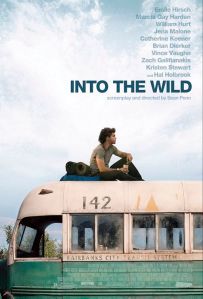 Undeniably well made, I just couldn’t emotionally connect with the main character, Christopher McCandless (Emile Hirch). Chris turns his back on his affluent parents and his bourgeois lifestyle and heads off into the wilderness to experience nature and find what has been missing in his life. Director/screen adaptor Sean Penn turns Chris into a Jesus-like figure that touches all those who he encounters on his cross-country tour that will meet its end in Alaska. I found the character treatment to be a tad naive and off-putting, and his lack of communication with his family, especially his younger sister who was in the same boat with him, seems especially cruel. And yet, the movie has its share of transcendent moments that bury themselves deep inside you, like when Chris befriends an 80-year-old widower (Oscar nominee Hal Holbrook) who is given new life. The closing moments, when Chris has accepted is fate, is profoundly moving and exceptionally performed, and this is coming from a guy that felt an emotional disconnect from the main character. Into the Wild is lovely to watch with top-notch cinematography, a fabulous score by Eddie Vedder, and fine acting by a diverse cast. I’m very impressed by what Penn has accomplished here. However, I admire the movie more than I can embrace it, and it all goes back to the character of Chris. He’s a mystery and both romantic and frustrating, which is kind of a fit summation for the movie.
Nate’s Grade: B
Share this:

The Interpreter (2005)
 This is a polished political thriller that hearkens back to the day of the 1970s, where Hollywood was willing to put out smart, complicated, involving political intrigue and have faith that adults would enjoy. The premise is sound and director Sydney Pollack sure knows how to add layers of complication and mystery as well as make you doubt everyone’s involvement. A scene where all the film’s major players somehow get on the same down town bus is a masterpiece of nuanced suspense. The ending, not so much. Nicole Kidman, as the white African U.N. interpreter that hears a planned assassination one night, is credible but a bit weightless in her part. It’s not enough the pretty girls are taking the ugly girl parts (Monster,The Hours), but now they’re taking African parts? Granted, the idea of a white African allows for a new insight into the struggle for ethnic and cultural identity. Sean Penn gives a nicely rattled performance, giving his character more edge then it even deserves. The Interpreter is a geo-political thriller that trusts its audience and mostly delivers a good time.
Nate’s Grade: B
Share this:

21 Grams (2003)
 21 Grams (2003)
Premise: A mathematician (Sean Penn) in need of a heart transplant, a recovering addict (Naomi Watts) mourning the loss of her husband and children, and an ex-con (Benicio Del Toro) whos found redemption in Jesus, are all linked by a horrific car accident. The aftermath will bring them together out of grief, guilt, and revenge.
Results: The greatest asset 21 Grams has, bar none, is the trio of breathtaking performances. De Toro gives a powerful performance as a man consumed by grief and seeking answers in the unknown. Watts gives the definition of a raw performance. What isn’t cool is the structure, told out of order like the directors first film, the brilliant Amorres Perros, translated: Loves a Bitch. But the mixed-up structure of 21 Grams is needlessly complicated d frustrating, plus it pulls you out of the movie. Im sure theres a rationale reason for it, but the surprises and expectations it produces are minimal. The whole thing would have been better plunked in an old-fashioned linear structure. The sensational performances and intelligent story will stay with you long after the film ends.
Nate’s Grade: B+


 nathanzoebl
You must be logged in to post a comment.