Blog Archives
Eternal Sunshine of the Spotless Mind (2004) [Review Re-View]

Originally released March 19, 2004:
No other movie this year captured the possibility of film like Michel Gondry and Charlie Kaufman’s enigmatic collaboration. Eternal Sunshine was a mind-bending philosophical excursion that also ended up being one of the most nakedly realistic romances of all time. Joel (Jim Carrey restrained) embarks on having his memories erased involving the painful breakup of Clementine (Kate Winslet, wonderful), an impulsive woman whose vibrant hair changes as much as her moods. As Joel revisits his memories, they fade and die. He starts to fall in love with her all over again and tries to have the process stop. This labyrinth of a movie gets so many details right, from the weird physics of dreams to the small, tender moments of love and relationships. I see something new and marvelous every time I watch Eternal Sunshine, and the fact that it’s caught on with audiences (it was nominated for Favorite Movie by the People’s friggin’ Choice Awards) reaffirms its insights into memory and love. I never would have thought we’d get the perfect romance for the new millennium from Kaufman. This is a beautiful, dizzingly complex, elegant romance caked in visual grandeur, and it will be just as special in 5 years as it will be in 50, that is if monkeys don’t evolve and take over by then (it will happen).
Nate’s Grade: A
——————————————————
WRITER REFLECTIONS 20 YEARS LATER

“How happy is the blameless vestal’s lot!
The world forgetting, by the world forgot:
Eternal sunshine of the spotless mind!
Each prayer accepted, and each wish resigned;”
-Alexander Pope, Eloisa to Abelard (1717)
“Go ahead and break my heart, that’s fine
So unkind
Eternal sunshine of the spotless mind
Oh, love is blind
Why am I missin’ you tonight?
Was it all a lie?”
-Kelly Clarkson, Mine (2023)
This one was always going to be special. Eternal Sunshine of the Spotless Mind is not just one of my favorite movies, it’s one of those movies that occupies the place of Important Formative Art. It’s a movie that connected with me but it’s also one that profoundly affected me and changed me, that inspired me in my own creative ventures. With its elevated place in my memory, I’ll also admit that there was some mild trepidation about returning to it and having it not measure up to the impact it had all those twenty years ago. It’s impossible to recreate that first experience or to chase after it, but you hope that the art we consider great still has resonance over time. This happened before when I revisited 2000’s Requiem for a Dream, a movie that gobsmacked me in my youth, had such innate power and fascination, and had lessened over the decades. It was still good art but it wasn’t quite the same, and there’s a little tinge of disappointment that lingers.

When I saw the movie for the first time it was at a promotional screening. I was a senior in college and had dyed my hair bright red for the second time. After marveling over my first encounter with 1999’s Run Lola Run, I was determined to have hair like the titular Lola. My parents were hesitant and set parameters, like certain grade achievements, and I met them all. Afterwards they had nothing left to quibble so I dyed my hair red, as well as other colors, my sophomore year and then again my senior year. At the screening, a publicist for the studio asked if I wanted to compete for a prize. I demurred but then she came back and asked again, and sensing something to my advantage, I accepted. It turns out the pre-show contest was a Clementine (Kate Winslet) look alike contest and my only competition was a teen girl with one light swath of blue hair. The audience voted and I won in a landslide and was given a gift basket of official Eternal Sunshine merchandise that included the CD soundtrack and a bright orange hooded sweatshirt modeled after the one Clem wears in the movie. That sweatshirt quickly became one of my favorite items of clothing, something special that nobody else had from a movie I adored. I wore it everywhere and it became a comfort and a confidence builder. Back during my initial courtship with my wife, in the winter months of 2020, she held onto the orange hoodie as a memento to wear and think of me during our time apart. She said it even smelled like me, which was a comfort. It had meaning for us, and we cherished it. I had to marry her, of course, to ensure I’d eventually get the sweatshirt back in my possession (I kid).
The lessons of Eternal Sunshine run deep for me. On the surface it’s a breakup movie about an impulsive woman, Clem, deciding to erase her memories of her now ex-boyfriend Joel (Jim Carrey). Out of spite, he elects to have the same procedure, and from there we jump in and out of Joel’s head as a subconscious avatar experiences their relationship but in reverse. It’s the bad memories, the hurt and ache of a relationship nearing or past its end, but as each memory degrades and Joel goes further into the past, he discovers that there are actually plenty of enjoyable memories through those good times, the elation and discovery, the connections and development of love, that he doesn’t want to lose. He tries to fight against the procedure but it becomes a losing battle, and so he gets to ride shotgun in his cerebellum as this woman vanishes from his life. What began out of spite and heartache ends in mourning and self-reflection.
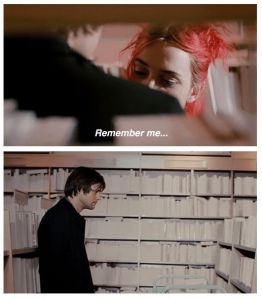
At its heart, the movie is asking us to reflect upon the importance of our personal experiences and how they shape us into the people that we are. This includes the ones that cause us pain and regret. The human experience is not one wholly given to happiness, unfortunately, but there are lessons to be had in the scars and pain of our individual pasts. I’m not saying that every point of discomfort or pain is worthwhile, as there are many victims who would say otherwise, but we are the sum total of our experiences, good and bad. With enough distance, wisdom can be gained, and perhaps those events that felt so raw and unending and terrible eventually put us on the path of becoming the person you are today. Now, of course, maybe you don’t like the person you are now, but that doesn’t mean you’re also a prisoner to your past and doomed to dwell in misery.
After my divorce from my previous wife in 2012, I wrote a sci-fi screenplay following some of the same themes from Eternal Sunshine. It was about two dueling time travelers trying to outsmart one another, one hired to ensure a romantic couple never got together and one hired to make sure that they had. The characters represented different viewpoints, one arguing that people are the total of their experiences and the other arguing people should be capable of choosing what experiences they want ultimately as formative. Naturally, through twists and turns, the one time traveler learns a lesson about “living in the now,” to stop literally living in the past and trying to correct other people’s perceived mistakes, and that our experiences, and our heartache, can be valuable in putting us into position to being the people we want or living the lives we seek. It shouldn’t be too hard to see that I was working through my own feelings with this creative venture. It got some attention within the industry and I dearly hope one day it can be made into a real movie. It’s one of my favorite stories I’ve ever written and I’m quite proud of it. It wouldn’t exist without Eternal Sunshine making its mark on me all those years ago.
It’s an amazing collaboration between director Michel Gondry and the brilliant mind of Charlie Kaufman. The whimsical, hardscrabble DIY-style of Gondry’s visuals masterfully keeps the viewer on our toes, as Joel’s memories begin vanishing and collapsing upon one another in visually inventive and memorable ways. There’s moments like Joel, after finding Clem once she’s erased her memory of him, and he storms off while row after row of lights shuts off, dooming this memory to the inky void. There’s one moment where he’s walking through a street and with every camera pan more details from the store exteriors vanish. A similar moment occurs through a store aisle where all the paperbacks become blank covers. It’s a consistent visual inventiveness to communicate the fraying memories and mind of Joel, which becomes its own playground that allows us to better understand him. The score by Jon Brion (Magnolia) is also a significant addition, constantly finding unique and chirpy sounds to provide a sense of earned melancholy. By experiencing their relationship backwards, it allows us to have a sense of discovery about the relationship. This is also aided by Kaufman’s sleight-of-hand structure, with the opening sequence misleadingly the beginning of their relationship when it’s actually their second first time meeting one another. The pointed details of relationships, both on the rise and decline, feel so achingly authentic, and the characters have more depth than they might appear on the surface. Joel is far more than a hopeless romantic. Clem is far more than some Manic Pixie Dream Girl, a term coined for 2005’s Elizabethtown. She tells Joel that she’s not some concept, she’s not here to complete his life and add excitement; she’s just a messed up girl looking for her own peace of mind and she doesn’t promise to be the answer for any wounded romantic soul.

The very end is such a unique combination of feelings. After Mary (Kirsten Dunst) discovers that she’s previously had her memories of an affair with her boss erased, she takes it upon herself to mail every client their files so that they too know the truth. Joel and Clem must suffer listening to their recorded interviews where they are viciously attacking one another, like Clem declaring Joel to be insufferably boring who puts her on edge, and Joel accuses her of using sex to get people to like her. Both are hurt by the accusations, both shake them off as being inaccurate, and yet it really is them saying these things, recorded proof about the ruination of their relationship. Would getting together be doomed to eventually repeat these same complaints? Clem walks off and Joel chases after her and tells her not to go. Teary-eyed, she warns that she’ll grow bored of him and resentful because that’s what she does, and she’ll become insufferable to him. And then Joel says, “Okay,” an acceptance that perhaps they may repeat their previous doomed path, maybe it’s inevitable, but maybe it also isn’t, and it’s worth it to try all the same. Maybe we’re not destined to repeat our same mistakes. Then it ends on a shot of our couple frolicing in the snow, the descending white beginning to blot out the screen, serving as a blank slate. It’s simultaneously a hopeful and pessimistic ending, a beautifully nuanced conclusion to a movie exploring the human condition.
Winslet received an Oscar nomination for her sprightly performance, and deservedly so, but it’s Carrey that really surprises. He had already begun to stretch his dramatic acting muscles before in the 1998 masterpiece The Truman Show and the far-from-masterpiece 2001 film The Majestic. He’s so restrained in this movie, perfectly capturing the awkwardness and passive aggressive irritability of the character, a man who views his life as too ordinary to be worth sharing. Clem begs him to share himself since she’s an open book but he’s more mercurial. She wants to get to know him better but to Joel there’s a question of whether or not he has anything worthwhile getting to know. Carrey sheds all his natural charisma to really bring this character to life. It’s one of his best performances because he’s truly devoted to playing a character, not aggressively obnoxious Method devotion like in 1999’s Man on the Moon.
Eternal Sunshine of the Spotless Mind is a messy, enlightening, profound, playful, poignant, and mesmerizing movie. A perfect collaboration between artists with unique creative perspectives. I see something new every time I watch it, and it’s already changed my life in different ways. I used to see myself as Joel when I was younger, but then I grew to see him as self-pitying and someone who too often sets himself up for failure by being too guarded and insular. It’s a reminder that our cherished relationships remain that way by allowing ourselves to be vulnerable and open. We are all capable and deserving of love.
Re-View Grade: A
Share this:

Madame Web (2024)
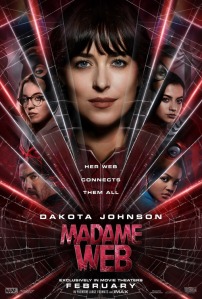 What even is this movie and who is this for? I think the real answer is to help Sony’s bottom line, but that’s generally the real reason for most studio blockbusters, the opportunity for the parent company to make more money. Sony has the rights to Spider-Man and they’re not going to let those things lapse, and while Marvel is shepherding the Tom Holland-lead Spider-Man franchise, Sony is left to their own devices to build out the Spidey universe with lesser-known solo vehicles meant to launch an interconnected web of Spidey’s rogues gallery. It’s about growing more franchises, and it worked with 2018’s Venom, a favorite Spidey villain with a sizable fan base and benefiting from the goofiness of its execution with Tom Hardy and company. It didn’t work out for Morbius in 2022 because nobody cares about Morbius as a character, just like nobody cares about Kraven the Hunter as a character (coming August 2024!), and just like nobody cares about Madame Web, who wasn’t even a Spidey villain and instead an old blind lady that saw the future. The far majority of Spider-Man villains are only interesting as they relate to Spider-Man, so giving them solo vehicles absent Spider-Man is a game in delayed gratification. Madame Web is the latest in this misguided attempt to create an enriched outer circle of brand extension. It’s a promise of a continuity of superhero movies that will never come to pass. It’s a bland return to early 2000s superhero heroics with some substantial structural flaws to its own tangled web.
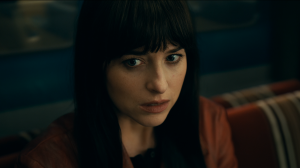
Cassandra “Cassie” Web (Dakota Johnson) is an EMT in New York City and frustrated by her humdrum life until after an accident she starts seeing the future. You see her mother was researching spiders in the Amazon before she died, and she was researching them with Ezekiel Sims (Tahar Rahim) who killed her because he needed a special spider with special properties. Her dying mother gave birth to Cassie thanks to some… mystical Amazonian spider-people? It’s rather confusing but so are Cassie’s visions. A trio of young students (Sydney Sweeney, Isabela Merced, Celeste O’Connor) is in danger of being killed by a 30-years-older Ezekiel, so she takes it upon herself to save them, as they one day will become Spider-laden superheroes themselves. This Ezekiel, however, has super strength, agility, and the ability to walk on walls, so overcoming a Spider…man’s abilities might be too much for one EMT driver/psychic.
 This movie is more Final Destination or That’s So Raven than a big superhero adventure, and that leads to lots of structural and narrative repetition. Cassie’s power involves her getting glimpses of the future, generally warnings of things to avoid or to intervene. It also makes for a very annoying structure because the movie never gives you clues about what is a vision and what is the real timeline of events. This leads to many repetitions of scenes and fake-outs, and after a while the story feels like it’s mostly jerking you around as well as treading in place. We don’t really know why these flashes happen and what larger meaning they may have. They just happen because the plot needs them to, and so they do. Early on, Cassie gets a vision of a bird flying into her window, and she chooses to open the window, signifying that she can avoid these fates. Why couldn’t Ezekiel Sims think likewise? He’s devoted his whole life to killing these mysterious girls because they’re destined to murder him, but if he’s known for years, why not strike when these girls were younger and more vulnerable, Skynet-style? Or maybe try just not being evil too? I guess that one was too difficult for him as he’s cryptically profited off his Amazon spider steal. More work needed to go into the story to make these characters important and for the fake-out scenes to feel more like horror double-takes. It just gets tiring, and you’ll likely start second-guessing anything of import is merely a vision about to rip away the consequences.
I think a big problem is our protagonist. She’s just so boring and we don’t really understand why she’s so compelled to save these three girls more than anyone else. Her entire back-story with her mother is merely the setup for how she might have super magic powers to kick in at a convenient yet unknown combination of elements and to provide motivation why she might want to kill Ezekiel. It’s all so rudimentary and mechanical, designed just to supply enough connective tissue of plot. As an EMT, finding out how to better save lives could be really useful, although I wish the movie had the gall to make her disdainful of her job beforehand and actively bad at saving lives so that way it would feel like the universe was interjecting and saying, “Here, be better.” You would think if she’s trying to prevent death, and especially the deaths of the people she knows, that it might kick in for her to warn a couple Spider-Man-related characters of note (more on this later). Instead, the Spidey girls have an extended moment learning CPR that feels forever and then tell Cassie, “Wow, you’re a really good teacher” after a rather unimpressive learning session with a motel room pillow. This character just isn’t that interesting even with her new psychic vision powers.
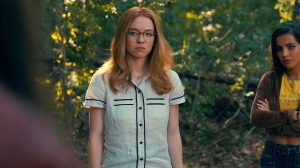 The Spidey girls are also rather uninteresting and given one note of characterization. One of them likes science. One of them has a skateboard and… attitude. One of them is Hispanic. I may have even confused about the characterization, that is how meaningless these characters are. They’re simply a glorified escort mission, a challenge for Cassie to simply keep alive. The scene where they stumble into a brightly lit diner in the middle of nowhere, after Cassie saved their lives and warned them to lay low for their own self-preservation, is immensely irritating. They take it upon themselves to stand on a table of letter jacket-wearing jocks and dance because that’s laying low. They’re annoying characters that never convince you why Cassie should go through such valiant efforts to keep alive. The flashes of them in Spider costumes are only brief glimpses of a possible future, one I can guarantee we’ll never see coming to fruition in this discarded universe.
The strained efforts to transform Madame Web into a disjointed Spider-Man prequel are distracting and generally annoying. It also reveals the doubts the studio had that anyone would be interested in a Madame Web story without additional connections to Peter Parker. Why do we need to have a pregnant Mary Parker (Emma Roberts) in this movie? Why does the climax also involve her giving birth? Are audiences going to wonder whether or not Peter Parker might be born? There’s also the prominent role of Uncle Ben Parker (Adam Scott) as Cassie’s EMT partner. He’s practically the third-leading character. The movie makes several ham-handed meta references about his eventual role in crafting Spider-Man’s development (I also guess he gets to marry Marissa Tomei, so good for you). “Ben can’t wait to be an uncle,” one person says, with, “All of the fun and none of the responsibility.” They might as well just turn to the camera and point-blankly state, “This man will eventually die and inspire Peter Parker to be a hero.” The worst moment of all this forced connectivity is when Mary demurs on picking a name and says she’ll determine when he’s born, even though the film has a “guess the name” baby shower game. Does this mean she saw her newborn babe and the first thing she thought was… Peter? The entire Spider-Man lineage feels so tacked-on and superfluous as glorified Easter eggs.
 I’m generally agnostic when it comes to product placement in movies. People got to eat and drink and drive cars, and as long as it’s not obnoxious, then so be it. However, the product placement needs to be mentioned in Madame Web for its narrative prominence, and this leads to some spoiler discussion but I’d advise you read anyway, dear reader, because this movie is practically spoiler-proof by its very conception. Ezekiel Sims is battling Cass and the Spider girls atop a large warehouse with a giant Pepsi sign built onto scaffolding. Then the engineer of Ezekiel’s doom is none other than the falling “S” from Pepsi. That’s right, the villain is dispatched through the help of Pepsi, as well as a literal sign falling from above (cue: eye-roll). Without the assistance from Pepsi (or “Pep_I”), these women might not have lived. You can’t expect that kind of divine intervention from any other cola company. Coke was probably secretly working with the villain, giving him aid and comfort from being parched (begun these Cola Wars have). Deus ex Pepsi. It’s just so egregious and in-your-face that I laughed out loud. Is it also a reference to the original Final Destination ending or am I myself reading the signs too closely?
For those hoping for a so-bad-it’s-good entertainment factor, I found Madame Web to be more dreary, bland, and confusing than unintentionally hilarious. Johnson is an actress I’ve grown to enjoy in efforts like Cha Cha Real Smooth and The Peanut Butter Falcon, also the much-derided but still enjoyable Netflix Persuasion, but she sleepwalks through this movie. I don’t blame her. I don’t blame any of the actors (poor Rahim’s performance seems entirely replaced by bad ADR lines). The character’s nonchalance already zaps the low stakes of a movie where a psychic character we don’t really have fond feelings over is trying to save a trio of annoying teenagers before a vague hodgepodge of a villain succeeds in killing them before they can kill him, which means they all need to kill him before he can kill them before they are destined to kill him. No wonder the executives decided to crassly cram in some Spider-Man relatives to make people care. Madame Web is less a bad movie and more a poorly executed and confused movie, one that doesn’t understand the desires of its intended audience. It’s barely even a superhero action movie, with few scenes of elevated action, though the director enjoys her ceiling perspective flips. There’s a moment where our villain flat-out says, “You can’t do [a thing],” and literally seconds later, through no setup or explanation, suddenly Cassie can do [that thing]. The whole movie feels like this moment, arbitrary and contrived and desperately reaching for an identity of its own. It should have stayed in the Amazon researching spiders before it was destined to die.
Nate’s Grade: C
Share this:

The Butterfly Effect (2004) [Review Re-View]
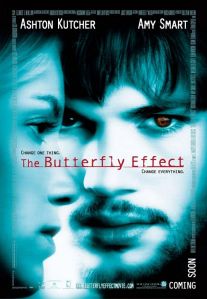 Originally released January 23, 2004:
Notice: I found Ashton Kutcher, star of The Butterfly Effect, on a trip to buy dog food, and cordially asked him to write a review. This is what he sent me. It’’s totally him. I wouldn’’t make this stuff up. That would be dumb.
“So, like, this Nate guy asked me to do a review of my new awesomest movie, The Butterfly Effect. Dude, like anyone needs a review for the most awesomest movie ever. I mean, like, the term ‘awesomest movie ever’ should say, like, everything. The only thing possibly more awesome than The Butterfly Effect would be trucker hats …… or two chicks totally making out. And I only said ‘possibly more awesome,’ which doesn’’t mean it is more awesome, because, dude, like I said before, The Butterfly Effect is the most awesomest thing ever. You can’t dispute that. Don’t even try. I’m awesome!
Like, the story goes like this, man. I play this guy, like I know big stretch there, but he’s not the most awesome guy ever, which is what you’d be thinking since it’s the most awesomest movie ever. But no, he’s like this kid who blacks out and has this wickedly twisted childhood where he stars in his neighbor’s kiddie porn, has his dog set on fire, and, like, his dad is all crazy, or, like I like to say, insane in the ole’ membrane. Ha, I totally made that up right now. I’m awesome!
So, you’re like saying, ‘Dude, that movie sounds less than awesome. Yes, sir, I am having definite doubts about the awesomeness of this movie. Like, do I need to go to the movies to, like, feel bad? I got my parents to do that for me. That and school.’ Hey man, I’m there, I know what you feel. ‘Cause right when you are like, ‘Dude, when is Demi gonna’ show up playing his mom?’ I find these old journals of mine and, dude, use them to travel back in time. I know, the awesomeness has returned. And I use the journals to go back and try and punk time, man. I try and make things better and change the future but I like totally just make it worse. I know, double punk’d, man! I try and fix the life of this hot girl in the movie (she showed her boobs in that Road Trip movie, did you see that? That part where she shows her boobs, oh man … It is awesome) but things don’’t work out. Like she becomes a crack ho at one point. Dude, total punk’d. I’m awesome!
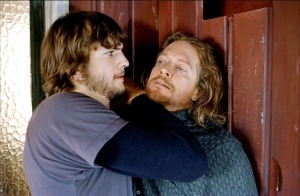 I should be taken as a serious actor. I didn’t hit my head on something and I grew a beard, what more do people need to know I got the goods? I mean, I don’t want to keep saying it but …… beard. C’mon! When actors want to be taken seriously they, like, grow beards. That’s why all those people in movies before 1970 (I know, it surprised me too that there were older movies) got awards and stuff. Beards, dude. Beards. When Billy Dee Shakespeare, like, invented acting, he totally imagined dudes, and chicks too, with beards. That’s why girls can’t be taken as serious actors, ‘cause they can’t grow beards. Ha. I’m awesome!
So, like, if you ever wondered what it would be like to see me, Ashton Kutcher, the most awesome man alive …who ever lived, no… the most awesome human being …-the most awesome thing …- ever, as a frat boy, or like, some poor dude with no arms, then you should see my new movie, The Butterfly Effect. After all, it is the most awesomest thing ever. That’s awesome. So, like, you people reading (is that what school is for?) should go see my movie. I’ll tell you why in two words: beard.”
Nate’s Grade: C+
——————————————————
WRITER REFLECTIONS 20 YEARS LATER
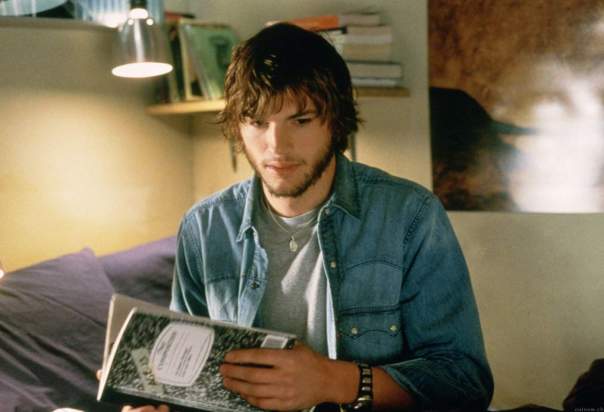
It’s hard to remember but there was a time where Ashton Kutcher was the king of the early 2000s universe. He had parlayed his excitable supporting character on a late 90s network sitcom into a successful movie career top-lining wild comedies, and he had also found success as a producer, bringing new life to the hidden camera prank TV show with his eponymous Punk’d where many of his celebrity friends would be victimized for the lols. The man even single handedly made goofy trucker hats a fashion mainstay. I know we haven’t seen much of the Kutch in a while, as he’s settled into his non-profit charities and being a family man, ceding the spotlight to his wife and former sitcom girlfriend, Mila Kunis. The Kutcher brand was stronger than ever at the time of The Butterfly Effect, enough so that Kutcher signing on as an executive producer was what finally got this widely read industry script to finally get made. You must view The Butterfly Effect as a point not just in Kutcher’s career but also in millennial edge-lord culture, the concept that anything dark is therefore compelling, and the more twisted the better. Re-watching the movie twenty years later, I wanted to laugh out loud at so many points because The Butterfly Effect is so serious while being so silly as it plumbs every depth of misery, both for its characters as well as any potential audience members still keeping track of the messy metaphysics.
Kutcher plays the adult version of Evan, a kid who has had quite a challenging upbringing to put it mildly. Mom (Melora Walters) is doing her best while Evan’s father is locked away in a mental asylum, and she’s worried her child might have inherited dad’s instability. He blacks out for extended periods and is found holding a knife or having drawn a horrible massacre at school, and even worse neighborhood tragedies (oh, I’ll get to all of them). A psychiatrist advises him to start journaling as a therapeutic means, and so he does, and when adult Evan reads his childhood journals, the words become blurry and he’s able to travel back in time to those exact moments. With this great power, adult Evan tries to right the wrongs of his life and those around him, but as all time travel stories are destined to discover, there are cruel unintended consequences to endure.
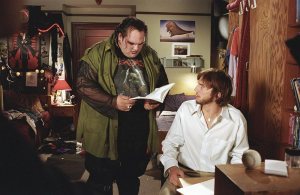 Watching this movie is like watching a checklist of events that producers thought would be dark and grisly and So Messed Up, but this movie is so self-serious that it could be a parody of what a moody teenager would think of as a “mature movie.” Let me just list some of the content the movie covers: the drunken dad next door (Eric Stoltz) is a pedophile who records his daughter and son and Evan in child porn, the kids put a firecracker in a mailbox that blows up killing a mother and her baby, an angry kid kidnaps Evan’s dog and ties him in a bag and literally sets the bag on fire killing the animal, lots of violence against young children including murder, attempted suicide, disturbing behavior in children including traumatic self-harm at school, prison rape, multiple mental asylums, disfigurement and disability, prostitution and addiction, and in the original ending, the one I re-watched, a fetus literally strangling itself with its own umbilical cord rather than being born. Wow. Just… wow. This movie is only two hours and it crams enough sundry melodrama and grimdark grist to fill out a month of the grimiest soap opera ever. Because of the sheer amount of disturbing content, every new provocative addition makes the movie’s tone teeter further and further into unintended self-parody. Once you’re starting to process the homegrown child pornographer, the movie throws animal cruelty at you, and so on. It’s not enough that Evan had a bad childhood of trauma, but does he have to experience all the traumas?
Much of the movie follows Evan’s morose quest to improve the life of his unrequited love, Kayleigh (Amy Smart as the adult version). He runs into her after several years apart and merely bringing up the past with her pedophile father filming the two of them propels her to kill herself off-screen. She’s literally introduced in one scene and then in the next she’s dead, and it’s all Evan’s fault, so says her angry brother via the answering machine clunkily informing us. Evan goes back and stops her dad from molesting her, so now dad only molests her brother Tommy instead, who Evan kills as an adult defending himself. He travels back in time and now her brother is dead and she’s become a heroin-addicted hooker and that won’t do. He travels back again and manages to improve the lives of Kayleigh, Tommy, and their friend Lenny, except in this timeline Lenny and Kayeligh are the romantic couple and Evan has no arms, having lost them in the childhood mailbox explosion. He travels back again and this time Kayleigh gets blown up as a child. Ultimately Evan concludes he cannot save her and have everything he wants, so he makes some form of sacrifice by the end; in the theatrical cut, young Evan upsets her so she chooses to live with her mother rather than her pedophile father, and in the director’s cut, he ensures Kayleigh will never meet him by killing himself in the womb (his mother reveals she’s had multiple miscarriages, leaving the impression other future siblings have done the same). I appreciate how the filmmakers have streamlined their convoluted time travel tale into a simple task of trying to get the girl, but it also becomes so overwrought that I wanted to shake my head and sigh.
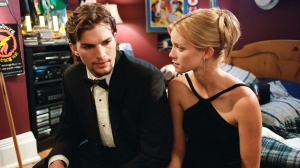 These characters are put through an emotional and often physical grinder, so it’s hard not to feel sorry for them. I long felt the film’s contempt for Kayleigh ever since young Evan (a young Logan Lerman) tells her, “You don’t even know how beautiful you are,” like she’s so stupid to see the obviousness of his compliment. I think dark comedy is the best way to read the movie, laughing along the way as Evan fails time and again to improve the lives of everyone through his space-time interventions. He can save this kid but doom his mother to lung cancer. He can save this person but is locked away in prison. It’s a no-win scenario for Evan, so he decides it’s better if he was never born, negating all the possible good he’s done in his life, including maybe being a force that could keep Kayleight from living with her dad. Maybe not having that friend and an advocate push her into that decision doomed her to a life of molestation, so way to go Evan.
I kind of loathe the time travel method in this movie but at least it provides a limitation that works within the universe of The Butterfly Effect. He can only travel reading his journals, which means he’s stuck in whatever nightmare timeline he’s responsible for unless he can recapture some part of his childhood scribblings. Reading them aloud is also an unexpected source of dark comedy because it makes me question how forthcoming a child of trauma would be about writing down his experiences in simplistic shorthand (“So today Kaleigh wasn’t feeling so good. Her face blew up. I was sad”). I did like that this inherited disorder provides more mystery to his family line, a source of material not covered in either of the Butterfly Effect direct-to-DVD sequels unrelated to Evan’s troubled story. This is perhaps the second worst method of time travel I’ve found in the movies after 1980’s Somewhere in Time where Christopher Reeve uses the power of positive thinking to convince himself he’s in 1912, and lo and behold he shall be.
 Watching this movie is like revisiting a Goth phase you had as a brooding teenager but have since considered a point of embarrassment (not that being Gothic is something to be ashamed of, simply that it was an overzealous step in asserting a misguided sense of what being a mature adult meant, generally disaffected and cynical and edgy for its own attention). The Butterfly Effect is an endless improv game of “yes and” where the proceedings only get worse. My original review in 2004 was one of my more unconventional reviews, and I just wanted to adopt my perception of the “Kutcher brand” persona of the era and make a bunch of dumb jokes, several of which I’m not too ashamed to admit still made me chuckle (“two words: beard.”). I’d lower my grade a tad but there is still a car-crash fascination of watching a movie try so transparently hard to be so twisted.
Re-View Grade: C
Share this:

Dream Scenario (2023)
 Imagine being the most famous person in the world for doing absolutely nothing, where every person can see you every night, each of them feeling like they own a little piece of you. Now imagine that person being a balding, middle-aged father and professor of evolutionary biology, a man so dull that nobody would likely remember him except that he keeps popping up in everyone’s dreams on a nightly basis. The man in question is Paul Matthews (Nicolas Cage), a man so boring that his literal dream is to publish a book on the evolutionary biology of ants. Dream Scenario begins as a sci-fi curiosity and then becomes an intriguing expose on sudden fame as well as the most cogent argument yet on the hazards of a “cancel culture” that too many comedians cling to as an excuse for not being funny. I kept thinking back more and more on the movie, rolling over sequences and choices, as it refused to leave my waking thoughts.
There’s an obvious and easy parallel between what Paul is experiencing and general celebrity, where members of the public have an individual relationship to a person but divorced from the reality of who that person may or may not be, as well as one-sided. These are strangers to Paul but so many feel like they know him, like a neighbor, or a lover, or a threat to someone’s mental stability. It’s an ongoing struggle of rationalizing different perceptions of a person, where so many project what they want onto this smiling bald man who has become a national figure of fascination. Given the premise, I completely understand. I can only fleetingly remember my own dreams maybe once every two weeks, but if a real person, who I’ve never met, continued to make strange cameo appearances, I would definitely investigate further. That’s a genuine mystery that could break through even our jaded media culture. The big question would be why is this happening but the more interesting question is why this guy? What makes him special? I was always engaged with the movie and impressed by the turns the screenplay made, providing insightful glimpses into human nature that felt relatable as well as realistic in response to this phenomenon. Of course there are certain people that view him as some angel, whereas others a devil needing to be stopped, and some an unknown being they’ve projected sexual feelings onto. There’s a very funny and also deeply uncomfortable sequence where a young woman tries to recreate her erotic dream with the real Paul, and of course the real Paul fails to measure up to the fantasy mystique. I was also intrigued by the question of why Paul does not appear in his wife’s dreams. The screenplay by director Kristoffer Borgli is consistently well-developed and full of changes and challenges that had me glued, though I should warn you, dear reader, that you will never be given a concrete reason why the dreams began.
 The first half of the movie is Paul’s ascension, enjoying his notoriety and the new access he has to getting published and achieving his dreams that felt stalled for too long. It’s the positivity of the fame and untapped desire of the general public, with the assorted weirdo from time to time. Then there is a significant turn, and the movie gives a clear theory as to why, and the dreams all of a sudden now become nightmares. Instead of Paul just being in the background of everyone’s dreams, acting as an observer rarely doing much of anything, now he’s become a malevolent force, a stalker, a killer, or worse. Now the general public fears this man and fears going to sleep with the certainty that Paul will be waiting for them to perform any manner of terrors. Paul is placed on sabbatical after his very presence on campus drives students away into hyperventilating. Paul is genuinely pained by this but also painfully annoyed, as he argues he cannot be responsible for the dreams of others and what happens inside every individual subconscious. He hasn’t really done anything in physical reality, and yet he’s kicked out of restaurants, shunned by his colleagues, and his endorsement deals are drying up with the exception of the alt-right.
The premise also allows for plenty of beguiling and funny and creative imagery. Since we’re dealing with a wealth of dreams, this allows the filmmakers a near limitless opportunity to hit whatever themes or oddities they desire under the pretense of retelling a dream. We get the mundane, we get the horrifying, which plays out with some effective jump scares, and we get plenty of surreal moments. This artistic choice allows for an ending that feels ambiguously bittersweet but also tragically fitting and satisfying. It felt exactly how it should have been. It reminded me of Being John Malkovich, and truthfully this movie feels like a lost Charlie Kaufman story. The consumerism satire is also right on target, from Paul’s initial agency meeting trying to get him to endorse Sprite in the dreams of millions, to the application of harnessing people’s dreams to sell products or further one’s social media branding. It feels topical while also a sadly logical extension.
For me, this is the most interesting satirical broadside yet exploring the concept of “cancel culture,” a term often so overblown to the point of being a nonsensical catch-all for consequences. Paul’s sense of grievance is real, but the movie doesn’t present him as a martyr and instead chooses to use this transition, from curiosity to pariah and national nightmare, to better satirize people’s attempts to manipulate their own flailing narratives (see: ukulele apology videos, self-imposed exile for “listening,” late-night Ambien usage, etc.). After Paul has a nightmare of his own, starring himself, he records a manic tear-filled self-pittying apology to appeal to his detractors saying he now too has those “lived experiences” with transparent insincerity, and of course it doesn’t appeal to anyone and he’s even more ridiculed and despised. I enjoy that the movie doesn’t want to dwell in the tragedy or general unfairness of this turn of events with Paul becoming the world’s most hated man. Paul also refuses to accommodate or acknowledge other people’s discomfort, overriding security concerns and repeatedly placing his family and children in uncomfortable if not humiliating positions because dear old dad just refuses to accept mollifying his behavior for their social benefit. Paul was riding high on the ego trips of the unexpected attention and adoration, and occasional starry-eyed groupie, and he’s fighting to regain that same level of credibility and status before he retreats back to being a punchline, an asterisk in history, a trivia answer on a game card.
 Dream Scenario tackles the rise-and-fall of overnight celebrity and sudden fame and adds an intriguing sci-fi spin as well as some arty yet accessible meditation and fun satirical social commentary. It asks us to contemplate the nature of our dreams and how we might behave under this extraordinary scenario, whether as one of the people befuddled by the dreams or the even larger befuddlement of the person appearing in all those millions of dreams. It asks us to reconsider perception, as well as how well others may know us, as well as what we look for with our own dreams. When Paul’s wife (Julianne Nicholson) admits her own fantasy and it involves him wearing an old 80s costume that she found to be surprisingly sexy, he’s a little let down that this is all she has for her dreams, and that to me seems like a fine central theme to ground this movie. It’s easy to go crazy with limitless possibilities, but we often return to what matters most, and that’s often idiosyncratic, personal, and perhaps underwhelming to an outsider who lacks the context and, sorry, lived experiences. Our dreams can help define us but not necessarily as extravagant escapism. It can also be the ordinary, the unusual, the moments and people we just want to revisit a little longer. Now imagine this hijacked, weaponized, and then hacked into ad space, and you have Dream Scenario, a peculiar yet arresting little movie that has lots of intriguing ideas to share.
Nate’s Grade: A-
Share this:

Poor Things (2023)
 Poor Things is going to be a lot to many people. It is a lot, and that’s kind of the larger message because ultimately, for all its peculiarities and perversions, the movie is also an inspiring fable about living one’s life to the fullest and embracing the choices that make us happy and content. It’s a feminist Frankenstein allegory as well as an invitation to see the world with new eyes and a fresh perspective, to embrace the same hunger for a life that defines the journey of Bella Baxter from woman to child to woman again. Under the unique care of director Yorgos Lanthimos and screenwriter Terry McNamara (reuniting after 2018’s triumphant and irreverent The Favourite), Poor Things proves to be an invigorating drama, a hilarious comedy, a stunning visual experience, and one of the year’s finest films.
Bella (Emma Stone) lives a life of solitude with her caregiver, a brilliant but disfigured surgeon named Dr. Godwin Baxter (Willem Defoe), who Bella refers to as “God,” and for good reason. Bella is herself one of the doctor’s experiments. Her body belongs to an adult woman of a different name who killed herself. Her mind belongs to the baby that had lived through its mother’s suicide. “God” resuscitated the body of the mother by giving her the brain of her child. She’s curious and defiant and soon yearns for independence and discovering the outside world. A caddish lawyer, Duncan Wedderburn (Mark Ruffalo), is drawn to Bella and offers to take her on a grand adventure to parts of the world. She agrees, and from there Bella gets an education on the plentiful pleasures and pains and puzzles of being a human being. In many ways, Poor Things serves as a fish-out-of-water fairy tale that invites the audience to question and analyze the Way Things Are. Bella’s childlike perspective allows her to strip away the assumptions of adulthood and the cynicism of disappointment. Everything is new and potentially exciting, but she can also cut through the cultural hang-ups and repressive rules of polite Victorian society. This is expressed perhaps most memorably in her embrace of sexuality and the pursuit of physical pleasure. She’s told not to seek out this pleasure except for very specific settings and situations, and this confounds her. Why aren’t people doing this all the time, she asks after an extensive session of vigorous sexual activity. She is a person incapable of shame during a modest time of conditioned shame. This brashly hedonistic reality might prove too morally demented for many viewers uncomfortable with the premise. In context, it is a grown woman’s body being operated by the mind of a child. We are told that she grows and matures as she accumulates her worldly experiences, but the movie keeps it purposely vague how analogous her brain-age might be and whether that maturation is of a pace with traditional aging. It’s a reverse of 1979’s The Tin Drum, a German movie where a child refuses to grow up once he hears the drudgery of the adult world, and so he remains three years old in appearance but continues maturing intellectually and emotionally. There’s a cliche about looking at the world with a child’s unassuming eyes, and that doesn’t necessarily mean only looking at the things that are safe and appropriate for children.
Bella responds with wonder to the many pleasures of being human, but, sadly, it’s not all puff pastries and orgasms. The world is also filled with horrors and injustices, and Bella’s personal journey of discovery is also one discovering the human capacity for cruelty and selfishness. Some of this is a response to Bella wanting to assert herself and independence, as she very reasonably doesn’t understand why all these men get to tell her what to do or expect that they should. At one point, Duncan literally hurls her books into the sea so that she will not continue educating herself. This extends to later in the movie when Bella looks at prostitution in a Parisian brothel as a means of earning a living. Her same sexual appetites, that were enthusiastically encouraged by Duncan, are now paradoxically looked at by the same man as wicked. Absent riches, Bella is treated as a disposable commodity and she’s trying to make sense of why one version of her receives respect and adoration and another version is looked with disgust. It seems that an essential part of maturation is acknowledging the faults of this world and its entrenched systems of thought, but does giving in to these systems make one more human or merely more cynical? Is it a matter of learning or is it a matter of giving up on changing the status quo? These are many of the questions that the movie inspires as we join Bella on her fantastic journey of self-discovery. This movie would not work nearly as well without the fearless performance from Stone (Cruella). She gives everything of herself for this role and rewires the very movements of her body to better portray such a unique elding of a character at so many crossroads. Her early physicality is gangly like she’s learning how to operate this adult body of hers that appears too ungainly, and her expressions are without restraint, as if she’s peeled back every acting impulse to instead find a purity of perception. There is a transparent and transcendent joy in her performance as well as an ache when Bella discovers the awful shortcomings of this world. Lanthimos movies exist in a different world than ours, a cracked mirror universe of deadpan detachment and casual cruelty, so it requires a commitment to a very specific tone of performance. And yet, the requirements of this role work against that Lanthimos model of acting because Bella cannot be detached from this world. As a result, there is the same matter-of-fact reaction to the world but channeled through an idealistic innocence rather than the sarcastic skepticism that can dominate the director’s oeuvre.
The supporting cast contributes wonderfully. Dafoe (The Lighthouse) is a natural at being a weirdo, but he exhibits a paternal love for his creation that is surprisingly earnest. I laughed every time he went into one of his extended wails when he was disconnecting himself from a machine to handle his bodily gasses. Ruffalo (The Adam Project) is devilishly amusing as he abandons all pretense of likeability to play a deeply manipulative but fascinating louse, a character that is almost as transparent about his desires as Bella. His faux elitism is a constant source of comedy. Kathryn Hunter (The Tragedy of Macbeth) has a memorable and sinister turn as the brothel madame who teaches Bella about the nature of capitalism and socialism. Christopher Abbott (Black Bear) appears late as a privileged man from Bella’s past reappearing with his own demands, and his is the most terrifying portrait in the entire wacky movie, an antagonist that’s all too real and scary in a movie given to such brilliantly quixotic flights of fancy.  Under Lanthimos’ direction, the movie presents the world as an awesome discovery and the lurches into the surreal allow the viewers to see the marvels of existence with the same awe as Bella. The movie feels like it takes place in a science fiction universe of crazy visuals and the avant garde incorporation of past, present, and future. It makes every scene something to behold. This is his most visually decadent film of his career. The musical score by Jerskin Fendrix, a first-time film composer, and it works on a thematic level as trying to discover new kinds of sounds along with the journey of its heroine. However, there are sequences where the music feels like an assault on your ears. While intentional, the detours into abrasive dissonance can make one long for something less experimental and more traditional at least for the sake of your own sensitive eardrums.
Life can be decadent, it can be confusing, it can be ridiculous, it can be heartbreaking, it can be terrifying, but it’s an experience worth savoring and embracing, and this ultimately is the message of Poor Things. Stone is brilliant as she confidently carries us along for every moment of an exploration of what it means to be human, and with an ending that is so fitting and satisfying that I wanted to stand and applaud. For those squeamish from the heavy amounts of sexuality, Poor Things is at its core a very pro-life movie. It’s an inspiration to make you think one minute while making you snort laughing the next. May we all see the world with the voracious hunger and curiosity and boldness of Bella Baxter with her second chance at this one life.
Nate’s Grade: A
Share this:

Aporia (2023)
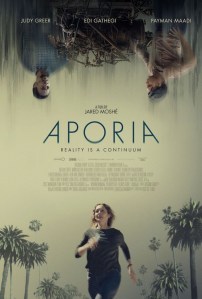
In writer/director Jared Moshe’s low-budget indie film Aporia, the Trolley Debate, killing one person in order to spare the lives of, presumably, more people or a greater number of people, gets its own movie in a thoughtful and provocative little indie. The thorny ethical questions are given their rightful due, and this is where Aporia really shines for me, as a small-scale sci-fi story with Big Ideas bursting forth and the understanding to give them adequate space for satisfying contemplation. It bowled me over.
Sophie (Judy Greer) is still very much not over the death of her husband, Malcolm (Ed Gathegi). He was killed by a drunk driver months ago and that driver also seems to have escaped justice. Sophie is left alone to raise their pre-teen daughter Riley. That’s where Jabir (Payman Maadi) comes in. He was a friend of Malcolm and reveals they had been working on a prototype for a time machine in secret. The machine has its own limits. It sends a photon particle back in time, which will kill any living creature that it materializes inside. All you need are the time, place, and coordinates and you could kill anyone. The further in time you need to go the more power the machine will have to draw. Sophie is beside herself but taken over with the excitement of possibly bringing her husband back to life. All it takes is murder.

What the characters have created is essentially a magic gun that can shoot into the past, which means the only use for this time travel device is to take life. They will only ever be murderers if they decide to use it, and so it becomes a question over under what circumstances would it be permissible to utilize this weapon. The first victim is obvious, the man responsible for the death of Sophie’s husband, and like magic he returns good as new without any memory of ever having been gone. It’s an important rule introduced that only the people in the room with the machine will still have memories of the previous timelines before the space-time revisions. This is a good move for an obvious dramatic one, so that the characters will be able to be impacted by the changes because they can recall a life without them, but it also sneakily supplies another complication. Each one of them has the potential to use the machine alone and thus never having the others realize what they had done. It’s one more tricky ethical question, asking whether you would betray the trust of someone close to you if you could get away with it. Naturally, the characters debate the merits of when to use the machine and when not to, with each new use further complicating matters because the next change can always destabilize the state of things, and then it’s a chain of changes to try and find the right order, and that leaves a trail of bodies littering the past.
It wouldn’t be a compelling time travel narrative without the ole’ favorite of unintended consequences. By removing the drunk driver before he could ever fatefully get behind the wheel, Sophie has brought back her husband and felt like the cost was negligible, as that driver in present-day is an abusive husband who gets drunk and yells at his family while he escapes justice for manslaughter. However, once you start pulling at the knots of the human timeline, some interesting and unexpected results can happen. That same man has been removed but his family isn’t necessarily better off. Kara (Whitney Morgan Cox), the widowed wife, is struggling to make ends meet as a single mom with a daughter (Veda Cienfuegos) suffering from multiple sclerosis (MS). They are deep in medical debt. It seems that the least this man did was help provide a financial cushion. Without his presence, they’ve had to go it alone and they’re broke and likely unable to continue paying the costly medical treatment for this adolescent girl. Because of Sophie’s desire to bring back her husband, she has doomed this innocent victim. Sophie’s guilt causes her to seek out the family, check up on them, and upon the discovery of their hardships, befriend mother and daughter and find a way to make things right as the unknowing perpetrator of their dilemma. From there it becomes a game of thinking how she can erase their misfortune while keeping her own husband.

I will discuss one significant turn because I think it’s an evocative example of the thought-provoking nature of the screenplay, but I will warn you there will be significant spoilers. If you wish to remain pure, dear reader, then skip to the next paragraph. The team comes up with a new name to eliminate to solve the fortunes for Kara and her daughter, a man who swindled her, a Ponzi scam artist who left her penniless and forced to close her bakery. Seems open and shut with an obvious bad person, thus an easy solution. But you should recognize there are no easy solutions in stories untangling timeline interference. All of a sudden, Sophie and Malcolm come home to discover that they have a completely different child. Their teen daughter is now a teenage boy with a different personality and different interests. How? How could eliminating one bad man in a completely different state change the course of history enough that their child has been affected? They debate the possibilities, perhaps something as small as a different sperm winning out or conceiving her on a different day or month, but the results are irrefutable. While their child is alive in this timeline, in a very real sense they have both now lost their daughter. The person they raised together, loved, and helped shape has been eliminated and the grief is palatable. This new child is a stranger, but they too are strangers to this child. They are absent formative memories and do not have the shared connections and history to draw upon. When Sophie tries to comfort this new Riley, she doesn’t know what may work because she doesn’t know anything about this child. I don’t think the filmmakers are making negative commentary on adoption, which is essentially what this scenario mirrors, but the grief goes two ways. They mourn the child blinked from existence, and this child also had his parents blinked from existence and replaced with lookalikes, they just don’t understand it yet. It’s this escalation that personalizes the unintended harm of what they’re doing and sets the stage for the final decision.
The ending is going to divide people but it felt note-perfect for me. It ends on an emotional high of coming to terms with their culpability but also on accepting uncertainty. We end on an ambiguous note, absent a resolution about the final extension of the final decision. I think it works very well not just in trying to have it multiple ways but because after being in the know, it puts the characters, and vicariously the viewer, in a state of vulnerability and the acceptance of staying there. It’s an uplifting conclusion thematically because it’s about accepting loss but also accepting our limitations. The final conversations are inadequate because how can you summarize a life with another person, whether a lover or a friend or a spouse, into just a handful of clumsy words. Our vocabulary does us a disservice when it comes to expressing the glorious debt we feel having had these people in our lives. That is why the movie ends on an emotional high for me and really comes together, personalizing the ethical conundrums.

Greer (Halloween Kills) has had a long career as a supporting actress, usually the funny but supportive best friend to the lead, and as an outstanding voice actress (Archer, Let’s Go Luna), but rarely does she get a meaty dramatic lead role. She’s terrific here and serves as our dramatic anchor through the turbulent changes and moral soul-searching. She is our reflection, and Greer’s emotional journey is well encapsulated in a performance that doesn’t go big into histrionics but is more carefully grounded and natural. I don’t think the movie would work as well, at least on an emotional level, without her.
Is Aporia a perfect film? Well, very few are, and the movie could have even more development, leaving possibilities behind given its tantalizing premise. I’m glad the movie didn’t go overboard into some slapdash thriller territory and instead grounded its science fiction timeline wonkiness into engaging human drama about loss, sacrifice, and acceptance. As my pal Eric Muller said, Aporia likely works better as a screenplay than a finished film, though this discounts the heavy-hearted contributions of Greer. I’m glad this movie emphasized its ideas and provided the time to really dwell in them, even if the movie is only about 90 minutes altogether. Aporia is a deeply engaging movie that worked on all levels for me, enriching emotions and satisfying intellect, and is definitely worth the discovery.
Nate’s Grade: A-
Share this:

Aquaman and the Lost Kingdom (2023)
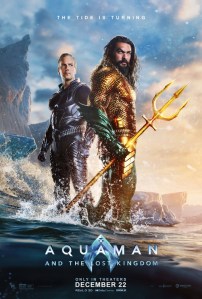 Aquaman and the Lost Kingdom is he last of the Zack Snyder-then-not-Snyder-verse DCU movies, and with that the ten years of mostly middling super hero heroics comes to an end not with a bang but with a whimper. I was a fan of 2018’s original Aquaman thanks to the self-aware craziness and visual decadence from its wily director, James Wan (Malignant). This is still the major appeal of the franchise, a universe that feels pulled from a child’s imagination and recreated in loving splendor on the big screen. The problem with this tone is that it’s a delicate balance between silly fun and silly nonsense. The goofy charm of these movies is still alive and well as they open up an even bigger undersea world of lore (Martin Short as a fish lord!), but this time it feels like a movie that is making it up as it goes, and all that “and this happens next” storytelling begins to feel like a monstrous CGI mess needing to be tamed. This might have something to do with the fact that Wan finished filming the movie over two years ago and it’s endured several re-shoots, including featuring two different Batman actor cameos at different points, to now bring to a close a decade of interconnected movies that are going to be blinked out of larger continuity in 2025 (excluding Margot Robbie’s Harley Quinn, I guess). Lost Kingdom has plenty of enjoyably weird undersea nightmare creatures, a specialty of Wan given his horror roots, but the ultimate villain spends most of his time sitting on a throne in wait and is laughably dismissed so easily in the climax. The whole evil magic trident that corrupts from its evil influence has a very Lord Sauron ring to it. I give the movie points for transforming into a buddy movie between Arthur Curry (Jason Momoa) and his brother Orm (Patrick Wilson) halfway through. The jail break sequence is fun and different, and their bickering dynamic makes for winning comedy. However, the drama feels too overworked, with holdovers from the first film (Black Manta, Amber Heard’s unremarkable love interest) repeating their same beats with robotic dedication. The opening reveal of Arthur being a new dad and it cramping his macho-cool style made he fear we were headed for Shrek 4 territory, where the new dad needs one more adventure to realize the importance of family, etc. Because even when you’re riding a mechanical shark, fighting alongside the crab people, and tunneling through worm prisons, it’s all about recognizing the importance of family, kids (the real undersea treasure after all). I defy anyone not to laugh at the literal concluding speech and its enigmatic “sure, fine, whatever”-energy. As a mere movie, Lost Kingdom is silly escapist entertainment that could enchant a few with lowered expectations, and as the final entry point in a universe of super heroes, it’s a fitting nonsensical end.
Nate’s Grade: C
Share this:

Rebel Moon – Part One: A Child of Fire (2023)
 Creating an original sci-fi/fantasy universe is hard work. It involves bringing to life an entire new universe of characters, worlds, back-stories, rules, conflicts, cultures, and classes. There’s a reason major studios look to scoop already established creative universes rather than build their own from scratch. This is what director Zack Snyder had in mind when he pitched a darker, grittier, more mature Star Wars to Disney, who passed. Over the ensuing decade, Snyder and his collaborators, Shay Hatten and Kurt Johnstad, continued working on their concept, transforming it into an original movie series, resulting in Netflix’s big-budget holiday release, Rebel Moon – Part One: A Child of Fire, a clunky title I will not be retyping in full again. Snyder’s original results of the “darker, grittier Star Wars” are rather underwhelming and don’t make me excited for the concluding second movie being released in April. Why go to the trouble of building your own universe if you don’t want to fill in the details about what makes it important or at least even unique? I can see why Snyder would have preferred Rebel Moon as a Star Wars pitch, because they could attach all the established world-building from George Lucas and his creative collaborators as a quick cheat code.
In another galaxy, the imperial Motherworld is the power in the universe. The king and his family have been assassinated, and in the power struggle that follows, several planets have taken up arms to fight for independence. On a distant moon, Kora (Sofia Boutella) is doing her best to live a nondescript life as a farmer, helping to provide for her community and stay out of trouble. Well trouble comes knockin’ anyway with Admiral Atticus Noble (Ed Skrein) and his fleet looking for resources and powerless villagers to abuse. Kora’s history of violence comes back to her as she fights back against the Motherworld soldiers with cool precision. Her only hope is to gather a team of the most formidable warriors to protect her village from reprisals. Kora and company band together while her mysterious past will come back to haunt her reluctant return to prominence.
 For the first thirty to forty minutes of Rebel Moon, I was nodding along and enjoying it well enough, at least enough to start to wonder if the tsunami of negative reviews had been unfairly harsh, and then the rest of the movie went downhill. One of the major problems of this Part One of a story is that it feels like a movie entirely made up of Act Two plotting. Once our hero sets off on her mission, the movie becomes a broken carousel of meeting the next member of the team, seeing them do something impressive as a fighter, getting some info dump about their mediocre tragic backstory, and then we’re off to the next planet to repeat the process. After the fifth time, when a character says, “Anyone else you know?” I thought that the rest of the movie, and the ensuring Part Two, would be nothing but recruiting members until every character in the galaxy had joined these ragtag revolutionaries, like it was all one elaborate practical joke by Snyder. Some part of me may still be watching Rebel Moon, my eyes glazing over while we add the eight hundred and sixty-sixth person who is strong but also shoots guns real good. Then the movie manufactures an ending that isn’t really an ending, merely a pause point, but without any larger revelations or escalations to further our anticipation for Part Two in four months’ time. What good are these handful of warriors going to be defending a village in a sci-fi universe where the bad guys could just nuke the planet from orbit? Find out in April 2024, folks!
The entire 124-minute enterprise feels not just like an incomplete movie but an incomplete idea. This is because the influences are obvious and copious for Snyder. Rebel Moon starts feeling entirely like Star Wars, but then it very much becomes a space opera version of The Magnificent Seven, itself a remake of Akira Kurosawa’s Seven Samurai. With our humble farmer, our high plains drifter trying to turn their back on an old life of violence, and the recruitment of our noble fighters to ward off the evil bandits coming to harass this small outpost, it’s clearly The Magnificent Seven, except Snyder doesn’t provide us the necessary material to invest in this scrappy team. The characters are all different variations of the same stoic badass archetype, like you took one character mold and simply sliced it into ten little shear pieces. The characters don’t even have the most basic difference you could offer in an action movie, variation in skill and weapons. One lady has laser swords (a.k.a. lens flair makers) but pretty much everyone else is just the same heavy gun fighter. One guy doesn’t even bother to put on a shirt. Some of them are slightly bigger or more slender than others but the whole get-the-gang-together plot only really works if we have interesting characters. If we don’t like the prospective team members, it’s like we’re stuck in an endless job interview with only lousy candidates.
 The fact that Rebel Moon is derivative is not in itself damaging. Science fiction is often the sum of its many earlier influences, including Star Wars. Rebel Moon cannot transcend its many film influences because it fails to reform them into something coherent of its own. There is no internal logic or connection within this new universe. The original world building amounts to a slain royal family, an evil fascist regime, and maybe a magic princess connected to a prophecy of balance, and that’s it. All the flashbacks and expository data dumps fail to create a clearer, larger picture of how this sci-fi universe operates. The inner workings are kept so broad and abstract. We have an imperial evil and assorted good-hearted little guys. The movie begins by introducing a robot clan of knights that are dying out, and even a young Motherworld soldier who seems likely to defect, both opportunities to go into greater character detail and open up this world and its complications. So what does Snyder do? He leaves both behind shortly. Even though we visit a half dozen planets, these alien worlds don’t feel connected, as if Snyder just told concept artists to follow whatever whim they had. They don’t even feel that interesting as places. One of them is desert. One of them has a saloon. One of them is a mining planet. It’s like the worlds have been procedurally generated from a computer for all we learn about them. They’re just glorified painted backdrops that don’t compliment the already shaky world building. They’re too interchangeable for all the impact on the plot and characters and any declining sense of wonder.
Given the open parameters of imagination with inventing your own sci-fi/fantasy universe, I am deeply confused by some of the choices that Snyder makes that visually weigh down this movie in anachronistic acts of self-sabotage. Firstly, the villains are clearly meant to be a one-to-one obvious analog for the Empire in Star Wars, itself an analog for the fascists of World War II, but Lucas decided having them as stand-ins was good enough without literally having them dress in the same style of uniforms as the literal fascists from World War II. You have an interconnected galaxy of future alien cultures and the bad guys dress like they stepped out of The Man in the High Castle. It’s too familiar while being too specific, and the fact that it’s also completely transparent with its iconic source references is yet another failure of imagination and subtext. I just accepted that the Space Nazis were going to look like literal Nazis, but what broke my brain was the costuming of Skrein’s big baddie in the second half of the movie. At some point he changes into a white dress shirt with a long thin black tie and all I could think about was that our space opera villain looks like one of those door-to-door Mormon missionaries (“Hello, have you heard the Good Word of [whatever Snyder is calling The Force in this universe]?”). Every scene with this outfit ripped me out of the movie; it was like someone had photo-shopped a character from a different movie. It certainly didn’t make the devious character of Atticus Noble more threatening or even interesting. I view this entire creative decision as a microcosm for Rebel Moon: a confused fusion of the literal, the derivative, and the dissonant.
 Snyder is still a premiere visual stylist so even at its worst Rebel Moon can still be an arresting watch. He’s one of the best at realizing the awe of selecting the right combination of images, a man who creates living comic book splash pages. I realized midway through Rebel Moon why the action just wasn’t as exciting for me. There’s a decided lack of weight. It’s not just that scenes don’t feel well choreographed or developed to make use of geography, mini-goals, and organic complications, the hallmarks of great action, it’s that too little feels concrete. It feels too phony. I’m not condemning the special effects, which are mostly fine. The action amounts to Character A shoots at Bad Guy and Character B shoots at Other Bad Guy, maybe behind some cover. There’s only one sequence that brings in specifics to its action, with the challenge of defeating a rotating turret gun pinning the team down from escape. That sequence established a specific obstacle and stakes. It worked, and it presented one of the only challenges that wasn’t immediately overcome by our heroes.
The Snyder action signature of slow-mo ramps has long ago entered into self-parody territory (I’m convinced a full hour of his four-hour Justice League cut was slow motion), so its use has to be even more self-aware here, especially in quizzical contexts. There are moments where it accentuates the visceral appeal of the vivid imagery, like a man leaping atop the back of a flying griffin, akin to an 80s metal album cover come to life. Then there are other times that just leave you questioning why Snyder decided to slow things down… for this? One such example is where a spaceship enters the atmosphere in the first twenty minutes, and a character drops their seeds in alarm, and those seeds falling are detailed in loving slow motion. Why show a character’s face to impart an emotion when you can instead see things falling onto the ground so dramatically?
 The actors are given little to do other than strike poses and attitudes, and for that they all do a fine job of making themselves available for stills and posters and trailers. Boutella (The Mummy) is good at being a stoic badass. I just wish there was something memorable for her to do or make use of her athleticism. The best actor in the movie is Skrein (Deadpool) who really relishes being a smarmy villain. He’s not an interesting bad guy but Skrein at least makes him worth watching even when he’s in the most ridiculous outfit and awful Hitler youth haircut. There’s also Jena Malone (Sucker Punch) as a widowed spider-woman creature. So there’s that. Cleopatra Coleman (Dopesick), who plays one half of a revolutionary set of siblings along with Ray Fisher, sounds remarkably like Jennifer Garner. Close your eyes when she’s speaking, dear reader, and test for yourself. I was most interested in Anthony Hopkins as the voice of our malfunctioning android (literally named “Jimmy the Robot”) operating on mysterious programming that hints at something larger in place relating to perhaps the princess being alive. Fun fact: Rebel Moon features both actors who played the role of Daario on Game of Thrones (Skrien and Michiel Husiman).
Even with all the money at Netflix’s mighty disposal, Rebel Moon can’t make up for its paltry imagination and thus feels like an empty enterprise. I’m reminded of 2011’s Sucker Punch, the last time Snyder was left completely to his own devices. I wrote back then, “Expect nothing more than top-of-the-line eye candy. Expect nothing to make sense. Expect nothing to really matter. In fact, go in expecting nothing but a two-hour ogling session, because that’s the aim of the film. Look at all those shiny things and pretty ladies, gentlemen.” That assessment seems fitting for Rebel Moon as well, a movie that can’t be bothered to provide compelling characters, drama, or world-building to invest in over two to four hours, once you consider the approaching Part Two. I wish this movie had a more distinct vision and sense of humor, something akin to Luc Besson’s lively Fifth Element, but fun is not allowed in the Zack Snyder universe, so everything must be grim, because grim means mature, and mature means automatically better, right? Rebel Moon is a space opera where you’ll prefer the void.
Nate’s Grade: C-
Share this:

Godzilla Minus One (2023)
 In his seventy years, Godzilla has been many things, a force representing mankind’s hubris, a protector of the Earth, a father, a weird chicken-like creature that Godzilla 1998 director Roland Emmerich asked his concept artists to make “sexy,” but rarely has the famous giant lizard been genuinely scary, and even rarer still has any of the thirty movies been genuinely serious. The surprisingly affecting Godzilla Minus One achieves both with impressive execution. Set shortly after the end of World War II, the far majority of this monster movie is given to somber human drama, with our protagonist a kamikaze pilot too afraid to give his life senselessly for the cause. Once he returns home, he is treated like a pariah, shamed by his neighbors attempting to literally put the pieces of their lives back together amidst the rubble. He’s riddled with post-traumatic stress and two counts of survivor’s guilt eating away at him. For this man, his war is not over. To make matters even worse, there’s a gigantic lizard terrorizing the seas and heading straight for Tokyo. The second half of the movie follows a very satisfying formula taken from Jaws, with a group of men getting on a boat, working together, and trying to catch their big prize. The ingenuity of their plans makes use of the meager means at their civilian disposal, as the military cannot get involved out of fear of stoking U.S.-Russia aggression in the dawn of the Cold War. The way this character’s arc comes together, at a great moment of heroism that also ties in his relationship with other supporting characters you’ve come to enjoy, is great storytelling. Usually in monster movies the human drama is filler and you can’t wait for those pesky people to get squished to make way for the waves of destructive fun. Not so here, as every scene the characters are in peril has you clenching your fists in fear that Godzilla could triumph. This Godzilla is terrifying and I really enjoyed the sense of scale the filmmakers exhibited, making sure we saw him from a human-sized perspective, and the special effects, while not outstanding, are quite remarkable for its small-scale budget. For Godzilla fans, there might not be enough of the Big Guy for them. I was taken with the emotional journey of these hardscrabble characters fighting for dignity and redemption and to protect their found families, and that was never something I thought would be the major selling point of a Godzilla movie — human emotion. Fear not, the 2024 American release looks to bring back the cheesy nonsense.
Nate’s Grade: B+
Share this:

The Marvels (2023)

No Marvel Cinematic Universe (MCU) movie has had a bigger trail of negative buzz than The Marvels, the supposed sequel to not just 2019’s Captain Marvel but also an extension of two Marvel television series from the Disney streaming service. The film has had its release delayed three times, rumors abound that heavy portions were re-shot, and its own director, Nia DeCosta (2021’s Candyman), had already moved on to starting her next project while her last movie was still being finished in post-production (to her defense, the movie was delayed three times). The opening weekend wasn’t kind, setting an all-time low for the MCU, and the critical and fan reception was rather dismal, with many calling the movie proof that Marvel was in trouble. There is a lot going against this movie, and yet when I actually sat and watched The Marvels, I found it a flawed but fun B-movie that doesn’t deserve its intense pile-on. Although, caution dear reader, as I’m also one of the seemingly few critics who enjoyed Black Widow and most of Eternals as well.
Carol Danvers a.k.a. Captain Marvel (Brie Larson) has been absent for most of the past 30 years, trying to do right by the universe’s many alien civilizations in need. The people of Earth also feel a little left behind, notably Monica Lambeau (Teyonah Parris), who knew Carol as a child in the 1990s and is now acclimating to her own light-based superpowers (see: WandaVision). A power-hungry Kree warrior, Dar-Benn (Zawe Ashton, Tom Hiddelston’s wife in real life), is seeking a way to restore a home world for her people. She finds one super-powerful weapon, a bangle she wears on her arm that opens interstellar portals. The other bangle happens to belong to a New Jersey teenager, Kamala Khan (Iman Vellani), a first generation Pakistani-American who also moonlights as the bangled-powered hero, Ms. Marvel (see: Ms. Marvel). Through strange circumstances, Kamala, Monica, and Carol are all linked by their powers, so if one of them uses said powers they happen to swap places in space, teleporting from three different points. It makes it really hard when you’re supposed to save the day and work together to defeat the bad guy.

The core dynamic of the movie is this trio of powerful women learning to work together, and while that might sound trite for the thirty-third movie in a colossal franchise, it’s a serviceable arc for a movie that only runs 100 minutes, the shortest in MCU history. The swift running time is both a help and a hindrance, but it allows the film not to overstay its welcome while juggling three lead characters and multiple space-time-hopping action set pieces. I wish Marvel could return to an era of telling smaller stories that don’t have to feel so grandiose, with personal stakes tied more to their characters than saving the planet yet again (2017’s Spider-Man: Homecoming is a great example). Even though this too falls into the trap of world-destroying-energy-hole, it still feels lighter and breezier, and I think that is a result of its pacing and lowered ambitions. That’s not an insult to the filmmakers, more a recognition that The Marvels doesn’t have to compete with the likes of Endgame or the Guardians for emotional stakes. It can just be fun, and simply being a fun and well-paced action movie is fine. That’s what the MCU diet can use more of, especially considering the Ant-Man movies have transformed from palate cleansers to same-old bombast.
On the flip side, the speedy running time is also a very real indication of its troubled production and the attempt to salvage multiple versions into one acceptable blockbuster. There are signs of heavy editing and re-shoots throughout, from lots of ADR dialogue hiding actors visibly mouthing these patchwork lines, to world-building problems and solutions that can seem hazy. The rationale for why these three women become linked is so contrived that even Nick Fury (Samuel L. Jackson) bemoans Carol not to touch a strange unknown space light because it’s shiny. The concept of the three heroes being linked by their powers offers plenty of fun moments, of which I’ll go into more detail soon, but the execution left me questioning. Which superpower use qualified and which did not? It seems a little arbitrary which powers using light trigger the switcheroo. I don’t think the movie even knows. There’s also a late solution that feels so obvious that characters could have been like, “Oh yeah, we could have tried that this whole time.” A reasonable excuse was right within reach, blaming the inability to attempt the solution on not having sufficient power before assembling both of the bangle MacGuffins. It also, curiously, allows the villain to win in spite of her vengeful indiscriminate killing, but don’t think too much about that or its possible real-world parallels as that will only make you feel dramatically uncomfortable.

There are remnants of what must have been a fuller movie of Marvels’ past, as each character has an intriguing element that goes relatively under-developed. Monica was gone thanks to Thanos while her mother died and is also trying to square her feelings of resentment for Carol, a woman she felt so close to as a child who flew away and didn’t return for decades. So we have attachment issues and issues of closure. Carol is likewise trying to rebuild her relationship with this little girl she let down, and she has to also consider the unintended consequences of being a superhero. The Kree worlds refer to Carol as “The Annihilator,” a powerful being that doomed their civilization. She’s become a culture’s nightmare. That re-framing of heroism and perspective, as well as the larger collateral damage of the innocents from defeating villains makes for an interesting psychological stew of guilt and doubt and moral indecision. Then there’s Kamala, who worships Captain Marvel as her personal hero and wants nothing more than to join the ranks of superheroes. Her rosy version of the duties of being a hero could be seriously challenged by the harsher reality, like when Carol has to determine that saving “some lives” is more important than losing all life to save more. She could become disillusioned with her heroes and re-examine her concepts of right and wrong. And there are elements of all these storylines with our trio but they’re only shading at best. There’s just not enough time to delve into this drama when the movie needs to keep moving.
However, the fun of the body-swapping concept leads to some of the more enjoyable and creative action sequences in the MCU. DeCosta really taps into the fun comedy but also the ingenuity of characters jumping places rapidly. It begins in a disorienting and goofy way, as characters jump in and out of different fights and have to adapt. It makes for a fun sequence where at any moment the action can be shaken up, as well as forcing there to be enough action going on for three people. This also leads to some interesting dangers, as Kamala gets zapped high above her neighborhood and plummets to the ground, as these are the dangers when your two other linked superheroes can fly. The use of the powers into the action feels well thought through, and the combination of the women working together and strategizing when and where to swap places makes for creatively satisfying resolutions. The action sequences are also very clearly staged and edited without the use of jarring and confusing edits. You can clearly see what is happening and what is important, and the choreography is imaginatively spry.

There are some asides to this movie that had me smiling and laughing and just plain happy. The Marvels visit a planet where the only way to communicate with the locals is through song, and it starts out like a big old school Hollywood musical with some Bollywood flourishes. I wish the movie had done even more with this wonderfully goofy rule, possibly even setting a fight sequence that also plays into the musical quality of the weird setting. Oh well, but it was pure fun and forced the characters outside of a comfort zone (though this too had some hazy rules application). There’s also a montage involving alien cats and a life-saving and space-saving solution that had me giggling like crazy (my extra appreciation for the ironic use of “Memory”). It’s because of these sequences, the delightful exuberance of Vellani, and the above-average action sequences that make it impossible for me to dismiss the movie as a waste.
The Marvels has problems, sure, with its lackluster villain, some hazy rule-setting and application, not to mention an overstuffed plot that feels a bit jumbled from the likes of twenty other stories trying to appear as one semi-unified whole. But it’s also fun, light, and entertaining in its best moments, and even the good moments outweigh the bad in my view. I would gladly re-watch this movie over the likes of Multiverse of Madness, Love and Thunder, and Quantumania. While it can seem initially overwhelming to approach, the movie does a workable job to catch up its audience on who the other Marvels happen to be just in case you didn’t watch 17 episodes of two different TV shows. It’s mid-tier Marvel but refreshingly comfortable as such, only aiming for popcorn antics and goofy humor with some colorful visuals. It all feels like a special event from a Saturday morning cartoon, which again might be faint praise to many. Blame it on my lowered expectations, blame it on my superhero fandom, or simply call me a contrarian lashing out against what seems a very ugly strain of vitriol for this movie to fail, but I found The Marvels to be a perfectly enjoyable 100 minutes of super team-up tomfoolery.
Nate’s Grade: B-


 nathanzoebl
You must be logged in to post a comment.