Blog Archives
Oblivion (2013)
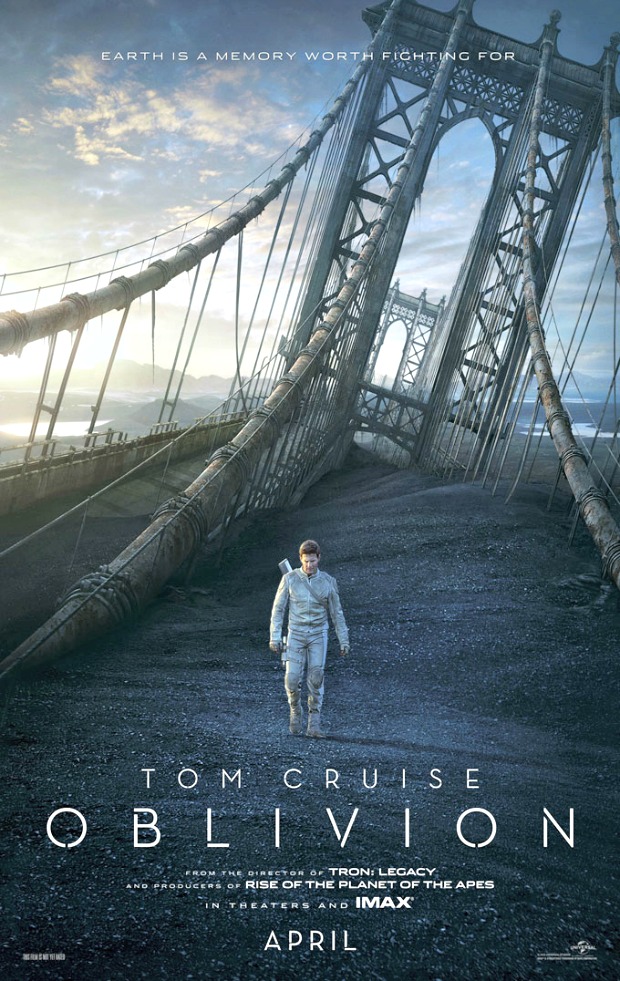 It’s late in the twenty-first century, decades after humanity battled an alien species in a war for the planet, and while humanity won the war Earth is desolate. The moon destroyed. The remaining members of humanity live on a starship around Saturn’s moon, Titan, and the oceans of Earth provide the energy resource. Jack (Tom Cruise) and Victoria (Andrea Riseborough) are the team stationed with repairing drones, the flying machines that protect the energy plants. There are still pockets of alien scavengers that need to be dealt with. Jack and Victoria make a great team, and dip into romantic companionship, until Jack meets a mysterious woman (Olga Kurylenko) professing to be his wife. Jack begins to doubt the purpose of his mission and wonder if the alien scavengers are the enemy.
If you’ve been keeping up with sci-fi cinema in the last couple decades, you’ll likely recognize more than a few elements with Oblivion. From its themes to its plot points to its revelations, there’s little here to designate as original. So the real question remains how derivative can we take? I think when the execution is nimble then it’s one of the easiest sins to remember. Especially in the realm of sci-fi cinema, it’s hard to put together a new story, let alone one set up as a Hollywood star vehicle, without borrowing from other established movies. This in itself is not an issue. Tarantino is a master borrower but he always recontextualizes his artistic influences into something new and different, and while we critics lament his less original career path of late, the man’s box-office profits have never been better in his career. I think when we feel like we’re getting a good story we don’t care when that story has been told before in other manners. Star Wars, after all, has many cultural fathers, but it was a rollicking good time with characters we cared about, so nobody seemed to mind. Likewise, Oblivion has many forbearers from Independence Day to I Am Legend to 2001 to an indie film from a few years ago I shall refrain from mentioning because even the very mention will spoil key plot points. Some will decry the film as a rip-off of superior, headier fare, but I never minded. I was having too good of a time and found the movie too satisfying to quibble.
 I won’t say the movie is smart per se but it’s far more measured than I would have expected. The advertising makes it look like Cruise fights a bunch of aliens and robots, and while there is that aspect, it’s almost an afterthought to a slow-burning mystery that patiently parcels out its revelations, even to the very end of the film. I’m trying to be cagey about certain plot points to avoid spoilers. It’s a film that has more on its mind than explosions, but when it goes into explosion mode, director Joseph Kosinski (TRON: Legacy) makes it count. The larger action elements are well staged and polished with some above average special effects. The sight of the moon dashed across the sky is definitely an evocative image. I love the overall look of the film, Kosinki’s clean, spare, bubbly Apple-esque aesthetics. The drones themselves manage to have personality even with a limited, streamlined design and some choice sound design. The man knows how to hold onto an image and when to keep pushing. The action is suitably thrilling and the drama suitably suspenseful. Actually, better than suitably. I enjoyed the details of this world. It’s probably the spiffiest post-apocalyptic landscape you’ll ever see. This is an entertaining movie that finds nice ways to satisfy, and given the particulars of its sci-fi plot, finds a way to have its cake and eat it too. As a result, Oblivion is a sci-fi flick that offers enough to engage the mind and audience demands for big effects and big thrills.
 I’ve never been a Cruise hater. I even thought the man tried his damndest to make a movie like Rock of Ages worth watching (a valiant effort but not enough). His character is pretty affable at first and we get to watch as everything he knows comes undone. It’s a role that would lead to overacting, but Cruise underplays the part, more alarmed naïf than flinty action hero. I’m not expecting Oscar-caliber performances in every role but Cruise does a fine job of anchoring the audience and selling his character’s journey. He also has good chemistry with not one but two ladies. Kurylenko (Seven Psychopaths, To the Wonder) is an actress of great beauty and questionable talent, but perhaps being paired up with a genuine star like Cruise brings out the best in her. They’re good together, though my preference was for Riseborough (W.E., Never Let Me Go), an actress who brings a tremulous vulnerability to an otherwise underwritten and confused character that’s more a plot device. Riseborough makes the character so much more than she is on the page. She’s still a relatively new actress so I look forward to her future performances. There are other familiar faces, like Morgan Freeman and an especially unsettling Melissa Leo, but it’s really a three-person acting exercise.
Oblivion is a visually alluring sci-fi thriller that also manages to have enough heart and smarts to leave a satisfying impression. The pacing is more deliberate but offers plenty rewards, doling out revelations up until the end, unpacking its mystery with finesse. The first twenty minutes or so, establishing the particulars of this world and the routine of our protagonists, is downright exceptional. The rest of the film doesn’t quite live up to that start but it continues to be an engaging and entertaining movie with some top-notch visuals. The musical score by electronic band M83 also provides a stirring counterpoint to the glossy, clean visuals (the band’s song “Outro” was also very effectively used in that lovely five-minute trailer for Cloud Atlas). You may figure things out as you watch, but you won’t mind, at least I didn’t. The more I step away the more I think back with renewed enthusiasm for the film. It’s smarter, slicker, and just a more satisfying film than we’re accustomed to with this kind of budget and from Hollywood.
Nate’s Grade: B
Share this:

The Host (2013)
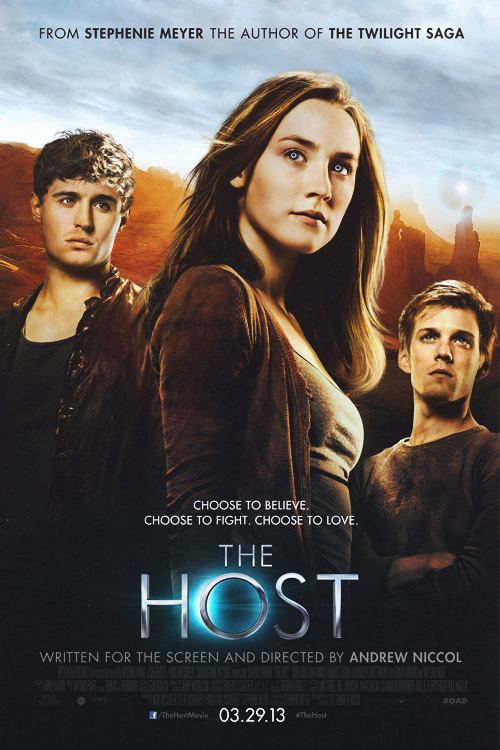 It’s impossible for me to ever separate The Host, a sci-fi would-be romance based upon the best-seller by dubious author Stephenie Meyer, and the demise of famous film critic, and personal influence, Roger Ebert. On April 4, 2013, America’s most prominent film critic, a man who with Gene Siskel changed the face of film criticism and the dialogue with movies, died after his cancer had returned. Upon hearing the news, I was overcome with grief and shed a few tears for the loss of a great writer and a great man who influenced a generation of online film critics like myself. Then I saw what was Ebert’s last published film review — The Host. Knowing his last review on this Earth is this awful movie, that it may be the last new release he ever saw, well it just feels ignoble. The man deserved better and so does anyone else who watches The Host, a movie I saw the very day of Ebert’s death.
Set on earth years after an invading alien race has already conquered, life isn’t too bad. There aren’t any wars or pollution or hunger. The aliens, looking like little glowworms, latch onto the spines of humans and use them as hosts. They control the bodies of the humans but some of us won’t go down willingly. Melanie (Saoirse Ronan) is an 18-year-old gal who fights as part of a resistance movement, led by her Uncle Jeb (William Hurt). The aliens abduct her and Melanie’s body gets a new owner – Wanderer, also referred to as Wanda. Good old Melanie is still in her head, feisty, and goading Wanda into finding Melanie’s family hiding out in the desert with Jeb. Also there is Melanie’s boyfriend, Jared (Max Irons), who is upset that his girlfriend has become “one of them.” Ian (Jake Abel), on the other hand, is adjusting well to the change, as he falls for Wanda and she him. In between these hormonal complications, Wanda is being chased by the appropriately named Seeker (Diane Kruger), who is deadest on bringing some human-style violence to Wanda/Melanie and the resistance fighters.
 The Host, like much of Meyer’s more popular Twilight saga, is a rather dramatically inert story that just seems to exist with little sense of momentum or direction or purpose, beyond providing another bloodless onscreen romance that ceaselessly finds unsettling messages to convey to young girls. Once again it all comes down to a stifling romantic triangle where none of the participants ever seems to work up the necessary passion to garner continual interest. There’s a bit more heavy petting going on but even when these people are having sex dreams, they imagine Melanie with her bra on (such a limited imagination). Please don’t confuse this as some implicit regret on my part that the movie didn’t sexualize its lead heroine (she’ll be turning 19 soon, so fear not pervs). At least the Twilight movies can be seen through the prism of pre-teen wish fulfillment. The Host, on the other hand, is just an Invasion of the Body Snatchers-style sci-fi movie where no one seems that preoccupied with anything too urgent. If the aliens are really that gung-ho to root out the resistance fighters, why aren’t they looking for heat signatures? Why aren’t they studying truck movements? The fighters aren’t very stealth-like in their comings and goings either. Hell, why don’t they even just keep a lookout for people wearing sunglasses, an obvious sign they have something to hide. It’s like the aliens and the humans are simply just going about their business without any danger. That’s because the ultimate fulcrum with which all the plot hinges upon is the romantic whims of a teen girl teaching an alien how to love. Sigh.
The least successful adaptation is likely including Melanie in the action through the use of bratty voiceover. She likes to chime in with snide remarks and pushes Wanda away when she starts getting feelings of her own for another boy. It is simply unbearable. You ever been stuck in the car with a really annoying brat? That’s what it felt like. Now I realize that having the dueling voices was an easier prospect on the printed page, but a similar challenge was tackled with 2003’s Dreamcatcher when an alien possessed Damien Lewis. We had a visual representation of Lewis taking refuge inside his own head. That was better than watching him, and it pains me even now to type it, engage in an argument with himself where the voice of the alien adopts a British accent. Maybe we could have had a better visual representation of Melanie inside Wanda, or maybe something with mirrors, that’s always a good go-to visual for characters of dueling minds. As developed, The Host feels like Melanie’s strapped in next to you, providing incessant and annoying commentary, and all you want to do is tell the kid to shut up.
Given the world-conquering plot elements, I can’t help but think Meyer found one of the least interesting stories to tell within this world. The invasion aspect seems far more compelling a story to tell than one girl stuck in a love triangle. I suppose it’s because Meyer is bringing a different perspective to science fiction, but I found most of this movie to be unbearably boring. And her premise, while flawed, could have been workable. Learning to live a symbiotic relationship with an alien that controls your physical being, there’s plenty of room there to tell an interesting and insightful story. The issues of identity and control could be richly explored. Instead, we get Melanie liking one boy and Wanda liking another, and so Melanie fights from inside to stop Wanda from acting out her exciting new feelings. Given the scope of everything going on, alien invaders and underground resistance organizations, it all feels so slight and myopic and overindulged melodrama. I suppose the whole thing could be a metaphor for puberty, a teen girl whose body is taken over by an alien presence, causing her to act irrationally and deal with swoons of affection she doesn’t know how to properly handle, causing her to act out and alter her perceptions of herself. Then again, I may just be giving Meyer and the movie more credit than they deserve.
The saddest part for me was that Andrew Niccol directed this movie as well as adapted the screenplay. He is responsible for these characters, these plot beats, these samples of dialogue. This is the man who gave us The Truman Show, Gattaca, and Lord of War. Granted, Niccol’s last movie, 2011’s In Time was a great idea in need of a far better script, but I always have high hopes with this man given his track record. From a visual standpoint, he takes a few pages from Gattaca where everything in the world is sleek and shiny and looking like an orgasmic car commercial. The shimmering cinematography by Roberto Schaefer (Marc Forster’s longtime DP) is crisp with plenty of cool colors to signify the mood of our pleasant overlords. There are plenty of nice things to look at, and female fans will likely extend that compliment to the young men duking it out for Melanie/Wanda’s affections. It’s just that everything moves so glacially, so stubbornly slow, that the movie feels like it’s run out of gas long before it’s over. At over two hours, there desperately needed to be some judicious chopping with this movie’s flabby midsection. If you’re not a fan of Meyer’s book, Niccol fails to give you any tangible reason why you should care or keep watching. I even thought about leaving at one point, and that’s an urge I can usually quell, so that’s how monotonous it truly got.
 It’s nice to see Ronan (Hanna) growing into the capable leading lady we all thought she could be, though this movie does her no favors (gone is the gangly awkwardness of The Lovely Bones). I understand that for the majority of the movie she’s playing Wanda, the alien controlling the body of Melanie. There are going to be certain limitations to this portrayal, but Ronan just sounds overly sedated for most of the movie. Then there’s her annoying voiceover, which dips into a Southern accent at several intervals. I guess when Mel gets mad it brings out her roots? Likewise with Meyer’s heroine du jour, Bella Swan, I just don’t see what all the fuss is about over this character. She’s a pretty plain heroine with courageous whims but it’s another example of a film where the supporting characters have to key us in on character traits we just aren’t picking up on our own.
I’m always puzzled when filmmakers decide to make their aliens so, well, alien. Independent evolution in a different star system is going to develop some funky designs, sure, but when you got magical glowworms as your sentient life, I find it hard to believe that they built all that super duper technology to achieve their world-domination. A glowworm made a spaceship? With its glowworm tentacles and its size of about three inches? At least the aliens on Star Trek looked like they knew there way around auto shop. For that matter, we’re in the future where everybody drives a crazy shiny vehicle no matter how off road it gets, but the stupid alien occupiers can’t master the tricky science of contact lenses? And this goes for the human rebels as well. The telltale sign you’re controlled by the aliens or not is the translucent blue ring around your iris, but why hasn’t either side just popped in some contacts to blend in? The aliens can master space travel but get squeamish about things touching their eyes?
The Host is another of Meyer’s poorly plotted, insipid melodrama that manages to be all about teen hormones except those hormones feels so hermetically sealed off. It’s another neutered romance, and this was supposed to be her so-called “adult book”? It’s the same themes and tropes from her non-adult Twilight series, just with a coating of sci-fi rather than supernatural. Even Niccol, admittedly in a bit of a slump, can’t save this picture, and ultimately the overly long, lightly plotted, and tremendously tedious affair lumbers to its predictable conclusion, replete with happy ending (let’s just say that Ian gets a hotness upgrade as far as his lover). The concept of an alien species stripping human beings of free will and living not just amongst us but within us, that’s a solid idea that could make for a compelling story. Meyer found the dumbest story to tell, her bread and butter, a love triangle where both guys have struck her at some point in the film (dwell on that). It pains me that The Host may have been Roger Ebert’s last movie. As far as I’m concerned, this movie murdered Ebert.
Nate’s Grade: D
Share this:

The Watch (2012)
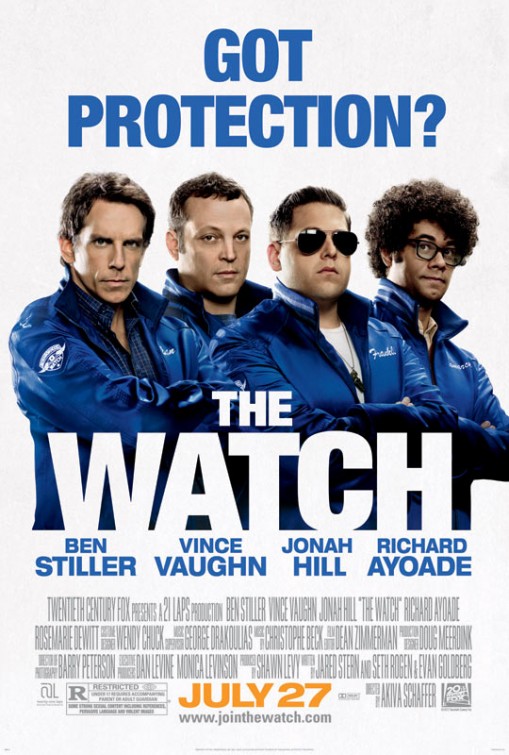 If scientists could take time away from, you know, curing diseases, and craft the perfect blend of “meh” in a lab, it would be The Watch. It’s not particularly offensive or terrible but it’s certainly not good. The humor of boys misbehaving and talking tough doesn’t ever seem to get further than the initial concept. The movie ends up becoming a more crass version of Ghostbusters, with a special fascination for the male member. This is a very penis-obsessive movie. Usually guy-centric sex raunchy comedies will definitely feature strong discussion/comedy revolving around male genitalia, but this is one of the few movies where complete storylines hinge upon penises (weird imagery, I’ll admit). Ben Stiller, Vince Vaughn, and Jonah Hill are more annoying than anything else. Poor Rosemarie DeWitt as the underwritten wife role in what is essentially a boys-behaving-badly movie (also her second 2012 movie where she’s trying to get pregnant). When the movie goes full-force into action mode, it loses just about any semblance of comedy. I laughed about three times, and that was thanks to Richard Ayoade (TV’s The IT Crowd) and, believe it or not, Will Forte (MacGruber). Sitting through 105 minutes with little laughs, irritating characters, and poorly conceived action in place of genuine comedic payoffs, well it’s not exactly a recipe for a successful summer comedy. And yet, with all its obvious faults, I couldn’t hate the movie as others have. It’s certainly not likeable but it does go about its business with a certain swagger, albeit misguided. Cocky loudmouths failing at entertainment are still marginally better than artists who don’t even try. It sounds like I’m reaching, and I am, but The Watch, certainly a bad comedy, may eventually be worth a watch when, you know, it’s on TV and you can half-heartedly pay attention to it while you go about your day.
Nate’s Grade: C-
Share this:

Cloud Atlas (2012)
 Most people regarded David Mitchell’s 2004 sprawling novel Cloud Atlas was unfilmable. It has six different stories each set in a different time period, slotted into a different genre, and each a variation on storytelling. Mitchell’s tome was structured like a series of nesting dolls, each narrative pulling back to reveal a character reading the previous manuscript, and eventually the direction was reversed. We go from the mid-nineteenth century to post-apocalyptic and back again. I read the book over the summer and found it to be enthralling, especially because each storyline was written so distinctively in a different writing style. The post-apocalyptic linguistics definitely took some getting used to. How could you turn this unwieldy book into a workable movie?
The Wachowski siblings, Andy and Lana, teamed up with German director Tom Tyker (Run Lola Run) to try and find a way. They decided to split up the stories into a musical syncopation, with stories blending into one another. As a result, Cloud Atlas is six different movies for the price of one but it’s far more than the sum of its parts. Cloud Atlas coalesces, bleeds, and bends, becoming a Mobius strip of causality and courage and love. The trio of directors, who shot simultaneously with two separate film crews, has done the impossible and translated Mitchell’s brilliant novel into a soaring, compelling, and multifaceted epic on hope and humanism.
Where to begin with this one? Well, in 1849, Adam Ewing (Jim Sturgess) is traveling across the Pacific back to his home in San Francisco. He’s fallen ill on the ship and keeping the secret of a stowaway in his chamber, a Moriori slave named Autua (David Gyasi). In 1931, Robert Frobisher (Ben Whishaw) is a penniless gay musician looking for refuge. He offers his services to the aged but still famed composer, Vyvian Ayers (Jim Broadbent). Ayers will dictate and Frobisher will assist in writing. In 1971, Luisa Rey (Halle Berry) is a reporter investigating a series of murders tied to a nuclear facility and a report the head honcho (Hugh Grant) doesn’t want exposed. In 2012, Timothy Cavendish (Broadbent) is a small-time publisher who mistakenly checks himself into a nursing home that won’t allow him to leave. In 2140, a new working class is grown from the lab. Somni 451 (Doona Bae) is one of these fabricants. With the help of a revolutionary (Sturgess), she escapes her confines and learns the horrors of the totalitarian world and becomes part of the rebellion. And 100 winters after “The Fall,” mankind has descended into agrarian tribes. Zachry (Hanks) is a goat herder who reluctantly agrees to take Meronym (Berry) to a hallowed mountain. Meronym belongs to the last group of technology-abled civilization, the Prescients, and Zachry mistrusts her and is tempted to kill her to protect his people. Just describing this stuff is tiring and could take up two reviews.
 This is going to be a very divisive movie, this much I can tell. It’s so powerfully earnest that you either embrace its mushiness and ambitions or you smirk and mock its New Age philosophy and optimism. There will be no middle ground with this film. We’re talking about transmigrating souls over the course of 500 years, Tom Hanks as a post-apocalyptic goat herder, and an evil presence known as Old Georgie, who looks like the forgotten cousin to the Wicked Witch of the West. There is some stuff in this movie that is plenty goofy, especially when seen on the surface. It takes a while to ease into the film, adjust to its tempo and accept the context of those goofy elements. But once that’s established then it feels like you can handle anything. There’s such an overflowing of feeling in this movie that it’s easy to make fun of it, to dismiss it under the safety of ironic detachment. It would be easy to decry the Cloud Atlas team for being self-indulgent or pretentious. What they are doing is far from normal, but the achievement of Cloud Atlas is the graceful way it finds to connect the rhythms of a deeply felt humanity. It has its stirring moments and memorable scenes, but when compacted and collected into a beautiful whole, that’s where the movie transcends. When an authoritative character barks, “You are but a drop in an ocean,” and our hero responds, “What is an ocean but a series of drops?” you either roll your eyes or you cheer. This is an earnest movie that wears its humanism on its sleeve. You either roll with that or you don’t, and I decided to embrace the big, messy, mushiness of the whole project and was swept away.
For a three-hour movie, the time flew by, and by the end I knew I had to see Cloud Atlas again. The first viewing requires much in the way of processing. You’re stringing together the disparate strands of the narrative, you’re listening hard to decipher the post-apocalyptic tongue of Zachry and company, and then you’re also keeping track of what actors are playing what characters, crossing lines of race and gender. The disguised actor factor is something of a fun ”who’s who” party game throughout the movie; initially distracting and somewhat questionable (especially the cross-racial makeup). I think seeing Cloud Atlas a second time will allow me to immerse myself further, finding new depths and connections. The pacing is surprisingly swift for a three-hour movie. You barely notice the time is gone, and honestly I could have done with even more movie, especially during the Neo Seoul segment. Given the six segments, some stories are going to be more compelling than others. I don’t think too many people are going to be as compelled with Frobisher’s creative sessions as they are Somni’s escape from enslavement. Initially, you’ll be scratching your head what they all have in common, and the lighthearted segments seem to clash with the more severe segments of systemic abuses. But then the big picture starts to eventually emerge and you see the parallel themes of oppression, bondage, rebellion, sacrifice, abolition and the yearning for freedom at all costs. The filmmakers find clever ways to thematically link their different tales. The movie starts to become a musical experience, much like Frobisher’s central melody, the overlapping notes of repetition and the swelling movements of human life in minor and major.
 As anyone who endured the Matrix sequels will attest, the Wachoswkis are film theologians and Cloud Atlas is unabashedly spiritual. The filmmakers openly favor examining the spiritual side of Mitchell’s novel rather than the political. I found the results to be intriguing but short of profound. From a philosophical/theological standpoint, Cloud Atlas is not breaking new ground or even going into great depth. We’ve got some basic Eastern notions like reincarnation and trying to improve upon one’s soul through various lifetimes. There’s also the notion that death is just a transitional phase and not the end. The film is also very interested in the transcendentalist interconnections of human history. “With each crime and each act of kindness, we give way to our future,” says Somni at one point. I like this; it’s essentially karma in its purest form but it also denotes that every choice gives ways to multitudes of possible futures (perhaps pedestrian but I still like it). I feel that human kindness is long-reaching and casts out many ripples, and Cloud Atlas is a film all about the ripples, seeing the long-reaching effects to causes, and discovering that individuals can become movements and movements can become inspiration. I also like the relatable debate over religious belief in the far-flung future; the Valley people worship Somni as their gracious Goddess, but the more advanced Prescients view her as a person, noble and with strong and important ideas but flesh and blood. And yet the film doesn’t look down on Zachry and his people for their beliefs; Somni inspires them to do good. Do the details matter when the results are positive? Cloud Atlas has plenty of intriguing questions roiling around, moments of pause worthy of post-screening debate. It’s not too deep but it’s far from shallow (the Wachoswkis love their Christ-like imagery, don’t they?).
From a filmmaking craft standpoint, Cloud Atlas is often breathtaking. In some respects it feels like something radically new, a $100 million dollar art film. The visuals are wonderful and the different time periods all come across handsomely mounted, perfectly realized, the details vivid and period appropriate. The future worlds are easily the most engrossing just because of how different they are. You’re never spoon-fed the answers in this movie, so we’re left to put together what lead to each future. I would have loved to have gotten even more details about Somni’s world, a time where democracy has been replaced by “corpocracy,” a world run by corporations. The ambitious story structure of Cloud Atlas could have easily become confusing, but the filmmakers smartly give each segment its own little undivided period to set up that world and its unique tone. They even provide date stamps. Then things get more spliced together, the different storylines cascading and braided together. Some of the storylines have to wrap up early and others are saved for heartbreaking finales of tragic resonance. The elliptical romances spanning centuries provide nice counterpoints and satisfying out-of-time conclusions for storylines that don’t always end cheerful. The movie is often thrilling, intellectually stimulating, disturbing, and poignant, though to be fair it comes up short when it comes to emotional involvement. Like the stunted depth of its philosophy, the movie has a way of drawing you in but never fully; it’s all about a wealth of human feelings and the nature of humanity yet it quixotically comes up short emotionally.
With up to six roles to play, the actors are given plenty to work with. It would be redundant to say you’ve never seen many of these actors like they are in Cloud Atlas (has anyone ever seen Berry in whiteface?). Every actor gets to play heroes and villains, saints and sinners. Only Weaving (The Matrix) and Grant (The Pirates! Band of Misfits) play antagonists in just about every story, and when you have Weaving at your disposal you have to give the man a role with menace. Grant gets to play a post-apocalyptic marauding cannibal. You won’t see him eat anybody’s face in one of those Bridget Jones movies. Like the filmmakers, the actors display full commitment to their varied roles no matter how silly some of the future diction may sound (“for true-true”). Hanks instantly anchors your empathy as Zachry and grounds a storyline that has the biggest danger of slipping into silliness. Readers will know I’m not the biggest Berry fan, and that is probably being charitable. However, I was truly impressed with her work in Cloud Atlas and would easily classify this as her best work since her Oscar-winning turn in Monster’s Ball. Her portrayal of Luisa Rey has such fire and her Meronym has such melancholy. Broadbent (The Iron Lady) is still highly enjoyable as a pompous sort, I’m always happy to see Keith David, and Weaving is delightful in his venomous villains, as a devil, a hit man, and most vividly as the Nurse Ratchet-style sadistic head nurse antagonizing Cavendish. The real breakaway star is Bae (The Host), who also benefits by having the most involving storyline. Her gradual awakening is just about note-perfect, alternating between curiosity, horror, amazement, and finally anger. All of those emotions need to be free of histrionics but if too underplayed then Somni seems like a walking zombie. Bae finds the right somber middle ground and her journey is the most emotionally rewarding.
 In the end, there’s so much to unpack, dissect, discuss, debate, and contemplate with this movie, and every hour I think of some new connection that dovetails the plots. Cloud Atlas is a thrillingly artistic mosaic, a giant puzzle that begs for closer examination. Unlike the films of Terrence Malick, this is a dense, challenging work that is also accessible and, here’s the heretical part film snobs, entertaining. We get a kaleidoscope of the human experience told in beautiful flourishes. There are a lot of demands with Cloud Atlas, and ultimately it may demand multiple viewings to completely sort out one’s opinion on this gigantic picture of gigantic feeling. I’m still uncertain whether I really enjoyed it or loved it, nagging doubts concerning the limited emotional attachment to consider. I’m curious what a second viewing, stripped of analyzing which actor is in what body, will allow me to further appreciate the scale and scope of the film’s achievement.
The individual stories of Cloud Atlas may not be terribly profound but collectively this movie is something special. I anticipate it will be trendy to mock its sincerity and ambition and New Agey spirituality (not that a negative opinion is automatically invalid). We live in a cynical world. It’s rare to find a movie that has so many things to say with such intense earnestness. It’s even more rare for that movie to be good. Due to the sci-fi elements and time hopping, The Fountain and 2001 will be natural film comparisons, but In some ways Cloud Atlas reminds me more of another divisive film, 2001’s Moulin Rouge!. Both were sincere movies about the genuine power of love and human connection, told with such artistic flair, drive, and ambition, and both attempt to transform the traditional tropes of storytelling and drama into a brave new 21st century collage of sight and sound and sprawling spirits. Simply put, you’ll never see a movie like Cloud Atlas again. So do yourself a favor and see it already, then find someone to talk about it and compare how fast the time goes. Then, if you’re like me, see it again.
Nate’s Grade: A
Share this:

Looper (2012)
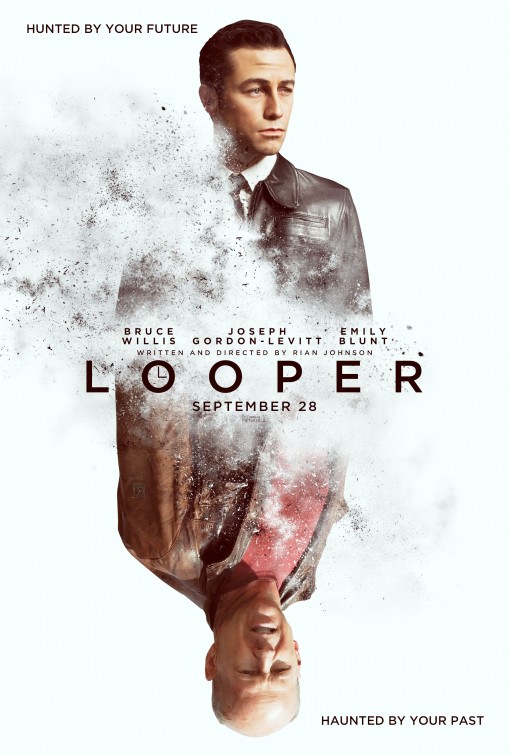 I became a Rian Johnson disciple the second that 2006’s Brick ended. I was floored by the originality, the artistic vision, the intelligence, and the creative voice. This was a unique filmmaker and I instantly knew this writer/director would be a man worth following. His follow-up, 2009’s The Brothers Bloom, was three fourths of a great movie, but a bit of an overdose on whimsy. Then I read that Johnson was next going to try his hand at time travel, and I could not contain my excitement. One of my favorite film genres and one of my favorite up-and-coming indie filmmakers together. I was expecting Johnson to do for time travel what he did with film noir (Brick) and the con movie (Brothers Bloom). How could Looper disappoint? Well, sadly, the movie found a way. It feels like Johnson smashed two halves of two different movies together, one good and one not so good.
In 2072, time travel is invented but instantly made illegal. The only people who have access to time travel are the mob. They have a surplus of dead bodies that need to disappear, so the mob sends them back 30 years. In 2042, Joe (Joseph Gordon-Levitt) is employed as a looper. He kills the guys the mob sends back in time and then disposes of the bodies. He’s paid well, and he and his fellow loopers live it up as privileged members of the Kansas City social sphere. Abe (Jeff Daniels) runs the show in town; he’s a mob guy from the future. There’s a catch to all the looper riches. The mob also wants to protect them in the future, so they send back the looper’s future self to be executed. It’s called closing the loop. And if you don’t kill your future self, bad things will definitely happen, just ask Seth (Paul Dano), a looper hacked apart to lure his future self back.
 The day comes where Joe is tasked with executing his future self, Old Joe (Bruce Willis). Old Joe escapes and goes on the run. Younger Joe is now under extreme pressure to kill his guy, or else the mob might just find him and start slicing body appendages. Old Joe is looking for the Rainmaker, who in 30 years will become a criminal tyrant responsible for much death. But in 2042, he’s only a child. Old Joe’s mission is to kill the child before he becomes the Rainmaker, and before he murders Old Joe’s eventual wife. While fleeing the mob, Joe takes refuge on a farm outside of the city. Sara (Emily Blunt) and her young son Cid (Pierce Gagnon) warily take in Joe but they’re also hiding a secret, that Cid has powerful telekinetic powers that can be put to great damage.
The film’s premise is compelling and allows for plenty of mind-bending possibilities, and Johnson has a fresh take on the sci-fi genre. Hunting down your future self is a grabber of a concept and I loved the scenes where Joe and Old Joe would sit down and converse. There’s the natural tension of Joe’s mission to eliminate his future self, but there’s also a flurry of ideas, ones that make the film better developed. Old Joe has an edge in foreknowledge but Joe has his own edge. He can change Old Joe’s memories by choosing different actions. He swears if he ever sees a picture of Old Joe’s wife that he’ll do everything in his path to alter fate, to make it so he never finds her. As a result, Old Joe is hobbled by headaches and fuzzy memories because the order of events is no longer concrete. “This time travel stuff fries my brain like an egg,” Old Joe admits. That, my friends, is a fascinating struggle for dominance and a refreshing take on time travel. Then you throw in the mob chasing after both Joes and you got an extra sense of urgency. Looper is playfully heady but easy enough to follow. It’s a thriller that doesn’t get bogged down in time travel logistics but it doesn’t pander to its audience either. If it did, I’m fairly certain Joe (addict, criminal, selfish) and Old Joe (eventual child slayer) would have taken turns to be more likeable. For a solid hour, Looper is alive with narrative jujitsu, a nice balance of action, drama, dark humor, intelligent plotting, stylish direction, the occasional startling visual, and strong acting from Gordon-Levitt and Willis.
And then the Looper becomes a completely different movie. Once the action shifts to Sara’s farm is where this movie completely unravels. I just couldn’t believe what was happening. The first half was so intriguing, intellectually stimulating, and thrilling, and then I got stuck on a farm and the movie turned into a lame version of Children of the Damned. I didn’t come for a telekinetic kid movie; I came for a time travel movie. The second half of this movie is practically wall-to-wall telekinetic kid stuff. The action slows down to a crawl and the flurry of ideas turns to a trickle as we introduce Strong Single Mom and Weird Son. I may have a cold heart but I didn’t care about these characters. I found the romance forced and Sara to be poorly developed. I found the kid annoying, and when he got mad and made his stupid mad face, it irritated me. Mostly I was irritated that the promise of the first half of the film had stalled out, and that this was where the movie was choosing to spend its dwindling time. It’s like the movie has been swallowed inside out by this stupid telekinetic subplot. The climax is fine but why did we have to travel through Dumb Farm Rest Stop to get there? Is it so that Joe can learn to be a better person? I didn’t buy that growth, especially with a kid as annoying and obviously dangerous as Cid. I suppose one night of sex with Emily Blunt (The Adjustment Bureau) could do the trick.
Besides the whole farm deal, there are other nagging questions I have that devalue Looper in my eyes.
 1) So in the future the mob is the only entity with access to time travel, but all they use it for is to dispose of bodies? That’s it? Biff Tanner used a sports almanac from the future to become king of the world. Are you telling me an organization that has historically profited from gambling would make no use of foreknowledge for personal gain?
2) Why would the mob have the loopers kill their older versions of themselves? This seems like a natural conflict of interest that could readily be avoided. Instead of having that particular looper kill his future self, thus closing the loop, why not assign that future version to a different looper? That way you don’t have to run the risk of the past looper letting his future self go. Or you could just never tell them what happened. For that matter, why does the mob have to send the guys back alive? Could they not simply just kill them and send the dead bodies 30 years back in time? This seems like an easier solution that also minimizes risk.
3) If you’ve just uncovered the power of time travel, why are you even bothering to send back your dead bodies 30 years into the past? Why not send your dead bodies back BILLIONS of years where the Earth is still forming, hot, and uninhabitable? I find this to be a better solution (I also wrote this solution in my own time travel screenplay, so there’s that too). Why can’t the mob feed dead bodies to dinosaurs? I’d love to see that.
4) You have a mob guy from the future, and you do nothing with that? Abe has one wisecrack about being from the future, and it’s a good one, but otherwise this guy could have just been from the present. The movie does nothing with the juicy element of a mob boss from the future. Maybe he doesn’t do as he’s told and arranges for his own rule. Or maybe he utilizes a sports almanac and makes some prescient bets, huh?
5) The movie takes place almost entirely around the confines of Kansas City. I find it hard to believe that a criminal organization would be sending all its bodies to Kansas City. Perhaps the mob also sends people across space and time, otherwise this means that we’re only following the future evil masterwork of the Kansas City mob.
6) I suppose you have to ask at what point do you really start to nitpick the whole butterfly effect of cause and effect paradoxes. With all time travel movies, there’s going to be some degree of suspension of disbelief, because changing one action can have wide-ranging consequences. However, with Looper there are several instances that gave me pause. Firstly, there’s the central idea of killing the Rainmaker as a child, which would negate the killing of the loopers, which would negate Old Joe seeking out the Rainmaker to kill. I’ll look beyond that. So Old Seth, in the film’s most horrifying sequence, starts noticing his fingers are disappearing, then his nose, and then his legs, etc. The mob is torturing young Seth to lure back the missing target. It’s an amazing visual sequence, but are you telling me that cutting off young Seth’s body parts would not have altered his future to a greater degree? I’m fairly certain when you start removing fingers and legs that Old Seth’s timeline would have been dramatically altered and he would cease to exist or follow the exact path to wind up in the past again. For that matter, why even bother luring the older Seth back? Could they not just take care of him by killing young Seth? What are they going to do with young Seth? If they’re just going to kill him then they should have just done that to begin with.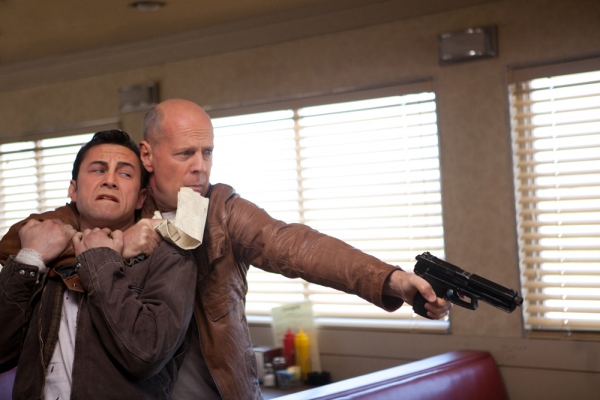
Johnson has plenty of thought-provoking questions he’d like to address within the bounds of a sci-fi action thriller. Would you kill a child if that kid were going to grow up and be a monster? Is redemption possible after doing horrible things? Could you kill your future version of yourself? Would you sacrifice everything to prevent future misery? These are legitimate questions and Looper deserves credit for spending time to ponder them, but I just wish Johnson could have gone back in time and chosen a different path.
Coming off of the stupendous Brick and the perfectly enjoyable Brothers Bloom, my expectations for Johnson’s third film were astronomical, especially given this crafty man’s take on time travel. I love the premise, love the actors involved, and love the ideas toyed around with, but the movie completely falls apart at the halfway mark. The pacing gets slack, the story becomes forced, and Looper transforms into a different, unwelcome movie. I can’t help but feel disappointed, partly from my expectations but also from the knowledge that Johnson could do better. The story just isn’t as well developed as it carries on, and the telekinetic subplot feels like a dull leftover from another movie. After an invigorating first half, Looper crumbles under the weight of a weak subplot that consumes the movie. There’s a good amount of thrills and intellectual stimulation aboard, but it’s all concentrated in the first half of the movie. I can’t recommend one half of a movie. I’ll still eagerly anticipate Johnson’s next project, but Looper is a sci-fi thriller that unravels at an alarming rate, turning a possibly great movie into a mediocre one.
Nate’s Grade: C+
Share this:

Dredd (2012)
 In 1995, Sylvester Stallone starred in Judge Dredd as the titular law enforcer. This big budget sci-fi action flick was goofy and violent and had the added punishment of Rob Schneider as pained comic relief. No wonder it failed at the box-office. I was never a fan of the comics so I can’t say how close the movie was to the source material, but given the presence of Rob Schneider, I’d say it’s doubtful. Because the 1995 film was such a flop, nobody wanted the rights to the character when they went back up for sale. That’s what allowed screenwriter Alex Garland (28 Days Later) to swoop in and write a new version. Dredd is an attempt to resuscitate a franchise that never got started. I don’t know if it’s particularly a good Judge Dredd movie, but as an action film it’s viciously entertaining and it has 100 percent less Rob Schneider.
Dredd (Karl Urban) works for the police of Mega City 1, one of the last metropolises of the irradiated waste land that is the United States. Crime has taken over and crime lords rule neighborhoods. Ma-Ma (Lena Headey) is the leader of a gang pushing Slo-Mo, wa drug that alters people’s perception of time. She controls the 20-story high rise that serves as her base of operations. Dredd is partnered with a young cadet, Anderson (Olivia Thirlby), who also has psychic abilities. She could be an asset to the force, but first she needs to be field tested. They get called to arrest Ma-Ma, but this prostitute-turned-ruthless drug kingpin isn’t going quietly. She locks Dredd and Anderson inside her high rise and orders her inhabitants to take care of the pesky officers.
 I had my doubts, but when it comes to action Dredd delivers. As soon as I saw the trailer, I screamed that this film was little more than a Hollywood remake of the awesome action film from Indonesia, The Raid: Redemption. The plots are identical but I’ll give Garland the benefit of the doubt that he came to his story independently. Whereas The Raid was heavy on martial arts and different fighting styles, and creative weapons, Dredd is really all about the firepower, the gunplay, the blowing up of material, the riddling of bodies with bullets. Each floor presents a new challenge and gives another opportunity for Dredd to outgun or outsmart the competition. This plot model feels like a video game come to life, clearing stage after stage, awaiting boss battles, collecting power ups. Readers will know I am not a strong believer that video games will ever give birth to a solid movie, but I’m ready to concede that this specific plot structure can allow for kickass action. The plot is simple but when given enough attention to geography and organic consequences, then great action can be unleashed, and Dredd is great action unleashed. It looks great, it’s constantly offering something new, raising the stakes, bringing in new elements to contend with, and it’s more than just things going boom. There are some genuinely suspenseful sequences to go along with all the stylish shoot-em-ups.
And the gunplay is vicious and bloody, reveling in the gory display of bodies being blown apart. There are slow-mo bullets traveling through people’s faces, all the better to see the care CGI artists put in to the gore. The ruthless violence is practically casual, and we’ll just see character walk by and fire into the backs of downed characters, giving us another explosion of blood to marvel upon. It would be really easy to call this movie sick, except it works so effectively as an action thriller that the bloody violence feels like a constant jolt. Our introduction to Ma-Ma is her hurling three men off the roof of her 2000-foot high penthouse, watching them splatter below. These are some nasty people and Dredd is dispelling some nasty justice, but because we recognize the antagonists are ruthless, and a real threat, then the violent dispatching of them doesn’t feel exploitative. It feels like keeping pace with some bad folk. Maybe that’s just a contrived way for me to justify that I found the brutish violence entertaining. Simple pleasures.
As far as a Judge Dredd adaptation, the Dredd elements almost feel grafted on, inconsequential. The screenplay could have been completely wiped of the Dredd elements and the plot would essentially be the same. It’s a dystopian world where crime has run amok and the police have resorted to become ruthless enforcers of justice. Dredd as a character, his worldview, his rookie partner who needs to prove herself on the mean streets, all of this is boilerplate cop movie stuff. It has some sci-fi stylizing but the content is still the same. I enjoyed the advanced gun that follows voice commands but nothing in the plot hinged on this element. Dredd just as easily could have been Cop #1 running from room to room, floor to floor, taking out the bad guys. So in this regard, Dredd works really well as a confined action movie but it’s questionable whether this is an effective adaptation of the comics.
 I’m surprised that with a drug called Slo-Mo that the movie didn’t make more use of this plot device. We get sequences of people blissfully on the Slo-Mo; the world looking like it was filmed through a glistening soap bubble. It’s neat but it can really become something cool for the sake of cool, ultimately superfluous except for a snazzy visual that plays into the 3D. It doesn’t appear like the drug lasts long either. But if time slows down for the people on this drug then wouldn’t you think somebody would want to make use of this when fighting Dredd? Perhaps it would sharpen their reaction time by making the world seem to slow to a crawl. However, if this is just an altered state of the drug, I think there could have been a fun moment where a Slo-Mo user tried to take on Dredd and we get differing points of view. For the user, time seems slow and they seem at an advantage. For Dredd, the user would just be acting slow and stupid. It’d punctuate the illusion of the reality-altering drug and explain why none of these gang members spark up before battle.
The acting in Dredd is competent and hardly dreadful (forgive me, it had to be done). Urban (Star Trek) goes the entire movie with his helmet screwed on. You never see the top half of the man’s face, presenting an interesting acting challenge (just ask Tom Hardy how tricky it is to act with your face obscured). The man has a permanent grimace carved into his face, grumbling his line throughout. Dredd is supposed to be a grim, no-nonsense enforcer. He’s not exactly got a lot of dimension to him. Urban inhabits the role well but you get the impression anybody could have been in that suit and the film would roughly be the same. Dredd also answers the question of what Olivia Thirlby (Juno) has been up to since 2008. She acquits herself well in all the bloody business and she’s not a bad blonde either. Headey has got the sneering villain act down cold thanks to TV’s Game of Thrones.
Dredd is your best bet when it comes to action movies right now. You’ll get the biggest bang for your buck. The action is brutish and routinely entertaining. It pulls no punches and the bloody melee is full of beautiful carnage. It’s a simple story with pretty simple characters and relatively shallow depth, but where Dredd succeeds is in execution. The emphasis is spent on constructing thrilling actions sequences that build, that change, that impress. It’s not for the faint of heart but for those hungry for a hard-R, bloody, sci-fi thriller, the likes of Paul Verhouven, then I suggest checking out Dredd. And you better hurry, because this version of Judge Dredd is also failing at the box office. Maybe Rob Schneider has been vindicated after all.
Nate’s Grade: B
Share this:

Total Recall (2012)
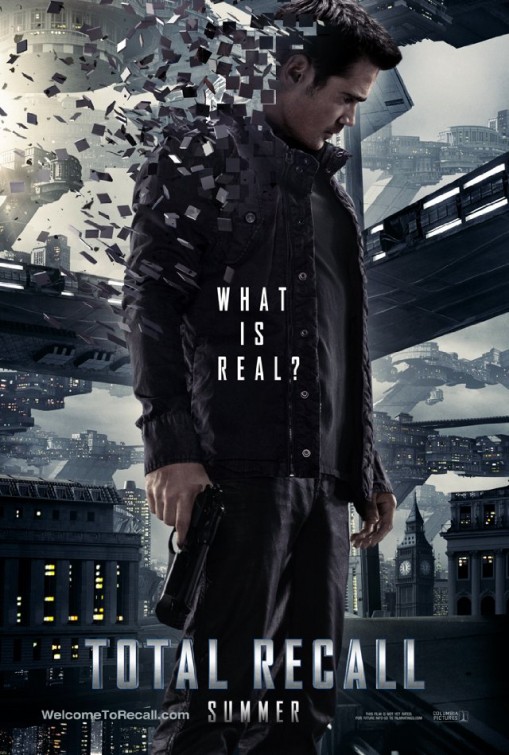 The latest needless remake takes the basic elements of 1990’s Total Recall and streamlines them into one very long chase sequence. And for those concerned males, the three-boobed lady makes a triumphant reappearance, because surely the movie wouldn’t be the same without her. Though in the age of the Internet, the sight of a three-boobed woman seems less indelible to impressionable male minds. But I digress. I was ready to dismiss this as another soulless Hollywood remake. Then I found myself enjoying Total Recall, and even the stuff that was dumb I had to also admit was cool. Take for instance a commute that goes through the center of the Earth. How exactly could such a thing be built? What does one do for maintenance? How does this not affect the Earth’s rotation? But then I forgot all about it because, in pure movie terms, it was cool. The zero gravity change-up as the transport changes directions at the core – cool. The fact that we get a zero gravity action sequence in this environment – cool. The fact that this transport system becomes a conduit for an invasion – cool. The plot mechanics are all familiar, notably the memory wipes and the super spy histories, but I didn’t care because the movie rarely lets its foot off the gas. When this thing starts, it doesn’t let up. The chase sequences are well executed amidst an imaginative array of locations, from a flying highway to a series of hanging housing developments. It’s not terribly smart but Total Recall is an entertaining escapist thriller that delivers some robust action and enough imagination in its future settings. Plus, there’s a woman with three boobs in it.
Nate’s Grade: B
Share this:

Prometheus (2012)
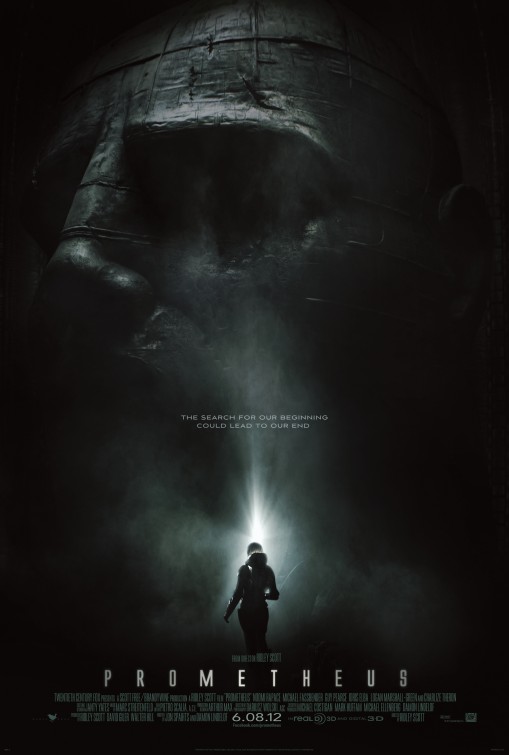 Ridley Scott has always wanted to go back to the Alien franchise that began with his 1979 sci-fi staple. There have been a lot of coy discussions over whether his big-budget sci-fi spectacle Prometheus is indeed an Alien prequel or not. Scott keeps hinting it has the DNA of the franchise but exists on its own. This movie has some Big Questions on its mind, like where did we come from, but the biggest question out there is whether it really is an Alien prequel or not. Well rest assured, that question will be sufficiently answered. Now if you have more than that, you will be left empty-handed with this gorgeous but ultimately confounding sci-fi thriller.
In 2089, a team of archeologists, lead by Elizabeth Shaw (Noomi Rapace), discover an ancient star map from 30,000 years in mankind’s past. This is not the only ancient illustration displaying the same constellation. Sure enough, in every ancient civilization across the globe, the same star pattern. Shaw believes it is an invitation and th key to finding the “engineers” who may be responsible for life on Earth. Four years later, the wealthy Peter Weyland (Guy Pearce) has funded a trip to that exact point in space, which harbors a moon that seems extraordinarily like Earth and capable of sustaining life. The ship is run by Meredith Vickers (Charlize Theron). who keeps asserting her company’s authority on this mission. Along for the ride is a cocksure pilot (Idris Elba), an android named David (Michael Fassbender), and Shaw’s own lover, a scientist in his own right, Charlie Halloway (Logan Marshall-Green). When the gang gets to that moon, they uncover large buried structure with some nasty surprises inside. Suffice to say, they should have stayed home.
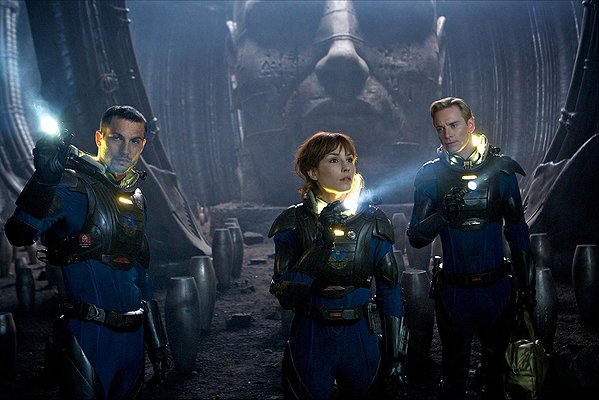 You can always count on Scott to deliver a visually extravagant picture, and Prometheus is packed with stunning, arresting visuals that fill up the big screen with lovely detail. The scale of some of these sets is massive, and your eyes just want to soak up every detail. The alien world is vast and eerie and you just want the characters to spend the rest of their lives exploring it (Scott shot in Iceland but it looks remarkably like a whole different world). The interior sets on the space ship are also sleek and cool. There’s a terrific sense of immersion in the movie. Scott has always done a great job at building worlds that feel completely lived-in, and Prometheus is another example of his talents. The special effects are astonishing but best when not dealing with the biological life forms. The giant spaceship is incredible; its inhabitants? Not so much. Apparently our DNA grandfathers looked like giant Michelin men (thankfully we take more after our mother’s side). Prometheus demands to be seen on the biggest screen possible.
Prometheus harkens back to the original Alien in its suspenseful “haunted house in space” setup. The movie has some terrifically taut moments and a great overwhelming sense of dread. The scientists let curiosity get the better of them, so they poke their heads in dark corners, touch unknown alien material, and get up close and personal with things better left unmolested. If slasher movies elicit a “Don’t go in there” audience response, then Prometheus certainly elicits a “Why are you touching that?” reaction. And yet, deep down, we want them to keep pushing further because like the best suspense films, we can’t stand the tension but we really want it to keep going. Probably the most memorable scene of them all involves Shaw performing her own hurried abdominal surgery to remove an alien from inside her. It’s creepy and caused me to wince repeatedly, but man is it fun and gruesome and a nice payoff to an earlier setup. The rest of the movie is pretty standard with its thrills, including the canon fodder supporting characters getting picked off unceremoniously, and the large-scale devastation climax. The movie delivers the goods when it comes to entertainment and suspense, though mostly in the first half. It’s almost like the movie is awed by the visuals as well, and then halfway in remembers, “Oh yeah, we got to do more than just poke at things,” and then it’s a rush to the end with a cascade of conflicts that don’t seem properly developed.
The film lays out a very essential question about the origins of mankind and plays around with theological concepts but it only plays in the shallow end of the philosophical pool. The screenplay by Jon Spaihts (The Darkest Hour) and Damon Lindelof (co-creator of TV’s Lost) deals with the conflicting origin stories via religion and observable science but never goes into specifics. “Religion” is always symbolized as a cross necklace that Shaw wears and her falling back point upon what she “chooses to believe.” The discovery that our alien forefathers have a similar appearance would be a huge revelation, except the movie spoils it with a clumsy prologue that shows us right off the bat what the “engineers” look like. Prometheus actually posits an Intelligent Design argument for human existence, albeit one the Raelians have been promoting for years, the idea that intelligent life outside our galaxy seeded Earth. Yet the one scientists on the crew, the one who objects to 300 years of evolutionary evidence, remains mum on the matter. I suppose the filmmakers didn’t want their monsters-in-space movie to be bogged down with that much pithy philosophy, but I would have appreciated some meatier conversations other than, “Should we touch this?” It’s not nearly as thought provoking or as compelling as it thinks it is.
As I sit here and I write this, the plot becomes a wispy memory of strong set pieces and eerie mood, but I cannot connect the story. It makes little sense and by the end of its 124 minutes we’re left with hardly any more answers than we started with (some spoilers to follow). Our genetic “engineers,” as they call them, remain pretty nebulous. I suppose one could argue that it would be impossible to fully understand an alien race’s habits and purposes without resorting to pandering, but that strikes me as a cop out (I’m reminded of Spielberg’s similar approach in Kingdom of the Crystal Skull, where the characters that wanted to know were punished for their intellectual curiosity by alien forces). Why did these super aliens create life on Earth and leave maps to a planet that was little more than a weapons depot? Why would these superior beings create life hundreds of thousands of years ago and then leave clues 35,000 years ago that would lead to the destruction of their little experiment? The motivation seems rather hazy. It’s not like the aliens created life on all these planets and waited to be contacted so that they knew their little biological Easy Bake oven was done and then they could reclaim a new planet. It’s not some imperialist empire or colonization scheme; it appears to just be wanton destruction. That seems like a waste of effort. Did these aliens keep checking back, see our ancestors hunting and gathering and go, “Oh my Space Deity, I can’t believe we created life on this planet? We were so wasted. Well, just wait until they conquer space travel and then we’ll kill them with a weird biological weapon.” If your desire is to destroy life, why even have a waiting period? If these “engineers” wanted to destroy Earth why not do it when there was far less clean up? Is there some kind of parent-child relationship I’m just not getting here?
 Fassbender (X-Men: First Class) makes the biggest impression as the fastidious android, David. He’s by far the most interesting character and he’s not even human. It doesn’t take long to figure out that David has his own agenda, and Fassbender plays the character with this eerie passive-aggressive arrogance. You get the sensation that he looks down on his human clientele, but you don’t know what lengths he will go. “How far will you go to get your answers?” he asks before doing something very not nice. He makes statements like, “Who doesn’t want to kill their parents?” and there’s an icy placidity to him; he’s just off enough to be menacing and unsettling without going overboard. Fassbender is excellent.
The rest of the cast cannot be at fault for failing to measure up to Fassbender (is that a Shame joke I stumbled upon?). Rapace (Sherlock Holmes: A Game of Shadows) is given top billing and does an admirable job of being a kickass heroine, which we already knew she was fully capable of in the Swedish Girl with the Dragon Tattoo trilogy. She even has a Ripley-esque haircut, which I doubt is a coincidence. Theron (Snow White & the Huntsman) gets to once again practice her ice queen routine, but I wish she had more to do than occasionally glower and bark orders. Her character’s secret background should be obvious to anyone well versed in the film economy of characters. Elba (TV’s superior Luther) tries to stick it out with some twangy Texas accent but can’t make his way through. His natural British accent pokes through routinely. Then there’s Guy Pearce (Lockout) as the wealthy benefactor who bankrolled the whole project. Apparently he was hired to film viral videos as himself, because in the movie he’s like a 100-year-old man in some pretty poor makeup (he resembles old Biff in Back to the Future: Part 2). Why hire an actor of Pearce’s caliber if you’re just going to hide him under a veil of old-age makeup? The actors do what they can but the film doesn’t give them much to work with. They’re stock roles and absent development. You don’t notice for a long while because you’re so caught up in the exploration and the gorgeous visuals, but when the end comes you realize that you hardly knew these people.
After all the pre-release coyness about whether this belonged in the Alien universe, Prometheus seems to be a victim of its own sky-high hype. The movie is moody and dark and intriguing and visually magnificent, but the plot does not hang together at all. The central mystery of the origins of mankind is given a face to start with, but that’s about it. The confusing story tries to mask its plot holes but eventually they just overtake the movie. It’s an entertaining movie in the moment but Prometheus pretty much evaporates as soon as you leave the theater and start thinking, “Hey wait a minute, that didn’t make any sense.” Why are mankind’s “engineers” a regretful bunch of jerks? Scott’s visuals are impressive, the film has a killer mood that’s hard to shake, but the plot is pretty shaky and reliant on supposedly smart people making pretty dumb decisions (why yes, I’ll try and touch the alien snake monster thing). That’s fine for basic thrills but it doesn’t elevate the movie into something headier, meatier, and more satisfying, like the original Alien. Prometheus was never going to meet the unattainably high expectations of fans stoked by tremendous trailers and the promise of Scott’s triumphant return to sci-fi, but much like the characters in the film, I was glad to go on this journey but wished I had more to take home with me.
Nate’s Grade: B
Share this:

Men in Black III (2012)
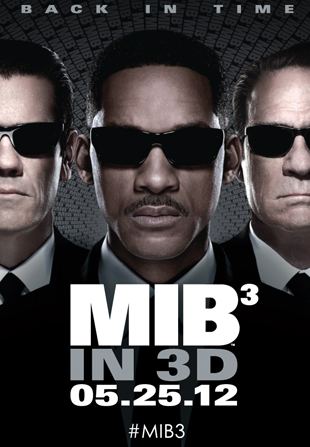 It wouldn’t be a Men in Black film without script problems. The first film languished for some time, originally taking place in Kansas of all places, before director Barry Sonnenfeld became attached and insisted upon a New York City location. The 1997 sci-fi buddy cop comedy was a hit, and rightfully so, and Will Smith became a megastar. Then the 2002 sequel’s climactic action sequence had to be rewritten due to the fact that it was originally going to take place in the World Trade Center. If only that lackluster sequel had gone through more extensive creative revisions. However, these past hiccups don’t seem to come close to Men in Black III, which to Sonnenfeld’s admission, started shooting in late 2010 without a finished script. It had a beginning, an ending, but nothing definite to tie together. So the whole production took eight months off to work on the meat of that movie sandwich. Hollywood movies, especially modern films of huge-scale budgets and set release dates, have routinely started production without completed scripts, including Gladiator, Jaws, Apocalypse Now, and Lawrence of Arabia. Naturally, those are the exceptions to the rule.
Boris the Animal (Jermaine Clement) has escaped from pison and out to seek revenge on the man who put him away and took his arm – Agent K (Tommy Lee Jones). Boris travels back to July 1969, when a young Agent K (Josh Brolin) thwarted the big bad Boris. Boris kills Agent K and alters the future. The Earth is now vulnerable to an alien invasion from Boris’ species. Agent J (Smith) has to travel back in time to save his old partner and the planet.
It’s been ten years since the spotty Men in Black II and almost four years since Smith has been seen in a movie. Where did the time go? Fortunately, this third movie hews closer to the droll brilliance of the first film. Part of that is a sharper story with a more clearly defined goal and a return of the playful exuberance that belies the franchise. Also, I must say that absence has made the heart grow stronger, because I’ve missed Smith’s effortless charisma onscreen. Agent K is such a natural fit for the guy and it’s just fun to watch him stumble through strange alien encounters (this time we learn all super models are aliens; listen good, young women of America who punish themselves to fit this image of beauty). Time travel is usually employed when a franchise seems like it’s all out of gas; it’s usually more focused on the comic fish-out-of-water possibilities, which there are a few in Men in Black III. As one characters notes, 1969 wasn’t exactly a great time for black people in America, and J combats casual racism, black panic, and ignorance with a defiant attitude that is amusing to watch. I’m glad the whole race-relations reality was addressed, though it’s also for the best that the movie doesn’t get bogged down with scenes of Agent J conflicting with bigoted authority. Men in Black III remembers that we’re here to have fun, and the screenplay by Etan Coen (Tropic Thunder) has a light-handed touch. I enjoyed the opening jailbreak sequence with Boris, though I would have thought a lunar prison would have better security. Bill Hader (Superbad) has a fun cameo as a self-hating Andy Warhol, really an undercover MIB agent, though the idea that Warhol’s Factory artists as aliens seem a tad simple. The glaring cameo omission was Jon Hamm (TV’s Mad Men) as a scotch-drinking MIB ladies man of legend.
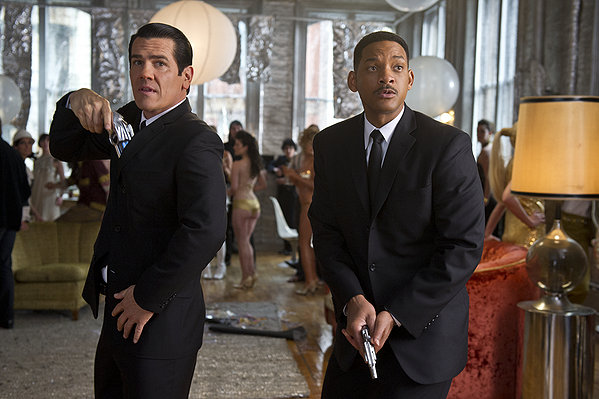 As evidenced from the trailers and marketing, Men in Black III is really Brolin’s movie. The guy establishes an uncanny Tommy Lee Jones impersonation. The eerie brick-faced stoicism, the melodic lilt of his voice, the syncopation of his speech patterns; Brolin nails it all. Watching his interaction with K are the film’s most enjoyable segments. At this point in the series, Agent J and K have gone beyond the rookie/mentor phase and now have something of a friendship, though their arguments at year fifteen of their partnership sound more like the arguments they would have in year two (you need to “open up” and be less grumpy, sounds elementary). Still, there is a personal connection to this case that eluded the last movie, and it gives the film a sense of urgency even when the comic shenanigans seem to hog the spotlight. The personal reveal in the last act didn’t have as much emotional power for me, mostly because I did the math and realized whom a certain unseen character of significance was before we got their true identity. The end does give the film series a circuitous sense of finality.
For a franchise that seems like it can go anywhere at any time with limitless possibilities, the worst thing you can do is be shut off to better avenues of storytelling. Take for instance the climax at Cape Canaveral, which itself is a rather anticlimactic sequence involving the launch of Apollo 11 (don’t they know that alternative 1960s history was sooo summer of 2011?). J has his time travel doohickey that lets him travel back. He gets to use this device once during the climactic fight, allowing him to travel back one minute in time so he knows how to properly duck. That is it. What a fantastic waste. If you’ve got a device that essentially allows for unlimited do-overs, then I want this device to be an integral part of the climax. I want J to have to regularly use it to fix past mistakes and learn more and more from each time jump. Just memorizing how to duck is lame. The entire subplot with Agent O (Emma Thompson in the present, Alice Eve in the past) and her dalliance with K is so carelessly thrown away that I wonder why the filmmakers even bothered to include it. Then there’s our villain, Boris, whose name itself is even lazy. He’s just a bad dude with some sort of insect that lives in his hand and shoots spikes. That is it. He’s a guy who can fire projectiles. So what? What about that makes him interesting? An unrecognizable Clement (Flight of the Conchords) does his best but the character just doesn’t have anything about him that deserves special attention; he could have been any villain (I think Vincent D’Onofrio was undervalued in his go-for-broke physical performance as the first film’s villain). I did like the idea of Present Boris arguing with Past Boris, but like most promising ideas in Men in Black III, this space-time sparring is never fully realized. While enjoyable, there’s little you’ll be able to think back on with Men in Black III and say, “That was well developed.”
Paradoxically, I think Men in Black III has a character that might simultaneously be the best and worst thing about the film. Allow me to explain. About halfway in, we’re introduced to the alien Griffin, played by the great Michael Stuhlberg from A Serious Man and TV’s Boardwalk Empire. He’s a creature who can see nigh unlimited timelines, all the variations of choice and possibility play out before his eyes, one after another. He never knows which timeline he’s in until the moment occurs, thus he’s constantly worried about every moment to come in his life. This foreknowledge sounds like a wretched curse, and with Stuhlberg gives a forlorn edge to his character’s eccentricity. So when J and K meet the guy, there are some clever moments, like when Griffin details every peculiar aspect of chance that lead to the 1969 Mets World Series victory. The moment, and by extension the character, is a nicely reflective idea that every moment is a miracle of causation. Griffin is just an interesting character. Here’s where the worst part comes in. Rarely is he treated as a character because, you see, Griffin is really a magic plot device. He can tell the Men in Black agents whatever they need to do at any point, instantly providing a narrative cheat. When in doubt, just ask the guy who sees the future and he’ll steer you without fail to the next necessary plot point.
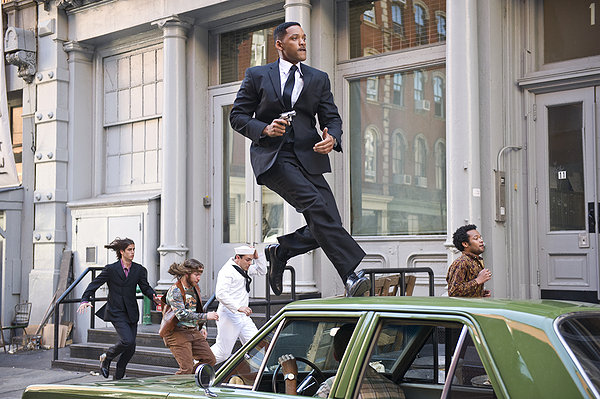 I saw this movie in 3D, not by choice mind you, and for the first half hour it felt like one of the better 3D conversions out there. Sonnenfeld’s camera plays a lot with depth of field and primarily forward-backwards movement, which made for a slightly elevated viewing experience. But somewhere around the halfway mark, I swear the movie forgot it was supposed to be 3D and the dimensional differences became negligent. It never really recovers, and so I advise all potential ticket-buyers to skip the 3D screenings.
With most time travel escapades, there’s going to be some plot holes. Working with a flurry of alien technology, it would have been exceptionally easy for the filmmakers to just explain away the plot holes with some magic device, much like the Paradox Machine in Dr. Who. Hey, there’s a machine that makes sure we don’t have paradoxes? Good enough for me. It’s like in Thank You for Smoking when Rob Lowe’s character explains why actors would be able to smoke in an all-oxygen space environment: “It’s an easy fix. One line of dialogue. ‘Thank God we invented the… you know, whatever device.’” The fact that Men in Black III doesn’t even address its biggest plot hole astounds me. If Agent K is killed in 1969, then he was never alive to recruit Agent J into the service. Let’s even assume that J’s credentials would still get him noticed and staffed with the MIB; if Boris killed Agent K in the past, then there was no reason for Boris in the future to travel back in time to kill Agent K. Again, these aren’t nit-picky gripes, these are major, easily understood plot holes, and I’m dumbfounded why no characters even address them. I could nit-pick over why Boris decides to go to 1969 when he just as readily could have gone to a time when K was a child and thus more vulnerable. Surely a child is easier to dispatch than a 29-year-old man.
Men in Black III is a far improvement over its stilted predecessor, but it still ends up falling well short of the potential it flashes. It’s intermittently amusing with some fun cameos and some visual panache, but this movie should have been stronger, stranger, and more playful with its central time travel conceit. It’s hard to work up that much distaste for the movie, especially since it has such a lively, jocular feel. Not all of the jokes work, but enough do, and the movie maintains an overall pleasant sensibility, zigzagging in imaginative directions that most Hollywood movies never beckon. It’s the stuff that works that illuminates the potential left behind as it goes into summer blockbuster territory. Men in Black III is an example of diminished returns, yes, but some franchises start so high that even latter, lesser sequels will have more entertainment value than their competitors. While it won’t set the world on fire, Men in Black III exceeds expectations and provides enough entertainment that it’s worth a look and little else.
Nate’s Grade: B
Share this:

Battleship (2012)
 On the surface, the classic board game Battleship would seem like a rather peculiar property to develop into a feature film. Unless someone was going the crafty Das Boot route, why would anybody even want to adapt the board game? And for that matter, why would anyone want to adapt the game and add killer aliens from outer space? Well actor-turned-director Peter Berg looked at the classic board game with the little pegs and the declarations of battleships sunk and said, “There’s a big summer movie in there.” With a hefty budget of $200 million, which is becoming alarmingly the norm for summer tent pole releases, Berg’s efforts have given birth to Battleship: The Movie. If it becomes a hit maybe it will start a trend. Who wouldn’t want to see Hungry, Hungry Hippos as a monster movie, or Connect Four as a searing domestic drama about alcoholism?
Off the Hawaiian Islands, the Navy is conducting an annual series of international war games in the Pacific. Oh but little did they expect to have to combat intergalactic foes. Alien spaceships crash land to Earth, emerging from the Pacific and creating a force field barrier. Along for the high seas action are the stoic Stone Hopper (Alexander Skarsgard), his screw-up little brother Alex (Taylor Kitsch), a Japanese captain (Tadanobu Asano), and a mess of other Navy personnel, including pop star Rihanna. On the other side of that force field is Alex’s girlfriend, Samantha (Brooklyn Decker), a naval physical therapist who finds herself in the middle of the aliens communications plans. The handful of Navy ships, some American and some Japanese, must figure out a way to topple the aliens before they get their communications up and running to broadcast that Earth is ripe for the taking.
 For some, Battleship will be the symbol of everything wrong with big-budget Hollywood filmmaking, a perceived slapdash effort meant to appeal to as many mass markets as possible, combining clichés and empty action sequences into a cacophony of noise deigned entertainment. And for most of those charges, I cannot defend Battleship. It has its fair share of clichés, gaps in logic, and some especially corny moments (WWII geezers save the day!). And yet, I found myself becoming entranced by Berg’s siren song, laughing at the comic relief, enjoying the stock characters enough to root for their triumphs, and having a total gas with the action sequences. I was shocked at how much fun I was having with Battleship. Perhaps that means that from a mechanical standpoint it knows all the pinpoints of the summer blockbuster model and knows how to craft a satisfying crowd-pleaser of an action movie. Or perhaps it just means I have lost my mind. Or maybe this is Berg’s expertly crafted satire of the Michael Bay School of filmmaking, brilliantly capturing the beautiful bombast and cheery jingoism of Bay’s career, especially when those salty WWII vets get to strut in slow motion. A movie based upon the board game Battleship is clearly not meant to be taken seriously, and Berg’s nautical adventure wants nothing more than to entertain the masses. Whatever the case may be, Battleship, weirdly enough works, and for some significant stretches, it works really well in the mold of summer spectacle.
I’m relieved that Berg has left behind his rigid docu-drama cinema verite approach he’s patterned after working on 2004’s Friday Night Lights. Berg’s verite style felt completely mismatched with 2008’s Hancock, an inexplicable global hit. With Battleship, Berg’s cameras settle down and give you plenty of action to soak up. Berg’s first foray into action, 2003’s The Rundown, was like the announcement of a great new talent and the herald of The Rock’s ascent in action. I’ve been waiting for Berg to return to that style he displayed with The Rundown, a slick, highly stylized flair, brimming with robust energy that popped at all the right moments. Thankfully, with his biggest budget yet, it’s like the return of the old Berg. Perhaps it’s just a reaction against the overindulgence of the “shaky cam” action style popularized by the Paul Greengrass Bourne films, but it’s nice to be able to actually follow what is happening. Berg’s cameras find different and exciting ways to frame the action. I enjoyed the speedy zoom outs to illustrate the size of the field of battle. The visuals really do feel like Berg is parlaying Bay’s shooting style, the tawny glow of people’s skin, especially women, a.k.a. sex objects, the fetishized ogling of giant toys/military hardware, the soaring camera. But unlike most of Bay’s pedigree, it’s spectacle on a mass scale without turning into a glorified video game.
The action in Battleship is huge but never dull. The scale of the demolition does not get out of hand because the movie works in shifts, focusing on pockets of action before ramping up to something even bigger and better. The alien tech, particularly the spheroids that munch through metal like the Langoliers (please, somebody tell me they remember that Stephen King TV movie), is impressively powerful without feeling completely over matched. Being totally obliterated in the movies has its own thrill, but seeing a slug fest between man and alien is more compelling. Watching the Navy go blow-for-blow and eventually triumph through ingenuity in the face of adverse odds makes for some pretty satisfying action. The Navy is learning through trial and, much, error about how to combat these alien antagonists. I enjoyed the tactile nature of the battles. I must say I found the film to be weirdly informative about the attack features of naval war vessels. I don’t know if its genius or absurd that the movie finds a way to organically squeeze in the actual Battleship game play (the alien bombs also look like pegs from the board game). The aliens are something of a mystery and kept that way. When we do see them minus their Halo helmets, you wish they kept those helmets on. They have some unexplained moral code, as we cut to alien POVs that scan for threats, choosing to spare innocent lives in other circumstances. When the alien spacecraft fist appear, they take up position in a row and wait for their Earthly challengers to strike. It reminded me of the fighting sequences in turn-based RPG video games. These aliens are more sporting than your typical interstellar advanced civilization just interested in conquest. These aliens are into turn-based RPGs. These aliens are nerds.
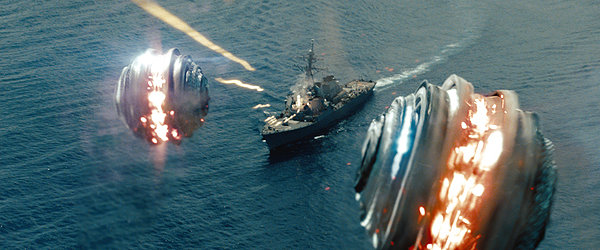 With all that surprising praise now established, Battleship the movie is still chock full of ridiculous moments and a rather leaky plot. The subplot involving a double-amputee veteran getting back his groove via alien invasion never feels well grafted to the major storyline. It feels like it was crowbarred in after the producers or Berg saw real-life double-amputee Gregory D. Gadson and declared, “This man needs to be in a movie.” He’s likeable enough but over the course of 130 minutes you realize likeable isn’t the same as being a skilled actor. This entire subplot involving Gadson, Samantha, and a computer techie (the amusing Hamish Linklater) strains credulity even for a dumb action movie. The fact that three easily over matched people can take out a load of well-armed aliens with little more than a Jeep and a briefcase mitigates the life-and-death stakes at sea. If these alien bad guys can lose so stupidly, then what’s the hold up? Also, the movie inserts a lot of bizarre tension between Japan and the U.S., like it’s trying to iron out the last unresolved conflict from the Second World War. The term “inelegant” cannot come close to describing the nativsm conflict and its dopey resolution. And then there’s the fact that the movie is long giant recruitment ad for the U.S. Navy. I suppose after the Marines had their own alien-fighting flick/recruitment ad last year (Battle: Los Angeles), the other branches of the armed services felt left out. I pray no one ever enlists over something this silly. No major life decisions should be made over the big screen adaptation of Battleship, people.
There’s a paucity of solid characters here. We get the bad boy younger brother who will discover his mettle and leadership by the end (by the by: having characters keep talking about how much “potential” somebody has is the annoying non-fantasy equivalent of talking about a prophecy being fulfilled). Kitsch comes off better than he did in Disney’s costly flop John Carter, but he seems too stiff and sullen for a leading man. If Battleship sinks, expect his leading man status to get dry-docked (okay, I’ll lay off the puns). Decker (Just Go with It) is still working out the kinks of transitioning from model to actress. Her romance with Kitsch is about as contrived as these things get in big action movies, a pathetic bone thrown to a deflated female audience who would rather see Decker in What to Expect When You’re Expecting. The additional seamen, including Rihanna’s acting debut (insert your “S.O.S.” joke here), are given one-note to play for over two hours. And as far as Ms. Umbrella-ella-ella is concerned, it’s certainly not the worst acting debut by a pop star (see: Crossroads, or better yet, don’t). Most disappointing is Neeson (Taken) who spends the far, far majority of the movie on the wrong side of the force field. I want this guy kicking ass and not barking impotently into a phone.
I don’t know if I can look myself in the mirror and declare, with solemn dignity, that Battleship is a good movie by the normal standards of objective excellence. Screw it, I had far too much fun with this film to stand back and pretend the movie’s flaws are too overpowering. Berg has slapped together what may be the most formulaic, pinpointed Big Summer Movie I’ve witnessed in some time, but I’d be lying if I said it didn’t win me over. They may be pushing buttons but Berg and company pushes them so well. Plus, I’m still uncertain whether or not the entire bloated affair is really the most expensive, subversive swipe at Michael Bay ever attempted. This is probably just wishful thinking from a critic looking to justify liking this movie. It’s got plenty of action, though doled out into bite-sized portions before the ACDC “Thunderstruck” montage ramps up the finale. Every now and then, you need a movie that gives you the right kind of stupid, and Battleship is the right kind of stupid for the summer movie season.
Nate’s Grade: B-


 nathanzoebl
You must be logged in to post a comment.