Blog Archives
Project Hail Mary (2026)
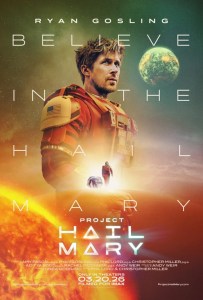
Being stranded for two hours in tight quarters with Ryan Gosling sounds like a dream come true for many. Something tells me I made this same joke except using Matt Damon’s name for the 2015 release of The Martian, another winning mixture of nuts-and-bolts scientific problem-solving and sci-fi exploration from best-selling author Andy Weir. Project Hail Mary is one of those big screen adventures that nourishes your imagination and heart. In short, it’s a rare full-package blockbuster, something to excite the senses as well as appeal to your intelligence to leave you fully satisfied. If you enjoyed the book like myself, then breathe easy, because the film has done this story a great justice. Best of all, it’s the rousing, heart-warming buddy movie you never knew you needed, and it all starts at the end of the world.
In the near future, science discovers an alien microbe that is literally eating the sun. The estimates are that our sun will dim over decades, causing widespread cooling and threatening the lives of billions. The world needs a hero. It got middle school science teacher and disgraced molecular biologist Ryland Grace (Ryan Gosling) instead, who awakens on a spaceship in a different stretch of the galaxy far, far away from Earth and its dimming sun. He has little memory of what transpired before and must piece together not just his understanding of who he is but also his world-saving mission that he now, unfortunately, is the only one who can accomplish. He’s very literally tasked with saving the world, so no pressure.
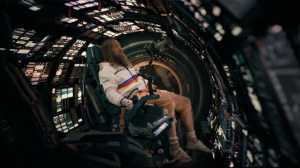
I’m going to avoid major spoilers but there is one plot development I feel needs to be discussed as it gets to the core appeal of the movie, so if you want to go into Project Hail Mary completely unspoiled, and I would advise it if you could, then end this review and come back once you’ve enjoyed the movie. For everyone else, let’s proceed ahead. Thankfully, the amnesia setup isn’t dragged out long. The film is structured to alternate between present-day problem-solving in space and flashbacks to Earth when Ryland was contacted by the top levels of the U.S. government to determine the extent of the unusual problem with water-molecule microbes somehow living and consuming the sun. The microbes are termed “astrophage” and release tremendous amounts of energy, enough so that they become the unexpected fuel for this long-shot space mission that Ryland finds himself the only survivor. He was never supposed to be mankind’s only hope (the other astronauts, the professionals, died from the induced comas for travel).
However, Ryland isn’t alone for long in the movie, and that’s where Project Hail Mary reaches a new level of entertainment and imagination. Our sun isn’t the only one affected by the astrophage, and Ryland is greeted by an alien spacecraft that has also traveled the long journey to figure out why this one sun is unaffected by the astrophage. The sense of discovery is greatly entertaining and I appreciated that there is something remarkably alien about our alien. Our intrepid alien will be nick-named “Rocky” because he best resembles a spider made out of rocks. That’s different. It’s not the old Star Trek school of slapping a forehead ridge onto somebody’s head and calling it a day. A significant and very gratifying sequence of the movie is just watching these two different lifeforms interacting and learning from one another. The language barrier has been explored before, most effectively in 2016’s grounded and somber Arrival. If Arrival was more the contemplative indie about conquering the linguistic challenges of first contact, then Project Hail Mary is the feel-good Spielbergian popcorn spectacle about saving the day and having fun. That doesn’t mean it’s a dumbed-down version; it just has different priorities, and chief among them is the winning buddy comedy of Gosling and a cuddly alien, two humble representatives of distant worlds in shared desperation for saviors. The relationship that blossoms between Ryland and our plucky, curious little space spider is naturally funny but also refreshingly serious too. Rocky is treated like an actual character, not some glorified pet or something to sell toys and Happy meals. He has a distinct perspective, learning curve, peculiarities, and determination that makes him feel more fully-developed than many human characters in terrestrial cinema. If you don’t walk away from the movie wanting your own personal huggable rock spider, then you watched a different movie than I did and, frankly, I pity you.
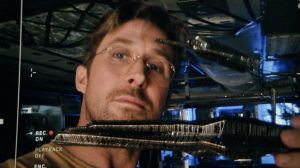
In my review for The Martian, I wrote, “There is an inherent enjoyment watching intelligent people tackle and persevere over daunting challenges, and this sets up The Martian for lots of payoffs and satisfaction. We see both sides of the problem and it provides even more opportunities for challenges and payoffs.” It’s tremendously enjoyable to watch Ryland and Rocky resolve serious scientific problems, whether it be studying the astrophage, the alien sun and its immunity to astrophage, or even just how to interact with one another when there are different systems for breathing and eating. It’s heady without being weighed down by too much scientific jargon, making the analytical discussions accessible and thus engaging. The conflict of Project Hail Mary isn’t quite as realistic as The Martian, given to more convenient cheats with “alien technology,” though the resulting resolutions still felt well-earned and satisfying thanks to the setups and payoffs that screenwriter Drew Goddard (Bad Times at the El Royale, The Martian) has layered throughout. The source material’s author, Andy Weir, has found himself a very profitable and marketable niche, dropping science whiz everymans into impossible scenarios and having them think their way out of them. At least this time the entire world is working in tandem, and spending likely trillions of dollars, to save the entire solar system instead of just retrieving one misplaced American astronaut. Weir will likely be throwing darts at what new setting someone could be stranded in next.
Now, as a film adaptation, Project Hail Mary goes the distance. This is the first live-action movie directed by Phil Lord and Christopher Miller since 2014’s 22 Jump Street (granted, they were notoriously fired from finishing 2018’s Han Solo prequel). For those worried that the movie might be more anarchic or yuk-heavy like the duo’s animated oeuvre, such as The Lego Movie and the Spider-Verse films, they have adapted their style to best suit the material. There’s plenty of humor in this movie because of the ridiculously high stakes and general odd couple nature of our buddy dynamic, but the movie never feels like it loses its focus on the bigger world-saving picture. For Ryland, he knows this mission is a one-way trip, as the capsule doesn’t have enough fuel to make the return trip to Earth. He knows this is a sacrifice, but the entirety of all living things on the planet are holding out hope that his sacrifice is successful. Lord and Miller are able to balance the comedy and dramatic elements, as well as finding appropriate spaces for the viewer, as well as Ryland, to take in the natural majesty of space in another star system. The cinematography by Greg Frasier (Dune Parts One and Two) is grand and visually sumptuous, mixing in aspect ratios and focus depth to distinguish between timelines and emotional states. The musical score by Daniel Pemberton (Spider-Man: Into the Spider-Verse) is remarkably pleasing to the ears, finding room to be rousing and immersive and awe-inspiring, perfectly aiding the gorgeous visuals. At 150 minutes long, there’s the concern about pacing, especially with a movie that has so much to explain on the go as well devoting nearly half its runtime to flashback morsels doled throughout. I never felt lag. I also never felt crushed with the exposition, as the key details are expertly elevated, then as we progress from one challenge to the next, the screenplay keeps us keyed in on what matters in that moment.

And lastly, where this movie really hinges upon is on the relationship and performances of its two leads. I’m not talking about Sandra Huller (Anatomy of a Fall) as the head of the Project Hail Mary mission, assembling cooperation among the world’s countries and experts for this longest of long-shots. Gosling (Barbie, The Fall Guy) is an immensely charming actor, self-effacing and relatably overwhelmed by the faith entrusted to him. Gosling makes us instantly connect with the protagonist, feeling the same nagging pull of his curiosity and excitement when studying something as uniquely fascinating as alien microbes, as well as the mounting trepidation of being out of your depth and having to adapt quickly or else. The film is taken to another level of entertainment thanks to Rocky, who is the clear MVP of the movie. He’s brought to vibrant life through puppeteer James Ortiz, who also provides the computer translation voice, and through the magic of empathy, we’re shedding tears for a creature without a discernible face. The dynamic between the two characters is so enjoyable, so funny, and ultimately so poignant, that it warms your heart while making you feel full by its perfect closing image.
Project Hail Mary is a crowd-pleaser to its very DNA, big yet accessible, brainy but still capable of popcorn thrills and visual fireworks, heartfelt but mordantly funny and even goofy at points, and always engaging and rewarding. It’s also a hopeful movie, something the present world could use more of. In the face of epoch-ending cataclysm, human beings are capable of working together to solve impossible problems, and heroes can emerge from the least likely places. It’s inspirational without falling into sappier, inauthentic maudlin drama, and it’s a celebration not just of teamwork but interstellar teamwork, working across enormous barriers for a common good. It’s invigorating to watch human decency and noble sacrifices prevail but also just an enviable demonstration of competency. What a wonderful world where experts are given deference and praise for their expertise and professionalism (if only this didn’t feel so tragically the stuff of “fiction” in present-day America). Project Hail Mary is a superbly made adventure movie that has a little of everything we’re looking for in mass-appeal blockbusters, and there’s a considerable skill to hold all these parts together into a movie that feels complete and enriching. Fans of heady sci-fi, buddy comedies, disaster movies, and space operas should find plenty to enjoy, but really Project Hail Mary is the kind of movie that all you need is eyes and ears to understand the appeal.
Nate’s Grade: A
Share this:

The Fall Guy (2024)
 The Fall Guy, loosely based upon the 1980s TV series starring Lee Majors, is not the best action movie, nor the best dedication to the efforts of Hollywood stunt performers, but walking away, I cannot help but think it’s perhaps the most summer blockbuster-y movie I’ve ever seen, a celebration of the magic of movies, the escapism of blockbusters, and the unsung heroes of the stunt community that deserve recognition and maybe even their own Oscar category. This is the kind of movie that reawakens feelings of cinematic elation, of what blockbuster cinema can accomplish with the right creatives in alignment, leaving a smile plastered across your face and a spring in your step leaving the theater. The Fall Guy is about our love of big stars, big explosions, big feelings, and the people responsible for making those big dreams a reality.
Colt Seavers (Ryan Gosling) is a professional movie stuntman who feels invincible until one stunt goes wrong, causing him to break his back. After a year of recovery, he’s parking cars when he gets a call that his ex-girlfriend Jody (Emily Blunt) is directing her first movie, a major sci-fi blockbuster called Metalstorm (which actually exists, it’s a 1983 movie directed by Charles Band and was the shares the same bombastic tagline: “It’s High Noon at the end of the universe”). They need a replacement stuntman and perhaps he can reconnect with her and start over. Also, Colt becomes entangled in searching for the missing star of the movie, Tom Ryder (Aaron Taylor-Johnson), a famous action star that Colt worked closely with, performing his stunts. Colt has to try and find this missing moron while keeping to the movie schedule, all the while hoping to win back Jody and make sure her movie finishes its costly production with its leading man.
 First of all, this is the Ryan Gosling show. If you’re a fan of the actor, especially his cavalier charisma that almost comes across as so cocksure to be enviably casual, then The Fall Guy is going to be a dream come true. It takes the Gosling of such comically committed, goofy, un-self-conscious performances from Barbie to The Nice Guys, and it builds a big Hollywood action movie around that persona, vaulting Gosling into his Big Movie Star phase with aplomb. He’s so effortlessly engaging as our hero, even when he’s being battered and bruised and exploded all over the screen. Colt is also immediately appealing as a capable man beset by challenges rediscovering his mojo. He’s been humbled by life and fights for his dignity while at the same time fighting to win back his girl, and it all plays on a breezy, light-hearted comedy wavelength that accepts the inherent and lasting appeal of movie stars being allowed to be movie stars. There might not be much to the characters of Colt and in particular Jody, but the movie just shimmers on their winning chemistry. You’ll yearn for them to be together again with quite little prompting. It’s a movie whose romantic force is front and center. It’s so unabashedly sincere too. When Colt is jamming to Taylor Swift’s “All Too Well,” it’s not an easy point of mockery, though some may take it as such seeing our strong hero in his feelings, but a point of reliability. It’s a movie unafraid of romance, of wearing its heart on its sleeve, and being a little square.
It’s also clearly a celebration of the unheralded stunt performers of Hollywood history filling in for the more dangerous derring-do of our big screen heroes and villains. Director David Leitch (Atomic Blonde, Bullet Train) came from the stunt world and stages his action set pieces to rely heavily upon real physical stunt work, practical effects, and giving extra time for the audience to understand various dangers and know-how, to learn about this often overlooked industry of professionals risking life and limb, and sometimes giving their own, to create the illusions. The action is varied and filmed in pleasing compositions to highlight the readability of the action. It’s big and propulsive and fun. That’s the key to all of Leitch’s moves here, making the fun infectious, extending the action into unexpected yet delightful directions for more payoffs. The climax involves branching out to an armada of movie stunt performers and technicians, and it feels like a communal effort to win the day, making the ending feel celebratory and satisfying.
 This goes along with the behind-the-scenes camaraderie of the found families of filmmaking, celebrating all the many collaborators that go into building these large-scale entertainment ventures. When they’re going through the steps of how to capture a big explosion or stunt, it’s educating the audience along to better anticipate and appreciate. The Fall Guy is clear about its sincere homages, recreating moods and style from action veterans like Michael Mann, James Cameron, and Michael Bay. It’s a movie celebrating movies, and if you’re a fan of the process like me, then you’ll easily join in on the revelry. I’m sure there are famous stunt performers littered throughout, getting Leitch’s favorite colleagues the platform they deserve. The movie’s insider satire is pretty glancing, without anything too vicious or specific about Hollywood stars, especially epitomized by Taylor-Johnson’s send-up of self-absorbed actors. The concept of Metalstorm, a sci-fi Western with elements of Dune and Mad Max, is a project where the silly mash-up of “cool” elements is the unspoken punchline, the sheer stupidity of this concept, magnified by Tom Ryder channeling his most laconic Matthew McConaughey impression.
There’s a special appeal about summer blockbuster movies and The Fall Guy understands that lasting appeal. It delivers a movie whose mission is to remind us why we love these kinds of movies, big and stylish and thrilling and romantic and enchantingly entertaining. It’s a movie that’s only interested in being two hours of excellent escapism, not setting up a cinematic universe or the next sequel leading to the next sequel and spin-off. It’s only concerned with telling its lone story, which is booed by the magnetic power of its leads and their buzzy chemistry together. Gosling is chiefly in the zone and supremely charming and funny. The Fall Guy is a treat for fans of action and the professionals that make all the action so incredible.
 As a personal side note, my lovely wife is almost five months pregnant and we were informed that our little baby boy would develop his sense of hearing around this time, and during the many action scenes roaring in the surround sound theater, the kiddo was moving around in utero. Either this kid was worried about the sudden shifts in volume and noise, or he was enjoying the experience and swimming along. Either way, I’ll consider this baby’s first movie, so thank you The Fall Guy for making this a personal landmark for me and my growing family.
Nate’s Grade: A-
Share this:

Barbie (2023)
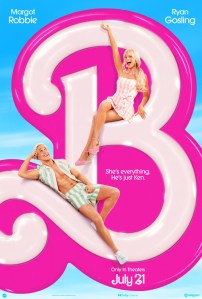
Who would have guessed a movie based upon a ubiquitous doll that dates back to the 1950s would become not just a cultural force and reclamation project but also the biggest moviegoing event of the year, as well as the highest-grossing movie in Warner Brothers’ history, even outpacing The Boy Who Lived? In 2023, it turns out we are all, every one, a Barbie girl living in a Barbie world. I came to this experience late, wondering if writer/director Greta Gerwig’s movie could live up to the lavish hype, the fawning praise, the hilarious offenses that many fragile males have levied against it. It couldn’t possibly be that good, could it? I saw it with three generations of women in my family, something I will privilege, and I must say, it is that good. Barbie is one of the best movies of the year and a shining example of what vision and passion can do to elevate any story. There’s so many ways this movie could have just been cheap corporate slop and instead it becomes an existential yet deeply personal treatise on life and death.
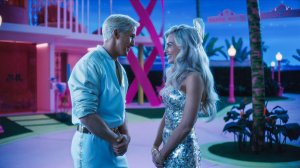
In the world of Barbies, women rule and the men are just afterthoughts. In this creation myth, the Kens were meant to compliment the Barbies. We watch “Stereotypical Barbie” (Margot Robbie) go through her daily routine of fun, frivolity, and nightly dance parties with all her best gal pals (no boys, er Kens, allowed). Then one day, this blonde Barbie started walking differently, started seeing the world differently, and started wondering about dying. Was there something wrong? Her human owner, in the real world, was in trouble, so Barbie sets off on an adventure to find her human owner and save the day, with help from her boyfriend, Ken (Ryan Gosling). Except for these two, the real world is very different from what they were expecting.

It’s easy to see how this movie could have been a mediocre fish-out-of-water comedy, with Barbie clashing in our modern-day world with its modern-day views of fashion, body image, and what skinny, buxom dolls represent to generations of young impressionable children. It’s clear to see what the scrapped version could have been when Amy Schumer was attached to star. What really impressed me with Barbie, beyond its delightful and inspired production values, is how ambitious and well-realized this movie is at every turn. It could have settled for easy jokes about Barbie and Ken not fitting in, not understanding human relationships and sex, and that stuff is there and it’s quite funny, but Gerwig and co-writer Noah Baumbach want to do so much more. This is a studio blockbuster, based upon a decades-long popular toy, that wants to do more with its platform. It aims higher, and in just about every measure, Barbie admirably succeeds. As a comedy, it had me howling with laughter, enough so that my response was providing another level of entertainment for my wife. There are jokes that are so specific, so beautifully targeted, that when they detonated, I was in awe and appreciation, (a reference to the literal definition of fascism and a Snyder Cut throwaway reference were perfectly attuned to my comedy sensibilities, thank you, Greta). As a frothy and fun fantasy, the movie has excellently crafted sets and costumes and retro visual aesthetics, making the movie a pink-accentuated sensory bombardment. But as a satire is where Barbie really becomes special.
Again, it would be easy for Barbie to learn lessons about body diversity and positivity and likely be browbeaten into what a good feminist is supposed to be, that the real world is a harder place for women than she previously thought. All of that is there, along with a consistent and entertaining critique of the faults of patriarchal society, but Barbie isn’t some reductive, man-hating screed to indoctrinate women into thinking they don’t need men (men are already very good at convincing women they don’t need men). This is a treatise on the power of inclusion and how this benefits society, both for men and for women. In Barbie Land, it’s a matriarchal society where girls rule and boys drool, but it’s a fantasy world reminiscent of a caste system, where the Kens will always be lesser afterthoughts because, well, they’re not Barbies, they’re just Kens. They are excluded in their own world. That’s why Gosling’s Ken is so excited by the real world, where the status quo is flipped, where the world is run by men, as he now sees this as an opportunity that has been denied to him. He wants to recreate his own version of the patriarchy not because he thinks women are inferior but because he just wants to be in power and respected, so he’s replicating his misguided understanding of what men in power are like, which naturally involves lots of horses. In the real world, Ken admonishes a suit-wearing corporate executive that they aren’t doing patriarchy right, to which the man winks and says, “We’re just better about hiding it.” The final act isn’t about “bringing down the patriarchy,” it’s about making a more inclusive world where people don’t have to feel marginalized and stuck and resentful.

Besides its social satire, there are other areas where Barbie goes deeper in surprising and affecting ways. There are more than a few applause-worthy moments explaining the perspective of women, particularly a monologue that is destined to be an audition piece for the rest of time, and it all works and is cutting without being too didactic. Gerwig even gets in a few jabs about corporate culture (“Are there any actual women in this boardroom?” “I’m a man with no power, does that make me a woman?”) and Mattel as an organization becomes another force of antagonism spearheaded by hapless buffoonish men (of course you get Will Ferrell to play the Mattel CEO). The biggest surprise is how emotional and deep the movie can become. There will be plenty that tear up just having a big Hollywood movie recognize their day-to-day emotional toil of being a woman in modern society. For me, the questions over what to do with the life we have flirted with some surprising existential contemplation, as Barbie is reminded at several points that death is a reality and yet would she want to move to the human world? An emotional highlight occurs when Stereotypical Barbie is speaking with the equivalent of her creator, and Billie Eilish’s tender-to-the-point-of-breaking song “What Was I Made For” lilts onto the soundtrack, and the sincerity of this sequence, topped with insert home video footage from the production cast and crew, really hit home how much more this movie is going for then bringing different dolls to life. It’s not just jokes about crotch-less creatures and weird feet, it’s about how we can live and why we do so, what inspires us. It’s a big studio summer release that flirts with the profundity and brevity of life.
There is one actor who deserves their own special recognition and that is Gosling (The Nice Guys), who so rarely gets to showcase his sharp comedy skills with the dour, serious, insular roles he gravitates to. Gosling is so committed to his role that he is operating on another plane of excellence, hitting sly jokes within jokes and selling every wonderfully stupid moment with Ken. This man isn’t afraid to look silly, he fully courts it, embraces it at every opportunity, and yet his performance doesn’t detract from Robbie but only makes them both shine brighter. He reminded me of Tommy Wiseau at points. His hilarious ballad “I’m Just Ken,” which segues into a wild West Side Story-style dance battle that is peak peacocking, is a phenomenal run of inspired silliness (the storming of the Malibu beach had me rolling), yet also connected to the character’s co-dependent arc and dissatisfaction with himself (when feeling down, just quote: “I’m just Ken, and I’m enough, and I’m great at doing stuff”). Ken has to learn to think of himself outside his combined definition with Barbie, and they both need to spend time discovering who they really are rather than who they think they’re supposed to be before considering forming attachments. I would not be surprised if Gosling earns a Best Supporting Actor nomination. It was the role he was born to play: insecure accessory doofus.
Gerwig has launched to mega-stardom with just three directing efforts (four if you count her co-directing effort in 2008 with Nights and Weekends, back in her early mumblecore breakout days). Already this woman has been nominated for Best Director, one of only seven ever, and she now owns the highest grossing movie of the year as well as in studio history. She’s proven herself with her 2017 coming-of-age semi-autobiographical Lady Bird, richly realized and achingly felt, with an established literary classic that is a foundation to generations, and had been adapted a dozen ways for the cinema, and yet she found ways to make her 2019 Little Women modern and personal, and now, on her biggest stage, being handled corporate IP that would be perfectly fine with just selling more toys, she has made a movie for the moment, something that compelled audiences back to theaters in droves, that will become a staple for a generation of film lovers. With just three movies, Gerwig has established herself in a league of her own as a director. Anyone who can turn the Barbie movie into a hilarious, poignant, and meaningful meditation on our times, on the relationships between mothers and daughters, and on life itself is a talent that deserves every creative latitude to achieve her vision. The voice and vision behind this, even to the smallest detail, is so impressive and fully committed and well developed and fabulous. Barbie is one of the best movies of the year and proof that studio blockbusters can indeed be more.
Nate’s Grade: A
Share this:

The Gray Man (2022)
 Two movies removed from the Marvel Cinematic Universe (MCU), I’m starting to wonder if the brotherly directing duo of Joe and Anthony Russo are absent their own vision. Cherry was an exhausting and annoying experience overloaded with self-conscious stylistic choices that dominated the movie and squeezed it from its dramatic potential. Now we have The Gray Man, based upon the 2009 book by a former Tom Clancy writing collaborator, and it looks indistinguishable from any other big-budget spy thriller. It feels like The Russos doing their version of Michael Bay doing his version of the Jason Bourne series. It’s an expensive movie for Netflix, in the range of $200 million, and it just made me think about 2019’s Six Underground, their $200 million collaboration with Bay where he had creative freedom to make the most bombastic, hyper masculine, and tedious movie of his career. If you’re going to devote a fifth of a billion dollars for a Michael Bay-esque action movie, you might as well hire the real deal again. The Gray Man is a passable action movie, especially in its middle, but it’s wholly derivative and coasting off your memories of better spy thrillers and better characters.
The titular “Gray Man” is a super-secret Sierra agent given the code name Six (Ryan Gosling). He’s been the government’s indispensable tool for taking out bad guy and keeping the world safe for 18 years, working time off his prison sentence. Then it all goes wrong when, of course, his callous boss (Rege-Jean Page, Bridgerton) demands he “take the shot” even if it means the death of an innocent child in the process. Six declines, the covert assignment becomes much messier, and he learns that his target was a former agent from the sane secret Sierra cabal. The dying man gives Six a MacGuffin necklace that the big bad boss really wants. Six goes on the run, with the help of some allies like another agent (Ana de Armas) and his retired handler (Billy Bob Thornton), and the CIA sends every professional killer to get their man. This includes the mustachioed Llyod Hansen (Chris Evans), a ruthless private mercenary who brags about being kicked out of the C.I.A. academy for his lack of ethics and impulse control issues.
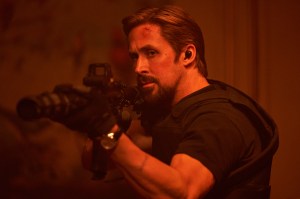 If you’re just looking for an action vehicle that provides enough bang and sizzle, The Gray Man can suffice. I’ll champion the highlights first before equivocating on them. There’s a recognizable blockbuster elan to the movie with enough energy to keep your attention. There is a significant uptick in the middle that gave me a false sense of hope that The Gray Man had transformed into a better movie. Again, this occurs well into an hour into a slightly under two-hour movie, but credit where its due, there is a nicely developed sequence of substantial action. For being a spy thriller, a majority of the movie takes place in and around Berlin. Six is handcuffed by German police to a park bench in the middle of an open square. Lloyd sends in vans of powerfully-armed goons that take out the police and then set their sights on Six. He’s trapped to the bench but still mobile, to a point, but he’s also unarmed. Watching the character react to these limitations and adapt is greatly pleasing. This is the stuff of good action cinema; supermen get boring without having to overcome legitimate obstacles and/or mini-goals. He’s able to escape and thwart his attackers and hides in a tram. This then becomes the next level of our action, and he has to utilize close-quarter combat to tease out his new attackers. And then a speeding truck with a rocket launcher shows up. And then de Armas shows up with a sports car for Six to try and leap into. And then both of those vehicles do battle while Six climbs atop the speeding tram and uses the reflection in a passing building to line up his shot to take out a goon inside the train underneath his feet. This entire middle action set piece is top-notch. It’s exciting, stylish without being too derivative, and there’s a clear set of cause-effect escalation. This is good action writing, and it’s a shame that this is also the peak with still 40 minutes left.
The beginning and closing of The Gray Man blunt whatever enjoyment I could gather. The film is oddly structured and uneven from reliable screenwriters Christopher Markus and Stephen McFeely (Avengers: Endgame). The opening scene watching Thornton recruit Gosling in his jail cell seems completely superfluous as something that could have been explained in passing, or needed no setup, but it’s at least short. There’s also a lengthy flashback in the middle of the movie that sets up Six’s allegiance to Thornton’s niece (Julia Butters, the little girl from Once Upon a Time… in Hollywood) as he babysits and saves her from kidnappers. Again, I don’t think we needed to have a set up why our protagonist would deign to save a child, but even if the movie wants to add more emotional heft to their relationship, why drop this in the middle of the movie? Why not even have this open the movie instead of the jailhouse recruitment? I like their scenes together. It reminded me of 2016’s underrated The Nice Guys. It’s just not enough to hang onto because there is no heart to this film; it is all quips and speed and flagging genre imitation. Just re-read the plot description. The genre cliches are all there, and we even have the old chestnut where the villain monologues that they and the hero are not so different.
 There’s also a questionable series of shorter flashbacks of Six as a kid surviving his abusive father’s rigorous “training,” including burning a kid’s arm with a cigarette lighter or dunking his head underwater. Again, I doubt we needed to visualize these scenes when Six could have explained his traumatic upbringing with Gosling’s acting. I was worried, and I’m still not dissuaded, that The Gray Man was establishing the parental abuse as having trained Six for these unique circumstances, that dear old bad dad somehow saved his adult son’s life. Do we need a flashback of his dad holding his head underwater to convey that Six, as his head is held underwater by Lloyd, does not like this? It reminded me of 2017’s Split when Shyamalan questionably had his character survive her captor because he recognized that she too had been abused. Did her trauma save her? The needless jumping around in time feels like The Gray Man attempting to be cleverer, or perhaps aping more of the genre expectations from an action movie of this size. The finale also lacks either the emotional catharsis or action climax that can serve as a satisfying conclusion. The last act is a compound assault set piece but it’s really just a series of interconnected gunfights and explosions. The mini-goals and engaging cause-effect escalation from before is absent.
There are a few commendable moments or choices among the blockbuster cruise control. I enjoyed that this was not just a Knives Out reunion between de Armas and a villainous Evans but it was also a Blade Runner 2049 reunion between de Armas and Gosling. I think de Armas deserves her own spy vehicle, especially after being one of the highlights of 2021’s No Time to Die (granted, it helps having Phoebe Waller-Bridge writing your character). I liked a hand-to-hand combat scene where Six utilized flares both to obscure his presence as well as an offensive weapon. Evans is fun to watch as a preening peacock of a villain, though there’s so little to his character beyond a bad mustache and smarmy attitude. There are some decent drone shots, though the dipping of the camera makes them feel more like point of view aerial assault shots. The Russos really, really like their drone shots in this movie (how much of the budget did this suck up?). However, the drone shots just made me think of the better drone shots from 2021’s Ambulance, Michael Bay’s newest movie, and it further cemented The Gray Man feeling like a clunky combination of other movies and artists. If you’ve seen any espionage action movie of the last ten years, you’ve seen enough to recognize all the key pieces of The Gray Man, and while its competent enough to satisfy the most forgiving of genre fans, it’s really just more empty noise.
Nate’s Grade: C
Share this:

First Man (2018)
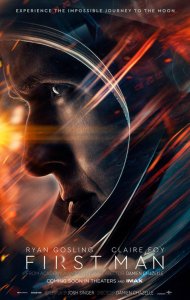 Oscar-winning filmmaker Damien Chazelle got to be the director of a Best Picture winner for approximately three minutes, which, to be fair, is more than most us will ever experience. La La Land won the top prize at the 2017 Oscars only to have it taken away and given to the smaller indie, Moonlight. Where an Academy of old white people that love to celebrate Old Hollywood decide to award a small million-dollar movie about growing up gay and black in the 80s, where does one go next? For Chazelle, it seems the answer is something even more irresistible to the Academy. First Man is partly a biopic on Neil Armstrong and partly a recreation of the 1960s Space Race. The finished movie is so mercurial, so insulated, so dry that I found a far majority of it be kind of boring.
Neil Armstrong (Ryan Gosling) is one of the select pilots training for space. NASA is racing to beat the Russians to the moon, and every new breakthrough is thanks to long hours of hard work. Janet Armstrong (Claire Foy) worries at home, listening to every radio broadcast and wondering if her husband will come back safely.
What First Man does best is make you realize how dangerous every step of the way was to get to the moon. Every leap forward required months of trial-and-error, and sometimes those mistakes cost lives, like the crew of the Apollo 1. The film opens on Armstrong flying above the atmosphere. The emerging curvature of the Earth is beautiful, but the beauty turns to horror quickly as it appears Armstrong’s plane is bouncing off the atmosphere and drifting into orbit. There’s another sequence where he and Buzz Aldrin (Corey Stoll) are above the Earth and planning to dock in space and their capsule spins wildly and if they can’t fix it they’ll black and out and assuredly die. These moments remind the audience about the inherent dangers of the Space Race that we don’t necessarily get in the history books. Looking back, we know the American astronauts succeed in the ultimate mission of landing a man, or an eventual dozen, on the moon, but that foreknowledge produces a false sense of security. Chazelle’s movie reminds us of the enormity of this challenge and the enormity of the dangers. The sound design in this movie is terrific, and Chazelle makes sure you hear every ping, every metal-on-metal scrape, to the point that you fear the whole thing could fall apart at any moment. When Janet furiously dresses down the Mission Control head (Kyle Chandler) that tries to calm her concerns, she accuses them of being boys who think they know what they’re doing. Even after the triumph of the final act, we know what happens two missions later (Apollo 13) to reconfirm just how much we still haven’t perfected when it comes to space travel.
 Besides reminding you of the precarious nature of early space travel, let alone the tests leading up to said travel, First Man doesn’t find much to justify its own existence other than as the latest in Oscar bait. It’s not exactly an in-depth look at the heroism and chutzpah of the Space Race like The Right Stuff, and it’s not exactly an examination on the frailty of man and the meticulous problem solving needed to achieve big goals, like Apollo 13. In fact, while watching this movie I would repeatedly think to myself, “Man, I should go home and watch Apollo 13 again.” When you keep thinking about watching a better movie, you have lost your audience, and that happens throughout First Man. There are thrilling, awestruck sequences to be sure, but that only accounts for perhaps a quarter of the lengthy 140-minute running time. The rest is spent at a distance trying to understand a man who comes across as largely impassive. He’s intensely focused but it’s like the movie adopts his very no-frills attitude, and it goes about its business with little thought for letting an audience into its inner world. We’re still only visitors at best here.
I admittedly don’t know much about Armstrong the man, so I can’t tell if the role was shaped for Gosling’s talents or he just matched perfectly with the man. Armstrong feels like one of the Nicolas Winding Refn roles (Drive) that we’re used to watching Gosling portray. Armstrong feels like somebody ported over a guarded, reserved, mostly silent Refn character into a staid biopic and asked Gosling to communicate a majority of emotion through unblinking stare downs. If there’s one actor you don’t want to challenge to a staring contest, it’s Gosling. Armstrong comes across a very internal man who seems uncomfortable in the spotlight, far less natural than Buzz Aldrin, who the movie unexpectedly positions as kind of a saying-what-we’re-all-thinking jerk. Because Chazelle has decided to keep Armstrong so guarded, it makes the film feel distant, like we’re being told the story second-hand, and that requires Chazelle to fill in the gaps as to the internal motivations and insights for an intensely private man. The answers we’re given seem almost cliché (the death of his young daughter is what drove him into his work, to escape the bounds of his Earthly grief, and to finally say goodbye to her). It’s too convenient as a simple character arc to be fully believed, but that’s all we have to work with because the movie won’t give us much more. It feels more like you are getting the idea of Neil Armstrong the Man rather than a realization. It’s a frustrating experience, watching a biopic and having the filmmakers keep their prized figure behind glass.
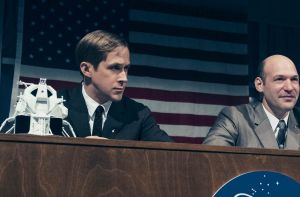 As a director, Chazelle is proving to be a remarkably skilled chameleon. First Man is completely different in style and approach to La La Land as it is to Whiplash (still his finest). His chosen approach for First Man is locking to Armstrong’s perspective, so we’re working with a lot of handheld camerawork that orbits our movie star. Chazelle’s cameras emulate a docu-drama aesthetic and there are several moments where the action happens onscreen and the cameras race to frame it, leaving the image blurry for seconds. I’m not sure that was the best decision. It does create a sense of verisimilitude, which heightens the thrilling aspects of the film like the excursions into space travel. However, it does little to heighten the underwhelming domestic drama on the NASA block. The added realism only benefits a small portion of the movie. At times, a camera racing to catch up with the onscreen action would be considered a hindrance. The claustrophobic feelings are heightened from Chazelle’s cramped camerawork, reminding us again of the tightly precarious spaces these men were willingly sliding into, the fragility of the cockpit walls separating them from an unrelenting empty void. When we switch over to the Apollo 11 mission, Chazelle keeps the attention squarely with the three men making the famous lunar landing. There’s a stirring thrill of destiny and the film transitions into an IMAX footage to make the moment that much more immersive and transformative.
First Man is much like the man of its title, reserved, guarded, and with a laser-like focus on its mission at the expense of outside drama. Chazelle is an excellent filmmaker and the craft on this out of this world, from the production design to the thrilling recreations of the dangers of space, bringing together the alarm through a sumptuous combination of editing, sound design, and cinema verite photography. Of course that verite style is also a double-edged sword, providing another layer to distance the audience. This is a pretty guarded movie with few insights into Armstrong the person. We get more Armstrong the pilot and numbers-cruncher, and I wish Chazelle had steered more into whatever version of Armstrong that opened him up to the audience. The family drama stuff is pretty pat and Foy (The Girl in the Spider’s Web) is generally wasted as the supportive and anxious wife. Most of the actors are generally wasted in this movie, with the potential exception of Gosling, who slips into the shoes of an impassive and emotionally restrained protagonist like it’s second nature. First Man might not be a giant leap artistically, and in fact a majority of the film is dull, but the artistic highs are enough to warrant one viewing. From there, you’ll likely conclude that you don’t need to watch Neil Armstrong stare forlornly into the middle distance again. Frankly, I’d rather watch La La Land again, and that’s saying something.
Nate;s Grade: B-
Share this:

Blade Runner 2049 (2017)
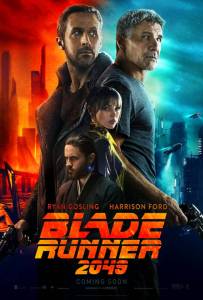 It’s confession time, dear reader. I do not love Blade Runner. In fact I find it to be overrated and then some. I’ll freely admit that it’s been an extremely influential science fiction work and its noir-soaked depiction of a cyber punk future has been the starting point for cinematic storytelling in that vein for decades. It’s got merits but I find the real merits to be its amazing use of production design, special effects, and the establishment of an overall atmosphere. It has some big ideas, yes, but it doesn’t know what to do with them, neglecting them for a slapdash story with some so-so acting. Rutger Hauer’s soulful yet doomed replicant should have been our central perspective. I wish I enjoyed the film more but I cannot attach myself without nagging reservation, and that’s not even accounting Ridley Scott’s numerous re-edits and the harebrained idea to imply that Harrison Ford was really a replicant after all even though that runs counter to the logic and themes of the film and Scott had to splice in unused unicorn footage from a movie he shot years later, thus proving this new twist ending was never part of anyone’s original story conceit. Anyway, what I’m saying is that the 1982 Blade Runner was not going to be an impossible hurdle to clear as far as I was concerned. The sequel 35 years in the making, Blade Runner 2049, is a better and more accomplished film experience and film story than the original, and it’s also one of the best, most visionary movies of the year.
Set in 2049, replicants have been shuttered and replaced with a new breed of android slave labor controlled by the enigmatic Niander Wallace (Jared Leto). He’s after a very special kind of replicant, one that will lead to even greater success, allowing mankind to reach further out into the stars. Agent K (Ryan Gosling) is a blade runner who finds himself looking for this same special kind of replicant. He must find it before Niander does and K’s journey of self takes him right to the doorstep of retired blade runner, Deckard (Ford).
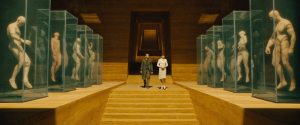 Apologies for the frustratingly vague plot synopsis above, but I’m trying to keep things as relatively spoiler-free as possible because I think that will improve the overall viewing experience. In an age where trailers and TV advertisements tell us everything about a movie in a zealous attempt to get our butts in seats, I was genuinely surprised at significant plot beats the 2049 advertising had successfully and deliberately kept under wraps. There are intriguing plot turns and character moments that I want to leave the reader to discover on their own. It will be worth the wait.
Director Denis Villeneuve (Arrival, Sicario) has created a filmgoing experience that immerses you in feeling. Every set, every little corner, every minor character goes toward enriching this world and making it feel real, like we’re just dropping in for a visit. He builds off the iconography from Scott in the first film and creates a future that is hypnotic and eerily beautiful, aided by the greatest living cinematographer, Roger Deakins. Seriously, if Deakins finally doesn’t win his long overdue Oscar for this, then the Academy is just never going to favor him. The visual landscapes of this movie are jaw dropping and the use of lighting is gorgeous. There’s a late sequence set in an irradiated Las Vegas where an orange fog hovers over the empty landscape of earthly pleasures. There’s a hiding sequence that takes place in a casino showroom, with holographic dancers and even Elvis fritzing in and out, static movements and bursts of sound that make for a dream-like encounter. Another wonderful hypnotic sequence is a threesome between K, a prostitute, and a virtual intelligence (V.I.) named Joi (Ana de Armas). Reminiscent of Spike Jonze’s Her, the sequence has one woman literally folded over another as hands caress, mouths kiss, and the whole sequence has an alluring disconnect during the acts of physical intimacy. This is a gorgeous movie to simply take in and appreciate the sumptuous visual brilliance. Villeneuve has quickly become one of the best big screen visual artists we have today.
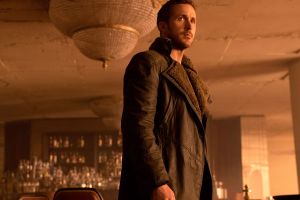 What separates 2049 and makes it better than the original is that here is a film that takes big ideas and knows what to do with them. This is an intelligent film that finds time to develop its ideas and to linger with them. This is a long movie (2 hours 43 minutes, the longest film so far of 2017) and one that many will decry as boring. That’s because Villeneuve and screenwriters Michael Green (Alien: Covenant) and Hampton Fancher (Blade Runner) commit to allowing the movie time to breathe, and scenes can take on an elegant life of their own becoming something of stunning power. Take for instance a scene where K visits the woman in charge of creating the false memories for replicants. Because of an autoimmune disorder, her life is behind glass, but she gets to create her own world to thrive in, and we watch her fine-tune the memory of a child’s birthday party while K asks her questions over her work. He has questions over the validity of memories, and this opens up a deep discussion over the concept of self, authenticity, and ownership over memory, all while still being character-based. It’s lovely. It’s like somebody saw the potential of the original Blade Runner and added the missing poetry.
2049 is driven by a central mystery but it’s also an exciting action movie. The sequences are few and far between but when they do happen they too luxuriate in the extra ordinary. The way the replicants are able to move again brings up that visual disconnect that can be so pleasing. A replicant-on-replicant fight is like a sci-fi superhero brawl. Dutch actress Sylvia Hoeks is our chief antagonist, Niander’s muscle on the outside. She might not have the languid magnetism of Daryl Hannah or playful philosophy of Hauer but she more than makes for a memorable and impressive physical force. The action and chase sequences are minimal, but when they do pop up Villeneuve doesn’t put the rest of the movie on pause. The characters are still important, the story is still important, and Deakins’ visual arrangements are still vastly important. 2049 is a movie at its best when it’s still and meditative, savoring the moment, but it can also quicken your pulse when called.
Gosling (La La Land) is uniquely suited for this character, another in the legacy of Sam Spade and Phillip Marlowe. His taciturn nature is essential to his character. This is a man going from day to day. His only emotional attachment is to Joi, the V.I. projection, and even that relationship is called into question knowing she is a product meant to serve. This relationship is given a healthy dose of ambiguity so that an audience never fully knows whether Joi genuinely cares or is just following the dictates of her programming. Gosling provides a quiet yet impactful turn as a man searching for answers. In the opening scene, Dave Bautista (Guardians of the Galaxy vol. 2) plays an older replicant that K must “retire.” Bautista says the difference between them is one of faith, as he has seen a miracle, and this allows him to believe in something greater. This opening interaction lays the foundation for K’s character arc, as he searches for his own faith. It’s not necessarily a spiritual faith per se but definitely a belief in a renewed hope.
 Another aspect lovingly recreated is the trance-inducing synth score from Vangelis, this time cranked up all the way to eleven by composers Hans Zimmer and Benjamin Walfisch (It). It comes in like waves, blaring loudly to the point that you swear you can hear the theater’s speakers rattling. It’s omnipresent and oppressive and it’s so freaking loud. I challenge anybody to fall asleep in the theater and actually stay asleep.
Blade Runner 2049 is one of those rare sequels that not only justify its existence but also improve upon its predecessor (again, not the biggest fan of Scott’s movie). It’s reverent to the older film and its film legacy while still charting a path all its own that it can stand upon. It takes a far more interesting narrative perspective to jump forward, possibly serving as a corrective to the original. I was fully engaged from the start as it challenged and entertained me to its concluding image of snowfall (oh no, spoilers!). This is a long movie but your patience pays off and then some. This is a deeper dive into the themes of author Phillip K. Dick and a better development of them. See it on as big a screen as possible, make sure to get your bathroom visits out of the way before it starts, and prepare for your eardrums to bleed from Zimmer’s blaring tones. Villeneuve has created a thoughtful, mature, exciting, and absorbing work of art that will stand the test of time. It won’t be as monumentally influential as the original Blade Runner but it is the better movie, and right now, in 2017, that’s a much more important factor for me as a viewer.
Nate’s Grade: A
Share this:

La La Land (2016)
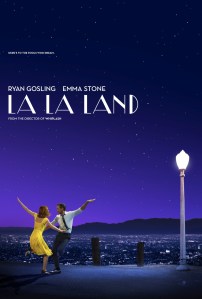 I understand that the year 2016 has been, charitably put, unkind to many people and why we all could use a little escapism around this time of year. Writer/director Damien Chazelle made a big Oscar splash with 2014’s Whiplash to make his passion project, a sincere musical that recreates the style of classic Hollywood. La La Land is a stylistic throwback that has enchanted critics and seems destined to compete for some of the biggest awards this season. Just imagine how much better it would be if it was great.
Chazelle and company certainly knows how to make an impression. The opening number transforms an L.A. traffic jam into a full-blown song-and-dance explosion, with commuters exiting their cars and coalescing into a teaming mass of jubilation on the freeway. It’s a moment that is sincere and full of energy and promise. The brightly colored commuters come together in long unbroken shots with a widescreen camera that dives and dips and leaves plenty of space for the audience to appreciate the dancing. This is a movie that wants you to see all of the rainbow-colored performers while they strut their stuff. It’s here that we’re introduced to Mia (Emma Stone), a part-time barista and struggling wannabe actress, and Sebastian (Ryan Gosling), a jazz musician who dreams of opening his own club at a historic site. These two dreamers resist each other but of course destiny has another plan. A highlight is a flirty sequence set atop a Hollywood Hillside overlooking the purplish dawn. Mia and Sebastian sing how beautiful this scenic view would be if only they were with someone they loved, playfully antagonizing the other into a dancer’s rivalry. The dancing is mischievous and fun and performed in wide angles to soak in the movements. It’s easy to get caught up in Chazelle’s early swell, a transporting experience that extols the virtues of classical musicals by the likes of Vincent Minnelli, Gene Kelly, and especially Jacques Demy’s The Umbrellas of Cherbourg. Chazelle fills out his frame like a painter. There’s an infectious love for Old Hollywood that tries to alchemize its influences into something new and old, and for a good while Chazelle is able to maintain this fizzy, effervescent experience and remind you of the soothing joys of a good movie musical told with finesse and brio.
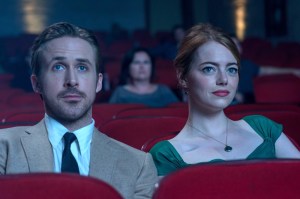 Then after about forty-five minutes the fizz gets a little staler and that’s when I felt the gnawing emptiness underneath all the Old Hollywood homage. It reminded me of 2011’s Best Picture winner, The Artist, as a movie that is more affectionate imitation than genuine substance. As I wrote in my review for The Artist: “The entire affair has such a slight feel to it; the movie is a confection, a sweet treat that melts away instantly after viewing. If you strip away all the old Hollywood nostalgia, there is very little substance here.” It’s all mimicry of the highest order but Chazelle hasn’t put enough authentic feeling into his imitation. There’s a fealty to the sources of his inspiration that Chazelle is replicating, and his screen pops with coded visual reminders (look, it’s Gosling leaning off a street lamp), but it fetishizes the inspirations rather than building from them. Quentin Tarantino is transparent about his outré influences but he doesn’t forget to tell an engaging story too. It’s in the movie’s dispiriting second half that it becomes all too clear just how little substance there is to our lovers as well as the industry satire. This is miles away from Singin’ in the Rain, folks (my favorite film musical, for the record) and more the same old broadsides about the industry: they’re shallow, they’re inconsiderate, they swallow up the dreamers, they “worship everything and value nothing,” as Sebastian put it. It’s not like the movie is telling you anything you haven’t heard before, and that’s fine but it limits any impact. It also seems to exist in a universe where minorities are mere background players to prop up the dazzling lives of the beautiful white leads. Imagine the enjoyment if some of that snappy industry satire was reserved for its less progressive casting practices. Can you imagine this kind of movie starring Tessa Thompson (Creed)?
Affection can only go so far because eventually the gravity of your characters, their relationship, their goals and dreams and relatability will need to kick in, and it doesn’t. I think this is because the first forty-five minutes are the typical rom-com story of the boy getting the girl. It’s the portion where the movie weaves its old Hollywood spell and courts us too, and it’s fun. And like bad relationships, once it has you La La Land feels like it has to do less work. Chazelle has to manufacture a series of pity problems (more below) to push his lovers apart and question whether these two star-crossed kids might make it after all. If the beginning half is the swirling romance that reverently celebrates old Hollywood, the second half is the attempt to “ground” the film in a sense of realism. It feels too late tonally to switch gears and it undercuts the first half. It might sound contradictory but if La La Land was just going to be a trifle then I wish it went all-in rather than half-heartedly trying an “edge” of harsh reality to mix the sour with the sweet. Just because the movie sets up the dreams of its characters, puts them together, and says not so fast doesn’t mean that Chazelle has properly set up this nascent melancholy.
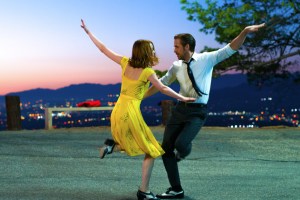 Mia and Sebastian are not particularly strong characters. The unified star power of the lead actors is enough to disguise this fact for a majority of the movie and maybe for some the entirety. They don’t have anything of import to say beyond their dreams and their jobs that are presently in the way of achieving said dreams. I couldn’t tell you anything else about these characters. For Mia and Sebastian, the world is divided into those who are pure and those who are impure, the real artists and the phonies, and the dichotomy will rankle anyone who has interacted with more than their share of hipster. Sebastian is a music snob who wants to impress upon the world the importance of jazz even as it shrugs indifferently. Nobody gets it, man. He’ll fight the good fight no matter what because Sebastian’s fight is Chazelle’s: taking outdated material and exporting value to a new generation. The characters serve the plot and exist to entwine and then be dutifully pulled apart. It’s hard to invest in the characters when they won’t show who they are and why they should be together. Maybe that’s the point ultimately, a rich meta commentary on how attenuated the central courtships in movies themselves are, or the fleeting relationship between film and audience, or maybe I’m just hoofing as hard as the leads to insert more meaning here.
The second half paddles into what my friend Ben Bailey affectionately termed White People Problems: The Musical. I won’t fully concur but the conflicts are too forced and the characters become whiney. Sebastian rejoins a pop band where he doesn’t feel 100 percent creatively fulfilled because he isn’t performing “true jazz.” The band is also popular and this causes friction because he has “sold out” on his dream, as if toiling during for any period of time is giving up. I guess you must be single-minded or it doesn’t count. Their combined egos won’t allow for different variations of success. La La Land pretends to endorse the dreamers but does it really? The only dreamers who seem to count are Mia and Sebastian. What happened to Mia’s lively group of roommates and friends from the beginning party? What about the nebbish screenwriter the movie mocks for an easy laugh? There are no significant supporting characters in this movie; the universe belongs to Mia and Sebastian. They’re not as insufferable as the characters from Rent but it’s definitely a detriment. Look at the characters in Fame, a group of hungry teenagers who came from all walks of life and circumstances to try and achieve their titular dream of stardom.
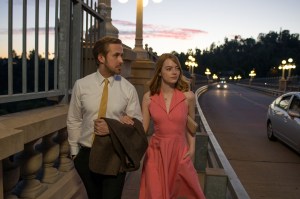 The limitations of its doe-eyed leads present some issues. Stone (Birdman) is smashing in the movie but part of that is because, aside from some song-and-dance choreography, the movie asks very little of her other than to be cute, a trait Stone has in natural abundance. There are two standout scenes for the actress. The first is an audition where she pretends to be a mistress getting the “sorry, I can’t do this” phone call from the man she thought had loved her. The sheer variety of emotions that Stone is so able to quickly convey on her face, in her tremulous eyes, and posture are remarkable. Of course the problem is that she’s too objectively good to keep getting blithely rejected by cold-hearted casting agents. The second is a musical showcase where Stone belts out a story about how her aunt inspired her to be a thespian. Stone is effortlessly captivating but she deserves better than to be foil to a grumbly Gosling. I feel that Gosling is one of those actors who can be amazingly talented when plugged into the right role and with the right director (see: Half Nelson, The Believer, The Big Short). He has an easygoing charm that all-too easily morphs into smarm without the right guidance or motivation on his part. Sebastian feels like a scowling grump who wants to bludgeon the world with his point of view. It feels more like he’s in it for submission. Gosling’s performance left me wanting someone else to play his part. They were so strong on screen in Crazy, Stupid, Love but that sizzling chemistry of old is gone here. They feel inert together, amplified by Gosling’s antiseptic performance. They’re both rather limited singers, very thin of voice, and that does hurt a musical. The songs by composer Justin Hurwitz and lyricists Benj Pasek and Justin Paul are exceptionally milquetoast. They’re all slight renditions on the same blandly pleasant tune. They evaporated from my memory by the time the end credits started rolling. Moana has nothing to fear come Oscar time from these at-best competent compositions.
If imitation is the highest form of flattery, then Chazelle’s anodyne musical is brimming with appreciation and adoration for the world of classic Hollywood, and that alone will be effectively transporting for many film critics and select audiences bred on a diet of Fred Astaire and Ginger Rogers. La La Land is an airy confection but one that dissipates all too easily after viewing thanks to the limited characters, the limited singing, the limited dancing, the limited songs, and the lack of overall substance independent from imitation. It has its lovely moments and Stone is an ingénue worth loving, though not as much her slim character, a dreamer who dreams the dreams of a dreamer. The breezy and bubbly first half doesn’t really mesh with the second half. I think it’s telling that Mia and Sebastian’s “love theme” is a sad plaintive piano trinkle. As the characters get more sullen and sour, the fizzy fun fades away and it starts to feel like a New Year’s Eve hangover that left you addled and warm but only in a vaguely ephemeral sense. If it leaves you toe tapping and giddy, I’m glad. I’m already mentally prepared for it to practically sweep the Oscars, as they do love celebrating their own importance. La La Land is a movie musical that is stuck looking backward that it loses its own footing.
Nate’s Grade: B-
Share this:

The Nice Guys (2016)
 Ever since I heard about its production, and especially after watching the first trailer, I have been intensely anticipating The Nice Guys, mostly because of my fervent and undying love for 2005’s Kiss Kiss Bang Bang. That gem was writer/director Shane Black’s manic and deliriously entertaining comedy noir that reinvigorated star Robert Downey Jr.’s career. The Nice Guys looked very much like a spiritual successor or predecessor given its swanky 1970s setting. While an enjoyable and funny caper, there is a significant gap between KKBB’s genius and the altogether amusing though lesser escapades of The Nice Guys. Perhaps it’s unfair of me to have had my expectations too high, to be hoping for another magical onscreen alchemy like KKBB. Whatever the case, I was slightly let down by The Nice Guys around the time I realized that the best jokes were in the trailer. They are admittedly great jokes but what was left too often hit lower registers of funny. Ryan Gosling and Russell Crowe have great chemistry together and Gosling especially showcases a talent for physical comedy that has been underutilized. When the movie finds ways to undercut detective movie tropes, like Gosling cutting his hand badly after a failed attempt to break into a locked window, that is when it feels most alive and fun. The action elements don’t feel as significantly connected, like a bunch of washout villains like a hitman named John Boy who has no memorable personality. The shaggy dog mystery has some entertaining detours but once again the real draw is the comic interplay of the two male leads and Black’s razor-sharp dialogue. The man perfected the buddy cop interplay at some point, and often the casual conversations and one-liners are more highlights than the set pieces. The Nice Guys is a funny, smart, and diverting detective action-comedy that is a solid effort from everyone involved. It’s just that I was hoping for a touch of the divine again and had to come back to Earth.
Nate’s Grade: B
Share this:

The Big Short (2015)
 Adam McKay is not exactly the kind of name you associate with a prestige picture that’s building serious Oscar heat. McKay is best known as the director and co-writer of Will Ferrell’s best movies, from Anchorman and its sequel to Talladega Nights and the underrated 2010 buddy cop movie, The Other Guys. If you stuck through the closing credits for Guys, you were treated to an animated education lesson on the size of Wall Street’s greed and accountability in regards to the 2008 financial crisis. It was impassioned, angry, and an interesting note to end an otherwise goofy comedy. The Big Short is based upon Michael Lewis’ (Moneyball) best-selling book and it’s a disaster movie where the biggest disaster is the world economy. The movie McKay co-adapted and directed is bristling with intelligence, indignation, and a clear purpose. He wants to make you very angry, and by the end if you’re not, you haven’t been paying enough attention.
In the wake of the financial collapse in 2008, the fallout was so tremendous that many people felt nobody could have seen this coming. There were a few and they made out like bandits while trying to warn others about the impending doom. In the early 2000s, Michael Burry (Christian Bale) is a hedgefund manager who sees warning signs that the housing market is a bubble ready to burst. He sees the toxicity of the majority sub-prime mortgages wrapped together and sold as a seemingly safe security, a CDO (collateralized debt obligation). His bosses think he’s mad and they’re furious when they discover Burry has gone from bank to bank making big bets against the housing market. The banks are eager to take what they believe to be easy money from a sucker. How could the housing market burst? Other Wall Street investors take notice of Burry, notably Jared Vennett (Ryan Gosling) who pitches the plan to “short” the housing market. Nobody takes him seriously except Mark Baum (Steve Carell) and his small team who works for Goldman Sachs. Baum is curious how something so large could go unnoticed, so he and his team fly to Florida and Vegas to investigate the realities of the market and what they find does not match the rosy cheerleading from Wall Street. A pair of wannabe traders (Finn Witrock, John Magaro) stumbles across Burry’s analysis and try to make their own bets, except they need a bigger name to make the trades. They reach out to an ex-Wall Street trader (Brad Pitt) who agrees to shepherd them on this quixotic quest. Are these men righteous defenders of fraud or just people trying to get their own cut of the pie?
 The brilliance of The Big Short lies in its accessibility and the virulent passion that McKay has for the subject matter. The movie is structured like a heist and an underdog story, suckering in the audience to root for the upstarts trying to fleece the big banks and profit off their greed and stupidity. For the first 90 minutes or so, the film comes across like a caper and we follow our group of misfits as they fight against the conventional wisdom that the housing market could never topple. These guys see the signs and the risks that others could not or would not see, especially since the flow of money was rich and the good times could be shared, which lead to collusion from the very same agencies designed to regulate and enforce the financial laws. For those 90 minutes the movie flies by on its sense of whimsy and are-we-getting-away-with-this good fortune, putting our band of misfits in position to win big on the losses of the ignorant and fraudulent. And then, in one swift move, it all comes down and you’re reminded, rather indignantly by Pitt’s character, that what they are benefiting from is the meltdown of the U.S. housing market and by extension the American economy. What once felt like a celebratory caper now starts to feel queasy, and it’s in the last act that The Big Short reminds you just how awful the events of the 2008 financial crisis were and how these guys did nothing more than benefit from mass misery. These are not heroes, though Mark Baum is given plenty of moral grandstanding moments that present him as the closest thing we have in the picture. These were a bunch of guys who got rich betting on a lot of other people’s bad bets, bets that almost destroyed the world’s economic systems. The concluding half hour feels like a sudden stop after a sugar rush, where you’re left to question your decision-making but also come to terms with the reality of what seemed like a fun time. McKay lures his audience in with the guise of a heist/underdog story, appealing and accessible avenues of cinema, and then serves the cold hard medicine in the concluding moments.
McKay is admirably trying to educate and advocate while he entertains, but he truly wants the audience to understand why they should be sharpening their pitchforks. At several points, characters will break the fourth wall and talk directly into the camera, admitting that certain events didn’t happen exactly as we saw, or occasionally they’ll remind us that what we watched was exactly how it happened. It’s a measure that isn’t overplayed and helps juice the spirits of the movie, becoming something of a confidant in the schemes with the onscreen participants. When things gets a little hard to understand with the mountain of Wall Street lingo, McKay will cut to celebrity cameos to help explain the more arcane instruments of the financial system. Margot Robbie luxuriates in a bubble bath and explains sub-prime mortgages, Anthony Bourdain explains CDOs, and Selena Gomez, in a rather cogent analogy, explains synthetic CDOs as an endless chain of side bets being made off one hand of blackjack. The movie goes pretty fast and a viewer might experience information overload but McKay knows when to slow things down and provide a well-timed assist so that his learned audience will see the true extent of the corruption and greed rampant in how Wall Street handled its business.
 Of the three storylines, I found Mark Baum and his team easily the most interesting and I think McKay and co-screenwriter Charles Randolph (The Interpreter) agreed, which is why he’s the biggest part of the movie. Burry gets things started but he recedes into the background after the first act, and that’s where Baum and his financial team step into the spotlight to further explore how unstable the housing market just might be. I think this is Carell’s best dramatic performance to date (I wasn’t wowed by Foxcatcher). He’s playing perhaps one of the angriest people seen on screen but that’s because he has a moral center and the bad business practices, let alone the sociopathic greed of his “peers,” constantly enrage him. He’s something like a flabbergasted crusading journalist who keeps shaking his head in stupefying revulsion at just how deep this whole thing goes. Having Baum as our entry into the moral morass of Wall Street allows the audience to feel a sense of ethical superiority, and then like Pitt’s character, it can all go away with one perfectly articulated retort. There’s a moment where Baum is lambasting a mortgage ratings officer (Melissa Leo, her only scene too) after she admits that if they don’t rate bad mortgages as good, the banks will just go to their competitor, and then she accuses Baum of being a hypocrite. His reason for the office visit is not his outrage at the fraud but the fact that this fraud is holding up his winnings. He’s not the crusader he may wish to be. Bale (American Hustle) and Gosling (Only God Forgives) are perfectly cast and provide strong supporting work in small doses spread throughout. Pitt is in 12 Years a Slave producer mode where he knows he needs to appear in the movie to better sell it to audiences, and so he’s here and rather unremarkable. There is a bevy of familiar faces (Marisa Tomei, Rafe Spall, Max Greenfield, Karen Gillan) appearing in small moments as if everybody in Hollywood wanted to get in on McKay’s party.
There is one annoying misstep in the movie and it occurs about halfway and it’s made to stretch out the stakes in a haphazard manner. The Big Short is a disaster movie where the audience knows exactly when the disaster is coming, and yet there’s a section in the middle where the characters are all left in doubt whether their big bets will pay off because of the ratings fraud. Burry is threatened with losing his job. It’s silly because we know the economy is going to crash in 2008, but the movie throws out a weak obstacle that, hey, maybe it won’t crash. It reminds me of the Hinderberg movie from the 1970s. There were several moments where it looked like that zeppelin full of hydrogen was going to go up in flames… except students of history know that moment is fated in New Jersey, so all the close calls were foolish fake-outs for a major event that was well anticipated. We all know the economy is going down so there’s no need for the manufactured doubts.
McKay and company want to wake up a fairly apathetic general public about the crimes and negligence of the Wall Street robber barons that risked the world’s economy and then managed to skip out on the tab. The tones can juggle wildly, and I’d credit McKay’s background in comedy for his ability to maintain a reliable and firm comic footing for the film without losing the significance of his message. It’s hard to nail down a genre for the movie; it’s a dark comedy, a drama, a true crime picture, and a wake-up call. You have moments that feel like a heist flick and moments that feel like a sickening journalistic expose. It’s got highs, lows, laughs, groans, and plenty of human emotions, though the most prominent would be disgust and disbelief. The Big Short is advocacy populism as pop-entertainment, and it succeeds ably. It’s an economics lesson for the public. At the end of the movie, the closing text informs us about “bespoke tranches,” which are investment opportunities that banks are flocking to ($5 billion in 2013 to $20 billion in 2014). It’s just another name for CDOs. Unless an informed public demands action from the system, it seems that Wall Street is doomed to repeat its same high-risk mistakes and that same vulnerable public is doomed to clean up the mess.
Nate’s Grade: A-
Share this:

The Place Beyond the Pines (2013)
 Ambitious filmmaking is welcome, but usually ambition leads somewhere, which is the main problem with co-writer and director Derek Cianfrance’s unwieldy 140-minute multi-generational crime drama, The Place Beyond the Pines. First we watch Luke (Ryan Gosling) as a traveling motorcyclist enter a life of crime to support his infant son. Next the focus shifts to Avery (Bradley Cooper) as a cop with a conscience running into corruption on the force. Last, we jump ahead into the future and watch the dramatic irony unfold as the children of Avery and Luke interact, waiting for them to learn their paternal connection. I believe Cianfrance (Blue Valentine) and his team was attempting to tell a meditative, searching drama about children paying for the sins of their fathers, the lingering fallout of bad decisions and moral compromises. Except that’s not this film. By the end of the movie, while some secrets have been laid bare, there really aren’t any significant consequences. The film does an excellent job of maintaining a sense of dread, but it doesn’t come to anything larger or thought provoking. The entire structure of this film is geared toward a tragic accumulation, but it just doesn’t materialize. That’s a shame because it’s got great acting through and through, though I have grown weary of Gosling’s taciturn antihero routine that seems like a rut now. Avery’s portion of the plot was the most interesting and anxiety-inducing, but I found the movie interesting at every turn. The characters are given pockets of nuance and ambiguity as they traverse similar paths of desperation and conciliation. The Place Beyond the Pines is a perfectly good movie, albeit disjointed, that cannot amount to the larger thematic impact it yearns for.
Nate’s Grade: B-


 nathanzoebl
You must be logged in to post a comment.