Blog Archives
Man of Steel (2013)
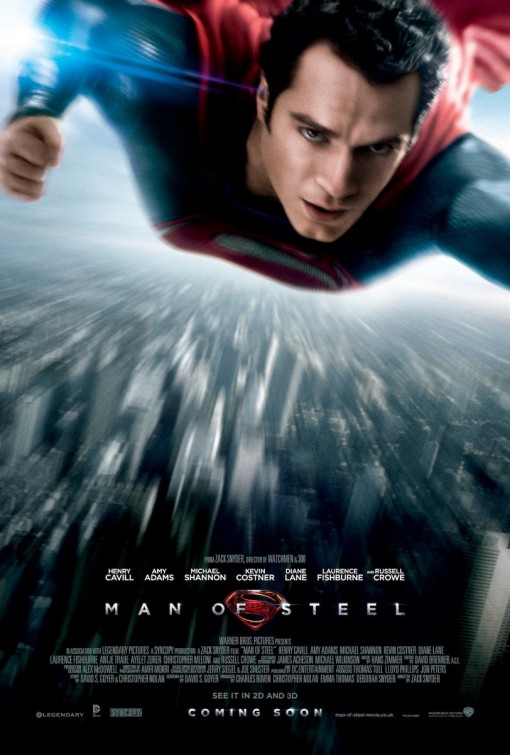 I think I began my review for 2006’s Superman Returns the same way but I don’t care. Does Superman have any relevant appeal in today’s society? I understand being a moral pinnacle has been his MO from the start, and I understand that today’s generation likes its heroes dark and broody and tortured. I know you can make Superman into an interesting figure (the man just celebrated his 75th anniversary, so there have to be some people who identify), though it is a bigger challenge, surely. I think taking a darker tack can be achievable but needs finesse. Christopher Nolan and David Goyer, having fashioned the highly successful Dark Knight trilogy, seem like a formidable pair to shepherd a darker Superman into the twenty-first century. Combine that with director Zack Snyder (300, Watchmen), and you’re guaranteed a pretty movie. Where does Man of Steel go wrong?
You know the drill at this point: Superman a.k.a. Clark Kent (Henry Cavill) was originally born on the doomed alien planet Krypton. His biological father, Jor-El (Russell Crowe), sent his son to Earth with the hope that he could survive and achieve great things. Raised by Jonathan and Martha Kent (Kevin Costner and Diane Lane), he then accepts his destiny to be mankind’s protector, butting heads and flirting with dogged reporter Lois Lane (Amy Adams). Except now Superman has the entire genetic code of Krypton’s history (?) transported into him via a “codex” (whish resembles a charred baby skull). General Zod (Michael Shannon), imprisoned off planet when Krypton was destroyed, is determined to retrieve that code and start his race anew. He and his crew travel to Earth and demand superman turn himself in, or else Earth will suffer.
 Where this movie gets into deep trouble is that it fashions Superman into an inactive loner, turning him into a super bore. He has such superhuman strength at his command but his doubtful dad has taught him that humanity would lose its mind if he revealed himself. And so Superman goes through half this movie hiding his super ability. He actively avoids conflict and confrontation. It’s basically the same formula as the Incredible Hulk TV show, where Bruce Banner would drift from town to town, warning others not to make him angry, then mournfully have to leave yet again. He can’t help himself save lives but, in flashback, dearly departed dad admonishes him for it (Clark: “Should I just have let them die?” Pa Kent: “Maybe.”). I think the isolation the character endures is essential to understanding his heavy burden, but at the same time this was compensated by Clark Kent, Superman’s opportunity to blend in with the natives, assume a frail phony identity, and to flash some much needed personality. In Man of Steel, he doesn’t become Clark Kent, news reporter, until the very last scene. It’s not a movie about a man becoming Superman but Clark Kent, experience-free reporter.
Two of the chief complaints about Bryan Singer’s 2006 Superman movie were that it was too reverent to its source material, namely the Richard Donner films, and it lacked sufficient action. Well, both of those issues are tackled in the very opening of Man of Steel. Goyer reworks plenty of Superman mythology from a science fiction angle, and so we get stuff about alien invaders, genetic bloodlines, clone baby labs, teraforming, and all sorts of spaceships. The characters keep referring to Superman as “the alien,” and dad worries that the knowledge of his super son will upset people’s worldviews about humanity and God (have no fear, there’s still messianic imagery to sledgehammer you with). I’m fine with Goyer playing fast and loose with Superman’s history but his alterations need to have solid reasoning. Nolan played around with Batman’s history and it worked because, in the context of the world and characters he developed, it fit. Does Jor-El riding a dragon like a live-action Heavy Metal fit? Does a billion people’s DNA transposed into Superman’s cells fit? Do Superman’s actions during the quite controversial ending fit? Does Clark’s stepdad, Jonathan Kent, willingly dying in a tornado fit? Does Lois Lane immediately knowing who Superman is, before he even adopts the Clark Kent disguise, fit? I doubt it, though it still could have worked. However, Goyer’s script is a mess structurally, preventing the story from gaining serious traction. First, we start with twenty-something minutes on Krypton, which could be condensed in half, then we slam into the present and this new formula appears: present, flashback, present, flashback, present. That happens for another twenty minutes. Then there’s 40 minutes of Superman dithering as the reluctant hero. Then the last hour plus is a nonstop barrage of meaningless action that squeezes out room for character growth.
I’ll credit Snyder and company for likely tripling the action quotient of any previous Superman movie (maybe even all of them combined), but I never thought such action would be so boring. Oh sure, it delights for a while with advanced special effects and Snyder’s eye for visuals, but the action sequences drag out far too long. A long action sequence? Isn’t that what you’re always demanding, critic Nate? Well anonymous and theoretical detractor, yes, I enjoy a well-developed and sustained action sequence. The problem with action sequences is that they have to matter. They have to accomplish something even if it’s just there are less enemies or the hero got from point A to point B. There has to be, at bare minimum, something that is accomplished. Sadly, this is not the case with the action in Man of Steel, which is why the sequences drag and feel like they are twice as long as their already bloated length. There’s a brawl between two evil Kryptonians and Superman and after a whole 10-15 minutes of sparring, the bad guys get on a ship and leave. Come on, Zod has like a crew of twelve henchmen. Can’t one of them at least die in a preliminary battle? Worse, the final confrontation between Zod and Superman could just as easily been eliminated. They punch and yell and punch and yell and stuff gets all smashy, but by the end of the fight, nothing has substantially changed, except the foundational surroundings (more on that below). Having two invincible beings punch each other for a half hour is not engrossing. For a lengthy action sequence to work there need to be complications, organic to the situation, and the stakes should escalate. James Cameron and Steven Spielberg are masters at crafting escalating action. J.J. Abrams is pretty good himself. Even Michael Bay has his merits. I don’t know whether to lay the crux of the blame on Snyder or the screenplay he had to give life.
 As the plodding action continued to pound me senseless, I was left to seriously ponder just how epic the scale of Superman’s collateral damage truly is. At one point, when Supes is fighting in the small-town center of Smallville, he tells the residents to, “Stay inside. It’s not safe.” What then proceeds to happen is a fight that rips up almost all the pavement in town, takes down a helicopter, a few fighter jets that crash in town, exploding, as well as a train car, plenty of ricocheting gunfire, and debris everywhere. But have no fear because those citizens stayed away from the windows and locked their doors! More than likely they are dead. The concluding clash in Metropolis is like 9/11 times eight. I counted three different skyscrapers that came tumbling down, and this is after the Krypton gravity field has ripped up the city and smashed it to dust, as well as missiles exploding around the city and Zod’s various spaceships. Then there’s the fight where Zod and Superman are blasting through just about every high-rise office building, and even when they collide outside it creates such force that buildings crater. They even fly into space, destroy a satellite, which then comes down as fiery debris that rains down on poor Metropolis. The final plan to foil the bad guys involves, get this, opening a black hole above a major city. It’s not like that sounds as if it will have catastrophic blowback.
The 9/11 imagery is unmistakable and I don’t care if it has been 12 years now. Couldn’t Superman at least react to the desolation he was causing? I really hope some enterprising soul via the Internet tallies the number of estimated deaths because I sincerely believe it would reach into the millions (Update: Ask and ye shall receive). Superman decimates the city and I thought less about the gee-whiz factor of the special effects and more about the innocent lives being lost amidst the CGI devastation. It looks like an atomic bomb went off. Perhaps a sequel will start with Lex Luthor rebuilding Metropolis.
And that’s the problem when you try and make sense of Man of Steel’s more realistic, grounded approach. This is a Superman that came of age in the 80/90s. While touches like young Clark experiencing sensory overload with his powers, like a scared autistic child, are clever and nice avenues toward relatability, you still have to square the more bombastic, over-the-top, and downright stupid moments that clash with that refined tone of greater realism. Nolan wanted Batman to exist in a recognizable world, so it makes sense that he and Goyer would attempt to do likewise with DC’s other champion. The prospect of an invincible alien among us is a potent source for some thoughtful and topical drama. It’s just not going to happen when Superman can demolish cities without blinking an eye or when anyone else fails to register the scale of this tremendous trauma. We don’t even have outside reactions or opinions to the earth-shattering revelation that we are not alone in the universe.
Then there are just the little things that annoyed me. Jonathan Kent dies in an effort to save the family dog. This comes off as lame, especially when Superman could save dad but has to hold back, per pa’s wishes, so as not to expose himself. Except, by the end, when the United States accepts Superman, doesn’t this invalidate all of Pa Kent’s worldview? If so, then the man died for nothing. Also, General Zod wants to transform Earth into Krypton. Except… on Earth all Kryptonians have godlike powers. Wouldn’t the man just want to keep that? Also, why does Zod never dispatch more than two Krypton lackeys to fight Superman? He has all these godlike warriors and decides to just keep them locked away in his spaceship. That just doesn’t make sense from a tactical standpoint. Also, Pa Kent tells his son to do his best to blend in, but in one scene bullies harass Clark as he’s reading from Plato. Yes, because your typical teenager can’t rip himself or herself away from the likes of Plato. Careful: Plato is a gateway read to Epicurus. Then there’s the overbearing product placement. Usually I give movies a pass if they’re not obnoxious with product placement; however, Man of Steel stages entire action sequences so we can get long-lasting looks at the logos for Sears, 7-11, and IHOP: “This callous destruction brought to you by the good (surviving) people at Sears.”
 Cavill (Immortals, TV’s The Tudors) sure has the look for the part. He’s appropriately bulky but because the role is too often inactive loner, always holding back, that makes his performance somewhat bland and more reticent than necessary. Part of this is also that Snyder has historically been a poor actor’s director. You can tell throughout the film as talented, Oscar-nominated and winning thespians like Crowe and Shannon will just give off deliveries, little tinny trills that clunk, moments that a director should have stepped in for. Shannon (Take Shelter, Premium Rush) is one of our best working wacko actors, but even he comes across as a bit too unrestrained and stiff, especially when he has to scream “I will find HIM” half a dozen times in a row. I thought Zod’s second-in-command played by German actress Antje Traue (Pandorum) had more personality and better moments. Adams (The Master, Trouble with the Curve) is a good choice for a plucky Lois Lane, especially one sharp enough to see through Clark’s disguise. The movie is packed with good character actors like Laurence Fishburne, Harry Lennix, Christopher Meloni, Michael Kelly, Richard Schiff, Mackenzie Gray, and two actors from Battlestar Galactica. That’s nice. The best actor in the movie is Dylan Sprayberry as teen Clark.
Snyder’s reworked Superman for our modern age just doesn’t cut it as popular entertainment. Its misshapen structure, heavy with exposition, doesn’t provide enough space for the characters to develop, and the general edict to make Superman an inactive loner on the fringes of society is a surefire way to keep an audience at bay. The CGI-heavy action sequences feel like they go on for an eternity, straining and struggling to keep your attention because the stakes fail to escalate or have consequences outside ridiculous amounts of collateral damage to rival the worst of Mother Nature. The over-amped sci-fi reworking tries to make a clean break from the demands of Superman’s mythology, and while some revamps work, most feel needless and ham-fisted, like Pa Kent’s somewhat pointless death. But the worst charge is that the movie is just too boring. I know people have levied this charge against Superman movies in the past, particularly the 2006 Singer film that I will still stand by my positive review for. Man of Steel is a good looking movie for certain, often a great looking movie, but all those pretty pictures are for naught because of a flawed approach and overindulgence with tedious action sequences. Given its box-office riches, I expect this Superman retread will garner the sequel that Singer’s film did not. I just hope the next chapter in the new adventures of Superman experiences a Dark Knight-level rise in quality.
Nate’s Grade: C+
Share this:

Les Miserables (2012)/ Rock of Ages (2012)
 I have no qualms with my heterosexual nature to make the following statement: I love a good musical. Why shouldn’t I? None other than Martin Scorsese said any true film lover is a fan of horror movies and musicals, two genres uniquely suited to the visual flourishes of cinema. My tastes tend to run toward the more offbeat, like Avenue Q and Hedwig and the Angry Inch and Sweeney Todd and Dancer in the Dark. My favorite movie musical of all time is 1952’s Singin’ in the Rain, but that’s probably because I’m a movie lover first and foremost. A well-done movie musical can sweep you off your feet. The polarizing Moulin Rouge! is still my favorite film of 2001; I love every messy, ambitious, transporting second of it. And that’s what the best musicals and, in general, best films achieve: they transport us to another realm. Since the success of 2002’s Chicago, there’s been a run of hit-or-miss movie musicals proliferating the big screen. It’s hard to think of any longstanding Broadway hits that have yet to make the leap (you’ll get your turn, Book of Mormon). Of course it also works the other way, with plenty of movies being adapted into Broadway musicals, like Shrek, Elf, Ghost, Catch Me if You Can, Newsies, A Christmas Story, Sister Act, Legally Blonde, Bring it On, and Tony-winner for Best Musical, Once. Then you get movies turned into musicals and back into movie musicals, like The Producers and Hairspray. It seems like Broadway and Hollywood are stuck in a loop, feeding off one another’s spoils.
In 2012, two high-profile musicals got the big screen treatment: Rock of Ages and Les Miserables. The former is from 2009 whereas the latter is one of the most successful Broadway shows of all time, beginning in 1980 and spanning continents. Rock of Ages was savaged by critics and bombed at the box-office, whereas Les Miz is soaring this holiday season and is seen as a major Oscar contender. Of course one of these films is about the outrage of the lower classes being exploited by an unfair system that benefits the rich, and the other has Tom Cruise and a monkey named “Hey Man.” Having seen both films recently, and Les Miserables more than once, I think they present an interesting discussion on the pitfalls of adapting a popular theatrical show to film. You won’t have to wait long to figure out which movie succeeds and which falters badly.
 Les Miserables, based on Victor Hugo’s novel, is set in early 19th century France. Prisoner Jean Valjean (Hugh Jackman) is nearing the end of his twenty-year sentence for stealing a loaf of bread. Inspector Javert (Russell Crowe) is convinced Valjean will never reform and go back to a life of crime. After help from a kindly bishop, Valjean flees his parole and sets up a new life as a businessman. Fantine (Anne Hathaway), one of Valjean’s workers, gets thrown out and tumbles down a chain of regrettable circumstances. She becomes a prostitute to support her young daughter, Cosette. Valjean recognizes poor Fantine on the street and, horrified at his own neglect leading her to this path, takes it upon himself to care for her and her daughter. Years later, the teenaged Cosette (Amanda Seyfried) has fallen for the young revolutionary Marius (Eddie Redmayne). Marius enlists his good friend Eponine (Samantha Barks) to help find out who Cosette is, all the while ignorant that Eponine is clearly in love with him. The young people of France are riled up about class abuses and exploitation, and the spirit of revolution is in the air. Javert is also becoming suspicious of Valjean’s true identity, so Valjean feels the need to flee once again. However, Cosette’s love and the bravery of the young revolutionaries makes Valjean decide to stop running from his past.
Oscar-winning director Tom Hooper (The King’s Speech) made the ballsy but ultimately brilliant decision to have his performers sing live. Every line, every note, every performance is captured in the moment; there is nary a second of lip-synching. I cannot overstate how blessed this decision was. It places the emphasis on the performances, and that’s exactly what something as big and deeply felt as Les Miserables required for the big screen. Look, Hollywood actors are never going to be able to outdo trained and professional theatrical singers. What I expect from movie stars is movie-star level performances, and Hooper understands this. These actors aren’t playing to the cheap seats, belting the tunes with power and over exaggerated dramatics (note: there is absolutely nothing wrong with this style given the theatrical setting). In many ways, this is a more intimate Les Miserables, and it still maintains its charms and magic. There is no choreography, short of perhaps the more jovial “Master of the House” number, and Hooper puts us right in the muck of life in a 19th century impoverished slum. This is one dirty movie with lots of grimy period details, creating a reality that can only be implied on stage. The more visceral version of Les Miserables demands performances that are more naturalistic and less bombastic, to a degree. I am a cinephile first but I genuinely prefer my musicals with trained actors to trained singers. A great actor can add so much inflection and personality through the prism of song, whereas a great singer is concentrating on the notes first and foremost. I value performance over nailing the mechanics, and more movie musicals should follow Hooper’s path. This, ladies and gentlemen, is how to do the movie musical experience right.
 I don’t know if Hooper was exactly the right man for the job but he certainly does the beloved stage show justice. Hooper’s visual tics are still present. The man loves to film in close-ups and at all sorts of tilted Dutch angles; he also loves filming a conversation between two people where neither one will be in the same shot. It’s a peculiarity that I never really warmed up to. However, Hooper generally has the best interests of his movie at stake, capitalizing on the large outpouring of feeling. This is a Big Musical with big emotions, and it’s easy to be swept up in its exuberant earnestness and humanism. It even has a famous concluding line, “To love another person is to see the face of God.” It’s the kind of stuff you roll your eyes at under lesser circumstances. Now, thinking back, you’ll realize that many of these people were simply painfully naïve and that there was a slew of death for no good reason. Purists may chafe at some altered lyrics and truncated songs, but really this is pretty much the closest version of the famous stage show you’ll ever see adapted. Not one of the songs has been cut (in fact a new one was written for the film by the original composers), and at a lengthy 157 minutes, it’s practically as long as the stage show, and just about sung through every moment. There are probably ten total lines that are merely spoken. I predict hardcore Les Miz fans will lap up every second.
Les Miserables also boasts some fortuitous casting (Taylor Swift at one point was rumored to be up for a role… shudder), none more than Anne Hathaway (The Dark Knight Rises). She is nothing less than perfect as Fantine. There isn’t a false note during any of her acting. Her performance of “I Dreamed a Dream” is so powerful, so breathtaking, so intensely felt, that it ranks up there with some of the best moments in all of 2012 movies. And oh can this woman sing her ass off too. You feel every flicker of anger and devastation, the grain in her voice, on the verge of tears and fury. This woman deserves every accolade they can come up with this year. This woman is a total lock for Best Supporting Actress. She’s wonderful during every moment of her screen time and the lengths and emotional ferocity of her performance, and subsequent pitfalls the character endures, left me reaching for the tissues at several points.
The other standout amidst a pretty stellar cast is Barks. This is her first film work though she has plenty of experience with her character, portraying Eponine in the 25th anniversary run of Les Miserables. Her singing is terrific, as you’d imagine, but her acting is just as strong. Her rendition of “On My Own” is a showstopper of a number. Barks naturally transitions to the demands of film. I was completely on Team Eponine and found her to be an infinitely better catch than Cosette. After people get a glimpse of this woman, she is going to get plenty more acting offers, and a few concerned inquiries into the size of her waist, which at times looks like it might be the size of The Rock’s neck. Hooper also has the good sense to film both “I Dreamed a Dream” and “On My Own” in unbroken takes; focus tightly pinned on our outstanding actresses, letting the skill of their performances sell the big emotions.
 Of course the crux of the tale rests on two men, Valjean and Javert, and the rest of the cast does kind of get saddled in underdeveloped roles made more apparent as a movie. It seems blasphemous to say I was a little disappointed with both lead actors. Crowe (Robin Hood) is easily the weakest singer of the cast but that doesn’t mean he’s bad. He has a lower register and sings his parts like a rock musician rather than a Broadway player. Fans of the stage show will have to adjust their expectations for a more subdued Javert. Still, having an actor of Crowe’s talents is definitely a plus even if his singing is adequate. Jackman (Real Steel) is a Tony-winning thespian, so I held him to a higher standard. He’s got a lot of heavy lifting to do as Jean Valjean, and Jackman does an admittedly fine job with the bigger emotional parts. I just expected more from his vocal abilities but it’s not a major detraction. As my mother noted, it’s not too difficult to spot the classically trained singers in the cast. Also, for eagle-eyed Les Miz fans, look for the original Jean Valjean, Colm Wilkinson, as the Bishop in this movie.
There is the tricky nature of translating a Broadway production into some variance of period reality. There’s plenty of relevance with the class struggle illustrated in the second half of the movie (Bane would approve). It’s an obvious statement but film is a different medium than the theater and affords different opportunities. The depressing reality of lower class life and the vultures that preyed on others is striking, yes, but sort of conflicts with the comic relief characters represented by the scheming Thenadiers (Sacha Baron Cohen, Helena Bonham Carter). When the seriousness of the period is inflated, they feel like they sort of belong in a different movie. Then there’s just the conflict between stage reality and film reality. On the stage we’ll accept Marius falling madly in love with Cosette at first sight. When it’s on film, the guy comes across as a callous chump, oblivious to Eponine’s pining. He ignores the friend he’s had for years for some blonde in a bonnet. And the final number, reuniting all the dead cast members, works better as a curtain call than a finale to a film. These are just the quirks of theater one must just accept. I wouldn’t say the songs and music is in the same category as Sondheim or Webber, but there are definitely some hummable tunes here made all the more swooning. You’ll have a fine pick of songs to get stuck in your head for days (mine: “Look Down”).
 Earlier this year, Rock of Ages came and quickly left the box-office, failing to make a splash with the American public despite a healthy enough run on Broadway and touring the country. The stage show is a jukebox musical set to the head-banging tunes of 1980s hair metal. Adam Shankman, the director behind the bouncy and thoroughly entertaining 2007 Hairspray movie musical, was tasked with bringing Rock of Ages to the screen with the same finesse. Cherie (Julianne Hough) a hopeful singer just off the bus from Oklahoma, meets up with Drew (Diego Boneta), a nice kid who gets her a job at The Bourbon Room, a rock club running afoul with the mayor (Bryan Cranston) and his moral crusading wife (Catherine Zeta-Jones). The club owners (Alec Baldwin, Russell Brand) are relying on fickle, burned-out, taciturn, and overall mysterious rock legend Stacy Jaxx (Tom Cruise) to save their club from financial ruin. Along the way, Cherie and Drew look for their big breaks, fall in love, get pulled apart, and reunite in time for one final sendoff to leave the audience tapping their toes.
 Allow me to elucidate on my main problem with the rise in jukebox musicals: I find them to be, with rare exception, exceedingly lazy. The musical number is meant to advance the narrative and give insights into character and situation, just like any other aspect of plot. You’ll find great original tunes that do this. When you’re dealing with pop songs that the public is well familiar with, then your job becomes even harder, and I find many are just not up to the task. Too often jukebox musicals are designed to merely string together a pre-packaged and time-tested number of hit songs, utilizing the faintest of narrative threads to get from one song to the next. The appeal of jukebox musicals lies not with the story or characters but waiting for the next recognizable song and wondering how it will, poorly, fit into this new context. You’ll notice that these jukebox musicals seem to have twice as many song numbers. They know their selling point, and more singing means less time spent developing characters and story. And so my impression of the jukebox musical is one of a cynical cash grab following the bare minimum of narratives to achieve the status of musical so it can be resold with low risk. I’m simplifying things in my ire, yes, but there’s a definite reason that jukebox musicals have sprouted like mad in the past few years. They don’t require as much work and the audience seems to hold them to a lesser standard. Much like the worst of Friedberg and Seltzer (Disaster Movie, Meet the Spartans), it seems just recognizing the familiar has become the core draw of entertainment.
And this is one of the main problems with Rock of Ages. I’ve never seen the stage show, but my God for something that purports to live the rock and roll lifestyle, it’s certainly so tame and scrubbed clean of anything dangerous. This feels like your grandparents’ idea of what “modern” rock music is. After a cursory search online, I’ve found that the movie makes some significant changes to convert a story about rock and roll hedonism into sanitized family friendly fare (spoilers to follow, theatergoers): apparently in the stage version, Cherie and Jaxx had sex, Jaxx remains a creep and flees the country on statutory rape charges, though before that he and Cherie share a lap dance/duet to “Rock Me Like a Hurricane,” the family values crusader characters were new inventions, the Rolling Stone reporter (Malin Akerman, the best singer in the film) is considerably beefed up to provide Jaxx his happy ending, and they don’t even use the song “Oh Cherie.” I’m not a stickler for adaptation changes, but clearly it feels like Rock of Ages had every edge carefully sanded down to reach out to the widest array of mainstream filmgoers (Shankman says he cut Cherie’s lap dance number because it tested poorly with mothers). The funny part is that the movie lambastes a slimy manager (Paul Giamatti) for playing to demo numbers, shooting for pandering mass appeal rather than the art, man. Feel the hypocrisy.
 The first hour of Rock of Ages is mildly passable mostly because of the goofy supporting cast, but then the movie just keeps going, getting more and more tedious with every protracted minute. The second half involves Cherie and Drew apart and finding new lows; for him it’s selling his soul to join in a boy band, and for her it’s selling herself, working as a stripper. Let’s look back at that sentence. One of those life choices is not nearly as upsetting as the other. Nothing against the hard-working strippers in this country, but Cherie taking to the pole is definitely more of a moral compromise for the character than whatever the hell Drew endures. It’s this leaden second hour that made me lose faith that Rock of Ages would even provide a morsel of cheesy entertainment. It has the misfortune of two of the blandest leads I’ve ever seen in a musical. Hogue (Footloose) and Boneta (Mean Girls 2) are both physically blessed specimens of human genetics, but oh are these kids boring boring boring. Their love story is completely malnourished and you couldn’t scrape together one interesting thing about them combined. The fact that Rock of Ages further strips away any interesting personality from Cherie (see above) makes them even more disastrously boring. To be stuck with these two for another hour of vapid griping, only to magically get back together, is interminable. Thank God they pumped up the side characters because that is the only time when Rock of Ages even challenges for your attention. Cruise isn’t the best singer but he’s pretty good belting out 80s rock hits, and the man has his natural charisma and stage presence to spare.
So I guess where Rock of Ages goes wrong, and where Les Miserables succeeds, is thinking of how best to translate the experience of the stage to the medium of film. Shankman does a pitiful job staging his musical numbers, with lackluster choreography that rarely takes advantage of the sets and characters. Worse, Shankman feels like he strays from the tone and angle of the stage show, sanitizing the rock and roll lifestyle and looking for ways to squeeze in bland happy endings. In other words, he doesn’t capture enough of the essence of the original stage show to please neophytes and fans of the Broadway show. With Les Miserables, I think most fans of the stage show, and they are legion, will walk away feeling satisfied with the results, content that real artists treated the long-running musical with justice. Hooper opens up the world of the stage show, utilizing the parameters of film, and the emphasis on performance over singing mechanics maximizes the unique power of film. Les Miserables is a grand movie musical smartly adapted to the opportunities of film. Rock of Ages is a sloppy, neutered, criminally boring mess poorly developed and poorly translated to the silver screen. Let this be an educational resource for future generations. Take note, producers, and learn from the mistakes of Rock of Ages and the accomplishments of Les Miserables. Oh, and guys, if you see Les Miserables, it will get you super laid with your girlfriend (I have anecdotal evidence).
Nate’s Grades:
Les Miserables: B+
Rock of Ages: C-
Share this:

The Man with the Iron Fists (2012)
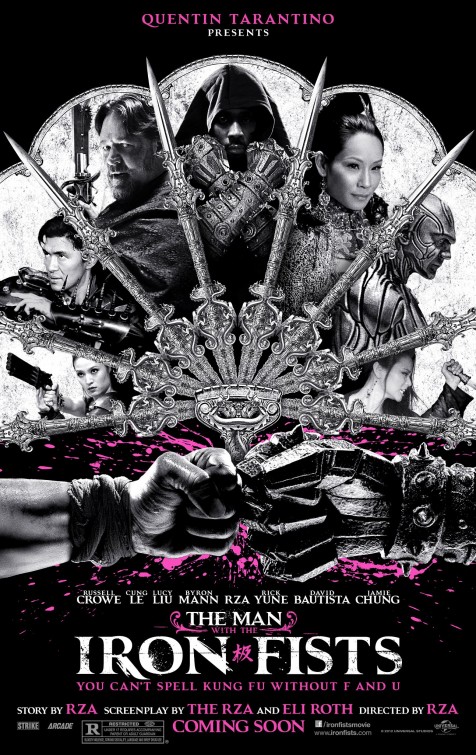 In my lifetime, I’ve developed a fine taste for schlock cinema. I appreciate a jolly good bad movie that knows what it is. With that said, when you’re bad at being bad, then that’s a special case of bad, and such is the case of the hip-hop martial arts junk that is The Man with the Iron Fists. It looks like the kind of campy schlock I’d eat up, and with Russell Crowe as a murderous lascivious scoundrel to boot. The problem with this movie is that it has hip-hop artist RZA as a writer and director. It’s not horribly directed but RZA doesn’t have a firm grasp on action, relying too heavily on wires and spurts of graphic blood. But where the movie completely misfires is with a script that feels cobbled together with subplots belonging to other movies. There’s a basic vengeance storyline, but the first hour of this mess is awash in confusion with a flurry of characters and storylines that fail to coalesce. It feels like everything is just rattling around waiting to be given greater significance. It has a few memorable moments but just as many tacky eye-rollers, like Crowe pulling out anal beads with his teeth. The Man with the Iron Fists just feels so flat overall, lacking a jocular tone or a distinct personality that would have given it a little life. I appreciate the detail that RZA put into his violent world, but I’d appreciate it more if he worked harder at developing a clear story that also was engaging. For all its exploitation elements and fantastic characters, the ultimate sin of The Man with the Iron Fists is that it’s just too boring for too long.
Nate’s Grade: C-
Share this:

Robin Hood (2010)
 So what happens when you make a Robin Hood movie that doesn’t have any Robin Hood? What’s the point of revisiting the legend when you don’t even bother incorporating the elements that made it legendary to begin with? It’s not like they sacrificed familiarity for historical accuracy. Director Ridley Scott’s film spends more time setting up the various pieces of a Robin Hood tale; it’s a prequel at best. This is mostly a historical drama about the English faring off French invasions (the opening text also identifies the setting as the wrong century). The film still manages to be relatively entertaining. The production design and cinematography are top-notch, the acting is robust, Russell Crowe makes a good, if aged, Hood, and the action sequences are thrilling and visually striking. The problem is that there are few action sequences and way too much yakking about foreign policy and Medieval politics and debt. I don’t think people were clamoring for a big-budget Robin Hood revival that explores in depth the financial consequences of an overextended military on the English treasury. This is just not an appealing origin story. The movie resorts to having Hood pose as Maid Marion’s (Cate Blanchett) husband, and it’s as eye-rollingly contrived as any sitcom setup. Originally, the film was designed so that Crowe would play both Hood and the villainous Sheriff of Nottingham (barely seen in the movie). While that is a terrible and senseless idea, at least it would have made the film worth watching from morbid curiosity. Robin Hood isn’t a bad film, but it barely ranks as a Hood outing, and it’s steps behind the delightfully cheesy Kevin Costner version.
Nate’s Grade: B-
Share this:

State of Play (2009)
 This is a solidly engaging mystery with some twists and turns that don’t come out of left field. Russell Crowe is a journalist investigating the murder of a Congressional aide, who just happened to be having an affair with Ben Affleck, his old friend. There are strong performances all around by the cast, though Rachel McAdams seems superfluous as a blogger-turned-sidekick except for allowing the movie to barely touch upon the idea of print journalism dying. The biggest issue is the pacing. The movie stays at a constant simmer, which works for grabbing your interest but then the final plot blows feel lacking because the narrative has not risen in tension. In fact, I’d say the conclusion to one of the two main mysteries is downright disappointing the way it fails to dovetail with the other, larger mystery. There is a lot more that could be said over the state of modern newspapers and the inherent biases that need be kept at bay. State of Play is an intelligent thriller but ultimately too limited by the condensed framework of its script. This movie feels like it has more ideas to share, ethics to chew over, questions to tease out, characters to ripen, and that’s probably because State of Play is based upon a 2003 BBC miniseries that gave sufficient time for these elements to flourish. Still, I can’t knock this relevant, political, old-fashioned conspiracy thriller. It’s too rare these days that Hollywood churns out smart movies like this for adults.
Nate’s Grade: B
Share this:

3:10 to Yuma (2007)
 The Western used to dominate the pop culture landscape. In the 1950s, you had John Ford and Gary Cooper in a different dustup practically every week at the cinema, and the TV lineup was wall-to-wall cowboys, Indians, horses, and damsel retrieval. The Western has become rather inactive since its cultural heyday and now resides on the outskirts of movie land, idly chatting with Screwball Comedy and Busby Berkley Musicals about how good they had it back then (yes, I have just personified genres). With that said, director James Mangold (Walk the Line) has remade the 1957 John Ford film 3:10 to Yuma for a modern movie-going audience. The film has to work extra hard just to overcome the prejudices of a dormant genre, but fortunately 3:10 to Yuma is a rousing drama that could have knocked ’em dead way back when.
Dan (Christian Bale) is a wounded Civil War veteran trying to eek out a living in Arizona. He cannot grow any crops because of drought conditions, is behind on his payments, and his teen son has no respect for dear old one-footed dad. To keep his family financially afloat, Dan agrees to help transport notorious outlaw Ben Wade (Russell Crowe) to his date with justice.. It’s three days to ride across Arizona and get Wade onto the 3:10 train to Yuma prison, and along the way the posse is beset by unexpected setbacks and Wade’s gang hot on their heels to save their imprisoned leader.
 This is no deconstructionist Western or a modern revisionist Western, no this is an old-fashioned Western and Mangold embraces the genre staples instead of steering away from them (runaway stagecoaches, high-noon showdowns, ineffective lawmen, saloon girls). There’s a reverence for the genre and Mangold makes sure the audience soaks up the dusty details of frontier life with lots of revealing close-ups. You can practically taste the earth these men are caked in. The script is filled with plenty of surprises along the way as Ben keeps regaining the upper hand even as he’s outnumbered and in shackles. The story benefits greatly from really opening up and exploring in depth whom Dan and Ben are and what makes them this way. 3:10 to Yuma does not paint in broad strokes and dwells in a lot of grey, which presents opportunities for the actors to work their magic.
At the heart of the film is the moral battle between Ben and Dan, and both actors rise to the occasion. Crowe’s name is all but a guarantee for a quality performance and he shows an array of seemingly contradictory elements to Ben Wade. He has roguish charm and swagger, but then in an instant you can feel the intense glare of hatred in his eyes, and the scary calm in his voice, and you realize that this man is a caged tiger always stalking his prey. He can erupt in sudden and vicious violence and then fall back into a conscienceless laugh. He has moments that seem like empathy and kindness, but then you realize every seemingly kind gesture has a hidden meaning that links back to Ben’s own benefit. Crowe is magnificent and plays around with audience expectations to keep us jumping back and forth between liking the sly brute and fearing him.
Bale is equally as good as a martyr for his moral principles. He sticks to his ethical convictions no matter the hardships and temptations to take an easy way out. The painful lengths Dan goes to protect his family produce several touching exchanges and add substantial meat to a character that very easily could have been drawn as a simplistic do-gooder. Bale sells every moment with commendable authenticity.
 The rest of the supporting cast -Gretchen Mol, Alan Tudyk, a near unrecognizable Peter Fonda- add strong contributions to the movie, but none more memorable than Ben Foster. As Ben Wade’s sadistic right hand man, Foster displays a sick brand of hero worship and homicidal insanity. He’s an unpredictable and menacing figure and Foster magnifies these qualities to frightening realization. These excellent actors make 3:10 to Yuma more than throwback; it reminds you how great Westerns can be with the right actors and devotion to characters.
The only marks against 3:10 to Yuma occur during its climax. Things escalate immensely into a wild shoot-out that racks up a massive body count. While exciting, the sequence feels at odds with the intimate moral struggle between these two men. I’m also unsure about whatever prompted some eleventh hour motivational change for one key character. The ending is unnecessarily dark and will surely leave most audiences with a bad taste in their mouth to exit upon. Maybe it’s just the recent bout of films that I’ve been watching, but I’m starting to get tired of movies that are convinced that a pointlessly tragic ending somehow makes their story more meaningful (The Painted Veil, my wife is still upset with you, novel adaptation or not). A happy ending has long been perceived as a trite Hollywood cliché, but now I wonder of the pendulum has swung too far the other way so that conventional thinking says an audience has to be left wanting more or dissatisfied for a movie to attain higher artistic credibility. This is, of course, utter nonsense. A movie ending need only be appropriate for the scope of its story, but then again it doesn’t have to strive for forced wisdom delivered by unnecessary tragedy.
3:10 to Yuma is a hard-charging, stoic, classic American Western of the old guard with a bit more blood and profanity mixed in for a modern public. Despite a small handful of missteps toward the end, this is an engaging and often gripping morality tale catapulted by two strong performances from foreign-born actors showing Americans how the West was done right. Let 3:10 to Yuma stand as proof that any genre, no matter how outdated, can succeed as long as the filmmakers place care with character and treat the audience with a modicum of respect.
Nate’s Grade: B+
Share this:

Cinderella Man (2005)
 Let’s talk a little about screenwriter Akiva Goldsman. This is the man responsible for travesties like Lost in Space and the franchise killing, pun-crazy Batman and Robin. There’s plenty of junk writers in Hollywood and plenty of good writers just saddled by junk to make a living, and either might apply to Goldsman. How in the world did he become a Hollywood go-to guy?It probably has something to do with Ron Howard. Goldsman adapted the screenplay for Howard’s film A Beautiful Mind and both walked away with Oscars. Suddenly the man who wrote Mr. Freeze saying, “You’re not sending MEEE to the COOLER,” had an Oscar on his mantle. Goldsman and Howard, in retrospect, seem like a match made in heaven. They both enjoy big Hollywood event movies that spoon-feed an audience and shave off the gray areas. Cinderella Man serves as the duo’s second collaboration and it’s exactly what you would expect a big Hollywood event movie to be from them.
Jim Braddock (Russell Crowe) is an up-and-coming New Jersey boxer who’s on a warpath to the heavyweight title. His wife Mae (Renee Zellweger) loves him dearly and he dotes on his three kids. Life seems so perfect in 1929 America. And then the Depression hits. Braddock breaks his hand in a fight and his skills slip tremendously. The boxing commission revokes his license and Braddock is forced to take a dock job to provide for his family. Times are tough and there doesn’t appear to be a way out, until Braddock’s old boxing manager (Paul Giamatti) offers him a one time only bout in the ring. Braddock is seen as a has-been but he knocks his opponent flat out. More fights come and so do more victories, and Jim Braddock seems destined for a remarkable storybook comeback. But then there’s the reigning champ Max Baer (Craig Bierko), an arrogant playboy. Baer also is a ferocious fighter and has actually killed two men in the ring. The championship leads through him and Braddock is unafraid. Mae is terrified she’ll become a widow and pleads with her husband not to fight. But now that he’s been through the gutter, Braddock knows what he?s fighting for: the survival of his family. To do that, he?s headed for a title match with Baer.
 What elevates Cinderella Man from an “okay” film into a “mostly good” film is the singular brilliance of Russell Crowe. This man is simply one of the most amazing actors we’ve ever seen, and he’s been on an incredible hot streak since 1999’s The Insider (forget 2000’s Proof of Life, please). Yet again mastering another accent, Crowe excels at playing a noble man with guarded emotions and honest intentions. He’s an actor that can display such an intense wealth of emotions in the same moment. When he visits his old boxing bosses, hat in hand, begging for enough money to turn the electricity back on, Crowe has laid a sucker punch to your emotions. It’s getting to the point where I will go out and see any movie Russell Crowe stars in just to soak up his brilliant performance. He can throw a phone at my head anytime. Crowe’s stellar and resonant acting will hopefully be noticed come Oscar time; however, I doubt much else of Cinderella Man will be remembered.
Crowe’s sparring partner doesn’t fare as well. I’ve liked Zellweger in a lot of her roles (even the sappy One True Thing), but she’s entirely miscast as Braddock’s underwritten stand-by-your-man wife. She scrunches her face too much and squints for most of the movie.
Two great actors make the most of their meager roles. Giamatti serves as Braddock’s growling pit dog of a corner man and works up a good froth. Bierko almost transcends the film’s one-note villain caste and becomes a figure of showboating sensuality. He struts in the ring with a gallant pride that’s fun to watch, even though you know Howard?s whispering in your ear, “Booooo. Don’t like him. He’s the mean man. Booooo.”
The production design on Cinderella Man is great and really recreates the look and feel of the 1930s in all walks of life. The cinematography, on the other hand, seems washed out and overly dark in spots, though it may have just been my theater?s projection. I miss Roger Deakins, DP on A Beautiful Mind. Deakins knew how to beautifully light a scene and capture the audience with a precise, eye-pleasing angle. In contrast, Cinderella Man seems to think that sepia tones defined the time period of the 1930s.
Howard still has little to no trust in his audience. He can’t rely on the performances of his actors to express their motivation. We know why Braddock is fighting during the Depression, Howard. We don’t need split-second cuts of his family for reminders. It’s almost like Howard wants to point to the screen and tell the audience what to feel. It should be obvious by now but ambiguity doesn’t work here. That’s why Braddock is seen as almost saintly (never mind the connections to organized crime). That’s why Baer is seen as dastardly (never mind that in 1933 Baer heroically wore a Jewish star and knocked out Hitler’s favorite prize fighter, Max Schmeling). It seems that the details just get in the way when Howard wants to turn true-life stories into calculating crowd-pleasers.
At the docks, just in case we don’t get how tragic the Great Depression is (you know, in case you forgot what either the words “great” or “depression” meant), Howard has to bend over backwards to show someone stepping over a newspaper declaring how high unemployment is. When Braddock finds a friend in Hoovertown (Central Park turned into a neighborhood of shanties) we see him run over by a horse and buggy as another man crushed by the system or a runaway metaphor. When Baer fights in the ring Howard makes sure to get that sneering close-up of our villain. And surely anyone who’s a womanizing playboy must go down for the good of the nation. Howard is aggressive in his pandering.
Thanks to Goldsman and Hollingsworth’s mawkish script, Cinderella Man has the myth of complexity to it when it’s really content to go the easy route. It plays this story too close to the rules: embittered hero with humanity intact, stalwart wife, cocky villain, the grumbling manager. Cinderella Man is stripped of complexity and Goldsman and Hollingsworth want to lead the audience by the nose. When Braddock promises his son in a heart-to-heart that he’ll never split up the family, we know it’s only a matter of time before it happens. Their script is also full of workmanlike dialogue that does enough to just push the story forward but give little shading to its people (Zellweger’s, “You are the champion of my heart, Jim Braddock” is particularly not great.
 Cinderella Man really is a film more about the Depression than boxing, except for its pummeling and gritty final act of non-stop boxing. The script paints an almost insulting idea that the Depression was good for people to learn important life lessons, like family comes first, hard work will be rewarded, and one man can heal a nation. Seabiscuit fell into this same trap with its depiction of the Depression but at least Gary Ross’ film dealt with characters that weren’t tired genre archetypes. Cinderella Man could be described as “Seabiscuit in a boxing ring,” as yet again the triumph of an underdog pulls the country back together and gives the common man something to believe in. What I’d like to see is Braddock vs. Seabiscuit in a ring or even on the horse’s turf. Then we can finally decide once and for all who is responsible for getting America out of the Depression (somewhere FDR is spinning in his wheelchair-accessible grave).
The film does come alive when Braddock steps into the ring. The boxing matches are finely choreographed and pack a real wallop. You can practically feel the bruises and taste the sweat during the 15-round bout between Braddock and Baer. These scenes give you a good understanding of the progression of a boxing match and the real strategy that can turn a loser into a winner. Howard also has a smart visual cue during these lively moments. Whenever a bone gets broken, like Braddock’s hand, we cut to an X-ray shot of that scene and see the bone snap. It might seem old in a CSI-drenched landscape of entertainment but it’s effective and neat.
Cinderella Man is a rousing, heartstring-tugging crowd-pleaser that will inspire hope and redemption. Until you look at it more objectively. It?s easy to get sucked into Howard’s underdog tale and that’s because it’s been tailored to satisfy your emotions. Crowe rises above this heavy-handed yesteryear yarn with a riveting performance. I’m positive most people will walk away from Cinderella Man feeling uplifted and touched and would view me as being overly cynical. But with a maudlin story by Goldsman that simplifies the details, Cinderella Man feels like a feel-good-movie that’s been rigged. These people have no trust in their audience, so why should you put your trust in them?
Nate’s Grade: C+
Share this:

Master and Commander: The Far Side of the World (2003)
 Without sounding easily amused, this movie really is glorious filmmaking. With Peter Weir’s steady and skilled direction we get to really know the life of the early 19th century. We also get to know an armada of characters and genuinely feel for them. Russell Crowe is outstanding as Captain Jack Aubrey. His physicality and emotions are expertly showcased. When he gives a motivational speech you’d understand why people would follow him to the ends of the Earth. Paul Bettany (again buddying up to Crowe after A Beautiful Mind) is Oscar-worthy for his performance as the ship’s doctor and confidant to the Captain. He’s not afraid to question the Captain’s motives, like following a dangerous French ship all around South America. Master and Commander hums with life, and the battle sequences are heart-stopping and beautifully filmed. It took three studios to produce and release this and every dollar spent can be seen on the screen. Master and Commander is fantastic, compelling entertainment with thrills, humanity, and wonder. It’s grand old school Hollywood filmmaking.
Nates Grade: A
Share this:

Proof of Life (2000)
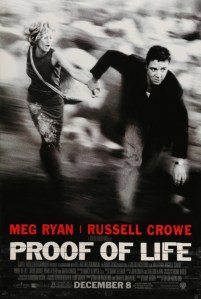 Proof of Life is more an interesting idea than an intelligent or well done thriller. The whole concept of the politics involved in K&R (kidnap and rescue) are duly fascinating. But Proof decides to build a different film around this premise and detours into mediocrity. The film ends with the standard take-down in the jungle I’ve seen many times over except I have the pleasure of seeing David Caruso do it this time.
David Morse is an environmentalist hired by an oil conglomerate to build a dam in a small fictional Ecuador looking country. He gets kidnapped by some radical revolutionaries and is held for ransom. Russel Crowe steps in as the hired K&R expert from Morse’s insurance agency.
The supposed romance on set between Crowe and Ryan is beyond my guess. On screen they have little chemistry and any romance bubbling rates a DOA on Dr. Love’s scale. Meg Ryan betrays herself as an actress and wanders the film minus a bra and constantly sniffling.
During play is a long going friction between Morse, who starts to look like he was auditioning for Cast Away, and some revolutionary hot-headed youth. It’s almost laughable the more it goes on. The will-they-or-won’t-they romance gets snuffed every time we cut back to Ryan’s husband enduring hardships. The editing and the concept ruin whatever sexual tension is supposed to build. The flick also has an unsettling theme that if you aren’t an English speaking white person you can’t be trusted.
The film starts off well with Crowe tangled in Russia but shifts into the mundane rather fast. Proof of Life is proof that what transpires off camera doesn’t always connect on camera.
Nate’s Grade: C+
Share this:

Gladiator (2000)
 Director Ridley Scott has given the world of cinema some of its most unforgettable visual experiences. But can Scott breath new life into a genre whose heyday was when a badly dubbed Steve Reeves oiled his chest and wrestled loincloth-clad extras in the 1950s?
The year is roughly 180 AD and Rome is just finishing up its long-standing assault on anything that moves in the European continent. General Maximus (Russell Crowe) merely wants to retire back to his loving family and get away from the doom and war that has plagued his life. This is made all the more difficult when the ailing Emperor bypasses his treacherous son Commodus (Joaquin Phoenix) and decides to crown Maximus as the Defender of Rome. Because of this Commodus rises to power through bloody circumstances and has Maximus assigned to execution and his family crucified. You’d think crucifixion would be so passé by now. Maximus escapes only to be sold into slavery and bought by a dirt-run gladiator training school. As he advances up the chain and learns the tricks of the primal sport he seeks but vengeance for his fallen family.
Gladiator is an absorbing and sweeping spectacle of carnage and first-rate entertainment. The action is swift and ruthlessly visceral. The first movie in a long time to literally have me poised on the edge of my seat. The blood spills in the gallons and life and limb go flying enough your theater owner may consider setting down a tarp.
 What Gladiator doesn’t sacrifice to the muscle of effects and action is storytelling. Are you listening George Lucas? Gladiator may unleash the beast when the rousing action is loose, but this is coupled with compelling drama and complex characters. Phoenix may at first seem like a snotty brat with an unhealthy eye for his sister (Connie Nielsen), but the further Gladiator continues the more you see in his eyes the troubled youth who just wants the love of his father that was never bestowed to him. Maximus is a devoted family man who regularly kisses clay statues of his family while away, and must ceremoniously dust himself with the earth before any battle.
The acting matches every sword blow and chariot race toe-for-toe. Russell Crowe marks a first-rate staple of heroism. Every calculating glare he exhibits shows the compassion and ferocity of this warrior. He becomes a rare breed – an action hero who can think and actually act. Oliver Reed, in what sadly was his last role, turns in a splendid and charismatic turn as the head of the gladiator school of Fine Arts and Carnage. Mysteriously everyone carries a British accent closer to them then a toga two sizes too small. Even Crowe who is nicknamed “The Spaniard” speaks like he walked out of Masterpiece Theater.
The effects and visuals are a sumptuous feast. The aerial shots of Rome and the Coliseum are simply breath taking. Gladiator rivals American Beauty for the most rose petals used in a movie, except in this one they don’t shoot out of Mena Suvari’s breasts.
Ridley Scott’s track record may be hit or miss but Gladiator is definitely one sorely not to be missed.
Nate’s Grade: A-
Reviewed 20 years later as part of the “Reviews Re-View: 2000” article.


 nathanzoebl
You must be logged in to post a comment.