Blog Archives
A Very Long Engagement (2004)
 Deep in the heart of WWI trenches, we begin this sprawling tale by narrowing in on five French soldiers. Each man has been accused of self-inflicting a wound to escape service, and each man is sentenced to spend the rest of their likely short lives in No Man’s Land, the stretch of bare land between the two trenches. One of these men is Manech (Gaspard Ulliel), a young country boy engaged to the charming Mathilde (Audrey Tautou). When she learns his fated punishment and fails to hear word from Manech, she steps out to launch her own investigation into the possible whereabouts of Manech or the possible details of her fiancé’s demise. She enlists her family, solicits strangers, and puts ads in newspapers to unravel the truth. Along the way she hears various stories from all sorts of people and attempts to form them into a clear picture of what went on in that trench, good or bad.
A Very Long Engagement could be flippantly described as “Rashomon in a trench,” but from the get-go it grabs you by the lapels and will not let go. Once again, Jeunet tells his story in a criss-crossing narrative. Front and center we learn about each doomed man’s life in snapshot, and while the device has a slight eulogy feel, it’s a fantastic way to show the depth of characters in such brevity. A Very Long Engagement is an immeasurably rich film where each detail is threaded into the film to create a magnificent artistic tapestry beyond compare. The tiniest details in the film like Mathilde’s tuba playing (the only instrument whose sound mimics a distress call), to the mail carrier choosing to slide his bike over gravel just further enhance the vibrant, animated world of Jeunet.
 Jeunet is quite possibly the most visually gifted director working today (he turned down Harry Potter 5). He couldn’t film an ugly shot composition if he tried with all his French might. As expected, A Very Long Engagement is gorgeous to look at. The production design is massively intricate, the cinematography, while computer assisted, has a shimmering radiance to it. This is simply the best looking film of all 2004, Hero be damned. You could pause any second in this film and use it as a glossy postcard. Jeunet has the technical credentials to fasten together complex and beautiful worlds. A Very Long Engagement is a technical marvel and gorgeous to experience.
Tautou, also as expected, is wonderful once more. She’s the anchor of the film and the audience feels every heartbreak and glimmer of hope this talented actress explores. The supporting cast is full of familiar Jeunet players and each performance adds to the richness of the film. They feel like characters and not stock roles or cliches.
There is some difficulty with following the storyline. There are so many subplots built upon other subplots that the film’s momentum takes a bit of a dive in the second act. A Very Long Engagement can also get very confusing when it comes to remembering so many names. There are maybe 30 characters to keep track of and as the subplots mount new characters are added to the pile, including a widow played by a surprisingly fluent Jodie Foster. It’s best to employ some kind of memory trick to keep the many colorful characters of Jeunet’s world straightened.
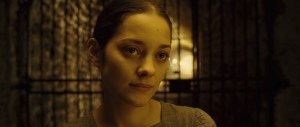 The focus of A Very Long Engagement is on Mathilde’s investigation into what really happened in that trench. She wants to know what happened to her beloved, and as her search picks up steam we get further glimpses of her relationship with Manech. One of my biggest problems I had with 2003’s Cold Mountain was that Jude Law was travailing through hell and back to get back to his beloved Nicole Kidman even though their relationship pre-war lasted as long as a Super Bowl commercial. It’s not that I disbelieve the overpowering nature of love, but I need more from my characters than shifty glances and a quick ejaculation of love (get your mind out of the gutter). Now, in A Very Long Engagement, Jeunet opens by showing the measures Manech will endure to return to his beloved, however, as the film goes on we also see enough peeks into the depths of their relationship beforehand, which dates all the way back to when they were children
A Very Long Engagement forges such a grand and sweeping love story that the audience gets just as immersed as Mathilde about the search for her man. There are so many lovely, intelligent moments between Mathilde and Manech, like their first sexual encounter. Every time Manech lights a new match Mathilde removes an article of clothing until, under the soft light of the newly lit match, she’s nude and blows the match out herself. The characters’ overriding love also taps into small truisms like when Mathilde makes arbitrary games for herself to ensure her love’s safety. (“If I can count to ten before that car passes, then he is alive.”) Mathilde’s faith and devotion are driving her investigation and the audience is behind her 100% of the way, fully invested in this mystery. When we reach our conclusion, I don’t mind telling you I was bawling like a baby.
The film has a merry whimsical tone during its origami-like narrative, but when it hits the trenches the film gets down and dirty. Jeunet shows a fascinating view into the hardships of everyday trench life as well as the machinery of death. Storming the other side’s trench, or “going over the top” as it was called, is seen in all its sordid features. There are hearty splashes of blood and gore that can be jarring.
There’s one terrifying scene in A Very Long Engagement involving the explosion of a makeshift hospital. The hospital is inside a hangar for zeppelins (hydrogen gas) and a missile has crashed into the roof with its nose sticking inside. One of the zeppelins becomes loose and slowly floats to the missile nose with unforgivable certainty. People are running around trying to shield themselves from the inevitable, but it does nothing. The moment is played so agonizingly slow that we become overwhelmed with terror. This was the life of WWI warfare.
 Having said this, the stark war violence doesn’t exactly gel exceedingly well with the whimsical romantic elements. For some, A Very Long Engagement will seem like two very tonally different movies butting heads and intruding upon the other (perhaps Amelie Goes to War?). Sometimes it does take a while to adjust to one tone after spending time with the other. I feel that the emotional investment in the characters and the anticipation of unraveling the mystery serves as thematic glue over the disproportionate tones. Some will feel chaffed by the two stark tones, but I think the power of the love story will conquer most hearts into experiencing the bloodshed of war to earn the shedding of tears by the film’s romance.
Jeunet has re-teamed with Tautou and created another masterpiece. A Very Long Engagement took hold of me from the start and mesmerized me with its beauty, grace, cruelty, excitement, and warmth. This is a great mystery and a great love story with great visuals and great characters. The opposing tones (whimsy vs. violence) won’t work for everyone, and the film takes one too many divergent paths in the middle, but A Very Long Engagement is a film of such startling originality and feeling that it should be treasured. I was floored by what Jeunet had to offer and deeply moved by the time I had to leave the theater. They don’t make them like this much anymore. Now if you’ll excuse me, I have something in my eye.
Nate’s Grade: A
Share this:

Bridget Jones: The Edge of Reason (2004)
 You don’t see too many sequels to romantic comedies, and that?s practically by design. Most romantic comedies consist of keeping the leads apart as long as possible, and then in that final climactic moment they connect, embrace, kiss, usually while a camera pans around them and some up-tempo Top 40 songs swells on the soundtrack. Then we end, our story finished. You see, romantic comedies are essentially modern fairy tales, and they end on the “happily ever after” moment, the most joyous moment. We don?t think about what their lives could be afterwards. I doubt few in the audience are biting their nails to know who does the dishes or if their sex life diminishes.
So for all of these stated reasons, sequels to romantic comedies are rare, unless, of course, they’re based on a book series that’s a cash cow of chick lit. Thus, America, we are given Bridget Jones: The Edge of Reason, the sequel to the smash 2001 film Bridget Jones’s Diary.
 The movie takes place four weeks after Bridget (Renee Zellweger) and Mark Darcy (Colin Firth) cuddling in the falling snow. Their relationship is all lovey-dovey, until Bridget starts reconsidering if she made the right choice of men. Her former boss, Daniel (Hugh Grant) has gone on to fame as a travel correspondent for TV news. He’s a bad boy, for sure, but sparks flew with him. Bridget also suspects Mark of cheating on her with a leggy colleague (whose final plot revelation is quite dumb). Bridget tries her best to fit in with Mark’s upper crust society, but is starting to feel unaccepted. Then she becomes a partner to Daniel on his travel reports, and the two visit exotic locales and sparks begin once more.
Edge of Reason feels like a poor slapdash grab at money. The film lifts entire scenes from the first Bridget Jones movie and tries reworking them for similar effect. Watching Firth and Grant sissy fight each other is amusing … the first time I saw it in 2001. For the most part, it seems like the filmmakers behind Edge of Reason were straining to come up with things after that “happily ever after” moment. What other reason can there be for some of the disastrous plot turns in Edge of Reason? The revolving door of writers (including author Helen Fielding herself) manufacture petty and foolish nitpicks for Bridget that she treats as life or death. It’s hard to feel concern for her. When you strand your main character -in a romantic comedy, no less- in a Thailand prison because she was caught smuggling drugs -in a romantic comedy, remember- then you have some giant plot issues.
The wit and biting commentary from Bridget seem to be stripped away. She only makes two journal entries, which open and close the film, and they were responsible for some of the greatest comedy bits in the original movie. She no longer comes across as a snappy, ordinary girl with a big heart and some big neuroses (did I mention the Thailand prison?). The Bridget of Edge of Reason seems a bit obnoxious at times. The comedy of Edge of Reason doesn’t generally rise above slapstick. Watch Bridget parachute into a dung field (Ha!), watch Bridget ski backwards down a slalom (Hilarious!), watch Bridget get stoned from magic mushrooms (You’re killing me!), and don?t forget to watch her fall down, like, a lot (R.I.P. Nate; cause of death: laughing too hard). The makers of Edge of Reason are just trying too damn hard.
It’s a wonder that Edge of Reason does work at times, and that reason is because of the acting of our romantic trio. Zellweger is still incredibly charming despite some of the things she’s forced to do. She’s never looked better than when she has her Bridget Jones physique; she’s practically glowing. Grant is at his best when he’s a cad, and once again he gets the best lines, especially when he’s undressing Bridget during a work trip. The movie comes alive when he and Zellweger start their flirtatious battle. Firth adds shades of humanity and adoration to his fuddy-duddy role. He’s got a great everyman appeal even when he’s being a twit.
Edge of Reason also seems to flog whatever it feels is funny. If Bridget saying something inappropriate in front of a group of dignitaries and ambassadors is funny, then expect it to happen again five or six times. And it does, sadly. Edge of Reason is almost a wall-to-wall torture chamber of public embarrassment for Bridget, and if the filmmakers thought that would endear her to audiences they were wrong. We were endeared already by her wit and charm, but I guess the people behind Edge of Reason thought we didn’t want more of that. I miss you old Bridget Jones, wherever you are.
 The first Bridget Jones movie was directed by Sharon Maguire, a personal friend of Fielding. Maguire was close enough to know how to adapt the story and retain the elements that made Bridget Jones entertaining. Edge of Reason‘s director Beeban Kidron seems to be assembling a Bridget Jones movie for a focus group. We lose the personality of Bridget and get an accident-prone buffoon. All that’s missing are the banana peels.
Everything about Edge of Reason screams laziness. A great example of this is the film’s choice for music. The songs are so obvious, from “All By Myself” to “I’m Not in Love” to songs that simply have “love” in their title, like “I Believe in a Thing Called Love” to Beyonce’s “Crazy in Love.” Chances are, if your band ever released a song with “love” in the title, the music director of Edge of Reason considered using it.
Bridget Jones: The Edge of Reason will likely entertain its core audience (there were very few men unaccompanied by women in my theater). The cast makes this stilted sequel worth watching. If you really liked Bridget Jones’s Diary, you’ll probably be intermittently amused with Edge of Reason, because it’s the same meal, only reheated with a bit of a chill. Let this be an example of why Hollywood doesn’t make sequels to romantic comedies. We’re happy enough with “happily ever after.”
Nate’s Grade: C+
Share this:

Shaun of the Dead (2004)
 This British import was described as a “rom-zom-com” (something tells me that genre is rather spare). Director Edgar Wright and star/co-writer Simon Pegg plunk down an assortment of typical British sitcom characters and then throw zombies into the mix. Shaun of the Dead is hilarious from start to finish. Pegg and his batch of survivors go through the strange scenario with wit, grit, and a genial sense of irrelevance. It’s as if even flesh-eating zombies can’t ruin their day (Shaun devises a plan that involves killing his zombie step-dad and drinking a cup of tea). Shaun of the Dead gives a knowing wink to the Romero films but also tweaks the zombie genre’s rules and clichés. Wright has a clever sense of visuals and the film does provide some sticky, gory goods for horror fans. If more films were this much fun I’d probably never see natural light again.
Nate’s Grade: A-
Share this:

Garden State (2004)
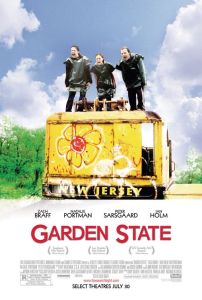 Zack Braff is best known to most as the lead doc on NBC’s hilarious Scrubs. He has razor-sharp comic timing, a goofy charisma, and a deft gift for physical comedy. So who knew that behind those bushy eyebrows and bushier hair was an aspiring writer/director? Furthermore, who would have known that there was such a talented writer/director? Garden State, Braff’s ode to his home, boasts a big name cast, deafening buzz, and perhaps, the first great steps outward for a new Hollywood voice.
Andrew Large Largeman (Braff) is an out-of-work actor living in an anti-depressant haze in LA. He heads back to his old stomping grounds in New Jersey when he learns that his mother has recently died. Andrew has to reface his psychiatrist father (Ian Holm), the source of his guilt and prescribed numbness. He has forgotten his lithium for his trip, and the consequences allow Andrew to begin to awaken as a human being once more. He meets old friends, including Mark (Peter Sarsgaard), who now digs graves for a living and robs them when he can. He parties at the mansion of a friend made rich by the invention of silent Velcro. Things really get moving when Andrew meets Sam (Natalie Portman), a free spirit who has trouble telling the truth and staying still. Their budding relationship coalesces with Andrews re-connection to friends, family, and the joys life can offer.
 Braff has a natural directors eye for visuals and how to properly use them to convey his characters feelings. A scene where Andrew wears a shirt and blends into the wall is a perfect visual note on the characters sleep-walk through life. Braff’s writing is also familiar but satisfyingly unusual, like a repackaging of old stories told with a confident voice. His characters are interesting and memorable, but dont feel uselessly quirky, unlike the creations of other first time indie writers. The melancholy coming-out of Andrew from disconnected schlub to post-pharmaceutical hero really grabs the audience and gives them a rooting point. At times, though, it seems as though Braff may be caught up trying to craft a movie that speaks to a generation, and some will see Garden State as a generation’s voice of a yearning to feel connected.
Braff deserves a medal for finally coaxing out the actress in Portman. She herself has looked like an overly medicated, numb being in several of her recent films (Star Wars prequels, Im looking in your direction), but with her plucky, whimsical role in Garden State, Portman proves that her careers acting apex wasn’t in 1994’s The Professional, when she was 12. Her winsome performance gives Garden State its spark, and the sincere romance between Sam and Andrew gives it its heart.
Sarsgaard is fast becoming one of the best young character actors out there. After solid efforts in Boys Don’t Cry and Shattered Glass, he shines as a course but affectionate grave robber that serves as Andrews motivational elbow-in-the-ribs. Only the great Holm seems to disappoint with a rare stilted and vacant performance. This can be mostly blamed on Braff’s underdevelopment of the father role. Even Method Man pops up in a very amusing cameo.
The humor in Garden State truly blossoms. There are several outrageous moments and wonderfully peculiar characters, but their interaction and friction are what provide the biggest laughs. So while Braff may shoehorn in a frisky seeing-eye canine, a knight of the breakfast table, and a keeper of an ark, the audience gets its real chuckles from the characters and not the bizarre scenarios. Garden State has several wonderfully hilarious moments, and its sharp sense of humor directly attributes to its high entertainment value. The film also has some insightful looks at family life, guilt, romance, human connection, and acceptance. Garden State can cut close like a surgeon but it’s the surprisingly elegant tenderness that will resonate most with a crowd.
 Braff’s film has a careful selection of low-key, highly emotional tunes by artists like The Shins, Coldplay, Zero 7, and Paul Simon. The closing song, the airy Let Go by Frou Frou, has been a staple on my play list after I heard it used in the commercials.
Garden State is not a flawless first entry for Braff. It really is more a string of amusing anecdotes than an actual plot. The film’s aloof charm seems to be intended to cover over the cracks in its narrative. Braff’s film never ceases to be amusing, and it does have a warm likeability to it; nevertheless, it also loses some of its visual and emotional insights by the second half. Braff spends too much time on less essential moments, like the all-day trip by Mark that ends in a heavy-handed metaphor with an abyss. The emotional confrontation between father and son feels more like a baby step than a climax. Braff’s characters also talk in a manner that less resembles reality and more resembles snappy, glib movie dialogue. It’s still fun and often funny, but the characters speak more like they’ve been saving up witty one-liners just for the occasion.
Garden State is a movie thats richly comic, sweetly post-adolescent, and defiantly different. Braff reveals himself to be a talent both behind the camera and in front of it, and possesses an every-man quality of humility, observation, and warmth that could soon shoot him to Hollywood’s A-list. His film will speak to many, and its message about experiencing lifes pleasures and pains, as long as you are experiencing life, is uplifting enough that you may leave the theater floating on air. Garden State is a breezy, heartwarming look at New York’s armpit and the spirited inhabitants that call it home. Braff delivers a blast of fresh air during the summer blahs.
Nate’s Grade: B
Share this:

Before Sunset (2004)
 Richard Linklater knows a thing or two about the poetry of language. Few can write conversations better than him, and with Before Sunset, the sequel to 1995’s Before Sunrise, we witness an entire film built around one couple’s conversation. Julie Delpy and Ethan Hawke return as older, wiser versions of their Sunrise characters. They stroll around the avenues of Paris chatting away so casually, so beautifully that it’s like birds chirping. Linklater and his actors have forged a romance through a romance of language, and an audience can’t help but be smitten. Before Sunset will not be for everyone because it is as advertised: 80 minutes of people talking uninterrupted (it put a friend of mine to sleep when we watched it), but for those people that enjoy sumptuous conversation, Before Sunset will cast a spell on you.
Nate’s Grade: A
Share this:

Jersey Girl (2004)
 Writer/director Kevin Smith (Dogma) takes a stab at family friendly territory with the story of Ollie Trinke (Ben Affleck), a music publicist who must give up the glamour of the big city to realize the realities of single fatherhood. Despite brief J. Lo involvement, Jersey Girl is by no means Gigli 2: Electric Boogaloo. Alternating between edgy humor and sweet family melodrama, Smith shows a growing sense of maturity. Liv Tyler stars as Maya, a liberated video store clerk and Ollie’s real love interest. Tyler and Affleck have terrific chemistry and their scenes together are a playful highlight. The real star of Jersey Girl is nine-year-old Raquel Castro, who plays Ollie’s daughter. Castro is delightful and her cherubic smile can light up the screen. Smith deals heavily with familiar clichés (how many films recently end with some parent rushing to their child’s theatrical production?), but at least they seem to be clichés and elements that Smith feels are worth something. Much cute kiddie stuff can be expected, but the strength of Jersey Girl is the earnest appeal of the characters. Some sequences are laugh-out-loud funny (like Affleck discovering his daughter and a neighbor boy engaging in the time-honored game of “doctor”), but there are just as many small character beats that could have you feeling some emotion. A late exchange between Ollie and his father (George Carlin) is heartwarming, as is the final image of the movie, a father and daughter embracing and swaying to music. Jersey Girl proves to be a sweetly enjoyable date movie from one of the most unlikely sources.
Nates Grade: B
Share this:

Eternal Sunshine of the Spotless Mind (2004)
 No other movie this year captured the possibility of film like Michel Gondry and Charlie Kaufman’s enigmatic collaboration. Eternal Sunshine was a mind-bending philosophical excursion that also ended up being one of the most nakedly realistic romances of all time. Joel (Jim Carrey restrained) embarks on having his memories erased involving the painful breakup of Clemintine (Kate Winslet, wonderful), an impulsive woman whose vibrant hair changes as much as her moods. As Joel revisits his memories, they fade and die. He starts to fall in love with her all over again and tries to have the process stop. This labyrinth of a movie gets so many details right, from the weird physics of dreams to the small, tender moments of love and relationships. I see something new and marvelous every time I watch Eternal Sunshine, and the fact that it’s caught on with audiences (it was nominated for Favorite Movie by the People’s friggin’ Choice Awards) reaffirms its insights into memory and love. I never would have thought we’d get the perfect romance for the new millennium from Kaufman. This is a beautiful, dizzingly complex, elegant romance caked in visual grandeur, and it will be just as special in 5 years as it will be in 50, that is if monkeys don’t evolve and take over by then (it will happen).
Nate’s Grade: A
Share this:

Intolerable Cruelty (2003)
 Miles Massey (George Clooney) is the preeminent divorce attorney in Los Angeles. But after years of bankrupting homes after people have broken them (this allusion may be too tricky), hes grown tired of the same old same old. Enter Marilyn Roxroth (Catherine Zeta-Jones), a conniving gold digger who has been ruined by Massey defending her dimwitted hubby (Edward Herrmann). Now shes out for revenge, which could be in the form of romancing Massey while bringing him down.
Intolerable Cruelty is something of a strange breed. It’s the Coens most striving foray into mainstream success, with the weight of the world on Clooney and Zeta-Jones exchanging sparks and verbal repartee. For the most part, things work: the leads do have a winning chemistry; Zeta-Jones is positively glowing in Roger Deakins’ beautifully milky cinematography (she found out she pregnant late in the shoot, which could explain the glow).
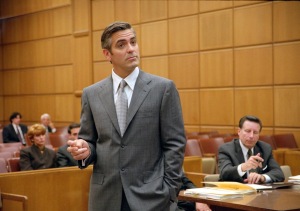 The stumbling block for Intolerable Cruelty and its central romance is that neither of the leads, though at times charming, isn’t exactly likable or able to root for. An integral part of any romantic comedy is empathy for the leads so much that we want them to get together, possibly with swirling crescendos. But in Intolerable Cruelty, both leads make a living off deceiving and taking advantage of others. So while their War of the Roses-esque pursuit to out-scam the other can provide some entertaining twists (and some forced and out of place), the whole duplicitous one-upsmanship doesn’t blossom credible love between the leads or the audience.
I have a strong feeling that Intolerable Cruelty was a story the Coens hopped on late, did some rewrites and invited old Coen friends to join in the jubilee. This is the first time the Coens have worked with other writers (the people who brought us such duds as (Big Trouble and Life), and certain storylines or subplots that glaringly feel disjointed from the screwball-comedy tone of the film. An asthmatic hit man named Wheezy Joe (who got the biggest laugh with his demise) is funny but in the wrong Coen film. When Clooney and Zeta-Jones both hire the services of Wheezy Joe to off the other, you know the story took a fantastical wrong turn. A creepy decrepit owner of Clooney’s law firm also feels like a leftover from a different film. This movie also has the most ripping up of legal documents I’ve ever seen in a movie.
Clooney is quite funny as a chattering legal eagle with a Cary Grant edge. Hes ready and willing to play against his movie star image, which works wonders for comedy, though the running gag where he must look at his teeth in any reflective surface never takes off. It took me until Intolerable Cruelty to realize how much of a beautiful woman Zeta-Jones is. Her warm smile could light up an auditorium. The supporting characters are all underused but very memorable. The opening with Geoffrey Rush’s TV exec walking in on his canoodling wife is very funny, and he plays the long-haired arrogant type well. Cedric the Entertainer is hilarious as a private eye determined to ”nail yo ass” that I started privately wishing the film would spin to follow his life and not Clooney’s.
Intolerable Cruelty is a nice diversion for the Coens, with some good laughs here and there (my favorite being the courtroom scene where Clooney and Zeta-Jones go head-to-head for the first time), but one would hope that the Coens will get back to doing hat they do best, which is quirky yet beautiful independent films. In the end, it seems that the Coens have created an oddity for themselves — a normal movie. We expect more Joel and Ethan.
Nate’s Grade: B-
Share this:

Lost in Translation (2003)
 Sophia Coppola probably has had one of the most infamous beginnings in showbiz. Her father, Francis Ford, is one of the most famous directors of our times. He was getting ready to film Godfather Part III when Winona Ryder dropped out weeks before filming. Sophia Coppola, just at the age of 18, stepped into the role of Michael Corleone’s daughter. The level of scathing reviews Coppolas acting received is something perhaps only Tom Green and Britney Spears can relate to. Coppola never really acted again. Instead she married Spike Jonze (Being John Malkovich) and adapted and directed the acclaimed indie flick, The Virgin Suicides. So now Coppola is back again with Lost in Translation, and if this is the kind of rewards reaped by bad reviews early in your career, then I’m circling the 2008 Oscar date for Britney.
Bob Harris (Bill Murray) is a washed up actor visiting Tokyo to film some well-paying whiskey commercials. Bob’s long marriage is fading and he feels the pains of loneliness dig its claws into his soul. Bob finds a kindred spirit in Charlotte (Scarlet Johansson), a young newlywed who has followed her photographer husband (Giovanni Ribisi) to Japan and is second-guessing herself and her marriage. The two strike up a friendship of resistance as strangers in a strange land. They run around the big city and share enough adventures to leave an indelible impression on each other’s life.
 Lost in Translation is, simply put, a marvelously beautiful film. The emphasis for Coppola is less on a rigidly structured story and more on a consistently lovely mood of melancholy. There are many scenes of potent visual power, nuance of absence, that the viewer is left aching like the moments after a long, cleansing cry. There are certain images (like Johansson or Murray staring out at the impersonal glittering Tokyo) and certain scenes (like the final, tearful hug between the leads) that I will never forget. Its one thing when a film opens on the quiet image of a womans derriere in pink panties and just holds onto it. It’s quite another thing to do it and not draw laughs from an audience.
Murray is outstanding and heartbreaking. Had he not finally gotten the recognition he deserved with last year’s Oscar nomination I would have raged for a recounting of hanging chads. Murray has long been one of our most gifted funnymen, but later in his career he has been turning in soulful and stirring performances playing lonely men. When Murray sings Roxy Music’s “More Than This” to Johansson during a wild night out at a karaoke bar, the words penetrate you and symbolize the leads’ evolving relationship.
Johansson (Ghost World) herself is proving to be an acting revelation. It is the understatement of her words, the presence of a mature intelligence, and the totality of her wistful staring that nail the emotion of Charlotte. Never does the character falter into a Lolita-esque vibe. Shes a lonely soul and finds a beautiful match in Murray.
 Lost in Translation is an epic exploration of connection, and the quintessential film that perfectly frames those inescapable moments of life where we come into contact with people who shape our lives by their short stays. This is a reserved love story where the most tender of actions are moments like Murray carrying a sleeping Johansson to her room, tucking her in, then locking the door behind. The comedy of disconnect is delightful, like when Murray receives incomprehensible direction at a photo shoot. The score by Jean-Benoît Dunckel, front man of the French duo Air, is ambient and wraps around you like a warm blanket. The cinematography is also an amazing experience to behold, especially the many shots of the vast glittering life of Tokyo and, equally, its strange emptiness.
Everything works so well in Lost in Translation, from the bravura acting, to the stirring story, to the confident direction, that the viewer will be caught up in its lovely swirl. The film ends up becoming a humanistic love letter to what brings us together and what shapes how we are as people. Coppola’s film is bursting with such sharply insightful, quietly touching moments, that the viewer is overwhelmed at seeing such a remarkably mature and honest movie. The enjoyment of Lost in Translation lies in the understanding the audience can feel with the characters and their plight for connection and human warmth. A work of art like this sure doesn’t come around every day.
Writer/director Sophia Coppola’s come a long way from being Winona Ryder’s last-second replacement, and if Lost in Translation, arguably the best film of 2003, is any indication, hopefully well see even more brilliance yet to come. This is not going to be a film for everyone. A common argument from detractors is that Lost in Translation is a film lost without a plot. I’ve had just as many friends call this movie “boring and pointless” as I’ve had friends call it “brilliant and touching.” The right audience to enjoy Lost in Translation would be people who have some patience and are willing to immerse themselves in the nuances of character and silence.
Nate’s Grade: A
Share this:

Gigli (2003)
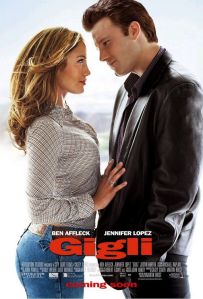 It’s the feel-good movie of the year revolving around a lunkhead mobster (Ben Affleck) and his mentally challenged kipnapee and their attempts to covert a lesbian hitman (Jennifer Lopez) in between her yoga/horrific monologues concerning the superiority of female genitalia. Believe the hype people; Gigli is indeed as bad as they have told you. It’s not even entertainingly bad, like Bulletproof Monk, no folks; Gigli is just mundane and awful. During the entire two hour stretch, which feels much much longer, I kept saying one thing aloud: “How could anyone making this think they were making a goodmovie?” Did they think audiences would find it funny that Affleck’s mother (the mother from My Big Fat Greek Wedding) shows us her big fat Greek behind? Did they really think that a mentally retarded kid (who has an affinity for gangster rap and wishes to travel to the mythical “Baywatch”) would come off as endearing? Well instead it comes across as insulting. And what else is insulting is the laugh-out-loud dialogue Lopez is forced to spit out concerning her attraction for women. I can’t think of any actress that could say the line, “I love my pussy” convincingly. And I’m sure a lot of actresses out there have true affection for it. The writing is just atrocious. And so much else fails as well. The score is a perplexing mix of upbeat jazz and inappropriate string orchestra. I don’t understand what emotions they were going for during scenes in Gigli but a full string orchestra playing music better suited for a real drama does not fit. Maybe it was for a tragedy. In that case, then it’s right on the money. You won’t see a more sloppily executed, horribly acted, painfully written, lazily directed, inept film this year. And what the hell did Christopher Walken walking in have anything to do with anything?
Nate’s Grade: F


 nathanzoebl
You must be logged in to post a comment.