Blog Archives
Ghosts of Girlfriends Past (2009)
 I maintain that no story has been redone, recycled, re-purposed, and parodied more so than Charles Dickens’ classic holiday tale, A Christmas Carol. Dickens’ tale of redemption aided by supernatural ghosts and time travel has appeared in everything from Muppets to the Odd Couple. Statistically, the odds are good that right now as you read this very sentence television is airing some adaptation of this story right now. I suppose it was only a matter of time before Dickens got reduced to a romantic comedy setup. Ghosts of Girlfriends Past is a charmless and mostly empty movie that makes you pine for the comparative masterpiece of A Muppet Christmas Carol.
Connor Mead (Matthew McConaughey, playing himself for the thousandth time) is a hunky fashion photographer for Vanity Fair magazine and, boy, is he in-demand. Everyone wants his photo services and every woman wants to rip his clothes off. Connor is a notorious womanizer and he travels to the country to attend his younger brother Paul’s (Breckin Meyer) wedding. Connor is intent on dissuading his brother on the prospect of marriage, which Conner dubs archaic and he feels love is “comfort food for the uneducated and lonely.” It just so happens that Connor’s ex-girlfriend from way back, Jenny (Jennifer Garner), is the maid of honor at the wedding. She hasn’t seen her dubious ex for some time, but that doesn’t stop him from trying to make his move. Jenny and Connor were childhood pals, but an early bout of heartbreak led Connor to become the disciple of his Uncle Wayne (Michael Douglas), a boozy playboy who taught the kid everything he knew about bedding the babes. During Connor’s stay, the ghost of Uncle Wayne informs him that three spirits will visit to showcase Connor’s checkered past, present, and dodgy future, Dicken’s-style.
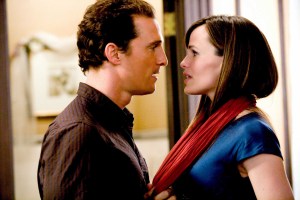 The movie is wholly unbelievable even for a contrived romantic comedy. The central romance between Connor and Jenny rests on the silly notion that after ten years apart, a lifelong selfish jerk can sweep his former girlfriend off her feet during a single crazy weekend. Connor’s redemptive arc is lackluster at best, and the movie just mimes the steps it feels that it needs to take to turn its lead insensitive jerk character into a sensitive jerk character. It doesn’t work. I refuse to believe for one second that a pretty, smart, confidant doctor such as Jenny would allow herself to get so completely suckered in by Connor’s “Baby I’ve changed” speech. It’s insulting and degrading. The compressed timeline reflects poorly on Jenny’s decision-making. The expedited timeline makes every human action seem far-fetched. There’s a scene where Connor opens a champagne bottle in the kitchen. The cork flies out and knocks one of the legs loose on the multi-tiered wedding cake. The cake is about to slip over when Connor slides in to stabilize it. Instead of redistributing the weight via the available legs, he tries reaching for the out of reach champagne bottle with his foot (the size of the bottle and the cake leg are not even close). A more believable situation would involve Connor trying to reach the fallen cake leg, not a champagne bottle, but alas. To make this example even worse, the filmmakers set up the disaster of a fallen wedding cake and then amazingly fail to show the goods. We only see the smashed aftermath. This is a comedy fundamental: set-up food disaster, let audience witness ensuing food-related disaster.
Ghosts of Girlfriends Past also doesn’t have one redeeming or marginally realistic female character. I would expect, given Garner’s star power and the natural importance of being the romantic lead, that Jenny would come across as a reasonable woman or someone worth fighting over. Sorry, Jenny is a powerfully underwritten character and Garner is left without much work other than serving as a reservoir of reaction shots. Seriously, that’s her main purpose in this movie; she is a cutaway image. Sandra (Lacey Chabert) is a shrieking high-maintenance shrew of a bride. The other female roles are largely one-note misogynistic fantasies (thanks male screenwriters Jon Lucas and Scott Moore). The trio of bridesmaids is gossipy chatterboxes and eager to get laid. Connor’s introduction to his future mother-in-law (Anne Archer) involves him casually groping her breasts, much to her prosaic approval. Connor has an irresistible way with the ladies, which makes everything without a Y chromosome want to sleep with the man. A young famous pop singer watches Connor dump three women simultaneously on an Internet conference call, insult them, and then she still strips off her clothes to bed the cad. She even states, “I don’t even know why I’m doing this,” and continues along. I’m just as confused what power Connor holds over the fairer sex because to me he’s just a twit.
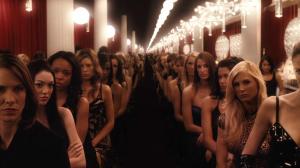 Here’s a telling example about how obvious this movie is written from an unenlightened male perspective: the central relationship dilemma is that Connor is afraid of cuddling. In the past, Jenny asked him to stay and cuddle but that was the breaking point, so he bolted. All of these women somehow manage to fall head over heels in love for a guy who willingly goes through women likes changes of underwear. It makes all the women comes across as emotionally needy, insecure, vapid bubbleheads who will sacrifice everything, including self-respect and dignity, to get a taste of McConaughey’s back sweat. Ghosts of Girlfriends Past is not a flattering movie for either sex.
The tone of this movie never finds an authentic and satisfying balance. Being a half-hearted tale of redemption during the period of a weekend, the movie crams in plenty of gooey sentimental claptrap. You’ll listen to characters talk about the true meaning of friendship, tear up over family memories, and then someone will make an inappropriate sex joke. There is a high level of semi-racy sex jokes that populate the world, appearing at odd moments, destroying any assembling emotions. Ghosts of Girlfriends Past will pretend like it’s building to something that actually matters and then it will throw it all away for a cheap sex gag — har har. There’s a moment where Douglas is illustrating how much ire Connor has wrought with visual metaphors. It begins to rain and he says that the downpour is made up of all the tears shed from ex-girlfriends and flings. Then it starts raining ripped pieces of confetti, and this we are told is all the tissues used. And then comes all the used condoms, and we watch Connor try and take cover before the aerial assault of used (and presumably “filled”) contraceptives annihilates him. It’s kind of gross and tonally disjointed from the rest of the sappy, happy PG-13 storyline.
 The movie is at its most amusing when it’s riffing on the expectations of following the Christmas Carol model. Connor is quite aware of the tried-and-true formula, so his comments along the way provide the movie’s only genuine laughs outside of Douglas. Really, Douglas’ character is the most entertaining character, and I kept wishing that the film would follow him even after death. Wouldn’t it be interesting to watch the life of a ghost involved in a Christmas Carol scenario? I imagine it would be a bit like a play rehearsal. I would enjoy seeing the behind-the-scenes work that goes into the scenario. I want to see ghostly foremen plot out unique scenarios for a list of real-life Scrooge cases, I want to see the ghost tryouts, I want to see the mechanics involved in the spiritual setup for this whole process. I enjoyed watching Uncle Wayne hit on his fellow spirits. But I suppose that approach would be too literary and break away from the cozy confines of the stillborn romantic comedy genre. And to prove that it is indeed a romantic comedy by the numbers, Ghosts of Girlfriends Past even includes the last minute dash to stop the romantic party from leaving via some method of transportation.
Ghosts of Girlfriends Past manages to squander every opportunity it has to be a better movie. The central idea could have worked but the execution is exceedingly lazy, charmless, and degrading to women in particular. The comic scenarios miss out on better laughs, and some of the better laughs are obvious and just around the corner, but the film routinely falls back on being a sexual farce. The characters don’t feel remotely like people and Connor is a terrible lead character with unfunny dialogue that reduces women to disposable pleasures. His transformation is contrived even for a romantic comedy. I’m not saying a cad character could not make for an entertaining lead here. Clearly Douglas is the best character, and his sleazy 1970s swinging sexpot has a fun Bob Evans vibe. Every moment he’s onscreen the movie comes alive in a new way, and Douglas is an actor that knows how to make lecherous appealing and appalling at the same time, like what Michael Caine pulled off in Alfie. This movie pales in comparison. Ghosts of Girlfriends Past should have been visited by the most important spirit of them all – the Spirit of Screenplay Rewrites.
Nate’s Grade: C-
Share this:

Confessions of a Shopaholic (2009)
 Releasing a romantic comedy about a woman plagued by credit woes in the middle of a global financial meltdown? Doesn’t sound like the best example of escapist entertainment, but Confessions of a Shopaholic is infectious fun, and it’s all thanks to the delightfully funny lead performance by Isla Fisher. She seems like she stepped out of one of the old Hollywood screwball comedies from the 1930s. There’s a terrific hunger in her eyes and the woman knows how to punctuate a joke. The movie itself isn’t too shabby either. As far as formulaic romantic comedies go, this is one of the better ones in recent years. It has a little dash of everything, from slapstick to farcical thriller to romance to even some mildly potent drama. Director P.J. Hogan (Muriel’s Wedding) keeps the movie light and fun and even spruces up the flick with some interesting visuals, like animated CGI mannequins that come alive to tempt Fisher. Even though the movie holds onto a sitcom level plot for too long (mistaken identity), Confessions of a Shopaholic is a far worthier piece of entertainment than typically found in the rom-com genre, and Fisher is a comedian to rival the best.
Nate’s Grade: B+
Share this:

Slumdog Millionaire (2008)
 If there is one independent movie that seems to be picking up momentum this awards season, it’s Slumdog Millionaire. The film seems destined to break out into the mainstream, especially in a time where audiences could use a happy story given the ongoing news of economic downturns. Slumdog Millionaire is a highly spirited rags-to-riches tale that marries Hollywood and Bollywood into one fantastic product.
Jamal (Dev Patel) is an 18-year-old kid who grew up impoverished in India’s favellas. He’s also on the verge of winning 20 million rupees on the Indian version of the Who Wants to Be a Millionaire? Game show. The TV host reminds Jamal that lawyers and doctors have never gotten as far as he, a lowly “slumdog” from such humble origins. As each question emerges we discover more about Jamal’s life, from escaping a riot, touring India as a stowaway on a train, conning American tourists at the Taj Mahal, to his assistant work at a call center. Throughout Jamal’s life are two constants: Salim (Madhur Mittal) and Latika (Frieda Pinto). Salim is Jamal’s scheming older brother who has a loose sense of morals. He finds a life of crime as a suitable escape from poverty. Latika is a young orphan girl that Jamal befriended as a child. He declared that she was the “third Musketeer” in their group and has always sworn to love her. This is complicated because Salim’s crime boss wants Latika for a prize, and Salim keeps his younger brother away from Latika. Ultimately, as an entire nation watches with baited breath, Jamal explains that he is appearing on TV because he knew that Latika, his love, would be watching somewhere.
 It’s like City of God and Forrest Gump had a baby that was raised by Oliver Twist. The film is given a dynamic energy thanks to director Danny Boyle’s exuberant camerawork and skillful style. Boyle is a director that knows how to make images jump and Slumdog feels like it is coursing with life. The feel-good fantasy nature of the rags-to-riches plot is offset by some pretty harrowing violence, and Boyle makes great pains to show the realities of living in squalor. At one point a very Fagin-esque local crime lord collects young orphans to be beggars and he has a foolproof scenario to make these kids sympathetic and thus big earners — he blinds them with hot liquid. Despite the fantastical elements, Slumdog is rated R for a reason and that’s because it does show the cruel reality of a life in the slums, granted it’s nowhere near as bleak and formidable as something like City of God. After all, the kid gets to win on a game show, though the movie does open with Jamal being tortured by the police. Boyle has a tremendously natural eye for crafting visuals that delight the senses; he can make his shot compositions feel interesting without ever truly calling attention to being flashy. The views of India are beautiful and fascinating. Plus, having a majority of the movie in a foreign dialect was appreciated (Boyle provides different color background for different character’s subtitles, a nice touch). There’s a magic feeling to the film that definitely takes hold of the audience, an uplift that channels smiles and gasps of joy. While I’ll still credit Millions as Boyle’s best film since Trainspotting, his work on Slumdog is deserving of praise. I don’t know if another director could have made a film with so many contradictory elements (feel-good flick with child prostitutes?) run so smoothly.
The movie is also given a brilliant story structure by screenwriter Simon Beaufoy (The Full Monty). The movie is built around a steady stream of flashbacks linked to the questions Jamal tackles on the game show. So the host will pose a question and then we’ll be treated to a 10-15-minute flashback to Jamal’s life to discover how he knows the answer. The approach is fresh and it reinforces the magical notion that Jamal’s life has all been leading up to this moment of glory. Beaufoy’s script smartly weaves many storylines together to give us an emerging sense of who Jamal truly is. He manages to write an uplifting and hopeful tale that stays clear from easy sentiment. Indeed, Slumdog is an accomplished feat of writing as well as direction. Working from the Indian novel Q&A, Beaufoy has written a modern-day fairy tale in the same fashion as the Brothers Grimm, which means he didn’t skimp on the unpleasantness and hardship. Yet Slumdog is able to find great human spirit amidst the squalor. I doubt I’ll see a climax more rousing and crowd-pleasing all year. Seriously, you’d have to have a pretty hard heart not to feel some excitement and jubilation in the closing moments.
 This unlikely fantasy is aided by sharp performances by a collection of actors. Jamal is an unassuming yet plucky underdog, and Patel nicely handles these elements. He’s a stringy kid but he carries himself with charm and fortitude. As he grows confident he spars with the combative TV host, and it’s fun to watch. Pinto is a swell looking beauty with a great smile but I wish the story had given her more to do as an actress. The young actors who play Jamal, Salim, and Latika as young children actually give the best performances.
And now after all my effusive talk comes the time where I must voice my minor reservations. First off, the structure is ingenious but having Jamal interrogated by the police after the fact seems unnecessary, plus it also tips off the audience from the beginning that this kid has already won it all, which sucks some of the tension out of the game show format. I really think the movie would have been better served just playing out the game show in real time instead. Also, it’s a bit too convenient that every one of the quiz questions triggers a memory in a linear fashion. Jamal can tell his life’s story from beginning to end, but the movie would have been more challenging and interesting if the quiz questions forced Jamal to bounce around in his own memory. That way the script would provide more mysteries that could lead to even more satisfying answers. The Millionaire game show also goes on a commercial break and Jamal is astoundingly allowed to leave and go to the bathroom after he knows one of the high-money questions. In the age of wireless Internet, no game show would ever allow the contestant to leave its sight. Finally, the movie is presented like a Dickensian fable told in chunks, which means I found it hard to fully embrace the central romance that drives Jamal. I will readily follow the romantic notion of locating your true love, however, I will feel more involved in that search if the combined time Jamal and Latika spent together was longer then like a week. Seriously, they see each other every few years for a moment and then are broken apart, only to find each other again for a few moments to be broken apart. She’s more a symbol than a fully translated character, though this did not stop me from rooting for a happy ending.
 Slumdog Millionaire is a thrilling, funny, and triumphant story that courses with lively electricity, thanks to the deft direction of Danny Boyle. This movie is enormously entertaining while still baring a social conscious about the plight of those impoverished, though I hope people don’t get the mistaken idea that all that character-building impoverished life styles will lead to future fortunes like Jamal. The movie is hopeful and uplifting while also balancing tense violence and improbable circumstances. While I’m not on board with the critics calling this the best film of 2008, it has some minor flaws in approach to storytelling and character, Slumdog Millionaire has all the right markings to be a crowd-pleasing sensation. After all, it is destiny. And that’s my final answer.
Nate’s Grade: A-
Share this:

Australia (2008)
 Baz Luhrmann is a filmmaker that doesn’t know the meaning of the word “small.” He paints in giant strokes with lavish creative flourishes that separate him from the pack of visionary auteurs. I’ve enjoyed every one of his films thus far and I fee that Moulin Rouge is a romantic touchstone that I can go back again and again to be dazzled and moved. I anticipated that Australia would be suitably grandiose in scope and style. While it suitably grandiose it definitely could have used some fine-tuning when it came to scope and style.
Australia follows the adventures of Lady Sarah Ashley (Nicole Kidman) entering the land Down Under in 1939. Her husband owns a cattle ranch in the north called Faraway Downs. She suspects that her husband travels to Australia to get a bit more business down under, if you know what I mean. He’s been killed and the only witness is a half-white, half-aboriginal boy named Nullah (newcomer Brandon Walters). It was customary for the Australian government to abduct mixed race children and ship them off to a church mission, where the tykes got to learn how to be servants for rich white people (this government policy only officially ended in the 1970s). Little Nullah hides on the Faraway downs ranch with his aboriginal mother. Lady Ashley must decide what to do with her strip of land. The local meat baron, King Carney (Bryan Brown), owns all the land surrounding Faraway downs and is close to maintaining a monopoly. Carney’s right hand man, Fletcher (David Wenham), has been keeping watch over Faraway Downs. Lady Ashley decides to hold onto the ranch and to drive the 1,000 head of cattle to sell at the town of Darwin. Carney orders Fletcher to stop the competition in its tracks. With little resources, Lady Ashley needs a rugged man to lead the cattle drive. The Drover (High Jackman) is a man of adventure and promises to deliver the cattle to their destination in Darwin. Through the course of 165 minutes Lady Ashley and the Drover will fall in love, Nullah’s freedom will be in jeopardy, and the Japanese will bomb Darwin in 1941.
 The flick is ambitious, I’ll give it that. Just the title itself sets off an aim to summarize an entire country’s history, culture, and people in a declarative and definitive narrative. Somehow I doubt many will leave the theater and say, “Well, now that’s Australia.” Indeed, I find the film’s narrative to be a limp representation for a country. I suppose most big nationalistic history films start with the birth of nations, but when your country began as a repository for English criminals then I suppose you may want to find a different tale to tell. Australia is really three movies in one colossal package: a Western dust-up, a World War II disaster, and a dark history lesson over the country’s treatment of the aborigines. There is too much movie there, especially at a mammoth running time of 2 hours and 45 minutes. I almost think that Luhrmann believes that if he throws out enough storylines and emotions that somehow it will form a cohesive whole, but the pieces never truly mesh satisfactory. The kitchen sink method rarely works without a grander scheme. The war elements could have been dropped entirely considering that the Japanese bombing sneaks in at the very end of the film and serves little other purpose then decimating the town of Darwin. The movie just all of a sudden transitions into Australia at wartime, and various characters have new positions, like Lady Ashley serving as a phone operator. Where did any of this come from? It just sort of happens without any solid setup or transition despite a near three-hour length. You don’t need to nudge in World War II disasters just to introduce sustainable conflict. Australia is filled with moments where the plot or the characters make big leaps without justifying the transition. Lady Ashley goes from a lily-white upper-class fop to a tanned Outback rootin’-tootin’ adventurer over the course of mere minutes.
Director Luhrmann’s over-the-top visual style is absent and the movie feels strangely square, like Luhrmann is keeping his more manic abilities in check so he can tell an old school epic. But [i]Australia[/i] is not an epic despite a running time that would argue otherwise. It has gorgeous cinematography, gorgeous natural exteriors, and a pair of fairly good-looking leads (Jackman was named People Magazine’s sexiest man alive for 2008), but these are all components and not a finished product. I kept wanting Luhrmann to break free from his creative straitjacket and add some pizzazz and inspired sidesteps. It never happened. Lurhmann has been instrumental in the birth of Australia from beginning to end (he is credited with the screen story), but having such an idiosyncratic and surreal talent make a movie that is so backwards in approach and appeal is lunacy. This is not the best use of Lurhmann’s many talents. Australia has some gauzy and gaudy visuals but it feels altogether devoid of style, though it attempts to make up for that loss in sweep.
 The true history of what happened to mixed race aboriginal children is appalling and certainly worth examination. So why then is Australia another case where the story of a minority’s oppression and tragedy must be told through the eyes of valiant white characters? Nullah’s story is far more interesting then Lady Ashley learning to be a country gal or the Drover learning to settle down. There is much more inherent drama in following a child who feels displaced and forever hunted because of his own genetics. That’s far more powerful than watching the tyke play “Somewhere Over the Rainbow” for the 80th time on his harmonica. Whenever Australia dips into serious statements on the plight of the unfortunate aboriginals, the movie feels very awkward. This is because “serious” is not what the movie does best at all. Australia is a large-scale attempt to revitalize that old-fashioned, sweepingly romantic Hollywood filmmaking of the 1950s. You could just as easily imagine John Wayne and Maureen O’Hara in the starring roles, though the movie’s sensuality and outward comments on racial equality would have been tampered down. My point is that Australia is engineered to be this romantic spectacle that nearly overdoses on sentiment, so whenever it cuts to the aboriginals plight (something serious not in a silly movie sense) then it just seems tonally disjointed.
Let’s also talk about the depiction of the aboriginal people in Australia. Clearly Luhrmann has sympathy for these people and their persecution, and rightfully so. However, the movie turns the aborigines into magical otherworldly spiritual creatures. The depiction is similar to how Native Americans are seen in movies that take place in North America. The Native American is always seen as a being more in tune with nature and spirituality; they’re a “magic Indian” and always seem to possess supernatural powers and great wisdom. These portrayals are intended to be flattering but they really come across as hollow and condescending, transforming disadvantaged people into mystical and mysterious figures. Australia is packed with aborigines walking around, singing their songs to the wind, and having a near-psychic connection to the Earth and its inhabitants. There are several moments where King George, an old aboriginal man, will hum to himself and appear out of nowhere across thousands of miles to pose in a flamingo-like stance. It’s this sort of silly attempt at mystical reverence that stops the movie full-force when it touches upon the terrible realities of how the government treated the aborigines.
 The actors do as best they can with such underwritten characters. Kidman found a perfect collaborator with Luhrmann on Moulin Rouge, a performance that deserved the Best Actress Oscar of that year. She has complete trust in Luhrmann. Her character is the typical role where someone from the outside adapts and finds a new home, which means Kidman is mostly comic and overacts in the beginning. She overdoes the comedy, expressing lines with a bit too much energy that almost seems against her will, like someone is pulling an invisible string to stretch her face into extreme expressions. I’ve always believed that Kidman could be a fine actress but honestly I don’t think I’ve loved a Kidman performance since 2001 with, yep, Moulin Rouge (she was quite fine in Dogville and The Interpreter). I’m starting to dread the thought that I may never see another Kidman performance that sets me afire. Jackman’s background in theater comes in handy when it comes to selling such melodrama and cheesy sentiment. He’s a handsome man and the movie takes great pains to showcase him shirtless. His character is another in a long line of solitary men who have to learn to reach out and love again despite the danger of being hurt. It’ all pretty standard for a Drover, naturally. Walters’ performance can at times be too cloying that it becomes grating. Eventually you do build a tolerance and he becomes more endearing than annoying. I had more fun with the supporting cast who can be relied on to offer glimpses of humor and menace.
I will say that I was rarely bored with the movie, though there are occasions that sag in the overly extended middle. Lurhmann still knows how to make an entertaining movie even if it’s one that generally plays by the book. The first third of the film, the cattle driving section, is the most successful and the most compelling, which is somewhat a backhanded compliment when the movie also deals with racial injustice. The stampede sequence is quite exciting and adds some needed action into the proceedings. From a technical standpoint, everything is staged well and looks refined, and my goodness does Walters have big dark soulful eyes that look pristine on the big screen. Kidman and Jackman’s big screen coupling will likely sate fans of romances between proper ladies and men with musk. Theirs is a romance thinly sketched but told with vigor. Australia is far too accomplished to be dismissed as a bad movie or a grandiose failure, but it never really settles into anything alluring or momentous.
 You know what I’ll take away most from Australia? The term “drover.” Jackman’s character never has a real name, he is simply referred to as “Drover” or occasionally, “Mr. Drover,” as manners require after you sleep with a drover. He is not a “driver” of cattle but a “drover,” which sounds like a present use of a past tense. At one point little Nullah says in voice over, “The Drover drove them cheeky bulls.” Can you “druv”? When you are completed is called “droven”? I wonder if Australian school children ever had to diagram this sentence: “The Drover drove the cows until he had droven them far enough to druv.” This grammatical curiosity lodged in my brain and I amused myself elaborating on the “drover” vocabulary.
Now, Australia itself, as many locals will tell you, isn’t bad. It packs a lot of movie in 165 minutes but I just wish it had been a stronger movie. While the visuals are pleasing and the story is mildly engaging, Australia never justifies itself as the epic it so eagerly wants to become. The story is too disjointed and silly to be taken seriously and too square and stifled to be fun and energetic. Lurhmann is a filmmaker who has such limitless potential; he didn’t just resurrect the movie musical in 2001 but gave it a new language. Watching his talents get henpecked and hampered to tell a nostalgic old-fashioned romance that doesn’t resonate is like watching Gene Kelly paint. Sure it might work but the man just wasn’t meant for it. Which then makes it even more bizarre that Australia has been a passion project that Luhrmann has been working on for years. I don’t feel his passion or even his pride for his native land, though cattle drive tours might increase as a result. This is a movie that could have used more of Luhrmann’s brash and buzzy style. The only thing declarative about Australia is that Luhrmann should have been attached to a different movie.
Nate’s Grade: C+
Share this:

Reprise (2008)
 This very New Wave-styled Norwegian film manages to be thoughtful and intelligent, stylish without being vapid, touching, and it brilliantly captures the exuberance of youth on the cusp of adapting into maturity. Reprise follows two best friends and aspiring writers; Phillip finds success immediately but cannot handle it, and Erik must fight through rejections. Director/co-writer Joachim Trier (cousin to Lars) has given the film a hypnotic triptych narrative structure, meaning there are flashbacks, flash forwards, flashbacks within flashbacks, and the viewer is best advised to just succumb to the thrills of the narrative and sort it all out later. The structure made me feel totally immersed in the lives of this small unit of 20-somethings. You get a lifetime of detail thanks to the tangential narrative structure and the help of an occasional narrator. The film has a remarkably deft touch when it comes to crafting realistic characters; the pangs of uncertainty, jealousy, and insecurity all ring true without being trite or obvious. But the movie never gets dour or pretentious as it covers weighty topics. The movie also has an indelible energy that is hard to ignore. Reprise is playfully edited and constantly moving, sometimes forward, sometimes backwards, sometimes telling us a possible scenario that sounds better than reality. I found several small moments to be provocative, like Phillip trying to replicate the happy memories of time and place by trying to re-stage a photo of his girlfriend with his girlfriend (a lovely Viktoria Winge). Reprise is full of small tender moments that speak volumes. This is a terrific film brimming with life and verve and clearly targets Trier as an inspiring filmmaker to watch.
Nate’s Grade: A
Share this:

The Sisterhood of the Traveling Pants 2 (2008)
 The ladies that inhabit The Sisterhood of the Traveling Pants 2 are not the same group of gals that charmed the pants off of me in the 2005 original film. This time the foursome is feeling some strain because they’ve all graduated and moved onto insanely ludicrous positions. Tibby (Amber Tamblyn) is making movies at NYU; Lena (Alexis Bledel) is studying art at the Rhode Island School of Design; Bridget (Blake Lively) is assisting with an archeological dig in Turkey; and Carmen (America Ferrera) is at the Brown theater department where she gets the lead in a summer production. Let’s face it, these are not the down-to-earth girls that were presented before. Was it too much to ask that one of the girls have a modestly plausible scenario? The drama is again split into two camps, the petty and comedic (Lena must choose between boyfriends, Carmen has to practice her lines) and the melodramatic (Bridget still has to deal with her mom’s suicide, Tibby has a pregnancy scare). The movie doesn’t work this go-round because every beat of the plot is wholly predictable (of course the guy Lena flirts with in art class will end up being the nude model), and much of the conflict is just inane. The characters act in stupid and contrived ways because the plot demands it. Sure the condom broke but can’t Tibby get the morning after pill at least? Sisterhood 2 also packs a baby birth, reunion between granddaughter and the grandmother she never knew existed, and a climactic trip to Greece for some serious girl power. It’s drama overload and lacks the notable sincerity of the first film.
Nate’s Grade: C
Share this:

Twilight (2008)
 It’s only been three years since the first book in the Twilight series was published, but man has it already become a phenomenon among young girls. Author Stephenie Meyer was a Mormon housewife who professed to never having seen an R-rated movie, so of course she seems like a natural fit for vampire literature. Meyer has taken the torch from Anne Rice and created an insanely popular series of books that chronicle the lives of humans and vampires in the rainy Northwest United States. I had never heard about the books until the spring of 2008, months before the hotly anticipated release of the fourth and final book in the series. Then again, I’m not a preteen girl, so excuse my ignorance. I decided to bear the hormonal, high-pitched squeals and sit with a packed house to experience the movie with the Twilight faithful. Judging from my screening, I think it might be mandatory for all girls between the ages of 7-14 to go see the Twilight film.
Bella Swan (Kristen Stewart, Into the Wild) is the new kid in school. She’s moved back to live with her father (Billy Burke), the sheriff of a tiny Washington town with a population of 3,000 people. Bella has her sights set on the Cullen family, a group of weird kids that are pale and keep to themselves. Edward Cullen (Robert Pattinson) goes out of his way to avoid Bella, and of course this just makes him more mysterious. He tells her that they shouldn’t be friends. Then one day at school he saves her life by stopping a van from crushing her. Bella suspects that this Cullen kid might not be a usual teenager. He’s not. He’s a vampire who hasn’t aged since 1918. Bella is smitten with her otherworldly protector. It’s your typical high school relationship. Bella doodles Edward’s name on her notebook and falls in love with an unattainable boy. Edward must resist the constant temptation to drink Bella’s blood (he and his vamp family are “vegetarians,” meaning they only drink animal blood).
 Let’s examine the distinctions of the Twilight vampire incarnation. Now, the vampire myth is not written in stone, so it allows for creative interpretation. Some vampires cast a reflection, others don’t. Some vampires are thwarted by garlic and crosses and others are not. Some vampires sleep in coffins and others just prefer a comfy mattress. It seems that the two characteristics that follow every vampire tale involve the insatiable thirst for blood to drink and the fact that sunlight is a vampire’s enemy. Meyer’s vampires don’t even adhere to this. They walk around in the daylight with no concern; in fact, we learn they never sleep at all, which means they must have all the late night infomercials memorized by this point. Removing the danger of daylight from the vampire myth proves to be somewhat troublesome decision. This is because, when you think about it, there are little to no drawbacks or limitations to being a vampire in Meyer’s world. Yeah you’ll live forever and crave an unorthodox beverage, but as a vamp you get super abilities, super strength, super speed, and a laughable diamond-like glow when the sun hits your exposed skin (think of those people that encase cell phones in tacky “bling” jewelry). If this is what it means to be a vampire in Meyer’s world then I wouldn’t be surprised if every freaking teenager in the world was signing up to join the army of the undead. The vampire myth brings with it plenty of baggage but it also helps to patch up holes in a narrative; just introducing the concept of a vampire allows an author some free pass with the details. However, vampire tales bring with them a certain set of expectations due to audience familiarity with the popular concept. I could care less if Meyer’s vampires have fangs or chow down on garlic bread, heavy on the garlic, but she loses me when she has vampires roam around during the day with little to no drawbacks. They just don’t feel like vampires. What they feel like are superheroes with skin conditions and a unique appetite. Which is fine, but don’t call it a traditional “vampire” flick.
I completely understand the enormous appeal of the Twilight series because it’s totally pre-teen wish fulfillment. I’m positive that the majority of the pre-teen readership projects themselves as Bella, the typical Every Girl. She encounters a sexy boy who ignores all the flashy and trashy girls and recognizes that special something in the Every Girl. In fact, he respects her and doesn’t want to be physical with her because he’s afraid of giving in to his urges (a rather obvious abstinence metaphor). He wants to love her forever and protect her. He has a dangerous bad boy angle but yet he’s still safe. In short, Edward Cullen is the idealized male for a nation of pre-teen girls who are just stepping into the world of boys (Bella also becomes an object of affection for no less than three boys at school). The Twilight tale even pulls a gender flip: the girl is pressuring the boy to give in to his carnal urges. And yet I can also understand why the books appeal to an older, mostly female, readership as well. If you remove the vampire angle from the story, it’s that old classic literary tale about a gal falling in love with the rebel, the boy who’s misunderstood. Hollywood has been making those sorts of love stories for decades, and so Meyer is able to tap into this classical romantic appeal.
 Twilight never delves too deeply into the dramatic dynamics of a 17-year-old girl dating a 90-year-old vampire. There are a lot of dramatic consequences drawn from dating somebody who cannot age. The Buffy the Vampire Slayer TV show explored the ins and outs of human-vampire relationships with wit and sincerity. Edward is forever seventeen but does that mean he still digs the high school girls? If you’re trapped in the body of a teenager does that mean you are still attracted to teenagers? If I were almost a century old I think I might seek out the comfort and conversation of a more mature woman, which is precisely the notion I’m sure the older female readership also fantasizes about (for all those guilty soccer moms, it doesn’t qualify as fantasizing an underage when he’s undead). Talking to teenagers for the rest of your life seems like a strange form of penance, as does repeatedly completing high school. Are the vampires just bored and attend school to pass the time? Don’t they know that TV was invented?
Twilight doesn’t have much of a plot to fill out a two-hour running time; the bulk of the movie consists of two characters feeling each other out. When the film does introduce an exterior threat (Cam Gigadet as a vamp obsessed with the hunt) it never feels that dangerous or fitting. The outside threat is saved for the very end and is easily dispatched, so the movie would have been better off without forcing a last-minute life-or-death dilemma into its love story. The love story itself doesn’t feel as properly nourished as it needed to be. The whole film experience feels like one long introduction and set-up, not so much an open-and-shut story.
Now, with all of that established, the Twilight film itself isn’t too bad. The movie is well made and certainly has a pulpy romantic vibe. The movie never feels overly burdened by excessive emotion or fake drama. It also follows a leisurely pace but never becomes dull. The actors are a big help. The leads don’t seem like they stepped out of a magazine photo spread; Stewart and Pattinson (Harry Potter and the Goblet of Fire) have a palpable chemistry that simmers throughout. Stewart is a terrific actress that embodies a typical teen, and Pattinson has the heartthrob glower down cold. I think there is rarely a scene where Edward isn’t glowering. Director Catherine Hardwicke (Thriteen) might as well provide onscreen instruction telling the audience when to swoon. Hardwicke is a filmmaker that doesn’t wallow in pretension, so she knows what kind of flick she has at her disposal. On the other hand, she is able to tamp down the inherent cheesiness that can go with a gooey supernatural love story. Twilight is able to work because it strikes the right balance between romance and silliness.
 Fans of Twilight should be delighted by the big screen adaptation of their favorite characters and heartthrobs. Sure the plot is a tad lightweight, the vampires might not be vampires as we traditionally understand them, the characters make giant leaps in their proclamations of love, and the outside conflict is a bit too poorly manufactured, but the movie has some bite. The movie isn’t moody, it isn’t too heavy, and it can come across as entertaining, though I’m at a loss to explain its extraordinary popularity. Now that Hardwicke and company have established the Twilight inhabitants, I hope the inevitable future installments will be better at providing resonating story and characters. If you doubt the certainty of sequels, need I remind you yet again that it is mandatory for girls age 7-14 to see this movie. The Twilight phenom has yet to reach its peak. Get used to it. It’s only a matter of time before Hollywood starts cranking out the Twilight knock-offs. Then, perhaps, I will join the armada of pre-teen girls and shriek wildly.
Nate’s Grade: B-
Share this:

Fool’s Gold (2008)
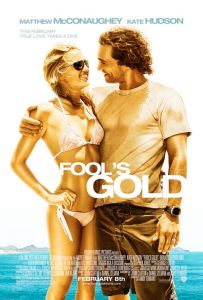 This may be the most boring film about treasure hunting I’ve seen in a long time. Clearly the filmmakers were intending to strike the comic/romance/adventure balance of Romancing the Stone, but boy does this flick flounder. It progresses but it never builds any sense of momentum; Fool’s Gold works almost entirely in lateral moves so no scene feels any more important than the other. It’s like the film succumbed to Matthew McConaughey’s foggy, stoner spirit and decides to just shrug its shoulders through gunfights and explosions. The characters are grotesquely annoying and yet the supporting characters keep elbowing into what should be a combative romance between Kate Hudson and McConaughey. It’s like the filmmakers thought exotic locations, sunny skies, and extremely tan lead actors would take care of the rest. Nothing in this movie ever crosses over into intentional comedy. The treasure angle is so contrived that it requires extensive sit-downs to just go over the convoluted exposition. Fool’s Gold is an empty-headed errand that takes far too long to go absolutely nowhere. For goodness sake, the movie has a puffy Malcolm-Jamal Warner (Theo from The Cosby Show) as a dreadlocked Caribbean gangster. You tell me if you think that sounds like a good idea.
Nate’s Grade: C-
Share this:

Zack and Miri Make a Porno (2008)
 It’s amazing how integrated pornography has become in our culture. Merely a few decades ago people had to wear disguises to venture out to a ratty theater to watch an adult movie alongside plenty of folks in raincoats helping to add to the sticky floors. Nowadays releasing a sex tape is considered a career boost. Porn stars have replaced supermodels as rock star arm candy, porn has become more socially acceptable, and a wealth of bizarre and explicit possibilities exist just a few keystrokes away. In the end, it’s all fantasy with bad acting.
And yet Kevin Smith’s newest comedy, Zack and Miri Make a Porno, got in trouble with advertisers because of people getting in a tizzy over the goofy word “porno.” Major League Baseball was told that a father was uncomfortably asked by his son what a “porno” was after seeing a commercial during a ball game. Heaven forbid our nation’s parents have to deal with an uncomfortable subject, so baseball banned any ads for the movie. Many newspapers nationwide have refused to list the full title. The original poster was deemed too inappropriate so Smith and crew devised a poster of stick figures. Poster version 2.0 then came under fire for being attractive to children because of the stick figure art. It seems Zack and Miri is getting it at both ends (no pun intended).
 Times are tough for lifelong friends Zack (Seth Rogen) and Miri (Elizabeth Banks). They’re scrambling to pay their bills and keep the electricity in their apartment during a chilly winter in Pennsylvania. Inspired by a conversation with a chatty gay porn star (Justin Long) at their tenth year high school reunion, Zack believes amateur porn can solve their money woes. The two will make their own porn video and sell it to the alumni list from their graduating class, who, Zack rationalizes, would buy a porn if they knew someone involved. Zack convinces his coffee shop co-worker Delaney (Craig Robinson) to help fund the project. Delaney agrees as long as he can have a say in casting; after many years of marriage he is eager to see something new. The team also recruits a squeaky-voiced stripper (current porn starlet Katie Morgan), an old bachelor party performer (former porn starlet Traci Lords), a cameraman (Jeff Anderson), and a man free from any inhibition (Jason Mewes). But Zack and Miri must confront their unspoken feelings for one another as they approach their own sex scene. Can they go from platonic friends to lovers?
Being a Smith film, naturally Zack and Miri is outrageous and often hysterical. The film manages to become witty and dirty at the same time, often stringing together vulgarities in exciting and imaginative ways (the curious “Dutch Rudder” as a means of escaping being deemed gay). Smith has a love of the profane. The movie is vulgar like most Smith movies but the beauty of its filth is in the sparkling, rapid-fire dialogue that adds eloquence to the scatological. This is Smith’s comedic brand, the verbose dirty joke. As in other Smith comedies, the true humor is not found in set pieces and set-ups but in the everyday camaraderie of the cast and through casual conversations. Smith writes characters that you just want to listen to for hours. Zack and Miri does have some funny moments that are specific to the production of randy moviemaking, like an unforgettable de-clogging that “frosts” a cameraman. The joke is swift. However, akin to the Judd Apatow brand of comedy, this is a movie where the charm is watching the characters interact, regardless of setting. I do think the movie unfortunately missed plenty of other potential gags on the silly minutia of homemade pornography. How about the crazy duties for a sound design? Imagine a guy trying to recreate the many weird bodily sounds during sex. I’m mildly shocked that Smith didn’t even touch the vagaries of pubic hair style.
 What the movie does nicely is dwell upon the distinction between love and sex. Now I’m not conveniently forgetting the thousands of movies that have come before and dealt with the topic of intimacy and carnality, but Zack and Miri goes into the nuts and bolts (no pun intended) of an industry that has turned intimacy into a mass-market business model. Zack and Miri stress out about their Big Scene and try to convince themselves that it won’t mean anything, but of course their body language betrays them. The actual deed is an obvious turning point for the twosome and count this as one sex scene that is actually, well, emotionally climactic and, yes, sexy. Though the camera only stays at shoulder-length and alternates between two angles, the actors convincingly convey an array of genuine feelings, notably love. It’s not easy for an actor to display honest-to-goodness love, but Banks and Rogen achieve this feat. The aftermath of their onscreen coupling extends into a seemingly unnecessary third act that divides them apart in a contrived fashion. Seriously, the typical third act misunderstanding in standard romantic comedy fluff is alive and well in a Smith vehicle. The characters do not react to this misunderstanding in a realistic manner; one character would rather be sequestered than easily prove their innocence.
While Zack and Miri has plenty of laughs and a nice, mushy center, I cannot help but feel mixed about the results. The characters are not nearly as sharply drawn as they have been in other Apatow comedies, even other Kevin Smith movies. I can go back and remember the multiple dimensions of the funny people that populated Superbad, Sarah Marshall, 40-Year Old Virgin and others, but Kevin Smith’s latest comedy suffers in comparison. Zack and Miri are the only characters with moderate sums of characterization, and yet their unspoken love is essentially the bulk of that. Neither character is well defined or explored in a substantial way that doesn’t involve the other. I get that the movie is a romance. But I expect more from characters than to be defined by whom they desire. I just wanted more. Yes Zack is a slacker who says he’s just looking for a good time, though we know he has his sights set on more, and yes Miri is a gorgeous gal with a lot of patience, but these characters are staples of Kevin Smith movies. The assorted side characters have fun moments but are mostly insignificant. There’s the stripper with a heart of gold, the been-around-the-block type, the henpecked husband, the secret freak behind the button-down exterior, the loudmouth, and the sex-crazed dude. Zack and Miri establishes the idea of filmmaking as a community by introducing this lot, but the movie then forgets to incorporate the supporting characters in meaningful ways. They’re mostly used for jokes that fail to extend beyond the immediate. A late scene involving Delaney’s angry wife (Tisha Campbell-Martin) relies on too many grating “white boy” japes that I tuned out. I’m not intending to slam Smith’s film, but the lack of character work hampers the audience investment in the central romance.
 What is lacking on paper is nearly compensated by the great performances from Rogen and Banks. Both are on loan from the Apatow comedy company, and both are skilled at being raunchy one second and heartfelt the next. Rogen finds his comic groove easily and is an enjoyable schmo that taps hidden ambition in the most unlikely of scenarios. It really is Banks who comes across as the star of the flick. She can talk trash with the boys but she is radiant during the film’s dramatic moments, selling Miri’s emotional highs and lows with crinkling smiles and fluttering eyelashes. Banks has always been a solid actress underutilized by most of her marginal film roles. With Zack and Miri, Banks showcases a devilish comedic gleam. Of course yet again the audience must believe that a beautiful gal with a beaming smile would be down on her luck finding a good guy.
In the end (no pun intended), Zack and Miri Make a Porno is a crude romantic comedy that might have benefited by more attention spent on the romance or the comedy. The tone never breaks as sharply as with Chasing Amy, arguably still Smith’s finest accomplishment, but the dirty humor and the gooey romance have a hard time expanding because of the presence of each other. Too often the ribald humor doesn’t feel fully realized because the dirty jokes are just window dressing for the romance, and I had trouble fully engaging with the romance because the characters haven’t been rendered to have substantial depth. Smith may have been better served by making his movie longer; the film is barely an hour and 40 minutes long. Zack and Miri Make a Porno is a sweet movie with a dirty mind but it does not measure up to recent comedies like the best of Apatow’s brand. Smith is a talented wordsmith who certainly knows how to make an entertaining comedy, and Zack and Miri certainly entertains, but like pornography, it just made me want something more fleshed-out and real (no pun intended).
Nate’s Grade: B-
Share this:

Nick and Norah’s Infinite Playlist (2008)
 When you’re a teenager, sometimes there is nothing more important in life than music. Generally one of the most prominent means for a teenager to outwardly define his or her emerging personality is by music. Coming of age and maturing musical tastes seem to go hand in hand. I may date myself here but I can recall my own personal blossoming thanks to the likes of Green Day, the Smashing Pumpkins, and the Offspring (you couldn’t go anywhere in 1995 without hearing “Self Esteem”). Nick and Norah’s romantic interlude begins over common musical tastes and move from there. Having a person “get” you seems to be linked with having a person “get” your music. Nick and Norah’s Infinite Playlist is an inviting and mostly successful teen comedy that “gets” it.
Nick (Michael Cera) is nursing the common teen ailment of a broken heart. He’s one part of a queer core punk band and just happens to be the only heterosexual band member. Nick has been sending mix CDs to his ex-girlfriend, Tris (Alexis Dziena), but she’s been tossing them in the trash. Norah (Kat Dennings) has been fishing those mix CDs and falling in love with her unknown musical soul mate. Norah’s best pal Caroline (Ari Graynor) has informed her that her favorite indie band, Where’s Fluffy?, is playing a secret late-night show in New York City. The slew of characters, Norah and Caroline and Tris and her new boyfriend, attend a nightclub where Nick’s band performs. Awkward. Norah poses as Nick’s new girlfriend and the two take off together to drive a very drunk Caroline home. It is here that they begin an unforgettable odyssey filled with gross toilets, drag queens, Norah’s ex-boyfriend (Jay Baruchel), jaunts to recording studios, and many stops along the way to try and find Where’s Fluffy?
 Nick and Norah isn’t anything altogether remarkable but its charm comes in how, well, unremarkable it comes across. I do not mean this as faint praise or a backhanded compliment. The majority of teen-oriented films have the habit of slotting characters into rigid archetypes. Earlier this year, the documentary American Teen was released and barely made a blip. The director of this documentary condensed an entire high school year into a feature-length film, but she framed her characters as entrenched stereotypes patterned after movies (movies began the stereotype, now is life merely following its lead?). The marketing even had its main “characters” recreate the Breakfast Club poster with the requisite Jock, Geek, Princess, etc. It’s so easy to paint in broad, well-established strokes when it comes to teenage characters and a high school setting. So it’s genuinely entertaining and encouraging to see Nick and Norah where the characters just are people. Granted the gay characters are a bit too cutesy by half, though they never become swishy stereotypes and the slutty manipulative ex-girlfriend character is a pretty familiar and clichéd antagonist. But the real charm of the movie is seeing characters that cannot be painted in broad strokes, characters that do not hide who they are, and characters that refuse to be typecast. Just watching Nick and Norah interact, I felt like I was watching two friends instead of high school archetypes having the same tired class warfare. Making the characters reasonably realistic and unremarkable is a breath of fresh air.
Not all the elements in Nick and Norah entertain; some feel like they’ve been surgically attached from different movies. The entire subplot involving the sloppy drunk escapades of Caroline seems extraneous at best, providing an unnecessary plot point that keeps Nick and Norah together for the night. It provides some laughs due to Graynor’s highly amusing drunken performance, but the subplot also pushes the movie into outlandish gross-out humor, like when Caroline vomits into a toilet, drops her gum in the same toilet, and then decides to foolishly go after the gum. The same piece of chewing gum has its own fantastic journey. The coupling between Nick and Norah is also given a weird and somewhat unseemly addition. Clearly these two kids “like like” each other and the wild night presents different coupling obstacles before these fun kids eventually decide to make a move. In one scene Norah is taunted by Tris about never having had an orgasm. So then the movie makes it a point that when nick and Norah do hook up that we are presented with Norah earning her first O-face (the whole climactic sequence is done off camera and only with audio). Orgasmic proof was not needed to convince the audience that Norah has finally found a worthy guy. The fact that they’re high school-aged students brings an unsettling, seedy element into an otherwise wholesome film. It wasn’t needed.
The plot of Nick and Norah has a few bumps along the way because the emphasis is on the groovy and genial atmosphere. Watching the movie is somewhat akin to attending a party with some cool people. You leave the theater with your spirits lifted a tad, a smile on your face, and some fond memories for the time being. I’m not saying that Nick and Norah is comparable to the best teen comedies of all time but it manages to spin a little magic. I couldn’t help feel wistful as I watched the teen characters romp through the late night music scene of New York City, a character all its own. The movie manages to capture the exciting essence of being young and alive in an authentic way.
 The two leads are deeply enjoyable. Dennings (The 40-Year-Old Virgin) is a great find and comes across as a natural teenager. She’s not precocious or glib, but she seems grounded, unassuming, and yet intelligent in a way that doesn’t pass as hyper-literate. Dennings gives a spunky performance that is tinged with awkwardness and heartache, as she explores the scary yet exhilarating prospect of romance. She’s also got a bashful beauty to her, like the girl next door that would never admit that she could be attractive. She’s got lips like red licorice and classic features that could work in old Hollywood. Dennings gives every scene a boost of heart and the movie shines brightest every minute she’s onscreen. Cera (Juno, Superbad) seems to have patented his nervous stammer that he’s previously showcased. I wonder what Cera’s acting range actually is because he seems to be playing different variations on the same character. However, I have written before that Cera is the living master of comic understatement and the well-timed pause, and he proves it again. He mopes a bit too much through the movie but Cera manages to make him empathetic and not pathetic. The two of them have a sweet chemistry and it’s easy to yearn for their coupling.
Nick and Norah’s Infinite Playlist exists in a world that doesn’t exactly resemble our own but seems like a swell place to visit. The movie almost contains a certain innocence to its teenage shenanigans. Dennings and Cera make for engaging leads and an adorable couple onscreen. Not all of the parts come together as well as Nick and Norah do, but the movie’s overall vibe is authentic and low-key, apt to provoke cheerful smiles more than laughs.
Nate’s Grade: B


 nathanzoebl
You must be logged in to post a comment.