Blog Archives
She’s Out of My League (2010)
 This is a fairly lackluster, flaccid, infantile comedy that aims to follow the same Judd Apatow formula of equal parts heart and raunch. Where this movie utterly fails is its choice of lead. Jay Baruchel (Tropic Thunder) is not a good leading man (his voice is very nasally and hard to listen to at times), but worse, his character, Kirk, is a callow, simpering, snot-nosed dolt. He has a dearth of a personality; he’s constantly berating himself or groveling for support by his oblivious family and mean ex-girlfriend. You simply don’t care. Kirk is not a guy worth watching. There’s empathy and then there’s pity. The movie wants to be a “nice guy gets the girl” story, but instead She’s Out of My League is a “guy with zero self-esteem and charisma gets the magazine cover model” story. At least in Apatow productions, the schlubby leads had personalities and redeeming qualities. I started enjoying the respites away from Kirk, time spent with his callous family members or his annoyingly juvenile friends. Anything to escape. The jokes have a pretty low ratio of hits to misses (an early ejaculation actually almost becomes an act break that keeps the couple apart), becoming subservient to a clichéd romantic comedy that wants to teach us that looks don’t matter. It’s what’s on the inside that counts. Have you heard that one before this week? If what’s on the inside is what matters, then She’s Out of My League has little to offer.
Nate’s Grade: C
Share this:

When in Rome (2010)
 When in Rome, do not do as this banal movie does. Know what kind of movie you’re in for? There’s an audio record scratch/slowdown effect twice in the first ten minutes. Kirsten Bell (Forgetting Sarah Marshall) is an unlucky in love workaholic who, when in Rome, pilfers coins from the Fountain of Love. This makes the subjects who tossed the coins (Jon Heder, Dax Shepard, Danny DeVito, Will Arnett) magically fall in love with Bell. They chase her back to New York and act like obsessive stalkers. Essentially, this is a rip-off of Love Potion Number Nine, except this rom-com is neither romantic nor comedic. The comedy is mostly brain-dead slapstick and the payoffs never materialize. In one scene, Bell and a date go out for a “night dinner” where they eat completely in the dark. There’s plenty of potential there but it’s like a minute until her posse of stalkers interrupt and the date’s over. There’s stuff like people running into trees, people squeezing into a tiny Italian car, a vase that’s supposed to break as a wedding celebration and refuses to break, and Bell and her lead, Josh Duhamel, have zero chemistry and like a three feet height differential. The movie is so joyless and bereft of energy. The scripts seems to be missing many scenes that fill in details about the various characters, or at least help give setup and context. The movie exists squarely in the absurd realm of romantic comedies and it’s thoroughly mediocre. I would expect nothing less from the writers of Old Dogs. I enjoy Bell but it’s not hard to resist the spell of this junk.
Nate’s Grade: C-
Share this:

Eclipse (2010)
 This may be an obvious statement but I will never be a teenage girl. Shocking news to anybody who never knew of the existence of my Y chromosome. Regardless, it’s hard for me to empathize with the madness that surrounds the cultural juggernaut that is the Twilight series. I cannot work myself into a frenzy. I cannot get madly passionate about the merits of Team Jacob vs. Team Edward (though full disclosure: I lean more toward Jacob). I cannot even understand the appeal of the main character and why she’s worth every human, vampire, and werewolf fighting over her. I just can’t walk in the same shoes of the Twilight faithful and their devotion to author Stephenie Meyer’s series. I get the appeal because its adolescent wish fulfillment with the flashes of danger muted by the overall security of traditional values (the vampire wants to wait until marriage before they have sex). I fully acknowledge my divorce from this conjured reality of the Twilight series. But that doesn’t mean I can’t judge the films on their merits. The first film worked for what it was, the second one was resoundingly bad, and now the third film, Eclipse, manages to reheat the same love triangle squabbles and call it something fresh.
Bella Swan (Kristen Stewart) is about to graduate high school and, presumably, graduate from the human race. Her vampire boyfriend, Edward Cullen (Robert Pattinson), has pledged to grant her wish and make her a vampire so they can truly be together forever. Bella’s friend/werewolf/ab model Jacob (Taylor Lautner) is vehemently against this plan. He wants Bella to be with him instead. He’s the safer choice and she doesn’t have to become dead for a happily ever after. Bella is torn between her two romantic options, again. However, Victoria (Bryce Dallas Howard) is out their plotting vengeance against Bella and the Cullen clan of “vegetarian” vampires. She’s creating an army of newborn vampires in Seattle. The army is so powerful that the Cullens reach out to the werewolves for an alliance. Mortal enemies comes together, including feuding paramours Edward and Jacob, to protect Bella and vanquish Victoria once and for all.
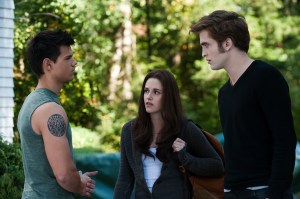 For starters, stuff actually happens in the third Twilight movie. I know that’s a fairly damning comment in itself that one must wait until the third movie for action. But here’s the thing: the plot fails to advance more than an inch. At the end of New Moon, Bella pretty much made her choice when she decided to whisk to the other side of the earth at the very utterance of Edward’s name, leaving poor Jacob high and dry. In Eclipse, she solidifies her choice. In New Moon, Bella implores Edward to turn her into a vampire, which he agrees to do after she graduates from high school (what a bizarre academic motivation strategy). In Eclipse, Bella further implores Edward to turn her into a vampire, which he is reluctant to do, but eventually he agrees. In New Moon, the werewolves and vampires don’t like each other. In Eclipse, that’s about the same, but they form an uneasy alliance to protect Bella, the most important girl in the whole wide world. The third film feels like a student’s paper revision; characters now add supporting evidence to explain their decision-making. Bella now gets to expound in further detail why she should be turned into a vampire (hint: she doesn’t feel like she fits in), Jacob adds to a budding Master’s thesis on why he is the better romantic option for Bella, and Edward gets plenty of opportunity to be the wet blanket, whether he’s turning down a horny Bella (no action there) or warning her about the dire lifestyle of today’s modern vampiric American. Much of Eclipse is people sitting around and chatting about their decision-making, verbalizing stuff that Meyer has no ability to place as subtext. By the end of the movie, at least you feel satisfied that everybody has weighed their options, even if they keep making the same dumb mistakes.
Speaking of action, Eclipse greatly benefits from having an external threat throughout the movie. The first two films felt prosaic and self-involved partially due to the fact that an antagonist was never introduced until the final act of each movie. The first two movies were two hours of brooding and making cow-eyes at each other, followed by a requisite climactic fight that felt anything but climactic.
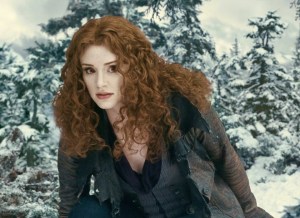
 With Eclipse, we have Victoria building her army of newborn vampires, and we see that army form, wreck havoc on the streets of Seattle, and for once the Twilight series feels like it has a real threat. That’s because Victoria has never ever felt like a threat. I don’t know how she’s represented in Meyer’s books, but in three movies, this curly-haired vampire has always come across as woefully unintimidating. She feels like a Kate Hudson romantic comedy character with fangs. It just doesn’t work no matter how fast the filmmakers show she can run through forests. The Cullen clan will occasionally chase after her, that is, when they’re not lining up like they’re making superhero posse poses. Victoria has never cut it as a villain, so it’s a good move for her to amass an army of super vampires that will do her bidding. The audience is repeatedly told, rather than shown, how serious the newborn vampires are because, you see, newborns still have some human blood in them. Never mind that the Twilight movies have never made mention of this power before. What’s puzzling is that Victoria has been building up her base of bloodsuckers for over a year, so why aren’t there like a ton more? The army of newborns consists of like twelve vampires. I understand the logistics of having to feed and house multiple vampires, but if I was planning for a brutal assault I’d want as many of these super vampires as I could sire.
Let me rephrase some of what I just said. New Moon did have an antagonist and her name was Bella Swan. She was sullen, whiny, self-involved, casually hurtful, and she led around Jacob on a leash. The dude is obviously in love with her, and even tells her face-to-face in Eclipse. Bella toyed around with her self-described “best friend” for whatever she needed and then she screwed him over for her sparkly vampire. In Eclipse, she starts to repeat this same pattern of behavior. Every movie makes it emphatically clear that Bella and Edward are destined to be together, and yet every movie has Bella engage in this annoying, wishy-washy “Maybe I’ll be with you, maybe I won’t” dance to make the boys fight over her one more time and thus validate her existence. I’ve seen this type of behavior before; it’s loathsome. She’s less unlikable and callous in Eclipse. Bella is absent any defining characteristic so that the millions of Twilight readers can insert themselves into the story as the girl everybody wants to fight over. Edward practically hounds her at every turn to marry him, which also seems like another case of wish fulfillment. Bella seems defined by whatever man she has at the current time. I’m surprised more of Meyer’s readers don’t find this fact insulting. Well, in Eclipse Bella doesn’t magically sprout a personality so you’re stuck yet again with the Bella bores.
 Director David Slade (Hard Candy, 30 Days of Night) was an interesting choice to handle all this teenage melodrama. The visual aesthetic is much more refined and accomplished, and the pacing is infinitely better. New Moon was 130 minutes but felt eight times that long because of all the repetitious plotting and brooding, not to mention the gratuitous beefcake shots. Eclipse is only six minutes shorter than its predecessor and yet it moves along at a steady jaunt thanks to the immediate external threat. It still has to fit in all those beefcake shots to make the soccer moms swoon, but at least the movie maintains that pulpy teenage synergy from the first Twilight movie. The special effects have greatly improved as well, which makes the wolves vs. vampire fight scenes more entertaining to witness for the right reasons.
The screenplay for Eclipse includes all sorts of extras to round out the Twilight universe, though they are tangential to the plot at best. Jasper (Jackson Rathbone) and Rosalie (Nikki Reed) get their back-stories revealed, which means flashbacks with costumes! While each is momentarily diverting, why am I getting time taken out from the movie to flesh out the lives of what are, essentially, background characters? At least Slade doesn’t just let the actors jaw away with exposition; he shows the audience their pre-vampire lives. Screenwriter Melissa Rosenberg has adapted every movie so far and she seems well aware of what her audience expects. Eclipse has the exasperating habit of not leaving anything implied. When Rosalie warns Bella about choosing to become a vampire, Bella promises she’ll never want anything more than Edward. “There’s one thing more you’ll want,” Rosalie says. And then, because the audience is perhaps too thick to pick up that subtlety, she adds, “Blood.”
Our threesome of young actors all seem to have their parts well memorized at this point. One part pouting, one part glowering, and two parts yearning. This is the meatiest film yet for the actors as they all get to assemble heir cases. Jacob argues that he’s best for Bella and tries to convince Edward that if he truly loves her, he won’t let her become a vampire. Edward knows the heartache that comes with transforming into a monster and watching as everybody you love dies while you seem to be standing still. Oh, and there’s that whole insatiable desire to drink blood thing, which is just gross. Bella realizes she’s in love with two guys at the same time. She also realizes that in order for her relationship with Edward to last, she will inevitable have to be turned into a vampire. It’s the fork in the road every “girl who dates vampire” story must ultimately lead.
 Stewart and Pattinson give serviceable performances, though Stewart seems like she’s doing you the favor of acting, like she’d rather be elsewhere. Once again, Lautner, who seems to have the most fun with his role, upstages them. There’s a sequence where the threesome share a tent in the mountains, and Bella is freezing and the ice-cold Edward cannot warm her. A plan is hatched: Jacob will crawl into the sleeping bag with Bella and warm her with his body heat. The ridiculousness of the scene is pierced by Lautner deadpanning, “Well, I am hotter than you” (which left my packed theater screaming in approval). Even though he’s saddled with quasi-stalker dialogue like “You love me, you just don’t know it yet,” Lautner makes the most of his wolf-boy licking his wounds.
Here’s another revelation thanks to Eclipse: vampires are apparently made of porcelain. When a vampire is destroyed in the Twilight world, they literally can have limbs snapped off like it’s nothing. They look like dolls getting ripped apart. Occasionally someone will have their head beaten and the vampire cranium will just shatter into thick pieces, much like a porcelain doll. Weirdest of all, whenever a vampire gets hit they are accompanied by this rattling sound effect, like inside the vampires are filled with rolls of nickels and dimes. It’s bizarre and distracting. I don’t ever remember this happening to vampires in the previous two installments. Why not go the Buffy route and just have dead vampires turn into ash? It doesn’t have to be as violent and nauseating as vampires getting staked on HBO’s superior True Blood, but I expect more than vampires just breaking. These are the creatures of the night. They should not be fragile little porcelain dolls. I know Slade and the producers went this route so that they could ramp up their bloodless action and get away with more onscreen.
The fact that something other than two-hours of lovey-dovey romantic declarations and intense, self-indulgent brooding happens means this is by far the most action-packed film in the Twilight series yet. It’s still not that good but it is a vast improvement over the dour suckfest that was New Moon. In fact, since Eclipse repeats many of the same plot points there really is no reason to ever watch New Moon. Skip it altogether. Once again, little of consequence happens in the film but at least Bella isn’t insufferable and we get some nice supernatural fight scenes out of it. The appeal of the series has failed to be translated on the big screen. It’s all about the swoon, and Eclipse will keep the Twi-hards swooning as they take in their male sex objects brought to visual life. Once again, I will state that the Twilight series comes across like a tedious teenage soap opera scrubbed clean of teenage hormones. Eclipse is probably the most guy-friendly of all the films so far, but even that isn’t enough to keep old material interesting the third time it’s reheated.
Nate’s Grade: C+
Share this:

The Princess and the Frog (2009)
 It’s taken this long to get an African-American leading lady/princess in a Disney animated film, and she gets to spend the majority of the flick as a slimy frog? This return to traditional 2-D animation for Disney is less than a triumph due to a pretty dull storyline. All the familiar elements are there, but the characters just fill voids rather than tell a story. There’s the downtrodden heroine with her dream, the arrogant prince who learns to value others, the comical talking animal sidekicks, and get ready for a slew of songs you will instantly forget despite the added gumbo flavor. Set in 1920s New Orleans, the film has plenty of ravishing visuals to get you through the formulaic plot. It’s a nice return to Disney’s bread and butter before the 3-D animation craze took off, and I pray that there will be plenty more traditional 2-D animation on the horizon from the Mouse House, but this isn’t the best film to reestablish the glory of traditional animation, racial politics aside.
Nate’s Grade: B-
Share this:

Sex and the City 2 (2010)
 Sex and the City is a cultural phenomenon that women around the globe celebrate. When the show first premiered on HBO in the late 90s, it chronicled the lives of professional women that wanted to have it all, and they wouldn’t apologize for their sexual appetites or fashion splurges. The successful show then launched a very successful movie in 2008, but the movie tied up everyone’s storylines in fairly nice little bows. So now where to? For the fans, it hardly matters. Sex and the City is a cause of celebration, a girl’s night out with cosmo in hand. The content of the movie seems almost like an afterthought. Fans aren’t going to be too picky but there is a lot to pick at with Sex and the City 2.
It’s two years after the events in the first film. Carrie (Sarah Jessica Parker) and her husband, John James “Mr. Big” Preston (Chris Noth), are settling into married life. Miranda (Cynthia Nixon) feels mistreated and unappreciated by her boss because she’s a woman. Charlotte (Kristin Davis) has her hands full with two young children, and motherhood in reality isn’t at glamorized as she thought. She’s also worried that her husband (Evan Handler) might cheat with their busty Irish nanny (Alice Eve, the “10” from She’s Out of My League). They girls dub her “Erin Go-bra-less,” I think as a weird wordplay on Erin Brockovich. Your guess is as good as mine. And then there’s Samantha (Kim Cattrall) who is 52 and desperately fighting to look and feel young again. She has a regiment of hormone pills and creams she uses daily to keep the encroaching effects of menopause at bay. To give the girls an excuse to get away, a rich middle Eastern sheik wants to persuade Samantha to do some PR work for his hotel, so he invites the foursome on a fabulous all-expenses-paid trip to Abu Dhabi in the United Arab Emirates.
 I know coming from my non-demographic perspective that I’m going to have some difficulty relating to these main characters, but these gals are so self-absorbed in their petty, rich people problems, I question who could really relate to much of this drama. Charlotte is being driven mad by the toll of motherhood, which is relatable, except her toll involves staying at home in a rich apartment, never having to worry about money, and handing off her screaming kids to the nanny. Not relatable. Carrie’s dilemma is the most forced and therefore the worst of the bunch. After having her storyline tied up in the first film, where can she go? She has got the guy, she got her wedding, she has a luxurious apartment, and her man wants to spend time with her. She’s in her mid-to-late 40s at this point and wants to still go out every night on the town. She complains that they stay in TWO NIGHTS a week. When Big gets her a thoughtful anniversary gift, a flat-screen TV in the bedroom so that they can watch old romantic movies TOGETHER, she pouts and says, “Jewelry would have been nice.” Her main problem is that her guy, the one she married, wants to spend time with his wife in their comfy abode and relax TOGETHER. When Carrie asks for two days leave so she can get some work done on an article, Big allows her the time off and then wonders if that apply to their marriage: each takes a day or two off to concentrate on work, relax, catch up with friends, etc. It’s her idea, but when he voices it suddenly it becomes threatening and again all about Carrie. She responds, “Is this because I’m a bitch wife who nags you?” Well, at least she cuts to the chase. These are the problems that people have when they don’t actually have any real problems.
There is one, count ’em, one great scene in the movie and it doesn’t involve Carrie or the ever increasingly cartoonish Samantha. Charlotte and Miranda are by themselves sipping from cocktails and confessing about the hardships of motherhood. Both take sips and then admit a guilty secret. One says she feels like a failure at being a mother. Another admits that being a stay-at-home mom just isn’t enough for her in life. They both admit that they love their children dearly, but have enjoyed the time away from them. The scene feels genuine, with some heartfelt laughs derived from the situation. Charlotte bashfully admits that her first thoughts following the idea that her husband might cheat with the nanny were, “No, I can’t lose that nanny,” and it feels honest and right for her character, plus it’s funny. And then they admit something that the audience had fortuitously forgotten in that moment — they do all this with help. Charlotte has a nanny and Miranda has her grandmother-in-law living with them to help raise the kids. A really nicely written and acted moment that peels away to showcase the complexities of the modern mother is dashed. Even the universal concerns we can all relate to (infidelity, doubt, settling, getting older) take a backseat to the overly manufactured melodrama.
 The rampant consumerism hasn’t slowed down despite the economic meltdown of 2008. Carrie makes a quick comment about how it “wasn’t a good time to sell her apartment,” and so she keeps her spacious apartment along with the multi-million dollar one she lives with Big. The sheer celebration of consumerism has turned into blind worship; it’s all about the stuff. The characters have long since burrowed into their types (the fussy one, the career-minded one, the sexually voracious one, and the self-involved one), and those types have become entrenched, and the men have become just another accessory for a large closet of goods. The real star of this movie is the outlandish, sometimes garish, fashion, and there is heaps of it. One outing into the Arabic desert makes use of three separate costume changes. The name-dropping and product placement are aggressive. For the first film I wrote: “‘I’m not going to charge the film with setting back feminism or anything but why do the main characters have to be so shallow, brand-conscious, and live to splurge? The emphasis on buy, buy, buy to make yourself feel good is a rather sad and empty message.” The Sex and the City movies have morphed into consumerist, female wish-fulfillment fantasies, enabling Carrie’s princess indulgences and superficial demands. The girls are all panicked towards the end about he possibility of, gasp, flying coach, you know, like the rest of us. These women haven’t lived in anything resembling reality for some time. It’s a shame that in these cost-conscious times, the Sex and the City universe seems unaffected. I would have enjoyed seeing how these high-powered women dealt with the repercussions of an economic recession (not to mention Carrie dealing with the death of print publishing). Yes, I know, it’s designed to be escapism, and that’s all well and good, but I wanted to escape from these characters and their lifestyles.
But what will get the most attention is the extensively long escapade in the Middle East, like Sex and the City is planning to solve global politics. Obviously, there is something wrong with how women are treated in several majority Muslim countries, from the demands to cover themselves in heavy garments so as not to tempt men, to the void of rights, to honor killings and stonings, and murdering women just because they went to school. This is a serious matter. These countries are behind the times and women deserve an equal footing and an equal say, and several contemporary movies have dealt with these issues in a thoughtful manner. Sex and the City 2, on the other hand, takes a patronizing approach that is culturally insensitive at best and downright racially insulting at worst. These ambassadors of modern feminist thinking basically show themselves to the Arab world as the quintessential ugly Americans; the ladies of Sex and the City are exactly what radicals think about when they order women to cover up or else. These women are self-indulgent, materialistic, vapid, and riding high on Western self-righteousness. I am in no way apologizing for how large portions of the Muslim world treat women, but Carrie and company are quite possible the worst ambassadors to argue the case for feminine equality. And remember, they complain about their pity-party problems while on an all-expenses-paid vacation to a lifestyle of lavish luxury in the Middle East. They reduce the problem of Muslim women into simplistic, indignant quips. It’s more than a little insulting to have somebody wearing clownish outfits telling women in other countries how to dress. This foursome is brash and in-your-face with their strong sense of cultural superiority, practically baiting the locals into making a scene. At one point, Samantha is jailed and shocked that the authorities might be upset that she was caught having sex on their beach. Don’t these women understand culture clash? In the end the women are chased out of town and you almost (I repeat — almost) feel for the other side.

This is considered fashionable?
Even worse than the ethically dubious moralizing is the fact that this extended portion of the movie (about 100 minutes) grinds the plot to a halt. Most of the storylines are set up before the trip, and then they are all tied up somehow when the women return, though the time in Abu Dhabi seems to have had no effect. Miranda’s conflict with her boss is resolved before the gals ever get on a plane, so she becomes essentially tour guide and confidant for the trip. Samantha is denied her plethora of pills at the airport, so she becomes the slapstick comic relief trying to stave off menopause. Her pun-heavy dialogue is full of groaners like, “Lawrence of my labia.” Her sex kitten act is getting as tiresome as her futile attempts to keep Mother Nature at bay. Samantha is the same from the beginning of the movie to the end, and fans will probably rejoice at this lack of character development. The entire misadventure in Abu Dhabi feels like a Hope & Crosby road picture, or, worse, one of those lame TV-movie gimmicks from sitcoms (luckily Carrie is spared the curse of the tiki idol).
But whatever I say will be regarded with shrugs by the legions of Sex and the City fans. They’ve grown with these characters over 12 years, so I understand the attachment fans feel. Like I said before, the movie medium is not the ideal place for these ladies. In half hour doses their quirks and problems seem cute, but when stretched to a bloated running time they come across as vapid and whiny. The conflicts don’t seem too relatable and the humor is once again tied to slapstick and leaden puns. The problem is that after six seasons and one 145-minute movie, the characters feel tapped out. They’ve been through plenty and now the crew is just coming up with whatever excuse they can have to reunite the cast on the big screen (stay tuned for Sex and the City 3 … in Space!).
Nate’s Grade: C
Share this:

Valentine’s Day (2010)
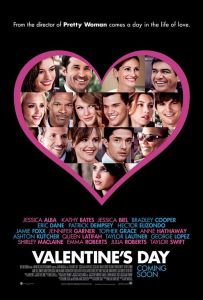 Imagine every romantic comedy cliché and sappy platitude about love stirred together into one giant gelatinous conglomeration of hollow sentiment. That’s Valentine’s Day. Regardless of your thoughts on the holiday, this movie, which aims to celebrate our national day of love, might have the opposite effect. This movie makes He’s Just Not That Into You look like When Harry Met Sally. It?s a fairly large ensemble with plenty of mega-watt stars, but it’s too bad that nobody knows what to do. Jessica Alba’s character literally runs her course an hour into the film and yet she still makes meaningless appearances. This overstuffed Hallmark card has ridiculously safe, candy-coated storylines sanded so that there is no hint of edge or wit (Anne Hathaway is the most ludicrous PG-13 phone sex operator you will ever find). The resolutions of most of these storylines will be predictable to anybody who has ever read a greeting card. Jamie Foxx is supposed to be a bitter TV reporter popping up everywhere reporting about the ills of V-Day. Think he’ll have a change of heart by the film’s end? The cast does offer their small pleasures (there are SIX Oscar nominees/winners in this movie!), except for the kid who has a crush on his teacher (Jennifer Garner). He was insufferably annoying. So was his movie.
Nate’s Grade: D+
Share this:

An Education (2009)
 In 1961 Britain, Jenny (Carey Mulligan) is a 16-year-old schoolgirl plowing away at her education. She?s on track to enroll at Oxford “reading English” and her parents (Alfred Molina, Cara Seymour) have overscheduled the girl with hobbies and clubs to help build her academic portfolio. Then one rainy night she meets David (Peter Sarsgaard), a thirty something man who offers to give her and her cello a ride. This enchanting man keeps coming back around to see Jenny, sweeping her off her feet. He invites her to go to concert recitals with his older friends Danny (Dominic Cooper) and Helen (Rosamund Pike), trips to the country, and even a fabulous getaway to Paris. “You have no idea how boring my life was before you,” she confesses to David. But David is coy about how he can pay for such extravagances. Jenny’s grades begin to suffer and it looks like she may miss out on being able to enroll at Oxford. She has to make a decision whether to continue seeing David or going back to her primary school education.
An Education is a handsomely recreated period drama that manages to be very funny, very engaging, and very well acted. It’s also rather insightful and does an exquisite job of conveying that strange wonderful heartsick of love, maybe better than any movie since My Summer of Love. You can practically just drink in all of Jenny’s excitement. Jenny isn’t a silly girl prone to naivety. She’s a smart and clever girl, and not just because other characters say so or we see her stellar test grades destined for prime placement on the fridge. You witness her intelligence in how she interacts through different social circles. Since the movie is entirely Jenny?s story, we need to be convinced that she’s smart in order to believe her willingness to be duped. She has reservations about David’s habits but doesn’t want to risk going back to a dull life of books and family dinners. She has to be a smart, vibrant girl anxious to keep a good thing going, willing to ignore certain warning signs that otherwise might cause her pause. Even Jenny’s parents get caught up in the seduction, swooning over David and his upper class connections and comforts.
 The teen-girl-with-older-male aspect might make us squirm, but in the realm of 1961 Britain, it’s acceptable. Jenny and David don?t need to hide their affair in dank hotel rooms and avoid any suspicious eyes. We don’t get any agonizing inner turmoil over dating a teenage girl, mostly because it’s from Jenny’s perspective and that everybody else seems okay with it all. This acceptance means that the drama for An Education can focus on something less seamy. That doesn’t mean that everybody approves. While Jenny’s friends think she hit the jackpot, and hang from her every word about her amazing sophisticated boyfriend, her literature teacher (Olivia Williams) sees through David?s whirlwind of charms. This isn’t the tale of some girl being drawn into the dark side, turning into an unsavory, rebellious teenager flouting the law and good manners. Jenny is not that kind of gal.
Mulligan is fantastic and delivers such a sumptuous performance that you feel like a human being is coming alive before your eyes. She lights up with the dawning realization that a charming and worldly man is courting her, and you feel every moments of her swirling delight and awe. Mulligan even goes so far as to get even the small details right, like the way Jenny opens her eyes to peak during a kiss to make sure it’s all not just some passing dream, or the way she has to look away at times and break eye-contact because she’s just so happy, with those twinkling eyes and a mouth curling like a cherry stem. She’s bashfully coquettish in her physical attraction to David, though in my praise it also sounds like I, too, have fallen for the girl. Much ink has been spilled declaring Mulligan as a rising Audrey Hepburn figure, mostly because she sports that famous short bob of a haircut that many girls had in 1961. To me, Mulligan gives a stronger impression as being the luminescent little sister to Emily Mortimer (Lovely & Amazing, Match Point). Mulligan is a fresh young actress that delivers a performance of stirring vulnerability. It’s a breakout performance that will likely mean that Hollywood will come calling when they need the worrisome girlfriend role for the next factory-produced mass-market entertainment (she’s finished filming the Wall Street sequel, so perhaps we’re already there).
 Adapted by Nick Hornby (About a Boy) from a memoir by Lynn Barber, An Education follows the coming-of-age track well with enough swipes at class-consciousness. But man, I was really surprised how funny this movie is. An Education is routinely crackling with a fine comic wit, and Jenny and her father have the best repartee. Molina is an unsung actor and he dutifully carries out the role of “uptight neurotic father” with more than a stiff upper lip; the man puts his all in the role. While he can come across as hysterical at times, Molina is paternal with a capital P. It’s refreshing just to listen to smart people banter at an intelligent level.
The movie’s theme ponders the significance of education. There’s the broader view of education, learning throughout one’s life from new and enriching experiences. She gets to learn a bit more of the way of the world, and Jenny feels that she can learn more and have fun with David than sitting through lectures and slogging through homework. She values what David has to teach her above what she can find in a textbook. Jenny’s father stresses the virtues of learning and thinking but once Jenny has a chance to marry an upper class, cultured male then education no longer matters. She is now set for life through David. All that learning to become a dutiful housewife in a lovely, gilded cage. Is that the real desired end to personal growth: to snag a husband? The school’s headmistress (Emma Thompson in practically a cameo) doesn’t serve as a great ambassador to higher learning: she stresses the lonely hardships, internal dedication, and she herself is openly anti-Semitic, proving that an intelligent mind is not the same as being open-minded. To her, Jenny is jeopardizing her lone chance at a respectable life.
 Jenny rejects the traditional route of education and chooses to pursue a life with David, that is, until the third act complications beckon. Jenny finds out about David’s secret rather too easily, I’m afraid (secret letters should never be hidden the glove compartment). While the end revelations are somewhat expected, what is unexpected is that every character pretty much escapes consequences by the end of the film. No one is really held accountable for his or her decisions. Pretty much everyone is exactly where he or she left off just with a tad more street smarts. It’s the equivalent of learning not to trust every person after getting ripped off.
Despite all the hesitation, and the age difference, An Education is an actual romantic movie. It’s a coming-of-age charmer with all the preen and gloss of an awards caliber film. You feel the delight in the sheer possibility of life for Jenny. The story unfolds at a deliberate pace and allows the audience to feel every point of anxiety and bubbling excitement for Jenny. Mulligan gives a star-making performance and practically glows with happiness during the movie’s key moments, making us love her even more. The plot may be conventional but the movie manages to be charming without much in the way of surprises. Still, An Education is a breezy, elegant, and clever movie that flies by, even if its biggest point of learning is that age-old chestnut that something too good to be true must be.
Nate’s Grade: A-
Share this:

Avatar (2009)
 Avatar cannot possibly meet expectations. Can it? The long-in-development pet project of director James Cameron has been dubbed as nothing short of a tectonic shift in moviemaking; it will “change movies forever.” Cameron had the idea for the movie 15 years ago but held on, waiting for the technology to catch up. After you’ve directed Titanic, the highest grossing movie in history, I suppose you have the luxury of waiting. The budget has been rumored to be wildly anywhere from $250 million to $500 million. Avatar was always planned as a 3-D experience and nothing short of the savior of modern movie and the theatrical experience. It would make going to the movies an event once again, something that could not be duplicated at home on puny TV screens. Given the reams of hype and anticipation, Avatar couldn’t possibly succeed, could it?
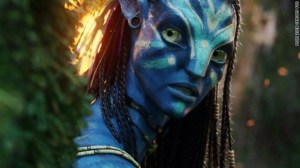
In the year 2154, mankind has posted a colonial base on the distant moon of Pandora. The planet orbits a gas giant and the atmosphere is deadly to humans after a few minutes exposure. The planet is inhabited by all walks of deadly, incredibly large life, including the indigenous Na’vi tribes, skinny, nine-feet tall blue aliens. The Na’vi also have connective tissues coming from their ponytails that allow them to connect with all nature by “jacking in,” so to speak. They are a relatively peaceful clan that makes sure to respectfully use every part of the space buffalo. It just so happens that they are also sitting on top of a huge enrichment of the mineral Unobtanium, which sells for a crapload of money back on Earth. A corporate exec (Giovani Ribisi) has hired a private army of mercenaries to forcefully move the natives. In the meantime, they are trying to reach a diplomatic solution. Dr. Grace Augustine (Sigourney Weaver) is the head of the Avatar program, where they biologically grow Na?vi bodies with some human DNA mixed in. People can then link their brains to the giant Na?vi bodies and walk and talk among the natives.
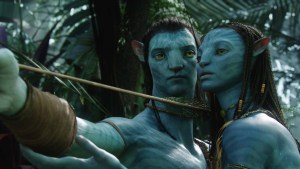 Jake Sully (Sam Worthington) is an ex-Marine who is living the rest of his life in a wheelchair. His twin brother was apart of the Avatar program but was murdered, and he?s signed on to take his brother’s place (the avatars, naturally, are hugely expensive). Jake will plug into his avatar body and be able to feel like he can walk again. Colonel Miles Quaritch (Stephen Lang, superb) likes the idea of having a former Marine on the inside. He makes a deal with Sully: provide useful Intel on the Na’vi, and he’ll get his “real” legs back. Jake and his fellow avatars ingratiate themselves with the Na’vi, and Jake is taught the ways of the tribe by Neytiri (Zoë Saldana). Their teacher-student relationship transforms into a love affair, and Jake begins having second thoughts about his mission.
To the heart of the matter, the special effects are transcendent. This is one of those pinnacle moments in the advancement of special effects technology. Avatar is now the new standard. The environments are so incredibly realistic that if I were told that Cameron and his crew filmed on location in some South American jungle, I would believe it without a moment’s hesitation. But everything in this movie was filmed on a giant sound stage. The visual detail is lushly intricate and altogether astounding. The planet of Pandora feels like a living, breathing world, with a complex environmental system. Every blades of grass, every speck of dust, every living creature feels real. Cameron and his technical team have crafted an intensely immersive, photo-realistic alien world. The level of depth is unparalleled. I found myself trying to soak up the artistry in every shot, admiring a tree canopy four dimensions back. The planet has an extensive night period, which has allowed the planet to evolve with an emphasis on bio-luminescence. Everything from moss that glows from being stepped on, to dragonflies that look like spinning flames, to glow-in-the-dark freckles on the Na’vi allows the movie, and Pandora, to feel like it has a rich evolutionary history. The ecosystem makes sense given the particulars of this world. Cameron isn’t just giving an extra leg or another eye to make the wildlife alien. The special effects are so good that you can easily take them for granted, like Jake’s atrophied legs. Those were special effects as well and yet they looked so real that I never stopped to consider them.
The Na’vi don’t necessarily have the same level of photo realism, however, this is by far the greatest motion capture accomplishment of all time. The creatures don?t appear rubbery or waxy, and there is honest to God life in those eyes, the same life that is absent in Robert Zemeckis’ motion capture movies. The CGI characters have believable facial expressions, capturing subtle movements and realistically capturing emotion. I’m still not a fan of motion capture, but at least Cameron makes effective use of the technique by recording actors movements and mannerisms and transforming them into nine-foot tall blue cat people. That seems like a better use of the technology than having Tom Hanks play a mystical hobo.
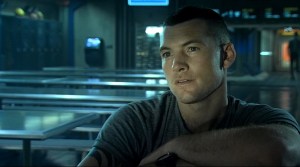 The 3-D is impressive as well but not the “game-changer” it was heralded to be. This is because Cameron doesn’t want to distract the audience and make them conscious of the 3-D gimmicks. There aren’t any moments where someone just hurls something at the screen randomly. There aren’t any clumsy swordsmen jutting forward. Because the 3-D glasses naturally dim the screen and make things darker, Cameron has smartly compensated by cranking up the natural light and vivid colors on screen. Nothing ever comes across as murky or hard to distinguish. Cameron has designed a 3-D environment that spaces out the different elements of the foreground and the background. There will be floating bits like ash or water that will seem right in front of your face. Short of that, you may find yourself forgetting about the 3-D because it’s not always utilized for a 160-minute action movie. It’s more just pushing the visual planes back with your depth of field. After all the praise about Avatar being the triumphant 3-D experience, I’m surprised that the best 3-D I’ve ever seen is still Zemeckis’ Beowulf. At least you still have that laurel, Zemeckis. For now.
From a narrative standpoint, Avatar has a lot of borrowed elements. It follows the exact same plot paces as Dances with Wolves. In fact, this story is exactly Dances with Wolves in space. Like Kevin Costner’s film, we follow an injured military man find acceptance and community with a native (Pandorian?) population. He falls in love, changes his world perspective, and realizes that these dignified people of the land deserve more than to be pushed aside for the greed of the Encroaching White Man. So he bands together and leads the natives against the superior military power of the White Man (It’s also the same plot formula for 2003’s The Last Samurai too). There?s even a young native that distrusts our hero at the start but eventually comes to call him “brother.” Add a few touches from Ferngully and The Matrix and there you have it. It’s the modern tale of colonialism where we, the people in power, are the enemy, though the villains of Avatar are corporations and private military contractors. That might not sit well with certain parts of the country; the same people that blithely think America can do no wrong simply because of its name. Cameron’s politics are pretty easy to identify on screen, and it’s probably too easy to dismiss the flick as “tree-hugging” eco-worshipping prattle. However, this is the same man that wrote and directed True Lies, which is nothing but the cool allure of the military industrial complex AND the villains were Arab terrorists.
Now, the characters aren’t too deep and the love story between Jake and his blue lady seems to be missing a couple reels worth of romantic development, but the movie follows its familiar beats with ease and the last act is terrific. It’s once again one of those all-out endings that gives way to a relentless series of explosions, but Cameron brings together all the creatures and characters he has established prior, which makes for a hugely satisfying and kick-ass payoff. Cameron is one of the greatest masters when it comes to constructing an invigorating action sequence, and he pulls out some great ones in Avatar. Geography is so key to staging a compelling action sequence, utilizing the particulars of the location and having an audience familiarized with the location. By he end, Cameron has fleshed out his world so well that we recall specific locations and remember their strategic value. The assault between the giant mechanical robot suits and the noble natives is great, with different points of action on the ground and in the air. Some have complained that the action sequences of Avatar are like a video game cut scene, and so what? My one complaint about the action is that we lose perspective by being with the Na’vi for so long. The audience becomes accustomed to seeing the world from the Na’vi proportional perspective, forgetting that these creatures are nine feet tall and even they look tiny on their flying dragon creature things, so how big must those things be?
 The movie is not without some level of flaws, primarily in the storytelling department. The first 90 minutes of the movie feels really solid but then the next hour kind of simplifies everything in a rush to the climactic booms. The human villains become dastardly, the Na’vi become extra noble, and the romance with Jake and his blue lady gets consummated in a sequence begging for biological questioning (Do they “jack in” to each other? Is this somehow considered bestiality?). Jake could have benefited with some more back-story as well. The earnest “I see you” Na’vi greeting can get silly after a while. The whole avatar aspect doesn’t feel fully committed and could use more explanation. The Ribisi character is a shallow glimmer of the corporate weasel that Paul Reiser played so perfectly in Aliens. Cameron never says why the Unobtanium element is so valuable in the movie; apparently, Earth is out of energy resources. There are elements that border on the ridiculous, like the giant mech robot suit having a giant Bowie knife. The end leaves the distinct impression that the defeated human beings will just come back with bigger hardware and stronger nukes. If this Unobtanium element is so valuable to the energy resources of Earth, I doubt that one butt whipping is going to stop the exploitation of Na’vi resources. The sappy end credit love song by James Horner and Leona Lewis also might elicit more than a few guffaws.
The only real groundbreaking part of Avatar is the visuals but a familiar story doesn’t stop Cameron’s technical achievement. The plot is entirely predictable, and wholly borrowed, with a crazy different environment and a fresh coat of CGI. But can a highly derivative story kill a project built upon visual wonders? Not for me. Star Wars itself was derivative of many other stories, from samurai tales like Akira Kirosawa’s The Hidden Fortress, to Buck Rogers and Flash Gordon, to Westerns like The Searchers, and war movies like The Guns of Navarone and The Dam Busters. Has that hindered the lasting impact of George Lucas’s quintessential space opera? I’d doubt you?d find too many folk with nagging complaints about Star Wars being too derivative. That’s because the characters were interesting and we cared about them, the story was satisfying, and the visual techniques pushed the medium forward. I could repeat that exact same sentence, word-for-word, about Avatar. It might not change movies forever as we know it, but Avatar is a singular artistic achievement that demands to be seen at least a few times, if, for nothing else, to stare at lifelike trees some more.
Nate’s Grade: B+
Share this:

Adam (2009)
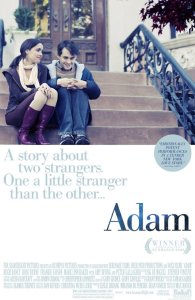 It’s a romantic comedy with a quirk. Adam (Hugh Dancy) has Asperger’s syndrome, a higher-functioning level of autism that makes social interactions difficult. Lucky for him he?s handsome enough that his new neighbor (Rose Byrne) falls for him anyway. What follows is mostly standard romantic comedy stuff, with boy and girl feeling each other out, except Adam has trouble with figurative language and implied speech. The movie works on a low-key cuteness as it hits all the conventional plot destinations, but then it charts its own path for an ending. I give credit to writer/director Max Mayer for bucking formula and following his convictions, refusing to tie everything together so easily. With that said, the Asperger’s portrayal seems to go into an extreme, Rain Man-level of social disability. Adam is crippled with fear even to leave his home; he is a slave to routine. Dancy is a sympathetic lead, though he’s overly reliant on his character’s quirks. Adam isn’t a freak or some delicate flower needing to be protected from the rigors of reality, and I think the movie would have benefited from a broader look at Adam’s ongoing lifelong struggle with his brain. Mostly, audiences are served up a sweet if somewhat plain romance with an extra dash of eccentricity, but not enough to rock any rom-com sensibilities. It’s a non-threatening alternative to the genre.
Nate’s Grade: B
Share this:

New Moon (2009)
 Admittedly, I am not a fan of the Twilight series. I have never read one of the books but I didn’t hate the first Twilight movie. I thought it kind of worked on its own merits even if it wasn’t for me. However, New Moon is a crushing bore and a mess.
Bella Swan (Kristen Stewart) is celebrating her eighteenth birthday with her vampire boyfriend, the 119-year-old Edward Cullen (Robert Pattinson). She accidentally cuts her finger and the sight of blood sends one of the Cullen vampires crazy with instinct. Edward concludes that his love would be safer without him. He bids her goodbye and promises, “This is the last time you will ever see me,” forgetting that there are two more books to go. Bella is heartbroken and spends months in a stupor. She finds solace with Jacob (Taylor Lautner), her friend of many years. Jacob’s people are indigenous Native Americans to the area, and he holds a secret as well. Turns out that Jacob is a werewolf. Now Bella has to decide between a vampire or a werewolf (does a Frankenstein monster enter the romantic fray later?). Edward mistakenly believes that Bella has died, so he too wants to die and will seek execution at the hands of the illustrious Vultari, the ruling vampire clan in Italy. Bella must decide between her two loves.
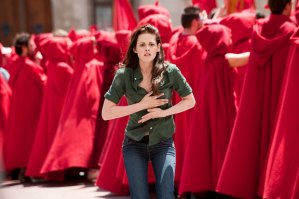 I can precisely indicate where everything goes wrong for the abysmal New Moon — the character of Bella Swan. For the majority of this sequel, I didn’t just detest and dislike her I downright hated her. I hated her. I understand her appeal to the millions of Meyer’s literary acolytes, but man does she come across as a self-centered, casually cruel, messed up girl who spends most of her time being whiny, mopey, and sulky. It’s not just that she has a guy interested in her, it’s the absurd notion that every man cannot get enough of this sullen gal. As presented in New Moon, Bella is such a dour and lifeless personality. I cannot see whatsoever why she is worth such effort. This criticism may be tracked all the way to Meyer’s source material, making Bella absent in defining character dynamics expressly so pre-teen readers can insert themselves as the character and swoon over being the object of universal desire. It is insultingly thin wish fulfillment that this girl has every man, vampire, and werewolf fighting over her in the Pacific Northwest. After Edward leaves, she shuts herself out and rejects all her friends. We see in one camera pan that she spends literal months in a stupor. I understand that teenagers think everything is the end of the world, but she and Edward were together for, what, a few months? Then again, heartache is something that knows no exact time frame for healing, so consider this but a quibble. Bella seems to push others away except when she needs a set of ears to whine.
It is post-Edward where Bella becomes insular, self-centered in her pursuit of danger placing herself in stupidly reckless scenarios, and hurtful. Where Bella really infuriated me is her treatment of her lifelong friend, Jacob. Obviously the big guy has a thing for his her and she knows this, which allows Bella to string Jacob along for almost a whole movie. She leads this little doggie along, teasing him with a “Maybe I will be with you, maybe I won’t” dance that becomes irritating and rather loathsome. Jacob is a swell guy who has looked out for Bella from day one, accepted her coupling with a vampire, sworn enemy of werewolves, and he’s been the best listener to all her self-involved drama. Plus this guy is ripped and has hip flexors that could cut glass. And he is there for her and didn’t abandon her like Edward. So Bella toys with her self-described “best friend” until she can hear the word “Edward” and then she can think about nothing else, even after months of complete separation. I understand that Edward has the sexy, brooding, bad boy appeal, where women think they will magically be the key ingredient to change the troubled man for the better. But on the flipside, Jacob thinks he?’ the key ingredient to finally get Bella to commit to a healthy relationship, and he gets screwed. Seriously, what’s the worse thing about dating a werewolf? You may have to take him for more walks. I suppose this makes me sound like I’m on Team Jacob, as the fans call themselves. I’m really on Team Bella Deserves to be Alone.
 I don’t want to sound unduly harsh. I don’t necessarily have an inherent dislike for characters that make bad decisions or who are, at their core, unlikable. I could forgive the sins of Bella Swan if she had even a hint of subtext. Bella Swan is a void of personality. I cannot recall if this was the same with Twilight, which I haven’t seen since I watched it on opening day in the theater a year ago.
What also sinks New Moon is how it repeats the same plot from Twilight. Once again Bella feels alone, she finds comfort in a boy that says they can’t be together, this intrigues her and pushes her into action, she’s warned of danger, and then finally she settles in with a pseudo relationship with a supernatural stud who makes blanket promises like “I’ll always protect you,” and, “I’ll never let anything happen to you.” It’s not complex folks; Meyer is just feeding pre-teen girls their fantasy of a male romantic interest. Because of this repetitious plot structure, very little of substance happens during the overlong 130 minutes of New Moon. Bella kinda sorta almost gets involved with a werewolf, there’s some lousy Romeo and Juliet allusions, and thanks to a delightfully hammy Michael Sheen (Frost/Nixon, The Queen), we learn a little bit about what makes Bella special to the world of vampires (it’s telling that her “specialty” is her lack of reaction). Beyond that, this is two hours of posturing and some gratuitous beefcake shots of shirtless men. My theater was sold out and packed with the Twilight faithful who swooned when they saw Edward strutting in slow-mo and openly hollering in approval when Jacob first whipped off his shirt. For supernatural creatures, they do more brooding than anything.
Director Chris Weitz (The Golden Compass, About a Boy) replaces Catherine Hardwicke to steer the second movie. I actually think Hardwicke had the right sensibilities for this franchise and she brought a youthful, rambunctious spirit that gave the first film a teenage synergy that made the romance feel pulpy. Weitz does away with this and makes the movie feel more ornate and chaste and dull. The execs spent major money to film in Italy for the vampire Volturi clan, but as near as I can tell some sets would have done the trick. Note to filmmakers: if you spend money to film in an exotic location, show it. As far as I can tell, Weitz was hired because of the bump up in special effects for this picture. Gone are goofy vampire baseball sequences and now we have cheesy wolf battle sequences, which come across like a less refined version of the polar bear brawl from Golden Compass. The special effects have improved but that doesn’t mean they?re good.
 This isn’t exactly the kind of movie that asks for much from its actors, and screenwriter Melissa Rosenberg distills Meyer’s text to the point that the actors pout and yearn. Stewart is an actress I have liked for years since Panic Room, so imagine how I would feel about the Bella character with a less capable actress. Pattinson is absent for almost the entire movie and it’s hard to say that his presence was missed. The best actor of this weird love triangle is Lautner who at least seems to have some fun with his role. He has an amiable spirit that penetrates all the gloom. He’s come a long way from being Shark Boy in 2005?s The Adventures of Shark Boy and Lava Girl.
The plot is a shadow of the first film, and the main character is annoying and hard to sympathize with, there?s so little of consequence that happens, it?s way too long, and, oh yeah, did I mention how much I disliked Bella Swan? At this point, the Twilight franchise is a juggernaut that cannot be contained (as I write this it’s poised to make over $70 million on opening day) and the Twi-hards will find the movie to be catnip, swooning at the visualized male sex objects. For anyone outside the cult of Twilight, the movie version of New Moon will fail to communicate the appeal of the series. The movie feels bloodless. Twilight is like a tedious soap opera scrubbed clean of teenage hormones. I think I’ll stick with HBO’s True Blood, a more nuanced, adult, sexy, and just plain fun series following vampire-human love. Bella could learn plenty from Sookie Stackhouse.
Nate’s Grade: D+


 nathanzoebl
You must be logged in to post a comment.