Blog Archives
happythankyoumoreplease (2011)
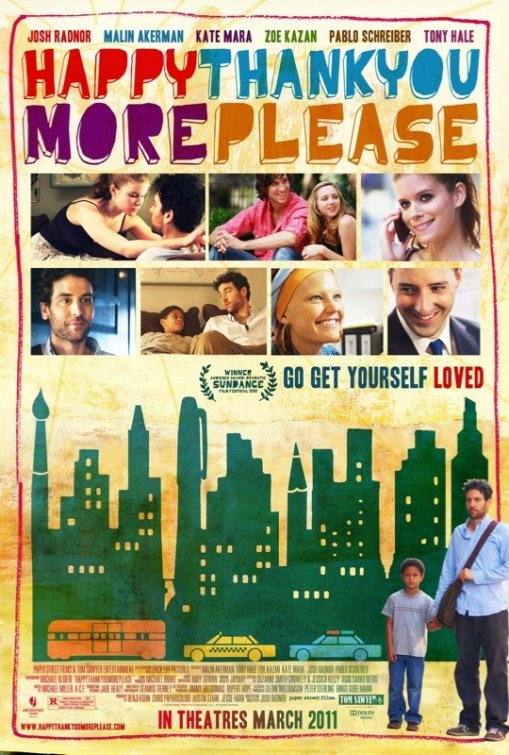 Josh Radnor’s (How I Met Your Mother) writing/directing debut reads like a heavy order of sitcom plots rolled into one tight space. There’s enough New York navel-gazing to fill up a spate of twee indie films. There’s Sam (Radnor), a struggling writer prone to relationship problems, having a three-night stand with Mississippi (Kate Mara), a waitress/cabaret singer. There’s Sam’s cousin, Mary (Zoe Kazan), is being pressured to move to L.A. by her boyfriend (Pablo Schrieber). Sam’s best friend Annie (Malin Akerman) suffers from dating the wrong kind of guys. She also suffers from alopecia, which makes her hairless (doesn’t sound like a deal-breaker to me). She’s being pursued by a suitor, Sam #2 (Tony Hale), a good man who acknowledges he’s not exactly a lady’s first image when it comes to Mr. Right. If this wasn’t enough plot to fight over for 100 minutes, Sam becomes an unlikely caretaker to a young child, Rasheen (Michael Algeri), left behind on a subway. The kid refuses to go back to foster care so he just sort of becomes Sam’s pet. Actually, the child is a plot device to facilitate Sam’s maturity and personal growth, which is why he all but disappears in the film’s second half dominated by romantic drama. Radnor is a relaxed presence onscreen. As a director, he knows a thing or two about pleasing shot compositions. As a writer, he has a good feel for droll observation (“Don’t make me run, kid, I’m almost thirty,” had me ruefully chuckling). As with most ensemble movies, some storylines are stronger than others; the Annie/Sam #2 stuff could have been its own movie. Both actors, Hale especially, are winning. Mara is sexy and a star in the making. The Mary stuff would have been better left alone. Kazan’s performance is somewhat irritating, and my interest sunk every time her face came onscreen. And yet, the film is carried by a sweetness that doesn’t tilt into saccharine. Given some of the sitcom-level setups, this could have spilled into eye-rolling cuteness (a girl named after the poorest state in the nation!). It’s romantic in a somewhat cheesy way but that’s part of its charm. It’s nothing groundbreaking, but happythankyoumoreplease rolls agreeably along thanks to being earnest, but not too earnest, and witty without being overly whimsical.
Nate’s Grade: B-
Share this:

Water for Elephants (2011)
 Would you believe at no point does the film Water for Elephants come close to explaining its title? I have never read the best-selling 2007 novel, where I’m sure it’s given some glancing explanation; so allow me to thus pontificate. Rosie the elephant is given tubs of whiskey at several points in the movie, which she happily laps up thanks to her prominent proboscis. So does that mean that the “water” for elephants is whiskey? If that’s the case, then this is really a tale of dangerous enabling. But then again, how do you tell a four-ton pachyderm that she’s cut off?
Jacob (Robert Pattinson) is one exam away from becoming a licensed vet from Cornell in 1931 when he’s delivered some tragic news. His Polish immigrant parents died in a car accident. Distraught, Jacob runs away and hops onto a passing train, stumbling upon a crew of circus performers. The train belongs to the Benzini Brothers circus, led by the fiery August (Christoph Waltz). He’s about to be thrown off the train when he panics and screams that he’s a vet. August hires the kid as the team’s newest vet and Jacob finds animals that are in bad shape and pushed to their limits. He recommends a mercy killing for the main attraction, a white horse that the boss’s wife, Marlena (Reese Witherspoon), performs upon. He takes some initiative and puts the horse out, despite August’s wishes. Lucky for them all, they find a new star attraction – Rosie the elephant. Robert doesn’t know the first thing about elephants, or “bulls” as they’re referred to by performers, but he’s tasked with getting the creature ready to perform or else everyone will be destitute. The man has a way with pachyderms, and the Benzini Brothers experience a windfall of new business, looking to take on Ringling Brothers. But the whole time, Jacob is making moon eyes at the boss’s wife, despite everyone telling him at every turn not to.
 The biggest issue this movie has is that the trio of main characters all feel like they exist in separate movies. There is zero chemistry between Pattinson and Witherspoon, further dampening their lukewarm romance. Robert is a character defined by being young and having a moral center. He’s not a person so much as an alternative. Marlena is the damsel very distressed, and Witherspoon plays her part all in all slow cock-eyed glances. If I had to pick one of the three, I’d choose to go with August’s version of the story just because he’s a more interesting character than our do-gooding Jacob. August is a huckster who needs to take care of a caravan of drifters and sell them to the public as the stuff of dream and legend. He has some charisma, he’s constantly leveraged against debts, and he is pressured to keep things afloat and to keep people from mutinying. This is beyond the heyday of circuses, so he knows that too many shows with too few people means that his troupe will be picked apart by circus carpetbaggers. You actually start to empathize with him at turns, and then he goes off and beats animals or his wife and that’s that. August is an interesting, vulnerable, flawed character, and he’s given the thankless role of being setup as sneering villain. I would have rather watched August try and keep his deteriorating circus together than watch another tired romantic triangle.
The romance that so much rides on is about as sure-footed as a drunken elephant. Part of this is the failure of Pattinson to deliver a performance that doesn’t feel wooden and artificial, as if he’s posing more than acting. But the romance, which dominates the film’s narrative, is given such scant reasoning that it expects the audience to simply fill in the blanks. He’s a young, good-looking guy who loves animals. She loves animals. Her husband is a jerk, so what’s the problem? Naturally, she’d just run to whatever available catch she could find to escape her hell so anything that delves into more character detail would be a waste of time, right? The movie seems to think so. The love triangle all inhabit very rigidly defined parts. Just because a woman is married to a nasty guy doesn’t mean I instantly want her to get together with just any alternative. Sure this lady deserves to be treated better, but just because a film presents “Option B,” and that option happens to set teenage girls aflutter, doesn’t mean I’m rooting for “Option B” just because it’s not “Option A.” That’s not enough for me to make a satisfying romance, but that’s all Water for Elephants has its aim set on. I need more effort, movie. It’s no surprise that the romantic moments are the weakest parts of the film.
 The real star of the movie is Rosie the elephant. She’s a natural performer and she’s got more presence than Witherspoon. I needed more moments with Rosie. After a somewhat boring first act, I started wishing that Rosie would replace someone in this dull love triangle. Imagine how much more interesting this movie would be if it was the heartbreaking story of one man, on woman, and one elephant. Maybe Jacob likes fat-bottomed girls. For animal lovers, there are some wince-inducing sequences of animal cruelty, mostly at the hands of the temperamental August.
The very opening sets the story up for a colossal disaster in the end, and the fact that we are not delivered disaster is a disaster of storytelling (too much?). I’ll try and keep the spoilers in a general sense without going into specifics. The film is bookended by the framing device of Old Jacob (Hal Holbrook) leaving his nursing home to see a circus and tell his life’s story. During his conversation with a circus leader (Paul Schneider), the young man is taken aback when Old Jacob reveals he was apart of the Benzini Brothers troupe when “it” happened. We’re told that it’s like the third biggest circus disaster in history and it has reverberated through decades. I’m set up for something memorable. I’m set up for a tragic ending, likely involving Marlena so that their love will forever have that tinge of unrequited longing. Then when we do eventually head to our big moment in the big top, well it’s far from memorable. Once you assess the ending, you realize that there is very little to make it number three on history’s lists of circus-related mayhem. If this stuff registered as number three, what the hell was number four? A clown catching his hair on fire? And then the movie carries on to some ludicrously happy ending, which seemed tonally inappropriate given the mood of the film and the poorly written romance between Jacob and Marlena. I was prepared for something operatic and terrible, and skimping out on that after an exasperated setup makes me feel hoodwinked, like listening to August bark about the greatest sights and sounds imaginable when they’re all just a trick. Something tells me that screenwriter Richard LaGravenese (Freedom Writers, P.S. I Love You) was not intending to add some meta commentary on how his story is built for dissatisfaction.
 Water for Elephants is a watered-down romance that flounders thanks to three different actors acting like they’re in three different movies. Also, it doesn’t help your romance when so little work is put into making young people fall in love. There are fascinating circus-related tidbits that make me wish the movie was more Depression era circus drama than Depression era circus romance. It’s a handsome enough movie from a technical standpoint, and it has some points of interest and some interesting characters, but its shackled to such a weightless and naïve love story. This movie was described by many as an “old fashioned” kind of film, and generally that can be construed as a warning signal. When people dub something “old fashioned” it can tend to mean “boring except to older people.” It just so happens that my screening of the film was an open caption screening, which attracted dozens of our nation’s elderly and hearing impaired. I didn’t so much mind having grown up with subtitled foreign films. But one delightful accident of seeing this open captioned screening was that they captioned everything. Every sound, every offhand piece of dialogue that would ordinarily go unnoticed and undetected. So now I got to see, as subtitle form, such discoveries as Guy in Background saying, “Hey pick that up,” and Other Guy in Background responding, “Okay. Put it where?” It was more exciting than what was going on between Jacob and Marlena. Now let’s get that elephant drunk!
Nate’s Grade: C
Share this:

The Adjustment Bureau (2011)
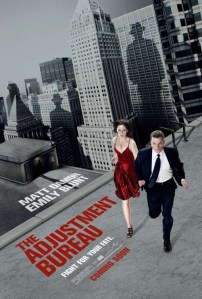 Gentlemen, if you were looking for an original excuse about not calling a girl back, try this one on for size: I couldn’t call because a team of men who control human destiny told me that if I did they would erase my memory and keep you from the fame that you are destined to achieve. She’ll probably at least give you points for originality before throwing a drink in your face (but it was all part of The Plan, or was it?).
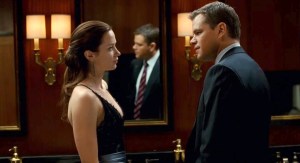
David Norris (Matt Damon) has just lost a New York congressional election thanks to his frat boy ways of old resurfacing. As he composes his concession speech inside the men’s restroom, he meets Elise (Emily Blunt), a ballet dancer hiding out. They have one of those crazy only-in-a-movie conversations that manages to feel authentic. Then they kiss. She inspires him to ditch his prepared remarks and speak from the heart to the national TV audience, which eats it up. David spends the rest of his days trying to meet the enchanting Elise again. Then he runs into a big stumbling block. He’s late to a meeting and catches a group of mysterious men in suits and fedoras fiddling around with people frozen like statues. They are the adjusters, the ones who ensure that the participants of mankind follow The Plan. These are the people responsible for the illusion of choice in our lives. If we deviate too far from The Plan, causing ripple effects that too need to be accounted for and adjusted, they step in. Richardson (John Slattery) is the spokesmen for the group and decides to just level with David. He is not supposed to be with Elise. He has a different future ahead of him, so sayeth The Plan. They will throw obstacles between the two of them. David seeks out Elise and fights against the whole universe for the two of them to make a future together.
 Horrible title aside, The Adjustment Bureau is a sometimes corny but often deeply satisfying movie. It may distract with some efficient and just-smart-enough sci-fi leanings and magic tricks, but it’s really a unabashed romance at its core. Not just that, it’s a good romance, once that flutter the heart and causes the ends of your mouth to do that thing, you know – smile. It helps when you have movie tars as gorgeous as Blunt and Damon, and are such good actors that they can fill their roles with dangerous amounts of charm, but let’s credit writer/director George Nolfi (The Bourne Ultimatum, Ocean’s Twelve). He takes a fairly routine concept (powerful forces control our lives and choices) and turns it into a finely tuned character-driven romance. Immediately from their first meeting in a men’s room, Blunt and Damon have that electric dynamic that you can genuinely believe in. Their chemistry will knock you over. You feel the spark between these two, which is essential because the two characters spend years apart at times, forever hoping to reunite. In that brief encounter, you fall in love as well and realize that this character, and this actress, is worth waiting for. I think people are going to be surprised that The Adjustment Bureau is a big gooey, stars-in-the-eyes love story, and it’s actually good. It’s a really enchanting love story, tackling the question of whether whom we love is a result of choice or destiny. This central concept is what every sci-fi element and thriller sequence is spun from. Here’s a funny thought: it’s all in service to the story.
It’s rare to see a studio movie that mixes so many different elements together to such effective, satisfying results. The film doesn’t get overly dark despite the cosmically long-reach and determination of the adjusters. There’s never any real threat of danger, only a broken heart or dashed dreams. The film has many light moments throughout, creating a rather bouncy tone that suits the romance angle nicely. The adjusters aren’t very menacing, more so comically perturbed. John Slattery, all silvery Mad Men appeal, is a perfect foil as the face of the adjusters. He feels like an exasperated parent baffled by the thought-processes of his youthful charge. It helps that these cosmic accounting agents have a finite level of power. If they had unlimited power then the film would fail to have any hope for David and Elise. But we learn that there are only so many adjusters that there are limitations to their powers, and that they can be outsmarted with enough gumption. Mingling with that light touch is enough whimsical science fiction to engage your brain. The concept of the adjusters and their supernatural abilities is nicely teased, setup, and then developed, making sure never to rock the audience with too much weirdness at one time. It’s a gradual process of discovery and it leads to a somewhat goofy, but infectiously amusing, climax that involves multiple doorway portals and magic hats. Yes, I said magic hats, which means there is an honest to God good reason why that stupid fedora hat, seen so prominently in advertising that it feels like the third-billed star, is featured. Admittedly, a concept like a magic hat that allows you to teleport through doorways would seem silly, but Nolfi makes it all work. The hardest aspect to believe (in a film with, I repeat, magic hats) is that Blunt could be a ballet dancer, let alone a future star of the medium. I’m by no means saying that the British beauty has anything to worry about in appearance, but she does not have a ballet dancer’s dangerously minuscule physique. Natalie Portman in Black Swan looked like a real-deal ballerina of fragile frame. Blunt doesn’t have the movement or the physique.
 In his directorial debut, Nolfi does enough good things, and does them with a smooth sense of style, to impress. The visual trick of going in one door and opening to another world walks a dangerous line of over saturation, but it’s playfully utilized enough to forgive. Nolfi is not perfect with his plotting, falling to misstep that can push back momentum. Characters will be chatting, and then they’ll walk away and we’ll get a title card that says something like, “Three years later,” and it sort of makes it feel like we have to start all over again. The fact that this happens more than once means that Nolfi might have wanted to plot his story around a series of events that occurred more often than Senate election terms. If we have to begin with David losing one campaign at the start and then zoom ahead at several points through another campaign, then perhaps the timeline could have been condensed a bit in retrospect. The film manages to be religious and faith affirming without pushing an agenda or overstating its romantic cause. The ones behind the plan are only referenced in oblique business terms, never confirming a certain high power but definitely nodding in that general direction.
Damon and Blunt are a terrific team. This is easily Blunt’s finest role as an actress since breaking out in 2006’s Devil Wears Prada. The actress has taken many a role that makes use of her large crystalline eyes and her sometimes go-to acting response of simpering. But in this film, she finally finds that perfect role that makes use of Blunt’s modest, goofy charm. She’s never been a leading actress in a traditional set; there’s always been a delightful goofy appeal that set her apart. When Blunt offers her playful smiles and asserts those glassy eyes of hers, you too will be smitten. Her character is a charming woman thanks to Nolfi’s writing, but having an actress of Blunt’s ability fill her out is a blessing. Damon is at a point in his career where he just grinds out good-to-great performances that manage to be convincing in unassuming, dignified ways. Damon has never been an actor given to the superfluous. His character feels like a sincere sport, which is amazing considering he’s supposed to be playing a politician. He’s the kind of guy you’d actually stand in the rain to vote for, and you understand why Elise would keep a place tucked away deep in her heart for the dashing Damon.
While the movie hinges on the coupling of Damon and Blunt, the rest of the supporting cast does fine work matching tone and making the most of their roles. Actors like Anthony Mackie (The Hurt Locker), Terrence Stamp (Valkyrie), and Michael Kelly (Changling) can make any movie better.
 The Adjustment Bureau, on paper, should not work. A sci-fi fantasy that’s unapologetically grounded in romance. A tone that nestles firmly in a safe, bubble-wrapped whimsy. And those magic hats, need we forget them? On paper this should be one overly silly, dumb, tonally disjointed, cornball movie worth venomous mocking. And yet it works; it does better than “works,” it succeeds. Blunt and Damon are terrifically charming together and imbue the movie with a sense of cheerful optimism in the face of uncertainty (and perhaps heaven itself). You desperately want these two crazy kids to get back together; they’re good, decent, charming people, winning personalities apart and even better together. What might have fallen apart in other hands becomes this endearing, fizzy piece of studio entertainment that fulfills and exceeds most expectations. I was really taken by this movie, won over by its effusive charm offensive, and left buoyant with happiness by the time the tidy, perhaps too tidy ending, came rolling. The Adjustment Bureau is hooey but it’s my kind of hooey.
Nate’s Grade: A-
Share this:

Going the Distance (2010)
 At turns randy and sweet, this romantic comedy is surprisingly honest about the trials of long-distance relationships. Justin Long and Drew Barrymore fall for one another before their respective careers place them on opposite coasts. They explore all the real frustrations of having your beloved only reachable via phone for months on end. Going the Distance presents two likeable leads with an affable chemistry, and the real kicker is that they genuinely love each other. Nobody is a man-child or a shrew. The real villain is the distance. While the film doesn’t know if it wants to be a Judd Apatow-style raunchy comedy or a saccharine romantic comedy, there is a strong rooting interest in our couple. The supporting characters aren’t too wacky, the situations feel more authentic than contrived, and our couple makes seriously difficult decisions in the end that are downright adult. Going the Distance is a true surprise of a film. It’s got enough laugh-out-loud lines and situations to recommend as a comedy and enough emotional involvement to recommend as a relationship drama. It’s a little unnecessarily vulgar at times, like a fascinated kid who has just discovered the power of dirty words. While it may not go the full distance, this cheeky rom-com will nicely get you to a pleasant place.
Nate’s Grade: B-
Share this:

Love and Other Drugs (2010)
 Director Edward Zwick has spent the last two decades making mass-friendly action films with designed to teach us all some valuable lesson, like Blood Diamond and Glory. But the idealistic filmmaker began his career with realistic relationship dramas like About Last Night… and the seminal TV show thirtysomething. There wasn’t an explosion to be had, unless you count the emotional ennui of middleclass white people. Love and Other Drugs is adapted from the biography of a Viagra salesman, which seems like a strange jumping off point for a romantic drama. Watch out for those unexpected side effects.
It’s 1996, and Jamie (Jake Gyllenhaal) is a smooth-talking, suave pharmaceutical rep for the medical giant Pfizer. He’s been dispatched to the Ohio River valley area with a mission to push his drug samples on doctors and raise his quotas. While posing as an intern, he meets Maggie Murdock (Anne Hathaway), a coffee shop beauty in stage one of Parkinson’s (don’t attack me, they reveal this spoiler before you even see Hathaway’s face). She spurs his advances but he persists, and the two agree to a strictly sexual relationship. Because of her illness, Maggie is wary of getting attached to people. She sees Jamie as a shallow, well-muscled lunkhead who won’t want anything else but a slew of orgasms from a pretty girl. And Jamie is content, until, of course, he falls in love. Maggie feels she’s sparing her lover the pains that will accompany her Parkinson’s. The two struggle with her illness, the toll it takes on their relationship, and the possible future they will have together… in between lots of sex.
 The true pleasure of Love and Other Drugs is watching Hathaway and Gyllenhaal together onscreen. The Brokeback Mountain buddies have tremendous chemistry that makes their give-and-take exciting and pleasing. Hathaway and Gyllenhaal may be the best onscreen couple I’ve seen since 2005’s Mr. and Mrs. Smith. Chemistry is such an indelible component for romance and yet it is so elusive to capture. So when a cinematic couple really create some serious sparks, it’s a memorable exchange. Hathaway and Gyllenhaal are a terrific team but also the rare screen couple that raises the performance of their partner. You are easily convinced that these two enjoy the company of one another; they’re so confident with each other even as they’re tumbling around naked. Hathaway has grown into an actress of surprising range, making keen use of her animated Disney heroine features. She has a knack for playing defiant, spunky women that have an alluring fragility, and that also describes her Maggie (how does a coffee shop give Hathaway the health insurance she needs for Parkinson’s meds?). Gyllenhaal has always had his boyish charm, but he seems catapulted to new charisma heights with Love and Other Drugs. He’s exploding with energy and comes across bursting with life onscreen. He starts as a suave Lothario drunk on his own charms but, as movie journeys dictate, he morphs into a committed, mature man. The roles are pretty standard (slick selfish salesman, sad girl with illness) but the duo bring extra vitality and heat that makes Love and Other Drugs compulsively watchable in its finer moments.
It’s refreshing to witness a major Hollywood movie that treats human sexuality without the standard artifices of Hollywood. Love and Other Drugs is not coy when it comes to physical lovemaking. This isn’t a blockheaded movie where the woman goes through the entire night of passion while wearing a bra the entire time (the epitome of PG-13 sex). This isn’t a movie where after a healthy bout of sex the couple feels the need to cover up their goods as they lay beside one another. Like after a vigorous sexual experience now the lovers suddenly become bashful at their own state of nakedness (get the fig leaves – stat!). So it’s refreshing to watch a film deal with sexuality without giving undue attention to how “risqué” everything is. The nudity is European-style casual, and while the film manages to be quite sexy, the nudity and sex scenes do not play as shameless titillation. The sex and copious nudity is just another part of the storytelling. Of course it also happens to be a prominent and highly marketable storytelling aspect. It’s not like Hathaway and Gyllenhaal are homely actors. Watching beautiful people writhe together on screen and nonchalantly walk around without a stitch on has always been a sure-fire way to sell tickets. Love and Other Drugs utilizes all that skin to lure boys into a traditional romantic drama. It’s to Zwick’s writing and directing credits, and the natural chemistry of his two high-wattage stars, that the parade of flesh doesn’t feel like naked, prurient exploitation. It’s not exactly an edgy film by any means but it’s assuredly adult in its portrayal of sexuality. Or at least it thinks it is. The sex isn’t really a topic to be explored with nuance and clarity; it’s more something to keep the actors busy.
 Ultimately, the tonal inconsistency is what hampers the momentum of Love and Other Drugs. It’s hard to build narrative momentum when the film just seems to be starting over time and again. Zwick bounces around different tones, sometimes wildly from scene to scene. At heart it’s a weepie romance, the sick girl and her paramour coming to terms with their doomed love. But then the movie also wants to be an energetic, smart-alecky comedy, then there are all sorts of crude gags (hope you like boner jokes), and then the film also wants to be a satire on high-powered pharmaceutical companies and their sleazy influence romancing doctors. And then in between all that is the weepie drama stuff as Maggie has to deal with the (movie) realities of her illness. Here’s an example of the tonal whiplash that did the movie no favors: Jamie stumbles in on his disgusting younger brother (see below) masturbating to a sex tape of Jamie and Maggie, of his own brother and his brother’s girlfriend. The scene is played for broad comic laughs and ends with Jamie beating his brother off screen with that very sex tape. If people needed another reason not to make sex tapes, here it is: Josh Gad might one day view them and pleasure himself. You don’t want that, trust me. But then the very next scene involves Maggie working on her art and unable to control her Parkinson’s symptoms, namely finger tremors. We watch as Maggie diligently and patiently tries to open a bottle of pills, the childproof locked top confounding her stubborn fingers, only to eventually find that the bottle is empty and her symptoms will only increase. The fact that these scenes coexist right next to one another makes their differences all the more jarring. Love and Other Drugs tries to jostle diverse genres but the different tones never coalesce. As a result, you feel violently ripped from one movie to another.
Let me give due attention to just how revolting the character of Jamie’s younger brother is. Josh is a cancer on the movie. He doesn’t make a scene better but rather drags it down to a lower level. He’s slovenly, boorish, coarse, and routinely unfunny. You can practically feel his sweaty fingerprints pawing at the movie for attention. This character is abominable and repulsive. He inserts himself into Jamie’s home and offers no dramatic value. His purpose seems to be solely as a cheap go-to plot device whenever Zwick feels he needs a random profane joke. Gad (The Rocker, 21) is a comic that I have enjoyed in other contexts, but he’s got the wrong energy and feel here, succumbing to the angry desperation of his character. Josh serves no worthwhile purpose and just becomes a pathetic distraction for a movie that already doesn’t seem to have full focus on what matters. He’s supposed to be an annoying presence but this annoying? You probably won’t find a more unnecessary and loathsome fictional character in a movie all year.
 Zwick can’t keep tired clichés from clipping how high the film can fly. The film’s message about family over business feels trite no matter how much nudity tries to obfuscate it. The Parkinson’s angle is too easily transformed into melodrama. The film takes a trip to a Parkinson’s meeting in Chicago with real-life people suffering through different stages of the debilitating disorder. It draws a poor comparison with Maggie’s tremors, which start to seem like a lightweight Hollywood example of illness (like when a character coughs onscreen and it somehow communicates a quickly metastasized cancer). Even after shirking Hollywood conventions the movie manages to end in that tried-and-true fashion where the man has to chase after the woman to give the Big Speech about how he truly feels. The Pfizer storyline that follows the launch of impotence-crushing super drug Viagra feels like the first draft of a different screenplay or the last remnants of a different story that’s been hollowed out. It’s fairly superficial and meant to serve merely as the male lead’s occupation that he has to reconsider when love’s on the line. The side stories and side characters feel like distractions. Oliver Platt is a fine actor to have in your movie, just make sure he has something to do other than drive Gyllenhaal around. Also, the movie follows the lead from the cancelled TV show Cold Case in that every scene from the past has to be accompanied by some generic hit of the day, like a simplistic scrapbook of the times.
Love and Other Drugs feels tragically overextended and if only Zwick had only been more judicious this could have been a really solid film. There are three or four different films at play here. The tone never settles down, bouncing from broad comedy to weepie Lifetime-related drama. Gyllenhaal and Hathaway work wonders together with and without clothes. Their performances make the film stronger, and they make you wish that the movie had more going on for it than spirited rolls in the hay. You even wish there was more to the sex than simply large amounts of it. Zwick will always wear his liberal idealism on his sleeve and slip a message into his films, but this time the message is completely eaten alive. If anybody walks away from Love and Other Drugs with a blinding passion for prescription drug reform, then they must have been watching a different movie. The one I watched was amusing in spurts and had nudity.
Nate’s Grade: B-
Share this:

The Last Song (2010)
 Miley Cyrus is tragically miscast and way out of her depths in this mawkish drivel. I don’t really understand the appeal of Billy Ray Cyrus’ achy-breaky star progeny. The girl’s all teeth. Her acting repertoire from her gigantically popular Disney TV series and movies has lead Cyrus to the motto that bigger is better. She plays every scene much louder and bigger than required, mistaking volume for drama. I don’t think (right now at least) that she has the acting capabilities to carry a drama, let alone a drama weighed down by so much overly serious, heavy-handed material. But then heavy-handed is a Nicholas Sparks trademark, same with someone dying of a terminal disease by film’s end (the streak continues). What’s remarkable about The Last Song‘s ineptitude is that Sparks wrote the screenplay and the novel at the same time, tailoring it specifically for Cyrus. The part was written with her in mind, which makes the failure even larger. Cyrus cannot do teenage angst to save her life. If you wanted a moody, angst-driven, hip-to-be-square, believable young actress, then they should have hired Kat Dennings (Nick and Norah’s Infinite Playlist). Cyrus is a troubled teen who mopes all summer, forced to spend time with her divorced father (Greg Kinnear, fighting to find some dignity in the film) before, well, you can guess where we’re headed. For melodrama, it all comes across as fairly dull and sterile (PG-13: wrestling in mud, PG: throwing mud). What’s even worse is that the titular “last song” Cyrus performs to honor a fallen loved one is powerfully bland. And yet I have the sneaking suspicion this stab at expanding Cyrus into adult roles could have been much worse. As it is, The Last Song is a sudsy dud.
Nate’s Grade: C
Share this:

Leap Year (2010)
 It’s not funny. It has more clichés than imaginable. The very premise that a woman has to travel all the way to Ireland to be “allowed” to propose to her long-time boyfriend is bizarre and borderline offensive. And yet, the unmistakably lowball chick flick is watchable thanks to the charms of leads Amy Adams and Matthew Goode. The two actors pretend like they’re in a different, better movie, and the illusion lasts just long enough for the film to come to its typical happy ending before you sit back and say, “Hey, that was pure junk.” Ireland is treated yet again as this quaint place of hospitality and magic, like it’s some postcard wonderland. Granted, the scenery is beautiful, and director Anand Tucker (Hilary and Jackie, Shopgirl) is quite taken with his shooting locations, highlighting the natural beauty of the Emerald Isles. With all the attention on the scenery, and not so much the plot, you realize that everyone signed up for this movie as a means of having a paid vacation. And I can’t blame them or hate their movie, but that doesn’t mean I have to like it either.
Nate’s Grade: C
Share this:

Remember Me (2010)
 How much time do we give before our memories are used as unnecessary and cheap dramatic ploys to wring out tears? Remember Me will test your sensibilities on what should be classified as art and what should be designated as hacky, shameless exploitation.
Tyler Hawkins (Robert Pattinson) is a troubled 21-year-old college student in New York City. He’s mostly estranged from his rich, distant father (Pierce Brosnan). Tyler’s older brother hanged himself five years earlier, and that personal tragedy still lingers. Tyler quotes poetry, writes letters to his dead brother, and has his share of run-ins with the police. Sergeant Neil Craig (Chris Cooper) busts Tyler and his friend (Tate Ellington, mostly annoying) one night after the duo tries to clear up a brawl. Then the boys discover that the sergeant’s daughter, Ally (Lost‘s Emilie de Ravin) also attends their college. They devise a sketchy means of getting even: Tyler will date Ally. A subway mugger killed her mother when she was 9 years old, so the two bond over family misfortune. He asks her out for dinner and she appears cautious, but it isn’t long before love is in the air. Dad doesn’t approve but that won’t stop Ally from spending time with her special someone. Suddenly Tyler is vulnerable and coming out of his shell. It looks like things might work out though you don?t really comprehend why, then things take a sudden turn and very much do not work out. More details on that plot development later.
Remember Me does not work for many reasons, but as designed, it was never going to work. Allow me to go into greater analysis, which will naturally unleash a horde of spoilers concerning the film’s conclusion.
 This movie will not work; in fact it refuses to work from a conceptual standpoint. The story seems retrofitted to lead directly to the ending. Screenwriter Will Fetters seems to have followed the M. Night Shyamalan approach to screenwriting and come up with a twist ending and worked backwards. You see dear reader, the film climaxes on a day burned into the memories of everyone who lived through it — September 11, 2001. The movie plays coy with its timeline the whole time, never drawing too much attention to its exact setting. Tyler even goes to see American Pie 2 to lift his spirits, and who besides people who are crazy about film release dates would know that was released back in August 2001? There’s also a jump forward of ten years from the murder of Ally’s mother in 1991, but that’s the last time the movie ever reminds you about time. Instead, it makes sure that all the pieces will be in place so that Tyler will be standing on the 90th floor of the World Trade Center, looking off into the horizon for the last day. Fetters’ story uses a national trauma as a dramatic tragedy for his doomed lovers. But here’s the thing: anything else would have worked the same. Did Tyler really have to die in the 9/11 attacks? Could he not have had an accident, gotten mugged, hit by a car, or any number of other missteps that would have the same effect? The emphasis isn’t on the relationship of 9/11 to the characters; 9/11 just serves as the event to wipe out one half of our relationship. But any other event would have resulted in the same effect without coming across as so icky and exploitative. The movie does not work because it’s designed as a ?gotcha? ending but the only “gotcha” is that 9/11 is shamefully used to spin this illusion that Remember Me is meaningful and transcendent.
The other half of this argument could go as such: Fetters was trying to tell but one tale of the many that lost their lives on 9/11, illuminating the fantastic human toll and how each number was a person with a family and friends that will forever miss them. That would have been sufficient. Hollywood and the cinema have a history of taking national tragedies and showcasing individuals who were lost. I even declared United 93, the docu-drama painstakingly detailing the final moments aboard that downed airline, the best film of 2006, and four years later I still stand by that declaration. Artists can take collective pain and showcase triumph and substance, allowing us a cathartic means for therapy and working through trauma. I believe with every fiber of my being that art has the power to heal and elucidate.
However, Remember Me is not that kind of art. If Fetters had a strong desire to showcase one of the lives lost that horrific day, that’s a noble effort. But the drama of Remember Me is stagnant and suffused with stereotypes and one-note characters bumbling around, uncertain what exactly they should be doing. It almost seems like everyone is simply waiting for the Big Event at the end, and that in itself is disquieting. The character dynamics of this movie couldn’t get more cliché. This sloppy, overcooked weepie has the Bad Boy and you know he?s troubled because he has stubble and smokes. Pattinson also spends 80 percent of his screen time looking forlorn. I’m sorry, but looking off screen and being forlorn are not replacements for good character development. He’s lost a brother and he?s mad at his distant, workaholic father, but you might as well describe him as Boy. That’s pretty much his extent in this film. His love interest could equally be named simply Girl. The two have a shared history of family tragedy, but then what? Do we learn anything about Ally as a person, about what draws her to Tyler (besides that haircut, of course), or how her life is made more whole thanks to the brooding bad boy? No. It would be generous to even refer to these characters as archetypes. They are characters in name only. Fetters has cobbled an equation that simply boils down to Boy + troubled past + Girl + troubled past = perfect future. Even worse, their whirlwind courtship feels like it exists in some movie world where gazes and hugs substitute for the excitement of romance, of feeling out the interested party and becoming overwhelmed with the sheer possibility of a relationship. This is only a love story from a the standpoint of that equation. You never believe for a second that anybody matters because they only feel like puppets meant to go through the motions until the film reaches its anvil of a climax. Then, you see, we’re supposed to feel because there is death, except I didn?t see any convincing signs of life beforehand.
 The rest of the story is awash with bizarre and mostly lame elements meant to heighten the ensemble drama. For whatever reason, Tyler’s friend coaxes him into initially dating Ally as a contrived means of sticking it to her father. This tiny yet stupid hurdle will of course be revisited when the film’s second act break comes calling. But why does this past run-in even matter? Romantic comedies have all sorts of plots where the couple begins their time together through some duplicitous guise, and of course the truth drops just as guy and girl are starting to really like one another. But in Remember Me it isn’t a bet or something nefarious that brings boy and girl together. If anything, the run-in with dad could be seen as an introduction. The “get revenge” idea isn’t something that’s ever revisited by Tyler or his friend, nor do they at any point provide further detail. It remains a vague notion from beginning to end.
Then there’s Tyler’s own family drama. The strangest plot addition is when Tyler’s younger sister attends a birthday party. It is at this birthday party that a cohort of mean girls gives Caroline Hawkins an unflattering makeover. This bad haircut is then played for ridiculous dramatic overkill. Everyone around the kid is speaking in hushed tones, trembling, recollecting as a family unit, and pretty much acting like Caroline had been molested when, at worst, she got her hair cut by some mean girls. Tyler even escorts his kid sis to school and almost decks one of the little girls responsible, instead choosing to huff and puff in her face like a raging bull. I guess when you’re Pattinson and a good third of your acting comes from your haircut, you take follicle care very seriously.
Remember Me is so anxious to be poetic. It’s not. It’s pedantic and faux intellectual. It wants to be a moving romance. It?s not. It?s two pretty but bland characters that just seem to play around furniture and eventually do it. They’re as interesting as bland pretty people usually are in these things. It wants to be a significant drama that manages to say something big. It’s not. It’s a slapdash effort revolving entirely around the eventual reveal of a “gotcha” ending that does nothing to justify all the strained spinning. At best, the ending is in poor taste and a cheap trick to gin up sympathy and give the impression of substance. At worst, it’s ugly exploitation that reduces a national tragedy into a last-ditch effort to cover the empathetic deficiencies of a lackluster drama. Flogging national suffering to make an audience feel for your bland characters after an empty 100 minutes? That’s offensive. Remember Me isn’t worth any outrage. It?s a pretty but mostly empty venture designed around a twist. It is anything but worth remembering, even in disgust.
Nate’s Grade: D+
Share this:

Scott Pilgrim vs. the World (2010)
 What happens when the millennial generation gets its own (attempted) seminal movie? It stays home and plays video games, letting the film, Scott Pilgrim vs. the World, languish at the box-office. I guess that’s what happens when you finance a movie whose target demographic will just as readily download the movie for free off the Internet.
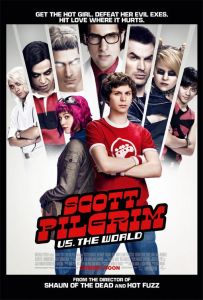
Scott Pilgrim (Michael Cera) is a 22-year-old Toronto slacker. He?s the bass player for the band Sex Bob-Omb, along with lead singer Stephen Stills (Mark Webber) and acerbic drummer Kim (Alison Pill), a former ex-girlfriend of Scott’s from high school. The band’s biggest fan is 17-year-old Knives Chau (Ellen Wong), who also happens to be Scott?s new girlfriend. The world of Scott Pilgrim is abuzz with this scandal, especially Scott’s gay roommate Wallace (Kieran Culkin) and Scott?s younger sister (Anna Kendrick). Scott insists it’s all on the level and he has no ulterior motives for dating a high schooler. Then he sees the mysterious and alluring Ramona Flowers (Mary Elizabeth Winstead) who?s new to the area and American. Scott rabidly pursues her in what could best be described as stalking, eventually getting her to agree to date him. Trouble is, he hasn’t broken up with Knives just yet before starting this new venture. Scott is then confronted at the Battle of the Bands concert by a man who comes bursting out from the ceiling. He is the first of Ramona’s seven evil exes and Scott must defeat them all in order to earn the right to the violet-haired beauty. “Everybody has baggage,” Ramona says. “Yeah, but my baggage doesn’t try and kill me,” Scott wearily replies.
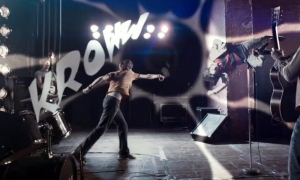
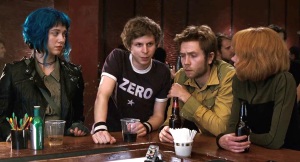 Visually, this movie showcases director Edgar Wright (Hot Fuzz, Shaun of the Dead) using every crayon in the Crayola box. This is a visually resplendent film where every scene seems crammed with details to delight the eyes and light up the senses. It’s a rush to watch the kaleidoscope of colors and motions. The Scott Pilgrim universe clearly differs from our own. This is a realm that borrows heavily from old school video games, where people burst into coins when vanquished, where life-decisions are met with “leveling up,” where people have onscreen pee bars that will deplete after a trip to a urinal. Sound effects will routinely be verbalized on screen, everything from a “RIIIIIIIIIIING” of a telephone to the “Ding Dong” of a door. It’s amusing, though also easily overused. Jobs and stuff like that are for the real world, hence too square to be depicted. It’s this entire idiosyncratic comic book world treated like everyday reality.
The enormous display of style is impossible to ignore. Scott Pilgrim is a slick, flashy piece of entertainment that is riddled with nostalgic references for a select crowd. I appreciated how a nice walk was accompanied by the theme song from The Legend of Zelda, or that sound effects and onscreen graphics echoed the fights from Street Fighter II (don’t ask me which of the 800 versions). Scott Pilgrim is an excellent pop pastiche of a specific culture, namely a slacker, hipster, amiable, comics and gamer group. I myself was an avid Nintendo gamer back in my day, but I admit to waning interest when the games got too complicated and grisly (“Back in my day we had two buttons to push, one to jump and the other to shoot, and that’s how we liked it!”). The movie is an explosion of color, light, and (lo-fi garage rock) sound, which also might sound like the description of a seizure or a stroke to some. Like those ailments, Scott Pilgrim will be seen by some as an infliction. It’s hyperactivity and eagerness to please via nostalgic reference points will be what drives people to this film and what drives them away in equal measure.
The Scott Pilgrim graphic novels total six volumes and approximately 1200 pages, which means it?s not the easiest fit for a two-hour window. It also hurts that the Pilgrim books have a wide supporting cast of characters to tussle with, plus there?s the whole seven deadly exes thing which means the movie has to provide about a solid 20 minutes of set-up before finding enough time for seven antagonists (or boss battles, following gamer parlance) and a reasonable amount of resolution. Add on top of this the fact that Wright keeps the movie moving at an outrageous, ADD-addled pace, like the plot conveyor belt lever got broken and the scenes speed one after another. Everything about this movie feels fast and over caffeinated. The editing in particular has characters holding conversations where every line is in a new location, implying an added sense of movement. So you shouldn’t be too surprised when the Scott Pilgrim film feels like a whole lot of a little; it’s moving at the speed of light to entertain.
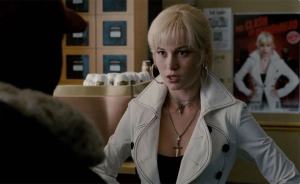 Because of the plot mechanics and oversized cast of characters, Pilgrim can give off the impression of shallowness. It seems like all style and little substance and that’s because the movie attempts to cram an entire series of stories, back-stories, and conflict into two hours. The film version only has enough time to attempt to give Scott and Ramona characterization, though both come across as weak-willed, tentative, and less than charismatic, wondering if either party is worth the trouble. The movie tries to paint over these differences through distraction and force of will. The large cast of supporting players all elbows each other just to be mouthpieces for one-liners. Knives actually comes across as the most complete character, consumed by her infatuation, heartbreak, and then quest for misguided vengeance. She’s somewhat dismissed and yet she is the most developed person on screen thanks to Wong’s endearing and relatable performance. The entire experience of Scott Pilgrim vs. the World can be somewhat fatiguing when there’s little evidence presented for emotional investment. The books supplied the reasons for caring besides the whole underdog angle.
The movie aims to be a battle over love, but it’s not entirely convincing. Scott appreciates Knives because she’s simple, a relationship he doesn’t have to invest much within, something casual and enjoyable while it lasts or until it becomes too taxing. Then he goes ga-ga for Ramona and stalks her, wearing down her defenses. He’s purely smitten with her and willing to do whatever it takes to earn her affections, though he can?t explain why he feels this way. Here’s a note to screenwriters: when characters are asked why they love somebody, do not have them say, “I don’t know.” But for Ramona, Scott is her Knives. He’s something easy that won?t break her heart, an escape from the jerks she’s been dating before. He?s low maintenance. He’s something to pass the time. There’s an interesting dynamic here, made even more complicated by the fact that Scott’s time with Knives blended with his time with Ramona. There was not a clear end point. The movie takes a literal approach to the idea of love being a destructive force of nature. Scott is punished throughout because of his infatuation with Ramona, but he persists despite the bruises. And he doesn’t even really know much about her. There’s an interesting statement somewhere there about the punishment we endure, sometimes foolishly, over the affections of people we may love, or convince ourselves of, but not even like.
 It may sound peculiar but I’m paying Michael Cera a compliment by saying his performance in Scott Pilgrim is the least Michael Cera the actor has ever been on screen. Gone is his gawky, awkward, ironic shtick that has fast become the Cera persona in films like Superbad and Year One. Scott is unjustifiably confident in his life’s pursuits, and Cera gets to act cocky and quippy, even if it?s done with a wink. He?s an unlikely kung-fu star but then again he?s also an unlikely leading man. Winstead (Live Free or Die Hard) is cute but plays her part a bit too toned down, like Ramona’s still searching for the right medication combination. Culkin and Pill are both scene-stealers of the first order, doing so with unabashed and flippant sarcasm. Every scene is made better by their presence. Among the evil exes, Brandon Routh (Superman Returns) has plenty of fun as a dim-witted super-powered Vegan bassist (“Vegans are just better than other people”), and Jason Schwartzman epitomizes hipster snark with such relish. The film is exceedingly well cast from top to bottom.
I’ve read some reviews positing that Scott Pilgrim vs. the World is an elaborate fantasy taking place in the mind of its titular hero, that he blends his knowledge of comics and video games to help make sense of the troubled waters of relationships and lingering hurt from the demise of love. I think that’s a nice explanation but perhaps trying too hard to frame this film as some form of psychoanalytical commentary on modern youth’s interpersonal relationships and the value of love. Scott Pilgrim vs. the World is really just a spastic, hip, clever wank that, as presented, gives little room or emotional investment. It?s a blurry, messy, prankish good time at the cinema that doesn’t translate into much more than the equivalent of sensory button mashing (video game reference). It’s fun while it lasts but it doesn’t have much beyond those astounding visuals to make it feel lasting, and I say this as a genuine fan of the graphic novels by Bryan Lee O’Malley. Alas, heavier discussions about the thorny, maddening issues of love are better left to more dramatic, and romantic, movies like Brokeback Mountain, Eternal Sunshine of the Spotless Mind, and even WALL-E. This movie is more preoccupied with spinning as fast as it can and then vomiting.
Nate’s Grade: B
Share this:

The Bounty Hunter (2010)
When a woman runs out of a trunk and is chased down by a man who then tackles her and drags her back to said trunk, how would you react? Horror, right? This scenario is the opening minute of The Bounty Hunter, an abhorrent romantic comedy that fails in every regard. The opening scene is supposed to be funny because it’s two stars and we learn, via onscreen text, that the guy and gal are formerly married. Somehow this knowledge makes the scene… funny? Because in real life no spurned ex-spouses inflict punishment on their former halves. This disastrous and bizarre opening clued me in that The Bounty Hunter was going to be one hell of a slog to sit through. It made me want to put a bounty on the filmmakers who made this mess possible.
Milo (Gerard Butler) is an ex-cop who currently pays the bills as a bounty hunter. Nicole (Jennifer Aniston) is an investigative reporter looking into a series of suicides that might not be what they seem. She’s also due in court for hitting a police horse with her car (the reveal of her actual crime is intended to be a payoff; you?re welcome for having it spoiled). Nicole gets too close to a crime conspiracy that has connections inside the New York City police force, so goons chase her down to kill her. Naturally, she misses her court date and becomes a wanted fugitive, which brings her ex back into the picture. Milo is elated that he gets to drag his ex-wife to jail and get paid for doing so. Along the way, the couple improbably rekindles their old romance while being chased by hordes of goons with guns.
First off, The Bounty Hunter is one of the more unpleasant, tone-deaf comedies I’ve seen in years. It assumes if two people, with obviously zero chemistry, will bicker long enough in shrill voices, eventually comedy will emerge. This is the comedic equivalent of the faulty scientific theory of Spontaneous Generation. The comedy just isn’t coming. I never laughed once during the entire painful 115 minutes. I failed to crack even a smile. I sat dumbfounded, looking back and forth between the screen and my then-partner’s reaction, to gauge if I was truly missing something, mainly the “comedy” part. These people are unlikable and not once do you ever believe that they are capable of even expressing a realistic human emotion. These are people that shouldn’t even exist in a crummy romantic comedy. These are the background players in a crummy romantic comedy, given starring roles and proving with every exhalation why they should have remained Angry Dinner Couple #2. Milo is a jackass who’s full of himself and Nicole is whiny and annoying and they both have massive egos. Butler and Aniston have various acting abilities, though both seem to be in rapid decline, but their hammy acting is trying to overcompensate for the film’s numerous shortcomings. They’re playing broadly, but now they’re just broad, unlikable idiots rather than unlikable idiots. The only way anybody could like these characters is imagining that they’re completely different people.
 The premise itself routinely destroys any plausible sense of believability. Milo chases down his ex-wife in scene after scene, taunting her, spitefully laughing at her misfortune, harassing and threatening her. At NO POINT WHATSOEVER in the entire movie does a single person look at this ongoing relationship and cry foul. Nobody calls the police, nobody intervenes, nobody notices what explicitly looks like a woman being stalked and kidnapped by a creep. At no point does Milo flash a badge to at least provide some context or explain his actions, so scene after scene looks like a blatant kidnapping with the female captive kicking and screaming. There is nothing wacky or amusing in watching a world of apathetic rom-com extras ignoring what is obviously somebody in trouble. The fact that Milo can get away with this behavior in a gala of public venues only makes the movie, and every living being within it, infinitely dumber.
The very nature of the comedy oddly results in plenty of cruel slapstick. Nicole has an officemate, Stewart (Jason Sudeikis), who is smitten with her after a drunken bout of making out. He follows her to Atlantic City and eventually gets hijacked by the goons after Milo. There are several astonishing scenes that just involve the goons torturing Stewart. They hit him in the leg with a golf club, they inject a horse tranquilizer into his neck, and all of this is somehow supposed to be funny. It’s really just mean and rather distasteful. The fact that The Bounty Hunter thinks that this situation is a comedy goldmine speaks volumes to me. Watching a dweeby character repeatedly get injured is not funny on its face, and it’s even less funny when the film just lets it keep happening without comment. Stewart doesn’t deserve his pain and neither does the unfortunate audience watching this garbage.
Director Andy Tennant (Hitch, Fool’s Gold) and screenwriter Sarah Thorp (Twisted) wouldn’t know comedy if it chained them to a car door. Tennant’s idea of comedy is to stretch the comedy, play things as big and as long as possible. There are plenty of moments that have a rather slipshod comedic setup (oh look, they’re chasing a guy on a golf course in a golf cart! This has to end well right?), and then the movie just keeps going and going, long after what was designed to be funny crashed, burned, and had its ashes scattered at sea. His visual style also leans on bright pastel colors that heighten the cartoonish atmosphere. The comic set-ups are along the lines of? Milo chains Nicole to bed. She crawls over him to reach for gun. Sexual dialogue about a “gun.” Milo chases a guy on stilts. Stilts! How could you resist that? And then at one point Nicole tries to make a break for it in a rickshaw. I’m already not laughing. And then the movie wants to be an action caper and lo does it fail miserably at this as well. Nicole is being chased by a bevy of goons because she knows too much. Milo is also being chased by his own bevy of goons that want to collect on his gambling debts. Then there’s a mutual friend/cop who may be dirty or might not be, but it’s just way too many extraneous characters chasing after the likes of Milo and Nicole.
 Thorp lacks an ear for dialogue. She seems to have some basic grasp on the ingredients of funny, but she can’t make them come together and work. Every line alternates between being clumsy, obvious, or clumsily obvious. We’re supposed to be amused by Milo and Nicole’s banter. It’s grating, like you’re stuck in someone else’s miserable family vacation. There’s a moment in the end where Milo has distracted the bad guys and come to save his ex-wife, and then instead of bolting they sit and glumly talk about the failed state of their relationship. Could that not have waited until you were safe? The tone is decidedly uneven and the second half of the film feels like an eternity. The comedy completely gets smothered in the last half because now the movie wants to be taken seriously and we’re supposed to care about the characters getting back together, as if their reconciliation was ever in doubt. Thorp’s screenplay feels like a pastiche of 1000 different movies. There isn’t an original thought anywhere inside this movie. Even worse, there isn’t anything funny. This is the kind of movie that you say, “Well, it had its moments,” except The Bounty Hunter doesn’t even have those “moments.”
The Bounty Hunter is a colossal miscalculation on the part of everyone involved. It is neither funny nor romantic in any sense, it’s weirdly cruel and very casual about it, and the entire movie exists in some contrived, sketchy realm of reality that only exists in the furthest reaches of the rom-com universe. I find it funny (much funnier than anything in this movie) that Butler and Aniston were rumored to be dating after filming this movie. They have no screen chemistry whatsoever, though they can argue in annoying tones effectively. As the film neared its merciful end, I thought about calling somebody to round up those responsible for such an egregious waste of time and money. It’s not just that The Bounty Hunter is a bad movie; it’s a woefully clumsy and excruciating movie even considering the depths of romantic comedies. And if anybody sat through The Ugly Truth, or Over Her Dead Body, or anything with Freddie Prinze Jr. in it, then you know exactly how alarming that statement is.
Nate’s Grade: D


 nathanzoebl
You must be logged in to post a comment.