Blog Archives
The Five-Year Engagement (2012)
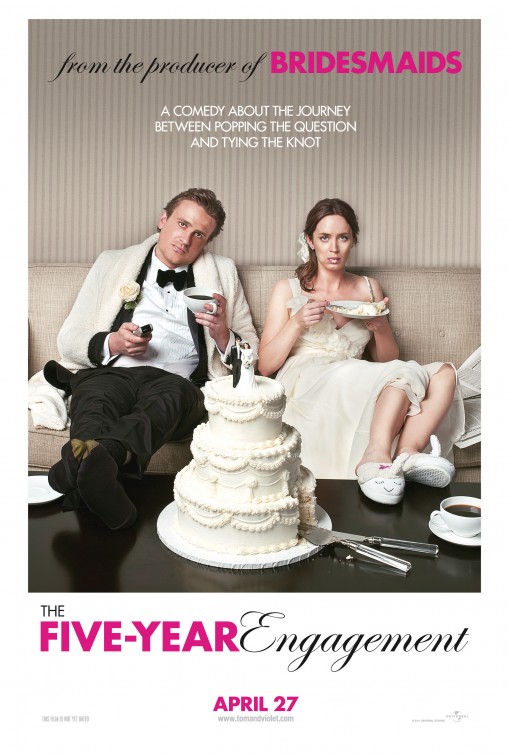 Relationships are serious business. In most Judd Apatow productions, they’re funny business. With The Five-Year Engagement, there’s romance to be found in surprising places, but the omnipresent feeling is one of dread. All those advertisements highlighting the comedy will start to melt away, and what you are left with is a funny, if bittersweet, anti-romantic comedy, more uncomfortable with hard-hitting truths than congenial laughs. My theater even had a few walkouts.
Tom (Jason Segel) and Violet (Emily Blunt) are happily in love. He’s a sous chef in a trendy San Francisco restaurant and she’s eager to gain a graduate fellowship at UC-Berkley in psychology. She doesn’t get accepted to Berkley, but the University of Michigan offers her a spot. Tom and Violet agree to put their wedding on hold and move to Michigan so that she can take advantage of an amazing opportunity. Michigan is not to Tom’s liking, especially since he can’t find a fulfilling job and settles with making sandwiches at a campus sub shop. It’s all just temporary, he keeps reminding himself. Then Violet’s two years gets extended, and Michigan isn’t just a temporary pit stop, it’s possibly home. Tom’s disappointment spirals, and he and Violet begin to drift apart, he resenting her for giving up his own dream to support hers. She begins getting emotionally attached to her Psychology professor, Dr. Childs (Rhys Ifans), in ways that straddle the mentor-student boundaries. Meanwhile, Violet’s sister, Suzie (Alison Brie), gets pregnant after a one-night stand with Alex (Chris Pratt), Tom’s best man and coworker, at the couple’s engagement party. They get married, have kids, and Tom and Violet are still stalling. This is the story of two people who deserve their happily ever after except life keeps putting obstacles in their path to the altar.
 You will be unprepared for how sobering The Five-Year Engagement can be. Some of these arguments between Tom and Violet cut right to the bone with an exacting level of painful authenticity. The level of uncomfortable intimacy can make the movie feel grueling. At the same time, I don’t want to give the impression that it’s some Apatow version of a John Cassavettes flick. There’s still plenty of comedy but the film is much more of a drama than any previous Apatow production. Part of the squirm factor comes in the very nature of the premise. The Five-Year Engagement picks up where most rom-coms end, with our happy couple together at last. We know these two are meant for one another; however, the majority of the screenplay involves watching two likeable, funny, loving people drift emotionally apart. Eventually they get back together in the end in a mad rush to staunch the gloom prevailing over the movie. It’s a hard act to watch people drift apart, losing the connections that once bound them together, and witnessing the glow of romance fade into complacency and resentment. Again, this is all handled in ways that find humor in uncomfortable places (like Tom, hopped up on painkillers, apologizing for smiling during sad news), but it can still be uncomfortable, and I don’t know if the ending, while happy, will justify the journey for many audience members.
I was shocked how much I found myself relating to the plight of the characters in The Five-Year Engagement, so much so that I simultaneously felt an extra level of engagement and discomfort. I will spare you the gory details, as I am a gentleman first and foremost, but relationships that just fizzle out rather than ending in some abrupt manner (infidelity, commitment issues, lack of availability, etc.) are not any more enviable. I related to the general sense of malaise that can plague a long-term relationship, the feeling of being forever a plus-one in your spouse’s circles, the resentment over the demands of a job or school, the small cracks that mask a lot of pain, the kind that is suffused with rationalization that to assert what you feel is to be selfish and inconsiderate, the loss of intimacy, physical and emotional, the guilt of being unhappy or making someone unhappy, and the sad realization that maybe love just wasn’t enough. What happens when nice people who are good for each other are just dealt rotten circumstances? Phew. I feel like I’m turning this into a therapy session. Let’s talk about something inappropriate in the next paragraph.
The biggest reason for sticking it out, both for Tom and Violet and the audience, is that Segel and Blunt have terrific chemistry together. Segel (Forgetting Sarah Marshall) is a big endearing lug of a man, and putting his career on hold to support his fiancé gives him an extra surplus of sympathy as we watch him spiral into despair and then resentment. He’s a funny, likeable guy, and we know he and Violet are meant for one another and we want them to get together, even as this looks less likely to come true after the circumstances that push them away. Granted, you must swallow the hard-to-believe reality that Tom couldn’t find a decent job in Ann Arbor, a college town that has to have some fine dining along the outskirts of town if not in the city. Blunt (The Adjustment Bureau) makes me fall in love with her yet again with a performance. Just like in 2011’s Bureau, she creates a charming, vibrant, luminescent portrayal of a person in love, so much so that I am envious of the man of her affections (her pantomime of “Circus Solei sex” made me feel all warm and fuzzy in multiple places). Violet has her own share of flaws but that just made her more relatable. I enjoy the way Segel, as a screenwriter (he co-wrote the movie with his regular collaborator, director Nicholas Stoller), is charitable with his characterization. He’s not afraid to make himself look mean and hurtful and wrong. He’s not afraid to make the girlfriends in his movies, even the ones who are about to dump him, justifiable in their decision-making. This is not a case of good guys and bad guys; it’s much more like life where everyone can draw good reasons, and the consequences just suck. Out of all of the Apatow films, Segel has done the best job of making his characters feel most like actual people than broad comedic types.
Luckily, the movie has its funny, peculiar little moments to make the drama bearable. I appreciate the little touches of comedy, which percolate through the heaviness. The wide supporting cast is peopled with the usual blend of oddballs and loudmouths. Pratt and Brie provide an ongoing foil as the couple who didn’t seem right for one another, made initial impulsive decisions, but have stuck it out and are happy; instead of waiting for the right time they embrace the mantra that there is no perfect time in life but the present. Pratt (TV’s Parks and Recreation) is great as a smart-aleck who grows into a responsible father. Brie adopts a British accent and becomes even more adorable, as all fans of Community would know. She’s quite funny as Violet’s sister and has a standout sequence where she and Violet have a very adult conversation in front of children so they disguise their voices as Cookie Monster and Elmo. The juxtaposition is a hoot and yet also a nice moment to add characterization. I also enjoyed seeing Chris Parnell (TV’s 30 Rock) as a sad sack faculty spouse stay-at-home father who clears his misery with kitting. There are some gory comedic set pieces around arrows being shot into legs and toes getting amputated, but the movie’s best comedy comes in the small moments, from Tom ‘s patchy “I’ve stopped caring” facial hair, to a self-described “pickle nerd” played by Brian Posehn, to the percentages of every undergrad named “Ashley” or “Zack,” to Tom’s hopelessly overmatched chase with Professor Childs, to a running gag about grandparents dying before Tom and Violet wed.
 I would like to take this time and observe that the University of Michigan, as well as its tenured professor, is responsible for the disruption of happiness between a young couple in love. How many other couples have you destroyed, U of M? When will your taste for suffering ever be quenched? And no, I’m not just saying this because I’m a diehard Ohio State Buckeyes fan, as well as a grad student. My point being: Michigan wants to kill Tom, Violet, and every person you hold dear (In short: Go Bucks).
You’d think with a title like The Five-Year Engagement they wouldn’t want to overstay their welcome, but like most Apatow productions, the film runs a bit on the long side. About 20 minutes into the movie, I felt the need to go to the bathroom. I rationalized staying put. Then about 90 minutes in, that urge became overwhelming but I reasoned the movie had to be over soon. And I kept telling myself that… for another 30 minutes. Then I just ran out and did my business, feeling the elation of relief. At over two hours, the movie feels excessive. Because of the drift away structure, the movie feels especially long in the second act, where we get hurtful scene after hurtful scene, and where Tom and Violet go their separate ways and start dating new people (the fact that Violet dates her smarmy professor feels realistic and yet also like a gut-punch to Tom). Some of the colorful characters that typical people Apatow productions feel more forced than usual, especially Violet’s collection of fellow psych grads played by the likes of Kevin Hart (Think Like a Man) and Mindy Kaling (TV’s The Office). They don’t seem well grafted to the story. The happy ending, while welcomed, also feels unlikely given the proceeding drama, and its brash adherence to rom-com conventions is a tad disappointing.
Watching the dissolution of a relationship is something of a hard sell to mainstream audiences, though Vince Vaughn was able to get audiences to see his anti-romantic comedy, 2006’s The Break-Up, which admittedly had bigger names and a lighter touch on the material. The Five-Year Engagement has its share of comedy but it’s pretty sublimated to the heavy drama of watching two people in love fall out of love and battle resentment, self-destruction, and apathy. Segel and Blunt are so good together we’re willing to give them a wider berth to stretch their wings, sow their oats, and eventually find one another again, falling back in love after a flurry of obstacles, realizing that finding and connecting with your right person is an ongoing process and not some prize to be awarded. I found myself connecting with the movie in several ways, so much so that it made me fee dour for the rest of the evening (you may feel differently). The movie gets so many subtle things right about how relationships can sour, and yet it still manages to overstay its welcome and fill its roly-poly narrative with annoying characters. At least the movie has helped me discover my perfect woman: Alison Brie with a British accent. However, Emily Blunt will also do in a pinch.
Nate’s Grade: B
Share this:

Friends with Benefits (2011)
 Sometimes chemistry can make up for a lot, and the dynamic, natural, and playfully flirty chemistry between stars Justin Timberlake and Mila Kunis makes up for a lot of their movies shortcomings (if you know what I mean). Friends with Benefits is another tale about a guy and a girl, both friends, who embark on a challenge to have casual sex and not form emotional/romantic attachments. No matter how many romantic comedy clichés it points out for ridicule, it doesn’t excuse the fact that the movie becomes one big, mushy, clichéd rom-com itself, albeit with saltier language (if you know what I mean). The randy humor will occasionally feel like it’s trying too hard, afraid to let an obvious joke lie dormant for too long. That’s where the sheer star power and amiable chemistry of the leads comes in handy. Kunis and Timberlake are both rather easy on the eyes, but they have a sharp sense of comic timing and a natural interplay. Hooray, a movie about friends where they feel like actual friends. Under the direction of Will Gluck (Easy A), the film has a jaunty pace except for an extended layover in Los Angeles that seems to sap the comic mojo and chart the film’s obvious rom-com reconciliatory ending. Friends with Benefits is sexy, funny, and an easy way to waste a couple hours (if you know what I mean).
Nate’s Grade: B-
Share this:

Submarine (2011)
 Submarine is the latest coming-of-age story, this time set in 1980s Wales, and while not breaking any new ground, it manages to be witty, stylish, and a completely winning portrait of a unique kid and his unique view of the world.
Oliver Tate (Craig Roberts) is a 15-eyar-old kid with two life goals. He’s like to romance the rebellious loner Jordana (Yasmin Paige) and, if possible, lose his virginity in the process. Oliver is also on a mission to save his parent’ marriage. Jill Tate (Sally Hawkins) has been drifting from her husband, Lloyd (Noah Taylor), a marine biologist who has been in a depressive funk for years. Jill’s old boyfriend, Graham (Paddy Considine), has moved in next-door and begun to insert himself back in her life.
Submarine is going to be something of an acquired taste. It’s almost drowning in whimsy, following the numerous affectations of its main character. Fans will say that the movie borrows liberally from Wes Anderson’s 1998 film, Rushmore; non-fans will just say the movie cops to outright theft. Like Rushmore, this movie follows the coming-of-age trials and tribulations of an intelligent but lonely outcast, a wiseacre beyond his years. What sets this movie apart is that we taken on the point of view of Oliver. He often refers to his life as if it were a movie, noting dramatic moments that would be accompanied by dramatic music, and a solemn moment that would feature a crane shot rising above the ground but if the budget were low he’d settle for a slow zoom out (the actual movie chooses the slow zoom). “I have turned these moments into the Super-8 footage of memory,” he remarks. Oliver is a student of pop-culture, an early Rob Gordon (High Fidelity), and as such blurs the line between reality and the movies. He will routinely point out film tropes ad then indulge in them. We are each the stars of our own stories. In this manner, Submarine separates itself from the idiosyncratic, miniaturized-doll house world of Anderson’s films or the fanciful magic realism of Jean Piere Jeunet (Amelie). For me, the multitude of quirks were appealing instead of insufferable because we were inside the mind of Oliver, seeing his world through his unique worldview. This brings rationale for the whimsy.
 Oliver is both an unreliable narrator and a flawed protagonist, a fantastic development. So often coming-of-age tales are mainly autobiographical (this one is based off a book by Joe Dunthorne), and as such the authors usually portray themselves as individuals whose chief fault is that they are naïve. Some life experience will shatter their innocence, usually a girl, and thus they will grow and learn. With Submarine, Oliver gains our sympathy by being clever but then he tests it with the compromises he makes to fit in. He engages in some very mean bullying all to win over Jordana. He’s trying to seem so mature, using advanced vocabulary to provide the illusion of adulthood, but really Oliver can’t comprehend the subtleties of social cues. Just when Jordana appears to be opening up and looking to him for need, that’s when he botches it, acts kind of awful, and then justifies it in his head, like so many of us will do with our mistakes. Still, I never stopped rooting for this kid. I was rooting for him and Jordana to work out. So hard was I yearning for these two loner oddballs to have their happy ending, I think I pulled something (my dignity?). We can see Jordana through Oliver’s infatuated eyes, but then we can also see deeper, see the vulnerability that comes forward that Oliver might be blithe to. Paige (The Sarah Jane Adventures) is a true breakout star and it’s easy to see why Oliver is so infatuated with the charming lass. She’s bruised but approachable, risky but relatable. We can see the connection building between these two, and we want it to continue (maybe that’s my own high school experience speaking out). The youthful romance is sweet and unconventional without seeming like a coming-of-age folly, something that Oliver is supposed to learn some gallant life lesson.
The other plot development, the rocky relationship between Oliver’s parents, is less resonant but it does provide for some fine moments of humor. The new neighbor, Graham, who practices martial arts and believes himself to be a New Age mystic, healing people by sensing their aura colors, just feels like a leftover Napoleon Dynamite. It provides Considine (In America) a springboard to act goofy, which he’s quite good at. The goofiness of the character, however, cuts into the credibility of being a threat to steal away Jill. She may be caught up in this guy’s tiny bubble of fame, but there’s no way she would leave her husband for this doofus, even if her husband has been suffering from depression for years. Oliver’s attempts to reignite his parents’ marriage are plenty hilarious, but they’re also informed with a sweet, if misguided, earnestness. He loves his parents and wants them to stay together. He doesn’t want a ninja mystic for his new dad. Fortunately, Oliver’s attempts to sabotage Graham are kept to a minimum and restrained enough not to resort to cheap slapstick or gross-out humiliation. Maybe it’s the distinctive point of view steering the narrative, but the potential doom of the marriage never feels as portentous and heartbreaking as Oliver’s hope at wooing Jordana.
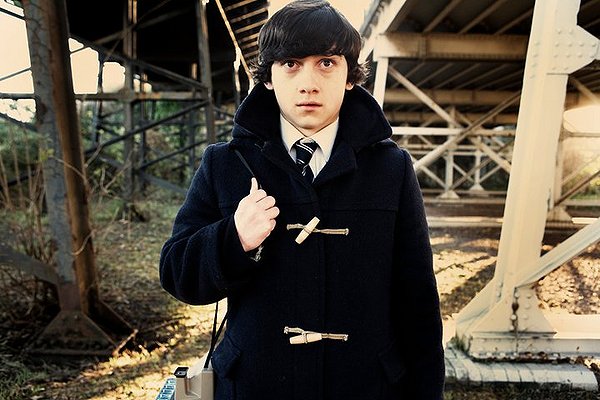 Debut director Richard Ayoade, who also adapted the screenplay, utilizes every visual trick in the book to tell this story. If the main character weren’t so amusing, and his plight so interesting, all the visual artifice might be exhausting. Instead it keeps the movie lively, crafty, and constantly wonderful to observe. Ayoade’s also quite a talent when it comes to screenwriting. He smoothly captures the very mannered speaking style of Oliver. Then there are just lines that make you laugh out loud from the sheer absurdity of misplaced teenager awe: “He wasn’t even considered hard until the Watkin twins famously stabbed him in the back with compasses. He said nothing; showed no discomfort as his shirt blossomed with blood poppies. His stoicism reminded me of the brave men who died in the First World War.” Ayoade, best known for his starring role on The IT Crowd, will probably soon have a lot more offers to direct features once people get a gander at Submarine. The man’s a natural storyteller and will be snapped up by Hollywood in no time flat.
Finally, the movie’s lead actor needs to be good, better than good, if this movie is going to rise above the din of precocious, coming-of-age cinema. Roberts (Jane Eyre), hollow eyed and just a little “off” looking, handles the material with ease, never letting his performance transform into a series of tics strewn together. Oliver is straight-laced throughout, letting the peculiarities of his imagination and worldview seem ordinary. Roberts doesn’t get overwhelmed by the material and makes a strong impression as a more literate, less rebellious, more anxious, less despondent Welsh version of Holden Caulfield (okay, so maybe that allusion doesn’t hold).
Submarine is an unfailingly entertaining vehicle full of quirk and humor and surprising heart. Oliver’s relationship with Jordana is sweet and mildly touching. I was surprised at how emotionally invested I was in their romance. The movie is also refreshingly low in angst, resorting more to Oliver’s comic anxieties and insecurities. It certainly owes a debt to Anderson’s Rushmore, but Submarine is so good, so thrilling in its creative voice, that it can stand outside the mighty shadow of Anderson and his indomitable influence.
Nate’s Grade: A-
Share this:

Love, Wedding, Marriage (2011)
 I keep wanting to mistakenly refer to this movie as Love, Marriage, Divorce since that seems like a more prevailing plot element in this abysmal rom-com. Mandy Moore plays a couples counselor who’s a newlywed herself, having just gotten hitched with Charlie (the Twilight Saga’s Kellan Lutz). Her life is great, that is, until she learns her parents (James Brolin, Jane Seymour) are splitting up. Their pain will soon be felt by every person watching this wretched movie. Incompetently directed by actor Dermot Mulroney (My Best Friend’s Wedding), the movie’s tone approaches something like spastic cartoon. Mulroney frames everything in uncomfortable close-ups, which magnifies the exaggerated gyrations and facial expressions of his cast. It looks like every person onscreen is suffering a stroke at one point. The acting is so shockingly terrible. It’s like the actors have been replaced with the amateur dinner theater versions of themselves. Moore’s character is too shrewish and self-involved to be compelling, and Lutz, whose name rhymes with putz, is so wooden you’d swear they carved him out of a chunk of balsa right before cameras rolled. The sitcom plot suffers from every cliché imaginable in the rom-com genre. This is the worst case of bad drunk acting since 2006’s The Black Dahlia, where actors over-do just about every action. The funny part is that it’s only a slight difference from the way the characters are behaving sober. Criminally unfunny, I have only one theory how Mulroney was able to get this movie made because clearly the screenplay wasn’t reeling investors in. In the end credits are many producers and executive producers, several of them with Slavic surnames. There’s also a Slavic model with in a key role. Mulroney turned to the only people who would finance Love, Wedding, Marriage – the Russian mafia. If you see Mulroney in a wheelchair from an “accident” in the near future, you heard the truth here first.
Nate’s Grade: D-
Share this:

The Myth of the American Sleepover (2011)
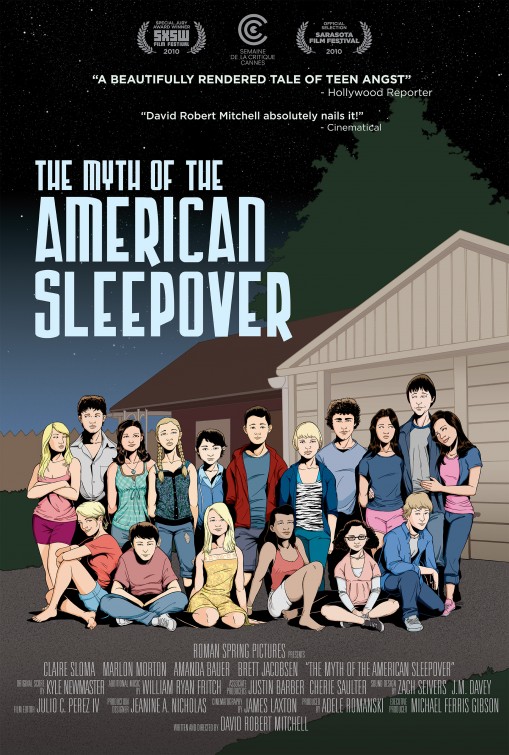 The curiously titled Myth of the American Sleepover owes as much to American Graffiti as it does to the works of John Hughes. This sprawling teenage opus by debut writer/director David Robert Mitchell resonates with all the beautiful aches and joys of adolescence, wonderfully understated but brilliantly realized. I fell in love with this movie.
Set over the course of one night in suburban Michigan, a slew of teenagers try and make the waning summer days worth remembering. Claudia (Amanda Bauer) is the new girl in school and invited to the cool gal’s (Shayla Curran) slumber party. She learns her boyfriend slept with the cool gal and plots a little boyfriend stealing of her own. Rob (Marlon Morton) is obsessed with a pretty blonde girl he once shared a look with in a supermarket. He is scouring the neighborhood, going from party to party, looking for her so he can reveal his true feelings. Scott (Brett Jacobson) is unsure of whether he wants to finish his final year of college, now the site of a painful breakup from his longtime girlfriend. One day while walking the halls of his former high school, he comes across a picture of him with twin sisters, Ady (Nikita Ramsey) and Anna Abbey (Jade Ramsey). He heads out to the University of Michigan, where the twins are enrolled, convinced he could win one, or both, of them over. Maggie (Claire Sloma) is navigating between the middle school sleepovers of her peers and the world of the cooler upperclassmen. She’s been nursing a crush on an older boy (Douglas Diedrich) who worked at the community pool all summer, and will find the courage to make a move.
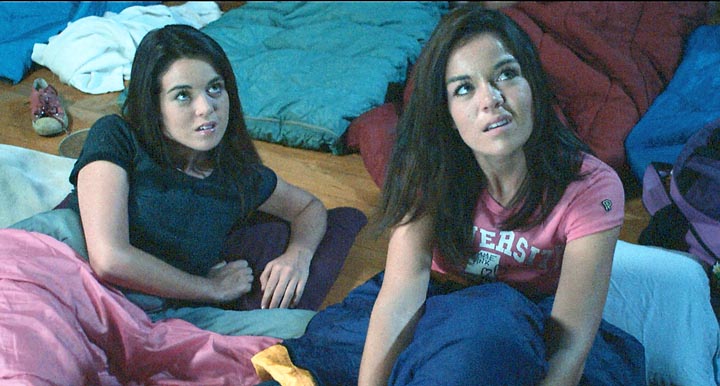 Unlike other coming-of-age entries, this is a movie that forgoes scatological comic setups and other Big Events meant to mark the passing into adulthood, like the loss of virginity, college admittance, or the prom; instead, Sleepover tackles a subject much more honestly and with tremendous naturalism. The level of detail is outstanding; set in what seems like the late 80s or early 90s, I was astounded at all the nostalgic artifacts of adolescence brought back to life. I kept going, “Oh yeah, I forgot about those,” or, “That’s totally something that me and my friends did.” I loved that the movie shows different social spheres and age ranges, so we go along with the late teen house party but we also get see a middle school/junior high sleepover that involves girls staying up late, talking about boys, and eating large bowls of chips. Obviously not everyone will have this reaction, but it just shows the commitment to recreating a very specific time, place, and sense of being. These feel entirely like real teenagers, and their troubles and desires are achingly articulated. You feel the powerful sense of yearning throughout, where the nudge of a knee, the closing distance between two hands that can cause your insides to fill up with a thousand butterflies. Sleepover is about teenagers grappling with emotional connection and personal identity, but it never drags out a soapbox or breaks from its verisimilitude. Every single character in this movie, even the ones meant to be seen in a questionable light, is deeply empathetic. Being an ensemble, you’ll gravitate to different characters and their pursuits, but the movie balances a nice mixture of storylines, cutting back and forth to build a graceful picture of the uncertainty of adolescence.
I found this movie to be so charming, so overwhelmingly affecting, and poignant without slipping into mock sentimentality, which would have been easy. It’s been a big year for nostalgia, but nostalgia is the “least authentic of all feelings,” according to Enrique de Heriz. It’s easy to sit back and say, “Oh I remember that too,” and feel the tingle of some wistful pull from the past, the yearning for a bygone time and place that has magically transformed in your mind into some idyllic spree. Does anyone remember those times, before there was an Internet, and cell phones, and social media, when you got together with your friends to witness the shared experience of a movie with female nudity (this might just be a guy thing), or when you didn’t know if you’d see your crush ever again? The Myth of the American Sleepover does, and so do I. In the words of Lou Reed: “I don’t like nostalgia unless it’s mine.”
 Indeed, it seems like the film exists in a bit of a cultural time warp, where sleepovers were the social apex and holding hands and making out were considered victories worth celebrating. There are no computers or cell phones, thank God. If you excuse the casual and extensive teenage drinking, Sleepover is a rather wholesome film. I was wary that some storyline might take an unexpected dark turn, especially with all the alcohol and hormones, but the movie maintains its sweet appeal without fail. While ostensibly existing in a late 80s/early 90s, I believe this movie is timeless and can be felt effortlessly by people of any age. The pains of adolescence and the anxiety of growing up, not to mention the peculiarities of the other sex, are universal. There is a superb scene where Rob and the girl who secretly likes him pass each other accompanied by friends. We get both sides of the story cut together; he tells his bud that one night he kissed her and then they made out. “It was a pretty good day,” he admits. She says she spent all night trying to get him to hold her hand and then just gave up. We instantly know that her side of this tale is far more accurate, but then this small exchange tells us even more about Rob, his fumbling attempt to be seen as cool with girls. Later, this same girl gives Rob a pep talk about unrequited crushes; she wonders if a person thinks hard enough about an individual, if they’ll know. Like most men, Rob misses her real meaning, but I’m happy to say that this story is tied up in such a sweet manner that I got choked up. The emotions of Sleepover are genuine and genuinely felt, no big overtures or outbursts, but the quiet moments of realizing who you are, who you like, and what you are and aren’t willing to compromise. It all feels utterly real and relatable.
The one storyline that seems to stand out amongst the rest of the panoply of sleepovers is that of Scott. He’s a college junior and at least three years outside the social realms of the majority of the other characters. You can’t help but feel at the start that he doesn’t belong and his presence, in a movie primarily about 14-15-year-olds, might feel a tad icky. Scott’s misguided attempt to get over his ex-girlfriend seems like some strange leftover plot from a sitcom. The fact that he’s trying to drown his sorrows in twin sisters almost seems skeevy. However, he comes clean early and opens up to reveal startling vulnerability, thanking the twins for a memory that would be incidental to them but has meant so much to him. It is this memory that gave him hope. The twins reveal that one of them had a huge crush on Scott back in high school, wishing he would one day reciprocate. But they won’t tell him who. He has to guess. The fact that this setup is actually a push toward personal growth and maturation is a great revelation and a relief.
 The cast of unknowns may be low when it comes to star-wattage but they lend the film another degree of authenticity. I wouldn’t say a single participant in this movie is a bad actor, though their characters are often understated, which under the wrong guidance can lead to blandness. None of these characters are exceptionally verbose or opinionated, which leaves the impression that they are thinly drawn. However, the characters coexist within the impressionistic nature of the film; it’s like a coming-of-age movie with the tone poem ambitions of Terrence Mallick. They are not as memorable or as sharp as the characters from Dazed and Confused and American Graffiti (Rob’s pursuit of his blonde dream girl, and his several near-misses, screams Graffiti homage), but the goal is a disarmingly sweet authenticity, allowing the viewer to discover relatable moments throughout the ensemble. I will say that Sloma imparts the biggest impression as the pieced, platinum pixie-gal feeling out the level of interest in her crush. I think we’ll be seeing more of Bauer and her cherubic, Scarlet Johansson-etched features as well.
The Myth of the American Sleepover is a sincere, observant, insightful, gentle, and overall wonderful little movie, brimming with life and the rocky experiences of growing up, but mostly it will make your heart sing. The details and small gestures feel completely believable; building an ode to youth that feels earnest without being sentimental and knowing without feeling like a know-it-all. There wasn’t a moment in this movie that didn’t leave me smiling, chuckling to myself, and feeling immersed in this innocent, heartfelt, exuberantly youthful world. The pleasures of Sleepover are small but numerous, and I don’t mind admitting to tearing up at several points, shaking in anticipation, and celebrating the personal triumphs of the cast of characters. The Myth of the American Sleepover made me feel like a teenager all over again, nervous, anxious, excited, and beguiled by the imprecise negotiations into adulthood. I’m sure some people will find this movie boring or too embryonic, a coming-of-age tale crystallized in dewy emo-earnestness. For me, I fell in love with this movie. It filled me with joy. I know it will do the same for others; Sleepover just needs a little tenderness and an open heart. The movie and its homespun magic will do the rest.
Nate’s Grade: A
Share this:

Crazy, Stupid, Love (2011)
 Crazy, Stupid, Love was sold as being a smart, urbane romantic comedy for adults, and this is accurate to some degree. It’s certainly worlds better than anything Katherine Heigl has been inflicting upon the public. At the same time, this film exists entirely within that familiar universe known as Movie World. It polishes old genre clichés, but in the end they’re still clichés. The movie follows playboy Jacob (Ryan Gosling) coaching Cal (Steve Carell), a divorced dad, on how to get back his mojo and seduce women in a modern world. Along the way, Jacob falls for the cute Hannah (Emma Stone), Cal’s teenage son (Jonah Bobo) is hopelessly in love with his 17-year-old babysitter (America’s Next Top Model contestant Analeigh Tipton), and the babysitter is secretly crushing on Cal. There are passing moments of awkward but recognizable reality, especially the free-falling nature of divorce, but they are eventually smothered by the gloss of rom-com schitck. Because this exists in Movie World, every character, including a one-night stand (Marissa Tomei), will pop back up because every character is related to everyone else in this tiny fishbowl. That also means that contrivances and misunderstandings will culminate in a comic clash. Oh, and don’t forget the grand public pronouncements of love. This is the only movie I can ever recall where the dissemination of child pornography is treated like a payoff or as something to cheer (naked babysitter pics are passed along). Huh? Crazy, Stupid, Love is a fitfully entertaining movie but don’t let the pretensions of maturity fool you, this is strict rom-com stuff.
Nate’s Grade: B
Share this:

Breaking Dawn: Part One (2011)
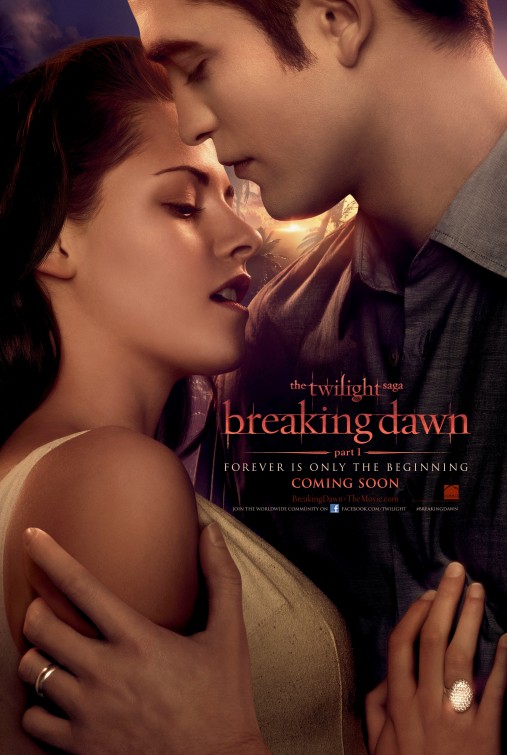 Taking a cue from the blockbuster film franchise of our age, the Harry Potter series, the producers and studio heads decided to split the final Twilight film into two separate movies. Yes, for you cheerless, unfortunate males dragged along to author Stefenie Meyer’s estrogen-drenched soap opera, hoping to be done with Bella Swan and her sparkly vampire boyfriend, well your pain soldiers onward another year. If Breaking Dawn: Part One is any indication, we’re all in for a world of hurt come November 2012.
Wedding bells are ringing for Bella Swan (Kristen Stewart) and her undead boyfriend, noble vampire/undead heartthrob, Edward Cullen (Robert Pattinson). Bella’s persistent demand to be turned into a vampire is finely about to come true. She wants to stay human a bit longer, to savor her last days on Earth before sipping blood through a bendy straw. Her always-in-second best bud, Jacob (Taylor Lautner), is worried for Bella’s well being. The wedding is like a fairy tale and Edward sweeps his new bride away to a tiny island off of Rio de Janeiro, where the housekeepers illogically speak Spanish. The couple makes the most of their time alone, and by this I mean they have sex (I refuse to believe this couple would play chess in their newlywed downtime). Edward withholds any second rounds of sex, fearing he’ll seriously harm his bride (he destroyed the bed in mid-copulation). No matter because Bella gets pregnant right out of the gate. We’re told this is impossible, yet her half-human/half-vampire fetus is rapidly growing inside momma’s belly. The baby is also destroying its host, eating away Bella’s body. Edward demands to kill the baby but Bella will have none of it. She’s going to deliver this baby even if it kills her. If it does kill her, then the truce between the werewolves and vampires will be broken, and Jacob’s feistier tribe mates will be knocking down the Cullen doors looking for some tasty vampires to chomp.
 Director Bill Condon, he of Dreamgirls fame and an Oscar-winner for 1998’s Gods and Monsters, goes hog-wild with the emotions, fittingly reminiscent of the life-and-death swings of emotional polarity that orient a teenager’s life. Condon plays all of the ridiculous melodrama straight. It successfully channels the feelings of teenage angst and obsession, much like the first Twilight film. This Teutonic exhibit of buzzy hormones is like catnip to the Twilight faithful. Finally, they get what they’ve been waiting for, and Condon and screenwriter Melissa Rosenberg delay that gratification even longer. This is the longest wedding I’ve seen on screen since The Godfather. It takes up about 45 minutes of the movie. The protracted walk down the aisle literally takes longer than the rest of the ceremony combined. I can already envision thousands of young girls asking for the “Bella dress” when their time down the aisle comes. At no point does the movie address the fact that the “groom’s side” probably are all absent a heartbeat (“Hmm, extreme paleness? Are you with the bride or the groom? I’m at a loss.”). That’s a missed comedic opportunity. What’s with the wedding guests played by name actors like Maggie Grace (TV’s Lost, Taken)? Did they hire recognizable actors for one-line bit parts? They better have larger roles in the second feature. Under Condon’s direction, the film looks marvelous, and even the long-awaited love scene has some discernible heat to it that will give teen girls “funny” dreams for the next few months. Condon’s also helming the next and final film, so I can at least say it’ll look swell.
This last film was broken into two parts due to the mountains of money the studio would make. It surely wasn’t for some sort of artistic necessity. The plot of BD: Part One is stretched mighty thin. It’s no joke that the wedding and honeymoon takes up half the running time. The baby drama is handled so amateurishly, and the plot ramps up the incubation time so that everything happens too fast for the audience to adjust to how stupid everything truly is. The first half of the movie is free of meaningful conflict. It’s just concerned with payoffs. From everything I’ve read online, and from female friends who have partaken of the series, BD: Part One pretty much covers most of the plot of the 400-page book. What’s left? I would totally give the series a pass if the second movie started with Bella, hair a knotted mess, holding a shrieking baby. Edward sits at the table, drinking. “When are you gonna get a job?” she yells. “When are you gonna stop being a bitch?” he retorts, then gulps down a swig of booze. This domestic downer of an ending would almost make the whole series worth sitting through. Truthfully, as the teaser during the end credits advertises, if Michael Sheen (Frost/Nixon) has a larger part in BD: Part Two, it automatically becomes, sight unseen, the best movie of the series. Thus is the awe-inspiring power of Michael Sheen.
This has long been a silly franchise filled with poorly veiled messages that seem less empowering to teenage girls than reassuring to their parents. Long a heavy-handed message about abstinence, the characters finally get to have sex, after they’re properly married of course (does God really object more to vampire-human relations or when it occurs?). And you better believe the moment Edward and Bella eventually do the deed is a moment that teen girls, and their mothers, around the nation have been anticipating for three long, hard years. The buildup to the carnal climax is a rapturous release for the audience of Twi-hards; my theater felt like it exploded in pubescent hormones and giggling as soon as the proverbial train entered the station. Speaking of euphemisms, I find it telling that not a single character ever refers to sex as, well, “sex.” They keep dancing around the term, referring to it as indistinct pronouns like “this” or “that” or the slightly more specific “honeymoon activities.” It’s like the characters can’t talk about a mature topic without a case of the giggles. There’s even a scene where Jacob talks about Bella’s forthcoming tangle between the sheets, openly, and with alarm: “You’ll kill her,” he tells Edward. He doesn’t kill her but he does leave bruises all over her body. Bella assures her new husband that he’s not to blame, arguing, “You just couldn’t control yourself.” What kind of irresponsible message is that sending to teenage girls? But after enduring three movies of “save it until marriage,” the message is made even clearer when Bella, after one bout of sex, gets pregnant. Boom. Bella breaks the news by saying, “The wedding was 14 days ago, and my period’s late.” Edward stares dumbfounded and replies, “What does that mean?” Apparently, after graduating from high school 200 times just for kicks, Edward must have been absent every damn time for sexual education (“Condoms go OVER? Oh! This whole time I thought they went UNDER, you know, to hold everything in.”).
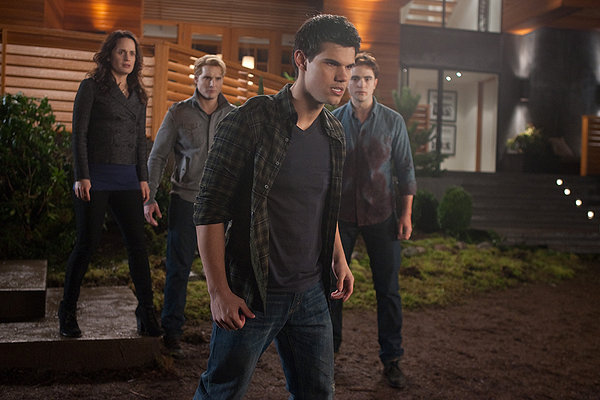 It’s here where the movie awkwardly shifts into a relentlessly pro-life message on legs. I’m not against movies presenting messages, but when a movie is as narratively empty and transparently padded as BD: Part 1, then the movie just gets swallowed up by the clumsy message. It doesn’t matter that Bella’s unborn hell spawn is literally killing her, sucking her dry from the inside out, she’s going to have this baby no matter what, even if she dies in the process. Okay, Meyer, we get it. Here’s a question for the world: can anyone really tell that much difference between emaciated Kristen Stewart and her normal self? She always appears a little sickly and hollow-eyed, but maybe that’s just me. The baby is basically the only conflict the movie presents and it happens so late in the film. Thanks to a fast gestation period, the demon fetus is determined not to wait until Part Two to make its grand entrance. Now that Bella is preggers, she’s become instant buddies with Rosalie (Nikki Reed, a long way from Thirteen), and the two of them begin a war against non-gender pronouns (its vs. he/her). The baby conflict would be more interesting if it was a tad more ambiguous, but the fact that it literally is killing Bella, not to mention its monstrous possibilities, and yet she persists to give birth is less characterization and more stubbornness. If Bella’s worried she’ll never have another chance to have a flesh-and-blood daughter, then explore this. Otherwise it makes Bella look blithely cavalier with her own life.
It’s here where Meyer and the Twilight franchise, already deliriously high on teen angst, goes off the charts into weirdo territory (some spoilers will follow). Never mind where the werewolf boys (and a girl) manage to find new clothes after they destroy them after each beastly transformation, we’ve got far weirder moments to process. There’s a vampire C-section via biting. There are giant wolves communicating via growling telepathy and bad CGI. There are Bella’s completely batshit names for her child; if it’s a boy she wants to combine Edward and Jacob’s names because that’s not awkward (“See, son, you’re named after the other guy I could have slept with but decided to just string along instead.”). And if it’s a girl she wants to combine her mother’s name and Edward’s mother’s name forming the atrocious “Reneesmee.” Excuse me? That makes “Apple” seem as traditional as apple pie. No one tells Bella these names are horrific because she’s pregnant, naturally. I imagine all the characters broke out into laughter as soon as Bella left the room to go puke into a bucket. Easily the weirdest and dumbest thing in the history of the Twilight franchise occurs as a contrived deus ex machina and a tidy solution to Jacob’s eternal, annoying pining. Jacob is determined to slay the monster he believes responsible for killing his unrequited love, Bella, but then he looks into those cute little baby eyes and… swears devotion to this newborn babe. He “imprints” on her, which means that they are meant to be together, and thus the werewolf/vampire truce holds. “Of course,” Edward intones, “Imprinting is their number one law. They cannot break it.” Of course! This reminded me of the scene at the end of the second Harry Potter movie where a phoenix comes from nowhere and cries into a wound (“Of course, phoenix tears can heal anything,” Harry informs while I was physically smacking myself in the head). Doesn’t anyone else find this whole plot development creepy? Jacob can’t have the mother, so he’s going to have the baby? And he’s got to wait 18 years if he wants their coupling to be legal on top of that. I think a messed up name is the least of this kid’s worries.

- Does she look like a healthy person? This is pre-baby succubus.
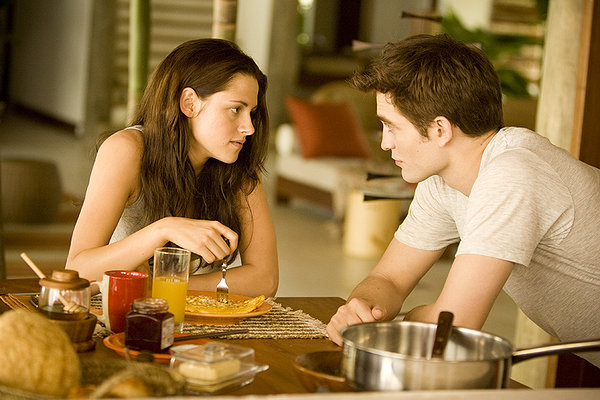
It all comes down to the heroine of the franchise, Miss Bella Swan (sorry, Bella Cullen now). I just don’t get what all the fuss is about. To me, Bella isn’t worth the effort. She’s never really been anything close to a fully formed character. Bella Swan has always defined herself by having a boyfriend, and when he was gone it was about pushing her friends away and moping until she finally found a new guy. She has zero self-identity, no center, she is an empty shell, there is no there there. She’s a cipher, meant for the teenage readership to plug themselves into her place. I won’t restate my theory that the Twilight series is glossed-up pre-teen wish fulfillment, but there you have it. Yet there are sneaking moments where Bella seems almost shockingly… human. Her anxious montage of preparation before her first night of sex is relatable and sympathetic (what outfit to wear? Shave the legs? What kinds of makeup?). Too bad this relatable side of her character vanishes all too quickly. Before Bella defined herself by her boyfriend and now she defines herself by her baby. She’s still the same whiny, selfish, morose, and cruelly manipulative Bella, though. She can’t let Jacob alone; she has to continue stringing him along, bringing him into inappropriate personal matters. Jacob’s always been a bit of a control freak who seems to spout quasi-rapist dialogue (the classic “You love me, you just don’t know it yet.”), but the guy’s always gotten a raw deal as far as I’m concerned. Betrothed to a baby is not a worthwhile parting gift. I worry that young, impressionable girls are going to look at Bella as an influential figure. If these same gals want a literary heroine they could truly look up to, they should feast their eyes on Katniss Everdeen, proactive and laudable star of the Hunger Games and forthcoming movie of the same name.
The three actors have been playing the same character notes for so long that they could all just go on autopilot and collect their paychecks. Stewart (Adventureland) is less annoying than she has been in previous films. I’m trying not to take out my disdain of her character on the actress, who I’ve genuinely liked in pre-Twilight projects (even her Joan Jett performance was pretty decent). Pattinson (Water for Elephants) seems to shrink into the background for this movie. There are a lot of long, ponderous, somehow meaningful stares between the two, with the soundtrack trying to communicate emotions that the screenplay has failed to do (a little more variety on the soundtrack next time, fellas? I think I tuned out after the twelfth melancholy piano ballad). Luckily, Pattinson does have something of a screen presence to go with those abs. Unfortunately, the same could not be said for Lauthner (Abduction). The young buck, formerly of Shardkboy fame, just cannot act. He has a nostril-heavy manner of expressing emotion that makes you wonder if he’s about to blow your house down. It’s telling that within mere seconds of the film beginning, the guy rips off his shirt, the peak of his acting abilities. I suspect it will not be long before Lautner and his six-pack and sitting at home, unemployed, and indulging in a different six-pack.
 Breaking Dawn: Part One is certainly not intended for critics of the book and film series or really any audience member lacking ovaries. But I think that even the most ardent Twi-hards will walk away giggling at the silliness of the overripe melodrama. I try not to be out rightly dismissive of the whole series, but the bad characters, bad plotting, and questionable messages make it hard to continue bending over backwards to find slivers of quality to support. I get the appeal of the series, the fact that Bella Swan is a cipher to exercise frothing teenage wish fulfillment, but that doesn’t excuse the movies from being so bad. This isn’t the painful abomination that was 2009’s New Moon, but it’s come the closest. Only the promise of more Michael Sheen makes me hopeful that BD: Part Two will be better than its predecessors. When you’re talking about an obscenely popular moneymaker, quality becomes secondary to delivering a product that is recognizable to the demands of the screaming fans. BD: Part One is less a payoff than a warning. There is more to come, and if you thought Bella was intolerable before just wait until her vampire growing pains.
Nate’s Grade: C-
Share this:

The Future (2011)
 Miranda July is a writer/performance artist/filmmaker whose unique voice earns as many praises of “precocious” as it does hails of “pretentious.” Her previous effort, 2005’s Me and You and Everyone We Know, had such oddities as a group of cars creating a caravan to save a goldfish left atop one’s roof and children engaging in online sex chat over sharing feces from behind to another ( ))<>(( is the visual articulation of this function). Yeah.
With her second feature film, The Future, we follow Sophie (July) and Jason (Hamish Linklater), a couple who decide to adopt an injured cat they find. Named Paw-Paw by Sophie, they must wait 30 days for the medical checks to clear before they can pick up the cat. They believe that they are doing a kindness and giving the cat a good place to live in its last month of life. Then the vet informs them that if bonded, the cat could live an additional five years. Sophie and Jason will be 40 in another five years, and this realization stops them cold in their tracks. Both are unhappy with their lives, he works as a technical help guru and she teaches dance to preschool-aged children. They decide that for the next 30 days they will reinvent themselves. They will take the road less traveled and see where it takes them. Jason volunteers to be an environmental solicitor on a whim. Sophie wants to do 30 dances in 30 days but is crippled by fear. She reaches out to Marshall (David Warshofsky), an older single dad who proves to be a source of unlikely temptation. Along the way to the conclusion of those 30 days, Jason will utilize his abilities to stop time, speak with the moon, an old T-shirt will crawl will come alive, and the story will be narrated at turns by Paw-Paw.
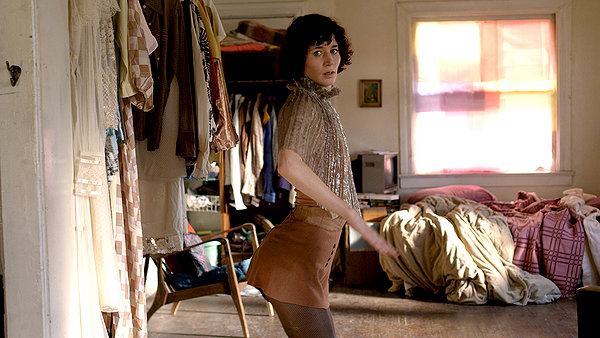 It should be obvious at this point that July is not going to be everyone’s taste. You could just as well furrow your brow at all these pseudo-intellectual bohemian artsy smartsy pretensions and make snide remarks under your breath. And I can’t say I’d blame you at points. However, if you happen to catch a ride on July’s funky wavelengths, then The Future becomes a poignant, observant, and occasionally profound rumination on human connection. July’s two main characters encounter a full crisis of self, fearing that their lives will essentially be over upon turning 35, which they reason is almost 40, which is practically 50, and all that back-half stuff is “loose change” (not enough to really get what you want). I believe I heard none other than Jessica Simpson herself utter a similar statement on her ill-fated Newlyweds reality TV show. She said, “I’m turning 23, which is practically 25, which is almost 30.” Perhaps Ms. July was also watching that episode, and if so this will be the only time in print that I congratulate Jessica Simpson for anything. This manufactured anxiety over doing something of worth and lasting value with your time on this planet is nothing new but it is deeply relatable, despite the silly numbers game the characters endure. It’s a paralyzing existential doubt. Who doesn’t want to feel like their life had purpose? You only get one. July makes a series of observant comments about human interaction. For their life project, Sophie decides to cancel the couple’s Internet connection. They have but moments, perhaps seconds left, before the Internet is lost to them for 30 days, and they scramble to open their laptops to do important stuff. “Only look up stuff we can’t find in books or by talking to people,” Jason intones. Slowly, both of them come to the same realization and close their laptops. It’s a silent admission that the technology we feel dependant upon might not be so.
There’s a striking clarity when an artist cuts through everything and finds something dwelling inside your grey matter. For me, July is that kind of artist. I loved a sequence where Sophie, out of slumming desperation, takes a job as a receptionist back at her old work place. One day two of her female friends come into the studio. Both women are several months pregnant, and Sophie is aghast that she let time get the better of her. She keeps shaking her head, rationalizing that it must have only been a couple weeks since last she saw her friends. Then through a series of edits, we witness a fantastic fantasy that highlights Sophie’s abject feelings of accomplishing little while time flies by. Every time the camera cuts back to the friends more time passes; we see them hold newborn babies, then we see those babies as kids, then as young adults, and finally as adults who themselves have married each other and wish to enroll their own daughter into pre-dance. They inform Sophie that their mothers passed some time ago. And all the while, Sophie is still in her dead-end job. It’s a terrific scene that highlights the anxiety we all feel about being lead footed in life, watching others skirt by and negatively assessing our own personal journeys by someone else’s accomplishments. The Future is full of moments like this that hit so hard you feel like the ground beneath you has vanished. Jason’s refusal to restart time is painfully identifiable, the wish to stay frozen in time to defer facing the hard pains of a breakup, the rueful knowledge that life will be forever different, and worse, in the passing of a second. The future can be a painful place we’d all like to hide under the covers and avoid.
Like July’s previous film, The Future is more a series of encapsulated vignettes, each with their own peculiarities, than a fully formed coherent story. While I enjoyed the separate vignettes better in Me and You, the overall story congeals better in The Future even if the results are messy. This is a less romantic and hopeful film than Me and You. It’s much more ambiguous (that’s saying something) and bleak when it exposes the missed chances that can haunt, none more so than Paw-Paw, our bandaged feline narrator. Scurry to the next paragraph if you’d like this part unspoiled for you, sensitive animal-loving readers. Paw-Paw speaks about her new sense of happiness, about having owners that will be kind to her, and this new sense of belonging fills the cat with a ballooning hope that her real life has finally begun. But then Paw-Paw doesn’t make it. She dies a day before either Sophie or Jason comes by to pick her up. But the cruel irony is that Sophie and Jason missed picking up their cat/metaphor of their relationship on its release date. Paw-Paw could have spent her last day on earth with the people she had yearned to be with, the people she wrote an imaginary letter to telling them how grateful she was and how much she promised to love them. Instead, the cat dies, forever waiting. That’s pretty rough, and even though July’s scratchy, high-pitched Paw-Paw voice can be annoying, God help me if the pet lover in me wasn’t in tears every time this damn cat was narrating, including after its death. That’s the kind of film The Future offers. It does not dish out easy answers for life’s Big Questions. Even as the end credits roll, you’re left to ponder whether you believe that Sophie and Jason will reconcile.
 July, resembling a cross between Kristen Schaal (Dinner for Schmucks) and Juliette Binoche (The English Patient), is probably also her biggest hindrance. She’s not that developed as an actress, or is being purposely opaque, and thus Sophie seems to be lost in a medicated fog. This was less of a problem with Me and You because the ensemble was larger. Here, it’s mainly three actors. July delivers every line in a flat style that makes her character harder to decipher and harder to empathize with when she goes off into her affair. The entire storyline with the sign making “other man” is kept at a mystery. We’re not really sure why Sophie would be attracted to this man or what problems are ailing her relationship with Jason. I suppose the early mid-life crisis could serve as a fire to get Sophie to reach out to someone who offers more security, but that’s merely my best estimation. It’s a detour that could use more attention to explain its significance. I suppose it could be July’s version of a romantic comedy staple of being with the wrong man and finding out late your mistake. It’ll be up to the viewer which guy fills the role of “wrong man.” Luckily, Linklater (TV’s New Adventures of Old Christine) is a winning presence, affable without being offbeat and striving for meaning without coming across as pompous.
Whether it’s a dance inside an oversized T-shirt or choosing a song to communicate undying love in the event of amnesia, The Future is chockablock with memorable moments, images, insights, and peculiarities. Whether all of that comes together into a fully realized movie is another matter. The scattershot nature and July’s own acting shortcomings clip the film’s momentum, but the uniqueness of voice and observant vision of July as writer/director makes me forgive much of The Future’s faults. It’s not exactly an easy sell of a movie, especially to concerned pet lovers, but July is one of those polarizing artists I’m glad finds the time to empty their brain every now and then. I may not fully understand everything but The Future held enough promise for me to leave feeling satisfied.
Nate’s Grade: B+
Share this:

Beginners (2011)
 Burying a parent is one of the most gut-wrenching hardships of life, a passage I have thankfully not had to endure yet in my own life. Writer/director Mike Mills (Thumbsucker) turned his own heartbreak into a subdued, life-affirming movie called Beginners. This gentle movie is comic, poignant, and frustratingly limited thanks to a miscalculation in its structure.
Oliver (Ewan McGregor) is reeling from the loss of his elderly father, Hal (Christopher Plummer). After the death of his wife, in his seventy-fifth year, Hal came out as being gay his whole life. And he decided to have some fun in those last years too, notably with a hunky younger boyfriend (Goran Visnjic, remember him, ER fans?). We get several flashbacks with Oliver and his ailing father, who was diagnosed with stage four lung cancer soon into his gay reemergence. In the present, Oliver, as a dissatisfied graphic designer, is trying to find his bearings after burying both of his parents. Hal’s dog, a Jack Russell terrier, is mourning as well, refusing to be left alone. As a result, Oliver takes the small dog with him wherever he travels, including social events. He meets Anna (Melanie Laurent) at a friend’s costume party. He’s dressed as Sigmund Freud and she mimes having laryngitis. Anna, a young actress who spends most of her life in hotels, invites him back and the two explore the possibility of a relationship. She’ll be off to another film shoot in a month, but the two become inseparable during the time they have together. Anna learns about Oliver and his complicated relationship with the complicated man he knew as his father. Oliver, and in flashback Hal, are beginners on a road to making sense of their lives.
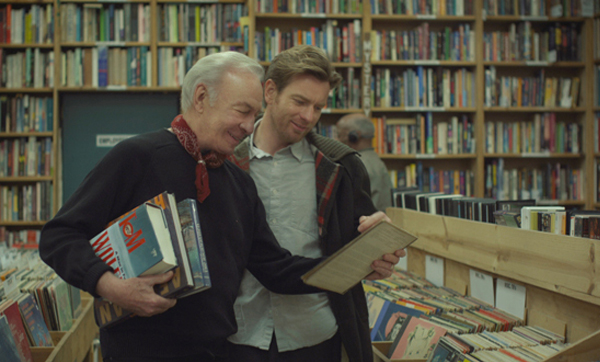 What eventually holds Beginners back is its clipped structure. The film diverges into two main storylines, father and son (60%) and son with new love (40%). The new love stuff is presented fairly linearly, however, the father/son material is not, consisting of memories that can be triggered by objects or offhand sayings. Like (500) Days of Summer, memories are presented not in a linear fashion but through a connection of theme or tone. Rarely do we recount memories in a chronological fashion, and as such Oliver is beset by deluges of images of his father ailing at various points. But it’s like Mills took that fleeting memory approach to heart because Beginners is a slave to the altar of jump cuts. The editing, and the narrative, is constantly leaping forward; scenes rarely last longer than 30-45 seconds, making the film feel like somebody had their finger mashed against a stubborn fast forward button. As a result, the film feels hurried and unsettled, and this clipped structure mollifies the emotional impact of the movie. It’s because the romance only feels like someone’s remembrance of those burgeoning happy beginnings. The film doesn’t feel like it is in its own present; we’re in 2003 and Oliver will occasionally inform us, in High Fidelity-styled notation, of life at that moment. It feels like the entire enterprise is an assembly of past memories ping-ponging off one another. Another hurdle is that Anna and Oliver’s main conflict concerns their fear of happiness. Each had parents who wed as unhappy people, had unhappy unions, and both are fearful that they too will commit to living unhappy lives. It’s not an impossible feat, to be sure, but it does make it somewhat harder to relate to your characters when the main relationship problem is that they cannot accept happiness. While psychologically interesting in larger scope, due to the structure of Beginners, this conflict for Anna and Oliver seems petty and insufficient. The antsy story structure limits the emotional resonance of the movie. What should be a nourishing meal about the human condition ends up being a tidy snack instead.
Don’t get me wrong, Beginners is still a fairly moving film in its own right. Just the very nature of the story, dealing with the last months of an ailing parent and what to do next, is destined to hit poignant pockets of drama. Plus you have gifted actors doing fine work to wring out those tears. Mills’ tale is semi-autobiographical, which allows for several personal insights that can wound, like direct shots of honesty. Oliver narrates the steps taken after a parent’s death, including the mundane yet painful trivialities needed to convince every bill collector that their client has left the Earth. When Hal is informed that he has a spot of cancer the size of a quarter in his lung, the screen flashes to black as the doctor continues her somber diagnosis. A quarter appears. Then five nickels, finally twenty-five pennies. It’s a small little visual insert, and yet it manages to seem like a believable, personally relatable moment when delivered such thundering news. Something the size of a quarter will be responsible for your father losing his life. Five nickels. Twenty-five pennies. The scenes with father and son, coming to terms with saying goodbye, reflecting on lives lived and lives deferred, is what gives Beginners its beating heart. The clipped present-day romance plays more like a post-script attempt to forge a neat resolution after all that heavy grief.
Plummer gives a performance that is equal parts weighed with the gravity of death and the electricity of life. After his wife’s death, Hal finally has an opportunity to embrace who he has been his whole life. Mills and Plummer are delicate with how they handle the relationship between Hal and his wife (Mary Page Keller in flashback). Neither hated the other, and both did express love, but they were together in a marriage of convenience, both of them hiding who they were from preying eyes (Oliver’s mother hid that she was Jewish). Plummer’s celebration of life, the twinkling realization of accepting who you truly are, is an uplifting path for his character, and thanks to both Mills and Plummer it never feels like he’s dancing on the grave of his long-suffering wife. He’s not celebrating her death; he’s embracing who he is in the twilight of his years. He’s looking for a small amount of kindness and comfort while finally being socially recognized without fear or intimidation. Plummer is delightful during Hal’s happier moments and heart wrenching during the realities of his failing body. Plummer deftly bites into one of those juicy, Oscar-bait roles.
 McGregor acts very well even if his character is kept in a very tight box of emotional expression. His character seems to sleepwalk from scene to scene; often little is said and much left to the imagination through pregnant pauses or gestures. McGregor does a fine job of balancing the different timelines of grief his character is experiencing. He’s in comic shock about his father’s newfound immersion in a gay lifestyle, he’s in mourning about the recent loss of his father, he’s in annoyance tinged with guilt about the burdens of taking care of a man that was often absent in his own life, leaving him in the care of his mother, resigned to a life of dutiful despondency, and he’s infatuated with the possibility of romantic love, a cleansing force. It’s a lot for one actor to keep straight and McGregor does an admirable job. Laurent does not fare as well. The Inglourious Basterds‘ actress is forced to rely mostly on wry smiles and her penetrating eyes. She also cocks her head to the side a lot, or a least that’s how I recall. She’s given something of a thanklessly underwritten role but she manages to be adorable from her first moment onscreen, which is her most vital acting accomplishment here. She’s supposed to be that happy ending we want Oliver to have.
Beginners is a moving, charming, and perceptive movie. If only there was more of it. The clipped, hurried jump cut-heavy structure keeps the audience at a certain distance and capping the emotional resonance. The father/son stuff is going to be easier to empathize with, both good times and bad, than two good-looking thirtysomethings afraid of being happy because their parents are screwed up. Ultimately, the film’s pretenses of a budding, quirky romance will take away from the more genuine father/son bonding late in life. You’ll get weepy at turns, maybe even swoon here and there, but the rewards are sadly too momentary, never cohesively assembling into a full-fledged narrative. Beginners has an equal number of hard truths and light moments of whimsy (the subtitled dog is a hoot), but ultimately it’s a movie that makes you wish it had left a better impression when it had the chance.
Nate’s Grade: B-
Share this:

Midnight in Paris (2011)
 Woody Allen hasn’t been this light-footed in a long time. Midnight in Paris is an effervescently charming film that flirts with overt sentimentality. But before you think Allen goes all gooey, the fatalist in him pulls back for some wisdom about the folly of nostalgia. Allen’s nebbish stand-in this time is Owen Wilson, assuredly better looking but on the same neurotic wavelength of his director. Wilson is a disgruntled Hollywood screenwriter visiting the City of Lights with his shrewish fiancé (Rachel McAdams) and her upper-class parents. One night a mysterious taxicab picks him up shortly after midnight. Wilson is transported back in time to his favorite era, 1920s Paris. He gets to rub elbows with literary and artistic giants, like Gertrude Stein (Kathy Bates), Ernest Hemmingway (Corey Stoll), Scott and Zelda Fitzgerald (Tom Hiddleston and Alison Pill), Salvador Dali (Adrien Brody), and others. He even falls for a lovely lady (Marion Cotillard) from that time period who served as a muse for several artists. Midnight in Paris is a far more enjoyable experience if you have a modicum of education in the humanities. Identifying the artists of old, albeit exaggerated cartoon versions of themselves, is part of the fun, fantasizing about interacting with the greats. But Allen is also playful with his storytelling, and for a while Midnight in Paris becomes a highly refined cross-time romance (think The Lake House written by Tom Stoppard). Midnight in Paris has been catching on with audiences, becoming Allen’s biggest hit in 25 years, and it’s easy to see why. It’s whimsical while being literate and romantic without being corny.
Nate’s Grade: B+


 nathanzoebl
You must be logged in to post a comment.